Ashby's Law of Requisite Variety

[From Richard Kennaway (20121203.0853 GMT)]

[From Fred Nickols (2012.12.2.1530 AZ)]

As I understand it, W. Ross Ashby�s Law of Requisite Variety asserts that a control system must be capable of a sufficient variety of actions to control that which is to be controlled. If it�s not, control is not possible. Ashby�s law is sometimes stated as �the complexity of a control system must equal or exceed that of the system to be controlled.� I�m wondering how Ashby�s law fits with PCT, if it does. It seems to me that we sometimes bite off more than we can chew so to speak and those are instances wherein our complexity is exceeded by that of the situation/variables we try to control. The �disturbances� overwhelm us. Comments anyone?

I've never understood what this law actually is. Did Ashby ever give a mathematical definition of "variety" and formulate and prove this law as a theorem? I've never found anything that wasn't just words.

···

--
Richard Kennaway, jrk@cmp.uea.ac.uk, Richard Kennaway
School of Computing Sciences,
University of East Anglia, Norwich NR4 7TJ, U.K.

[From Bill Powers (2012.12.03.1330 MST)]

Richard Kennaway (20121203.0853 GMT)]

>[From Fred Nickols (2012.12.2.1530 AZ)]
>
>FN: As I understand it, W. Ross Ashby's Law of Requisite Variety asserts that a control system must be capable of a sufficient variety of actions to control that which is to be controlled.

JRK: I've never understood what this law actually is. Did Ashby ever give a mathematical definition of "variety" and formulate and prove this law as a theorem? I've never found anything that wasn't just words.

BP: I think I saw an article somewhere that tried to tie Ashby's law to information theory. But I agree with you. Words, words, words.

Best,

Bill

[From Chad Green (2012.12.03.1700 EST)]

It's called history repeating itself. Centuries ago Ibn Khaldun
observed that societies sowed the seeds of their own destruction, or
what he called the Asabiyyah cycle. You'd think that we'd be used to it
by now!

Source: Muqaddimah - Wikipedia

Chad

Chad Green, PMP
Program Analyst
Loudoun County Public Schools
21000 Education Court
Ashburn, VA 20148
Voice: 571-252-1486
Fax: 571-252-1633

"If you want sense, you'll have to make it yourself." - Norton Juster

"Richard Kennaway (CMP)" <R.Kennaway@UEA.AC.UK> 12/3/2012 3:57 AM

[From Richard Kennaway (20121203.0853 GMT)]

[From Fred Nickols (2012.12.2.1530 AZ)]

As I understand it, W. Ross Ashby’s Law of Requisite Variety asserts

that a control system must be capable of a sufficient variety of actions
to control that which is to be controlled. If it’s not, control is
not possible. Ashby’s law is sometimes stated as “the complexity of
a control system must equal or exceed that of the system to be
controlled.�? I’m wondering how Ashby’s law fits with PCT, if it
does. It seems to me that we sometimes bite off more than we can chew
so to speak and those are instances wherein our complexity is exceeded
by that of the situation/variables we try to control. The
“disturbances�? overwhelm us. Comments anyone?

I've never understood what this law actually is. Did Ashby ever give a
mathematical definition of "variety" and formulate and prove this law as
a theorem? I've never found anything that wasn't just words.

···

--
Richard Kennaway, jrk@cmp.uea.ac.uk, Richard Kennaway
School of Computing Sciences,
University of East Anglia, Norwich NR4 7TJ, U.K.

[From Bruce Abbott (2012.12.3.1910 EST]

[Richard Kennaway (20121203.0853 GMT)]

[From Fred Nickols (2012.12.2.1530 AZ)]

As I understand it, W. Ross Ashby's Law of Requisite Variety asserts that a

control system must be capable of a sufficient variety of actions to control
that which is to be controlled. If it's not, control is not possible.
Ashby's law is sometimes stated as "the complexity of a control system must
equal or exceed that of the system to be controlled." I'm wondering how
Ashby's law fits with PCT, if it does. It seems to me that we sometimes
bite off more than we can chew so to speak and those are instances wherein
our complexity is exceeded by that of the situation/variables we try to
control. The "disturbances" overwhelm us. Comments anyone?

I've never understood what this law actually is. Did Ashby ever give a

mathematical definition of "variety" and formulate and prove this law as a
theorem? I've never found anything that wasn't just words.

You might try Ashby W.R. (1958) "Requisite variety and its implications for
the control of complex systems,"
Cybernetica 1:2, p. 83-99 ( available online at
http://pcp.vub.ac.be/books/AshbyReqVar.pdf in which Ashby shows that his Law
of Requisite Variety is closely related Shannon's Theorem 10. The former is
about the correction of error, induced by disturbances, in a control system,
the latter about the correction of noise in a noisy transmission channel.

Bruce

[From Bill Powers (2012.12.04.1418 MST)]

Bruce Abbott (2012.12.3.1910 EST --

BA: You might try Ashby W.R. (1958) "Requisite variety and its implications for
the control of complex systems, "Cybernetica 1:2, p. 83-99 ( available online at
http://pcp.vub.ac.be/books/AshbyReqVar.pdf in which Ashby shows that his Law
of Requisite Variety is closely related Shannon's Theorem 10. The former is
about the correction of error, induced by disturbances, in a control system,
the latter about the correction of noise in a noisy transmission channel.

BP: Good find. As I thought, something to do with information theory. Interesting how the assumption that behavior is noisy and statistical is so easily offered and accepted -- I wonder how they accounted for brain surgeons or the guys who worked at the National Bureau of Standards, or Tiger Woods, or (as Tom Bourbon once pointed out) all those people driving on two-lane roads in opposite directions, passing each other within six feet or so at a relative speed of 100 mph, with an accident rate of 0.001% or less per encounter.

And you probably noticed how utterly useless the Law of Requisite Variety is for actually designing a system that will obey it. It's sort of like advising carmakers that pickup trucks need to satisfy a Law of Requisite Towing Force. Armchair engineering that makes you sound smart when you actually know practically nothing of any use about how to get there from here.

It is good to keep in mind that W. Ross Ashby was a psychiatrist professionally, and a cyberneticist as a hobby. He says a lot of pertinent things in this article, but never puts it all together as a coherent theory of behavior. I won't say he didn't get close, but he made some very bad choices and ended up with no cigar.

Best,

Bill P.

[Martin Taylor 2012.12.04.17.37]

[From Bill Powers (2012.12.04.1418 MST)]

Bruce Abbott (2012.12.3.1910 EST --

BA: You might try Ashby W.R. (1958) "Requisite variety and its implications for
the control of complex systems, "Cybernetica 1:2, p. 83-99 ( available online at
http://pcp.vub.ac.be/books/AshbyReqVar.pdf in which Ashby shows that his Law
of Requisite Variety is closely related Shannon's Theorem 10. The former is
about the correction of error, induced by disturbances, in a control system,
the latter about the correction of noise in a noisy transmission channel.

BP: Good find. As I thought, something to do with information theory. Interesting how the assumption that behavior is noisy and statistical is so easily offered and accepted

Perhaps because it is true?

-- I wonder how they accounted for brain surgeons or the guys who worked at the National Bureau of Standards, or Tiger Woods, or (as Tom Bourbon once pointed out) all those people driving on two-lane roads in opposite directions, passing each other within six feet or so at a relative speed of 100 mph, with an accident rate of 0.001% or less per encounter.

Might control have something to do with it? Behaviour that is as noisy and statistical as the disturbances the behaviour is acting to counter? After all, if control is excellent, the output must be at least as variable as the disturbance, but not much more so, must it not?

Noisy and statistical does not necessarily mean unpredictable, if you have some other variable with which it is correlated.

Martin

[From Bill Powers (2012.12.04.1550 MST)]

Martin Taylor 2012.12.04.17.37 --

BP: Good find. As I thought, something to do with information
theory. Interesting how the assumption that behavior is noisy and
statistical is so easily offered and accepted

MMT: Perhaps because it is true?

BP: No, I don't think it is, if that was actually a question.

BP earlier: -- I wonder how they accounted for brain surgeons or
the guys who worked at the National Bureau of Standards, or Tiger
Woods, or (as Tom Bourbon once pointed out) all those people
driving on two-lane roads in opposite directions, passing each
other within six feet or so at a relative speed of 100 mph, with an
accident rate of 0.001% or less per encounter.

MMT: Might control have something to do with it? Behaviour that is
as noisy and statistical as the disturbances the behaviour is acting
to counter? After all, if control is excellent, the output must be
at least as variable as the disturbance, but not much more so, must it not?

BP: But systematic variability is not statistical, and a systematic
relationship to disturbances is required for accurate control to
happen. The "modern control theory" approach with Kalman Filters and
such assumes that the noise level of the input limits the accuracy of
control, and is treated strictly as an average measure, not as a
quantitative waveform. Back me up on that, JRK?

MMT: Noisy and statistical does not necessarily mean unpredictable,
if you have some other variable with which it is correlated.

BP: I don't follow you, unless you're just referring to predictable
average measures. If the perceptual input function is noisy, the
output of the controller is going to be even more noisy than the
disturbances, and the correlations will be next to nonexistent.

Neuroscientists often refer to how noisy neural signals are, even
sensory signals, but I think this is just because they don't know how
to measure what matters and have given up. You can't have noisy
sensory signals together with detailed accurate control, and there is
an enormous amount of detailed accurate control to account for, with
bandwidths up to 2.5 Hz. according to the old-time engineering
psychologists who measured such things before being displaced by the
digital wizards.

Best,

Bill P.
[Settings]
UseACAPServer=1
LastOptionsCategory=10
RunBefore=1
UserSignatures=1
MainWindowState=1
MboxBarFloatHeight=150
MboxBarFloatWidth=200
MboxBarDockHeight=544
MboxBarDockWidth=13
AutoConnectionPassword=bGV2ZWwxMg==
POPAccount=powers_w@frontier.net@mail.frontier.net
SavePassword=1
RealName=Bill Powers
ReturnAddress=powers_w@frontier.net
DialupUsername=powers_w
SMTPServer=mail.frontier.net
ImmediateSend=0
ZoomWindows=0
ShowCategoryIcons=0
StyleBold=0
StyleItalic=0
StyleUnderline=0
StyleFont=0
StyleSize=0
StyleColor=0
StyleJustify=0
StyleExcerpt=0
MailboxShowPriority=0
DialupPhoneNumber=2477798
EnableNavWindow=1
NetImmediateClose=1
AutoConnection=0
AutoConnectionName=
AutoConnectionSavePassword=1
EasyOpen=0
AllowDragAndDropTransfers=1
WarnDeleteUnread=0
AutoConnectionUsername=powers_w
AutoConnectionDomain=frontier.net
SuccessfulSend=1
RegistrationLightFlag=-1
AsyncDatabase=0
AsyncWinsock=0
MailboxSuperclose=0
AutoOK=1
ShowEudoraPro=0
NicknameLastActivePropertyPage=0
EmptyTrashOnQuit=1
WarnEmptyTrash=0
ScreenFontSize=10
NicknameLastViewBy=1
TextAsDoc=1
ScreenFont=Courier
TidyAttach=1
UseSignature=0
NetworkOpenTimeout=600
NetworkTimeout=600
NetworkCaching=0
ACAPServer=
ACAPUserID=
LeaveMailOnServer=0
DefaultMailto=1
WarnDefaultMailto=0
Mode=0
LoginName=powers_w@frontier.net
PopServer=mail.frontier.net
PrinterFont=Courier
UseProportionalAsDefault=0
LastWindowMax=0
SeenIntro=1
ShowTipOfTheDay=0
CurrentTipOfTheDay=53
Signature=<No Default>
IncludeSigReply=0
UseBidentAlways=1
MailboxShowLabel=0
MailboxShowServerStatus=0
MailboxShowMood=0
WarnQueueStyledText=0
SendPlainAndStyled=1
SendPlainOnly=0
AlwaysSuggest=0
SuggestSplitWords=0
SuggestTypographicWords=0
ManualSpellCheck=1
AddFromLinesToHistory=0
PopupNameCompleter=0
DoHistoryCompletion=0
DoABCompletion=0
DoPluginCompletion=0
SenderTimeDisplay=1
LocalTimeDisplay=0
Sound=1
WarnQueueBigMessage=0
DoMoodWatchCheck=0
AutoExpandNicknames=1
InlineSignature=0
CopyPriority=0
MailboxPreviewPane=0
ShowStyledTextToolbar=1
FileBrowserNameWidth=197
FileBrowserTypeWidth=80
FileBrowserSizeWidth=45
FileBrowserModifiedWidth=120
PersonaViewNameWidth=90
PersonaViewAccountWidth=200
TaskStatusStateWidth=120
TaskStatusStatusWidth=366
TaskStatusProgressWidth=318
NGBase1=1014670067
NGLast1=1017243755
NGBase2=1095186060
NGLast2=1287452296
NGBase3=1095186060
NGLast3=1095186060
NGBase4=1068386828
NGLast4=1068386828
NGBase5=1277056784
NGLast5=1290099684
NicknameViewByIndex=0
SmtpAuthAllowed=1
Fumlub=0
TabsInBody=0
TaskStatusBringToFront=1
NGLoc1=199,126,601,474
ScreenFontBaseSize=3
RegCodeLight=6405-3673-5131-5404
RegFirstNameLight=william
RegLastNameLight=Powers
NGLoc5=160,114,640,494
MessageFontBaseSize=3
Alert=0
WarnLaunchProgram=1
WarnExternalLaunchAttach=1
ReplySelection=0
FindMsgsCriteriaCount=1
FindMsgsCriteria1=Anywhere;contains;
FindMsgsCriteria2=Anywhere;contains;
FindMsgsCriteria3=Anywhere;contains;
FindMsgsCriteria4=Anywhere;contains;
FindMsgsCriteria5=Anywhere;contains;
CheckForMailEvery=10
SendOnCheck=1
TaskMgrWaitTime=10
RasCloseAfterDone=0
MessageFixedFont=Courier
UseQP=1
DomainQualifier=
FetchInlineContent=1
SkipBigMessages=0
BigMessageThreshold=25600000
CtrlJMapping=1
AskedAboutJunk=12
NGUpdateCS="171 125 105 28 47 55 196 95 90 209 247 98 26 64 101 95 "
NGLoc3=180,91,621,509
NGLoc2=66,87,722,623
RasCloseOnExit=0
MailboxShowStatus=1
SearchBarSearchType=1
PopBeforeSmtpAuthTime=1354641549
QTFilesFilterString=Image Files|*.sgi;*.rgb;*.psd;*.bmp;*.fpx;*.fpix;*.gif;*.jpeg;*.jpe;*.jpg;*.pntg;*.pnt;*.mac;*.pict;*.pic;*.pct;*.png;*.qtif;*.qti;*.targa;*.tga;*.tif;*.tiff|All Files|*.*||
Profile=b4e6be459b90152849560d21f7566e3d
SendStyledOnly=0
DisplayImageAttachmentsInMessages=1
DisplayEmoticonsAsPictures=0
MessageFont=Times New Roman
LastKnownCrashInfo=0 0x01CD69C5 0x863E3EF4
SSLReceiveUse=1
LeaveOnServerDays=0
ServerDelete=1
DeleteMailFromServer=0
HideABookFromVirus=1
DonotCheckWithBattery=1
MessageLines=40
SeparateMSHTMLSettings=0
DontCheckUnconnected=1
NGBase6=1095186060
NGLast6=1095186060
AutoSaveMessagesEvery=10
WarnDeleteUnsent=0
SSLSendUse=1
PrinterFontBaseSize=3
ReplyToAll=0
LastAgeOff=-16928
LastEmoticon=>:-o
AutoCompListOnly=1
ConConPreviewProfile=None
AddressBookIsWhitelist=1
NonJunkToAddressBook=0
LastTextColor=13
Commercial32Version=16
ShowToolBar=0
AdToolbarFloat=0
AdToolbarDock=0
SearchResultsDateWidth=172
SearchResultsSubjectWidth=288
MessageWidth=90

[Mappings]
out=txt,ttxt,TEXT,text,plain
both=doc,MSWD,application,msword
out=mcw,MSWD,WDBN,application,msword
in=xls,XCEL,
out=xls,XCEL,XLS4,
both=xlc,XCEL,XLC3,
both=xlm,XCEL,XLM3,
both=xlw,XCEL,XLW,
both=ppt,PPT3,SLD3,
both=wav,SCPL,WAVE,audio,microsoft-wave
both=grp,application,microsoft-group
both=wri,application,microsoft-write
both=cal,application,microsoft-calendar
both=zip,pZIP,pZIP,application,zip
both=rtf,MSWD,TEXT,application,rtf
both=pdf,application,pdf
both=ps,application,postscript
in=eps,EPSF,
out=eps,dPro,EPSF,application,postscript
both=jpg,JVWR,JPEG,image,jpeg
out=jpeg,JVWR,JPEG,image,jpeg
both=jfif,JFIF,JPEG,image,jpeg
both=gif,JVWR,GIFf,image,gif
both=tif,JVWR,TIFF,image,tiff
both=mpg,mMPG,MPEG,video,mpeg
both=mpeg,mMPG,MPEG,video,mpeg
both=mov,TVOD,MooV,video,quicktime
both=qt,TVOD,MooV,video,quicktime
both=htm,text,html
out=html,text,html
out=1st,ttxt,TEXT,text,plain
both=aif,SCPL,AIFF,
both=arc,arc*,mArc,
both=arj,DArj,BINA,
out=asc,ttxt,TEXT,text,plain
out=asm,ttxt,TEXT,text,plain
both=au,SCPL,ULAW,
out=bas,ttxt,TEXT,text,plain
out=bat,ttxt,TEXT,text,plain
out=bga,JVWR,BMPp,
both=bmp,JVWR,BMPp,
out=c,ttxt,TEXT,text,plain
both=cgm,GKON,CGMm,
out=cmd,ttxt,TEXT,text,plain
out=com,mdos,BINA,
out=cp,ttxt,TEXT,text,plain
out=cpp,ttxt,TEXT,text,plain
both=cpt,CPCT,PACT,
out=csv,XCEL,TEXT,
both=cvs,DAD2,drw2,
out=dif,XCEL,TEXT,
both=dl,GKON,DLdI,
both=dvi,OTEX,ODVI,
out=exe,mdos,BINA,
out=faq,ttxt,TEXT,text,plain
out=flc,GKON,FLI,
both=fli,GKON,FLI,
both=fm,FMPR,FMPR,
out=for,ttxt,TEXT,text,plain
both=gl,AnVw,
both=gz,Gzip,Gzip,
out=h,ttxt,TEXT,text,plain
both=hqx,BnHq,TEXT,application,mac-binhex40
both=ico,GKON,ICO,
both=iff,GKON,ILBM,
both=ima,dCpy,dImg,
both=img,GKON,IMGg,
out=ini,ttxt,TEXT,text,plain
both=lbm,GKON,ILBM,
both=lha,LARC,LHA,
both=lzh,LARC,LHA,
out=m3,ttxt,TEXT,text,plain
both=mac,dPro,PICT,
out=mak,ttxt,TEXT,text,plain
out=me,ttxt,TEXT,text,plain
both=mod,SCPL,STrk,
both=msp,GKON,MSPp,
out=out,ttxt,TEXT,text,plain
out=p,ttxt,TEXT,text,plain
both=PAC,GKON,STAD,
out=pas,ttxt,TEXT,text,plain
both=pbm,GKON,PPGM,
both=pcs,GKON,PICS,
both=pct,ttxt,PICT,
both=pcx,GKON,PCXx,
both=pgm,GKON,PPGM,
both=pic,ttxt,PICT,
both=pit,UPIT,PIT,
both=plt,GKON,HPGL,
both=pm,GKON,PMpm,
both=pm3,ALD3,ALB3,
both=pm4,ALD4,ALB4,
both=pm5,ALD5,ALB5,
both=pntg,SPNT,PNTG,
both=ppm,GKON,PPGM,
out=prn,ttxt,TEXT,text,plain
both=psd,8BIM,8BPS,
both=qxd,XPRS,XDOC,
both=rif,GKON,RIFF,
both=rle,GKON,RLE,
both=shp,GKON,SHPp,
both=sit,SITx,SIT!,
both=sit,SITx,SITD,
both=slk,XCEL,TEXT,
both=spc,GKON,Spec,
both=sr,GKON,SUNn,
both=sun,GKON,SUNn,
both=sup,GKON,SCRN,
both=svx,SCPL,8SVX,
both=tar,TAR,TARF,
both=tex,OTEX,TEXT,
both=tga,8BIM,TPIC,
both=tga,GKON,TARG,
out=tx8,ttxt,TEXT,text,plain
out=vga,JVWR,BMPp,
both=wks,L123,WKS,
both=wmf,GKON,WMF,
both=wp,WPC2,.WP5,application,wordperfect5.1
both=wp5,WPC2,.WP5,application,wordperfect5.1
both=z,LZIV,ZIVU,
both=zoo,Booz,Zoo,
both=qcp,Blad,celp,audio,vnd.qcelp

[Window Position]
MainWindowPosition=774,-9,1632,1052
FindWindowPosition=303,110,724,217
NicknamesWindowPosition=334,121,787,503
TextFileWindowPosition=0,0,606,422
StatisticsWindowPosition=0,0,627,510
FindMsgsWindowPosition=0,44,709,423
FiltersWindowSplitterPosition=248
AdToolbarWindowPosition=0,0,0,0
NicknamesWindowSplitterPosition=243

[Dialup]
BaudRate=115200
MiddleScript=Scripts\DEFAULT.mid
StartupScript=Scripts\DEFAULT.NAV
DialupTimeout=1200

[Labels]
LabelCount=7
Label1=255,128,0,Label 1
Label2=255,0,0,Label 2
Label3=255,0,255,Label 3
Label4=0,128,255,Label 4
Label5=0,0,255,Label 5
Label6=0,128,0,Label 6
Label7=128,64,64,Label 7

[ToolBar-ToolBarManager]
ToolTips=1
CoolLook=1
LargeButtons=1

[ToolBar-BarID59392]
btn0=32805
btn1=0
btn2=32792
btn3=32793
btn4=0
btn5=32772
btn6=0
btn7=32797
btn8=32855
btn9=32856
btn10=32799
btn11=0
btn12=32997
btn13=32998
btn14=0
btn15=32804
btn16=0
btn17=32778
btn18=0
btn19=32828
btn20=0
btn21=57607
btn22=0
btn23=57669
CustomButtonCount=0

[DirectoryServices]
OldKeepOnTopConverted=1
TopPaneY=235
BottomPaneY=240
PanesX=281
LeftPaneX=254
RightPaneX=481
PanesY=574
KeepOnTop=0
Ph:Qualcomm=0
Finger:Qualcomm Finger Server=0
LDAP:Big Foot=0
LDAP:Who Where=0
Eudora Address Book:Eudora Nicknames=0
Ph:BigFoot=0

[Search Bar Recent Search List]
SearchType0=1
SearchText0=big old house
SearchType1=1
SearchText1=langton
[Recent Mailboxes]
Mailbox01=tai.mbx
Mailbox02=Carey.mbx
Mailbox03=csg2011Attenders.mbx
Mailbox04=Trash.mbx
Mailbox05=CSGConfCall.mbx
Mailbox06=Out.mbx
Mailbox07=In.mbx
Mailbox08=OReilly.mbx
Mailbox09=CSGnet.mbx
Mailbox10=CSG2011Conference.mbx
[ToolBar-Bar0]
BarID=59393
Style=32768
ExStyle=0
PrevFloating=0
MDIChild=0
PctWidth=1000000
MRUFloatCX=0
MRUFloatCY=0
MRUHorzDockCX=0
MRUHorzDockCY=0
MRUVertDockCX=0
MRUVertDockCY=0
MRUDockingState=0
DockingStyle=0
TypeID=0
[ToolBar-Bar1]
BarID=318
Visible=0
XPos=0
YPos=0
MRUWidth=300
Docking=1
MRUDockID=0
MRUDockLeftPos=0
MRUDockTopPos=0
MRUDockRightPos=180
MRUDockBottomPos=484
MRUFloatStyle=4
MRUFloatXPos=-1
MRUFloatYPos=1000
Style=12165
ExStyle=3889
PrevFloating=0
MDIChild=0
PctWidth=1000000
MRUFloatCX=300
MRUFloatCY=180
MRUHorzDockCX=300
MRUHorzDockCY=180
MRUVertDockCX=180
MRUVertDockCY=484
MRUDockingState=61440
DockingStyle=0
TypeID=0
[ToolBar-Bar10]
BarID=1068
Visible=0
Docking=1
MRUDockID=0
MRUDockLeftPos=0
MRUDockTopPos=0
MRUDockRightPos=150
MRUDockBottomPos=43
MRUFloatStyle=4
MRUFloatXPos=-1
MRUFloatYPos=6
Style=12167
ExStyle=781
PrevFloating=0
MDIChild=0
PctWidth=1000000
MRUFloatCX=150
MRUFloatCY=43
MRUHorzDockCX=150
MRUHorzDockCY=43
MRUVertDockCX=150
MRUVertDockCY=43
MRUDockingState=61440
DockingStyle=0
TypeID=14946
[ToolBar-Bar11]
BarID=59423
Horz=0
Floating=1
XPos=3
YPos=26
Bars=3
Style=0
ExStyle=0
PrevFloating=0
MDIChild=1
PctWidth=0
MRUFloatCX=0
MRUFloatCY=0
MRUHorzDockCX=0
MRUHorzDockCY=0
MRUVertDockCX=0
MRUVertDockCY=0
MRUDockingState=0
DockingStyle=0
TypeID=0
Bar#0=0
Bar#1=319
Bar#2=0
[ToolBar-Bar12]
BarID=59423
Horz=1
Floating=1
XPos=841
YPos=160
Bars=3
Style=0
ExStyle=0
PrevFloating=0
MDIChild=0
PctWidth=0
MRUFloatCX=0
MRUFloatCY=0
MRUHorzDockCX=0
MRUHorzDockCY=0
MRUVertDockCX=0
MRUVertDockCY=0
MRUDockingState=0
DockingStyle=0
TypeID=0
Bar#0=0
Bar#1=318
Bar#2=0
[ToolBar-Bar2]
BarID=319
Visible=0
XPos=300
YPos=0
MRUWidth=780
Docking=1
MRUDockID=0
MRUDockLeftPos=5
MRUDockTopPos=0
MRUDockRightPos=185
MRUDockBottomPos=663
MRUFloatStyle=4
MRUFloatXPos=777
MRUFloatYPos=36
Style=8069
ExStyle=3889
PrevFloating=0
MDIChild=0
PctWidth=1000000
MRUFloatCX=780
MRUFloatCY=629
MRUHorzDockCX=300
MRUHorzDockCY=180
MRUVertDockCX=180
MRUVertDockCY=663
MRUDockingState=0
DockingStyle=61440
TypeID=0
[ToolBar-Bar3]
BarID=320
XPos=1
YPos=5
Docking=1
MRUDockID=59422
MRUDockLeftPos=1
MRUDockTopPos=5
MRUDockRightPos=851
MRUDockBottomPos=58
MRUFloatStyle=4
MRUFloatXPos=-1
MRUFloatYPos=1000
Style=36740
ExStyle=3889
PrevFloating=0
MDIChild=0
PctWidth=1000000
MRUFloatCX=300
MRUFloatCY=180
MRUHorzDockCX=850
MRUHorzDockCY=53
MRUVertDockCX=180
MRUVertDockCY=180
MRUDockingState=0
DockingStyle=61440
TypeID=0
[ToolBar-Bar4]
BarID=316
XPos=-2
YPos=-2
Docking=1
MRUDockID=59420
MRUDockLeftPos=0
MRUDockTopPos=0
MRUDockRightPos=165
MRUDockBottomPos=706
MRUFloatStyle=4096
MRUFloatXPos=1648
MRUFloatYPos=130
Style=8067
ExStyle=769
PrevFloating=0
MDIChild=0
PctWidth=1000000
MRUFloatCX=300
MRUFloatCY=180
MRUHorzDockCX=300
MRUHorzDockCY=180
MRUVertDockCX=165
MRUVertDockCY=156
MRUDockingState=61440
DockingStyle=0
TypeID=0
[ToolBar-Bar5]
BarID=59419
Bars=5
Style=0
ExStyle=0
PrevFloating=0
MDIChild=0
PctWidth=0
MRUFloatCX=0
MRUFloatCY=0
MRUHorzDockCX=0
MRUHorzDockCY=0
MRUVertDockCX=0
MRUVertDockCY=0
MRUDockingState=0
DockingStyle=0
TypeID=0
Bar#0=0
Bar#1=59392
Bar#2=0
Bar#3=66604
Bar#4=0
[ToolBar-Bar6]
BarID=59422
Bars=3
Style=0
ExStyle=0
PrevFloating=0
MDIChild=0
PctWidth=0
MRUFloatCX=0
MRUFloatCY=0
MRUHorzDockCX=0
MRUHorzDockCY=0
MRUVertDockCX=0
MRUVertDockCY=0
MRUDockingState=0
DockingStyle=0
TypeID=0
Bar#0=0
Bar#1=320
Bar#2=0
[ToolBar-Bar7]
BarID=59420
Bars=5
Style=0
ExStyle=0
PrevFloating=0
MDIChild=0
PctWidth=0
MRUFloatCX=0
MRUFloatCY=0
MRUHorzDockCX=0
MRUHorzDockCY=0
MRUVertDockCX=0
MRUVertDockCY=0
MRUDockingState=0
DockingStyle=0
TypeID=0
Bar#0=0
Bar#1=65854
Bar#2=0
Bar#3=65852
Bar#4=0
[ToolBar-Bar8]
BarID=59421
Bars=3
Style=0
ExStyle=0
PrevFloating=0
MDIChild=0
PctWidth=0
MRUFloatCX=0
MRUFloatCY=0
MRUHorzDockCX=0
MRUHorzDockCY=0
MRUVertDockCX=0
MRUVertDockCY=0
MRUDockingState=0
DockingStyle=0
TypeID=0
Bar#0=0
Bar#1=65855
Bar#2=0
[ToolBar-Bar9]
BarID=59392
Visible=0
Docking=1
MRUDockID=0
MRUDockLeftPos=0
MRUDockTopPos=0
MRUDockRightPos=721
MRUDockBottomPos=43
MRUFloatStyle=8196
MRUFloatXPos=-1
MRUFloatYPos=1
Style=12212
ExStyle=780
PrevFloating=0
MDIChild=0
PctWidth=1000000
MRUFloatCX=0
MRUFloatCY=0
MRUHorzDockCX=721
MRUHorzDockCY=43
MRUVertDockCX=0
MRUVertDockCY=0
MRUDockingState=0
DockingStyle=61440
TypeID=14946
Title=Toolbar
Buttons=FCAIAAAAAAAAAAAAAAAAIBAIAAAAAAJBAIAAAAAAAAAAAAAAAAEAAIAAAAAAAAAAAAAAAANBAIAAAAAAHFAIAAAAAAIFAIAAAAAAPBAIAAAAAAAAAAAAAAAAFOAIAAAAAAGOAIAAAAAAAAAAAAAAAAECAIAAAAAAAAAAAAAAAAKAAIAAAAAAAAAAAAAAAAMDAIAAAAAAAAAAAAAAAAHABOAAAAAAAAAAAAAAAAFEBOAAAAAA
[ToolBar-Summary]
Bars=15
ScreenCX=1680
ScreenCY=1050
[ToolBar-Bar13]
BarID=59423
Horz=0
Floating=1
XPos=1648
YPos=150
Bars=3
Style=0
ExStyle=0
PrevFloating=0
MDIChild=0
PctWidth=0
MRUFloatCX=0
MRUFloatCY=0
MRUHorzDockCX=0
MRUHorzDockCY=0
MRUVertDockCX=0
MRUVertDockCY=0
MRUDockingState=0
DockingStyle=0
TypeID=0
Bar#0=0
Bar#1=316
Bar#2=0
[ToolBar-Bar14]
BarID=59423
Horz=1
Floating=1
XPos=824
YPos=125
Bars=3
Style=0
ExStyle=0
PrevFloating=0
MDIChild=0
PctWidth=0
MRUFloatCX=0
MRUFloatCY=0
MRUHorzDockCX=0
MRUHorzDockCY=0
MRUVertDockCX=0
MRUVertDockCY=0
MRUDockingState=0
DockingStyle=0
TypeID=0
Bar#0=0
Bar#1=1068
Bar#2=0
[WazooBars]
WazooBarIds=318,319,320
WazooBar318=16,CMboxWazooWnd,CFileBrowseWazooWnd,CSignatureWazooWnd,CStationeryWazooWnd,CPersonalityWazooWnd
WazooBar319=16,CNicknamesWazooWnd,DirectoryServicesWazooWndNew,CFiltersWazooWnd,CFilterReportWazooWnd,CLinkHistoryWazooWnd
WazooMDI319=-3,1,109,28,1,0
WazooBar320=64,CTaskStatusWazooWnd,CTaskErrorWazooWnd
[Recent File List]
File1=C:\Program Files\Qualcomm\Eudora\A
File2=C:\Program Files\Mozilla Firefox\A
File3=C:\PROGRA~1\Qualcomm\Eudora\A
File4=C:\Documents and Settings\Owner.YOUR-8D0A8280CA\Desktop\Internet\A
[Open Windows]
OpenWindow1=2,1,Out.mbx,Out
OpenWindow2=2,1,In.mbx,In

[From Bruce Abbott (2012.12.04.1955 EST)] --

BP: Bill Powers (2012.12.04.1418 MST)]

Bruce Abbott (2012.12.3.1910 EST

BA: You might try Ashby W.R. (1958) "Requisite variety and its
implications for the control of complex systems, "Cybernetica 1:2, p.
83-99 ( available online at http://pcp.vub.ac.be/books/AshbyReqVar.pdf
in which Ashby shows that his Law of Requisite Variety is closely
related Shannon's Theorem 10. The former is about the correction of
error, induced by disturbances, in a control system, the latter about
the correction of noise in a noisy transmission channel.

BP: Good find. As I thought, something to do with information theory.
Interesting how the assumption that behavior is noisy and statistical is so
easily offered and accepted -- I wonder how they accounted for brain
surgeons or the guys who worked at the National Bureau of Standards, or
Tiger Woods, or (as Tom Bourbon once pointed out) all those people driving
on two-lane roads in opposite directions, passing each other within six feet
or so at a relative speed of 100 mph, with an accident rate of 0.001% or
less per encounter.

BA: I don't find anything in Ashby's paper about behavior being noisy and
statistical. The argument is simply that noise in a transmission channel
(which could take the form of nonrandom variation such as that induced by
channel cross-talk, by the way) is logically equivalent to
disturbance-induced variation in a controlled variable. Thus, an isomorphism
exists between Ashby's Law of Requisite Variety and Shannon's Theorem 10.

Ashby notes that, for control to be perfect, every disturbance-induced
change in the controlled variable must be countered by an equal and opposite
change induced by the system's output. To do that, the output must be
capable of assuming the same values as the disturbance (in terms of the
effect of each on the CV). That is Ashby's Law of Requisite Variety. To the
extent that variety in the output fails to match the variety in the
disturbance, the ability of the system to control the CV is reduced.

Ashby further notes that an error-controlled regulator cannot achieve
perfect control, because to achieve perfect control, the output of the
system would have to completely cancel any disturbance-induced variety in
error signal, thus eliminating variety in the output that would act to
cancel variety in the disturbance. The only way to achieve theoretically
perfect control is to use the disturbance directly to drive the output. You
simply apply the inverse of the disturbance and the disturbance itself
simultaneously to the CS., thus cancelling any disturbance-induced variation
in the CV.

Ashby might have mentioned, but doesn't, that in an error-controlled
regulator, control, although never perfect, can be made as close to perfect
as one pleases (at least in theory) simply by making the loop gain high
enough.

Bruce

[Martin Taylor 2012.12.04.22.53]

[From Bill Powers (2012.12.04.1550 MST)]

Martin Taylor 2012.12.04.17.37 --

BP: Good find. As I thought, something to do with information theory. Interesting how the assumption that behavior is noisy and statistical is so easily offered and accepted

MMT: Perhaps because it is true?

BP: No, I don't think it is, if that was actually a question.

It was a rhetorical question.

BP earlier: -- I wonder how they accounted for brain surgeons or the guys who worked at the National Bureau of Standards, or Tiger Woods, or (as Tom Bourbon once pointed out) all those people driving on two-lane roads in opposite directions, passing each other within six feet or so at a relative speed of 100 mph, with an accident rate of 0.001% or less per encounter.

MMT: Might control have something to do with it? Behaviour that is as noisy and statistical as the disturbances the behaviour is acting to counter? After all, if control is excellent, the output must be at least as variable as the disturbance, but not much more so, must it not?

BP: But systematic variability is not statistical, and a systematic relationship to disturbances is required for accurate control to happen.

Quite so. That was my point. Since the disturbance is noisy and unpredictable, and the control output (a.k.a "behaviour") must counter it pretty closely, the behaviour is _necessarily_ noisy and unpredictable if you observe only the behaviour and not the disturbance, or even if you observe the disturbance but the feedback function is complicated and not known to you..

MMT: Noisy and statistical does not necessarily mean unpredictable, if you have some other variable with which it is correlated.

BP: I don't follow you, unless you're just referring to predictable average measures

No, I am not. Consider an example. Suppose I give a list of numbers, say "1, 5, 6, 4, 10, 11, 3" and someone else then says "eye, vee, vee-eye, eye-vee, ex, ex-eye, eye-eye-eye", what that person says might seem quite random. But in fact it is strictly correlated with what I said, and you can expect that the person will say "ell, ex, eye, eye, eye" if I next say "63", provided you recognize that the person is giving the Roman equivalent of what I say and you know how the Roman number system works. Listening only to the person saying strings of "eye" "vee" "ell" "cee" "dee" "emm" and "ex" might seem very "noisy" and unpredictable if you can't hear what I say, or if you don't know the translation of Arabic to Roman numbers. In general, if you don't know the feedback function, the behaviour may seem quite unpredictable even if you do observe the disturbance.

Incidentally, I used "noisy" in this and my previous message because you did. But I've never been clear why every time "information" comes up, you immediately bring in the idea of "noise". Use of the word, and more particularly of the idea behind it, rather biases the discussion in ways that are not always helpful.

Martin

[From Bill Powers (2012.12.04.1723 MST)]

Bruce Abbott (2012.12.04.1955 EST) –

BA: I don’t find anything in
Ashby’s paper about behavior being noisy and

statistical. The argument is simply that noise in a transmission
channel

(which could take the form of nonrandom variation such as that induced
by

channel cross-talk, by the way) is logically equivalent to

disturbance-induced variation in a controlled variable. Thus, an
isomorphism

exists between Ashby’s Law of Requisite Variety and Shannon’s Theorem 10.

BP: But in a noise-free channel, that theorem is irrelevant, isn’t it? I
think that under normal conditions perception is about as nearly
noise-free as one could wish – at least mine is. I don’t know about
yours. About the only noise in my behavior under condition of low
disturbance is due to “essential tremor” which I’ve had as long
as I can remember and is worst I’m tired and cold. Normally it’s not a
problem – it’s just a small disturbance and I average it out. Of course
if there are disturbances of the controlled variable, behavior varies so
as to have equal and opposite effect on that variable, and
therefore has a form that resembles the form of the disturbance up to the
limit set by the bandwidth of good control. Within bandwidth limits, if
the disturbance varies in a regular pattern, so does the behavior. If an
unpredictable pattern, the behavior pattern is also unpredictable –
unless you know what the disturbance pattern is, in which case the
behavior is highly predictable.

BA: Ashby notes that, for
control to be perfect, every disturbance-induced

change in the controlled variable must be countered by an equal and
opposite

change induced by the system’s output. To do that, the output must
be

capable of assuming the same values as the disturbance (in terms of
the

effect of each on the CV). That is Ashby’s Law of Requisite Variety. To
the

extent that variety in the output fails to match the variety in the

disturbance, the ability of the system to control the CV is
reduced.

Ashby further notes that an error-controlled regulator cannot
achieve

perfect control, because to achieve perfect control, the output of
the

system would have to completely cancel any disturbance-induced variety
in

error signal, thus eliminating variety in the output that would act
to

cancel variety in the disturbance. The only way to achieve
theoretically

perfect control is to use the disturbance directly to drive the output.
You

simply apply the inverse of the disturbance and the disturbance
itself

simultaneously to the CS., thus cancelling any disturbance-induced
variation

in the CV.

BP: The fact that Ashby offered that argument made the first big dent in
my admiration for his Design for a Brain. That’s the kind of argument
that would be made by someone who hasn’t been required to design and
build any real control systems. The homeostat was a crude set of four
simple and slow control systems with no disturbances and low loop
gain.
If you actually had to build Ashby’s “perfect” control system
you would find out what is wrong with it. You would have to design and
construct
a system that could perceive with high precision the source
of a disturbance somewhere in the environment, then calculate the effect
it would have on some controlled variable in a different place in the
environment, calculate the action the controlling system would have to
take to have an equal and opposite effect on the controlled variable, and
then design an actuator which would have that effect acting from the
position of the system’s actuator across the distance to the controlled
variable, all parts acting with sufficient strength and precision. Before
you got halfway through this project, I predict that you would take the
work order and tell whoever issued it where to file it.

BA: Ashby might have mentioned,
but doesn’t, that in an error-controlled

regulator, control, although never perfect, can be made as close to
perfect

as one pleases (at least in theory) simply by making the loop gain
high

enough.

BP: Yes, I’m glad you mentioned that. Shows you know more about control
than Ashby did. That’s about the only way to build a truly precise
controller that would actually work. You can make control as precise as
the best instrument you have for measuring departures from perfection,
because you would use that instrument as the input function and
comparator of a negative feedback control system (some instructor
somewhere in the past told that to a class I was in, don’t give me the
credit). There is no way you’re ever going to accomplish that with an
open-loop “controller” and even to suggest that possibility
reveals some kind of fundamental ignorance or naivete.

Best,

Bill P.

[From Bruce Abbott (2012.12.05.0740)]

Bill Powers (2012.12.04.1723 MST) –

Bruce Abbott (2012.12.04.1955 EST)

BA previously: I don’t find anything in Ashby’s paper about behavior being noisy and
statistical. The argument is simply that noise in a transmission channel
(which could take the form of nonrandom variation such as that induced by
channel cross-talk, by the way) is logically equivalent to
disturbance-induced variation in a controlled variable. Thus, an isomorphism
exists between Ashby’s Law of Requisite Variety and Shannon’s Theorem 10.

BP: But in a noise-free channel, that theorem is irrelevant, isn’t it? I think that under normal conditions perception is about as nearly noise-free as one could wish – at least mine is. I don’t know about yours. About the only noise in my behavior under condition of low disturbance is due to “essential tremor” which I’ve had as long as I can remember and is worst I’m tired and cold. Normally it’s not a problem – it’s just a small disturbance and I average it out. Of course if there are disturbances of the controlled variable, behavior varies so as to have equal and opposite effect on that variable, and therefore has a form that resembles the form of the disturbance up to the limit set by the bandwidth of good control. Within bandwidth limits, if the disturbance varies in a regular pattern, so does the behavior. If an unpredictable pattern, the behavior pattern is also unpredictable – unless you know what the disturbance pattern is, in which case the behavior is highly predictable.

BA: You’re missing the point. Perhaps another example will clarify. Assume that you have a control system with a continuously varying reference signal. In addition, a continuously varying disturbance is acting on the controlled variable. The perceptual signal emerging from the input function varies as a function of both. It represents the desired values of the perceptual signal, plus “noise” added to that signal by the disturbance. That’s the “noise” we’re talking about. We’re not talking about any other source of noise in the system.

In a control system, we have access to the reference signal. We can subtract the perceptual signal from the reference signal; what is left is the disturbance waveform, otherwise known as the error signal. The error signal drives the output, which negatively feeds back onto the controlled variable to oppose the effect of the disturbance on the controlled variable.

If the output of the system perfectly cancelled the effect of the disturbance, the error signal would never vary from zero. Consequently, there would be no variation in the output to cancel out variation in the CV due to the disturbance. Conclusion: perfect control in such a system is impossible.

In information theory, the channel that conducts the error signal to the output function conveys information about the disturbance. In a perfect control system, that channel is blocked with respect to the flow of information because the error signal never varies.

Information theory simply offers another way to analyze the operation of a control system. It’s just another tool. Whether it’s a useful tool in this context depends on the purposes of the investigator.

Bruce

[From Rick Marken (2012.12.05.1000)]

Bruce Abbott (2012.12.05.0740)--

BP: But in a noise-free channel, that theorem is irrelevant, isn't it?

BA: You�re missing the point. Perhaps another example will clarify. Assume
that you have a control system with a continuously varying reference signal.
In addition, a continuously varying disturbance is acting on the controlled
variable. The perceptual signal emerging from the input function varies as a
function of both. It represents the desired values of the perceptual signal,
plus �noise� added to that signal by the disturbance. That�s the �noise�
we�re talking about. We�re not talking about any other source of noise in
the system.

RM: Don't forget it's a closed-loop system. So the "noise" added to
the perceptual signal includes the output of the system itself. So p =
o+d. That means e = r-(o+d). So the "noise" added to the error signal
is o+d, not just d.

BA: In a control system, we have access to the reference signal. We can subtract
the perceptual signal from the reference signal; what is left is the
disturbance waveform, otherwise known as the error signal.

RM: Nope, it's the combined result of disturbance and output.

BA: If the output of the system perfectly cancelled the effect of the
disturbance, the error signal would never vary from zero. Consequently,
there would be no variation in the output to cancel out variation in the CV
due to the disturbance.

RM: I don't think this is actually true. Zero error just means no
change in output. So while the output is changing in a way that
perfectly opposes the disturbance there will be control with zero
error.

BA: Conclusion: perfect control in such a system is impossible.

RM: That may be true but I don't think it follows from the information
theory analysis, which treats the control system as an open-loop
system because, if your analysis is a correct reflection of the
information theory approach, it doesn't take into account the feedback
effects of the system on the controlled input. That is, it assumes
that p =f(d) rather than p = f(o+d).

BA: In information theory, the channel that conducts the error signal to the
output function conveys information about the disturbance.

RM: Oh, no. Not this again!?! I thought we had slayed the "information
about the disturbance in perception" dragon years ago. Suffice it to
say, the error signal can't convery informatoin about the disturbance
because the error signal depends on the difference between r and o+d,
not between r and d. Think about it.

BA: In a perfect
control system, that channel is blocked with respect to the flow of
information because the error signal never varies.

RM: Oh, Bruce. Say it ain't so.

BA: Information theory simply offers another way to analyze the operation of a
control system.

RM: Yes. The wrong way.

Best

A very disappointed Rick

···

--
Richard S. Marken PhD
rsmarken@gmail.com
www.mindreadings.com

[From Bill Powers (2012.12.05.0950 MST)]

Bruce Abbott
(2012.12.05.0740)]

Bill Powers (2012.12.04.1723 MST) –

Bruce Abbott (2012.12.04.1955 EST)

BA previously: I don’t find anything in Ashby’s paper about behavior
being noisy and

statistical. The argument is simply that noise in a transmission
channel

(which could take the form of nonrandom variation such as that induced
by

channel cross-talk, by the way) is logically equivalent to

disturbance-induced variation in a controlled variable. Thus, an
isomorphism

exists between Ashby’s Law of Requisite Variety and Shannon’s Theorem 10.

BP: But in a noise-free channel, that theorem is irrelevant, isn’t
it?

BA: You’re missing the point.
Perhaps another example will clarify. Assume that you have a control
system with a continuously varying reference signal. In addition, a
continuously varying disturbance is acting on the controlled variable.
The perceptual signal emerging from the input function varies as a
function of both. It represents the desired values of the perceptual
signal, plus “noise” added to that signal by the disturbance. That’s the
“noise” we’re talking about. We’re not talking about any other source of
noise in the system.

BP: OK, I see how this applies to the first part of the paper. You’ll
notice that the elements of Ashby’s analysis are not continuous
variables, but “events” which either occur or don’t occur. This
is on page 2:

4d13c0.jpg

This is the traditional way of defining probabilities, information,
uncertainty, and so on. The variables are occurrances which either happen
or don’t happen. If you count all the things that might happen, perhaps
with accompanying relative probabilities, you can use that number to
compute the probability that a particular one will happen. But nothing
ever happens partway.

The main effect of using this discrete-variable approach is to bypass the
problem of quantitative accuracy. Ashby does this a lot, by giving
examples in which the variables have values that are small integers or
just logical states. If the reference signal is 1 and the perceptual
signal is 2, the error, r - p, is -1, which in one form of controller
should lead to an output effect of -1 that will reduce the perceptual
signal to 1 and the error to 0, giving perfect control. Of course no
physical system works that way. The example on page 3 is set up and
discussed that way, with the outcomes being rated either Good or
Bad.

BA: In a control system, we have
access to the reference signal. We can subtract the perceptual signal
from the reference signal; what is left is the disturbance waveform,
otherwise known as the error signal. The error signal drives the output,
which negatively feeds back onto the controlled variable to oppose the
effect of the disturbance on the controlled variable.

If the output of the system perfectly cancelled the effect of the
disturbance, the error signal would never vary from zero. Consequently,
there would be no variation in the output to cancel out variation in the
CV due to the disturbance. Conclusion: perfect control in such a system
is impossible.

BP: This is the conclusion you reach when thinking in terms of discrete
variables or small whole numbers. As you pointed out in yesterday’s post,
however, the concept of loop gain is missing from this approach. When you
take loop gain into account you find that you can get the error as small
as you please. Also, only simple proportional control is considered. If
the output function is an integrator, the output variable becomes a time
series which converges toward a final value of zero error. How rapidly it
converges depends on the gain of the integrator. Strictly speaking,
control is still not perfect until you’ve waited an infinite time. But if
the first iteration corrects 90% of the error, the 10th one reduces the
error to 1% of its initial value, and so on, and at some point the error
becomes smaller than the system’s own internal noise level.

BA: In information theory, the
channel that conducts the error signal to the output function conveys
information about the disturbance. In a perfect control system, that
channel is blocked with respect to the flow of information because the
error signal never varies.

BP: That is an artifact of the method of analysis, and requires ignoring
variations in the reference signal. When you neglect all real sources of
disturbance in the controller itself, and measure continuous variables as
small integers, and assume perfect ability to convert signals into other
signals or physical effects of the correct magnitude, of course you come
out with perfect control using Ashby’s model, and the problem of zero
error (not) producing the right output in the closed-loop model. But
Ashby’s model applies only in an imaginary idealized environment, and for
control systems built of imaginary perfect materials, with computers of
infinite speed and precision inside them.

In the real control system, you can solve the equations to get the
steady-state value of the variables, and you find that the system ends up
with a specific amount of error which can be reduced to the limits of our
devices to detect errors by using high enough loop gain and taking pains
to stabilize the loop (a problem never mentioned by Ashby).

BA: Information theory simply
offers another way to analyze the operation of a control system. It’s
just another tool. Whether it’s a useful tool in this context depends on
the purposes of the investigator.

BP: I very strongly dispute those claims in relation to control systems.
It is a blunt tool that works only with imaginary systems in an imaginary
environment. It comes up with very clear conclusions, which is a strong
reason to reject it because the conclusions are wrong for any real
control system.

I know you admired Ashby’s work in the past. For a long time, so did I,
until I worked out my own understandings of control processes and saw all
his mistakes. But we can’t ignore those after we know about them, and I
long ago saw Ashby as reduced to the status of a highly intelligent and
very clever dilettante. It’s still easy to find things in his writings to
admire, but he spread more poison than fertilizer and it is still
contaminating people.

His generalizations and “laws” are banalities or trivial truths
when translated into simpler engineering language. Of course the output
of a control system has to be able to vary enough, and rapidly enough and
in the right ways, to counteract the effects of the disturbances that are
most likely to happen. Who on Earth would ever have thought otherwise?
And who would ever have the nerve to dress that quite obvious fact up as
a law with a fancy name?

There have been many people like Ashby in cybernetics and allied
occupations who are too smart for their own good. They are used to coming
up with their own explanations of things like control systems, and are so
confident that they never actually learn how others solved the same
problems. They reinvent wheels and often miss the obvious simplifications
that are possible. A lot of them simply love complexity, instead of being
made suspicious by it that they have gone down an unnecessarily twisty
path.

Best,

Bill P.

[From Bill Powers (2012.12.05.1110 MST)]

Rick Marken (2012.12.05.1000) –

RM:Zero error just means no

change in output. So while the output is changing in a way that

perfectly opposes the disturbance there will be control with zero

error.

BP: But if the error is zero the output will not be changing. That’s why
Ashby had to go to a different model in which there is no closed loop,
and use discrete algebra instead of differential equations.

BA: In information theory,
the channel that conducts the error signal to the

output function conveys information about the disturbance.

RM: Oh, no. Not this again!?! I thought we had slayed the
"information

about the disturbance in perception" dragon years ago. Suffice it
to

say, the error signal can’t convey information about the disturbance

because the error signal depends on the difference between r and
o+d,

not between r and d. Think about it.

BP: This is one of those dragons that can grow replacement heads. You
can’t kill it. It’s a myth with just enough truth in it to encourage
anyone who for unknown reasons is desperate to preserve it.
The way they get around this is to treat the loop as sequential rather
than simultaneous, and to deal with discrete happenings rather than
continuous variables. So when d changes, o does not change until the next
time around the loop. Changes of state require zero time, too. Physical
time never gets into the equations. If r and o are both held constant,
then the error signal indicates the disturbance. If they are allowed to
change, then the proponents just say “Yes, but we know what they
are.” So what they know makes the control system (which
doesn’t know it) work as they assume.

BA: In a perfect

control system, that channel is blocked with respect to the flow
of

information because the error signal never varies.

RM: Oh, Bruce. Say it ain’t so.

BP: Thousands of cyberneticists think it is so. And they definitely don’t
like anyone questioning the big clever insights that they celebrate. I
got very tired of all this and stopped trying to convert them years ago.
Too bad – they have a perfect name that we could use instead of
PCT.

Best,

Bill P.

[Martin Taylor 2012.12.05.14.07]

[From Bill Powers (2012.12.05.0950 MST)]

    Bruce Abbott

(2012.12.05.0740)]

    Bill Powers (2012.12.04.1723 MST) --


    Bruce Abbott (2012.12.04.1955 EST)


    BP: But in a noise-free channel, that theorem is irrelevant,

isn’t
it?

    BA: You’re missing

the point.
Perhaps another example will clarify. Assume that you have a
control
system with a continuously varying reference signal. In
addition, a
continuously varying disturbance is acting on the controlled
variable.
The perceptual signal emerging from the input function varies as
a
function of both. It represents the desired values of the
perceptual
signal, plus “noise” added to that signal by the disturbance.
That’s the
“noise” we’re talking about. We’re not talking about any other
source of
noise in the system.

  BP: OK, I see how this applies to the first part of the paper.

You’ll
notice that the elements of Ashby’s analysis are not continuous
variables, but “events” which either occur or don’t occur.

You are setting up straw men again.
  This is the traditional way of defining probabilities,

information,
uncertainty, and so on. The variables are occurrances which either
happen
or don’t happen.

Not as Shannon treated uncertainty in his seminal monograph (which

you can buy in reprint from Amazon at

if you want to criticize the information theory that is rather than
some imaginary version that you can easily show to be irrelevant to
PCT). Nor, in the discrete form, are the variables necessarily
occurrences that either happen or don’t happen (unless you count
that the variable taking on a value between 3 and 3.01 is an event
that happens while it does not happen that the variable has the
value 4.7 at the same moment:-).
You have a vivid imagination when you want to knock down an idea
that doesn’t suit you. Shannon discussed the question of
quantitative accuracy at length.
And on how fast the disturbance varies and on the transport lag of
the loop. If the disturbance doesn’t change at all, the error
converges to zero. If the transport lag is T and the disturbance
bandwidth is greater than 1/2T, it doesn’t converge at all.
Information theory, in Shannon’s original form, quantifies these
notions.
That’s a surprisingly strong opinion for a real scientist. I would
have expected something more like “I have not yet seen a situation
in which information analysis has proved helpful, but if I do see
one, I will accept that such situations do exist even if I don’t
feel comfortable using the approach.”
[From Rick Marken (2012.12.05.1000)]
Not true. The discussion stopped because you could not accept a
simple mathematical demonstration that if control is perfect, all
the information about the disturbance is in the output, and to the
extent that control is imperfect, the channel fails to convey the
information about the disturbance accurately. You controlled in
imagination so perfectly that environmental data did not enter into
your perception of the situation.
Here’s the argument, without the maths that so confused you in the
long-ago disucssion. Just think about the situation from the
viewpoint of an outside observer deducing the disturbance waveform
from observation of the output waveform. Information-theoretically,
the quality of control is specified by how much you don’t know about
the disturbance when you know the output. If control is perfect, and
the observer knows the environmental feedback function, the output
waveform is sufficient for the observer to know the disturbance
waveform, because the output waveform, transformed by the
environmental feedback function, is exactly the negative of the
disturbance waveform.
How can this happen? The output doesn’t create its waveform
spontaneously, nor are the output and disturbance waveforms both
determined by some common source of variation; yet the output
waveform is influenced (determined, if the reference value remains
unchanged) by the waveform of the disturbance. The disturbance does
not influence the output by effects that propagate backward through
the environmental feedback function. The only remaining possibility
is that the output is influenced by the chain of influences through
the sensory system, the perceptual mechanism, the error computation,
through to the output function and output machinery that produces
the output that the outside observer can now use to determine what
the disturbance must be. If control is imperfect, as all control must be when the disturbance
is a time-varying quantity, then knowing the output is insufficient
to determine the disturbance exactly, but if there is any control at
all, knowing the output tells the observer more about the
disturbance than does knowing only the global statistics of the
disturbance. Information about the disturbance does pass through the interior
components of the control loop, back to the input where that
information is used to cancel the disturbance.
I know it’s hard to think of closed loops, but that’s what you must
do when when dealing with control.
Martin

···

http://www.amazon.com/Mathematical-Theory-Communication-Claude-Shannon/dp/0252725484/ref=sr_1_1?s=books&ie=UTF8&qid=1354736909&sr=1-1&keywords=Shannon%2C+C.+E.

  The main effect of using this discrete-variable approach is to

bypass the
problem of quantitative accuracy.

  BP: If

the output function is an integrator, the output variable becomes
a time
series which converges toward a final value of zero error. How
rapidly it
converges depends on the gain of the integrator.

    BA: Information

theory simply
offers another way to analyze the operation of a control system.
It’s
just another tool. Whether it’s a useful tool in this context
depends on
the purposes of the investigator.

  BP: I very strongly dispute those claims in relation to control

systems.
It is a blunt tool that works only with imaginary systems in an
imaginary
environment. It comes up with very clear conclusions, which is a
strong
reason to reject it because the conclusions are wrong for any real
control system.

BA: In information theory, the channel that conducts the error signal to the
output function conveys information about the disturbance.
RM: Oh, no. Not this again!?! I thought we had slayed the "information
about the disturbance in perception" dragon years ago. Suffice it to
say, the error signal can't convery informatoin about the disturbance
because the error signal depends on the difference between r and o+d,
not between r and d. Think about it.

[From Bruce Abbott (2012.12.05.1545 EST)]

RM: Rick Marken (2012.12.05.1000) --

Bruce Abbott (2012.12.05.0740)

RM: But in a noise-free channel, that theorem is irrelevant, isn't it?

You're missing the point. Perhaps another example will clarify.
Assume that you have a control system with a continuously varying

reference signal.

In addition, a continuously varying disturbance is acting on the
controlled variable. The perceptual signal emerging from the input
function varies as a function of both. It represents the desired
values of the perceptual signal, plus "noise" added to that signal by the

disturbance. That's the "noise"

we're talking about. We're not talking about any other source of noise
in the system.

RM: Don't forget it's a closed-loop system. So the "noise" added to the
perceptual signal includes the output of the system itself. So p =
o+d. That means e = r-(o+d). So the "noise" added to the error signal
is o+d, not just d.

BA: Ah, I see where I lost you. See below.

In a control system, we have access to the reference signal. We
can subtract the perceptual signal from the reference signal; what is
left is the disturbance waveform, otherwise known as the error signal.

RM: Nope, it's the combined result of disturbance and output.

BA: I started by noting the composition of the perceptual signal in the
absence of feedback from the output, not because such feedback is absent,
but because I wanted to indicate how an ideal compensating output removes
any information about the disturbance waveform from the perceptual signal.
The ideal compensating output has an equal effect on the CV as the
disturbance, but in the opposing direction. But if it does this, then the
error signal is simultaneously zero, thus the output is zero, thus the
output cannot be of the same magnitude as the disturbance, unless the
disturbance is also zero. If the output is not zero, then the error cannot
be zero, and the controller is not an ideal one.

from the information-theoretic point of view, perfect compensation removes
variation in the error signal that is necessary to produce variation in the
output in order to compensate for a varying disturbance. The flow of
information through the error-signal channel is blocked.

If the output of the system perfectly cancelled the effect of the
disturbance, the error signal would never vary from zero.
Consequently, there would be no variation in the output to cancel out
variation in the CV due to the disturbance.

RM: I don't think this is actually true. Zero error just means no change in
output. So while the output is changing in a way that perfectly opposes the
disturbance there will be control with zero error.

BA: Do you realize what you just said? You said that there is no change in
output (agreed), but the output is changing in a way that perfectly opposes
the disturbance. How can an output that is constant be changing at the same
time?

Conclusion: perfect control in such a system is impossible.

RM: That may be true but I don't think it follows from the information
theory analysis, which treats the control system as an open-loop system
because, if your analysis is a correct reflection of the information theory
approach, it doesn't take into account the feedback effects of the system on
the controlled input. That is, it assumes that p =f(d) rather than p =
f(o+d).

BA: It is true, and it does follow from an information theoretic analysis,
which does not necessarily treat the control system as open-loop.

In information theory, the channel that conducts the error signal
to the output function conveys information about the disturbance.

BA: To be applicable to the general case (in which the output varies), I
should have said that the error signal conveys information about the
perceptual signal, which ordinarily includes the influences of both the
disturbance and feedback. But I was focusing on the ideal limit, in which
this source of variation is constant and therefore can be ignored.

RM: Oh, no. Not this again!?! I thought we had slayed the "information about
the disturbance in perception" dragon years ago. Suffice it to say, the
error signal can't convery informatoin about the disturbance because the
error signal depends on the difference between r and o+d, not between r and
d. Think about it.

BA: I have thought about it. We're talking about the limiting case of the
ideal controller, for which o is always zero because e is always zero. An
error-controlled regulator cannot regulate against a varying disturbance
while maintaining zero error.

When the output fails to instantly and perfectly compensate for the effect
of a disturbance upon the controlled variable, then it is true that the
perceptual signal varies as a function of the combination of the effects of
disturbance, reference signal, and output; the error signal then equals the
combined effects of d+o. This signal transmits information to the output
function, in that its values reduce uncertainty about the current state of
the perceptual signal, relative to that of the reference signal. At the
limit of perfect control, however, that information channel is blocked.
Uncertainty as to the state of the perceptual signal fails to be transmitted
to the output, thus preventing the variation in output that is needed to
compensate for the variation in the CV induced by the disturbance.

BA: In a perfect
control system, that channel is blocked with respect to the flow of
information because the error signal never varies.

RM: Oh, Bruce. Say it ain't so.

BA: Oh, Rick, it IS so. Sorry to be the bearer of what apparently is for you
a bit of bad news.

Information theory simply offers another way to analyze the
operation of a control system.

RM: Yes. The wrong way.

BA: No, just a different way. Whether the information analysis offers any
advantages over the traditional analysis is another matter, which I leave to
others to judge.

Bruce

[From Bruce Abbott (2012.12.05.1625 EST)]

Bill Powers (2012.12.05.0950 MST) –

Bruce Abbott (2012.12.05.0740)]

Bill Powers (2012.12.04.1723 MST)

Bruce Abbott (2012.12.04.1955 EST)

BA previously: I don’t find anything in Ashby’s paper about behavior being noisy and
statistical. The argument is simply that noise in a transmission channel
(which could take the form of nonrandom variation such as that induced by
channel cross-talk, by the way) is logically equivalent to
disturbance-induced variation in a controlled variable. Thus, an isomorphism
exists between Ashby’s Law of Requisite Variety and Shannon’s Theorem 10.

BP: But in a noise-free channel, that theorem is irrelevant, isn’t it?

BA: You’re missing the point. Perhaps another example will clarify. Assume that you have a control system with a continuously varying reference signal. In addition, a continuously varying disturbance is acting on the controlled variable. The perceptual signal emerging from the input function varies as a function of both. It represents the desired values of the perceptual signal, plus “noise” added to that signal by the disturbance. That’s the “noise” we’re talking about. We’re not talking about any other source of noise in the system.

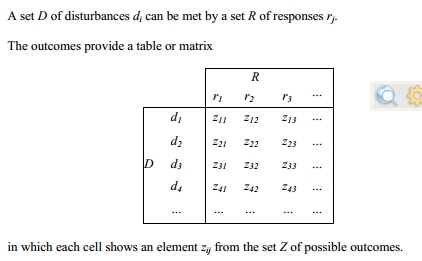
BP: OK, I see how this applies to the first part of the paper. You’ll notice that the elements of Ashby’s analysis are not continuous variables, but “events” which either occur or don’t occur. This is on page 2:

4d13c0.jpg

This is the traditional way of defining probabilities, information, uncertainty, and so on. The variables are occurrances which either happen or don’t happen. If you count all the things that might happen, perhaps with accompanying relative probabilities, you can use that number to compute the probability that a particular one will happen. But nothing ever happens partway.

BA2: A couple of points are in order here. First, Ashby could have given you the relevant math for continuous, quantitative variables, but chose to present the discrete analysis because he believed that it made the logic of his conclusions easier for the reader to comprehend. Second, the matrix above has nothing to do with probabilities. Given discrete disturbance d1, response r1 will produce outcome z11, etc.

The main effect of using this discrete-variable approach is to bypass the problem of quantitative accuracy. Ashby does this a lot, by giving examples in which the variables have values that are small integers or just logical states. If the reference signal is 1 and the perceptual signal is 2, the error, r - p, is -1, which in one form of controller should lead to an output effect of -1 that will reduce the perceptual signal to 1 and the error to 0, giving perfect control. Of course no physical system works that way. The example on page 3 is set up and discussed that way, with the outcomes being rated either Good or Bad.

BA2: Ashby is describing a general approach, of which regulation of continuous variables is a special case. For example, If hungry, eat food, outcome: stay nourished; if thirsty, drink water, outcome: stay hydrated. He’s avoiding the complexities introduced by the continuous case in order to keep the argument clear.

BA: In a control system, we have access to the reference signal. We can subtract the perceptual signal from the reference signal; what is left is the disturbance waveform, otherwise known as the error signal. The error signal drives the output, which negatively feeds back onto the controlled variable to oppose the effect of the disturbance on the controlled variable.

If the output of the system perfectly cancelled the effect of the disturbance, the error signal would never vary from zero. Consequently, there would be no variation in the output to cancel out variation in the CV due to the disturbance. Conclusion: perfect control in such a system is impossible.

BP: This is the conclusion you reach when thinking in terms of discrete variables or small whole numbers. As you pointed out in yesterday’s post, however, the concept of loop gain is missing from this approach. When you take loop gain into account you find that you can get the error as small as you please. Also, only simple proportional control is considered. If the output function is an integrator, the output variable becomes a time series which converges toward a final value of zero error. How rapidly it converges depends on the gain of the integrator. Strictly speaking, control is still not perfect until you’ve waited an infinite time. But if the first iteration corrects 90% of the error, the 10th one reduces the error to 1% of its initial value, and so on, and at some point the error becomes smaller than the system’s own internal noise level.

BA2: True enough, but it doesn’t invalidate Ashby’s logic.

BA: In information theory, the channel that conducts the error signal to the output function conveys information about the disturbance. In a perfect control system, that channel is blocked with respect to the flow of information because the error signal never varies.

BP: That is an artifact of the method of analysis, and requires ignoring variations in the reference signal. When you neglect all real sources of disturbance in the controller itself, and measure continuous variables as small integers, and assume perfect ability to convert signals into other signals or physical effects of the correct magnitude, of course you come out with perfect control using Ashby’s model, and the problem of zero error (not) producing the right output in the closed-loop model. But Ashby’s model applies only in an imaginary idealized environment, and for control systems built of imaginary perfect materials, with computers of infinite speed and precision inside them.

BA2: We’re talking about Ashby’s analysis of the error-controlled regulator here, which concludes that an ideal version of such a controller – one in which the error is kept at zero under all values of the disturbance – is a logical impossibility. I think you agree with that conclusion.

But for some reason you have switched in this paragraph to talking about Ashby’s controller, which in the ideal case CAN achieve perfect control. I agree that a practical version of Ashby’s controller – which measures the disturbance slightly ahead of its effect on the controlled variable and generates a perfect compensating output – faces the difficulties in application that you describe.

In the real control system, you can solve the equations to get the steady-state value of the variables, and you find that the system ends up with a specific amount of error which can be reduced to the limits of our devices to detect errors by using high enough loop gain and taking pains to stabilize the loop (a problem never mentioned by Ashby).

BA: Information theory simply offers another way to analyze the operation of a control system. It’s just another tool. Whether it’s a useful tool in this context depends on the purposes of the investigator.

BP: I very strongly dispute those claims in relation to control systems. It is a blunt tool that works only with imaginary systems in an imaginary environment. It comes up with very clear conclusions, which is a strong reason to reject it because the conclusions are wrong for any real control system.

BA: That’s an assertion for which you present no evidence. Information theory apparently works well enough to be adopted in the field of communication; I see no reason why it wouldn’t work as well when analyzing real controllers as it apparently does when analyzing real communication channels. What I don’t know is whether its application to the latter offers any specific advantages to the analyst, relative to a traditional approach.

A reminder: I introduced Ashby’s paper in response to Richard Kennaway’s question about whether anyone had presented a mathematical derivation of Ashby’s Law of Requisite Variety. Ashby’s paper does at least show how his law related to Shannon’s Theorem 10, for which such a derivation has been presented. I certainly did not bring this up in order to advocate for Ashby’s approach, nor for the application of information theory to control-system analysis.

Bruce

[From Rick Marken (2012.12.05.1440)]

Bill Powers (2012.12.05.1110 MST)--

RM: Oh, no. Not this again!?! I thought we had slayed the "information
about the disturbance in perception" dragon years ago.

BP: This is one of those dragons that can grow replacement heads. You can't
kill it. It's a myth with just enough truth in it to encourage anyone who
for unknown reasons is desperate to preserve it.

RM: Ah 'tis true, 'tis true. Except, of course, that the reasons are
not at all unknown.

Best

Rick

···

--
Richard S. Marken PhD
rsmarken@gmail.com
www.mindreadings.com

[From: Richard Pfau (2012.12.06 08:30 Nepal)]

Ref: [From Bill Powers (2012.12.05 0950 MST)]

BP: Of course the output of a control system has to be able to vary
enough, and rapidly enough and in the right ways, to counteract the
effects of the disturbances that are most likely to happen. Who on
Earth would ever have thought otherwise?And who would ever have the
nerve to dress that quite obvious fact up as a law with a fancy name?

Bill,

It seems that you are recognizing the existence of "feedforward"
phenomena in the above statement when you mention "Of course the output
of a control system has to be able to vary ... to counteract the
effects of the disturbances that are most likely to happen."

Are you?

With Regards,
Richard Pfau

[From Richard Kennaway (2012.12.06.1545 BST)]

[From: Richard Pfau (2012.12.06 08:30 Nepal)]

Ref: [From Bill Powers (2012.12.05 0950 MST)]

BP: Of course the output of a control system has to be able to vary
enough, and rapidly enough and in the right ways, to counteract the
effects of the disturbances that are most likely to happen. Who on
Earth would ever have thought otherwise?And who would ever have the
nerve to dress that quite obvious fact up as a law with a fancy name?

Bill,

It seems that you are recognizing the existence of "feedforward"
phenomena in the above statement when you mention "Of course the output
of a control system has to be able to vary ... to counteract the
effects of the disturbances that are most likely to happen."

Are you?

Bill can answer for himself, but my answer would be that the counteraction of disturbance by output is a fact about the functioning of the control system. It is not the mechanism by which the control system works.

···

--
Richard Kennaway, jrk@cmp.uea.ac.uk, Richard Kennaway
School of Computing Sciences,
University of East Anglia, Norwich NR4 7TJ, U.K.