Conscious of p's and Qi's

[Vyv Huddy(24.02.017.2120)]

Hi Rick

[From Rick Marken (2017.02.23.1210)]

RM: Why that train of impulses looks like a varying angle rather than something else is, I believe, what is called the “hard problem” of consciousness.

In B:CP p. 79 Powers states “the hierarchy described here is meant to cover performance … a place will be provided for awareness … as a specific phenomenon not covered by the model of the control hierarchy”.

I find the separation of the phenomena of control and awareness/consciousness a neat aspect of Powers theory. It is the opposite of the dogma of experimental psychology, as I was taught, where control is conscious / voluntary. As I understand Powers PCT suggests awareness is
present when there is some persistent error / loss of control? So if your explanation pertains to performance where control is functioning well, then there is no awareness/consciousness of the rectangle?

All the best

VYv
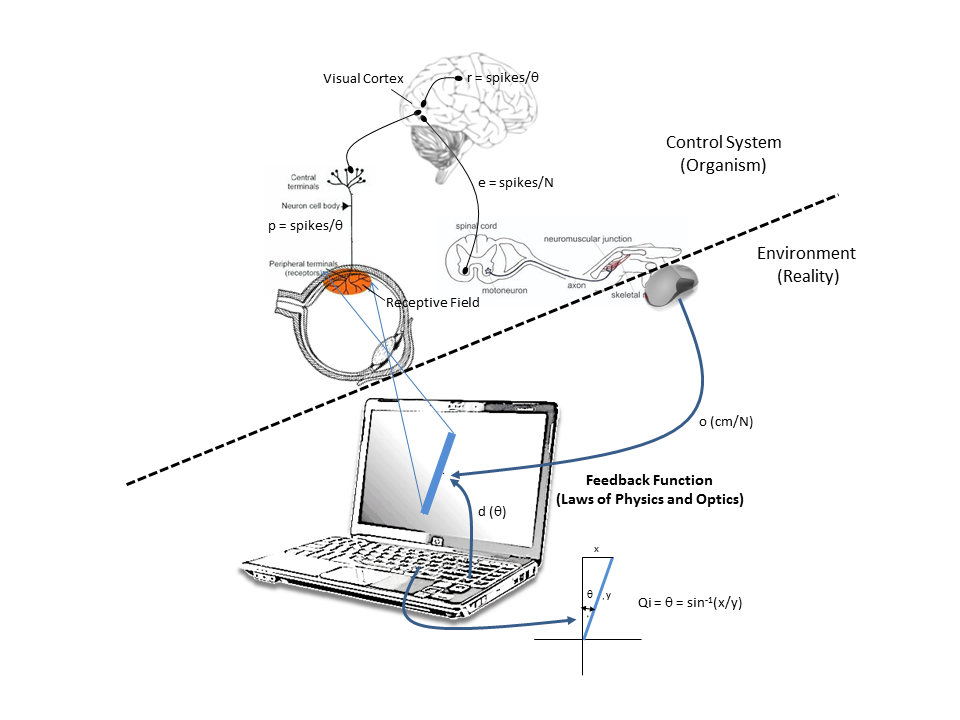
image354.png

image355.png

···

From: Richard Marken rsmarken@gmail.com
Sent: 23 February 2017 20:09
To: csgnet@lists.illinois.edu
Subject: Watch Your p’s and Qi’s

RM: The relationship between the controlled perception (symbolized p) and the controlled quantity (symbolized Qi) has created some confusion so I have drawn a couple of diagrams to illustrate the relationship. The diagrams depict the situation in my
Control of Perception demo where the subject (you) controls the angle (rather than the shape or area) of the displayed rectangle. You might want to try this demo before reading any further. The demo is at:

http://www.mindreadings.com/ControlDemo/ControlOfPerception.html

RM: The PCT view of your behavior when you are controlling the angle of the rectangle is illustrated in the figure below (this and the next figure are attached in a PowerPoint file in case there is a problem seeing them clearly in the email) . First note
that PCT distinguishes between the environment (also known as reality), shown below the dashed line, and the control system (the organism), shown above the line. The control system is controlling some variable aspect of the environment, in this case the angle
of the rectangle on the computer display.

RM: The environment is made up of the physical variables and entities postulated by the models of physics and chemistry. But in the diagram it looks like the environment consists of a mouse and a laptop computer displaying a blue rectangle at a slight
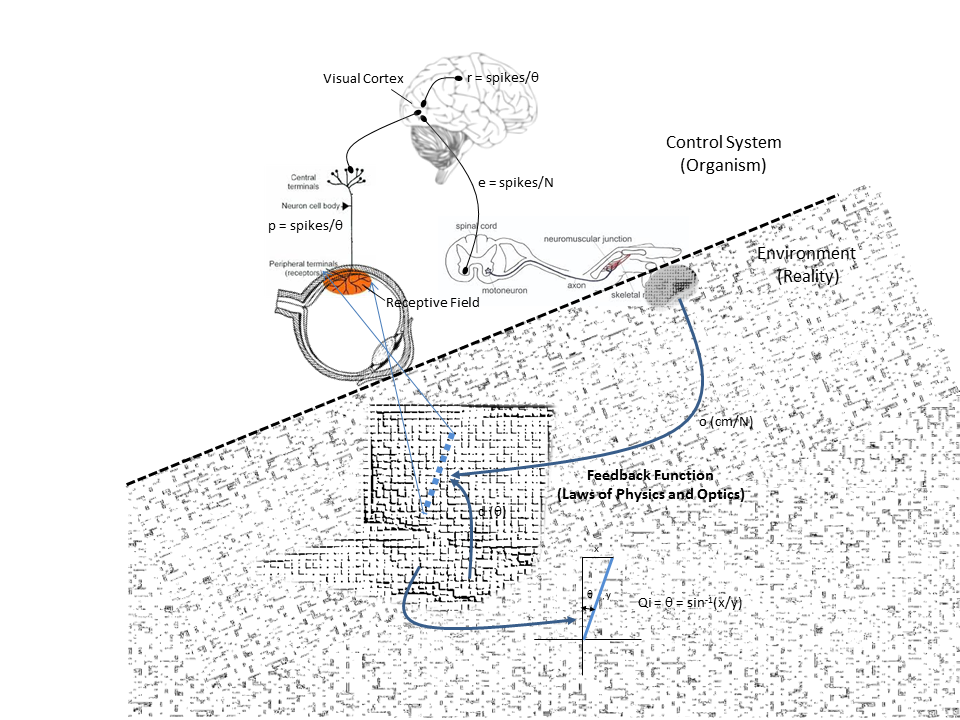
angle with respect to vertical. But these are your own perceptions of what is in the environment side of the diagram. Perhaps a better way to depict what constitutes the environment (reality) in PCT is shown in the next figure.

RM: Here the environment is represented as an array of points of varying intensity and wavelength,. You can still make out a computer and mouse – that’s you perceptual systems at work again – but I think this way of depicting the environment makes it
clearer that what is presumed to be out there in the environment is a collection of physical variables like the intensity and wavelength of light energy and entities, like atoms. It’s our perceptual systems that organize this “booming, buzzing confusion” into
things like computers, mice and so on. Actually, it’s the booming, buzzing confusion of the
sensory effects of the physical variables and entities that our perceptual systems organize into computers, mice, and so on

RM: So with that understanding in hand, let’s trace out the processes that are taking place (according to PCT) when you control the angle of the displayed rectangle. Let’s start with the physical variables in the environment. This array of energy stimulates
receptors in the retina via the laws of optics. An array of these receptors, called a
receptive field, is the input to a neural network that is a perceptual function that produces a perceptual signal, p, that is proportional to the angle, q, of the line on the screen
relative to vertical. (Actually, the computation of the angle perception is most likely carried out by a perceptual function that is higher up in the optical pathway but we will assume for simplicity that it is done at the retinal level).

RM: The perceptual signal is a train of neural impulses carried by the cell body (axon) of the neuron leaving the receptive field network, the rate of impulses (spikes) being proportional to q .
So the greater the spike rate, the greater the angle that is perceived. And this is the first place where things could get confusing because, when you are doing this control task, what you perceive is the angle of the blue rectangle relative to vertical, not
a varying rate of neural impulses. But it is this rate of impulses – the perceptual signal --, in theory, is being controlled. Why that train of impulses looks like a varying angle rather than something else is, I believe, what is called the “hard problem”
of consciousness. It is actually a problem of understanding perception and I solve it to my own satisfaction by assuming that that’s the way it looks when you are the neuron carrying the varying rates of neural impulses.

RM: The perceptual signal, measured in spikes/q is the first step in the PCT model of control of the angle in the Control of Perception demo. The next steps are shown clearly in both
figures: The neuron carrying the perceptual signal, p, and a neuron carrying the reference signal, r, synapse with opposite signs (one is excitatory and the other inhibitory) on a neuron carrying the error signal, e. The spike rate of the reference signal,
like that of the perceptual signal, is in spikes/q ; in this way the spike rate of the reference signal “specifies” the spike rate of the perceptual signal. The result of the opposite effects
of the perceptual and reference signal on the neuron carry the error signal is the firing rate of the error signal, e, neuron represents something close to the arithmetic difference between r and p: e = r-p. This error signal neuron ultimately drives the muscular
output that moves the mouse. So the spike rate of the error signal causes an amount of force to be produced by the muscles; so the error signal is in spike rate per unit force (which are Newtons, N, in the figures).

RM: The forces produced by the muscles (as a result of the error signal) have their effects on the external environment. Their immediate effect is on the position of the mouse, which is the output variable, o. The output variable in a control loop is a
physical variable measured in physical units. In this case, the output variable – mouse movement-- is measured in units of distance moved per units of force exerted: cm/N. These mouse movements affect, via the computer, the physical variables that correspond
to the perception of the angle of the blue rectangle, q. These physical variables are also affected by a disturbance variable, d, produced by the computer. The physical variables that correspond
to variations in p, the perception of q, stimulate,via the laws of optics, the receptors that make up the receptive field that calculates p, the perceptual (spike rate) value of q ,
and we are back to the beginning, closing the loop from input (stimulation of the receptive field receptors) back to the same input. The loop is completed via the
feedback function that links the output (mouse movements) by the laws of physics and optics to the input (stimulation of the receptive field receptors).

RM: Note that Qi does not show up in this loop. This was done to emphasize the fact that there is no Qi in the environment. All that is in the environment are physical variables – the v’s in Figure 1 of Powers’ 1973
Science article (reprinted on p. 66 of LCS I). Qi doesn’t exist unless there is an observer around to perceive it. When you control the angle of the blue rectangle in the Control of Perception demo – keeping it at 0 degrees relative to vertical – and
do it with no one watching you, the only observer is the computer itself. This is shown in the figures as the line coming out of the computer and computing Qi =
q = sin-1(x/y),
where x and y stand for the physical variables that are the basis for the computation of q.
If the computer were not computing q
then Qi would not exist and the only place where q would
exist during this demo would be as a perception in the person doing the demo, a perception produced by computations carried out by the neural network that makes up the receptive field.

RM: So, in summary, what is called Qi, the controlled input variable, is the observer’s perception of the perception that a controller is controlling. So Qi is p from the observer’s perspective
(if there is an observer). If there is no observer, then all that is controlled is p, a perceptual variable constructed by perceptual functions such as the receptive fields in the Figures above.

RM: One last point. Qi is important in PCT because it is the basic data of PCT. It is a variable that an observer can see is being controlled. So Qi is a perception for the observer; p
is part of the observer’s theoretical explanation of how this control is being done.

Best regards

Rick

–
Richard S. Marken

"Perfection is achieved not when you have nothing more to add, but when you
have nothing left to take away.”
–Antoine de Saint-Exupery

[From Rick Marken (2017.02.25.0950)]

···

Vyv Huddy(24.02.017.2120)

VH: I find the separation of the phenomena of control and awareness/consciousness a neat aspect of Powers theory. It is the opposite of the dogma of experimental psychology, as I was taught, where control is conscious / voluntary.Â

RM: I briefly discuss the fact that controlling can be done consciously or unconsciously in my paper “The Illusion of No Control” which can be found only in my book “Doing Research on Purpose” (DRoP). It’s one of the few papers that I gave up on publishing and like the one or two others that I gave up on, I think it’s one of my best. The relevant section titled Conscious and Unconscious Control starts on p. 130 of DRoP.

Â

VH: As I understand Powers PCT suggests awareness is
present when there is some persistent error / loss of control? So if your explanation pertains to performance where control is functioning well, then there is no awareness/consciousness of the rectangle?Â

RM: I think the idea is that the reorganizing system, which has no “smarts”, is only controlling for eliminating “intrinsic error” through random changes in parameters of the system(s) in the control (performance) hierarchy that are experiencing chronic (intrinsic) error. To the extent that awareness is associated with the operation of the reorganization system, awareness will tend to go to those systems in the hierarchy that are experiencing chronic error. But my own experience is that my awareness can be moved around voluntarily (don’t ask me how that works). So in the angle control demo, I can be aware of the fact that I am controlling the angle but my awareness can also wander off (I can think about what I want to say about it on CSGNet, for example), but not for too long or things can go haywire, since it is a relatively difficult control task. But we can clearly control with and without awareness. We tend to be unaware of the perceptions we are controlling very skillfully, such as the perceptions involved in maintaining our balance when we walk. But we can also voluntarily become aware of those perceptions.Â

RM: I think the fact that awareness can be voluntarily moved around to different perceptions – sometimes perceptions that are controlled and sometimes perceptions that are uncontrolled – is an important phenomenon to understand in the work on MOL that I know you are involved in. I think that research on what is going on in MOL may be the best way to start figuring out what might be going on with this consciousness (awareness) phenomenon.Â

BestÂ

Rick

Â


From: Richard Marken rsmarken@gmail.com
Sent: 23 February 2017 20:09
To: csgnet@lists.illinois.edu
Subject: Watch Your p’s and Qi’s
Â

RM: The relationship between the controlled perception (symbolized p) and the controlled quantity (symbolized Qi) has created some confusion so I have drawn a couple of diagrams to illustrate the relationship. The diagrams depict the situation in my
Control of Perception demo where the subject (you) controls the angle (rather than the shape or area) of the displayed rectangle. You might want to try this demo before reading any further. The demo is at:

http://www.mindreadings.com/ControlDemo/ControlOfPerception.html

RM: The PCT view of your behavior when you are controlling the angle of the rectangle is illustrated in the figure below (this and the next figure are attached in a PowerPoint file in case there is a problem seeing them clearly in the email) . First note
that PCT distinguishes between the environment (also known as reality), shown below the dashed line, and the control system (the organism), shown above the line. The control system is controlling some variable aspect of the environment, in this case the angle
of the rectangle on the computer display.

RM: The environment is made up of the physical variables and entities postulated by the models of physics and chemistry. But in the diagram it looks like the environment consists of a mouse and a laptop computer displaying a blue rectangle at a slight
angle with respect to vertical. But these are your own perceptions of what is in the environment side of the diagram. Perhaps a better way to depict what constitutes the environment (reality) in PCT is shown in the next figure. Â

RM: Here the environment is represented as an array of points of varying intensity and wavelength,. You can still make out a computer and mouse – that’s you perceptual systems at work again – but I think this way of depicting the environment makes it
clearer that what is presumed to be out there in the environment is a collection of physical variables like the intensity and wavelength of light energy and entities, like atoms. It’s our perceptual systems that organize this “booming, buzzing confusion” into
things like computers, mice and so on. Actually, it’s the booming, buzzing confusion of the
sensory effects of the physical variables and entities that our perceptual systems organize into computers, mice, and so on

RM: So with that understanding in hand, let’s trace out the processes that are taking place (according to PCT) when you control the angle of the displayed rectangle. Let’s start with the physical variables in the environment. This array of energy stimulates
receptors in the retina via the laws of optics. An array of these receptors, called a
receptive field, is the input to a neural network that is a perceptual function that produces a perceptual signal, p, that is proportional to the angle, q,  of the line on the screen
relative to vertical. (Actually, the computation of the angle perception is most likely carried out by a perceptual function that is higher up in the optical pathway but we will assume for simplicity that it is done at the retinal level).Â

RM: The perceptual signal is a train of neural impulses carried by the cell body (axon) of the neuron leaving the receptive field network, the rate of impulses (spikes) being proportional to q .Â
So the greater the spike rate, the greater the angle that is perceived. And this is the first place where things could get confusing because, when you are doing this control task, what you perceive is the angle of the blue rectangle relative to vertical, not
a varying rate of neural impulses. But it is this rate of impulses – the perceptual signal --, in theory, is being controlled. Why that train of impulses looks like a varying angle rather than something else is, I believe, what is called the “hard problem”
of consciousness. It is actually a problem of understanding perception and I solve it to my own satisfaction by assuming that that’s the way it looks when you are the neuron carrying the varying rates of neural impulses.Â

RM: The perceptual signal, measured in spikes/q  is the first step in the PCT model of control of the angle in the Control of Perception demo. The next steps are shown clearly in both
figures: The neuron carrying the perceptual signal, p, and a neuron carrying the reference signal, r, synapse with opposite signs (one is excitatory and the other inhibitory) on a neuron carrying the error signal, e. The spike rate of the reference signal,
like that of the perceptual signal, is in spikes/q ; in this way the spike rate of the reference signal “specifies” the spike rate of the perceptual signal. The result of the opposite effects
of the perceptual and reference signal on the neuron carry the error signal is the firing rate of the error signal, e, neuron represents something close to the arithmetic difference between r and p: e = r-p. This error signal neuron ultimately drives the muscular
output that moves the mouse. So the spike rate of the error signal causes an amount of force to be produced by the muscles; so the error signal is in spike rate per unit force (which are Newtons, N, in the figures).Â

RM: The forces produced by the muscles (as a result of the error signal) have their effects on the external environment. Their immediate effect is on the position of the mouse, which is the output variable, o. The output variable in a control loop is a
physical variable measured in physical units. In this case, the output variable – mouse movement-- is measured in units of distance moved per units of force exerted: cm/N. These mouse movements affect, via the computer, the physical variables that correspond
to the perception of the angle of the blue rectangle, q. These physical variables are also affected by a disturbance variable, d, produced by the computer. The physical variables that correspond
to variations in p, the perception of q, stimulate,via the laws of optics, the receptors that make up the receptive field that calculates p, the perceptual (spike rate) value of q ,
and we are back to the beginning, closing the loop from input (stimulation of the receptive field receptors) back to the same input. The loop is completed via the
feedback function that links the output (mouse movements) by the laws of physics and optics to the input (stimulation of the receptive field receptors).Â

RM: Note that Qi does not show up in this loop. This was done to emphasize the fact that there is no Qi in the environment. All that is in the environment are physical variables – the v’s in Figure 1 of Powers’ 1973
Science article (reprinted on p. 66 of LCS I). Qi doesn’t exist unless there is an observer around to perceive it. When you control the angle of the blue rectangle in the Control of Perception demo – keeping it at 0 degrees relative to vertical – and
do it with no one watching you, the only observer is the computer itself. This is shown in the figures as the line coming out of the computer and computing Qi =
q = sin-1(x/y),
where x and y stand for the physical variables that are the basis for the computation of q.
If the computer were not computing q
then Qi would not exist and the only place where q would
exist during this demo would be as a perception in the person doing the demo, a perception produced by computations carried out by the neural network that makes up the receptive field.Â

RM: So, in summary, what is called Qi, the controlled input variable, is the observer’s perception of the perception that a controller is controlling. So Qi is p from the observer’s perspective
(if there is an observer). If there is no observer, then all that is controlled is p, a perceptual variable constructed by perceptual functions such as the receptive fields in the Figures above.Â

RM: One last point. Qi is important in PCT because it is the basic data of PCT. It is a variable that an observer can see is being controlled. So Qi is a perception for the observer; p
is part of the observer’s theoretical explanation of how this control is being done.Â

Best regards

Rick

–
Richard S. MarkenÂ

"Perfection is achieved not when you have nothing more to add, but when you
have nothing left to take away.�
                --Antoine de Saint-Exupery

–
Richard S. MarkenÂ

"Perfection is achieved not when you have nothing more to add, but when you
have nothing left to take away.�
                --Antoine de Saint-Exupery
