[From Bill Powers (2011.04.21.1102 MDT)]
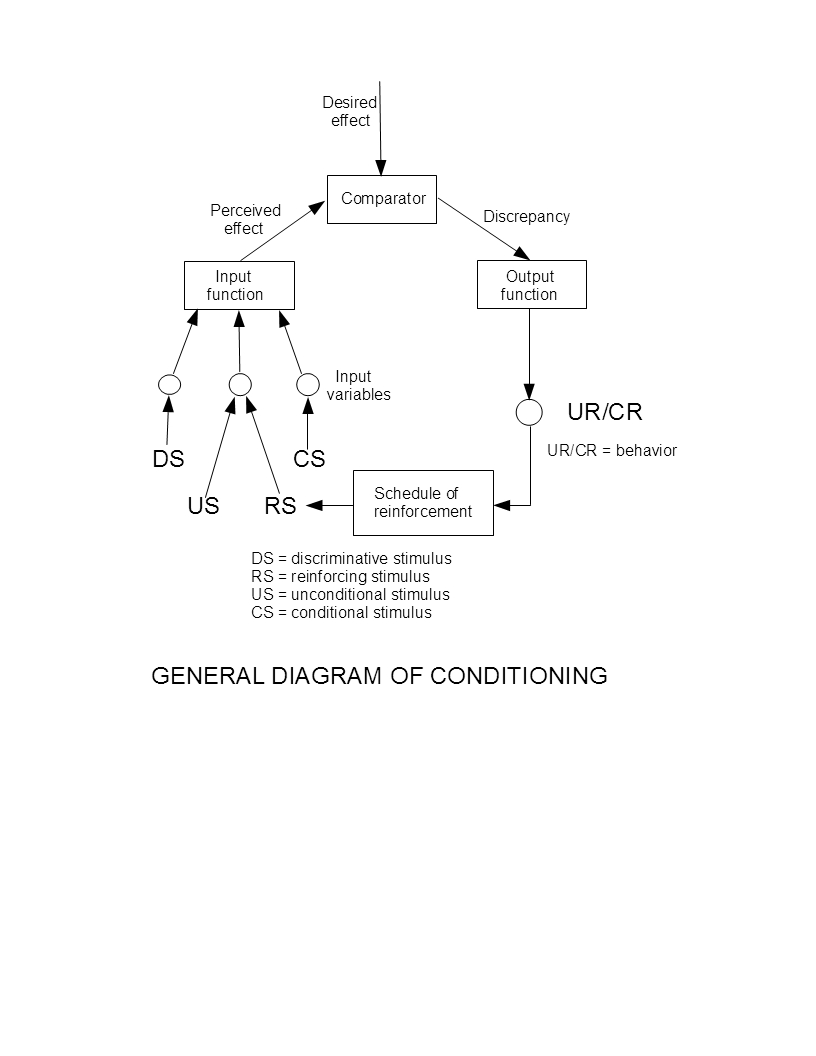
I just sent the attached diagram to Henry Yin and thought others
might be interested in it, too. Try it out as an explanation of
either classical or operant (or any other kind of) conditioning. It's
all just learning to control inputs, isn't it?
Best,
Bill P.
[From Rick Marken (2011.04.21.1615)]
Bill Powers (2011.04.21.1102 MDT)--
I just sent the attached diagram to Henry Yin and thought others might be
interested in it, too. Try it out as an explanation of either classical or
operant (or any other kind of) conditioning. It's all just learning to
control inputs, isn't it?
Very nice. That's a keeper.
Best
Rick
···
--
Richard S. Marken PhD
rsmarken@gmail.com
www.mindreadings.com
(Gavin Ritz 2011.04.22.15.24NZT)
[From Bill Powers
(2011.04.21.1102 MDT)]
I just sent the attached diagram to Henry Yin and thought others
might be interested in it, too. Try it out as an
explanation of
either classical or operant (or any other kind of)
conditioning. It’s
all just learning to control inputs, isn’t it?
Bill
What is a discriminative stimulus?
And all the other stimuli
(I’ve never heard of these things before)
What would the Input Variables
(controlled variables) be associated with these stimuli?
Regards
Gavin
···
[From Bill Powers (2011.04.22.0100 MDT)]
···
What is a
discriminative
stimulus?
===========================================================================
http://www.psychology.uiowa.edu/faculty/wasserman/glossary/stimuli.html
Discriminative StimulusA discriminative stimulus influences the occurrence of an
operant response because of the contingencies of
schedules of reinforcement or
paradigms of reinforcement/punishment that are or have been
associated with that response. Many authors further suggest that
discriminative stimuli provide information to the organism, allowing it
to respond appropriately in the presence of different stimuli. An
observing response is sometimes necessary for presentation of the
discriminative stimulus/stimuli.
================================================================
And all the other
stimuli (Ive never
heard of these things before)
What would the Input Variables
(controlled variables) be associated with these
s
The Unconditional Stimulus is, in Pavlovian conditioning, a stimulus that
results in an (apparently) automatic action, such as a jab from a pin
that results in withdrawal of the affected part of the body from the pin.
The Unconditional Response is the behavior that causes the withdrawal.
The Conditional Stimulus is a stimulus that occurs prior to the
Unconditional Stimulus. After some number of presentations of the CS
followed by the US and a UR, the CS alone becomes sufficient to result in
the UR without the US (thereby preventing the effect of the US). The
behavior is then called the Conditional Response or CR rather than the
UR, although it is the same behavior. That is called classical or
Pavlovian conditioning.
In operant conditioning, the behavior that generates a reinforcing
stimulus or RS (usually just called a reinforcement) operates through a
schedule of reinforcements such as Fixed Ratio 5 or FR-5, to affect an
input variable such of which the organism has been deprived (the
“establishing operation” which corresponds to the US in the
diagram). The delivery of a reinforcement has the effect of reducing the
effect caused by the deprivation. The schedule of reinforcement is what
we call the feedback function in PCT. A discriminative stimulus or DS can
be used to indicate whether a response will cause a reinforcement. In
general, the whole stimulus context is thought of as the discriminative
stimulus, which, if present, results in the behavior that is followed by
the reinforcement.
The diagram shows how either operant or classical conditioning can be
explained as learning a process of controlling some variable that is a
function of one or more of the input quantities affected by the various
stimuli. The function in question is the Input Function, which defines a
controlled variable represented by the perceptual signal.
timuli?
Anything we would call in PCT a controlled variable or the associated
proximal physical variables that are present just outside the sensors,
such as light, heat, sound, pain, and so on. The four stimuli are events
or disturbances (such as penetration by the point of a pin) that affect
the proximal stimuli actually sensed. The perceptual signal is some
function of the multiple input variables.
The point of the diagram is to show that the traditional terms of operant
and classical conditioning are merely different ways of describing
learning the process of control of input. The old terms are no longer
needed since they imply an incorrect kind of cause-effect behavior and
ignore the immediate feedback effects. They amount to bad guesses about
what was being observed. We are observing the acquisition of a control
process in either case, not “conditioning.” There is no such
thing as conditioning.
Best,
Bill P.
[From Bill Powers (2011.04.22.0100 MDT)]
(sorry, I forgot to identify the post to which I was replying)
(Gavin Ritz
2011.04.22.15.24NZT)
What is a
discriminative
stimulus?
[etc]
Best,
Bill P.
[From Bill Powers (2011.04.22.0745 MT)]
Hi Bill, that's great, but wouldn't there be a role for memory in
this process (how reference values are in fact memories as in the
chapter in B:CP), and more than one layer of a hierarchy, to
incorporate the fact that 'stimuli' are typically coded as
configurations or categories?
Yes, all you say is true. The perceptions involved in classical
conditioning go at least to the relationship level (as Rescorla says:
see attached article), and of course you need all the intervening
levels to turn the abstract error signal into a set of reference
signals for muscle forces. So the input function and output function
boxes contain similar functions for the lower levels of the hierarchy.
I wasn't trying to come up with an exact model here -- just to show
how the concepts of conditioning can be absorbed into the PCT model.
Operant and classical conditioning don't call for any capabilities
that aren't already part of the PCT model, do they?
Best,
Bill
RESCORLA (1988).pdf (549 KB)
···
At 10:13 AM 4/22/2011 +0100, Warren Mansell wrote: