[Martin Taylor 2014.02.04.07.59]
Warren, your comment "this seems to be an imagination mode process",
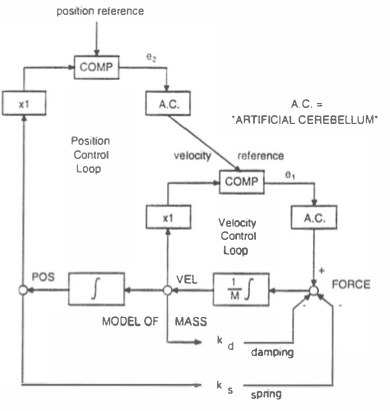
together with Rick’s having induced me to reread Bill’s description
of the Artificial Cerebellum, has clarified for me something that
has been bugging me for many years, especially recently.
At CSG93, I discussed with Bill this configuration of the
imagination connection, which I had used in a presentation earlier
in the year – I quote a page from that presentation, which is on my
Web site at .
------------quote---------
···
On 2014/02/4 2:20 AM, Warren Mansell
wrote:
I think that the cloud and umbrella example really illustrates that we are talking about multi-componential phenomena here. First, putting up an umbrella is a behaviour to control the perception of staying dry.
But, given it only takes a second to put up an umbrella, you wouldn't do it until the rain started anyway.
Maybe a better example is whether you would put up a canopy at you garden party if rain was predicted.
Now, the actual putting up of the canopy is all controlled perception and the question is rather whether one takes the prediction of the perception of rain as the perception of rain.
So, this one seems to be an imagination mode process.
However I am sure that other apparent feed forward examples use a different combination of PCT components....
Warren
http://www.mmtaylor.net/PCT/DFS93/DFS93_1.html
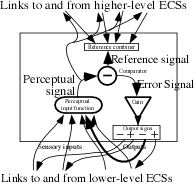
Basic elements of an Elementary Control System (ECS) showing an
“imagination loop”
The simple ECS is not complete in the form shown earlier. It is
capable of “imagining.” In PCT, imagination is conceived as
permitting the output to be connected directly back to the input.
Since the output usually serves as a reference for lower-level
perceptions that “should be” controlled to match their references,
feeding back the output is equivalent to receiving those
perceptions. It is the difference between a commander ordering
“Take that hill” and the commander imagining “What would it be
like if that hill were to be taken.”
The ECS also can be augmented by the addition of a memory, which
allows it to recapture a perception previously obtained, either in
the form of a reference signal (which creates an error signal that
leads to output) or as a perceptual signal perhaps together with a
reference signal, leading to a perception but no error and thus no
output.
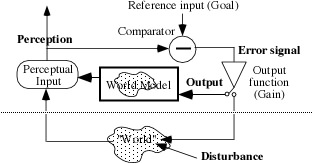
Imagining: Planning
The imagination is not necessarily a direct connection between
the output and the perceptual input function, as shown in the
previous slide. It is likely to go through some kind of a world
model, particularly at the higher control levels where the
perceptual input function may be logical rather than analogue in
form. The world model may well be implemented in parts of the
complicated control network that are not currently being used for
active control (and which might be specialized for the imagination
function). It allows the output signal to have effects that are
distributed over time, rather than being concentrated at the time
the output signal is issued. The world model is built up through
experience with the world, as well as by training. Testing out the
likely effects of output by imagining through the world model is
“planning.”