# Giving the Game Away (was Tail Wagging the Dog)
**URL:** http://discourse.iapct.org/t/giving-the-game-away-was-tail-wagging-the-dog/4769
**Category:** CSG2015
**Created:** [February 10, 2015, 7:20pm UTC](http://discourse.iapct.org/t/giving-the-game-away-was-tail-wagging-the-dog/4769 "2015-02-10T19:20:54Z")
**Posts on this page:** 10
**Page:** 1
### Author:  [@rsmarken](http://discourse.iapct.org/u/rsmarken)
#### Post date: [February 10, 2015, 7:20pm UTC](http://discourse.iapct.org/t/giving-the-game-away-was-tail-wagging-the-dog/4769/1 "2015-02-10T19:20:54Z")
[From Rick Marken (2015.02.10.1120)]
> **···**
>
> > Bruce Abbott (2015.02.09.1750)
>
> >
>
> > RM: But I’ll correct it here. What I meant to say was:
>
> >
>
> > > RM: All that’s very interesting but what I have shown is that the disturbance to the mass in a mass spring system IS COMPLETELY EFFECTIVE, so for all intents and purposes, the gain of this negative feedback system is 0.
>
> > BA: Well, perhaps I didn’t read carefully enough, but that’s exactly what I TOOK you to be saying.
>
> RM: OK, I re-read your story and it seems that you did understand that I said that there is no disturbance resistance in a mass spring system. The restoring force that is “generated” by the “disturbance” is just the reaction force of Newton’s third law: action - reaction. The action is the force, Fa, that you apply to the mass to displace it (what you call the “disturbance”); the reaction is the restoring force, Fr, that, according to the third law, is equal and opposite to the applied force: Fa = - Fr.
>
> RM: So if the restoring force, Fr, in a mass-spring system is the disturbance resistance of a negative feedback system then so is the reaction force that exists when a force is applied to any mass. When you push on a large block of lead, for example, the block produces a reaction force, Fr, that is equal and opposite to your applied force, Fa. Because all matter is somewhat elastic, the force you apply to the block displaces its surface just as the force you apply to a mass on a spring displaces the spring. However, the spring constant of the block is very large so the displacement produced by the applied force is infinitesimally small. That is, by Hooke’s law, the displacement, x, produced by Fa is x = 1/k\*Fa. Clearly, if k is close to being infinitely large, x will be close to being infinitesimally small. But the displacement, x, exists so when you stop pushing on the block of lead the reaction force, Fr, “restores” the surface to its original position.
>
> > BA: You can see this illustrated in my little dialog, where Obi Wan explains to Luke an implication of the disturbance being completely effective (i.e., no resistance being developed to it whatsoever): coffee cups falling through the table and non-supportive floors.
>
> RM: Apparently Obi Wan didn’t know about Newton’s third law.
>
> BA: So, the rest of my post is relevant and shouldn’t be ignored on the basis of irrelevance. My bottom line: your conclusion is total nonsense, for all the reasons I’ve already given.
>
> RM: And I think Obi Wan’s conclusion is nonsense for the reasons I just gave. If he considers the reaction force that keeps a coffee cup from going through the table to be an example of disturbance resistance then he really needs some tutoring in basic physics.
>
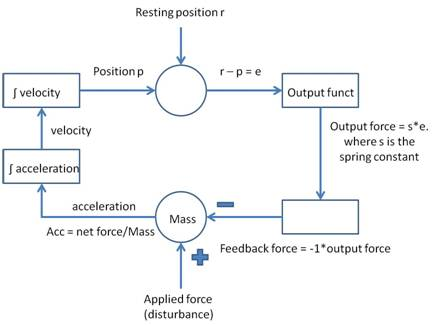
> RM: But the real problem with the “equilibrium theory” approach isn’t that it mistakes Newton’s third law for disturbance resistance. The real problem is that it is trying to account for control – purposeful behavior – using causal models. This game was finally given away when you posted this closed-loop model of a mass-spring system:
>
> RM: This diagram shows that you consider an equilibrium system to be a purposeful system – a control system – as indicated by your inclusion of a reference position in the model. What this model says is that you consider the mass spring system to have a purpose; its purpose is to have the mass to be at the resting position. This is simply animism – attributing purpose to purposeless systems – disguised with some fancy math and terminology.
>
> RM: My simulations demonstrated that this model of a mass spring system is incorrect, and that it is incorrect because of the inclusion of the reference. But anyone should have been able to tell that just from looking at the diagram. This is a diagram of a system that has a purpose (goal) – the reference for the position of the mass. Even without knowing PCT I think we can all agree that masses on springs are not purposeful systems. And it is also clear that even though you can legitimately call them negative feedback systems (as per my earlier post) they don’t resist disturbances. All they do is react (per Newton’s Third law), a fact that is easily demonstrated by simply pushing the mass to a new position and noting that you can hold it in that “disturbed” position and the system does nothing about; it just produces a reaction force equal and opposite to your applied force (the 3rd law). The mass spring system doesn’t compensate for disturbances because it doesn’t care what happens to the position of the mass; it doesn’t want the mass to be in the resting state.
>
> RM: The problem with this 'equilibrium theory" game of using non-purposeful systems, like the mass spring system, as examples of systems that can produce purposeful behavior, beside the fact that it is completely wrong, is that it gives ammunition to those who, as Bill used to say, have an allergic reaction to the concept purpose in behavior and, therefore, argue that PCT is not needed to explain (purposeful) behaviors, such as limb movements. Therefore, I have no idea why Bruce and Martin are so enamored of equilibrium theory. I would really like to hear what they think “equilibrium theory” has to contribute to PCT. As far as I can see, all it has to contribute is confusion.
>
> RM: PCT is about the fact that purposeful behavior is the control of perception. Understanding purposeful behavior, then, is a matter of understanding what perceptions organisms are controlling and how they control them. This was Bill’s incredibly important contribution to our understanding of the nature of living systems. I don’t see how the study of equilibrium systems – which neither perceive nor control – fits into this vision.
>
> Best
>
> Rick
>
> –
> Richard S. Marken, Ph.D.
> Author of [Doing Research on Purpose](http://www.amazon.com/Doing-Research-Purpose-Experimental-Psychology/dp/0944337554/ref=sr_1_1?ie=UTF8&qid=1407342866&sr=8-1&keywords=doing+research+on+purpose).
> Now available from Amazon or Barnes & Noble
---
### Author:  [@MartinT](http://discourse.iapct.org/u/MartinT)
#### Post date: [February 11, 2015, 5:21am UTC](http://discourse.iapct.org/t/giving-the-game-away-was-tail-wagging-the-dog/4769/2 "2015-02-11T05:21:56Z")
[Martin Taylor 2015.02.10.15.17]
```
True, but rather misleading. Here's why.
```
In high school (in my day, I can’t speak for now) we were taught
that all stationary material structures are in one kind of
equilibrium: stable, neutral, or unstable. The cases are
distinguished by the change in the system energy if they are
disturbed slightly away from their equilibrium position. A stable
system displaced has a higher energy than at equilibrium position, a
neutrally stable system has an unchanged energy, and an unstable
system has a lower energy. (Displaced means that the system is at an
off-equilibrium position but stationary, so as to eliminate kinetic
energy from consideration).
A pencil balancing on its point is in unstable equilibrium, because
if you add any energy to it (as by a lateral touch), it falls,
converting potential energy to kinetic energy as it accelerates. If
you want to keep it standing on its point, you have to keep
providing enough energy to compensate for whatever it loses in the
distance it has already fallen. A control system can do this, but a
passive system such as those we have been discussing cannot.
A glass on a table is in neutral equilibrium because if you give it
a small push it neither departs further from its initial position
nor returns toward its initial position. In the absence of friction
it would simply glide on forever, but a real glass on a table
quickly dissipates the energy of the push in the form of heat.
A pendulum hanging vertically from the ceiling is in stable
equilibrium. If it is displaced in either direction, the pendulum
bob increases its potential energy. That energy is supplied by the
disturbing influence. The only way the system can dissipate this
added energy is by friction (including air resistance) that
dissipates the energy in the form of heat, while the negative
feedback force is returning the pendulum toward its equilibrium
position. In a stable equilibrium system, the equilibrium
configuration has the status of the reference value in a control
system.
As you describe it, the surface of the lead block is a system in
stable equilibrium, though why you use “scare-quotes” around
“restores” is rather mysterious. Fr, as you describe it, does simply
restore the surface to its original position. It’s just like a
spring.
Newton’s third law is independent of the question about equilibrium.
Again consider the pendulum. When you push the bob leftward, there’s
a rightward third law force opposing the push. If the reaction force
were equal to the push force, the bob wouldn’t move, would it? But,
as Galileo pointed out “Yet, it does move.” You see this as a
mystery. ObiWan did not. He understood that Newton also mentioned
that the net force applied to the mass induces acceleration.
Think about it. You can get to the third law without needing to see
it as an independent construct. Have a mass in free (Newtonian)
space and apply a force f1 to it, say leftward. F = ma. The block
accelerates leftward at a rate a = f1/m. Now suppose the block
doesn’t accelerate when you apply the force. It is still true that F
= ma, but F is the total force applied to the block. There must be
another, invisibe, force f2 such that F = f1 + f2 = 0. So, if the
block doesn’t accelerate, the applied force induces an equal and
opposite reaction force. If the block does accelerate, there still
may be an opposite reaction force, but it is less than f1.
You have been insisting (a) that the Third Law force doesn’t exist,
(b) that it is always equal to the applied force, (c) that it
nevertheless allows for the mass to be accelerated by the disturbing
push, and (d) that it is friction that provides the force that
directs the mass toward the stable equilibrium position.
I know of no physics in which either (a) or (b) is consistent with
(c), nor any physics in which friction forces do not act in a
direction opposed to the direction of movement, nor any physics in
which friction adds energy to a mass to make it move, both of which
are implied by (d).
I suggest studying a little middle-high-school physics before
commenting further,
I wonder whether it is Obi Wan who needs the tutoring?
This is an idée fixe whose source is very mysterious. I have
wondered from the very beginning of this discussion where it came
from, but it seems to be under very high-gain control. Bruce and I
have emphasised over and over that there’s no way equilibrium
systems can be said to control. The argument even started with Bruce
drawing a distinction between them, and yet Rick continues to insist
that we are trying to say equilibrium systems are control systems.
Joe: Green is different from Red
Stan: You think Green is the same as Red.
Joe: No, Green is quite different from Red.
Stan: You are wrong. Green is different from Red no matter what you
say.
Joe: I have always said Green is different from Red.
Stan: How can I convince you that Green is different from Red.
Joe: Here’s a demonstration of just how Green differs from Red.
Stan: I don’t know why you keep insisting that Green is the same as
Red.
etc. etc.
Let’s recap with a few quotes, from consecutive messages early in
the thread, but scattered quotes for the most recent period:
[From Rick Marken (2015.01.27.1100)] Equilibrium systems are
not not control systems;
[From Rick Marken (2015.01.27.1730)] Yes, the kind of homeostasis
Bruce mentioned is called “equilibrium”. The other kind is
“control”. Both involve observing a variable return to and/or remain
in a stable state. It’s easy to discriminate between those two kinds
of homeostasis using the test for the controlled variable. [MT comment: At this point Rick seems aware that nobody is claiming
a spring or equivalent equilibrium system is a control system.But a
couple of hours later…
[From Rick Marken (2015.01.27.1940)]
A control system controls; an equilibrium system doesn’t control.
[From Rick Marken (2015.01.28.1120)]
“Equilibriium systems” are not feedback systems, period, amen.
People who use these systems as examples of control systems are just
trying to account for purposive behavior using causal models.
[Bruce showed a functional negative feedback diagram of an
equilibrium system]
[From Rick Marken (2015.01.28.1640)]
Another problem for me with the diagram is that it doesn’t show the
effect of the disturbance on what is supposedly the “controlled
variable” (the position of the mass). I think this is because
equilibrium models are only interested in the stability that results
after a disturbance has been removed. And that’s because equilibrium
models don’t produce stability when there is a time-varying
disturbance applied to the variable that is supposedly being
stabilized. And that’s because there is no negative feedback in a
an equilibrium model; there is no control.
[From Rick Marken (2015.01.29.2210)]
I think equilibrium models are simply an attempt to use a causal
model (Newton’s laws of motion) to account for purposeful (control)
behavior.
[From Rick Marken (2015.01.30.1230)] If equilibrium systems are
negative feedback systems then they are control systems… So the
reason I am so adamantly opposed to the idea that
[From Rick Marken (2015.01.30.1610)] [From Rick Marken (2015.01.30.1910)]
So a system in which a variable, such as the position of a pendulum
bob, close to a particular (right) state, protected from
disturbances, is a stable system. It sounds to me like a stable
system (by your definition of stable) is one that controls some
variable (by the PCT definition of control). So a stable system
sounds a lot like a control system. [From Rick Marken (2015.01.31.1140)]
Right now the only argument I would make is that if the pendulum and
mass spring system are negative feedback systems then they are
control systems
[A week later …
[And on and on until today …
[From Rick
(2015.02.10.1120)]
But the real problem with the “equilibrium theory” approach isn’t
that it mistakes Newton’s third law for disturbance resistance. The
real problem is that it is trying to account for control [and, referring back to Bruce’s simulink diagram that showed the
negative feedback loops and their relation to the equilibrium
position shown as equivalent to the reference position of a control
loop] This diagram  shows that you consider an equilibrium system to
be a purposeful system – a control system – as indicated by your
inclusion of a reference position in the model.
> **···**
>
> > [From Rick Marken
> > (2015.02.10.1120)]
> >
> > > ```
> > > Bruce
> > >
> > > ```
> > >
> > > Abbott (2015.02.09.1750)
>
> > > Â
>
> > > ```
> > > RM: But I'll correct it here.
> > >
> > > ```
> > >
> > > What I meant to say was:Â
>
> > > Â
>
> > > > ```
> > > > RM: All that's
> > > >
> > > > ```
> > > >
> > > > very interesting but what I have shown is
> > > > that the disturbance to the mass in a mass
> > > > spring system IS COMPLETELY EFFECTIVE, so
> > > > for all intents and purposes, the gain of
> > > > this negative feedback system is 0.Â
>
> > > ```
> > > BA:Â
> > >
> > > ```
> > >
> > > Well, perhaps I didn’t read carefully enough,
> > > but that’s exactly what I TOOK you to be
> > > saying.Â
>
> >
>
> > ```
> > RM: OK, I re-read your story and it seems that you did
> >
> > ```
> >
> > understand that I said that there is no disturbance
> > resistance in a mass spring system. The restoring force
> > that is “generated” by the “disturbance” is just the
> > reaction force of Newton’s third law: action - reaction.Â
> > The action is the force, Fa, that you apply to the mass to
> > displace it (what you call the “disturbance”); the
> > reaction is the restoring force, Fr, that, according to
> > the third law, is equal and opposite to the applied force:
> > Fa = - Fr.Â
>
> >
>
> > ```
> > RM: So if the restoring force, Fr, in a mass-spring
> >
> > ```
> >
> > system is the disturbance resistance of a negative
> > feedback system then so is the reaction force that exists
> > when a force is applied to any mass.
>
> > ```
> > When you push on a large block of lead, for example,
> >
> > ```
> >
> > the block produces a reaction force, Fr, that is equal and
> > opposite to your applied force, Fa. Because all matter is
> > somewhat elastic, the force you apply to the block
> > displaces its surface just as the force you apply to a
> > mass on a spring displaces the spring. However, the spring
> > constant of the block is very large so the displacement
> > produced by the applied force is infinitesimally small.
> > That is, by Hooke’s law, the displacement, x, produced by
> > Fa is x = 1/k\*Fa. Clearly, if k is close to being
> > infinitely large, x will be close to being infinitesimally
> > small. But the displacement, x, Â exists so when you stop
> > pushing on the block of lead the reaction force, Fr,
> > “restores” the surface to its original position.
>
> >
>
> > > ```
> > > BA:
> > >
> > > ```
> > >
> > > You can see this illustrated in my little
> > > dialog, where Obi Wan explains to Luke an
> > > implication of the disturbance being
> > > completely effective (i.e., no resistance
> > > being developed to it whatsoever): coffee cups
> > > falling through the table and non-supportive
> > > floors.
>
> >
>
> > ```
> > RM: Apparently Obi Wan didn't know about Newton's third
> >
> > ```
> >
> > law.
>
> >
>
> > ```
> > BA:Â
> >
> > ```
> >
> > So, the rest of my post is relevant and shouldn’t be
> > ignored on the basis of irrelevance. My bottom line:
> > your conclusion is total nonsense, for all the reasons
> > I’ve already given.
>
> > Â
>
> > ```
> > RM: And I think Obi Wan's conclusion is nonsense for
> >
> > ```
> >
> > the reasons I just gave. If he considers the reaction
> > force that keeps a coffee cup from going through the table
> > to be an example of disturbance resistance then he really
> > needs some tutoring in basic physics.
>
> >
>
> > ```
> > RM: But the real problem with the "equilibrium theory"
> >
> > ```
> >
> > approach isn’t that it mistakes Newton’s third law for
> > disturbance resistance. The real problem is that it is
> > trying to account for control
>
> ```
> [From
>
> ```
>
> Bruce Abbott (2015.01.27.1010 EST)]
>
> ```
> If homeostasis includes ***any*** *stable* negative
>
> ```
>
> feedback system, then the term covers both control systems and
> passive equilibrium systems.
>
> ```
> [From
>
> ```
>
> Bruce Abbott (2015.01.27.2020 EST)]
>
> ```
> The above [a mass supported by a spring]Â is not a control system,
>
> ```
>
> but a control system is an equilibrium system. The difference
> lies in whether the energy to oppose the disturbance comes from
> the disturbance itself or from some independent source. The
> former reaches a passive equilibrium, the latter an active one.
>
> ```
> [From
>
> ```
>
> Bruce Abbott (2014.01.28.0955 EST)]
> [After
> some analytical discussion] This approach makes explicit the
> differences between such a passive equilibrium system and an
> actual control system. The passive system’s “reference� value is
> fixed and equal to the undisturbed value; the control system’s
> reference can be adjusted. The passive system’s loop gain cannot
> exceed 1.0 because its restorative energy comes from the
> disturbance itself; the control system’s loop gain can be
> extremely high because the energy it uses to generate the
> restorative force comes from an independent source.
>
> ```
> [From
>
> ```
>
> Bruce Abbott (2015.01.28.2210 EST)]
> I
> don’t know why you added “there is no control� to the end of your
> last sentence. It suggests that I am asserting that passive
> equilibrium systems are control systems, which I have taken pains
> to make clear they are not.
>
> ```
> [From
>
> ```
>
> Bruce Abbott (2015.01.29.0855 EST)]
> Equilibrium
> systems do **not** exhibit purpose, they just come to whatever
> equilibrium values emerge from the interaction of their
> variables. Purposeful behavior involves an **active**
> intervention (energy drawn from an independent source) that pushes
> the controlled variable toward an **intended** Â (reference)
> value.
>
> ```
> [Martin Taylor 2014.01.30.10.11] PCT is indeed
>
> ```
>
> not being applied to springs, for the reason Bruce has repeatedly
> given – in a spring and its analogues, the restorative energy is
> supplied by the disturbance, whereas in a control system the
> restorative energy is supplied by a separate source that is seldom
> if ever incorporated in the control diagram. This has nothing to
> do with whether springs can be analyzed as feedback systems.
>
> “passive
> equilibrium systems” help to stabilize variables through negative
> feedback" is that I can’t see it as anything other than an attempt
> to show that control (stabilization) can be exerted by causal
> systems.
>
> > > ```
> > > MT: All negative feedback
> > >
> > > ```
> > >
> > > systems are control systems, indeed!
>
> > ```
> > RM: Of course. What else could they
> >
> > ```
> >
> > be?Â
>
> > > ```
> > > MT: And this claim is the
> > >
> > > ```
> > >
> > > rationale for saying that a spring is not a negative feedback
> > > system.
>
> > ```
> > RM: Yes, one of them. If the
> >
> > ```
> >
> > mass-spring system were a negative feedback system it would
> > control the position of the mass.Â
>
> > > ```
> > > MT: Bruce said an
> > >
> > > ```
> > >
> > > equilibrium system is not a control system, and you agreed,
>
> > RM: Right, because it’s not.Â
>
> > > ```
> > > MT: so your claim that any
> > >
> > > ```
> > >
> > > negative feedback system is a control system PROVES that
> > > there’s no negative feedback in the spring.
>
> > RM: You logic is too dizzying for me.
>
> ```
> [From
>
> ```
>
> Bruce Abbott (2015.01.30.2010 EST)]
> A
> pendulum is stable: it will resist being deflected by a
> disturbance and returns to vertical once the disturbance is
> removed. Well-designed control systems are also (usually) stable,
> but conditions may arise that will cause a control system to
> “hunt� or even go into destructive oscillations – a form of
> instability. A perfectly balanced inverted pendulum is an
> equilibrium system but unstable: the slightest tip off the
> vertical sends the bob plummeting. (The reason it is unstable is
> that its arrangement of parts [bob on top, pivot below] engenders
> positive feedback.)Â However, it may be stabilized by a properly
> designed and tuned control system. So, there are equilibrium
> systems that are stable and ones that are unstable. There are
> control systems that are stable and some that are unstable.Â
> Stability is not a necessary property of either kind of system.
>
> ```
> [From
>
> ```
>
> Bruce Abbott (2015.01.31.1215 EST)]
>
> ```
> The
>
> ```
>
> Simulink system diagram of the mass-spring-damper system I
> presented earlier quite clearly shows the negative feedback
> relationship between the acceleration of the mass by the
> disturbing force and the reaction forces generated by the spring
> and damper that oppose this acceleration. If you are going to go
> so far as to deny what is clearly evident in the diagram, then
> there is nothing further I can do to convince you that systems
> such as the spring and the pendulum are passive equilibrium
> systems that include negative feedback among the causal
> connections among their variables.
>
> [Martin Taylor 2015.02.07.17.35]
>
> > [From Rick Marken (2015.02.07.1400)]
> > :So the mass spring system is a
> > negative feedback system that doesn’t seem to resist
> > disturbances; that is, it doesn’t control.
>
> ```
> Why do you keep reiterating what has been
>
> ```
>
> agreed by all from the get-go, as if it were a critical argument
> against the fact that equilibrium systems are (as they indeed are
> and have been shown to be) negative feedback systems?
>
> Marken
---
### Author:  [@rsmarken](http://discourse.iapct.org/u/rsmarken)
#### Post date: [February 11, 2015, 6:53pm UTC](http://discourse.iapct.org/t/giving-the-game-away-was-tail-wagging-the-dog/4769/3 "2015-02-11T18:53:53Z")
[From Rick Marken (2015.02.11.1050)]
> **···**
>
> > Martin Taylor (2015.02.10.15.17)–
>
> > ```
> > MT: You have been insisting (a) that the Third Law force doesn't exist,
> >
> > ```
> >
> > (b) that it is always equal to the applied force, (c) that it
> > nevertheless allows for the mass to be accelerated by the disturbing
> > push, and (d) that it is friction that provides the force that
> > directs the mass toward the stable equilibrium position.
>
> RM: Actually I’ve only been “insisting” only on b (Fr = -Fa) and d (Fr alone does not bring the mass or the bob back to the resting state; damping – friction and or gravity-- is essential).
>
> > ```
> > MT: This is an idée fixe whose source is very mysterious. I have
> >
> > ```
> >
> > wondered from the very beginning of this discussion where it came
> > from, but it seems to be under very high-gain control. Bruce and I
> > have emphasised over and over that there’s no way equilibrium
> > systems can be said to control.
>
> RM: Bruce’s control diagram of a mass-spring system gave the game away – the game of taking passive equilibrium systems as examples of low gain control systems without saying so . Only control systems have reference specifications for the state of a variable. So the diagram gives away the fact that you think of equilibrium systems as control systems with internal reference specifications for the state of a variable. As you say, this is “not good science” and it is certainly not good PCT.
>
> Best
>
> ```
> RM: But the real problem with the "equilibrium theory"
>
> ```
>
> approach isn’t that it mistakes Newton’s third law for
> disturbance resistance. The real problem is that it is
> trying to account for control
>
> ## Rick
>
> Richard S. Marken, Ph.D.
> Author of [Doing Research on Purpose](http://www.amazon.com/Doing-Research-Purpose-Experimental-Psychology/dp/0944337554/ref=sr_1_1?ie=UTF8&qid=1407342866&sr=8-1&keywords=doing+research+on+purpose).
> Now available from Amazon or Barnes & Noble
---
### Author:  [@MartinT](http://discourse.iapct.org/u/MartinT)
#### Post date: [February 11, 2015, 7:30pm UTC](http://discourse.iapct.org/t/giving-the-game-away-was-tail-wagging-the-dog/4769/4 "2015-02-11T19:30:40Z")
[Martin Taylor 2015.02.11.14.01]
```
We can work with that.
```
If (b) is true, no force could ever move any object, because the net
force on the object would be zero. Since we observe that pushing on
things sometimes makes them move, (b) is incorrect. (Or Newton was
wrong about F=ma).
You have greatly revised what you originally said about friction,
which initially was that friction was the only force involved in
moving the mass. What you say here is better, but still rather
different from normal physics in that gravity can never contribute
to damping. What gravity does is to provide the force driving the disturbed
variable back toward its equilibrium value. What friction does is to
allow the energy supplied by the disturbance, which oscillates
between potential and kinetic energy after the disturbance vanishes,
to be dissipated to the environment. The frictional force always
opposes the direction of motion, sometimes point toward and
sometimes pointing away from the equilibrium position.
Bruce explained this explicitly at least as early as So the idée fixe remains unbudged, despite my recitation of multiple
times when Bruce (and I but less often) have tried to tell you that
this statement is out-and-out false.
I take it that you refer to your method of argument, as I did?
It’s certainly good PCT when one uses the Test for the Controlled
Variable against a variety of possible controlled perceptions. We
now know pretty well that you control a perception along the lines
of: “People who use physics and mathematics to explain how
equilibrium systems use negative feedback believe that equilibrium
systems are control systems”. Also, a perception that: “Control
System is synonymous with Negative Feedback System”. We have applied
some pretty string disturbances to those hypothesised controlled
percptions, and they have proved to be controlled with
extraordinarily high gain. They haven’t budged since at least 1995
according to the archives. Even the disturbance provided by Bill’s
cogent analysis resulted only in an assertion that Bill was
mistaken, without any reanalysis that would have explained in what
way he was mistaken beyond a restatement of the Credo.
In other words, your controlled perceptions in this matter are items
of pure faith, not science. They are controlled through a very
strong imagination loop, as are all matters of faith.
Martin
> **···**
>
> > [From Rick Marken (2015.02.11.1050)]
> >
> > > ```
> > > Martin Taylor
> > >
> > > ```
> > >
> > > (2015.02.10.15.17)–
>
> > > ```
> > > MT: You have been insisting (a) that the Third Law force
> > >
> > > ```
> > >
> > > doesn’t exist, (b) that it is always equal to the
> > > applied force, (c) that it nevertheless allows for the
> > > mass to be accelerated by the disturbing push, and (d)
> > > that it is friction that provides the force that directs
> > > the mass toward the stable equilibrium position.
>
> >
>
> > ```
> > RM: Actually I've only been "insisting" only on b (Fr =
> >
> > ```
> >
> > -Fa) and d (Fr alone does not bring the mass or the bob
> > back to the resting state; damping – friction and or
> > gravity-- is essential).
>
> > > > ```
> > > > RM: But the real problem with the
> > > >
> > > > ```
> > > >
> > > > “equilibrium theory” approach isn’t that it
> > > > mistakes Newton’s third law for disturbance
> > > > resistance. The real problem is that it is
> > > > trying to account for control
>
> > > ```
> > > MT: This is an idée fixe whose source is very
> > >
> > > ```
> > >
> > > mysterious. I have wondered from the very beginning of
> > > this discussion where it came from, but it seems to be
> > > under very high-gain control. Bruce and I have
> > > emphasised over and over that there’s no way equilibrium
> > > systems can be said to control.
>
> >
>
> > ```
> > RM: Bruce's control diagram of a mass-spring system
> >
> > ```
> >
> > gave the game away – the game of taking passive
> > equilibrium systems as examples of low gain control
> > systems without saying so . Only control systems have
> > reference specifications for the state of a variable.
>
> ```
> [From
>
> ```
>
> Bruce Abbott (2014.01.28.0955 EST)], and implicitly earlier. The
> equilibrium position DOES have the function in a passive
> equilibrium system that the reference value has in a control
> system (and that at least some of the inputs do in a longer-loop
> homeostatic system). That has nothing to do with “internal
> reference specifications” such as are supplied by reference
> signals, and I don’t see what “game” is involved. It’s all maths
> and correct physics, whichever kind of system you are dealing
> with.
>
> > ```
> > So the diagram gives away the fact that you think of
> >
> > ```
> >
> > equilibrium systems as control systems with internal
> > reference specifications for the state of a variable.
>
> > ```
> > As you say, this is "not good science" and it is
> >
> > ```
> >
> > certainly not good PCT.
---
### Author:  [@amatic](http://discourse.iapct.org/u/amatic)
#### Post date: [February 11, 2015, 11:57pm UTC](http://discourse.iapct.org/t/giving-the-game-away-was-tail-wagging-the-dog/4769/5 "2015-02-11T23:57:09Z")
[From Adam Matic 2015.02.12]
> **···**
>
> > From Rick Marken (2015.02.10.1120)
>
> Look in LCSIII, page 86, you’ll see a similar diagram of a mass on a spring with damping, The F coming from the right is “the reference”, what is usually called “the input”. Other inputs are forces that act in the opposite direction - spring reaction and damping, very similar to a position-velocity cascade loop. The mass has the role of the “slowing factor”. Look at the delphi code.
>
> All PCT concepts are based on physics and you really do need to understand the “environment” part of the system. That is the most complex part in most simulations in LCSIII.
>
> This is not about “equilibrium theory in motor control”, it is about calculating solutions to differential equations that represent physical quantities. You can solve differential equations that represent physical processes with feedback loops, and representing physical processes as feedback loops does not mean there is active control in the physical process. Still, there is a very exact and precise mathematical analogy, and you can call such systems of variables - negative feedback systems.
>
> Adam
>
> RM: But the real problem with the “equilibrium theory” approach isn’t that it mistakes Newton’s third law for disturbance resistance. The real problem is that it is trying to account for control – purposeful behavior – using causal models. This game was finally given away when you posted this closed-loop model of a mass-spring system:
>
> RM: This diagram shows that you consider an equilibrium system to be a purposeful system – a control system – as indicated by your inclusion of a reference position in the model. What this model says is that you consider the mass spring system to have a purpose; its purpose is to have the mass to be at the resting position. This is simply animism – attributing purpose to purposeless systems – disguised with some fancy math and terminology.
---
### Author:  [@rsmarken](http://discourse.iapct.org/u/rsmarken)
#### Post date: [February 12, 2015, 1:22am UTC](http://discourse.iapct.org/t/giving-the-game-away-was-tail-wagging-the-dog/4769/6 "2015-02-12T01:22:21Z")
[From Rick Marken (2015.02.11.1720)]
> **···**
>
> > Adam Matic (2015.02.12)
>
> RM: Thank you Adam! Geat find!
>
> RM I actually represented the mass spring system in the same way in my post (Rick Marken (2015.02.06.1700) which I’ve copied below. In that post I describe my realization that the mass spring equations were equivalent to a negative feedback loop with the applied force (called Force in Bruce’s simulation) as the reference. This would make the restoring force (s_Pos in Bruce’s simulation) equivalent to a controlled variable, although it’s not really controlled since there is no way for the system to resist disturbances to s_Pos, such as changes in s. So this is a negative feedback system in which the reference signal, Force, causes the specified restoring force, s\*Pos, in the muscle/spring, assuming s constant. I had a feeling I remembered Bill proposing something like this and I did look for it but couldn’t find it. Thanks again for finding it!!
>
> RM: As you may recall, by the way, I was soundly rebuked by the equilibrium theory experts for proposing that the applied Force functions like a reference signal in a control loop since the applied Force is so obviously a disturbance (to them), not a reference. The equilibrium theory experts believe that the position of the mass is the controlled variable-- oops, I mean “stabilized variiable” or “the variable the disturbance to which is resisted” - and that the resting position of the mass is somehow the reference for position. Of course, it’s not, as easily demonstrated by the fact that a force applied to the mass changes the position of the mass exactly as predicted by Hooke’s law.
>
> RM: Note that it can appear from the diagram on p. 86 of LCS III that position, P, is a controlled variable because its value is negatively fed back and compared to the Force reference. But it’s actually P\*Ks (position times the spring constant, which is the restoring force) that is compared to the applied force reference, F. So variations in the spring constant will lead to variations in P as well as to the controlled variable, restoring force. So the diagram on p. 86 does describe a negative feedback loop but not a control loop and not a loop that resists disturbances to any of the variables in the loop.
>
> RM: Absolutely! That’s why I am enjoying this discussion. All I’m objecting to is the idea that equilibrium systems do anything like control. In particular, they don’t “resist disturbances” as the equilibrium theory experts seem to think. But they do return to their original states after disturbance (as long as there is damping) and it’s good to know the physics of these systems if they are the environmental component of the control system that you are trying to simulate (as they are in the systems that control limb position).
>
> RM: If it were just about that it would be great. Maybe it will be presented that way in Bruce’s tutorial. But it isn’t presented that way in the papers I’ve seen on equilibrium theory as applied to the control of limb position, for example. In those papers they are using equilibrium system models as though those models _in themselves_ can account for control of limb movement. That is something up with which I will not put;-)
>
> RM: I couldn’t agree more!! And you can see from the attached post that I am happy to call such systems negative feedback systems. But they are negative feedback systems that behave just like open loop systems; they don’t control or resist disturbances.
>
> ================================
> [From Rick Marken (2015.02.06.1700)]
>
> –
> Richard S. Marken, Ph.D.
> Author of [Doing Research on Purpose](http://www.amazon.com/Doing-Research-Purpose-Experimental-Psychology/dp/0944337554/ref=sr_1_1?ie=UTF8&qid=1407342866&sr=8-1&keywords=doing+research+on+purpose).
> Now available from Amazon or Barnes & Noble
>
> AM: Look in LCSIII, page 86, you’ll see a similar diagram of a mass on a spring with damping, The F coming from the right is “the reference”, what is usually called “the input”. Other inputs are forces that act in the opposite direction - spring reaction and damping, very similar to a position-velocity cascade loop. The mass has the role of the “slowing factor”. Look at the delphi code.
>
> RM: This diagram shows that you consider an equilibrium system to be a purposeful system – a control system – as indicated by your inclusion of a reference position in the model. What this model says is that you consider the mass spring system to have a purpose; its purpose is to have the mass to be at the resting position. This is simply animism – attributing purpose to purposeless systems – disguised with some fancy math and terminology.
>
> AM: All PCT concepts are based on physics and you really do need to understand the “environment” part of the system. That is the most complex part in most simulations in LCSIII.
>
> AM: This is not about “equilibrium theory in motor control”, it is about calculating solutions to differential equations that represent physical quantities.
>
> AM: You can solve differential equations that represent physical processes with feedback loops, and representing physical processes as feedback loops does not mean there is active control in the physical process. Still, there is a very exact and precise mathematical analogy, and you can call such systems of variables - negative feedback systems.
>
> Best regards
>
> Rick
>
> > Bruce Abbott(2014.02.06.1140 EST)–
>
> >
>
> > BA: It finally dawned on me why you believe that the mass-spring-damper system shows no resistance to disturbance.
>
> >
>
> > BA: You believe that the mass-spring-damper system is a lineal causal system, and as such does not involve negative feedback. So when the system comes to rest under continuous applied force, the stable position of the mass is just what the physical computations based on Acc = (Force – s\*Pos)/Mass predicts for the level of applied force.
>
> RM: You are absolutely right and I am wrong. I finally see it now thanks to the above equation. Suddenly I realized that Force and s\*Pos in that equation correspond exactly to the reference signal and perceptual variable in the system equation for a control loop. Here’s the system equation for a control loop:
>
> o = k.o (r-p)
>
> and here is your equation
>
> Acc = k.o (Force - s\*Pos)
>
> where k.o = 1/Mass
>
> And the equation that gives position, Pos, as a function of acceleration, Acc, closes the loop.
>
> Pos = Pos +(Vel+.5_Acc_dt)\*dt
>
> RM: So this certainly can be considered a negative feedback system. The controlled variable is a force – s_Pos – not the position – Pos – and the reference for this force is provided by the externally applied force, Force. And it does behave like a negative feedback system because it compensates for the only disturbance that can enter this loop: variations in the spring constant, s. I believe this is shown in your simulation. When the spring constant is changed, Pos is changed also so that s_Pos comes to match the reference, Force. It would be nice to make s variable and show a plot of s, Acc and s_Pos over time while Force is constant; you should see something like the “mirror image” plots that we get in a tracking task: with s in the role of d, Acc in the role of o and s_Pos in the role of q.i.
>
> RM: So, my gosh, it seems that you and Martin are right; a mass spring system seems to be a negative feedback system. Moreover, it seems to be a control system; the controlled variable is force (not position) and the reference for force is set by the external force, Force, applied to the mass. If you, Bruce, could change your simulation to show this I think it would be _really_ cool. That is, add the ability to vary the frequency and amplitude of variations in s throughout a trial (like the one you have now where there is just one change in the reference Force); you already plot Acc so I would just have the plot show Acc, s and s\*Pos (scaled appropriately for display) on the same graph.
>
> Best
>
> Rick
---
### Author:  [@Abbott](http://discourse.iapct.org/u/Abbott)
#### Post date: [February 12, 2015, 3:01am UTC](http://discourse.iapct.org/t/giving-the-game-away-was-tail-wagging-the-dog/4769/7 "2015-02-12T03:01:00Z")
[From Bruce Abbott (2015.02.11.2200 EST)]
Adam Matic 2015.02.12 –
> From Rick Marken (2015.02.10.1120)
> RM: But the real problem with the “equilibrium theory” approach isn’t that it mistakes Newton’s third law for disturbance resistance. The real problem is that it is trying to account for control – purposeful behavior – using causal models. This game was finally given away when you posted this closed-loop model of a mass-spring system:
> RM: This diagram shows that you consider an equilibrium system to be a purposeful system – a control system – as indicated by your inclusion of a reference position in the model. What this model says is that you consider the mass spring system to have a purpose; its purpose is to have the mass to be at the resting position. This is simply animism – attributing purpose to purposeless systems – disguised with some fancy math and terminology.
Look in LCSIII, page 86, you’ll see a similar diagram of a mass on a spring with damping, The F coming from the right is “the reference”, what is usually called “the input”. Other inputs are forces that act in the opposite direction - spring reaction and damping, very similar to a position-velocity cascade loop. The mass has the role of the “slowing factor”. Look at the delphi code.
The force coming in from the right is the disturbance. It is a force that accelerates the mass (acc = F/mass). The acceleration is integrated to give velocity (right box) and again to give position (left box).
Position is measured from the initial position of the mass before the force is applied, when the spring is relaxed. The change in position stretches the spring, generating a reaction force, Ks_P, where Ks is the spring constant. This force feeds back as input to the right box, where it has a negative sign indicating that the feedback is negative. Thus the reaction force subtracts from the disturbing force F, reducing the acceleration of the mass. Velocity also feeds back, multiplied by the damping coefficient (Kd_V), producing another force that opposes the acceleration of the mass.
This is the same system diagram as shown in the Simulink picture I presented some time back, with the parts rearranged somewhat. It also corresponds to the diagram I presented, although in my diagram I omitted the velocity feedback in order to simplify the discussion.
I think what may be leading you to believe that F in the diagram is equivalent to a reference is the fact that, after the force is applied, the system comes to rest at a position for which the spring reaction force equals the applied force. This makes it seem as though the system is setting a reference of F and then producing the same value as a reaction force when at equilibrium. But you could draw the same conclusion when analyzing a proportional control system that resists an applied force – say, by applying current to a motor that pushes in the opposite direction. You set the reference for position and as the force tries to move the mass, the positional error generates a current to the motor and the motor pushes back. In the steady state, the remaining positional error will be just large enough to produce just enough current to generate just enough force in the motor to equal the disturbing force. Thus it would _appear_ that the applied force is setting a reference and that the system then produces this reference force. But notice: the force produced by the system is not the force “specifiedâ€? by the supposed reference – it is of the ssame magnitude but _opposite_ in direction. Its role in the system is to _oppose_ the applied force, which is what you expect in a negative feedback system, whether the passive mass-spring-damper system or a control system: a system actively opposing the effect of a disturbing force.
Bruce
---
### Author:  [@MartinT](http://discourse.iapct.org/u/MartinT)
#### Post date: [February 12, 2015, 4:59am UTC](http://discourse.iapct.org/t/giving-the-game-away-was-tail-wagging-the-dog/4769/8 "2015-02-12T04:59:06Z")
[Martin Taylor 2015.02.11.23.56]
> [From Rick Marken (2015.02.11.1720)]
>
> AM: All PCT concepts are based on physics and you really do need to understand the "environment" part of the system. That is the most complex part in most simulations in LCSIII.
>
> RM: Absolutely! That's why I am enjoying this discussion. All I'm objecting to is the idea that equilibrium systems do anything like control. In particular, they don't "resist disturbances" as the equilibrium theory experts seem to think.
None so deaf as he who will not hear, eh?
I don't know whether you just like repeating the same lie week after week, or whether you simply don't understand that "No means no".
Martin
---
### Author:  [@rsmarken](http://discourse.iapct.org/u/rsmarken)
#### Post date: [February 12, 2015, 9:04pm UTC](http://discourse.iapct.org/t/giving-the-game-away-was-tail-wagging-the-dog/4769/9 "2015-02-12T21:04:35Z")
[From Rick Marken (2015.02.12.1305)]
> **···**
>
> > Bruce Abbott (2015.02.11.2200 EST)
>
> >
>
> > AM: Look in LCSIII, page 86, you’ll see a similar diagram of a mass on a spring with damping, The F coming from the right is “the reference”, what is usually called “the input”. Other inputs are forces that act in the opposite direction - spring reaction and damping, very similar to a position-velocity cascade loop. The mass has the role of the “slowing factor”. Look at the delphi code.
>
> > Â
>
> > BA: The force coming in from the right is the disturbance.Â
>
> RM: I’m afraid Adam is correct. The force input, F, to the mass spring model on p. 86 of LCS III corresponds to a reference input to a negative feedback system. Perhaps this will be clearer to you if you look at the diagram in Figure  5-2  on p. 89, which shows FORCE as a “reference input” to the MASS SPRING ON DAMPING box below the gray line that divides the control system (above the line) from the environment (below it). The MASS SPRING ON DAMPING box contains the mass spring model that is shown in Figure 5-1, p. 86. The mass-spring model in Figure 5-1 is a  model of the relevant part of the environment of the control system in Figure 5-2, as indicated by the fact that Figure 5-1 is in the section entitled “The Model of the Environment”. In fact the diagram in Figure 5-1 is a detailed look at the environmental feedback function – MASS SPRING ON DAMPING box – of the control system shown above the gray line in Figure 5-2.
>
> RM: The FORCE, F, that enters the environment – the MASS SPRING BOX – is an actual physical force created by the output function of the feedback function. This makes sense since the reference and controlled variable in a negative feedback loop must be of the same type. Since the variable controlled in this control loop is a force – the restoring force of the spring, KsP – it is indeed the same type as the reference variable, FORCE: both are forces.
>
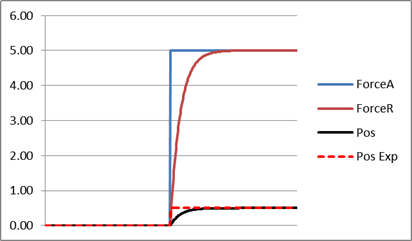
> RM: It turns out that the mass spring model in Figure 5-1 is a true control loop; the controlled variable is the restoring force, KsP, and this variable will be brought to the reference, FORCE, when FORCE is varied. There is actually no need for damping. I thought that there was a need for damping based on running the simulation using Bruce’s code. But just now, while fiddling around with it, I discovered an error in Bruce’s code that has led me to this incorrect conclusion. The error is tiny and very easy to miss but it makes all the difference. The code I was running was:Â
>
>  Acc = (ForceA - d \* Vel - s \* Pos ) / Mass
>
> Â Pos = Pos + (Vel + 0.5 \* Acc \* dt) \* dtÂ
>
> Â Vel = Vel + Acc \* dt
>
> The error is in the last statement. It should be  Vel = (Vel + Acc) \* dt. When this little change is made we have a true control system with reference ForceA (the equivalent of FORCE in Figure 5-1) and controlled variable s\*Pos (the equivalent of KsP in Figure 5-1). When I make this change I get results that are more like what I would expect when I push on a mass attached to a spring anchored at a wall. The results look like this:
>
> ForceA is my sudden applied force (equivalent to a sudden change in the reference FORCE in Figure 5-1). The result is that ForceR (the restoring force, which is s_Pos in the program and KsP in Figure 5-1) moves right up into a match with the applied force. And the position of the mass (Pos) moves to its expected position (Pos Exp) which is what is expected based on Hooke’s law: Pos Exp = 1/s_ForceA. This is the result you get with no damping, which is nice because I assume that the same thing would happen if I did the same push on a mass which had no damper.Â
>
> RM: The mass spring model in Figure 1 is a control system with a gain of 1.0. I tested the model with different gains and disturbances using the following code:
>
>  Acc = gain \* (ForceA - s \* Pos ) / Mass
>
> Â Pos = Pos + (Vel + 0.5 \* Acc \* dt) \* dt
>
> Â Vel = (Vel + Acc+dist) \* dt
>
> The gain parameter amplifies error (ForceA - s \* Pos ) into output (Acc) and the disturbance, dist, adds to output. And, sure enough, when you increase the gain above 1 you get a decrease in the effect of the disturbance on the controlled variable. But I don’t think this is not a very realistic control system since I don’t know what an increase the gain or a disturbance to the change in velocity caused by the acceleration of the mass could mean in the world of physical reality as we understand it.Â
>
> > BA: I think what may be leading you to believe that F in the diagram is equivalent to a reference is the fact that, after the force is applied, the system comes to rest at a position for which the spring reaction force equals the applied force.Â
>
> RM: Yes, that’s one thing. But the role it plays in the model is the main thing. If you read Figures 5-1 and 5-2 more carefully I think you would see that F not only **acts** like a reference, it was intended to **be** a reference in the model as described in the Figures.
>
> > BA: This makes it seem as though the system is setting a reference of F and then producing the same value as a reaction force when at equilibrium.Â
>
> RM: It not only looks that way; it is that way, as I have shown above.
>
> Â
>
> > BA: But you could draw the same conclusion when analyzing a proportional control system that resists an applied force – say, by applyiing current to a motor that pushes in the opposite direction. You set the reference for position and as the force tries to move the mass, the positional error generates a current to the motor and the motor pushes back. In the steady state, the remaining positional error will be just large enough to produce just enough current to generate just enough force in the motor to equal the disturbing force. Thus it would _appear_ that the applied force is setting a reference and that the system then produces this reference force.Â
>
> RM: I don’t think anyone who understands PCT would come to that conclusion. What they would see is that the mass remains in the same "resting"Â place , protected from the disturbance of the applied force. This is how you can tell that disturbances to the position of the mass in a mass spring system is not resisted. When you push or pull on the mass (apply a force disturbance) the disturbance is completely effective (as shown in my figure above). The force you apply (ForceA) changes the position of the mass (Pos) in exactly the way expected PosExp). So in this case the disturbance (ForceA) functions exactly as a reference specification for the position of the mass; and the effect of ForceA is modeled that way in Figure 5-1 of LCS III.Â
>
> > BA: But notice: the force produced by the system is not the force “specifiedâ€? by the supposed reference – it is of the same magnitude but _opposiite_ in direction. Its role in the system is to _oppose_ the applied force, which is what you expect in a negative feedback system, whether the passive mass-spring-damper system or a control system: a system actively opposing the effect of a disturbing force.
>
> Â RM: But in a pursuit tracking task the response “specified” by the supposed reference (which is actually the disturbance to the position of the target) is of the same magnitude and moves in the same direction. Yet it is still not a reference.
>
> RM: You might want to think about these things, Bruce, before you start your presentation of Bill arm model. But I see from my mail box that it may be too late. Ah well.
>
> Best
>
> Rick
>
> –
> Richard S. Marken, Ph.D.
> Author of  [Doing Research on Purpose](http://www.amazon.com/Doing-Research-Purpose-Experimental-Psychology/dp/0944337554/ref=sr_1_1?ie=UTF8&qid=1407342866&sr=8-1&keywords=doing+research+on+purpose).Â
> Now available from Amazon or Barnes & Noble
---
### Author:  [@Abbott](http://discourse.iapct.org/u/Abbott)
#### Post date: [February 12, 2015, 11:37pm UTC](http://discourse.iapct.org/t/giving-the-game-away-was-tail-wagging-the-dog/4769/10 "2015-02-12T23:37:00Z")
[From Bruce Abbott (2015.02.12.1835 EST)]
Rick Marken (2015.02.12.1305)
> Bruce Abbott (2015.02.11.2200 EST)
> AM: Look in LCSIII, page 86, you’ll see a similar diagram of a mass on a spring with damping, The F coming from the right is “the reference”, what is usually called “the input”. Other inputs are forces that act in the opposite direction - spring reaction and damping, very similar to a position-velocity cascade loop. The mass has the role of the “slowing factor”. Look at the delphi code
> BA: The force coming in from the right is the disturbance.
RM: I’m afraid Adam is correct. The force input, F, to the mass spring model on p. 86 of LCS III corresponds to a reference input to a negative feedback system. Perhaps this will be clearer to you if you look at the diagram in Figure 5-2 on p. 89, which shows FORCE as a “reference input” to the MASS SPRING ON DAMPING box below the gray line that divides the control system (above the line) from the environment (below it). The MASS SPRING ON DAMPING box contains the mass spring model that is shown in Figure 5-1, p. 86. The mass-spring model in Figure 5-1 is a model of the relevant part of the environment of the control system in Figure 5-2, as indicated by the fact that Figure 5-1 is in the section entitled “The Model of the Environment”. In fact the diagram in Figure 5-1 is a detailed look at the environmental feedback function – MASS SPRING ON DAMPING box – of the control system shown above the gray line in Figure 5-2.
BA: You are confused, as usual. Figure 5-2 on page 89 shows a control system designed to control the position of the mass. The top-level controller senses the difference between perception of the current position and generates an output the serves as the reference to a velocity control system. The velocity control system compares the current perceived velocity of the mass to this reference velocity and generates an output force that will act on the mass to change its velocity toward this reference level. This force acts on the mass (Acc = Force/Mass), to accelerate it, thus changing its velocity. Integrating velocity gives position, the perceptual input to the top level (position) controller. This two-level control system overrides the mass-spring-damper system’s natural tendency to come to equilibrium at the position at which the spring is relaxed, generating whatever force it needs to push the mass to its reference position.
RM: The FORCE, F, that enters the environment – the MASS SPRING BOX – is an actual physical force created by the output function of the feedback function. This makes sense since the reference and controlled variable in a negative feedback loop must be of the same type. Since the variable controlled in this control loop is a force – the restoring force of the spring, KsP – it is indeed the same type as the reference variable, FORCE: both are forces.
BA: Nope, not a reference variable, an output that exerts its effect in the environment.
RM: It turns out that the mass spring model in Figure 5-1 is a true control loop; the controlled variable is the restoring force, KsP, and this variable will be brought to the reference, FORCE, when FORCE is varied. There is actually no need for damping. I thought that there was a need for damping based on running the simulation using Bruce’s code. But just now, while fiddling around with it, I discovered an error in Bruce’s code that has led me to this incorrect conclusion. The error is tiny and very easy to miss but it makes all the difference. The code I was running was:
Acc = (ForceA - d \* Vel - s \* Pos ) / Mass
Pos = Pos + (Vel + 0.5 \* Acc \* dt) \* dt
Vel = Vel + Acc \* dt
The error is in the last statement. It should be Vel = (Vel + Acc) \* dt. When this little change is made we have a true control system with reference ForceA (the equivalent of FORCE in Figure 5-1) and controlled variable s\*Pos (the equivalent of KsP in Figure 5-1). When I make this change I get results that are more like what I would expect when I push on a mass attached to a spring anchored at a wall. The results look like this:
BA: There is no error in the code. In the line that computes the new position after each time-step, the part in parentheses is (1) the previous velocity, Vel, and (2) the change in velocity during the time-step (0.5_Acc_dt). The sum of old velocity plus change in velocity Is multiplied by the time-step, dt to convert velocity to the change in position during time-step dt.
BA: The reason for computing change in velocity using 0.5_Acc_dt is to improve the accuracy of the integration. The change in velocity during the interval is better approximated by the level of acceleration half-way into the interval than the level of acceleration at the end of the interval, which is what you would have if you simply used Acc\*dt.
BA: The computation of the change in velocity (third line) uses Acc\*dt rather than half that value as used in the computation of change in position is that you want the new velocity to depend on the terminal velocity at the end of the interval and not the approximately average acceleration.
BA: This is Bill’s code, but I suppose you will want us to believe that it’s another of his mistakes.
Bruce