# Imagination Connection
**URL:** http://discourse.iapct.org/t/imagination-connection/5531
**Category:** CSG2019
**Created:** [May 21, 2019, 7:37pm UTC](http://discourse.iapct.org/t/imagination-connection/5531 "2019-05-21T19:37:30Z")
**Posts on this page:** 20
**Page:** 1
### Author:  [@rsmarken](http://discourse.iapct.org/u/rsmarken)
#### Post date: [May 21, 2019, 7:37pm UTC](http://discourse.iapct.org/t/imagination-connection/5531/1 "2019-05-21T19:37:30Z")
[Rick Marken 2019-05-21\_12:37:05]
RM: I had an interesting conversation a couple days ago with Eva de Hullu, who has made some very nice diagrams of Powers’ hierarchical model. And one of these diagrams was of the “imagination connection”. It’s the diagram on the left in the figure below. Â
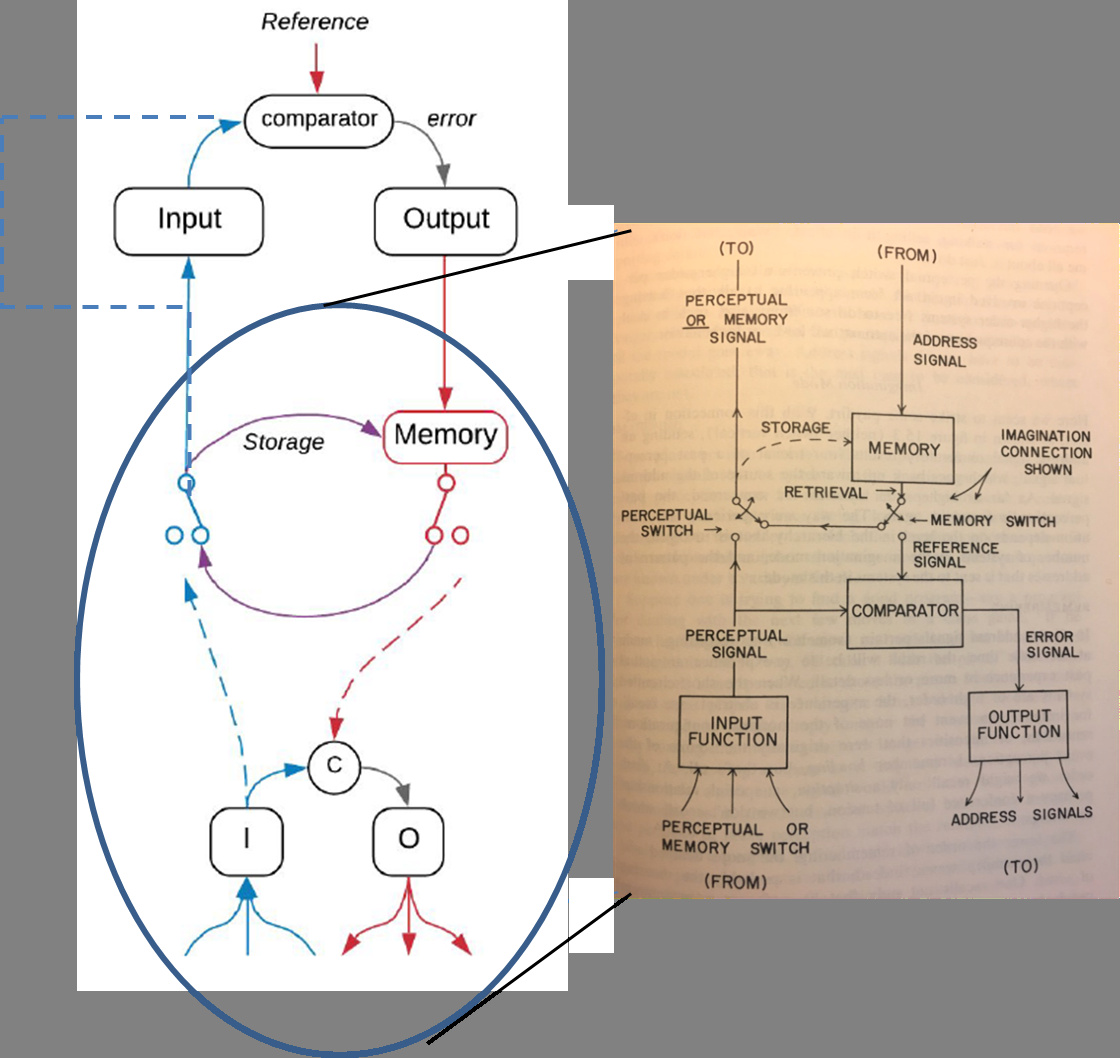
RM: At first I thought there was something wrong with Eva’s diagram because it shows the Output/Memory signal being short-circuited away from the reference to a lower level system (where it would go in normal “control” mode) back up into the Input function of the control system that is sending that Output/Memory signal. This seemed wrong to me because the Input function creates the perceptual signal – the one going into the comparator – from lower level perceptual inputs. So sending a remembered Output into the Input function would not create the perceptual signal specified by the reference signal. And imagination presumably occurs when a control system produces the perception specified by the reference signal without having to go through the outside world to get it.Â
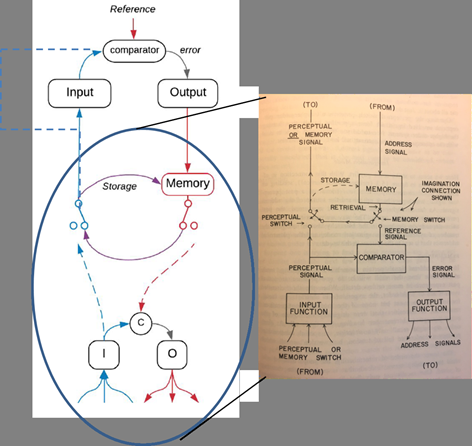
RM: So thinking that Eva’s figure was incorrect, I went to the diagram of the imagination connection in B:CP and found that it’s not clear whether the diagram is right or not. The diagram in B:CP (copied on the right side of the figure above) shows only the part of Eva’s diagram that I’ve circled. It’s not clear whether the “Perceptual or Memory Signal” in the B:CP diagram is going “To” an Input function or directly to the perceptual signal of the system from whence came the Output/Memory signal. I’ve drawn a dashed line in Eva’s diagram to show where I think the short-circuited Output/Memory signal should go.Â
RM: So I post this because I think Bill’s diagram of the imagination connection is not clear (to me anyway). What Bill calls the “Perceptual or Memory Signal” could be the input to the Input function of the system to which it is going (which is how Eva’s diagram shows it) or it could simply become the perceptual signal in that system (which is how my dashed line augmentation of Eva’s diagram shows it). Any ideas about the correct way to model imagination in PCT?Â
BestÂ
Rick
> **···**
>
> –
> Richard S. MarkenÂ
>
> "Perfection is achieved not when you have nothing more to add, but when you
> have nothing left to take away.�
> Â Â Â Â Â Â Â Â Â Â Â Â Â Â Â Â --Antoine de Saint-Exupery
---
### Author:  [@MartinT](http://discourse.iapct.org/u/MartinT)
#### Post date: [May 21, 2019, 10:08pm UTC](http://discourse.iapct.org/t/imagination-connection/5531/2 "2019-05-21T22:08:13Z")
[Martin Taylor 2019.05.21.18.02.03]
> [Rick Marken 2019-05-21\_12:37:05]
>
> ```
> RM: I had an interesting conversation a couple days ago with Eva
>
> ```
>
> de Hullu, who has made some very nice diagrams of Powers’
> hierarchical model. And one of these diagrams was of the
> “imagination connection”. It’s the diagram on the left in the
> figure below. Â
>
> 
>
> ```
> RM: At first I thought there was something wrong with
>
> ```
>
> Eva’s diagram because it shows the Output/Memory signal
> being short-circuited away from the reference to a lower
> level system (where it would go in normal “control” mode)
> back up into the Input function of the control system that
> is sending that Output/Memory signal. This seemed wrong to
> me because the Input function creates the perceptual
> signal – the one going into the comparator – from lower
> level perceptual inputs. So sending a remembered Output
> into the Input function would not create the perceptual
> signal specified by the reference signal. And imagination
> presumably occurs when a control system produces the
> perception specified by the reference signal without
> having to go through the outside world to get it.Â
>
> ```
> RM: So thinking that Eva's figure was incorrect, I went
>
> ```
>
> to the diagram of the imagination connection in B:CP and
> found that it’s not clear whether the diagram is right or
> not. The diagram in B:CP (copied on the right side of the
> figure above) shows only the part of Eva’s diagram that I’ve
> circled. It’s not clear whether the “Perceptual or Memory
> Signal” in the B:CP diagram is going “To” an Input function
> or directly to the perceptual signal of the system from
> whence came the Output/Memory signal. I’ve drawn a dashed
> line in Eva’s diagram to show where I think the
> short-circuited Output/Memory signal should go.Â
>
> ```
> RM: So I post this because I think Bill's diagram of the
>
> ```
>
> imagination connection is not clear (to me anyway). What
> Bill calls the “Perceptual or Memory Signal” could be the
> input to the Input function of the system to which it is
> going (which is how Eva’s diagram shows it) or it could
> simply become the perceptual signal in that system (which is
> how my dashed line augmentation of Eva’s diagram shows it).
> Any ideas about the correct way to model imagination in PCT?
```
You send the imagined output to the comparator of a lower-level
```
controller as a reference value. You get the input to the next level
from the lower-level perception. This implies that the effect of
imagination is to produce an action that influences something in the
environment that produces the desired perception to be provided by
that lower-level loop. That’s not imagining. Imagining does what
Eva’s diagram does – pretend that the lower level is doing its job
and producing the desired perception that is fed into the perceptual
input function of the upper level.
```
Martin
```
> **···**
>
> >
>
> > BestÂ
>
> > ```
> > Rick
> >
> > ```
>
> >
>
> > –
> > Richard S. MarkenÂ
>
> > ```
> > "Perfection
> >
> > ```
> >
> > is achieved not when you have
> > nothing more to add, but when you
> > have
> > nothing left to take away.�
> > Â Â Â
> > Â Â Â Â Â Â Â Â Â Â Â Â Â
> > –Antoine de Saint-Exupery
---
### Author:  [@rsmarken](http://discourse.iapct.org/u/rsmarken)
#### Post date: [May 22, 2019, 5:32am UTC](http://discourse.iapct.org/t/imagination-connection/5531/3 "2019-05-22T05:32:34Z")
[Rick Marken 2019-05-21\_22:32:14]
> [Martin Taylor 2019.05.21.18.02.03]
> > . Â
> > 
> >
> > ```
> > RM: ....It's not clear whether the "Perceptual or Memory
> >
> > ```
> >
> > Signal" in the B:CP diagram is going “To” an Input function
> > or directly to the perceptual signal of the system from
> > whence came the Output/Memory signal. I’ve drawn a dashed
> > line in Eva’s diagram to show where I think the
> > short-circuited Output/Memory signal should go.Â
> ```
> MT: You send the imagined output to the comparator of a lower-level
>
> ```
>
> controller as a reference value.
RM:Â Are you talking about the dashed red arrow going into the comparator of the lower level system? If so, that is part of Eva’s diagram and it corresponds to the reference signal arrow in Bill’s diagram. And it is not send to the lower level controller as a reference signal; note that there is a switch below the Memory unit that is connected to an arrow that brings the Output of the Memory unit right back up to the input of the system that produced the output. My suggestions is to route that returning Memory/Output signal around the Input function so that it becomes the perceptual signal in the higher order control system. This is what I was asking about; does that seem right? Why or why not?Â
RM: Bill’s diagram shows the Memory/ Output signal returning to the higher level system that produced that signal; but his diagram doesn’t show whether that signal returns through the Input function or simply become the perceptual signal (as shown by the dashed blue arrow that I added to Eva’s diagram.Â
BestÂ
Rick
> **···**
>
> > ```
> > You get the input to the next level
> >
> > ```
> >
> > from the lower-level perception. This implies that the effect of
> > imagination is to produce an action that influences something in the
> > environment that produces the desired perception to be provided by
> > that lower-level loop. That’s not imagining. Imagining does what
> > Eva’s diagram does – pretend that the lower level is doing its job
> > and producing the desired perception that is fed into the perceptual
> > input function of the upper level.
> >
> > ```
> > Martin
> >
> > ```
> >
> > >
>
> > > BestÂ
>
> > > ```
> > > Rick
> > >
> > > ```
>
> > >
>
> > > –
> > > Richard S. MarkenÂ
>
> > > ```
> > > "Perfection
> > >
> > > ```
> > >
> > > is achieved not when you have
> > > nothing more to add, but when you
> > > have
> > > nothing left to take away.�
> > > Â Â Â
> > > Â Â Â Â Â Â Â Â Â Â Â Â Â
> > > –Antoine de Saint-Exupery
>
> >
>
> –
> Richard S. MarkenÂ
>
> "Perfection is achieved not when you have nothing more to add, but when you
> have nothing left to take away.�
> Â Â Â Â Â Â Â Â Â Â Â Â Â Â Â Â --Antoine de Saint-Exupery
---
### Author:  [@EetuP](http://discourse.iapct.org/u/EetuP)
#### Post date: [May 22, 2019, 6:19am UTC](http://discourse.iapct.org/t/imagination-connection/5531/4 "2019-05-22T06:19:55Z")
[Eetu Pikkarainen 2019-05-22\_05:51:35 UTC]
> **···**
>
> [Rick Marken 2019-05-21\_22:32:14]
>
> > [Martin Taylor 2019.05.21.18.02.03].
>
> > RM: …It’s not clear whether the “Perceptual or Memory Signal” in the B:CP diagram is going “To” an Input function or directly to the perceptual signal of the system from whence came the Output/Memory signal.
> > I’ve drawn a dashed line in Eva’s diagram to show where I think the short-circuited Output/Memory signal should go.
>
> MT: You send the imagined output to the comparator of a lower-level controller as a reference value.
>
> RM: Are you talking about the dashed red arrow going into the comparator of the lower level system? If so, that is part of Eva’s diagram and it corresponds to the reference signal arrow in Bill’s diagram. And
> it is not send to the lower level controller as a reference signal; note that there is a switch below the Memory unit that is connected to an arrow that brings the Output of the Memory unit right back up to the input of the system that produced the output.
> My suggestions is to route that returning Memory/Output signal around the Input function so that it becomes the perceptual signal in the higher order control system. This is what I was asking about; does that seem right? Why or why not?
>
> RM: Bill’s diagram shows the Memory/ Output signal returning to the higher level system that produced that signal; but his diagram doesn’t show whether that signal returns through the Input function or simply
> become the perceptual signal (as shown by the dashed blue arrow that I added to Eva’s diagram.
>
> I think this is a very good question. An input function forms a perceptual signal from many lower level perceptions. If the memory/imagined signal goes to the input then it would be just like one among those many lower
> level perceptions. However it could be meant to be the imagined result that the input function forms from all those lower level perceptions if their control were successful. In the latter case the memory signal really should pass and overwrite the result of
> the input function.
>
> What I think is that the diagram in B:CP is a very rough simplification of a very much more complex phenomenon. Perhaps there must be those kind of switches somewhere but what sense and function there could be in imagination
> in one loop? Maybe it could work as a temporary defense mechanism in a situation of an overwhelming disturbance. Imagination as we think about it and as Powers described it somewhere in connected to consciousness and many levels of hierarchy. When we imagine
> we combine many possible lower level perceptions to some possible higher level perceptions. And in addition we often perceive our environment and control these perceptions at the same time we imagine that things could be differently. I am not sure does that
> really happen, but I feel so. Some data could be useful. If it happens so then those switches must be leaky.
>
> Confusedly
>
> Eetu
---
### Author:  [@Evadeh](http://discourse.iapct.org/u/Evadeh)
#### Post date: [May 22, 2019, 7:58am UTC](http://discourse.iapct.org/t/imagination-connection/5531/5 "2019-05-22T07:58:53Z")
[Eva de Hullu 2019-05-22\_07:58:20 UTC]
Hi all,
First, allow me to clarify. I just drew the diagram of the imagination mode in an effort to understand these modes, after reading B:CP. It is not ‘my model’.
I drew it based on this text by Bruce Abbot [http://users.ipfw.edu/abbott/pct/pct.html](https://urldefense.proofpoint.com/v2/url?u=http-3A__users.ipfw.edu_abbott_pct_pct.html&d=DwMFaQ&c=OCIEmEwdEq_aNlsP4fF3gFqSN-E3mlr2t9JcDdfOZag&r=G2rjwc9SjlT6Blyc8su_Md8P_xOsOTRMJ5teQVBC2qU&m=MWP6rcjL12KRo_1-qQOOSGU3-KL-CtNN2L0AEFdrGVk&s=3UrpRVeWMGocBmFcjMjE3N1SnpMQ32xB62oV5DHSXBM&e=) and this youtube presentation by Warren Mansell: [https://youtu.be/Z1USiP4qdAQ](https://urldefense.proofpoint.com/v2/url?u=https-3A__youtu.be_Z1USiP4qdAQ&d=DwMFaQ&c=OCIEmEwdEq_aNlsP4fF3gFqSN-E3mlr2t9JcDdfOZag&r=G2rjwc9SjlT6Blyc8su_Md8P_xOsOTRMJ5teQVBC2qU&m=MWP6rcjL12KRo_1-qQOOSGU3-KL-CtNN2L0AEFdrGVk&s=8ci14UPec37g-PnElS-w1i4sFFJO0SkncxWX_KhjTwg&e=) (see slide at 20:00 min). I believe the drawing is not different from that of Warren’s image, but then again, I don’t know if any deviations from Powers’ drawing were intentional.
The interesting point is that Rick perceives some error when looking at these diagrams. And it’s not simple: Eetu’s error even spans more of the hierarchy.
For me, this means that there’s room for improvement of our understanding or improvement of our models, and it’s fruitful to work on this together and see which perception fits best.
Eva

> **···**
>
> On Wed, May 22, 2019 at 8:20 AM Eetu Pikkarainen [csgnet@lists.illinois.edu](mailto:csgnet@lists.illinois.edu) wrote:
>
> > [Eetu Pikkarainen 2019-05-22\_05:51:35 UTC]
>
> >
>
> > [Rick Marken 2019-05-21\_22:32:14]
>
> > > [Martin Taylor 2019.05.21.18.02.03].
>
> > > ![image.png]()
>
> > >
>
> > > RM: …It’s not clear whether the “Perceptual or Memory Signal” in the B:CP diagram is going “To” an Input function or directly to the perceptual signal of the system from whence came the Output/Memory signal.
> > > I’ve drawn a dashed line in Eva’s diagram to show where I think the short-circuited Output/Memory signal should go.
>
> > MT: You send the imagined output to the comparator of a lower-level controller as a reference value.
>
> >
>
> > RM: Are you talking about the dashed red arrow going into the comparator of the lower level system? If so, that is part of Eva’s diagram and it corresponds to the reference signal arrow in Bill’s diagram. And
> > it is not send to the lower level controller as a reference signal; note that there is a switch below the Memory unit that is connected to an arrow that brings the Output of the Memory unit right back up to the input of the system that produced the output.
> > My suggestions is to route that returning Memory/Output signal around the Input function so that it becomes the perceptual signal in the higher order control system. This is what I was asking about; does that seem right? Why or why not?
>
> >
>
> > RM: Bill’s diagram shows the Memory/ Output signal returning to the higher level system that produced that signal; but his diagram doesn’t show whether that signal returns through the Input function or simply
> > become the perceptual signal (as shown by the dashed blue arrow that I added to Eva’s diagram.
>
> >
>
> > I think this is a very good question. An input function forms a perceptual signal from many lower level perceptions. If the memory/imagined signal goes to the input then it would be just like one among those many lower
> > level perceptions. However it could be meant to be the imagined result that the input function forms from all those lower level perceptions if their control were successful. In the latter case the memory signal really should pass and overwrite the result of
> > the input function.
>
> >
>
> > What I think is that the diagram in B:CP is a very rough simplification of a very much more complex phenomenon. Perhaps there must be those kind of switches somewhere but what sense and function there could be in imagination
> > in one loop? Maybe it could work as a temporary defense mechanism in a situation of an overwhelming disturbance. Imagination as we think about it and as Powers described it somewhere in connected to consciousness and many levels of hierarchy. When we imagine
> > we combine many possible lower level perceptions to some possible higher level perceptions. And in addition we often perceive our environment and control these perceptions at the same time we imagine that things could be differently. I am not sure does that
> > really happen, but I feel so. Some data could be useful. If it happens so then those switches must be leaky.
>
> >
>
> > Confusedly
>
> > Eetu
---
### Author:  [@MartinT](http://discourse.iapct.org/u/MartinT)
#### Post date: [May 22, 2019, 1:41pm UTC](http://discourse.iapct.org/t/imagination-connection/5531/6 "2019-05-22T13:41:04Z")
[Martin Taylor 2019.05.22.09.16]
```
Yes, I was. Sorry about that. I didn't notice the dashed line that
```
presumably short-circuits the input function of the higher level
loop (there are two dashed lines that go out of frame, and I’m
presuming they are connected off-screen).
But this seems to suggest a more fundamental problem with Bill’s
diagram, using either interpretation. The output of a control unit does not the reference
value of a unit at the next level below; it to
the lower-level reference value. The perceptual value sent up by the
lower-level unit in the normal non-imagined control mode will
usually not approximate the reference value sent down by that single
higher-level unit. In the imagination switch settings of the
diagram, however, the signal pretending to be the perceptual signal
sent up from the lower-level loop is what the lower-level would send
if it controlled perfectly and there were no contributions to its
reference value from other higher-level units. The two values sent
up to the higher level are different in imagination versus on-line
modes.
I think Eva had it right when she said [Eva de Hullu
2019-05-22\_07:58:20 UTC]:Martin

> **···**
>
> Sorry, I clearly misinterpreted the
> nature of the ambiguity you saw.
>
> > [Rick Marken 2019-05-21\_22:32:14]
>
> > > [Martin Taylor 2019.05.21.18.02.03]
>
> > > > .
>
> > > >
>
> > > >
>
> > > > ```
> > > > RM: ....It's not clear whether the "Perceptual
> > > >
> > > > ```
> > > >
> > > > or Memory Signal" in the B:CP diagram is going
> > > > “To” an Input function or directly to the
> > > > perceptual signal of the system from whence came
> > > > the Output/Memory signal. I’ve drawn a dashed line
> > > > in Eva’s diagram to show where I think the
> > > > short-circuited Output/Memory signal should go.
>
> > > ```
> > > MT: You send the imagined output to the comparator of a
> > >
> > > ```
> > >
> > > lower-level controller as a reference value.
>
> >
>
> > ```
> > RM: Are you talking about the dashed red arrow going
> >
> > ```
> >
> > into the comparator of the lower level system? …
>
> _define\*\*contributes_
>
> -
>
> ```
> For me, this means that there's room for
>
> ```
>
> improvement of our understanding or improvement of our models, and
> it’s fruitful to work on this together and see which perception
> fits best.
>
> -
---
### Author:  [@rsmarken](http://discourse.iapct.org/u/rsmarken)
#### Post date: [May 22, 2019, 10:12pm UTC](http://discourse.iapct.org/t/imagination-connection/5531/7 "2019-05-22T22:12:37Z")
[Rick Marken 2019-05-22\_15:12:17]
> [Eva de Hullu 2019-05-22\_07:58:20 UTC]
> EdH: The interesting point is that Rick perceives some error when looking at these diagrams. And it’s not simple: Eetu’s error even spans more of the hierarchy. For me, this means that there’s room for improvement of our understanding or improvement of our models, and it’s fruitful to work on this together and see which perception fits best.
RM: Exactly. But I’m sorry if you got the impression that I was finding something wrong with your diagrams. Your diagrams are masterpieces (what else would one expect from the land of Rembrandt and Vermeer;-)Â And correct in terms of the descriptions you had available from others. They were so good that they allowed me to see an ambiguity in Bill’s diagram of the imagination connection in B:CP. I realized that it was not clear whether his diagram meant that the rerouted output of a control system in imagination mode goes back into the input function of that same control system (as shown in your diagram) or directly into the perceptual signal. It could be either one. But I think it makes more sense for it to go directly into the perceptual signal. I have set up my hierarchy spreadsheet this way and it works like a charm. Actually, I can’t see it working any other way.
BestÂ
Rick

> **···**
>
> –
> Richard S. MarkenÂ
>
> "Perfection is achieved not when you have nothing more to add, but when you
> have nothing left to take away.â?
> Â Â Â Â Â Â Â Â Â Â Â Â Â Â Â Â --Antoine de Saint-Exupery
---
### Author:  [@bnhpct](http://discourse.iapct.org/u/bnhpct)
#### Post date: [May 23, 2019, 1:15pm UTC](http://discourse.iapct.org/t/imagination-connection/5531/8 "2019-05-23T13:15:18Z")
[Bruce Nevin 20190523.0852 ET]
What we are puzzling over is how the error output from above becomes a reference signal below.Â
At the point where it enters the “Memory” box in the diagram it is an error output signal (or many error outputs). The error says how much of the signal that is stored in “Memory” is required by the system(s) above that are issuing the error signals to that reference input.
At the point where it exits the “Memory” box it is a reference signal for the lower system, a remembered perceptual input with which the current perceptual input is to be made to conform. That’s why when the hypothesized imagination connection shunts it over to the input side it serves perfectly as perceptual input.
That “Memory” box is a reference input function. The reference input function combines a plurality of error signals into a single firing rate, the amount that is to be perceived of whatever perceptual input the lower system controls.
The “Memory” label comes from a confusion about the objective firing rate (“reference signal” and “perceptual signal”) and the subjective experience that is associated with that firing rate (“desire” and “perception”). Slipping with unconscious equivocation between the model and the experience in order to communicate in effective terms what it means to us to control, Bill’s account in B:CP says that the memory of the perception is stored there and the input from higher-level error only specifies the amount of that remembered perception. The fact of that memory is given solely by its location relative to other control systems in the hierarchy; the experience of that memory is something that PCT explains just as satisfactorily as it explains the experience associated with a perceptual input signal.
Just as we distinguish “perceptual signal” from “perception”, we must distinguish “reference signal” from “Memory”. The simple fact that the reference signal is input to the same comparator as a particular perceptual signal in the objective terms of the model is what makes that reference signal a “memory” of that “perception” in subjective experience.
Perceptual input functions and reference input functions mirror each other. In both cases, a plurality of quantitative inputs are somehow made into a single quantity which is input to a comparator, one from above, the other from below. These two kinds of input functions occasion a great deal of the hand-waving in PCT .
> **···**
>
> On Wed, May 22, 2019 at 6:13 PM Richard Marken [csgnet@lists.illinois.edu](mailto:csgnet@lists.illinois.edu) wrote:
>
> > [Rick Marken 2019-05-22\_15:12:17]
>
> >
>
> > > [Eva de Hullu 2019-05-22\_07:58:20 UTC]
>
> > > EdH: The interesting point is that Rick perceives some error when looking at these diagrams. And it’s not simple: Eetu’s error even spans more of the hierarchy. For me, this means that there’s room for improvement of our understanding or improvement of our models, and it’s fruitful to work on this together and see which perception fits best.
>
> >
>
> > RM: Exactly. But I’m sorry if you got the impression that I was finding something wrong with your diagrams. Your diagrams are masterpieces (what else would one expect from the land of Rembrandt and Vermeer;-)Â And correct in terms of the descriptions you had available from others. They were so good that they allowed me to see an ambiguity in Bill’s diagram of the imagination connection in B:CP. I realized that it was not clear whether his diagram meant that the rerouted output of a control system in imagination mode goes back into the input function of that same control system (as shown in your diagram) or directly into the perceptual signal. It could be either one. But I think it makes more sense for it to go directly into the perceptual signal. I have set up my hierarchy spreadsheet this way and it works like a charm. Actually, I can’t see it working any other way.
>
> >
>
> > BestÂ
>
> >
>
> > Rick
>
> > –
> > Richard S. MarkenÂ
>
> > "Perfection is achieved not when you have nothing more to add, but when you
> > have nothing left to take away.�
> > Â Â Â Â Â Â Â Â Â Â Â Â Â Â Â Â --Antoine de Saint-Exupery
---
### Author:  [@MartinT](http://discourse.iapct.org/u/MartinT)
#### Post date: [May 23, 2019, 6:04pm UTC](http://discourse.iapct.org/t/imagination-connection/5531/9 "2019-05-23T18:04:28Z")
[Martin Taylor 2019.05.23]
```
Are you saying that the "Memory" module is the reference input
```
function of the lower-level system? That certainly is worth
considering, but it’s a novel concept.
Ah, yes. I see that you do. It takes its inputs from the outputs of
all the upper-level units to which the “imagined” perception
contributes when it is not being imagined.
Yes. You seem to be restating from a different starting point an
idea that Rick squashed when I proposed it, that the control
hierarchy should be considered vectorially rather than in the scalar
fashion in which it is normally discussed. The Memory as an
associative memory addressed by the multiple outputs of one level
with the result distributed to multiple reference inputs of the
level below seems to be a logical consequence of Bill’s discussion
of the associative memory, though not necessarily of the diagram
under discussion. In its simple form, this way of looking at it has
the same issues as does looking at the neural current rather than at
the distribution of contributions of many neurons to that current.
The spread matters, in the same way that reciting the average income
tells you nothing about the spread between the incomes of the
richest and the poorest.
Martin
> **···**
>
> > ```
> > [Bruce Nevin
> >
> > ```
> >
> > 20190523.0852 ET]
>
> >
>
> > ```
> > What we are
> >
> > ```
> >
> > puzzling over is how the error output from above becomes a
> > reference signal below.Â
>
> >
>
> > ```
> > At the point
> >
> > ```
> >
> > where it enters the “Memory” box in the diagram it is an error
> > output signal (or many error outputs). The error says how much
> > of the signal that is stored in “Memory” is required by the
> > system(s) above that are issuing the error signals to that
> > reference input.
>
> >
>
> > ```
> > At the point
> >
> > ```
> >
> > where it exits the “Memory” box it is a reference signal for
> > the lower system,
>
> > ```
> > a
> >
> > ```
> >
> > remembered perceptual input with which the current perceptual
> > input is to be made to conform. That’s why when the
> > hypothesized imagination connection shunts it over to the
> > input side it serves perfectly as perceptual input.
>
> >
>
> > ```
> > That
> >
> > ```
> >
> > “Memory” box is a reference input function. The reference
> > input function combines a plurality of error signals into a
> > single firing rate, the amount that is to be perceived of
> > whatever perceptual input the lower system controls.
>
> >
>
> > ```
> > The "Memory"
> >
> > ```
> >
> > label comes from a confusion about the objective firing rate
> > (“reference signal” and “perceptual signal”) and the
> > subjective experience that is associated with that firing rate
> > (“desire” and “perception”). Slipping with unconscious
> > equivocation between the model and the experience in order to
> > communicate in effective terms what it means to us to control,
> > Bill’s account in B:CP says that the memory of the perception
> > is stored there and the input from higher-level error only
> > specifies the amount of that remembered perception. The fact
> > of that memory is given solely by its location relative to
> > other control systems in the hierarchy; the experience of that
> > memory is something that PCT explains just as satisfactorily
> > as it explains the experience associated with a perceptual
> > input signal.
>
> >
>
> > ```
> > Just as we
> >
> > ```
> >
> > distinguish “perceptual signal” from “perception”, we must
> > distinguish “reference signal” from “Memory”. The simple fact
> > that the reference signal is input to the same comparator as a
> > particular perceptual signal in the objective terms of the
> > model is what makes that reference signal a “memory” of that
> > “perception” in subjective experience.
>
> >
>
> > ```
> > Perceptual
> >
> > ```
> >
> > input functions and reference input functions mirror each
> > other. In both cases, a plurality of quantitative inputs are
> > somehow made into a single quantity which is input to a
> > comparator, one from above, the other from below. These two
> > kinds of input functions occasion a great deal of the
> > hand-waving in PCT .
>
> >
>
> > ```
> > On Wed, May 22, 2019 at 6:13
> >
> > ```
> >
> > PM Richard Marken \
> > wrote:
>
> > > [Rick Marken 2019-05-22\_15:12:17]
>
> > >
>
> > > > [Eva de Hullu 2019-05-22\_07:58:20 UTC]
>
> > > > ```
> > > > EdH: The interesting point is that Rick perceives
> > > >
> > > > ```
> > > >
> > > > some error when looking at these diagrams. And
> > > > it’s not simple: Eetu’s error even spans more of
> > > > the hierarchy. For me, this means that there’s
> > > > room for improvement of our understanding or
> > > > improvement of our models, and it’s fruitful to
> > > > work on this together and see which perception
> > > > fits best.
>
> > >
>
> > > ```
> > > RM: Exactly. But I'm sorry if you got the impression
> > >
> > > ```
> > >
> > > that I was finding something wrong with your diagrams.
> > > Your diagrams are masterpieces (what else would one
> > > expect from the land of Rembrandt and Vermeer;-)Â And
> > > correct in terms of the descriptions you had available
> > > from others. They were so good that they allowed me to
> > > see an ambiguity in Bill’s diagram of the imagination
> > > connection in B:CP. I realized that it was not clear
> > > whether his diagram meant that the rerouted output of a
> > > control system in imagination mode goes back into the
> > > input function of that same control system (as shown in
> > > your diagram) or directly into the perceptual signal. It
> > > could be either one. But I think it makes more sense for
> > > it to go directly into the perceptual signal. I have set
> > > up my hierarchy spreadsheet this way and it works like a
> > > charm. Actually, I can’t see it working any other way.
>
> > >
>
> > > BestÂ
>
> > >
>
> > > Rick
>
> > > –
> > > Richard S. MarkenÂ
>
> > > ```
> > > "Perfection
> > >
> > > ```
> > >
> > > is achieved not when you have
> > > nothing more to add, but when
> > > you
> > > have
> > > nothing left to take away.�
> > > Â Â
> > > Â Â Â Â Â Â Â Â Â Â Â Â Â Â
> > > –Antoine de Saint-Exupery
---
### Author:  [@rsmarken](http://discourse.iapct.org/u/rsmarken)
#### Post date: [May 23, 2019, 8:31pm UTC](http://discourse.iapct.org/t/imagination-connection/5531/10 "2019-05-23T20:31:36Z")
[Rick Marken 2019-05-23\_13:31:17]
> [Bruce Nevin 20190523.0852 ET]
>
> BN: What we are puzzling over is how the error output from above becomes a reference signal below.Â
RM: No, I was actually puzzling over how the output of a control systems becomes the perceptual signal in that same control system when the system is in imagination mode. The imagination mode model is meant to account for the subjective phenomenon of imagining something “on purpose”. For example, I can, at this very moment, imagine that there is an apple on my desk. The imagination model explains this as me setting a reference for the perception of an apple which produces an error that creates an output that is routed right back into the input of that control system and, voila, I perceive (in imagination) an apple without doing all that pain in the ass lower level controlling I would have to do (walking to the kitchen, opening the refrigerator, looking in the fruit compartment, etc) to actually get an apple onto my desk.Â
RM: The puzzle was whether this rerouting of the output to the input of a control system goes back through the input function of the control system or bypasses the input function to directly become the perceptual signal of that control system. My hierarchy model shows that this second approach – routing the output signal right back as the perceptual signal – works rather nicely. In fact I don’t believe it could be done any other way. That is, I don’t think there is any other way for the reference signal to produce exactly the perception it wants in imagination model. The imagination connection must work this way because there is no way a single output signal could line up all the appropriate inputs to the input function in order to produce the perceptual signal demanded by the reference signal.
RM: However, at first it didn’t seem intuitively obvious to me that rerouting the output as the perceptual signal would produce the exact perception demanded by the reference signal. But then I remembered the simple algebraic expression for the output of a control system is:
o = r -1/k(d)
RM: And since, in imagination mode, there is no d, then o = r. So if o goes right back to become the perceptual signal we get r = p; that is, the reference signal gets precisely the perception it wants. Or, as the Rolling Stones would say, in imagination mode “You _can_ always git what you want, but if you try and try you _won’t_ git what you need” because you are not actually controlling anything about the real world out there.
RM: By the way, since Warren asked, I’ve attached the spreadsheet hierarchy model where each system can be placed into imagination model by placing an asterisk above the system. What you will see when you do this is that the system in imagination mode produces output that is equal to the reference (as per the equation above); and this output becomes the perceptual signal so the system is getting exactly what it wants. And this is true even when the reference to the system is continuously changing, a fact that is particularly noticeable if you put one of the level 1 systems into imagination mode. Â
RM: I’m going to try to extend this spreadsheet to show that while a system gets what it wants when it controls in imagination mode, the aspect of the environment that it would be controlling if the system were not controlling in imagination is not what the system needs. To do this, I have to correctly compute the controlled variables; right now they are the same as the perceptions that are controlled. But if you are controlling a variable in imagination, an observer would see that that variable is not being controlled. I want the spreadsheet to should that.Â
Best
Rick
Â
[newhierarchy1.xlsx](http://discourse.iapct.org/uploads/short-url/5R00yVlVyExdNtV5RcQMI5yTyni.xlsx) (19.1 KB)
> **···**
>
> > At the point where it enters the “Memory” box in the diagram it is an error output signal (or many error outputs). The error says how much of the signal that is stored in “Memory” is required by the system(s) above that are issuing the error signals to that reference input.
>
> >
>
> > At the point where it exits the “Memory” box it is a reference signal for the lower system, a remembered perceptual input with which the current perceptual input is to be made to conform. That’s why when the hypothesized imagination connection shunts it over to the input side it serves perfectly as perceptual input.
>
> >
>
> > That “Memory” box is a reference input function. The reference input function combines a plurality of error signals into a single firing rate, the amount that is to be perceived of whatever perceptual input the lower system controls.
>
> >
>
> > The “Memory” label comes from a confusion about the objective firing rate (“reference signal” and “perceptual signal”) and the subjective experience that is associated with that firing rate (“desire” and “perception”). Slipping with unconscious equivocation between the model and the experience in order to communicate in effective terms what it means to us to control, Bill’s account in B:CP says that the memory of the perception is stored there and the input from higher-level error only specifies the amount of that remembered perception. The fact of that memory is given solely by its location relative to other control systems in the hierarchy; the experience of that memory is something that PCT explains just as satisfactorily as it explains the experience associated with a perceptual input signal.
>
> >
>
> > Just as we distinguish “perceptual signal” from “perception”, we must distinguish “reference signal” from “Memory”. The simple fact that the reference signal is input to the same comparator as a particular perceptual signal in the objective terms of the model is what makes that reference signal a “memory” of that “perception” in subjective experience.
>
> >
>
> > Perceptual input functions and reference input functions mirror each other. In both cases, a plurality of quantitative inputs are somehow made into a single quantity which is input to a comparator, one from above, the other from below. These two kinds of input functions occasion a great deal of the hand-waving in PCT .
>
> >
>
> > On Wed, May 22, 2019 at 6:13 PM Richard Marken [csgnet@lists.illinois.edu](mailto:csgnet@lists.illinois.edu) wrote:
>
> > > [Rick Marken 2019-05-22\_15:12:17]
>
> > >
>
> > > > [Eva de Hullu 2019-05-22\_07:58:20 UTC]
>
> > > > EdH: The interesting point is that Rick perceives some error when looking at these diagrams. And it’s not simple: Eetu’s error even spans more of the hierarchy. For me, this means that there’s room for improvement of our understanding or improvement of our models, and it’s fruitful to work on this together and see which perception fits best.
>
> > >
>
> > > RM: Exactly. But I’m sorry if you got the impression that I was finding something wrong with your diagrams. Your diagrams are masterpieces (what else would one expect from the land of Rembrandt and Vermeer;-)Â And correct in terms of the descriptions you had available from others. They were so good that they allowed me to see an ambiguity in Bill’s diagram of the imagination connection in B:CP. I realized that it was not clear whether his diagram meant that the rerouted output of a control system in imagination mode goes back into the input function of that same control system (as shown in your diagram) or directly into the perceptual signal. It could be either one. But I think it makes more sense for it to go directly into the perceptual signal. I have set up my hierarchy spreadsheet this way and it works like a charm. Actually, I can’t see it working any other way.
>
> > >
>
> > > BestÂ
>
> > >
>
> > > Rick
>
> > > –
> > > Richard S. MarkenÂ
>
> > > "Perfection is achieved not when you have nothing more to add, but when you
> > > have nothing left to take away.�
> > > Â Â Â Â Â Â Â Â Â Â Â Â Â Â Â Â --Antoine de Saint-Exupery
>
> –
> Richard S. MarkenÂ
>
> "Perfection is achieved not when you have nothing more to add, but when you
> have nothing left to take away.�
> Â Â Â Â Â Â Â Â Â Â Â Â Â Â Â Â --Antoine de Saint-Exupery
---
### Author:  [@MartinT](http://discourse.iapct.org/u/MartinT)
#### Post date: [May 23, 2019, 9:21pm UTC](http://discourse.iapct.org/t/imagination-connection/5531/11 "2019-05-23T21:21:50Z")
[Martin Taylor 2019.05.23.17.12]
> [Rick Marken 2019-05-23\_13:31:17]
>
> > ```
> > [Bruce
> >
> > ```
> >
> > Nevin 20190523.0852 ET]
> >
> > ```
> > BN:
> >
> > ```
> >
> > What we are puzzling over is how the error output from
> > above becomes a reference signal below.Â
>
> ```
> RM: No, I was actually puzzling over how the output of a
>
> ```
>
> control systems becomes the perceptual signal in that same
> control system when the system is in imagination mode.
```
We puzzle over different things, but the solution to one puzzle can
```
lead to answers to another, and I think that your suggestion here
does open up some avenues of thought that were not available. In
your model, it isn’t the lower system that is in imagination mode,
as I had interpreted Bill’s diagram. It’s the upper loop that is
doing the imagining.
```
Thank you.
Martin
```
> **···**
>
> > ```
> > The imagination mode model is meant to account for the
> >
> > ```
> >
> > subjective phenomenon of imagining something “on purpose”.
> > For example, I can, at this very moment, imagine that there
> > is an apple on my desk. The imagination model explains this
> > as me setting a reference for the perception of an apple
> > which produces an error that creates an output that is
> > routed right back into the input of that control system and,
> > voila, I perceive (in imagination) an apple without doing
> > all that pain in the ass lower level controlling I would
> > have to do (walking to the kitchen, opening the
> > refrigerator, looking in the fruit compartment, etc) to
> > actually get an apple onto my desk.Â
>
> >
>
> > ```
> > RM: The puzzle was whether this rerouting of the output
> >
> > ```
> >
> > to the input of a control system goes back through the input
> > function of the control system or bypasses the input
> > function to directly become the perceptual signal of that
> > control system. My hierarchy model shows that this second
> > approach – routing the output signal right back as the
> > perceptual signal – works rather nicely. In fact I don’t
> > believe it could be done any other way. That is, I don’t
> > think there is any other way for the reference signal to
> > produce exactly the perception it wants in imagination
> > model. The imagination connection must work this way because
> > there is no way a single output signal could line up all
> > the appropriate inputs to the input function in order to
> > produce the perceptual signal demanded by the reference
> > signal.
>
> >
>
> > ```
> > RM: However, at first it didn't seem intuitively obvious
> >
> > ```
> >
> > to me that rerouting the output as the perceptual signal
> > would produce the exact perception demanded by the reference
> > signal. But then I remembered the simple algebraic
> > expression for the output of a control system is:
>
> >
>
> > o = r -1/k(d)
>
> >
>
> > ```
> > RM: And since, in imagination mode, there is no d, then o
> >
> > ```
> >
> > = r. So if o goes right back to become the perceptual signal
> > we get r = p; that is, the reference signal gets precisely
> > the perception it wants. Or, as the Rolling Stones would
> > say, in imagination mode “You _can_ always git what you
> > want, but if you try and try you _won’t_ git what you
> > need” because you are not actually controlling anything
> > about the real world out there.
>
> >
>
> > ```
> > RM: By the way, since Warren asked, I've attached the
> >
> > ```
> >
> > spreadsheet hierarchy model where each system can be placed
> > into imagination model by placing an asterisk above the
> > system. What you will see when you do this is that the
> > system in imagination mode produces output that is equal to
> > the reference (as per the equation above); and this output
> > becomes the perceptual signal so the system is getting
> > exactly what it wants. And this is true even when the
> > reference to the system is continuously changing, a fact
> > that is particularly noticeable if you put one of the level
> > 1 systems into imagination mode. Â
>
> >
>
> > ```
> > RM: I'm going to try to extend this spreadsheet to show
> >
> > ```
> >
> > that while a system gets what it wants when it controls in
> > imagination mode, the aspect of the environment that it
> > would be controlling if the system were not controlling in
> > imagination is not what the system needs. To do this, I have
> > to correctly compute the controlled variables; right now
> > they are the same as the perceptions that are controlled.
> > But if you are controlling a variable in imagination, an
> > observer would see that that variable is not being
> > controlled. I want the spreadsheet to should that.Â
>
> >
>
> > Best
>
> >
>
> > Rick
>
> > Â
>
> > > ```
> > > At
> > >
> > > ```
> > >
> > > the point where it enters the “Memory” box in the
> > > diagram it is an error output signal (or many error
> > > outputs). The error says how much of the signal that is
> > > stored in “Memory” is required by the system(s) above
> > > that are issuing the error signals to that reference
> > > input.
>
> > >
>
> > > ```
> > > At
> > >
> > > ```
> > >
> > > the point where it exits the “Memory” box it is a
> > > reference signal for the lower system, a remembered
> > > perceptual input with which the current perceptual input
> > > is to be made to conform. That’s why when the
> > > hypothesized imagination connection shunts it over to
> > > the input side it serves perfectly as perceptual input.
>
> > >
>
> > > ```
> > > That
> > >
> > > ```
> > >
> > > “Memory” box is a reference input function. The
> > > reference input function combines a plurality of error
> > > signals into a single firing rate, the amount that is to
> > > be perceived of whatever perceptual input the lower
> > > system controls.
>
> > >
>
> > > ```
> > > The
> > >
> > > ```
> > >
> > > “Memory” label comes from a confusion about the
> > > objective firing rate (“reference signal” and
> > > “perceptual signal”) and the subjective experience that
> > > is associated with that firing rate (“desire” and
> > > “perception”). Slipping with unconscious equivocation
> > > between the model and the experience in order to
> > > communicate in effective terms what it means to us to
> > > control, Bill’s account in B:CP says that the memory of
> > > the perception is stored there and the input from
> > > higher-level error only specifies the amount of that
> > > remembered perception. The fact of that memory is given
> > > solely by its location relative to other control systems
> > > in the hierarchy; the experience of that memory is
> > > something that PCT explains just as satisfactorily as it
> > > explains the experience associated with a perceptual
> > > input signal.
>
> > >
>
> > > ```
> > > Just
> > >
> > > ```
> > >
> > > as we distinguish “perceptual signal” from “perception”,
> > > we must distinguish “reference signal” from “Memory”.
> > > The simple fact that the reference signal is input to
> > > the same comparator as a particular perceptual signal in
> > > the objective terms of the model is what makes that
> > > reference signal a “memory” of that “perception” in
> > > subjective experience.
>
> > >
>
> > > ```
> > > Perceptual
> > >
> > > ```
> > >
> > > input functions and reference input functions mirror
> > > each other. In both cases, a plurality of quantitative
> > > inputs are somehow made into a single quantity which is
> > > input to a comparator, one from above, the other from
> > > below. These two kinds of input functions occasion a
> > > great deal of the hand-waving in PCT .
>
> > >
>
> > > ```
> > > On Wed, May 22, 2019 at > > 6:13 PM Richard Marken > > wrote:
> > >
> > > ```
>
> > > > [Rick Marken 2019-05-22\_15:12:17]
>
> > > >
>
> > > > > [Eva de Hullu 2019-05-22\_07:58:20 UTC]
>
> > > > > ```
> > > > > EdH: The interesting point is that Rick
> > > > >
> > > > > ```
> > > > >
> > > > > perceives some error when looking at these
> > > > > diagrams. And it’s not simple: Eetu’s error
> > > > > even spans more of the hierarchy. For me,
> > > > > this means that there’s room for improvement
> > > > > of our understanding or improvement of our
> > > > > models, and it’s fruitful to work on this
> > > > > together and see which perception fits best.
>
> > > >
>
> > > > ```
> > > > RM: Exactly. But I'm sorry if you got the
> > > >
> > > > ```
> > > >
> > > > impression that I was finding something wrong with
> > > > your diagrams. Your diagrams are masterpieces
> > > > (what else would one expect from the land of
> > > > Rembrandt and Vermeer;-)Â And correct in terms of
> > > > the descriptions you had available from others.
> > > > They were so good that they allowed me to see an
> > > > ambiguity in Bill’s diagram of the imagination
> > > > connection in B:CP. I realized that it was not
> > > > clear whether his diagram meant that the rerouted
> > > > output of a control system in imagination mode
> > > > goes back into the input function of that same
> > > > control system (as shown in your diagram) or
> > > > directly into the perceptual signal. It could be
> > > > either one. But I think it makes more sense for it
> > > > to go directly into the perceptual signal. I have
> > > > set up my hierarchy spreadsheet this way and it
> > > > works like a charm. Actually, I can’t see it
> > > > working any other way.
>
> > > >
>
> > > > BestÂ
>
> > > >
>
> > > > Rick
>
> > > > –
> > > > Richard S.
> > > > MarkenÂ
>
> > > > ```
> > > > "Perfection
> > > >
> > > > ```
> > > >
> > > > is achieved not when you
> > > > have nothing more to add,
> > > > but when you
> > > > have
> > > > nothing left to take
> > > > away.�
> > > > Â
> > > > Â Â Â Â Â Â Â Â Â Â Â Â Â
> > > > Â Â --Antoine de
> > > > Saint-Exupery
>
> >
>
> > –
> > Richard S. MarkenÂ
>
> > ```
> > "Perfection
> >
> > ```
> >
> > is achieved not when you have
> > nothing more to add, but when you
> > have
> > nothing left to take away.�
> > Â Â Â Â
> > Â Â Â Â Â Â Â Â Â Â Â Â --Antoine de
> > Saint-Exupery
---
### Author:  [@bnhpct](http://discourse.iapct.org/u/bnhpct)
#### Post date: [May 23, 2019, 9:40pm UTC](http://discourse.iapct.org/t/imagination-connection/5531/12 "2019-05-23T21:40:10Z")
[Bruce Nevin 20190523.0852 ET]Â
> Â Rick Marken 2019-05-23\_13:31:17–
>
> RM: No, I was actually puzzling over how the output of a control systems becomes the perceptual signal in that same control system when the system is in imagination mode.Â
 The “Memory” box is not part of the same control system. It is part of a system or systems at the level below it.
> **···**
>
> > /Bruce
>
> > Â
>
> On Thu, May 23, 2019 at 4:32 PM Richard Marken [csgnet@lists.illinois.edu](mailto:csgnet@lists.illinois.edu) wrote:
>
> > [Rick Marken 2019-05-23\_13:31:17]
>
> >
>
> > > [Bruce Nevin 20190523.0852 ET]
>
> > >
>
> > > BN: What we are puzzling over is how the error output from above becomes a reference signal below.Â
>
> >
>
> > RM: No, I was actually puzzling over how the output of a control systems becomes the perceptual signal in that same control system when the system is in imagination mode. The imagination mode model is meant to account for the subjective phenomenon of imagining something “on purpose”. For example, I can, at this very moment, imagine that there is an apple on my desk. The imagination model explains this as me setting a reference for the perception of an apple which produces an error that creates an output that is routed right back into the input of that control system and, voila, I perceive (in imagination) an apple without doing all that pain in the ass lower level controlling I would have to do (walking to the kitchen, opening the refrigerator, looking in the fruit compartment, etc) to actually get an apple onto my desk.Â
>
> >
>
> > RM: The puzzle was whether this rerouting of the output to the input of a control system goes back through the input function of the control system or bypasses the input function to directly become the perceptual signal of that control system. My hierarchy model shows that this second approach – routing the output signal right back as the perceptual signal – works rather nicely. In fact I don’t believe it could be done any other way. That is, I don’t think there is any other way for the reference signal to produce exactly the perception it wants in imagination model. The imagination connection must work this way because there is no way a single output signal could line up all the appropriate inputs to the input function in order to produce the perceptual signal demanded by the reference signal.
>
> >
>
> > RM: However, at first it didn’t seem intuitively obvious to me that rerouting the output as the perceptual signal would produce the exact perception demanded by the reference signal. But then I remembered the simple algebraic expression for the output of a control system is:
>
> >
>
> > o = r -1/k(d)
>
> >
>
> > RM: And since, in imagination mode, there is no d, then o = r. So if o goes right back to become the perceptual signal we get r = p; that is, the reference signal gets precisely the perception it wants. Or, as the Rolling Stones would say, in imagination mode “You _can_ always git what you want, but if you try and try you _won’t_ git what you need” because you are not actually controlling anything about the real world out there.
>
> >
>
> > RM: By the way, since Warren asked, I’ve attached the spreadsheet hierarchy model where each system can be placed into imagination model by placing an asterisk above the system. What you will see when you do this is that the system in imagination mode produces output that is equal to the reference (as per the equation above); and this output becomes the perceptual signal so the system is getting exactly what it wants. And this is true even when the reference to the system is continuously changing, a fact that is particularly noticeable if you put one of the level 1 systems into imagination mode. Â
>
> >
>
> > RM: I’m going to try to extend this spreadsheet to show that while a system gets what it wants when it controls in imagination mode, the aspect of the environment that it would be controlling if the system were not controlling in imagination is not what the system needs. To do this, I have to correctly compute the controlled variables; right now they are the same as the perceptions that are controlled. But if you are controlling a variable in imagination, an observer would see that that variable is not being controlled. I want the spreadsheet to should that.Â
>
> >
>
> > Best
>
> >
>
> > Rick
>
> > Â
>
> > > At the point where it enters the “Memory” box in the diagram it is an error output signal (or many error outputs). The error says how much of the signal that is stored in “Memory” is required by the system(s) above that are issuing the error signals to that reference input.
>
> > >
>
> > > At the point where it exits the “Memory” box it is a reference signal for the lower system, a remembered perceptual input with which the current perceptual input is to be made to conform. That’s why when the hypothesized imagination connection shunts it over to the input side it serves perfectly as perceptual input.
>
> > >
>
> > > That “Memory” box is a reference input function. The reference input function combines a plurality of error signals into a single firing rate, the amount that is to be perceived of whatever perceptual input the lower system controls.
>
> > >
>
> > > The “Memory” label comes from a confusion about the objective firing rate (“reference signal” and “perceptual signal”) and the subjective experience that is associated with that firing rate (“desire” and “perception”). Slipping with unconscious equivocation between the model and the experience in order to communicate in effective terms what it means to us to control, Bill’s account in B:CP says that the memory of the perception is stored there and the input from higher-level error only specifies the amount of that remembered perception. The fact of that memory is given solely by its location relative to other control systems in the hierarchy; the experience of that memory is something that PCT explains just as satisfactorily as it explains the experience associated with a perceptual input signal.
>
> > >
>
> > > Just as we distinguish “perceptual signal” from “perception”, we must distinguish “reference signal” from “Memory”. The simple fact that the reference signal is input to the same comparator as a particular perceptual signal in the objective terms of the model is what makes that reference signal a “memory” of that “perception” in subjective experience.
>
> > >
>
> > > Perceptual input functions and reference input functions mirror each other. In both cases, a plurality of quantitative inputs are somehow made into a single quantity which is input to a comparator, one from above, the other from below. These two kinds of input functions occasion a great deal of the hand-waving in PCT .
>
> > >
>
> > > On Wed, May 22, 2019 at 6:13 PM Richard Marken [csgnet@lists.illinois.edu](mailto:csgnet@lists.illinois.edu) wrote:
>
> > > > [Rick Marken 2019-05-22\_15:12:17]
>
> > > >
>
> > > > > [Eva de Hullu 2019-05-22\_07:58:20 UTC]
>
> > > > > EdH: The interesting point is that Rick perceives some error when looking at these diagrams. And it’s not simple: Eetu’s error even spans more of the hierarchy. For me, this means that there’s room for improvement of our understanding or improvement of our models, and it’s fruitful to work on this together and see which perception fits best.
>
> > > >
>
> > > > RM: Exactly. But I’m sorry if you got the impression that I was finding something wrong with your diagrams. Your diagrams are masterpieces (what else would one expect from the land of Rembrandt and Vermeer;-)Â And correct in terms of the descriptions you had available from others. They were so good that they allowed me to see an ambiguity in Bill’s diagram of the imagination connection in B:CP. I realized that it was not clear whether his diagram meant that the rerouted output of a control system in imagination mode goes back into the input function of that same control system (as shown in your diagram) or directly into the perceptual signal. It could be either one. But I think it makes more sense for it to go directly into the perceptual signal. I have set up my hierarchy spreadsheet this way and it works like a charm. Actually, I can’t see it working any other way.
>
> > > >
>
> > > > BestÂ
>
> > > >
>
> > > > Rick
>
> > > > –
> > > > Richard S. MarkenÂ
>
> > > > "Perfection is achieved not when you have nothing more to add, but when you
> > > > have nothing left to take away.�
> > > > Â Â Â Â Â Â Â Â Â Â Â Â Â Â Â Â --Antoine de Saint-Exupery
>
> >
>
> > –
> > Richard S. MarkenÂ
>
> > "Perfection is achieved not when you have nothing more to add, but when you
> > have nothing left to take away.�
> > Â Â Â Â Â Â Â Â Â Â Â Â Â Â Â Â --Antoine de Saint-Exupery
---
### Author:  [@EetuP](http://discourse.iapct.org/u/EetuP)
#### Post date: [May 24, 2019, 5:45am UTC](http://discourse.iapct.org/t/imagination-connection/5531/13 "2019-05-24T05:45:08Z")
[Eetu Pikkarainen 2019-05-24\_05:36:08 UTC]
Quite intuitively and introspectively, I see a problem in Rick’s shortcut model. It can be possible, but I have a strong feeling that “imagining� must be a harder job where the current
control unit must put it’s lower units to work. When I imagine an apple it is a different thing than using a concept or word “apple�. I must imagine a apple which has at least some special characteristics like color, shape, size and in the Rick’s example also
the position. To imagine these I must use lower level perceptions than just the configuration level perception of apple.
Eetu
> **···**
>
> [Bruce Nevin 20190523.0852 ET]
>
> > Rick Marken 2019-05-23\_13:31:17–
>
> > RM: No, I was actually puzzling over how the output of a control systems becomes the perceptual signal in that same control system when the system
> > is in imagination mode.
>
> The “Memory” box is not part of the same control system. It is part of a system or systems at the level below it.
>
> > /Bruce
>
> On Thu, May 23, 2019 at 4:32 PM Richard Marken [csgnet@lists.illinois.edu](mailto:csgnet@lists.illinois.edu) wrote:
>
> > [Rick Marken 2019-05-23\_13:31:17]
>
> > > [Bruce Nevin 20190523.0852 ET]
>
> > > BN: What we are puzzling over is how the error output from above becomes a reference signal below.
>
> > RM: No, I was actually puzzling over how the output of a control systems becomes the perceptual signal in that same control system when the system is in imagination mode. The imagination mode model is meant to
> > account for the subjective phenomenon of imagining something “on purpose”. For example, I can, at this very moment, imagine that there is an apple on my desk. The imagination model explains this as me setting a reference for the perception of an apple which
> > produces an error that creates an output that is routed right back into the input of that control system and, voila, I perceive (in imagination) an apple without doing all that pain in the ass lower level controlling I would have to do (walking to the kitchen,
> > opening the refrigerator, looking in the fruit compartment, etc) to actually get an apple onto my desk.
>
> > RM: The puzzle was whether this rerouting of the output to the input of a control system goes back through the input function of the control system or bypasses the input function to directly become the perceptual
> > signal of that control system. My hierarchy model shows that this second approach – routing the output signal right back as the perceptual signal – works rather nicely. In fact I don’t believe it could be done any other way. That is, I don’t think there
> > is any other way for the reference signal to produce exactly the perception it wants in imagination model. The imagination connection must work this way because there is no way a single output signal could line up all the appropriate inputs to the input function
> > in order to produce the perceptual signal demanded by the reference signal.
>
> > RM: However, at first it didn’t seem intuitively obvious to me that rerouting the output as the perceptual signal would produce the exact perception demanded by the reference signal. But then I remembered the
> > simple algebraic expression for the output of a control system is:
>
> > o = r -1/k(d)
>
> > RM: And since, in imagination mode, there is no d, then o = r. So if o goes right back to become the perceptual signal we get r = p; that is, the reference signal gets precisely the perception it wants. Or, as
> > the Rolling Stones would say, in imagination mode “You _can_ always git what you want, but if you try and try you
> > _won’t_ git what you need” because you are not actually controlling anything about the real world out there.
>
> > RM: By the way, since Warren asked, I’ve attached the spreadsheet hierarchy model where each system can be placed into imagination model by placing an asterisk above the system. What you will see when you do this
> > is that the system in imagination mode produces output that is equal to the reference (as per the equation above); and this output becomes the perceptual signal so the system is getting exactly what it wants. And this is true even when the reference to the
> > system is continuously changing, a fact that is particularly noticeable if you put one of the level 1 systems into imagination mode.
>
> > RM: I’m going to try to extend this spreadsheet to show that while a system gets what it wants when it controls in imagination mode, the aspect of the environment that it would be controlling if the system were
> > not controlling in imagination is not what the system needs. To do this, I have to correctly compute the controlled variables; right now they are the same as the perceptions that are controlled. But if you are controlling a variable in imagination, an observer
> > would see that that variable is not being controlled. I want the spreadsheet to should that.
>
> > Best
>
> > Rick
>
> > > At the point where it enters the “Memory” box in the diagram it is an error output signal (or many error outputs). The error says how much of the signal
> > > that is stored in “Memory” is required by the system(s) above that are issuing the error signals to that reference input.
>
> > > At the point where it exits the “Memory” box it is a reference signal for the lower system, a remembered perceptual input with which the current perceptual
> > > input is to be made to conform. That’s why when the hypothesized imagination connection shunts it over to the input side it serves perfectly as perceptual input.
>
> > > That “Memory” box is a reference input function. The reference input function combines a plurality of error signals into a single firing rate, the amount
> > > that is to be perceived of whatever perceptual input the lower system controls.
>
> > > The “Memory” label comes from a confusion about the objective firing rate (“reference signal” and “perceptual signal”) and the subjective experience that
> > > is associated with that firing rate (“desire” and “perception”). Slipping with unconscious equivocation between the model and the experience in order to communicate in effective terms what it means to us to control, Bill’s account in B:CP says that the memory
> > > of the perception is stored there and the input from higher-level error only specifies the amount of that remembered perception. The fact of that memory is given solely by its location relative to other control systems in the hierarchy; the experience of that
> > > memory is something that PCT explains just as satisfactorily as it explains the experience associated with a perceptual input signal.
>
> > > Just as we distinguish “perceptual signal” from “perception”, we must distinguish “reference signal” from “Memory”. The simple fact that the reference
> > > signal is input to the same comparator as a particular perceptual signal in the objective terms of the model is what makes that reference signal a “memory” of that “perception” in subjective experience.
>
> > > Perceptual input functions and reference input functions mirror each other. In both cases, a plurality of quantitative inputs are somehow made into a
> > > single quantity which is input to a comparator, one from above, the other from below. These two kinds of input functions occasion a great deal of the hand-waving in PCT .
>
> > > On Wed, May 22, 2019 at 6:13 PM Richard Marken [csgnet@lists.illinois.edu](mailto:csgnet@lists.illinois.edu) wrote:
>
> > > > [Rick Marken 2019-05-22\_15:12:17]
>
> > > > > [Eva de Hullu 2019-05-22\_07:58:20 UTC]
>
> > > > > EdH: The interesting point is that Rick perceives some error when looking at these diagrams. And it’s not simple: Eetu’s error even spans more of the hierarchy. For me, this means that there’s room for improvement of our understanding or improvement of our
> > > > > models, and it’s fruitful to work on this together and see which perception fits best.
>
> > > > RM: Exactly. But I’m sorry if you got the impression that I was finding something wrong with your diagrams. Your diagrams are masterpieces (what else would one expect from the land of Rembrandt and Vermeer;-)
> > > > And correct in terms of the descriptions you had available from others. They were so good that they allowed me to see an ambiguity in Bill’s diagram of the imagination connection in B:CP. I realized that it was not clear whether his diagram meant that the
> > > > rerouted output of a control system in imagination mode goes back into the input function of that same control system (as shown in your diagram) or directly into the perceptual signal. It could be either one. But I think it makes more sense for it to go directly
> > > > into the perceptual signal. I have set up my hierarchy spreadsheet this way and it works like a charm. Actually, I can’t see it working any other way.
>
> > > > Best
>
> > > > Rick
>
> > > > –
>
> > > > Richard S. Marken
>
> > > > "Perfection is achieved not when you have nothing more to add, but when you
> > > >
> > > > have nothing left to take away.�
> > > >
> > > > ```
> > > > --Antoine de Saint-Exupery
> > > >
> > > > ```
>
> >
>
> > –
>
> > Richard S. Marken
>
> > "Perfection is achieved not when you have nothing more to add, but when you
> >
> > have nothing left to take away.�
> >
> > ```
> > --Antoine de Saint-Exupery
> >
> > ```
---
### Author:  [@Evadeh](http://discourse.iapct.org/u/Evadeh)
#### Post date: [May 24, 2019, 7:21am UTC](http://discourse.iapct.org/t/imagination-connection/5531/14 "2019-05-24T07:21:29Z")
[Eva de Hullu 2019-05-24\_06:50:33 UTC]Â Â
Let’s see if I can draw these:
[Rick Marken 2019-05-23\_13:31:17]Â Â
> RM: The puzzle was whether this rerouting of the output to the input of a control system goes back through the input function of the control system or bypasses the input function to directly become the perceptual signal of that control system. My hierarchy model shows that this second approach – routing the output signal right back as the perceptual signal – works rather nicely. In fact I don’t believe it could be done any other way. That is, I don’t think there is any other way for the reference signal to produce exactly the perception it wants in imagination model. The imagination connection must work this way because there is no way a single output signal could line up all the appropriate inputs to the input function in order to produce the perceptual signal demanded by the reference signal.
> EH: Would it look like this? Â
Â
And then I tried to draw Bruce’s idea:
>  [Bruce Nevin 20190523.0852 ET] The “Memory” box is not part of the same control system. It is part of a system or systems at the level below it. Â
> But I can’t visualize how this would look, other that just the normal control system. What would the difference be between memory and ‘normal’ input?
So following Eetu:
> [Eetu Pikkarainen 2019-05-24\_05:36:08 UTC]
>  Quite intuitively and introspectively, I see a problem in Rick’s shortcut model. It can be possible, but I have a strong feeling that “imagining� must be a harder job where the current control unit must put it’s lower units to work. When I imagine an apple it is a different thing than using a concept or word “apple�. I must imagine a apple which has at least some special characteristics like color, shape, size and in the Rick’s example also the position. To imagine these I must use lower level perceptions than just the configuration level perception of apple.
Would then, as I intuitively and introspectively suspect as well, imagination involve the entire control system?
In Rick Marken’s More Mind Readings chapter The Hierarchical Behavior o Perception I encountered this paragraph [p90] that confirmed my perception that we can’t have upper level perceptions without the lower level perceptions involved. In my mind, that doesn’t match with the idea of the imagination mode shortcut at any level.
EH:So then, could we imagine the imagination mode taking place only at the bottom level of the hierarchy? If there’s no input from outside the system, or no ‘triggering’ of the senses (no disturbance, actually), the output signal could serve as input to the current control model. Since at the bottom level each control system has only one single input signal (otherwise it wouldn’t be the bottom level), the input is the same as the perceptual signal (no combination of inputs needed).Â
So the equation:Â o = r -1/k(d), without d, o=r does still apply.Â
In a 4-level hierarchical control system:
Â
And the same system with disturbances and actions (and imagination feedback as well):Â
 Â
Am I missing something? Do we actually need the imagination switch?Â
Best,
Eva
Â
Â
> **···**
>
> On Fri, May 24, 2019 at 7:45 AM Eetu Pikkarainen [csgnet@lists.illinois.edu](mailto:csgnet@lists.illinois.edu) wrote:
>
> > [Eetu Pikkarainen 2019-05-24\_05:36:08 UTC]
>
> > Â
>
> > Quite intuitively and introspectively, I see a problem in Rick’s shortcut model. It can be possible, but I have a strong feeling that “imagining� must be a harder job where the current
> > control unit must put it’s lower units to work. When I imagine an apple it is a different thing than using a concept or word “apple�. I must imagine a apple which has at least some special characteristics like color, shape, size and in the Rick’s example also
> > the position. To imagine these I must use lower level perceptions than just the configuration level perception of apple.
>
> > Â
>
> > Eetu
>
> > Â
>
> > **From:** Bruce Nevin [csgnet@lists.illinois.edu](mailto:csgnet@lists.illinois.edu)
> > **Sent:** Friday, May 24, 2019 12:40 AM
> > **To:** csgnet@lists.illinois.edu
> > **Subject:** Re: Imagination Connection
>
> > Â
>
> > [Bruce Nevin 20190523.0852 ET]Â
>
> > Â
>
> > > Â Rick Marken 2019-05-23\_13:31:17–
>
> > > Â
>
> > > RM: No, I was actually puzzling over how the output of a control systems becomes the perceptual signal in that same control system when the system
> > > is in imagination mode.Â
>
> > Â
>
> > Â The “Memory” box is not part of the same control system. It is part of a system or systems at the level below it.
>
> > Â
>
> > > /Bruce
>
> > > Â
>
> > Â
>
> > Â
>
> > Â
>
> > On Thu, May 23, 2019 at 4:32 PM Richard Marken [csgnet@lists.illinois.edu](mailto:csgnet@lists.illinois.edu) wrote:
>
> > > [Rick Marken 2019-05-23\_13:31:17]
>
> > > Â
>
> > > > [Bruce Nevin 20190523.0852 ET]
>
> > > > Â
>
> > > > BN: What we are puzzling over is how the error output from above becomes a reference signal below.Â
>
> > > Â
>
> > > RM: No, I was actually puzzling over how the output of a control systems becomes the perceptual signal in that same control system when the system is in imagination mode. The imagination mode model is meant to
> > > account for the subjective phenomenon of imagining something “on purpose”. For example, I can, at this very moment, imagine that there is an apple on my desk. The imagination model explains this as me setting a reference for the perception of an apple which
> > > produces an error that creates an output that is routed right back into the input of that control system and, voila, I perceive (in imagination) an apple without doing all that pain in the ass lower level controlling I would have to do (walking to the kitchen,
> > > opening the refrigerator, looking in the fruit compartment, etc) to actually get an apple onto my desk.Â
>
> > > Â
>
> > > RM: The puzzle was whether this rerouting of the output to the input of a control system goes back through the input function of the control system or bypasses the input function to directly become the perceptual
> > > signal of that control system. My hierarchy model shows that this second approach – routing the output signal right back as the perceptual signal – works rather nicely. In fact I don’t believe it could be done any other way. That is, I don’t think there
> > > is any other way for the reference signal to produce exactly the perception it wants in imagination model. The imagination connection must work this way because there is no way a single output signal could line up all the appropriate inputs to the input function
> > > in order to produce the perceptual signal demanded by the reference signal.
>
> > > Â
>
> > > RM: However, at first it didn’t seem intuitively obvious to me that rerouting the output as the perceptual signal would produce the exact perception demanded by the reference signal. But then I remembered the
> > > simple algebraic expression for the output of a control system is:
>
> > > Â
>
> > > o = r -1/k(d)
>
> > > Â
>
> > > RM: And since, in imagination mode, there is no d, then o = r. So if o goes right back to become the perceptual signal we get r = p; that is, the reference signal gets precisely the perception it wants. Or, as
> > > the Rolling Stones would say, in imagination mode “You _can_ always git what you want, but if you try and try you
> > > _won’t_ git what you need” because you are not actually controlling anything about the real world out there.
>
> > > Â
>
> > > RM: By the way, since Warren asked, I’ve attached the spreadsheet hierarchy model where each system can be placed into imagination model by placing an asterisk above the system. What you will see when you do this
> > > is that the system in imagination mode produces output that is equal to the reference (as per the equation above); and this output becomes the perceptual signal so the system is getting exactly what it wants. And this is true even when the reference to the
> > > system is continuously changing, a fact that is particularly noticeable if you put one of the level 1 systems into imagination mode. Â
>
> > > Â
>
> > > RM: I’m going to try to extend this spreadsheet to show that while a system gets what it wants when it controls in imagination mode, the aspect of the environment that it would be controlling if the system were
> > > not controlling in imagination is not what the system needs. To do this, I have to correctly compute the controlled variables; right now they are the same as the perceptions that are controlled. But if you are controlling a variable in imagination, an observer
> > > would see that that variable is not being controlled. I want the spreadsheet to should that.Â
>
> > > Â
>
> > > Best
>
> > > Â
>
> > > Rick
>
> > > Â
>
> > > > At the point where it enters the “Memory” box in the diagram it is an error output signal (or many error outputs). The error says how much of the signal
> > > > that is stored in “Memory” is required by the system(s) above that are issuing the error signals to that reference input.
>
> > > > Â
>
> > > > At the point where it exits the “Memory” box it is a reference signal for the lower system, a remembered perceptual input with which the current perceptual
> > > > input is to be made to conform. That’s why when the hypothesized imagination connection shunts it over to the input side it serves perfectly as perceptual input.
>
> > > > Â
>
> > > > That “Memory” box is a reference input function. The reference input function combines a plurality of error signals into a single firing rate, the amount
> > > > that is to be perceived of whatever perceptual input the lower system controls.
>
> > > > Â
>
> > > > The “Memory” label comes from a confusion about the objective firing rate (“reference signal” and “perceptual signal”) and the subjective experience that
> > > > is associated with that firing rate (“desire” and “perception”). Slipping with unconscious equivocation between the model and the experience in order to communicate in effective terms what it means to us to control, Bill’s account in B:CP says that the memory
> > > > of the perception is stored there and the input from higher-level error only specifies the amount of that remembered perception. The fact of that memory is given solely by its location relative to other control systems in the hierarchy; the experience of that
> > > > memory is something that PCT explains just as satisfactorily as it explains the experience associated with a perceptual input signal.
>
> > > > Â
>
> > > > Just as we distinguish “perceptual signal” from “perception”, we must distinguish “reference signal” from “Memory”. The simple fact that the reference
> > > > signal is input to the same comparator as a particular perceptual signal in the objective terms of the model is what makes that reference signal a “memory” of that “perception” in subjective experience.
>
> > > > Â
>
> > > > Perceptual input functions and reference input functions mirror each other. In both cases, a plurality of quantitative inputs are somehow made into a
> > > > single quantity which is input to a comparator, one from above, the other from below. These two kinds of input functions occasion a great deal of the hand-waving in PCT .
>
> > > > Â
>
> > > > Â
>
> > > > On Wed, May 22, 2019 at 6:13 PM Richard Marken [csgnet@lists.illinois.edu](mailto:csgnet@lists.illinois.edu) wrote:
>
> > > > > [Rick Marken 2019-05-22\_15:12:17]
>
> > > > > Â
>
> > > > > > [Eva de Hullu 2019-05-22\_07:58:20 UTC]
>
> > > > > > EdH: The interesting point is that Rick perceives some error when looking at these diagrams. And it’s not simple: Eetu’s error even spans more of the hierarchy. For me, this means that there’s room for improvement of our understanding or improvement of our
> > > > > > models, and it’s fruitful to work on this together and see which perception fits best.
>
> > > > > Â
>
> > > > > RM: Exactly. But I’m sorry if you got the impression that I was finding something wrong with your diagrams. Your diagrams are masterpieces (what else would one expect from the land of Rembrandt and Vermeer;-)Â
> > > > > And correct in terms of the descriptions you had available from others. They were so good that they allowed me to see an ambiguity in Bill’s diagram of the imagination connection in B:CP. I realized that it was not clear whether his diagram meant that the
> > > > > rerouted output of a control system in imagination mode goes back into the input function of that same control system (as shown in your diagram) or directly into the perceptual signal. It could be either one. But I think it makes more sense for it to go directly
> > > > > into the perceptual signal. I have set up my hierarchy spreadsheet this way and it works like a charm. Actually, I can’t see it working any other way.
>
> > > > > Â
>
> > > > > BestÂ
>
> > > > > Â
>
> > > > > Rick
>
> > > > > –
>
> > > > > Richard S. MarkenÂ
>
> > > > > "Perfection is achieved not when you have nothing more to add, but when you
> > > > >
> > > > > have nothing left to take away.�
> > > > >
> > > > > Â Â Â Â Â Â Â Â Â Â Â Â Â Â Â Â --Antoine de Saint-Exupery
>
> > >
>
> > > Â
>
> > > –
>
> > > Richard S. MarkenÂ
>
> > > "Perfection is achieved not when you have nothing more to add, but when you
> > >
> > > have nothing left to take away.�
> > >
> > > Â Â Â Â Â Â Â Â Â Â Â Â Â Â Â Â --Antoine de Saint-Exupery
---
### Author:  [@Evadeh](http://discourse.iapct.org/u/Evadeh)
#### Post date: [May 24, 2019, 7:54am UTC](http://discourse.iapct.org/t/imagination-connection/5531/15 "2019-05-24T07:54:50Z")
[Eva de Hullu 2019-05-24\_07:54:40 UTC]
Maybe I’m overdoing this, but let’s take it one step further.
When we move the mechanism of imagination to the first level of the hierarchy, the switches are no longer needed.
Take a look at the originally proposed memory switches and modes (these again, I drew based on the sources I mentioned earlier).Â
We could reinterpret these modes as follows without switches. I think the two switches are reinterpreted as input from the environment that is different from the reference (thus a disturbance) and output as action on the environment.Â
To separate the original modes, we might need awareness (which is tied with reorganization, I believe).
**Controlled mode:** Disturbance present, awareness on the reorganizing parts of the hierarchy. The CEV is disturbed, so the input and output are both ‘active’, working to maintain the desired perception.Â
**Automatic mode:** No disturbance present, no reorganization and thus no awareness. The CEV is not disturbed. Any actions carried out by the organism do not disturb any CEV. Everything you do runs smoothly (until something goes wrong, you cut your finger and ‘switch’ back to controlled mode - a disturbance has occured).Â
**Passive observation mode:** Disturbance present, awareness on the reorganizing parts of the hierarchy (but not on actions: no action in the environment needed). Everything that happens can be handled inside the control system. For example; listening to someone giving a lecture.Â
**Imagination mode:** No disturbance from outside environment present, but new references from top-down are tested in the hierarchy, so reorganization occurs through the changing of reference values. Awareness in currently reorganizing parts of the hierarchy (no actions needed).
Looking at it this way, the modes don’t really fit that well. They overlap all the time. We are aware, then unaware, we act, stop acting, we imagine, then act, then imagine again. We could describe what’s happening in the control hierarchy through the concepts of awareness (tied with reorganization I believe), disturbances to CEV’s and actions. Â
Eva

> **···**
>
> On Fri, May 24, 2019 at 9:21 AM Eva de Hullu [eva@dehullu.net](mailto:eva@dehullu.net) wrote:
>
> > [Eva de Hullu 2019-05-24\_06:50:33 UTC]Â Â
>
> > Let’s see if I can draw these:
>
> > [Rick Marken 2019-05-23\_13:31:17]Â Â
>
> > > RM: The puzzle was whether this rerouting of the output to the input of a control system goes back through the input function of the control system or bypasses the input function to directly become the perceptual signal of that control system. My hierarchy model shows that this second approach – routing the output signal right back as the perceptual signal – works rather nicely. In fact I don’t believe it could be done any other way. That is, I don’t think there is any other way for the reference signal to produce exactly the perception it wants in imagination model. The imagination connection must work this way because there is no way a single output signal could line up all the appropriate inputs to the input function in order to produce the perceptual signal demanded by the reference signal.
> > > EH: Would it look like this? Â
>
> > Â
>
> > And then I tried to draw Bruce’s idea:
>
> > >  [Bruce Nevin 20190523.0852 ET] The “Memory” box is not part of the same control system. It is part of a system or systems at the level below it. Â
> > > But I can’t visualize how this would look, other that just the normal control system. What would the difference be between memory and ‘normal’ input?
>
> >
>
> > So following Eetu:
>
> > > [Eetu Pikkarainen 2019-05-24\_05:36:08 UTC]
> > >  Quite intuitively and introspectively, I see a problem in Rick’s shortcut model. It can be possible, but I have a strong feeling that “imagining� must be a harder job where the current control unit must put it’s lower units to work. When I imagine an apple it is a different thing than using a concept or word “apple�. I must imagine a apple which has at least some special characteristics like color, shape, size and in the Rick’s example also the position. To imagine these I must use lower level perceptions than just the configuration level perception of apple.
>
> >
>
> > Would then, as I intuitively and introspectively suspect as well, imagination involve the entire control system?
>
> > In Rick Marken’s More Mind Readings chapter The Hierarchical Behavior o Perception I encountered this paragraph [p90] that confirmed my perception that we can’t have upper level perceptions without the lower level perceptions involved. In my mind, that doesn’t match with the idea of the imagination mode shortcut at any level.
>
> > ![image.png]()
>
> > EH:So then, could we imagine the imagination mode taking place only at the bottom level of the hierarchy? If there’s no input from outside the system, or no ‘triggering’ of the senses (no disturbance, actually), the output signal could serve as input to the current control model. Since at the bottom level each control system has only one single input signal (otherwise it wouldn’t be the bottom level), the input is the same as the perceptual signal (no combination of inputs needed).Â
>
> > So the equation:Â o = r -1/k(d), without d, o=r does still apply.Â
>
> >
>
> > In a 4-level hierarchical control system:
>
> > Â
>
> > And the same system with disturbances and actions (and imagination feedback as well):Â
>
> > Â Â
>
> > Am I missing something? Do we actually need the imagination switch?Â
>
> >
>
> > Best,
> > Eva
>
> >
>
> >
>
> >
>
> > Â
>
> > Â
>
> > On Fri, May 24, 2019 at 7:45 AM Eetu Pikkarainen [csgnet@lists.illinois.edu](mailto:csgnet@lists.illinois.edu) wrote:
>
> > > [Eetu Pikkarainen 2019-05-24\_05:36:08 UTC]
>
> > > Â
>
> > > Quite intuitively and introspectively, I see a problem in Rick’s shortcut model. It can be possible, but I have a strong feeling that “imagining� must be a harder job where the current
> > > control unit must put it’s lower units to work. When I imagine an apple it is a different thing than using a concept or word “apple�. I must imagine a apple which has at least some special characteristics like color, shape, size and in the Rick’s example also
> > > the position. To imagine these I must use lower level perceptions than just the configuration level perception of apple.
>
> > > Â
>
> > > Eetu
>
> > > Â
>
> > > **From:** Bruce Nevin [csgnet@lists.illinois.edu](mailto:csgnet@lists.illinois.edu)
> > > **Sent:** Friday, May 24, 2019 12:40 AM
> > > **To:** csgnet@lists.illinois.edu
> > > **Subject:** Re: Imagination Connection
>
> > > Â
>
> > > [Bruce Nevin 20190523.0852 ET]Â
>
> > > Â
>
> > > > Â Rick Marken 2019-05-23\_13:31:17–
>
> > > > Â
>
> > > > RM: No, I was actually puzzling over how the output of a control systems becomes the perceptual signal in that same control system when the system
> > > > is in imagination mode.Â
>
> > > Â
>
> > > Â The “Memory” box is not part of the same control system. It is part of a system or systems at the level below it.
>
> > > Â
>
> > > > /Bruce
>
> > > > Â
>
> > > Â
>
> > > Â
>
> > > Â
>
> > > On Thu, May 23, 2019 at 4:32 PM Richard Marken [csgnet@lists.illinois.edu](mailto:csgnet@lists.illinois.edu) wrote:
>
> > > > [Rick Marken 2019-05-23\_13:31:17]
>
> > > > Â
>
> > > > > [Bruce Nevin 20190523.0852 ET]
>
> > > > > Â
>
> > > > > BN: What we are puzzling over is how the error output from above becomes a reference signal below.Â
>
> > > > Â
>
> > > > RM: No, I was actually puzzling over how the output of a control systems becomes the perceptual signal in that same control system when the system is in imagination mode. The imagination mode model is meant to
> > > > account for the subjective phenomenon of imagining something “on purpose”. For example, I can, at this very moment, imagine that there is an apple on my desk. The imagination model explains this as me setting a reference for the perception of an apple which
> > > > produces an error that creates an output that is routed right back into the input of that control system and, voila, I perceive (in imagination) an apple without doing all that pain in the ass lower level controlling I would have to do (walking to the kitchen,
> > > > opening the refrigerator, looking in the fruit compartment, etc) to actually get an apple onto my desk.Â
>
> > > > Â
>
> > > > RM: The puzzle was whether this rerouting of the output to the input of a control system goes back through the input function of the control system or bypasses the input function to directly become the perceptual
> > > > signal of that control system. My hierarchy model shows that this second approach – routing the output signal right back as the perceptual signal – works rather nicely. In fact I don’t believe it could be done any other way. That is, I don’t think there
> > > > is any other way for the reference signal to produce exactly the perception it wants in imagination model. The imagination connection must work this way because there is no way a single output signal could line up all the appropriate inputs to the input function
> > > > in order to produce the perceptual signal demanded by the reference signal.
>
> > > > Â
>
> > > > RM: However, at first it didn’t seem intuitively obvious to me that rerouting the output as the perceptual signal would produce the exact perception demanded by the reference signal. But then I remembered the
> > > > simple algebraic expression for the output of a control system is:
>
> > > > Â
>
> > > > o = r -1/k(d)
>
> > > > Â
>
> > > > RM: And since, in imagination mode, there is no d, then o = r. So if o goes right back to become the perceptual signal we get r = p; that is, the reference signal gets precisely the perception it wants. Or, as
> > > > the Rolling Stones would say, in imagination mode “You _can_ always git what you want, but if you try and try you
> > > > _won’t_ git what you need” because you are not actually controlling anything about the real world out there.
>
> > > > Â
>
> > > > RM: By the way, since Warren asked, I’ve attached the spreadsheet hierarchy model where each system can be placed into imagination model by placing an asterisk above the system. What you will see when you do this
> > > > is that the system in imagination mode produces output that is equal to the reference (as per the equation above); and this output becomes the perceptual signal so the system is getting exactly what it wants. And this is true even when the reference to the
> > > > system is continuously changing, a fact that is particularly noticeable if you put one of the level 1 systems into imagination mode. Â
>
> > > > Â
>
> > > > RM: I’m going to try to extend this spreadsheet to show that while a system gets what it wants when it controls in imagination mode, the aspect of the environment that it would be controlling if the system were
> > > > not controlling in imagination is not what the system needs. To do this, I have to correctly compute the controlled variables; right now they are the same as the perceptions that are controlled. But if you are controlling a variable in imagination, an observer
> > > > would see that that variable is not being controlled. I want the spreadsheet to should that.Â
>
> > > > Â
>
> > > > Best
>
> > > > Â
>
> > > > Rick
>
> > > > Â
>
> > > > > At the point where it enters the “Memory” box in the diagram it is an error output signal (or many error outputs). The error says how much of the signal
> > > > > that is stored in “Memory” is required by the system(s) above that are issuing the error signals to that reference input.
>
> > > > > Â
>
> > > > > At the point where it exits the “Memory” box it is a reference signal for the lower system, a remembered perceptual input with which the current perceptual
> > > > > input is to be made to conform. That’s why when the hypothesized imagination connection shunts it over to the input side it serves perfectly as perceptual input.
>
> > > > > Â
>
> > > > > That “Memory” box is a reference input function. The reference input function combines a plurality of error signals into a single firing rate, the amount
> > > > > that is to be perceived of whatever perceptual input the lower system controls.
>
> > > > > Â
>
> > > > > The “Memory” label comes from a confusion about the objective firing rate (“reference signal” and “perceptual signal”) and the subjective experience that
> > > > > is associated with that firing rate (“desire” and “perception”). Slipping with unconscious equivocation between the model and the experience in order to communicate in effective terms what it means to us to control, Bill’s account in B:CP says that the memory
> > > > > of the perception is stored there and the input from higher-level error only specifies the amount of that remembered perception. The fact of that memory is given solely by its location relative to other control systems in the hierarchy; the experience of that
> > > > > memory is something that PCT explains just as satisfactorily as it explains the experience associated with a perceptual input signal.
>
> > > > > Â
>
> > > > > Just as we distinguish “perceptual signal” from “perception”, we must distinguish “reference signal” from “Memory”. The simple fact that the reference
> > > > > signal is input to the same comparator as a particular perceptual signal in the objective terms of the model is what makes that reference signal a “memory” of that “perception” in subjective experience.
>
> > > > > Â
>
> > > > > Perceptual input functions and reference input functions mirror each other. In both cases, a plurality of quantitative inputs are somehow made into a
> > > > > single quantity which is input to a comparator, one from above, the other from below. These two kinds of input functions occasion a great deal of the hand-waving in PCT .
>
> > > > > Â
>
> > > > > Â
>
> > > > > On Wed, May 22, 2019 at 6:13 PM Richard Marken [csgnet@lists.illinois.edu](mailto:csgnet@lists.illinois.edu) wrote:
>
> > > > > > [Rick Marken 2019-05-22\_15:12:17]
>
> > > > > > Â
>
> > > > > > > [Eva de Hullu 2019-05-22\_07:58:20 UTC]
>
> > > > > > > EdH: The interesting point is that Rick perceives some error when looking at these diagrams. And it’s not simple: Eetu’s error even spans more of the hierarchy. For me, this means that there’s room for improvement of our understanding or improvement of our
> > > > > > > models, and it’s fruitful to work on this together and see which perception fits best.
>
> > > > > > Â
>
> > > > > > RM: Exactly. But I’m sorry if you got the impression that I was finding something wrong with your diagrams. Your diagrams are masterpieces (what else would one expect from the land of Rembrandt and Vermeer;-)Â
> > > > > > And correct in terms of the descriptions you had available from others. They were so good that they allowed me to see an ambiguity in Bill’s diagram of the imagination connection in B:CP. I realized that it was not clear whether his diagram meant that the
> > > > > > rerouted output of a control system in imagination mode goes back into the input function of that same control system (as shown in your diagram) or directly into the perceptual signal. It could be either one. But I think it makes more sense for it to go directly
> > > > > > into the perceptual signal. I have set up my hierarchy spreadsheet this way and it works like a charm. Actually, I can’t see it working any other way.
>
> > > > > > Â
>
> > > > > > BestÂ
>
> > > > > > Â
>
> > > > > > Rick
>
> > > > > > –
>
> > > > > > Richard S. MarkenÂ
>
> > > > > > "Perfection is achieved not when you have nothing more to add, but when you
> > > > > >
> > > > > > have nothing left to take away.�
> > > > > >
> > > > > > Â Â Â Â Â Â Â Â Â Â Â Â Â Â Â Â --Antoine de Saint-Exupery
>
> > > >
>
> > > > Â
>
> > > > –
>
> > > > Richard S. MarkenÂ
>
> > > > "Perfection is achieved not when you have nothing more to add, but when you
> > > >
> > > > have nothing left to take away.�
> > > >
> > > > Â Â Â Â Â Â Â Â Â Â Â Â Â Â Â Â --Antoine de Saint-Exupery
---
### Author:  [@wmansell](http://discourse.iapct.org/u/wmansell)
#### Post date: [May 24, 2019, 8:23am UTC](http://discourse.iapct.org/t/imagination-connection/5531/16 "2019-05-24T08:23:09Z")
Hi Eva, I’m going with you on the fact that imagination requires the lower level systems in order to fully imagine, for example, a cat, in my minds eye.
However, here are a few points I’d like to make…
- when I have a mental image of a cat, it is definitely much less vivid and detailed than a real cat. Presumably this is because of the lack of actual sensory input from the environment. But could it also be because I am not, for example, rerouting any reference points for intensity back up through the perceptual signal route?
- disturbances are definitely occurring all the time in automatic mode - the acts that happen outside awareness are often very sophisticated from a PCT point of view and full of dynamic disturbances - sleep walking for example.
- the fact that the imagination switch can in theory operate outside awareness means that we need to think of this switch, if it exists, as a contributor to conscious imagination, but not sufficient. For example, it is self-evident that Rick’s demo currently shows the switch having a role outside awareness unless we think the spreadsheet is conscious.
- ultimately we need a way to represent all the symbolism that happens in conscious imagination - I.e. use of language. Bruce might be able to send you something on this.
Talk to you all soon and thanks Eva for pushing this forward so productively!
Warren

> **···**
>
> On 24 May 2019, at 08:54, Eva de Hullu ([eva@dehullu.net](mailto:eva@dehullu.net) via csgnet Mailing List) [csgnet@lists.illinois.edu](mailto:csgnet@lists.illinois.edu) wrote:
>
> > [Eva de Hullu 2019-05-24\_07:54:40 UTC]
> > Maybe I’m overdoing this, but let’s take it one step further.
>
> >
>
> > When we move the mechanism of imagination to the first level of the hierarchy, the switches are no longer needed.
>
> > Take a look at the originally proposed memory switches and modes (these again, I drew based on the sources I mentioned earlier).
>
> >
>
> > We could reinterpret these modes as follows without switches. I think the two switches are reinterpreted as input from the environment that is different from the reference (thus a disturbance) and output as action on the environment.
>
> > To separate the original modes, we might need awareness (which is tied with reorganization, I believe).
>
> > **Controlled mode:** Disturbance present, awareness on the reorganizing parts of the hierarchy. The CEV is disturbed, so the input and output are both ‘active’, working to maintain the desired perception.
>
> > **Automatic mode:** No disturbance present, no reorganization and thus no awareness. The CEV is not disturbed. Any actions carried out by the organism do not disturb any CEV. Everything you do runs smoothly (until something goes wrong, you cut your finger and ‘switch’ back to controlled mode - a disturbance has occured).
>
> > **Passive observation mode:** Disturbance present, awareness on the reorganizing parts of the hierarchy (but not on actions: no action in the environment needed). Everything that happens can be handled inside the control system. For example; listening to someone giving a lecture.
>
> > **Imagination mode:** No disturbance from outside environment present, but new references from top-down are tested in the hierarchy, so reorganization occurs through the changing of reference values. Awareness in currently reorganizing parts of the hierarchy (no actions needed).
>
> >
>
> > Looking at it this way, the modes don’t really fit that well. They overlap all the time. We are aware, then unaware, we act, stop acting, we imagine, then act, then imagine again. We could describe what’s happening in the control hierarchy through the concepts of awareness (tied with reorganization I believe), disturbances to CEV’s and actions.
>
> > Eva
>
> >
>
> >
>
> >
>
> >
>
> > On Fri, May 24, 2019 at 9:21 AM Eva de Hullu [eva@dehullu.net](mailto:eva@dehullu.net) wrote:
>
> > > [Eva de Hullu 2019-05-24\_06:50:33 UTC]
>
> > > Let’s see if I can draw these:
>
> > > [Rick Marken 2019-05-23\_13:31:17]
>
> > > > RM: The puzzle was whether this rerouting of the output to the input of a control system goes back through the input function of the control system or bypasses the input function to directly become the perceptual signal of that control system. My hierarchy model shows that this second approach – routing the output signal right back as the perceptual signal – works rather nicely. In fact I don’t believe it could be done any other way. That is, I don’t think there is any other way for the reference signal to produce exactly the perception it wants in imagination model. The imagination connection must work this way because there is no way a single output signal could line up all the appropriate inputs to the input function in order to produce the perceptual signal demanded by the reference signal.
> > > > EH: Would it look like this?
>
> > >
>
> > > And then I tried to draw Bruce’s idea:
>
> > > > [Bruce Nevin 20190523.0852 ET] The “Memory” box is not part of the same control system. It is part of a system or systems at the level below it.
> > > > But I can’t visualize how this would look, other that just the normal control system. What would the difference be between memory and ‘normal’ input?
>
> > >
>
> > > So following Eetu:
>
> > > > [Eetu Pikkarainen 2019-05-24\_05:36:08 UTC]
> > > > Quite intuitively and introspectively, I see a problem in Rick’s shortcut model. It can be possible, but I have a strong feeling that “imagining� must be a harder job where the current control unit must put it’s lower units to work. When I imagine an apple it is a different thing than using a concept or word “apple�. I must imagine a apple which has at least some special characteristics like color, shape, size and in the Rick’s example also the position. To imagine these I must use lower level perceptions than just the configuration level perception of apple.
>
> > >
>
> > > Would then, as I intuitively and introspectively suspect as well, imagination involve the entire control system?
>
> > > In Rick Marken’s More Mind Readings chapter The Hierarchical Behavior o Perception I encountered this paragraph [p90] that confirmed my perception that we can’t have upper level perceptions without the lower level perceptions involved. In my mind, that doesn’t match with the idea of the imagination mode shortcut at any level.
>
> > > ![image.png]()
>
> > > EH:So then, could we imagine the imagination mode taking place only at the bottom level of the hierarchy? If there’s no input from outside the system, or no ‘triggering’ of the senses (no disturbance, actually), the output signal could serve as input to the current control model. Since at the bottom level each control system has only one single input signal (otherwise it wouldn’t be the bottom level), the input is the same as the perceptual signal (no combination of inputs needed).
>
> > > So the equation: o = r -1/k(d), without d, o=r does still apply.
>
> > >
>
> > > In a 4-level hierarchical control system:
>
> > >
>
> > > And the same system with disturbances and actions (and imagination feedback as well):
>
> > >
>
> > > Am I missing something? Do we actually need the imagination switch?
>
> > >
>
> > > Best,
> > > Eva
>
> > >
>
> > >
>
> > >
>
> > >
>
> > > On Fri, May 24, 2019 at 7:45 AM Eetu Pikkarainen [csgnet@lists.illinois.edu](mailto:csgnet@lists.illinois.edu) wrote:
>
> > > > [Eetu Pikkarainen 2019-05-24\_05:36:08 UTC]
>
> > > >
>
> > > > Quite intuitively and introspectively, I see a problem in Rick’s shortcut model. It can be possible, but I have a strong feeling that “imagining� must be a harder job where the current
> > > > control unit must put it’s lower units to work. When I imagine an apple it is a different thing than using a concept or word “apple�. I must imagine a apple which has at least some special characteristics like color, shape, size and in the Rick’s example also
> > > > the position. To imagine these I must use lower level perceptions than just the configuration level perception of apple.
>
> > > >
>
> > > > Eetu
>
> > > >
>
> > > > **From:** Bruce Nevin [csgnet@lists.illinois.edu](mailto:csgnet@lists.illinois.edu)
> > > > **Sent:** Friday, May 24, 2019 12:40 AM
> > > > **To:** csgnet@lists.illinois.edu
> > > > **Subject:** Re: Imagination Connection
>
> > > >
>
> > > > [Bruce Nevin 20190523.0852 ET]
>
> > > >
>
> > > > > Rick Marken 2019-05-23\_13:31:17–
>
> > > > >
>
> > > > > RM: No, I was actually puzzling over how the output of a control systems becomes the perceptual signal in that same control system when the system
> > > > > is in imagination mode.
>
> > > >
>
> > > > The “Memory” box is not part of the same control system. It is part of a system or systems at the level below it.
>
> > > >
>
> > > > > /Bruce
>
> > > > >
>
> > > >
>
> > > >
>
> > > >
>
> > > > On Thu, May 23, 2019 at 4:32 PM Richard Marken [csgnet@lists.illinois.edu](mailto:csgnet@lists.illinois.edu) wrote:
>
> > > > > [Rick Marken 2019-05-23\_13:31:17]
>
> > > > >
>
> > > > > > [Bruce Nevin 20190523.0852 ET]
>
> > > > > >
>
> > > > > > BN: What we are puzzling over is how the error output from above becomes a reference signal below.
>
> > > > >
>
> > > > > RM: No, I was actually puzzling over how the output of a control systems becomes the perceptual signal in that same control system when the system is in imagination mode. The imagination mode model is meant to
> > > > > account for the subjective phenomenon of imagining something “on purpose”. For example, I can, at this very moment, imagine that there is an apple on my desk. The imagination model explains this as me setting a reference for the perception of an apple which
> > > > > produces an error that creates an output that is routed right back into the input of that control system and, voila, I perceive (in imagination) an apple without doing all that pain in the ass lower level controlling I would have to do (walking to the kitchen,
> > > > > opening the refrigerator, looking in the fruit compartment, etc) to actually get an apple onto my desk.
>
> > > > >
>
> > > > > RM: The puzzle was whether this rerouting of the output to the input of a control system goes back through the input function of the control system or bypasses the input function to directly become the perceptual
> > > > > signal of that control system. My hierarchy model shows that this second approach – routing the output signal right back as the perceptual signal – works rather nicely. In fact I don’t believe it could be done any other way. That is, I don’t think there
> > > > > is any other way for the reference signal to produce exactly the perception it wants in imagination model. The imagination connection must work this way because there is no way a single output signal could line up all the appropriate inputs to the input function
> > > > > in order to produce the perceptual signal demanded by the reference signal.
>
> > > > >
>
> > > > > RM: However, at first it didn’t seem intuitively obvious to me that rerouting the output as the perceptual signal would produce the exact perception demanded by the reference signal. But then I remembered the
> > > > > simple algebraic expression for the output of a control system is:
>
> > > > >
>
> > > > > o = r -1/k(d)
>
> > > > >
>
> > > > > RM: And since, in imagination mode, there is no d, then o = r. So if o goes right back to become the perceptual signal we get r = p; that is, the reference signal gets precisely the perception it wants. Or, as
> > > > > the Rolling Stones would say, in imagination mode “You _can_ always git what you want, but if you try and try you
> > > > > _won’t_ git what you need” because you are not actually controlling anything about the real world out there.
>
> > > > >
>
> > > > > RM: By the way, since Warren asked, I’ve attached the spreadsheet hierarchy model where each system can be placed into imagination model by placing an asterisk above the system. What you will see when you do this
> > > > > is that the system in imagination mode produces output that is equal to the reference (as per the equation above); and this output becomes the perceptual signal so the system is getting exactly what it wants. And this is true even when the reference to the
> > > > > system is continuously changing, a fact that is particularly noticeable if you put one of the level 1 systems into imagination mode.
>
> > > > >
>
> > > > > RM: I’m going to try to extend this spreadsheet to show that while a system gets what it wants when it controls in imagination mode, the aspect of the environment that it would be controlling if the system were
> > > > > not controlling in imagination is not what the system needs. To do this, I have to correctly compute the controlled variables; right now they are the same as the perceptions that are controlled. But if you are controlling a variable in imagination, an observer
> > > > > would see that that variable is not being controlled. I want the spreadsheet to should that.
>
> > > > >
>
> > > > > Best
>
> > > > >
>
> > > > > Rick
>
> > > > > > At the point where it enters the “Memory” box in the diagram it is an error output signal (or many error outputs). The error says how much of the signal
> > > > > > that is stored in “Memory” is required by the system(s) above that are issuing the error signals to that reference input.
>
> > > > > >
>
> > > > > > At the point where it exits the “Memory” box it is a reference signal for the lower system, a remembered perceptual input with which the current perceptual
> > > > > > input is to be made to conform. That’s why when the hypothesized imagination connection shunts it over to the input side it serves perfectly as perceptual input.
>
> > > > > >
>
> > > > > > That “Memory” box is a reference input function. The reference input function combines a plurality of error signals into a single firing rate, the amount
> > > > > > that is to be perceived of whatever perceptual input the lower system controls.
>
> > > > > >
>
> > > > > > The “Memory” label comes from a confusion about the objective firing rate (“reference signal” and “perceptual signal”) and the subjective experience that
> > > > > > is associated with that firing rate (“desire” and “perception”). Slipping with unconscious equivocation between the model and the experience in order to communicate in effective terms what it means to us to control, Bill’s account in B:CP says that the memory
> > > > > > of the perception is stored there and the input from higher-level error only specifies the amount of that remembered perception. The fact of that memory is given solely by its location relative to other control systems in the hierarchy; the experience of that
> > > > > > memory is something that PCT explains just as satisfactorily as it explains the experience associated with a perceptual input signal.
>
> > > > > >
>
> > > > > > Just as we distinguish “perceptual signal” from “perception”, we must distinguish “reference signal” from “Memory”. The simple fact that the reference
> > > > > > signal is input to the same comparator as a particular perceptual signal in the objective terms of the model is what makes that reference signal a “memory” of that “perception” in subjective experience.
>
> > > > > >
>
> > > > > > Perceptual input functions and reference input functions mirror each other. In both cases, a plurality of quantitative inputs are somehow made into a
> > > > > > single quantity which is input to a comparator, one from above, the other from below. These two kinds of input functions occasion a great deal of the hand-waving in PCT .
>
> > > > > >
>
> > > > > >
>
> > > > > > On Wed, May 22, 2019 at 6:13 PM Richard Marken [csgnet@lists.illinois.edu](mailto:csgnet@lists.illinois.edu) wrote:
>
> > > > > > > [Rick Marken 2019-05-22\_15:12:17]
>
> > > > > > >
>
> > > > > > > > [Eva de Hullu 2019-05-22\_07:58:20 UTC]
>
> > > > > > > > EdH: The interesting point is that Rick perceives some error when looking at these diagrams. And it’s not simple: Eetu’s error even spans more of the hierarchy. For me, this means that there’s room for improvement of our understanding or improvement of our
> > > > > > > > models, and it’s fruitful to work on this together and see which perception fits best.
>
> > > > > > >
>
> > > > > > > RM: Exactly. But I’m sorry if you got the impression that I was finding something wrong with your diagrams. Your diagrams are masterpieces (what else would one expect from the land of Rembrandt and Vermeer;-)
> > > > > > > And correct in terms of the descriptions you had available from others. They were so good that they allowed me to see an ambiguity in Bill’s diagram of the imagination connection in B:CP. I realized that it was not clear whether his diagram meant that the
> > > > > > > rerouted output of a control system in imagination mode goes back into the input function of that same control system (as shown in your diagram) or directly into the perceptual signal. It could be either one. But I think it makes more sense for it to go directly
> > > > > > > into the perceptual signal. I have set up my hierarchy spreadsheet this way and it works like a charm. Actually, I can’t see it working any other way.
>
> > > > > > >
>
> > > > > > > Best
>
> > > > > > >
>
> > > > > > > Rick
>
> > > > > > > –
>
> > > > > > > Richard S. Marken
>
> > > > > > > "Perfection is achieved not when you have nothing more to add, but when you
> > > > > > >
> > > > > > > have nothing left to take away.�
> > > > > > >
> > > > > > > ```
> > > > > > > --Antoine de Saint-Exupery
> > > > > > >
> > > > > > > ```
>
> > > > >
>
> > > > >
>
> > > > > –
>
> > > > > Richard S. Marken
>
> > > > > "Perfection is achieved not when you have nothing more to add, but when you
> > > > >
> > > > > have nothing left to take away.�
> > > > >
> > > > > ```
> > > > > --Antoine de Saint-Exupery
> > > > >
> > > > > ```
---
### Author:  [@bnhpct](http://discourse.iapct.org/u/bnhpct)
#### Post date: [May 24, 2019, 12:26pm UTC](http://discourse.iapct.org/t/imagination-connection/5531/17 "2019-05-24T12:26:32Z")
[Bruce Nevin 20190524.0610 ET]
> Eva de Hullu 2019-05-24\_07:54:40 UTC –
> I tried to draw Bruce’s idea:
> > [Bruce Nevin 20190523.0852 ET] The “Memory” box is not part of the same control system. It is part of a system or systems at the level below it.
> But I can’t visualize how this would look, other that just the normal control system. What would the difference be between memory and ‘normal’ input?
Bill’s proposal in B:CP for the ‘Control Mode’ position of the two switches is that error output at the higher level evokes memory of the given perception by specifying the _amount_ of each of the tributary lower-level perception(s), where the lower-level perceptions themselves are stored in memory.
The error signal from a given higher-level system typically or perhaps always branches so as to specify the amount of each of the many lower-level systems which contribute perceptual input to that higher-level perceptual input function. A single rate of firing is diversified into the several rates of firing appropriate to get the right amount of each tributary perception. (See “amplification” in B:CP.)
So I am oversimplifying to say that the “Memory” box in the diagram is part of the lower-level systems. According to Bill’s verbal formulation in B:CP, that box in the diagram represents a copy of the input perception which has been stored in memory at the same level. However, what is memory? It is not off in a box someplace. It is stored electrochemically at every synapse. (A source of confusion: people sometimes talk imprecisely about memory functions in the brain. There are functions in the brain that are instrumental in storing and reinforcing memory, apparently by feedback to the synapses where the memory is actually stored.)
The “Memory” box has an arrow entering it from the error output of the comparator above it. The particular perception controlled by that comparator comprises in its perceptual input function a set of perceptual inputs which contribute to it from below. The fact that it is memory of that particular perception arises from and is identical with its connections in the hierarchy. It arises from the fact that certain higher-level systems call for that perception as part of the perceptions that they control. It arises from the fact that this particular higher-level system has both its perceptual input function and its branching error output signal connected precisely to each and all of those particular lower-level systems. (At the lowest level, sensors providing input and effectors receiving error output are distinct kinds of organs, but precisely there the loop is closed through the environment rather than through lower-level comparators.) The branching of error output to just those systems which contribute perceptual input could properly be called the error-output function of the higher-level comparator; and that is what the “Memory” box represents: the error-output function which distributes just the appropriate rate of firing to the reference input functions of the connected lower-level systems.
The oversimplification is in our diagram which represents a single arrow entering a box labeled “Memory” and a single arrow exiting (via a “switch”) either to a reference input below or to the imagination shunt over to the perceptual input.
I have proposed here and in print that every system is always imagining its input; that is, that every comparator is always receiving a signal through its reference input. Absent control from above and perceptual input from the environment, this is a low rate of firing. Not much of that perception is requested, and the difference between the reference and current perceptual input generates weak reference signals for the tributary lower-level systems. A higher-level system calls for that perception by way of a stronger error signal generating a stronger reference signal. Choosing to imagine an apple generates these stronger reference signals down the hierarchy, but absent input from the environment to sensors the lowest level or levels have only a pallid activation.
If this were not the case, then the natural state of mind when sitting quietly in a static environment would be vegetative. Anyone who has meditated knows that this is not the case. FMRI scans also show apparently random activity, what one neurologist told me was the brain talking to itself. (What was surprising to him – I had the impression that it was unprecedented in his experience–was that my wife’s brain was completely quiet when, minutes later, she put herself into a trance state to channel. But that’s another story, probably over the event horizon for some folks here, and should not distract from present purposes.)
This is consistent with brain activity during sleep. As we approach a waking state, the narrative-making functions in the brain fashion this into what we recall as dreams.
It is consistent with the phenomenon of perceiving aspects of the environment that are not presently perceptible, as though they were present. This ranges from recognizing the cat by glimpsing its tail twitching under a bush through constructed illusions to the phenomena of confirmation bias.
Martin, I’m really swamped right now. Do you think it would be useful to dredge up some of the discussion that we had about this a year or two ago?
> **···**
>
> From my first reading of B:CP the mechanistic character of the switches in Bill’s diagram has been unconvincing to me. As I have learned more, I understand that neural connections are not at all static, and that neurons make and break synaptic connections all the time. But the _purposeful_ changing of connections when something calls for imagining a given perceptual input, at one or many levels depending upon the vividness of the imagining, is not explained. The way in which some current perception ‘triggers’ a memory, which is in fact an imagined perception, is obviously related.
>
> > /Bruce
---
### Author:  [@MartinT](http://discourse.iapct.org/u/MartinT)
#### Post date: [May 24, 2019, 4:05pm UTC](http://discourse.iapct.org/t/imagination-connection/5531/18 "2019-05-24T16:05:35Z")
[Martin Taylor 2019.05.24.11.33]
> **···**
>
> On thing that seems missing from this
> discussion is that, no matter how Bill drew his diagram, imagined
> perceptions are conscious, and are never (in my conscious
> experience) isolated from the rest of the consciously perceived
> environment. In Rick’s example of the imaginary apple on his desk,
> he says he is not conscious of an isolated “location” perception.
> he is conscious of a apple (not an “apple”), which has a location
> property relative to the desk.
>
> ```
> What attracted me to Rick's interpretation of the Powers drawing
>
> ```
>
> was that it allows just this conscious inclusion of imagined
> properties in a background of perceptions built from current
> sensory data. A consciously perceived apple, whether imagined or
> not, is a bundle of properties, many of which are not included in
> the visually imagined apple, though thy could be in other ways of
> imagining the apple. I think of its texture, taste, acidity,
> hardness, etc. Rick could imagine the apple on his desk having
> particular values of those properties, but he mentioned only its
> visual properties, so I am assuming that its other properties were
> not at that moment included in his consciously imagined perception
> of an apple on the desk, though they might have been if he wanted.
> The rest of the context could have been imagined away, such as a
> pencil lying on the desk where he wanted to imagine an apple. And
> maybe it was.
>
> ```
> Another point that is usually missed, usually with no ill effects,
>
> ```
>
> in CSGnet discussions is that a “neural current” is no more than a
> hypothetical variable introduced only to make some calculations
> easier. Its a collective effect of the actions of many nerves, no
> two of which are likely to have the exact same connections with
> other nerves, and which do not therefore all have the same
> sensitivity to any specific pattern of inputs. Each neuron is a
> “Memory” function like that in the diagram, and the “neural
> current” effect of Bill’s associative memory is the effect of all
> those micro-memories on the thousands of other nerves with which
> each output synapses. All this means is that the boundaries of ANY
> “neural bundle” are fuzzy, with core contributing nerves and
> nerves that contribute less and less consistently to ANY scalar
> signal in a control loop. Most of the time, using just the neural
> currents works just fine, but sometimes it doesn’t, and this may
> be such a case.
>
> ```
> Bruce, it might be an idea to include the earlier discussion in
>
> ```
>
> the new forum as an early example thread. What with preparing for
> two different meetings with close deadlines, writing a book, doing
> “Spring” things i the garden, and dealing with changing home
> computer organization, I, too, am pretty much swamped. Taking time
> to write CSGnet messages is really something I should not be
> doing. Unfortunately it is more fun than what I should be doing.
>
> ```
> Martin
>
> ```
>
> > ```
> > [Bruce Nevin
> >
> > ```
> >
> > 20190524.0610 ET]
>
> >
>
> > > ```
> > > Eva
> > >
> > > ```
> > >
> > > de Hullu 2019-05-24\_07:54:40 UTC –
>
> > > ```
> > > I
> > >
> > > ```
> > >
> > > tried to draw Bruce’s idea:
>
> > > > ```
> > > > [Bruce Nevin
> > > >
> > > > ```
> > > >
> > > > 20190523.0852 ET] The “Memory” box is not part
> > > > of the same control system. It is part of a
> > > > system or systems at the level below it.
>
> > > ```
> > > But
> > >
> > > ```
> > >
> > > I can’t visualize how this would look, other
> > > that just the normal control system. What would
> > > the difference be between memory and ‘normal’
> > > input?
>
> >
>
> > ```
> > From my first
> >
> > ```
> >
> > reading of B:CP the mechanistic character of the
> > switches in Bill’s diagram has been unconvincing
> > to me. As I have learned more, I understand that
> > neural connections are not at all static, and that
> > neurons make and break synaptic connections all
> > the time. But the _purposeful_ changing of
> > connections when something calls for imagining a
> > given perceptual input, at one or many levels
> > depending upon the vividness of the imagining, is
> > not explained. The way in which some current
> > perception ‘triggers’ a memory, which is in fact
> > an imagined perception, is obviously related.
>
> >
>
> > ```
> > Bill's proposal
> >
> > ```
> >
> > in B:CP for the ‘Control Mode’ position of the two
> > switches is that error output at the higher level
> > evokes memory of the given perception by
> > specifying the _amount_ of each of the
> > tributary lower-level perception(s), where the
> > lower-level perceptions themselves are stored in
> > memory.
>
> >
>
> > ```
> > The error signal
> >
> > ```
> >
> > from a given higher-level system typically or
> > perhaps always branches so as to specify the
> > amount of each of the many lower-level systems
> > which contribute perceptual input to that
> > higher-level perceptual input function. A single
> > rate of firing is diversified into the several
> > rates of firing appropriate to get the right
> > amount of each tributary perception. (See
> > “amplification” in B:CP.)
>
> >
>
> > ```
> > So I am
> >
> > ```
> >
> > oversimplifying to say that the “Memory” box in
> > the diagram is part of the lower-level systems.
> > According to Bill’s verbal formulation in B:CP,
> > that box in the diagram represents a copy of the
> > input perception which has been stored in memory
> > at the same level. However, what is memory? It is
> > not off in a box someplace. It is stored
> > electrochemically at every synapse. (A source of
> > confusion: people sometimes talk imprecisely about
> > memory functions in the brain. There are functions
> > in the brain that are instrumental in storing and
> > reinforcing memory, apparently by feedback to the
> > synapses where the memory is actually stored.)
>
> >
>
> > ```
> > The "Memory" box
> >
> > ```
> >
> > has an arrow entering it from the error output of
> > the comparator above it. The particular perception
> > controlled by that comparator comprises in its
> > perceptual input function a set of perceptual
> > inputs which contribute to it from below. The fact
> > that it is memory of that particular perception
> > arises from and is identical with its connections
> > in the hierarchy. It arises from the fact that
> > certain higher-level systems call for that
> > perception as part of the perceptions that they
> > control. It arises from the fact that this
> > particular higher-level system has both its
> > perceptual input function and its branching error
> > output signal connected precisely to each and all
> > of those particular lower-level systems. (At the
> > lowest level, sensors providing input and
> > effectors receiving error output are distinct
> > kinds of organs, but precisely there the loop is
> > closed through the environment rather than through
> > lower-level comparators.) The branching of error
> > output to just those systems which contribute
> > perceptual input could properly be called the
> > error-output function of the higher-level
> > comparator; and that is what the “Memory” box
> > represents: the error-output function which
> > distributes just the appropriate rate of firing to
> > the reference input functions of the connected
> > lower-level systems.
>
> >
>
> > ```
> > The
> >
> > ```
> >
> > oversimplification is in our diagram which
> > represents a single arrow entering a box labeled
> > “Memory” and a single arrow exiting (via a
> > “switch”) either to a reference input below or to
> > the imagination shunt over to the perceptual
> > input.
>
> >
>
> > ```
> > I have proposed
> >
> > ```
> >
> > here and in print that every system is always
> > imagining its input; that is, that every
> > comparator is always receiving a signal through
> > its reference input. Absent control from above and
> > perceptual input from the environment, this is a
> > low rate of firing. Not much of that perception is
> > requested, and the difference between the
> > reference and current perceptual input generates
> > weak reference signals for the tributary
> > lower-level systems. A higher-level system calls
> > for that perception by way of a stronger error
> > signal generating a stronger reference signal.
> > Choosing to imagine an apple generates these
> > stronger reference signals down the hierarchy, but
> > absent input from the environment to sensors the
> > lowest level or levels have only a pallid
> > activation.
>
> >
>
> > ```
> > If this were not
> >
> > ```
> >
> > the case, then the natural state of mind when
> > sitting quietly in a static environment would be
> > vegetative. Anyone who has meditated knows that
> > this is not the case. FMRI scans also show
> > apparently random activity, what one neurologist
> > told me was the brain talking to itself. (What was
> > surprising to him – I had the impression that it
> > was unprecedented in his experience–was that my
> > wife’s brain was completely quiet when, minutes
> > later, she put herself into a trance state to
> > channel. But that’s another story, probably over
> > the event horizon for some folks here, and should
> > not distract from present purposes.)
>
> >
>
> > ```
> > This is
> >
> > ```
> >
> > consistent with brain activity during sleep. As we
> > approach a waking state, the narrative-making
> > functions in the brain fashion this into what we
> > recall as dreams.
>
> >
>
> > ```
> > It is consistent
> >
> > ```
> >
> > with the phenomenon of perceiving aspects of the
> > environment that are not presently perceptible, as
> > though they were present. This ranges from
> > recognizing the cat by glimpsing its tail
> > twitching under a bush through constructed
> > illusions to the phenomena of confirmation bias.
>
> >
>
> > ```
> > Martin, I'm
> >
> > ```
> >
> > really swamped right now. Do you think it would be
> > useful to dredge up some of the discussion that we
> > had about this a year or two ago?
>
> >
>
> > > /Bruce
---
### Author:  [@bnhpct](http://discourse.iapct.org/u/bnhpct)
#### Post date: [May 24, 2019, 7:05pm UTC](http://discourse.iapct.org/t/imagination-connection/5531/19 "2019-05-24T19:05:31Z")
[Bruce Nevin 20190524.1456 ET]
> Martin Taylor 2019.05.24.11.33–
> MMT: One thing that seems missing from this discussion is that, no matter how Bill drew his diagram, imagined perceptions are conscious, and are never (in my conscious experience) isolated from the rest of the consciously perceived environment
It is easy to find examples where it is realized after the fact that something was imagined and not consciously perceived at the time. In addition, I also include dreaming in this. Recommended reading:

> MMT: Taking time to write CSGnet messages is really something I should not be doing. Unfortunately it is more fun than what I should be doing.
Yup.
> **···**
>
> On Fri, May 24, 2019 at 12:06 PM Martin Taylor [csgnet@lists.illinois.edu](mailto:csgnet@lists.illinois.edu) wrote:
>
> > [Martin Taylor 2019.05.24.11.33]
> >
> > ```
> > On thing that seems missing from this
> >
> > ```
> >
> > discussion is that, no matter how Bill drew his diagram, imagined
> > perceptions are conscious, and are never (in my conscious
> > experience) isolated from the rest of the consciously perceived
> > environment. In Rick’s example of the imaginary apple on his desk,
> > he says he is not conscious of an isolated “location” perception.
> > he is conscious of a apple (not an “apple”), which has a location
> > property relative to the desk.
> >
> > ```
> > What attracted me to Rick's interpretation of the Powers drawing
> >
> > ```
> >
> > was that it allows just this conscious inclusion of imagined
> > properties in a background of perceptions built from current
> > sensory data. A consciously perceived apple, whether imagined or
> > not, is a bundle of properties, many of which are not included in
> > the visually imagined apple, though thy could be in other ways of
> > imagining the apple. I think of its texture, taste, acidity,
> > hardness, etc. Rick could imagine the apple on his desk having
> > particular values of those properties, but he mentioned only its
> > visual properties, so I am assuming that its other properties were
> > not at that moment included in his consciously imagined perception
> > of an apple on the desk, though they might have been if he wanted.
> > The rest of the context could have been imagined away, such as a
> > pencil lying on the desk where he wanted to imagine an apple. And
> > maybe it was.
> >
> > ```
> > Another point that is usually missed, usually with no ill effects,
> >
> > ```
> >
> > in CSGnet discussions is that a “neural current” is no more than a
> > hypothetical variable introduced only to make some calculations
> > easier. Its a collective effect of the actions of many nerves, no
> > two of which are likely to have the exact same connections with
> > other nerves, and which do not therefore all have the same
> > sensitivity to any specific pattern of inputs. Each neuron is a
> > “Memory” function like that in the diagram, and the “neural
> > current” effect of Bill’s associative memory is the effect of all
> > those micro-memories on the thousands of other nerves with which
> > each output synapses. All this means is that the boundaries of ANY
> > “neural bundle” are fuzzy, with core contributing nerves and
> > nerves that contribute less and less consistently to ANY scalar
> > signal in a control loop. Most of the time, using just the neural
> > currents works just fine, but sometimes it doesn’t, and this may
> > be such a case.
> >
> > ```
> > Bruce, it might be an idea to include the earlier discussion in
> >
> > ```
> >
> > the new forum as an early example thread. What with preparing for
> > two different meetings with close deadlines, writing a book, doing
> > “Spring” things i the garden, and dealing with changing home
> > computer organization, I, too, am pretty much swamped. Taking time
> > to write CSGnet messages is really something I should not be
> > doing. Unfortunately it is more fun than what I should be doing.
> >
> > ```
> > Martin
> >
> > ```
>
> > > ```
> > > [Bruce Nevin
> > >
> > > ```
> > >
> > > 20190524.0610 ET]
>
> > >
>
> > > > ```
> > > > Eva
> > > >
> > > > ```
> > > >
> > > > de Hullu 2019-05-24\_07:54:40 UTC –
>
> > > > ```
> > > > I
> > > >
> > > > ```
> > > >
> > > > tried to draw Bruce’s idea:
>
> > > > > ```
> > > > > [Bruce Nevin
> > > > >
> > > > > ```
> > > > >
> > > > > 20190523.0852 ET] The “Memory” box is not part
> > > > > of the same control system. It is part of a
> > > > > system or systems at the level below it.
>
> > > > ```
> > > > But
> > > >
> > > > ```
> > > >
> > > > I can’t visualize how this would look, other
> > > > that just the normal control system. What would
> > > > the difference be between memory and ‘normal’
> > > > input?
>
> > >
>
> > > ```
> > > From my first
> > >
> > > ```
> > >
> > > reading of B:CP the mechanistic character of the
> > > switches in Bill’s diagram has been unconvincing
> > > to me. As I have learned more, I understand that
> > > neural connections are not at all static, and that
> > > neurons make and break synaptic connections all
> > > the time. But the _purposeful_ changing of
> > > connections when something calls for imagining a
> > > given perceptual input, at one or many levels
> > > depending upon the vividness of the imagining, is
> > > not explained. The way in which some current
> > > perception ‘triggers’ a memory, which is in fact
> > > an imagined perception, is obviously related.
>
> > >
>
> > > ```
> > > Bill's proposal
> > >
> > > ```
> > >
> > > in B:CP for the ‘Control Mode’ position of the two
> > > switches is that error output at the higher level
> > > evokes memory of the given perception by
> > > specifying the _amount_ of each of the
> > > tributary lower-level perception(s), where the
> > > lower-level perceptions themselves are stored in
> > > memory.
>
> > >
>
> > > ```
> > > The error signal
> > >
> > > ```
> > >
> > > from a given higher-level system typically or
> > > perhaps always branches so as to specify the
> > > amount of each of the many lower-level systems
> > > which contribute perceptual input to that
> > > higher-level perceptual input function. A single
> > > rate of firing is diversified into the several
> > > rates of firing appropriate to get the right
> > > amount of each tributary perception. (See
> > > “amplification” in B:CP.)
>
> > >
>
> > > ```
> > > So I am
> > >
> > > ```
> > >
> > > oversimplifying to say that the “Memory” box in
> > > the diagram is part of the lower-level systems.
> > > According to Bill’s verbal formulation in B:CP,
> > > that box in the diagram represents a copy of the
> > > input perception which has been stored in memory
> > > at the same level. However, what is memory? It is
> > > not off in a box someplace. It is stored
> > > electrochemically at every synapse. (A source of
> > > confusion: people sometimes talk imprecisely about
> > > memory functions in the brain. There are functions
> > > in the brain that are instrumental in storing and
> > > reinforcing memory, apparently by feedback to the
> > > synapses where the memory is actually stored.)
>
> > >
>
> > > ```
> > > The "Memory" box
> > >
> > > ```
> > >
> > > has an arrow entering it from the error output of
> > > the comparator above it. The particular perception
> > > controlled by that comparator comprises in its
> > > perceptual input function a set of perceptual
> > > inputs which contribute to it from below. The fact
> > > that it is memory of that particular perception
> > > arises from and is identical with its connections
> > > in the hierarchy. It arises from the fact that
> > > certain higher-level systems call for that
> > > perception as part of the perceptions that they
> > > control. It arises from the fact that this
> > > particular higher-level system has both its
> > > perceptual input function and its branching error
> > > output signal connected precisely to each and all
> > > of those particular lower-level systems. (At the
> > > lowest level, sensors providing input and
> > > effectors receiving error output are distinct
> > > kinds of organs, but precisely there the loop is
> > > closed through the environment rather than through
> > > lower-level comparators.) The branching of error
> > > output to just those systems which contribute
> > > perceptual input could properly be called the
> > > error-output function of the higher-level
> > > comparator; and that is what the “Memory” box
> > > represents: the error-output function which
> > > distributes just the appropriate rate of firing to
> > > the reference input functions of the connected
> > > lower-level systems.
>
> > >
>
> > > ```
> > > The
> > >
> > > ```
> > >
> > > oversimplification is in our diagram which
> > > represents a single arrow entering a box labeled
> > > “Memory” and a single arrow exiting (via a
> > > “switch”) either to a reference input below or to
> > > the imagination shunt over to the perceptual
> > > input.
>
> > >
>
> > > ```
> > > I have proposed
> > >
> > > ```
> > >
> > > here and in print that every system is always
> > > imagining its input; that is, that every
> > > comparator is always receiving a signal through
> > > its reference input. Absent control from above and
> > > perceptual input from the environment, this is a
> > > low rate of firing. Not much of that perception is
> > > requested, and the difference between the
> > > reference and current perceptual input generates
> > > weak reference signals for the tributary
> > > lower-level systems. A higher-level system calls
> > > for that perception by way of a stronger error
> > > signal generating a stronger reference signal.
> > > Choosing to imagine an apple generates these
> > > stronger reference signals down the hierarchy, but
> > > absent input from the environment to sensors the
> > > lowest level or levels have only a pallid
> > > activation.
>
> > >
>
> > > ```
> > > If this were not
> > >
> > > ```
> > >
> > > the case, then the natural state of mind when
> > > sitting quietly in a static environment would be
> > > vegetative. Anyone who has meditated knows that
> > > this is not the case. FMRI scans also show
> > > apparently random activity, what one neurologist
> > > told me was the brain talking to itself. (What was
> > > surprising to him – I had the impression that it
> > > was unprecedented in his experience–was that my
> > > wife’s brain was completely quiet when, minutes
> > > later, she put herself into a trance state to
> > > channel. But that’s another story, probably over
> > > the event horizon for some folks here, and should
> > > not distract from present purposes.)
>
> > >
>
> > > ```
> > > This is
> > >
> > > ```
> > >
> > > consistent with brain activity during sleep. As we
> > > approach a waking state, the narrative-making
> > > functions in the brain fashion this into what we
> > > recall as dreams.
>
> > >
>
> > > ```
> > > It is consistent
> > >
> > > ```
> > >
> > > with the phenomenon of perceiving aspects of the
> > > environment that are not presently perceptible, as
> > > though they were present. This ranges from
> > > recognizing the cat by glimpsing its tail
> > > twitching under a bush through constructed
> > > illusions to the phenomena of confirmation bias.
>
> > >
>
> > > ```
> > > Martin, I'm
> > >
> > > ```
> > >
> > > really swamped right now. Do you think it would be
> > > useful to dredge up some of the discussion that we
> > > had about this a year or two ago?
>
> > >
>
> > > > /Bruce
>
> >
---
### Author:  [@MartinT](http://discourse.iapct.org/u/MartinT)
#### Post date: [May 24, 2019, 8:31pm UTC](http://discourse.iapct.org/t/imagination-connection/5531/20 "2019-05-24T20:31:36Z")
[Martin Taylor 2019.05.25.16.25]
```
You surprise me. Could you offer one? If you were to describe one of
```
these easy to find examples of things imagined but not perceived, I
might understand what you mean.
How so? I am very much conscious of the content of my dreams, and I
would call them imagined. An outside observer is not conscious of MY
dreams, but I imagine that one would be conscious of his or her own
dreams.
I suspect we are using the word “conscious” rather differently.
Martin

> **···**
>
> > ```
> > [Bruce
> >
> > ```
> >
> > Nevin 20190524.1456 ET]
>
> >
>
> > > ```
> > > Martin
> > >
> > > ```
> > >
> > > Taylor 2019.05.24.11.33–
>
> > > ```
> > > MMT: One
> > > thing that seems missing from this discussion is that, no
> > >
> > > ```
> > >
> > > matter how Bill drew his diagram, imagined perceptions are
> > > conscious, and are never (in my conscious experience)
> > > isolated from the rest of the consciously perceived
> > > environment
>
> >
>
> > ```
> > It is easy
> >
> > ```
> >
> > to find examples where it is realized after the fact that
> > something was imagined and not consciously perceived at the
> > time.
>
> > ```
> > In
> >
> > ```
> >
> > addition, I also include dreaming in this.
>
> > Recommended reading:
>
> >
>
> >
>
> >
>
> >
>
> >
>
> > > MMT: Taking
> > > time to write CSGnet messages is really something I
> > > should not be doing. Unfortunately it is more fun than
> > > what I should be doing.
>
> >
>
> > Yup.
>
> >
>
> >
>
> >
>
> >
>
> > ```
> > On Fri, May 24, 2019 at 12:06
> >
> > ```
> >
> > PM Martin Taylor \
> > wrote:
>
> > > [Martin Taylor 2019.05.24.11.33]
> > >
> > > ```
> > > On
> > >
> > > ```
> > >
> > > thing that seems missing from this discussion is that, no
> > > matter how Bill drew his diagram, imagined perceptions are
> > > conscious, and are never (in my conscious experience)
> > > isolated from the rest of the consciously perceived
> > > environment. In Rick’s example of the imaginary apple on
> > > his desk, he says he is not conscious of an isolated
> > > “location” perception. he is conscious of a apple (not an
> > > “apple”), which has a location property relative to the
> > > desk.
> > >
> > > ```
> > > What attracted me to Rick's interpretation of the Powers
> > >
> > > ```
> > >
> > > drawing was that it allows just this conscious inclusion
> > > of imagined properties in a background of perceptions
> > > built from current sensory data. A consciously perceived
> > > apple, whether imagined or not, is a bundle of properties,
> > > many of which are not included in the visually imagined
> > > apple, though thy could be in other ways of imagining the
> > > apple. I think of its texture, taste, acidity, hardness,
> > > etc. Rick could imagine the apple on his desk having
> > > particular values of those properties, but he mentioned
> > > only its visual properties, so I am assuming that its
> > > other properties were not at that moment included in his
> > > consciously imagined perception of an apple on the desk,
> > > though they might have been if he wanted. The rest of the
> > > context could have been imagined away, such as a pencil
> > > lying on the desk where he wanted to imagine an apple. And
> > > maybe it was.
> > >
> > > ```
> > > Another point that is usually missed, usually with no ill
> > >
> > > ```
> > >
> > > effects, in CSGnet discussions is that a “neural current”
> > > is no more than a hypothetical variable introduced only to
> > > make some calculations easier. Its a collective effect of
> > > the actions of many nerves, no two of which are likely to
> > > have the exact same connections with other nerves, and
> > > which do not therefore all have the same sensitivity to
> > > any specific pattern of inputs. Each neuron is a “Memory”
> > > function like that in the diagram, and the “neural
> > > current” effect of Bill’s associative memory is the effect
> > > of all those micro-memories on the thousands of other
> > > nerves with which each output synapses. All this means is
> > > that the boundaries of ANY “neural bundle” are fuzzy, with
> > > core contributing nerves and nerves that contribute less
> > > and less consistently to ANY scalar signal in a control
> > > loop. Most of the time, using just the neural currents
> > > works just fine, but sometimes it doesn’t, and this may be
> > > such a case.
> > >
> > > ```
> > > Bruce, it might be an idea to include the earlier
> > >
> > > ```
> > >
> > > discussion in the new forum as an early example thread.
> > > What with preparing for two different meetings with close
> > > deadlines, writing a book, doing “Spring” things i the
> > > garden, and dealing with changing home computer
> > > organization, I, too, am pretty much swamped. Taking time
> > > to write CSGnet messages is really something I should not
> > > be doing. Unfortunately it is more fun than what I should
> > > be doing.
> > >
> > > ```
> > > Martin
> > >
> > > ```
>
> > > > ```
> > > > [Bruce
> > > >
> > > > ```
> > > >
> > > > Nevin 20190524.0610 ET]
>
> > > >
>
> > > > > ```
> > > > > Eva
> > > > >
> > > > > ```
> > > > >
> > > > > de Hullu 2019-05-24\_07:54:40 UTC –
>
> > > > > ```
> > > > > I
> > > > >
> > > > > ```
> > > > >
> > > > > tried to draw Bruce’s idea:
>
> > > > > > ```
> > > > > > [Bruce
> > > > > >
> > > > > > ```
> > > > > >
> > > > > > Nevin 20190523.0852 ET] The “Memory” box
> > > > > > is not part of the same control system.
> > > > > > It is part of a system or systems at the
> > > > > > level below it.
>
> > > > > ```
> > > > > But
> > > > >
> > > > > ```
> > > > >
> > > > > I can’t visualize how this would look,
> > > > > other that just the normal control
> > > > > system. What would the difference be
> > > > > between memory and ‘normal’ input?
>
> > > >
>
> > > > ```
> > > > From my
> > > >
> > > > ```
> > > >
> > > > first reading of B:CP the mechanistic
> > > > character of the switches in Bill’s
> > > > diagram has been unconvincing to me. As I
> > > > have learned more, I understand that
> > > > neural connections are not at all static,
> > > > and that neurons make and break synaptic
> > > > connections all the time. But the _purposeful_ changing
> > > > of connections when something calls for
> > > > imagining a given perceptual input, at one
> > > > or many levels depending upon the
> > > > vividness of the imagining, is not
> > > > explained. The way in which some current
> > > > perception ‘triggers’ a memory, which is
> > > > in fact an imagined perception, is
> > > > obviously related.
>
> > > >
>
> > > > ```
> > > > Bill's
> > > >
> > > > ```
> > > >
> > > > proposal in B:CP for the ‘Control Mode’
> > > > position of the two switches is that error
> > > > output at the higher level evokes memory
> > > > of the given perception by specifying the _amount_ of
> > > > each of the tributary lower-level
> > > > perception(s), where the lower-level
> > > > perceptions themselves are stored in
> > > > memory.
>
> > > >
>
> > > > ```
> > > > The
> > > >
> > > > ```
> > > >
> > > > error signal from a given higher-level
> > > > system typically or perhaps always
> > > > branches so as to specify the amount of
> > > > each of the many lower-level systems which
> > > > contribute perceptual input to that
> > > > higher-level perceptual input function. A
> > > > single rate of firing is diversified into
> > > > the several rates of firing appropriate to
> > > > get the right amount of each tributary
> > > > perception. (See “amplification” in B:CP.)
>
> > > >
>
> > > > ```
> > > > So I am
> > > >
> > > > ```
> > > >
> > > > oversimplifying to say that the “Memory”
> > > > box in the diagram is part of the
> > > > lower-level systems. According to Bill’s
> > > > verbal formulation in B:CP, that box in
> > > > the diagram represents a copy of the input
> > > > perception which has been stored in memory
> > > > at the same level. However, what is
> > > > memory? It is not off in a box someplace.
> > > > It is stored electrochemically at every
> > > > synapse. (A source of confusion: people
> > > > sometimes talk imprecisely about memory
> > > > functions in the brain. There are
> > > > functions in the brain that are
> > > > instrumental in storing and reinforcing
> > > > memory, apparently by feedback to the
> > > > synapses where the memory is actually
> > > > stored.)
>
> > > >
>
> > > > ```
> > > > The
> > > >
> > > > ```
> > > >
> > > > “Memory” box has an arrow entering it from
> > > > the error output of the comparator above
> > > > it. The particular perception controlled
> > > > by that comparator comprises in its
> > > > perceptual input function a set of
> > > > perceptual inputs which contribute to it
> > > > from below. The fact that it is memory of
> > > > that particular perception arises from and
> > > > is identical with its connections in the
> > > > hierarchy. It arises from the fact that
> > > > certain higher-level systems call for that
> > > > perception as part of the perceptions that
> > > > they control. It arises from the fact that
> > > > this particular higher-level system has
> > > > both its perceptual input function and its
> > > > branching error output signal connected
> > > > precisely to each and all of those
> > > > particular lower-level systems. (At the
> > > > lowest level, sensors providing input and
> > > > effectors receiving error output are
> > > > distinct kinds of organs, but precisely
> > > > there the loop is closed through the
> > > > environment rather than through
> > > > lower-level comparators.) The branching of
> > > > error output to just those systems which
> > > > contribute perceptual input could properly
> > > > be called the error-output function of the
> > > > higher-level comparator; and that is what
> > > > the “Memory” box represents: the
> > > > error-output function which distributes
> > > > just the appropriate rate of firing to the
> > > > reference input functions of the connected
> > > > lower-level systems.
>
> > > >
>
> > > > ```
> > > > The
> > > >
> > > > ```
> > > >
> > > > oversimplification is in our diagram which
> > > > represents a single arrow entering a box
> > > > labeled “Memory” and a single arrow
> > > > exiting (via a “switch”) either to a
> > > > reference input below or to the
> > > > imagination shunt over to the perceptual
> > > > input.
>
> > > >
>
> > > > ```
> > > > I have
> > > >
> > > > ```
> > > >
> > > > proposed here and in print that every
> > > > system is always imagining its input; that
> > > > is, that every comparator is always
> > > > receiving a signal through its reference
> > > > input. Absent control from above and
> > > > perceptual input from the environment,
> > > > this is a low rate of firing. Not much of
> > > > that perception is requested, and the
> > > > difference between the reference and
> > > > current perceptual input generates weak
> > > > reference signals for the tributary
> > > > lower-level systems. A higher-level system
> > > > calls for that perception by way of a
> > > > stronger error signal generating a
> > > > stronger reference signal. Choosing to
> > > > imagine an apple generates these stronger
> > > > reference signals down the hierarchy, but
> > > > absent input from the environment to
> > > > sensors the lowest level or levels have
> > > > only a pallid activation.
>
> > > >
>
> > > > ```
> > > > If this
> > > >
> > > > ```
> > > >
> > > > were not the case, then the natural state
> > > > of mind when sitting quietly in a static
> > > > environment would be vegetative. Anyone
> > > > who has meditated knows that this is not
> > > > the case. FMRI scans also show apparently
> > > > random activity, what one neurologist told
> > > > me was the brain talking to itself. (What
> > > > was surprising to him – I had the
> > > > impression that it was unprecedented in
> > > > his experience–was that my wife’s brain
> > > > was completely quiet when, minutes later,
> > > > she put herself into a trance state to
> > > > channel. But that’s another story,
> > > > probably over the event horizon for some
> > > > folks here, and should not distract from
> > > > present purposes.)
>
> > > >
>
> > > > ```
> > > > This is
> > > >
> > > > ```
> > > >
> > > > consistent with brain activity during
> > > > sleep. As we approach a waking state, the
> > > > narrative-making functions in the brain
> > > > fashion this into what we recall as
> > > > dreams.
>
> > > >
>
> > > > ```
> > > > It is
> > > >
> > > > ```
> > > >
> > > > consistent with the phenomenon of
> > > > perceiving aspects of the environment that
> > > > are not presently perceptible, as though
> > > > they were present. This ranges from
> > > > recognizing the cat by glimpsing its tail
> > > > twitching under a bush through constructed
> > > > illusions to the phenomena of confirmation
> > > > bias.
>
> > > >
>
> > > > ```
> > > > Martin,
> > > >
> > > > ```
> > > >
> > > > I’m really swamped right now. Do you think
> > > > it would be useful to dredge up some of
> > > > the discussion that we had about this a
> > > > year or two ago?
>
> > > >
>
> > > > > /Bruce
>
> > >
[Next page](http://discourse.iapct.org/t/imagination-connection/5531.md?page=2)