Please ignore a message I just sent, which is a first draft of a half-written "essay". Just trash it, because the final message may be quite different.
Martin
Please ignore a message I just sent, which is a first draft of a half-written "essay". Just trash it, because the final message may be quite different.
Martin
Martin,
I’ve got an idea. I hope you will not mind. And I hope I’m not disturbing your line of thoughts.
Maybe you could include in your “essay” also your “old” diagram and some thoughts like :
MT : Probably very old diagram.
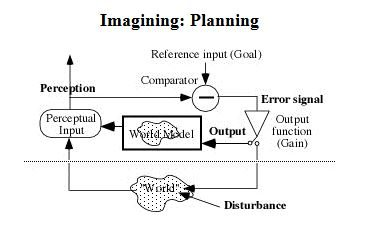
HB : This diagram was supported also by Bill.
Bill P :
Something is coming together that is making sense of some ideas I have resisted for a long time. It has to do with the brain’s models of the external world… has not seen models; he has seen a hierarchy of perceptions that somehow represents an external world, and a large collection of Complex Environmental Variables (as Martin Taylor calls them) that is mirrored inside the brain in the form of perceptions.
Briefly, then: what I call the hierarchy of perceptions is the model. When you open your eyes and look around, what you see – and feel, smell, hear, and taste – is the model. In fact we never experience anything but the model. The model is composed of perceptions of all kinds from intensities on up.
That is all we need to do to build up a model of the external world. It’s not even that; it’s just a model of the world. The idea that there’s also an external world that we don’t experience takes a while to develop. At first it’s just the only world there is.
HB : Here I get the reason to ask you about »Complex Enironmental Variables« CEV which seemed to me a very sophisticated concept. Not one-dimensional as Ricks’. But multidomensional, wide. I just have to turn it to my construction of the world to make it functional for me. It helped.
There were some of your statements in our conversation that also demanded a lot of thinking fo me. And they were very usefull. Here is one of them.
MT earlier :
As we have often said before, Bill’s diagram refers ONLY to controlled perceptions. At any moment, almost all of our perceptions cannot be controlled. That’s fundamental because of the difference between the speeds and variety of our output possibilities and the speeds and variety of our sensory systems.
HB : Can you include also these parts into your »essay« ?
Boris
-----Original Message-----
From: Martin Taylor [mailto:mmt-csg@mmtaylor.net]
Sent: Wednesday, March 01, 2017 11:25 PM
To: csgnet@lists.illinois.edu
Subject: Re: Instrumentalism versus realism? – Please ignore previous message
Please ignore a message I just sent, which is a first draft of a half-written “essay”. Just trash it, because the final message may be quite different.
Martin