Martin Taylor's Essay: Re Prediction

[From Bill Powers (2007.05.18.1115 MDT)]

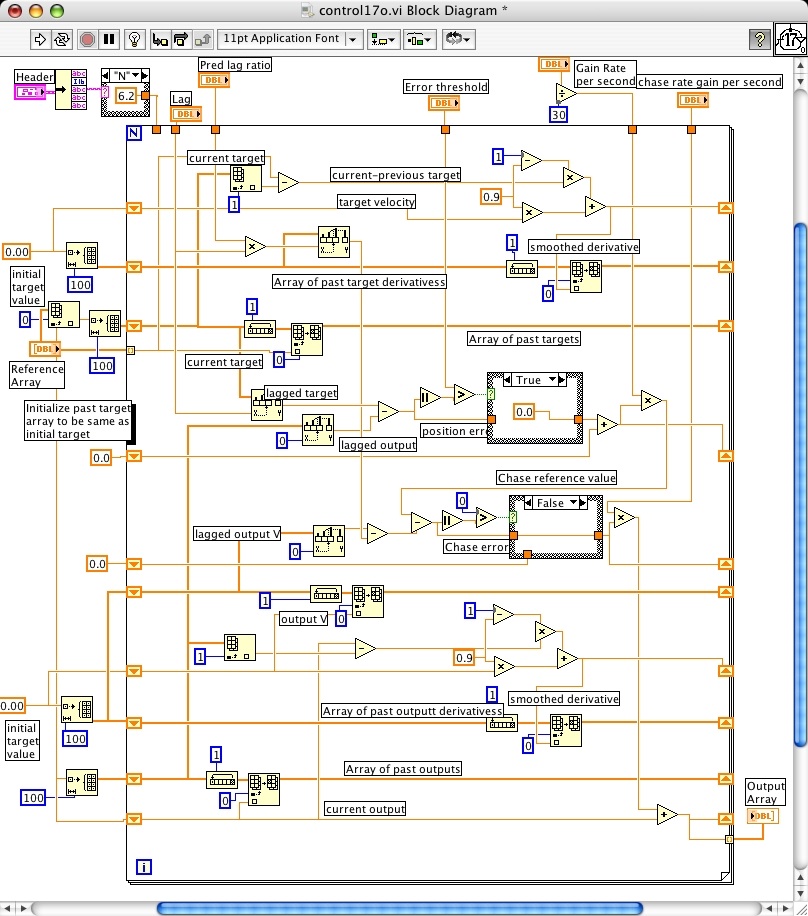
I should mention that it is quite possible for some control systems to perceive not just the state of the input data, but that state plus a smoothed first derivative of that state. This was called "quickening" by the engineering psychologists of the 1940s and 1950s, an unfortunate term that gives an impression exactly opposite to the actual effect.

A system that controls a perception that includes a rate of change component reacts more slowly to disturbances, not "quicker" than systems without the rate of change component. The reason is that the system thinks the perception has reached the reference level before it actually has done so. The apparent error falls to zero, or close to zero, while the actual error in terms of the final desired state of the environment is still large. As a result, the output, instead of rising immediately to oppose the error as soon as possible, rises much more slowly, simply because the error signal is not as large as it would be without the so-called quickening.

In general, achieving stability in the presence of perceptual or output delays requires slowing of the output response to error. Adding a rate-of-change component to the perceptual signal is one way to do that, at the expense of increased input noise. Making the output function into a leaky integrator is easier to do and seems to work better.

I am quite sure that successful use of rate-of-change information in the input depends on smoothing the rate component so nothing can change significantly during one input-output delay time. If an attempt is made to "predict" by a time as short as the delay time, instability will result. I haven't modeled that yet but someone may want to do it.

Best,

Bill P.

[Martin Taylor 2007.05.18.14.45]

[From Bill Powers (2007.05.18.1115 MDT)]

A system that controls a perception that includes a rate of change component reacts more slowly to disturbances, not "quicker" than systems without the rate of change component. The reason is that the system thinks the perception has reached the reference level before it actually has done so. The apparent error falls to zero, or close to zero, while the actual error in terms of the final desired state of the environment is still large. As a result, the output, instead of rising immediately to oppose the error as soon as possible, rises much more slowly, simply because the error signal is not as large as it would be without the so-called quickening.

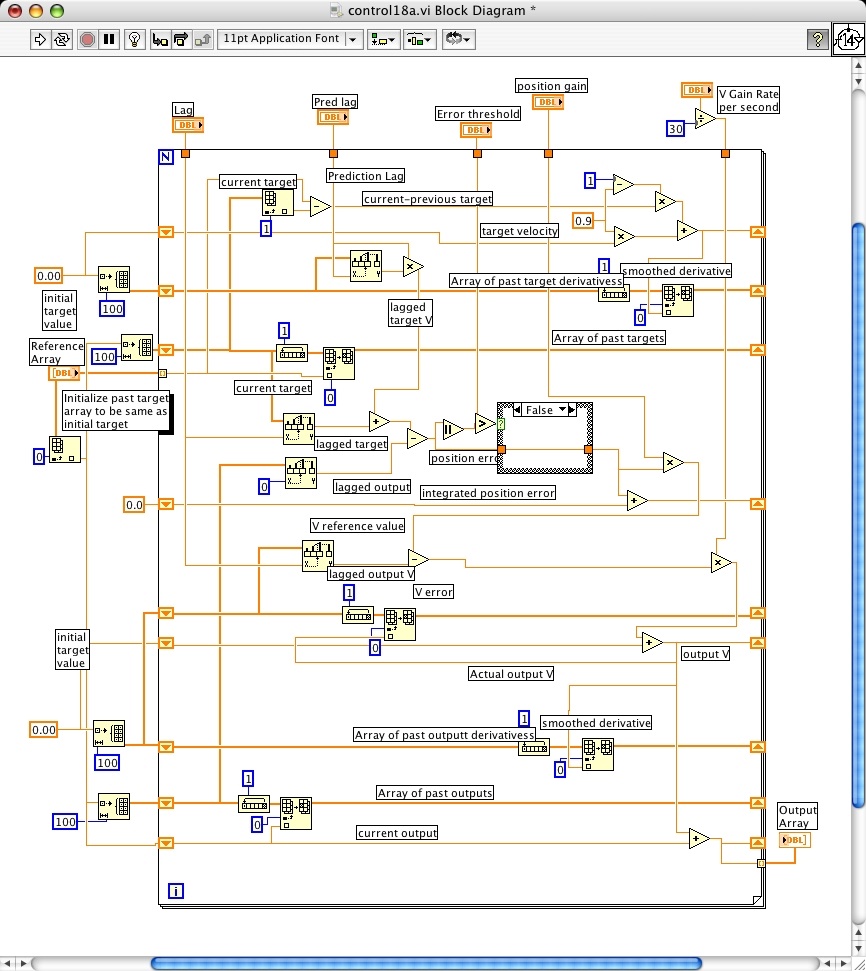
On the other hand, a control system that augments its output according to a (correct) prediction of where the perception would be going could reduce the error to zero rather quicker than otherwise -- to speak heuristically. Certainly in my simulations of tracking in the sleep-loss studies, the match to human responses is improved by adding in a little prediction.

We do it all the time. Imagine tracking a smoothly oscillating pendulum. You can track where it is now with no following error. You may even have a bit of leading error. Why? Because the bandwidth of the motion of a pendulum is very low, far lower than its oscillation frequency, and so its motion is predictable quite a long way into the future. That's why clocks worked a couple of hundred years ago. You don't perceive where the pendulum is going to be and track that. You act so that your finger is where the pendulum actually is, not where it was when the photons hit your retina.

I guess I first realized this as possibly being important one party evening when we played ping-pong by the light of the full moon. There's quite a long perceptual delay in low light, called the Pulfrich effect. I realized then that if I hit the ball at the moment I perceived it to be more or less over the net (predicting its location after it passed the end of the table, in effect), I did OK. My opponents, for the most part, didn't use that prediction possibility, and hit as though the ball were where the delayed visual perception made it seem to be, by which time it was much too late.

Bill and I have disagreed in the past about the role of prediction in control. Usually, such disagreements are caused by misunderstandings, and I suspect that this is true also in this case. Informationally, the point is that one's teh precision of one's estimate of the future value of a variable of bandwidth W decays into the future so that at a time 1/2W in the future there is no information left. One's knowledge of the value more than 1/2W in the future is only that given by the global statistics of the variable (and their rate of change also affects how well you know even that).

How a system makes use of this available information is a structural question. Bill chooses to assume that it is used to create a pseudo-perception of where the variable will be, and to use it as the target that should match the reference signal. But the reference value is not for where the perception should be in the future; it is for where the variable should be NOW. It is the output that is delayed from where the variable is now, and it is the output that needs to be advanced. How that is implemented without going unstable is the question.

Martin

On the other hand, a control
system that augments its output according to a (correct) prediction of
where the perception would be going could reduce the error to zero rather
quicker than otherwise – to speak heuristically. Certainly in my
simulations of tracking in the sleep-loss studies, the match to human
responses is improved by adding in a little
prediction.
[From Bill Powers (2007.05.18.1620 MDT)]

Martin Taylor 2007.05.18.14.45 –

The real problem here is that what you call a prediction is not a
prediction; it’s just adding k*(dp/dt) to p. That doesn’t predict p,
because when you actually put that added term in, the output changes and
the actual value reached by p is no longer p + k*(dp*dt). You change the
speed with which the error is corrected but the final error is exactly
the same as before, because at equilibrium, dp/dt is zero.

This is not a matter of saying “Oh, the perception falls short by
10%, so I will add 10% to the output to make up for that.” Adding
10% to the output will not make up for the 10% error. In a control system
with a loop gain of 11.1, the final error will be 10%. If we add 10% to
the perceptual signal, that amounts to a disturbance of the loop and will
result in a reduction of the output, leading to a new final error of
around 9%. Not zero.

There is no simple way to use a prediction of a future value of a
perceptual signal to achieve zero error in a control system.
“Prediction” is simply the wrong word for what you do.
Basically you alter the dynamics of the system so the time constant of
the loop is changed, but you don’t alter the final state at all by adding
a derivative to the perceptual signal.

Your report of moonlight table tennis reminds me of another kind of
“prediction” which is not a prediction. In driving a car, how
do you determine when to begin turning the steering wheel in making the
transition from a straight road to a curve? After much experimenting, I
determined that I do it best by finding the right place ahead of the car
to watch. If you watch an imaginary position just the right distance
ahead, you will anticipate the curve exactly right. Just control the
position of the road relative to that place straight ahead of the hood by
20 feet or so, whether on a curve or driving straight: no prediction
required. The main thing to learn is how far ahead to look at different
speeds, and that’s far from critical.

This holds also for steering deliberate collision courses. The hard way
to do that is to calculate where the other object will be at some time in
the future and aim for that point. The easy way is simply to change
direction or speed so as to maintain a constant bearing angle to the
other object. Both will result in the desired collision, provided you can
do the computations quickly and accurately enough to use the first
method, but the second method requires no computing at all of any
importance. Helmsmen are taught the second method because it infallibly
predicts an impending collision with no computation.

For tennis and Ping-Pong “collision” is not quite the right
idea because we are not talking about two small objects approaching at an
arbitrary angle. Instead, the problem is that of moving a flat surface up
the path taken by a small object so as to hit the object somewhere along
its path. The exact position of the collision along the path of travel is
then of far less importance, and the lateral extent of the paddle or
racket greatly reduces the accuracy requirements at right angles to the
path. Basically, all you have to do is make sure the paddle is somewhere
along the path of the moving object, which does take some prediction but
is not nearly as hard as, say, rolling a billiard ball so as to collide
with another billiard ball rolling across the line of sight. Now the
primary problem is to see the direction of travel soon enough to move the
paddle somewhere onto the predicted line. Your strategy of looking
farther toward the other side of the net would allow more time to
establish an imaginary line of travel. In my mind’s eye I can see the
imagined path of a served ping-pong ball very soon after it leaves the
opponent’s paddle, and at one time I could play that game with almost
Chinese skill. Well, almost somewhat. But that never seemed like
prediction to me – there was certainly not much time to do any
predicting. It seemed more like a matter of looking in the right
place.

By the way, is that low-light-level lag an integral lag or a tranport
lag?

Best,

Bill P.

[From Bill Powers (2007.05.18.1620 MDT)]

Martin Taylor 2007.05.18.14.45 --

On the other hand, a control system that augments its output according to a (correct) prediction of where the perception would be going could reduce the error to zero rather quicker than otherwise -- to speak heuristically. Certainly in my simulations of tracking in the sleep-loss studies, the match to human responses is improved by adding in a little prediction.

The real problem here is that what you call a prediction is not a prediction; it's just adding k*(dp/dt) to p.

No it isn't. Consider this example:

x x x x
   x x x x x x x
     x x x x x x x
       x x x x x x x
         x x x ???

Assuming that this pattern has been going on for some time, what would be your bet as to the next four samples? Would it be

x x x x
   x x x x x x x
     x x x x x x x
       x x x x x x x
         x x x *

···

*
                                                    *
                                                      *

as the addition of k*(dp/dt) would have you do? I doubt it. Or would you say "I can't predict" and wait to see whether it is

x x x x
   x x x x x x x
     x x x x x x x
       x x x x x x x * * * *
         x x x

I suspect you would do neither, and would predict

x x x x
   x x x x x x x *
     x x x x x x x *
       x x x x x x x *
         x x x *

Of course, the prediction is unprovable until after the fact; the source might change the pattern at that precise moment. Nevertheless, I'll bet this last is what you would predict. Almost always, you would be very close to correct. I do predict that the sun will rise tomorrow morning. I could be wrong, but would you like to bet against me at even odds?

If you were tracking this pattern and the perceptual system had a delay of, say four samples, what would the track look like (a) without prediction, (b) using the derivative as a prediction and (c) using the low bandwidth (repetitive nature) of the pattern to predict the upturns and downturns at the peaks? With proper prediction, you could track almost exactly.

That doesn't predict p, because when you actually put that added term in, the output changes and the actual value reached by p is no longer p + k*(dp*dt). You change the speed with which the error is corrected but the final error is exactly the same as before, because at equilibrium, dp/dt is zero.

You are still thinking of adding the prediction to the PERCEPTUAL signal!

As an aside, dp/dt isn't zero except by chance. You are thinking of de/dt, which only approaches zero in the long term if the disturbance remains zero forever (bandwidth = 0) or under improbable patterns of disturbance variation. Otherwise, both dp/dt and de/dt are zero only momentarily, when crossing from positive to negative and vice-versa.

Your report of moonlight table tennis reminds me of another kind of "prediction" which is not a prediction. In driving a car, how do you determine when to begin turning the steering wheel in making the transition from a straight road to a curve? After much experimenting, I determined that I do it best by finding the right place ahead of the car to watch.

With large ships and submarines, one thing they they sometimes do is display a track on the display that shows where the ship would go if the controls were to be left in their current settings (a prediction). By making that track go through the harbour entrance, big oil tankers that take many minutes to make a course correction can be steered in tight situations, and submarines can deploy their vanes and ballast to go where they want in 3D space.

For tennis and Ping-Pong "collision" is not quite the right idea because we are not talking about two small objects approaching at an arbitrary angle. Instead, the problem is that of moving a flat surface up the path taken by a small object so as to hit the object somewhere along its path. The exact position of the collision along the path of travel is then of far less importance, and the lateral extent of the paddle or racket greatly reduces the accuracy requirements at right angles to the path. Basically, all you have to do is make sure the paddle is somewhere along the path of the moving object, which does take some prediction but is not nearly as hard as, say, rolling a billiard ball so as to collide with another billiard ball rolling across the line of sight. Now the primary problem is to see the direction of travel soon enough to move the paddle somewhere onto the predicted line. Your strategy of looking farther toward the other side of the net would allow more time to establish an imaginary line of travel.

That's NOT my strategy. My strategy in the moonlight was to HIT the ball at the moment when it seemed to be crossing the net, but was actually at my end of the table. What I'm saying is that in moonlight, one perceives the ball as being over the net when it is really much further along its track, perhaps even past you.

I don't think any real table-tennis player simply moves the bat along the predicted path of the ball for most shots. Mostly the bat moves from below to above the track, to put topspin, with spin variants to confuse the opponent. A flat push along the track would be both physically awkward and dynamically ineffective. You have to be on the track of the ball when it is there, but not many milliseconds before or after. It's the same with any sport in which you hit a moving ball. Timing is everything.

In my mind's eye I can see the imagined path of a served ping-pong ball very soon after it leaves the opponent's paddle,

That's prediction, in my book.

and at one time I could play that game with almost Chinese skill. Well, almost somewhat.

Yes. As an undergraduate, I used to play for the University of Toronto. That's nowhere near Chinese skill, but it's non-novice. My brother and I used to practice in a basement with about 4 ft between the end of the table and the wall. That certainly makes you work fast when the opponent smashes -- and we did!

But that never seemed like prediction to me -- there was certainly not much time to do any predicting. It seemed more like a matter of looking in the right place.

Right. You don't perceive the prediction of perception or the perception of prediction. You just perceive the predicted track of the ball and probably the opponent's moves (and the opponent's immediate intentions if you are a good player). Seldom in PCT do we talk about perceiving the perception of the scene. We perceive the scene, but we don't perceive ourselves perceiving unless we train ourselves to do so. It's hard!

None of which has anything to do with the example of the effect of perceptual delay in low light and my semi-successful counter by hitting early at the place where I predicted the ball would be, hitting it at the time I saw the ball as arriving at about the level of the net.

By the way, is that low-light-level lag an integral lag or a tranport lag?

I'm not sure how you mean that. The perceptual effect is of a transport lag. You see things normally, but delayed. If I understand your question, an integral lag would smear it over time, as with motion on a screen with a slow phosphor. That's not the effect, as you must know from having walked in the twilight or by moonlight. When you are walking, you don't notice the delay. Mostly, what you are walking on and the surroundings don't change in the time of half a step, or if they do, you probably don't have to treat them as disturbances you have to counter with exact timing, so you simply don't notice that your visual perception is delayed.

You can demonstrate the Pulfrich effect by looking at a pendulum swinging across your line of sight while one eye is seeing through a moderately dense grey-scale filter. The pendulum looks to be swinging in an ellipse both across your line of sight and in depth, because the image from the eye lookingthrough the filter is delayed with respect to the other. The delayed eye sees the bob at a different angle than it normally would, so the convergence angle changes as the bob moves left-to-right and then right-to-left. Check out "Pulfrich effect" on Wikipedia.

Anyway, you are always asking for simulations and demonstrations rather than verbal arguments. I did mention in my last message that my simulations with prediction match human performance better than without, which should be some evidence that adding prediction doesn't always make things worse. You quoted that at the head of your message, before going on to claim that using prediction wouldn't help.

I discussed the effect of doing the prediction in two different ways at the CSG meeting near Toronto a couple of years ago. Since then I tried a couple of other approaches that seem to work a little better for most tracks, and all of them match human performance better than does control without prediction. Mind you, they were done using disturbance conditions that don't favour the use of prediction; the disturbances were generated using low-pass white noise, rather than with a narrow band filter. All the same, prediction does help even in those conditions, even though the method of prediction (as you suggested up top) was simply to add some part of the derivative of some signal somewhere in the wiring diagram.

Martin

The real problem here is that
what you call a prediction is not a prediction; it’s just adding
k*(dp/dt) to p.

No it isn’t. Consider this example:

x
x
x
x

x x
x x
x x x

x    

x x
x x
x x

  x 

x x
x x
x x

x
x
x
???

Assuming that this pattern has been going on for some time, what would be
your bet as to the next four samples?
[From Bill Powers (2007.05.18.0806 MDT)]

Martin Taylor 2007.05.18 –

It would be that the same pattern would continue. However, to see this
pattern I would have to use a perceptual input function of a kind
different from what is needed for ordinary tracking. I would need to be
able to perceive a repetitive pattern of positions, not simply the
current vertical position of the asterisk.

Once I perceived the pattern, I would try to produce the same pattern
myself, and match the amplitude, phase, and frequency of my
movements to the movements of the target, adjusting those three
parameters to get the least average difference (relationship control). Of
course I could pick some other relationship as a reference condition –
for example, moving antisymmetrically, or at 90 degrees so as to make a
stationary 2-dimensional figure, or offset by some constant amount. The
same temporal considerations would be involved.

This kind of control is discussed in the 1960 papers with Clark and
MacFarland, as part of the “portable demonstrater.” The
experimenter moves his finger in a regular circular pattern and the
controller tracks it. After a while, when the controller is tracking
well, the experimenter suddenly stops his finger and holds it still. The
controller goes on producing the circular motion for around four tenths
of a second (if I remember right) before stopping and then moving his
finger back into alignment. This shows that the controller was generating
the pattern independently, not simply following the experimenter’s
momentary finger positions as when the target movements do not repeat.
During random tracking, if the experimenter stops his finger, the
controller stops in far less time – in fact, in the same time it takes
to follow any random change of position, less than 0.2 seconds.

The continuation of the controller’s motion shows that this is not the
same as the tracking we see when the experimenter moves in an
unpredictable pattern. It is much slower. It takes longer to detect an
error because the perception is derived from a long sample of the
tracking experience. It takes longer to detect that the pattern has
changed because the pattern spans time. Far from being faster, this kind
of sequence (?) control is reliably slower than configuration
control.

Of course, the
prediction is unprovable until after the fact; the source might change
the pattern at that precise moment. Nevertheless, I’ll bet this last is
what you would predict. Almost always, you would be very close to
correct. I do predict that the sun will rise tomorrow morning. I could be
wrong, but would you like to bet against me at even
odds?

I agree that my behavior would be as you suggest, but I do not agree that
this is prediction, as shown by my discussion above. It is matching a
pattern in your own actions to an independent pattern in the environment.
The purpose is not to be able to calculate what the position will be at
some time in the future, which is what I mean by a prediction, but simply
to minimize the present error. This is done by employing a higher level
of perception and control. However, this higher level of control becomes
a handicap if the target then returns to a random pattern of movement, or
some other form of regular movement. The independently-produced movements
of the controller then cause errors instead of correcting them.

I will make a prediction: if you compare tracking a target with
randomized movements (smoothed just enough to permit continuous tracking)
with tracking a target that shows any regular repetitive pattern of
movements with the same high-frequency limit on bandwidth, you will find
that the reaction time to step-disturbances is faster for the random
target task than for the regular one. Also, you will find that the
bandwidth of disturbances that can be cancelled to some standard degree
is lower for the repetitive task than for the random one. This would
appear to be the opposite of your prediction, because as I read your
words you’re saying that when prediction is occurring, the correction of
disturbance-induced errors should be faster, not slower.

My reason for making this prediction is that I think a different (higher)
level of perception is needed to perceive a regular temporal pattern of
positions than is needed to detect simply the present-time position of
the target (which is all the simple tracking model can do). Control at
the level of position control is faster than control at the level of a
series of successive positions.

steering wheel in
making the transition from a straight road to a curve? After much
experimenting, I determined that I do it best by finding the right place
ahead of the car to watch.

With large ships and submarines, one thing they they sometimes do is
display a track on the display that shows where the ship would go if the
controls were to be left in their current settings (a prediction).
By making that track go through the harbour entrance, big oil tankers
that take many minutes to make a course correction can be steered in
tight situations, and submarines can deploy their vanes and ballast to go
where they want in 3D space

Yes, I have discussed on CSGnet this kind of predictive control in
connection with predictive landing systems for airplanes, and for the
displays that astronauts use for rendezvous with other objects in orbit.
Of course the bandwidth of control in all these case is far lower than it
is for simple positional control, partly because so much computation has
to be done, and partly because the pattern itself spans time and cannot
change or be changed rapidly.

That’s NOT my
strategy. My strategy in the moonlight was to HIT the ball at the moment
when it seemed to be crossing the net, but was actually at my end of the
table. What I’m saying is that in moonlight, one perceives the ball as
being over the net when it is really much further along its track,
perhaps even past you.

If you tried to hit the ball at the moment it seemed to be crossing the
net, then you must have reached much farther forward than when you waited
for the ball to reach your end of the table. So I presume you are not
describing here what you actually did. When you say you tried to hit
“the ball”, I can make sense of that if you mean not the ball
you see crossing the net, but an imaginary ball much closer to you along
the line of flight. To hit that imaginary ball you would not reach
forward any more than usual. Is that how it happened?

I don’t think any
real table-tennis player simply moves the bat along the predicted path of
the ball for most shots. Mostly the bat moves from below to above the
track, to put topspin, with spin variants to confuse the
opponent.

Yes, but at the moment of contact the angle between the direction of
paddle movement and the direction of ball movement is small – if you
contact the ball a foot early or late, the paddle will still hit it. It
feels like a much larger angle than is really is. The paddle is cocked so
it contacts the ball off-center, imparting a spin to the ball. If you
have enough time (which you gain by returning drives from six to ten feet
behind the end of the table) you can cock the paddle much more and
produce much more spin – but to achieve that you simply have to see more
exactly where the ball is. I learned to return a drive with so much
backspin that the ball would cross the net and then bounce back across
the net to my side again. Of course that required a fairly high
trajectory so the opponent had more time to leap forward and smash the
ball into my teeth, so that wasn’t a very successful strategy. And I had
to stand way back because the capture cross-section of the paddle was so
small for such an extreme slice. I couldn’t have done it by
moonlight.

A flat push
along the track would be both physically awkward and dynamically
ineffective. You have to be on the track of the ball when it is there,
but not many milliseconds before or after. It’s the same with any sport
in which you hit a moving ball. Timing is
everything.

Yes, but superhuman timing is neither necessary nor possible. If the ball
takes two tenths of a second to get from the opponent’s paddle to the
bounce point on your side of the table (as I estimate for a modest
smash), you had better be able to predict correctly, well within that 0.2
sec, where the ball is going, because if you’re a little off there is no
chance of correcting the error in time. You get a great deal of
information from the arc of the opponents paddle before it hits
the ball, so the prediction time can be increased and the amount of
correction needed can be minimized. But you can learn to give the
appearance of hitting in one direction and at the last instant cock the
paddle so the serve goes to the other side of the table. If you’ve caught
your opponent trying to predict the ball’s path by watching your paddle,
the ball will miss his paddle by three feet. As I found when I was the
clever predicter. Overall, the best stragegy in ping-pong is NOT to
predict. You react much faster. When you try to predict, you’re wrong too
often. Of course we have a preference for remembering the times when we
predicted right.

In my mind’s
eye I can see the imagined path of a served ping-pong ball very soon
after it leaves the opponent’s paddle,

That’s prediction, in my book.

Yes, I agree. We’re not discussing whether prediction happens – we both
know it does. What we’re discussing is whether it speeds up control. I
say it doesn’t, it makes it slower. When prediction works, it works only
because you’e dealing with slower variations.

Right. You don’t
perceive the prediction of perception or the perception of prediction.
You just perceive the predicted track of the ball and probably the
opponent’s moves (and the opponent’s immediate intentions if you are a
good player). Seldom in PCT do we talk about perceiving the perception of
the scene. We perceive the scene, but we don’t perceive ourselves
perceiving unless we train ourselves to do so. It’s
hard!

Well, I’m not inclined to believe in what I can’t perceive, being a
person of little faith. Measurements I believe, but they cannot be
superceded by logic or imagination.

Anyway, you are
always asking for simulations and demonstrations rather than verbal
arguments. I did mention in my last message that my simulations with
prediction match human performance better than without, which should be
some evidence that adding prediction doesn’t always make things worse.
You quoted that at the head of your message, before going on to claim
that using prediction wouldn’t help.

You didn’t say that using prediction made control better, you said it
made the model match real performance better. Putting a perceptual
transport lag (pure time delay) into a model also makes it match real
behavior better than without it, because without it, the model controls
significantly better than the person does.

I discussed the
effect of doing the prediction in two different ways at the CSG meeting
near Toronto a couple of years ago. Since then I tried a couple of other
approaches that seem to work a little better for most tracks, and all of
them match human performance better than does control without prediction.

Yes, but you’re still not saying that it makes control better. If people
are trying to predict, perhaps they aren’t controlling as well as when
they just correct the current error. So your model without prediction
controls too well, compared with real people. That’s certainly something
you could check.

Mind you, they were
done using disturbance conditions that don’t favour the use of
prediction; the disturbances were generated using low-pass white noise,
rather than with a narrow band filter. All the same, prediction does help
even in those conditions, even though the method of prediction (as you
suggested up top) was simply to add some part of the derivative of some
signal somewhere in the wiring diagram.

“Somewhere” isn’t good enough: if it’s not in the
perceptual channel then “prediction” is not the correct word,
in my opinion. “Phase advance” might be appropriate in the
frequency domain. If there’s a phase advance present, it’s present no
matter how the target happens to move, in a regular or random pattern.
And if it doesn’t produce a perception of the future state of a variable,
it’s not prediction in my book.
Finally, a control system that works only when the environment behaves in
one particular way is not of much general use. A negative feedback
control system of the kind I use in models does not have to change its
organization for every change in the behavior of the environment, or even
for every change in the properties of the environment. A system designed
to deal only with a particular frequency of disturbance would have to
reorganize every time the disturbance moved to a different frequency or
the pattern changed its shape.
As I have pointed out above, if control is based on detection of regular
patterns, it is always slower than control that is based on the current
value of a variable. If the “prediction” involved is a simple
phase advance achieved by adding a bit of derivative
“somewhere in the loop” as you say, then I can believe that
this may make a model behave slightly more like a real person, but
whether that means the model controls better is not at present known. I
would guess that given the perceptual and output delays we know are
there, it is unlikely that more than a minute improvement would be
possible. The cure for instability in a system with transport lags is to
insert an integral lag somewhere in the loop – the opposite of a
phase advance.

Best,

Bill P.

[From Rick Marken (2007.05.19.1010)]

Bill Powers (2007.05.18.0806 MDT)--

It would be that the same pattern would continue. However, to see this
pattern I would have to use a perceptual input function of a kind different
from what is needed for ordinary tracking. I would need to be able to
perceive a repetitive pattern of positions, not simply the current vertical
position of the asterisk.

This kind of control is discussed in the 1960 papers with Clark and
MacFarland, as part of the "portable demonstrater." The experimenter moves
his finger in a regular circular pattern and the controller tracks it.

Great post Bill. Thanks. It reminded me of this nice, clear
demonstration of levels that I can use in class. It also reminded me
that we have been through this discussion of "prediction and control"
before and we showed (then as now) that what looks like prediction is,
in fact, control of a higher level perception.

I think this discussion is important because prediction is a major
component of many current non-PCT (ie. open loop) models of mind (and
they are models; the baseball catching models with which mine competes
all use prediction algorithms and still do worse than mine in terms of
accounting for the observed behavior). In a closed loop hierarchical
control model, what is important is what is perceived, not what is
predicted, especially since prediction is basically useless when there
are unpredictably and continuously varying disturbances influencing
perceptions at _all levels of control_ simultaneously.

I think this discussion also shows that you have been wrong about only
one thing when it comes to PCT, and that is your belief (expressed to
me in personal conversation) that once people understand PCT they
never go back to their old ways of looking at behavior;-) I think it's
now clear that it's not only difficult for people to make the switch
to a PCT concept of behavior but it's also difficult for them to hang
onto it once they have it. If some aspect of PCT conflicts with some
previously held belief that is very important to a person, that
previously held belief will win. The only reason that hasn't happened
to me is because there were no beliefs that were important to me
before I discovered PCT;-)

Best

Rick

···

--
Richard S. Marken
Adjunct Professor of Psychology UCLA
Statistical Analyst VHA
rsmarken@gmail.com

Re: Martin Taylor’s Essay: Re
Prediction
[Martin Taylor 2007.05.19.14.12]

[From Bill Powers (2007.05.18.0806
MDT)]

Martin Taylor 2007.05.18 –

The real problem here is that what you
call a prediction is not a prediction; it’s just adding k*(dp/dt) to
p.

No it isn’t. Consider this example:

x
x
x
x

x x
x x
x x x

x    

x x
x x
x x

  x 

x x
x x
x x

x
x
x
???

Assuming that this pattern has been going on for some time, what would
be your bet as to the next four samples?

It would be that the same pattern would continue. However, to see this
pattern I would have to use a perceptual input function of a kind
different from what is needed for ordinary tracking. I would need to
be able to perceive a repetitive pattern of positions, not simply the
current vertical position of the asterisk.

Yes. I’d amend that to say you would need to perceive two things:
that there was a regular pattern, and the form of the pattern. Humans
are good at that with both visual and auditory patterns, if the
repetition rate is fast enough.

Once I perceived the pattern, I would try to produce the same pattern
myself, and match the amplitude, phase, and frequency of my
movements to the movements of the target, adjusting those three
parameters to get the least average difference (relationship control).
Of course I could pick some other relationship as a reference
condition – for example, moving antisymmetrically, or at 90 degrees
so as to make a stationary 2-dimensional figure, or offset by some
constant amount. The same temporal considerations would be
involved.

Yes.

This kind of control is discussed in the
1960 papers with Clark and MacFarland, as part of the “portable
demonstrater.” The experimenter moves his finger in a regular
circular pattern and the controller tracks it. After a while, when the
controller is tracking well, the experimenter suddenly stops his
finger and holds it still. The controller goes on producing the
circular motion for around four tenths of a second (if I remember
right) before stopping and then moving his finger back into alignment.
This shows that the controller was generating the pattern
independently, not simply following the experimenter’s momentary
finger positions as when the target movements do not
repeat.

Actually, it doesn’t show “that the controller was
generating the pattern independently” because if that were the
case, there would be phase drift, not low-error tracking, even if we
accepts the assumption that “generating independently”
admits “generating exactly the given pattern.” What it shows
is that the controller was using the predictability of the pattern and
controlling the phase.

During random tracking, if the
experimenter stops his finger, the controller stops in far less time
– in fact, in the same time it takes to follow any random change of
position, less than 0.2 seconds.

As one would expect.

The continuation of the controller’s
motion shows that this is not the same as the tracking we see when the
experimenter moves in an unpredictable pattern. It is much slower. It
takes longer to detect an error because the perception is derived from
a long sample of the tracking experience. It takes longer to detect
that the pattern has changed because the pattern spans time. Far from
being faster, this kind of sequence (?) control is reliably slower
than configuration control.

Yes, yes, yes!

Of course, the prediction is unprovable
until after the fact; the source might change the pattern at that
precise moment. Nevertheless, I’ll bet this last is what you would
predict. Almost always, you would be very close to correct. I do
predict that the sun will rise tomorrow morning. I could be wrong, but
would you like to bet against me at even odds?

I agree that my behavior would be as you suggest, but I do not agree
that this is prediction, as shown by my discussion above.

So, we disagree ONLY on the use of the word “prediction”
to represent the way one tracks a low bandwidth variable. I agree with
everything you say above (except for that “independently”),
and would add that it clearly demonstrated that you use prediction in
tracking, to the extent that the bandwidth of the disturbance permits
it.

We have a dispute on terminology, it seems.

It is matching a pattern in your
own actions to an independent pattern in the environment. The purpose
is not to be able to calculate what the position will be at some time
in the future, which is what I mean by a prediction, but simply to
minimize the present error.

But why would one be matching the pattern if it were not to minimize
the present error? Why would one be using the predictability of the
pattern at all, otherwise?

This is done by employing a higher
level of perception and control.

Yes.

However, this higher level of control
becomes a handicap if the target then returns to a random pattern of
movement, or some other form of regular movement.

As I said, one can use prediction only within the limits of the
bandwidth of the disturbance. If you act as though X is going to
happen and it doesn’t, it takes time to recover and to deal with the
fact that Y happened. An everyday experience, for most of us, I
think.

The independently-produced
movements of the controller then cause errors instead of correcting
them.

Yes. They are operating in the same bandwidth zone (which I think
is a controlled perceptual variable; one tries NOT to make rapid
corrective movements when tracking a slowly varying target).

I will make a prediction: if you compare
tracking a target with randomized movements (smoothed just enough to
permit continuous tracking) with tracking a target that shows any
regular repetitive pattern of movements with the same high-frequency
limit on bandwidth, you will find that the reaction time to
step-disturbances is faster for the random target task than for the
regular one.

Yes. That follows from what I have been saying.

Also, you will find that the
bandwidth of disturbances that can be cancelled to some standard
degree is lower for the repetitive task than for the random
one.

Yes, obviously.

This would appear to be the
opposite of your prediction,

???

because as I read your words you’re
saying that when prediction is occurring, the correction of
disturbance-induced errors should be faster, not slower.

I said that correection should be more accurate, not faster. If
you are working in a low-bandwidth regime, things go slower, don’t
they?

Increased accuracy (not speed) works only so long as the
disturbance (and its statistics) remain band-limited. Once they go out
of the band, as you postulate, things change, much as they change in
the “reversed tracking polarity” study you and Rick did. It
takes time to alter the polarity of the tracking action; it takes time
to alter the narrow-band tracking actions.

My reason for making this prediction is that I think a different
(higher) level of perception is needed to perceive a regular temporal
pattern of positions than is needed to detect simply the present-time
position of the target (which is all the simple tracking model can
do).

Yes.

Control at the level of position
control is faster than control at the level of a series of successive
positions.

Yes.

That’s NOT my strategy. My strategy in
the moonlight was to HIT the ball at the moment when it seemed to be
crossing the net, but was actually at my end of the table. What I’m
saying is that in moonlight, one perceives the ball as being over the
net when it is really much further along its track, perhaps even past
you.

If you tried to hit the ball at the
moment it seemed to be crossing the net, then you must have reached
much farther forward than when you waited for the ball to reach your
end of the table.

No, No, NO, NOOOO !!! NO.

I hit EXACTLY as I would normally have done, but earlier, when
compared with the timing of by perception of the ball position. It was
a conscious decision to hit when all my visual perceptions told me I
would hit only thin air, the ball still seeming to be only just
getting to the net. Please do try to believe that, rather than
recasting what I keep saying!

So I presume you are not describing
here what you actually did. When you say you tried to hit “the
ball”, I can make sense of that if you mean not the ball you see
crossing the net, but an imaginary ball much closer to you along the
line of flight. To hit that imaginary ball you would not reach forward
any more than usual. Is that how it happened?

I did not consciously imagine another ball. As you said of
yourself, I see an imaginary trajectory quite early in the ball’s
flight – perhaps even before the opponent hits it, though I can’t be
sure of that. All I did (consciously) was to hit the ball on that
trajectory earlier than I would normally have tried to do.

You get a great deal of information
from the arc of the opponents paddle before it hits the ball,
so the prediction time can be increased and the amount of correction
needed can be minimized.

Yes, that’s what I meant above.

But you can learn to give the
appearance of hitting in one direction and at the last instant cock
the paddle so the serve goes to the other side of the
table.

My favourite trick in the old days! It often works quite
dramatically – and it’s another evidence that we use prediction.

When prediction works, it works
only because you’e dealing with slower variations.

Yes, I’ve said it in previous posts over the years as well as
recently. It’s the critical criterion, and I know you know it. I
really believe we are talking only about a difference of terminology.
Prediction works as far into the future as is limited by the bandwidth
of the disturbance (in practice, substantially less into the future
than 1/2W). Low bandwidth = slow variation = possibility of using
prediction to improve tracking accuracy = susceptibility to changes in
predicted pattern = slow response to such changes.

You didn’t say that using prediction made
control better, you said it made the model match real performance
better. Putting a perceptual transport lag (pure time delay) into a
model also makes it match real behavior better than without it,
because without it, the model controls significantly better
than the person does.

True. My models incorporate transport lags, whether or not they
include prediction. The question is not what makes control better, but
how human control systems are structured.

I discussed the effect of doing the
prediction in two different ways at the CSG meeting near Toronto a
couple of years ago. Since then I tried a couple of other approaches
that seem to work a little better for most tracks, and all of them
match human performance better than does control without
prediction.

Yes, but you’re still not saying that it makes control better. If
people are trying to predict, perhaps they aren’t controlling as well
as when they just correct the current error. So your model without
prediction controls too well, compared with real people. That’s
certainly something you could check.

Yes, I have, and your suggestion turns out not to be correct. I
definitely CAN make the models track better than humans, but when I
get the best match to human performance without prediction, the errors
aren’t in the direction of tracking too well, at least not
consistently.

Anyway, it’s a side issue whether control is or is not better
with prediction. One can show situations when it is and situations
when it isn’t (specifically, when the disturbance has a white
spectrum). The question is what humans do when tracking. I used
low-pass filtered noise as a disturbance, which doesn’t give much
opportunity for effective prediction, but people still seem to use
it.

Mind you, they were done using
disturbance conditions that don’t favour the use of prediction; the
disturbances were generated using low-pass white noise, rather than
with a narrow band filter. All the same, prediction does help even in
those conditions, even though the method of prediction (as you
suggested up top) was simply to add some part of the derivative of
some signal somewhere in the wiring diagram.

“Somewhere” isn’t good enough: if it’s not in the perceptual
channel then “prediction” is not the correct word, in my
opinion.

There you go. You make a personal definition, and so we get an
unnecessary argument about the use of a word. In MY opinion, if you
use information about the probable future of anything, in any way, you
are using prediction. In my various models, I don’t remember all the
variations, but my prediction was at least sometimes of the error and
sometimes of the required action output, as well as sometimes (I
think) of the perceptual signal. All, in my book,
“prediction”.

So there!

Finally, a control system that works only
when the environment behaves in one particular way is not of much
general use. A negative feedback control system of the kind I use in
models does not have to change its organization for every change in
the behavior of the environment, or even for every change in the
properties of the environment. A system designed to deal only with a
particular frequency of disturbance would have to reorganize every
time the disturbance moved to a different frequency or the pattern
changed its shape.

So a control system that must change its direction of action when
the environmental feedback path changes polarity is reorganizing and
is not of much general use? Or are you asserting that a control system
that uses prediction is not a negative feedback control system? Come
on, now!

Anyway, who said anything about systems “designed to deal
only with a particular frequency of disturbance”?

As I have pointed out above, if control
is based on detection of regular patterns, it is always slower than
control that is based on the current value of a variable.

Slower, but more precise in the sense that the rms error can be
lower. Obviously, if the entire circuit from sensory input to output
effect has no delay, then control is best using the current value of
the perceptual variable. When there is delay anywhere in that circuit,
the answer is different, not least because the maximum control
bandwidth becomes finite. If the perceptual variable represents the
environmental variable at time deltaT ago, then the corrective action,
however rapid, will always be in error by an amount that depends on
the spectrum of the disturbance. Likewise if the perceptual signal
instantaneously reflects the environmental variable, but the output
effect is delayed.

Just for the sake of argument, imagine a simple sinusoidal
oscillating target with a period of two seconds, and a perceptual lag
of one second. Without prediction, what do you get? Positive feedback
and an exponential explosion.

Now use the low bandwidth of the target to predict where it would
be one second later than where it was when you perceived it. What do
you get then? Almost perect tracking. Call it phase advance if you
will, but the same one-second prediction would work even if the target
frequency changed (very slowly compared to a cycle period). Predicting
half a second ahead still works, but the same 180 degree phase advance
does not.

The cure for instability in a system with
transport lags is to insert an integral lag somewhere in the
loop – the opposite of a phase advance.

A quite different topic.

Anyway, do you agree that the nub of the argument is a difference
in our usage of the word “prediction”?

If so, I’m right and you’re wrong.

So there (and as someone in some radio show from my youth said,
as an oft-repeated tag-line: “Boo snubs and squishy
mess!”).

Martin
Actually, it doesn’t show
“that the controller was generating the pattern independently”
because if that were the case, there would be phase drift, not low-error
tracking, even if we accepts the assumption that “generating
independently” admits “generating exactly the given
pattern.” What it shows is that the controller was using the
predictability of the pattern and controlling the
phase.
[From Bill Powers (2007.05.19.1350 MDT)]

Martin Taylor 2007.05.19.14.12 –

Actually it does show that the pattern is independently generated
because the path of the controller’s finger is curved in the same way as
when the target finger was moving. But there is an even better
illustration which I just remembered (and have demonstrated at meetings).
The experimenter, instead of moving his finger in a circle, simply moves
it up and down in a sine-wave pattern. Starting at a low frequency, the
experimenter gradually speeds up the oscillations until they’re going
about 2 cycles per second (faster if the controller can do it). Then when
the experimenter stops the finger, the controller keeps going through
more than half a cycle, including a reversal, before stopping and
realigning the finger. Now it’s perfectly clear that the controller is
independently generating the sine-wave movement.

Once the controller establishes a sine-wave output movement, it can be
matched to the target movement by adjusting the phase, frequency, and
amplitude of the movement to achieve and maintain the best match. Your
concern about phase drifts does not apply. It’s the same principle as a
phase-locked loop, with the addition of amplitude control.If you can
perceive phase and amplitude errors integrated over a sufficient part of
the cycle, or even several cycles, that is all that is needed, given an
output function that is a neurally controlled oscillator.

We have a dispute
on terminology, it seems.

This is mainly because of your liking for stretching the meanings of
words to make different situations seem to have something in common when
they have nothing to do with each other. I can go along with some degree
of generalization, but not so much as to make adding a bit of derivative
to a variable and forecasting that it will rain tomorrow the same
process. That’s too Platonian for me. I don’t believe there are Perfect
Forms of which we perceive only the shadows. In my view, there is no
overarching entity called “prediction” which manifests itself
to our imperfect perceptions by taking on different appearances.

But why would one
be matching the pattern if it were not to minimize the present error? Why
would one be using the predictability of the pattern at all,
otherwise?

In my phase-locked-loop analogy, the predictability of the target motion
does not mean that any part of the system needs to predict it. It says
that you can tune a high-Q oscillator to have the same frequency and
phase and adjust the damping up and down to get the same amplitude as the
target movements. You can say that this is somehow equivalent to a
prediction , but as I have already said, if you have to say “you can
say that …”, then you shouldn’t.

Anyway, do you
agree that the nub of the argument is a difference in our usage of the
word “prediction”?

If so, I’m right and you’re wrong.

Ah, I believe I have found the bug in your program. You have organized it
so that the goal of feeling right creates an error that directly drives
the perception of feeling right, which of course will necessarily lead to
feeling right whether you are or not.

Best,

Bill P.

Re: Martin Taylor’s Essay: Re
Prediction
[Martin Taylor 2007.05.19.14.37]

[From Rick Marken (2007.05.19.1010)]

Bill Powers (2007.05.18.0806
MDT)–

It would be that the same pattern
would continue. However, to see this

pattern I would have to use a perceptual input function of a kind
different

from what is needed for ordinary tracking. I would need to be able
to

perceive a repetitive pattern of positions, not simply the current
vertical

position of the asterisk.

This kind of control is discussed in the
1960 papers with Clark and

MacFarland, as part of the “portable demonstrater.” The
experimenter moves

his finger in a regular circular pattern and the controller tracks
it.

Great post Bill. Thanks. It reminded me of this nice, clear

demonstration of levels that I can use in class. It also reminded
me

that we have been through this discussion of “prediction and
control”

before and we showed (then as now) that what looks like prediction
is,

in fact, control of a higher level perception.

I refer you to my response to Bill. It’s not one or the other.
It’s both.

I think this discussion is important because prediction is a major

component of many current non-PCT (ie. open loop) models of mind
(and

they are models;

Aha! I see, I think. Could this be the reason for such strong
control against understanding the role of prediction in PCT? I’ve
always thought that it was simply a failure to understand the
mathematics.

prediction is basically useless
when there
are unpredictably and continuously
varying disturbances influencing

perceptions at all levels of control simultaneously.

Yes, here’s a failure to understand the mathematics.
“Unpredictably” is NEVER correct unless the bandwidth is
infinite. “Continuously” and “all levels
simultaneously” are correct. You could correctly write the above,
for finite bandwidth disturbances (i.e. all physically realizable
ones) if you substitute “imperfectly predictable” for
“unpredictably”. The imperfection ranges from zero for
prediction an infinitesimal moment into the future, to complete at a
time 1/2W in the future, where W is the bandwidth of the
disturbance.

(Incidentally, W is usually lower, the higher in the hierarchy
one goes; you have long written as though the predictability of the
attitudes of teh current President was pretty good looking even years
into the future. I don’t thin you yourself really believe what you
wrote in the bit quoted above).

I think this discussion also shows that
you have been wrong about only

one thing when it comes to PCT, and that is your belief (expressed
to

me in personal conversation) that once people understand PCT they

never go back to their old ways of looking at behavior;-) I think
it’s

now clear that it’s not only difficult for people to make the
switch

to a PCT concept of behavior but it’s also difficult for them to
hang

onto it once they have it.

I take it you ar referring to me. If so, perhaps you are
sustaining some long-held misperception. What I never have had (so I
haven’t lost it) is a belief that PCT is what Bill P. says it is. I
quote Bill (2007.05.18.0911 MDT)

quoting me:

(Me) I think the bottom-line point of all
this is that PCT is not “what Bill P says it is”. PCT is a
DERIVABLE theory. If you posit a hierarchy, you don’t need to persuade
others that it ought to work. You can (in principle) simulate it and
show that it can work. And then you can try to set parameters to show
that it produces results similar to the results a human produces under
similar circumstances.

(Bill) That is indeed the message I try
to get across. If PCT depended only on me, it would be a failure. The
whole point is that anyone “versed in the art” can
recreate the genesis of PCT from first principles, now that we know
which principles are relevant. Also, handily, if anyone finds that he
or she can’t do that, that is a good sign that some additional
learning is needed.

As you may have fogotten, I came to PCT from having developed
Layered Protocol Theory (of dialogue), and embraced PCT both because I
could see the underlying necessity (technical reason) and because I
could see that LPT was a special case of PCT (emotional reason).

If some aspect of PCT conflicts
with some

previously held belief that is very important to a person,
that
previously held belief will
win.

That’s a theoretical statement cast as a kind of lament. As a
lament, it’s poetic. As theory, I don’t think you can say anything
about the result, except that there is a range of possible outcomes,
such as:

“the previously held belief will win.”

“the previously held belief will be dropped, but PCT will
not be believed either; something else will take the place of
both.”

“PCT will win, and the convert will worship at the temple of
Powers” (this seems to be what happened to Rick).

“PCT will be understood, along with its place in the body of
science” (which is what I try to achieve).

“the conflict will be seen not to be a conflict, if viewed
appropriately” (MOL)

“…”

Martin

[From Rick Marken (2007.05.19.2240)]

Martin Taylor (2007.05.19.14.37) --

>Rick Marken (2007.05.19.1010)--

> I think this discussion is important because prediction is a major
> component of many current non-PCT (ie. open loop) models of mind (and
> they are models;

Aha! I see, I think. Could this be the reason for such strong control
against understanding the role of prediction in PCT?

Yes, in a way it is, for me anyway. Prediction is part of open loop
concepts of behavior because it seems necessary when you think of
things open loop. Baseball catching models use prediction because the
theorists think that the only way to act in order to compensate for
disturbances (the changing trajectory of the ball, for example) if by
anticipating what those disturbances will be in the future so that the
necessary compensating actions can be computed in anticipation. The
idea that a closed loop system can handle this by controlling present
time perceptions -- sometimes perceptions of temporal patterns, as in
the "portable demonstrator" example -- is not even considered. This
has made it hard for PCT to get anyone's attention. And since I want
PCT to get people's attention, I object to things -- like prediction
-- that get in the way.

(Incidentally, W is usually lower, the higher in the hierarchy one goes; you
have long written as though the predictability of the attitudes of teh
current President was pretty good looking even years into the future. I
don't thin you yourself really believe what you wrote in the bit quoted
above).

I don't understand what you said here. But if you think I am saying
that people don't predict, then that is not the case at all. People do
predict (they imagine what the future will be) and sometimes even
control for these imaged future events. It's just not a very good way
to operate (I don't think so, anyway). It's just a way to get oneself
all worried about nothing. It's also a good way to scare people into
supporting fascism -- think "war on terror", a prediction of future
apocalypse, so we better act preemptively.

I think it's
now clear that it's not only difficult for people to make the switch
to a PCT concept of behavior but it's also difficult for them to hang
onto it once they have it.

I take it you ar referring to me.

You and several others. Note that I said this about people who
_understand PCT really well_. But what I said was too general. It's
not the overall concept of PCT that is hard to hang onto but, rather,
just certain aspects of PCT, which are the one's (or one) that
conflict with some preconception that is important to the person. I'm
sure I have some of these preconceptions myself they just haven't been
as noticeable (to me, anyway) as those of other people.

Your thing with "prediction" (whatever it is you mean by it) just
strikes me as something that comes from a pre-PCT point of view that
must be very important to you. In the little bit of research and
modeling I've done I've never seen the need to incorporate prediction
oif any kind into the model in order to account for the data. I'd be
happy to put it into a model if it was shown to me that it was
necessary to explain some behavior, like pursuit tracking or catching
a fly ball or bimanual coordination or whatever. But so far what has
worked best for me -- and what absolutely no conventional psychologist
will pay any attention to -- is the nice, simple process of control
of perception.

Best regards

Rick

···

--
Richard S. Marken
Adjunct Professor of Psychology UCLA
Statistical Analyst VHA
rsmarken@gmail.com

Hello everybody.

I'm sorry I'm interupting but I see no problem in the debate about
prediction that's going on. There are arguments on both sides, and I think
that's good for the PCT. PCT is still a theory, isn't it. It's not yet the
exact knowledge about how nervous system works. So it has to be improved as
any other thing on the world.

My oppinion is with all respect to PCT thinkers Bill and Martin and Richard,
that you are now improving the theory with different aspects of viewing the
same problems about control of perception. I don't see the debate as who is
better with PCT or who understand it better.

Bill is with no doubt author of PCT. I think we all agree with that. And I
think he doesn't have to prove it all the time who's theory is it. We all
learn it from him.
And I thnik we also agree that PCT is today's nearest possible explanation
how nervous system really works.

I think we also agree that PCT have to be improved with such a disccusions
and all others. It's not the end of the way. Such a free disccusion is
undoubtedly leading to maybe new discoveries of what we are really doing,
how we really behave or how nervous system exactly works. Isn't it that the
point of PCT ?

think this discussion also shows that you have been wrong about

only one thing when it comes to PCT, and that is your belief (expressed to
me in personal conversation) that once people understand PCT they
never go back to their old ways of looking at behavior;-) I think it's
now clear that it's not only difficult for people to make the switch
to a PCT concept of behavior but it's also difficult for them to hang
onto it once they have it.>>>>>>>>>>>

I don't really agree with all the point of it. When you are once in PCT you
really never go back. But I also think that PCT doesn't have all the answers
yet and the problem is not in "difficulty to hang onto it once have it", but
in the fact that everything is improving, getting better. And so will PCT
...if we all contribute...

The discusion between Bill and Martin was about the prediction. As I'm not
a mathematical expert, I will stay in the range of sport behavior. So is
there a prediction in table tennis play or not ? Is the prediction the best
strategy for playing table tennis or not ?
I hope that I didn't misunderstand something. You know my language. Be patient.
I hope you'll take my disccusion as contribution to the debate, not as
"difficulty to hang on" PCT.

I think Bill and Martin in table-tennis case showed two slightly different
views of the same problem. How to follow the ball in the play and "produce"
such a behavior that will "meet" the ball in the right position with right
angle of the racket and effectively win a point. So if I understood well,
the goal is to win a point. Or what perception do we have to follow and how
many of them at the same time to be better than the opponent.

Analysing the table tennis games I make a conclusion that there are big
difference in experianced player and beginner. Beginners are really
"watching" the ball in the way as Bill described :

Basically, all you have to do is make sure the paddle is somewhere along

the path of the moving object, which does take some prediction but is not
nearly as hard as...>>>

So little effort little result. The beginners are really usually seeing the
problem of the table-tennis game - as ball on the trajectory from opponents
recket to his recket - and are usually controling only the perception of the
ball when it leaves the opponents recket or even later.

Now the primary problem is to see the direction of travel soon enough to

move the paddle somewhere onto the predicted line.>>>>>

In the described way above, the game for the beginners is really easy to
play, but for their pleasure, that couldn't be really enough for serious
game... So they can not seriously compete with that knowledge of the game.

The competitiors have to show much more skills and knowledge of prediciton.
So the game is very difficult and needs a lot of training. The best players
of the world are trainig in the range of 6-10 hours a day. So I think that
table-tennis is one of the most complex game at all and it's far from being
easy (I think it's much more complex than billiard :))))).

I think Martin is looking on problem more complex, as also Bill discovered :

Your strategy of looking farther toward the other side of the net

would allow more time to establish an imaginary line of travel. In my mind's
eye I can see the imagined path of a served ping-pong ball very soon after
it leaves the opponent's paddle..../..../ But that never seemed like
prediction to me -- there was certainly not much time to do any predicting.
It seemed more like a matter of looking in the right place>>>>>>>>

Martin wrote :

I don't think any real table-tennis player simply moves the bat

along the predicted path of the ball for most shots. Mostly the bat moves
from below to above the track, to put topspin, with spin variants to
confuse the opponent. A flat push along the track would be both
physically awkward and dynamically ineffective. You have to be on the
track of the ball when it is there, but not many milliseconds before
or after. It's the same with any sport in which you hit a moving
ball. Timing is everything.>>>>>>>>

The best players are really ussualy perceiving the predicted ball from the
movement of the opponents position relative to the ball and their movements
of the body and kicking hand. He is also perceiving the prediction of the
rotation of the ball which is to be "read" from opponnets position, faster
or slower move of the body and as far as it could see the move of the racket.
But these are usually involved the perceptions that are under control of
lower level. We trainner call it automatization. In PCT we could call it
"automatized" control of perception. That automatization is deriving from
training. The top competitor are "dealing" with other more complex tactical
problems.

So more experianced competitor is usually better player. I could say more
trainig he has, more automatized control of perception. More levels of
control are working in sinchronisation, more the awarness is dealing with
higher tactical problems ?

So what by my oppinion is left for awarness to do in the case of beginner
and skilled competitor ? The goals are different. The beginners goal is to
hit the ball in the "right" position, and the competitor goal is to hit the
ball in the "timing" position, relative to his position to the table,
relative to the position of the opponent, relative to his movements,
relative to rotation of the ball....

If we look again to the beginner, he's awarness is dealing with the problems
of how to move with legs and body to the ball, how to put the racket on the
trajectory (control of perception of hands moving), which side of the racket
to put on the trajctory of the ball, and so on...he has no experiances...

The skilled player has "automated" control of perception :
1. Perception of moving the leggs, body and hands, position of head ....in
one sentence, control of perception of his body parts is automated. All body
parts "in the line", working in perfect rhythem with the opponent and the
ball (like rubber band experiment as Richard said). And all this
automatization makes possible the optimal movements.
2. Perception of his own position. Where he is standing relative to table
and opponent when opponent strikes the ball. Some angels of players allow
limited possibilities of continuing the game.
3. Perception of rotation of the ball. Or the ball has no rotation ? How
could the competitor see that ?
4. Perception of competitors relative possition to the table, when he
strikes the ball. Where's the opponent in that time ?

And many more perceptions to control...never ends. The problem is how to
organize this control of perceptions in the training process to get better
result ? Or how to automate this control or better how to sinchronize the
levels of control, that they will work "Continuously" and at "all levels
simultaneously".

The less the player "thinks" in the awarness "space" during the competition
game, the more effective he should be.
For example, if the competitor have to think and "calculate" how fast has
the opponent turn the body, how and what the opponent has done with the
ball, where he will "put" it, what inside body perceptions the competitor
have to control to reach the ball in the right moment and be in the right
body position for the kick he imagined and (un)consciously realized....

So more problems competitor have with internal control of perception what to
do with position of the legs and body to maintain the stability in specific
situation (timing to the ball) and more problems he has with perceiving the
rotation of the ball and it's direction, less effective he'll be.

Because table tennis is limited with the rules as any other sport, there are
many typical situation which can be trained, or we can say many control of
perceptions can be predicted in the process of trainig. So the competitor
will not have to think of it during the game. The imagined future is planned
and I could say predicted as much as possible so the awarness will deal with
the highest tactical problems.

What by my oppinion can be predicted in the trainig process :
1. all kinds of service (down, up, side rotation, mixed rotation, no
rotation...) to the different part of the table.
2. All kinds of returning the service in all direction
3. All kinds of possible kicks after returning the serve, usually depends
from the nature of serve.
4. All kinds of possible kicks on kick of the opponent with variations in
the direction, speed and rotation of the ball.....

How the table tennis game on the highest level of competition does look like
by my oppinion, supported by analyses of the game of many top players of the
world.

It concerns the top play on European and World Championships. I'll describe
only the tactics on the beginnig of the game as I already take to much space.

Possible start of top-level table tennis game :
The server serves with the intention to trick the opponent by sending the
(un)rotated ball in one direction of the table. He is predicting before
serving where the opponet can place the return ball (he has a plan in his
head). From the rotation to the ball the server gave, and the direction of
the ball, and position of the opponent, the server is controling perception
of the ball, matching it trajectory to the place he wanted to jump and the
rotation he wanted to give. If his goal was realizing well, the return ball
will be placed just exactly where he predicted. And he is waiting for it
there in the exact point in the excat position he was trained to. The
starting position of his legs, body and hands alow him to create a maximal
force that human anatomy aloves (biomechanicaly determined). He hits the
ball in the exactly the same point in which the ball is hit by best players.
In the optimal position relative to the body...As I said that' just the
beginning...of prediction...

Bill wrote

Overall, the best stragegy in ping-pong is NOT to predict>>>>>>>

Bill sorry to deny your findings, but nowadays table tennis has advanced
very much. By my opinion prediction is the only succesfull strategy.
Table-tennis today or tennis became their own sciences.

The first who improved this prediction to almost perfect, was Jan Owe
Waldner. For him it was said that he is "reading" the opponents like an open
books. He exactly predict what they can do and what they will do and what
they are able to do. And Chinese did copy him almost perfectly. First five
of Chinese players on the top list are surelly using his tactics or strategy
of the table-tennis game he created. He is the legend of World table tennis.

I think Martin's oppinion is one of the oppinion among the others equal
valued oppinion. I hope you'll take also my oppinion as that. I'm
specialized on one field (I think it won't be difficult to guess in which)
and I think my knowledge can contribute to development of PCT. As Richard
Marken said. We can all benefit.
I have a problem with the language. And I'm thankfull to anyone who will
help me with that. Why to disqualify me because of the language or on any
other ground that doesn't suit momentaly in PCT amount of knowledge ? I
think PCT will develope only with friendship and mutual understanding.

I think the main point of PCT that Bill invented will stay forever, only
understanding of the theory will change through disccusions and final
understanding of how nervous system really works.

Aren't we one big PCT family ? :))))))))

Best,

Boris

[Martin Taylor 2007.05.20.09.33]

[From Bill Powers (2007.05.19.1350 MDT)]

Martin Taylor 2007.05.19.14.12 --

Anyway, do you agree that the nub of the argument is a difference in our usage of the word "prediction"?

If so, I'm right and you're wrong.

Ah, I believe I have found the bug in your program. You have organized it so that the goal of feeling right creates an error that directly drives the perception of feeling right, which of course will necessarily lead to feeling right whether you are or not.

I like that! At least I do if I take it as a light-hearted way of saying "Yes", in the spirit of my "Boo snubs and squishy mess"!

Anyway, just to recap my understanding at the moment (and thanks to [Boris Hartmann, apparently Sun, 20 May 2007 03:41:02 -0500]), we agree on the probable mechanisms of controlling patterns. But Bill and Rick object to calling the projection of the pattern into the future "prediction" because to do so might lend credence to a pervasive non-PCT approach to behavious.

I sympathize with this public-relations problem, as one sees it over and over in the pages of respected journals such as Science or Nature. Many authors assert quite strongly that the problem of making robots that do X in the way humans or animals do is to find ways to get the robot to predict the effect of moving _this_ joint to _that_ angle, or how to predict the right movements to compensate for the roll of a ship. It almost makes my skin crawl to read such articles, and I imagine it is worse for Bill and Rick.

Rick even says [Rick Marken (2007.05.19.2240)]

Martin Taylor (2007.05.19.14.37) --

>Rick Marken (2007.05.19.1010)--

> I think this discussion is important because prediction is a major
> component of many current non-PCT (ie. open loop) models of mind (and
> they are models;

Aha! I see, I think. Could this be the reason for such strong control
against understanding the role of prediction in PCT?

Yes, in a way it is, for me anyway. Prediction is part of open loop
concepts of behavior because it seems necessary when you think of
things open loop.

which is rather like saying one should not eat bananas because monkeys eat bananas, and if someone saw us eating bananas they might think we were monkeys. What Rick says is true, but quite irrelevant.

In the normal way one uses words -- which we should do unless there is an agreed technical redefinition --, when one (consciously or unconsciously) uses expectations about the future, one is using prediction. And that is what happens when one tracks a temporal pattern as though the pattern will persist beyond the last moment at which one perceived a pattern element. Propaganda value aside, one would normally say that the slower reactions to changes in pattern than to random disturbance, mentioned by Bill, are clear demonstrations that the tracker uses the projection of the pattern into the future in some part of the control circuit -- prediction.

I think all of us -- Bill, Boris, and I, have recognized the use of prediction in playing Table Tennis. The issue, as I see it, is not whether we use prediction. The issue is whether using the word "prediction" creates a misapprehension that PCT is contaminated by open-loop thinking. Rick makes this quite explicit in the cited message:

The idea that a closed loop system can handle this by controlling present
time perceptions -- sometimes perceptions of temporal patterns, as in
the "portable demonstrator" example -- is not even considered. This
has made it hard for PCT to get anyone's attention. And since I want
PCT to get people's attention, I object to things -- like prediction
-- that get in the way.

Later, Rick says:

Your thing with "prediction" (whatever it is you mean by it) just
strikes me as something that comes from a pre-PCT point of view that
must be very important to you. In the little bit of research and
modeling I've done I've never seen the need to incorporate prediction
oif any kind into the model in order to account for the data.

Everything I know and understand depends on what I knew and understood before I incorporated new information, so that part is true. It's true for everyone else, too. The reason I understand the necessity of PCT comes from that, and I don't see it as a problem. As for the importance to me of allowing for prediction in PCT modelling, or for using the term when dealing with patterns projected into the future, that's just a question of what words to use. "Prediction" is a perfectly good word to describe what is going on, so why not use it?

Rick says he has never seen the need to incorporate prediction of any knid into his models to account for the data. I beg to differ. The first time I tried seriously modelling tracking data (the 1994 sleep-loss study), I used a model of Rick's that incorporated prediction, and estimated the change in the relative importance of prediction versus immediate perception during the course of the two nights of sleep deprivation. I forget the results, but they were published, with credit to Marken for the model. That same model was the inspiration for my essays in modelling different ways people might be using prediction in the more recent sleep-loss study. So, if I have a "thing" about prediction, I can only say that it was initially due to finding out from the data that Rick was right in using prediction in his model.

Maybe it was the same occasion, maybe not, but in a CSGnet predecessor discussion around 1993, Rick modelled tracking a sine wave, using prediction, and asked us to guess how far ahead the prediction went. I made an estimate (I think it was 180 ms) based on bandwidth, which Rick said was correct. He was surprised because he had thought prediction would have been much further into the future. (Unfortunately, I then incorrectly "corrected" an apparent computational mistake which suggested the advance was a wrong 300 msec.)

  Be that as it may, there was a time when Rick did embrace the idea of incorporating prediction in the models, and it was from that time that I developed my interest in just how prediction is used in PCT. So, contrary to Rick's presumption above, it does not come from a pre-PCT point of view. It comes from learning from Rick something he now disavows.

I think Rick is wrong to disavow someting he found from his earlier modelling experience to be useful, but maybe he is right. What I do know is that incorporating prediction in my own models does improve the match to human data, even if it doesn't in his. Rick, have you actually tried incorporating prediction in recent models or are you just saying that the data fit is good enough for you without it, so there's no need to try?

I'd like to close this off by thanking Boris for an elegant message. He has no need to apologise for his English! But I would ask him to add a date label at the head of future messages, of the form [Boris Hartman 2007.05.20.03.41].

Martin

[From Bill Powers (2007.05.20.0640 MDT)]
Boris Hartman (2007.05.20) –
Thanks for the long thoughtful post, Boris, and I hope you write more.
Your English is really very good, and I wouldn’t want you to lose your
nice accent. You are perfectly understandable – I even know what you
mean by kicking the ping-pong ball (even though, in English, kicking is
done with the feet).
I think there is indeed prediction involved in control behavior, but
mostly at the higher levels where things change more slowly and there is
more time to compute or adapt. At the lower levels of control, what
Martin Taylor calls prediction is part of what I call the dynamic design
of the system, and does not reach far enough into the future to merit the
use of what is really a cognitive term. But then I like to make
distinctions, whereas Martin likes to generalize. If Martin had his way,
we would end up needing only one word for everything.
My main argument against giving prediction any important role at levels
at or below, say, control of spatial relationships is that models of
human tracking behavior, which is relationship control or a form of
hand-eye coordination in traditional terms, fit actual performance
extremely well, within a few per cent, without any prediction in the
model at all, not even what I call a phase advance. The main requirements
are (1) the proper amount of perceptual delay, which is very nearly the
same for everyone, (2) the proper gain in an integrating output function,
and (3) the proper amount of leakage in the integrator. The fourth
parameter that is varied is the apparent setting of the reference
level for the distance between cursor and target, which normally comes
out to be within one or two pixels of zero, showing that the controller
is intending to do the right task. The right amount of leakage, by the
way, though it has only a small effect, varies radically with the
bandwidth of the disturbance, which tells us that we don’t quite have the
right model yet.
That degree of fit is obtained without any prediction, anticipation, or
phase advance in the model, so there is really very little room for
improvement from adding any kind of prediction. If prediction does occur,
it does not play any important role in this kind of behavior. I think
this is the ultimate test of whether prediction is needed in a model of
behavioral organization. If the model works significantly better when
prediction is added (however you define it), then add it. But don’t add
it just because of a principle.
In your decriptions you refer to much higher levels of control – above
the levels you call “automatic.” I think it is possible
that you sometimes use the word prediction where I would use the word
plan. Control systems do not plan their actions, of course, but their
perceptions. There is no practical way to anticipate exactly what
action will be needed at a given moment to achieve a given goal, but one
can at least plan which goals to seek at various levels of organization
– that is, which perceptions one intends to experience. Means and ends
get tangled up in a hierarchical system, but whatever level one is
talking about defines the perception that is under control and the
reference signal that is to be set or varied. The action is always
controlled at a relatively lower level, as a lower-level
perception.
Planning where to hit the ping-pong ball is not a matter of prediction,
but of intention. If you intend to hit it cross-court, it is highly
likely that the ball will land cross-court no matter how it arrives at
your paddle. In adjusting your swing so as to hit it there, you must
control relationships between your movements and positions and the
movements and positions of the other player, as well as the ball. As you
describe them, the positions and movements are under automatic control,
and even the relationships may eventually be controlled automatically,
while higher systems anticipate and plan what experiences are desired at
the moment, or over a series of volleys and returns.
One difficulty with speaking of plans as intentions is that long ago,
psychologists decided that there is no such thing as intention, so what
we call intentions must really be predictions. An intention, they argued,
has to do with a future event, and because the environment is always what
causes behavior, intentional behavior must therefore require a future
event to affect present behavior. A nice little circular argument, but
most scientists accepted it. The result was to turn intention around and
change it into prediction, and since predictions often fail (particularly
in psychology), they decided that intentions must also be
unreliable.
Now I am saying that intentions are not only real but highly reliable
because they involve control, which means adjusting actions rapidly and
continually so as to reach a preselected end. Thus much of what
psychologists have traditionally treated as prediction is simply replaced
by the idea of setting reference signals to some state.
In discussing prediction, we therefore must eliminate from the discussion
all examples of prediction that are nothing but spurious attempts to
eliminate intentions.
We must also eliminate plans from the discussion, because although
planning may entail prediction, the plan itself is embodied as a set of
reference signals specifying perceptions that are to occur. Plans are not
predictions, but intentions. The actions needed to make them occur will
be discovered when they start to happen and the current environment makes
itself felt.
If we eliminate plans and intentions as examples of prediction, we will
then be able to focus on the process of prediction itself, wherever it is
used.
One obvious example of prediction is running a model of behavior. This is
not only prediction, but prediction that puts a theory to the ultimate
test. I predict that the person tracking this target in the presence of
these disturbances will move his hand and the mouse in it exactly as
shown by this randomly wavering line on a plot, which consists of 3600
consecutive data points. If I could run the model very rapidly and think
much faster than the real person can, I could use the model to predict
where the person’s hand would be one second from now, and adjust an
independent disturbance to make the hand be exactly in the best position
when the time comes. If the person’s brain could run a mental model far
faster than the real behavior occurs, that person could use that model to
anticipate errors in the immediate future and make sure that the errors
were always zero.
Of course no person doing a tracking task could do that, and none do.
Errors are never zero except en passant. The tracking process is
already happening at exactly the highest speed the tracker can handle.
What a person can do is anticipate that errors are going to occur
and make plans for what to do when they happen. That is a higher-level
process that occurs on a slower time scale.

I think a lot of so-called prediction is really the higher levels making
verbal commentaries about what lower levels are expected to do –
commentaries that have little to do with what is actually happening. When
I said it’s best to play ping-pong without trying to predict, what I
meant was that these higher-level conscious commentaries are not very
useful. As you say, Boris, most of the actual skill is in the systems
that are operating automatically through long practice, and what the
player is thinking about them has little effect (except perhaps to
disrupt them). Only on a very slow time scale is thinking of any use. You
might consciously realize that your opponent is missing a lot of short
backhand shots, and decide to give him more of them, but actually doing
that is something you just ask for, and it happens by itself.

But by the same token, what we think we’re doing, consciously, is not a
good measure of what we’re doing. Only a good model can show the details
sufficiently well to be believed. I would never have guessed that during
a tracking task, where the screen is refreshed at 60 frames per second,
the action I use to control the perception is running a full eight frames
behind the actual movements on the screen, most of the delay being, I
think, perceptual. Nor would I have guessed that the open-loop time
constant of my output is seven full seconds, even though I’m correcting
errors in three tenths of a second.

Yes, Boris, I think PCT is, or might be, one big happy family. Welcome to
it.

Best,

Bill P.

Re: Martin Taylor’s Essay: Re
Prediction
[Martin Taylor 2007.05.20.11.35]

[From Bill Powers (2007.05.20.0640
MDT)]

To Boris Hartman (2007.05.20) –

We have two apparently contradictory statements about the fit of
models to data with and without prediction.

(1) Bill:

My main argument against giving
prediction any important role at levels at or below, say, control of
spatial relationships is that models of human tracking behavior, which
is relationship control or a form of hand-eye coordination in
traditional terms, fit actual performance extremely well, within a few
per cent, without any prediction in the model at all, not even what I
call a phase advance.
…

That degree of fit is obtained without
any prediction, anticipation, or phase advance in the model, so there
is really very little room for improvement from adding any kind of
prediction.

as against my (2)

I discussed the effect of doing the
prediction in two different ways at the CSG meeting near Toronto a
couple of years ago. Since then I tried a couple of other approaches
that seem to work a little better for most tracks, and all of them
match human performance better than does control without prediction.
Mind you, they were done using disturbance conditions that don’t
favour the use of prediction; the disturbances were generated using
low-pass white noise, rather than with a narrow band filter. All the
same, prediction does help even in those conditions, even though the
method of prediction (as you suggested up top) was simply to add some
part of the derivative of some signal somewhere in the wiring
diagram.

and

You didn’t say that using prediction made
control better, you said it made the model match real performance
better. Putting a perceptual transport lag (pure time delay) into a
model also makes it match real behavior better than without it,
because without it, the model controls significantly better
than the person does.

True. My models incorporate transport
lags, whether or not they include prediction. The question is not what
makes control better, but how human control systems are
structured.

I discussed the effect of doing the
prediction in two different ways at the CSG meeting near Toronto a
couple of years ago. Since then I tried a couple of other approaches
that seem to work a little better for most tracks, and all of them
match human performance better than does control without
prediction.

Yes, but you’re still not saying that it
makes control better. If people are trying to predict, perhaps they
aren’t controlling as well as when they just correct the current
error. So your model without prediction controls too well, compared
with real people. That’s certainly something you could
check.

Yes, I have, and your suggestion turns
out not to be correct. I definitely CAN make the models track better
than humans, but when I get the best match to human performance
without prediction, the errors aren’t in the direction of tracking too
well, at least not consistently.

Actually, the contradiction between Bill’s statements and mine is
more apparent than real. I agree with Bill that the models at low
perceptual levels can give very good matches to human behaviour
without including any element of prediction. All I’m saying is that
when you incorporate prediction into the same kind of model, the match
to human peformance gets better.

Ptolemy’s epicycles gave very good descriptions of the motions of
planets, good enough that people used them for more than a millenium.
But treating their orbits as ellipses made the descriptions of their
motions in the sky just that tiny bit more accurate, and allowed a
Newton to describe what was going on behind the scenes. And then, the
very slight inaccuracies of the descriptions engendered by Newton’s
model allowed Einstein’s very slightly more accurate model to be
accepted as nearer the “truth” (whatever that may be). Yet
we still use Newton’s model for many things, even sending spaceships
to other planets. It’s only when we need even better accuracy (e.g.
GPS) that we need to go to Einstein’s model. Or when we try to figure
out how the Universe “really” works.

Likewise, if we want to know what humans are doing when they
track, and there are two control models that both fit the data quite
well, I would normally give consideration to the one that fits better,
unless there were some objective reason for thinking otherwise. That
the first model fits pretty well is insufficient reason to reject all
others as descriptions of what humans do, even though it may fit well
enough for most practical purposes.

Martin

[From Rick Marken (2007.05.20.0945)]

Martin Taylor (2007.05.20.09.33) --

Rick says he has never seen the need to incorporate prediction of any
knid into his models to account for the data. I beg to differ. The
first time I tried seriously modelling tracking data (the 1994
sleep-loss study), I used a model of Rick's that incorporated
prediction, and estimated the change in the relative importance of
prediction versus immediate perception during the course of the two
nights of sleep deprivation. I forget the results, but they were
published, with credit to Marken for the model. That same model was
the inspiration for my essays in modelling different ways people
might be using prediction in the more recent sleep-loss study. So, if
I have a "thing" about prediction, I can only say that it was
initially due to finding out from the data that Rick was right in
using prediction in his model.

I'm sorry, I don't remember ever using a model of tracking that
incorporated any kind of prediction (using my understanding of
prediction, anyway, as predicting the future state of a variable from
the present and/or past states of that and/or other variables). It's
certainly not part of anything I've published on PCT. Maybe I was in
one of my occasional dissociative states;-)

Maybe it was the same occasion, maybe not, but in a CSGnet
predecessor discussion around 1993, Rick modelled tracking a sine
wave, using prediction, and asked us to guess how far ahead the
prediction went. I made an estimate (I think it was 180 ms) based on
bandwidth, which Rick said was correct. He was surprised because he
had thought prediction would have been much further into the future.
(Unfortunately, I then incorrectly "corrected" an apparent
computational mistake which suggested the advance was a wrong 300
msec.)

I just don't remember this. Are you sure this was about prediction. I
don't remember ever doing anything related to prediction or how far
into the future people predict. The only research I can think of that
I have done that involves timing was work on the maximum speed at
which people can control various perceptions. This is work described
in my "Hierarchical Behavior of Perception" paper which you didn't
care for and was never accepted for publication but is, in fact, one
of my best papers (it's now published in _More Minds Readings_) and
also in my Hierarchy of Perception and Control demo at
http://www.mindreadings.com/ControlDemo/HP.html. This work has nothing
to do with prediction; it is about the speed limits on control of
perceptions of different types, confirming the idea that these
perceptions are controlled at different levels. It would be great if
you could show me what you are talking about; I just seems like we're
talking about a different Rick. I guess I can cull up a vague memory
of possibly looking at lagged correlations between cursor and target
(or mouse) movements; but that's data, not models.

  Be that as it may, there was a time when Rick did embrace the idea
of incorporating prediction in the models, and it was from that time
that I developed my interest in just how prediction is used in PCT.
So, contrary to Rick's presumption above, it does not come from a
pre-PCT point of view. It comes from learning from Rick something he
now disavows.

I'd be interested in seeing where I had "avowed" prediction in
control. Maybe you're thinking of someone else. Maybe your other
control theorist friends up there in Canada, Henley or Hedley or
something?

Rick, have you
actually tried incorporating prediction in recent models or are you
just saying that the data fit is good enough for you without it, so
there's no need to try?

The latter mainly. But where the fit has not been as good as I'd like
it has not been because of anything that seemed like a lack of
incorporation of prediction. The PCT model sans prediction usually
picks up over 95% of the variance in behavior. I think prediction is
not the rock to look under to better understand behavior; I think the
big payoff will come from getting a better idea of the perceptions
that are controlled when people do things.

Best regards

Rick

···

--
Richard S. Marken
Adjunct Professor of Psychology UCLA
Statistical Analyst VHA
rsmarken@gmail.com

We have two apparently
contradictory statements about the fit of models to data with and without
prediction.
[From Bill Powers (2007.05.20.1050 MDT)]

Martin Taylor 2007.05.20.11.35 –

I think what I need now is your code for the model with prediction. I may
have had it after the Guelph meeting, but I have moved since then and
have no idea where it might be, I should be able to plug this code
into my program for analyzing tracking data and compare it with the model
I use, or maybe just seeing the code will be enough.

Can do?

Best,

Bill P.

[Martin Taylor 2007.05.20.13.29]

[From Bill Powers (2007.05.20.1050 MDT)]

Martin Taylor 2007.05.20.11.35 --

We have two apparently contradictory statements about the fit of models to data with and without prediction.

I think what I need now is your code for the model with prediction. I may have had it after the Guelph meeting, but I have moved since then and have no idea where it might be, I should be able to plug this code into my program for analyzing tracking data and compare it with the model I use, or maybe just seeing the code will be enough.
Can do?

Maybe. See below.

ModelS, plural. I've run the data through four different variants. If you remember, with the first two variants I found a difference between how well they matched men and women. The other two seemed to fit the data for both sexes a little better, but without the clear distinction. I sort of set aside further analysis and model revision in the hope that I could think of some principled reason for trying another model.

The reason I want to find a better model has nothing to do with numerical fitting data. It has to do with something you taught me -- to look carefully at the actual tracking graphs of the human and the model to see if there are consistent patterns of failure of the model to match the human. One of the characteristic mismatch configurations is that humans tend to overshoot if the target has had a long move in one direction, and after the overshoot they make a quick correction or even overcorrection. I didn't get the models to do that without prediction (in the form of a derivative of some signal in the circuit.

The programming is in Labview, which is a rather expensive visual programming language. However, it turns out that Labview, at least its programming, is incorporated into the Lego educational software called RoboLab, which is now superceded by MindStorms. I don't know whether LabView is part of MindStorms. Anyway, the point is that RoboLab is a LOT cheaper than LabView (the upgrade price for minimal Labview was $1200 at last look). I bought RoboLab for the Mac (it's available for Windows, too), and the programs worked except that something failed in the file handling that I didn't track down.

If you have or can get RoboLab (or possibly MindStorms), I can send the program files. Otherwise, I could send the circuit diagrams that you could program into models in your favourite language, along with the results files (which are rather large).

If I can put in a plug for LabView, it took a colleague a lot of persuading to get me to use it, but once I did, I really got hooked. For things like PCT modelling, it's great! You just plug wires into boxes, where boxes can represent things as simple as a numeric constant or algorithms as complicated as a Tchebycheff filter. Many hundreds of different algorithms are included with the full LabView, but not so many with RoboLab.

Martin

[From Bill Powers (2007.05.20.1155 MDT)]

Martin Taylor 2007.05.20.13.29 –

I think I might be able to do something with the circuit diagrams. As to
buying Labview, that’s outside my budget!

By the way, I have realized that I could get a lot better fit by modeling
the slip-stick friction in my mouse! Some day…

Best,

Bill P.

[From Rick Marken (2007.05.20.1100)]

Hi Boris!

I said:

I think it's
now clear that it's not only difficult for people to make the switch
to a PCT concept of behavior but it's also difficult for them to hang
onto it once they have it.>

And you say:

I don't really agree with all the point of it. When you are once in PCT you
really never go back.

I wish that were true but the data shows otherwise.

Best

Rick

···

On 5/20/07, Boris Hartman <boris.hartman@masicom.net> wrote:
--
Richard S. Marken
Adjunct Professor of Psychology UCLA
Statistical Analyst VHA
rsmarken@gmail.com

[From Bill Powers (2007.05.20.1155 MDT)]

Martin Taylor 2007.05.20.13.29 --

I think I might be able to do something with the circuit diagrams.
As to buying Labview, that's outside my budget!

You might like to look into RoboLab, whch I find is still available
in the version I bought for an amount I don't exactly remember (and
for which I can't find the receipt). The total, including a
substantial box of Lego parts and the infrared communicator stuff,
was $356 Cdn (at that time about $270 US). I think the software was
less than half of that, but don't remember exactly.

I know that these screenshots will look complicated and won't make
too much sense to you, but I include them to show what a LebView
subroutine program looks like. They are for two of the models out of
the dozens I tried. I don't knopw for sure whether these were among
the four I finally compared over the whole dataset, as those results
are all at work and I'm at home. And these programs are far from
optimized -- there are some operations that produce results that are
never used!

I'll translate the diagrams for the four actual models into a more
intelligible pair of block diagrams separately. However, for now, you
might be able to read some of it.

The big box is a "for loop" or a "while loop" depending on how you
use it. Inside the box are different icons that represent different
operations on their input data. Orange lines are floating (double)
numbers. Thick lines are unidimensional arrays, thin ones are
scalars. Blue represents integers, purple is text, and green is
boolean. On the edges of the box you see different kinds of
connectors. The triangles inside rectangles match on the left and
right sides of the box. That means the result from one iteration is
fed back to the next iteration. In most cases, at least in this
program, these connect arrays, as you can see from the fact that a
thick line comes in from the left (the initial array) and a thick
line is connected inside the box. In one case, an array line comes
into a connector and a scalar line emerges inside the box. This is
the control for the loop. It represents an array (in this case the
sample sequence of positions the cursor would take if tracking were
ideal) for which the elements are treated one at a time in successive
iterations of the box, until they are all completed and the loop
terminates.

What I'm sending you is the actual control loop program. There's a
lot of harness outside this, to perform optimization of the fit by
changing parameters such as perceptual transport lag (there's an icon
for output lag, but it's set to zero), how far in advance prediction
is used, tolerance for error (I find one has to use that to get a
good fit in most cases, though the tolerance is often small), and
gain at two levels (position and velocity).

I hope this will help until later in the week, when I can get at the
actual test data.

Martin