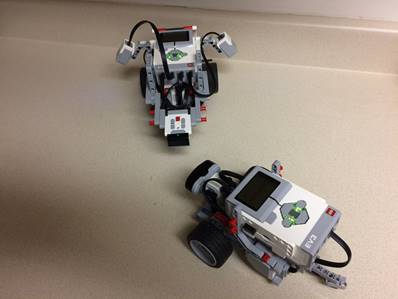
More Lego ev3 demos

[From Rupert Young (2018.02.16 16.30)]

(Rick Marken 2018-02-15_17:44:40]

With Vehicle 1
()
the output speed is proportional to the sensory input (in this case
temperature). How does the effect of the output reduce the effect of
the input?
Which Vehicle is this?
What is the purpose within Vehicle 1?
Regards,
Rupert

···

Rupert Young (2018.02.15 10.30)

RY: Are all closed-loop,
control systems PCT systems?

RM: Yes.

            RY: I don't see that

Vehicles are PCT systems, though happy to be corrected.
They don’t embody a goal, or comparator, or error.

          RM: There is not a variable reference (goal) but there

is an implicit constant reference of zero. I think Bruce
Abbott already explained this.

            RY: Their outputs

are directly functions of the inputs; in other words
they are input-output systems.

          RM: But their outputs are also have an effect, via the

environment, on their inputs. If the effect of these
outputs is to reduce the effect of the input that causes
the output then you’ve got a negative feedback system.

http://www.bcp.psych.ualberta.ca/~mike/Pearl_Street/Margin/Vehicles/Vehicle.1.html

            RY: I'm not sure

they are even control systems as there is no variable
that is being controlled.

          RM: I think the line- following cars are controlling

the level of illumination in each “eye”, trying to get it
to zero; the higher the illumination at an eye, the
greater the acceleration of the wheel on the same side as
the eye. So the car follows the line by controlling for
zero illumination in both eyes, so that both wheels move
at the same velocity. That is, both eyes are controlling
for looking at the line. The disturbance to this variable
is the curvature of the line. The car compensates for this
disturbance by accelerating the wheel on the side of the
car that is moving off the line.

            RY: Rather I'd call

them iterative input-output systems, with the outputs
being continually updated based upon the input states.
They are certainly dynamic systems, and, due to their
complexity, appear to do interesting things. But
they are not purposeful, in that they are not
controlling (perceptual) variables.

          RM: They are purposeful systems, controlling the

intensity of light in each eye relative to a fixed reference
– zero. So they have a fixed purpose, rather like
Republicans whose fixed purpose is quite obviously to
destroy the country for everyone except themselves and
their financial backers.

[From Bruce Abbott (2018.02.16.1305 EST)]

[Rick Marken 2018-02-15_17:23:50]

Richard Kennaway (2018.02.15 12:15)

RM: Thanks, Richard. Beautifully done. Almost as good as mine! Well, OK, better. But I do have one little nit. You say:

RK: Here is a first definition: A control system is something that acts so as to keep some property of the world at or close to some reference value, in spite of other influences on the value

RK: That is a little too wide: I want to exclude passive equilibrium systems, like a ball coming to rest in a bowl. So add to that definition that the putative control system must be drawing on some other source of energy to accomplish its task.

RM: I think a better way to distinguish equilibrium from control systems is to simply note that a putative control system keeps some variable property of the world (a controlled variable) at or close to some reference value, protected from disturbances. An equilibrium system can appear to keep some variable property of the environment (such as the rate of movement of the ball in the bowl) at or close to some reference value (such as resting at the bottom of the bowl); but the property of the world that appears to be kept at a reference (or equilibrium) value is not being protected from disturbances. If, for example, the ball in bowl the were being kept at rest at the bottom of the bowl it would not be easy to push it back up the side; but it is.

So the criterion is to be how easy it is to disturb the putative controlled variable?  Let’s make the ball a bowling ball being pushed against steep sides. You can’t do it, so it’s a control system? No, this criterion will not distinguish an equilibrium system from a control system.

RM: Adding that a control system draws on some other source of energy to accomplish its task doesn’t really distinguish it from an equilibrium system because the equilibrium system could be seen to draw on some other source of energy as well (such as an initial lateral push of the ball against the side of the bowl). In a control system that “other source of energy” is the energy used to produce the outputs that protect the controlled variable from disturbance. Identifying whether or not a system has an extra source of energy that does this would be quite difficult in most cases, I imagine. So why not identify a control system the way we do it with The Test for the Controlled Variable: by seeing whether the system protects a variable from disturbance. If it does, it’s a control system and not an equilibrium system (which is just an example of a causal system).

The difference between an equilibrium system and a control system is that the equilibrium draws on the energy supplied by the disturbance to generate the restoring force, whereas the control system draws on the energy supplied from another source, normally one that can supply a greater restorative force than could be supplied by the disturbance. Pushing the ball up the sides of the bowl uses the energy in the push to raise the ball against the opposing force of gravity, storing energy much as compressing a spring stores energy. When the ball is released, this potential energy is released and the ball returns to the bottom. Bend your arm at the elbow to hold you forearm horizontally, palm up. Place a ball into your palm. The weight of the ball slightly stretches the biceps muscle and its tendons, causing the forearm to sag slightly. If you do not change the neural input to this muscle, the system acts simply as a spring, storing energy in the stretching of muscle and tendons. Remove the ball and the forearm rises back to its original position. This is functioning as an equilibrium system. Place a heavier ball in your palm (or better yet, drop it onto the palm from some height). The forearm again sags as the forces involved again stretch the muscle and tendons. However, in this case the additional force generated by the higher ball-weight and the kinetic energy of the ball as it strikes the palm stretch the muscle enough to increase the output of the muscle’s spindles – sensors of muscle length and rate of change in length. The spindles have afferent nerves that synapse in an excitatory way on the alpha motor neurons that drive the biceps, so this increase in spindle signals increases the contractile force being generated by the biceps, thus acting to counteract the additional downward forces acting on the palm. This energy comes from chemical sources within the muscle – sources other than those generated by the disturbance and stored in spring-like fashion in the stretched muscle and tendons. This system is a control system.

Note that, as in this example, equilibrium and control systems can work in parallel; it doesn’t have to be either one or the other.

Bruce

[Martin Taylor 2018.02.16.13.05]

The current rate of movement of the ball has no relevance to the

current location of the ball. I think you mean in your bracket “such
as the location of the ball”.

How easy depends on the slope of the bowl sides. How well protected

is a control system’s controlled variable depends on the system
gain. There’s no way a priori to say which is easier to disturb. The
point is better put that some control systems (those with integrator
outputs) will move the ball back toward the reference/equilibrium
value while the disturbance remains unchanged.

      "Other source of energy

"-- other than that supplied by the disturbance – is really the
crucial distinction. Only with another source of energy could the
control system counter the effects of the disturbance. Without it,
all you have is the equivalent of a spring: disturbance puts
energy into the spring, disturbance relaxes, spring restores that
energy into kinetic form in order to return to the equilibrium
position.

···

[Rick Marken 2018-02-15_17:23:50]

Richard Kennaway (2018.02.15 12:15)

          RM: Thanks, Richard. Beautifully done. Almost as good

as mine! Well, OK, better. But I do have one little nit.
You say:

                  RK: Here is a first

definition: A control system is something that
acts so as to keep some property of the world at
or close to some reference value, in spite of
other influences on the value.

                  RK: That is a little

too wide: I want to exclude passive equilibrium
systems, like a ball coming to rest in a bowl. So
add to that definition that the putative control
system must be drawing on some other source of
energy to accomplish its task.

          RM:  I think a better way to distinguish equilibrium

from control systems is to simply note that a putative
control system keeps some variable property of the world
(a controlled variable) at or close to some reference
value, protected from disturbances . An equilibrium
system can appear to keep some variable property of the
environment (such as the rate of movement of the ball in
the bowl) at or close to some reference value (such as
resting at the bottom of the bowl);

          but the property of the world that appears to be kept

at a reference (or equilibrium) value is not being
protected from disturbances. If, for example, the ball in
bowl the were being kept at rest at the bottom of the bowl
it would not be easy to push it back up the side; but it
is.

RM: Adding that a control system draws
on some other source of energy to accomplish its task
doesn’t really distinguish it from an equilibrium
system because the equilibrium system could be seen to
draw on some other source of energy as well (such as
an initial lateral push of the ball against the side
of the bowl).

[Rick Marken 2018-02-16_16:15:22]

image00361.jpg

···

On Thu, Feb 15, 2018 at 1:53 AM, Alex Gomez-Marin agomezmarin@gmail.com wrote:

AGM: Hey Rick, I appreciate all your “in silico” demos. They really make the point!Â

RM: Thanks. They are all modeled after Bill’s, of course. And they are really only 1/2 in silico; the other half is in vivo – the person doing the demo.But I do think it’s great to develop demonstrations of the principles of PCT in machina. I think the best way to use the in machina implementations of control systems is as a way to demonstrate the principles of research based on an understanding of control systems as controllers of their own perceptual inputs relative to secularly varying references for those inputs. The nice thing about doing such demonstrations in machina is that we would know the “ground truth” – the perceptual variables that the system actually controls – so that the person doing the test could see how well they did.

AGM: What we can demonstrate​ “in machina” (robot) here is precisely what Powers said in his 1978 paper in page 426: “Consider a bird with eyes that are fixed in its head. If some interesting object, say, a bug, is moved across the line of sight, the bird’s head will most likely turn to follow it. The Z-system on open-loop explanation would run about like this…”. Our robot is that bird and the square moving is the bug. And we can first show what is needed software-wise and hardware-wise to have the system running as an ideal system (or not; aka, poor control), and then make a stimulus-response plot that we think most neuroethologists would interpret as telling us about the sensory-motor transformations of the bird, while we can actually show that it tells us about simple trigonometric laws of optics, and only that, nothing more. So the “experimenter to realise too late that his results were forced by his experimental design and do not actually pertain to behaviour”. Thus, an instantiation of the behavioural illusion.

RM: That’s a great idea, and very much like what I would like to see done with such a demo. I would just suggest telling the person observing the head movement , once they have made the incorrect interpretation of the stimulus response plot, that what is actually happening is that the bird is controlling for keeping the image of the bug stationary; and once you know that the bird is controlling that perception the observed stimulus-response law can be predicted precisely from the laws of control and the laws of optics. That is, you can show that the illusion of a linear causal path from bug image to head angle comes from ignoring the perceptual variable the bird is controlling.

AGM: It is tempting to present the results to the community as a kind of game where they need to propose, based on the data alone, what is going on with the bird. And then, in a second instalment, to publish the solution to the problem, also collecting their responses. Wouldn’t that be fun, engaging and telling?

RM: Yes, indeed. That is exactly what I have in mind. The “game” would be to have people try to figure out what perceptions the robot (bird, in this case) is controlling. You could make it more difficult by having several possible perceptual variables that the bird might be controlling. For example, you could have several bugs moving at different virtual distances from the bird and the bird could be controlling for fixation on one of them. The observer, by introducing disturbances to the movement of each of the bugs, would have to determine which of the bugs is the one being fixated on. There are many other ways to make it difficult for an observer to tell what perception the bird is controlling for but Im sure you can think of all kinds of ways to do this. That could be a great contribution to the repertoire of in machina demonstrations of the principles of PCT.Â

Best

Rick


Richard S. MarkenÂ

"Perfection is achieved not when you have nothing more to add, but when you
have nothing left to take away.�
                --Antoine de Saint-Exupery

On Thu, Feb 15, 2018 at 2:24 AM, Richard Marken rsmarken@gmail.com wrote:

[Rick Marken 2018-02-14_17:24:01]

On Wed, Feb 14, 2018 at 1:32 PM, Alex Gomez-Marin agomezmarin@gmail.com wrote:

AGM:Â

See attached a couple of videos of our (i) “geo-rover” and our (ii) “tennis-umpire”. The first one is an attempt to test the power law stuff with a “turtle geometry” perspective. The second one —built by my lovely Adam! and another student— is the actuatual embodiment of Power’s “behavioural illusion” problem in the 1978 “spadeworks” paper.Â

RM: I think it would help if there were some explanation of what is being demonstrated in these videos. I particularly thrilled that you have developed a demonstration of the “behavioral illusion”. But I’m afraid I can’t tell what’s being demonstrated. It would help if you could add an audio track explaining what’s going on.Â

RM: By the way, here is my own demonstration of the behavioral illusion:Â

http://www.mindreadings.com/ControlDemo/Illusion.html

RM: What do you think?

BestÂ

Rick

Â

Cheers,

Alex

​
 MOV_0388.mp4

​


Richard S. MarkenÂ

"Perfection is achieved not when you have nothing more to add, but when you
have nothing left to take away.�
                --Antoine de Saint-Exupery

On Wed, Feb 14, 2018 at 9:25 PM, Richard Marken rsmarken@gmail.com wrote:

[Rick Marken 2018-02-14_12:24:13]

Rupert Young (2018.02.14 18.05)–

RY: These are very nice Bruce! Great work!

  RY: Are they implemented as PCT systems? Some look like Braitenberg's

Vehicles. This could be a good opportunity (something I’ve long
wanted to do) to demonstrate the difference between reactive
systems (Braitenberg’s Vehicles) and PCT systems. This could be
done by implementing the Vehicles and showing how they’d work much
better with an equivalent PCT implementation.

RM: I’d like to see that too! Especially since I think a Braitenberg vehicle is a PCT system since it’s a closed-loop, control system.Â

BestÂ

Rick

Regards,

Rupert

  On 13/02/2018 04:12, Bruce Abbott

wrote:

[From Bruce Abbott (2018.02.12.1105 EST)]

Â

      I’ve just posted several new Lego ev3-based

demos on my YouTube site. The first shows an ev3 vehicle that
has a color sensor mounted on each side above the driving
wheels. Both sensors operate in “ambient light intensity�
mode, returning a number proportional to the intensity of
light falling on the sensor. The two driving wheels, which
are driven by separate motors, steer the vehicle by slowing
one or the other motor below its set speed based on the
difference in sensed intensity of the light falling on the two
sensors. In the first video, the vehicle moves toward a
bright light located at some distance from the starting
location. Â (Biologists refer to this type of control as a
positive phototaxis.) An ultrasonic distance sensor stops both
motors when the distance to a wall or other obstacle is less
than 10 cm.

Â

      The second video shows the same vehicle

behaving under a spot of light being projected on the floor in
an otherwise darkened room. The behavior observed resembles
that of a moth drawn to a light.

Â

      A phototaxis requires at least two light

sensors to register the difference in light intensities on
opposite sides. A simple test for the presence of a
phototaxis is to cover or otherwise blind one of the two
sensors; if a phototaxis is at work you will observe “circus�
behavior – in the case of a positive phototaxis the crittter
will be moving in tight circles, turning in the direction of
the operable eye as the system fruitlessly attempts to
increase the signal from the blind eye. I tested this with
the ev3 by unplugging one of the two sensors and observed
exactly this behavior.

Â

      The third video again shows the same ev3

but now the program’s “polarity� has been reversed so that the
ev3 turns away from the bright side and keeps turning until
the sensors are registering equal intensities. At that point
the vehicle is speeding directly away from the light source.Â
Biologists call this a negative phototaxis; it is the behavior
shown by cockroaches that scatter for the dark places when the
lights are turned on.

Â

      The fourth and final new video recreates

Bill Power’s “Crowd� demo in “Lorenz� mode. The same ev3
serves as a “mother duck,� while a second ev3 acts as the
duckling. The mother duck is seen heading for a distant light
while the duckling follows its mother at a short distance.Â
When the mother reaches the light and stops, the duckling
catches up and comes to a stop close to its mother.

Â

      The reason why the duckling follows its

mother is that the ducking is equipped with an infrared sensor
and the mother has an infrared beacon attached to her tail.Â
The infrared sensor provides numbers reflecting the angular
position of the beacon relative to the sensor, and the ev3’s
two driving motors’ relative speeds are determined by this
angle, such that the vehicle will turn in a direction that
reduces the beam’s angular position to zero. The infrared
sensor also provides numbers proportional to the “proximity,�
or distance between the sensor and beacon; this number
determines the overall speed of the two motors. As the
distance decreases, the motor speeds decrease. Thus, when the
duckling finally catches up to its mother, its forward speed
reduces with the distance until the speed reaches zero,
leaving the duckling close to mama.

Â

You can view all these demos at https://www.youtube.com/channel/UC7jvewkUPeP777s7HQgKmXA

Â

Mama duck and her baby.

Â

Bruce

Richard S. MarkenÂ

"Perfection is achieved not when you have nothing more to add, but when you
have nothing left to take away.�
                --Antoine de Saint-Exupery

Hey Rick,

You’re right: your demos are not merely simulations, they are indeed demos with half in silico, half in vivo

Exactly: having a robot behave is a good tool because we actually know the ground truth because we programmed ourselves, as opposed to inferences we need to make in humans or animals.

Indeed: asking a person in situ observing the movement would be like what you and Warren did in the rubber band illusion paper. I would like to do in the context of neuroscientists where I would tell them all they could measure and ask them what the infer about the organism.

Having many bugs moving around but only one really attended by the bird (robot) reminds me of Powers’ Figure 8 in his 1978 paper. (by the way, this year is the 40th anniversary! so a good year to put out a in machina revival of it).

3 more points I would like to discuss related to the bug-bird robot, to the 1978 paper, and also to the Braitenberg vehicles:

1- go to page 424 of the 1978 paper: Does anyone know what Powers concretely meant by “In order to show that a given organisms should be modelled as a Z system, it is necessary to establish that the organism’s own behaviour has no effect on the proximal stimuli in the supposed causal chain. I believe that this condition is, in any normal circumstance, impossible to meet.”? In other words, let’s say people in neuroscience put a fish in some gel and present it with some visual stimulus and measure how the fish moves its tail, but of course it is not going anywhere. Now, wouldn’t that be a Z system (of course, artificial, not “a normal circumstance”) yet, wouldn’t we be able to learn something real and interesting about the “f function”, the “systems function” of the fish?

2-go to page 421: did powers comment further on when/whether the “transfer function” approach can be useful to reveal properties of the “f function” of the system. This approach, knowingly or not, is what most behavioural neuroscientist apply. And in our bird-bug robot, we would like to test whether it could also tell us something about the behaviour of the system or not.

3- go to page 23: “classifying system-environment relationships”. Related to our previous Braitenberg’s discussion, I realised something quite obvious but subtle and very important: that being a Z-system, or a N-system, or a P-system is a property of the system-AND-world relationship! Because it has to do with both U and F (in Power’s notion, after his approximation in the 1978 paper), which reflect the first derivative of the system’s and feedback function. So, that is why a Stimulus-Response system can be put in an environment where it actually behaves and becomes a control system (N-system), like the Braitenberg vehicle. Conversely, a N-system (in one environment) can become a P-system or even a Z-system in another environment. This is quite clarifying to me, as it seemed that being a control system was predicated only on the system itself, but it is a relational property.Â

thanks,

Alex

image00361.jpg

···

On Sat, Feb 17, 2018 at 1:19 AM, Richard Marken rsmarken@gmail.com wrote:

[Rick Marken 2018-02-16_16:15:22]

On Thu, Feb 15, 2018 at 1:53 AM, Alex Gomez-Marin agomezmarin@gmail.com wrote:

AGM: Hey Rick, I appreciate all your “in silico” demos. They really make the point!Â

RM: Thanks. They are all modeled after Bill’s, of course. And they are really only 1/2 in silico; the other half is in vivo – the person doing the demo.But I do think it’s great to develop demonstrations of the principles of PCT in machina. I think the best way to use the in machina implementations of control systems is as a way to demonstrate the principles of research based on an understanding of control systems as controllers of their own perceptual inputs relative to secularly varying references for those inputs. The nice thing about doing such demonstrations in machina is that we would know the “ground truth” – the perceptual variables that the system actually controls – so that the person doing the test could see how well they did.

AGM: What we can demonstrate​ “in machina” (robot) here is precisely what Powers said in his 1978 paper in page 426: “Consider a bird with eyes that are fixed in its head. If some interesting object, say, a bug, is moved across the line of sight, the bird’s head will most likely turn to follow it. The Z-system on open-loop explanation would run about like this…”. Our robot is that bird and the square moving is the bug. And we can first show what is needed software-wise and hardware-wise to have the system running as an ideal system (or not; aka, poor control), and then make a stimulus-response plot that we think most neuroethologists would interpret as telling us about the sensory-motor transformations of the bird, while we can actually show that it tells us about simple trigonometric laws of optics, and only that, nothing more. So the “experimenter to realise too late that his results were forced by his experimental design and do not actually pertain to behaviour”. Thus, an instantiation of the behavioural illusion.

RM: That’s a great idea, and very much like what I would like to see done with such a demo. I would just suggest telling the person observing the head movement , once they have made the incorrect interpretation of the stimulus response plot, that what is actually happening is that the bird is controlling for keeping the image of the bug stationary; and once you know that the bird is controlling that perception the observed stimulus-response law can be predicted precisely from the laws of control and the laws of optics. That is, you can show that the illusion of a linear causal path from bug image to head angle comes from ignoring the perceptual variable the bird is controlling.

AGM: It is tempting to present the results to the community as a kind of game where they need to propose, based on the data alone, what is going on with the bird. And then, in a second instalment, to publish the solution to the problem, also collecting their responses. Wouldn’t that be fun, engaging and telling?

RM: Yes, indeed. That is exactly what I have in mind. The “game” would be to have people try to figure out what perceptions the robot (bird, in this case) is controlling. You could make it more difficult by having several possible perceptual variables that the bird might be controlling. For example, you could have several bugs moving at different virtual distances from the bird and the bird could be controlling for fixation on one of them. The observer, by introducing disturbances to the movement of each of the bugs, would have to determine which of the bugs is the one being fixated on. There are many other ways to make it difficult for an observer to tell what perception the bird is controlling for but Im sure you can think of all kinds of ways to do this. That could be a great contribution to the repertoire of in machina demonstrations of the principles of PCT.Â

Best

Rick


Richard S. MarkenÂ

"Perfection is achieved not when you have nothing more to add, but when you
have nothing left to take away.�
                --Antoine de Saint-Exupery

On Thu, Feb 15, 2018 at 2:24 AM, Richard Marken rsmarken@gmail.com wrote:

[Rick Marken 2018-02-14_17:24:01]

On Wed, Feb 14, 2018 at 1:32 PM, Alex Gomez-Marin agomezmarin@gmail.com wrote:

AGM:Â

See attached a couple of videos of our (i) “geo-rover” and our (ii) “tennis-umpire”. The first one is an attempt to test the power law stuff with a “turtle geometry” perspective. The second one —built by my lovely Adam! and another student— is the actuatual embodiment of Power’s “behavioural illusion” problem in the 1978 “spadeworks” paper.Â

RM: I think it would help if there were some explanation of what is being demonstrated in these videos. I particularly thrilled that you have developed a demonstration of the “behavioral illusion”. But I’m afraid I can’t tell what’s being demonstrated. It would help if you could add an audio track explaining what’s going on.Â

RM: By the way, here is my own demonstration of the behavioral illusion:Â

http://www.mindreadings.com/ControlDemo/Illusion.html

RM: What do you think?

BestÂ

Rick

Â

Cheers,

Alex

​
 MOV_0388.mp4

​


Richard S. MarkenÂ

"Perfection is achieved not when you have nothing more to add, but when you
have nothing left to take away.�
                --Antoine de Saint-Exupery

On Wed, Feb 14, 2018 at 9:25 PM, Richard Marken rsmarken@gmail.com wrote:

[Rick Marken 2018-02-14_12:24:13]

Rupert Young (2018.02.14 18.05)–

RY: These are very nice Bruce! Great work!

  RY: Are they implemented as PCT systems? Some look like Braitenberg's

Vehicles. This could be a good opportunity (something I’ve long
wanted to do) to demonstrate the difference between reactive
systems (Braitenberg’s Vehicles) and PCT systems. This could be
done by implementing the Vehicles and showing how they’d work much
better with an equivalent PCT implementation.

RM: I’d like to see that too! Especially since I think a Braitenberg vehicle is a PCT system since it’s a closed-loop, control system.Â

BestÂ

Rick

Regards,

Rupert

  On 13/02/2018 04:12, Bruce Abbott

wrote:

[From Bruce Abbott (2018.02.12.1105 EST)]

Â

      I’ve just posted several new Lego ev3-based

demos on my YouTube site. The first shows an ev3 vehicle that
has a color sensor mounted on each side above the driving
wheels. Both sensors operate in “ambient light intensity�
mode, returning a number proportional to the intensity of
light falling on the sensor. The two driving wheels, which
are driven by separate motors, steer the vehicle by slowing
one or the other motor below its set speed based on the
difference in sensed intensity of the light falling on the two
sensors. In the first video, the vehicle moves toward a
bright light located at some distance from the starting
location. Â (Biologists refer to this type of control as a
positive phototaxis.) An ultrasonic distance sensor stops both
motors when the distance to a wall or other obstacle is less
than 10 cm.

Â

      The second video shows the same vehicle

behaving under a spot of light being projected on the floor in
an otherwise darkened room. The behavior observed resembles
that of a moth drawn to a light.

Â

      A phototaxis requires at least two light

sensors to register the difference in light intensities on
opposite sides. A simple test for the presence of a
phototaxis is to cover or otherwise blind one of the two
sensors; if a phototaxis is at work you will observe “circus�
behavior – in the case of a positive phototaxis the crittter
will be moving in tight circles, turning in the direction of
the operable eye as the system fruitlessly attempts to
increase the signal from the blind eye. I tested this with
the ev3 by unplugging one of the two sensors and observed
exactly this behavior.

Â

      The third video again shows the same ev3

but now the program’s “polarity� has been reversed so that the
ev3 turns away from the bright side and keeps turning until
the sensors are registering equal intensities. At that point
the vehicle is speeding directly away from the light source.Â
Biologists call this a negative phototaxis; it is the behavior
shown by cockroaches that scatter for the dark places when the
lights are turned on.

Â

      The fourth and final new video recreates

Bill Power’s “Crowd� demo in “Lorenz� mode. The same ev3
serves as a “mother duck,� while a second ev3 acts as the
duckling. The mother duck is seen heading for a distant light
while the duckling follows its mother at a short distance.Â
When the mother reaches the light and stops, the duckling
catches up and comes to a stop close to its mother.

Â

      The reason why the duckling follows its

mother is that the ducking is equipped with an infrared sensor
and the mother has an infrared beacon attached to her tail.Â
The infrared sensor provides numbers reflecting the angular
position of the beacon relative to the sensor, and the ev3’s
two driving motors’ relative speeds are determined by this
angle, such that the vehicle will turn in a direction that
reduces the beam’s angular position to zero. The infrared
sensor also provides numbers proportional to the “proximity,�
or distance between the sensor and beacon; this number
determines the overall speed of the two motors. As the
distance decreases, the motor speeds decrease. Thus, when the
duckling finally catches up to its mother, its forward speed
reduces with the distance until the speed reaches zero,
leaving the duckling close to mama.

Â

You can view all these demos at https://www.youtube.com/channel/UC7jvewkUPeP777s7HQgKmXA

Â

Mama duck and her baby.

Â

Bruce

Richard S. MarkenÂ

"Perfection is achieved not when you have nothing more to add, but when you
have nothing left to take away.�
                --Antoine de Saint-Exupery

[Eetu Pikkarainen 2018-02-17_13:32:50 UTC]

[From Rupert Young (2018.02.16 16.30)]

With Vehicle 1 (http://www.bcp.psych.ualberta.ca/~mike/Pearl_Street/Margin/Vehicles/Vehicle.1.html )
the output speed is proportional to the sensory input (in this case temperature).
How does the effect of the output reduce the effect of the input?

Rupert, thank you for that link, there is more info than in Wikipedia. Vehicle 1 is really a simple vehicle because it can stay in rest or run straight forward, and
the speed of its running depends on the strength of the signal sensed by its sensor – in this case warmmth. The direction of its movement depends on how it is put to the ground (or water).

What is the purpose within Vehicle 1?

That depends on how you turn it
:blush: . If you turn it towards the source of the signal it senses then it acts as a positive feedback loop. Its purpose
is to get more warmth, as much and as soon as it can. If instead its movement is away from the heat source the it is negative feedback loop whose purpose is to avoid warmth. As Bruce described in
[From Bruce Abbott (2018.02.16.1015 EST)]

“One can think of this as temperature control system with a virtual reference located at the temperature at which the vehicle stops.�

Eetu

Please, regard all my statements as questions,

no matter how they are formulated.

Regards,
Rupert

[Rick Marken 2018-02-17_11:52:48]

Rupert Young (2018.02.16 16.30)--

RY: With Vehicle 1 (<Notes On Vehicle 1: Getting Around) the output speed is proportional to the sensory input (in this case temperature). How does the effect of the output reduce the effect of the input?

RM: It depends on the direction of rotation of the wheel. If the wheel turns clockwise with the sensor to the right of the axle then movement of the wheel will move the sensor toward the heat source, increasing the heat at the sensor. So the effect of output on input is to increase the input effect on the output; there is positive feedback and the car will accelerate toward the heat source. No control:Â
RM: If, instead, the wheel turns counterclockwise relative to the sensor on the right then movement of the wheel caused by heat at the sensor moves the sensor away from the heat reducing the effect of input on output; the car eventually stops when the sensor is far enough from the heat source that the input is zero; car stops when the the input is at the virtual reference value, zero.

RM: I think the line- following cars are controlling the level of illumination in each "eye", trying to get it to zero; the higher the illumination at an eye, the greater the acceleration of the wheel on the same side as the eye. So the car follows the line by controlling for zero illumination in both eyes, so that both wheels move at the same velocity. That is, both eyes are controlling for looking at the line. The disturbance to this variable is the curvature of the line. The car compensates for this disturbance by accelerating the wheel on the side of the car that is moving off the line.

RY: Which Vehicle is this?

RM: One I saw as a student project.Â

RY: Rather I'd call them iterative input-output systems, with the outputs being continually updated based upon the input states. They are certainly dynamic systems, and, due to their complexity, appear to do interesting things. But they are not purposeful, in that they are not controlling (perceptual) variables.

RM: All control systems have the purpose of controlling their inputs. Â

RM: They are purposeful systems, controlling the intensity of light in each eye relative to a fixed reference -- zero. So they have a fixed purpose, rather like Republicans whose fixed purpose is quite obviously to destroy the country for everyone except themselves and their financial backers.Â

RY: What is the purpose within Vehicle 1?

RM: If properly designed for stable negative feedback (as I described above) vehicle 1 will control the heat level at the sensor, maintaining it at a reference level of zero.
 >

···

Regards,
Rupert

--
Richard S. MarkenÂ
"Perfection is achieved not when you have nothing more to add, but when you
have nothing left to take away.�
                --Antoine de Saint-Exupery

[Rick Marken 2018-02-17_12:15:18]

Bruce Abbott (2018.02.16.1305 EST)--

Â

RM:Â I think a better way to distinguish equilibrium from control systems is to simply note that a putative control system keeps some variable property of the world (a controlled variable) at or close to some reference value, protected from disturbances.Â

Â

BA: So the criterion is to be how easy it is to disturb the putative controlled variable?

RM: No, the criterion for distinguishing equilibrium from control systems is to see whether the system keeps a variable in a reference state protected from disturbance; that is, we distinguish equilibrium from control systems by seeing whether ot not they control; control systems do, equilibrium systems don't.
Â

Â

BA: The difference between an equilibrium system and a control system is that the equilibrium draws on the energy supplied by the disturbance to generate the restoring force, whereas the control system draws on the energy supplied from another source, normally one that can supply a greater restorative force than could be supplied by the disturbance.Â

RM: No, the difference is that a control system controls and an equilibrium system doesn't.Â
Â

BA: Pushing the ball up the sides of the bowl uses the energy in the push to raise the ball against the opposing force of gravity, storing energy much as compressing a spring stores energy. When the ball is released, this potential energy is released and the ball returns to the bottom...This system is a control system.

RM: What's the controlled variable?
 >

BA: Note that, as in this example, equilibrium and control systems can work in parallel; it doesn’t have to be either one or the other.

RM: Of course. Equilibrium systems are just causal systems and causal systems are components of all control systems.Â
BestÂ

···

--
Richard S. MarkenÂ
"Perfection is achieved not when you have nothing more to add, but when you
have nothing left to take away.�
                --Antoine de Saint-Exupery

[Rick Marken 2018-02-17_13:01:45]

Martin Taylor (2018.02.16.13.05)--

RM:Â I think a better way to distinguish equilibrium from control systems is to simply note that a putative control system keeps some variable property of the world (a controlled variable) at or close to some reference value, protected from disturbances. An equilibrium system can appear to keep some variable property of the environment (such as the rate of movement of the ball in the bowl) at or close to some reference value (such as resting at the bottom of the bowl);

MT: The current rate of movement of the ball has no relevance to the current location of the ball. I think you mean in your bracket "such as the location of the ball".

RM: No, rate of movement is a possible controlled variable. as is acceleration and location.You assume that the bowl is controlling the location of the ball; I know the bowl isn't controlling anything about the ball.Â

RM: but the property of the world that appears to be kept at a reference (or equilibrium) value is not being protected from disturbances. If, for example, the ball in bowl the were being kept at rest at the bottom of the bowl it would not be easy to push it back up the side; but it is.Â

MT: How easy depends on the slope of the bowl sides. How well protected is a control system's controlled variable depends on the system gain.

RM: A better (and more accurate) way to have said it would have been: You can tell that the ball's location in the bowl is NOT being controlled by noting that a force disturbance moves the ball a distance that is precisely predicted by the laws of physics. You can tell you are dealing with a control system when disturbances have far less of an effect on a variable than would be expected if the variable were not under control -- if a system were not acting to protect the variable from the effects of the disturbance.
BestÂ
Rick

···

--
Richard S. MarkenÂ
"Perfection is achieved not when you have nothing more to add, but when you
have nothing left to take away.�
                --Antoine de Saint-Exupery

[Martin Taylor 2018.02.17.16.44]

What did I write that suggests your comment in the second sentence?

In respect of your first sentence, I realize now that what you wrote
was ambiguous rather than incorrect. Anything you can perceive is
potentially a controlled perception, if you have the means to
influence it. It was just an unfortunate didactic choice, to use one
perception when talking about a variable in the environment and then
switch to another when talking about what I (and maybe others)
assumed to be intended to be the reference value for the perception
of that same variable.
As indeed I said. You forgot to include your objection (assuming you
have one) to what I wrote in the rest of that paragraph, which was:
Anyway, the point of my message was none of the above. The point was
that Kennaway was correct in saying that the true criterion is that
the control system uses energy from some other source to oppose the
disturbance, whereas the equilibrium system uses only energy
supplied by the disturbance.
Martin

···

On 2018/02/17 4:01 PM, Richard Marken
wrote:

[Rick Marken 2018-02-17_13:01:45]

Martin Taylor (2018.02.16.13.05)–

                        RM:  I think a better way to distinguish

equilibrium from control systems is to
simply note that a putative control system
keeps some variable property of the world (a
controlled variable) at or close to some
reference value, * protected from
disturbances* . An equilibrium system
can appear to keep some variable property of
the environment (such as the rate of
movement of the ball in the bowl) at or
close to some reference value (such as
resting at the bottom of the bowl);

            MT: The current rate of movement of the ball has

no relevance to the current location of the ball. I
think you mean in your bracket “such as the location of
the ball”.

          RM: No, rate of movement is  a possible controlled

variable. as is acceleration and location.You assume that
the bowl is controlling the location of the ball; I know
the bowl isn’t controlling anything about the ball.

                        RM: but the property of the world that

appears to be kept at a reference (or
equilibrium) value is not being protected
from disturbances. If, for example, the ball
in bowl the were being kept at rest at the
bottom of the bowl it would not be easy to
push it back up the side; but it is.

            MT: How easy depends on the slope of the bowl

sides. How well protected is a control system’s
controlled variable depends on the system gain.

          RM: A better (and more accurate) way to have said it

would have been: You can tell that the ball’s location in
the bowl is NOT being controlled by noting that a force
disturbance moves the ball a distance that is precisely
predicted by the laws of physics. You can tell you are
dealing with a control system when disturbances have far
less of an effect on a variable than would be expected if
the variable were not under control – if a system were
not acting to protect the variable from the effects of the
disturbance.

  There's no way a priori to say which is

easier to disturb. The point is better put that some control
systems (those with integrator outputs) will move the ball back
toward the reference/equilibrium value while the disturbance
remains unchanged.

[Rick Marken 2018-02-17_14:02:52]

image00361.jpg

···

On Sat, Feb 17, 2018 at 4:47 AM, Alex Gomez-Marin agomezmarin@gmail.com wrote:

AGM: 3 more points I would like to discuss related to the bug-bird robot, to the 1978 paper, and also to the Braitenberg vehicles:

AGM: 1- go to page 424 of the 1978 paper: Does anyone know what Powers concretely meant by “In order to show that a given organisms should be modelled as a Z system, it is necessary to establish that the organism’s own behaviour has no effect on the proximal stimuli in the supposed causal chain. I believe that this condition is, in any normal circumstance, impossible to meet.”? In other words, let’s say people in neuroscience put a fish in some gel and present it with some visual stimulus and measure how the fish moves its tail, but of course it is not going anywhere. Now, wouldn’t that be a Z system (of course, artificial, not “a normal circumstance”) yet, wouldn’t we be able to learn something real and interesting about the “f function”, the “systems function” of the fish?

RM: Yes, the fish would probably be close to a Z system, at least with respect to whatever visual variables are controlled by the changes in positoin that are usually produced by movements of the tail. But this kind of research won’t tell you the system function of the fish. The system function for an N system is o = f(r-p). The crucial thing to understand about this function is the variable p, the controlled perceptual variable. If you don’t know p you can’t possibly get the system function, f(), right. And you can’t determine what p is by trying to turn the system into an open loop (N) system.Â

RM: I think the basic message of that incredible 1978 paper is that the most important thing to understand about the behavior of living N systems (living control systems) is the perceptual variables they control. And you can do this only if you know a controlled perceptual variable is and how to identify them using what
in the 1978Â Â paper is called the Test for the Controlled Quantity (p 432).Â

Â

AGM: 2-go to page 421: did powers comment further on when/whether the “transfer function” approach can be useful to reveal properties of the “f function” of the system. This approach, knowingly or not, is what most behavioural neuroscientist apply. And in our bird-bug robot, we would like to test whether it could also tell us something about the behaviour of the system or not.

RM: Bill was well aware of the use of the “transfer function” approach to understanding behavior. Here’s what he had to say about it on p. 421:Â

WTP: The designer of a man-machine system focuses on the
high-frequency limits of performance because his task is not to understand the
man but to get the most out of the machine for some extraneous purpose
. This is
the origin of the transfer function approach, and the reason why the engineering
models can get away with treating the man in the system as an input-output box.(emphasis mine).

RM: What you won’t understand using the transfer function approach is what variable(s) the system is controlling. So the way to study the behavior of organisms is using the test for the controlled quantity rather than the derivation of transfer functions.

RM: Bill Powers did develop methods for estimating transfer functions (the functions “transferring” error into output) in order to improve the fit of models to data. But these methods are only useful after the controlled perceptual variable, p, has been identified. This, of course, is because the transfer function, f, in a control system is o = f(r-p).

Best

Rick

AGM: 3- go to page 23: “classifying system-environment relationships”. Related to our previous Braitenberg’s discussion, I realised something quite obvious but subtle and very important: that being a Z-system, or a N-system, or a P-system is a property of the system-AND-world relationship! Because it has to do with both U and F (in Power’s notion, after his approximation in the 1978 paper), which reflect the first derivative of the system’s and feedback function. So, that is why a Stimulus-Response system can be put in an environment where it actually behaves and becomes a control system (N-system), like the Braitenberg vehicle. Conversely, a N-system (in one environment) can become a P-system or even a Z-system in another environment. This is quite clarifying to me, as it seemed that being a control system was predicated only on the system itself, but it is a relational property.Â

thanks,

Alex


Richard S. MarkenÂ

"Perfection is achieved not when you have nothing more to add, but when you
have nothing left to take away.�
                --Antoine de Saint-Exupery

On Sat, Feb 17, 2018 at 1:19 AM, Richard Marken rsmarken@gmail.com wrote:

[Rick Marken 2018-02-16_16:15:22]

On Thu, Feb 15, 2018 at 1:53 AM, Alex Gomez-Marin agomezmarin@gmail.com wrote:

AGM: Hey Rick, I appreciate all your “in silico” demos. They really make the point!Â

RM: Thanks. They are all modeled after Bill’s, of course. And they are really only 1/2 in silico; the other half is in vivo – the person doing the demo.But I do think it’s great to develop demonstrations of the principles of PCT in machina. I think the best way to use the in machina implementations of control systems is as a way to demonstrate the principles of research based on an understanding of control systems as controllers of their own perceptual inputs relative to secularly varying references for those inputs. The nice thing about doing such demonstrations in machina is that we would know the “ground truth” – the perceptual variables that the system actually controls – so that the person doing the test could see how well they did.

AGM: What we can demonstrate​ “in machina” (robot) here is precisely what Powers said in his 1978 paper in page 426: “Consider a bird with eyes that are fixed in its head. If some interesting object, say, a bug, is moved across the line of sight, the bird’s head will most likely turn to follow it. The Z-system on open-loop explanation would run about like this…”. Our robot is that bird and the square moving is the bug. And we can first show what is needed software-wise and hardware-wise to have the system running as an ideal system (or not; aka, poor control), and then make a stimulus-response plot that we think most neuroethologists would interpret as telling us about the sensory-motor transformations of the bird, while we can actually show that it tells us about simple trigonometric laws of optics, and only that, nothing more. So the “experimenter to realise too late that his results were forced by his experimental design and do not actually pertain to behaviour”. Thus, an instantiation of the behavioural illusion.

RM: That’s a great idea, and very much like what I would like to see done with such a demo. I would just suggest telling the person observing the head movement , once they have made the incorrect interpretation of the stimulus response plot, that what is actually happening is that the bird is controlling for keeping the image of the bug stationary; and once you know that the bird is controlling that perception the observed stimulus-response law can be predicted precisely from the laws of control and the laws of optics. That is, you can show that the illusion of a linear causal path from bug image to head angle comes from ignoring the perceptual variable the bird is controlling.

AGM: It is tempting to present the results to the community as a kind of game where they need to propose, based on the data alone, what is going on with the bird. And then, in a second instalment, to publish the solution to the problem, also collecting their responses. Wouldn’t that be fun, engaging and telling?

RM: Yes, indeed. That is exactly what I have in mind. The “game” would be to have people try to figure out what perceptions the robot (bird, in this case) is controlling. You could make it more difficult by having several possible perceptual variables that the bird might be controlling. For example, you could have several bugs moving at different virtual distances from the bird and the bird could be controlling for fixation on one of them. The observer, by introducing disturbances to the movement of each of the bugs, would have to determine which of the bugs is the one being fixated on. There are many other ways to make it difficult for an observer to tell what perception the bird is controlling for but Im sure you can think of all kinds of ways to do this. That could be a great contribution to the repertoire of in machina demonstrations of the principles of PCT.Â

Best

Rick


Richard S. MarkenÂ

"Perfection is achieved not when you have nothing more to add, but when you
have nothing left to take away.�
                --Antoine de Saint-Exupery

On Thu, Feb 15, 2018 at 2:24 AM, Richard Marken rsmarken@gmail.com wrote:

[Rick Marken 2018-02-14_17:24:01]

On Wed, Feb 14, 2018 at 1:32 PM, Alex Gomez-Marin agomezmarin@gmail.com wrote:

AGM:Â

See attached a couple of videos of our (i) “geo-rover” and our (ii) “tennis-umpire”. The first one is an attempt to test the power law stuff with a “turtle geometry” perspective. The second one —built by my lovely Adam! and another student— is the actuatual embodiment of Power’s “behavioural illusion” problem in the 1978 “spadeworks” paper.Â

RM: I think it would help if there were some explanation of what is being demonstrated in these videos. I particularly thrilled that you have developed a demonstration of the “behavioral illusion”. But I’m afraid I can’t tell what’s being demonstrated. It would help if you could add an audio track explaining what’s going on.Â

RM: By the way, here is my own demonstration of the behavioral illusion:Â

http://www.mindreadings.com/ControlDemo/Illusion.html

RM: What do you think?

BestÂ

Rick

Â

Cheers,

Alex

​
 MOV_0388.mp4

​


Richard S. MarkenÂ

"Perfection is achieved not when you have nothing more to add, but when you
have nothing left to take away.�
                --Antoine de Saint-Exupery

On Wed, Feb 14, 2018 at 9:25 PM, Richard Marken rsmarken@gmail.com wrote:

[Rick Marken 2018-02-14_12:24:13]

Rupert Young (2018.02.14 18.05)–

RY: These are very nice Bruce! Great work!

  RY: Are they implemented as PCT systems? Some look like Braitenberg's

Vehicles. This could be a good opportunity (something I’ve long
wanted to do) to demonstrate the difference between reactive
systems (Braitenberg’s Vehicles) and PCT systems. This could be
done by implementing the Vehicles and showing how they’d work much
better with an equivalent PCT implementation.

RM: I’d like to see that too! Especially since I think a Braitenberg vehicle is a PCT system since it’s a closed-loop, control system.Â

BestÂ

Rick

Regards,

Rupert

  On 13/02/2018 04:12, Bruce Abbott

wrote:

[From Bruce Abbott (2018.02.12.1105 EST)]

Â

      I’ve just posted several new Lego ev3-based

demos on my YouTube site. The first shows an ev3 vehicle that
has a color sensor mounted on each side above the driving
wheels. Both sensors operate in “ambient light intensity�
mode, returning a number proportional to the intensity of
light falling on the sensor. The two driving wheels, which
are driven by separate motors, steer the vehicle by slowing
one or the other motor below its set speed based on the
difference in sensed intensity of the light falling on the two
sensors. In the first video, the vehicle moves toward a
bright light located at some distance from the starting
location. Â (Biologists refer to this type of control as a
positive phototaxis.) An ultrasonic distance sensor stops both
motors when the distance to a wall or other obstacle is less
than 10 cm.

Â

      The second video shows the same vehicle

behaving under a spot of light being projected on the floor in
an otherwise darkened room. The behavior observed resembles
that of a moth drawn to a light.

Â

      A phototaxis requires at least two light

sensors to register the difference in light intensities on
opposite sides. A simple test for the presence of a
phototaxis is to cover or otherwise blind one of the two
sensors; if a phototaxis is at work you will observe “circus�
behavior – in the case of a positive phototaxis the crittter
will be moving in tight circles, turning in the direction of
the operable eye as the system fruitlessly attempts to
increase the signal from the blind eye. I tested this with
the ev3 by unplugging one of the two sensors and observed
exactly this behavior.

Â

      The third video again shows the same ev3

but now the program’s “polarity� has been reversed so that the
ev3 turns away from the bright side and keeps turning until
the sensors are registering equal intensities. At that point
the vehicle is speeding directly away from the light source.Â
Biologists call this a negative phototaxis; it is the behavior
shown by cockroaches that scatter for the dark places when the
lights are turned on.

Â

      The fourth and final new video recreates

Bill Power’s “Crowd� demo in “Lorenz� mode. The same ev3
serves as a “mother duck,� while a second ev3 acts as the
duckling. The mother duck is seen heading for a distant light
while the duckling follows its mother at a short distance.Â
When the mother reaches the light and stops, the duckling
catches up and comes to a stop close to its mother.

Â

      The reason why the duckling follows its

mother is that the ducking is equipped with an infrared sensor
and the mother has an infrared beacon attached to her tail.Â
The infrared sensor provides numbers reflecting the angular
position of the beacon relative to the sensor, and the ev3’s
two driving motors’ relative speeds are determined by this
angle, such that the vehicle will turn in a direction that
reduces the beam’s angular position to zero. The infrared
sensor also provides numbers proportional to the “proximity,�
or distance between the sensor and beacon; this number
determines the overall speed of the two motors. As the
distance decreases, the motor speeds decrease. Thus, when the
duckling finally catches up to its mother, its forward speed
reduces with the distance until the speed reaches zero,
leaving the duckling close to mama.

Â

You can view all these demos at https://www.youtube.com/channel/UC7jvewkUPeP777s7HQgKmXA

Â

Mama duck and her baby.

Â

Bruce

Richard S. MarkenÂ

"Perfection is achieved not when you have nothing more to add, but when you
have nothing left to take away.�
                --Antoine de Saint-Exupery

[From Bruce Abbott (2018.02.17.1750 EST)]

[Rick Marken 2018-02-17_12:15:18]

Bruce Abbott (2018.02.16.1305 EST)–

RM: I think a better way to distinguish equilibrium from control systems is to simply note that a putative control system keeps some variable property of the world (a controlled variable) at or close to some reference value, protected from disturbances.

BA: So the criterion is to be how easy it is to disturb the putative controlled variable?

RM: No, the criterion for distinguishing equilibrium from control systems is to see whether the system keeps a variable in a reference state protected from disturbance; that is, we distinguish equilibrium from control systems by seeing whether ot not they control; control systems do, equilibrium systems don’t.

Let’s add back the part to which my comment actually applies, which you excised. (I’ve bolded the relevant part.):

RM: An equilibrium system can appear to keep some variable property of the environment (such as the rate of movement of the ball in the bowl) at or close to some reference value (such as resting at the bottom of the bowl); but the property of the world that appears to be kept at a reference (or equilibrium) value is not being protected from disturbances**. If, for example, the ball in bowl were being kept at rest at the bottom of the bowl it would not be easy to push it back up the side; but it is.**

To which I replied:

               BA: So the criterion is to be how easy it is to disturb the putative controlled variable?

You were the one who suggested that the ball-in-a-bowl qualifies as an equilibrium system (and not a control system) because of the ease with which the ball can be pushed back up the side of the bowl, compared to the ease if a control system were at work, not me. It is that criterion I objected to.

BA: The difference between an equilibrium system and a control system is that the equilibrium draws on the energy supplied by the disturbance to generate the restoring force, whereas the control system draws on the energy supplied from another source, normally one that can supply a greater restorative force than could be supplied by the disturbance.

RM: No, the difference is that a control system controls and an equilibrium system doesn’t.

Actually, Rick, mathematically, an equilibrium system is equivalent to a control system with a loop gain of 1. The gain is 1 because all the restorative energy comes from the disturbance itself, and therefore cannot exceed the disturbance. Martin Taylor also highlighted the inapplicability of your “weakness� criterion as a way to distinguish equilibrium from control systems, by noting that a control system might also produce weak counteraction if it has low loop gain. You are just flat out wrong, so you might just as well admit it.

BA: Pushing the ball up the sides of the bowl uses the energy in the push to raise the ball against the opposing force of gravity, storing energy much as compressing a spring stores energy. When the ball is released, this potential energy is released and the ball returns to the bottom…This system is a control system.

RM: What’s the controlled variable?

Once again you have selectively deleted relevant parts in a way that misleads whomever might be reading this. I never claimed that the ball-in-bowl is a control system. For context, here is my original paragraph:

BA: The difference between an equilibrium system and a control system is that the equilibrium draws on the energy supplied by the disturbance to generate the restoring force, whereas the control system draws on the energy supplied from another source, normally one that can supply a greater restorative force than could be supplied by the disturbance. Pushing the ball up the sides of the bowl uses the energy in the push to raise the ball against the opposing force of gravity, storing energy much as compressing a spring stores energy. When the ball is released, this potential energy is released and the ball returns to the bottom. Bend your arm at the elbow to hold you forearm horizontally, palm up. Place a ball into your palm. The weight of the ball slightly stretches the biceps muscle and its tendons, causing the forearm to sag slightly. If you do not change the neural input to this muscle, the system acts simply as a spring, storing energy in the stretching of muscle and tendons. Remove the ball and the forearm rises back to its original position. This is functioning as an equilibrium system. Place a heavier ball in your palm (or better yet, drop it onto the palm from some height). The forearm again sags as the forces involved again stretch the muscle and tendons. However, in this case the additional force generated by the higher ball-weight and the kinetic energy of the ball as it strikes the palm stretch the muscle enough to increase the output of the muscle’s spindles – sensors of muscle length and rate of change in length.&nnbsp; The spindles have afferent nerves that synapse in an excitatory way on the alpha motor neurons that drive the biceps, so this increase in spindle signals increases the contractile force being generated by the biceps, thus acting to counteract the additional downward forces acting on the palm. This energy comes from chemical sources within the muscle – soources other than those generated by the disturbance and stored in spring-like fashion in the stretched muscle and tendons. This system is a control system.

In this paragraph I contrasted the equilibrium system to a control system. The first part describes the bowl-in-bowl equilibrium system, first using the ball-in-bowl example and then one based on the springiness of muscles and tendons. This is followed by a description of a control system in which muscle length is the controlled variable. The muscle spindles sense this length, which is compared to a reference length at the alpha motor neuron. The disturbance stretches the muscle, resulting in an increased output from the alpha motor neuron, thus contracting the muscle back to near its former length despite the continued presence of the extra weight in the palm.

BA: Note that, as in this example, equilibrium and control systems can work in parallel; it doesn’t have to be either one or the other.

RM: Of course. Equilibrium systems are just causal systems and causal systems are components of all control systems.

Yes, but not for that reason. Equilibrium systems are negative feedback systems, just as are control systems.  To distinguish them, one must apply appropriate criteria, and I endorse those that Richard Kennaway elaborated.

Bruce

[Rick Marken 2018-02-17_17:31:38]

Martin Taylor (2018.02.17.16.44)--

RM: A better (and more accurate) way to have said it would have been: You can tell that the ball's location in the bowl is NOT being controlled by noting that a force disturbance moves the ball a distance that is precisely predicted by the laws of physics. You can tell you are dealing with a control system when disturbances have far less of an effect on a variable than would be expected if the variable were not under control -- if a system were not acting to protect the variable from the effects of the disturbance.

MT: As indeed I said. You forgot to include your objection (assuming you have one) to what I wrote in the rest of that paragraph, which was:

MT: There's no way a priori to say which is easier to disturb. The point is better put that some control systems (those with integrator outputs) will move the ball back toward the reference/equilibrium value while the disturbance remains unchanged.

RM: My only objection to this is the implication that the equilibrium value in an equilibrium system is equivalent to the reference value in a control system. It's not because equilibrium systems don't control.

MT: Anyway, the point of my message was none of the above. The point was that Kennaway was correct in saying that the true criterion is that the control system uses energy from some other source to oppose the disturbance, whereas the equilibrium system uses only energy supplied by the disturbance.

RM: The problem with this criterion is that implies (with the phrase "oppose the disturbance") that an equilibrium system controls -- protects a variable from the effects of disturbance. An equilibrium system is just an example of a Z system; a cause-effect system that does not control. An equilibrium system is not an N system -- a control system. Â
Best
Rick

···

--
Richard S. MarkenÂ
"Perfection is achieved not when you have nothing more to add, but when you
have nothing left to take away.�
                --Antoine de Saint-Exupery

[Rick Marken 2018-02-17_18:03:26]

 Bruce Abbott (2018.02.17.1750 EST)--

Â

BA: You were the one who suggested that the ball-in-a-bowl qualifies as an equilibrium system (and not a control system) because of the ease with which the ball can be pushed back up the side of the bowl, compared to the ease if a control system were at work, not me. It is that criterion I objected to.Â

RM: OK, I don't like it either. I prefer a simpler criterion to distinguish equilibrium from control systems: control systems control, equilibrium systems don't.Â
Â

 BA: Actually, Rick, mathematically, an equilibrium system is equivalent to a control system with a loop gain of 1.Â

RM: We've been through this before and clearly it's important for you to believe this. But the fact is that equilibrium systems don't control, period.Â
Â

BA: The gain is 1 because all the restorative energy comes from the disturbance itself, and therefore cannot exceed the disturbance.Â

RM: OK, so an equilibrium system can't oppose the disturbance at all; the disturbance is completely effective. Disturb a mass on a spring by pulling down on the mass and the spring is deflected by exactly the amount predicted by Hooke's law. Release the pull and the spring oscillates back to the "equilibrium position" exactly as predicted by the differential equations derived from Newton's laws. It's all just cause and effect; no control involved at all.Â
Â

BA: Martin Taylor also highlighted the inapplicability of your “weaknessâ€? criterion as a way to distinguish equilibrium from control systems, by noting that a control system might also produce weak counteraction if it has low loop gain. You are just flat out wrong, so you might just as well admit it.Â

RM:Â Sure I'll admit it (with my fingers crossed, of course;-) Look, there's nothing wrong with equilibrium systems. They may even aid control to some extent if placed in the feedback connection between the output and input to a control system. They are just not control systems and they don't tell us anything about how control systems work.Â

BA: Pushing the ball up the sides of the bowl uses the energy in the push to raise the ball against the opposing force of gravity, storing energy much as compressing a spring stores energy. When the ball is released, this potential energy is released and the ball returns to the bottom..This system is a control system.

Â

RM: What's the controlled variable?

Â

BA: Once again you have selectively deleted relevant parts in a way that misleads whomever might be reading this. I never claimed that the ball-in-bowl is a control system.Â

RM: You're right, sorry.Â

RM: Of course. Equilibrium systems are just causal systems and causal systems are components of all control systems.Â

Â

BA: Yes, but not for that reason. Equilibrium systems are negative feedback systems, just as are control systems. To distinguish them, one must apply appropriate criteria, and I endorse those that Richard Kennaway elaborated.Â

RM: This is what confuses me. A negative feedback system (N system) is a control system (see Powers, 1978). So if equilibrium systems are N systems they are control systems. But you say they are not control systems because they don't get their disturbance resisting energy from an outside source but, rather, from the disturbance itself (per Richard's criterion). But "disturbance resistance" implies that there is a variable being controlled. So it sounds like you are saying that an equilibrium system controls (in the sense that is acts to resist disturbance to a controlled variable) but it is not a control system because it gets all its energy for this disturbance resistance from the disturbance itself, which is not enough energy to resist the disturbance. So the equilibrium system can't control while a control system can. But the only difference between an equilibrium system and a control system is the source of energy to do the controlling that the equilibrium system can't do anyway.Â
RM: You see my problem.

BestÂ
Rick

···

--
Richard S. MarkenÂ
"Perfection is achieved not when you have nothing more to add, but when you
have nothing left to take away.�
                --Antoine de Saint-Exupery

[Martin Taylor 2018.02.17.23.25]

Is any of your message relevant to anything in the message on which

you are commenting? If so, I don’t see it. You seem to be commenting
on something created from your own imagination, but for some reason
you include my words as though they had something to do with your
comments.

Martin
···

[Rick Marken 2018-02-17_17:31:38]

Martin Taylor (2018.02.17.16.44)–

                MT: There's no way a priori to

say which is easier to disturb. The point is better
put that some control systems (those with integrator
outputs) will move the ball back toward the
reference/equilibrium value while the disturbance
remains unchanged.
MT: As indeed I said. You forgot to include your
objection (assuming you have one) to what I wrote in the
rest of that paragraph, which was:

          RM: My only objection to this is the implication that

the equilibrium value in an equilibrium system is
equivalent to the reference value in a control system.
It’s not because equilibrium systems don’t control.

            MT:

Anyway, the point of my message was none of the above.
The point was that Kennaway was correct in saying that
the true criterion is that the control system uses
energy from some other source to oppose the disturbance,
whereas the equilibrium system uses only energy supplied
by the disturbance.

          RM: The problem with this criterion is that implies

(with the phrase “oppose the disturbance”) that an
equilibrium system controls – protects a variable from
the effects of disturbance. An equilibrium system is just
an example of a Z system; a cause-effect system that does
not control. An equilibrium system is not an N
system – a control system. Â

Best

Rick

                        RM: A better (and more accurate) way to

have said it would have been: You can tell
that the ball’s location in the bowl is NOT
being controlled by noting that a force
disturbance moves the ball a distance that
is precisely predicted by the laws of
physics. You can tell you are dealing with a
control system when disturbances have far
less of an effect on a variable than would
be expected if the variable were not under
control – if a system were not acting to
protect the variable from the effects of the
disturbance.

Richard S. MarkenÂ

                                  "Perfection

is achieved not when you have
nothing more to add, but when you
have
nothing left to take away.�
  Â
            Â
–Antoine de Saint-Exupery

[Martin Taylor 2018.02.17.23.29]

Why? Is the push of a ball up the side of a bowl not resisted by

gravity?

That last part "which is not enough energy to resist the

disturbance" has absolutely nothing to do with anything. You brought
it up out of your imagination, entire and complete. The preceding
part is also wrong: "it gets all its energy for this disturbance
resistance from the disturbance itself. Not correct. The energy used
by the disturbance in an equilibrium system is stored as potential
energy, which may be available to restore the system to its initial
state when the disturbance goes to zero. It isn’t used in any way to
“resist” the disturbance. There is no such thing as “energy for
disturbance resistance” in this situation, in contrast to the
control situation in which there is.

To understand the energy issue at a more fundamental level, notice

that an equilibrium system does not preferentially change the
entropy of the variable affected by the disturbance, and thus has no
need for a through flow of energy. On the other hand, the basic
function of a control system is to export entropy from the
environmental variable to the outside Universe. So far as I know,
this cannot be accomplished without a through flow of energy (just
like a refrigerator that is cooling only a single degree of
freedom). That’s the underlying “why” of the need for an external
energy source for control, and why an equilibrium system doesn’t
need one.

Of course its not the "only" difference, and I hope that none of

Kennaway, Bruce, and I have implied that it is. But it is a crucial
difference.

Yes, it is very clear: An inability to read and to interpret

according to the normal laws of physics and mathematics criticisms
of ideas you propose. Once you have proposed an idea, you prefer to
rebut criticisms by imagining and rebutting what the critic might
have said that would have been wrong had it actually been said.

That is a difficult problem to fix, but it is an easy problem to

see.

Martin
···

[Rick Marken 2018-02-17_18:03:26]

                Bruce Abbott (2018.02.17.1750

EST)–

              ... [RM] A negative feedback system (N system) is a

control system (see Powers, 1978). So if equilibrium
systems are N systems they are control systems. But
you say they are not control systems because they
don’t get their disturbance resisting energy from an
outside source but, rather, from the disturbance
itself (per Richard’s criterion). But “disturbance
resistance” implies that there is a variable being
controlled.

              So

it sounds like you are saying that an equilibrium
system controls (in the sense that is acts to resist
disturbance to a controlled variable) but it is not a
control system because it gets all its energy for this
disturbance resistance from the disturbance itself,
which is not enough energy to resist the disturbance.

              So the equilibrium system can't control while a

control system can. But the only difference between an
equilibrium system and a control system is the source
of energy to do the controlling that the equilibrium
system can’t do anyway.

RM: You see my problem.

[From Bruce Abbott (2018.02.18.1315 EST)]

[Martin Taylor 2018.02.17.23.29]

[Rick Marken 2018-02-17_18:03:26]

Bruce Abbott (2018.02.17.1750 EST)–

… [RM] A negative feedback system (N system) is a control system (see Powers, 1978). So if equilibrium systems are N systems they are control systems. But you say they are not control systems because they don’t get their disturbance resisting energy from an outside source but, rather, from the disturbance itself (per Richard’s criterion). But “disturbance resistance” implies that there is a variable being controlled.

Why? Is the push of a ball up the side of a bowl not resisted by gravity?

So it sounds like you are saying that an equilibrium system controls (in the sense that is acts to resist disturbance to a controlled variable) but it is not a control system because it gets all its energy for this disturbance resistance from the disturbance itself, which is not enough energy to resist the disturbance.

That last part “which is not enough energy to resist the disturbance” has absolutely nothing to do with anything. You brought it up out of your imagination, entire and complete. The preceding part is also wrong: "it gets all its energy for this disturbance resistance from the disturbance itself. Not correct. The energy used by the disturbance in an equilibrium system is stored as potential energy, which may be available to restore the system to its initial state when the disturbance goes to zero. It isn’t used in any way to “resist” the disturbance. There is no such thing as “energy for disturbance resistance” in this situation, in contrast to the control situation in which there is.

Rick was just quoting me about the restoring force in an equilibrium system coming from the disturbance itself. If you push the ball up the side of the bowl, thereby disturbing its position relative to the bottom of the bowl, the energy you expend is stored in the potential energy of the lifted ball. When you remove the disturbance, this potential energy gets converted to kinetic energy as gravity pulls the ball back toward the bottom. This energy has “come from the disturbance itself� rather than from some other source. This restorative energy cannot exceed the energy that was expended to lift the ball and in the absence of frictional or other losses would exactly equal it. Mathematically, this equates to a negative feedback system with a gain of no more than 1.0.

In this example it is the force of gravity, acting on the mass of the ball, that supplies the resistance to the disturbing force. Similarly, the energy expended to compress a spring is stored in the spring. The spring resists being compressed; once the compressing force is removed the force stored in the compressed spring acts to restore the spring to its former uncompressed state.

The classic “leaky bucket� provides another example of an equilibrium system. As the bucket fills, the water level in the bucket rises, which increases the pressure exerted by the water on the bottom of the bucket. This pressure forces water out the hole in the bottom, and does so at an increasing rate as the pressure increases. Eventually the rate at which the water squirts out the bottom equals the rate at which the water is being added, and the water-level stabilizes at that equilibrium value. If increasing the flow of water into the bucket is viewed as a disturbance to the water’s level, this system resists that disturbance by increasing the rate at which the water flows out of the hole as the water level in the bucket rises further. If we then reduce the inflow back to its previous value, the water level will return to its pre-disturbance value. The extra pressure exerted by the higher water level came from the disturbance (gravity acting on the additional mass of water) and now acts to reduce the water level until it reaches its former equilibrium value.

If there’s something wrong with this analysis I’d like to hear about.

Bruce

[From Rupert Young (2018.02.18 18.15)]

Yes, exactly (Eetu also raised this) (though I think it's just a

matter of whether the motor goes forwards or backwards). Whether the
input reduces or increases is entirely dependent upon the
environment, not the architecture (design) of the system. So, could
this be said to be a control system?
My comments were specifically about Braitenberg’s Vehicles. Some of
them may be PCT systems, but more by accident than by design.
Well, yes, but are Braitenberg’s Vehicles control systems? Your
comment above “No control” suggests not, necessarily.
Well, yes, but my question was about the current design of Vehicle
1, not if you change the design.
I think the crucial point here is that the design of Braitenberg’s
Vehicles, and the whole of robotics, pretty much, is based upon a
conceptual oversight. Now, we could conceive of Vehicle 1 as a
special, restricted case of a control system, where the reference is
zero (the output is just to move). However, that is not at all
readily apparent from the design. If we take that special case then
the output is a function of the error. The output, in this special
case, is also a function of the input. However, only the latter is
apparent from the design. So, the conceptual mistake that has been
made is to not realise that the output is a function of the error
not of the input. Braitenberg made this conceptual error in Vehicle
1 and carried it on throughout his design of all the other vehicles.
It is this same assumption that is made in robotics resulting in the
perceived requirement for internal models.
As you say Vehicle 1 could have been designed differently. If it
explicitly had a reference signal, which could be non-zero, e.g.
such that the vehicle comes to rest at a particular temperature it
would be obvious that the output (the speed) was a function of the
error and not the sensed input, i.e. it would explicitly be a
perceptual control system. If that were the case then the design of
all subsequent vehicles would have been very different.
Unfortunately, Braitenberg’s book, which has been very influential
in robotics, has just perpetuated this conceptual error. The history
of robotics could have been very different!
I see this conceptual point as very important and fundamental as
depending upon which side of it one falls then it leads to very
different architectures. One one hand complex input-output
functions/models, on the other the relatively more simple perceptual
control system.
Braitenberg’s other vehicles were more complex dynamical systems,
but I think rather than controlling a specific perception they would
settle on various attractor points. If disturbed they may settle on
a different attractor point. A perceptual control system would
always act to return to the same point.
That’s my take on it anyway.
Regards,
Rupert

···

On 17/02/2018 19:56, Richard Marken
wrote:

[Rick Marken 2018-02-17_11:52:48]

Rupert Young (2018.02.16 16.30)–

RY: With Vehicle 1 (http://www.bcp.psych.ualberta.ca/~mike/Pearl_Street/Margin/Vehicles/Vehicle.1.html )
the output speed is proportional to the sensory input
(in this case temperature). How does the effect of the
output reduce the effect of the input?

          RM: It depends on the direction of rotation of the

wheel. If the wheel turns clockwise with the sensor to the
right of the axle then movement of the wheel will move the
sensor toward the heat source, increasing the heat at the
sensor. So the effect of output on input is to increase
the input effect on the output; there is positive feedback
and the car will accelerate toward the heat source. No
control:

          RM: If, instead, the wheel turns counterclockwise

relative to the sensor on the right then movement of the
wheel caused by heat at the sensor moves the sensor away
from the heat reducing the effect of input on output; the
car eventually stops when the sensor is far enough from
the heat source that the input is zero; car stops when the
the input is at the virtual reference value, zero.

                        RM: I think the line- following cars are

controlling the level of illumination in
each “eye”, trying to get it to zero; the
higher the illumination at an eye, the
greater the acceleration of the wheel on the
same side as the eye. So the car follows the
line by controlling for zero illumination in
both eyes, so that both wheels move at the
same velocity. That is, both eyes are
controlling for looking at the line. The
disturbance to this variable is the
curvature of the line. The car compensates
for this disturbance by accelerating the
wheel on the side of the car that is moving
off the line.

RY: Which Vehicle is this?

RM: One I saw as a student project.

                          RY:

Rather I’d call them iterative
input-output systems, with the outputs
being continually updated based upon the
input states. They are certainly dynamic
systems, and, due to their complexity, appear
to do interesting things. But they are not
purposeful, in that they are not
controlling (perceptual) variables.

          RM: All control systems have the purpose of controlling

their inputs.

                        RM: They are purposeful systems,

controlling the intensity of light in each
eye relative to a fixed reference
– zero. So they have a fixed purpose,
rather like Republicans whose fixed purpose
is quite obviously to destroy the country
for everyone except themselves and their
financial backers.

RY: What is the purpose within Vehicle 1?

          RM: If properly designed for stable negative feedback

(as I described above) vehicle 1 will control the heat
level at the sensor, maintaining it at a reference level
of zero.

one of my comments got lost: a braitenberg or any other system is a control system depending also on the environment since N-systems are so by virtue of properties of both the f and the g function, so it is a organism-world relational property.

···

[Rick Marken 2018-02-17_11:52:48]

Rupert Young (2018.02.16 16.30)–

RY: With Vehicle 1 (http://www.bcp.psych.ualberta.ca/~mike/Pearl_Street/Margin/Vehicles/Vehicle.1.html )
the output speed is proportional to the sensory input
(in this case temperature). How does the effect of the
output reduce the effect of the input?

          RM: It depends on the direction of rotation of the

wheel. If the wheel turns clockwise with the sensor to the
right of the axle then movement of the wheel will move the
sensor toward the heat source, increasing the heat at the
sensor. So the effect of output on input is to increase
the input effect on the output; there is positive feedback
and the car will accelerate toward the heat source. No
control:

          RM: If, instead, the wheel turns counterclockwise

relative to the sensor on the right then movement of the
wheel caused by heat at the sensor moves the sensor away
from the heat reducing the effect of input on output; the
car eventually stops when the sensor is far enough from
the heat source that the input is zero; car stops when the
the input is at the virtual reference value, zero.

RY: Which Vehicle is this?

RM: One I saw as a student project.

                        RM: I think the line- following cars are

controlling the level of illumination in
each “eye”, trying to get it to zero; the
higher the illumination at an eye, the
greater the acceleration of the wheel on the
same side as the eye. So the car follows the
line by controlling for zero illumination in
both eyes, so that both wheels move at the
same velocity. That is, both eyes are
controlling for looking at the line. The
disturbance to this variable is the
curvature of the line. The car compensates
for this disturbance by accelerating the
wheel on the side of the car that is moving
off the line.

          RM: All control systems have the purpose of controlling

their inputs.

                          RY:

Rather I’d call them iterative
input-output systems, with the outputs
being continually updated based upon the
input states. They are certainly dynamic
systems, and, due to their complexity, appear
to do interesting things. But they are not
purposeful, in that they are not
controlling (perceptual) variables.

RY: What is the purpose within Vehicle 1?

          RM: If properly designed for stable negative feedback

(as I described above) vehicle 1 will control the heat
level at the sensor, maintaining it at a reference level
of zero.

                        RM: They are purposeful systems,

controlling the intensity of light in each
eye relative to a fixed reference
– zero. So they have a fixed purpose,
rather like Republicans whose fixed purpose
is quite obviously to destroy the country
for everyone except themselves and their
financial backers.

Alex Gomez-Marin
behavior-of-organisms.org

[Rick Marken 2018-02-18_18:53:41]

Bruce Abbott (2018.02.18.1315 EST)

BA: The classic “leaky bucketâ€? provides another example of an equilibrium system. As the bucket fills, the water level in the bucket rises, which increases the pressure exerted by the water on the bottom of the bucket. This pressure forces water out the hole in the bottom, and does so at an increasing rate as the pressure increases. Eventually the rate at which the water squirts out the bottom equals the rate at which the water is being added, and the water-level stabilizes at that equilibrium value. If increasing the flow of water into the bucket is viewed as a disturbance to the water’s level, this system resists that disturbance by increasing the rate at which the water flows out of the hole as the water level in the bucket rises further. If we then reduce the inflow back to its previous value, the water level will return to its pre-disturbance value. The extra pressure exerted by the higher water level came from the disturbance (gravity acting on the additional mass of water) and now acts to reduce the water level until it reaches its former equilibrium value.

Â

BA: If there’s something wrong with this analysis I’d like to hear about.

RM: Sounds right to me.
Best
Rick

···

--
Richard S. MarkenÂ
"Perfection is achieved not when you have nothing more to add, but when you
have nothing left to take away.�
                --Antoine de Saint-Exupery