[From Kenny Kitzke (2004.08.03)]
<Bill Powers (2004.08.02.1131 MDT)>
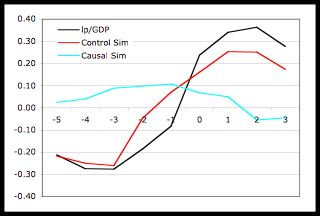
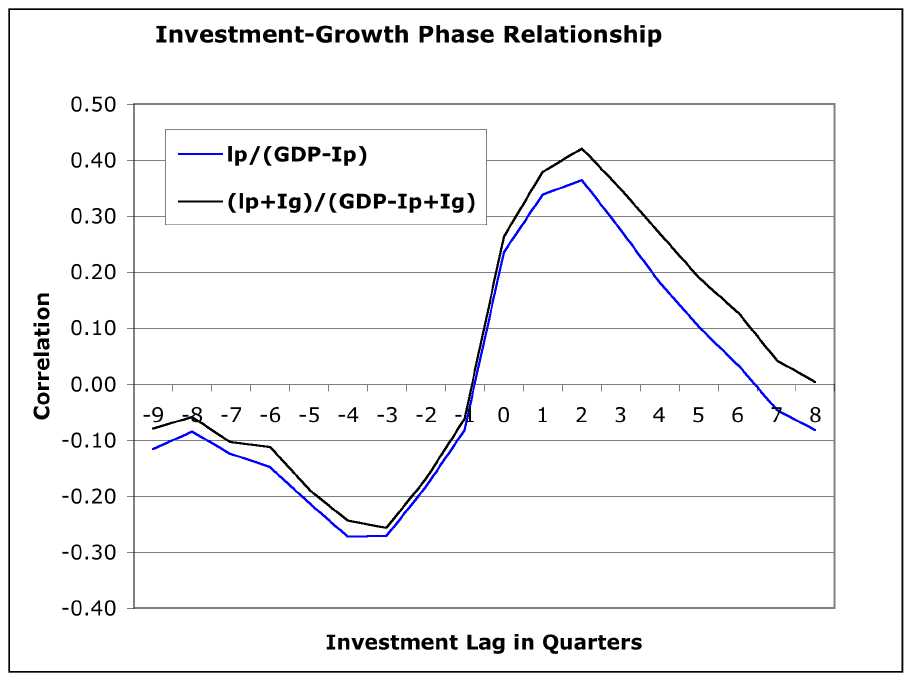
<Your point about investment being included in GDP is a good one. It should really be subtracted out before any relationship is calculated. Rick, take notice.>
Thanks for the credit, Bill. I do not comprehend why Rick can’t see his error or can’t appreciate the helpful feedback he claims to desire but does not feel he gets from Bill Williams re economics. I do not claim to be an expert in economics, but I have a fair amount of education and experience and success in economics from a business standpoint. Where I can help you, when you want help with the Test Bed, I certainly will offer ideas and concepts.
<From my point of view ( not TCPs), the problem here is one of trying to find a cause-effect relationship in a closed-loop phenomenon. Increasing money spent on the means of production will probably make more production possible. But if this is done before there is an increase in demand, there will not be enough buying power in the hands of the consumer to purchase the increased output (speaking in terms of macroeconomics, of course). On the other hand, if there is an increase in (potential) demand before production increases, there can be no increase in production until purchases of as-yet-nonexistent goods occur. Buying and selling, supply and demand, are always in equilibrium because they are just two views of the same transactions. So we appear to have a conflict here.>
Some capital investments increase production capability. Some do not. In business, many capital equipment investments are aimed at speeding up production, or reducing human labor, to save time or money; not to increase capacity. The automation of one step in a production process happens all the time in companies when the overall system production capability remains limited by other steps, often called the “bottleneck”.
I have tried to explain before that a “transactional” model of the economy, where produced products (goods or services) are exchanged for money is more properly called a model of a market economy or of a supply and demand economy. Now, you get into accounting methods and conventions with equalities such as dual ledger bookkeeping and all its rules.
But, Bill, surely you recognize that the economy of a busines or a nation has non-transactional elements? Concepts of weath, value, assets, etc., are not measured soley by transactions. An economy is a complex web of loops and definitional challenges.
<In my view, the proper analysis has to start with the closed loop, and the closed loop has to contain both inventories and cash reserves as well as paths by which transactions take place.>
This is your view and your approach. Go for it. See what you can discover. I do not want to rain on your parade. But, I see this as a tiny start in one concept of economic activity model and one that leaves out important processes in a nation’s actual economy. So, I have a hard time getting very excited about a model that does not refect the nature of the reality. I guess it is similar to my conviction that understanding behavior is helpful in understanding an important part of human nature, but the part can’t define the whole or explain the whole when the whole is what is of value.
<And in a model constructed like that, the natural equilibrium between buying and selling can’t be disturbed more than transiently just by increasing or improving the means of production. Well, there is one way, but it hasn’t been tried much. If there are increases in productivity, this can lead to an increase in the flow of goods and services provided that prices drop at the same time to accomodate a finite supply of money, so the increased output can be purchased. Of course in money terms this will leave GDP or GNP unchanged, but it will lead to an increase in the standard of living by requiring less work to meet consumer needs and wants, or an increase in consumption without requiring an increase in work, or some conbination of the two effects.>
In this, you show an appreciation of the difficultly in modeling a complex economy with a few simple control loops which disturbs me. But, you have also acknowledged making a start and then expanding the model to better match the economic system that operates/behaves every day. I do like that and believe your Test Bed could be revalational compared to other models and theories.
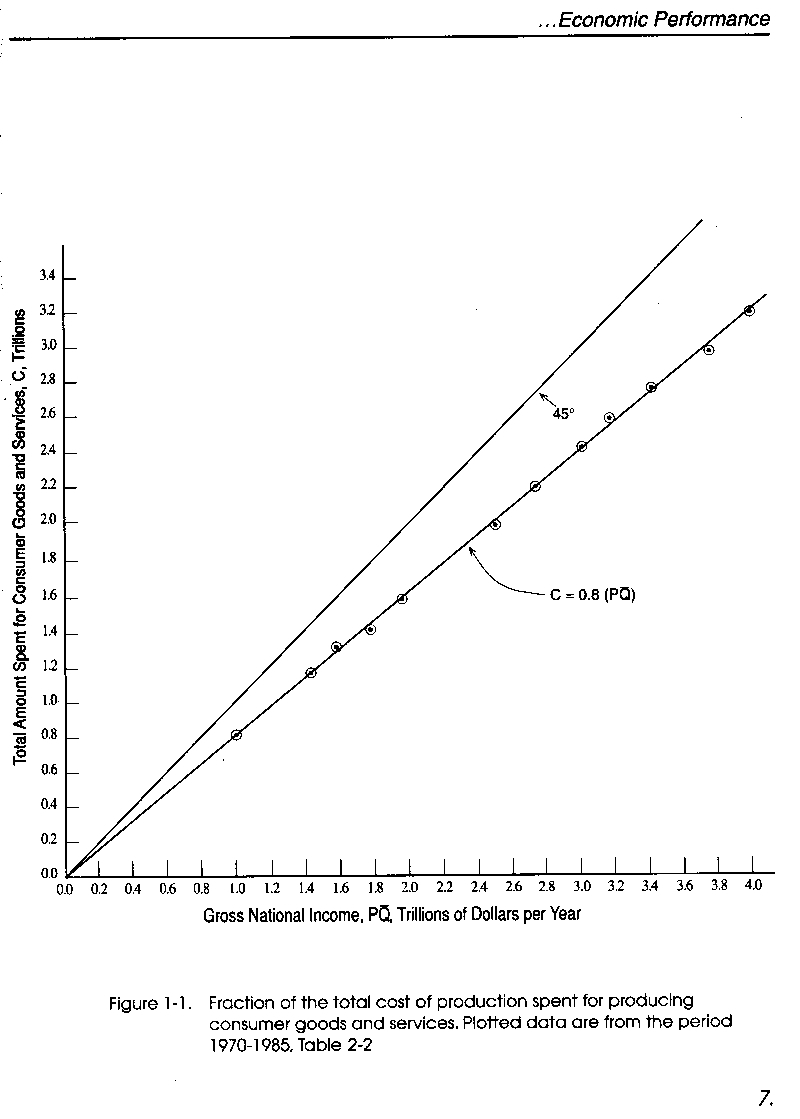
<The way this translates into the closed-loop economic model, as far as I can see right now, is that we find that the money used for investment and the overall activity measured as GNP vary in a ratio of 20 to 80 (empirically determined), not causally but as a consequence of changes in demand (consumer reference levels) and productivity acting together on the balances in the closed loop. When the real controlling factors change, both investment and GNP change, remaining in the ratio found by TCP in the data.>
I have no problem here. I think this is similar to your concept of a behavior control loop where acting, perceiving and comparing are continually operating. They are not linear, sequential functions.
<If more money is available, then an increase in productivity can bring about both an increase in GNP and an increase in standard of living. To the extent that money is needed to increase productivity (it often helps), increasing investment can produce an increase in GNP, and indeed is required if both GNP and consumption per unit of work are to increase. But the net effect is not causal: GNP and investment rise and fall together as, for example, the money supply increases and decreases, and as productivity changes for whatever reason.>
Are you saying that neither of these statements are always true about the economy?:
a) Increasing Investment increases GDP
b) Increasing GDP increases Investment.
If so, isn’t this contrary to Rick’s conclusions? What is your explanation?
<The relationships among variables, both scalar and cumulative, require differential equations to be expressed correctly, and causation is far from obvious. It’s the same situation as in any control loop – see the paper on Properties of Negative Feedback Control Systems that I distributed at the meeting. In a control loop, the variables p,e,qo, and qi are related to each other by functions you encounter as you go around the loop. But when you solve the equations, you find that each variable is a function of only two variables that are not even in the loop: the reference signal r and the disturbance d. The local relationships inside the loop are entirely misleading when it comes to predicting how the variables in the loop will change.>
Wow. BTW, that paper is the only one from the Conference that I have not gotten around to reading. I surely will now.
<The mathematical necessity, in the light of my closed-loop analysis, is simply that increasing production requires an almost proportional increase in investment in the means of production; that is, the investment required is found to remain at about 20% of the increase in production measured in dollars. But you can’t make this happen by forcing any variable in the closed loop to a different value. Rate of consumption and rate of production have to be in long-term balance, and the monetary books have to balance. The only independent variables in this loop are consumer desires, the desire of owners and creditors to extract money from the system, and the ingenuity of those who get more output from the same labor. Once the independent variables are set, all the others are determined.>
The emperical fact that Investment is an essentially constant proportion of GDP in our economy, does not preclude or prove that increasing Investment increases GDP does it?
<I can’t prove this yet, but I think that when investment is translated into productivity changes, we will find that there is a specific “market for investment” that is determined by the independent variables in the system. If there is either over or under investment, imbalances will occur that force investments back to the (apparently) optimum value of 20% of whatever change in GDP has become possible. When interest rates are included in the model, we will begin to see the mechanisms behind the market for investment. Some year. I think I need a couple of extra lifetimes.>
These are sensible theories Bill. And, your models may well help test them against past performance. Then, if verifiable, they would be helpful presumably in future economic decision making. If you don’t have the time, perhaps the seeds will be planted for others to complete? You would have added great value to economics if that were to happen.
I can’t help but notice your use of “optimum” which seems to relate to what Bill Williams refers to as something like the “maximation” theory of economics. I hope he will chime in constructively. I think that the desire to maximize profit, or value creation, is a reasonable goal for an economy, for a society, for a company and for an individual, especially if you believe in Hell (tongue in cheek). How about you?