New Demo (was Re: Homage to CSGNet)

[Martin Taylor 2017.03.17.17.39]

    ...
What the demo seems to show is that when you perceive the "size" of

something in the environment (a patch of light on a screen in this
case), the environmental property Qi is actually a complex function
of a larger context, rather than what the naive instructor thinks it
“should” be. But you don’t need to be a PCT psychologist to be
careful about that. I was doing experiments on that before I got my
degree, and my thesis was actually on that topic, though I didn’t
describe it that way at the time (almost 60 years ago).

I don't see how the demo or the related on-line or off-line comments

about it are in any way relevant to the discussion of whether in the
classical control diagram

 ![ctrl.logo.transp1.png|120x80](upload://q7soC4Dkg0IKV6XxqVXaJRgEv8E.png)

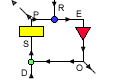
the little circle in the diagram where O adds to D to produce the

value Qi (called “S”) is in the environment or is inside the
controller above the Perceptual Input Function (the yellow box).

That simple question has been the only thing we have been arguing

about, AFAIK, with no complication about other observers or
instructions. Or about how many parallel channels any of the diagram
lines represent in a real-life situation.

Martin
···

[From Rick Marken (2017.03.15.1630
PDT)]

      RM: No matter how heated the

discussions on CSGNet have been, however, I have benefited
from them to the present day, as evidenced by the fact that
two recent discussion threads have led to the development of a
new demo and a new publication. The thread on the distinction
between Qi and p led to the development of a demo I call “Just
Following Instructions”, which is available at:

http://www.mindreadings.com/ControlDemo/Instruct.html

      RM: The demo is described as a caution

about the possible pitfalls of doing performance evaluations
without an understanding of the fact that what a person is
controlling may not be exactly what they were instructed to
control. But it is actually a demonstration of the fact that
Qi is p from the observer’s perspective (and, conversely, that
p is Qi from the controller’s perspective). Of course,
comments or suggestions about the demo and/or the write-up
would be most welcome (especially if they leave out ad hominum
attacks;-).

[Bruce Nevin 2017.03.17.19:44 ET]

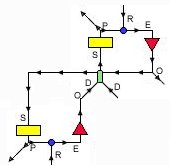
Left out is where the disturbance D comes from; that is, where a perception of Q.i is controlled so as to create that disturbance.

4mmt.jpg

To the subject (upper loop), the green quadrangle is a projection of p within the subject (p.s), called whatever that perceptual signal is experienced to be, in a particular more or less desired state. Maybe it’s the degree that the vertical edge of a picture frame departs from parallel with the vertical edge of a nearby door frame, and the desired state is zero.

The observing experimenter (lower loop) also experiences a perceptual signal p.e called the same thing that the subject calls the experience of p.s. (I omitted the experimenter’s unintended side effects from O.)

To assert that Q.i is in the world is no more than to assert the veridicality of our controlled perception.

I know it is possible to disturb a sensory receptor directly; it is possible in principle and maybe already in fact to disturb a perceptual input signal higher in the hierarchy, such as a perception that two edges are variably close to parallel. In such cases, Q.i is inside the hierarchy, but still in the environment of the control that is being disturbed. Because the environment for level n is level n-1 (and perhaps lower).

O tell me, where is Qi bred,

or in the world, or in the head?

Q.i is a projection of the experimenter’s perception p.e. Because of success with the TCV, the experimenter is justified in saying that Q.i is a projection of the subject’s perception p.s. We all attribute reality to such projections. The vicissitudes and successes of control constitute ongoing continual empirical tests of these attributions that justify them. We never have proof. But the theory works in practice. Most of the time. And if there are exceptions, we generally maintain adequate control and move on.

Is this a pseudo-problem?

ctrl.logo.transp1.png

···

On Fri, Mar 17, 2017 at 5:54 PM, Martin Taylor mmt-csg@mmtaylor.net wrote:

[Martin Taylor 2017.03.17.17.39]

    ...
What the demo seems to show is that when you perceive the "size" of

something in the environment (a patch of light on a screen in this
case), the environmental property Qi is actually a complex function
of a larger context, rather than what the naive instructor thinks it
“should” be. But you don’t need to be a PCT psychologist to be
careful about that. I was doing experiments on that before I got my
degree, and my thesis was actually on that topic, though I didn’t
describe it that way at the time (almost 60 years ago).

I don't see how the demo or the related on-line or off-line comments

about it are in any way relevant to the discussion of whether in the
classical control diagram

the little circle in the diagram where O adds to D to produce the

value Qi (called “S”) is in the environment or is inside the
controller above the Perceptual Input Function (the yellow box).

That simple question has been the only thing we have been arguing

about, AFAIK, with no complication about other observers or
instructions. Or about how many parallel channels any of the diagram
lines represent in a real-life situation.

Martin
      [From Rick Marken (2017.03.15.1630

PDT)]

      RM: No matter how heated the

discussions on CSGNet have been, however, I have benefited
from them to the present day, as evidenced by the fact that
two recent discussion threads have led to the development of a
new demo and a new publication. The thread on the distinction
between Qi and p led to the development of a demo I call “Just
Following Instructions”, which is available at:

http://www.mindreadings.com/ControlDemo/Instruct.html

      RM: The demo is described as a caution

about the possible pitfalls of doing performance evaluations
without an understanding of the fact that what a person is
controlling may not be exactly what they were instructed to
control. But it is actually a demonstration of the fact that
Qi is p from the observer’s perspective (and, conversely, that
p is Qi from the controller’s perspective). Of course,
comments or suggestions about the demo and/or the write-up
would be most welcome (especially if they leave out ad hominum
attacks;-).

[Martin Taylor 2017.03.17.22.52]

[Bruce Nevin 2017.03.17.19:44 ET]

      Left out is where the disturbance D comes from; that is,

where a perception of Q.i is controlled so as to create that
disturbance.

I don't see the relevance to the issue. PCT has never been concerned

with the source of the disturbance, which could be anything from
gremlins or malicious Gods to the wind, a distant car, or one’s
spouse. Bill P. frequently made a major point of saying that the
source of the disturbance was not perceivable to the controller and
was therefore entirely irrelevant to that controller. Only Qi
(labelled “S” in both our diagrams) affected the perception.

You follow by a diagram

4mmt.jpg

and description of an observer who has already conducted a perfect

TCV. It’s not wrong, but it’s unnecessary to the core dispute. The
only question at issue is and has been whether the circle you have
replaced with a blue lozenge is inside the controller (and in your
diagram in both the upper and lower controllers at the same time) or
in the environment external to the controller(s). So far as I can
see all your diagram does is present visually my original position,
way back when, that started Rick’s tirade about moving Qi into the
controller. I said then, thinking it self-evident, that one test of
whether something is in the environment (as opposed to being a
mirage or illusion) is whether other people can also perceive it and
can influence it in ways that the original controller can oppose.

Martin

[From Rick Marken (2017.03.17.2215)]

ctrl.logo.transp1.png

···

Martin Taylor (2017.03.17.17.39)–

MT: What the demo seems to show is that when you perceive the "size" of

something in the environment (a patch of light on a screen in this
case), the environmental property Qi is actually a complex function
of a larger context, rather than what the naive instructor thinks it
“should” be.

RM: Exactly!Â

Â

MT: I don't see how the demo or the related on-line or off-line comments

about it are in any way relevant to the discussion of whether in the
classical control diagram


the little circle in the diagram where O adds to D to produce the

value Qi (called “S”) is in the environment or is inside the
controller above the Perceptual Input Function (the yellow box).

RM: That’s because no one ever said the Qi is inside the controller; I certainly didn’t. What I have been saying is that Qi is inside the observer of the controller; Qi is the observer’s perception of the variable that the controller is controlling. As Bruce Nevin has pointed out, Qi is perceived, by the observer, as being in the environment of the controller. But, like anything that we experience as being “out there” in the environment,Qi is a perception; a function of the sensory effect of physical variables.Â

RM: In the demo, Qi is a perception of the size of the target disk, a perception that is proportional to the ratio of context to target disk size, or, as you say " a complex function of a larger context". The variables that are the basis of this perception – the size of the context and target disks – exist in the environment but the ratio itself is a function of these variables. The output of this function is Qi for the observer and, theoretically, p for the controller. The computation that carries out the function that produces Qi is done by the computer (in the demo) and by the neural nets that are the perceptual functions in the controller.Â

RM: Finally, the demo shows that when you incorrectly identify Qi as a function simply of the size of the target disk, it will appear that Qi is poorly controlled when the context starts to vary in phase 2 of the demo. This could lead you to conclude that the controller’s perception of Qi is poor. This is a mistake that would be made by someone who thinks that Qi and the perception, p, of Qi, are two different variables; that p is a function of Qi. But when you correctly identify Qi as the ratio of target to context disk size you can see that the controller is controlling a perception that is equivalent to Qi. Qi is the observer’s view of the perception the controller controls; it is not a variable in the environment that the controller perceives with varying degrees of accuracy.

BestÂ

Rick

Â

MT: That simple question has been the only thing we have been arguing

about, AFAIK, with no complication about other observers or
instructions. Or about how many parallel channels any of the diagram
lines represent in a real-life situation.

Martin

–

Richard S. MarkenÂ

"Perfection is achieved not when you have nothing more to add, but when you
have nothing left to take away.�
                --Antoine de Saint-Exupery

[From Rick Marken (2017.03.18.1020)]

···

Martin Taylor (2017.03.17.22.52) to Bruce Nevin (2017.03.17.19:44 ET)–

MT: So far as I can

see all your diagram does is present visually my original position,
way back when, that started Rick’s tirade about moving Qi into the
controller.

RM: I think in the spirit of making the discussions on CSGNet less “cringe worthy” you might consider trying to avoid referring to other people’s posts using disparaging terms such as “tirades”. It doesn’t bother me but it might be off-putting to onlookers.

RM: Â What does bother me is misrepresenting what I said in my “tirades”. Such misrepresentations may have been unintentional – a result of the ambiguity of language – but they are annoying nevertheless. I suggest that a good way to avoid making these kinds of misrepresentations is to refrain from asserting what someone else’s position is and, instead, simply ask the person what it is if you have any doubt. For example, to find out what you are arguing against, you might have said something like “Rick, are you saying that Qi should be moved into the controller?” and I could have said “no” and we could have avoided a lot of unnecessary disagreement.Â

RM: I think this is the kind of thing Bruce N. is suggesting as a way to make the discussions on CSGNet more civil. Of course, the first step in making the discussions civil is to stop using pejoratives. But I think it would also help if we try to take a more “questioning” approach to each others’ arguments. If you are not sure of what someone is arguing don’t jump to conclusions about what their argument is. And if you think you are sure of what another person’s argument means, just reply based on what you think they mean; don’t argue by making assertions about what you think you know is meant. I think this would improve the civility – as well as the productivity – of CSGNet discussions considerably.Â

BestÂ

Rick

–

Richard S. MarkenÂ

"Perfection is achieved not when you have nothing more to add, but when you
have nothing left to take away.�
                --Antoine de Saint-Exupery

[Martin Taylor 2017.03.18.14.08]

Forget the potential observer for this round of questioning. The

answers to the questions do not depend on there being one.
Question 1: Are you saying then that there is no such thing as Qi in
the original controller’s control loop?
Answer 1: [Yes] [No]
Question 1a. if “Yes”, then why does “qi” historically appear in the
equations for analysis of control loops both in print and on CSGnet
(e.g. “Mind Readings” p73 diagram (which replicates the above except
for adding the source of the disturbance and calling “S” “q”)
? And what is “S” in the diagram? In the Mind Readings diagram it is
called q, but now you say it isn’t.
Question 1b: If “No” (meaning Qi does exist somewhere in the
controller’s control loop) where should the symbol be placed in the
loop if it is not inside the controller above the Perceptual
Function in the diagram? Is it “S” as it was in Mind Readings, or is
it “O”? These seem to be the only possibilities.
Martin
Martin

ctrl.logo.transp1.png

···

Let’s follow the programme of asking
questions about one point at a time.

[From Rick Marken (2017.03.17.2215)]

Martin Taylor (2017.03.17.17.39)–

            MT: What the demo seems to show is that when you

perceive the “size” of something in the environment (a
patch of light on a screen in this case), the
environmental property Qi is actually a complex function
of a larger context, rather than what the naive
instructor thinks it “should” be.

RM: Exactly!

            MT: I don't see how the demo or the

related on-line or off-line comments about it are in any
way relevant to the discussion of whether in the
classical control diagram

            the little circle in the diagram where O adds to D to

produce the value Qi (called “S”) is in the environment
or is inside the controller above the Perceptual Input
Function (the yellow box).

          RM: That's because no one ever said the Qi is inside

the controller; I certainly didn’t. What I have been
saying is that Qi is inside the observer of the
controller; Qi is the observer’s perception of the
variable that the controller is controlling.

ii

[Martin Taylor 2017.03.18.14.41]

I should have referenced B:CP [Figure A.1 p 273 in the second

edition, of which the Mind Readings diagram is a copy. Sorry about
that.
Martin

ctrl.logo.transp1.png

···

Correction…

[Martin Taylor 2017.03.18.14.08]

  Forget the potential observer for this round of questioning. The

answers to the questions do not depend on there being one.
Question 1: Are you saying then that there is no such thing as Qi
in the original controller’s control loop?
Answer 1: [Yes] [No]
Question 1a. if “Yes”, then why does “qi” historically appear in
the equations for analysis of control loops both in print and on
CSGnet (e.g. “Mind Readings” p73 diagram (which replicates the
above except for adding the source of the disturbance and calling
“S” “q”) ? And what is “S” in the diagram? In the Mind
Readings diagram it is called q, but now you say it
isn’t.

    Let's follow the programme of asking

questions about one point at a time.

[From Rick Marken (2017.03.17.2215)]

Martin Taylor (2017.03.17.17.39)–

              MT: What the demo seems to show is that when you

perceive the “size” of something in the environment (a
patch of light on a screen in this case), the
environmental property Qi is actually a complex
function of a larger context, rather than what the
naive instructor thinks it “should” be.

RM: Exactly!

              MT: I don't see how the demo or

the related on-line or off-line comments about it are
in any way relevant to the discussion of whether in
the classical control diagram

              the little circle in the diagram where O adds to D to

produce the value Qi (called “S”) is in the
environment or is inside the controller above the
Perceptual Input Function (the yellow box).

            RM: That's because no one ever said the Qi is inside

the controller; I certainly didn’t. What I have been
saying is that Qi is inside the observer of the
controller; Qi is the observer’s perception of the
variable that the controller is controlling.

ii

[From Rick Marken (2017.03.18.1150)]

···

Martin Taylor (2017.03.18.14.08)

  MT: Let's follow the programme of asking

questions about one point at a time.

MT: Forget the potential observer for this round of questioning. The

answers to the questions do not depend on there being one.

RM: Maybe. Maybe not. Â

MT: Question 1: Are you saying then that there is no such thing as Qi in

the original controller’s control loop?

Answer 1: [Yes] [No]

RM: No.Â

MT:Question 1b: If "No" (meaning Qi does exist somewhere in the

controller’s control loop) where should the symbol be placed in the
loop if it is not inside the controller above the Perceptual
Function in the diagram?

RM: It should be left where it is, in the environment of the controller.Â

Â

MT: Is it "S" as it was in Mind Readings, or is

it “O”? These seem to be the only possibilities.

RM: I don’t know what this refers to but S usually refers to what is seen as a “stimulus”, which corresponds to a disturbance variable in PCT. And O usually refers to an output variable. So Qi corresponds to neither of these.Â

BestÂ

Rick

–
Richard S. MarkenÂ

"Perfection is achieved not when you have nothing more to add, but when you
have nothing left to take away.�
                --Antoine de Saint-Exupery

[Martin Taylor 2017.03.18.16.34]

Follow-up questions.

[From Rick Marken (2017.03.18.1150)]

Question 2: Why does S, which used to mean "Semsory input" in a

control loop, now have to mean “Stimulus”. a concept that does not
exist in a control loop?

Question 3. Since there are only two variables, qi and O, in the

environment in the diagrams of B:CP Figure A.1 and Mindreadings Page
73, and there are only two variables in the coloured diagram I used,
S and O, and S is the label on the diagram “wire” exactly where qi
is in the otherwise identical control loops of the Marken and Powers
diagrams, what is the essential difference between S and qi?

![ctrl.logo.transp1.png|120x80](upload://q7soC4Dkg0IKV6XxqVXaJRgEv8E.png)

Martin
···

Martin Taylor (2017.03.18.14.08)

              MT:

Let’s follow the programme of asking questions about
one point at a time.

                            MT: Forget the potential observer for this round

of questioning. The answers to the questions do not
depend on there being one.

RM: Maybe. Maybe not.

            MT: Question 1: Are you saying then that there is no

such thing as Qi in the original controller’s control
loop?

            Answer 1: [Yes] [No]

RM: No.

            MT:Question 1b: If

“No” (meaning Qi does exist somewhere in the
controller’s control loop) where should the symbol be
placed in the loop if it is not inside the controller
above the Perceptual Function in the diagram?

          RM: It should be left where it is, in the environment

of the controller.

            MT: Is it "S" as it

was in Mind Readings, or is it “O”? These seem to be the
only possibilities.

      RM: I don't know what this refers to but S usually refers to

what is seen as a “stimulus”, which corresponds to a
disturbance variable in PCT. And O usually refers to an output
variable. So Qi corresponds to neither of these.

[Martin Taylor 2017.03.18.14.44]

    [From Rick Marken (2017.03.18.1020)]
Sorry about that. I didn't think of it as disparaging, but if you

perceive it as such, then it was. I hope others did not see it as
such.

Offhand, I can't think of another one-word descriptor of the abrupt

change you made to the usually accepted description of a control
loop . In [From Rick Marken (2016.12.07.1710)] we have this passage:

    [From Bill Powers (961224.1145 MST)]Remember that as far as

the observer is concerned, what is controlled is ONLY the CV.
The idea that this CV is represented by a perceptual signal
inside the other system is theoretical. We can observe CV, but
not p. When we apply a disturbance, we apply it to CV, not to p.
The action that opposes the effect of the disturbance acts on
CV, not p. …

    RM: Note that CV in this discussion refers to the controlled

quantity, q.i, not p.

So last December, qi was not p, just as had been the case for the

quarter century I have known about PCT, and was the case in B:CP or
Mind Readings.

At some later point everything changed, and qi, the value of a

variable I had for decades called the “CEV” (and Bill in the cited
post called the “CV”) suddenly became p. What happened? I had
pointed out that the CEV was the scalar environmental correlate of a
perceptual function of possibly many variables, and suddenly, qi had
to become p, in a stream of messages for which I thought I had
chosen a neutrally descriptive word. I apologise for the word, but
not for the thought behind it.

Martin
···
              Martin Taylor (2017.03.17.22.52) to Bruce Nevin

(2017.03.17.19:44 ET)–

                    MT: So far as I can see all your diagram does

is present visually my original position, way
back when, that started Rick’s tirade about
moving Qi into the controller.

      RM: I think in the spirit of making the discussions on CSGNet

less “cringe worthy” you might consider trying to avoid
referring to other people’s posts using disparaging terms such
as “tirades”. It doesn’t bother me but it might be off-putting
to onlookers.

[Bruce Nevin 2017.03.18.18:25 ET]

Martin Taylor 2017.03.17.22.52–

I don’t see the relevance to the issue.

The claim has been made that Q.i is the observing experimenter’s perception, which (by the usual projection of one’s subjective experience of a perception) is projected as a real attribute of the real environment–with some justification because of the TCV. Indeed, Q.i (a measured quantity) cannot be determined without the TCV.

PCT has never been concerned with the source of the disturbance, which could be anything from gremlins or malicious Gods to the wind, a distant car, or one’s spouse.

There is another arrow labeled D to cover those cases. The one you are objecting to is a distal label on the experimenter’s control output. That arrow is labeled O at the proximal end and D at the distal end. This is because the experimenter is controlling disturbance to what the subject is first imagined, and then perceived, to be controlling.

In the experimental situation, we can call it Q.i because it is a quantity measured by the experimenter. By the usual projection of the experimenter’s perception we attribute reality to it. You are generalizing in a perfectly ordinary and understandable way to attribute reality to it outside of any experimental situation. You are making an analogy without being aware of it. The analogy is quite reasonable, but it has led to this impasse about where Q.i really exists.

The subject also projects his or her or its controlled perception p as a real angle or alignment or whatever is being protected from the experimenter’s disturbances (along with other disturbances, represented by the other D arrow, which the experimenter in all cases I know of treats as negligible). For that, the experimenter’s nomenclature Q.i is rarely apt for the subject’s point of view.

The term Q.i in its literal sense is not justified unless the appropriate measurements have been made in an experimental setup in which all sources of disturbance have been either measured or controlled to zero. That is why the observing experimenter’s control loop generating the disturbances for the TCV and consequently recognizing and controlling a perception of Q.i, should be included.

Equivocation over these distinctions can lead to confusion as to where the p is of which Q.i is a projection (see below), and could possibly cause the appearance of a more fundamental disagreement.

Rick Marken (2017.03.17.2215) –

What I have been saying is that Qi is inside the observer of the controller; Qi is the observer’s perception of the variable that the controller is controlling.

Q.i is not inside the observer. What is inside the observer is a perception p which the observer calls Q.i and projects as being in the environment as that which the subject is controlling. To avoid confusion, the correlate from the subject’s point of view should properly have a different name.

From the modeler’s point of view, these are all variable quantities, the conflation of Q.i from the experimenter with p within the subject is immaterial, and there is no reason to include the experimenter as part of the model unless you are modeling an experiment.

4mmt.jpg

···

On Fri, Mar 17, 2017 at 11:07 PM, Martin Taylor mmt-csg@mmtaylor.net wrote:

[Martin Taylor 2017.03.17.22.52]

[Bruce Nevin 2017.03.17.19:44 ET]

      Left out is where the disturbance D comes from; that is,

where a perception of Q.i is controlled so as to create that
disturbance.

I don't see the relevance to the issue. PCT has never been concerned

with the source of the disturbance, which could be anything from
gremlins or malicious Gods to the wind, a distant car, or one’s
spouse. Bill P. frequently made a major point of saying that the
source of the disturbance was not perceivable to the controller and
was therefore entirely irrelevant to that controller. Only Qi
(labelled “S” in both our diagrams) affected the perception.

You follow by a diagram
and description of an observer who has already conducted a perfect

TCV. It’s not wrong, but it’s unnecessary to the core dispute. The
only question at issue is and has been whether the circle you have
replaced with a blue lozenge is inside the controller (and in your
diagram in both the upper and lower controllers at the same time) or
in the environment external to the controller(s). So far as I can
see all your diagram does is present visually my original position,
way back when, that started Rick’s tirade about moving Qi into the
controller. I said then, thinking it self-evident, that one test of
whether something is in the environment (as opposed to being a
mirage or illusion) is whether other people can also perceive it and
can influence it in ways that the original controller can oppose.

Martin

[From Rick Marken (2017.03.18.1815)]

ctrl.logo.transp1.png

···

Martin Taylor (2017.03.18.16.34)–

MT: Question 2: Why does S, which used to mean "Semsory input" in a

control loop, now have to mean “Stimulus”. a concept that does not
exist in a control loop?

RM: It can still mean sensory input. In your diagram below it certainly does.

Â

MT: Question 3. Since there are only two variables, qi and O, in the

environment in the diagrams of B:CP Figure A.1 and Mindreadings Page
73, and there are only two variables in the coloured diagram I used,
S and O, and S is the label on the diagram “wire” exactly where qi
is in the otherwise identical control loops of the Marken and Powers
diagrams, what is the essential difference between S and qi?

RM: I take the blue dot to be Qi. So S is the sensory effects of the environmental variables that are the basis of the variable Qi. Qi is the observer’s perception of those sensory effects, a perception to which q is equivalent.Â

RM: By the way, saying that Qi is equivalent to p is not the same as saying that Qi is p. Qi is the observer’s perception of the variable being controlled; p is the controller’s perception of the variable being controlled.*Â *In my new demo, Qi is the observer’s (in this case the computer’s) perception of the size of the target disk; in the coin game Qi is E’s perception of the pattern of coins being controlled by S; in the rubber band demo Qi is the position of the knot relative to the dot as seen by E; etc. In each case, p is the controller’s perception of the variable being controlled, and it is presumably equivalent to Qi, the variable the observer sees being controlled. Qi is a fact; p is a theory.

BestÂ

Rick

–

      RM: I don't know what this refers to but S usually refers to

what is seen as a “stimulus”, which corresponds to a
disturbance variable in PCT. And O usually refers to an output
variable. So Qi corresponds to neither of these.Â

Richard S. MarkenÂ

"Perfection is achieved not when you have nothing more to add, but when you
have nothing left to take away.�
                --Antoine de Saint-Exupery

[From Bruce Nevin 2017.03.18.21:29 ET)]

Rick Marken (2017.03.18.1815)–

RM: By the way, saying that Qi is equivalent to p is *not the same *as saying that Qi is p. Qi is the observer’s perception of the variable being controlled; p is the controller’s perception of the variable being controlled.* *In my new demo, Qi is the observer’s (in this case the computer’s) perception of the size of the target disk; in the coin game Qi is E’s perception of the pattern of coins being controlled by S; in the rubber band demo Qi is the position of the knot relative to the dot as seen by E; etc. In each case, p is the controller’s perception of the variable being controlled, and it is presumably equivalent to Qi, the variable the observer sees being controlled. Qi is a fact; p is a theory.

If  Qi is the label for the observer’s perception, then you have to place it inside the observer’s control loop, not in the environment. In that case, it is the observer’s perception of a variable aspect of the perceived environment that is defended from disturbance by the subject’s output

If you place Qi in the environment, than it represents the observer’s projection of that perception into the environment, much as I presently project my perceptions of this screen and keyboard into my environment and take them to be real.

ctrl.logo.transp1.png

···

On Sat, Mar 18, 2017 at 9:18 PM, Richard Marken rsmarken@gmail.com wrote:

[From Rick Marken (2017.03.18.1815)]

Martin Taylor (2017.03.18.16.34)–

MT: Question 2: Why does S, which used to mean "Semsory input" in a

control loop, now have to mean “Stimulus”. a concept that does not
exist in a control loop?

RM: It can still mean sensory input. In your diagram below it certainly does.

Â

MT: Question 3. Since there are only two variables, qi and O, in the

environment in the diagrams of B:CP Figure A.1 and Mindreadings Page
73, and there are only two variables in the coloured diagram I used,
S and O, and S is the label on the diagram “wire” exactly where qi
is in the otherwise identical control loops of the Marken and Powers
diagrams, what is the essential difference between S and qi?

RM: I take the blue dot to be Qi. So S is the sensory effects of the environmental variables that are the basis of the variable Qi. Qi is the observer’s perception of those sensory effects, a perception to which q is equivalent.Â

RM: By the way, saying that Qi is equivalent to p is not the same as saying that Qi is p. Qi is the observer’s perception of the variable being controlled; p is the controller’s perception of the variable being controlled.*Â *In my new demo, Qi is the observer’s (in this case the computer’s) perception of the size of the target disk; in the coin game Qi is E’s perception of the pattern of coins being controlled by S; in the rubber band demo Qi is the position of the knot relative to the dot as seen by E; etc. In each case, p is the controller’s perception of the variable being controlled, and it is presumably equivalent to Qi, the variable the observer sees being controlled. Qi is a fact; p is a theory.

BestÂ

Rick

–
Richard S. MarkenÂ

"Perfection is achieved not when you have nothing more to add, but when you
have nothing left to take away.�
                --Antoine de Saint-Exupery

      RM: I don't know what this refers to but S usually refers to

what is seen as a “stimulus”, which corresponds to a
disturbance variable in PCT. And O usually refers to an output
variable. So Qi corresponds to neither of these.Â

[Martin Taylor 2017.03.18.23.00]

[Bruce Nevin 2017.03.18.18:25 ET]

        Martin Taylor

2017.03.17.22.52–

        I don't see the relevance to the

issue.

        The claim has been made that Q.i is the observing

experimenter’s perception, which (by the usual projection of
one’s subjective experience of a perception) is projected as
a real attribute of the real environment–with some
justification because of the TCV. Indeed, Q.i (a measured
quantity) cannot be determined without the TCV.

Yes, of course I agree that everyone's control loops, all of them at

every level of the hierarchy, have a “p” and a “Qi”. I don’t know if
you and/or Rick are questioning that. To me, the mystery is why you
seem to assert that for Qi to exist, someone has to be doing an
experiment to determine its value.

Let's keep it simple, without getting into "If a tree falls in the

forest and nobody hears it, does it make a sound". An insistence on
having an observer in order for there to exist an environmental
variable the subject can influence when controlling a perception
makes it seem as though the answer to that question is necessarily
“No”. I don’t think we need that question answered in order to
understand how control works.

Throughout, I have always been talking about one control loop that

controls one scalar variable perception. The issue has always (since
December 14 2016) been whether qi in this diagram (B:CP p
286 in the 2005 edition) is in the environment as a function of
environmental variables (in this case a simple multiplier ki )
or is simply equivalent to (or more strongly “is equal” to) “p”.
(And it seemed to me to be even worse, in that there were what
seemed to be claims that Qi is p. Maybe I misinterpreted that, but
it’s what led to my last round of questions to Rick.)

![PowersBasicControlLoop.jpg|735x775](upload://oXuhcH3aIcmaQ4CS0sLyPBocKXc.jpeg)

In
[From Rick Marken (2017.02.27.1200)], Rick says, as though

contradicting something,
“Powers is obviously using q.i to represent what may be a very
complex function of environmental variables, v.” and “I think Bill
took it for granted that people would understand that q.i was a
variable that represented a possibly very complex function of
environmental variables and , moreover, that they would understand
that q.i would not be computed by the environment itself.”

I can't remember anyone disputing either of these statements. They

are purely red herrings drawn across the trail, and I have
throughout this and earlier threads wondered why they have been made
and repeated in various paraphrases. All we know for sure is what we
perceive, as Bill often pointed out. But we do have theories that
purport to explain why we perceive what we perceive, and one of them
is based around this simple control loop diagram.

In this diagram, if "p" is a single scalar value (a variable with

only one degree of freedom, its magnitude), then there is only one
degree of freedom for each loop variable everywhere around the loop,
including qo and qi , no matter how many
variables that could be perceived by other control systems each of
them might be a function of. It’s useful sometimes to point out the
fact that every perception at any level can be described as some
combination of other variables. It’s also useful to point out that
the existence of a perceptual function in the control loop
incorporates no claim that the environment has some kind of
processor that creates inverse functions that present variables to
the sensors or vice-versa (I’m not sure exactly how to interpret
those red herrings).

My gedanken experiment [Martin Taylor 2016.12.13.12.09] was intended

to take the multiple variable point to an extreme, by showing that
even internally these single-degree-of-freedom “wires” might be
implemented in the form of many variables (Powers’s “bunch of nerve
fibres” on which the firings add to be treated in the theory as a
“neural current”). None of it allows qi to be anything
other than the magnitude of a variable that has no properties except
its magnitude. If action on the environment can affect that
magnitude, then the variable, which Bill P called “CV” and I call
“CEV” (which was originally an acronym for “Complex Environmental
Variable” to acknowledge that it is constructed as a function of
many component variables) must be at least partially in the
environment.

          PCT has never been

concerned with the source of the disturbance, which could
be anything from gremlins or malicious Gods to the wind, a
distant car, or one’s spouse.

          There is another arrow

labeled D to cover those cases. The one you are objecting
to is a distal label on the experimenter’s control output.
That arrow is labeled O at the proximal end and D at the
distal end. This is because the experimenter is
controlling disturbance to what the subject is first
imagined, and then perceived, to be controlling.

I wasn't objecting, merely pointing out a fact of PCT, that to

analyse control it is unnecessary to know anything about the source
of the disturbing influence because the control system perceives
only the effect of variation of the CEV, no matter what the cause or
causes of this variation.

In the experimental situation,

Here's where I really get into problems. Why is it necessary to

introduce an experimenter in order to talk about one simple control
diagram? What does it gain you in understanding how control works?

Martin
[From Rick Marken (2017.03.19.1125)]

···

Martin Taylor (2017.03.18.14.44)–

MT: Sorry about that. I didn't think of it as disparaging, but if you

perceive it as such, then it was. I hope others did not see it as
such.

MT: Offhand, I can't think of another one-word descriptor of the abrupt

change you made to the usually accepted description of a control
loop .

RM: How about this: “So far as I can see, all your diagram does is present visually my original position, way back when, that started Rick’s apparent change of course, moving Qi into the controller”.

MT: In [From Rick Marken (2016.12.07.1710)] we have this passage:

    [From Bill Powers (961224.1145 MST)]Remember that as far as

the observer is concerned, what is controlled is ONLY the CV.
The idea that this CV is represented by a perceptual signal
inside the other system is theoretical. We can observe CV, but
not p. When we apply a disturbance, we apply it to CV, not to p.
The action that opposes the effect of the disturbance acts on
CV, not p. …

    RM: Note that CV in this discussion refers to the controlled

quantity, q.i, not p.

MT: So last December, qi was not p, just as had been the case for the

quarter century I have known about PCT, and was the case in B:CP or
Mind Readings.

MT: At some later point everything changed, and qi, the value of a

variable I had for decades called the “CEV” (and Bill in the cited
post called the “CV”) suddenly became p. What happened?

RM: Perhaps you thought that when I said that Qi is a perception in the observer that is equivalent to p you took that to mean thatI was saying Qi is p.Â

Â

MT: I had

pointed out that the CEV was the scalar environmental correlate of a
perceptual function of possibly many variables, and suddenly, qi had
to become p, in a stream of messages for which I thought I had
chosen a neutrally descriptive word. I apologise for the word, but
not for the thought behind it.

RM: I may have said that this description of a CEV is a description of a perceptual, not an environmental, variable.Which is true. Saying that “the CEV is the scalar environmental correlate of a perceptual function of possibly many variables” implies that CEV = f(x.1,x.2,…x.n) where x.1,x.2,…x.n are many environmental variables. Let’s say that the CEV is the area of a rectangle, as in my “What is Size”" demo. Then CEV = Area = HeightWidth. According to this equation, Area is indeed a scalar variable; it’s a single number that varies along with variations in Height and Width. But it is not an environmental correlate of a perceptual variable because that scalar variable does not exist in the environment. There is nothing in the environment that can multiply Height times Width to produce a scalar variable equal to Area. If the environment could produce a scalar variable that is the product of Height times Width there would be no need for organisms to have complex perceptual functions; they could just transduce the scalar variable produced by the environment, such as the Area variable, into a perception. That is, if p = f(Qi) then the perceptual function, f() need only be a constant of proportionality, so that p = k Qi. This would work because Area, which is Qi, has already been computed by the environment.Â

RM: Thus, the idea that Qi is the scalar environmental correlate of a perceptual function makes perception a very simple process since all the work of perceiving Areas or Shapes or Relationships or Sequences or Programs, etc, Â would have been done by the environment itself, producing the scalar variables – the Qi – that are the environmental correlates of the perception of these Areas, Shapes, Relationships, Sequences, Programs, etc. My argument is that the environment can’t do the computations necessary to produce scalar variables that correspond to the Areas, Shapes, Relationships, Sequences, Programs, etc, that we experience – that we project as being out there, as Bruce N. notes. That can only be done by a system that can compute the functions that produce scalar variables that correspond to variations in these aspects of the environment; that is, by a system that can perceive.Â

BestÂ

Rick

Martin

–
Richard S. MarkenÂ

"Perfection is achieved not when you have nothing more to add, but when you
have nothing left to take away.�
                --Antoine de Saint-Exupery

                    MT: So far as I can see all your diagram does

is present visually my original position, way
back when, that started Rick’s tirade about
moving Qi into the controller.

      RM: I think in the spirit of making the discussions on CSGNet

less “cringe worthy” you might consider trying to avoid
referring to other people’s posts using disparaging terms such
as “tirades”. It doesn’t bother me but it might be off-putting
to onlookers.

[From Rick Marken (2017.03.19.1230)]

ctrl.logo.transp1.png

···

Bruce Nevin 2017.03.18.21:29 ET)

BN: If  Qi is the label for the observer’s perception, then you have to place it inside the observer’s control loop, not in the environment. In that case, it is the observer’s perception of a variable aspect of the perceived environment that is defended from disturbance by the subject’s output

RM: Yes, to be completely accurate, what should be in the environment are just a bunch of x’s (or v’s as in Bill’s diagram in the Science paper) representing physical variables. The Qi woulld exist as a perceptual function of these variables in the observer and p would exist as a perceptual function of these variables in the controller.Â

Â

BN: If you place Qi in the environment, than it represents the observer’s projection of that perception into the environment, much as I presently project my perceptions of this screen and keyboard into my environment and take them to be real.

RM: Yes.Â

BestÂ

Rick

Â

/Bruce Nevin

–

On Sat, Mar 18, 2017 at 9:18 PM, Richard Marken rsmarken@gmail.com wrote:

[From Rick Marken (2017.03.18.1815)]

Martin Taylor (2017.03.18.16.34)–

MT: Question 2: Why does S, which used to mean "Semsory input" in a

control loop, now have to mean “Stimulus”. a concept that does not
exist in a control loop?

RM: It can still mean sensory input. In your diagram below it certainly does.

Â

MT: Question 3. Since there are only two variables, qi and O, in the

environment in the diagrams of B:CP Figure A.1 and Mindreadings Page
73, and there are only two variables in the coloured diagram I used,
S and O, and S is the label on the diagram “wire” exactly where qi
is in the otherwise identical control loops of the Marken and Powers
diagrams, what is the essential difference between S and qi?

RM: I take the blue dot to be Qi. So S is the sensory effects of the environmental variables that are the basis of the variable Qi. Qi is the observer’s perception of those sensory effects, a perception to which q is equivalent.Â

RM: By the way, saying that Qi is equivalent to p is not the same as saying that Qi is p. Qi is the observer’s perception of the variable being controlled; p is the controller’s perception of the variable being controlled.*Â *In my new demo, Qi is the observer’s (in this case the computer’s) perception of the size of the target disk; in the coin game Qi is E’s perception of the pattern of coins being controlled by S; in the rubber band demo Qi is the position of the knot relative to the dot as seen by E; etc. In each case, p is the controller’s perception of the variable being controlled, and it is presumably equivalent to Qi, the variable the observer sees being controlled. Qi is a fact; p is a theory.

BestÂ

Rick

–
Richard S. MarkenÂ

"Perfection is achieved not when you have nothing more to add, but when you
have nothing left to take away.�
                --Antoine de Saint-Exupery

      RM: I don't know what this refers to but S usually refers to

what is seen as a “stimulus”, which corresponds to a
disturbance variable in PCT. And O usually refers to an output
variable. So Qi corresponds to neither of these.Â

Richard S. MarkenÂ

"Perfection is achieved not when you have nothing more to add, but when you
have nothing left to take away.�
                --Antoine de Saint-Exupery

[From Rick Marken (2017.03.19.1225)

···

Martin Taylor 2017.03.18.23.00]

MT: To me, the mystery is why you

seem to assert that for Qi to exist, someone has to be doing an
experiment to determine its value.

RM: Qi simply refers to any observer’s perception of a variable that another control system is controlling. So when you see that a pitcher is trying to throw the ball in a particular location in the strike zone, your perception of the location of the pitch is Qi; when you see a soloist varying the tempo during a cadenza your perception of the tempo is Qi. All that’s needed to determine Qi is a system that can perceive (calculate) it.Â

Â

MT: In

[From Rick Marken (2017.02.27.1200)], Rick says, as though
contradicting something,
“Powers is obviously using q.i to represent what may be a very
complex function of environmental variables, v.” and “I think Bill
took it for granted that people would understand that q.i was a
variable that represented a possibly very complex function of
environmental variables and , moreover, that they would understand
that q.i would not be computed by the environment itself.”

MT: I can’t remember anyone disputing either of these statements.

 RM: Then what are we disagreeing about?!?!

MT: In this diagram, if "p" is a single scalar value (a variable with

only one degree of freedom, its magnitude), then there is only one
degree of freedom for each loop variable everywhere around the loop,
including qo and qi,

RM: This seems to be the problem. I agree that q.i is a scalar variable, like p. But if it is taken to be the input to the perceptual function, then it implies that the perceptual function does nothing more than transduce q.i into p. If q.i is a variable more complex than an intensity, then that implies that the environment itself has computed the function that turns that complex aspect of the environment into a scalar variable, q.i. So what I think we disagree about is whether q.i – a scalar variable – is meant to represent the input to the perceptual function of the control system. I say q.i does not represent the input to the perceptual function. It represents the perceptual variable the control system is controlling, as seen from the point of view of an observer of the system.

BestÂ

Rick

Â

My gedanken experiment [Martin Taylor 2016.12.13.12.09] was intended

to take the multiple variable point to an extreme, by showing that
even internally these single-degree-of-freedom “wires” might be
implemented in the form of many variables (Powers’s “bunch of nerve
fibres” on which the firings add to be treated in the theory as a
“neural current”). None of it allows qi to be anything
other than the magnitude of a variable that has no properties except
its magnitude. If action on the environment can affect that
magnitude, then the variable, which Bill P called “CV” and I call
“CEV” (which was originally an acronym for “Complex Environmental
Variable” to acknowledge that it is constructed as a function of
many component variables) must be at least partially in the
environment.

 PCT has never been
concerned with the source of the disturbance, which could
be anything from gremlins or malicious Gods to the wind, a
distant car, or one’s spouse.Â

          There is another arrow

labeled D to cover those cases. The one you are objecting
to is a distal label on the experimenter’s control output.
That arrow is labeled O at the proximal end and D at the
distal end. This is because the experimenter is
controlling disturbance to what the subject is first
imagined, and then perceived, to be controlling.

I wasn't objecting, merely pointing out a fact of PCT, that to

analyse control it is unnecessary to know anything about the source
of the disturbing influence because the control system perceives
only the effect of variation of the CEV, no matter what the cause or
causes of this variation.

In the experimental situation,

Here's where I really get into problems. Why is it necessary to

introduce an experimenter in order to talk about one simple control
diagram? What does it gain you in understanding how control works?

Martin
–
Richard S. MarkenÂ

"Perfection is achieved not when you have nothing more to add, but when you
have nothing left to take away.�
                --Antoine de Saint-Exupery