Perception vs Interpretation

[From Bill Powers (2007.01.19.0950 MST)]

Fred Nickols (2007.01.19.1053 EST) –

I don’t buy that, Bill. It
might be the case that I can’t prove it to your

standards but I sure as heck can to mine. Suppose I ask you to say
"rocking

chair" and you subsequently utter sounds that to me are a match with
my own

notion of what “rocking chair” should sound like. That’s
good enough for me

as far as “sounding the same.”

I know I seem unreasonable about this, but I’m looking for something
solid enough to believe as a scientific fact instead of just a subjective
opinion. You do seem to recognize the same problem I see, when you say
you hear sounds that are a match with what “rocking chair”
should sound like. This tells me you realize that hearing the sounds from
me uses the same perceptual input function you use in order to know what
you’re saying, and doesn’t tell you what the sounds “really
are” in the world outside you. You satisfy yourself that the sounds
are the ones that go with the image of the rocking chair, so inside your
own perceptual world everything is self-consistent and reliable.
Just imagine that everyone works the same way, looking for
self-consistency and finding it. But what if there is a systematic
transformation that takes place between all human auditory systems and
the physical world of pressure-waves – or even a different
transformation for everyone. Would we ever discover that those
transformations are there? I say what I hear as “oo” and you
hear “ee”; you say what you hear as “ee” and I hear
“oo”. And so of course we agree that we are saying the same
thing!
Just considering that little thought experiment, what could we do to find
out that we’re experiencing different things? We could record the sound
and play it back. You would hear “ee” and I would hear
“oo”, and we would agree that we are hearing the same thing as
before. We could use an oscilloscope to show the waveform of the sound: I
would say, “So that’s what ‘oo’ looks like,” and you would say,
“So that’s what ‘ee’ looks like”. And again we would
agree.
Can you figure out a way to discover that we’re not actually having the
same experience? If we can’t discover that, then there is nothing to say
that we are having the same experience.

Best,

Bill P.

[From Rick Marken (2007.01.19.1200)]

Bill Powers (2007.01.19.0950 MST)--

Just imagine that everyone works the same way, looking for self-consistency and finding it. But what if there is a systematic transformation that takes place between all human auditory systems and the physical world of pressure-waves -- or even a different transformation for everyone. Would we ever discover that those transformations are there? I say what I hear as "oo" and you hear "ee"; you say what you hear as "ee" and I hear "oo". And so of course we agree that we are saying the same thing!

I had this discussion with some of my advisors and fellow grad students way back when I studying perception at UCSB. I even remember when it: it was in 1969, after I had first met Linda and 4 years before I met B:CP. It's a fun little philosophical question but my conclusion then (as now) was: so what? If we both can agree that the fire engine over there is red (and that it's a fire engine), who cares if what I am experiencing is what you would call a blue limousine and what you are experiencing is what I would call a purple Mercedes?

Just considering that little thought experiment, what could we do to find out that we're experiencing different things?

I think we can do absolutely nothing. And, for me, anyway, it's unimportant. What matters to me is that people are clearly able to control what are functionally the same perceptions. It seems to me that there are many "proofs" that this is the case. The constructed world is one of them. In order to build things collectively I think people have to perceive a gazillion things in the same way: the position of I beams, the pitch of the roadway, etc, etc. And, as I said, the fact that people are able to control the same variable in a tracking task suggests to me that different people can control what is functionally the same perceptual variable (whether they are all experiencing that variable in the same way or not). And, of course, the fact of interpersonal conflict is, I think, proof that people often control what are functionally the same perceptions. Otherwise such conflicts wouldn't happen. Interpersonal conflict is _expressed_ when control systems in the different parties are setting different (incompatible) references for what is functionally the same (or nearly the same) perception. That is, if one person is perceiving x+y and the other is perceiving 2x+3y, they are perceiving what is functionally the same variable (though it will "look" different to each one, as in Dag's parallax example) so there can be conflict if higher level systems in each person set incompatible references for the state of this variable.

Best

Rick

···

----
Richard S. Marken Consulting
marken@mindreadings.com
Home 310 474-0313
Cell 310 729-1400

[From Bill Powers (2007.01.19.1520 MST)]

Rick Marken (2007.01.19.1200) –

I had this discussion with some
of my advisors and fellow grad students way back when I studying
perception at UCSB. I even remember when it: it was in 1969, after I had
first met Linda and 4 years before I met B:CP. It’s a fun little
philosophical question but my conclusion then (as now) was: so
what?

That’s not exactly an answer to my question. I’m wondering if there is
any way to show that two people are having the same experience at any
level, from intensities to system concepts. If you know of a way, fine –
let me in on it. I don’t just want to go on assuming it for no good
reason other than that’s the way I prefer things to be (which I
do).

Just considering that little
thought experiment, what could we do to find out that we’re experiencing
different things?

I think we can do absolutely nothing. And, for me, anyway, it’s
unimportant. What matters to me is that people are clearly able to
control what are functionally the same perceptions.

But saying “functionally the same” is simply assuming the
answer. I have no problem with saying it’s “functionally the
same” for me, but when this is extended to other people this is
definitely not a trivial question. When you say “people” are
clearly able to control what are functionally the same perceptions,
you’re assuming what I am saying I can’t prove – and neither can
you, unless you show me different. These are functionally the same
perceptions for you, that’s all you can say. In fact, that’s the heart of
the issue.

It seems to me that there
are many “proofs” that this is the case. The constructed
world is one of them. In order to build things collectively I think
people have to perceive a gazillion things in the same way: the position
of I beams, the pitch of the roadway, etc, etc.

But you don’t know what “people” perceive; you know only what
you perceive. You know what you deduce, using your own reasoning methods,
from your own observations of other people.

And, as I said, the fact
that people are able to control the same variable in a tracking task
suggests to me that different people can control what is functionally the
same perceptual variable (whether they are all experiencing that variable
in the same way or not).

Functionally the same in terms of your own private perceptual
organization. You have no basis that I can see for saying it’s
functionally the same for everyone.

Let me show you something I have found while working on a demo of
reorganization. Imagine three control systems in an environment of three
variables. Each control system perceives a randomly-chosen weighted sum
of all three EVs, nine wieghts in all, and each control system’s output
affects all three CV’s through another set of nine weights. The input
weights are set at random; the output weights start at zero and are
adjusted through e-coli reorganization. The intrinsic variable is the
square root of the sum of the squares of all three reference signals,
summed over one cycle of variation of the reference signals. There is one
chance to reorganize per cycle. The reference-signal point traces out a
Lissajuous pattern to make comparisons easy.

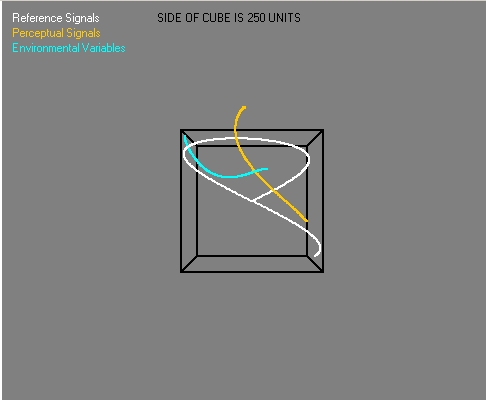
The first screen shot shows how the variables are plotted. The white
trace shows the three reference signals as a moving point in 3-D space
(the point is at the lower right). The orange trace shows the three
perceptual signals, and the aqua trace shows the three environmental
variables. This is a slow-motion plot done shortly after
starting:

1fbfde.jpg

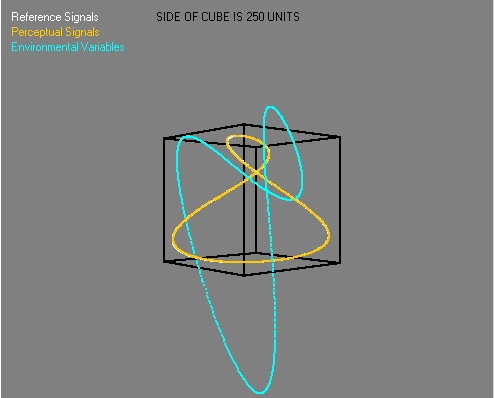
The next screen shot shows the screen after a large number of fast
iterations. The orange trace almost perfectly overlays the white trace,
showing that each perception is closely following its reference signal.
I’ve turned the view for a better look.

1fc06b.jpg

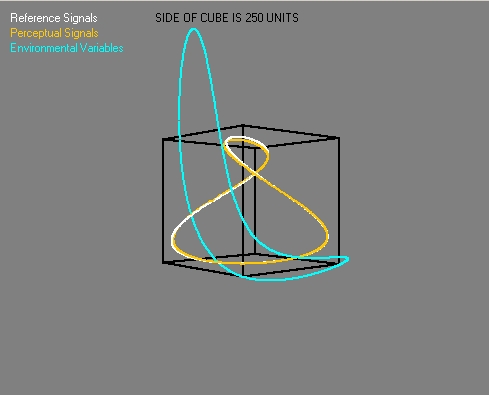
The third screen shot is simply a repeat of the above trace after
selecting a new set of random input weights, so each control system is
perceiving its environment differently.

1fc0d8.jpg

As you can see, the perceptual signals still track the reference signals
(not as perfectly because I stopped it a little sooner). But the aqua
trace showing how the environmental variables change is not the same as
before. In fact, if these were two identical systems in different bodies,
each one would be experiencing the environment as being under control
relative to the same pattern of reference signal changes, yet the
environmental pattern that satisfies one set of controllers would not
satisfy the other. They would be in conflict if they both tried to
operate at once. And the only difference between them is that their
perceptual input functions use different weights in perceiving the three
environmental variables. Each has adapted its outputs to control as well
as possible given the three input weights.

This is not an issue to be shrugged off.

Best,

Bill P.

[From Rick Marken (2007.01.19.1700)]

Bill Powers (2007.01.19.1520 MST)--

That's not exactly an answer to my question. I'm wondering if there is any way to show that two people are having the same experience at any level, from intensities to system concepts. If you know of a way, fine -- let me in on it. I don't just want to go on assuming it for no good reason other than that's the way I prefer things to be (which I do).

But I don't think there is a way to answer that question. Perhaps the problem is the word "experience". What do you mean by that word? If you mean "perception" as in p = f(qi) then I think that people _can_ have the same (or, at least, isomorphic -- if that's the correct mathematical term) perceptions at all levels and the proof would be observing that people can control any particular f(qi), from intensities to system concepts. I think of the test for the controlled variable as a way of answering the question of whether people have the same experiences, in the sense of the same perceptions. If, however, what you mean by "experience", is the experienced or phenomenal quality of a perception, then I don't think there is a way to test it.

But saying "functionally the same" is simply assuming the answer. I have no problem with saying it's "functionally the same" for me, but when this is extended to other people this is definitely not a trivial question. When you say "people" are clearly able to control what are functionally the same perceptions, you're assuming what I am saying I can't prove -- and neither can you, unless you show me different. These are functionally the same perceptions for you, that's all you can say. In fact, that's the heart of the issue.

I guess I'm not understanding what you are saying. Here's what I am thinking when I say "functionally the same perception". You do a tracking task and I find that you are controlling what I perceive as the distance between the cursor and target. Something equivalent to this perception of mine is (I trust) computed by the computer by subtracting variable c from variable t. I see that you are keeping c-t under control (because is varies considerably less than expected due to disturbances). So I conclude that you are also perceiving something like c-t. Is there something wrong with that conclusion?

It seems to me that there are many "proofs" that this is the case. The constructed world is one of them. In order to build things collectively I think people have to perceive a gazillion things in the same way: the position of I beams, the pitch of the roadway, etc, etc.

But you don't know what "people" perceive; you know only what you perceive. You know what you deduce, using your own reasoning methods, from your own observations of other people.

I also come to this conclusion based on my observations of the _consequences_ of people's actions; from their controlling. People seem to be controlling for (by making or consuming) the same kinds of results I want: clothes, houses, cars, computers, phones, etc. I think this is more than a coincidence;-)

And, as I said, the fact that people are able to control the same variable in a tracking task suggests to me that different people can control what is functionally the same perceptual variable (whether they are all experiencing that variable in the same way or not).

Functionally the same in terms of your own private perceptual organization. You have no basis that I can see for saying it's functionally the same for everyone.

Now I guess I don't know what you mean by "functionally". Perhaps this is just over my head.

Let me show you something I have found while working on a demo of reorganization. Imagine three control systems in an environment of three variables...

The next screen shot shows the screen after a large number of fast iterations. The orange trace almost perfectly overlays the white trace, showing that each perception is closely following its reference signal. I've turned the view for a better look.

Yes, I understand this as three unidimensional perceptions tracking their references.

The third screen shot is simply a repeat of the above trace after selecting a new set of random input weights, so each control system is perceiving its environment differently.

OK.

As you can see, the perceptual signals still track the reference signals (not as perfectly because I stopped it a little sooner). But the aqua trace showing how the environmental variables change is not the same as before.

But why would you expect the variations in the environmental variable to be the same as before? Didn't you just change to a new set of input functions? So the actions on the environment by all three systems that keep all three perceptions in their reference state would be expected to produce different variations in the three environmental variables as compared to the environmental variations that occurred with the previous set of input functions. Help!

In fact, if these were two identical systems in different bodies, each one would be experiencing the environment as being under control relative to the same pattern of reference signal changes, yet the environmental pattern that satisfies one set of controllers would not satisfy the other.

I don't understand this. What are the two identical systems in different bodies? Is it the two sets of three control systems with different input functions? If so, then they are not identical, right? They have different input functions. I'm completely lost here.

It looks to me like you created two "organisms", each consisting of three control systems controlling a different perception, each perception being a different linear function of the same three environmental variables. Is that right? The two "organisms" differ only in terms of the three perceptions they control. So it seems like these two "organisms" together control 6 different aspects of an environment made up of 3 variables. If you put both organisms together in the same environment you would definitely have a conflict because you can't have more than three independent linear combinations of three variables.

They would be in conflict if they both tried to operate at once.

Yes, I think it's a degrees of freedom problem.

And the only difference between them is that their perceptual input functions use different weights in perceiving the three environmental variables. Each has adapted its outputs to control as well as possible given the three input weights.

Right. Let's start with just the first organism environment. This organism is controlling three linear combinations of the 3 environmental variables. Once you put even one more control system into that environment, one which is controlling _any_ linear combination of the three environmental variables, you will get a conflict, because you can't have more than three orthogonal linear combinations (the perceptual functions) of three variables (the environment). I think what you may have demonstrated is a basic theorem of linear algebra, not of perception.

This is not an issue to be shrugged off.

I don't mean to shrug it off. I'm trying to understand what the issue _is_. If I understand your demo correctly, I think you have already (brilliantly) explained the issue in your "Degrees of Freedom in Social Interaction" paper in LCS I.

Best

Rick

···

---
Richard S. Marken Consulting
marken@mindreadings.com
Home 310 474-0313
Cell 310 729-1400
[From Bill Powers (2007.01.19.1835 MST)]

Rick Marken (2007.01.19.1700) –

As you can see, the perceptual
signals still track the reference signals (not as perfectly because I
stopped it a little sooner). But the aqua trace showing how the
environmental variables change is not the same as before.

But why would you expect the variations in the environmental variable to
be the same as before? Didn’t you just change to a new set of input
functions? So the actions on the environment by all three systems that
keep all three perceptions in their reference state would be expected to
produce different variations in the three environmental variables as
compared to the environmental variations that occurred with the previous
set of input functions. Help!

The point of this is that in both systems, the same perceptual signals
track the same reference signals – yet what is being controlled
externally is different. So the actual “objective” meaning of
the perceptual signals is undetectably different for the two control
systems. Higher systems could not tell that different environmental
patterns were being controlled by one system inside one person after the
input function changed and reorganization restored control.

It’s very hard to grasp this problem, I realize, because we always take
something for granted as “really existing” without remembering
that it, too, is a perception. For example:

I also come to this conclusion
based on my observations of the consequences of people’s actions; from
their controlling. People seem to be controlling for (by making or
consuming) the same kinds of results I want: clothes, houses, cars,
computers, phones, etc. I think this is more than a coincidence;-)

When you succeed in keeping in mind that it’s ALL perception, the
problem I’m concerned with pops right out. Those consequences and the
people acting are your perceptions, as are clothes, houses, cars,
computers, phones, etc. Your guesses about what someone else perceives
and controls are always stated in terms of your own perceptual world, not
the other person’s.

I really hope someone can show me that this is a non-problem. Actually,
philosophers have been sweating over this one for quite a while, so
perhaps the answer is not as simple as it looks at first.

Best,

Bill P.

[From Rick Marken (2007.01.19.1810)]

Bill Powers (2007.01.19.1835 MST)--

Rick Marken (2007.01.19.1700) --

But why would you expect the variations in the environmental variable to be the same as before? Didn't you just change to a new set of input functions? So the actions on the environment by all three systems that keep all three perceptions in their reference state would be expected to produce different variations in the three environmental variables as compared to the environmental variations that occurred with the previous set of input functions. Help!

The point of this is that in both systems, the same perceptual signals track the same reference signals -- yet what is being controlled externally is different.

I'm still not getting it and I really want to. In particular, I don't understand what you mean by "in both systems, the same perceptual signals track the same reference signals". Aren't the perceptions in one system different than the perceptions in the other system?

Here's what I think is going on. There are two systems (I'll call them "organisms") each made of three control systems. The three control systems in organism 1 are controlling the following 3 perceptions:

p11=a11e1+b11e2+c11e3
p12=a12e1+b12e2+c12e3
p13=a13e1+b13e2+c13e3

And the three control systems in organism 2 are controlling the following 3 perceptions:

p21=a21e1+b21e2+c21e3
p22=a22e1+b22e2+c22e3
p23=a23e1+b23e2+c23e3

where the first subscript of p and a indexes the organism and the second indexes the control system in the organism. All perceptions are based on the same three environmental variables, e1, e2 and e3.

Is this right, or not?

Best

Rick

···

---
Richard S. Marken Consulting
marken@mindreadings.com
Home 310 474-0313
Cell 310 729-1400
[Martin Taylor 2007.01.19.22.22]

[From Rick Marken (2007.01.19.1810)]

Bill Powers (2007.01.19.1835 MST)--

Rick Marken (2007.01.19.1700) --

But why would you expect the variations in the environmental variable to be the same as before? Didn't you just change to a new set of input functions? So the actions on the environment by all three systems that keep all three perceptions in their reference state would be expected to produce different variations in the three environmental variables as compared to the environmental variations that occurred with the previous set of input functions. Help!

The point of this is that in both systems, the same perceptual signals track the same reference signals -- yet what is being controlled externally is different.

I'm still not getting it and I really want to. In particular, I don't understand what you mean by "in both systems, the same perceptual signals track the same reference signals". Aren't the perceptions in one system different than the perceptions in the other system?

Maybe I can confuse the situation a little, since I thought the same, at first. But Bill's later explanation made things clear. Thought I'm not sure I quite agree with Bill's interpretation of the situation.

Look at it from the viewpoint of the second-level systems. All they get is a set of signals from below. They have a set of reference values that they can make their perceptual values follow. They know nothing about what is happening in the environment, and it looks the same to them with both sets of inputs. From that point of view, you can say that they know nothing whatsoever about what is going on in the environment outside the hierarchy. All they know is that they are able to control their perceptions exactly the same in both environments, so for all they know, those environments are the same.

Why I don't necessarily agree with Bill is that the environment is deliberately set up to be as symmetrical as it can possibly be. It doesn't matter what outputs do to the environment, because they do nothing except feed back to the input sensors. If the environment were "lumpy", so that, say, output 1 could never affect sensor 3 (real-world analogy: moving a chair won't affect the smell of dinner), and output 2 had an effect on sensor 1 over only part of its range, etc. etc., then I wonder whether different systems would have to reorganize so as to fit the asymmetric world in the same way?

It would be interesting if Bill could add a "lumpy" environment with no symmetries and a fair amount of nonlinearity, and then see whether the systems with different random sensor functions could reorganize differently to control it. I suspect they could, but not always, in the same way that deaf or colour-blind people fail to control perceptions relating to aspects of the world that other people can control quite well.

I think the philosophical point is that if one can control the environment well under different conditions of disturbance, one is likely to consider that one is "correctly" perceiving reality, whereas it is quite possible that entirely different ways of perceiving the world would allow one to control equally well. In a highly symmetrical world, it is very likely that multiple different sets of ways of percieving would function well, but in a highly unsymmetric world with many interacting nonlinearities, the opportunities for alternate effective ways of perceiving are likely to be much reduced, but never eliminated. I think that is the basis for the "experimental method" in science. One compares alternate possibilities where the world is likely to be unsymmetric so that the two competing sets of possibilities would not behave the same way.

I hope this makes at least some sense.

Martin

[Martin Taylor 2007.01.20.10.33]

This is an addendum to [Martin Taylor 2007.01.19.22.22] after a night's sleep.

Why I don't necessarily agree with Bill is that the environment is deliberately set up to be as symmetrical as it can possibly be. It doesn't matter what outputs do to the environment, because they do nothing except feed back to the input sensors. If the environment were "lumpy", so that, say, output 1 could never affect sensor 3 (real-world analogy: moving a chair won't affect the smell of dinner), and output 2 had an effect on sensor 1 over only part of its range, etc. etc., then I wonder whether different systems would have to reorganize so as to fit the asymmetric world in the same way?

It would be interesting if Bill could add a "lumpy" environment with no symmetries and a fair amount of nonlinearity, and then see whether the systems with different random sensor functions could reorganize differently to control it. I suspect they could, but not always, in the same way that deaf or colour-blind people fail to control perceptions relating to aspects of the world that other people can control quite well.

The addendum is this: since the underlying question is whether people probably perceive much of the environment in the same way, the reorganization process must include the sensor systems pr at least the first level control systems that connect to the different kinds of sensors. In the "lumpy" environment, would initially random weight patterns for the sensors converge more often than not toward a common pattern that bears some relation to the pattern of lumpiness in the environment?

I think the philosophical point is that if one can control the environment well under different conditions of disturbance, one is likely to consider that one is "correctly" perceiving reality, whereas it is quite possible that entirely different ways of perceiving the world would allow one to control equally well.

If any way of perceiving is as good as any other, the different sets of perceptual input weights arrived at by reorganizations from randomized starting points should not cluster, but if perceptions in successful control systems do bear some relationship to the structure of the environment, then they should cluster in one or more distinct parts of the available weight space.

Martin

[From Bill Powers (2007.01.20.0812 MST)]

Rick Marken (2007.01.19.1810) –

Here’s what I think is going on.
There are two systems (I’ll call them “organisms”) each made of
three control systems. The three control systems in organism 1 are
controlling the following 3 perceptions:

p11=a11e1+b11e2+c11e3

p12=a12e1+b12e2+c12e3

p13=a13e1+b13e2+c13e3

And the three control systems in organism 2 are controlling the following
3 perceptions:

p21=a21e1+b21e2+c21e3

p22=a22e1+b22e2+c22e3

p23=a23e1+b23e2+c23e3

where the first subscript of p and a indexes the organism and the second
indexes the control system in the organism. All perceptions are based on
the same three environmental variables, e1, e2 and e3.

Is this right, or not?

This is right. However, this is going to be easier to talk about if we
forget about the “two different systems,” because that puts us
in the “omniscient analyst” mode a little too much. Consider
that these two sets of equations describe the same perceptions at two
different times, time 1 and time 2 (the first subscript), before and
after setting the input weights to a new set of values (as in
reorganization). That’s what actually happens in this demonstration. As
Martin Taylor said, the higher systems in this organism, which receive
copies of these perceptual signals, will see the perceptual signals
resulting from the lower reference signals (nee’ upper-level output
signals) as being the same as before, after the lower level adapts its
output weights to the new input weights.
After the input weights change, the output weights are reorganized to
minimize the error in the lower-level control system. The most
interesting aspect of this demo is that the required output weightings
are always (so far) found. This is true even when the sets of
input weights are so far from orthogonal that the output weights must be
ten or more times as large as the net changes in the environmental
variables, indicating a state near to complete conflict.

Consider the implications for sports psychology!

I suspect that we could reorganize both the input functions and the
output functions, using RMS error as the criterion for organizing the
output functions and RMS output for organizing the input functions. In
the demo, the input weights can be selected so the determinant of the 3 x
3 input matrix is in a narrow range, all the way from 0.0 - 0.1 to 0.9 -
1.0. When the determinant is in the upper range, the input matrix is
nearly orthogonal. The result is that the least action is needed to
achieve control. At the other end of the scale, the actions needed become
extreme. So the3 amount of output is apparently a way to measure how
close to orthogonality the input matrix is. If the input matrix
reorganized much more slowly than the output matrix, both reorganizations
might proceed at the same time. Maybe they could be simultaneous even
working at the same speed. I haven’t tried any of those possibilities.
Not enough time.

When the input matrix is as orthogonal as possible, it becomes a rotation
matrix in three dimensions. The perceptual signals represent the state of
the environment randomly rotated about three axes. The output matrix,
after reorganization, becomes another rotation matrix that exactly
compensates for the rotation in the input matrix. The net result is that
after reorganization, the set of control systems does not experience any
rotation of the environment.

Martin suspects, as do I, that there may be a way to determine similarity
between the time-1 and time-2 organizations. Reverting to the
two-organism view, it’s possible that the conflict between the two
systems could be detected, and used as the basis for discovering a set of
input weights that represents the same degree of rotation in both
systems. So although the actual amount of rotation could not be sensed,
the two systems could in fact learn to rotate their inputs by the same
amount, so that source of conflict would disappear. Of course that would
still leave the possibility of conflict arising from different reference
settings. Perhaps the two systems would co-reorganize their input
functions, even without knowing about each other.

There’s a lot more going on here than I can deal with. The questions and
possiblities multiply exponentially. And while there are tantalizing
hints of an answer to my epistemological question, the real answer is
still unknown.

Best,

Bill P.

[From Rick Marken (2007.01.20.0915)]

Bill Powers (2007.01.20.0812 MST)]

Rick Marken (2007.01.19.1810) --

Here's what I think is going on. There are two systems (I'll call them "organisms") each made of three control systems. The three control systems in organism 1 are controlling the following 3 perceptions:

p11=a11e1+b11e2+c11e3
p12=a12e1+b12e2+c12e3
p13=a13e1+b13e2+c13e3...

As Martin Taylor said, the higher systems in this organism, which receive copies of these perceptual signals, will see the perceptual signals resulting from the lower reference signals (nee' upper-level output signals) as being the same as before, after the lower level adapts its output weights to the new input weights.

I guess I still don't understand this. If the function that defines a perceptual signal, pi1, goes from

p11=a11e1+b11e2+c11e3

to

p21=a21e1+b21e2+c21e3

doesn't that, according to the model, change the "meaning" of the perceptual signal itself? I still must be missing something. I thought all perceptual signals are just signals -- temporal variations in the magnitude of neural currents. So I would think that what a higher system in an organism "sees" when the signal it receives changes from p11 to p21 depends on the nature of the functions that compute p11 and p21.

When the input matrix is as orthogonal as possible, it becomes a rotation matrix in three dimensions. The perceptual signals represent the state of the environment randomly rotated about three axes. The output matrix, after reorganization, becomes another rotation matrix that exactly compensates for the rotation in the input matrix. The net result is that after reorganization, the set of control systems does not experience any rotation of the environment.

I'm definitely not understanding this. I'm sorry. You may be onto something that is beyond my mental capabilities.

Martin suspects, as do I, that there may be a way to determine similarity between the time-1 and time-2 organizations. Reverting to the two-organism view, it's possible that the conflict between the two systems could be detected

More confusion for me. I think the conflict between the two systems (the two organisms, in my terminology) isn't "possible"; it is certain. And it would be readily detected by higher level systems in the organisms as an inability to control one or more of their perceptions. At least I think this is true. Again, I may be misunderstanding what is going on. I should be able to get it -- especially if I use my spreadsheet model. So I'll keep trying. Sorry I'm so dense.

There's a lot more going on here than I can deal with. The questions and possiblities multiply exponentially. And while there are tantalizing hints of an answer to my epistemological question, the real answer is still unknown.

Given your remarkable past record, I'm trusting that you are really onto something important here. But I gotta tell you I can't see it myself -- yet.

Best

Rick

···

---
Richard S. Marken Consulting
marken@mindreadings.com
Home 310 474-0313
Cell 310 729-1400
[Martin Taylor 2007.01.20.12.51]

[From Rick Marken (2007.01.20.0915)]

I guess I still don't understand this. If the function that defines a perceptual signal, pi1, goes from

p11=a11e1+b11e2+c11e3

to

p21=a21e1+b21e2+c21e3

doesn't that, according to the model, change the "meaning" of the perceptual signal itself?

To an outside observer that can see the state of the environmental variables and of the perceptual signals, yes it does. If you can see "real reality", then you can know whether perceptual functions "mean" one thing or another.

The control system itself is not so lucky. All it can do is determine the value of the signal coming from its perceptual input function, and "push on" the environment in its own unique way. If it finds that a push on the environment does to its perceptual signal value just what it did before, how can it know that the meaning of the perceptual signal has changed?

In Bill's simulations, the pushes at the lowest level aren't always the same to get the same effect on their perceptual values. With some sets of input functions, the low-level control systems have to push harder than they do with others. But the control systems at the level above don't know that. What they "know" is that the effects of their outputs on their perceptions is the same. More properly put, an outside observer seeing the perceptual and output values of the second level would have no way of knowing that the perceptual input functions at the lowest level were one setup rather than another.

Martin

[From RIck Marken (2007.01.20.1100)]

Martin Taylor (2007.01.20.12.51)--

Rick Marken (2007.01.20.0915)

I guess I still don't understand this. If the function that defines a perceptual signal, pi1, goes from

p11=a11e1+b11e2+c11e3

to

p21=a21e1+b21e2+c21e3

doesn't that, according to the model, change the "meaning" of the perceptual signal itself?

To an outside observer that can see the state of the environmental variables and of the perceptual signals, yes it does. If you can see "real reality", then you can know whether perceptual functions "mean" one thing or another.

I'm not talking about perceiving real reality; I'm talking about the nature of the perceptual functions themselves, which are a property of the organism. I think that the reason p11 differs (experientially) from p21 is because the function that defines p11 (a11e1+b11e2+c11e3) differs from the function that defines p21 (a11e1+b11e2+c11e3). This, I believe, is why the perception of red differs from the perception of green. The perceptual signal that we experience as red (p[red]) is a train of neural impulses, just like the perceptual signal that we experience as green (p[green]). The experienced perceptual difference between p[red] and p[green] is (I believe) the difference in how our perceptual functions create the perceptual signals from the same set of environmental energies (wavelengths of light). So p[red] is computed from low, medium and high wavelengths (e1, e2 and e2) by the function a11e1+b11e2+c11e3 and p[green] is computed from the same low, medium and high wavelengths as a21e1+b21e2+c21e3. If our perceptual functions reorganized so that p[red] suddenly equalled a31e1+b31e2+c31e3 I believe we would see something other than red in situations where we used to see red.

The control system itself is not so lucky. All it can do is determine the value of the signal coming from its perceptual input function, and "push on" the environment in its own unique way. If it finds that a push on the environment does to its perceptual signal value just what it did before, how can it know that the meaning of the perceptual signal has changed?

I didn't know that the PCT model of perception worked that way. I don't have to "push on" the environment differently to tell that I am perceiving a white table and a yellow wall (the wall color was Linda's idea, but it looks great). I believe the difference between these perceptions is defined by the nature of the perceptual functions that compute the perceptual signals, not by the outputs needed to influence the state of those perceptual signals. At least, that's my perspective on PCT, and I'm sticking to it unless I'm provided with some good (and comprehesible, to me) reason to change.

In Bill's simulations, the pushes at the lowest level aren't always the same to get the same effect on their perceptual values.

That's true whether the perceptual functions change or not, right? The "pushes" I have to produce to keep the cursor on target change continuously due to changes in disturbance effects to the cursor and, sometimes, due to changes in the feedback function connecting my "pushes" to the cursor.

With some sets of input functions, the low-level control systems have to push harder than they do with others. But the control systems at the level above don't know that. What they "know" is that the effects of their outputs on their perceptions is the same. More properly put, an outside observer seeing the perceptual and output values of the second level would have no way of knowing that the perceptual input functions at the lowest level were one setup rather than another.

So you are saying that the lower level perceptions are "the same" in both cases (even though the perceptual functions have changed) because they still follow the references set by the higher level systems? If this is what is being said, then this is a different approach to perception than the one I was understanding when I first got into PCT. It doesn't fit with my view of PCT and I think I'll stick with my current view, until convinced to do otherwise.

I also noticed something else in Bill's earlier post that that I found puzzling.

Bill Powers (2007.01.20.0812 MST) --

Martin suspects, as do I, that there may be a way to determine similarity between the time-1 and time-2 organizations. Reverting to the two-organism view, it's possible that the conflict between the two systems could be detected, and used as the basis for discovering a set of input weights that represents the same degree of rotation in both systems. So although the actual amount of rotation could not be sensed, the two systems could in fact learn to rotate their inputs by the same amount, so that source of conflict would disappear.

I seems like Bill is saying that a conflict between the systems (organisms) controlling the different perceptions would be a result of the fact that the systems (organisms) are controlling different aspects of the environment. As I see it, the conflict that occurs between the two organisms does _not_ result from the fact that one organism is controlling an aspect of the environment that is rotated relative to that controlled by the other organism. I think the conflict results from the fact that when one organism tries to control:

p11=a11e1+b11e2+c11e3
p12=a12e1+b12e2+c12e3
p13=a13e1+b13e2+c13e3

and the other tries to control

p21=a21e1+b21e2+c21e3
p22=a22e1+b22e2+c22e3
p23=a23e1+b23e2+c23e3

one or more of the p2js is bound to be highly correlated with one or more of the p1js, and vice versa. The conflict results from a shortage of perceptual degrees of freedom, not from perceiving the same environment differently.

What am I missing?

Best

Rick

···

---
Richard S. Marken Consulting
marken@mindreadings.com
Home 310 474-0313
Cell 310 729-1400

[Martin Taylor 2007.01.20.19.56]

[From RIck Marken (2007.01.20.1100)]

Martin Taylor (2007.01.20.12.51)--

Rick Marken (2007.01.20.0915)

I guess I still don't understand this. If the function that defines a perceptual signal, pi1, goes from

p11=a11e1+b11e2+c11e3

to

p21=a21e1+b21e2+c21e3

doesn't that, according to the model, change the "meaning" of the perceptual signal itself?

To an outside observer that can see the state of the environmental variables and of the perceptual signals, yes it does. If you can see "real reality", then you can know whether perceptual functions "mean" one thing or another.

I'm not talking about perceiving real reality; I'm talking about the nature of the perceptual functions themselves, which are a property of the organism.

I thought that's what I was doing. Was it not?

I intended to argue two points: (1) that in a complex environment, it is quite probable that the perceptual functions will reorganize similarly in different organisms (perhaps on evolutionary time scales, perhaps within individuals), and (2) that it is the ability to control that permits this hypothesis to be plausible.

I also suggested that the plausibility of the notion could be tested in experiments such as the one Bill conducted, if the input functions were allowed to reorganize, and the environment were what I called "lumpy". By "lumpy" I mean complicated and non-linear as is the environment in which we seem to live. We all seem to think that it has edges of objects, for example, a highly non-linear property apparently perceived similarly by many people and animals. Edges manifest themselves as places in space where something changes in the relation between muscular output and perceptual input, and maybe that effect preceded in evolutionary time the ability to see edges at a distance, and was influential in permitting the evolution of visual edge-detectors.

I think that the reason p11 differs (experientially) from p21 is because the function that defines p11 (a11e1+b11e2+c11e3) differs from the function that defines p21 (a11e1+b11e2+c11e3). This, I believe, is why the perception of red differs from the perception of green.

Is that supposed to be controversial, or to contradict something I said?

The control system itself is not so lucky. All it can do is determine the value of the signal coming from its perceptual input function, and "push on" the environment in its own unique way. If it finds that a push on the environment does to its perceptual signal value just what it did before, how can it know that the meaning of the perceptual signal has changed?

I didn't know that the PCT model of perception worked that way. I don't have to "push on" the environment differently to tell that I am perceiving a white table and a yellow wall

The current state of the world is presumably determined largely by the values of the inputs to the sensory systems and the current structure of the perceptual functions. That has nothing to do with the outputs of your control systems. But one has to ask how the perceptual functions (and the sensor systems) came to be the way they are. And that, I think, has a lot to do with the way the world works -- how the inputs from the world are influenced by different kinds of "push" on the environment.

I believe the difference between these perceptions is defined by the nature of the perceptual functions that compute the perceptual signals, not by the outputs needed to influence the state of those perceptual signals.

Are you expecting some disagreement with this? If so, why?

The argument is that it is possible that the perceptual functions are the way they are because the real world is the way it is insofar as it allows the organism's actions to affect the physical-chemical states of the organism's surface (and of course, of all its ancestors).

With some sets of input functions, the low-level control systems have to push harder than they do with others. But the control systems at the level above don't know that. What they "know" is that the effects of their outputs on their perceptions is the same. More properly put, an outside observer seeing the perceptual and output values of the second level would have no way of knowing that the perceptual input functions at the lowest level were one setup rather than another.

So you are saying that the lower level perceptions are "the same" in both cases (even though the perceptual functions have changed) because they still follow the references set by the higher level systems?

No, of course not. I can't see where you get that from anything I said. What I said was that the _higher-level_ perceptions couldn't tell that the lower-level perceptual functions had changed, if their own perceptual inputs didn't change and the way the world reacts to their outputs didn't change.

Martin

[From Bill Powers (2007.01.21.0105 MST)]

Rick Marken (2007.01.20.0915)--

The issues you raise are important ones and I don't have many good answers. One concept that might help is that when we think about conflict between two systems, we have to think of these systems as starting with very little organization and gradually becoming organized in each other's presence. When there is a tendency to conflict, it shows up as difficulties with control, which are subject to reorganization. So as the systems become more skillful at controlling, they are simultaneously adapting themselves so as to keep the conflicts from getting serious. What I model as one system with two different organizations (starting with two different sets of input weights) would look different if we were dealing with two systems simultaneously reorganizing in a common environment.

The biggest problem with perception, one that I have never solved, is that the model's perceptions simply don't look like real perceptions. Real perceptions don't look like anonymous magnitudes, all alike. They look different. They have qualities. Maybe, as Paul Churchland has suggested, this sense of quality is simply a result of each magnitude being experienced in the presence of all the other magnitudes. But that's not a very satisfactory answer, for me. Something is missing from this picture. I don't think the basic concept of the hierarchy or of hierarchically-related perceptions is wrong. But I really don't think we have the whole story yet, by a long shot.

I have to get to work on the book now. I've been hung up on trying to show multiple levels of coordinated action reorganizing at all levels, and I have just realized that this is too much for me to accomplish right now. Now I can simplify again and stick to the aspects of the model I know how to demonstrate, and stop trying to bite off more than I can chew. This way the book can be done by the target date of May or June. Then I can focus on doing what I always wanted to do when I grew up, which is play boogie-woogie in a bar. Whoopee.

Best,

Bill P.

[From Rick Marken (2007.01.21.1100)]

[Martin Taylor 2007.01.20.19.56]

RIck Marken (2007.01.20.1100)

I'm not talking about perceiving real reality; I'm talking about the nature of the perceptual functions themselves, which are a property of the organism.

I thought that's what I was doing. Was it not?

I intended to argue two points: (1) that in a complex environment, it is quite probable that the perceptual functions will reorganize similarly in different organisms (perhaps on evolutionary time scales, perhaps within individuals), and (2) that it is the ability to control that permits this hypothesis to be plausible.

OK. Then you were talking about something other than what I thought you were talking about.

I think that the reason p11 differs (experientially) from p21 is because the function that defines p11 (a11e1+b11e2+c11e3) differs from the function that defines p21 (a11e1+b11e2+c11e3). This, I believe, is why the perception of red differs from the perception of green.

Is that supposed to be controversial, or to contradict something I said?

No and yes. But I guess you didn't say what I thought you said so never mind the "yes".

I didn't know that the PCT model of perception worked that way. I don't have to "push on" the environment differently to tell that I am perceiving a white table and a yellow wall

The current state of the world is presumably determined largely by the values of the inputs to the sensory systems and the current structure of the perceptual functions.

This is a bit too solipsistic for me. I would say that the current perceived state of the world is determined by those things.

That has nothing to do with the outputs of your control systems. But one has to ask how the perceptual functions (and the sensor systems) came to be the way they are.

At some point, I suppose that's true. But at this point that is not a concern of mine. I'm content to deal with the perceptual functions the way they exist in people at the time when I study them. I question the notion (given my way of looking at PCT, of course) that conflict is ever expressed because the systems in conflict perceive external reality (the three environmental variables in Bill's demo, for example) differently.

I believe the difference between these perceptions is defined by the nature of the perceptual functions that compute the perceptual signals, not by the outputs needed to influence the state of those perceptual signals.

Are you expecting some disagreement with this? If so, why?

I never expect disagreement. I always expect awed agreement. I don't why, since I almost always get angry disagreement. Talk about not learning;-)

With some sets of input functions, the low-level control systems have to push harder than they do with others. But the control systems at the level above don't know that. What they "know" is that the effects of their outputs on their perceptions is the same. More properly put, an outside observer seeing the perceptual and output values of the second level would have no way of knowing that the perceptual input functions at the lowest level were one setup rather than another.

So you are saying that the lower level perceptions are "the same" in both cases (even though the perceptual functions have changed) because they still follow the references set by the higher level systems?

No, of course not. I can't see where you get that from anything I said.

I thought you were saying that the second level systems couldn't tell that there was a change in the perceptual function at the lower level if the perception at that lower level kept tracking the reference, as it does in Bill's demo. I guess I was reading into what you were saying an interpretation of Bill's demo, as I understand it, anyway.

I think that what Bill's demo shows is that three systems can be organized to control almost three perceptions -- p1, p2, and p3 -- that are a function of three environmental variables -- e1, e2 and e3 -- so that these perceptions are kept matching three time varying references -- r1, r2 and r3. The three systems can then be reorganized to control three different perceptions -- p1', p2' and p3' -- of the same three environmental variables, keeping these new perceptions matching the same three time varying references -- r1, r2 and r3 as were used originally. But in this latter case the time variations in e1, e2 and e3 differ from those that were produced when the three systems were controlling p1, p2 and p3.

I think (and I'm still not sure about this) that Bill interprets the results this way: Since the two different sets of systems are controlling different perceptions of the same environment by putting that environment in incompatible states, any conflict that results from putting both sets of systems into this environment simultaneously would result from the different sets of systems trying to put that same environment (e1,e2 and e3) into incompatible states, which shows how different ways of perceiving the same environment can result in conflict.

If this is a correct interpretation of what Bill believes is being shown by his demo then I disagree. I think that the conflict that would unquestionably result when you put systems controlling p1, p2, and p3 into the same, three variable environment (e1, e2 and e3 ) with systems controlling p1', p2' and p3' happens because it is mathematically impossible to control more than three functions of three variables (the perceptions p1, p2, p3, p1', p2' and p3') simultaneously; there are not enough degrees of freedom.

I think that conflict occurs (in the sense of _is expressed_) only when two more more systems try to control the same (or nearly the same) perceptual variable relative to different references. I also believe that it is never correct to say that conflict results from perceiving the same situation differently. Even if the different perceptions are controlled by higher level systems that set the references for the lower level systems, what is really responsible for the conflict is not that these higher level systems are controlling different perceptions -- higher level systems control all kinds of different perceptions and there is usually no conflict -- but, rather, when these higher level systems require _incompatible_ states for the same lower level perception. At least, that's the way I look at PCT.

Best

Rick

···

---

Richard S. Marken Consulting
marken@mindreadings.com
Home 310 474-0313
Cell 310 729-1400

[From Rick Marken (2007.01.21.1115)]

[From Bill Powers (2007.01.21.0105 MST)]

I have to get to work on the book now. I've been hung up on trying to show multiple levels of coordinated action reorganizing at all levels, and I have just realized that this is too much for me to accomplish right now. Now I can simplify again and stick to the aspects of the model I know how to demonstrate, and stop trying to bite off more than I can chew. This way the book can be done by the target date of May or June. Then I can focus on doing what I always wanted to do when I grew up, which is play boogie-woogie in a bar. Whoopee.

Now that sounds like a plan!!

I once played folk music in a bar (with a friend of mine); it was a blast and we were a smash. But, unfortunately, we also got too smashed to do another set. Careful with those bars;-)

Best

Rick

···

--
Richard S. Marken Consulting
marken@mindreadings.com
Home 310 474-0313
Cell 310 729-1400

[From Bill Powers (2007.01.22.1536 MST)]

Rick Marken (2007.01.21.1100) –

I think that conflict occurs (in
the sense of is expressed) only when two more more systems try to
control the same (or nearly the same) perceptual variable relative to
different references.

While that will generate conflict, it’s not the only way to generate a
conflict.
Suppose two systems are controlling perceptions p of the same
environmental variable v at the same reference levels r. p1 = v, p2 = v,
r1 = 1, r2 = 1.
To be sure, a conflict will result if one of the systems greatly
increases its reference level for its perception. p1 = v, p2 = v, r1 =
1, r2 = 2.
But a conflict will also result if the two systems maintain the same
reference levels for their perceptions, and the input function of one of
them changes: p1 = v, p2 = 2v, r1 = 1, r2 = 1.
Notice that in both cases of conflict, one system is trying to produce a
perceptual signal equal to v and the other is trying to produce a
perceptual signal of 2v. The controlled variable for one of them would be
observed to be v, and for the other it would be 2v. In the first case
they are controlling the same variable; in the second case they are not.
But conflict occurs in both cases.
A conflict is not between controlled variables, but between the actions
being used to control two variables. When the actions conflict, the
action needed to bring one variable to its reference level causes the
other variable to depart from its reference level. The solution of the
equations for the two systems would show the controlled variable being
somewhere between the values required by the two systems. Kent McClelland
demonstrated that for a pure integrator type of system, the two opposing
outputs would continually increase while the apparent controlled
variable is kept at a virtual reference level between the two actual
reference levels.

True conflict depends largely on just how great the disparity of
perceptions or reference signals is, what the gain of the systems is, and
most important, on the maximum amount of output each system can produce.
Control is completely lost when an output reaches its maximum.

Best,

Bill P.

[From Rick Marken (2007.01.22.1710)]

Bill Powers (2007.01.22.1536 MST)]

Rick Marken (2007.01.21.1100) --

I think that conflict occurs (in the sense of _is expressed_) only when two more more systems try to control the same (or nearly the same) perceptual variable relative to different references.

While that will generate conflict, it's not the only way to generate a conflict.

Suppose two systems are controlling perceptions p of the same environmental variable v at the same reference levels r. p1 = v, p2 = v, r1 = 1, r2 = 1.

To be sure, a conflict will result if one of the systems greatly increases its reference level for its perception. p1 = v, p2 = v, r1 = 1, r2 = 2.

But a conflict will also result if the two systems maintain the same reference levels for their perceptions, and the input function of one of them changes: p1 = v, p2 = 2v, r1 = 1, r2 = 1.

But p1 and p2 are not really different perceptions from my perspective; they are not orthogonal; in fact, they are about as non-orthogonal as you can get. The correlation between variations in v and 2v will be precisely 1.0. So this is _not_ a case (from my perspective) where conflict results when you are controlling different perceptions.

True conflict depends largely on just how great the disparity of perceptions or reference signals is, what the gain of the systems is, and most important, on the maximum amount of output each system can produce. Control is completely lost when an output reaches its maximum.

OK, if you want to think of v and 2v as different perceptions, then I'l accept that conflict _can_ result from a perceptual disparity. But it has to be a rather special disparity. If the disparity is one where the perceptions are completely unrelated (uncorrelated) then there will be no conflict.

It seems so much easier and more elegant to think of conflict as higher level systems setting inconsistent reference for the same lower level perception. The "parallax" form of conflict (which is what I would call you v vs 2v example) would seem to apply only to interpersonal conflicts. And I would bet that it's pretty rare, even in that case, and readily fixable when it does occur.

Best

Rick

···

---
Richard S. Marken Consulting
marken@mindreadings.com
Home 310 474-0313
Cell 310 729-1400

[From Bruce Nevin (2007.02.07 22:24 EST)]

Bill Powers (2007.01.19.1520 MST) –

You have two control systems that have reorganized, independenty of one another, in two different environments.

The living control systems of interest always learn to control in an environment that includes others such as themselves, including in particular adults who control well. Put the other way around, if an individual is somehow kept alive and growing in isolation, with no social contact, he or she never matures and never learns to control with full competency.

A control system is in a social environment if it perceives other control systems as being like itself in having preferences as to the states of perceived environment variables and acting to resist undesired changes to those variables. The control actions and inferred intentions of other control systems are among the environment variables that it perceives and controls. Even if control sometimes involves no more than staying out of the way, the other’s intention must be perceived (as an inference) so as to control not interfering.

From these interactions, by reorganization, emerge what we perceive to be common knowledge.

Until you have reorganizing control systems in an environment that includes one another, perceived as such, traces of the results of reorganization have only limited relevance to the question.

/Bruce Nevin

[From Bill Powers (2007.02.08.1711 MST)]

Bruce Nevin (2007.02.07 22:24 EST) –

The living
control systems of interest always learn to control in an environment
that includes others such as themselves, including in particular adults
who control well. Put the other way around, if an individual is somehow
kept alive and growing in isolation, with no social contact, he or she
never matures and never learns to control with full
competency.

That’s a good observation. It only deepens the mystery for me, however.
How does the other person help with reorganization, when (a)
reorganization is operated by internal control processes, and (b) no two
people ever know whether they are controlling similar perceptions?

It would be lovely if someone could prove a theorem to the effect that
this inability to share experiences makes no difference – that is, prove
that if we could actually check for similarity, we would act no
differently. Then I could drop the subject and go back to being a naive
realist, as I was until High School.

Best,

Bill P.