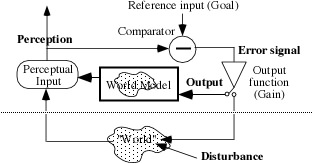
[From Erling Jorgensen (2007.01.25 17:45 EST)]
Hi Bjorn,
I'll just focus on those portions of your post that were in response to
my postings.
Bjorn Simonsen (2007.01.25,13:45 EUST)
From Erling Jorgensen (2007.01.14 22:00 EST)
Sometimes it means stepping back & looking at
acceptance strategies -- cp. "...serenity to accept the things I
cannot change..." -- where the error-gap is reduced by making what
one wants match what one is getting.
Yes I think clinicians have challenging work to do. I didn�t understand
�cp� in your last sentence.
The "cp." was simply an abbreviation for "compare." I was using it to
draw attention to a phrase of the Serenity Prayer of Alcoholics
Anonymous.
That phrase points to an important way that we sometimes use to reduce
the error in some of our control systems. At times, we adjust our
reference standard to match the perceptions that we are getting, instead
of the other way around. I would call this an acceptance strategy.
It is usually not our first mode of reducing error. But when error
persists long enough or high enough, we can use this method with "things
I cannot change", to reduce the distress of uncorrected error (assuming
there is distress from such a state.)
But I appreciated that clinicians (you) focus on how people arrive at
useful references, for getting things _under_ control. I look upon
clinicians as disturbances.
I'm sure many of my clients do, too! 
But this points up an important realization arising from PCT. Even as
"a helping professional," the functional route of acting as a (potential)
disturbance is the only route in! This may be why so many theories of
counseling emphasize the importance of empathy and reflective listening,
as crucial components of therapy. As "professional disturbances," we
generally want to operate close to the client's perceptual frames of
reference, so that our disturbances are not immediately corrected away.
I'm not sure if that means operating within a threshold window of
"minimal error and therefore no action" for the client, or not. It
certainly sets important limits on what may or may not be helpful, and
the Method of Levels is one way to take those limits seriously.
I believe there are others, as alluded to in my previous post.
Sometimes that involves modeling potential behaviors, as in skill
acquisition groups.
This is trying to help clients find output behaviors that may be more
effective in bringing their perceptions to their preferred references.
And again, there is no direct access to changing client behaviors. What
can be done is to present something that clients can perceive, which
they may want to choose to attempt themselves, to improve their desired
control. Such modeling may involve presenting to clients' perceptual
memory store potential references for lower level perceptions, which
they might want to imitate themselves, to see if better control results.
Sometimes it means looking at the uncontrolled
aspects themselves, as in what is called motivational interviewing.
This is a non-judging technique that invites the client to examine
the consequences of their current choices. I believe it tries to
invite the client into the passive observation mode, and describe
there what they see.
Sometimes it means empathic listening & circular questioning, akin
to the method of levels.
The previous technique of (so-called) motivational interviewing may
slide attention down the hierarchy, to what clients are attempting and
whether it is working. Circular questioning and the method of levels
and "walking down the ladder" (a Cognitive Behavioral Therapy technique),
all help slide attention up the hierarchy, to where the reference
standards may be coming from. I believe they allow, either choosing
alternate existing references at those higher levels, or reorganization
that may arrive at improved parameters or functions for achieving
better control.
Sometimes it means interrupting the
runaway feedback from meta-levels, as when panic becomes anxiety
over having anxiety.
I believe this has something to do with changing the loop dominance,
so that positive (i.e., error-increasing) feedback loops become
negative (i.e., error-correcting) feedback loops again. It may also
relate to dampening oscillations that are reacting too quickly (i.e.,
quicker than results can be produced), or at least slowing the degree
of runaway, from exponential to simply linear, so as to buy time to
improve control through other means.
These are some of the ways that I try to map the notions of PCT and
Systems Dynamics onto the work I do as a clinician, so that I can be
guided by the insights of those theories.
I think the negative feedback loop demonstrate very well how people
arrive at useful references, for getting things _under_ control. If the
disturbance is the starter, three things can happen; passive observation
mode, control and conflict. If the reference is the starter, two things
can happen; control and conflict. Am I right?
I am not sure what you mean by the disturbance or the reference being
"the starter," respectively. I have not sorted all the possibilities
into the options you suggest, so I cannot give you an answer.
From Erling Jorgensen (2007.01.17 0915 EST)
To get a bidirectional control system in neural tissue which cannot
register negative numbers, the reference signal can be split into two
signals, one of which activates an inhibitory neuron (is that a glial
cell? I'm not sure), before feeding into the comparator. The same is
done with a perceptual signal, feeding one copy through an inhibitory
neuron.
First, a point of correction. As Bill noted, one of the known neural
means of reversing a signal into an inhibitory form is the Renshaw cell.
Yes, normally I have learned that the perceptual signal enters in the
inhibitory sense ( minus sign) and the reference signal enters in the
excitatory sense (positive sign), and if both signals are reversed, the
effect is the same.
But the effect is not the same, because they are going to outputs
exerting their effects in opposite directions. That allows bringing
a perception to its intended reference, from either below or above.
Think of them as pushing up or pulling down, respectively.
Suppose r=5 and p=2. If p is fed through an inhibitory Renshaw cell,
r - p produces an error of +3, which through a proportional output
would allow pushing up on p by +3, bringing it to its intended
reference level of p=5.
The same figures, but this time with the r fed through the inhibitory
cell, would lead to -5 + 2 = 0 for the error signal, since neural
tissue cannot have a _signal_ that is negative, even though it can
reduce a positive signal through inhibition. In this case, there would
be 0 error going to a different output, meaning no pulling down on the
p=2, since we only want it to move up toward r=5.
Let's reverse the starting numbers. r=2 and p=5. With p fed through
the inhibitory cell, 2 - 5 = 0 error to the output meant to push up on
the perception, which is correct because it is already higher than its
intended reference.
Similarly, having the r fed through the inhibitory cell leads to -2 + 5
= +3 error to the output meant to pull down on the perception, to bring
it closer to the desired r=2.
All of this is a simplified _implimentation_, as Martin notes, providing
one way to produce a _functionally bidirectional_ set of control systems.
If p>r; e<0 and negative numbers cannot be registered as you say.
To press home the point of what I meant to say --
The way that negative numbers are registered within neural tissue is to
inhibit positive signals. That inhibition may go all the way to zero.
But it is still possible to bring a higher perception back down to a
lower reference standard. The way is to feed the reference, not the
perception, through an inhibitory cell, and then have the positive
error signal that is produced be connected to a form of behavioral
output that can make the perceptual signal "lower."
As Martin notes, higher and lower are not the only ways to think of
bidirectionality. Left versus right is another way, as is forward
versus back. Indeed, it seems as though many muscle groups are
hard-wired into opponent process arrangements, so that joint angles
(for instance) can become more open or more closed. All of these are
operating via _positive_ neural signals, but it is the wiring that
dictates the direction of the effect.
If p=r; e=0 and this may lead the output quantity to maintain its value
if the output function has an integrator.
Yes. It is like saying, "Keep doing whatever brought the error to zero."
A zero input to an integrator means zero _change_ to the accumulating
function. This, of course, does not rule out further corrective actions
if the disturbance should serve to move the perception away from its
reference.
In Neurology, I think they refer to this as neuromodulation. And I think
this is fundamental for developing different psychiatric medicines. Is
that correct?
from what I understand, the mechanism of action of different psychiatric
medicines may be quite complex, and in many cases unknown. One place
I would look, in terms of mapping their function onto the schematics
of PCT or HPCT, is in the altering of thresholds and other types of
parameters of the systems. But that's just a guess at this point. And
I think we are pretty far away from knowing anything definite, at this
level of detail.
All the best,
Erling