Self-Regulation

Hi Marttin,

I know that you disagree with that all perceptions
are being controlled all the time. We’ve talk about that “endless”
times J. I offered you physiologocal
explanation and ask you whether you can explain to me how controlled and
uncontrolled perceptions are represented in Bill’s diagram. As I recall I
didn’t get an answer.

Can you offfer me some detailed explanation how unconntrolled
perceptions are “selected” in PCT hierarchy or in nervous system
levels ? Or any pther explanation about nerve-pathways where uncontrolled
perception could go. Anything ?

MT :

Ceasing to control ALL perceptions would
mean death, but ceasing to control any particular perception just means that
another possibility is open for controlling some currently uncontrolled
perception.

HB : Matin how do you know that to control all
perceptions would mean death ? Can you offer me some proof ? I’m just following
what I know about how processes in nerv net are functioning from physiological
view. Can you offer me some other method or theory to show me how neural signals
are “travelling” ?

But maybe it’s misunderstanding. Are you suggesting
that uncontrolled perception are “stored” somehwere in nervous system
“waiting” to be controlled ? It could be that I fully misunderstood
your thought " possibility is open for
controlling some currently uncontrolled perception".

MT :

Does insulting people disturb some
perception in your target that you expect to be controlled by an action you
want to observe? If not, why do it?

HB :

If you control what I wrote insulting I’m really
sorry for that, Martin. It’s not my intention ? I don’t understand why is
turning people to knowledge sources insult ? What’s causing your “error”
?

Can you answer me these questions :

Do you agree that Jeff’s self-regulation theory and
PCT are the same thing ? And do you agree that Jeff’s and Bill’s diagram are
the same ?

I’m don’t agree. So I offered posibility where we
could test both different statements. Can you suggest some other way to test
who is right ?

Best,

Boris

···

From: csgnet-request@lists.illinois.edu
[mailto:csgnet-request@lists.illinois.edu] On
Behalf Of
Martin
Taylor
Sent: Thursday, April 24, 2014
6:02 PM
To: csgnet@lists.illinois.edu
Subject: Re: Self-Regulation

[ Martin
Taylor 2014.04.24.11.51]

On 2014/04/24 11:09 AM, Boris Hartman wrote:

Hi Jeff,

I didn’t know at first if I should aswer
you or not, as you seems to be quite “high gain guy”. But I decided
to answer you any way. My new text is in green…

It seems to me that there is a lot of mutual misunderstanding
between Boris and Jeff, as well as possible cultural differences. The dialogue
is hardly productive for this reason.


. But Bill explained to me that no real control
process in LCS ends or exit. All control processes in organism work all of the
time. And perception is also controlled continuosly, all the time. Just start
to “observe” your visual perception, and you will have no problem
with understanding that. There is no “exit” from these processes. If
any important exit happens, organism soon stops controlling and we know what is
the consequence : death.

I totally disagree with this. Boris, I don’t know what Bill may
have said to you, but if he led you to believe that all possible control
processes are active all the time, either he was badly mistaken or you badly
misinterpreted him. There are at any moment millions of perceptions available
for control, but only at most tens of them actually being controlled. Ceasing
to control ALL perceptions would mean death, but ceasing to control any
particular perception just means that another possibility is open for
controlling some currently uncontrolled perception.

Maybe
it wouldn’t be bad if you read something about biology and physiology to
understand organisms and I’m sure you would understand better also how behavior
and control of perception in organisms work.

Does insulting people disturb some perception in your target that
you expect to be controlled by an action you want to observe? If not, why do
it?

Martin

No virus found in this message.
Checked by AVG - www.avg.com
Version: 2014.0.4570 / Virus Database: 3920/7389 - Release Date: 04/24/14

Hi Jeff,

glad to “hear” from you…J

···

From: csgnet-request@lists.illinois.edu
[mailto:csgnet-request@lists.illinois.edu] On
Behalf Of
Vancouver, Jeff
Sent: Friday, April 25, 2014 5:51
AM
To: csgnet@lists.illinois.edu
Subject: RE: Self-Regulation

[Jeff Vancouver
2014.04.24.2236]

Martin Taylor wrote [2014.04.24.13.11] to Boris
Hartman [2014/04/24 12:48]:

Aren’t you a bit inconsistent in
asserting that Jeff’s diagram is Bill’s diagram and that in Slovenia Jeff would
be criminally responsible for publishing it without saying it is Bill’s, and
then saying you don’t think Jeff’s theory is the same as PCT?

JV:
Good catch Martin. BTW, is the H in HPCT hierarchical or hypothetical?

HB :

It doesn’t seem that you Jeff was insulted by my writings as Martin
tried to present it. It seems to me that you can make jokes too (H)PCT.

Maybe we could get along sitting behind the same table and maybe
drinking wine together JJ. It seems to me that you took my opinion more
as scientist : as another opinion. I think you deserved my respect. Respect is
something that can’t be done with interpersonal control as Martin thought. So I
think he is wrong.

As my inconsistency is concerned :

(1) Well maybe I did mislead
as putting together different statements about Jeff’s oppinion and mine. Jeff
equates “control unit” with “agent”. In that case I think
he should note that diagram is Bill’s.

(2) But by my oppinion diagrams are not
the same but still Jeff used many Bill’s terms and almost whole control loop. I
still think he should mention what is Bill’s. I can hardly find term to express
how we point out other authors right in this case.

But whether I’m incosistent or not, I
think that Jeff should think about borders between his and Bill’s work and do the
right thing…

And Martin. Thank you very much for you
discrection. I don’t know for sure, but I think that you lost all your
credibility in my eyes.

MT: As
for whether I think it is the same or not, I have not followed Jeff’s work as
closely as I have followed Bill’s, so I shouldn’t comment. But I do recognize
that Bill thought that his HPCT (not PCT) was only a sketch or an embryo of a
theory, that would need to be changed, elaborated, and fleshed out over time.
So if Jeff is building on HPCT, he is doing what Bill said would be required,
and if he isn’t, you can’t complain of him using PCT and not giving credit.

JV:
Truth is, I give Bill credit throughout my work, so Boris cannot complain
about that either. However, I am not so sure Bill was all that happy about it.
In particular, he did not have much good to say about my work on self-efficacy.
I do not think he understood the purpose of that work, which was to pit what
seemed to me an implication of control theory against Bandura’s social
cognitive theory. In particular, I considered Bill’s 1991 comment on
Bandura’s 1989 American Psychologist to be a control theory based
argument regarding self-efficacy. Much to my surprise, Bill thought I
misinterpreted him and thus the predictions I made were not, to him, control
theory based. By the time he let me know that, it was too late. I had published
a couple of papers that seriously undermined Bandura’s claims regarding
self-efficacy using the control theory moniker and based on my understanding of
that logic. I also, and I know this sounds heretical, think Bill was wrong. I have
read and reread that 1991 comment. It is pretty clear to me that I correctly
interpreted what he was saying then and what he said to me later is not what he
said then. That is, Bill’s 1991 comment was unambiguous (as was his later
description of what he said he meant or claimed he said – they were just
not the same). So I do not know if I was/am carrying on Bill’s PCT with
my work. The result of the self-efficacy work was what I hoped for though. It
made control theory a viable model for my field. Indeed, one could argue that
it is now the dominant perspective in the area of work motivation. But is it
PCT? Maybe, but it would be difficult to tell. Once a bunch of people get their
hands on something, that something changes. It is the price of dissemination.
Now I have computational models of my self-efficacy work; models that I think
are PCT (or HPCT), but I have yet to publish them. My more recent work is
computational and thus more transparent than my published work on
self-efficacy. Boris aside, it is very control theory. It is not, however, very
much like what Bill did because I am working on explaining different phenomena
than he got to. It has the negative feedback loop (and some open loops as well,
which exercised Rick). As for the learning part of my modeling, it does not
conceive of learning as a global reorganization process, but it is very true to
the negative feedback loop concept (and is closed loop). I am not sure what
label Bill would want me to use, but that is not a perception I am controlling.
I am just trying to develop a veridical model of human behavior using what
seems best. I think control theory concepts are key to that and I needed to
silence the critics (by that I mean take their censoring power at the journal
office away) and I wanted to get others to see their merits. Both seem to have
happened in my sub-discipline (I-O). I am still working on developing the model
and getting more on board.

HB :

It seems to me that you
are in quite serious doubts what your theory in relation to PCT. I didn’t
say that your efforts are not good, I just thought that you could improve your theory
with (1) enriching your “organism” with more solid “facts” (2)
preciously defining the limits between your theory and PCT and (2) respect what
is Bill’s work. They were just suggestions and it seems to me that you took it in
that way. So I wish you luck with your theory, and to cooperation with Rick.

Best,

Boris

No virus found in this message.
Checked by AVG - www.avg.com
Version: 2014.0.4570 / Virus Database: 3920/7389 - Release Date: 04/24/14

Hi Martin,

MT :

Another perception I try to control, with little
success, is that the discourse on CSGnet should be on technical matters, not on
personal properties. I know I violate this in my own postings, but doing so
simply illuminates the presence of a conflict among my own controlled
perceptions.

HB :

Right. I’m not
used to so much phylosophy (phenomenology) in your arguments. I never knew
before how good phylosopher you are J. I also noticed that you have emotional outburst for your friend
Jeff. I’ll not cooment your arguments as it is your privilege to think what you
want.

So as I see our conversation was typical waste
of time. We didn’t accomplish anything. I insulted you and you insulted me. So
we are equal. We are stying steady on our positions and we’ll be doing whatever
we were doing till now.

But something has changed and that was all
what I wanted :

Barb:

I’m a bit baffled by your continued suggestion to
change the name. Simply put, this will not happen, anymore than we would
try to change the name of Einstein’s theory of relativity.

HB :

This is the only oppinon that I really wanted to hear
and that is relevant for me and my work with PCT. PCT will not be some version
of “self-regulation” theory.

Best,

Boris

···

From: csgnet-request@lists.illinois.edu
[mailto:csgnet-request@lists.illinois.edu] On
Behalf Of
Martin
Taylor
Sent: Thursday, April 24, 2014
7:41 PM
To: csgnet@lists.illinois.edu
Subject: Re: Self-Regulation

[ Martin
Taylor 2014.04.24.13.11]

On 2014/04/24 12:48 PM, Boris Hartman wrote:

Hi Marttin,

I know that you disagree with that all perceptions
are being controlled all the time. We’ve talk about that “endless”
times J. I offered you physiologocal
explanation and ask you whether you can explain to me how controlled and
uncontrolled perceptions are represented in Bill’s diagram. As I recall I
didn’t get an answer.

You often refer, privately and publicly, to
“Bill’s diagram”. Bill produced hundreds of diagrams, so it
would be helpful if you were to specify. However, in most of them he dealt only
with controlled perceptions, so uncontrolled ones are not shown. Why should
they be? They would just clutter up any diagram that shows whatever he wanted
to show about control in that particular diagram.

Can you offfer me some detailed explanation how
unconntrolled perceptions are “selected” in PCT hierarchy or in
nervous system levels ? Or any pther explanation about nerve-pathways where
uncontrolled perception could go. Anything ?

I don’t understand the question. Many times I’ve shown
you examples of uncontrolled perceptions. Look around you and ask yourself
whether you are at this moment controlling your perception of the colour of the
bricks (if there are any) of which the bukilding outside your window is
constructed. Are you at this moment controlling your perception of the shape of
the edge of the cloud most nearly directly above you? Are you at this moment
controlling your many perceptions of the clothes you are wearing? You probably
were controlling your perceptions of your clothes when you got up this morning,
but are you at this moment?

MT :

Ceasing to control ALL perceptions would
mean death, but ceasing to control any particular perception just means that
another possibility is open for controlling some currently uncontrolled
perception.

HB : Matin how do you know that to control all
perceptions would mean death ?

If an organism ceases to control all perceptions, it
becomes just another part of the universe with the inevitable entropic decay
(i.e. it rots away). It does nothing to get food, nothing to get
air or water, nothing at all. There is nothing to maintain its internal
organization, which dissipates into the general environment. It is dead.

HB :

Can you imagine that all perceptual signals (signals
that are over sensor treshold = all or nothing principle) are controllled on
first level, and are “selected” through heirarchy to become
“controlled” on some level of hierarchy ? There are some data that I
must admitt, that I don’t yet understand this principle of selection. But this
could clarify our misundestanding.

Can
you offer me some proof ?

No, but I can offer you examples of entities that
control nothing: a rock, a book, a glass of water… Are they alive? If not,
why not. Would you not say that it is because they don’t control any
perceptions relating to the states of their environment? In what way is an
organism that has ceased to control anything different?

I’m
just following what I know about how processes in nerv net are functioning from
physiological view. Can you offer me some other method or theory to show me how
neural signals are “travelling” ?

I don’t understand the question, especially not in the
context of an organism that has ceased to control anything. what
does the mechanism of transmission of nerve imulses have to do with the issue?

But maybe it’s misunderstanding. Are you suggesting
that uncontrolled perception are “stored” somehwere in nervous system
“waiting” to be controlled ? It could be that I fully misunderstood
your thought " possibility is open for
controlling some currently uncontrolled perception".

Where is your perception of
the book on your bookshelf that you are not touching stored? Where is any
current perception (controlled or uncontrolled) stored? Is it stored?
Where is the memory of it stored, if it is stored? Uncontrolled perceptions are
just that: perceptions not currently being controlled. Why is that a problem
for you? Remember something else Bill repeated (I think from
Korzybski): “The map is not the territory”, and a diagram is not the
world.

MT :

Does insulting people disturb some
perception in your target that you expect to be controlled by an action you
want to observe? If not, why do it?

HB :

If you control what I wrote insulting I’m really
sorry for that, Martin. It’s not my intention ? I don’t understand why is
turning people to knowledge sources insult ? What’s causing your
“error” ?

Telling a senior researcher that he should go back to
kindergarten is insulting, in my view. That causes an error in my perception of
the civility of discourse on CSGnet, a perception for which I have a reference
value that does not include gratuitous insults. Another
perception I try to control, with little success, is that the discourse on
CSGnet should be on technical matters, not on personal properties. I know I
violate this in my own postings, but doing so simply illuminates the presence
of a conflict among my own controlled perceptions.

Can you answer me these questions :

Do you agree that Jeff’s self-regulation theory and
PCT are the same thing ? And do you agree that Jeff’s and Bill’s diagram are
the same ?

I’m don’t agree. So I offered posibility where we
could test both different statements. Can you suggest some other way to test
who is right ?

Aren’t you a bit inconsistent in asserting that Jeff’s
diagram is Bill’s diagram and that in Slovenia Jeff would be criminally
responsible for publishing it without saying it is Bill’s, and then saying you
don’t think Jeff’s theory is the same as PCT?

As for whether I think it is the same or not, I have not followed Jeff’s work
as closely as I have followed Bill’s, so I shouldn’t comment. But I do
recognize that Bill thought that his HPCT (not PCT) was only a sketch or an
embryo of a theory, that would need to be changed, elaborated, and fleshed out
over time. So if Jeff is building on HPCT, he is doing what Bill said would be
required, and if he isn’t, you can’t complain of him using PCT and not giving
credit.

Martin

No virus found in this message.
Checked by AVG - www.avg.com
Version: 2014.0.4570 / Virus Database: 3920/7389 - Release Date: 04/24/14

[Martin Taylor 2014.04.24.11.51]

···

On 2014/04/24 11:09 AM, Boris Hartman
wrote:

Hi Jeff,

                    I didn't

know at first if I should aswer
you or not, as you seems to be quite “high gain
guy”. But I decided
to answer you any way. My new text is in green…

      It seems to me

that there is a lot of mutual misunderstanding between Boris
and Jeff, as well as possible cultural differences. The
dialogue is hardly productive for this reason.


. But Bill explained to me
that no real control process in LCS ends or
exit. All control processes in
organism work all of the time. And perception is
also controlled continuosly,
all the time. Just start to “observe” your
visual perception, and you
will have no problem with understanding that.
There is no “exit” from
these processes. If any important exit happens,
organism soon stops controlling
and we know what is the consequence : death.

      I totally

disagree with this. Boris, I don’t know what Bill may have
said to you, but if he led you to believe that all possible
control processes are active all the time, either he was badly
mistaken or you badly misinterpreted him. There are at any
moment millions of perceptions available for control, but only
at most tens of them actually being controlled. Ceasing to
control ALL perceptions would mean death, but ceasing to
control any particular perception just means that another
possibility is open for controlling some currently
uncontrolled perception.

                    Maybe it wouldn't be bad

if you read something about biology and
physiology to understand organisms and
I’m sure you would understand better also how
behavior and control of
perception in organisms work.

      Does insulting

people disturb some perception in your target that you expect
to be controlled by an action you want to observe? If not, why
do it?

      Martin

[Martin Taylor 2014.04.24.13.11]

it would be helpful if you were to

specify. However, in most of them he dealt only with controlled
perceptions, so uncontrolled ones are not shown. Why should they be?
They would just clutter up any diagram that shows whatever he wanted
to show about control in that particular diagram.
.
It does nothing to get food, nothing to get air or water, nothing at
all. There is nothing to maintain its internal organization, which
dissipates into the general environment. It is dead.
what does the mechanism of
transmission of nerve imulses have to do with the issue?
Remember something
else Bill repeated (I think from Korzybski): “The map is not the
territory”, and a diagram is not the world.
Another
perception I try to control, with little success, is that the
discourse on CSGnet should be on technical matters, not on personal
properties. I know I violate this in my own postings, but doing so
simply illuminates the presence of a conflict among my own
controlled perceptions.
Martin

···

On 2014/04/24 12:48 PM, Boris Hartman
wrote:

Hi Marttin,

            I know that you disagree with

that all perceptions
are being controlled all the time. We’ve talk about that
“endless”
times J . I offered
you physiologocal
explanation and ask you whether you can explain to me
how controlled and
uncontrolled perceptions are represented in Bill’s
diagram. As I recall I
didn’t get an answer.

    You often refer, privately and

publicly, to “Bill’s diagram”. Bill produced hundreds of
diagrams, so

            Can you offfer me some

detailed explanation how unconntrolled
perceptions are “selected” in PCT hierarchy or in
nervous system
levels ? Or any pther explanation about nerve-pathways
where uncontrolled
perception could go. Anything ?

I don’t understand the question. Many times I’ve shown you examples of
uncontrolled perceptions. Look around you and ask yourself
whether you are at this moment controlling your perception of
the colour of the bricks (if there are any) of which the
bukilding outside your window is constructed. Are you at this
moment controlling your perception of the shape of the edge of
the cloud most nearly directly above you? Are you at this moment
controlling your many perceptions of the clothes you are
wearing? You probably were controlling your perceptions of your
clothes when you got up this morning, but are you at this
moment?

MT :

            Ceasing to control

ALL perceptions would
mean death, but ceasing to control any particular
perception just means that
another possibility is open for controlling some
currently uncontrolled
perception.

            HB : Matin how do you know

that to control all
perceptions would mean death ?

    If an organism ceases to control

all perceptions, it becomes just another part of the universe
with the inevitable entropic decay (i.e. it rots away)

Can you offer me some proof ?

    No, but I can offer you examples

of entities that control nothing: a rock, a book, a glass of
water… Are they alive? If not, why not. Would you not say that
it is because they don’t control any perceptions relating to the
states of their environment? In what way is an organism that has
ceased to control anything different?

I’m just following
what I know about how processes in nerv net are
functioning from physiological
view. Can you offer me some other method or theory to
show me how neural signals
are “travelling” ?

    I don't understand the question,

especially not in the context of an organism that has ceased to
control anything.

            But maybe it's

misunderstanding. Are you suggesting
that uncontrolled perception are “stored” somehwere in
nervous system
“waiting” to be controlled ? It could be that I fully
misunderstood
your thought "
possibility is open for
controlling some currently uncontrolled perception".

      Where is your

perception of the book on your bookshelf that you are not
touching stored? Where is any current perception (controlled
or uncontrolled) stored? Is it stored? Where is the memory of
it stored, if it is stored? Uncontrolled perceptions are just
that: perceptions not currently being controlled. Why is that
a problem for you?

MT :

            Does insulting

people disturb some
perception in your target that you expect to be
controlled by an action you
want to observe? If not, why do it?

HB :

            If you control what I wrote

insulting I’m really
sorry for that, Martin. It’s not my intention ? I don’t
understand why is
turning people to knowledge sources insult ? What’s
causing your “error”
?

    Telling a senior researcher that

he should go back to kindergarten is insulting, in my view. That
causes an error in my perception of the civility of discourse on
CSGnet, a perception for which I have a reference value that
does not include gratuitous insults.

            Can you answer me these

questions :

            Do you agree that Jeff's

self-regulation theory and
PCT are the same thing ? And do you agree that Jeff’s
and Bill’s diagram are
the same ?

            I'm don't agree. So I offered

posibility where we
could test both different statements. Can you suggest
some other way to test
who is right ?

    Aren't you a bit inconsistent in

asserting that Jeff’s diagram is Bill’s diagram and that in
Slovenia Jeff would be criminally responsible for publishing it
without saying it is Bill’s, and then saying you don’t think
Jeff’s theory is the same as PCT?

    As for whether I think it is the same or not, I have not

followed Jeff’s work as closely as I have followed Bill’s, so I
shouldn’t comment. But I do recognize that Bill thought that his
HPCT (not PCT) was only a sketch or an embryo of a theory, that
would need to be changed, elaborated, and fleshed out over time.
So if Jeff is building on HPCT, he is doing what Bill said would
be required, and if he isn’t, you can’t complain of him using
PCT and not giving credit.

[Martin Taylor 2014.04.25.15.41]

[MT] I did answer those of your question that I understood. If you

disagree with those answers, which boil down to asking you to look
around you and decide for yourself what of your perceptions you at
that moment are controlling, so be it. But you presumably have
reasons for disagreeing, and it might be useful if you were to let
others know those reasons. You have never, that I remember, given
them to me.

···

On 2014/04/25 2:49 PM, Boris Hartman
wrote:

              Hi

Martin,

MT :

              Another

perception I try to control, with little
success, is that the discourse on CSGnet should be on
technical matters, not on
personal properties. I know I violate this in my own
postings, but doing so
simply illuminates the presence of a conflict among my
own controlled
perceptions.

HB :

Right. I’m
not
used to so much phylosophy (phenomenology) in your
arguments. I never knew
before how good phylosopher you are J . I also noticed that you have emotional
outburst for your friend
Jeff. I’ll not cooment your arguments as it is your
privilege to think what you
want.

      [MT[ Jeff is

not a freind. I have never met him and have had, until the lst
day or two, no communication with him in public or private.

              So as I see our

conversation was typical waste
of time. We didn’t accomplish anything. I insulted you
and you insulted me.

      [MT] I had no

idea you had insulted me. When was that? Nor did I know I
insulted you. If I did, I apologize for that, but I’d like to
know how I did it, so as not to do it again (unless “insult”
translates into something different in Slovenian, and you
don’t intend the meaning I get from the word, nor do you get
the meaning I intended).

              So

we are equal. We are stying steady on our positions
and we’ll be doing whatever
we were doing till now.

              But something has

changed and that was all
what I wanted :

Barb:

              I'm a bit

baffled by your continued suggestion to
change the name. Simply put, this will not happen,
anymore than we would
try to change the name of Einstein’s theory of
relativity.

HB :

              This is

the only oppinon that I really wanted to hear
and that is relevant for me and my work with PCT. PCT
will not be some version
of “self-regulation” theory.

Best,

Boris


From:
Thursday, April 24, 2014
7:41 PM
Re: Self-Regulation

[Martin Taylor
2014.04.24.13.11]

              On

2014/04/24 12:48 PM, Boris
Hartman
wrote:

Hi Marttin,

                I know that you disagree

with that all perceptions
are being controlled all the time. We’ve talk about
that “endless”
times J . I
offered you physiologocal
explanation and ask you whether you can explain to
me how controlled and
uncontrolled perceptions are represented in Bill’s
diagram. As I recall I
didn’t get an answer.

                          You often refer, privately and publicly, to

“Bill’s diagram”. Bill produced hundreds of diagrams, so
it
would be helpful if you were to specify. However, in most of
them he dealt only
with controlled perceptions, so uncontrolled ones are not
shown. Why should
they be? They would just clutter up any diagram that shows
whatever he wanted
to show about control in that particular diagram.

            Can you offfer me some

detailed explanation how
unconntrolled perceptions are “selected” in PCT
hierarchy or in
nervous system levels ? Or any pther explanation about
nerve-pathways where
uncontrolled perception could go. Anything ?

                          I don't understand the question. Many times I've

shown
you examples of uncontrolled perceptions. Look around
you and ask yourself
whether you are at this moment controlling your
perception of the colour of the
bricks (if there are any) of which the bukilding outside
your window is
constructed. Are you at this moment controlling your
perception of the shape of
the edge of the cloud most nearly directly above you?
Are you at this moment
controlling your many perceptions of the clothes you are
wearing? You probably
were controlling your perceptions of your clothes when
you got up this morning,
but are you at this moment?

MT :

            Ceasing to control

ALL perceptions would
mean death, but ceasing to control any particular
perception just means that
another possibility is open for controlling some
currently uncontrolled
perception.

            HB : Matin how do you know

that to control all
perceptions would mean death ?

                          If an organism ceases to control all perceptions,

it
becomes just another part of the universe with the
inevitable entropic decay
(i.e. it rots away) . It does nothing to
get food, nothing to get
air or water, nothing at all. There is nothing to maintain
its internal
organization, which dissipates into the general environment.
It is dead.

HB :

            Can you

imagine that all perceptual signals (signals
that are over sensor treshold = all or nothing
principle) are controllled on
first level, and are “selected” through heirarchy to
become
“controlled” on some level of hierarchy ? There are some
data that I
must admitt, that I don’t yet understand this principle
of selection. But this
could clarify our misundestanding.

              Can

you offer me some proof ?

                          No, but I can offer you examples of entities that

control nothing: a rock, a book, a glass of water… Are
they alive? If not,
why not. Would you not say that it is because they don’t
control any
perceptions relating to the states of their environment?
In what way is an
organism that has ceased to control anything different?

              I'm

just following what I know about how processes in nerv
net are functioning from
physiological view. Can you offer me some other method
or theory to show me how
neural signals are “travelling” ?

                          I don't understand the question, especially not

in the
context of an organism that has ceased to control
anything. what
does the mechanism of transmission of nerve imulses have to
do with the issue?

            But maybe it's

misunderstanding. Are you suggesting
that uncontrolled perception are “stored” somehwere in
nervous system
“waiting” to be controlled ? It could be that I fully
misunderstood
your thought "
possibility is open for
controlling some currently uncontrolled perception".

                          Where is your perception

of
the book on your bookshelf that you are not touching
stored? Where is any
current perception (controlled or uncontrolled) stored?
Is it stored?
Where is the memory of it stored, if it is stored?
Uncontrolled perceptions are
just that: perceptions not currently being controlled.
Why is that a problem
for you? Remember something else Bill
repeated (I think from
Korzybski): “The map is not the territory”, and a diagram is
not the
world.

MT :

            Does insulting

people disturb some
perception in your target that you expect to be
controlled by an action you
want to observe? If not, why do it?

HB :

            If you control what I wrote

insulting I’m really
sorry for that, Martin. It’s not my intention ? I don’t
understand why is
turning people to knowledge sources insult ? What’s
causing your
“error” ?

                          Telling a senior researcher that he should go

back to
kindergarten is insulting, in my view. That causes an
error in my perception of
the civility of discourse on CSGnet, a perception for
which I have a reference
value that does not include gratuitous insults.
Another
perception I try to control, with little success, is that
the discourse on
CSGnet should be on technical matters, not on personal
properties. I know I
violate this in my own postings, but doing so simply
illuminates the presence
of a conflict among my own controlled perceptions.

            Can you answer me these

questions :

            Do you agree that Jeff's

self-regulation theory and
PCT are the same thing ? And do you agree that Jeff’s
and Bill’s diagram are
the same ?

            I'm don't agree. So I offered

posibility where we
could test both different statements. Can you suggest
some other way to test
who is right ?

                          Aren't you a bit inconsistent in asserting that

Jeff’s
diagram is Bill’s diagram and that in Slovenia Jeff
would be criminally
responsible for publishing it without saying it is
Bill’s, and then saying you
don’t think Jeff’s theory is the same as PCT?

            As for whether I think it is the same or not, I have not

followed Jeff’s work
as closely as I have followed Bill’s, so I shouldn’t
comment. But I do
recognize that Bill thought that his HPCT (not PCT) was
only a sketch or an
embryo of a theory, that would need to be changed,
elaborated, and fleshed out
over time. So if Jeff is building on HPCT, he is doing
what Bill said would be
required, and if he isn’t, you can’t complain of him
using PCT and not giving
credit.

        Martin
      No virus

found in this message.
Checked by AVG - www.avg.com
Version: 2014.0.4570 / Virus Database: 3920/7389 - Release
Date: 04/24/14

csgnet-request@lists.illinois.edumailto:csgnet-request@lists.illinois.edu** On
Behalf Of** Martin Taylor
Sent:
**To:**csgnet@lists.illinois.edu
Subject:

[From Kent McClelland (2014.04.24.1035)]

Hi Boris and Jeff,

I’m not sure quite where I fit into this conversation, but my name is mentioned in Boris’s most recent post. I’ve been in contact with Jeff in the past, and I’m aware of his work and appreciate it. I also appreciate Boris’s kind words about my work, though
I’m not as sure as he seems to be that it has much relevance to Jeff’s.

For what it’s worth, I’ve been working on a proposal for a book, to be titled STABILITY, in which I plan to offer my latest take on how to apply PCT to sociology. I have a proposal and a couple of chapters in draft, which I would be happy to share with
interested CSGnet readers, though I’m not ready to post any of it on CSGnet. If you would like to look at these drafts and give me some comments, please contact me directly at
mcclel@grinnell.edu, rather than on CSGnet.

Best to all,

Kent

···

On Apr 24, 2014, at 10:09 AM, Boris Hartman wrote:

Hi Jeff,

I didn’t know at first if I should aswer you or not, as you seems to be quite “high gain guy”. But I decided to answer you any way. My
new text is in green…


From:
csgnet-request@lists.illinois.edu [mailto:csgnet-request@lists.illinois.edu]
On Behalf Of Vancouver, Jeff
Sent: Tuesday, April 22, 2014 11:32 PM
To: csgnet@lists.illinois.edu
Subject: RE: Self-Regulation

[Jeff Vancouver 2014.04.22.1700]

HB :

Thank you Jeff for the links. I was just reading some of them and “flyed over” some articles , and I must say I’m disappointed.
And I’m sorry if I’ll disappoint you. But you as a scientist must be used to other opinions. I made some critical points to your theory :

JV: Would not be the first time.

HB:

  1. Your statement about the equality of terms “Self-regulatory agent” and “Control unit” is maybe equal in your imagination,
    because you used so many terms from “Control Unit”. I see it as your “perceptual illusion”.
  1. We can hardly talk about equality of theories. Your diagram and theory are by my opinion still “opposite” to PCT. I’ll
    be glad if you show me “controlled variable” in Bill’s generic diagram ? And I’ll be glad if you show me how did you get the idea about PCT being a version of control theory ? A version of which Control Theory ?

JV: not sure why this is all caps, but “variable” = “controlled variable”. I have a little
less math (e.g., no leak parameter), but not sure why it looks so different to you.

Hb :

I’m sorry Jeff to be so guibling but I’d really want to know what’s the relations between your theory and PCT : so would
you be so kind and show me, where do you see a “variable” in outside environment in Bill’s diagram ? As I see Bill’s diagram, there is no variable or “controlled variable” in outside environment ? And as I see it this is one of the main differences between
your “agent” theory and PCT which is supposed to be general. It’s not environmental variable that is controlled (it could be a special case), but perception (input) that is continuously varying and is not controlled just to the end when one goal is reached
i.e. one outside variable is brought to wanted state, but all the time, even when there is nothing to regulate (control) outside with behavior.

And it’s quite strange to me : if your and Bill’s diagram are so equal or approximately equal, WHY CAN’T I SEE BILLS’ NAME
UNDER HIS DIAGRAM in your articles ? What kind of Law about author rights you have in
America that you could write under Bill’s diagram
: "self-regulatory agent as part of cybernetic negative feed-back. In other words. : as I see it, you presented your “self-regulatory agent” under Bill’s diagram. That was, what Mary was also talking about.
In my country I would be much more careful when using other author knowledge. By our Law about authors rights I could be prosecuted for “stealing” somebody knowledge if I use it in your way.

You maybe can ask on APA how my conflict with Carver about using Bill’s diagram in his purposes ended. I reported Carver
to APA for wrong use of Bill’s diagram. Well I thought that he will change his attitude to Bill’s work, but as I see lately he just let out Bill’s diagram, although he kept him as reference for hierarchy of goals. V ery
strange. I really don’t understand what you psychologist are up to with Bill’s diagram and self-regulation.

HB:

  1. I don’t understand how Bill’s theory can be a version of “unknown Control Theory”. By my opinion it’s the first and fundamental
    stone in psychological theories of self-regulation (control) which were started with Carver&Scheier. Maybe you could read their book from 1981 or as I already asked you and Warren to show me author who introduced “Control Theory” into psychology ?
    Warren confirmed that Bill was the first. I didn’t hear your voice ?

JV. I do not understand the first sentence from above. I read much of C&S’ book in the 80’s. Miller, Galanter, and
Pribrum introduced a control theory-like theory to psychology same year as Power and company (1960). Much more popular, but was a serial model. Big mistake. Anyway,
Richardson has an excellent history of cybernetic and systems concepts in science (Feedback Though in the social science and systems theory). Great overview of concepts.

HB :

O.K. In our conversation between Carver, me and Bill, we talked also about Miller, Galanter and Pilbram. Carver said that
he was mostly inspired by them, but he didin’t used their model of control. No, he rather took Bills’.

Bill said that he was talking to them, specially with Galanter if I remember right (it’s long time ago), before they published
anything. Bill seemed to me somehow suspicious that they used some of his work.

But he also said that there is no “control theory” behind. It’s just goal hierarchy and TOTE.
Kent wrote something about that. I also didn’t see in the time when we talked any problem with Miller, Galanter and Pilbrum goal theory. But Bill explained to me that no real
control process in LCS ends or exit. All control processes in organism work all of the time. And perception is also controlled continuosly, all the time. Just start to “observe” your visual perception, and you will have no problem with understanding that.
There is no “exit” from these processes. If any important exit happens, organism soon stops controlling and we know what is the consequence : death. But I don’t understand what did you mean by a “serial model” and “Big mistake” ?

Maybe it wouldn’t be bad if you read something about biology and physiology to understand organisms and I’m sure you would
understand better also how behavior and control of perception in organisms work. Bill was really “all-round player”. His knowledge was enormously wide and it’s no wonder to me, that he invented such a Great Theory. There’s nothing like his theory. It’s definitely
no version of any “Control Theory” or any other theory. But I don’t doubt it’s the ground for self-regulation theories.

I assume that if you’ll really understand PCT as a whole (not just parts) you’ll probably have more chances to understand
how goal-directed or goal-seeking behavior (Ashby, 1952, 1960) really works. I’ll try to get Robertson (sociologist). Let me remind you :
If it is the
Kent I know (McClelland), I have read him, but he is a sociologist.
So I thought that “but” means that you have something against sociologist when “control knowledge” is concerned ?

I’m quite sure that
Kent will surprise you in every aspect you mentioned, if you’ll talk to him. If I understood
Kent right, to understand society you have to understand individual. So I could say that also his “psychological” knowledge beside his sociological is quite huge.

But the main question is : why didn’t you use model from
Miller, Galanter and Pilbrum, if you are so enthusiastic about. Or any other control model you mentioned to expose “your agent
theory” ? Why Bill’s ?

HB:

  1. I really said that it’s good or even excellent to substitute Bill’s terms with “people friendly” terms, but I also said
    that it’s necessary to preserve PCT originality or intact. But with turning PCT terms and diagram into your “thought construct”, it seems to me that Bill’s terms lost all PCT credibility. It’s something like Glasser’s “Choice or Control Theory”. And I really
    don’t understand what you psychologist are up to with self-regulating. But you could start to act right and end the version of “self-regulation theories” that are not in accordance with PCT. PCT is special and unique theory, not some variation or version.
    I’m really wondering where did you get the idea that it could be a version ?
  1. Jeff. Can you answer to me openly and sincerely how did you get the idea for diagram you are using for presenting “your
    theory” ?

JV: I am not quite sure what to diagram you are referring. At this point my models are computational, not just “thought
constructs”.

HB :

Even they are computational, they are still your “thought constructs”. Computer will make no change to them on his own “will”.
I’m talking about “pictured” diagrams in your articles :

  1. Change one can believe in: Adding learning to computational models of self-regulation (p. 3)
  1. A
    Formal, Computational Theory of Multiple-Goal Pursuit: Integrating Goal-Choice and Goal-Striving Processes (p. 987)
  1. The Depth of History and Explanation as Benefit and Bane for Psychological Control Theories (p.39).

There are some more. And none of them is subscribed by Bill’s name. How’s that possible if diagrams are his ?

HB:

  1. The only real reference to all “Control theories” and distorted variation of it, like “self-regulation theory”, are biological
    and physiological “facts”. So all of them has to be in accordance with them. Your theory simply doesn’t support survival of organisms. And if organisms don’t survive how they can think, feel, and learn ?

JV: “My organisms” will not survive. I am not modeling the complete, viable organism. I am merely working on a part
of the hierarchy that might occur in a human (and maybe higher level organism). That is, I am trying to see if I can account for particular phenomenon with as few control units as possible (I do not accept that my agents are different than control units –
the math seem clear).

HB :

I thought so. That can also mean that you are exploring just one part of the body. And it can also mean that your mistake
can be quite huge. Organisms deal with billions of control units. And their combined effects are amazing and very various, as the organisms’ “adaptation” to different environmental circumstances are various and complex. You can’t even imagine what kind of
knowledge you are missing J .
But I’m interested, how do you expect to learn something from few “agents” ?

Whether you accept differences between your “agent” and “control unit” it’s up to you and your imagination. But perceptual
evidence show that diagrams distinguish. There is obvious difference, which confirms at least to me, that you did misunderstand something about PCT. As mathematical equality is concerned, it would be good if you speak to Martin and Bruce. It would be nice
if you explain mathematics to them. I’ll be glad to hear their opinion. But my opinion about mathematical (computational) modeling of organisms with “control unit” theory, tells me, that at least one matrix should be seen.

HB:

  1. I think that serious conversation about your or any other “self-regulation” theory wouldn’t stay long in any physiological
    or biological context. I’m sorry to say that. You seem to be fine guy, but reading wrong authors. So first I would advice you to get really serious conversation about PCT. Beside Martins’ and Bruces’ help, I would advise you also
    Kents’ articles and book.

JV: If it is the
Kent I know (McClelland), I have read him, but he is a sociologist. Seems further removed from physiology and biology than me. In any case, I am not trying to model physiology
or biology. Frankly, I am not sure I buy that the control unit is made up of a few nerves (as described by Bill in his book).

HB :

I can confirm (if my opinion has any value) that Bill’s diagram is very good approximation of “unit” or “some units” structure
and functions of nervous system, although I think that nerv-net of units or part of unit could be improved.

Maybe that’s the reason why Bill was accepted in psychology field. But I’m astonished how his work (specialy diagram) was
treated. But on the other hand knowing that writers on psychology field are all “HPCT” as other people, I wasn’t surprised that they maybe control for their Glory and Fame, professional Worth or whatever is in their interest, to “reach their goals” or much
better, to control perception to the desired state inside them.

There was some disharmony between me and Bill about coordinated activity and connections between “control units” in real
organisms that is actually possible, but the bases for thinking about structure and functions of nervous system in such way (coordinated control units) is incredibly powerful on any level of organic structure and specialy nervous system.

As I said before. Bill’s knowledge was incredibly wide, and I haven’t see yet so powerfull tool for analyzing human body
and mind as his PCT is. It can’t be a version of any control theory.

Bill deserved and still deserves and will deserve highest respect. My opinion is that his theory is quite before time that
he lived in. I don’t doubt that his time will come when technology will enable simulating so enormous number of “control units”, as was done in first simulation of bacteria (that could by my approximation involve about 2400 control units coordinated, but some
physiological “facts” point to much more involved units). But this is so enormously little part of live organisms. So I can only imagine technology that will enable simulation of organism with all control units in coordination working together as by that living
organism is most probably represented.

So I imagine and believe that maybe I’ll see to the end of my life this whole simulation of control units and be aware “in
real” of how powerful mind Bill was. This is at least my vision.

I saw that as a possibility (proof of concept, if you will), and that it may be what is going on, but I am completely
unqualified to address that. I am modeling at the information processing level.

HB :

I’m sorry for that Jeff. You don’t know what you are missing
J.

HB:

These are only first impressions after reading some of your text.

JV: Please stop asking me questions. I am controlling for politeness…

HB :

What is politeness for you Jeff ? Only words, sentences which confirm your theory or what you want to perceive. Didn’t you
answer on the top that it wouldn’t be the first time that you disappointed somebody or that somebody has not the same opinion as you ? I thought you are tolerant (medium or lower gain) to different opinions. In area of self-respect I suppose you are controlling
for a good scientist. But maybe yours to high expectations could maybe cause “error” for your “controlling attempt”. I’m not sure. Maybe you could tell us.

JV :

…but my patience is ebbing.

HB :

J .
Well, well, well is this a threat ? You would like me to write differently, more closer to your references ? Maybe you could send “hidden” message to my private e-mail, and I’ll rewrite it here on CSGnet as what you would like to read (perceive). Would that
be enough polite and your “patient will not be ebbing” as you will not experience so big “error”?

I really think that you should read
Kent once again and everything what he wrote on attempts of controlling other people as “Strategies of Interpersonal Control” or you can read all about his “Collective Control
Processes”. I read him sometimes just to enjoy in his writings. So maybe we could qualify your “outburst” as having very “high gain”. It seems to me that you are controlling perceptions very “tight”, like perfectionist. Or I’m wrong ?

PCT in my mind is not about goals and “chasing variables” around in outer environment with regulation of behavior
to manipulate “controlled variable” to desired state (goal). And repeating that control loop for all possible goals in hierarchy of goals.

For me this live situation is something, where we experience real PCT, with all the recognition how people relationship
should or shouldn’t work and how people experience “perceptual control” inside their mind, specialy when they interact.

If you know PCT then I hope you are aware that you tried to control me with “please stop…” and “my patient is ebbing”…and
of course from our discussion history you have "
some gain on wanting to not be treated insulting and even higher gain on not wasting your time for me". I think these are
all your attempts to make a course of our discussion “going your way”.

You’ll probably reorganize further to “reach your goal state”. So do you have any other “demands” i.e. “control attempts”
how our conversation should go on ? Do you try to put conversation “limits” also to your students ?

I would really advice you to start to “think, feel and learn” and behave in experiencing how “perceptual control” works
in your mind and among people you interact and you’ll maybe understand what PCT really means….
J …
As I see it, for real understanding of PCT it’s really important to see both aspects (individual and social). So I’m so pretty sure that
Kent has a great advantage while he is exploring both aspects.

I admit, this is my attempt of controlling you… There were some attempts before
J .
Of course it’s up to you, whether you’ll accept control or not, or in your “agent” language : your choice. As it’s mine.

Best,

Boris

No virus found in this message.
Checked by AVG - www.avg.com
Version: 2014.0.4569 / Virus Database: 3882/7378 - Release Date: 04/22/14

Hello all, I’ve been lurking on the list for a while which has been enjoyable as a PCT neophyte.

Just thought I’d pitch in on Boris’s statement (below) that Carver & Scheier excluded Bill from their 1998 book. That’s simply not true. I have that book here
in front of me. Despite the difference in focus (which Warren explained to me in person slightly later), it references BCP many times and discusses Powers’ ideas over 15 pages. Anyway, it was certainly enough for me to sense that “respect” was being paid to
Bill’s work. If it weren’t for the Carver & Scheier book (for all its difference of emphasis), I would probably never have come across PCT and sampled Bill’s work first-hand. Perhaps we are in danger of missing the word for the trees?

Regards,

Nick

···

From: csgnet-request@lists.illinois.edu [mailto:csgnet-request@lists.illinois.edu]
On Behalf Of Boris Hartman
Sent: 23 April 2014 19:11
To: csgnet@lists.illinois.edu
Subject: RE: Self-Regulation

Thaks Warren,

for your detailed answer. I thought that I would need new glasses
J.

My efforts when talking to Carver and Bil was just to make Bill’s work recognizible and worth as it is. When he recognized that Carver/Scheier excuded
him as a reference in their 1998 book, as he was fuly included in their 1981 book, I somehow promised myself that I’ll “prosecute” all psychologist that will use Bill’s diagram without his “signature”. I started with Carver.But I soon recognized that articles
and books about “self-regulation” don’t include much respect to others work. I take that as quite strange in psychological community. It’s quite a mess. Whatever. I’m struglling for his name wherever I see his work subscibed with some other text.

I’m sorry to bother you with glasses
J.

Best,

Boris


From:
csgnet-request@lists.illinois.edu [mailto:csgnet-request@lists.illinois.edu]
On Behalf Of Warren Mansell
Sent: Wednesday, April 23, 2014 7:11 PM
To: csgnet@lists.illinois.edu
Subject: Re: Self-Regulation

Hi Boris, I were glasses to work and contact lenses on my days off! I don’t claim that the diagrams are exactly the same with exactly the same labels. Jeff references Bill, but as I said, I think his work could be more explicit
that this is Bill’s unique contribution rather than a generic diagram for ‘control theories’. So, I think I agree with you, but I am very aware that there are much greater aberrations of the control loop out there, probably including some of my own reproductions,
for the purposes of accessible dissemination! But for the purposes of exact detail, it is Bill’s diagrams all the way!

Warren

On Wed, Apr 23, 2014 at 2:55 PM, Boris Hartman boris.hartman@masicom.net wrote:

Hi Warren,

I’m sorry but do you wear glasses ? Can you please show me Bill’s original diagram with variable
or “controlled variable” in it ? If you think that diagrams are the same, where we can see that Jeff’s diagram is Bill’s ? My oppinion is that Jeff in any case violated authors rights.

Best,

Boris


From:
csgnet-request@lists.illinois.edu [mailto:csgnet-request@lists.illinois.edu]
On Behalf Of Warren Mansell
Sent: Wednesday, April 23, 2014 2:46 PM
To: csgnet@lists.illinois.edu
Subject: Re: Self-Regulation

Hi there Boris and Jeff,

Well Figure 1 of the Vancouver et al. (2010) model looks exactly like a PCT control unit to me, which is as it should be, and Powers is appropriately credited.

I do at the same time agree with Rick that there may be ways to model ‘choice’, for example, as emergent properties of PCT and not requiring additional features
that Jeff incorporates but that is an empirical matter and I do see the worth in Rick building a model to test this.

Conversely, again, I see that these kind of concepts, alongside ‘expectancy’ for example, do need to be explored from a PCT perspective and their nature may require
some amendment of the PCT architecture. For example, I am interested as to how the ‘addressing of memories’ in PCT (Memory chapter of Powers, 1973) is managed across the system - is this what we see as ‘expectancy’ the process through which one memory is selected
over others? What is this process from a mathematical perspective? Could it possibly (!) be Bayesian?

I like the fact that Jeff does want to answer, and model, some of the higher level cognitive processes. Biological survival is another key direction to understand
PCT, but it is just not as the same level as the domain that Jeff is interested in. Both are potentially complementary and can be explored in parallel to then return to a fully integrated PCT model.

I also see the worth in some adaptation of language to disseminate PCT, but the balance has to be struck between doing that and losing the uniqueness of PCT. It
seems that some people’s strategy is to bring out the differences of PCT starkly (Rick) whereas others is to make it seem like all of these self-regulatory theories broadly agree that behaviour is the control of perception, and get the basic idea accepted
and included, even though the uniqueness of PCT’s contribution is somewhat diluted. This seems to be Jeff’s approach. It has paid of massively in some ways ( Austin, J. T., & Vancouver,
J. B. (1996). Goal constructs in psychology: Structure, process, and content. Psychological bulletin, 120 (3), 338. has a 1300+ citations) but not others (only someone already familiar with PCT would realise how much the full set of ideas in that
article are more attributable to PCT than any other specific theory even though the paper cites Powers generously).

It’s a tough political decision and I don’t quite know which one I prefer! I think I might take a step
back for longer and reorganise!

Warren

On Tue, Apr 22, 2014 at 10:31 PM, Vancouver, Jeff vancouve@ohio.edu wrote:

[Jeff Vancouver 2014.04.22.1700]


HB :

Thank you Jeff for the links. I was just reading some of them and “flyed over” some articles
, and I must say I’m disappointed. And I’m sorry if I’ll disappoint you. But you as a scientist must be used to other opinions. I made some critical points to your theory :

JV: Would not be the first time.

HB:

  1. Your statement about the equality of terms “Self-regulatory agent” and “Control unit”
    is maybe equal in your imagination, because you used so many terms from “Control Unit”. I see it as your “perceptual illusion”.

  2. We can hardly talk about equality of theories. Your diagram and theory are by my opinion
    still “opposite” to PCT. I’ll be glad if you show me “controlled variable” in Bill’s generic diagram ? And I’ll be glad if you show me how did you get the idea about PCT being a version of control theory ? A version of
    which Control Theory ?

JV: not sure why this is all caps, but “variable” = “controlled
variable”. I have a little less math (e.g., no leak parameter), but not sure why it looks so different to you.

HB:

  1. I don’t understand how Bill’s theory can be a version of “unknown Control Theory”. By
    my opinion it’s the first and fundamental stone in psychological theories of self-regulation (control) which were started with Carver&Scheier. Maybe you could read their book from 1981 or as I already asked you and Warren to show me author who introduced “Control
    Theory” into psychology ? Warren confirmed that Bill was the first. I didn’t hear your voice ?

JV. I do not understand the first sentence from above. I read much of C&S’ book in the
80’s. Miller, Galanter, and Pribrum introduced a control theory-like theory to psychology same year as Power and company (1960). Much more popular, but was a serial model. Big mistake. Anyway, Richardson has an excellent history of cybernetic and systems concepts
in science (Feedback Though in the social science and systems theory). Great overview of concepts.

HB:

  1. I really said that it’s good or even excellent to substitute Bill’s terms with “people
    friendly” terms, but I also said that it’s necessary to preserve PCT originality or intact. But with turning PCT terms and diagram into your “thought construct”, it seems to me that Bill’s terms lost all PCT credibility. It’s something like Glasser’s “Choice
    or Control Theory”. And I really don’t understand what you psychologist are up to with self-regulating. But you could start to act right and end the version of “self-regulation theories” that are not in accordance with PCT. PCT is special and unique theory,
    not some variation or version. I’m really wondering where did you get the idea that it could be a version ?

  2. Jeff. Can you answer to me openly and sincerely how did you get the idea for diagram you
    are using for presenting “your theory” ?

JV: I am not quite sure what to diagram you are referring. At this point my models are
computational, not just “thought constructs”.

HB:

  1. The only real reference to all “Control theories” and distorted variation of it, like
    “self-regulation theory”, are biological and physiological “facts”. So all of them has to be in accordance with them. Your theory simply doesn’t support survival of organisms. And if organisms don’t survive how they can think, feel, and learn ?

JV: “My organisms” will not survive. I am not modeling the complete, viable organism.
I am merely working on a part of the hierarchy that might occur in a human (and maybe higher level organism). That is, I am trying to see if I can account for particular phenomenon with as few control units as possible (I do not accept that my agents are different
than control units – the math seem clear).

HB:

  1. I think that serious conversation about your or any other “self-regulation” theory wouldn’t
    stay long in any physiological or biological context. I’m sorry to say that. You seem to be fine guy, but reading wrong authors. So first I would advice you to get really serious conversation about PCT. Beside Martins’ and Bruces’ help, I would advise you
    also Kents’ articles and book.

JV: If it is the Kent I know (McClelland), I have read him, but he is a sociologist.
Seems further removed from physiology and biology than me. In any case, I am not trying to model physiology or biology. Frankly, I am not sure I buy that the control unit is made up of a few nerves (as described by Bill in his book). I saw that as a possibility
(proof of concept, if you will), and that it may be what is going on, but I am completely unqualified to address that. I am modeling at the information processing level.

HB:

These are only first impressions after reading some of your text.

JV: Please stop asking me questions. I am controlling for politeness, but my patience
is ebbing.

Jeff

Dr Warren Mansell
Reader in Psychology
Cognitive Behavioural Therapist & Chartered Clinical Psychologist
School of Psychological Sciences
Coupland I
University of Manchester
Oxford Road
Manchester M13 9PL
Email: warren.mansell@manchester.ac.uk

Tel: +44 (0) 161 275 8589

Website:
http://www.psych-sci.manchester.ac.uk/staff/131406

See teamstrial.net for further information on our trial of CBT for Bipolar Disorders in NW England

The highly acclaimed therapy manual on
A Transdiagnostic Approach to CBT using Method of Levels
is available now.

Check www.pctweb.org for further information on Perceptual Control Theory

No virus found in this message.

Checked by AVG - www.avg.com

Version: 2014.0.4569 / Virus Database: 3882/7378 - Release Date: 04/22/14

Dr Warren Mansell
Reader in Psychology
Cognitive Behavioural Therapist & Chartered Clinical Psychologist
School of Psychological Sciences
Coupland I
University of Manchester
Oxford Road
Manchester M13 9PL
Email: warren.mansell@manchester.ac.uk

Tel: +44 (0) 161 275 8589

Website:
http://www.psych-sci.manchester.ac.uk/staff/131406

See teamstrial.net for further information on our trial of CBT for Bipolar Disorders in NW England

The highly acclaimed therapy manual on
A Transdiagnostic Approach to CBT using Method of Levels
is available now.

Check www.pctweb.org for further information on Perceptual Control Theory

No virus found in this message.
Checked by AVG - www.avg.com
Version: 2014.0.4569 / Virus Database: 3920/7383 - Release Date: 04/23/14

[From Rick Marken (2014.04.24.1030)]

···

On Thu, Apr 24, 2014 at 8:09 AM, Boris Hartman boris.hartman@masicom.net wrote:

Hb
: As I see Bill’s diagram, there is no variable
or “controlled variable” in outside environment ?

RM: There is always a variable (variables, really) in the outside environment in a PCT control diagram (or in any control diagram, for that matter). In the “general model” of a control system in Figure 5.2, p. 61 of B:CP (2005) the variable(s) in the environment are the “proximal physical stimuli” that are inputs to the “input function” of the control system. The nature of the input function defines what aspect of the environment (“proximal physical stimuli”) is controlled. So it is a perception that is controlled by a control system. But this perception is a representation of some aspect of the environmental variables outside of the control system.

RM: The aspect of the environment that is perceived and controlled by a control system is called the “controlled quantity” to distinguish it from its perceptual correlate, the “controlled variable”. So in other diagrams of the “general model” of a control system, the environmental variable that is outside the system is called the “controlled quantity” (or “input quantity”, as it is in Figure 2-3 of LCS II), the term “quantity” as opposed to "variable’ indicating that this the aspect of the environment that is under control by the control system.

RM: This can get a little confusing because the term “controlled variable” (which refers to a perception) is often used when the term “controlled quantity” (which refers to an aspect of the environment) would be more appropriate. But one thing is for sure; in PCT the perceptions that are controlled are assumed to be functions of the external environment; the environment that is described by the models of physics and chemistry – made up of atoms, molecules and such – not the “environment” that we perceive – made up of people, trees and such.

Best

Rick


Richard S. Marken PhD
www.mindreadings.com
It is difficult to get a man to understand something, when his salary depends upon his not understanding it. – Upton Sinclair

[Jeff Vancouver 2014.04.24.2236]

Martin Taylor wrote [2014.04.24.13.11] to Boris Hartman [2014/04/24 12:48]:

Aren’t you a bit inconsistent in asserting that Jeff’s diagram is Bill’s diagram and that in Slovenia Jeff would be criminally responsible for publishing it without saying it is Bill’s, and then saying you don’t think Jeff’s theory is the same as PCT?

JV: Good catch Martin. BTW, is the H in HPCT hierarchical or hypothetical?

MT: As for whether I think it is the same or not, I have not followed Jeff’s work as closely as I have followed Bill’s, so I shouldn’t comment. But I do recognize that Bill thought that his HPCT (not PCT) was only a sketch or an embryo of a theory, that would need to be changed, elaborated, and fleshed out over time. So if Jeff is building on HPCT, he is doing what Bill said would be required, and if he isn’t, you can’t complain of him using PCT and not giving credit.

JV: Truth is, I give Bill credit throughout my work, so Boris cannot complain about that either. However, I am not so sure Bill was all that happy about it. In particular, he did not have much good to say about my work on self-efficacy. I do not think he understood the purpose of that work, which was to pit what seemed to me an implication of control theory against Bandura’s social cognitive theory. In particular, I considered Bill’s 1991 comment on Bandura’s 1989 American Psychologist to be a control theory based argument regarding self-efficacy. Much to my surprise, Bill thought I misinterpreted him and thus the predictions I made were not, to him, control theory based. By the time he let me know that, it was too late. I had published a couple of papers that seriously undermined Bandura’s claims regarding self-efficacy using the control theory moniker and based on my understanding of that logic. I also, and I know this sounds heretical, think Bill was wrong. I have read and reread that 1991 comment. It is pretty clear to me that I correctly interpreted what he was saying then and what he said to me later is not what he said then. That is, Bill’s 1991 comment was unambiguous (as was his later description of what he said he meant or claimed he said – they were just not the same). So I do not know if I was/am carrying on Bill’s PCT with my work. The result of the self-efficacy work was what I hoped for though. It made control theory a viable model for my field. Indeed, one could argue that it is now the dominant perspective in the area of work motivation. But is it PCT? Maybe, but it would be difficult to tell. Once a bunch of people get their hands on something, that something changes. It is the price of dissemination. Now I have computational models of my self-efficacy work; models that I think are PCT (or HPCT), but I have yet to publish them. My more recent work is computational and thus more transparent than my published work on self-efficacy. Boris aside, it is very control theory. It is not, however, very much like what Bill did because I am working on explaining different phenomena than he got to. It has the negative feedback loop (and some open loops as well, which exercised Rick). As for the learning part of my modeling, it does not conceive of learning as a global reorganization process, but it is very true to the negative feedback loop concept (and is closed loop). I am not sure what label Bill would want me to use, but that is not a perception I am controlling. I am just trying to develop a veridical model of human behavior using what seems best. I think control theory concepts are key to that and I needed to silence the critics (by that I mean take their censoring power at the journal office away) and I wanted to get others to see their merits. Both seem to have happened in my sub-discipline (I-O). I am still working on developing the model and getting more on board.

Jeff

No worries, I share a similar sense of injustice about it.

Warren

···

Sent from my iPhone

On 23 Apr 2014, at 19:11, “Boris Hartman” boris.hartman@masicom.net wrote:

Thaks Warren,

for your detailed answer. I thought that I
would need new glasses J.

My efforts when talking to Carver and Bil
was just to make Bill’s work recognizible and worth as it is. When he recognized
that Carver/Scheier excuded him as a reference in their 1998 book, as he was
fuly included in their 1981 book, I somehow promised myself that I’ll “prosecute”
all psychologist that will use Bill’s diagram without his
“signature”. I started with Carver.But I soon recognized that articles
and books about “self-regulation” don’t include much respect to
others work. I take that as quite strange in psychological community. It’s
quite a mess. Whatever. I’m struglling for his name wherever I see his work
subscibed with some other text.

I’m sorry to bother you with glasses J.

Best,

Boris


From:
csgnet-request@lists.illinois.edu [mailto:csgnet-request@lists.illinois.edu] On Behalf Of Warren Mansell
Sent: Wednesday, April 23, 2014
7:11 PM
To: csgnet@lists.illinois.edu
Subject: Re: Self-Regulation

Hi Boris, I were glasses to work and contact lenses on my days off! I
don’t claim that the diagrams are exactly the same with exactly the same
labels. Jeff references Bill, but as I said, I think his work could be more
explicit that this is Bill’s unique contribution rather than a generic diagram
for ‘control theories’. So, I think I agree with you, but I am very aware that
there are much greater aberrations of the control loop out there, probably
including some of my own reproductions, for the purposes of accessible
dissemination! But for the purposes of exact detail, it is Bill’s diagrams all
the way!

Warren

On Wed, Apr 23, 2014 at 2:55 PM, Boris Hartman > boris.hartman@masicom.net > wrote:

Hi Warren,

I’m sorry but do you wear glasses ? Can you please show me Bill’s
original diagram with variable or “controlled variable” in it ? If
you think that diagrams are the same, where we can see that Jeff’s diagram is
Bill’s ? My oppinion is that Jeff in any case violated authors rights.

Best,

Boris


From: csgnet-request@lists.illinois.edu [mailto:csgnet-request@lists.illinois.edu]
On Behalf Of Warren Mansell
Sent: Wednesday, April 23, 2014
2:46 PM
To: csgnet@lists.illinois.edu
Subject: Re: Self-Regulation

Hi there Boris and
Jeff,

Well Figure 1 of
the Vancouver et al. (2010) model looks exactly like a PCT control unit to me,
which is as it should be, and Powers is appropriately credited.

I do at the same
time agree with Rick that there may be ways to model ‘choice’, for example, as
emergent properties of PCT and not requiring additional features that Jeff
incorporates but that is an empirical matter and I do see the worth in Rick
building a model to test this.

Conversely, again,
I see that these kind of concepts, alongside ‘expectancy’ for example, do need
to be explored from a PCT perspective and their nature may require some
amendment of the PCT architecture. For example, I am interested as to how the
‘addressing of memories’ in PCT (Memory chapter of Powers, 1973) is managed
across the system - is this what we see as ‘expectancy’ the process through
which one memory is selected over others? What is this process from a
mathematical perspective? Could it possibly (!) be Bayesian?

I like the fact
that Jeff does want to answer, and model, some of the higher level cognitive processes.
Biological survival is another key direction to understand PCT, but it is just
not as the same level as the domain that Jeff is interested in. Both are
potentially complementary and can be explored in parallel to then return to a
fully integrated PCT model.

I also see the
worth in some adaptation of language to disseminate PCT, but the balance has to
be struck between doing that and losing the uniqueness of PCT. It seems that
some people’s strategy is to bring out the differences of PCT starkly (Rick)
whereas others is to make it seem like all of these self-regulatory theories
broadly agree that behaviour is the control of perception, and get the basic
idea accepted and included, even though the uniqueness of PCT’s contribution is
somewhat diluted. This seems to be Jeff’s approach. It has paid of massively in
some ways (Austin, J. T., & Vancouver, J. B. (1996). Goal
constructs in psychology: Structure, process, and content. Psychological bulletin, 120(3), 338. has a 1300+ citations) but
not others (only someone already familiar with PCT would realise how much the
full set of ideas in that article are more attributable to PCT than any other
specific theory even though the paper cites Powers generously).

It’s a tough
political decision and I don’t quite know which one I prefer! I think I might
take a step back for longer and reorganise!

Warren

On Tue, Apr 22, > 2014 at 10:31 PM, Vancouver, Jeff vancouve@ohio.edu wrote:

[Jeff Vancouver 2014.04.22.1700]


HB :

Thank you Jeff for the links. I was just reading
some of them and “flyed over” some articles , and I must say I’m
disappointed. And I’m sorry if I’ll disappoint you. But you as a scientist must
be used to other opinions. I made some critical points to your theory :

JV: Would not be the first time.

HB:

  1. Your statement about the equality of terms
    “Self-regulatory agent” and “Control unit” is maybe equal
    in your imagination, because you used so many terms from “Control
    Unit”. I see it as your “perceptual illusion”.
  1. We can hardly talk about equality of theories.
    Your diagram and theory are by my opinion still “opposite” to PCT.
    I’ll be glad if you show me “controlled variable” in Bill’s generic
    diagram ? And I’ll be glad if you show me how did you get the idea about PCT
    being a version of control theory ? A
    version of which Control Theory ?

JV: not sure why
this is all caps, but “variable� = “controlled
variable�. I have a little less math (e.g., no leak parameter), but not
sure why it looks so different to you.

HB:

  1. I don’t understand how Bill’s theory can be a
    version of “unknown Control Theory”. By my opinion it’s the first and
    fundamental stone in psychological theories of self-regulation (control) which
    were started with Carver&Scheier. Maybe you could read their book from 1981
    or as I already asked you and Warren to show me author who introduced
    “Control Theory” into psychology ? Warren confirmed that Bill was the first. I
    didn’t hear your voice ?

JV. I do not understand the first sentence
from above. I read much of C&S’ book in the 80’s. Miller,
Galanter, and Pribrum introduced a control theory-like theory to psychology
same year as Power and company (1960). Much more popular, but was a serial
model. Big mistake. Anyway, Richardson
has an excellent history of cybernetic and systems concepts in science
(Feedback Though in the social science and systems theory). Great overview of
concepts.

HB:

  1. I really said that it’s good or even excellent
    to substitute Bill’s terms with “people friendly” terms, but I also
    said that it’s necessary to preserve PCT originality or intact. But with
    turning PCT terms and diagram into your “thought construct”, it seems
    to me that Bill’s terms lost all PCT credibility. It’s something like Glasser’s
    “Choice or Control Theory”. And I really don’t understand what you
    psychologist are up to with self-regulating. But you could start to act right
    and end the version of “self-regulation theories” that are not in
    accordance with PCT. PCT is special and unique theory, not some variation or
    version. I’m really wondering where did you get the idea that it could be a
    version ?
  1. Jeff. Can you answer to me openly and
    sincerely how did you get the idea for diagram you are using for presenting
    “your theory” ?

JV: I am not quite sure what to diagram you
are referring. At this point my models are computational, not just
“thought constructs�.

HB:

  1. The only real reference to all “Control
    theories” and distorted variation of it, like “self-regulation
    theory”, are biological and physiological “facts”. So all of
    them has to be in accordance with them. Your theory simply doesn’t support
    survival of organisms. And if organisms don’t survive how they can think, feel,
    and learn ?

JV: “My organisms� will not
survive. I am not modeling the complete, viable organism. I am merely working
on a part of the hierarchy that might occur in a human (and maybe higher level organism).
That is, I am trying to see if I can account for particular phenomenon with as
few control units as possible (I do not accept that my agents are different
than control units – the math seem clear).

HB:

  1. I think that serious conversation about your
    or any other “self-regulation” theory wouldn’t stay long in any
    physiological or biological context. I’m sorry to say that. You seem to be fine
    guy, but reading wrong authors. So first I would advice you to get really
    serious conversation about PCT. Beside Martins’ and Bruces’ help, I would
    advise you also Kents’
    articles and book.

JV: If it is the Kent I know (McClelland), I have
read him, but he is a sociologist. Seems further removed from physiology and
biology than me. In any case, I am not trying to model physiology or biology.
Frankly, I am not sure I buy that the control unit is made up of a few nerves
(as described by Bill in his book). I saw that as a possibility (proof of
concept, if you will), and that it may be what is going on, but I am completely
unqualified to address that. I am modeling at the information processing level.

HB:

These are only first impressions after reading
some of your text.

JV: Please stop asking me questions. I am controlling
for politeness, but my patience is ebbing.

Jeff

Dr Warren Mansell

Reader in Psychology

Cognitive Behavioural Therapist & Chartered Clinical Psychologist

School of Psychological Sciences

Coupland I

University of Manchester

Oxford Road

Manchester M13 9PL

Email: warren.mansell@manchester.ac.uk

Tel: +44 (0) 161 275 8589

Website: http://www.psych-sci.manchester.ac.uk/staff/131406

See teamstrial.net for
further information on our trial of CBT for Bipolar Disorders in NW England

The highly acclaimed therapy manual on A Transdiagnostic Approach to CBT using Method of Levels is
available now.

Check www.pctweb.org for
further information on Perceptual Control Theory

No virus found in this message.

Checked by AVG - www.avg.com

Version: 2014.0.4569 / Virus Database: 3882/7378 - Release Date:
04/22/14

Dr Warren Mansell

Reader in Psychology

Cognitive Behavioural Therapist & Chartered Clinical Psychologist

School of Psychological Sciences

Coupland I

University of Manchester

Oxford Road

Manchester M13 9PL

Email: warren.mansell@manchester.ac.uk

Tel: +44 (0) 161 275 8589

Website: http://www.psych-sci.manchester.ac.uk/staff/131406

See teamstrial.net for
further information on our trial of CBT for Bipolar Disorders in NW England

The highly acclaimed therapy manual on A Transdiagnostic Approach to CBT using Method of Levels is
available now.

Check www.pctweb.org for
further information on Perceptual Control Theory

No virus found in this message.

Checked by AVG - www.avg.com

Version: 2014.0.4569 / Virus Database: 3920/7383 - Release Date: 04/23/14

Thanks Nick, great to see you on this list! I agree that there is a balance to be struck between letting people like Carver & Scheier raise awareness of PCT versus limiting the damage that might be done where it gets misrepresented. You are one of the astute and conscientious people who read between the lines and can see that there is a deeper, fuller, more fundamental account of PCT within the original books and papers, and later in published research on PCT. Unfortunately, as I am sure you know, the vast majority of psychologists leave it at Carver & Scheier and don’t go any further, maintaining the impression that it is their theory rather than Powers and that it is about the ‘regulation of behaviour’. But I agree that it is a really strange thing that people read it that way, given that Carver and Scheier do cite Bill heavily. Not sufficiently, but heavily.
Talk to you again soon I hope!

Warren

···

On Thu, Apr 24, 2014 at 10:00 AM, Moberly, Nicholas N.J.Moberly@exeter.ac.uk wrote:

Hello all, I’ve been lurking on the list for a while which has been enjoyable as a PCT neophyte.

Just thought I’d pitch in on Boris’s statement (below) that Carver & Scheier excluded Bill from their 1998 book. That’s simply not true. I have that book here
in front of me. Despite the difference in focus (which Warren explained to me in person slightly later), it references BCP many times and discusses Powers’ ideas over 15 pages. Anyway, it was certainly enough for me to sense that “respect” was being paid to
Bill’s work. If it weren’t for the Carver & Scheier book (for all its difference of emphasis), I would probably never have come across PCT and sampled Bill’s work first-hand. Perhaps we are in danger of missing the word for the trees?

Regards,

Nick

From: csgnet-request@lists.illinois.edu [mailto:csgnet-request@lists.illinois.edu]
On Behalf Of Boris Hartman
Sent: 23 April 2014 19:11

To: csgnet@lists.illinois.edu
Subject: RE: Self-Regulation

Thaks Warren,

for your detailed answer. I thought that I would need new glasses
J.

My efforts when talking to Carver and Bil was just to make Bill’s work recognizible and worth as it is. When he recognized that Carver/Scheier excuded
him as a reference in their 1998 book, as he was fuly included in their 1981 book, I somehow promised myself that I’ll “prosecute” all psychologist that will use Bill’s diagram without his “signature”. I started with Carver.But I soon recognized that articles
and books about “self-regulation” don’t include much respect to others work. I take that as quite strange in psychological community. It’s quite a mess. Whatever. I’m struglling for his name wherever I see his work subscibed with some other text.

I’m sorry to bother you with glasses
J.

Best,

Boris


From:
csgnet-request@lists.illinois.edu [mailto:csgnet-request@lists.illinois.edu]
On Behalf Of Warren Mansell
Sent: Wednesday, April 23, 2014 7:11 PM
To: csgnet@lists.illinois.edu
Subject: Re: Self-Regulation

Hi Boris, I were glasses to work and contact lenses on my days off! I don’t claim that the diagrams are exactly the same with exactly the same labels. Jeff references Bill, but as I said, I think his work could be more explicit
that this is Bill’s unique contribution rather than a generic diagram for ‘control theories’. So, I think I agree with you, but I am very aware that there are much greater aberrations of the control loop out there, probably including some of my own reproductions,
for the purposes of accessible dissemination! But for the purposes of exact detail, it is Bill’s diagrams all the way!

Warren

On Wed, Apr 23, 2014 at 2:55 PM, Boris Hartman boris.hartman@masicom.net wrote:

Hi Warren,

I’m sorry but do you wear glasses ? Can you please show me Bill’s original diagram with variable
or “controlled variable” in it ? If you think that diagrams are the same, where we can see that Jeff’s diagram is Bill’s ? My oppinion is that Jeff in any case violated authors rights.

Best,

Boris


From:
csgnet-request@lists.illinois.edu [mailto:csgnet-request@lists.illinois.edu]
On Behalf Of Warren Mansell
Sent: Wednesday, April 23, 2014 2:46 PM
To: csgnet@lists.illinois.edu
Subject: Re: Self-Regulation

Hi there Boris and Jeff,

Well Figure 1 of the Vancouver et al. (2010) model looks exactly like a PCT control unit to me, which is as it should be, and Powers is appropriately credited.

I do at the same time agree with Rick that there may be ways to model ‘choice’, for example, as emergent properties of PCT and not requiring additional features
that Jeff incorporates but that is an empirical matter and I do see the worth in Rick building a model to test this.

Conversely, again, I see that these kind of concepts, alongside ‘expectancy’ for example, do need to be explored from a PCT perspective and their nature may require
some amendment of the PCT architecture. For example, I am interested as to how the ‘addressing of memories’ in PCT (Memory chapter of Powers, 1973) is managed across the system - is this what we see as ‘expectancy’ the process through which one memory is selected
over others? What is this process from a mathematical perspective? Could it possibly (!) be Bayesian?

I like the fact that Jeff does want to answer, and model, some of the higher level cognitive processes. Biological survival is another key direction to understand
PCT, but it is just not as the same level as the domain that Jeff is interested in. Both are potentially complementary and can be explored in parallel to then return to a fully integrated PCT model.

I also see the worth in some adaptation of language to disseminate PCT, but the balance has to be struck between doing that and losing the uniqueness of PCT. It
seems that some people’s strategy is to bring out the differences of PCT starkly (Rick) whereas others is to make it seem like all of these self-regulatory theories broadly agree that behaviour is the control of perception, and get the basic idea accepted
and included, even though the uniqueness of PCT’s contribution is somewhat diluted. This seems to be Jeff’s approach. It has paid of massively in some ways ( Austin, J. T., & Vancouver,
J. B. (1996). Goal constructs in psychology: Structure, process, and content. Psychological bulletin, 120 (3), 338. has a 1300+ citations) but not others (only someone already familiar with PCT would realise how much the full set of ideas in that
article are more attributable to PCT than any other specific theory even though the paper cites Powers generously).

It’s a tough political decision and I don’t quite know which one I prefer! I think I might take a step
back for longer and reorganise!

Warren

On Tue, Apr 22, 2014 at 10:31 PM, Vancouver, Jeff vancouve@ohio.edu wrote:

[Jeff Vancouver 2014.04.22.1700]


HB :

Thank you Jeff for the links. I was just reading some of them and “flyed over” some articles
, and I must say I’m disappointed. And I’m sorry if I’ll disappoint you. But you as a scientist must be used to other opinions. I made some critical points to your theory :

JV: Would not be the first time.

HB:

  1. Your statement about the equality of terms “Self-regulatory agent” and “Control unit”
    is maybe equal in your imagination, because you used so many terms from “Control Unit”. I see it as your “perceptual illusion”.
  1. We can hardly talk about equality of theories. Your diagram and theory are by my opinion
    still “opposite” to PCT. I’ll be glad if you show me “controlled variable” in Bill’s generic diagram ? And I’ll be glad if you show me how did you get the idea about PCT being a version of control theory ? A version of
    which Control Theory ?

JV: not sure why this is all caps, but “variable” = “controlled
variable”. I have a little less math (e.g., no leak parameter), but not sure why it looks so different to you.

HB:

  1. I don’t understand how Bill’s theory can be a version of “unknown Control Theory”. By
    my opinion it’s the first and fundamental stone in psychological theories of self-regulation (control) which were started with Carver&Scheier. Maybe you could read their book from 1981 or as I already asked you and Warren to show me author who introduced “Control
    Theory” into psychology ? Warren confirmed that Bill was the first. I didn’t hear your voice ?

JV. I do not understand the first sentence from above. I read much of C&S’ book in the
80’s. Miller, Galanter, and Pribrum introduced a control theory-like theory to psychology same year as Power and company (1960). Much more popular, but was a serial model. Big mistake. Anyway, Richardson has an excellent history of cybernetic and systems concepts
in science (Feedback Though in the social science and systems theory). Great overview of concepts.

HB:

  1. I really said that it’s good or even excellent to substitute Bill’s terms with “people
    friendly” terms, but I also said that it’s necessary to preserve PCT originality or intact. But with turning PCT terms and diagram into your “thought construct”, it seems to me that Bill’s terms lost all PCT credibility. It’s something like Glasser’s “Choice
    or Control Theory”. And I really don’t understand what you psychologist are up to with self-regulating. But you could start to act right and end the version of “self-regulation theories” that are not in accordance with PCT. PCT is special and unique theory,
    not some variation or version. I’m really wondering where did you get the idea that it could be a version ?
  1. Jeff. Can you answer to me openly and sincerely how did you get the idea for diagram you
    are using for presenting “your theory” ?

JV: I am not quite sure what to diagram you are referring. At this point my models are
computational, not just “thought constructs”.

HB:

  1. The only real reference to all “Control theories” and distorted variation of it, like
    “self-regulation theory”, are biological and physiological “facts”. So all of them has to be in accordance with them. Your theory simply doesn’t support survival of organisms. And if organisms don’t survive how they can think, feel, and learn ?

JV: “My organisms” will not survive. I am not modeling the complete, viable organism.
I am merely working on a part of the hierarchy that might occur in a human (and maybe higher level organism). That is, I am trying to see if I can account for particular phenomenon with as few control units as possible (I do not accept that my agents are different
than control units – the math seem clear).

HB:

  1. I think that serious conversation about your or any other “self-regulation” theory wouldn’t
    stay long in any physiological or biological context. I’m sorry to say that. You seem to be fine guy, but reading wrong authors. So first I would advice you to get really serious conversation about PCT. Beside Martins’ and Bruces’ help, I would advise you
    also Kents’ articles and book.

JV: If it is the Kent I know (McClelland), I have read him, but he is a sociologist.
Seems further removed from physiology and biology than me. In any case, I am not trying to model physiology or biology. Frankly, I am not sure I buy that the control unit is made up of a few nerves (as described by Bill in his book). I saw that as a possibility
(proof of concept, if you will), and that it may be what is going on, but I am completely unqualified to address that. I am modeling at the information processing level.

HB:

These are only first impressions after reading some of your text.

JV: Please stop asking me questions. I am controlling for politeness, but my patience
is ebbing.

Jeff

Dr Warren Mansell

Reader in Psychology

Cognitive Behavioural Therapist & Chartered Clinical Psychologist

School of Psychological Sciences

Coupland I

University of Manchester

Oxford Road

Manchester M13 9PL

Email: warren.mansell@manchester.ac.uk

Tel: +44 (0) 161 275 8589

Website:
http://www.psych-sci.manchester.ac.uk/staff/131406

See teamstrial.net for further information on our trial of CBT for Bipolar Disorders in NW England

The highly acclaimed therapy manual on
A Transdiagnostic Approach to CBT using Method of Levels
is available now.

Check www.pctweb.org for further information on Perceptual Control Theory

No virus found in this message.

Checked by AVG - www.avg.com

Version: 2014.0.4569 / Virus Database: 3882/7378 - Release Date: 04/22/14

Dr Warren Mansell

Reader in Psychology

Cognitive Behavioural Therapist & Chartered Clinical Psychologist

School of Psychological Sciences

Coupland I

University of Manchester

Oxford Road

Manchester M13 9PL

Email: warren.mansell@manchester.ac.uk

Tel: +44 (0) 161 275 8589

Website:
http://www.psych-sci.manchester.ac.uk/staff/131406

See teamstrial.net for further information on our trial of CBT for Bipolar Disorders in NW England

The highly acclaimed therapy manual on
A Transdiagnostic Approach to CBT using Method of Levels
is available now.

Check www.pctweb.org for further information on Perceptual Control Theory

No virus found in this message.

Checked by AVG - www.avg.com

Version: 2014.0.4569 / Virus Database: 3920/7383 - Release Date: 04/23/14


Dr Warren Mansell
Reader in Psychology
Cognitive Behavioural Therapist & Chartered Clinical Psychologist
School of Psychological Sciences

Coupland I
University of Manchester
Oxford Road
Manchester M13 9PL
Email: warren.mansell@manchester.ac.uk

Tel: +44 (0) 161 275 8589

Website: http://www.psych-sci.manchester.ac.uk/staff/131406

See teamstrial.net for further information on our trial of CBT for Bipolar Disorders in NW England

The highly acclaimed therapy manual on A Transdiagnostic Approach to CBT using Method of Levels is available now.

Check www.pctweb.org for further information on Perceptual Control Theory

Hi Rick,

I’m sorry to be so late to your discourse, but I had a vacations J

On general it seems to me, that you did a great job. It was my impression that you deepen into problem and really find a good explanation. I could say it’s on the »level«. I think it can serve for a serious conversations about how and what humans really perceive ?

There is only one thing that »disturbed« me. Maybe others saw some other problems, but I have a problem understanding whta does it mean »representation«. I could maybe translate »input function«  into physico-chemical (physiological) sence to my language.  But I’m not sure I understand precisely what does ti mean to »transform physical stimuli to neural signal« in PCT by using word »representation« . So maybe we can work it out together ? J

RM :

But this perception is a representation of some aspect of the environmental variables outside of the control system.

HB :

I’ve looked into vocabulary and »representation« can be used in many sences. I took only translatations which I thought that could be relevant. So any help will be welcome :

(1) To stand for, symbolize

(2) To be equivalent of, correspond to,

(3) Â substitution

(4) to express or designate by some term, character, symbol or example : in this painting the cat represents evil and the bird, good.

(5) to serve to express, designate or example : to represent musical sounds by notes

I got a feeling that to »represent« more means expression of the »perceptual world« through output function than »transformation« of physical world through input function to perceptual signal.

Bill seems to be using these terms to »represent« transformation of »physical stimuli« to perceptual signal:

  1.   INPUT FUNCFTION : The portion of a system that receives  signals or stimuli from outside the system, and generates a perceptual signal that is some function of the received signals or stimuli.
    
  2.   PERCEPTION : a perceptual signal (inside a system) that is a continuous analog of a state of affirs outside the system.
    
  3.   PERCEPTUAL SIGNAL : The signal emitted by the input function of a system; an internal analog of some aspect of the environment
    
  4.   PHYSICAL QUANTITY, PHENOMENON : A perception identified as part a physical model of external reality
    
  5.   ANALOG : a variable the state of which is a measure of the state of some other physical distinct variable, or which is some regular function of some set of other variables
    

Bill also used term »conversion« when function was mentioned….

Are all these expressing the same thing ?

I saw also that Jeff in his earlier articles used wording »comparator function«, what I think is misleading, when we are talking about PCT. But I’m interested what would happen to PCT diagram if »comparator« would be used as »function« ?

Best,

Boris

···

From: csgnet-request@lists.illinois.edu [mailto:csgnet-request@lists.illinois.edu] On Behalf Of Richard Marken
Sent: Thursday, April 24, 2014 7:34 PM
To: csgnet@lists.illinois.edu
Subject: Re: Self-Regulation

[From Rick Marken (2014.04.24.1030)]

On Thu, Apr 24, 2014 at 8:09 AM, Boris Hartman boris.hartman@masicom.net wrote:

Hb : As I see Bill’s diagram, there is no variable or “controlled variable” in outside environment ?

RM: There is always a variable (variables, really) in the outside environment in a PCT control diagram (or in any control diagram, for that matter). In the “general model” of a control system in Figure 5.2, p. 61 of B:CP (2005) the variable(s) in the environment are the “proximal physical stimuli” that are inputs to the “input function” of the control system. The nature of the input function defines what aspect of the environment (“proximal physical stimuli”) is controlled. So it is a perception that is controlled by a control system. But this perception is a representation of some aspect of the environmental variables outside of the control system.

RM: The aspect of the environment that is perceived and controlled by a control system is called the “controlled quantity” to distinguish it from its perceptual correlate, the “controlled variable”. So in other diagrams of the “general model” of a control system, the environmental variable that is outside the system is called the “controlled quantity” (or “input quantity”, as it is in Figure 2-3 of LCS II), the term “quantity” as opposed to "variable’ indicating that this the aspect of the environment that is under control by the control system.

RM: This can get a little confusing because the term “controlled variable” (which refers to a perception) is often used when the term “controlled quantity” (which refers to an aspect of the environment) would be more appropriate. But one thing is for sure; in PCT the perceptions that are controlled are assumed to be functions of the external environment; the environment that is described by the models of physics and chemistry – made up of atoms, molecules and such – not the “environment” that we perceive – made up of people, trees and such.

Best

Rick

Richard S. Marken PhD
www.mindreadings.com

It is difficult to get a man to understand something, when his salary depends upon his not understanding it. – Upton Sinclair

No virus found in this message.
Checked by AVG - www.avg.com
Version: 2014.0.4570 / Virus Database: 3920/7389 - Release Date: 04/24/14

Hi Martin,

I don’t know why you interrupted with mathematical definitions. Probably it must be, that is yours favourite way of abstract thinking.  So I’ll take it as your way of understanding the comparator. I personaly think that you are using mathematics for manipulations with terms. With your way of explanining you could explain all terms in »your language« or as you want it. So no other meaning make any sense, as they loose their original meaning, when you give your mathematical defiritions of them.

My impression in our latest discusiions was that you used your mathemathical knowldge to protect Jeff and his »sel-regulation« theory. My oppinion is that »self-regulation« theories are being far away to explain how organisms work and prove it in practice, specially in physiological sence.

Martin I hope that you will not be offended, if 'llI refuse such a discusiion. If you will try to offer qualitative or physiological explanations, I’ll be glad to talk with you. I never saw that only with mathematical definitions some people were saved or cured in hospitals. But with physilogical knowledge and understanding how organisms work, they are saved every day.

But maybe I didin’t understand right Bill’s definitions. That’s always possible if I consider my understanding of your language.

  1.   COMPARATOR : Â The portion of a control system that computes the magnitude and direction of mismatch between perceptual and reference signals.
    
  2.   INPUT FUNCTION : The portion of a system that receives signals or stimuli from outside the system, and generates a perceptual signal that is some function of received signals or stimuli.
    
  3.   OUTPUT FUNCTION : The portion of a system that converts the magnitude or state of a signal inside the system into corresponding set of effects on the immediate environment of the system.
    
  4.   ENVIRONMENTAL FUNCTION : maybe you could define it ?
    

It seems obviuos to me, why Bill didn’t use »comparator function« in this context. I never see that he ever did. As I said before. I’m  tying to understand how  organisms function, and I think that’s what was Bill’s idea.

Bill at all (2011) : …(PCT) proivides a general theory of functioning for organisms.

I try to understand it for now without mathematical knowledge as I think it’s necesary in the begining to clear conceptions and make a clear model, and than mathematically formulate it. If model is clarified enough every simulation or any other experiment based on it, can give wrong results.

Well it’s true that I don’t understand how your »transformation« of Bill’s diagram and knowledge work. But I know that it’s not helping me, specialy your mathematical expressions. I’ll not correspond any more, if you will continue. I hope that we understand that every oppinion can be always transformed so to suit goals or intentions of individuals. And I think that you are using your knowledge for Jeff’s »protection«. I really don’t need your oppinion in that subjective way.

Best,

Boris

···

From: csgnet-request@lists.illinois.edu [mailto:csgnet-request@lists.illinois.edu] On Behalf Of Martin Taylor
Sent: Tuesday, May 06, 2014 4:14 PM
To: csgnet@lists.illinois.edu
Subject: Re: Self-Regulation

[Martin Taylor 2014.05.06.09.31]

On 2014/05/6 1:38 AM, Boris Hartman wrote:

Hi Rick,

I’m sorry to be so late to your discourse, but I had a vacations J

Sorry to butt in, but I hope it was a most pleasant vacation. In Maribor?

I saw also that Jeff in his earlier articles used wording »comparator function«, what I think is misleading, when we are talking about PCT. But I’m interested what would happen to PCT diagram if »comparator« would be used as »function« ?

It’s not misleading. It’s just a different, and quite normal, way of talking mathematically about the control circuit.

In a functional diagram such as the usual control system diagram, you see boxes or circles. Each box or circle has one or more arrows going in and one or more arrows going out. All of those boxes represent (i.e. stand for) functions.

The comparator in the standard control system diagram is one of them. It is a function with two arguments (inputs), “r” and “p” and one result (output), “e”. In its simplest form, you could write it mathematically as e = C(r, p), which represents “the error is the function ‘C’ of the reference and the perception”.

Usually in control system diagrams, C(x, y) is “x-y”, but it need not be. It could, for example, be “-p/r”. And as Bill pointed out a while back, the “r-p” form of C( ) can lead a control loop into continuous minor oscillation or tremor under some conditions of the rest of the loop. The tremor can be avoided by making “e”, the output of C( ) be zero if the absolute value of r-p is less than some tolerance value, which we could call “z”, where z is a small positive value. In that case, the writing of C mathematically becomes more complicated, because it contains conditional expressions, depending on whether r-p is below, in, or above the tolerance zone between -z and +z:

C(r, p, z) =[ if (r-p) < -z] r-p+z
[if (r-p) > z] r-p-z
0 otherwise.

If there is a tolerance zone, C is a function of all three variables, r, p, and z. Typically, in such diagrams “z” would be treated as a parameter that is not represented by an arrow, although in hardware it could be set through a connecting wire. Usually, arrows are used only for those values that change during the operation of the circuit, and in this case only r and p can change. The value of z would be fixed. In more complex arrangements of control system interconnections, one could imagine the value of z being influenced by the output of some other control system, but it never is in HPCT.

There are several parameters in the dfferent functions of a control loop. For example, the “output function” is usually shown as having one input, the error, and one output, but it also has a parameter “gain” or “gain rate”, symbolized by “G”. Various experimental and theoretical control structures have treated G as an input value, influenced by the outputs of other control units. When such a complex circuit is diagrammed, an input labelled “G” would be shown for the output function. Usually, however, there is no such arrow although there is no difference to the function whether the arrow is shown or omitted.

Does this ease your mind about Jeff’s use of language?

Martin

[Martin Taylor 2014.05.06.09.31]

Sorry to butt in, but I hope it was a most pleasant vacation. In

Maribor?
It’s not misleading. It’s just a different, and quite normal, way of
talking mathematically about the control circuit.
In a functional diagram such as the usual control system diagram,
you see boxes or circles. Each box or circle has one or more arrows
going in and one or more arrows going out. All of those boxes
represent (i.e. stand for) functions. The comparator in the standard control system diagram is one of
them. It is a function with two arguments (inputs), “r” and “p” and
one result (output), “e”. In its simplest form, you could write it
mathematically as e = C(r, p), which represents “the error is the
function ‘C’ of the reference and the perception”.
Usually in control system diagrams, C(x, y) is “x-y”, but it need
not be. It could, for example, be “-p/r”. And as Bill pointed out a
while back, the “r-p” form of C( ) can lead a control loop into
continuous minor oscillation or tremor under some conditions of the
rest of the loop. The tremor can be avoided by making “e”, the
output of C( ) be zero if the absolute value of r-p is less than
some tolerance value, which we could call “z”, where z is a small
positive value. In that case, the writing of C mathematically
becomes more complicated, because it contains conditional
expressions, depending on whether r-p is below, in, or above the
tolerance zone between -z and +z:
C(r, p, z) =[ if (r-p) < -z] r-p+z
[if (r-p) > z] r-p-z
0 otherwise.
If there is a tolerance zone, C is a function of all three
variables, r, p, and z. Typically, in such diagrams “z” would be
treated as a parameter that is not represented by an arrow, although
in hardware it could be set through a connecting wire. Usually,
arrows are used only for those values that change during the
operation of the circuit, and in this case only r and p can change.
The value of z would be fixed. In more complex arrangements of
control system interconnections, one could imagine the value of z
being influenced by the output of some other control system, but it
never is in HPCT. There are several parameters in the dfferent functions of a control
loop. For example, the “output function” is usually shown as having
one input, the error, and one output, but it also has a parameter
“gain” or “gain rate”, symbolized by “G”. Various experimental and
theoretical control structures have treated G as an input value,
influenced by the outputs of other control units. When such a
complex circuit is diagrammed, an input labelled “G” would be shown
for the output function. Usually, however, there is no such arrow
although there is no difference to the function whether the arrow is
shown or omitted.
Does this ease your mind about Jeff’s use of language?
Martin

···

On 2014/05/6 1:38 AM, Boris Hartman
wrote:

        Hi

Rick,

        I'm

sorry to be so late to your discourse, but I had a vacations
J

        I

saw also that Jeff in his earlier articles used wording
»comparator function«, what I think is misleading, when we
are talking about PCT. But I’m interested what would happen
to PCT diagram if »comparator« would be used as »function« ?

[From Rick Marken (2014.05.06.1500)]

···

On Mon, May 5, 2014 at 10:38 PM, Boris Hartman boris.hartman@masicom.net wrote:

BH: Â On general it seems to me, that you did a great job…

Â

There is only one thing that »disturbed« me. Maybe others saw some other problems, but I have a problem understanding whta does it mean »representation«. I could maybe translate »input function«  into physico-chemical (physiological) sence to my language.  But I’m not sure I understand precisely what does ti mean to »transform physical stimuli to neural signal« in PCT by using word »representation« . So maybe we can work it out together ? J

RM: I agree. “Representation” is not necessarily the best way to describe the PCT model of perception. It’s best to just know how the model works, as you seem to, and then the words become a bit less important. In PCT a perceptual function transforms physical stimulation – the energy at the senses – into a neural signal. I think of the nature of the perceptual function as “representing” the aspect of this physical stimulation that is perceived. So if the physical stimulation is just the intensity of stimulation at two points on the sensory surface is represented by x and y. Then one possible perceptual function of there physical intensities is x+y; another is x-y; still another is x*y, etc. I sometimes say that these three different functions of physical stimulation, x and y, are three different “representations” of "aspect of x and y, where the “aspects” are the possible functions of x and y, which, I suppose, is an infinite number. So in this sense “represents” may be a poor way of describing what the perceptual function does since there is really nothing “out there” in the physical world that is being represented; the perceptual function is just computing one of the infinite number of possible functions of the physical stimulation that could be computed.Â

RM: I really should try to avoid “representation” and always make it clear that perception is a function of physical variables. Understanding the behavior of living systems, from a PCT perceptive, Â is largely a matter of determining what these functions are.

BestÂ

Rick

Â

RM :

But this perception is a representation of some aspect of the environmental variables outside of the control system.

Â

HB :

I’ve looked into vocabulary and »representation« can be used in many sences. I took only translatations which I thought that could be relevant. So any help will be welcome :

(1)Â Â Â To stand for, symbolize

(2)Â Â Â To be equivalent of, correspond to,

(3)Â Â Â Â substitution

(4)Â Â Â to express or designate by some term, character, symbol or example : in this painting the cat represents evil and the bird, good.

(5)Â Â Â to serve to express, designate or example : to represent musical sounds by notes

Â

I got a feeling that to »represent« more means expression of the »perceptual world« through output function than »transformation« of physical world through input function to perceptual signal.

Â

Bill seems to be using these terms to »represent« transformation of »physical stimuli« to perceptual signal:

1.      INPUT FUNCFTION : The portion of a system that receives  signals or stimuli from outside the system, and generates a perceptual signal that is some function of the received signals or stimuli.

2.      PERCEPTION : a perceptual signal (inside a system) that is a continuous analog of a state of affirs outside the system.

3.      PERCEPTUAL SIGNAL : The signal emitted by the input function of a system; an internal analog of some aspect of the environment

4.      PHYSICAL QUANTITY, PHENOMENON : A perception identified as part a physical model of external reality

5.      ANALOG : a variable the state of which is a measure of the state of some other physical distinct variable, or which is some regular function of some set of other variables

Bill also used term »conversion« when function was mentioned….

Â

Are all these expressing the same thing ?

Â

I saw also that Jeff in his earlier articles used wording »comparator function«, what I think is misleading, when we are talking about PCT. But I’m interested what would happen to PCT diagram if »comparator« would be used as »function« ?

Â

Best,

Â

Boris

Â

Â

From: csgnet-request@lists.illinois.edu [mailto:csgnet-request@lists.illinois.edu] On Behalf Of Richard Marken
Sent: Thursday, April 24, 2014 7:34 PM
To: csgnet@lists.illinois.edu
Subject: Re: Self-Regulation

Â

[From Rick Marken (2014.04.24.1030)]

Â

On Thu, Apr 24, 2014 at 8:09 AM, Boris Hartman boris.hartman@masicom.net wrote:

Â

Hb :Â As I see Bill’s diagram, there is no variable or “controlled variable” in outside environment ?Â

Â

RM: There is always a variable (variables, really) in the outside environment in a PCT control diagram (or in any control diagram, for that matter). In the “general model” of a control system in Figure 5.2, p. 61 of B:CP (2005) the variable(s) in the environment are the “proximal physical stimuli” that are inputs to the “input function” of the control system. The nature of the input function defines what aspect of the environment (“proximal physical stimuli”) is controlled. So it is a perception that is controlled by a control system. But this perception is a representation of some aspect of the environmental variables outside of the control system.Â

Â

RM: The aspect of the environment that is perceived and controlled by a control system is called the “controlled quantity” to distinguish it from its perceptual correlate, the “controlled variable”. So in other diagrams of the “general model” of a control system, the environmental variable that is outside the system is called the "controlled quantity"Â (or “input quantity”, as it is in Figure 2-3 of LCS II), the term “quantity” as opposed to "variable’ Â indicating that this the aspect of the environment that is under control by the control system.Â

Â

RM: This can get a little confusing because the term “controlled variable” (which refers to a perception) is often used when the term “controlled quantity” (which refers to an aspect of the environment) would be more appropriate. But one thing is for sure; in PCT the perceptions that are controlled are assumed to be functions of the external environment; the environment that is described by the models of physics and chemistry – made up of atoms, molecules and such – not the “environment” that we perceive – made up of people, trees and such.Â

Â

BestÂ

Â

Rick

Â

Richard S. Marken PhD
www.mindreadings.com

           Â

It is difficult to get a man to understand something, when his salary depends upon his not understanding it. – Upton Sinclair

No virus found in this message.
Checked by AVG - www.avg.com
Version: 2014.0.4570 / Virus Database: 3920/7389 - Release Date: 04/24/14


Richard S. Marken PhD
www.mindreadings.com
           Â
It is difficult to get a man to understand something, when his salary depends upon his not understanding it. – Upton Sinclair

[Martin Taylor 2014.05.06.20.00]

Why would you think that an explanation of the meaning of "function"

is anything to do with self-regulation or any other theory? I simply
explained Jeff’s perfectly ordinary use of the English language. The
comparator is simply a function of two arguments, and that is all I
tried to explain. What I did was to use examples, including a
three-argument comparator, to illustrate for you both the correct
use of the word “function” and a couple of uses of the word
“represent”. I do not understand how you turn this into “protecting
Jeff”.
Well, it is obvious to me, too, though I doubt we have the same
reason for saying so. My reason is that “Input”, “output” and
“environment” are all words that mean something other than
functions. They are used as adjectives in the list. But a comparator
IS a function. so you don’t have to add the redundant word
“function” in order to say so. It would be an extra word to type,
that would add nothing to the meaning.
I think the same is true for all of us.
I can understand your not wanting to deal with precise descriptions
of how control systems work, if the language needed for that
precision is unfamiliar. But Bill’s approach to control is an
engineering approach, and to understand it properly, you really do
have to grapple with the mathematics or write your own programs to
test out different conditions, difficult as either may be.
I understand that. But what I don’t understand is your last two
(actually three, in this context) sentences. They seem to have no
connection with anything else. They just appear, out of the blue, as
something you need to say.
Martin

···

On 2014/05/6 2:16 PM, Boris Hartman
wrote:

        Hi

Martin,

Â

        I

don’t know why you interrupted with mathematical
definitions. Probably it must be, that is yours favourite
way of abstract thinking. Â So I’ll take it as your way of
understanding the comparator. I personaly think that you are
using mathematics for manipulations with terms. With your
way of explanining you could explain all terms in »your
language« or as you want it. So no other meaning make any
sense, as they loose their original meaning, when you give
your mathematical defiritions of them.

        My

impression in our latest discusiions was that you used your
mathemathical knowldge to protect Jeff and his
»sel-regulation« theory. My oppinion is that
»self-regulation« theories are being far away to explain how
organisms work and prove it in practice, specially in
physiological sence.

Â

        Martin

I hope that you will not be offended, if 'llI refuse such a
discusiion. If you will try to offer qualitative or
physiological explanations, I’ll be glad to talk with you. I
never saw that only with mathematical definitions some
people were saved or cured in hospitals. But with
physilogical knowledge and understanding how organisms work,
they are saved every day.

Â

        But

maybe I didin’t understand right Bill’s definitions. That’s
always possible if I consider my understanding of your
language.

1.      COMPARATOR
: Â The portion of a control system that computes the
magnitude and direction of mismatch between perceptual and
reference signals.

2.      INPUT
FUNCTION : The portion of a system that receives signals or
stimuli from outside the system, and generates a perceptual
signal that is some function of received signals or stimuli.

3.      OUTPUT
FUNCTION : The portion of a system that converts the
magnitude or state of a signal inside the system into
corresponding set of effects on the immediate environment of
the system.

4.      ENVIRONMENTAL
FUNCTION : maybe you could define it ?

Â

        It

seems obviuos to me, why Bill didn’t use »comparator
function« in this context.

        I never see that he ever did. As I said before. I'm  tying

to understand how  organisms function, and I think that’s
what was Bill’s idea.

Â

        Bill

at all (2011) : …(PCT) proivides a general theory of
functioning for organisms.

Â

        I

try to understand it for now without mathematical knowledge
as I think it’s necesary in the begining to clear
conceptions and make a clear model, and than mathematically
formulate it. If model is clarified enough every simulation
or any other experiment based on it, can give wrong results.

Â

        Well

it’s true that I don’t understand how your »transformation«
of Bill’s diagram and knowledge work. But I know that it’s
not helping me, specialy your mathematical expressions. I’ll
not correspond any more, if you will continue. I hope that
we understand that every oppinion can be always transformed
so to suit goals or intentions of individuals. And I think
that you are using your knowledge for Jeff’s »protection«. I
really don’t need your oppinion in that subjective way.

Martin,

···

From: csgnet-request@lists.illinois.edu
[mailto:csgnet-request@lists.illinois.edu] On
Behalf Of
Martin
Taylor
Sent: Friday, April 25, 2014 9:50
PM
To: csgnet@lists.illinois.edu
Subject: Re: Self-Regulation

[MT[

Jeff is not a freind. I have never met him and have
had, until the lst day or two, no communication with him in public or private.

HB :

I think that Jeff is quite adult and
responsable person (at least not a child that would need a care and somebody to
look after him). So don’t you think that he is enough adult and resposnsible to
answer for himself ? Do you really think that he needs advocate or parent to
speak in his name ?

[MT] I did answer those of your question that I
understood. If you disagree with those answers, which boil down to asking you
to look around you and decide for yourself what of your perceptions you at that
moment are controlling, so be it. But you presumably have reasons for
disagreeing, and it might be useful if you were to let others know those
reasons. You have never, that I remember, given them to me.

HB :

Do you really think Martin that what you
perceive on highest level or at least on the level “where you are looking
around” is the same as it is perceived on the first level ? Do you think
that there is any difference in “density” of “controled
perception on first level” and on the level of hierarchy “where you
look around”. It’s not everything as it seems to be. And it’s not
everything what you see, something to be objective, something what everybody
see. People are constructing thier own perceptual world from “proximal
physical stimuli”.

So can you say that what you see on the
level “where you are looking around” is the same as it is transformed
from “proximal physical stimuli”, through “input function”
to the level “where are you looking around” ?

[MT] I had no idea you had insulted me. When was
that? Nor did I know I insulted you. If I did, I apologize for that, but I’d
like to know how I did it, so as not to do it again (unless “insult”
translates into something different in Slovenian, and you don’t intend the
meaning I get from the word, nor do you get the meaning I intended).

MT earlier :

That causes an error in my perception of the civility
of discourse on CSGnet, a perception for which I have a reference value that
does not include gratuitous insults.

HB:

Do you think Martin that it was civilized
how you interfear into our discussion with Jeff ? Couldn’t you wait that our
conversation end and then put your oppinion ? I thougt this would be civilized
and polite.

MT earlier :

However, in most of them he dealt only with controlled
perceptions, so uncontrolled ones are not shown. Why should they be? They would
just clutter up any diagram that shows whatever he wanted to show about control
in that particular diagram.

HB :

Cocluding from this one, I asume that you
are official interpreter of Bill’s work JJ.

I’m sorry Jeff I was wrong answering your
question.

JV earlier :

Frankly, I am not
sure I buy that the control unit is made up of a few nerves (as described by
Bill in his book).

HB :

Franky, I’m not sure
too. I don’t buy it anymore either J. I thought
Bill’s diagram and theory was meant to model and simulate nervous system and
organisms on whole. I thought it was top-theory. But after Martin
“opened my eyes widely” JJ, I’m pretty
sure that PCT is just Bill’s imaginational “baby” construct (an
embrio, sketch), you know (H)PCT where “H” stands for “hypothetical”
as you put it J. Diagram is showing just “controlled perceptions”
which are probably selected by sensors (input function). Clever sensors JJ. They were
probably specialy imagined for such a task. If I understood Martin right “uncontrolled
perceptions” would probably be just “garbage” in diagram.

I don’t understand how
could I be so stupid to think that there is something more in PCT.

So Martin I’m
interested : how would you construct an “embrio” diagram that would
include “uncontrolled perceptions” and show how they are integrated
into control hierarchy from the 1. to 11. level ?

But something has changed and that was all what I wanted :

Barb:

I’m a bit baffled by
your continued suggestion to change the name. Simply put, this will not
happen, anymore than we would try to change the name of Einstein’s theory of
relativity.

HB :

This is the only oppinon
that I really wanted to hear and that is relevant for me and my work with PCT.
PCT will not be some version of “self-regulation” theory.

P.S, Martin I would advise you sometimes
to sleep over and than answer. Your advice to Rick was very good, but do you
practice it ? I do. “Emotional outburst” could wear
“uncontrolled answers”. Hidden. Not in diagram J

Martin you are expert on your technical field,
so I don’t understand why you don’t keep on doing good work there ? You don’t
seem to me like advocate.

And the last question : do you know any physiological
control process in organism that ends or exit from the control loop while
organism is alive ?

Best,

Boris


From: csgnet-request@lists.illinois.edu
[mailto:csgnet-request@lists.illinois.edu]
On Behalf Of Martin Taylor
Sent: Thursday, April 24, 2014
7:41 PM
To: csgnet@lists.illinois.edu
Subject: Re: Self-Regulation

[Martin Taylor
2014.04.24.13.11]

On 2014/04/24 12:48 PM, Boris Hartman wrote:

Hi Marttin,

I know that you disagree with that all perceptions are
being controlled all the time. We’ve talk about that “endless” times J. I offered
you physiologocal explanation and ask you whether you can explain to me how
controlled and uncontrolled perceptions are represented in Bill’s diagram. As I
recall I didn’t get an answer.

You often refer, privately and publicly, to
“Bill’s diagram”. Bill produced hundreds of diagrams, so it
would be helpful if you were to specify. However, in most of them he dealt only
with controlled perceptions, so uncontrolled ones are not shown. Why should
they be? They would just clutter up any diagram that shows whatever he wanted
to show about control in that particular diagram.

Can you offfer me some detailed explanation how
unconntrolled perceptions are “selected” in PCT hierarchy or in
nervous system levels ? Or any pther explanation about nerve-pathways where
uncontrolled perception could go. Anything ?

I don’t understand the question. Many times I’ve shown you examples of
uncontrolled perceptions. Look around you and ask yourself whether you are at
this moment controlling your perception of the colour of the bricks (if there
are any) of which the bukilding outside your window is constructed. Are you at
this moment controlling your perception of the shape of the edge of the cloud
most nearly directly above you? Are you at this moment controlling your many
perceptions of the clothes you are wearing? You probably were controlling your
perceptions of your clothes when you got up this morning, but are you at this
moment?

MT :

Ceasing to control ALL perceptions would
mean death, but ceasing to control any particular perception just means that
another possibility is open for controlling some currently uncontrolled
perception.

HB : Matin how do you know that to control all perceptions
would mean death ?

If an organism ceases to control all perceptions, it becomes just
another part of the universe with the inevitable entropic decay (i.e. it rots
away). It does nothing to get food, nothing to get air or water,
nothing at all. There is nothing to maintain its internal organization, which
dissipates into the general environment. It is dead.

HB :

Can you imagine that all
perceptual signals (signals that are over sensor treshold = all or nothing
principle) are controllled on first level, and are “selected” through
heirarchy to become “controlled” on some level of hierarchy ? There
are some data that I must admitt, that I don’t yet understand this principle of
selection. But this could clarify our misundestanding.

Can
you offer me some proof ?

No, but I can offer you examples of entities that control nothing: a
rock, a book, a glass of water… Are they alive? If not, why not. Would you
not say that it is because they don’t control any perceptions relating to the
states of their environment? In what way is an organism that has ceased to
control anything different?

I’m
just following what I know about how processes in nerv net are functioning from
physiological view. Can you offer me some other method or theory to show me how
neural signals are “travelling” ?

I don’t understand the question, especially not in the context of an
organism that has ceased to control anything. what does the
mechanism of transmission of nerve imulses have to do with the issue?

But maybe it’s misunderstanding. Are you suggesting
that uncontrolled perception are “stored” somehwere in nervous system
“waiting” to be controlled ? It could be that I fully misunderstood
your thought " possibility is open for
controlling some currently uncontrolled perception".

Where is your perception of the book on your
bookshelf that you are not touching stored? Where is any current perception
(controlled or uncontrolled) stored? Is it stored? Where is the memory of
it stored, if it is stored? Uncontrolled perceptions are just that: perceptions
not currently being controlled. Why is that a problem for you?
Remember something else Bill repeated (I think from Korzybski): “The map
is not the territory”, and a diagram is not the world.

MT :

Does insulting people disturb some
perception in your target that you expect to be controlled by an action you
want to observe? If not, why do it?

HB :

If you control what I wrote insulting I’m really
sorry for that, Martin. It’s not my intention ? I don’t understand why is
turning people to knowledge sources insult ? What’s causing your
“error” ?

Telling a senior researcher that he should go back to kindergarten is
insulting, in my view. That causes an error in my perception of the civility of
discourse on CSGnet, a perception for which I have a reference value that does
not include gratuitous insults. Another perception I try to
control, with little success, is that the discourse on CSGnet should be on
technical matters, not on personal properties. I know I violate this in my own
postings, but doing so simply illuminates the presence of a conflict among my
own controlled perceptions.

Can you answer me these questions :

Do you agree that Jeff’s self-regulation theory and
PCT are the same thing ? And do you agree that Jeff’s and Bill’s diagram are
the same ?

I’m don’t agree. So I offered posibility where we
could test both different statements. Can you suggest some other way to test
who is right ?

Aren’t you a bit inconsistent in asserting that Jeff’s diagram is Bill’s
diagram and that in Slovenia Jeff would be criminally responsible for
publishing it without saying it is Bill’s, and then saying you don’t think
Jeff’s theory is the same as PCT?

As for whether I think it is the same or not, I have not followed Jeff’s work
as closely as I have followed Bill’s, so I shouldn’t comment. But I do
recognize that Bill thought that his HPCT (not PCT) was only a sketch or an
embryo of a theory, that would need to be changed, elaborated, and fleshed out
over time. So if Jeff is building on HPCT, he is doing what Bill said would be
required, and if he isn’t, you can’t complain of him using PCT and not giving
credit.

Martin

No virus found in this message.

Checked by AVG - www.avg.com

Version: 2014.0.4570 / Virus Database: 3920/7389 - Release Date: 04/24/14


No virus found in this message.

Checked by AVG - www.avg.com

Version: 2014.0.4570 / Virus Database: 3920/7395 - Release Date: 04/25/14

No virus found in this message.
Checked by AVG - www.avg.com
Version: 2014.0.4570 / Virus Database: 3920/7395 - Release Date: 04/25/14

[Martin Taylor 2014.04.26.13.27]

privately, I have nothing

to say. If you want to hold him up to ridicule on a public mailing
list, that’s a different matter, and I think it would be the duty of
anybody on the list to object. Of course, some people like flame
wars. I don’t, and when my perception of the civility of discourse
on CSGnet deviates substantially from my reference for it, I act to
control it. I perceived Jeff as getting quite annoyed at your
comments, though he continued to answer you civilly, while giving
you hints about his annoyance. I probably wouldn’t have had his
great patience.

image00126.jpg

···

On 2014/04/26 3:20 AM, Boris Hartman
wrote:

Martin,


From:
Friday, April 25, 2014 9:50
PM
Re: Self-Regulation

          [MT[
            Jeff is not a freind. I have

never met him and have
had, until the lst day or two, no communication with him
in public or private.

HB :

            I think that Jeff

is quite adult and
responsable person (at least not a child that would need
a care and somebody to
look after him). So don’t you think that he is enough
adult and resposnsible to
answer for himself ? Do you really think that he needs
advocate or parent to
speak in his name ?

      For me, this

isn’t about Jeff. It’s about civility on CSGnet. If you want
to insult Jeff

            [MT] I did

answer those of your question that I
understood. If you disagree with those answers, which
boil down to asking you
to look around you and decide for yourself what of your
perceptions you at that
moment are controlling, so be it. But you presumably
have reasons for
disagreeing, and it might be useful if you were to let
others know those
reasons. You have never, that I remember, given them to
me.

HB :

            Do you really think

Martin that what you
perceive on highest level or at least on the level
“where you are looking
around”

      In my

understanding of Hierarchic PCT, or of PCT in general

            is the same as it

is perceived on the first level ? Do you think
that there is any difference in “density” of “controled
perception on first level” and on the level of hierarchy
“where you
look around”.

      I don't see

what you are driving at. I ask whether you are actively
controlling certain specified perceptions at that moment, and
deliberately included a set of perceptions you probably did
control but would not be controlling at that moment, just to
illustrate that you can and do change what perceptions you
control.

            [MT] I had no idea you had

insulted me. When was
that? Nor did I know I insulted you. If I did, I
apologize for that, but I’d
like to know how I did it, so as not to do it again
(unless “insult”
translates into something different in Slovenian, and
you don’t intend the
meaning I get from the word, nor do you get the meaning
I intended).

MT earlier :

            That causes an error in my

perception of the civility
of discourse on CSGnet, a perception for which I have a
reference value that
does not include gratuitous insults.

HB:

            Do you think Martin

that it was civilized
how you interfear into our discussion with Jeff ?
Couldn’t you wait that our
conversation end and then put your oppinion ? I thougt
this would be civilized
and polite.

MT earlier :

            However, in

most of them he dealt only with controlled
perceptions, so uncontrolled ones are not shown. Why
should they be? They would
just clutter up any diagram that shows whatever he
wanted to show about control
in that particular diagram.

HB :

            Cocluding from this

one, I asume that you
are official interpreter of Bill’s work JJ.

      I suppose that

is meant as an insult. But it’s a mild one, and I won’t
respond.

            I'm sorry Jeff I

was wrong answering your
question.

JV earlier :

            Frankly, I am not

sure I buy that the control unit is made up of a few
nerves (as described by
Bill in his book).

HB :

            Franky, I'm not sure

too. I don’t buy it anymore either J . I thought
Bill’s diagram and theory was meant to model and
simulate nervous system and
organisms on whole.

      I wish, just

once at least, you would point to one of Bill’s many diagrams,
to illustrate what you mean.

      So far as I understand the way diagrams are used in technical

writing, they show enough to illustrate the point being made,
and omit what is not relevant to that point, so as to avoid
the viewer getting mixed up between what the author wants to
get across and what is not relevant at that place in the
discussion. You seem to disagree, so I suppose that every
diagram you would produce to illustrate your understanding of
PCT (though I’ve never seen one) would be the same diagram of
the entire nervous system and all functional relationships
within it. It would be a VERY big diagram, would it not?

I thought it was top-theory. But after
Martin
“opened my eyes widely” JJ , I’m pretty
sure that PCT is just Bill’s imaginational “baby”
construct (an
embrio, sketch), you know (H)PCT where “H” stands for
“hypothetical”
as you put it J.

      What are

those “J” symbols?

      In case you were not joking, "H" stands for "Hierarchic", and

since I invented the term and the acronym, I hope you will
allow me “Author’s rights” on it. When I talk about Bill’s
HPCT being a sketch or an enbryo, I simply echo what Bill has
often said. It’s a working concept, that Bill hoped would be
fleshed out and matured by future science.

            Diagram is

showing just “controlled perceptions”
which are probably selected by sensors (input function).

      Could you

explain how that could be possible? It sounds very weird to
me. How would lower-level elements determine the nature of the
functions that use their outputs?

            Clever

sensors JJ . They were
probably specialy imagined for such a task. If I
understood Martin right “uncontrolled
perceptions” would probably be just “garbage” in
diagram.

      No, they

would be “clutter”. It wouldn’t be wrong to include them, but
it would be pointless, and confusing to the viewer.

            I don't understand how

could I be so stupid to think that there is something
more in PCT.

            So Martin I'm

interested : how would you construct an “embrio” diagram
that would
include “uncontrolled perceptions” and show how they are
integrated
into control hierarchy from the 1. to 11. level ?

      I wouldn't, but

here’s a small segment of a diagram that shows a possible
control loop that control for perceiving a particular book to
be on a desk when it is disturbed by perceiving the book to be
falling off the desk. The diagram shows approximately 20
uncontrolled perceptions involved in this loop (plus
indications of an uncountable number more).

      What would you

mean by an “embrio” diagram? I haven’t come across that term
before.

              But something has changed and that was all what I

wanted :

Barb:

              I'm

a bit baffled by
your continued suggestion to change the name. Simply
put, this will not
happen, anymore than we would try to change the name
of Einstein’s theory of
relativity.

HB :

              This

is the only oppinon
that I really wanted to hear and that is relevant for
me and my work with PCT.
PCT will not be some version of “self-regulation”
theory.

    I'm sorry if that is the

only opinion you want to hear about PCT. I had thought in our
earlier interactions that you were keen to learn as much s you
could.

              P.S, Martin I

would advise you sometimes
to sleep over and than answer. Your advice to Rick was
very good, but do you
practice it ? I do. “Emotional outburst” could wear
“uncontrolled answers”. Hidden. Not in diagram J

      According

to Bill’s version of PCT (whether H or not), ALL actions are
for the control of perception. There are no controlled
actions, only controlled perceptions.

      Anyway, your advice about sleeping on an answer is probably

good for everybody, including you and me both.That’s what I
did before making this answer. Before I slept, I had been
planning to ignore your message.

              Martin you are

expert on your technical field,
so I don’t understand why you don’t keep on doing good
work there ? You don’t
seem to me like advocate.

      Advocate for

what? I advocate for what I believe to be a tolerably correct
version of PCT, but not for a tolerably correct reading of
Bill’s writings, because that is a question for
bibliographers. When I want to study someone’s writings, I do
that. When I want to study nature, I look at nature, and use
other people’s writings as guides. Bill’s writings happen to
be very good guides, but they are not Holy Writ. I often
disputed with Bill when he was alive. I think he convinced me
more often than the reverse, but that doesn’t mean I agree
with everything he wrote – though I may come to agree with
him after more thought.

      I also advocate for trying to keep the discussion on CSGnet to

technical matters, even when, as I said, I fail to do so
myself. There are lots of places on the Internet where
personal attacks are standard operating procedure. I have a
reference for seeing CSGnet as a place where the science of
PCT can be advanced and developed in new ways, not simply as a
place to restate what Bill already wrote.

              And the last

question : do you know any physiological
control process in organism that ends or exit from the
control loop while
organism is alive ?

      I'm not a

physiologist, so I won’t try to answer that question as asked.
But I will tell you of a few example control processes that
have ended for me today.

Martin

  csgnet-request@lists.illinois.edumailto:csgnet-request@lists.illinois.edu**                      On

Behalf Of** Martin Taylor
Sent:
**To:**csgnet@lists.illinois.edu
Subject:

Martin,

It was nice chating with you, but I really
have to do some serious work. As probably you do. You surprised me being a good
phylosopher and cheerful guy answering all those jockes I’ve written. I realy
never thought you will. Some of your counter-jokes were orginal. Thanks for a
nice day. Maybe once we’ll really manage to realize our beer-party as summer is
coming up.

But Martin I think it would be honest to
other members of CSGnet that you describe continuous control that is going on in
organism. I know that you know it and I know that you can do it. You also know
that I wasn’t lying about that Bill said what I wrote about “never ending continuous
control in LCS”.

Whatever you were describing about cofee
and temperature and so on are consequences of never-ending control processes in
organism and reorganization, which never stops, it’s continuous through all
“controlling” variations you described. And you can keep on
describing infinite controlling variations that ends, begin and so on. This are
all consequences of what is contiuously happening deep inside organism. Any
physiological process never stops (specialy those which you said that you don’t
understand J. But I know you do.

MT :

I have a reference for seeing CSGnet as a
place where the science of PCT can be advanced and developed in new ways, not
simply as a place to restate what Bill already wrote.

HB :

This is O.K. But it’s not O.K. that you
are accomodating PCT and discussions about it to youself or against some person
although I must admitt that sometimes it’s really hard to stay cool, when we
“hear” some nonsense.

Best,

Boris

image00126.jpg

···

From: csgnet-request@lists.illinois.edu
[mailto:csgnet-request@lists.illinois.edu] On
Behalf Of
Martin
Taylor
Sent: Saturday, April 26, 2014
9:04 PM
To: csgnet@lists.illinois.edu
Subject: Re: Self-Regulation

[ Martin
Taylor 2014.04.26.13.27]

On 2014/04/26 3:20 AM, Boris Hartman wrote:

Martin,


From: csgnet-request@lists.illinois.edu
[mailto:csgnet-request@lists.illinois.edu]
On Behalf Of Martin Taylor
Sent: Friday, April 25, 2014 9:50
PM
To: csgnet@lists.illinois.edu
Subject: Re: Self-Regulation

[MT[

Jeff is not a freind. I have never met him and have
had, until the lst day or two, no communication with him in public or private.

HB :

I think that Jeff is quite adult and
responsable person (at least not a child that would need a care and somebody to
look after him). So don’t you think that he is enough adult and resposnsible to
answer for himself ? Do you really think that he needs advocate or parent to
speak in his name ?

For me, this isn’t about
Jeff. It’s about civility on CSGnet. If you want to insult Jeff privately,
I have nothing to say. If you want to hold him up to ridicule on a public
mailing list, that’s a different matter, and I think it would be the duty of
anybody on the list to object. Of course, some people like flame wars. I don’t,
and when my perception of the civility of discourse on CSGnet deviates
substantially from my reference for it, I act to control it. I perceived Jeff
as getting quite annoyed at your comments, though he continued to answer you
civilly, while giving you hints about his annoyance. I probably wouldn’t have
had his great patience.

[MT] I did answer those
of your question that I understood. If you disagree with those answers, which
boil down to asking you to look around you and decide for yourself what of your
perceptions you at that moment are controlling, so be it. But you presumably
have reasons for disagreeing, and it might be useful if you were to let others
know those reasons. You have never, that I remember, given them to me.

HB :

Do you really think Martin that what you
perceive on highest level or at least on the level “where you are looking
around”

In my understanding of
Hierarchic PCT, or of PCT in general, “looking around”
is an action, not a level of anything. Who knows what perception(s) at what
levels one might be controlling by that action?

is
the same as it is perceived on the first level ? Do you think that there is any
difference in “density” of “controled perception on first
level” and on the level of hierarchy “where you look around”.

I don’t see what you are
driving at. I ask whether you are actively controlling certain specified
perceptions at that moment, and deliberately included a set of perceptions you
probably did control but would not be controlling at that moment, just to
illustrate that you can and do change what perceptions you control. What
does “highest level” or “the level ‘where you are looking
around’” (as if that defined a level) have to do with anything? At a low
level you can perceive different intensities of different colours in different
parts of your visible environment. Between those different patches you can
perceive transitions such as edges. You can perceive leaves moving on the tree
outside your window (if there is such a tree and a little wind). Let’s just ask
how many such transitions you are at this moment perceiving, and how many of
them you are this moment controlling.

[MT] I had no idea you had insulted me. When was
that? Nor did I know I insulted you. If I did, I apologize for that, but I’d
like to know how I did it, so as not to do it again (unless “insult”
translates into something different in Slovenian, and you don’t intend the
meaning I get from the word, nor do you get the meaning I intended).

MT earlier :

That causes an error in my perception of the civility
of discourse on CSGnet, a perception for which I have a reference value that
does not include gratuitous insults.

HB:

Do you think Martin that it was civilized
how you interfear into our discussion with Jeff ? Couldn’t you wait that our
conversation end and then put your oppinion ? I thougt this would be civilized
and polite.

MT earlier :

However, in most of them
he dealt only with controlled perceptions, so uncontrolled ones are not shown.
Why should they be? They would just clutter up any diagram that shows whatever
he wanted to show about control in that particular diagram.

HB :

Cocluding from this one, I asume that you
are official interpreter of Bill’s work JJ.

I suppose that is meant
as an insult. But it’s a mild one, and I won’t respond.

I’m sorry Jeff I was wrong answering your
question.

JV earlier :

Frankly, I am not
sure I buy that the control unit is made up of a few nerves (as described by
Bill in his book).

HB :

Franky, I’m not sure
too. I don’t buy it anymore either J. I thought
Bill’s diagram and theory was meant to model and simulate nervous system and
organisms on whole.

I wish, just once at
least, you would point to one of Bill’s many diagrams, to illustrate what you
mean.

So far as I understand the way diagrams are used in technical writing, they
show enough to illustrate the point being made, and omit what is not relevant
to that point, so as to avoid the viewer getting mixed up between what the
author wants to get across and what is not relevant at that place in the discussion.
You seem to disagree, so I suppose that every diagram you would produce to
illustrate your understanding of PCT (though I’ve never seen one) would be the
same diagram of the entire nervous system and all functional relationships
within it. It would be a VERY big diagram, would it not?

I
thought it was top-theory. But after Martin “opened my eyes
widely” JJ, I’m pretty sure that PCT is just Bill’s
imaginational “baby” construct (an embrio, sketch), you know (H)PCT
where “H” stands for “hypothetical” as you put it J.

What are those
“J” symbols?

In case you were not joking, “H” stands for “Hierarchic”,
and since I invented the term and the acronym, I hope you will allow me
“Author’s rights” on it. When I talk about Bill’s HPCT being a sketch
or an enbryo, I simply echo what Bill has often said. It’s a working concept,
that Bill hoped would be fleshed out and matured by future science.

Diagram
is showing just “controlled perceptions” which are probably selected
by sensors (input function).

Could you explain how
that could be possible? It sounds very weird to me. How would lower-level
elements determine the nature of the functions that use their outputs?

Clever
sensors JJ. They were probably specialy imagined for such
a task. If I understood Martin right “uncontrolled perceptions” would
probably be just “garbage” in diagram.

No, they would be
“clutter”. It wouldn’t be wrong to include them, but it would be
pointless, and confusing to the viewer.

I
don’t understand how could I be so stupid to think that there is something more
in PCT.

So Martin I’m
interested : how would you construct an “embrio” diagram that would
include “uncontrolled perceptions” and show how they are integrated
into control hierarchy from the 1. to 11. level ?

I wouldn’t, but here’s a
small segment of a diagram that shows a possible control loop that control for
perceiving a particular book to be on a desk when it is disturbed by perceiving
the book to be falling off the desk. The diagram shows approximately 20
uncontrolled perceptions involved in this loop (plus indications of an
uncountable number more). The properties of the book and of the
desk are not controlled when acting to catch the falling book, but they are
necessary to the system that controls for perceiving the book to be on the
desk. If I were to draw the control loop in the normal way, I wouldn’t include
them. I would only show the relationship perception that is being controlled,
and I wouldn’t show any of the mid-level control systems to which the output of
the relationship control unit sends reference values (as I have not in this
diagram).

What would you mean by an “embrio” diagram? I
haven’t come across that term before.

But
something has changed and that was all what I wanted :

Barb:

I’m a bit
baffled by your continued suggestion to change the name. Simply put, this
will not happen, anymore than we would try to change the name of Einstein’s
theory of relativity.

HB :

This is the
only oppinon that I really wanted to hear and that is relevant for me and my
work with PCT. PCT will not be some version of “self-regulation”
theory.

I’m sorry if that is the only
opinion you want to hear about PCT. I had thought in our earlier interactions
that you were keen to learn as much s you could. But if you now
know all there is to know, I won’t continue to bother you when you ask
questions.

P.S, Martin I would advise you sometimes
to sleep over and than answer. Your advice to Rick was very good, but do you
practice it ? I do. “Emotional outburst” could wear
“uncontrolled answers”. Hidden. Not in diagram J

According to Bill’s
version of PCT (whether H or not), ALL actions are for the control of
perception. There are no controlled actions, only controlled perceptions.

Anyway, your advice about sleeping on an answer is probably good for everybody,
including you and me both.That’s what I did before making this answer. Before I
slept, I had been planning to ignore your message.

Martin you are expert on your technical
field, so I don’t understand why you don’t keep on doing good work there ? You
don’t seem to me like advocate.

Advocate for what? I
advocate for what I believe to be a tolerably correct version of PCT, but not
for a tolerably correct reading of Bill’s writings, because that is a question
for bibliographers. When I want to study someone’s writings, I do that. When I
want to study nature, I look at nature, and use other people’s writings as
guides. Bill’s writings happen to be very good guides, but they are not Holy
Writ. I often disputed with Bill when he was alive. I think he convinced me
more often than the reverse, but that doesn’t mean I agree with everything he
wrote – though I may come to agree with him after more thought.

I also advocate for trying to keep the discussion on CSGnet to technical
matters, even when, as I said, I fail to do so myself. There are lots of places
on the Internet where personal attacks are standard operating procedure. I have a reference for seeing CSGnet as a place where the science of PCT can be advanced and developed in new ways, not simply as a place to restate what Bill already wrote.

And the last question : do you know any
physiological control process in organism that ends or exit from the control
loop while organism is alive ?

I’m not a physiologist,
so I won’t try to answer that question as asked. But I will tell you of a few
example control processes that have ended for me today.

I wanted to perceive myself as having some coffee inside me. I
executed several control processes involving perceptions at many levels, ending
in a set of relationships that conformed to their reference values, such as the
relation between cup and coffee, for which the reference was initially
“full” and then was “empty”, the relation between me and
the cup, for which the reference kept alternating between cup-on-table and
cup-at-lips. When i perceived the cup to be empty its reference position became
in-the-sink and under-the-tap, and then, after controlling a perception of the
cup as “clean”, the reference position became
“in-the-drying-rack”, after which I ceased controlling the position
of the cup. In other words, I did not care whether my wife put it away, or it
was stolen, or it jumped out of the drying rack and ran away. I was in another
room and I was not perceiving it at all, and if the cup did any of those
things, I would simply have got another cup the next time I wanted coffee.

I think in this little story I mentioned quite a few control processes that
ended.

By the way, there is actually an issue of semantics here. To me, there is a
difference between actively controlling and being prepared to control a
perception. For example, suppose I have no central heating, and get my winter
warmth from a wood stove. If the temperature gets too cold, I put wood in the
stove. I am controlling my perception of temperature. In the summer, I may not
even have any wood, and I don’t even contemplate lighting the stove, even on a
cold night. I would say that in the summer I’m not controlling my temperature
perception, but I think it would be quite legitimate to say that I continue to control it but the error is
always zero no matter what the temperature.

On the other hand, if I was collecting postage stamps but decided to stop, and
gave away my collection, I think most would agree that I had stopped
controlling the related perceptions.

Martin


No virus found in this message.

Checked by AVG - www.avg.com

Version: 2014.0.4570 / Virus Database: 3920/7400 - Release Date: 04/26/14
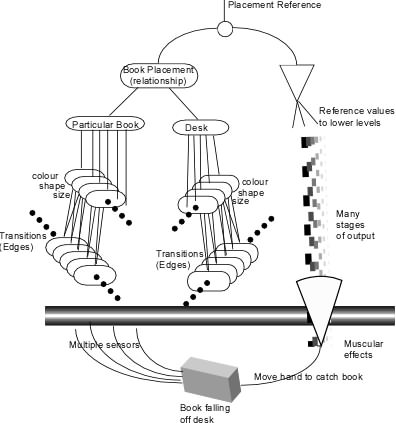
No virus found in this message.
Checked by AVG - www.avg.com
Version: 2014.0.4570 / Virus Database: 3920/7400 - Release Date: 04/26/14