# Sheepdog and flock behavior
**URL:** http://discourse.iapct.org/t/sheepdog-and-flock-behavior/10422
**Category:** CSG2014
**Created:** [August 30, 2014, 12:19pm UTC](http://discourse.iapct.org/t/sheepdog-and-flock-behavior/10422 "2014-08-30T12:19:46Z")
**Posts on this page:** 20
**Page:** 2
### Author:  [@Bob\_Hintz](http://discourse.iapct.org/u/Bob_Hintz)
#### Post date: [September 9, 2014, 2:49am UTC](http://discourse.iapct.org/t/sheepdog-and-flock-behavior/10422/21 "2014-09-09T02:49:24Z")
How would you explain it if the customer merely nodded at the clerk and no money was exchanged and no hassle occurred? Might you suppose the customer was really the owner. Perhaps the customer is a partner of the clerk and they are stealing from the owner. The hidden assumptions in your example are that both participants know who they are and who the other is in terms of reference conditions and that they are both honest participants in the exchange process.
bob
> **···**
>
> On Mon, Sep 8, 2014 at 8:13 PM, Richard Marken [rsmarken@gmail.com](mailto:rsmarken@gmail.com) wrote:
>
> > [From Rick Marken (2014.09.08.1812)]
>
> > Martin Taylor (2014.09.07.20.56)
>
> > ```
> > MT: That is not a diagram of a protocol. It's a diagram of a mutual
> >
> > ```
> >
> > side-effect interaction,
> >
> > MT: Correct. The customer-cashier situation is an example of a protocol.
>
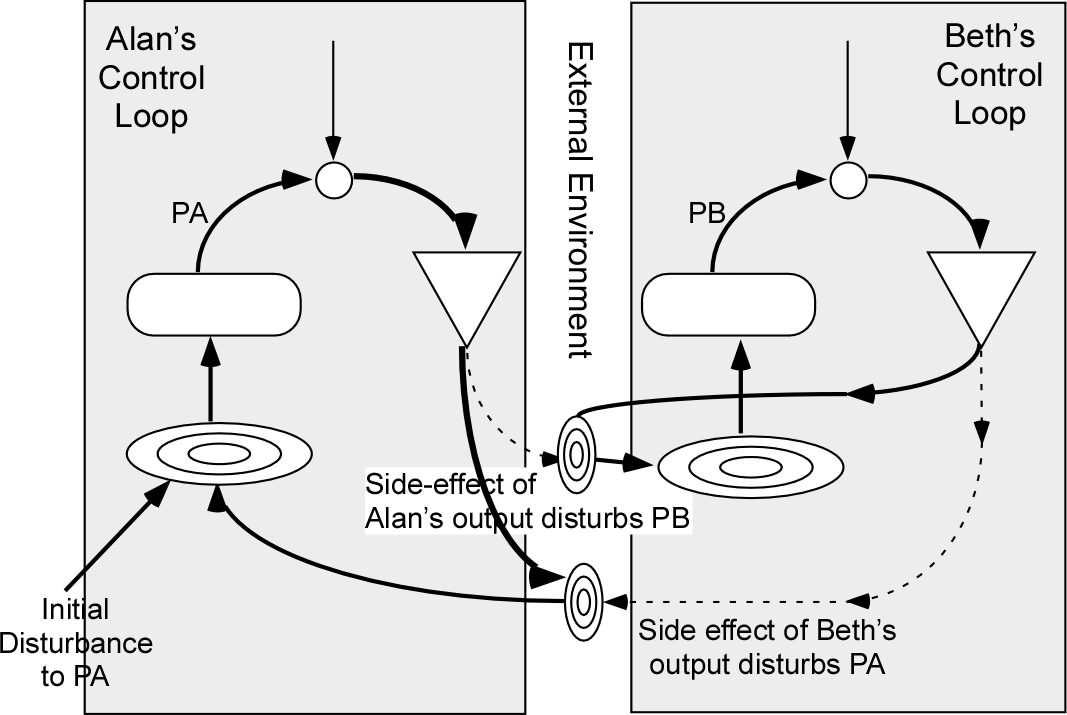
> RM: You are so right. My mistake. A quick glance led me to believe that the diagrams were essentially the same. But the diagram of the other interaction – the one between Ivan and Cora – is one that involves mutual control of each other’s behavior (via disturbance to controlled variables), which is, indeed, the situation with the customer-cashier. So a protocol does involve mutual control of behavior. Nice work. Sorry about the mistake.
>
> Best
>
> Rick
>
> –
> Richard S. Marken, Ph.D.
> Author of [Doing Research on Purpose](http://www.amazon.com/Doing-Research-Purpose-Experimental-Psychology/dp/0944337554/ref=sr_1_1?ie=UTF8&qid=1407342866&sr=8-1&keywords=doing+research+on+purpose).
> Now available from Amazon or Barnes & Noble
>
> ```
> RM: I looked at Martin's reply and what he describes as
>
> ```
>
> a “protocol” is not the same as the mutual controlling
> that occurs in the customer/cashier interaction.
---
### Author:  [@MartinT](http://discourse.iapct.org/u/MartinT)
#### Post date: [September 9, 2014, 4:10am UTC](http://discourse.iapct.org/t/sheepdog-and-flock-behavior/10422/22 "2014-09-09T04:10:20Z")
Martin Taylor 2014.09.07.25.53]
```
One of the mantras of PCT is "You can't see what someone is doing by
```
looking at what they are doing". In the words of a related mantra
“Many means to the same end, many ends by the same means”. Which is all to say that your interpretations of what might be
happening could be right, or they might be wrong. If one of your
suggestions is right, the same “hidden assumption” that both
participants know who they are applies. So it does if the customer
had already paid for a corresponding item that proved to be
defective and the clerk had said “go get another one”. But if the
clerk didn’t notice the customer, or didn’t notice that the customer
carried an item that should have been paid for, that “hidden
assumption” isn’t necessary.
Protocols do depend on the partners perceiving each other in a
suitable context, just as your actions when controlling for a level
surface to a driveway depends on whether you perceive the offending
object on the driveway to be something you can lift safely, or to be
something that might explode on touch, or to be simply too heavy or
too embedded to move by hand. For all that PCT says that the output
of a control unit is blind, nevertheless we do look at the situation
when deciding how to act to control some perceptions. The same is
true of the use of protocols.
Whatever the clerk and the customer might be controlling, would you,
observing this little scene knowing nothing of the clerk or the
customer, call the store security?
Martin

> **···**
>
> > ```
> > How would you explain it if the customer merely
> >
> > ```
> >
> > nodded at the clerk and no money was exchanged and no hassle
> > occurred? Might you suppose the customer was really the owner.
> > Perhaps the customer is a partner of the clerk and they are
> > stealing from the owner. The hidden assumptions in your example
> > are that both participants know who they are and who the other
> > is in terms of reference conditions and that they are both
> > honest participants in the exchange process.
>
> > bob
>
> > ```
> > On Mon, Sep 8, 2014 at 8:13 PM, Richard
> >
> > ```
> >
> > Marken [rsmarken@gmail.com](mailto:rsmarken@gmail.com)
> > wrote:
> >
> > > [From Rick Marken (2014.09.08.1812)]
> > >
> > > > ```
> > > > Martin Taylor
> > > >
> > > > ```
> > > >
> > > > (2014.09.07.20.56)
> > > >
> > > > > ```
> > > > > RM: I looked at Martin's reply
> > > > >
> > > > > ```
> > > > >
> > > > > and what he describes as a
> > > > > “protocol” is not the same as the
> > > > > mutual controlling that occurs in
> > > > > the customer/cashier interaction.
>
> > > > >
>
> > > > >
>
> > > > >
>
> > > > ```
> > > > MT: That is not a diagram of a protocol. It's a
> > > >
> > > > ```
> > > >
> > > > diagram of a mutual side-effect interaction,
> > > >
> > > > ```
> > > > MT: Correct. The customer-cashier situation
> > > >
> > > > ```
> > > >
> > > > is an example of a protocol.
>
> > >
>
> > > ```
> > > RM: You are so right. My mistake. A quick glance
> > >
> > > ```
> > >
> > > led me to believe that the diagrams were essentially
> > > the same. But the diagram of the other interaction
> > > – the one between Ivan and Cora – is one that
> > > involves mutual control of each other’s behavior
> > > (via disturbance to controlled variables), which is,
> > > indeed, the situation with the customer-cashier. So
> > > a protocol does involve mutual control of behavior.
> > > Nice work. Sorry about the mistake.
>
> > >
>
> > > Best
>
> > >
>
> > > Rick
>
> > > –
> > > Richard S. Marken, Ph.D.
> > >
> > > ```
> > > Author of [Doing Research on Purpose](http://www.amazon.com/Doing-Research-Purpose-Experimental-Psychology/dp/0944337554/ref=sr_1_1?ie=UTF8&qid=1407342866&sr=8-1&keywords=doing+research+on+purpose).
> > >
> > > ```
> > >
> > > Now available from Amazon or Barnes & Noble
>
> >
---
### Author:  [@Bob\_Hintz](http://discourse.iapct.org/u/Bob_Hintz)
#### Post date: [September 9, 2014, 4:41pm UTC](http://discourse.iapct.org/t/sheepdog-and-flock-behavior/10422/23 "2014-09-09T16:41:55Z")
I would certainly like to read your protocols paper. I assume that both participants must know the procedure to accomplish a reference condition, such as the legitimate transfer of property. That each must meet the conditions necessary to perform their part in the procedure, ie., I claim to be a legitimate buyer and you claim to be a legitimate seller. If I, as an observer, also know the protocols as a member of the same society/culture, would I not be able to recognize how each was contributing to the accomplishment of that protocol, or how each dealt with an error in the production of that protocol (Rick’s example of the wrong change)? If I am presenting as a customer, but you have just closed you register and tell me that I must go to a different line because you are no longer able to fulfill your part of the protocol, are you controlling my behavior when I start looking for next shortest line to purchase this item. Would I be controlling your behavior if you were able and willing to participate in producing your part of the protocol? If you ring up a different price for the item than I thought it would be, I can stop the protocol. Each of us can stop the protocol at any point because it requires both of us in order to happen and no legitimate transfer occurs.
I am concerned with how two or more independent control systems join together to control variables that neither could control alone. I assume a protocol would not specify whether I used my right hand or my left hand to give you money, or whether I used cash or a credit card, but only that I presented something of value which you recognized as sufficient to give me a receipt which was proof of purchase. Most of the world that modern humans inhabit was created by collective control systems. In one sense the person that I am is also a collective control system of control units of various complexity.
bob

> **···**
>
> On Mon, Sep 8, 2014 at 11:10 PM, Martin Taylor [mmt-csg@mmtaylor.net](mailto:mmt-csg@mmtaylor.net) wrote:
>
> > Martin Taylor 2014.09.07.25.53]
>
> > > ```
> > > How would you explain it if the customer merely
> > >
> > > ```
> > >
> > > nodded at the clerk and no money was exchanged and no hassle
> > > occurred? Might you suppose the customer was really the owner.
> > > Perhaps the customer is a partner of the clerk and they are
> > > stealing from the owner. The hidden assumptions in your example
> > > are that both participants know who they are and who the other
> > > is in terms of reference conditions and that they are both
> > > honest participants in the exchange process.
>
> > > bob
>
> > ```
> > One of the mantras of PCT is "You can't see what someone is doing by
> >
> > ```
> >
> > looking at what they are doing". In the words of a related mantra
> > “Many means to the same end, many ends by the same means”.
> >
> > ```
> > Which is all to say that your interpretations of what might be
> >
> > ```
> >
> > happening could be right, or they might be wrong. If one of your
> > suggestions is right, the same “hidden assumption” that both
> > participants know who they are applies. So it does if the customer
> > had already paid for a corresponding item that proved to be
> > defective and the clerk had said “go get another one”. But if the
> > clerk didn’t notice the customer, or didn’t notice that the customer
> > carried an item that should have been paid for, that “hidden
> > assumption” isn’t necessary.
> >
> > ```
> > Protocols do depend on the partners perceiving each other in a
> >
> > ```
> >
> > suitable context, just as your actions when controlling for a level
> > surface to a driveway depends on whether you perceive the offending
> > object on the driveway to be something you can lift safely, or to be
> > something that might explode on touch, or to be simply too heavy or
> > too embedded to move by hand. For all that PCT says that the output
> > of a control unit is blind, nevertheless we do look at the situation
> > when deciding how to act to control some perceptions. The same is
> > true of the use of protocols.
> >
> > ```
> > Whatever the clerk and the customer might be controlling, would you,
> >
> > ```
> >
> > observing this little scene knowing nothing of the clerk or the
> > customer, call the store security?
> >
> > ```
> > Martin
> >
> > ```
>
> ```
> On Mon, Sep 8, 2014 at 8:13 PM, Richard
>
> ```
>
> Marken [rsmarken@gmail.com](mailto:rsmarken@gmail.com)
> wrote:
>
> > [From Rick Marken (2014.09.08.1812)]
>
> > ```
> > Martin Taylor
> >
> > ```
> >
> > (2014.09.07.20.56)
>
> > ```
> > MT: That is not a diagram of a protocol. It's a
> >
> > ```
> >
> > diagram of a mutual side-effect interaction,
> >
> > ```
> > MT: Correct. The customer-cashier situation
> >
> > ```
> >
> > is an example of a protocol.
>
> ```
> RM: You are so right. My mistake. A quick glance
>
> ```
>
> led me to believe that the diagrams were essentially
> the same. But the diagram of the other interaction
> – the one between Ivan and Cora – is one that
> involves mutual control of each other’s behavior
> (via disturbance to controlled variables), which is,
> indeed, the situation with the customer-cashier. So
> a protocol does involve mutual control of behavior.
> Nice work. Sorry about the mistake.
>
> Best
>
> Rick
>
> –
> Richard S. Marken, Ph.D.
>
> ```
> Author of [Doing Research on Purpose](http://www.amazon.com/Doing-Research-Purpose-Experimental-Psychology/dp/0944337554/ref=sr_1_1?ie=UTF8&qid=1407342866&sr=8-1&keywords=doing+research+on+purpose).
>
> ```
>
> Now available from Amazon or Barnes & Noble
>
> ```
> RM: I looked at Martin's reply
>
> ```
>
> and what he describes as a
> “protocol” is not the same as the
> mutual controlling that occurs in
> the customer/cashier interaction.
---
### Author:  [@rsmarken](http://discourse.iapct.org/u/rsmarken)
#### Post date: [September 9, 2014, 5:50pm UTC](http://discourse.iapct.org/t/sheepdog-and-flock-behavior/10422/24 "2014-09-09T17:50:52Z")
[From Rick Marken (2014.09.09.1050)]
> **···**
>
> On Sun, Sep 7, 2014 at 9:35 PM, Boris Hartman [boris.hartman@masicom.net](mailto:boris.hartman@masicom.net) wrote:
>
> >
>
> > BH: But just for exercise you can maybe solve the problem why are you writing to CSGnet forum for many decades, persuading people to beleive you.
>
> RM: My intention is not to persuade people to believe me so much as to teach people about PCT.Â
>
> Â
>
> > BH: And yet I see no result. How that can be if people are so easy to control just by applyin distrubances to »controlled variable« in outer environment.
>
> RM: I never said that people are _easy_ to control. I said they can be and often are controlled. Â
>
> Â
>
> >
>
> > BH: By your imagined »picture« of »interperosnal control«, you should be applying disturbances to »controlled variables« of people on CSGnet (their oppinion) and you already control them. It seems to fit your definition. Â
>
> RM: My “picture” of interpersonal control is observed, not imagined. Interpersonal control happens, usually voluntarily because we live in a society with rules for interpersonal conduct that most people accept. So I am controlling for people paying their rent and they are controlling for me providing them with acceptable living space. I don’t control for things that I can’t (or shouldn’t) control for because I know what I can control, what I can’t (or shouldn’t) control and I have the wisdom (thanks to PCT) to know the difference.
>
> Â
>
> >  BH: I really don’t understand how can we with applying distrubances to »controlled variables« in external environment have others »under control as that seems to be your defintion of »interpersonal control« :
>
> RM: Perhaps you are just controlling for not understanding it. But if you want to give it another try see p. 245 of B:CP, 2nd edition.
>
> Â
>
> > RM :
>
> > Control theory doesn’t say that organisms (particularly humans) can’t be controlled; indeed, it shows that they can be controlled, mainly by disturbance to a controlled variable.
>
> > Â
>
> > HB :
>
> > Did I missed something. I indeed never saw somebody who  persuaded somebody (by applying disturbances to controlled variable) to say that somebody  started to control somebody in the sense to change somebody’s oppinion  " mainly by disturbance to a controlled variable«.
>
> RM: I think you see fairly successful attempts at this kind of control in advertising and politics. Â In these cases, the disturbances are applied through deception, which is another excellent way to control people. Children apparently learn this kind of control very early in the game: by the age of three my daughter was able to successful appropriate a swing from her older brother by saying that Mom was calling him. Â
>
> Â
>
> >
>
> >  BH: I saw you using many kinds of »strategies of interpersonal control« like insulting, humbling people, attempts of moving them away, but also crticizing,praizing …,
>
> RM: You should point it out when I or anyone insults people. Insults should not be part of the discussion on CSGNet, and that includes insulting people by making baseless claims that they insult people. So if this is not a baseless claim that I insult people, show me where I have insulted someone and I will certainly apologize for it. If, however, your claim that I have insulted people is baseless then it is an insult and I will expect an apology from you.Â
>
> Â
>
> > BH: but I never saw you succeded in perfect control as you describe it (within 1%)…I doubt that ever anybody succed iin any kind of »interperosnal control« within 1% in everyday life.
>
> RM: I am not trying to control people when I post on CSGNet. The 1% accuracy comment was based on the fact that a subject’s response (mouse) variations in a tracking task are typically within 1% of being an exact mirror image of disturbance variations. If a human rather than the computer were the source of the disturbance variations and the human’s goal was to control the subject’s response variations then the human could control the subject’s responses to within 1% of the desired response variations.Â
>
> Best regards
>
> Rick
>
> Â
>
> >  So  show me how can you with applying disturbances to others oppinion (controlled variable) on CSGnet immediately overtake their control of their oppinion to change their oppinion into yours ? As that seems to be your defintion of »control of others«. Did i get it right ?
>
> > Â
>
> > I’m also looking forward to see somebody who will  let us know that your »efforts« on CSGnet were succesfull in the ssense that you managed to control somebody »within 1% of the desired value«. I’d really like to see that. I hope you’ll surprise me.
>
> > Â
>
> > Best,
>
> > Â
>
> > Boris
>
> > Â
>
> > P.S. I’ll continue discussion with Kent, so you can join us there if you wish…J
>
> > Â
>
> >
>
> > Â
>
> > **From:** csgnet-request@lists.illinois.edu [[mailto:csgnet-request@lists.illinois.edu](mailto:csgnet-request@lists.illinois.edu)] **On Behalf Of** Richard Marken
> > **Sent:** Sunday, September 07, 2014 7:54 PM
>
> > **To:** csgnet@lists.illinois.edu
> > **Subject:** Re: Sheepdog and flock behavior
>
> > Â
>
> > [From Rick Marken (2014.09.07.1100)]
>
> > Â
>
> > [boris.hartman@masicom.net](mailto:boris.hartman@masicom.net) wrote:
>
> > Â
>
> > BH : I don’t think that dogs were controlling gaps by »controlling sheeps behavior«. Sheeps were controlling their behavior on the bases of disturbances dog produced to sheep perceptual control.
>
> > Â
>
> > RM: Yes, the sheep were controlling a perception (I called it safety) to which the approach of the dog was a disturbance. The sheep compensated for this disturbance by moving closer to other sheep. This is the behavior that the dog wanted to see (were controlling for) because it closed the gaps that were a disturbance to the perception the dog was controlling. So the dog was able to control the behavior of the sheep, getting them to bunch closer together, because the sheep were controlling for safety by bunching together.Â
>
> > Â
>
> > > RM : So any model of this behavior would have to model the dogs’ “gap” control system and the sheep’s safety control system. Such a simulation would show that control systems can both control and  _be_ controlled.
>
> > > Â
>
> > > BH : Well this is a good idea to make simultaneous simulation. Did you try it ?
>
> > Â
>
> > RM: Not yet. Â
>
> > > Â
>
> > > BH: But this is the n-th time that we are trying to solve the problem how LCS can be “controlled”. In the book : Making sense of behavior Bill talks about “attempts of control” not “control”…Â
>
> > > Â
>
> > > BH: Maybe Kent could explain what’s wrong with your position about »LCS can be controlled".Â
>
> > Â
>
> > RM: Yes, I think that’s a good idea, though I would be surprised if Kent thought that there is something wrong with my “position”. My position is simply that people can clearly control the behavior other people and their own behavior can be controlled as well. This is an observable fact that is explained by PCT. I leave the explanation as an exercise.
>
> > Â
>
> > > RM : It can also be easily demonstrated with humans using the rubber band demo; the E in this experiment can control the finger position of the S once S has agreed to control the position of the knot.
>
> > > Â
>
> > > BH : Yes. Watch your wording in rubber band demo. “ **Once S has agreed** ” or as Kent said **“S chooses”**. . So it’s obviously that S agreed to be controlled.
>
> > Â
>
> > RM: Not quite. S has agreed to control a particular perception (the location of the knot relative to the dot, in this case). Â S has not agreed to _be controlled_; indeed, S is typically unaware of being controlled after agreeing to control that perception.Â
>
> > Â
>
> > > HB : Aplying distrubance to a »controlled variable« does not mean that control is established. It seems that Kent and I agree that disturbances are aplyed to perceptual control and target person chooses.Â
>
> > Â
>
> > RM: I would be interested to hear what Kent has to say about that. I would be very surprised if he agreed with your analysis.Â
>
> > Â
>
> > > RM : Nor does control theory show that controlling organisms (particularly humans) is necessarily a bad thing to do.
>
> > > Â
>
> > > BHÂ : Now you are exaggerating Rick. You can’t control organisms. I’d really like to see how you are doing that in everyday life ?
>
> > Â
>
> > RM: One example: When I give a cashier $10 for a $5 item I am controlling for the cashier giving me $5 change. The cashier is also controlling for me paying $5 for the item. Typically, we both get the behaviors from each other than we want: a nice example of mutual control, and no one gets hurt (or oppressed). This kind of agreed on mutual control is the basis of civilization.
>
> > Â
>
> > > Â RM : What control theory does show is that _arbitrary_ control, particularly of humans by other humans, will almost certainly lead to _conflict_. Arbitrary control is exerting control without considering the fact that living control systems are controlling many variables at the same time and when you arbitrarily decide to have a person do something (by disturbing a controlling variable) what you have them do may conflict with other things they are controlling.
>
> > > Â
>
> > > HB : It makes some sense, but I don’t understand what you meant by »arbitrary control« ?
>
> > Â
>
> > RM: It means controlling without taking a persons wants and needs (the references for the many different perceptions that the person is controlling for) into account. In non-PCT terms, it is controlling another person without respecting that person’s humanity (and autonomy).
>
> > Â
>
> > > BH: If you are thinking like this one : »Controlle behavior match my wanted perception of behvior and thus it is »controlled« it’s wrong.
>
> > Â
>
> > RM: That’s exactly how I am thinking. And I think you are wrong about this being wrong.
>
> > Â
>
> > > BH: You have PCT which helps you understand what’s happening inside organisms. Human control and behavior are quite unpredictable, because the references are formed inside organism, where most of control is done.
>
> > Â
>
> > RM: Once you have correctly identified a controlled variable behavior (the actions that protect that variable from disturbance) can be predicted with very high accuracy. See the “Basic Control demo” at [http://www.mindreadings.com/ControlDemo/BasicTrack.html](http://www.mindreadings.com/ControlDemo/BasicTrack.html) to see what I mean.Â
>
> > Â
>
> > > BH: Just observable »facts« of behavioral event are not prove that people control each other. Although it’s not excluded. The controller’s behavior is just a disturbance to controlee perceptual control. From what happens in controlee comparator (error) will probably decide whether controlee behavior will resemble to something controller wanted or not. But never behavior of controlee will be just exact »copy« of controller’s wanted behavior, because controlee is in control.
>
> > Â
>
> > Â RM: It may not be an “exact” copy of what the controller wants, but it can be very close (like within 1% of the desired value).Â
>
> > > Â
>
> > > Â
>
> > > RM: Anyway, this behavior – managing flocks – is a very interesting demonstration of controlling a perception (of gaps between sheep) via disturbance of a perception being controlled by the control systems that are being controlled.Â
>
> > > Â
>
> > > BH: This one makes some PCT sense. J
>
> > Â
>
> > RM: Well, that’s progress!
>
> > Â
>
> > Best
>
> > Â
>
> > Rick
>
> > Â
>
> > > Â
>
> > > But as usual I’m living space for not understanding something right. And as always, sorry for my language.
>
> > > Â
>
> > > Best,
>
> > > Â
>
> > > Boris
>
> > > Â
>
> > > Â
>
> > > **From:** csgnet-request@lists.illinois.edu [[mailto:csgnet-request@lists.illinois.edu](mailto:csgnet-request@lists.illinois.edu)] **On Behalf Of** Richard Marken
> > > **Sent:** Sunday, August 31, 2014 3:23 AM
> > > **To:** csgnet@lists.illinois.edu
> > > **Subject:** Re: Sheepdog and flock behavior
>
> > > Â
>
> > > [From Rick Marken (2014.08.30.1820)]
>
> > > Â
>
> > > > [From Bruce Abbott (2014.08.30.0820 EDT)]
>
> > > > Â
>
> > > > Researchers have investigated how sheepdogs manage their flocks by fitting both the dogs and the sheep with highly accurate GPS devices, allowing the researchers to track their movements. The research is presented in a BBC article at [http://www.bbc.com/news/science-environment-28936251](http://www.bbc.com/news/science-environment-28936251) .
>
> > > Â
>
> > > RM: Great find, Bruce!  There are two things that make this report particularly interesting to me. The first is the quote by Andrew King, which is a great description of the PCT approach to research. To paraphrase King: in order to understand the behavior of organisms you have to try to look at their behavior from the point of view of the organism (behaving system) Itself. I make this same point in the chapter on  “Looking at Behavior through Control Theory Glasses” in “Doing Research on Purpose” (why hasn’t that become a best seller yet?). I do it in the section on trying to understand the apparent “fixed action pattern” of the greylag goose. The goose is seen to continue to make the movements that would pull an egg back into its nest even when the egg is no longer present. Looking at an organism’s behavior from the organism’s perspective helps you come up with good ideas about what perceptual variables the organism is controlling (the first step in the Test for the Controlled Variable). By looking at the goose’s egg rolling behavior from the goose’s perspective I was able to come up with the hypothesis that the goose is trying to control the pressure of the egg against the back of its bill and when the egg is removed the continued efforts to move the non-existent egg into the nest (the apparent fixed action pattern) is just the efforts of the pressure control system to restore the pressure of the egg against the back of the bill. By looking at the sheepdogs herding behavior from the dogs’ perspective King came up with the reasonable hypothesis that the dogs were controlling their perception of the gaps between patches of white (the sheep), trying to keep those gaps at zero.Â
>
> > > Â
>
> > > RM: The other thing that’s interesting about this report is that the dogs were clearly controlling their perception of the gaps by controlling the behavior of the sheep. And they did this by becoming a disturbance to a perception that the sheep control by getting closer to other sheep: the perception of safety. So any model of this behavior would have to model the dogs’ “gap” control system and the sheep’s safety control system. Such a simulation would show that control systems can both control and  _be_ controlled. This kind of simulation would help dispel what I think is a common misconception about the control theory model of organisms – particularly humans. It is a misconception that I myself labored under until just a few years ago. It is the idea that because organisms are autonomous control systems – autonomous in the sense that they set their own references for the states of their own perception – they cannot be controlled. But autonomous control systems _can_ be controlled, as is demonstrated by the sheepdogs controlling the sheep. It can also be easily demonstrated with humans using the rubber band demo; the E in this experiment can control the finger position of the S once S has agreed to control the position of the knot. And thanks to Bruce Abbott I demonstrated to myself that E can still exert this control even if S continuously – and autonomously – varies his or her reference for the position of the knot.Â
>
> > > Â
>
> > > RM: Control theory doesn’t say that organisms (particularly humans) can’t be controlled; indeed, it shows that they can be controlled, mainly by disturbance to a controlled variable. Nor does control theory show that controlling organisms (particularly humans) is necessarily a bad thing to do. What control theory does show is that _arbitrary_ control, particularly of humans by other humans, will almost certainly lead to _conflict_. Arbitrary control is exerting control without considering the fact that living control systems are controlling many variables at the same time and when you arbitrarily decide to have a person do something (by disturbing a controlling variable) what you have them do may conflict with other things they are controlling. So to take an example that Bill used (somewhere), if E decides to place S’s finger against a hot soldering iron while controlling Ss finger position in the rubber band game that will clearly lconflict with another goal S has (not getting burned). Non-arbitrary control is control that is done with the consent (often implicit but sometimes explicit) of the would-be controllee. Non- arbitrary control is, I think, essential when humans control other humans. To see why, think about what happens when people are arbitrarily controlled (herded) in the same way that the sheep were. Hint: They don’t like it. Why do you think not?Â
>
> > > Â
>
> > > Â RM: Anyway, this behavior – managing flocks – is a very interesting demonstration of controlling a perception (of gaps between sheep) via disturbance of a perception being controlled by the control systems that are being controlled.Â
>
> > > Â
>
> > > BestÂ
>
> > > Â
>
> > > Rick
>
> > > Â
>
> > > Â
>
> > > > Â
>
> > > > The researchers found that the behavior could be described by two simple rules, but more interesting from a PCT perspective, they found that to understand the behavior they needed to view the action from the animal’s perspectives. According to researcher Dr. Andrew King:
>
> > > > “At the beginning we had lots of different ideas. We started out looking from a birds eye view, but then we realised we needed to see what the dog sees. It sees white, fluffy things. If there are gaps between them or the gaps get bigger, the dogs needs to bring them together.”
>
> > > > Â
>
> > > > According to Dr King, sheepdogs are making the most of the “selfish herd theory” to bring the animals close together and move them where they want.
>
> > > > “One of the things that sheep are really good at is responding to a threat by working with their neighbours. It’s the selfish herd theory: put something between the threat and you. Individuals try to minimise the chance of anything happening to them, so they move towards the centre of a group.”
>
> > > > The article continues as follows:
>
> > > > A colleague, Dr Daniel Strombom from Uppsala University in Sweden, used the GPS data from the collars to develop computer simulations. This enabled them to develop a mathematical shepherding model.
>
> > > > The algorithm displays the same weaving pattern exhibited by sheepdogs. It helps to solve what has been called the ‘the shepherding problem’: how one agent can control a large number of unwilling agents.
>
> > > > Â
>
> > > > I’d be interested to know whether the computer algorithm models each individual’s control systems or operates by some other method.
>
> > > > Â
>
> > > > Bruce
>
> > >
>
> > > Â
>
> > > –
>
> > > Richard S. Marken, Ph.D.
> > > Author of  [Doing Research on Purpose](http://www.amazon.com/Doing-Research-Purpose-Experimental-Psychology/dp/0944337554/ref=sr_1_1?ie=UTF8&qid=1407342866&sr=8-1&keywords=doing+research+on+purpose).Â
>
> > > Now available from Amazon or Barnes & Noble
>
> >
>
> > Â
>
> > –
>
> > Richard S. Marken, Ph.D.
> > Author of  [Doing Research on Purpose](http://www.amazon.com/Doing-Research-Purpose-Experimental-Psychology/dp/0944337554/ref=sr_1_1?ie=UTF8&qid=1407342866&sr=8-1&keywords=doing+research+on+purpose).Â
>
> > Now available from Amazon or Barnes & Noble
---
### Author:  [@rsmarken](http://discourse.iapct.org/u/rsmarken)
#### Post date: [September 9, 2014, 6:50pm UTC](http://discourse.iapct.org/t/sheepdog-and-flock-behavior/10422/25 "2014-09-09T18:50:56Z")
[From Rick Marken (2014.09.09.1150)]

> **···**
>
> On Mon, Sep 8, 2014 at 7:49 PM, Bob Hintz [bob.hintz@gmail.com](mailto:bob.hintz@gmail.com) wrote:
>
> > BH: How would you explain it if the customer merely nodded at the clerk and no money was exchanged and no hassle occurred? Might you suppose the customer was really the owner. Perhaps the customer is a partner of the clerk and they are stealing from the owner. The hidden assumptions in your example are that both participants know who they are and who the other is in terms of reference conditions and that they are both honest participants in the exchange process.
>
> RM: Hi Bob.
>
> RM: My example of the customer/cashier interaction was to demonstrate how you can show that interpersonal control is going on _in fact_, not just in theory. PCT does provide an explanation of the interpersonal controlling that goes on between the customer and cashier. But the first thing to do before trying to explain some behavior, I think, is to determine whether control is going on and, if so, what variable(s) the system(s) might be controlling.
>
> RM: In the situation you describe, I don’t have enough data to know what is to be explained. Assuming that the customer is walking past the cashier with a $5 item in hand then its pretty clear that in this case the customer is not controlling for paying for the item and the cashier is not controlling for getting paid. The nod by the customer suggests that there might be some kind of collusion between customer and cashier – so maybe they are both controlling for stealing the item. But that’s just wild speculation; there are many stories that could fit this one little scenario.
>
> RM: My goal in this discussion of interpersonal control was to show that it – interpersonal control – _happens_; it’s an observable fact. The fact that the cashier is controlling for getting the correct payment from the customer is shown by the cashier’s corrective response to the disturbance of the customer paying less than full price; the fact that the customer is controlling for getting the cashier to give the correct change is shown by the customer’s corrective response to the disturbance of the cashier returning less than the correct change. Once we’ve established that control is going on then we can seek an explanation of this controlling. PCT provides that explanation.
>
> RM: Remember, LCS III is subtitled “The Fact of Control”. Powers was a great theorist but perhaps what I loved most about him as a scientist was that, for him, it was always _phenomena first_. Theories exist to explain facts – phenomena. PCT was developed to explain the fact of control (also known as purposive behavior) as it is observed in natural systems (living organisms). Without this anchoring in observation I see a tendency to deal with behavior almost entirely in terms theory, which usually just means making up stories using the terminology of the theory to support an existing prejudice about how behavior works.
>
> RM: In my (rather rambling, I’m afraid) talk at the dedication of the Powers archives at Northwestern (still available at [https://mediasite.nuit.northwestern.edu/Mediasite/Play/a643fa27cf394f0d8c7eaea435b84f681d](https://mediasite.nuit.northwestern.edu/Mediasite/Play/a643fa27cf394f0d8c7eaea435b84f681d) ) I referred to this as the “theoretical” approach to PCT and I was setting it off against what I called the “scientific” approach. I argued for the scientific approach being the one taken by Bill Powers and the one where I think the future of PCT lies. It’s an approach based on testing theory against observation; it’s theoretical speculation disciplined by observational test. I don’t think this test always has to go on in a laboratory; naturalistic observation, like that done by the Plooij’s, is great too. But observation there must be, I believe, so that PCT becomes a true science rather than just another ideology.
>
> Best regards
>
> Rick
>
> –
> Richard S. Marken, Ph.D.
> Author of [Doing Research on Purpose](http://www.amazon.com/Doing-Research-Purpose-Experimental-Psychology/dp/0944337554/ref=sr_1_1?ie=UTF8&qid=1407342866&sr=8-1&keywords=doing+research+on+purpose).
> Now available from Amazon or Barnes & Noble
---
### Author:  [@MartinT](http://discourse.iapct.org/u/MartinT)
#### Post date: [September 9, 2014, 7:40pm UTC](http://discourse.iapct.org/t/sheepdog-and-flock-behavior/10422/26 "2014-09-09T19:40:57Z")
[Martin Taylor 2014.09.09.15.04]
> I would certainly like to read your protocols paper.
Thanks. When it is finished it will be a chapter in the book known as LCS IV that Warren Mansell is editing.
> I assume that both participants must know the procedure to accomplish a reference condition, such as the legitimate transfer of property.
Let's back off, and start with the proposition that each person controls ONLY his or her own perception of something. Only an external analyst can see both at once, and only an external theorist can see inside either one. As far as each partner in a protocol loop is concerned, the actions that influence their own perception are those that are the consequences of reorganization, meaning that the lower-level perceptions control variables that contribute to the primary one of interest at the moment. If reorganization has led to some supporting control loop controlling a perception of something about another person, that doesn't make it any different from reorganization that has led to actions that don't involve controlling any perceptions of anyone else. The other person is just a part of the environment that acts in a certain way, just as reorganization can lead you to actions that use an inanimate tool.
> That each must meet the conditions necessary to perform their part in the procedure, ie., I claim to be a legitimate buyer and you claim to be a legitimate seller.
Again, think of an analogous case of control that does not involve another person. I want to patch a blue-painted wall from which some paint has flaked off. The paint I pick for the patch is not red or green. It is blue. When I want to buy something, I must perceive something in the environment that offers the possibility of allowing me to do it, whether that be a vending machine or another person. I do not pick a traffic cop or a teacher in the classroom. But the other person, being a living control system is also controlling some perceptions, possibly of me. If that person is controlling for perceiving a transaction of money going to her and a particular item leaving her (i.e. wants to sell the item), she can do that if she can perceive me to be a suitable tool for the purpose. And that's where the arbitrary nature of language taken in the broadest sense comes from. If she and I both know that when someone puts a pink sticker on their left wrist they want to buy something and if they put a blue sticker on their forehead they want to sell something, we put on the appropriate stickers and proceed to find out using other supporting protocols whether I want to buy what she wants to sell.
> If I, as an observer, also know the protocols as a member of the same society/culture, would I not be able to recognize how each was contributing to the accomplishment of that protocol, or how each dealt with an error in the production of that protocol (Rick's example of the wrong change)?
Probably. But not assuredly.
> If I am presenting as a customer, but you have just closed you register and tell me that I must go to a different line because you are no longer able to fulfill your part of the protocol, are you controlling my behavior when I start looking for next shortest line to purchase this item.
You are not controlling my behaviour. Are you controlling a perception of my behaviour? Hard to say without doing the Test for the Controlled Variable, and it isn't easy to see how an external experimenter could arrange that. I haven't thought about doing the TCV for a protocol loop in which there are two controlled perceptions. I should think about it, though, before completing the chapter. However, I should expect in the example you mention that my actions are from my controlling perceptions that were disturbed as a side-effect rather than as a main effect of your closing the register. You probably didn't close it because you saw ME coming.
> Would I be controlling your behavior if you were able and willing to participate in producing your part of the protocol? If you ring up a different price for the item than I thought it would be, I can stop the protocol. Each of us can stop the protocol at any point because it requires both of us in order to happen and no legitimate transfer occurs.
I don't like this idea of controlling someone else's behaviour. You control your own perceptions. If you can correctly guess a perception someone else is controlling and what actions they would use if you disturbed that perception in a particular way, then you can control your perception of their actions. I don't see that as controlling the person. You can alter the ability of someone to control their perceptions by, for example, reducing their access to money, or by tying them to a chair. But I don't think that is controlling them.
The point of a protocol is that the partners act so as to display to each other something that allows each to be able to disturb the other's controlled perception in a way that produces the actions that reduce error in each partner. In an honest use of the protocol, if I say "I want to buy" or I put a pink patch on my left wrist, I am allowing the potential seller to know that if they offer the desired item, I will give the desired money. The same is true on the other side. The seller has honestly displayed something that allows me to perceive how to act in a way that disturbs a perception for which the corrective action is to give me the item when I give the money.
> I am concerned with how two or more independent control systems join together to control variables that neither could control alone. I assume a protocol would not specify whether I used my right hand or my left hand to give you money,
It might. Suppose some religion considered the left hand dirty or evil. Maybe someone of that religion would not accept money proffered by the left hand. Protocols can be quite strange, and the symbols quite arbitrary.
> or whether I used cash or a credit card,
Have you never seen a little shop that has a sign "no credit cards, cash only"? The supporting protocols can be anything acceptable to both.
> but only that I presented something of value which you recognized as sufficient to give me a receipt which was proof of purchase.
If that's the protocol, then yes.
> Most of the world that modern humans inhabit was created by collective control systems.
I prefer the term "collections of control systems" that have reorganized so that they work reasonably well together. The reorganization certainly hasn't done away with conflict, but most of the time you don't personally experience too much of it, even if you are in a war.
> In one sense the person that I am is also a collective control system of control units of various complexity.
Yes.
Martin
> **···**
>
> On 2014/09/9 12:41 PM, Bob Hintz wrote:
---
### Author:  [@rsmarken](http://discourse.iapct.org/u/rsmarken)
#### Post date: [September 9, 2014, 10:44pm UTC](http://discourse.iapct.org/t/sheepdog-and-flock-behavior/10422/27 "2014-09-09T22:44:11Z")
[From Rick Marken (2014.09.09.1545)]
> **···**
>
> > Martin Taylor (2014.09.09.15.04)–
> >
> > MT: I don’t like this idea of controlling someone else’s behaviour. You control your own perceptions.
>
> RM: Does this apply to all control or just the control of someone else’s behavior? For example, when I control the behavior of a cursor on a computer screen, making it stay aligned with a target, am I just controlling my perception of that cursor’s behavior or am I also controlling the cursor’s behavior? And if, in this case, I am controlling the cursor’s behavior as well as my perception of the cursor’s behavior, why is this not also the case when I control the behavior of someone’s finger in the rubber band game, making the person’s fingertip stay aligned with a target in the same way as I made the cursor stay lined with a target?
>
> Best
>
> Rick
>
> –
> Richard S. Marken, Ph.D.
> Author of [Doing Research on Purpose](http://www.amazon.com/Doing-Research-Purpose-Experimental-Psychology/dp/0944337554/ref=sr_1_1?ie=UTF8&qid=1407342866&sr=8-1&keywords=doing+research+on+purpose).
> Now available from Amazon or Barnes & Noble
---
### Author:  [@Bob\_Hintz](http://discourse.iapct.org/u/Bob_Hintz)
#### Post date: [September 10, 2014, 1:53am UTC](http://discourse.iapct.org/t/sheepdog-and-flock-behavior/10422/28 "2014-09-10T01:53:46Z")
This is a very detailed response and I appreciate it.
1. “Only an external analyst can see both at once, and only an external theorist can see inside either one.” I suspect you meant that an external theorist cannot see inside either one, but surely I also have some awareness of my own behavior and what it looks and sounds like to others even though I cannot see all of my self while I am interacting with another. I can, of course, hear myself when you hear me even though it will not sound exactly the same to both of us. Each participant does has privileged information about their own internal state and has at least some model of what might be true of the other person. I also have some concept of the difference between a biological being and a mechanical being and maybe an electronic being.
2. When I put on the pink sticker, but my hands are empty, would that translate into “I may want to buy something.” Does this not reveal something to all participants in the store about my internal state, ie., my reference condition. If I am at a car dealership, it will mean something different than if I am at Walmart. If you have your blue sticker on and are just walking around, might that translate into “I am a representative of this place.” Does this reveal something about your internal state and what knowledge you possess and what services you can provide to assist me in achieving my reference condition. I could simply wander around until I found what I was looking for or I could ask someone if they could tell me how to find it. If I don’t know about pink stickers and blue stickers because someone simply put it on my arm when I entered the store, I might just ask the first person I meet in an aisle, they might says “sorry” and point to their pink sticker and say “sorry, don’t know” or they might be helpful and say “look for someone with a blue sticker”. What did that kind person do? If I use the information they provided, I will have a new reference condition to structure my search for someone to help me find the item I came to the store to buy. I might learn this by trial and error, if I paid attention and I noticed the stickers, but if the first person I asked had a blue sticker and gave me directions, I might just get my item and go to the check out lane and still not understand the significance of the stickers. Do I need errors in order to learn?
3. How do I learn about buying instead of simply taking something that I want? This is not something I can discover without interacting with other people. Does this require language as it is quite different from bartering or trading real goods.
4. If you ask me to keep the knot over the dot and then move around your end of the rubber band and I do it, you are you learning that I speak English, understood what you asked and was willing to accept your request as a temporary reference condition. If I don’t do it, you could simply ask me to tell you why? PCT does not seem to believe that language is real or that sharing information about references and/or perceptions is necessary or even possible. This seems to me to be a real weakness.
5. Is an family just a collection of people who happen to live together? Is a basketball team a collection of people who happen play a game with another collection of people? Is Toyota a collection of people who reorganized to produce cars? I suspect that human being can organize as complex control systems with functions like perception, comparison, and output/behavior/action.
bob
> **···**
>
> On Tue, Sep 9, 2014 at 2:40 PM, Martin Taylor [mmt-csg@mmtaylor.net](mailto:mmt-csg@mmtaylor.net) wrote:
>
> > > I would certainly like to read your protocols paper.
> > > I assume that both participants must know the procedure to accomplish a reference condition, such as the legitimate transfer of property.
> > > That each must meet the conditions necessary to perform their part in the procedure, ie., I claim to be a legitimate buyer and you claim to be a legitimate seller.
> > > If I, as an observer, also know the protocols as a member of the same society/culture, would I not be able to recognize how each was contributing to the accomplishment of that protocol, or how each dealt with an error in the production of that protocol (Rick’s example of the wrong change)?
> > > If I am presenting as a customer, but you have just closed you register and tell me that I must go to a different line because you are no longer able to fulfill your part of the protocol, are you controlling my behavior when I start looking for next shortest line to purchase this item.
> > > Would I be controlling your behavior if you were able and willing to participate in producing your part of the protocol? If you ring up a different price for the item than I thought it would be, I can stop the protocol. Each of us can stop the protocol at any point because it requires both of us in order to happen and no legitimate transfer occurs.
> > >
> > > I am concerned with how two or more independent control systems join together to control variables that neither could control alone. I assume a protocol would not specify whether I used my right hand or my left hand to give you money,
> > > or whether I used cash or a credit card,
> > > but only that I presented something of value which you recognized as sufficient to give me a receipt which was proof of purchase.
> > > Most of the world that modern humans inhabit was created by collective control systems.
> > > In one sense the person that I am is also a collective control system of control units of various complexity.
> >
> > [Martin Taylor 2014.09.09.15.04]
> >
> > On 2014/09/9 12:41 PM, Bob Hintz wrote:
> >
> > Thanks. When it is finished it will be a chapter in the book known as LCS IV that Warren Mansell is editing.
> >
> > Let’s back off, and start with the proposition that each person controls ONLY his or her own perception of something. Only an external analyst can see both at once, and only an external theorist can see inside either one. As far as each partner in a protocol loop is concerned, the actions that influence their own perception are those that are the consequences of reorganization, meaning that the lower-level perceptions control variables that contribute to the primary one of interest at the moment. If reorganization has led to some supporting control loop controlling a perception of something about another person, that doesn’t make it any different from reorganization that has led to actions that don’t involve controlling any perceptions of anyone else. The other person is just a part of the environment that acts in a certain way, just as reorganization can lead you to actions that use an inanimate tool.
> >
> > Again, think of an analogous case of control that does not involve another person. I want to patch a blue-painted wall from which some paint has flaked off. The paint I pick for the patch is not red or green. It is blue. When I want to buy something, I must perceive something in the environment that offers the possibility of allowing me to do it, whether that be a vending machine or another person. I do not pick a traffic cop or a teacher in the classroom. But the other person, being a living control system is also controlling some perceptions, possibly of me. If that person is controlling for perceiving a transaction of money going to her and a particular item leaving her (i.e. wants to sell the item), she can do that if she can perceive me to be a suitable tool for the purpose. And that’s where the arbitrary nature of language taken in the broadest sense comes from. If she and I both know that when someone puts a pink sticker on their left wrist they want to buy something and if they put a blue sticker on their forehead they want to sell something, we put on the appropriate stickers and proceed to find out using other supporting protocols whether I want to buy what she wants to sell.
> >
> > Probably. But not assuredly.
> >
> > You are not controlling my behaviour. Are you controlling a perception of my behaviour? Hard to say without doing the Test for the Controlled Variable, and it isn’t easy to see how an external experimenter could arrange that. I haven’t thought about doing the TCV for a protocol loop in which there are two controlled perceptions. I should think about it, though, before completing the chapter. However, I should expect in the example you mention that my actions are from my controlling perceptions that were disturbed as a side-effect rather than as a main effect of your closing the register. You probably didn’t close it because you saw ME coming.
> >
> > I don’t like this idea of controlling someone else’s behaviour. You control your own perceptions. If you can correctly guess a perception someone else is controlling and what actions they would use if you disturbed that perception in a particular way, then you can control your perception of their actions. I don’t see that as controlling the person. You can alter the ability of someone to control their perceptions by, for example, reducing their access to money, or by tying them to a chair. But I don’t think that is controlling them.
> >
> > The point of a protocol is that the partners act so as to display to each other something that allows each to be able to disturb the other’s controlled perception in a way that produces the actions that reduce error in each partner. In an honest use of the protocol, if I say “I want to buy” or I put a pink patch on my left wrist, I am allowing the potential seller to know that if they offer the desired item, I will give the desired money. The same is true on the other side. The seller has honestly displayed something that allows me to perceive how to act in a way that disturbs a perception for which the corrective action is to give me the item when I give the money.
> >
> > It might. Suppose some religion considered the left hand dirty or evil. Maybe someone of that religion would not accept money proffered by the left hand. Protocols can be quite strange, and the symbols quite arbitrary.
> >
> > Have you never seen a little shop that has a sign “no credit cards, cash only”? The supporting protocols can be anything acceptable to both.
> >
> > If that’s the protocol, then yes.
> >
> > I prefer the term “collections of control systems” that have reorganized so that they work reasonably well together. The reorganization certainly hasn’t done away with conflict, but most of the time you don’t personally experience too much of it, even if you are in a war.
> >
> > Yes.
> >
> > Martin
---
### Author:  [@\_Erling\_Jorgensen](http://discourse.iapct.org/u/_Erling_Jorgensen)
#### Post date: [September 10, 2014, 1:15pm UTC](http://discourse.iapct.org/t/sheepdog-and-flock-behavior/10422/29 "2014-09-10T13:15:18Z")
[From Erling Jorgensen (2014.09.10 0815 EDT)]
> Rick Marken (2014.09.09.1545)
>
> > Martin Taylor (2014.09.09.15.04)--
> > MT: I don't like this idea of controlling someone else's behaviour. You
control your own perceptions.
> RM: Does this apply to all control or just the control of someone else's
behavior? For example, when I control the behavior of a cursor on a computer
screen, making it stay aligned with a target, am I just controlling my
perception of that cursor's behavior or am I also controlling the cursor's
behavior?
EJ: My understanding of PCT is that it is your perception of the cursor that
you are controlling. Your constructed \_model\_ of the environment -- which is
another set of perceptions, probably System Concept, some of which is
controlled in imagination mode -- says that your perception is connected to
real events in the environment. But all we have are our perceptions. We
don't know for sure what is happening out there.
EJ: Don't we have enough history by now to realize this word "behavior" is
not a very helpful concept? It's too imprecise. It can mean whatever the
speaker imagines it to mean. In the cursor example, is it the movement of the
cursor? its rate of change? its resulting position? We have good perceptual
words for those things already; what does the label "behavior" add?
EJ: Is behavior supposed to be what an autonomous agent can generate, (in
which case it would not apply to cursors)? If agency is key, which behaviors
do we wish to count? Joint configurations? Integrated motor events? The
controlled changes in membrane potentials that are bringing those results
about? All of those things are being generated by the agent, and on some time
scale controlled.
EJ: This question about how we choose, in any given example, what 'counts' as
behavior brings it back to the perception side. It is our \_interpretation\_ of
what is going on out there that we are controlling, or attempting to control.
In other words, it is our perceptions. That is the game-changing, genius
insight of Bill Powers and PCT. Certainly our actions affect things out in
the environment, (or so it seems to all perceptual appearances.) But it is
the perceptual results that we care about, and thus try to control for.
That's the insight that turns the crank for everyone of us on this listserv.
I think we should maintain the distinction between output variables or
environmental variables which can "affect" other things, versus input
variables that are "controlled." I believe an ambiguous term like "behavior"
has nothing to offer the more rigorously defined notions of PCT.
All the best,
Erling
---
### Author:  [@MartinT](http://discourse.iapct.org/u/MartinT)
#### Post date: [September 10, 2014, 2:37pm UTC](http://discourse.iapct.org/t/sheepdog-and-flock-behavior/10422/30 "2014-09-10T14:37:38Z")
[Martin Taylor 2014.09.09.23.26]
```
All control, but it is more meaningful when the one being controlled
```
is a living control system (or even a non-living one). See the next
insert…
Your influence on the cursor _location_ (does a cursor even have a
behaviour?) is an S-R process from the output to the cursor, and
thence from cursor to perception of cursor, so when you control your
perception of the cursor location effectively, the cursor in the
environment correspondingly changes or stays stable. When you
disturb another person’s perception, it only looks like an S-R
process if that person is controlling her perception at a fixed
reference value, and uses only a fixed set of actions to control it.
So although I have no problem with using “controlling the person” as
a colloquial shorthand, I do have a problem with using it in a
technical discussion in which the control of another person is at
the heart of the issue at hand. I don’t use it in my discussion of
protocols.
Speaking colloquially, you are indeed controlling the other person’s
fingertip location, since the other person has temporarily agreed to
act like an S-R process. Speaking precisely, you aren’t, even if you
would call on-screen tracking “control of the cursor location”. As
someone (maybe you) pointed out, if you control the other person’s
finger so that it would contact a too-hot object, they won’t do it,
even if you are controlling your perception of their finger with
that location as a reference value. At that moment, you are still
controlling your perception of the fingertip location, but you
aren’t controlling successfully.
For me, the problem isn’t a factual one. I think we probably all
agree on what is actually happening, and differ only in the use of
language. It’s a public relations problem, of continuing to remind
people that when they see someone apparently controlling something
in the environment, they see that only because of the S-R
relationship between output and “the something” and thence between
“the something” and the perception that is actually being
controlled. The emphasis in public discourse should always be on the perception
that is controlled, since emphasising the environmental variable
that varies in concert with the perceptual variable leads all too
easily to the idea that what is controlled is the output that
influences the environmental variable and thus the perception.
Martin
> **···**
>
> > [From Rick Marken (2014.09.09.1545)]
>
> > > ```
> > > Martin
> > >
> > > ```
> > >
> > > Taylor (2014.09.09.15.04)–
> > >
> > > ```
> > > MT: I don't like this idea of controlling someone
> > >
> > > ```
> > >
> > > else’s behaviour. You control your own perceptions.
>
> > ```
> > RM: Does this apply to all control or just the control
> >
> > ```
> >
> > of someone else’s behavior?
>
> > ```
> > For example, when I control the behavior of a cursor
> >
> > ```
> >
> > on a computer screen, making it stay aligned with a
> > target, am I just controlling my perception of that
> > cursor’s behavior or am I also controlling the cursor’s
> > behavior?
>
> > ```
> > And if, in this case, I am controlling the cursor's
> >
> > ```
> >
> > behavior as well as my perception of the cursor’s
> > behavior, why is this not also the case when I control the
> > behavior of someone’s finger in the rubber band game,
> > making the person’s fingertip stay aligned with a target
> > in the same way as I made the cursor stay lined with a
> > target?
---
### Author:  [@MartinT](http://discourse.iapct.org/u/MartinT)
#### Post date: [September 10, 2014, 5:20pm UTC](http://discourse.iapct.org/t/sheepdog-and-flock-behavior/10422/31 "2014-09-10T17:20:47Z")
[Martin Taylor 2014.09.10.12.16]
```
Thanks. As I said, I don't have much time to devote to this thread,
```
but I find that my ideas are refined by answering your questions. So
for a little while I am continuing to do it.
No. I meant that a theorist can model the interior of both, but an
observer of the actual interaction can see inside neither. As you
point out later, each of the interacting people has a privileged
view inside him/herself, and might perhaps model the other as a
theorist would.
Yes, but those perceptions use control units other than the ones
involved in the protocol loop. You can often control those other
perceptions, too. Yes. From that point of view, the person is a privileged observer,
and in the full development of the layered protocols that
“modelling” perspective becomes important. I really don’t want to go
into those details on CSGnet right now. In a few weeks I should have
a bit more time. If you would like to go into it as I thought about
it 22 years ago, download the tutorial at
. Part 6 is
especially relevant. My ideas have evolved since then, but the basic
notions haven’t, so far as I can see.
Most times when the other partner is a computer, any modelling of
you was done initially by the programmer, who modelled you as “User”
with a certain set of competent protocols that he could take
advantage of, but there are rudimentary exceptions in which the
computer might be said to do some minimal modelling on-line.
Yes, at least for those who know the language of stickers.
Maybe in both places you really want to buy a live pink elephant,
but don’t know that those places don’t carry them. Of course, the
store personnel might well perceive you to be someone wanting to buy
something they do carry, because they perceive you in what I call
the “role” of competent member of the regional culture, and such
people only wear pink stickers when they seriously want to buy.
How someone seeing the blue sticker would perceive you depends on
how they interpret the sticker language. If the sticker-wearer and
sticker-perceiver agree on what it means, then that IS what it
means. An outside observer may know that “impact” means a short
sharp blow, but that doesn’t change the fact that if Alec uses
“impact” to mean “influence” and Betty understands it the same way,
then for them “impact” DOES mean “influence”.
Given that, the stickers are supposed to allow the viewer to
perceive that you are controlling some perception at some particular
reference value. But they can create that perception only if they
know the sticker language in the same way as the wearer does.
Sure. In either case, it wouldn’t matter whether you wore a sticker,
except that in the second case the helper might perceive that you
were serious about wanting to buy, if that’s what the sticker has
been agreed to mean. The helper would probably perceive your asking
how to find as another implementation of the same protocol “wanting
to buy X”, with X being instantiated, (instantiating the “X” is
something the pink sticker does not do).
That person used a different protocol. The first person allowed you
to perceive that there exists a language of which you were not aware
(as when Adlai Stevenson showed the sole of his foot during a
meeting with Arab leaders, not knowing that to do so was an insult).
The second person allowed you to perceive not only that there was a
language of stickers, but also gave you the meaning of one of its
“words”.
Not really, but you probably do if you are to learn the range of
meanings of the “words” of a language. If you by chance keep
successfully asking blue-sticker people, you might develop a
perceptual function that associates blue-sticker with helpful
knowledge. That learning would probably be much more successful if
you also associated pink stickers with no knowledge. Easier yet if
someone told you in words what the stickers mean.
There are lots of ways without language, but language makes it
easier. In the chapter I spend perhaps more time than I should on
how protocols begin. For example, to “steal” is a different concept
in the thief than in the victim. For the victim “to steal” is to
have something taken that the victim thinks of as being available
for use in her own control of various perceptions. For the thief,
“to steal” means to take something that he perceives as being
available for use in another person’s perceptual control and prevent
that use while at the same time making it available for his own use.
If I take something of yours, not knowing it is yours, I don’t think
I steal it, but you might disturb another of my perceptions that
contribute to my perception of comfort, and at the same time take
back the stolen thing. Enough such events should allow me to develop
a perceptual function that produces a perception an outsider might
call “stealing”.
Yes. I would probably perceive those things about you.
Yes.
It’s not a weakness, in my view. It’s a misapplication of PCT. Even
the inventors of a theory don’t always realize all its
ramifications. In my own case, I’m learning a lot about layered
protocols by writing this chapter for LCS IV, and it was the theory
of layered protocols that led me to PCT in the first place.
See
Martin
> **···**
>
> On 2014/09/9 9:53 PM, Bob Hintz wrote:
>
> > ```
> > This is a very detailed response and I appreciate
> >
> > ```
> >
> > it.
>
> >
>
> > 1. " Only
> > an external analyst can see both at once, and only an
> > external theorist can see inside either one."
> > I suspect you meant that an external theorist cannot
> > see inside either one,
>
> > ```
> > but
> >
> > ```
> >
> > surely I also have some awareness of my own behavior and
> > what it looks and sounds like to others even though I cannot
> > see all of my self while I am interacting with another.
>
> > ```
> > I can, of course, hear myself when you hear me even though
> >
> > ```
> >
> > it will not sound exactly the same to both of us. Each
> > participant does has privileged information about their own
> > internal state and has at least some model of what might be
> > true of the other person. I also have some concept of the
> > difference between a biological being and a mechanical being
> > and maybe an electronic being.
>
> [http://www.mmtaylor.net/PCT/ParisTutorial.pdf](http://www.mmtaylor.net/PCT/ParisTutorial.pdf)
>
> >
>
> > ```
> > 2.
> >
> > ```
> >
> > When I put on the pink sticker, but my hands are empty,
> > would that translate into “I may want to buy something.”
> > Does this not reveal something to all participants in the
> > store about my internal state, ie., my reference condition.
>
> > ```
> > If I am at a car dealership, it will mean something
> >
> > ```
> >
> > different than if I am at Walmart.
>
> > ```
> > If
> >
> > ```
> >
> > you have your blue sticker on and are just walking around,
> > might that translate into “I am a representative of this
> > place.” Does this reveal something about your internal
> > state and what knowledge you possess and what services you
> > can provide to assist me in achieving my reference
> > condition.
>
> > ```
> > I could simply wander around until I found what I was
> >
> > ```
> >
> > looking for
>
> > ```
> > or I could ask someone if they could tell me how to find
> >
> > ```
> >
> > it.
>
> > ```
> > If
> >
> > ```
> >
> > I don’t know about pink stickers and blue stickers because
> > someone simply put it on my arm when I entered the store, I
> > might just ask the first person I meet in an aisle, they
> > might says “sorry” and point to their pink sticker and say
> > “sorry, don’t know” or they might be helpful and say “look
> > for someone with a blue sticker”. What did that kind person
> > do?
>
> > ```
> > If I use the information they provided, I will have a new
> >
> > ```
> >
> > reference condition to structure my search for someone to
> > help me find the item I came to the store to buy. I might
> > learn this by trial and error, if I paid attention and I
> > noticed the stickers, but if the first person I asked had a
> > blue sticker and gave me directions, I might just get my
> > item and go to the check out lane and still not understand
> > the significance of the stickers. Do I need errors in order
> > to learn?
>
> >
>
> > ```
> > 3.
> >
> > ```
> >
> > How do I learn about buying instead of simply taking
> > something that I want? This is not something I can discover
> > without interacting with other people. Does this require
> > language as it is quite different from bartering or trading
> > real goods.
>
> >
>
> > ```
> > 4.
> >
> > ```
> >
> > If you ask me to keep the knot over the dot and then move
> > around your end of the rubber band and I do it, you are you
> > learning that I speak English, understood what you asked and
> > was willing to accept your request as a temporary reference
> > condition.
>
> > ```
> > If
> >
> > ```
> >
> > I don’t do it, you could simply ask me to tell you why?
>
> > ```
> > PCT does not seem to believe that language is real or that
> >
> > ```
> >
> > sharing information about references and/or perceptions is
> > necessary or even possible. This seems to me to be a real
> > weakness.
>
> >
>
> > ```
> > 5.
> >
> > ```
> >
> > Is an family just a collection of people who happen to live
> > together? Is a basketball team a collection of people who
> > happen play a game with another collection of people? Is
> > Toyota a collection of people who reorganized to produce
> > cars? I suspect that human being can organize as complex
> > control systems with functions like perception, comparison,
> > and output/behavior/action.
>
> [http://www.mmtaylor.net/PCT/CSG2005/CSG2005cSocialControl.ppt](http://www.mmtaylor.net/PCT/CSG2005/CSG2005cSocialControl.ppt)
>
> >
>
> > bob
>
> > ```
> > On Tue, Sep 9, 2014 at 2:40 PM, Martin
> >
> > ```
> >
> > Taylor [mmt-csg@mmtaylor.net](mailto:mmt-csg@mmtaylor.net)
> > wrote:
> >
> > > > I would certainly like to read your protocols paper.
> > > > I assume that both participants must know the procedure
> > > > to accomplish a reference condition, such as the
> > > > legitimate transfer of property.
> > > > That each must meet the conditions necessary to perform
> > > > their part in the procedure, ie., I claim to be a
> > > > legitimate buyer and you claim to be a legitimate
> > > > seller.
> > > > If I, as an observer, also know the protocols as a
> > > > member of the same society/culture, would I not be able
> > > > to recognize how each was contributing to the
> > > > accomplishment of that protocol, or how each dealt with
> > > > an error in the production of that protocol (Rick’s
> > > > example of the wrong change)?
> > > > If I am presenting as a customer, but you have just
> > > > closed you register and tell me that I must go to a
> > > > different line because you are no longer able to fulfill
> > > > your part of the protocol, are you controlling my
> > > > behavior when I start looking for next shortest line to
> > > > purchase this item.
> > > > Would I be controlling your behavior if you were able
> > > > and willing to participate in producing your part of the
> > > > protocol? If you ring up a different price for the item
> > > > than I thought it would be, I can stop the protocol.
> > > > Each of us can stop the protocol at any point because it
> > > > requires both of us in order to happen and no legitimate
> > > > transfer occurs.
> > > >
> > > > ```
> > > > I am concerned with how two or more independent control
> > > >
> > > > ```
> > > >
> > > > systems join together to control variables that neither
> > > > could control alone. I assume a protocol would not
> > > > specify whether I used my right hand or my left hand to
> > > > give you money,
> > > > or whether I used cash or a credit card,
> > > > but only that I presented something of value which you
> > > > recognized as sufficient to give me a receipt which was
> > > > proof of purchase.
> > > > Most of the world that modern humans inhabit was created
> > > > by collective control systems.
> > > > In one sense the person that I am is also a collective
> > > > control system of control units of various complexity.
> > >
> > > ```
> > > [Martin
> > >
> > > ```
> > >
> > > Taylor 2014.09.09.15.04]
> > >
> > > ```
> > > On 2014/09/9 12:41 PM, Bob Hintz wrote:
> > >
> > > Thanks. When it is finished it will be a chapter in the book
> > >
> > > ```
> > >
> > > known as LCS IV that Warren Mansell is editing.
> > >
> > > ```
> > > Let's back off, and start with the proposition that each
> > >
> > > ```
> > >
> > > person controls ONLY his or her own perception of something.
> > > Only an external analyst can see both at once, and only an
> > > external theorist can see inside either one. As far as each
> > > partner in a protocol loop is concerned, the actions that
> > > influence their own perception are those that are the
> > > consequences of reorganization, meaning that the lower-level
> > > perceptions control variables that contribute to the primary
> > > one of interest at the moment. If reorganization has led to
> > > some supporting control loop controlling a perception of
> > > something about another person, that doesn’t make it any
> > > different from reorganization that has led to actions that
> > > don’t involve controlling any perceptions of anyone else.
> > > The other person is just a part of the environment that acts
> > > in a certain way, just as reorganization can lead you to
> > > actions that use an inanimate tool.
> > >
> > > ```
> > > Again, think of an analogous case of control that does not
> > >
> > > ```
> > >
> > > involve another person. I want to patch a blue-painted wall
> > > from which some paint has flaked off. The paint I pick for
> > > the patch is not red or green. It is blue. When I want to
> > > buy something, I must perceive something in the environment
> > > that offers the possibility of allowing me to do it, whether
> > > that be a vending machine or another person. I do not pick a
> > > traffic cop or a teacher in the classroom. But the other
> > > person, being a living control system is also controlling
> > > some perceptions, possibly of me. If that person is
> > > controlling for perceiving a transaction of money going to
> > > her and a particular item leaving her (i.e. wants to sell
> > > the item), she can do that if she can perceive me to be a
> > > suitable tool for the purpose. And that’s where the
> > > arbitrary nature of language taken in the broadest sense
> > > comes from. If she and I both know that when someone puts a
> > > pink sticker on their left wrist they want to buy something
> > > and if they put a blue sticker on their forehead they want
> > > to sell something, we put on the appropriate stickers and
> > > proceed to find out using other supporting protocols whether
> > > I want to buy what she wants to sell.
> > >
> > > ```
> > > Probably. But not assuredly.
> > >
> > > You are not controlling my behaviour. Are you controlling a
> > >
> > > ```
> > >
> > > perception of my behaviour? Hard to say without doing the
> > > Test for the Controlled Variable, and it isn’t easy to see
> > > how an external experimenter could arrange that. I haven’t
> > > thought about doing the TCV for a protocol loop in which
> > > there are two controlled perceptions. I should think about
> > > it, though, before completing the chapter. However, I should
> > > expect in the example you mention that my actions are from
> > > my controlling perceptions that were disturbed as a
> > > side-effect rather than as a main effect of your closing the
> > > register. You probably didn’t close it because you saw ME
> > > coming.
> > >
> > > ```
> > > I don't like this idea of controlling someone else's
> > >
> > > ```
> > >
> > > behaviour. You control your own perceptions. If you can
> > > correctly guess a perception someone else is controlling and
> > > what actions they would use if you disturbed that perception
> > > in a particular way, then you can control your perception of
> > > their actions. I don’t see that as controlling the person.
> > > You can alter the ability of someone to control their
> > > perceptions by, for example, reducing their access to money,
> > > or by tying them to a chair. But I don’t think that is
> > > controlling them.
> > >
> > > ```
> > > The point of a protocol is that the partners act so as to
> > >
> > > ```
> > >
> > > display to each other something that allows each to be able
> > > to disturb the other’s controlled perception in a way that
> > > produces the actions that reduce error in each partner. In
> > > an honest use of the protocol, if I say “I want to buy” or I
> > > put a pink patch on my left wrist, I am allowing the
> > > potential seller to know that if they offer the desired
> > > item, I will give the desired money. The same is true on the
> > > other side. The seller has honestly displayed something that
> > > allows me to perceive how to act in a way that disturbs a
> > > perception for which the corrective action is to give me the
> > > item when I give the money.
> > >
> > > ```
> > > It might. Suppose some religion considered the left hand
> > >
> > > ```
> > >
> > > dirty or evil. Maybe someone of that religion would not
> > > accept money proffered by the left hand. Protocols can be
> > > quite strange, and the symbols quite arbitrary.
> > >
> > > ```
> > > Have you never seen a little shop that has a sign "no credit
> > >
> > > ```
> > >
> > > cards, cash only"? The supporting protocols can be anything
> > > acceptable to both.
> > >
> > > ```
> > > If that's the protocol, then yes.
> > >
> > > I prefer the term "collections of control systems" that have
> > >
> > > ```
> > >
> > > reorganized so that they work reasonably well together. The
> > > reorganization certainly hasn’t done away with conflict, but
> > > most of the time you don’t personally experience too much of
> > > it, even if you are in a war.
> > >
> > > ```
> > > Yes.
> > >
> > > Martin
> > >
> > > ```
>
> >
---
### Author:  [@Bob\_Hintz](http://discourse.iapct.org/u/Bob_Hintz)
#### Post date: [September 10, 2014, 6:20pm UTC](http://discourse.iapct.org/t/sheepdog-and-flock-behavior/10422/32 "2014-09-10T18:20:51Z")
again my thanks. I have already examined Paris tutorial months ago and quite liked it.
I will read social control today. Perhaps I will learn why you prefer to think of others as tools rather than partners.
bob
> **···**
>
> On Wed, Sep 10, 2014 at 12:20 PM, Martin Taylor [mmt-csg@mmtaylor.net](mailto:mmt-csg@mmtaylor.net) wrote:
>
> > [Martin Taylor 2014.09.10.12.16]
> > On 2014/09/9 9:53 PM, Bob Hintz wrote:
>
> > > ```
> > > This is a very detailed response and I appreciate
> > >
> > > ```
> > >
> > > it.
>
> > ```
> > Thanks. As I said, I don't have much time to devote to this thread,
> >
> > ```
> >
> > but I find that my ideas are refined by answering your questions. So
> > for a little while I am continuing to do it.
> >
> > >
>
> > > 1. " Only
> > > an external analyst can see both at once, and only an
> > > external theorist can see inside either one."
> > > I suspect you meant that an external theorist cannot
> > > see inside either one,
>
> > ```
> > No. I meant that a theorist can model the interior of both, but an
> >
> > ```
> >
> > observer of the actual interaction can see inside neither. As you
> > point out later, each of the interacting people has a privileged
> > view inside him/herself, and might perhaps model the other as a
> > theorist would.
> >
> > > ```
> > > but
> > >
> > > ```
> > >
> > > surely I also have some awareness of my own behavior and
> > > what it looks and sounds like to others even though I cannot
> > > see all of my self while I am interacting with another.
>
> > ```
> > Yes, but those perceptions use control units other than the ones
> >
> > ```
> >
> > involved in the protocol loop. You can often control those other
> > perceptions, too.
> >
> > > ```
> > > I can, of course, hear myself when you hear me even though
> > >
> > > ```
> > >
> > > it will not sound exactly the same to both of us. Each
> > > participant does has privileged information about their own
> > > internal state and has at least some model of what might be
> > > true of the other person. I also have some concept of the
> > > difference between a biological being and a mechanical being
> > > and maybe an electronic being.
>
> > ```
> > Yes. From that point of view, the person is a privileged observer,
> >
> > ```
> >
> > and in the full development of the layered protocols that
> > “modelling” perspective becomes important. I really don’t want to go
> > into those details on CSGnet right now. In a few weeks I should have
> > a bit more time. If you would like to go into it as I thought about
> > it 22 years ago, download the tutorial at
> > [http://www.mmtaylor.net/PCT/ParisTutorial.pdf](http://www.mmtaylor.net/PCT/ParisTutorial.pdf) . Part 6 is
> > especially relevant. My ideas have evolved since then, but the basic
> > notions haven’t, so far as I can see.
> >
> > ```
> > Most times when the other partner is a computer, any modelling of
> >
> > ```
> >
> > you was done initially by the programmer, who modelled you as “User”
> > with a certain set of competent protocols that he could take
> > advantage of, but there are rudimentary exceptions in which the
> > computer might be said to do some minimal modelling on-line.
> >
> > >
>
> > > ```
> > > 2.
> > >
> > > ```
> > >
> > > When I put on the pink sticker, but my hands are empty,
> > > would that translate into “I may want to buy something.”
> > > Does this not reveal something to all participants in the
> > > store about my internal state, ie., my reference condition.
>
> > ```
> > Yes, at least for those who know the language of stickers.
> >
> > ```
> >
> > > ```
> > > If I am at a car dealership, it will mean something
> > >
> > > ```
> > >
> > > different than if I am at Walmart.
>
> > ```
> > Maybe in both places you really want to buy a live pink elephant,
> >
> > ```
> >
> > but don’t know that those places don’t carry them. Of course, the
> > store personnel might well perceive you to be someone wanting to buy
> > something they do carry, because they perceive you in what I call
> > the “role” of competent member of the regional culture, and such
> > people only wear pink stickers when they seriously want to buy.
> >
> > > ```
> > > If
> > >
> > > ```
> > >
> > > you have your blue sticker on and are just walking around,
> > > might that translate into “I am a representative of this
> > > place.” Does this reveal something about your internal
> > > state and what knowledge you possess and what services you
> > > can provide to assist me in achieving my reference
> > > condition.
>
> > ```
> > How someone seeing the blue sticker would perceive you depends on
> >
> > ```
> >
> > how they interpret the sticker language. If the sticker-wearer and
> > sticker-perceiver agree on what it means, then that IS what it
> > means. An outside observer may know that “impact” means a short
> > sharp blow, but that doesn’t change the fact that if Alec uses
> > “impact” to mean “influence” and Betty understands it the same way,
> > then for them “impact” DOES mean “influence”.
> >
> > ```
> > Given that, the stickers are supposed to allow the viewer to
> >
> > ```
> >
> > perceive that you are controlling some perception at some particular
> > reference value. But they can create that perception only if they
> > know the sticker language in the same way as the wearer does.
> >
> > > ```
> > > I could simply wander around until I found what I was
> > >
> > > ```
> > >
> > > looking for
>
> > ```
> > Sure.
> >
> > ```
> >
> > > ```
> > > or I could ask someone if they could tell me how to find
> > >
> > > ```
> > >
> > > it.
>
> > ```
> > In either case, it wouldn't matter whether you wore a sticker,
> >
> > ```
> >
> > except that in the second case the helper might perceive that you
> > were serious about wanting to buy, if that’s what the sticker has
> > been agreed to mean. The helper would probably perceive your asking
> > how to find as another implementation of the same protocol “wanting
> > to buy X”, with X being instantiated, (instantiating the “X” is
> > something the pink sticker does not do).
> >
> > > ```
> > > If
> > >
> > > ```
> > >
> > > I don’t know about pink stickers and blue stickers because
> > > someone simply put it on my arm when I entered the store, I
> > > might just ask the first person I meet in an aisle, they
> > > might says “sorry” and point to their pink sticker and say
> > > “sorry, don’t know” or they might be helpful and say “look
> > > for someone with a blue sticker”. What did that kind person
> > > do?
>
> > ```
> > That person used a different protocol. The first person allowed you
> >
> > ```
> >
> > to perceive that there exists a language of which you were not aware
> > (as when Adlai Stevenson showed the sole of his foot during a
> > meeting with Arab leaders, not knowing that to do so was an insult).
> > The second person allowed you to perceive not only that there was a
> > language of stickers, but also gave you the meaning of one of its
> > “words”.
> >
> > > ```
> > > If I use the information they provided, I will have a new
> > >
> > > ```
> > >
> > > reference condition to structure my search for someone to
> > > help me find the item I came to the store to buy. I might
> > > learn this by trial and error, if I paid attention and I
> > > noticed the stickers, but if the first person I asked had a
> > > blue sticker and gave me directions, I might just get my
> > > item and go to the check out lane and still not understand
> > > the significance of the stickers. Do I need errors in order
> > > to learn?
>
> > ```
> > Not really, but you probably do if you are to learn the range of
> >
> > ```
> >
> > meanings of the “words” of a language. If you by chance keep
> > successfully asking blue-sticker people, you might develop a
> > perceptual function that associates blue-sticker with helpful
> > knowledge. That learning would probably be much more successful if
> > you also associated pink stickers with no knowledge. Easier yet if
> > someone told you in words what the stickers mean.
> >
> > >
>
> > > ```
> > > 3.
> > >
> > > ```
> > >
> > > How do I learn about buying instead of simply taking
> > > something that I want? This is not something I can discover
> > > without interacting with other people. Does this require
> > > language as it is quite different from bartering or trading
> > > real goods.
>
> > ```
> > There are lots of ways without language, but language makes it
> >
> > ```
> >
> > easier. In the chapter I spend perhaps more time than I should on
> > how protocols begin. For example, to “steal” is a different concept
> > in the thief than in the victim. For the victim “to steal” is to
> > have something taken that the victim thinks of as being available
> > for use in her own control of various perceptions. For the thief,
> > “to steal” means to take something that he perceives as being
> > available for use in another person’s perceptual control and prevent
> > that use while at the same time making it available for his own use.
> > If I take something of yours, not knowing it is yours, I don’t think
> > I steal it, but you might disturb another of my perceptions that
> > contribute to my perception of comfort, and at the same time take
> > back the stolen thing. Enough such events should allow me to develop
> > a perceptual function that produces a perception an outsider might
> > call “stealing”.
> >
> > >
>
> > > ```
> > > 4.
> > >
> > > ```
> > >
> > > If you ask me to keep the knot over the dot and then move
> > > around your end of the rubber band and I do it, you are you
> > > learning that I speak English, understood what you asked and
> > > was willing to accept your request as a temporary reference
> > > condition.
>
> > ```
> > Yes. I would probably perceive those things about you.
> >
> > ```
> >
> > > ```
> > > If
> > >
> > > ```
> > >
> > > I don’t do it, you could simply ask me to tell you why?
>
> > ```
> > Yes.
> >
> > ```
> >
> > > ```
> > > PCT does not seem to believe that language is real or that
> > >
> > > ```
> > >
> > > sharing information about references and/or perceptions is
> > > necessary or even possible. This seems to me to be a real
> > > weakness.
>
> > ```
> > It's not a weakness, in my view. It's a misapplication of PCT. Even
> >
> > ```
> >
> > the inventors of a theory don’t always realize all its
> > ramifications. In my own case, I’m learning a lot about layered
> > protocols by writing this chapter for LCS IV, and it was the theory
> > of layered protocols that led me to PCT in the first place.
> >
> > >
>
> > > ```
> > > 5.
> > >
> > > ```
> > >
> > > Is an family just a collection of people who happen to live
> > > together? Is a basketball team a collection of people who
> > > happen play a game with another collection of people? Is
> > > Toyota a collection of people who reorganized to produce
> > > cars? I suspect that human being can organize as complex
> > > control systems with functions like perception, comparison,
> > > and output/behavior/action.
>
> > ```
> > See
> >
> > ```
> >
> > [http://www.mmtaylor.net/PCT/CSG2005/CSG2005cSocialControl.ppt](http://www.mmtaylor.net/PCT/CSG2005/CSG2005cSocialControl.ppt)
> >
> > ```
> > Martin
> >
> > ```
> >
> > >
>
> > > bob
>
> >
>
> ```
> On Tue, Sep 9, 2014 at 2:40 PM, Martin
>
> ```
>
> Taylor [mmt-csg@mmtaylor.net](mailto:mmt-csg@mmtaylor.net)
> wrote:
>
> > > I would certainly like to read your protocols paper.
> > > I assume that both participants must know the procedure
> > > to accomplish a reference condition, such as the
> > > legitimate transfer of property.
> > > That each must meet the conditions necessary to perform
> > > their part in the procedure, ie., I claim to be a
> > > legitimate buyer and you claim to be a legitimate
> > > seller.
> > > If I, as an observer, also know the protocols as a
> > > member of the same society/culture, would I not be able
> > > to recognize how each was contributing to the
> > > accomplishment of that protocol, or how each dealt with
> > > an error in the production of that protocol (Rick’s
> > > example of the wrong change)?
> > > If I am presenting as a customer, but you have just
> > > closed you register and tell me that I must go to a
> > > different line because you are no longer able to fulfill
> > > your part of the protocol, are you controlling my
> > > behavior when I start looking for next shortest line to
> > > purchase this item.
> > > Would I be controlling your behavior if you were able
> > > and willing to participate in producing your part of the
> > > protocol? If you ring up a different price for the item
> > > than I thought it would be, I can stop the protocol.
> > > Each of us can stop the protocol at any point because it
> > > requires both of us in order to happen and no legitimate
> > > transfer occurs.
> > >
> > > ```
> > > I am concerned with how two or more independent control
> > >
> > > ```
> > >
> > > systems join together to control variables that neither
> > > could control alone. I assume a protocol would not
> > > specify whether I used my right hand or my left hand to
> > > give you money,
> > > or whether I used cash or a credit card,
> > > but only that I presented something of value which you
> > > recognized as sufficient to give me a receipt which was
> > > proof of purchase.
> > > Most of the world that modern humans inhabit was created
> > > by collective control systems.
> > > In one sense the person that I am is also a collective
> > > control system of control units of various complexity.
> >
> > ```
> > [Martin
> >
> > ```
> >
> > Taylor 2014.09.09.15.04]
> >
> > ```
> > On 2014/09/9 12:41 PM, Bob Hintz wrote:
> >
> > Thanks. When it is finished it will be a chapter in the book
> >
> > ```
> >
> > known as LCS IV that Warren Mansell is editing.
> >
> > ```
> > Let's back off, and start with the proposition that each
> >
> > ```
> >
> > person controls ONLY his or her own perception of something.
> > Only an external analyst can see both at once, and only an
> > external theorist can see inside either one. As far as each
> > partner in a protocol loop is concerned, the actions that
> > influence their own perception are those that are the
> > consequences of reorganization, meaning that the lower-level
> > perceptions control variables that contribute to the primary
> > one of interest at the moment. If reorganization has led to
> > some supporting control loop controlling a perception of
> > something about another person, that doesn’t make it any
> > different from reorganization that has led to actions that
> > don’t involve controlling any perceptions of anyone else.
> > The other person is just a part of the environment that acts
> > in a certain way, just as reorganization can lead you to
> > actions that use an inanimate tool.
> >
> > ```
> > Again, think of an analogous case of control that does not
> >
> > ```
> >
> > involve another person. I want to patch a blue-painted wall
> > from which some paint has flaked off. The paint I pick for
> > the patch is not red or green. It is blue. When I want to
> > buy something, I must perceive something in the environment
> > that offers the possibility of allowing me to do it, whether
> > that be a vending machine or another person. I do not pick a
> > traffic cop or a teacher in the classroom. But the other
> > person, being a living control system is also controlling
> > some perceptions, possibly of me. If that person is
> > controlling for perceiving a transaction of money going to
> > her and a particular item leaving her (i.e. wants to sell
> > the item), she can do that if she can perceive me to be a
> > suitable tool for the purpose. And that’s where the
> > arbitrary nature of language taken in the broadest sense
> > comes from. If she and I both know that when someone puts a
> > pink sticker on their left wrist they want to buy something
> > and if they put a blue sticker on their forehead they want
> > to sell something, we put on the appropriate stickers and
> > proceed to find out using other supporting protocols whether
> > I want to buy what she wants to sell.
> >
> > ```
> > Probably. But not assuredly.
> >
> > You are not controlling my behaviour. Are you controlling a
> >
> > ```
> >
> > perception of my behaviour? Hard to say without doing the
> > Test for the Controlled Variable, and it isn’t easy to see
> > how an external experimenter could arrange that. I haven’t
> > thought about doing the TCV for a protocol loop in which
> > there are two controlled perceptions. I should think about
> > it, though, before completing the chapter. However, I should
> > expect in the example you mention that my actions are from
> > my controlling perceptions that were disturbed as a
> > side-effect rather than as a main effect of your closing the
> > register. You probably didn’t close it because you saw ME
> > coming.
> >
> > ```
> > I don't like this idea of controlling someone else's
> >
> > ```
> >
> > behaviour. You control your own perceptions. If you can
> > correctly guess a perception someone else is controlling and
> > what actions they would use if you disturbed that perception
> > in a particular way, then you can control your perception of
> > their actions. I don’t see that as controlling the person.
> > You can alter the ability of someone to control their
> > perceptions by, for example, reducing their access to money,
> > or by tying them to a chair. But I don’t think that is
> > controlling them.
> >
> > ```
> > The point of a protocol is that the partners act so as to
> >
> > ```
> >
> > display to each other something that allows each to be able
> > to disturb the other’s controlled perception in a way that
> > produces the actions that reduce error in each partner. In
> > an honest use of the protocol, if I say “I want to buy” or I
> > put a pink patch on my left wrist, I am allowing the
> > potential seller to know that if they offer the desired
> > item, I will give the desired money. The same is true on the
> > other side. The seller has honestly displayed something that
> > allows me to perceive how to act in a way that disturbs a
> > perception for which the corrective action is to give me the
> > item when I give the money.
> >
> > ```
> > It might. Suppose some religion considered the left hand
> >
> > ```
> >
> > dirty or evil. Maybe someone of that religion would not
> > accept money proffered by the left hand. Protocols can be
> > quite strange, and the symbols quite arbitrary.
> >
> > ```
> > Have you never seen a little shop that has a sign "no credit
> >
> > ```
> >
> > cards, cash only"? The supporting protocols can be anything
> > acceptable to both.
> >
> > ```
> > If that's the protocol, then yes.
> >
> > I prefer the term "collections of control systems" that have
> >
> > ```
> >
> > reorganized so that they work reasonably well together. The
> > reorganization certainly hasn’t done away with conflict, but
> > most of the time you don’t personally experience too much of
> > it, even if you are in a war.
> >
> > ```
> > Yes.
> >
> > Martin
> >
> > ```
---
### Author:  [@MartinT](http://discourse.iapct.org/u/MartinT)
#### Post date: [September 10, 2014, 7:21pm UTC](http://discourse.iapct.org/t/sheepdog-and-flock-behavior/10422/33 "2014-09-10T19:21:26Z")
[Martin Taylor 2014.09.10.15.19]
> **···**
>
> On 2014/09/10 2:20 PM, Bob Hintz wrote:
>
> > again my thanks. I have already examined Paris tutorial months ago and quite liked it.
> >
> > I will read social control today. Perhaps I will learn why you prefer to think of others as tools rather than partners.
>
> I don't accept "rather than". And I don't think of "others" in the sense of entire persons as "tools". I think of the actions they are willing to offer as tools, in the same way as I think of the actions I am willing to offer them.
>
> Martin
---
### Author:  [@Bob\_Hintz](http://discourse.iapct.org/u/Bob_Hintz)
#### Post date: [September 10, 2014, 8:13pm UTC](http://discourse.iapct.org/t/sheepdog-and-flock-behavior/10422/34 "2014-09-10T20:13:55Z")
[bob hintz 2014.09.10]
This is getting complicated. I just responded to your protocols response to Kent a few days ago after reading social control systems presentation. I am wondering if a social system is that set of people who speak the same language and can routinely join together to form temporary control systems for mutually related purposes when they would be unable to control specific perceptions alone.
bob
> **···**
>
> On Wed, Sep 10, 2014 at 2:21 PM, Martin Taylor [mmt-csg@mmtaylor.net](mailto:mmt-csg@mmtaylor.net) wrote:
>
> > > again my thanks. I have already examined Paris tutorial months ago and quite liked it.
> > >
> > > I will read social control today. Perhaps I will learn why you prefer to think of others as tools rather than partners.
> >
> > [Martin Taylor 2014.09.10.15.19]
> >
> > On 2014/09/10 2:20 PM, Bob Hintz wrote:
> >
> > I don’t accept “rather than”. And I don’t think of “others” in the sense of entire persons as “tools”. I think of the actions they are willing to offer as tools, in the same way as I think of the actions I am willing to offer them.
> >
> > Martin
---
### Author:  [@rsmarken](http://discourse.iapct.org/u/rsmarken)
#### Post date: [September 10, 2014, 9:02pm UTC](http://discourse.iapct.org/t/sheepdog-and-flock-behavior/10422/35 "2014-09-10T21:02:32Z")
[From Rick Marken (2014.09.10.1400)]
> **···**
>
> > Erling Jorgensen (2014.09.10 0815 EDT)–
> >
> > > > MT: I don’t like this idea of controlling someone else’s behaviour. You
> >
> > control your own perceptions.
> >
> > > RM: Does this apply to all control or just the control of someone else’s
> >
> > behavior? For example, when I control the behavior of a cursor on a computer
> >
> > screen, making it stay aligned with a target, am I just controlling my
> >
> > perception of that cursor’s behavior or am I also controlling the cursor’s
> >
> > behavior?
> >
> > EJ: My understanding of PCT is that it is your perception of the cursor that
> >
> > you are controlling.
>
> RM: It’s a perceptual representation of the physical situation that includes the cursor and target. By measuring the same function of the physical situation as that perceived by the person (what we call the controlled quantity to distinguish it from the controlled variable, which refers to the perceptual correlate of this controlled quantity) we can determine that the person _is_ controlling that controlled quantity (the distance between cursor and target in the case of tracking).
>
> > EJ: Don’t we have enough history by now to realize this word “behavior” is
> >
> > not a very helpful concept? It’s too imprecise.
>
> RM: Right, we have to be more precise. In the case of the rubber band demo the behavior that is controlled by E is precisely (and quantitatively) described as the position of S’s finger in two space.
>
> > EJ: This question about how we choose, in any given example, what ‘counts’ as
> >
> > behavior brings it back to the perception side. It is our _interpretation_ of
> >
> > what is going on out there that we are controlling, or attempting to control.
>
> RM: In the rubber band demo it is quite easy to show that the perception of S’s behavior that E is controlling is the x,y position of S’s finger.
>
> > EJ: In other words, it is our perceptions. That is the game-changing, genius
> >
> > insight of Bill Powers and PCT.
>
> RM: Yes, that was a brilliant theoretical insight about what organisms are doing. But that insight didn’t rule out the fact of control; it explained it. It is a fact that organisms (sheepdogs and people) do control, among many other things, the behavior of other organisms (the gaps between sheep, the position of S’s finger in the rubber band demo). PCT explains these facts of control, it doesn’t deny them. The PCT explanation is that the sheepdogs are controlling their perception of the distance between sheep; the E is controlling his/her perception of the position of S’s finger.
>
> RM: I think it works better for PCT if we accept the facts rather than try to explain them away. The fact is that behavior (defined as precisely as you like) can be controlled. Skinner controlled the bar pressing behavior of rats; customers control the change giving behavior of cashiers; E controls the finger positioning behavior of S in the rubber band demo. PCT explains these facts. It explains how control systems are able to control the behavior of other control systems. Once you know how it works then you can see when it might be helpful (as in the cooperative mutual control that goes on in a company) and when it might be unhelpful (as in the arbitrary control that is exerted by one person over another).
>
> > EJ: Certainly our actions affect things out in
> >
> > the environment, (or so it seems to all perceptual appearances.) But it is
> >
> > the perceptual results that we care about, and thus try to control for.
> >
> > That’s the insight that turns the crank for everyone of us on this listserv.
>
> RM: Almost everyone. What turns the crank for me is Bill’s astounding factual observation that _behavior is control,_ in fact, not theory.
>
> RM: I got into control theory myself because I was as disturbed by the idea that behavior could be controlled as you and others seem to be. I thought PCT would show why Skinner was wrong about the controllability of behavior. It’s taken me awhile to realize that PCT does show that Skinner was wrong, but not in the way I thought. Skinner was right that behavior could be controlled, but he was wrong about what could control it. Skinner thought the environment (rewards and punishments) controlled behavior. Powers showed that only control systems (like Skinner himself) can control behavior. And they can do it because behavior is control.
>
> RM: I think the understanding we get from PCT of what is going on when control systems control the behavior of other control systems gives us a far more nuanced view of the good, the bad and the ugly of interpersonal control than we get from just believing that control systems (such as people) cannot be controlled.
>
> Best regards
>
> Rick
>
> > EJ: I think we should maintain the distinction between output variables or
> >
> > environmental variables which can “affect” other things, versus input
> >
> > variables that are “controlled.” I believe an ambiguous term like “behavior”
> >
> > has nothing to offer the more rigorously defined notions of PCT.
>
> –
> Richard S. Marken, Ph.D.
> Author of [Doing Research on Purpose](http://www.amazon.com/Doing-Research-Purpose-Experimental-Psychology/dp/0944337554/ref=sr_1_1?ie=UTF8&qid=1407342866&sr=8-1&keywords=doing+research+on+purpose).
> Now available from Amazon or Barnes & Noble
---
### Author:  [@\_Boris\_Hartman](http://discourse.iapct.org/u/_Boris_Hartman)
#### Post date: [September 11, 2014, 3:31pm UTC](http://discourse.iapct.org/t/sheepdog-and-flock-behavior/10422/36 "2014-09-11T15:31:23Z")
Hi Rick,
RM: Exactly, the dog controls the behavior of the sheep by disturbing a variable that the sheep control by grouping themselves closer together. Boris disagrees and says that the sheep are not being controlled by the dog, which is demonstrably wrong. Without the dog there, the gaps between the sheep would on average be quite wide.
HB :
First of all nobody can control any behavior. Neither dog or sheep. Both control their own perception.
So if I see right your »attack on me« that I’m wrong, you are trying to say that dog and sheep are controlling for the same perception : the gap between sheep and so it seems to you that dog controls the behavior of sheep. And that’s by your oppinion proof that sheeps are controlled by dog. Or in other words : because sheeps behave as dog wants, sheeps are controlled. Did I missed something ?
The problem here is that sheep could control the perception of the gap between sheep, for safety as you said. But when you say safety what does it mean. If we say just control for safety we don’t know what is really controlled. I asssume that safety could be higher order perception, composed of at least two lower level controlled perceptions : distance between ship and distance between dog and sheep. Both controlled perceptions are contributing to safety, specialy the last one.
But sheep do control at least one more life-important perception : eating grass. When they control such a perception they spread on great teritory seeking for better grass, not seeking for control of gap between them. That’s what owners of sheep wants. So owner train a dog to group sheep so not to be spread arround.
Sheeps are not controlling only for the gap between sheep, they control for their life-important perception. The owner of course also control that sheep could eat best grass. Dog and people who trained dog, do control for sheep being togetheras as much as possible to eat grass, but also not to lose any of sheep.
So I think you are right that dog control for »the gap between sheep« as that’s what owner wants. But I think you are not right that dog controls the behavior of sheep by controlling the gap among them.  Sheep can control for different perception among which is also perception of grouping together for safety. But behavior of sheep is not determined with presence of the dog, but depends from sheep’s internal control by which relevant behavior (output) for the sheep’s control of perception is established. Â
Sheep beside very important control of eating grass, control also perception for the distance to the predator (in our case it’s dog).  It’s probably some inborn survival behavior. So sheep control for the perception of distance to dog. Here is video, which show how group of sheeps are moving in accordance with distance to the dog. When dogs are at safe diastance (probably low »error« in sheep control) sheeps are not moving. When distance minimize sheep move (run) away from dog. But the distance is varying in accordance to control of sheep and dog. When sheep control differently – run away from group, than we can see that sheep in control of their perception. Â
[https://www.youtube.com/watch?v=wJUVULU7GDM](https://www.youtube.com/watch?v=wJUVULU7GDM)
So we can conclude that there are many »survivial behaviors« or sheep can control for different perceptions. One of them and very important is : the gap between dog (predator) and sheep. With output sheep will control perception of being enough far from dog. We can say that sheep controls the distance to the dog (predator) and varying distance will in some proportion (not linear) cause »errors« in control. The closer dog is, more »error« and more distance to the dog is produced, less »error« no activity or perception of eating grass is controlled.
Dog’s controlled perception is : the more the sheep are together – less »error«, the more they are appart – €“ more »error«. So again varying distance, varying »error« of dog control. Also seen in video when one sheep ran away from group. Dogs ran after it.
So both : dog and sheep are controllig what they are supposed to control.
Now Rick you can make simulation of both LCS each controling for own perception – varying perception of distance. We have only to establish, how these diferent controls with different goals are coordinated. I would say that dog run in different directions trying to change the distance to sheep so to move sheep in wanted direction.
In this way sheep is stil controlling for distance and less »error« in the direction of group of other sheep mean that is more possibility for sheep to move to the group. So in this case sheep is tending to encrease the gap to the dog and dog somehow enable that. But this is not always the case.
So I concluded that dog behavior is not always implaying sheep behavior to increase distance to the dog only by running away. It can be also different. In next video you can see that sheeps choose another behavior, which has something to do with the dog, but in opposite direction. Instead of increasing the gap to the dog, with running away, they choose the control of perception of moving the dog away. So they attack dog. Â
[https://www.youtube.com/watch?v=RY\_7U56R0AM](https://www.youtube.com/watch?v=RY_7U56R0AM)
Your term Rick about controling other living being somehow sounds to me as S-R logic. Dog behavior (stimulus, disturbance) to sheep perceptual input, and then directly to sheep behavior is somehow determined sheep behavior by it’s input (environment). It’s denying Bill’s aymetry of control : LCS can control environment, and environment can’t control LCS.
By your control of behavior of others can happen in the opposite  way.  So it sounds like absolutely determined behavior by environment : sheep input (dogs behavior) - sheep output (induced behavior by dog behavior). Nothing in between. No process inside »controlled« LCS counts, no references, no reorganization, just stream from input to output (control of others).
LCS are already controlling, so nobody can overtake that control. Sheep all the time control their perception. Â Dogs all the time control their percpetion.
I didn’t find any example to show how sheep can attack alone sheep dog, not just ran away form the dog, but I found this video, which shows how sheep attacked wolf, when he comes to close.
[https://www.youtube.com/watch?v=F29dMtxXCkE](https://www.youtube.com/watch?v=F29dMtxXCkE)
If we think that sheep are inocent little animals harmly eating grass, we can made a hudge mistake : here is video which show how nasty can be sheep attack.
[https://www.youtube.com/watch?v=GJrlo2VuUR8](https://www.youtube.com/watch?v=GJrlo2VuUR8)
Maybe this video will help to see, how sheep control the distance to dog (predator) :
[https://www.youtube.com/watch?v=uXkHDiuadTI](https://www.youtube.com/watch?v=uXkHDiuadTI)
And maybe one more video which shows that dog is not controlling the behavior of the ram.
[https://www.youtube.com/watch?v=cluHOW\_EnAQ](https://www.youtube.com/watch?v=cluHOW_EnAQ)
And maybe the last video that shows that perceptual control is choosen in the ram not in environment and can be very unpredictable and dangerous.
[https://www.youtube.com/watch?v=6jgjk3DsN7c](https://www.youtube.com/watch?v=6jgjk3DsN7c)
All in all I think that there is enough proof that dogs are not controlling behavior of the sheep, but sheep control it’s own perception that it chooses  and dog control it’s perception that it chooses. But neither of them can control behavior. Nor own, neither others. As far as I understand there is no such a thing in PCT. Â
Best,
Boris
> **···**
>
> **From:** csgnet-request@lists.illinois.edu [[mailto:csgnet-request@lists.illinois.edu](mailto:csgnet-request@lists.illinois.edu)] **On Behalf Of** Richard Marken
> **Sent:** Tuesday, September 09, 2014 2:45 AM
> **To:** csgnet@lists.illinois.edu
> **Subject:** Re: Sheepdog and flock behavior
>
> [From Rick Marken (2014.09.08.1545)]
>
> > Kent McClelland (2014.09.07.2050)
>
> > KM: I see that my name has come up in this exchange, so I’ll see if I can say anything to help move it along. As I look at what you’ve written, I don’t see much in either person’s position to disagree with, but you seem to be at an impasse. The difficulty seems to be semantic, revolving around what it means to control another person’s behavior, which Rick says can be done and Boris says can’t. In my view, you’re both partly right.
>
> RM: I think it’s more than semantic. I think the difficulty turns on knowing what control _is_, in fact, not in theory. Once you know what control is then there is no controversy at all: behavior can be controlled. That’s what we are seeing with the sheepdogs (the dogs controlling the gaps between the sheep) and with the E and S in the rubber band demo (E controlling the finger position of S). A variable (the gap, the finger position) is being kept in a pre-selected state (0 gap, finger on target dot), protected from disturbance (autonomously produced changes in the closeness of the sheep to one another, the closeness of the finger to the target dot) by varying actions appropriately (moving towards or away from the sheep, increasing or reducing the pull on the rubber band) .
>
> > KM: The problem, as I see it, is that a person’s behavior (or that of any living control system with hierarchical control of perceptions) is never just one thing. A person controls lots of different perceptions simultaneously, at different perceptual levels. And when a person observes another person’s physical actions, the observer can see “behaviors” at a lot of different perceptual levels.
>
> RM: Yes, but this is true of all of our experience, not just our experience of other people’s behavior. We control perceptual variables of many different types (hypothetically 11 different types of perceptual variable). I don’t see what this has to do with whether or not people can control other people’s behavior.
>
> > KM: Because a person controls lots of different things at once, under the right circumstances another person can control SOME of these behaviors (as the controller perceives them), but not ALL of them, at least not all of them simultaneously. The trick in controlling a particular behavior by another person (call it behavior A) is to get the person to focus on controlling behavior B, and then to remove all the other ways for the person to keep controlling behavior B except by doing behavior A.
>
> RM: Yes, this is all I claimed was true: people can control the behavior of other people. Of course, they can only control _some_ of these behaviors – the one’s that correct for disturbances to the variable the controllee is controlling. This is why I gave the example of controlling the position of S’s finger in the rubber band demo. Since S must vary the position of the finger in order to compensate for E- produced disturbances to the position of the knot, the variable S is controlling, E can control S’s finger position by disturbing the position of the knot. S’s finger position is the only aspect of S’s behavior that E can control in this situation. But that aspect of S’s behavior can certainly be controlled.
>
> > KM: That’s the classic pattern for manipulation of a person’s behavior.
>
> RM: Right! This is how you can manipulate (control) another person’s behavior.
>
> > KM: The pattern also applies to the dog and sheep example.
>
> RM: Exactly, the dog controls the behavior of the sheep by disturbing a variable that the sheep control by grouping themselves closer together. Boris disagrees and says that the sheep are not being controlled by the dog, which is demonstrably wrong. Without the dog there, the gaps between the sheep would on average be quite wide.
>
> > KM: Thus, the control of one person’s behavior by another person can and does happen
>
> RM: My point exactly.
>
> > > RM: One example: When I give a cashier $10 for a $5 item I am controlling for the cashier giving me $5 change. The cashier is also controlling for me paying $5 for the item. Typically, we both get the behaviors from each other than we want: a nice example of mutual control, and no one gets hurt (or oppressed). This kind of agreed on mutual control is the basis of civilization.
> >
> > KM: Martin Taylor, in the chapter he’s writing for the LCS IV book edited by Warren Mansell (a preliminary draft of which I’ve been lucky enough to see), calls this kind of exchange transaction a “protocol,”
>
> RM: I looked at Martin’s reply and what he describes as a “protocol” is not the same as the mutual controlling that occurs in the customer/cashier interaction.
>
> > KM: and, if I understand his concept correctly, protocols provide a way for two people acting together to control two different perceptions. The side-effects of one person’s behavior in controlling his or her own perception allow the other person to control a different perception (and vice-versa). In your example, the cashier controls the perception of completing a sale by getting your money and giving you the item and $5 change, while you control the perception of buying the item by handing over the money and getting the item and change back.
>
> RM: The difference between the customer/cashier interaction and the interaction between two control systems described by Martin is that there is no control of one control system by another in the situation Martin describes. In the customer/cashier situation, successful control by each control system requires successful control of each control system’s behavior by the other control system. In Martin’s “protocol”, shown below, Alan’s ability to control PA does not depend on controlling Beth’s behavior and vice versa. The actions Alan uses to control PA are a disturbance to PB which Beth will oppose along with any other disturbances to PB, and vice versa. But Alan’s ability to control PA does not depend on his controlling Beth’s behavior. INdeed, Alan can control PA just fine whether Beth is controlling PB or not.
>
> ![Inline image 1]()
>
> This is quite different from the customer/cashier situation. The customer is controlling for paying the exact cost for the product; the cashier is controlling for collecting the exact payment. If the product costs $5 and the customer hands $10 to the cashier, the customer will achieve the “pay the exact cost” goal only if the cashier returns the exact change. So the customer is controlling for the cashier returning $5. The cashier is also controlling for collecting the cost of the customer’s item and so will allow the customer to leave with the product only after payment has been received. If the cashier were not controlling for getting only the exact amount for the product the customer would not successfully control for getting the correct change behavior from the cashier; if the customer were not controlling for paying for the product the cashier would not successfully control for getting paid by the customer.
>
> > KM: I don’t think I would describe this exchange situation as control of another person’s behavior
>
> RM: Apparently Bob Hintz doesn’t think so either. But, again, I think it can be easily demonstrated that both the customer and cashier are, _in fact_, controlling each other’s behavior by introducing disturbances to the hypothetical behavior variables that are being controlled. For example, have the cashier give the customer $4 rather $5 dollars in change – a disturbance to the customer’s perception of the cashier returning the correct change. I think you will see the customer take action – like arguing with the cashier – to bring the cashier’s behavior to the desired state: handing over the $5 change. Similarly, have the customer hand the cashier $4 rather than $5. I think you will see the cashier take action – like calling over the manager – to bring the customer’s behavior to the desired state: pay for the product. So the customer is controlling for the “returning correct change” behavior of the cashier and the cashier is controlling for the “paying for the product” behavior of the customer.
>
> > KM: unless you were buying the item from someone who had a monopoly, and the only way for you to get the item (behavior B) would be to pay the asking price (behavior A). Even then, you could refuse to buy the item or just get something else, unless the item were something you couldn’t live without.
>
> RM: I hope my little explanation shows that this is not necessary. The customer and cashier are controlling each other’s behavior but it doesn’t look like they are controlling each other’s behavior (and they certainly don’t feel like they are controlling each other) until one or the other doesn’t behave as desired. This is the way it is with all our controlling, though, isn’t it? We don’t feel like we are controlling when we walk down the street or talk on the phone or swim in the lake – that is, we don’t notice our controlling until we start to lose it .Skillful control does’t feel like anything special; it just feels like we are _doing_ things. And this is true of skillful controlling of our own limbs, of the physical consequences of limb movements (like walking and swimming) and interpersonal consequences of these limb movements (like getting change from a cashier).
>
> RM: I think I understand why people don’t want to believe that they can be controlled and why they do want to believe that they never control other people. It fits with our idea that we are “free” and “good”. But I think it’s better to recognize when we are controlling, especially when we are controlling (and being controlled by) other control systems. Understanding how to recognize this is, I think, one of the most important things to learn from PCT. It’s only when you know that you are controlling (and being controlled) that you can adjust your own controlling to reduce inter (and intra) personal conflict and work to organize society in a way that allows controllers to do their controlling with the least amount of conflict and the greatest amount of cooperation with other controllers. Making believe that we can’t be controlled or that we are not controlled by and/or don’t control other controllers is not the road to a better world, I think.
>
> Best
>
> Rick
>
> > Hope these thoughts help you to clarify the questions you were discussing.
> >
> > Best,
> >
> > Kent
>
> > On Sep 7, 2014, at 12:54 PM, Richard Marken wrote:
> >
> > > [From Rick Marken (2014.09.07.1100)]
> > >
> > > [boris.hartman@masicom.net](mailto:boris.hartman@masicom.net) wrote:
> > >
> > > BH : I don’t think that dogs were controlling gaps by »controlling sheeps behavior«. Sheeps were controlling their behavior on the bases of disturbances dog produced to sheep perceptual control.
> > >
> > > RM: Yes, the sheep were controlling a perception (I called it safety) to which the approach of the dog was a disturbance. The sheep compensated for this disturbance by moving closer to other sheep. This is the behavior that the dog wanted to see (were controlling for) because it closed the gaps that were a disturbance to the perception the dog was controlling. So the dog was able to control the behavior of the sheep, getting them to bunch closer together, because the sheep were controlling for safety by bunching together.
> > >
> > > RM : So any model of this behavior would have to model the dogs’ “gap” control system and the sheep’s safety control system. Such a simulation would show that control systems can both control and _be_ controlled.
> > >
> > > BH : Well this is a good idea to make simultaneous simulation. Did you try it ?
> > >
> > > RM: Not yet.
> > >
> > > BH: But this is the n-th time that we are trying to solve the problem how LCS can be “controlled”. In the book : Making sense of behavior Bill talks about “attempts of control” not “control”…
> > >
> > > BH: Maybe Kent could explain what’s wrong with your position about »LCS can be controlled".
> > >
> > > RM: Yes, I think that’s a good idea, though I would be surprised if Kent thought that there is something wrong with my “position”. My position is simply that people can clearly control the behavior other people and their own behavior can be controlled as well. This is an observable fact that is explained by PCT. I leave the explanation as an exercise.
> > >
> > > RM : It can also be easily demonstrated with humans using the rubber band demo; the E in this experiment can control the finger position of the S once S has agreed to control the position of the knot.
> > >
> > > BH : Yes. Watch your wording in rubber band demo. “Once S has agreed” or as Kent said “S chooses”. . So it’s obviously that S agreed to be controlled.
> > >
> > > RM: Not quite. S has agreed to control a particular perception (the location of the knot relative to the dot, in this case). S has not agreed to be controlled; indeed, S is typically unaware of being controlled after agreeing to control that perception.
> > >
> > > HB : Aplying distrubance to a »controlled variable« does not mean that control is established. It seems that Kent and I agree that disturbances are aplyed to perceptual control and target person chooses.
> > >
> > > RM: I would be interested to hear what Kent has to say about that. I would be very surprised if he agreed with your analysis.
> > >
> > > RM : Nor does control theory show that controlling organisms (particularly humans) is necessarily a bad thing to do.
> > >
> > > BH : Now you are exaggerating Rick. You can’t control organisms. I’d really like to see how you are doing that in everyday life ?
> > >
> > > RM: One example: When I give a cashier $10 for a $5 item I am controlling for the cashier giving me $5 change. The cashier is also controlling for me paying $5 for the item. Typically, we both get the behaviors from each other than we want: a nice example of mutual control, and no one gets hurt (or oppressed). This kind of agreed on mutual control is the basis of civilization.
> > >
> > > RM : What control theory does show is that arbitrary control, particularly of humans by other humans, will almost certainly lead to conflict. Arbitrary control is exerting control without considering the fact that living control systems are controlling many variables at the same time and when you arbitrarily decide to have a person do something (by disturbing a controlling variable) what you have them do may conflict with other things they are controlling.
> > >
> > > HB : It makes some sense, but I don’t understand what you meant by »arbitrary control« ?
> > >
> > > RM: It means controlling without taking a persons wants and needs (the references for the many different perceptions that the person is controlling for) into account. In non-PCT terms, it is controlling another person without respecting that person’s humanity (and autonomy).
> > >
> > > BH: If you are thinking like this one : »Controlle behavior match my wanted perception of behvior and thus it is »controlled« it’s wrong.
> > >
> > > RM: That’s exactly how I am thinking. And I think you are wrong about this being wrong.
> > >
> > > BH: You have PCT which helps you understand what’s happening inside organisms. Human control and behavior are quite unpredictable, because the references are formed inside organism, where most of control is done.
> > >
> > > RM: Once you have correctly identified a controlled variable behavior (the actions that protect that variable from disturbance) can be predicted with very high accuracy. See the “Basic Control demo” at [http://www.mindreadings.com/ControlDemo/BasicTrack.html](http://www.mindreadings.com/ControlDemo/BasicTrack.html) to see what I mean.
> > >
> > > BH: Just observable »facts« of behavioral event are not prove that people control each other. Although it’s not excluded. The controller’s behavior is just a disturbance to controlee perceptual control. From what happens in controlee comparator (error) will probably decide whether controlee behavior will resemble to something controller wanted or not. But never behavior of controlee will be just exact »copy« of controller’s wanted behavior, because controlee is in control.
> > >
> > > RM: It may not be an “exact” copy of what the controller wants, but it can be very close (like within 1% of the desired value).
> > >
> > > RM: Anyway, this behavior – managing flocks – is a very interesting demonstration of controlling a perception (of gaps between sheep) via disturbance of a perception being controlled by the control systems that are being controlled.
> > >
> > > BH: This one makes some PCT sense. J
> > >
> > > RM: Well, that’s progress!
> > >
> > > Best
> > >
> > > Rick
> > >
> > > But as usual I’m living space for not understanding something right. And as always, sorry for my language.
> > >
> > > Best,
> > >
> > > Boris
> > >
> > > From: csgnet-request@lists.illinois.edu [[mailto:csgnet-request@lists.illinois.edu](mailto:csgnet-request@lists.illinois.edu)] On Behalf Of Richard Marken
> > > Sent: Sunday, August 31, 2014 3:23 AM
> > > To: csgnet@lists.illinois.edu
> > > Subject: Re: Sheepdog and flock behavior
> > >
> > > [From Rick Marken (2014.08.30.1820)]
> > >
> > > [From Bruce Abbott (2014.08.30.0820 EDT)]
> > >
> > > Researchers have investigated how sheepdogs manage their flocks by fitting both the dogs and the sheep with highly accurate GPS devices, allowing the researchers to track their movements. The research is presented in a BBC article at [http://www.bbc.com/news/science-environment-28936251](http://www.bbc.com/news/science-environment-28936251) .
> > >
> > > RM: Great find, Bruce! There are two things that make this report particularly interesting to me. The first is the quote by Andrew King, which is a great description of the PCT approach to research. To paraphrase King: in order to understand the behavior of organisms you have to try to look at their behavior from the point of view of the organism (behaving system) Itself. I make this same point in the chapter on “Looking at Behavior through Control Theory Glasses” in “Doing Research on Purpose” (why hasn’t that become a best seller yet?). I do it in the section on trying to understand the apparent “fixed action pattern” of the greylag goose. The goose is seen to continue to make the movements that would pull an egg back into its nest even when the egg is no longer present. Looking at an organism’s behavior from the organism’s perspective helps you come up with good ideas about what perceptual variables the organism is controlling (the first step in the Test for the Controlled Variable). By looking at the goose’s egg rolling behavior from the goose’s perspective I was able to come up with the hypothesis that the goose is trying to control the pressure of the egg against the back of its bill and when the egg is removed the continued efforts to move the non-existent egg into the nest (the apparent fixed action pattern) is just the efforts of the pressure control system to restore the pressure of the egg against the back of the bill. By looking at the sheepdogs herding behavior from the dogs’ perspective King came up with the reasonable hypothesis that the dogs were controlling their perception of the gaps between patches of white (the sheep), trying to keep those gaps at zero.
> > >
> > > RM: The other thing that’s interesting about this report is that the dogs were clearly controlling their perception of the gaps by controlling the behavior of the sheep. And they did this by becoming a disturbance to a perception that the sheep control by getting closer to other sheep: the perception of safety. So any model of this behavior would have to model the dogs’ “gap” control system and the sheep’s safety control system. Such a simulation would show that control systems can both control and _be_ controlled. This kind of simulation would help dispel what I think is a common misconception about the control theory model of organisms – particularly humans. It is a misconception that I myself labored under until just a few years ago. It is the idea that because organisms are autonomous control systems – autonomous in the sense that they set their own references for the states of their own perception – they cannot be controlled. But autonomous control systems can be controlled, as is demonstrated by the sheepdogs controlling the sheep. It can also be easily demonstrated with humans using the rubber band demo; the E in this experiment can control the finger position of the S once S has agreed to control the position of the knot. And thanks to Bruce Abbott I demonstrated to myself that E can still exert this control even if S continuously – and autonomously – varies his or her reference for the position of the knot.
> > >
> > > RM: Control theory doesn’t say that organisms (particularly humans) can’t be controlled; indeed, it shows that they can be controlled, mainly by disturbance to a controlled variable. Nor does control theory show that controlling organisms (particularly humans) is necessarily a bad thing to do. What control theory does show is that arbitrary control, particularly of humans by other humans, will almost certainly lead to conflict. Arbitrary control is exerting control without considering the fact that living control systems are controlling many variables at the same time and when you arbitrarily decide to have a person do something (by disturbing a controlling variable) what you have them do may conflict with other things they are controlling. So to take an example that Bill used (somewhere), if E decides to place S’s finger against a hot soldering iron while controlling Ss finger position in the rubber band game that will clearly lconflict with another goal S has (not getting burned). Non-arbitrary control is control that is done with the consent (often implicit but sometimes explicit) of the would-be controllee. Non- arbitrary control is, I think, essential when humans control other humans. To see why, think about what happens when people are arbitrarily controlled (herded) in the same way that the sheep were. Hint: They don’t like it. Why do you think not?
> > >
> > > RM: Anyway, this behavior – managing flocks – is a very interesting demonstration of controlling a perception (of gaps between sheep) via disturbance of a perception being controlled by the control systems that are being controlled.
> > >
> > > Best
> > >
> > > Rick
> > >
> > > The researchers found that the behavior could be described by two simple rules, but more interesting from a PCT perspective, they found that to understand the behavior they needed to view the action from the animal’s perspectives. According to researcher Dr. Andrew King:
> > >
> > > “At the beginning we had lots of different ideas. We started out looking from a birds eye view, but then we realised we needed to see what the dog sees. It sees white, fluffy things. If there are gaps between them or the gaps get bigger, the dogs needs to bring them together.”
> > >
> > > According to Dr King, sheepdogs are making the most of the “selfish herd theory” to bring the animals close together and move them where they want.
> > >
> > > “One of the things that sheep are really good at is responding to a threat by working with their neighbours. It’s the selfish herd theory: put something between the threat and you. Individuals try to minimise the chance of anything happening to them, so they move towards the centre of a group.”
> > >
> > > The article continues as follows:
> > >
> > > A colleague, Dr Daniel Strombom from Uppsala University in Sweden, used the GPS data from the collars to develop computer simulations. This enabled them to develop a mathematical shepherding model.
> > >
> > > The algorithm displays the same weaving pattern exhibited by sheepdogs. It helps to solve what has been called the ‘the shepherding problem’: how one agent can control a large number of unwilling agents.
> > >
> > > I’d be interested to know whether the computer algorithm models each individual’s control systems or operates by some other method.
> > >
> > > Bruce
> > >
> > > –
> > >
> > > Richard S. Marken, Ph.D.
> > > Author of Doing Research on Purpose.
> > >
> > > Now available from Amazon or Barnes & Noble
> > >
> > > –
> > > Richard S. Marken, Ph.D.
> > > Author of Doing Research on Purpose.
> > > Now available from Amazon or Barnes & Noble
>
> –
>
> Richard S. Marken, Ph.D.
> Author of [Doing Research on Purpose](http://www.amazon.com/Doing-Research-Purpose-Experimental-Psychology/dp/0944337554/ref=sr_1_1?ie=UTF8&qid=1407342866&sr=8-1&keywords=doing+research+on+purpose).
>
> Now available from Amazon or Barnes & Noble
---
### Author:  [@Bob\_Hintz](http://discourse.iapct.org/u/Bob_Hintz)
#### Post date: [September 12, 2014, 4:28pm UTC](http://discourse.iapct.org/t/sheepdog-and-flock-behavior/10422/37 "2014-09-12T16:28:23Z")
bob hintz - 2014.09.12
I think Boris has collected some nice video references here. Â He also raises another issue. Â When a sheep is eating (controlling for internal perceptions of nutrition by chomping clumps of grass, chewing and swallowing) its observable behavior is different than when it is controlling the distance between itself and the dog. Â How does the sheep switch reference signals? Â Is there an internal perception device that monitors the degree of error in various control units so that choices are made regarding when danger takes precedence over hunger (ordinary talk for different control units?).

> **···**
>
> On Thu, Sep 11, 2014 at 10:31 AM, Boris Hartman [boris.hartman@masicom.net](mailto:boris.hartman@masicom.net) wrote:
>
> > Hi Rick,
>
> > Â
>
> > RM: Exactly, the dog controls the behavior of the sheep by disturbing a variable that the sheep control by grouping themselves closer together. Boris disagrees and says that the sheep are not being controlled by the dog, which is demonstrably wrong. Without the dog there, the gaps between the sheep would on average be quite wide.
>
> > Â
>
> > Â
>
> > HB :
>
> > First of all nobody can control any behavior. Neither dog or sheep. Both control their own perception.
>
> > Â
>
> > So if I see right your »attack on me« that I’m wrong, you are trying to say that dog and sheep are controlling for the same perception : the gap between sheep and so it seems to you that dog controls the behavior of sheep. And that’s by your oppinion proof that sheeps are controlled by dog. Or in other words : because sheeps behave as dog wants, sheeps are controlled. Did I missed something ?
>
> > Â
>
> > The problem here is that sheep could control the perception of the gap between sheep, for safety as you said. But when you say safety what does it mean. If we say just control for safety we don’t know what is really controlled. I asssume that safety could be higher order perception, composed of at least two lower level controlled perceptions : distance between ship and distance between dog and sheep. Both controlled perceptions are contributing to safety, specialy the last one.
>
> > Â
>
> > But sheep do control at least one more life-important perception : eating grass. When they control such a perception they spread on great teritory seeking for better grass, not seeking for control of gap between them. That’s what owners of sheep wants. So owner train a dog to group sheep so not to be spread arround.
>
> > Â
>
> > Sheeps are not controlling only for the gap between sheep, they control for their life-important perception. The owner of course also control that sheep could eat best grass. Dog and people who trained dog, do control for sheep being togetheras as much as possible to eat grass, but also not to lose any of sheep.
>
> > Â
>
> > So I think you are right that dog control for »the gap between sheep« as that’s what owner wants. But I think you are not right that dog controls the behavior of sheep by controlling the gap among them.  Sheep can control for different perception among which is also perception of grouping together for safety. But behavior of sheep is not determined with presence of the dog, but depends from sheep’s internal control by which relevant behavior (output) for the sheep’s control of perception is established. Â
>
> > Â
>
> > Sheep beside very important control of eating grass, control also perception for the distance to the predator (in our case it’s dog).  It’s probably some inborn survival behavior. So sheep control for the perception of distance to dog. Here is video, which show how group of sheeps are moving in accordance with distance to the dog. When dogs are at safe diastance (probably low »error« in sheep control) sheeps are not moving. When distance minimize sheep move (run) away from dog. But the distance is varying in accordance to control of sheep and dog. When sheep control differently – run away from group, than we can see that sheep in control of theeir perception. Â
>
> > Â
>
> > [https://www.youtube.com/watch?v=wJUVULU7GDM](https://www.youtube.com/watch?v=wJUVULU7GDM)
>
> > Â
>
> > So we can conclude that there are many »survivial behaviors« or sheep can control for different perceptions. One of them and very important is : the gap between dog (predator) and sheep. With output sheep will control perception of being enough far from dog. We can say that sheep controls the distance to the dog (predator) and varying distance will in some proportion (not linear) cause »errors« in control. The closer dog is, more »error« and more distance to the dog is produced, less »error« no activity or perception of eating grass is controlled.
>
> > Dog’s controlled perception is : the more the sheep are together – less »error«, the more they are appart – mormore »error«. So again varying distance, varying »error« of dog control. Also seen in video when one sheep ran away from group. Dogs ran after it.
>
> > Â
>
> > So both : dog and sheep are controllig what they are supposed to control.
>
> > Â
>
> > Now Rick you can make simulation of both LCS each controling for own perception – varying perception of distance. WWe have only to establish, how these diferent controls with different goals are coordinated. I would say that dog run in different directions trying to change the distance to sheep so to move sheep in wanted direction.
>
> > Â
>
> > In this way sheep is stil controlling for distance and less »error« in the direction of group of other sheep mean that is more possibility for sheep to move to the group. So in this case sheep is tending to encrease the gap to the dog and dog somehow enable that. But this is not always the case.
>
> > Â
>
> > So I concluded that dog behavior is not always implaying sheep behavior to increase distance to the dog only by running away. It can be also different. In next video you can see that sheeps choose another behavior, which has something to do with the dog, but in opposite direction. Instead of increasing the gap to the dog, with running away, they choose the control of perception of moving the dog away. So they attack dog. Â
>
> > Â
>
> > [https://www.youtube.com/watch?v=RY\_7U56R0AM](https://www.youtube.com/watch?v=RY_7U56R0AM)
>
> > Â
>
> > Your term Rick about controling other living being somehow sounds to me as S-R logic. Dog behavior (stimulus, disturbance) to sheep perceptual input, and then directly to sheep behavior is somehow determined sheep behavior by it’s input (environment). It’s denying Bill’s aymetry of control : LCS can control environment, and environment can’t control LCS.
>
> > Â
>
> > By your control of behavior of others can happen in the opposite  way.  So it sounds like absolutely determined behavior by environment : sheep input (dogs behavior) - sheep output (induced behavior by dog behavior). Nothing in between. No process inside »controlled« LCS counts, no references, no reorganization, just stream from input to output (control of others).
>
> > Â
>
> > LCS are already controlling, so nobody can overtake that control. Sheep all the time control their perception. Â Dogs all the time control their percpetion.
>
> > Â
>
> > I didn’t find any example to show how sheep can attack alone sheep dog, not just ran away form the dog, but I found this video, which shows how sheep attacked wolf, when he comes to close.
>
> > [https://www.youtube.com/watch?v=F29dMtxXCkE](https://www.youtube.com/watch?v=F29dMtxXCkE)
>
> > Â
>
> > If we think that sheep are inocent little animals harmly eating grass, we can made a hudge mistake : here is video which show how nasty can be sheep attack.
>
> > [https://www.youtube.com/watch?v=GJrlo2VuUR8](https://www.youtube.com/watch?v=GJrlo2VuUR8)
>
> > Â
>
> > Maybe this video will help to see, how sheep control the distance to dog (predator) :
>
> > [https://www.youtube.com/watch?v=uXkHDiuadTI](https://www.youtube.com/watch?v=uXkHDiuadTI)
>
> > Â
>
> > And maybe one more video which shows that dog is not controlling the behavior of the ram.
>
> > [https://www.youtube.com/watch?v=cluHOW\_EnAQ](https://www.youtube.com/watch?v=cluHOW_EnAQ)
>
> > Â
>
> > And maybe the last video that shows that perceptual control is choosen in the ram not in environment and can be very unpredictable and dangerous.
>
> > [https://www.youtube.com/watch?v=6jgjk3DsN7c](https://www.youtube.com/watch?v=6jgjk3DsN7c)
>
> > Â
>
> > Â
>
> > All in all I think that there is enough proof that dogs are not controlling behavior of the sheep, but sheep control it’s own perception that it chooses  and dog control it’s perception that it chooses. But neither of them can control behavior. Nor own, neither others. As far as I understand there is no such a thing in PCT. Â
>
> > Â
>
> > Best,
>
> > Â
>
> > Boris
>
> > Â
>
> > Â
>
> > Â
>
> > Â
>
> > Â
>
> > Â
>
> > Â
>
> > Â
>
> > Â
>
> > Â
>
> > **From:** csgnet-request@lists.illinois.edu [[mailto:csgnet-request@lists.illinois.edu](mailto:csgnet-request@lists.illinois.edu)] **On Behalf Of** Richard Marken
> > **Sent:** Tuesday, September 09, 2014 2:45 AM
> > **To:** csgnet@lists.illinois.edu
> > **Subject:** Re: Sheepdog and flock behavior
>
> > Â
>
> > [From Rick Marken (2014.09.08.1545)]
>
> > > Â
>
> > > Kent McClelland (2014.09.07.2050)
>
> > Â
>
> > > KM: I see that my name has come up in this exchange, so I’ll see if I can say anything to help move it along. As I look at what you’ve written, I don’t see much in either person’s position to disagree with, but you seem to be at an impasse. The difficulty seems to be semantic, revolving around what it means to control another person’s behavior, which Rick says can be done and Boris says can’t. In my view, you’re both partly right.
>
> > Â
>
> > RM: I think it’s more than semantic. I think the difficulty turns on knowing what control _is_, in fact, not in theory. Once you know what control is then there is no controversy at all: behavior can be controlled. That’s what we are seeing with the sheepdogs (the dogs controlling the gaps between the sheep) and with the E and S in the rubber band demo (E controlling the finger position of S). A variable (the gap, the finger position) is being kept in a pre-selected state (0 gap, finger on target dot), protected from disturbance (autonomously produced changes in the closeness of the sheep to one another, the closeness of the finger to the target dot) by varying actions appropriately (moving towards or away from the sheep, increasing or reducing the pull on the rubber band) .
>
> > Â
>
> > > KM: The problem, as I see it, is that a person’s behavior (or that of any living control system with hierarchical control of perceptions) is never just one thing. A person controls lots of different perceptions simultaneously, at different perceptual levels. And when a person observes another person’s physical actions, the observer can see “behaviors” at a lot of different perceptual levels.
>
> > Â
>
> > RM: Yes, but this is true of all of our experience, not just our experience of other people’s behavior. We control perceptual variables of many different types (hypothetically 11 different types of perceptual variable). I don’t see what this has to do with whether or not people can control other people’s behavior.
>
> > Â
>
> > > KM: Because a person controls lots of different things at once, under the right circumstances another person can control SOME of these behaviors (as the controller perceives them), but not ALL of them, at least not all of them simultaneously. The trick in controlling a particular behavior by another person (call it behavior A) is to get the person to focus on controlling behavior B, and then to remove all the other ways for the person to keep controlling behavior B except by doing behavior A.
>
> > Â
>
> > RM: Yes, this is all I claimed was true: people can control the behavior of other people. Of course, they can only control _some_ of these behaviors – the one’s that correct for disturbances to the variable the controllee is controlling. This is why I gave the example of controlling the position of S’s finger in the rubber band demo. Since S must vary the position of the finger in order to compensate for E- produced disturbances to the position of the knot, Â the variable S is controlling, E can control S’s finger position by disturbing the position of the knot. S’s finger position is the only aspect of S’s behavior that E can control in this situation. But that aspect of S’s behavior can certainly be controlled.
>
> > > KM: That’s the classic pattern for manipulation of a person’s behavior.
>
> > Â
>
> > RM: Right! This is how you can manipulate (control) another  person’s behavior.Â
>
> > Â
>
> > > KM: The pattern also applies to the dog and sheep example.
>
> > Â
>
> > RM: Exactly, the dog controls the behavior of the sheep by disturbing a variable that the sheep control by grouping themselves closer together. Boris disagrees and says that the sheep are not being controlled by the dog, which is demonstrably wrong. Without the dog there, the gaps between the sheep would on average be quite wide.
>
> > Â
>
> > > KM: Thus, the control of one person’s behavior by another person can and does happen
>
> > Â
>
> > RM: Â My point exactly. Â
>
> > Â
>
> > > > RM: One example: When I give a cashier $10 for a $5 item I am controlling for the cashier giving me $5 change. The cashier is also controlling for me paying $5 for the item. Typically, we both get the behaviors from each other than we want: a nice example of mutual control, and no one gets hurt (or oppressed). This kind of agreed on mutual control is the basis of civilization.
> > >
> > > KM: Martin Taylor, in the chapter he’s writing for the LCS IV book edited by Warren Mansell (a preliminary draft of which I’ve been lucky enough to see), calls this kind of exchange transaction a “protocol,”
>
> > Â
>
> > RM: I looked at Martin’s reply and what he describes as a “protocol” is not the same as the mutual controlling that occurs in the customer/cashier interaction.Â
>
> > Â
>
> > > KM: and, if I understand his concept correctly, protocols provide a way for two people acting together to control two different perceptions. The side-effects of one person’s behavior in controlling his or her own perception allow the other person to control a different perception (and vice-versa). In your example, the cashier controls the perception of completing a sale by getting your money and giving you the item and $5 change, while you control the perception of buying the item by handing over the money and getting the item and change back.
>
> > Â
>
> > RM: The difference between the customer/cashier interaction and the interaction between two control systems described by Martin is that there is no control of one control system by another in the situation Martin describes. In the customer/cashier situation, successful control by each control system requires successful control of  each control system’s behavior by the other control system. In Martin’s “protocol”, shown below, Alan’s ability to control PA does not depend on controlling Beth’s behavior and vice versa.  The actions Alan uses to control PA are a disturbance to PB which Beth will oppose along with any other disturbances to PB, and vice versa.  But Alan’s ability to control PA does not depend on his controlling Beth’s behavior. INdeed, Alan can control PA just fine whether Beth is controlling PB or not.Â
>
> > Â
>
> > Â
>
> > This is quite different from the customer/cashier situation. The customer is controlling for paying the exact cost for the product; the cashier is controlling for collecting the exact payment. If the product costs $5 and the customer hands $10 to the cashier, the customer will achieve the “pay the exact cost” goal only if the cashier returns the exact change. So the customer is controlling for the cashier returning $5. Â The cashier is also controlling for collecting the cost of the customer’s item and so will allow the customer to leave with the product only after payment has been received. If the cashier were not controlling for getting only the exact amount for the product the customer would not successfully control for getting the correct change behavior from the cashier; if the customer were not controlling for paying for the product the cashier would not successfully control for getting paid by the customer.Â
>
> > Â
>
> > > KM: I don’t think I would describe this exchange situation as control of another person’s behavior
>
> > Â
>
> > RM: Apparently Bob Hintz doesn’t think so either. Â But, again, I think it can be easily demonstrated that both the customer and cashier are, _in fact_, controlling each other’s behavior by introducing disturbances to the hypothetical behavior variables that are being controlled. For example, have the cashier give the customer $4 rather $5 dollars in change – a disturbance to the customer’s perception of the cashier returning the correct change. I think you will see the customer take action – like arguing with the cashier – to bring the cashier’s behavior to the desired state: handing over the $5 change. Similarly, have the customer hand the cashier $4 rather than $5. I think you will see the cashier take action – like calling over the manager – to bring the customer’s behavior to the desired state: pay for the product. So the customer is controlling for the “returning correct change” behavior of the cashier and the cashier is controlling for the “paying for the product” behavior of the customer.Â
>
> > Â
>
> > > KM: unless you were buying the item from someone who had a monopoly, and the only way for you to get the item (behavior B) would be to pay the asking price (behavior A). Even then, you could refuse to buy the item or just get something else, unless the item were something you couldn’t live without.
>
> > Â
>
> > RM: I hope my little explanation shows that this is not necessary. The customer and cashier are controlling each other’s behavior but it doesn’t look like they are controlling each other’s behavior (and they certainly don’t feel like they are controlling each other) until one or the other doesn’t behave as desired. Â This is the way it is with all our controlling, though, isn’t it? We don’t feel like we are controlling when we walk down the street or talk on the phone or swim in the lake – that is, we don’t notice our controlling until we start to lose it .Skillful control does’t feel like anything special; it just feels like we are _doing_ things. Â And this is true of skillful controlling of our own limbs, of the physical consequences of limb movements (like walking and swimming) and interpersonal consequences of these limb movements (like getting change from a cashier). Â
>
> > Â
>
> > RM: I think I understand why people don’t want to believe that they can be controlled and why they do want to believe that they never control other people. It fits with our idea that we are “free” and “good”. But I think it’s better to recognize when we are controlling, especially when we are controlling (and being controlled by) other control systems. Understanding how to recognize this is, I think, one of the most important things to learn from PCT. It’s only when you know that you are controlling (and being controlled) that you can adjust your own controlling to reduce inter (and intra) personal conflict and work to organize society in a way that allows controllers to do their controlling with the least amount of conflict and the greatest amount of cooperation with other controllers. Making believe that we can’t be controlled or that we are not controlled by and/or don’t control other controllers is not the road to a better world, I think.
>
> > Â
>
> > BestÂ
>
> > Â
>
> > Rick
>
> > Â
>
> > Â
>
> > > Hope these thoughts help you to clarify the questions you were discussing.
> > >
> > > Best,
> > >
> > > Kent
>
> > > On Sep 7, 2014, at 12:54 PM, Richard Marken wrote:
> > >
> > > > [From Rick Marken (2014.09.07.1100)]
> > > >
> > > > [boris.hartman@masicom.net](mailto:boris.hartman@masicom.net) wrote:
> > > >
> > > > BH : I don’t think that dogs were controlling gaps by »controlling sheeps behavior«. Sheeps were controlling their behavior on the bases of disturbances dog produced to sheep perceptual control.
> > > >
> > > > RM: Yes, the sheep were controlling a perception (I called it safety) to which the approach of the dog was a disturbance. The sheep compensated for this disturbance by moving closer to other sheep. This is the behavior that the dog wanted to see (were controlling for) because it closed the gaps that were a disturbance to the perception the dog was controlling. So the dog was able to control the behavior of the sheep, getting them to bunch closer together, because the sheep were controlling for safety by bunching together.
> > > >
> > > > RM : So any model of this behavior would have to model the dogs’ “gap” control system and the sheep’s safety control system. Such a simulation would show that control systems can both control and _be_ controlled.
> > > >
> > > > BH : Well this is a good idea to make simultaneous simulation. Did you try it ?
> > > >
> > > > RM: Not yet.
> > > >
> > > > BH: But this is the n-th time that we are trying to solve the problem how LCS can be “controlled”. In the book : Making sense of behavior Bill talks about “attempts of control” not “control”…
> > > >
> > > > BH: Maybe Kent could explain what’s wrong with your position about »LCS can be controlled".
> > > >
> > > > RM: Yes, I think that’s a good idea, though I would be surprised if Kent thought that there is something wrong with my “position”. My position is simply that people can clearly control the behavior other people and their own behavior can be controlled as well. This is an observable fact that is explained by PCT. I leave the explanation as an exercise.
> > > >
> > > > RM : It can also be easily demonstrated with humans using the rubber band demo; the E in this experiment can control the finger position of the S once S has agreed to control the position of the knot.
> > > >
> > > > BH : Yes. Watch your wording in rubber band demo. “Once S has agreed” or as Kent said “S chooses”. . So it’s obviously that S agreed to be controlled.
> > > >
> > > > RM: Not quite. S has agreed to control a particular perception (the location of the knot relative to the dot, in this case). S has not agreed to be controlled; indeed, S is typically unaware of being controlled after agreeing to control that perception.
> > > >
> > > > HB : Aplying distrubance to a »controlled variable« does not mean that control is established. It seems that Kent and I agree that disturbances are aplyed to perceptual control and target person chooses.
> > > >
> > > > RM: I would be interested to hear what Kent has to say about that. I would be very surprised if he agreed with your analysis.
> > > >
> > > > RM : Nor does control theory show that controlling organisms (particularly humans) is necessarily a bad thing to do.
> > > >
> > > > BH : Now you are exaggerating Rick. You can’t control organisms. I’d really like to see how you are doing that in everyday life ?
>
> > > > RM: One example: When I give a cashier $10 for a $5 item I am controlling for the cashier giving me $5 change. The cashier is also controlling for me paying $5 for the item. Typically, we both get the behaviors from each other than we want: a nice example of mutual control, and no one gets hurt (or oppressed). This kind of agreed on mutual control is the basis of civilization.
> > > >
> > > > Â RM : What control theory does show is that arbitrary control, particularly of humans by other humans, will almost certainly lead to conflict. Arbitrary control is exerting control without considering the fact that living control systems are controlling many variables at the same time and when you arbitrarily decide to have a person do something (by disturbing a controlling variable) what you have them do may conflict with other things they are controlling.
> > > >
> > > > HB : It makes some sense, but I don’t understand what you meant by »arbitrary control« ?
> > > >
> > > > RM: It means controlling without taking a persons wants and needs (the references for the many different perceptions that the person is controlling for) into account. In non-PCT terms, it is controlling another person without respecting that person’s humanity (and autonomy).
> > > >
> > > > BH: If you are thinking like this one : »Controlle behavior match my wanted perception of behvior and thus it is »controlled« it’s wrong.
> > > >
> > > > RM: That’s exactly how I am thinking. And I think you are wrong about this being wrong.
> > > >
> > > > BH: You have PCT which helps you understand what’s happening inside organisms. Human control and behavior are quite unpredictable, because the references are formed inside organism, where most of control is done.
> > > >
> > > > RM: Once you have correctly identified a controlled variable behavior (the actions that protect that variable from disturbance) can be predicted with very high accuracy. See the “Basic Control demo” at [http://www.mindreadings.com/ControlDemo/BasicTrack.html](http://www.mindreadings.com/ControlDemo/BasicTrack.html) to see what I mean.
> > > >
> > > > BH: Just observable »facts« of behavioral event are not prove that people control each other. Although it’s not excluded. The controller’s behavior is just a disturbance to controlee perceptual control. From what happens in controlee comparator (error) will probably decide whether controlee behavior will resemble to something controller wanted or not. But never behavior of controlee will be just exact »copy« of controller’s wanted behavior, because controlee is in control.
> > > >
> > > > Â RM: It may not be an “exact” copy of what the controller wants, but it can be very close (like within 1% of the desired value).
> > > >
> > > > RM: Anyway, this behavior – managing flocks – is a very interesting demonstration of controlling a perception (of gaps between sheep) via disturbance of a perception being controlled by the control systems that are being controlled.
> > > >
> > > > BH: This one makes some PCT sense. J
> > > >
> > > > RM: Well, that’s progress!
> > > >
> > > > Best
> > > >
> > > > Rick
> > > >
> > > > But as usual I’m living space for not understanding something right. And as always, sorry for my language.
> > > >
> > > > Best,
> > > >
> > > > Boris
> > > >
> > > > From: csgnet-request@lists.illinois.edu [[mailto:csgnet-request@lists.illinois.edu](mailto:csgnet-request@lists.illinois.edu)] On Behalf Of Richard Marken
> > > > Sent: Sunday, August 31, 2014 3:23 AM
> > > > To: csgnet@lists.illinois.edu
> > > > Subject: Re: Sheepdog and flock behavior
> > > >
> > > > [From Rick Marken (2014.08.30.1820)]
> > > >
> > > > [From Bruce Abbott (2014.08.30.0820 EDT)]
> > > >
> > > > Researchers have investigated how sheepdogs manage their flocks by fitting both the dogs and the sheep with highly accurate GPS devices, allowing the researchers to track their movements. The research is presented in a BBC article at [http://www.bbc.com/news/science-environment-28936251](http://www.bbc.com/news/science-environment-28936251) .
> > > >
> > > > RM: Great find, Bruce! There are two things that make this report particularly interesting to me. The first is the quote by Andrew King, which is a great description of the PCT approach to research. To paraphrase King: in order to understand the behavior of organisms you have to try to look at their behavior from the point of view of the organism (behaving system) Itself. I make this same point in the chapter on “Looking at Behavior through Control Theory Glasses” in “Doing Research on Purpose” (why hasn’t that become a best seller yet?). I do it in the section on trying to understand the apparent “fixed action pattern” of the greylag goose. The goose is seen to continue to make the movements that would pull an egg back into its nest even when the egg is no longer present. Looking at an organism’s behavior from the organism’s perspective helps you come up with good ideas about what perceptual variables the organism is controlling (the first step in the Test for the Controlled Variable). By looking at the goose’s egg rolling behavior from the goose’s perspective I was able to come up with the hypothesis that the goose is trying to control the pressure of the egg against the back of its bill and when the egg is removed the continued efforts to move the non-existent egg into the nest (the apparent fixed action pattern) is just the efforts of the pressure control system to restore the pressure of the egg against the back of the bill. By looking at the sheepdogs herding behavior from the dogs’ perspective King came up with the reasonable hypothesis that the dogs were controlling their perception of the gaps between patches of white (the sheep), trying to keep those gaps at zero.
> > > >
> > > > RM: The other thing that’s interesting about this report is that the dogs were clearly controlling their perception of the gaps by controlling the behavior of the sheep. And they did this by becoming a disturbance to a perception that the sheep control by getting closer to other sheep: the perception of safety. So any model of this behavior would have to model the dogs’ “gap” control system and the sheep’s safety control system. Such a simulation would show that control systems can both control and _be_ controlled. This kind of simulation would help dispel what I think is a common misconception about the control theory model of organisms – particularly humans. It is a misconception that I myself labored under until just a few years ago. It is the idea that because organisms are autonomous control systems – autonomous in the sense that they set their own references for the states of their own perception – they cannot be controlled. But autonomous control systems can be controlled, as is demonstrated by the sheepdogs controlling the sheep. It can also be easily demonstrated with humans using the rubber band demo; the E in this experiment can control the finger position of the S once S has agreed to control the position of the knot. And thanks to Bruce Abbott I demonstrated to myself that E can still exert this control even if S continuously – and autonomously – varies his or her reference for the position of the knot.
> > > >
> > > > RM: Control theory doesn’t say that organisms (particularly humans) can’t be controlled; indeed, it shows that they can be controlled, mainly by disturbance to a controlled variable. Nor does control theory show that controlling organisms (particularly humans) is necessarily a bad thing to do. What control theory does show is that arbitrary control, particularly of humans by other humans, will almost certainly lead to conflict. Arbitrary control is exerting control without considering the fact that living control systems are controlling many variables at the same time and when you arbitrarily decide to have a person do something (by disturbing a controlling variable) what you have them do may conflict with other things they are controlling. So to take an example that Bill used (somewhere), if E decides to place S’s finger against a hot soldering iron while controlling Ss finger position in the rubber band game that will clearly lconflict with another goal S has (not getting burned). Non-arbitrary control is control that is done with the consent (often implicit but sometimes explicit) of the would-be controllee. Non- arbitrary control is, I think, essential when humans control other humans. To see why, think about what happens when people are arbitrarily controlled (herded) in the same way that the sheep were. Hint: They don’t like it. Why do you think not?
> > > >
> > > > Â RM: Anyway, this behavior – managing flocks – is a very interesting demonstration of controlling a perception (of gaps between sheep) via disturbance of a perception being controlled by the control systems that are being controlled.
> > > >
> > > > Best
> > > >
> > > > Rick
> > > >
> > > > The researchers found that the behavior could be described by two simple rules, but more interesting from a PCT perspective, they found that to understand the behavior they needed to view the action from the animal’s perspectives. According to researcher Dr. Andrew King:
> > > >
> > > > “At the beginning we had lots of different ideas. We started out looking from a birds eye view, but then we realised we needed to see what the dog sees. It sees white, fluffy things. If there are gaps between them or the gaps get bigger, the dogs needs to bring them together.”
> > > >
> > > > According to Dr King, sheepdogs are making the most of the “selfish herd theory” to bring the animals close together and move them where they want.
> > > >
> > > > “One of the things that sheep are really good at is responding to a threat by working with their neighbours. It’s the selfish herd theory: put something between the threat and you. Individuals try to minimise the chance of anything happening to them, so they move towards the centre of a group.”
> > > >
> > > > The article continues as follows:
> > > >
> > > > A colleague, Dr Daniel Strombom from Uppsala University in Sweden, used the GPS data from the collars to develop computer simulations. This enabled them to develop a mathematical shepherding model.
> > > >
> > > > The algorithm displays the same weaving pattern exhibited by sheepdogs. It helps to solve what has been called the ‘the shepherding problem’: how one agent can control a large number of unwilling agents.
> > > >
> > > > I’d be interested to know whether the computer algorithm models each individual’s control systems or operates by some other method.
> > > >
> > > > Bruce
>
> > > > –
> > > >
> > > > Richard S. Marken, Ph.D.
> > > > Author of Doing Research on Purpose.
> > > >
> > > > Now available from Amazon or Barnes & Noble
> > > >
> > > > –
> > > > Richard S. Marken, Ph.D.
> > > > Author of Doing Research on Purpose.
> > > > Now available from Amazon or Barnes & Noble
>
> >
>
> > Â
>
> > –
>
> > Richard S. Marken, Ph.D.
> > Author of  [Doing Research on Purpose](http://www.amazon.com/Doing-Research-Purpose-Experimental-Psychology/dp/0944337554/ref=sr_1_1?ie=UTF8&qid=1407342866&sr=8-1&keywords=doing+research+on+purpose).Â
>
> > Now available from Amazon or Barnes & Noble
---
### Author:  [@MartinT](http://discourse.iapct.org/u/MartinT)
#### Post date: [September 12, 2014, 5:10pm UTC](http://discourse.iapct.org/t/sheepdog-and-flock-behavior/10422/38 "2014-09-12T17:10:30Z")
[Martin Taylor 2014.09.12.12.46]
```
You are talking about conflict between different control systems.
```
The conflict occurs when two control systems want to set one
perceptual variable (location on the field) to two different places.
The “eating” set of control systems wants to be where the grass is
lush, while the “safety” set of control systems wants to be away
from the dog. How conflicts get resolved is a generic question in
PCT with probably several different answers. Indeed, that’s what MOL
is about.
From the outside, conflict resolution looks like choice or decision,
and maybe that’s actually what happens. Maybe one control system
turns its gain down to zero and lets the other one win. Maybe some
switch disconnects one and allows the other to control. Maybe they
both keep providing output but there’s a system nonlinearity
somewhere that allows one of them to dominate. There are several
possibilities. In any particular case, I suppose that it would be
possible to model the effects of different possible ways a conflict
is resolved. Kent McClelland would be a good one to ask about this.
But we can’t tell in the case of the sheep.
If you were out in the jungle picking berries to stave off hunger
and you thought you heard a tiger, would you imagine you would keep
on picking berries? If not, what perceptions would you imagine
yourself to now be controlling that you were not controlling before
you thought you heard the tiger? And why?
Martin

> **···**
>
> On 2014/09/12 12:28 PM, Bob Hintz
> wrote:
>
> > bob hintz - 2014.09.12
>
> > ```
> > I think Boris has collected some nice video references
> >
> > ```
> >
> > here. Â He also raises another issue. Â When a sheep is eating
> > (controlling for internal perceptions of nutrition by chomping
> > clumps of grass, chewing and swallowing) its observable
> > behavior is different than when it is controlling the distance
> > between itself and the dog. Â How does the sheep switch
> > reference signals? Â Is there an internal perception device
> > that monitors the degree of error in various control units so
> > that choices are made regarding when danger takes precedence
> > over hunger (ordinary talk for different control units?).
>
> >
>
> >
>
> > ```
> > On Thu, Sep 11, 2014 at 10:31 AM, Boris
> >
> > ```
> >
> > Hartman [boris.hartman@masicom.net](mailto:boris.hartman@masicom.net)
> > wrote:
> >
> > > Hi Rick,
>
> > > Â
>
> > > ```
> > > RM: Exactly, the dog controls the
> > >
> > > ```
> > >
> > > behavior of the sheep by disturbing a variable that
> > > the sheep control by grouping themselves closer
> > > together. Boris disagrees and says that the sheep
> > > are not being controlled by the dog, which is
> > > demonstrably wrong. Without the dog there, the gaps
> > > between the sheep would on average be quite wide.
>
> > > Â
>
> > > Â
>
> > > ```
> > > HB
> > >
> > > ```
> > >
> > > :
>
> > > ```
> > > First
> > >
> > > ```
> > >
> > > of all nobody can control any behavior. Neither dog
> > > or sheep. Both control their own perception.
>
> > > Â
>
> > > ```
> > > So
> > >
> > > ```
> > >
> > > if I see right your »attack on me« that I’m wrong,
> > > you are trying to say that dog and sheep are
> > > controlling for the same perception : the gap
> > > between sheep and so it seems to you that dog
> > > controls the behavior of sheep. And that’s by your
> > > oppinion proof that sheeps are controlled by dog. Or
> > > in other words : because sheeps behave as dog wants,
> > > sheeps are controlled. Did I missed something ?
>
> > > Â
>
> > > ```
> > > The
> > >
> > > ```
> > >
> > > problem here is that sheep could control the
> > > perception of the gap between sheep, for safety as
> > > you said. But when you say safety what does it mean.
> > > If we say just control for safety we don’t know what
> > > is really controlled. I asssume that safety could be
> > > higher order perception, composed of at least two
> > > lower level controlled perceptions : distance
> > > between ship and distance between dog and sheep.
> > > Both controlled perceptions are contributing to
> > > safety, specialy the last one.
>
> > > Â
>
> > > ```
> > > But
> > >
> > > ```
> > >
> > > sheep do control at least one more life-important
> > > perception : eating grass. When they control such a
> > > perception they spread on great teritory seeking for
> > > better grass, not seeking for control of gap between
> > > them. That’s what owners of sheep wants. So owner
> > > train a dog to group sheep so not to be spread
> > > arround.
>
> > > Â
>
> > > ```
> > > Sheeps
> > >
> > > ```
> > >
> > > are not controlling only for the gap between sheep,
> > > they control for their life-important perception.
> > > The owner of course also control that sheep could
> > > eat best grass. Dog and people who trained dog, do
> > > control for sheep being togetheras as much as
> > > possible to eat grass, but also not to lose any of
> > > sheep.
>
> > > Â
>
> > > ```
> > > So
> > >
> > > ```
> > >
> > > I think you are right that dog control for »the gap
> > > between sheep« as that’s what owner wants. But I
> > > think you are not right that dog controls the
> > > behavior of sheep by controlling the gap among them.
> > > Â Sheep can control for different perception among
> > > which is also perception of grouping together for
> > > safety. But behavior of sheep is not determined with
> > > presence of the dog, but depends from sheep’s
> > > internal control by which relevant behavior (output)
> > > for the sheep’s control of perception is
> > > established. Â
>
> > > Â
>
> > > ```
> > > Sheep
> > >
> > > ```
> > >
> > > beside very important control of eating grass,
> > > control also perception for the distance to the
> > > predator (in our case it’s dog). Â It’s probably some
> > > inborn survival behavior. So sheep control for the
> > > perception of distance to dog. Here is video, which
> > > show how group of sheeps are moving in accordance
> > > with distance to the dog. When dogs are at safe
> > > diastance (probably low »error« in sheep control)
> > > sheeps are not moving. When distance minimize sheep
> > > move (run) away from dog. But the distance is
> > > varying in accordance to control of sheep and dog.
> > > When sheep control differently – run away froom
> > > group, than we can see that sheep in control of
> > > their perception. Â
>
> > > Â
>
> > > [https://www.youtube.com/watch?v=wJUVULU7GDM](https://www.youtube.com/watch?v=wJUVULU7GDM)
>
> > > Â
>
> > > ```
> > > So
> > >
> > > ```
> > >
> > > we can conclude that there are many »survivial
> > > behaviors« or sheep can control for different
> > > perceptions. One of them and very important is : the
> > > gap between dog (predator) and sheep. With output
> > > sheep will control perception of being enough far
> > > from dog. We can say that sheep controls the
> > > distance to the dog (predator) and varying distance
> > > will in some proportion (not linear) cause »errors«
> > > in control. The closer dog is, more »error« and more
> > > distance to the dog is produced, less »error« no
> > > activity or perception of eating grass is
> > > controlled.
>
> > > ```
> > > Dog's
> > >
> > > ```
> > >
> > > controlled perception is : the more the sheep are
> > > together – less »error«, the more tthey are appart –
> > > more »error«. So again varying distance, varying
> > > »error« of dog control. Also seen in video when one
> > > sheep ran away from group. Dogs ran after it.
>
> > > Â
>
> > > ```
> > > So
> > >
> > > ```
> > >
> > > both : dog and sheep are controllig what they are
> > > supposed to control.
>
> > > Â
>
> > > ```
> > > Now
> > >
> > > ```
> > >
> > > Rick you can make simulation of both LCS each
> > > controling for own perception – varying perceeption
> > > of distance. We have only to establish, how these
> > > diferent controls with different goals are
> > > coordinated. I would say that dog run in different
> > > directions trying to change the distance to sheep so
> > > to move sheep in wanted direction.
>
> > > Â
>
> > > ```
> > > In
> > >
> > > ```
> > >
> > > this way sheep is stil controlling for distance and
> > > less »error« in the direction of group of other
> > > sheep mean that is more possibility for sheep to
> > > move to the group. So in this case sheep is tending
> > > to encrease the gap to the dog and dog somehow
> > > enable that. But this is not always the case.
>
> > > Â
>
> > > ```
> > > So
> > >
> > > ```
> > >
> > > I concluded that dog behavior is not always
> > > implaying sheep behavior to increase distance to the
> > > dog only by running away. It can be also different.
> > > In next video you can see that sheeps choose another
> > > behavior, which has something to do with the dog,
> > > but in opposite direction. Instead of increasing the
> > > gap to the dog, with running away, they choose the
> > > control of perception of moving the dog away. So
> > > they attack dog. Â
>
> > > Â
>
> > > [https://www.youtube.com/watch?v=RY\_7U56R0AM](https://www.youtube.com/watch?v=RY_7U56R0AM)
>
> > > Â
>
> > > ```
> > > Your
> > >
> > > ```
> > >
> > > term Rick about controling other living being
> > > somehow sounds to me as S-R logic. Dog behavior
> > > (stimulus, disturbance) to sheep perceptual input,
> > > and then directly to sheep behavior is somehow
> > > determined sheep behavior by it’s input
> > > (environment). It’s denying Bill’s aymetry of
> > > control : LCS can control environment, and
> > > environment can’t control LCS.
>
> > > Â
>
> > > ```
> > > By
> > >
> > > ```
> > >
> > > your control of behavior of others can happen in the
> > > opposite  way.  So it sounds like absolutely
> > > determined behavior by environment : sheep input
> > > (dogs behavior) - sheep output (induced behavior by
> > > dog behavior). Nothing in between. No process inside
> > > »controlled« LCS counts, no references, no
> > > reorganization, just stream from input to output
> > > (control of others).
>
> > > Â
>
> > > ```
> > > LCS
> > >
> > > ```
> > >
> > > are already controlling, so nobody can overtake that
> > > control. Sheep all the time control their
> > > perception. Â Dogs all the time control their
> > > percpetion.
>
> > > Â
>
> > > ```
> > > I
> > >
> > > ```
> > >
> > > didn’t find any example to show how sheep can attack
> > > alone sheep dog, not just ran away form the dog, but
> > > I found this video, which shows how sheep attacked
> > > wolf, when he comes to close.
>
> > > [https://www.youtube.com/watch?v=F29dMtxXCkE](https://www.youtube.com/watch?v=F29dMtxXCkE)
>
> > > Â
>
> > > ```
> > > If
> > >
> > > ```
> > >
> > > we think that sheep are inocent little animals
> > > harmly eating grass, we can made a hudge mistake :
> > > here is video which show how nasty can be sheep
> > > attack.
>
> > > [https://www.youtube.com/watch?v=GJrlo2VuUR8](https://www.youtube.com/watch?v=GJrlo2VuUR8)
>
> > > Â
>
> > > ```
> > > Maybe
> > >
> > > ```
> > >
> > > this video will help to see, how sheep control the
> > > distance to dog (predator) :
>
> > > [https://www.youtube.com/watch?v=uXkHDiuadTI](https://www.youtube.com/watch?v=uXkHDiuadTI)
>
> > > Â
>
> > > ```
> > > And
> > >
> > > ```
> > >
> > > maybe one more video which shows that dog is not
> > > controlling the behavior of the ram.
>
> > > [https://www.youtube.com/watch?v=cluHOW\_EnAQ](https://www.youtube.com/watch?v=cluHOW_EnAQ)
>
> > > Â
>
> > > ```
> > > And
> > >
> > > ```
> > >
> > > maybe the last video that shows that perceptual
> > > control is choosen in the ram not in environment and
> > > can be very unpredictable and dangerous.
>
> > > [https://www.youtube.com/watch?v=6jgjk3DsN7c](https://www.youtube.com/watch?v=6jgjk3DsN7c)
>
> > > Â
>
> > > Â
>
> > > ```
> > > All
> > >
> > > ```
> > >
> > > in all I think that there is enough proof that dogs
> > > are not controlling behavior of the sheep, but sheep
> > > control it’s own perception that it chooses  and dog
> > > control it’s perception that it chooses. But neither
> > > of them can control behavior. Nor own, neither
> > > others. As far as I understand there is no such a
> > > thing in PCT. Â
>
> > > Â
>
> > > Best,
>
> > > Â
>
> > > Boris
>
> > > Â
>
> > > Â
>
> > > Â
>
> > > Â
>
> > > Â
>
> > > Â
>
> > > Â
>
> > > Â
>
> > > Â
>
> > > Â
>
> > > **From:**
> > > csgnet-request@lists.illinois.edu
> > > [[mailto:csgnet-request@lists.illinois.edu](mailto:csgnet-request@lists.illinois.edu) ]
> > > **On Behalf Of** Richard Marken
> > > **Sent:** Tuesday, September 09, 2014 2:45 AM
> > > **To:** csgnet@lists.illinois.edu
> > > **Subject:** Re: Sheepdog and flock behavior
>
> > > Â
>
> > > ```
> > > [From Rick Marken
> > >
> > > ```
> > >
> > > (2014.09.08.1545)]
>
> > > > Â
>
> > > > ```
> > > > Kent McClelland
> > > >
> > > > ```
> > > >
> > > > (2014.09.07.2050)
>
> > > Â
>
> > > > ```
> > > > KM: I see that my name has
> > > >
> > > > ```
> > > >
> > > > come up in this exchange, so I’ll see if I can
> > > > say anything to help move it along. As I look
> > > > at what you’ve written, I don’t see much in
> > > > either person’s position to disagree with, but
> > > > you seem to be at an impasse. The difficulty
> > > > seems to be semantic, revolving around what it
> > > > means to control another person’s behavior,
> > > > which Rick says can be done and Boris says
> > > > can’t. In my view, you’re both partly right.
>
> > > Â
>
> > > ```
> > > RM: I think it's more
> > >
> > > ```
> > >
> > > than semantic. I think the difficulty turns
> > > on knowing what control _is_, in fact, not
> > > in theory. Once you know what control is
> > > then there is no controversy at all:
> > > behavior can be controlled. That’s what we
> > > are seeing with the sheepdogs (the dogs
> > > controlling the gaps between the sheep) and
> > > with the E and S in the rubber band demo (E
> > > controlling the finger position of S). A
> > > variable (the gap, the finger position) is
> > > being kept in a pre-selected state (0 gap,
> > > finger on target dot), protected from
> > > disturbance (autonomously produced changes
> > > in the closeness of the sheep to one
> > > another, the closeness of the finger to the
> > > target dot) by varying actions appropriately
> > > (moving towards or away from the sheep,
> > > increasing or reducing the pull on the
> > > rubber band) .
>
> > > Â
>
> > > > ```
> > > > KM: The problem, as I see
> > > >
> > > > ```
> > > >
> > > > it, is that a person’s behavior (or that of
> > > > any living control system with hierarchical
> > > > control of perceptions) is never just one
> > > > thing. A person controls lots of different
> > > > perceptions simultaneously, at different
> > > > perceptual levels. And when a person
> > > > observes another person’s physical actions,
> > > > the observer can see “behaviors” at a lot of
> > > > different perceptual levels.
>
> > > Â
>
> > > ```
> > > RM: Yes, but this is true
> > >
> > > ```
> > >
> > > of all of our experience, not just our
> > > experience of other people’s behavior. We
> > > control perceptual variables of many
> > > different types (hypothetically 11 different
> > > types of perceptual variable). I don’t see
> > > what this has to do with whether or not
> > > people can control other people’s behavior.
>
> > > Â
>
> > > > ```
> > > > KM:
> > > >
> > > > ```
> > > >
> > > > Because a person controls lots of
> > > > different things at once, under the right
> > > > circumstances another person can control
> > > > SOME of these behaviors (as the controller
> > > > perceives them), but not ALL of them, at
> > > > least not all of them simultaneously. The
> > > > trick in controlling a particular behavior
> > > > by another person (call it behavior A) is
> > > > to get the person to focus on controlling
> > > > behavior B, and then to remove all the
> > > > other ways for the person to keep
> > > > controlling behavior B except by doing
> > > > behavior A.
>
> > > Â
>
> > > ```
> > > RM: Yes, this is all I
> > >
> > > ```
> > >
> > > claimed was true: people can control the
> > > behavior of other people. Of course, they
> > > can only control _some_ of these behaviors
> > > – the one’s that correct for disturbances
> > > to the variable the controllee is
> > > controlling. This is why I gave the example
> > > of controlling the position of S’s finger in
> > > the rubber band demo. Since S must vary the
> > > position of the finger in order to
> > > compensate for E- produced disturbances to
> > > the position of the knot, Â the variable S is
> > > controlling, E can control S’s finger
> > > position by disturbing the position of the
> > > knot. S’s finger position is the only aspect
> > > of S’s behavior that E can control in this
> > > situation. But that aspect of S’s behavior
> > > can certainly be controlled.
>
> > > > ```
> > > > KM: That's the classic pattern for
> > > >
> > > > ```
> > > >
> > > > manipulation of a person’s behavior.
>
> > > Â
>
> > > ```
> > > RM: Right! This is how
> > >
> > > ```
> > >
> > > you can manipulate (control) another
> > > Â person’s behavior.Â
>
> > > Â
>
> > > > ```
> > > > KM: The pattern also
> > > >
> > > > ```
> > > >
> > > > applies to the dog and sheep example.
>
> > > Â
>
> > > ```
> > > RM: Exactly, the dog
> > >
> > > ```
> > >
> > > controls the behavior of the sheep by
> > > disturbing a variable that the sheep control
> > > by grouping themselves closer together.
> > > Boris disagrees and says that the sheep are
> > > not being controlled by the dog, which is
> > > demonstrably wrong. Without the dog there,
> > > the gaps between the sheep would on average
> > > be quite wide.
>
> > > Â
>
> > > > ```
> > > > KM: Thus, the control of
> > > >
> > > > ```
> > > >
> > > > one person’s behavior by another person can
> > > > and does happen
>
> > > Â
>
> > > RM: Â My point exactly. Â
>
> > > Â
>
> > > > ```
> > > > > RM: One example: When
> > > >
> > > > ```
> > > >
> > > > I give a cashier $10 for a $5 item I am
> > > > controlling for the cashier giving me $5
> > > > change. The cashier is also controlling for me
> > > > paying $5 for the item. Typically, we both get
> > > > the behaviors from each other than we want: a
> > > > nice example of mutual control, and no one
> > > > gets hurt (or oppressed). This kind of agreed
> > > > on mutual control is the basis of
> > > > civilization.
> > > >
> > > > ```
> > > > KM: Martin Taylor, in the chapter he's
> > > >
> > > > ```
> > > >
> > > > writing for the LCS IV book edited by Warren
> > > > Mansell (a preliminary draft of which I’ve
> > > > been lucky enough to see), calls this kind
> > > > of exchange transaction a “protocol,”
>
> > > Â
>
> > > ```
> > > RM: I looked at Martin's
> > >
> > > ```
> > >
> > > reply and what he describes as a “protocol” is
> > > not the same as the mutual controlling that
> > > occurs in the customer/cashier interaction.Â
>
> > > Â
>
> > > > ```
> > > > KM: and, if I understand
> > > >
> > > > ```
> > > >
> > > > his concept correctly, protocols provide a way
> > > > for two people acting together to control two
> > > > different perceptions. The side-effects of one
> > > > person’s behavior in controlling his or her
> > > > own perception allow the other person to
> > > > control a different perception (and
> > > > vice-versa). In your example, the cashier
> > > > controls the perception of completing a sale
> > > > by getting your money and giving you the item
> > > > and $5 change, while you control the
> > > > perception of buying the item by handing over
> > > > the money and getting the item and change
> > > > back.
>
> > > Â
>
> > > ```
> > > RM: The difference
> > >
> > > ```
> > >
> > > between the customer/cashier interaction and
> > > the interaction between two control systems
> > > described by Martin is that there is no
> > > control of one control system by another in
> > > the situation Martin describes. In the
> > > customer/cashier situation, successful
> > > control by each control system requires
> > > successful control of  each control system’s
> > > behavior by the other control system. In
> > > Martin’s “protocol”, shown below, Alan’s
> > > ability to control PA does not depend on
> > > controlling Beth’s behavior and vice versa.
> > > Â The actions Alan uses to control PA are a
> > > disturbance to PB which Beth will oppose
> > > along with any other disturbances to PB, and
> > > vice versa. Â But Alan’s ability to control
> > > PA does not depend on his controlling Beth’s
> > > behavior. INdeed, Alan can control PA just
> > > fine whether Beth is controlling PB or not.Â
>
> > > Â
>
> > > Â
>
> > > ```
> > > This is quite different
> > >
> > > ```
> > >
> > > from the customer/cashier situation. The
> > > customer is controlling for paying the exact
> > > cost for the product; the cashier is
> > > controlling for collecting the exact payment.
> > > If the product costs $5 and the customer hands
> > > $10 to the cashier, the customer will achieve
> > > the “pay the exact cost” goal only if the
> > > cashier returns the exact change. So the
> > > customer is controlling for the cashier
> > > returning $5. Â The cashier is also controlling
> > > for collecting the cost of the customer’s item
> > > and so will allow the customer to leave with
> > > the product only after payment has been
> > > received. If the cashier were not controlling
> > > for getting only the exact amount for the
> > > product the customer would not successfully
> > > control for getting the correct change
> > > behavior from the cashier; if the customer
> > > were not controlling for paying for the
> > > product the cashier would not successfully
> > > control for getting paid by the customer.Â
>
> > > Â
>
> > > > ```
> > > > KM: I don't think I
> > > >
> > > > ```
> > > >
> > > > would describe this exchange situation as
> > > > control of another person’s behavior
>
> > > Â
>
> > > ```
> > > RM: Apparently Bob
> > >
> > > ```
> > >
> > > Hintz doesn’t think so either. Â But,
> > > again, I think it can be easily
> > > demonstrated that both the customer and
> > > cashier are, _in fact_ , controlling
> > > each other’s behavior by introducing
> > > disturbances to the hypothetical behavior
> > > variables that are being controlled. For
> > > example, have the cashier give the
> > > customer $4 rather $5 dollars in change –
> > > a disturbance to the customer’s perception
> > > of the cashier returning the correct
> > > change. I think you will see the customer
> > > take action – like arguing with the
> > > cashier – to bring the cashier’s behavior
> > > to the desired state: handing over the $5
> > > change. Similarly, have the customer hand
> > > the cashier $4 rather than $5. I think you
> > > will see the cashier take action – like
> > > calling over the manager – to bring the
> > > customer’s behavior to the desired state:
> > > pay for the product. So the customer is
> > > controlling for the “returning correct
> > > change” behavior of the cashier and the
> > > cashier is controlling for the “paying for
> > > the product” behavior of the customer.Â
>
> > > Â
>
> > > > ```
> > > > KM: unless you were
> > > >
> > > > ```
> > > >
> > > > buying the item from someone who had a
> > > > monopoly, and the only way for you to get
> > > > the item (behavior B) would be to pay the
> > > > asking price (behavior A). Even then, you
> > > > could refuse to buy the item or just get
> > > > something else, unless the item were
> > > > something you couldn’t live without.
>
> > > Â
>
> > > ```
> > > RM: I hope my little
> > >
> > > ```
> > >
> > > explanation shows that this is not
> > > necessary. The customer and cashier are
> > > controlling each other’s behavior but it
> > > doesn’t look like they are controlling
> > > each other’s behavior (and they certainly
> > > don’t feel like they are controlling each
> > > other) until one or the other doesn’t
> > > behave as desired. Â This is the way it is
> > > with all our controlling, though, isn’t
> > > it? We don’t feel like we are controlling
> > > when we walk down the street or talk on
> > > the phone or swim in the lake – that is,
> > > we don’t notice our controlling until we
> > > start to lose it .Skillful control does’t
> > > feel like anything special; it just feels
> > > like we are _doing_ things. Â And
> > > this is true of skillful controlling of
> > > our own limbs, of the physical
> > > consequences of limb movements (like
> > > walking and swimming) and interpersonal
> > > consequences of these limb movements (like
> > > getting change from a cashier). Â
>
> > > Â
>
> > > ```
> > > RM: I think I
> > >
> > > ```
> > >
> > > understand why people don’t want to
> > > believe that they can be controlled and
> > > why they do want to believe that they
> > > never control other people. It fits with
> > > our idea that we are “free” and “good”.
> > > But I think it’s better to recognize when
> > > we are controlling, especially when we are
> > > controlling (and being controlled by)
> > > other control systems. Understanding how
> > > to recognize this is, I think, one of the
> > > most important things to learn from PCT.
> > > It’s only when you know that you are
> > > controlling (and being controlled) that
> > > you can adjust your own controlling to
> > > reduce inter (and intra) personal conflict
> > > and work to organize society in a way that
> > > allows controllers to do their controlling
> > > with the least amount of conflict and the
> > > greatest amount of cooperation with other
> > > controllers. Making believe that we can’t
> > > be controlled or that we are not
> > > controlled by and/or don’t control other
> > > controllers is not the road to a better
> > > world, I think.
>
> > > Â
>
> > > BestÂ
>
> > > Â
>
> > > Rick
>
> > > Â
>
> > > Â
>
> > > > ```
> > > > Hope these thoughts help you to clarify
> > > >
> > > > ```
> > > >
> > > > the questions you were discussing.
> > > >
> > > > ```
> > > > Best,
> > > >
> > > > Kent
> > > >
> > > > ```
>
> > > > ```
> > > > On Sep 7, 2014, at 12:54 PM, Richard
> > > >
> > > > ```
> > > >
> > > > Marken wrote:
> > > >
> > > > ```
> > > > > [From Rick Marken
> > > >
> > > > ```
> > > >
> > > > (2014.09.07.1100)]
> > > >
> > > > ```
> > > > >
> > > >
> > > > >
> > > >
> > > > ```
> > > >
> > > > wrote:
> > > >
> > > > ```
> > > > >
> > > >
> > > > >
> > > >
> > > > > BH : I don't think that dogs were
> > > >
> > > > ```
> > > >
> > > > controlling gaps by »controlling sheeps
> > > > behavior«. Sheeps were controlling their
> > > > behavior on the bases of disturbances
> > > > dog produced to sheep perceptual
> > > > control.
> > > >
> > > > ```
> > > > >
> > > >
> > > > >
> > > >
> > > > > RM: Yes, the sheep were controlling
> > > >
> > > > ```
> > > >
> > > > a perception (I called it safety) to
> > > > which the approach of the dog was a
> > > > disturbance. The sheep compensated for
> > > > this disturbance by moving closer to
> > > > other sheep. This is the behavior that
> > > > the dog wanted to see (were controlling
> > > > for) because it closed the gaps that
> > > > were a disturbance to the perception the
> > > > dog was controlling. So the dog was able
> > > > to control the behavior of the sheep,
> > > > getting them to bunch closer together,
> > > > because the sheep were controlling for
> > > > safety by bunching together.
> > > >
> > > > ```
> > > > >
> > > >
> > > > > RM : So any model of this behavior
> > > >
> > > > ```
> > > >
> > > > would have to model the dogs’ “gap”
> > > > control system and the sheep’s safety
> > > > control system. Such a simulation would
> > > > show that control systems can both
> > > > control and _be_ controlled.
> > > >
> > > > ```
> > > > >
> > > >
> > > > >
> > > >
> > > > >
> > > >
> > > > >
> > > >
> > > > > BH : Well this is a good idea to
> > > >
> > > > ```
> > > >
> > > > make simultaneous simulation. Did you
> > > > try it ?
> > > >
> > > > ```
> > > > >
> > > >
> > > > >
> > > >
> > > > > RM: Not yet.
> > > >
> > > > >
> > > >
> > > > >
> > > >
> > > > >
> > > >
> > > > > BH: But this is the n-th time that
> > > >
> > > > ```
> > > >
> > > > we are trying to solve the problem how
> > > > LCS can be “controlled”. In the book :
> > > > Making sense of behavior Bill talks
> > > > about “attempts of control” not
> > > > “control”…
> > > >
> > > > ```
> > > > >
> > > >
> > > > >
> > > >
> > > > >
> > > >
> > > > > BH: Maybe Kent could explain what's
> > > >
> > > > ```
> > > >
> > > > wrong with your position about »LCS can
> > > > be controlled".
> > > >
> > > > ```
> > > > >
> > > >
> > > > >
> > > >
> > > > > RM: Yes, I think that's a good
> > > >
> > > > ```
> > > >
> > > > idea, though I would be surprised if
> > > > Kent thought that there is something
> > > > wrong with my “position”. My position is
> > > > simply that people can clearly control
> > > > the behavior other people and their own
> > > > behavior can be controlled as well. This
> > > > is an observable fact that is explained
> > > > by PCT. I leave the explanation as an
> > > > exercise.
> > > >
> > > > ```
> > > > >
> > > >
> > > > > RM : It can also be easily
> > > >
> > > > ```
> > > >
> > > > demonstrated with humans using the
> > > > rubber band demo; the E in this
> > > > experiment can control the finger
> > > > position of the S once S has agreed to
> > > > control the position of the knot.
> > > >
> > > > ```
> > > > >
> > > >
> > > > >
> > > >
> > > > >
> > > >
> > > > > BH : Yes. Watch your wording in
> > > >
> > > > ```
> > > >
> > > > rubber band demo. “Once S has agreed” or
> > > > as Kent said “S chooses”. . So it’s
> > > > obviously that S agreed to be
> > > > controlled.
> > > >
> > > > ```
> > > > >
> > > >
> > > > >
> > > >
> > > > > RM: Not quite. S has agreed to
> > > >
> > > > ```
> > > >
> > > > control a particular perception (the
> > > > location of the knot relative to the
> > > > dot, in this case). S has not agreed to
> > > > be controlled; indeed, S is typically
> > > > unaware of being controlled after
> > > > agreeing to control that perception.
> > > >
> > > > ```
> > > > >
> > > >
> > > > > HB : Aplying distrubance to a
> > > >
> > > > ```
> > > >
> > > > »controlled variable« does not mean that
> > > > control is established. It seems that
> > > > Kent and I agree that disturbances are
> > > > aplyed to perceptual control and target
> > > > person chooses.
> > > >
> > > > ```
> > > > >
> > > >
> > > > >
> > > >
> > > > > RM: I would be interested to hear
> > > >
> > > > ```
> > > >
> > > > what Kent has to say about that. I would
> > > > be very surprised if he agreed with your
> > > > analysis.
> > > >
> > > > ```
> > > > >
> > > >
> > > > >
> > > >
> > > > > RM : Nor does control theory show
> > > >
> > > > ```
> > > >
> > > > that controlling organisms (particularly
> > > > humans) is necessarily a bad thing to
> > > > do.
> > > >
> > > > ```
> > > > >
> > > >
> > > > >
> > > >
> > > > >
> > > >
> > > > >
> > > >
> > > > > BH : Now you are exaggerating Rick.
> > > >
> > > > ```
> > > >
> > > > You can’t control organisms. I’d really
> > > > like to see how you are doing that in
> > > > everyday life ?
> > > >
> > > > ```
> > > > >
> > > >
> > > > >
> > > >
> > > > ```
>
> > > > ```
> > > > > RM: One example: When I
> > > >
> > > > ```
> > > >
> > > > give a cashier $10 for a $5 item I am
> > > > controlling for the cashier giving me $5
> > > > change. The cashier is also controlling
> > > > for me paying $5 for the item. Typically,
> > > > we both get the behaviors from each other
> > > > than we want: a nice example of mutual
> > > > control, and no one gets hurt (or
> > > > oppressed). This kind of agreed on mutual
> > > > control is the basis of civilization.
> > > >
> > > > ```
> > > > >
> > > >
> > > > >Â RM : What control
> > > >
> > > > ```
> > > >
> > > > theory does show is that arbitrary
> > > > control, particularly of humans by other
> > > > humans, will almost certainly lead to
> > > > conflict. Arbitrary control is exerting
> > > > control without considering the fact
> > > > that living control systems are
> > > > controlling many variables at the same
> > > > time and when you arbitrarily decide to
> > > > have a person do something (by
> > > > disturbing a controlling variable) what
> > > > you have them do may conflict with other
> > > > things they are controlling.
> > > >
> > > > ```
> > > > >
> > > >
> > > > >
> > > >
> > > > >
> > > >
> > > > >
> > > >
> > > > > HB : It makes some sense, but I
> > > >
> > > > ```
> > > >
> > > > don’t understand what you meant by
> > > > »arbitrary control« ?
> > > >
> > > > ```
> > > > >
> > > >
> > > > >
> > > >
> > > > > RM: It means controlling without
> > > >
> > > > ```
> > > >
> > > > taking a persons wants and needs (the
> > > > references for the many different
> > > > perceptions that the person is
> > > > controlling for) into account. In
> > > > non-PCT terms, it is controlling another
> > > > person without respecting that person’s
> > > > humanity (and autonomy).
> > > >
> > > > ```
> > > > >
> > > >
> > > > > BH: If you are thinking like this
> > > >
> > > > ```
> > > >
> > > > one : »Controlle behavior match my
> > > > wanted perception of behvior and thus it
> > > > is »controlled« it’s wrong.
> > > >
> > > > ```
> > > > >
> > > >
> > > > >
> > > >
> > > > > RM: That's exactly how I am
> > > >
> > > > ```
> > > >
> > > > thinking. And I think you are wrong
> > > > about this being wrong.
> > > >
> > > > ```
> > > > >
> > > >
> > > > > BH: You have PCT which helps you
> > > >
> > > > ```
> > > >
> > > > understand what’s happening inside
> > > > organisms. Human control and behavior
> > > > are quite unpredictable, because the
> > > > references are formed inside organism,
> > > > where most of control is done.
> > > >
> > > > ```
> > > > >
> > > >
> > > > >
> > > >
> > > > > RM: Once you have correctly
> > > >
> > > > ```
> > > >
> > > > identified a controlled variable
> > > > behavior (the actions that protect that
> > > > variable from disturbance) can be
> > > > predicted with very high accuracy. See
> > > > the “Basic Control demo” at [http://www.mindreadings.com/ControlDemo/BasicTrack.html](http://www.mindreadings.com/ControlDemo/BasicTrack.html)
> > > > to see what I mean.
> > > >
> > > > ```
> > > > >
> > > >
> > > > > BH: Just observable »facts« of
> > > >
> > > > ```
> > > >
> > > > behavioral event are not prove that
> > > > people control each other. Although it’s
> > > > not excluded. The controller’s behavior
> > > > is just a disturbance to controlee
> > > > perceptual control. From what happens in
> > > > controlee comparator (error) will
> > > > probably decide whether controlee
> > > > behavior will resemble to something
> > > > controller wanted or not. But never
> > > > behavior of controlee will be just exact
> > > > »copy« of controller’s wanted behavior,
> > > > because controlee is in control.
> > > >
> > > > ```
> > > > >
> > > >
> > > > >
> > > >
> > > > >Â RM: It may not be an "exact" copy
> > > >
> > > > ```
> > > >
> > > > of what the controller wants, but it can
> > > > be very close (like within 1% of the
> > > > desired value).
> > > >
> > > > ```
> > > > >
> > > >
> > > > >
> > > >
> > > > >
> > > >
> > > > >
> > > >
> > > > > RM: Anyway, this behavior --
> > > >
> > > > ```
> > > >
> > > > managing flocks – is a very interesting
> > > > demonstration of controlling a
> > > > perception (of gaps between sheep) via
> > > > disturbance of a perception being
> > > > controlled by the control systems that
> > > > are being controlled.
> > > >
> > > > ```
> > > > >
> > > >
> > > > >
> > > >
> > > > >
> > > >
> > > > > BH: This one makes some PCT sense.
> > > >
> > > > ```
> > > >
> > > > J
> > > >
> > > > ```
> > > > >
> > > >
> > > > >
> > > >
> > > > > RM: Well, that's progress!
> > > >
> > > > >
> > > >
> > > > > Best
> > > >
> > > > >
> > > >
> > > > > Rick
> > > >
> > > > >
> > > >
> > > > >
> > > >
> > > > >
> > > >
> > > > >
> > > >
> > > > > But as usual I'm living space for
> > > >
> > > > ```
> > > >
> > > > not understanding something right. And
> > > > as always, sorry for my language.
> > > >
> > > > ```
> > > > >
> > > >
> > > > >
> > > >
> > > > >
> > > >
> > > > > Best,
> > > >
> > > > >
> > > >
> > > > >
> > > >
> > > > >
> > > >
> > > > > Boris
> > > >
> > > > >
> > > >
> > > > >
> > > >
> > > > >
> > > >
> > > > >
> > > >
> > > > >
> > > >
> > > > > From: csgnet-request@lists.illinois.edu
> > > > [mailto:csgnet-request@lists.illinois.edu]
> > > >
> > > > ```
> > > >
> > > > On Behalf Of Richard Marken
> > > >
> > > > ```
> > > > > Sent: Sunday, August 31, 2014 3:23
> > > >
> > > > ```
> > > >
> > > > AM
> > > >
> > > > ```
> > > > > To: csgnet@lists.illinois.edu
> > > >
> > > > > Subject: Re: Sheepdog and flock
> > > >
> > > > ```
> > > >
> > > > behavior
> > > >
> > > > ```
> > > > >
> > > >
> > > > >
> > > >
> > > > >
> > > >
> > > > > [From Rick Marken
> > > >
> > > > ```
> > > >
> > > > (2014.08.30.1820)]
> > > >
> > > > ```
> > > > >
> > > >
> > > > >
> > > >
> > > > >
> > > >
> > > > > [From Bruce Abbott (2014.08.30.0820
> > > >
> > > > ```
> > > >
> > > > EDT)]
> > > >
> > > > ```
> > > > >
> > > >
> > > > >
> > > >
> > > > >
> > > >
> > > > > Researchers have investigated how
> > > >
> > > > ```
> > > >
> > > > sheepdogs manage their flocks by fitting
> > > > both the dogs and the sheep with highly
> > > > accurate GPS devices, allowing the
> > > > researchers to track their movements.Â
> > > > The research is presented in a BBC
> > > > article at [http://www.bbc.com/news/science-environment-28936251](http://www.bbc.com/news/science-environment-28936251)
> > > > .
> > > >
> > > > ```
> > > > >
> > > >
> > > > >
> > > >
> > > > >
> > > >
> > > > > RM: Great find, Bruce! There are
> > > >
> > > > ```
> > > >
> > > > two things that make this report
> > > > particularly interesting to me. The
> > > > first is the quote by Andrew King, which
> > > > is a great description of the PCT
> > > > approach to research. To paraphrase
> > > > King: in order to understand the
> > > > behavior of organisms you have to try to
> > > > look at their behavior from the point of
> > > > view of the organism (behaving system)
> > > > Itself. I make this same point in the
> > > > chapter on “Looking at Behavior through
> > > > Control Theory Glasses” in “Doing
> > > > Research on Purpose” (why hasn’t that
> > > > become a best seller yet?). I do it in
> > > > the section on trying to understand the
> > > > apparent “fixed action pattern” of the
> > > > greylag goose. The goose is seen to
> > > > continue to make the movements that
> > > > would pull an egg back into its nest
> > > > even when the egg is no longer present.
> > > > Looking at an organism’s behavior from
> > > > the organism’s perspective helps you
> > > > come up with good ideas about what
> > > > perceptual variables the organism is
> > > > controlling (the first step in the Test
> > > > for the Controlled Variable). By looking
> > > > at the goose’s egg rolling behavior from
> > > > the goose’s perspective I was able to
> > > > come up with the hypothesis that the
> > > > goose is trying to control the pressure
> > > > of the egg against the back of its bill
> > > > and when the egg is removed the
> > > > continued efforts to move the
> > > > non-existent egg into the nest (the
> > > > apparent fixed action pattern) is just
> > > > the efforts of the pressure control
> > > > system to restore the pressure of the
> > > > egg against the back of the bill. By
> > > > looking at the sheepdogs herding
> > > > behavior from the dogs’ perspective King
> > > > came up with the reasonable hypothesis
> > > > that the dogs were controlling their
> > > > perception of the gaps between patches
> > > > of white (the sheep), trying to keep
> > > > those gaps at zero.
> > > >
> > > > ```
> > > > >
> > > >
> > > > >
> > > >
> > > > >
> > > >
> > > > > RM: The other thing that's
> > > >
> > > > ```
> > > >
> > > > interesting about this report is that
> > > > the dogs were clearly controlling their
> > > > perception of the gaps by controlling
> > > > the behavior of the sheep. And they did
> > > > this by becoming a disturbance to a
> > > > perception that the sheep control by
> > > > getting closer to other sheep: the
> > > > perception of safety. So any model of
> > > > this behavior would have to model the
> > > > dogs’ “gap” control system and the
> > > > sheep’s safety control system. Such a
> > > > simulation would show that control
> > > > systems can both control and _be_
> > > > controlled. This kind of simulation
> > > > would help dispel what I think is a
> > > > common misconception about the control
> > > > theory model of organisms –
> > > > particularly humans. It is a
> > > > misconception that I myself labored
> > > > under until just a few years ago. It is
> > > > the idea that because organisms are
> > > > autonomous control systems – autonomous
> > > > in the sense that they set their own
> > > > references for the states of their own
> > > > perception – they cannot be controlled.
> > > > But autonomous control systems can be
> > > > controlled, as is demonstrated by the
> > > > sheepdogs controlling the sheep. It can
> > > > also be easily demonstrated with humans
> > > > using the rubber band demo; the E in
> > > > this experiment can control the finger
> > > > position of the S once S has agreed to
> > > > control the position of the knot. And
> > > > thanks to Bruce Abbott I demonstrated to
> > > > myself that E can still exert this
> > > > control even if S continuously – and
> > > > autonomously – varies his or her
> > > > reference for the position of the knot.
> > > >
> > > > ```
> > > > >
> > > >
> > > > >
> > > >
> > > > >
> > > >
> > > > > RM: Control theory doesn't say that
> > > >
> > > > ```
> > > >
> > > > organisms (particularly humans) can’t be
> > > > controlled; indeed, it shows that they
> > > > can be controlled, mainly by disturbance
> > > > to a controlled variable. Nor does
> > > > control theory show that controlling
> > > > organisms (particularly humans) is
> > > > necessarily a bad thing to do. What
> > > > control theory does show is that
> > > > arbitrary control, particularly of
> > > > humans by other humans, will almost
> > > > certainly lead to conflict. Arbitrary
> > > > control is exerting control without
> > > > considering the fact that living control
> > > > systems are controlling many variables
> > > > at the same time and when you
> > > > arbitrarily decide to have a person do
> > > > something (by disturbing a controlling
> > > > variable) what you have them do may
> > > > conflict with other things they are
> > > > controlling. So to take an example that
> > > > Bill used (somewhere), if E decides to
> > > > place S’s finger against a hot soldering
> > > > iron while controlling Ss finger
> > > > position in the rubber band game that
> > > > will clearly lconflict with another goal
> > > > S has (not getting burned).
> > > > Non-arbitrary control is control that is
> > > > done with the consent (often implicit
> > > > but sometimes explicit) of the would-be
> > > > controllee. Non- arbitrary control is, I
> > > > think, essential when humans control
> > > > other humans. To see why, think about
> > > > what happens when people are arbitrarily
> > > > controlled (herded) in the same way that
> > > > the sheep were. Hint: They don’t like
> > > > it. Why do you think not?
> > > >
> > > > ```
> > > > >
> > > >
> > > > >
> > > >
> > > > >
> > > >
> > > > >Â RM: Anyway, this behavior --
> > > >
> > > > ```
> > > >
> > > > managing flocks – is a very interesting
> > > > demonstration of controlling a
> > > > perception (of gaps between sheep) via
> > > > disturbance of a perception being
> > > > controlled by the control systems that
> > > > are being controlled.
> > > >
> > > > ```
> > > > >
> > > >
> > > > >
> > > >
> > > > >
> > > >
> > > > > Best
> > > >
> > > > >
> > > >
> > > > >
> > > >
> > > > >
> > > >
> > > > > Rick
> > > >
> > > > >
> > > >
> > > > >
> > > >
> > > > >
> > > >
> > > > >
> > > >
> > > > >
> > > >
> > > > >
> > > >
> > > > >
> > > >
> > > > > The researchers found that the
> > > >
> > > > ```
> > > >
> > > > behavior could be described by two
> > > > simple rules, but more interesting from
> > > > a PCT perspective, they found that to
> > > > understand the behavior they needed to
> > > > view the action from the animal’s
> > > > perspectives. According to researcher
> > > > Dr. Andrew King:
> > > >
> > > > ```
> > > > >
> > > >
> > > > > "At the beginning we had lots of
> > > >
> > > > ```
> > > >
> > > > different ideas. We started out looking
> > > > from a birds eye view, but then we
> > > > realised we needed to see what the dog
> > > > sees. It sees white, fluffy things. If
> > > > there are gaps between them or the gaps
> > > > get bigger, the dogs needs to bring them
> > > > together."
> > > >
> > > > ```
> > > > >
> > > >
> > > > >
> > > >
> > > > >
> > > >
> > > > > According to Dr King, sheepdogs are
> > > >
> > > > ```
> > > >
> > > > making the most of the “selfish herd
> > > > theory” to bring the animals close
> > > > together and move them where they want.
> > > >
> > > > ```
> > > > >
> > > >
> > > > > "One of the things that sheep are
> > > >
> > > > ```
> > > >
> > > > really good at is responding to a threat
> > > > by working with their neighbours. It’s
> > > > the selfish herd theory: put something
> > > > between the threat and you. Individuals
> > > > try to minimise the chance of anything
> > > > happening to them, so they move towards
> > > > the centre of a group."
> > > >
> > > > ```
> > > > >
> > > >
> > > > > The article continues as follows:
> > > >
> > > > >
> > > >
> > > > > A colleague, Dr Daniel Strombom
> > > >
> > > > ```
> > > >
> > > > from Uppsala University in Sweden, used
> > > > the GPS data from the collars to develop
> > > > computer simulations. This enabled them
> > > > to develop a mathematical shepherding
> > > > model.
> > > >
> > > > ```
> > > > >
> > > >
> > > > > The algorithm displays the same
> > > >
> > > > ```
> > > >
> > > > weaving pattern exhibited by sheepdogs.
> > > > It helps to solve what has been called
> > > > the ‘the shepherding problem’: how one
> > > > agent can control a large number of
> > > > unwilling agents.
> > > >
> > > > ```
> > > > >
> > > >
> > > > >
> > > >
> > > > >
> > > >
> > > > > I’d be interested to know whether
> > > >
> > > > ```
> > > >
> > > > the computer algorithm models each
> > > > individual’s control systems or operates
> > > > by some other method.
> > > >
> > > > ```
> > > > >
> > > >
> > > > >
> > > >
> > > > >
> > > >
> > > > > Bruce
> > > >
> > > > >
> > > >
> > > > >
> > > >
> > > > >
> > > >
> > > > >
> > > >
> > > > >
> > > >
> > > > >
> > > >
> > > > ```
>
> > > > > –
> > > >
> > > > ```
> > > > >
> > > >
> > > > > Richard S. Marken, Ph.D.
> > > >
> > > > > Author of Doing Research on Purpose.
> > > >
> > > > >
> > > >
> > > > > Now available from Amazon or Barnes
> > > >
> > > > ```
> > > >
> > > > & Noble
> > > >
> > > > ```
> > > > >
> > > >
> > > > >
> > > >
> > > > >
> > > >
> > > > >
> > > >
> > > > > --
> > > >
> > > > > Richard S. Marken, Ph.D.
> > > >
> > > > > Author of Doing Research on Purpose.
> > > >
> > > > > Now available from Amazon or Barnes
> > > >
> > > > ```
> > > >
> > > > & Noble
>
> > >
>
> > > Â
>
> > > –
>
> > > Richard S. Marken, Ph.D.
> > > Author of  [ Doing
> > > Research on Purpose](http://www.amazon.com/Doing-Research-Purpose-Experimental-Psychology/dp/0944337554/ref=sr_1_1?ie=UTF8&qid=1407342866&sr=8-1&keywords=doing+research+on+purpose).Â
>
> > > ```
> > > Now available from Amazon
> > >
> > > ```
> > >
> > > or Barnes & Noble
>
> >
---
### Author:  [@rsmarken](http://discourse.iapct.org/u/rsmarken)
#### Post date: [September 12, 2014, 5:38pm UTC](http://discourse.iapct.org/t/sheepdog-and-flock-behavior/10422/39 "2014-09-12T17:38:00Z")
[From Rick Marken (2014.09.12.1040)]

> **···**
>
> > bob hintz - 2014.09.12
>
> > BH: I think Boris has collected some nice video references here.
>
> RM: I’ve only looked at the first one and it is, indeed, a super video. It’s as clear a demonstration of dogs controlling the position of the sheep as one could hope for.
>
> > BH: He also raises another issue. When a sheep is eating (controlling for internal perceptions of nutrition by chomping clumps of grass, chewing and swallowing) its observable behavior is different than when it is controlling the distance between itself and the dog. How does the sheep switch reference signals?
>
> RM: According to PCT, organisms are controlling many hierarchically related perceptions simultaneously. So what looks like “switching” from doing one thing to doing another (from controlling one perception to controlling another) is (in theory) higher level systems varying the values of the references for these controlled perceptions as the means of controlling higher level perceptions. So, for example, a sheep is presumably always controlling for both the perception of being fed and of being a safe distance from the dog. But one possible explanation for what appears to be the “switching” from one behavior to another is that that a higher level system acts to prevent conflict by controlling for one thing being done before the other.
>
> RM: For example. when the distance to the dog perception is disturbed, the sheep must use output systems (move away from where it is currently munching on grass, for example) to correct for that disturbance that would interfere with eating. So a higher level system might set the eating reference temporarily to zero while the sheep is dealing with the disturbance to distance. The higher level system may be a sequence control system that is controlling for a sequence perception (flee then eat) that would preventing the sheep from being eaten before it eats.
>
> > BH: Is there an internal perception device that monitors the degree of error in various control units so that choices are made regarding when danger takes precedence over hunger (ordinary talk for different control units?).
>
> RM: Yes, I just described one possibility. There are surely others. The way to figure out what is actually going on when one behavior seems to be prioritized over another (which, I think, is a very interesting question) is to do experimental tests. It can’t be done by sitting on an armchair and deciding which explanation one likes best.
>
> Best
>
> Rick
>
> –
> Richard S. Marken, Ph.D.
> Author of [Doing Research on Purpose](http://www.amazon.com/Doing-Research-Purpose-Experimental-Psychology/dp/0944337554/ref=sr_1_1?ie=UTF8&qid=1407342866&sr=8-1&keywords=doing+research+on+purpose).
> Now available from Amazon or Barnes & Noble
---
### Author:  [@rsmarken](http://discourse.iapct.org/u/rsmarken)
#### Post date: [September 12, 2014, 5:40pm UTC](http://discourse.iapct.org/t/sheepdog-and-flock-behavior/10422/40 "2014-09-12T17:40:56Z")

> **···**
>
> [From Rick Marken (2014.09.12.1041)]
>
> > Martin Taylor (2014.09.12.12.46)
> > On 2014/09/12 12:28 PM, Bob Hintz
> > wrote:
>
> > > bob hintz - 2014.09.12
>
> > > ```
> > > I think Boris has collected some nice video references
> > >
> > > ```
> > >
> > > here. Â He also raises another issue. Â When a sheep is eating
> > > (controlling for internal perceptions of nutrition by chomping
> > > clumps of grass, chewing and swallowing) its observable
> > > behavior is different than when it is controlling the distance
> > > between itself and the dog. Â
>
> > MT: You are talking about conflict between different control systems.
>
> RM: Excellent post Martin!!
>
> BestÂ
>
> Rick
>
> > ```
> > The conflict occurs when two control systems want to set one
> >
> > ```
> >
> > perceptual variable (location on the field) to two different places.
> > The “eating” set of control systems wants to be where the grass is
> > lush, while the “safety” set of control systems wants to be away
> > from the dog. How conflicts get resolved is a generic question in
> > PCT with probably several different answers. Indeed, that’s what MOL
> > is about.
> >
> > ```
> > From the outside, conflict resolution looks like choice or decision,
> >
> > ```
> >
> > and maybe that’s actually what happens. Maybe one control system
> > turns its gain down to zero and lets the other one win. Maybe some
> > switch disconnects one and allows the other to control. Maybe they
> > both keep providing output but there’s a system nonlinearity
> > somewhere that allows one of them to dominate. There are several
> > possibilities. In any particular case, I suppose that it would be
> > possible to model the effects of different possible ways a conflict
> > is resolved. Kent McClelland would be a good one to ask about this.
> > But we can’t tell in the case of the sheep.
> >
> > ```
> > If you were out in the jungle picking berries to stave off hunger
> >
> > ```
> >
> > and you thought you heard a tiger, would you imagine you would keep
> > on picking berries? If not, what perceptions would you imagine
> > yourself to now be controlling that you were not controlling before
> > you thought you heard the tiger? And why?
> >
> > ```
> > Martin
> >
> > ```
> >
> > >
>
> >
>
> –
> Richard S. Marken, Ph.D.
> Author of  [Doing Research on Purpose](http://www.amazon.com/Doing-Research-Purpose-Experimental-Psychology/dp/0944337554/ref=sr_1_1?ie=UTF8&qid=1407342866&sr=8-1&keywords=doing+research+on+purpose).Â
> Now available from Amazon or Barnes & Noble
>
> ```
> On Thu, Sep 11, 2014 at 10:31 AM, Boris
>
> ```
>
> Hartman [boris.hartman@masicom.net](mailto:boris.hartman@masicom.net)
> wrote:
>
> > Hi Rick,
>
> > Â
>
> > ```
> > RM: Exactly, the dog controls the
> >
> > ```
> >
> > behavior of the sheep by disturbing a variable that
> > the sheep control by grouping themselves closer
> > together. Boris disagrees and says that the sheep
> > are not being controlled by the dog, which is
> > demonstrably wrong. Without the dog there, the gaps
> > between the sheep would on average be quite wide.
>
> > Â
>
> > Â
>
> > ```
> > HB
> >
> > ```
> >
> > :
>
> > ```
> > First
> >
> > ```
> >
> > of all nobody can control any behavior. Neither dog
> > or sheep. Both control their own perception.
>
> > Â
>
> > ```
> > So
> >
> > ```
> >
> > if I see right your »attack on me« that I’m wrong,
> > you are trying to say that dog and sheep are
> > controlling for the same perception : the gap
> > between sheep and so it seems to you that dog
> > controls the behavior of sheep. And that’s by your
> > oppinion proof that sheeps are controlled by dog. Or
> > in other words : because sheeps behave as dog wants,
> > sheeps are controlled. Did I missed something ?
>
> > Â
>
> > ```
> > The
> >
> > ```
> >
> > problem here is that sheep could control the
> > perception of the gap between sheep, for safety as
> > you said. But when you say safety what does it mean.
> > If we say just control for safety we don’t know what
> > is really controlled. I asssume that safety could be
> > higher order perception, composed of at least two
> > lower level controlled perceptions : distance
> > between ship and distance between dog and sheep.
> > Both controlled perceptions are contributing to
> > safety, specialy the last one.
>
> > Â
>
> > ```
> > But
> >
> > ```
> >
> > sheep do control at least one more life-important
> > perception : eating grass. When they control such a
> > perception they spread on great teritory seeking for
> > better grass, not seeking for control of gap between
> > them. That’s what owners of sheep wants. So owner
> > train a dog to group sheep so not to be spread
> > arround.
>
> > Â
>
> > ```
> > Sheeps
> >
> > ```
> >
> > are not controlling only for the gap between sheep,
> > they control for their life-important perception.
> > The owner of course also control that sheep could
> > eat best grass. Dog and people who trained dog, do
> > control for sheep being togetheras as much as
> > possible to eat grass, but also not to lose any of
> > sheep.
>
> > Â
>
> > ```
> > So
> >
> > ```
> >
> > I think you are right that dog control for »the gap
> > between sheep« as that’s what owner wants. But I
> > think you are not right that dog controls the
> > behavior of sheep by controlling the gap among them.
> > Â Sheep can control for different perception among
> > which is also perception of grouping together for
> > safety. But behavior of sheep is not determined with
> > presence of the dog, but depends from sheep’s
> > internal control by which relevant behavior (output)
> > for the sheep’s control of perception is
> > established. Â
>
> > Â
>
> > ```
> > Sheep
> >
> > ```
> >
> > beside very important control of eating grass,
> > control also perception for the distance to the
> > predator (in our case it’s dog). Â It’s probably some
> > inborn survival behavior. So sheep control for the
> > perception of distance to dog. Here is video, which
> > show how group of sheeps are moving in accordance
> > with distance to the dog. When dogs are at safe
> > diastance (probably low »error« in sheep control)
> > sheeps are not moving. When distance minimize sheep
> > move (run) away from dog. But the distance is
> > varying in accordance to control of sheep and dog.
> > When sheep control differently – run away from
> > group, than we can see that sheep in control of
> > their perception. Â
>
> > Â
>
> > [https://www.youtube.com/watch?v=wJUVULU7GDM](https://www.youtube.com/watch?v=wJUVULU7GDM)
>
> > Â
>
> > ```
> > So
> >
> > ```
> >
> > we can conclude that there are many »survivial
> > behaviors« or sheep can control for different
> > perceptions. One of them and very important is : the
> > gap between dog (predator) and sheep. With output
> > sheep will control perception of being enough far
> > from dog. We can say that sheep controls the
> > distance to the dog (predator) and varying distance
> > will in some proportion (not linear) cause »errors«
> > in control. The closer dog is, more »error« and more
> > distance to the dog is produced, less »error« no
> > activity or perception of eating grass is
> > controlled.
>
> > ```
> > Dog's
> >
> > ```
> >
> > controlled perception is : the more the sheep are
> > together – less »error«, the more theey are appart –
> > more »error«. So again varying distance, varying
> > »error« of dog control. Also seen in video when one
> > sheep ran away from group. Dogs ran after it.
>
> > Â
>
> > ```
> > So
> >
> > ```
> >
> > both : dog and sheep are controllig what they are
> > supposed to control.
>
> > Â
>
> > ```
> > Now
> >
> > ```
> >
> > Rick you can make simulation of both LCS each
> > controling for own perception – varying percepttion
> > of distance. We have only to establish, how these
> > diferent controls with different goals are
> > coordinated. I would say that dog run in different
> > directions trying to change the distance to sheep so
> > to move sheep in wanted direction.
>
> > Â
>
> > ```
> > In
> >
> > ```
> >
> > this way sheep is stil controlling for distance and
> > less »error« in the direction of group of other
> > sheep mean that is more possibility for sheep to
> > move to the group. So in this case sheep is tending
> > to encrease the gap to the dog and dog somehow
> > enable that. But this is not always the case.
>
> > Â
>
> > ```
> > So
> >
> > ```
> >
> > I concluded that dog behavior is not always
> > implaying sheep behavior to increase distance to the
> > dog only by running away. It can be also different.
> > In next video you can see that sheeps choose another
> > behavior, which has something to do with the dog,
> > but in opposite direction. Instead of increasing the
> > gap to the dog, with running away, they choose the
> > control of perception of moving the dog away. So
> > they attack dog. Â
>
> > Â
>
> > [https://www.youtube.com/watch?v=RY\_7U56R0AM](https://www.youtube.com/watch?v=RY_7U56R0AM)
>
> > Â
>
> > ```
> > Your
> >
> > ```
> >
> > term Rick about controling other living being
> > somehow sounds to me as S-R logic. Dog behavior
> > (stimulus, disturbance) to sheep perceptual input,
> > and then directly to sheep behavior is somehow
> > determined sheep behavior by it’s input
> > (environment). It’s denying Bill’s aymetry of
> > control : LCS can control environment, and
> > environment can’t control LCS.
>
> > Â
>
> > ```
> > By
> >
> > ```
> >
> > your control of behavior of others can happen in the
> > opposite  way.  So it sounds like absolutely
> > determined behavior by environment : sheep input
> > (dogs behavior) - sheep output (induced behavior by
> > dog behavior). Nothing in between. No process inside
> > »controlled« LCS counts, no references, no
> > reorganization, just stream from input to output
> > (control of others).
>
> > Â
>
> > ```
> > LCS
> >
> > ```
> >
> > are already controlling, so nobody can overtake that
> > control. Sheep all the time control their
> > perception. Â Dogs all the time control their
> > percpetion.
>
> > Â
>
> > ```
> > I
> >
> > ```
> >
> > didn’t find any example to show how sheep can attack
> > alone sheep dog, not just ran away form the dog, but
> > I found this video, which shows how sheep attacked
> > wolf, when he comes to close.
>
> > [https://www.youtube.com/watch?v=F29dMtxXCkE](https://www.youtube.com/watch?v=F29dMtxXCkE)
>
> > Â
>
> > ```
> > If
> >
> > ```
> >
> > we think that sheep are inocent little animals
> > harmly eating grass, we can made a hudge mistake :
> > here is video which show how nasty can be sheep
> > attack.
>
> > [https://www.youtube.com/watch?v=GJrlo2VuUR8](https://www.youtube.com/watch?v=GJrlo2VuUR8)
>
> > Â
>
> > ```
> > Maybe
> >
> > ```
> >
> > this video will help to see, how sheep control the
> > distance to dog (predator) :
>
> > [https://www.youtube.com/watch?v=uXkHDiuadTI](https://www.youtube.com/watch?v=uXkHDiuadTI)
>
> > Â
>
> > ```
> > And
> >
> > ```
> >
> > maybe one more video which shows that dog is not
> > controlling the behavior of the ram.
>
> > [https://www.youtube.com/watch?v=cluHOW\_EnAQ](https://www.youtube.com/watch?v=cluHOW_EnAQ)
>
> > Â
>
> > ```
> > And
> >
> > ```
> >
> > maybe the last video that shows that perceptual
> > control is choosen in the ram not in environment and
> > can be very unpredictable and dangerous.
>
> > [https://www.youtube.com/watch?v=6jgjk3DsN7c](https://www.youtube.com/watch?v=6jgjk3DsN7c)
>
> > Â
>
> > Â
>
> > ```
> > All
> >
> > ```
> >
> > in all I think that there is enough proof that dogs
> > are not controlling behavior of the sheep, but sheep
> > control it’s own perception that it chooses  and dog
> > control it’s perception that it chooses. But neither
> > of them can control behavior. Nor own, neither
> > others. As far as I understand there is no such a
> > thing in PCT. Â
>
> > Â
>
> > Best,
>
> > Â
>
> > Boris
>
> > Â
>
> > Â
>
> > Â
>
> > Â
>
> > Â
>
> > Â
>
> > Â
>
> > Â
>
> > Â
>
> > Â
>
> > **From:**
> > csgnet-request@lists.illinois.edu
> > [[mailto:csgnet-request@lists.illinois.edu](mailto:csgnet-request@lists.illinois.edu) ]
> > **On Behalf Of** Richard Marken
> > **Sent:** Tuesday, September 09, 2014 2:45 AM
> > **To:** csgnet@lists.illinois.edu
> > **Subject:** Re: Sheepdog and flock behavior
>
> > Â
>
> > ```
> > [From Rick Marken
> >
> > ```
> >
> > (2014.09.08.1545)]
>
> > > Â
>
> > > ```
> > > Kent McClelland
> > >
> > > ```
> > >
> > > (2014.09.07.2050)
>
> > Â
>
> > > ```
> > > KM: I see that my name has
> > >
> > > ```
> > >
> > > come up in this exchange, so I’ll see if I can
> > > say anything to help move it along. As I look
> > > at what you’ve written, I don’t see much in
> > > either person’s position to disagree with, but
> > > you seem to be at an impasse. The difficulty
> > > seems to be semantic, revolving around what it
> > > means to control another person’s behavior,
> > > which Rick says can be done and Boris says
> > > can’t. In my view, you’re both partly right.
>
> > Â
>
> > ```
> > RM: I think it's more
> >
> > ```
> >
> > than semantic. I think the difficulty turns
> > on knowing what control _is_, in fact, not
> > in theory. Once you know what control is
> > then there is no controversy at all:
> > behavior can be controlled. That’s what we
> > are seeing with the sheepdogs (the dogs
> > controlling the gaps between the sheep) and
> > with the E and S in the rubber band demo (E
> > controlling the finger position of S). A
> > variable (the gap, the finger position) is
> > being kept in a pre-selected state (0 gap,
> > finger on target dot), protected from
> > disturbance (autonomously produced changes
> > in the closeness of the sheep to one
> > another, the closeness of the finger to the
> > target dot) by varying actions appropriately
> > (moving towards or away from the sheep,
> > increasing or reducing the pull on the
> > rubber band) .
>
> > Â
>
> > > ```
> > > KM: The problem, as I see
> > >
> > > ```
> > >
> > > it, is that a person’s behavior (or that of
> > > any living control system with hierarchical
> > > control of perceptions) is never just one
> > > thing. A person controls lots of different
> > > perceptions simultaneously, at different
> > > perceptual levels. And when a person
> > > observes another person’s physical actions,
> > > the observer can see “behaviors” at a lot of
> > > different perceptual levels.
>
> > Â
>
> > ```
> > RM: Yes, but this is true
> >
> > ```
> >
> > of all of our experience, not just our
> > experience of other people’s behavior. We
> > control perceptual variables of many
> > different types (hypothetically 11 different
> > types of perceptual variable). I don’t see
> > what this has to do with whether or not
> > people can control other people’s behavior.
>
> > Â
>
> > > ```
> > > KM:
> > >
> > > ```
> > >
> > > Because a person controls lots of
> > > different things at once, under the right
> > > circumstances another person can control
> > > SOME of these behaviors (as the controller
> > > perceives them), but not ALL of them, at
> > > least not all of them simultaneously. The
> > > trick in controlling a particular behavior
> > > by another person (call it behavior A) is
> > > to get the person to focus on controlling
> > > behavior B, and then to remove all the
> > > other ways for the person to keep
> > > controlling behavior B except by doing
> > > behavior A.
>
> > Â
>
> > ```
> > RM: Yes, this is all I
> >
> > ```
> >
> > claimed was true: people can control the
> > behavior of other people. Of course, they
> > can only control _some_ of these behaviors
> > – the one’s that correct for disturbances
> > to the variable the controllee is
> > controlling. This is why I gave the example
> > of controlling the position of S’s finger in
> > the rubber band demo. Since S must vary the
> > position of the finger in order to
> > compensate for E- produced disturbances to
> > the position of the knot, Â the variable S is
> > controlling, E can control S’s finger
> > position by disturbing the position of the
> > knot. S’s finger position is the only aspect
> > of S’s behavior that E can control in this
> > situation. But that aspect of S’s behavior
> > can certainly be controlled.
>
> > > ```
> > > KM: That's the classic pattern for
> > >
> > > ```
> > >
> > > manipulation of a person’s behavior.
>
> > Â
>
> > ```
> > RM: Right! This is how
> >
> > ```
> >
> > you can manipulate (control) another
> > Â person’s behavior.Â
>
> > Â
>
> > > ```
> > > KM: The pattern also
> > >
> > > ```
> > >
> > > applies to the dog and sheep example.
>
> > Â
>
> > ```
> > RM: Exactly, the dog
> >
> > ```
> >
> > controls the behavior of the sheep by
> > disturbing a variable that the sheep control
> > by grouping themselves closer together.
> > Boris disagrees and says that the sheep are
> > not being controlled by the dog, which is
> > demonstrably wrong. Without the dog there,
> > the gaps between the sheep would on average
> > be quite wide.
>
> > Â
>
> > > ```
> > > KM: Thus, the control of
> > >
> > > ```
> > >
> > > one person’s behavior by another person can
> > > and does happen
>
> > Â
>
> > RM: Â My point exactly. Â
>
> > Â
>
> > > ```
> > > > RM: One example: When
> > >
> > > ```
> > >
> > > I give a cashier $10 for a $5 item I am
> > > controlling for the cashier giving me $5
> > > change. The cashier is also controlling for me
> > > paying $5 for the item. Typically, we both get
> > > the behaviors from each other than we want: a
> > > nice example of mutual control, and no one
> > > gets hurt (or oppressed). This kind of agreed
> > > on mutual control is the basis of
> > > civilization.
> > >
> > > ```
> > > KM: Martin Taylor, in the chapter he's
> > >
> > > ```
> > >
> > > writing for the LCS IV book edited by Warren
> > > Mansell (a preliminary draft of which I’ve
> > > been lucky enough to see), calls this kind
> > > of exchange transaction a “protocol,”
>
> > Â
>
> > ```
> > RM: I looked at Martin's
> >
> > ```
> >
> > reply and what he describes as a “protocol” is
> > not the same as the mutual controlling that
> > occurs in the customer/cashier interaction.Â
>
> > Â
>
> > > ```
> > > KM: and, if I understand
> > >
> > > ```
> > >
> > > his concept correctly, protocols provide a way
> > > for two people acting together to control two
> > > different perceptions. The side-effects of one
> > > person’s behavior in controlling his or her
> > > own perception allow the other person to
> > > control a different perception (and
> > > vice-versa). In your example, the cashier
> > > controls the perception of completing a sale
> > > by getting your money and giving you the item
> > > and $5 change, while you control the
> > > perception of buying the item by handing over
> > > the money and getting the item and change
> > > back.
>
> > Â
>
> > ```
> > RM: The difference
> >
> > ```
> >
> > between the customer/cashier interaction and
> > the interaction between two control systems
> > described by Martin is that there is no
> > control of one control system by another in
> > the situation Martin describes. In the
> > customer/cashier situation, successful
> > control by each control system requires
> > successful control of  each control system’s
> > behavior by the other control system. In
> > Martin’s “protocol”, shown below, Alan’s
> > ability to control PA does not depend on
> > controlling Beth’s behavior and vice versa.
> > Â The actions Alan uses to control PA are a
> > disturbance to PB which Beth will oppose
> > along with any other disturbances to PB, and
> > vice versa. Â But Alan’s ability to control
> > PA does not depend on his controlling Beth’s
> > behavior. INdeed, Alan can control PA just
> > fine whether Beth is controlling PB or not.Â
>
> > Â
>
> > Â
>
> > ```
> > This is quite different
> >
> > ```
> >
> > from the customer/cashier situation. The
> > customer is controlling for paying the exact
> > cost for the product; the cashier is
> > controlling for collecting the exact payment.
> > If the product costs $5 and the customer hands
> > $10 to the cashier, the customer will achieve
> > the “pay the exact cost” goal only if the
> > cashier returns the exact change. So the
> > customer is controlling for the cashier
> > returning $5. Â The cashier is also controlling
> > for collecting the cost of the customer’s item
> > and so will allow the customer to leave with
> > the product only after payment has been
> > received. If the cashier were not controlling
> > for getting only the exact amount for the
> > product the customer would not successfully
> > control for getting the correct change
> > behavior from the cashier; if the customer
> > were not controlling for paying for the
> > product the cashier would not successfully
> > control for getting paid by the customer.Â
>
> > Â
>
> > > ```
> > > KM: I don't think I
> > >
> > > ```
> > >
> > > would describe this exchange situation as
> > > control of another person’s behavior
>
> > Â
>
> > ```
> > RM: Apparently Bob
> >
> > ```
> >
> > Hintz doesn’t think so either. Â But,
> > again, I think it can be easily
> > demonstrated that both the customer and
> > cashier are, _in fact_ , controlling
> > each other’s behavior by introducing
> > disturbances to the hypothetical behavior
> > variables that are being controlled. For
> > example, have the cashier give the
> > customer $4 rather $5 dollars in change –
> > a disturbance to the customer’s perception
> > of the cashier returning the correct
> > change. I think you will see the customer
> > take action – like arguing with the
> > cashier – to bring the cashier’s behavior
> > to the desired state: handing over the $5
> > change. Similarly, have the customer hand
> > the cashier $4 rather than $5. I think you
> > will see the cashier take action – like
> > calling over the manager – to bring the
> > customer’s behavior to the desired state:
> > pay for the product. So the customer is
> > controlling for the “returning correct
> > change” behavior of the cashier and the
> > cashier is controlling for the “paying for
> > the product” behavior of the customer.Â
>
> > Â
>
> > > ```
> > > KM: unless you were
> > >
> > > ```
> > >
> > > buying the item from someone who had a
> > > monopoly, and the only way for you to get
> > > the item (behavior B) would be to pay the
> > > asking price (behavior A). Even then, you
> > > could refuse to buy the item or just get
> > > something else, unless the item were
> > > something you couldn’t live without.
>
> > Â
>
> > ```
> > RM: I hope my little
> >
> > ```
> >
> > explanation shows that this is not
> > necessary. The customer and cashier are
> > controlling each other’s behavior but it
> > doesn’t look like they are controlling
> > each other’s behavior (and they certainly
> > don’t feel like they are controlling each
> > other) until one or the other doesn’t
> > behave as desired. Â This is the way it is
> > with all our controlling, though, isn’t
> > it? We don’t feel like we are controlling
> > when we walk down the street or talk on
> > the phone or swim in the lake – that is,
> > we don’t notice our controlling until we
> > start to lose it .Skillful control does’t
> > feel like anything special; it just feels
> > like we are _doing_ things. Â And
> > this is true of skillful controlling of
> > our own limbs, of the physical
> > consequences of limb movements (like
> > walking and swimming) and interpersonal
> > consequences of these limb movements (like
> > getting change from a cashier). Â
>
> > Â
>
> > ```
> > RM: I think I
> >
> > ```
> >
> > understand why people don’t want to
> > believe that they can be controlled and
> > why they do want to believe that they
> > never control other people. It fits with
> > our idea that we are “free” and “good”.
> > But I think it’s better to recognize when
> > we are controlling, especially when we are
> > controlling (and being controlled by)
> > other control systems. Understanding how
> > to recognize this is, I think, one of the
> > most important things to learn from PCT.
> > It’s only when you know that you are
> > controlling (and being controlled) that
> > you can adjust your own controlling to
> > reduce inter (and intra) personal conflict
> > and work to organize society in a way that
> > allows controllers to do their controlling
> > with the least amount of conflict and the
> > greatest amount of cooperation with other
> > controllers. Making believe that we can’t
> > be controlled or that we are not
> > controlled by and/or don’t control other
> > controllers is not the road to a better
> > world, I think.
>
> > Â
>
> > BestÂ
>
> > Â
>
> > Rick
>
> > Â
>
> > Â
>
> > > ```
> > > Hope these thoughts help you to clarify
> > >
> > > ```
> > >
> > > the questions you were discussing.
> > >
> > > ```
> > > Best,
> > >
> > > Kent
> > >
> > > ```
>
> > > ```
> > > On Sep 7, 2014, at 12:54 PM, Richard
> > >
> > > ```
> > >
> > > Marken wrote:
> > >
> > > ```
> > > > [From Rick Marken
> > >
> > > ```
> > >
> > > (2014.09.07.1100)]
> > >
> > > ```
> > > >
> > >
> > > >
> > >
> > > ```
> > >
> > > wrote:
> > >
> > > ```
> > > >
> > >
> > > >
> > >
> > > > BH : I don't think that dogs were
> > >
> > > ```
> > >
> > > controlling gaps by »controlling sheeps
> > > behavior«. Sheeps were controlling their
> > > behavior on the bases of disturbances
> > > dog produced to sheep perceptual
> > > control.
> > >
> > > ```
> > > >
> > >
> > > >
> > >
> > > > RM: Yes, the sheep were controlling
> > >
> > > ```
> > >
> > > a perception (I called it safety) to
> > > which the approach of the dog was a
> > > disturbance. The sheep compensated for
> > > this disturbance by moving closer to
> > > other sheep. This is the behavior that
> > > the dog wanted to see (were controlling
> > > for) because it closed the gaps that
> > > were a disturbance to the perception the
> > > dog was controlling. So the dog was able
> > > to control the behavior of the sheep,
> > > getting them to bunch closer together,
> > > because the sheep were controlling for
> > > safety by bunching together.
> > >
> > > ```
> > > >
> > >
> > > > RM : So any model of this behavior
> > >
> > > ```
> > >
> > > would have to model the dogs’ “gap”
> > > control system and the sheep’s safety
> > > control system. Such a simulation would
> > > show that control systems can both
> > > control and _be_ controlled.
> > >
> > > ```
> > > >
> > >
> > > >
> > >
> > > >
> > >
> > > >
> > >
> > > > BH : Well this is a good idea to
> > >
> > > ```
> > >
> > > make simultaneous simulation. Did you
> > > try it ?
> > >
> > > ```
> > > >
> > >
> > > >
> > >
> > > > RM: Not yet.
> > >
> > > >
> > >
> > > >
> > >
> > > >
> > >
> > > > BH: But this is the n-th time that
> > >
> > > ```
> > >
> > > we are trying to solve the problem how
> > > LCS can be “controlled”. In the book :
> > > Making sense of behavior Bill talks
> > > about “attempts of control” not
> > > “control”…
> > >
> > > ```
> > > >
> > >
> > > >
> > >
> > > >
> > >
> > > > BH: Maybe Kent could explain what's
> > >
> > > ```
> > >
> > > wrong with your position about »LCS can
> > > be controlled".
> > >
> > > ```
> > > >
> > >
> > > >
> > >
> > > > RM: Yes, I think that's a good
> > >
> > > ```
> > >
> > > idea, though I would be surprised if
> > > Kent thought that there is something
> > > wrong with my “position”. My position is
> > > simply that people can clearly control
> > > the behavior other people and their own
> > > behavior can be controlled as well. This
> > > is an observable fact that is explained
> > > by PCT. I leave the explanation as an
> > > exercise.
> > >
> > > ```
> > > >
> > >
> > > > RM : It can also be easily
> > >
> > > ```
> > >
> > > demonstrated with humans using the
> > > rubber band demo; the E in this
> > > experiment can control the finger
> > > position of the S once S has agreed to
> > > control the position of the knot.
> > >
> > > ```
> > > >
> > >
> > > >
> > >
> > > >
> > >
> > > > BH : Yes. Watch your wording in
> > >
> > > ```
> > >
> > > rubber band demo. “Once S has agreed” or
> > > as Kent said “S chooses”. . So it’s
> > > obviously that S agreed to be
> > > controlled.
> > >
> > > ```
> > > >
> > >
> > > >
> > >
> > > > RM: Not quite. S has agreed to
> > >
> > > ```
> > >
> > > control a particular perception (the
> > > location of the knot relative to the
> > > dot, in this case). S has not agreed to
> > > be controlled; indeed, S is typically
> > > unaware of being controlled after
> > > agreeing to control that perception.
> > >
> > > ```
> > > >
> > >
> > > > HB : Aplying distrubance to a
> > >
> > > ```
> > >
> > > »controlled variable« does not mean that
> > > control is established. It seems that
> > > Kent and I agree that disturbances are
> > > aplyed to perceptual control and target
> > > person chooses.
> > >
> > > ```
> > > >
> > >
> > > >
> > >
> > > > RM: I would be interested to hear
> > >
> > > ```
> > >
> > > what Kent has to say about that. I would
> > > be very surprised if he agreed with your
> > > analysis.
> > >
> > > ```
> > > >
> > >
> > > >
> > >
> > > > RM : Nor does control theory show
> > >
> > > ```
> > >
> > > that controlling organisms (particularly
> > > humans) is necessarily a bad thing to
> > > do.
> > >
> > > ```
> > > >
> > >
> > > >
> > >
> > > >
> > >
> > > >
> > >
> > > > BH : Now you are exaggerating Rick.
> > >
> > > ```
> > >
> > > You can’t control organisms. I’d really
> > > like to see how you are doing that in
> > > everyday life ?
> > >
> > > ```
> > > >
> > >
> > > >
> > >
> > > ```
>
> > > ```
> > > > RM: One example: When I
> > >
> > > ```
> > >
> > > give a cashier $10 for a $5 item I am
> > > controlling for the cashier giving me $5
> > > change. The cashier is also controlling
> > > for me paying $5 for the item. Typically,
> > > we both get the behaviors from each other
> > > than we want: a nice example of mutual
> > > control, and no one gets hurt (or
> > > oppressed). This kind of agreed on mutual
> > > control is the basis of civilization.
> > >
> > > ```
> > > >
> > >
> > > >Â RM : What control
> > >
> > > ```
> > >
> > > theory does show is that arbitrary
> > > control, particularly of humans by other
> > > humans, will almost certainly lead to
> > > conflict. Arbitrary control is exerting
> > > control without considering the fact
> > > that living control systems are
> > > controlling many variables at the same
> > > time and when you arbitrarily decide to
> > > have a person do something (by
> > > disturbing a controlling variable) what
> > > you have them do may conflict with other
> > > things they are controlling.
> > >
> > > ```
> > > >
> > >
> > > >
> > >
> > > >
> > >
> > > >
> > >
> > > > HB : It makes some sense, but I
> > >
> > > ```
> > >
> > > don’t understand what you meant by
> > > »arbitrary control« ?
> > >
> > > ```
> > > >
> > >
> > > >
> > >
> > > > RM: It means controlling without
> > >
> > > ```
> > >
> > > taking a persons wants and needs (the
> > > references for the many different
> > > perceptions that the person is
> > > controlling for) into account. In
> > > non-PCT terms, it is controlling another
> > > person without respecting that person’s
> > > humanity (and autonomy).
> > >
> > > ```
> > > >
> > >
> > > > BH: If you are thinking like this
> > >
> > > ```
> > >
> > > one : »Controlle behavior match my
> > > wanted perception of behvior and thus it
> > > is »controlled« it’s wrong.
> > >
> > > ```
> > > >
> > >
> > > >
> > >
> > > > RM: That's exactly how I am
> > >
> > > ```
> > >
> > > thinking. And I think you are wrong
> > > about this being wrong.
> > >
> > > ```
> > > >
> > >
> > > > BH: You have PCT which helps you
> > >
> > > ```
> > >
> > > understand what’s happening inside
> > > organisms. Human control and behavior
> > > are quite unpredictable, because the
> > > references are formed inside organism,
> > > where most of control is done.
> > >
> > > ```
> > > >
> > >
> > > >
> > >
> > > > RM: Once you have correctly
> > >
> > > ```
> > >
> > > identified a controlled variable
> > > behavior (the actions that protect that
> > > variable from disturbance) can be
> > > predicted with very high accuracy. See
> > > the “Basic Control demo” at [http://www.mindreadings.com/ControlDemo/BasicTrack.html](http://www.mindreadings.com/ControlDemo/BasicTrack.html)
> > > to see what I mean.
> > >
> > > ```
> > > >
> > >
> > > > BH: Just observable »facts« of
> > >
> > > ```
> > >
> > > behavioral event are not prove that
> > > people control each other. Although it’s
> > > not excluded. The controller’s behavior
> > > is just a disturbance to controlee
> > > perceptual control. From what happens in
> > > controlee comparator (error) will
> > > probably decide whether controlee
> > > behavior will resemble to something
> > > controller wanted or not. But never
> > > behavior of controlee will be just exact
> > > »copy« of controller’s wanted behavior,
> > > because controlee is in control.
> > >
> > > ```
> > > >
> > >
> > > >
> > >
> > > >Â RM: It may not be an "exact" copy
> > >
> > > ```
> > >
> > > of what the controller wants, but it can
> > > be very close (like within 1% of the
> > > desired value).
> > >
> > > ```
> > > >
> > >
> > > >
> > >
> > > >
> > >
> > > >
> > >
> > > > RM: Anyway, this behavior --
> > >
> > > ```
> > >
> > > managing flocks – is a very interesting
> > > demonstration of controlling a
> > > perception (of gaps between sheep) via
> > > disturbance of a perception being
> > > controlled by the control systems that
> > > are being controlled.
> > >
> > > ```
> > > >
> > >
> > > >
> > >
> > > >
> > >
> > > > BH: This one makes some PCT sense.
> > >
> > > ```
> > >
> > > J
> > >
> > > ```
> > > >
> > >
> > > >
> > >
> > > > RM: Well, that's progress!
> > >
> > > >
> > >
> > > > Best
> > >
> > > >
> > >
> > > > Rick
> > >
> > > >
> > >
> > > >
> > >
> > > >
> > >
> > > >
> > >
> > > > But as usual I'm living space for
> > >
> > > ```
> > >
> > > not understanding something right. And
> > > as always, sorry for my language.
> > >
> > > ```
> > > >
> > >
> > > >
> > >
> > > >
> > >
> > > > Best,
> > >
> > > >
> > >
> > > >
> > >
> > > >
> > >
> > > > Boris
> > >
> > > >
> > >
> > > >
> > >
> > > >
> > >
> > > >
> > >
> > > >
> > >
> > > > From: csgnet-request@lists.illinois.edu
> > > [mailto:csgnet-request@lists.illinois.edu]
> > >
> > > ```
> > >
> > > On Behalf Of Richard Marken
> > >
> > > ```
> > > > Sent: Sunday, August 31, 2014 3:23
> > >
> > > ```
> > >
> > > AM
> > >
> > > ```
> > > > To: csgnet@lists.illinois.edu
> > >
> > > > Subject: Re: Sheepdog and flock
> > >
> > > ```
> > >
> > > behavior
> > >
> > > ```
> > > >
> > >
> > > >
> > >
> > > >
> > >
> > > > [From Rick Marken
> > >
> > > ```
> > >
> > > (2014.08.30.1820)]
> > >
> > > ```
> > > >
> > >
> > > >
> > >
> > > >
> > >
> > > > [From Bruce Abbott (2014.08.30.0820
> > >
> > > ```
> > >
> > > EDT)]
> > >
> > > ```
> > > >
> > >
> > > >
> > >
> > > >
> > >
> > > > Researchers have investigated how
> > >
> > > ```
> > >
> > > sheepdogs manage their flocks by fitting
> > > both the dogs and the sheep with highly
> > > accurate GPS devices, allowing the
> > > researchers to track their movements.Â
> > > The research is presented in a BBC
> > > article at [http://www.bbc.com/news/science-environment-28936251](http://www.bbc.com/news/science-environment-28936251)
> > > .
> > >
> > > ```
> > > >
> > >
> > > >
> > >
> > > >
> > >
> > > > RM: Great find, Bruce! There are
> > >
> > > ```
> > >
> > > two things that make this report
> > > particularly interesting to me. The
> > > first is the quote by Andrew King, which
> > > is a great description of the PCT
> > > approach to research. To paraphrase
> > > King: in order to understand the
> > > behavior of organisms you have to try to
> > > look at their behavior from the point of
> > > view of the organism (behaving system)
> > > Itself. I make this same point in the
> > > chapter on “Looking at Behavior through
> > > Control Theory Glasses” in “Doing
> > > Research on Purpose” (why hasn’t that
> > > become a best seller yet?). I do it in
> > > the section on trying to understand the
> > > apparent “fixed action pattern” of the
> > > greylag goose. The goose is seen to
> > > continue to make the movements that
> > > would pull an egg back into its nest
> > > even when the egg is no longer present.
> > > Looking at an organism’s behavior from
> > > the organism’s perspective helps you
> > > come up with good ideas about what
> > > perceptual variables the organism is
> > > controlling (the first step in the Test
> > > for the Controlled Variable). By looking
> > > at the goose’s egg rolling behavior from
> > > the goose’s perspective I was able to
> > > come up with the hypothesis that the
> > > goose is trying to control the pressure
> > > of the egg against the back of its bill
> > > and when the egg is removed the
> > > continued efforts to move the
> > > non-existent egg into the nest (the
> > > apparent fixed action pattern) is just
> > > the efforts of the pressure control
> > > system to restore the pressure of the
> > > egg against the back of the bill. By
> > > looking at the sheepdogs herding
> > > behavior from the dogs’ perspective King
> > > came up with the reasonable hypothesis
> > > that the dogs were controlling their
> > > perception of the gaps between patches
> > > of white (the sheep), trying to keep
> > > those gaps at zero.
> > >
> > > ```
> > > >
> > >
> > > >
> > >
> > > >
> > >
> > > > RM: The other thing that's
> > >
> > > ```
> > >
> > > interesting about this report is that
> > > the dogs were clearly controlling their
> > > perception of the gaps by controlling
> > > the behavior of the sheep. And they did
> > > this by becoming a disturbance to a
> > > perception that the sheep control by
> > > getting closer to other sheep: the
> > > perception of safety. So any model of
> > > this behavior would have to model the
> > > dogs’ “gap” control system and the
> > > sheep’s safety control system. Such a
> > > simulation would show that control
> > > systems can both control and _be_
> > > controlled. This kind of simulation
> > > would help dispel what I think is a
> > > common misconception about the control
> > > theory model of organisms –
> > > particularly humans. It is a
> > > misconception that I myself labored
> > > under until just a few years ago. It is
> > > the idea that because organisms are
> > > autonomous control systems – autonomous
> > > in the sense that they set their own
> > > references for the states of their own
> > > perception – they cannot be controlled.
> > > But autonomous control systems can be
> > > controlled, as is demonstrated by the
> > > sheepdogs controlling the sheep. It can
> > > also be easily demonstrated with humans
> > > using the rubber band demo; the E in
> > > this experiment can control the finger
> > > position of the S once S has agreed to
> > > control the position of the knot. And
> > > thanks to Bruce Abbott I demonstrated to
> > > myself that E can still exert this
> > > control even if S continuously – and
> > > autonomously – varies his or her
> > > reference for the position of the knot.
> > >
> > > ```
> > > >
> > >
> > > >
> > >
> > > >
> > >
> > > > RM: Control theory doesn't say that
> > >
> > > ```
> > >
> > > organisms (particularly humans) can’t be
> > > controlled; indeed, it shows that they
> > > can be controlled, mainly by disturbance
> > > to a controlled variable. Nor does
> > > control theory show that controlling
> > > organisms (particularly humans) is
> > > necessarily a bad thing to do. What
> > > control theory does show is that
> > > arbitrary control, particularly of
> > > humans by other humans, will almost
> > > certainly lead to conflict. Arbitrary
> > > control is exerting control without
> > > considering the fact that living control
> > > systems are controlling many variables
> > > at the same time and when you
> > > arbitrarily decide to have a person do
> > > something (by disturbing a controlling
> > > variable) what you have them do may
> > > conflict with other things they are
> > > controlling. So to take an example that
> > > Bill used (somewhere), if E decides to
> > > place S’s finger against a hot soldering
> > > iron while controlling Ss finger
> > > position in the rubber band game that
> > > will clearly lconflict with another goal
> > > S has (not getting burned).
> > > Non-arbitrary control is control that is
> > > done with the consent (often implicit
> > > but sometimes explicit) of the would-be
> > > controllee. Non- arbitrary control is, I
> > > think, essential when humans control
> > > other humans. To see why, think about
> > > what happens when people are arbitrarily
> > > controlled (herded) in the same way that
> > > the sheep were. Hint: They don’t like
> > > it. Why do you think not?
> > >
> > > ```
> > > >
> > >
> > > >
> > >
> > > >
> > >
> > > >Â RM: Anyway, this behavior --
> > >
> > > ```
> > >
> > > managing flocks – is a very interesting
> > > demonstration of controlling a
> > > perception (of gaps between sheep) via
> > > disturbance of a perception being
> > > controlled by the control systems that
> > > are being controlled.
> > >
> > > ```
> > > >
> > >
> > > >
> > >
> > > >
> > >
> > > > Best
> > >
> > > >
> > >
> > > >
> > >
> > > >
> > >
> > > > Rick
> > >
> > > >
> > >
> > > >
> > >
> > > >
> > >
> > > >
> > >
> > > >
> > >
> > > >
> > >
> > > >
> > >
> > > > The researchers found that the
> > >
> > > ```
> > >
> > > behavior could be described by two
> > > simple rules, but more interesting from
> > > a PCT perspective, they found that to
> > > understand the behavior they needed to
> > > view the action from the animal’s
> > > perspectives. According to researcher
> > > Dr. Andrew King:
> > >
> > > ```
> > > >
> > >
> > > > "At the beginning we had lots of
> > >
> > > ```
> > >
> > > different ideas. We started out looking
> > > from a birds eye view, but then we
> > > realised we needed to see what the dog
> > > sees. It sees white, fluffy things. If
> > > there are gaps between them or the gaps
> > > get bigger, the dogs needs to bring them
> > > together."
> > >
> > > ```
> > > >
> > >
> > > >
> > >
> > > >
> > >
> > > > According to Dr King, sheepdogs are
> > >
> > > ```
> > >
> > > making the most of the “selfish herd
> > > theory” to bring the animals close
> > > together and move them where they want.
> > >
> > > ```
> > > >
> > >
> > > > "One of the things that sheep are
> > >
> > > ```
> > >
> > > really good at is responding to a threat
> > > by working with their neighbours. It’s
> > > the selfish herd theory: put something
> > > between the threat and you. Individuals
> > > try to minimise the chance of anything
> > > happening to them, so they move towards
> > > the centre of a group."
> > >
> > > ```
> > > >
> > >
> > > > The article continues as follows:
> > >
> > > >
> > >
> > > > A colleague, Dr Daniel Strombom
> > >
> > > ```
> > >
> > > from Uppsala University in Sweden, used
> > > the GPS data from the collars to develop
> > > computer simulations. This enabled them
> > > to develop a mathematical shepherding
> > > model.
> > >
> > > ```
> > > >
> > >
> > > > The algorithm displays the same
> > >
> > > ```
> > >
> > > weaving pattern exhibited by sheepdogs.
> > > It helps to solve what has been called
> > > the ‘the shepherding problem’: how one
> > > agent can control a large number of
> > > unwilling agents.
> > >
> > > ```
> > > >
> > >
> > > >
> > >
> > > >
> > >
> > > > I’d be interested to know whether
> > >
> > > ```
> > >
> > > the computer algorithm models each
> > > individual’s control systems or operates
> > > by some other method.
> > >
> > > ```
> > > >
> > >
> > > >
> > >
> > > >
> > >
> > > > Bruce
> > >
> > > >
> > >
> > > >
> > >
> > > >
> > >
> > > >
> > >
> > > >
> > >
> > > >
> > >
> > > ```
>
> > > > –
> > >
> > > ```
> > > >
> > >
> > > > Richard S. Marken, Ph.D.
> > >
> > > > Author of Doing Research on Purpose.
> > >
> > > >
> > >
> > > > Now available from Amazon or Barnes
> > >
> > > ```
> > >
> > > & Noble
> > >
> > > ```
> > > >
> > >
> > > >
> > >
> > > >
> > >
> > > >
> > >
> > > > --
> > >
> > > > Richard S. Marken, Ph.D.
> > >
> > > > Author of Doing Research on Purpose.
> > >
> > > > Now available from Amazon or Barnes
> > >
> > > ```
> > >
> > > & Noble
>
> >
>
> > Â
>
> > –
>
> > Richard S. Marken, Ph.D.
> > Author of  [ Doing
> > Research on Purpose](http://www.amazon.com/Doing-Research-Purpose-Experimental-Psychology/dp/0944337554/ref=sr_1_1?ie=UTF8&qid=1407342866&sr=8-1&keywords=doing+research+on+purpose).Â
>
> > ```
> > Now available from Amazon
> >
> > ```
> >
> > or Barnes & Noble
[Previous page](http://discourse.iapct.org/t/sheepdog-and-flock-behavior/10422.md?page=1)
[Next page](http://discourse.iapct.org/t/sheepdog-and-flock-behavior/10422.md?page=3)