### Author:  [@Bob\_Hintz](http://discourse.iapct.org/u/Bob_Hintz)
#### Post date: [September 12, 2014, 9:35pm UTC](http://discourse.iapct.org/t/sheepdog-and-flock-behavior/10422/41 "2014-09-12T21:35:27Z")
So when the sheep observes the alteration in the distance between them caused by the dog’s movement, there will come a point where the management of that distance takes priority over the management of the perception of hunger or achieving contact with some tasty looking grass. Â MOL is appropriate when the switch keeps alternating back and forth because priority cannot be established in any satisfactory manner for any specified length of time or circumstance. Â There might be such a distance (like the ass between two bales of hay who starves to death) but the dog would have to stand still at the distance just as the grass stands still. Â Otherwise there does not seem to be any conflict, just a change in priority. Â Might it be appropriate to talk about influencing the priority of another’s reference conditions rather than talking about influencing their behavior? Â Boris has one video which shows a sheep head butting a dog who is clearing not harming the sheep. Â They appear to be playing. Â The sheep turns toward the dog as it approaches and put its head down, the dog contacts the head and slides to one side, but does not grab anything while the sheep spins orient its head toward the dog and then they separate and do the whole thing over again. Â This might be an example of co-reorganization (protocols?) of these two particular animals and their history of interaction with each other.
It seems to me that if I want to get you to do something in particular, I will have to be able to influence what reference condition currently has priority in your hierarchy. Â This means that I must have some conception of your hierarchy, its contents, how they are prioritized, and what changes in perception influence that process prioritization. Being a member of a group and sharing a language makes this at least possible some of the time. Â If I see my spouse going toward the kitchen and say “can you bring me a beer?” and she says, “sure”. Â There is no other observable change in her behavior. Â Moments later, she sets a beer down next to me and I say, “thanks” as she walks back to a chair in the living room. Â Have I controlled her behavior or did I simply give her an opportunity to change the priority of some reference condition that she already had built into her hierarchy? Â When I share information about myself, am I disturbing her? Â She could have said, “No, I’m on my way to Jan’s” and I would know that she did not change her priorities and I would know what I needed to do if I wanted a beer. Â The fact that she told me where she was going, might have been a change in her priorities, how would anyone other than her know if that was the case? Â Each of us has some awareness of the sequences of reference conditions that we are engaged in controlling. Â
The discussion of controlling our perception of the behavior of others has led to some serious thinking (good old armchair) about what kind of model a self-conscious control system might need to have about another self-conscious control system in order in order to succeed at intentionally controlling some variables together. Â
Thanks to one and all - I have also some ideas how to use youtube as part of a research process,
Thanks, Boris
bob
> **···**
>
> On Fri, Sep 12, 2014 at 12:40 PM, Richard Marken [rsmarken@gmail.com](mailto:rsmarken@gmail.com) wrote:
>
> [From Rick Marken (2014.09.12.1041)]
>
> > ```
> > On 2014/09/12 12:28 PM, Bob Hintz
> >
> > ```
> >
> > wrote:
>
> > > bob hintz - 2014.09.12
>
> > > ```
> > > I think Boris has collected some nice video references
> > >
> > > ```
> > >
> > > here. Â He also raises another issue. Â When a sheep is eating
> > > (controlling for internal perceptions of nutrition by chomping
> > > clumps of grass, chewing and swallowing) its observable
> > > behavior is different than when it is controlling the distance
> > > between itself and the dog. Â
>
> > Martin Taylor (2014.09.12.12.46)
> > MT: You are talking about conflict between different control systems.
>
> RM: Excellent post Martin!!
>
> BestÂ
>
> Rick
>
> > ```
> > The conflict occurs when two control systems want to set one
> >
> > ```
> >
> > perceptual variable (location on the field) to two different places.
> > The “eating” set of control systems wants to be where the grass is
> > lush, while the “safety” set of control systems wants to be away
> > from the dog. How conflicts get resolved is a generic question in
> > PCT with probably several different answers. Indeed, that’s what MOL
> > is about.
> >
> > ```
> > From the outside, conflict resolution looks like choice or decision,
> >
> > ```
> >
> > and maybe that’s actually what happens. Maybe one control system
> > turns its gain down to zero and lets the other one win. Maybe some
> > switch disconnects one and allows the other to control. Maybe they
> > both keep providing output but there’s a system nonlinearity
> > somewhere that allows one of them to dominate. There are several
> > possibilities. In any particular case, I suppose that it would be
> > possible to model the effects of different possible ways a conflict
> > is resolved. Kent McClelland would be a good one to ask about this.
> > But we can’t tell in the case of the sheep.
> >
> > ```
> > If you were out in the jungle picking berries to stave off hunger
> >
> > ```
> >
> > and you thought you heard a tiger, would you imagine you would keep
> > on picking berries? If not, what perceptions would you imagine
> > yourself to now be controlling that you were not controlling before
> > you thought you heard the tiger? And why?
> >
> > ```
> > Martin
> >
> > ```
> >
> > >
>
> >
>
> –
> Richard S. Marken, Ph.D.
> Author of  [Doing Research on Purpose](http://www.amazon.com/Doing-Research-Purpose-Experimental-Psychology/dp/0944337554/ref=sr_1_1?ie=UTF8&qid=1407342866&sr=8-1&keywords=doing+research+on+purpose).Â
> Now available from Amazon or Barnes & Noble
>
> ```
> On Thu, Sep 11, 2014 at 10:31 AM, Boris
>
> ```
>
> Hartman [boris.hartman@masicom.net](mailto:boris.hartman@masicom.net)
> wrote:
>
> > Hi Rick,
>
> > Â
>
> > ```
> > RM: Exactly, the dog controls the
> >
> > ```
> >
> > behavior of the sheep by disturbing a variable that
> > the sheep control by grouping themselves closer
> > together. Boris disagrees and says that the sheep
> > are not being controlled by the dog, which is
> > demonstrably wrong. Without the dog there, the gaps
> > between the sheep would on average be quite wide.
>
> > Â
>
> > Â
>
> > ```
> > HB
> >
> > ```
> >
> > :
>
> > ```
> > First
> >
> > ```
> >
> > of all nobody can control any behavior. Neither dog
> > or sheep. Both control their own perception.
>
> > Â
>
> > ```
> > So
> >
> > ```
> >
> > if I see right your »attack on me« that I’m wrong,
> > you are trying to say that dog and sheep are
> > controlling for the same perception : the gap
> > between sheep and so it seems to you that dog
> > controls the behavior of sheep. And that’s by your
> > oppinion proof that sheeps are controlled by dog. Or
> > in other words : because sheeps behave as dog wants,
> > sheeps are controlled. Did I missed something ?
>
> > Â
>
> > ```
> > The
> >
> > ```
> >
> > problem here is that sheep could control the
> > perception of the gap between sheep, for safety as
> > you said. But when you say safety what does it mean.
> > If we say just control for safety we don’t know what
> > is really controlled. I asssume that safety could be
> > higher order perception, composed of at least two
> > lower level controlled perceptions : distance
> > between ship and distance between dog and sheep.
> > Both controlled perceptions are contributing to
> > safety, specialy the last one.
>
> > Â
>
> > ```
> > But
> >
> > ```
> >
> > sheep do control at least one more life-important
> > perception : eating grass. When they control such a
> > perception they spread on great teritory seeking for
> > better grass, not seeking for control of gap between
> > them. That’s what owners of sheep wants. So owner
> > train a dog to group sheep so not to be spread
> > arround.
>
> > Â
>
> > ```
> > Sheeps
> >
> > ```
> >
> > are not controlling only for the gap between sheep,
> > they control for their life-important perception.
> > The owner of course also control that sheep could
> > eat best grass. Dog and people who trained dog, do
> > control for sheep being togetheras as much as
> > possible to eat grass, but also not to lose any of
> > sheep.
>
> > Â
>
> > ```
> > So
> >
> > ```
> >
> > I think you are right that dog control for »the gap
> > between sheep« as that’s what owner wants. But I
> > think you are not right that dog controls the
> > behavior of sheep by controlling the gap among them.
> > Â Sheep can control for different perception among
> > which is also perception of grouping together for
> > safety. But behavior of sheep is not determined with
> > presence of the dog, but depends from sheep’s
> > internal control by which relevant behavior (output)
> > for the sheep’s control of perception is
> > established. Â
>
> > Â
>
> > ```
> > Sheep
> >
> > ```
> >
> > beside very important control of eating grass,
> > control also perception for the distance to the
> > predator (in our case it’s dog). Â It’s probably some
> > inborn survival behavior. So sheep control for the
> > perception of distance to dog. Here is video, which
> > show how group of sheeps are moving in accordance
> > with distance to the dog. When dogs are at safe
> > diastance (probably low »error« in sheep control)
> > sheeps are not moving. When distance minimize sheep
> > move (run) away from dog. But the distance is
> > varying in accordance to control of sheep and dog.
> > When sheep control differently – run away from
> > group, than we can see that sheep in control of
> > their perception. Â
>
> > Â
>
> > [https://www.youtube.com/watch?v=wJUVULU7GDM](https://www.youtube.com/watch?v=wJUVULU7GDM)
>
> > Â
>
> > ```
> > So
> >
> > ```
> >
> > we can conclude that there are many »survivial
> > behaviors« or sheep can control for different
> > perceptions. One of them and very important is : the
> > gap between dog (predator) and sheep. With output
> > sheep will control perception of being enough far
> > from dog. We can say that sheep controls the
> > distance to the dog (predator) and varying distance
> > will in some proportion (not linear) cause »errors«
> > in control. The closer dog is, more »error« and more
> > distance to the dog is produced, less »error« no
> > activity or perception of eating grass is
> > controlled.
>
> > ```
> > Dog's
> >
> > ```
> >
> > controlled perception is : the more the sheep are
> > together – less »error«, the more theey are appart –
> > more »error«. So again varying distance, varying
> > »error« of dog control. Also seen in video when one
> > sheep ran away from group. Dogs ran after it.
>
> > Â
>
> > ```
> > So
> >
> > ```
> >
> > both : dog and sheep are controllig what they are
> > supposed to control.
>
> > Â
>
> > ```
> > Now
> >
> > ```
> >
> > Rick you can make simulation of both LCS each
> > controling for own perception – varying percepttion
> > of distance. We have only to establish, how these
> > diferent controls with different goals are
> > coordinated. I would say that dog run in different
> > directions trying to change the distance to sheep so
> > to move sheep in wanted direction.
>
> > Â
>
> > ```
> > In
> >
> > ```
> >
> > this way sheep is stil controlling for distance and
> > less »error« in the direction of group of other
> > sheep mean that is more possibility for sheep to
> > move to the group. So in this case sheep is tending
> > to encrease the gap to the dog and dog somehow
> > enable that. But this is not always the case.
>
> > Â
>
> > ```
> > So
> >
> > ```
> >
> > I concluded that dog behavior is not always
> > implaying sheep behavior to increase distance to the
> > dog only by running away. It can be also different.
> > In next video you can see that sheeps choose another
> > behavior, which has something to do with the dog,
> > but in opposite direction. Instead of increasing the
> > gap to the dog, with running away, they choose the
> > control of perception of moving the dog away. So
> > they attack dog. Â
>
> > Â
>
> > [https://www.youtube.com/watch?v=RY\_7U56R0AM](https://www.youtube.com/watch?v=RY_7U56R0AM)
>
> > Â
>
> > ```
> > Your
> >
> > ```
> >
> > term Rick about controling other living being
> > somehow sounds to me as S-R logic. Dog behavior
> > (stimulus, disturbance) to sheep perceptual input,
> > and then directly to sheep behavior is somehow
> > determined sheep behavior by it’s input
> > (environment). It’s denying Bill’s aymetry of
> > control : LCS can control environment, and
> > environment can’t control LCS.
>
> > Â
>
> > ```
> > By
> >
> > ```
> >
> > your control of behavior of others can happen in the
> > opposite  way.  So it sounds like absolutely
> > determined behavior by environment : sheep input
> > (dogs behavior) - sheep output (induced behavior by
> > dog behavior). Nothing in between. No process inside
> > »controlled« LCS counts, no references, no
> > reorganization, just stream from input to output
> > (control of others).
>
> > Â
>
> > ```
> > LCS
> >
> > ```
> >
> > are already controlling, so nobody can overtake that
> > control. Sheep all the time control their
> > perception. Â Dogs all the time control their
> > percpetion.
>
> > Â
>
> > ```
> > I
> >
> > ```
> >
> > didn’t find any example to show how sheep can attack
> > alone sheep dog, not just ran away form the dog, but
> > I found this video, which shows how sheep attacked
> > wolf, when he comes to close.
>
> > [https://www.youtube.com/watch?v=F29dMtxXCkE](https://www.youtube.com/watch?v=F29dMtxXCkE)
>
> > Â
>
> > ```
> > If
> >
> > ```
> >
> > we think that sheep are inocent little animals
> > harmly eating grass, we can made a hudge mistake :
> > here is video which show how nasty can be sheep
> > attack.
>
> > [https://www.youtube.com/watch?v=GJrlo2VuUR8](https://www.youtube.com/watch?v=GJrlo2VuUR8)
>
> > Â
>
> > ```
> > Maybe
> >
> > ```
> >
> > this video will help to see, how sheep control the
> > distance to dog (predator) :
>
> > [https://www.youtube.com/watch?v=uXkHDiuadTI](https://www.youtube.com/watch?v=uXkHDiuadTI)
>
> > Â
>
> > ```
> > And
> >
> > ```
> >
> > maybe one more video which shows that dog is not
> > controlling the behavior of the ram.
>
> > [https://www.youtube.com/watch?v=cluHOW\_EnAQ](https://www.youtube.com/watch?v=cluHOW_EnAQ)
>
> > Â
>
> > ```
> > And
> >
> > ```
> >
> > maybe the last video that shows that perceptual
> > control is choosen in the ram not in environment and
> > can be very unpredictable and dangerous.
>
> > [https://www.youtube.com/watch?v=6jgjk3DsN7c](https://www.youtube.com/watch?v=6jgjk3DsN7c)
>
> > Â
>
> > Â
>
> > ```
> > All
> >
> > ```
> >
> > in all I think that there is enough proof that dogs
> > are not controlling behavior of the sheep, but sheep
> > control it’s own perception that it chooses  and dog
> > control it’s perception that it chooses. But neither
> > of them can control behavior. Nor own, neither
> > others. As far as I understand there is no such a
> > thing in PCT. Â
>
> > Â
>
> > Best,
>
> > Â
>
> > Boris
>
> > Â
>
> > Â
>
> > Â
>
> > Â
>
> > Â
>
> > Â
>
> > Â
>
> > Â
>
> > Â
>
> > Â
>
> > **From:**
> > csgnet-request@lists.illinois.edu
> > [[mailto:csgnet-request@lists.illinois.edu](mailto:csgnet-request@lists.illinois.edu) ]
> > **On Behalf Of** Richard Marken
> > **Sent:** Tuesday, September 09, 2014 2:45 AM
> > **To:** csgnet@lists.illinois.edu
> > **Subject:** Re: Sheepdog and flock behavior
>
> > Â
>
> > ```
> > [From Rick Marken
> >
> > ```
> >
> > (2014.09.08.1545)]
>
> > > Â
>
> > > ```
> > > Kent McClelland
> > >
> > > ```
> > >
> > > (2014.09.07.2050)
>
> > Â
>
> > > ```
> > > KM: I see that my name has
> > >
> > > ```
> > >
> > > come up in this exchange, so I’ll see if I can
> > > say anything to help move it along. As I look
> > > at what you’ve written, I don’t see much in
> > > either person’s position to disagree with, but
> > > you seem to be at an impasse. The difficulty
> > > seems to be semantic, revolving around what it
> > > means to control another person’s behavior,
> > > which Rick says can be done and Boris says
> > > can’t. In my view, you’re both partly right.
>
> > Â
>
> > ```
> > RM: I think it's more
> >
> > ```
> >
> > than semantic. I think the difficulty turns
> > on knowing what control _is_, in fact, not
> > in theory. Once you know what control is
> > then there is no controversy at all:
> > behavior can be controlled. That’s what we
> > are seeing with the sheepdogs (the dogs
> > controlling the gaps between the sheep) and
> > with the E and S in the rubber band demo (E
> > controlling the finger position of S). A
> > variable (the gap, the finger position) is
> > being kept in a pre-selected state (0 gap,
> > finger on target dot), protected from
> > disturbance (autonomously produced changes
> > in the closeness of the sheep to one
> > another, the closeness of the finger to the
> > target dot) by varying actions appropriately
> > (moving towards or away from the sheep,
> > increasing or reducing the pull on the
> > rubber band) .
>
> > Â
>
> > > ```
> > > KM: The problem, as I see
> > >
> > > ```
> > >
> > > it, is that a person’s behavior (or that of
> > > any living control system with hierarchical
> > > control of perceptions) is never just one
> > > thing. A person controls lots of different
> > > perceptions simultaneously, at different
> > > perceptual levels. And when a person
> > > observes another person’s physical actions,
> > > the observer can see “behaviors” at a lot of
> > > different perceptual levels.
>
> > Â
>
> > ```
> > RM: Yes, but this is true
> >
> > ```
> >
> > of all of our experience, not just our
> > experience of other people’s behavior. We
> > control perceptual variables of many
> > different types (hypothetically 11 different
> > types of perceptual variable). I don’t see
> > what this has to do with whether or not
> > people can control other people’s behavior.
>
> > Â
>
> > > ```
> > > KM:
> > >
> > > ```
> > >
> > > Because a person controls lots of
> > > different things at once, under the right
> > > circumstances another person can control
> > > SOME of these behaviors (as the controller
> > > perceives them), but not ALL of them, at
> > > least not all of them simultaneously. The
> > > trick in controlling a particular behavior
> > > by another person (call it behavior A) is
> > > to get the person to focus on controlling
> > > behavior B, and then to remove all the
> > > other ways for the person to keep
> > > controlling behavior B except by doing
> > > behavior A.
>
> > Â
>
> > ```
> > RM: Yes, this is all I
> >
> > ```
> >
> > claimed was true: people can control the
> > behavior of other people. Of course, they
> > can only control _some_ of these behaviors
> > – the one’s that correct for disturbances
> > to the variable the controllee is
> > controlling. This is why I gave the example
> > of controlling the position of S’s finger in
> > the rubber band demo. Since S must vary the
> > position of the finger in order to
> > compensate for E- produced disturbances to
> > the position of the knot, Â the variable S is
> > controlling, E can control S’s finger
> > position by disturbing the position of the
> > knot. S’s finger position is the only aspect
> > of S’s behavior that E can control in this
> > situation. But that aspect of S’s behavior
> > can certainly be controlled.
>
> > > ```
> > > KM: That's the classic pattern for
> > >
> > > ```
> > >
> > > manipulation of a person’s behavior.
>
> > Â
>
> > ```
> > RM: Right! This is how
> >
> > ```
> >
> > you can manipulate (control) another
> > Â person’s behavior.Â
>
> > Â
>
> > > ```
> > > KM: The pattern also
> > >
> > > ```
> > >
> > > applies to the dog and sheep example.
>
> > Â
>
> > ```
> > RM: Exactly, the dog
> >
> > ```
> >
> > controls the behavior of the sheep by
> > disturbing a variable that the sheep control
> > by grouping themselves closer together.
> > Boris disagrees and says that the sheep are
> > not being controlled by the dog, which is
> > demonstrably wrong. Without the dog there,
> > the gaps between the sheep would on average
> > be quite wide.
>
> > Â
>
> > > ```
> > > KM: Thus, the control of
> > >
> > > ```
> > >
> > > one person’s behavior by another person can
> > > and does happen
>
> > Â
>
> > RM: Â My point exactly. Â
>
> > Â
>
> > > ```
> > > > RM: One example: When
> > >
> > > ```
> > >
> > > I give a cashier $10 for a $5 item I am
> > > controlling for the cashier giving me $5
> > > change. The cashier is also controlling for me
> > > paying $5 for the item. Typically, we both get
> > > the behaviors from each other than we want: a
> > > nice example of mutual control, and no one
> > > gets hurt (or oppressed). This kind of agreed
> > > on mutual control is the basis of
> > > civilization.
> > >
> > > ```
> > > KM: Martin Taylor, in the chapter he's
> > >
> > > ```
> > >
> > > writing for the LCS IV book edited by Warren
> > > Mansell (a preliminary draft of which I’ve
> > > been lucky enough to see), calls this kind
> > > of exchange transaction a “protocol,”
>
> > Â
>
> > ```
> > RM: I looked at Martin's
> >
> > ```
> >
> > reply and what he describes as a “protocol” is
> > not the same as the mutual controlling that
> > occurs in the customer/cashier interaction.Â
>
> > Â
>
> > > ```
> > > KM: and, if I understand
> > >
> > > ```
> > >
> > > his concept correctly, protocols provide a way
> > > for two people acting together to control two
> > > different perceptions. The side-effects of one
> > > person’s behavior in controlling his or her
> > > own perception allow the other person to
> > > control a different perception (and
> > > vice-versa). In your example, the cashier
> > > controls the perception of completing a sale
> > > by getting your money and giving you the item
> > > and $5 change, while you control the
> > > perception of buying the item by handing over
> > > the money and getting the item and change
> > > back.
>
> > Â
>
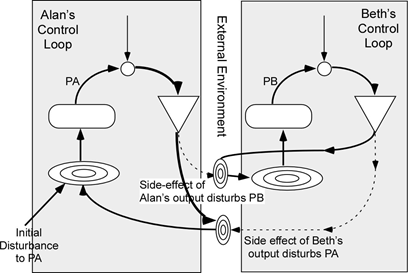
> > ```
> > RM: The difference
> >
> > ```
> >
> > between the customer/cashier interaction and
> > the interaction between two control systems
> > described by Martin is that there is no
> > control of one control system by another in
> > the situation Martin describes. In the
> > customer/cashier situation, successful
> > control by each control system requires
> > successful control of  each control system’s
> > behavior by the other control system. In
> > Martin’s “protocol”, shown below, Alan’s
> > ability to control PA does not depend on
> > controlling Beth’s behavior and vice versa.
> > Â The actions Alan uses to control PA are a
> > disturbance to PB which Beth will oppose
> > along with any other disturbances to PB, and
> > vice versa. Â But Alan’s ability to control
> > PA does not depend on his controlling Beth’s
> > behavior. INdeed, Alan can control PA just
> > fine whether Beth is controlling PB or not.Â
>
> > Â
>
> > Â
>
> > ```
> > This is quite different
> >
> > ```
> >
> > from the customer/cashier situation. The
> > customer is controlling for paying the exact
> > cost for the product; the cashier is
> > controlling for collecting the exact payment.
> > If the product costs $5 and the customer hands
> > $10 to the cashier, the customer will achieve
> > the “pay the exact cost” goal only if the
> > cashier returns the exact change. So the
> > customer is controlling for the cashier
> > returning $5. Â The cashier is also controlling
> > for collecting the cost of the customer’s item
> > and so will allow the customer to leave with
> > the product only after payment has been
> > received. If the cashier were not controlling
> > for getting only the exact amount for the
> > product the customer would not successfully
> > control for getting the correct change
> > behavior from the cashier; if the customer
> > were not controlling for paying for the
> > product the cashier would not successfully
> > control for getting paid by the customer.Â
>
> > Â
>
> > > ```
> > > KM: I don't think I
> > >
> > > ```
> > >
> > > would describe this exchange situation as
> > > control of another person’s behavior
>
> > Â
>
> > ```
> > RM: Apparently Bob
> >
> > ```
> >
> > Hintz doesn’t think so either. Â But,
> > again, I think it can be easily
> > demonstrated that both the customer and
> > cashier are, _in fact_ , controlling
> > each other’s behavior by introducing
> > disturbances to the hypothetical behavior
> > variables that are being controlled. For
> > example, have the cashier give the
> > customer $4 rather $5 dollars in change –
> > a disturbance to the customer’s perception
> > of the cashier returning the correct
> > change. I think you will see the customer
> > take action – like arguing with the
> > cashier – to bring the cashier’s behavior
> > to the desired state: handing over the $5
> > change. Similarly, have the customer hand
> > the cashier $4 rather than $5. I think you
> > will see the cashier take action – like
> > calling over the manager – to bring the
> > customer’s behavior to the desired state:
> > pay for the product. So the customer is
> > controlling for the “returning correct
> > change” behavior of the cashier and the
> > cashier is controlling for the “paying for
> > the product” behavior of the customer.Â
>
> > Â
>
> > > ```
> > > KM: unless you were
> > >
> > > ```
> > >
> > > buying the item from someone who had a
> > > monopoly, and the only way for you to get
> > > the item (behavior B) would be to pay the
> > > asking price (behavior A). Even then, you
> > > could refuse to buy the item or just get
> > > something else, unless the item were
> > > something you couldn’t live without.
>
> > Â
>
> > ```
> > RM: I hope my little
> >
> > ```
> >
> > explanation shows that this is not
> > necessary. The customer and cashier are
> > controlling each other’s behavior but it
> > doesn’t look like they are controlling
> > each other’s behavior (and they certainly
> > don’t feel like they are controlling each
> > other) until one or the other doesn’t
> > behave as desired. Â This is the way it is
> > with all our controlling, though, isn’t
> > it? We don’t feel like we are controlling
> > when we walk down the street or talk on
> > the phone or swim in the lake – that is,
> > we don’t notice our controlling until we
> > start to lose it .Skillful control does’t
> > feel like anything special; it just feels
> > like we are _doing_ things. Â And
> > this is true of skillful controlling of
> > our own limbs, of the physical
> > consequences of limb movements (like
> > walking and swimming) and interpersonal
> > consequences of these limb movements (like
> > getting change from a cashier). Â
>
> > Â
>
> > ```
> > RM: I think I
> >
> > ```
> >
> > understand why people don’t want to
> > believe that they can be controlled and
> > why they do want to believe that they
> > never control other people. It fits with
> > our idea that we are “free” and “good”.
> > But I think it’s better to recognize when
> > we are controlling, especially when we are
> > controlling (and being controlled by)
> > other control systems. Understanding how
> > to recognize this is, I think, one of the
> > most important things to learn from PCT.
> > It’s only when you know that you are
> > controlling (and being controlled) that
> > you can adjust your own controlling to
> > reduce inter (and intra) personal conflict
> > and work to organize society in a way that
> > allows controllers to do their controlling
> > with the least amount of conflict and the
> > greatest amount of cooperation with other
> > controllers. Making believe that we can’t
> > be controlled or that we are not
> > controlled by and/or don’t control other
> > controllers is not the road to a better
> > world, I think.
>
> > Â
>
> > BestÂ
>
> > Â
>
> > Rick
>
> > Â
>
> > Â
>
> > > ```
> > > Hope these thoughts help you to clarify
> > >
> > > ```
> > >
> > > the questions you were discussing.
> > >
> > > ```
> > > Best,
> > >
> > > Kent
> > >
> > > ```
>
> > > ```
> > > On Sep 7, 2014, at 12:54 PM, Richard
> > >
> > > ```
> > >
> > > Marken wrote:
> > >
> > > ```
> > > > [From Rick Marken
> > >
> > > ```
> > >
> > > (2014.09.07.1100)]
> > >
> > > ```
> > > >
> > >
> > > >
> > >
> > > ```
> > >
> > > wrote:
> > >
> > > ```
> > > >
> > >
> > > >
> > >
> > > > BH : I don't think that dogs were
> > >
> > > ```
> > >
> > > controlling gaps by »controlling sheeps
> > > behavior«. Sheeps were controlling their
> > > behavior on the bases of disturbances
> > > dog produced to sheep perceptual
> > > control.
> > >
> > > ```
> > > >
> > >
> > > >
> > >
> > > > RM: Yes, the sheep were controlling
> > >
> > > ```
> > >
> > > a perception (I called it safety) to
> > > which the approach of the dog was a
> > > disturbance. The sheep compensated for
> > > this disturbance by moving closer to
> > > other sheep. This is the behavior that
> > > the dog wanted to see (were controlling
> > > for) because it closed the gaps that
> > > were a disturbance to the perception the
> > > dog was controlling. So the dog was able
> > > to control the behavior of the sheep,
> > > getting them to bunch closer together,
> > > because the sheep were controlling for
> > > safety by bunching together.
> > >
> > > ```
> > > >
> > >
> > > > RM : So any model of this behavior
> > >
> > > ```
> > >
> > > would have to model the dogs’ “gap”
> > > control system and the sheep’s safety
> > > control system. Such a simulation would
> > > show that control systems can both
> > > control and _be_ controlled.
> > >
> > > ```
> > > >
> > >
> > > >
> > >
> > > >
> > >
> > > >
> > >
> > > > BH : Well this is a good idea to
> > >
> > > ```
> > >
> > > make simultaneous simulation. Did you
> > > try it ?
> > >
> > > ```
> > > >
> > >
> > > >
> > >
> > > > RM: Not yet.
> > >
> > > >
> > >
> > > >
> > >
> > > >
> > >
> > > > BH: But this is the n-th time that
> > >
> > > ```
> > >
> > > we are trying to solve the problem how
> > > LCS can be “controlled”. In the book :
> > > Making sense of behavior Bill talks
> > > about “attempts of control” not
> > > “control”…
> > >
> > > ```
> > > >
> > >
> > > >
> > >
> > > >
> > >
> > > > BH: Maybe Kent could explain what's
> > >
> > > ```
> > >
> > > wrong with your position about »LCS can
> > > be controlled".
> > >
> > > ```
> > > >
> > >
> > > >
> > >
> > > > RM: Yes, I think that's a good
> > >
> > > ```
> > >
> > > idea, though I would be surprised if
> > > Kent thought that there is something
> > > wrong with my “position”. My position is
> > > simply that people can clearly control
> > > the behavior other people and their own
> > > behavior can be controlled as well. This
> > > is an observable fact that is explained
> > > by PCT. I leave the explanation as an
> > > exercise.
> > >
> > > ```
> > > >
> > >
> > > > RM : It can also be easily
> > >
> > > ```
> > >
> > > demonstrated with humans using the
> > > rubber band demo; the E in this
> > > experiment can control the finger
> > > position of the S once S has agreed to
> > > control the position of the knot.
> > >
> > > ```
> > > >
> > >
> > > >
> > >
> > > >
> > >
> > > > BH : Yes. Watch your wording in
> > >
> > > ```
> > >
> > > rubber band demo. “Once S has agreed” or
> > > as Kent said “S chooses”. . So it’s
> > > obviously that S agreed to be
> > > controlled.
> > >
> > > ```
> > > >
> > >
> > > >
> > >
> > > > RM: Not quite. S has agreed to
> > >
> > > ```
> > >
> > > control a particular perception (the
> > > location of the knot relative to the
> > > dot, in this case). S has not agreed to
> > > be controlled; indeed, S is typically
> > > unaware of being controlled after
> > > agreeing to control that perception.
> > >
> > > ```
> > > >
> > >
> > > > HB : Aplying distrubance to a
> > >
> > > ```
> > >
> > > »controlled variable« does not mean that
> > > control is established. It seems that
> > > Kent and I agree that disturbances are
> > > aplyed to perceptual control and target
> > > person chooses.
> > >
> > > ```
> > > >
> > >
> > > >
> > >
> > > > RM: I would be interested to hear
> > >
> > > ```
> > >
> > > what Kent has to say about that. I would
> > > be very surprised if he agreed with your
> > > analysis.
> > >
> > > ```
> > > >
> > >
> > > >
> > >
> > > > RM : Nor does control theory show
> > >
> > > ```
> > >
> > > that controlling organisms (particularly
> > > humans) is necessarily a bad thing to
> > > do.
> > >
> > > ```
> > > >
> > >
> > > >
> > >
> > > >
> > >
> > > >
> > >
> > > > BH : Now you are exaggerating Rick.
> > >
> > > ```
> > >
> > > You can’t control organisms. I’d really
> > > like to see how you are doing that in
> > > everyday life ?
> > >
> > > ```
> > > >
> > >
> > > >
> > >
> > > ```
>
> > > ```
> > > > RM: One example: When I
> > >
> > > ```
> > >
> > > give a cashier $10 for a $5 item I am
> > > controlling for the cashier giving me $5
> > > change. The cashier is also controlling
> > > for me paying $5 for the item. Typically,
> > > we both get the behaviors from each other
> > > than we want: a nice example of mutual
> > > control, and no one gets hurt (or
> > > oppressed). This kind of agreed on mutual
> > > control is the basis of civilization.
> > >
> > > ```
> > > >
> > >
> > > >Â RM : What control
> > >
> > > ```
> > >
> > > theory does show is that arbitrary
> > > control, particularly of humans by other
> > > humans, will almost certainly lead to
> > > conflict. Arbitrary control is exerting
> > > control without considering the fact
> > > that living control systems are
> > > controlling many variables at the same
> > > time and when you arbitrarily decide to
> > > have a person do something (by
> > > disturbing a controlling variable) what
> > > you have them do may conflict with other
> > > things they are controlling.
> > >
> > > ```
> > > >
> > >
> > > >
> > >
> > > >
> > >
> > > >
> > >
> > > > HB : It makes some sense, but I
> > >
> > > ```
> > >
> > > don’t understand what you meant by
> > > »arbitrary control« ?
> > >
> > > ```
> > > >
> > >
> > > >
> > >
> > > > RM: It means controlling without
> > >
> > > ```
> > >
> > > taking a persons wants and needs (the
> > > references for the many different
> > > perceptions that the person is
> > > controlling for) into account. In
> > > non-PCT terms, it is controlling another
> > > person without respecting that person’s
> > > humanity (and autonomy).
> > >
> > > ```
> > > >
> > >
> > > > BH: If you are thinking like this
> > >
> > > ```
> > >
> > > one : »Controlle behavior match my
> > > wanted perception of behvior and thus it
> > > is »controlled« it’s wrong.
> > >
> > > ```
> > > >
> > >
> > > >
> > >
> > > > RM: That's exactly how I am
> > >
> > > ```
> > >
> > > thinking. And I think you are wrong
> > > about this being wrong.
> > >
> > > ```
> > > >
> > >
> > > > BH: You have PCT which helps you
> > >
> > > ```
> > >
> > > understand what’s happening inside
> > > organisms. Human control and behavior
> > > are quite unpredictable, because the
> > > references are formed inside organism,
> > > where most of control is done.
> > >
> > > ```
> > > >
> > >
> > > >
> > >
> > > > RM: Once you have correctly
> > >
> > > ```
> > >
> > > identified a controlled variable
> > > behavior (the actions that protect that
> > > variable from disturbance) can be
> > > predicted with very high accuracy. See
> > > the “Basic Control demo” at [http://www.mindreadings.com/ControlDemo/BasicTrack.html](http://www.mindreadings.com/ControlDemo/BasicTrack.html)
> > > to see what I mean.
> > >
> > > ```
> > > >
> > >
> > > > BH: Just observable »facts« of
> > >
> > > ```
> > >
> > > behavioral event are not prove that
> > > people control each other. Although it’s
> > > not excluded. The controller’s behavior
> > > is just a disturbance to controlee
> > > perceptual control. From what happens in
> > > controlee comparator (error) will
> > > probably decide whether controlee
> > > behavior will resemble to something
> > > controller wanted or not. But never
> > > behavior of controlee will be just exact
> > > »copy« of controller’s wanted behavior,
> > > because controlee is in control.
> > >
> > > ```
> > > >
> > >
> > > >
> > >
> > > >Â RM: It may not be an "exact" copy
> > >
> > > ```
> > >
> > > of what the controller wants, but it can
> > > be very close (like within 1% of the
> > > desired value).
> > >
> > > ```
> > > >
> > >
> > > >
> > >
> > > >
> > >
> > > >
> > >
> > > > RM: Anyway, this behavior --
> > >
> > > ```
> > >
> > > managing flocks – is a very interesting
> > > demonstration of controlling a
> > > perception (of gaps between sheep) via
> > > disturbance of a perception being
> > > controlled by the control systems that
> > > are being controlled.
> > >
> > > ```
> > > >
> > >
> > > >
> > >
> > > >
> > >
> > > > BH: This one makes some PCT sense.
> > >
> > > ```
> > >
> > > J
> > >
> > > ```
> > > >
> > >
> > > >
> > >
> > > > RM: Well, that's progress!
> > >
> > > >
> > >
> > > > Best
> > >
> > > >
> > >
> > > > Rick
> > >
> > > >
> > >
> > > >
> > >
> > > >
> > >
> > > >
> > >
> > > > But as usual I'm living space for
> > >
> > > ```
> > >
> > > not understanding something right. And
> > > as always, sorry for my language.
> > >
> > > ```
> > > >
> > >
> > > >
> > >
> > > >
> > >
> > > > Best,
> > >
> > > >
> > >
> > > >
> > >
> > > >
> > >
> > > > Boris
> > >
> > > >
> > >
> > > >
> > >
> > > >
> > >
> > > >
> > >
> > > >
> > >
> > > > From: csgnet-request@lists.illinois.edu
> > > [mailto:csgnet-request@lists.illinois.edu]
> > >
> > > ```
> > >
> > > On Behalf Of Richard Marken
> > >
> > > ```
> > > > Sent: Sunday, August 31, 2014 3:23
> > >
> > > ```
> > >
> > > AM
> > >
> > > ```
> > > > To: csgnet@lists.illinois.edu
> > >
> > > > Subject: Re: Sheepdog and flock
> > >
> > > ```
> > >
> > > behavior
> > >
> > > ```
> > > >
> > >
> > > >
> > >
> > > >
> > >
> > > > [From Rick Marken
> > >
> > > ```
> > >
> > > (2014.08.30.1820)]
> > >
> > > ```
> > > >
> > >
> > > >
> > >
> > > >
> > >
> > > > [From Bruce Abbott (2014.08.30.0820
> > >
> > > ```
> > >
> > > EDT)]
> > >
> > > ```
> > > >
> > >
> > > >
> > >
> > > >
> > >
> > > > Researchers have investigated how
> > >
> > > ```
> > >
> > > sheepdogs manage their flocks by fitting
> > > both the dogs and the sheep with highly
> > > accurate GPS devices, allowing the
> > > researchers to track their movements.Â
> > > The research is presented in a BBC
> > > article at [http://www.bbc.com/news/science-environment-28936251](http://www.bbc.com/news/science-environment-28936251)
> > > .
> > >
> > > ```
> > > >
> > >
> > > >
> > >
> > > >
> > >
> > > > RM: Great find, Bruce! There are
> > >
> > > ```
> > >
> > > two things that make this report
> > > particularly interesting to me. The
> > > first is the quote by Andrew King, which
> > > is a great description of the PCT
> > > approach to research. To paraphrase
> > > King: in order to understand the
> > > behavior of organisms you have to try to
> > > look at their behavior from the point of
> > > view of the organism (behaving system)
> > > Itself. I make this same point in the
> > > chapter on “Looking at Behavior through
> > > Control Theory Glasses” in “Doing
> > > Research on Purpose” (why hasn’t that
> > > become a best seller yet?). I do it in
> > > the section on trying to understand the
> > > apparent “fixed action pattern” of the
> > > greylag goose. The goose is seen to
> > > continue to make the movements that
> > > would pull an egg back into its nest
> > > even when the egg is no longer present.
> > > Looking at an organism’s behavior from
> > > the organism’s perspective helps you
> > > come up with good ideas about what
> > > perceptual variables the organism is
> > > controlling (the first step in the Test
> > > for the Controlled Variable). By looking
> > > at the goose’s egg rolling behavior from
> > > the goose’s perspective I was able to
> > > come up with the hypothesis that the
> > > goose is trying to control the pressure
> > > of the egg against the back of its bill
> > > and when the egg is removed the
> > > continued efforts to move the
> > > non-existent egg into the nest (the
> > > apparent fixed action pattern) is just
> > > the efforts of the pressure control
> > > system to restore the pressure of the
> > > egg against the back of the bill. By
> > > looking at the sheepdogs herding
> > > behavior from the dogs’ perspective King
> > > came up with the reasonable hypothesis
> > > that the dogs were controlling their
> > > perception of the gaps between patches
> > > of white (the sheep), trying to keep
> > > those gaps at zero.
> > >
> > > ```
> > > >
> > >
> > > >
> > >
> > > >
> > >
> > > > RM: The other thing that's
> > >
> > > ```
> > >
> > > interesting about this report is that
> > > the dogs were clearly controlling their
> > > perception of the gaps by controlling
> > > the behavior of the sheep. And they did
> > > this by becoming a disturbance to a
> > > perception that the sheep control by
> > > getting closer to other sheep: the
> > > perception of safety. So any model of
> > > this behavior would have to model the
> > > dogs’ “gap” control system and the
> > > sheep’s safety control system. Such a
> > > simulation would show that control
> > > systems can both control and _be_
> > > controlled. This kind of simulation
> > > would help dispel what I think is a
> > > common misconception about the control
> > > theory model of organisms –
> > > particularly humans. It is a
> > > misconception that I myself labored
> > > under until just a few years ago. It is
> > > the idea that because organisms are
> > > autonomous control systems – autonomous
> > > in the sense that they set their own
> > > references for the states of their own
> > > perception – they cannot be controlled.
> > > But autonomous control systems can be
> > > controlled, as is demonstrated by the
> > > sheepdogs controlling the sheep. It can
> > > also be easily demonstrated with humans
> > > using the rubber band demo; the E in
> > > this experiment can control the finger
> > > position of the S once S has agreed to
> > > control the position of the knot. And
> > > thanks to Bruce Abbott I demonstrated to
> > > myself that E can still exert this
> > > control even if S continuously – and
> > > autonomously – varies his or her
> > > reference for the position of the knot.
> > >
> > > ```
> > > >
> > >
> > > >
> > >
> > > >
> > >
> > > > RM: Control theory doesn't say that
> > >
> > > ```
> > >
> > > organisms (particularly humans) can’t be
> > > controlled; indeed, it shows that they
> > > can be controlled, mainly by disturbance
> > > to a controlled variable. Nor does
> > > control theory show that controlling
> > > organisms (particularly humans) is
> > > necessarily a bad thing to do. What
> > > control theory does show is that
> > > arbitrary control, particularly of
> > > humans by other humans, will almost
> > > certainly lead to conflict. Arbitrary
> > > control is exerting control without
> > > considering the fact that living control
> > > systems are controlling many variables
> > > at the same time and when you
> > > arbitrarily decide to have a person do
> > > something (by disturbing a controlling
> > > variable) what you have them do may
> > > conflict with other things they are
> > > controlling. So to take an example that
> > > Bill used (somewhere), if E decides to
> > > place S’s finger against a hot soldering
> > > iron while controlling Ss finger
> > > position in the rubber band game that
> > > will clearly lconflict with another goal
> > > S has (not getting burned).
> > > Non-arbitrary control is control that is
> > > done with the consent (often implicit
> > > but sometimes explicit) of the would-be
> > > controllee. Non- arbitrary control is, I
> > > think, essential when humans control
> > > other humans. To see why, think about
> > > what happens when people are arbitrarily
> > > controlled (herded) in the same way that
> > > the sheep were. Hint: They don’t like
> > > it. Why do you think not?
> > >
> > > ```
> > > >
> > >
> > > >
> > >
> > > >
> > >
> > > >Â RM: Anyway, this behavior --
> > >
> > > ```
> > >
> > > managing flocks – is a very interesting
> > > demonstration of controlling a
> > > perception (of gaps between sheep) via
> > > disturbance of a perception being
> > > controlled by the control systems that
> > > are being controlled.
> > >
> > > ```
> > > >
> > >
> > > >
> > >
> > > >
> > >
> > > > Best
> > >
> > > >
> > >
> > > >
> > >
> > > >
> > >
> > > > Rick
> > >
> > > >
> > >
> > > >
> > >
> > > >
> > >
> > > >
> > >
> > > >
> > >
> > > >
> > >
> > > >
> > >
> > > > The researchers found that the
> > >
> > > ```
> > >
> > > behavior could be described by two
> > > simple rules, but more interesting from
> > > a PCT perspective, they found that to
> > > understand the behavior they needed to
> > > view the action from the animal’s
> > > perspectives. According to researcher
> > > Dr. Andrew King:
> > >
> > > ```
> > > >
> > >
> > > > "At the beginning we had lots of
> > >
> > > ```
> > >
> > > different ideas. We started out looking
> > > from a birds eye view, but then we
> > > realised we needed to see what the dog
> > > sees. It sees white, fluffy things. If
> > > there are gaps between them or the gaps
> > > get bigger, the dogs needs to bring them
> > > together."
> > >
> > > ```
> > > >
> > >
> > > >
> > >
> > > >
> > >
> > > > According to Dr King, sheepdogs are
> > >
> > > ```
> > >
> > > making the most of the “selfish herd
> > > theory” to bring the animals close
> > > together and move them where they want.
> > >
> > > ```
> > > >
> > >
> > > > "One of the things that sheep are
> > >
> > > ```
> > >
> > > really good at is responding to a threat
> > > by working with their neighbours. It’s
> > > the selfish herd theory: put something
> > > between the threat and you. Individuals
> > > try to minimise the chance of anything
> > > happening to them, so they move towards
> > > the centre of a group."
> > >
> > > ```
> > > >
> > >
> > > > The article continues as follows:
> > >
> > > >
> > >
> > > > A colleague, Dr Daniel Strombom
> > >
> > > ```
> > >
> > > from Uppsala University in Sweden, used
> > > the GPS data from the collars to develop
> > > computer simulations. This enabled them
> > > to develop a mathematical shepherding
> > > model.
> > >
> > > ```
> > > >
> > >
> > > > The algorithm displays the same
> > >
> > > ```
> > >
> > > weaving pattern exhibited by sheepdogs.
> > > It helps to solve what has been called
> > > the ‘the shepherding problem’: how one
> > > agent can control a large number of
> > > unwilling agents.
> > >
> > > ```
> > > >
> > >
> > > >
> > >
> > > >
> > >
> > > > I’d be interested to know whether
> > >
> > > ```
> > >
> > > the computer algorithm models each
> > > individual’s control systems or operates
> > > by some other method.
> > >
> > > ```
> > > >
> > >
> > > >
> > >
> > > >
> > >
> > > > Bruce
> > >
> > > >
> > >
> > > >
> > >
> > > >
> > >
> > > >
> > >
> > > >
> > >
> > > >
> > >
> > > ```
>
> > > > –
> > >
> > > ```
> > > >
> > >
> > > > Richard S. Marken, Ph.D.
> > >
> > > > Author of Doing Research on Purpose.
> > >
> > > >
> > >
> > > > Now available from Amazon or Barnes
> > >
> > > ```
> > >
> > > & Noble
> > >
> > > ```
> > > >
> > >
> > > >
> > >
> > > >
> > >
> > > >
> > >
> > > > --
> > >
> > > > Richard S. Marken, Ph.D.
> > >
> > > > Author of Doing Research on Purpose.
> > >
> > > > Now available from Amazon or Barnes
> > >
> > > ```
> > >
> > > & Noble
>
> >
>
> > Â
>
> > –
>
> > Richard S. Marken, Ph.D.
> > Author of  [ Doing
> > Research on Purpose](http://www.amazon.com/Doing-Research-Purpose-Experimental-Psychology/dp/0944337554/ref=sr_1_1?ie=UTF8&qid=1407342866&sr=8-1&keywords=doing+research+on+purpose).Â
>
> > ```
> > Now available from Amazon
> >
> > ```
> >
> > or Barnes & Noble
---
### Author:  [@rsmarken](http://discourse.iapct.org/u/rsmarken)
#### Post date: [September 12, 2014, 10:10pm UTC](http://discourse.iapct.org/t/sheepdog-and-flock-behavior/10422/42 "2014-09-12T22:10:25Z")
[From Rick Marken (2014.09.12.1510)]

> **···**
>
> On Thu, Sep 11, 2014 at 8:31 AM, Boris Hartman [boris.hartman@masicom.net](mailto:boris.hartman@masicom.net) wrote:
>
> >
>
> > HB :
>
> > First of all nobody can control any behavior. Neither dog or sheep. Both control their own perception.
>
> RM: Yes, but they are controlling their perceptions of what? In the case of the dogs, it seems likely that they are controlling their perception of the position of the sheep relative to a target location in the field.Â
>
> Â
>
> >  HB: So if I see right your »attack on me« that I’m wrong, you are trying to say that dog and sheep are controlling for the same perception : the gap between sheep and so it seems to you that dog controls the behavior of sheep. And that’s by your oppinion proof that sheeps are controlled by dog. Or in other words : because sheeps behave as dog wants, sheeps are controlled. Did I missed something ?
>
> RM: Yes, you missed the fact that my “proof” (actually, “evidence” is a better word) that the sheep are controlled by the dogs had nothing to do with guesses about what perceptions the dogs and sheep are controlling. The evidence of control is that a variable aspect of the sheep behavior – their position on the ground – Â is being maintained at a specific value – the target position in the field – and protected from disturbances – such as sheep wandering away from the target position – by the actions of the dogs. This control can be seen very clearly in the first video. What we are seeing fits the definition of control. The dogs are clearly controlling the behavior of the sheep. The dogs are the one’s keeping the sheep in the target position. Take ke away the dogs (the controllers) and you take away control. The sheep will be randomly arrayed all over the field; the variable that the dogs were controlling is no longer under control. Â
>
> RM: Again, I am not saying that the dogs are controlling the behavior of the sheep in theory; they are controlling them _in fact_. Control of sheep behavior by the dogs is an observable fact. PCT explains that fact; it doesn’t explain it away.
>
> BestÂ
>
> Rick
>
> Â
>
> > Â
>
> > The problem here is that sheep could control the perception of the gap between sheep, for safety as you said. But when you say safety what does it mean. If we say just control for safety we don’t know what is really controlled. I asssume that safety could be higher order perception, composed of at least two lower level controlled perceptions : distance between ship and distance between dog and sheep. Both controlled perceptions are contributing to safety, specialy the last one.
>
> > Â
>
> > But sheep do control at least one more life-important perception : eating grass. When they control such a perception they spread on great teritory seeking for better grass, not seeking for control of gap between them. That’s what owners of sheep wants. So owner train a dog to group sheep so not to be spread arround.
>
> > Â
>
> > Sheeps are not controlling only for the gap between sheep, they control for their life-important perception. The owner of course also control that sheep could eat best grass. Dog and people who trained dog, do control for sheep being togetheras as much as possible to eat grass, but also not to lose any of sheep.
>
> > Â
>
> > So I think you are right that dog control for »the gap between sheep« as that’s what owner wants. But I think you are not right that dog controls the behavior of sheep by controlling the gap among them.  Sheep can control for different perception among which is also perception of grouping together for safety. But behavior of sheep is not determined with presence of the dog, but depends from sheep’s internal control by which relevant behavior (output) for the sheep’s control of perception is established. Â
>
> > Â
>
> > Sheep beside very important control of eating grass, control also perception for the distance to the predator (in our case it’s dog).  It’s probably some inborn survival behavior. So sheep control for the perception of distance to dog. Here is video, which show how group of sheeps are moving in accordance with distance to the dog. When dogs are at safe diastance (probably low »error« in sheep control) sheeps are not moving. When distance minimize sheep move (run) away from dog. But the distance is varying in accordance to control of sheep and dog. When sheep control differently – run awayy from group, than we can see that sheep in control of their perception. Â
>
> > Â
>
> > [https://www.youtube.com/watch?v=wJUVULU7GDM](https://www.youtube.com/watch?v=wJUVULU7GDM)
>
> > Â
>
> > So we can conclude that there are many »survivial behaviors« or sheep can control for different perceptions. One of them and very important is : the gap between dog (predator) and sheep. With output sheep will control perception of being enough far from dog. We can say that sheep controls the distance to the dog (predator) and varying distance will in some proportion (not linear) cause »errors« in control. The closer dog is, more »error« and more distance to the dog is produced, less »error« no activity or perception of eating grass is controlled.
>
> > Dog’s controlled perception is : the more the sheep are together – less »error«, thhe more they are appart – more »error«. So again varying ddistance, varying »error« of dog control. Also seen in video when one sheep ran away from group. Dogs ran after it.
>
> > Â
>
> > So both : dog and sheep are controllig what they are supposed to control.
>
> > Â
>
> > Now Rick you can make simulation of both LCS each controling for own perception – varying perception of distance. We have only to establish, how these diferent controls with different goals are coordinated. I would say that dog run in different directions trying to change the distance to sheep so to move sheep in wanted direction.
>
> > Â
>
> > In this way sheep is stil controlling for distance and less »error« in the direction of group of other sheep mean that is more possibility for sheep to move to the group. So in this case sheep is tending to encrease the gap to the dog and dog somehow enable that. But this is not always the case.
>
> > Â
>
> > So I concluded that dog behavior is not always implaying sheep behavior to increase distance to the dog only by running away. It can be also different. In next video you can see that sheeps choose another behavior, which has something to do with the dog, but in opposite direction. Instead of increasing the gap to the dog, with running away, they choose the control of perception of moving the dog away. So they attack dog. Â
>
> > Â
>
> > [https://www.youtube.com/watch?v=RY\_7U56R0AM](https://www.youtube.com/watch?v=RY_7U56R0AM)
>
> > Â
>
> > Your term Rick about controling other living being somehow sounds to me as S-R logic. Dog behavior (stimulus, disturbance) to sheep perceptual input, and then directly to sheep behavior is somehow determined sheep behavior by it’s input (environment). It’s denying Bill’s aymetry of control : LCS can control environment, and environment can’t control LCS.
>
> > Â
>
> > By your control of behavior of others can happen in the opposite  way.  So it sounds like absolutely determined behavior by environment : sheep input (dogs behavior) - sheep output (induced behavior by dog behavior). Nothing in between. No process inside »controlled« LCS counts, no references, no reorganization, just stream from input to output (control of others).
>
> > Â
>
> > LCS are already controlling, so nobody can overtake that control. Sheep all the time control their perception. Â Dogs all the time control their percpetion.
>
> > Â
>
> > I didn’t find any example to show how sheep can attack alone sheep dog, not just ran away form the dog, but I found this video, which shows how sheep attacked wolf, when he comes to close.
>
> > [https://www.youtube.com/watch?v=F29dMtxXCkE](https://www.youtube.com/watch?v=F29dMtxXCkE)
>
> > Â
>
> > If we think that sheep are inocent little animals harmly eating grass, we can made a hudge mistake : here is video which show how nasty can be sheep attack.
>
> > [https://www.youtube.com/watch?v=GJrlo2VuUR8](https://www.youtube.com/watch?v=GJrlo2VuUR8)
>
> > Â
>
> > Maybe this video will help to see, how sheep control the distance to dog (predator) :
>
> > [https://www.youtube.com/watch?v=uXkHDiuadTI](https://www.youtube.com/watch?v=uXkHDiuadTI)
>
> > Â
>
> > And maybe one more video which shows that dog is not controlling the behavior of the ram.
>
> > [https://www.youtube.com/watch?v=cluHOW\_EnAQ](https://www.youtube.com/watch?v=cluHOW_EnAQ)
>
> > Â
>
> > And maybe the last video that shows that perceptual control is choosen in the ram not in environment and can be very unpredictable and dangerous.
>
> > [https://www.youtube.com/watch?v=6jgjk3DsN7c](https://www.youtube.com/watch?v=6jgjk3DsN7c)
>
> > Â
>
> > Â
>
> > All in all I think that there is enough proof that dogs are not controlling behavior of the sheep, but sheep control it’s own perception that it chooses  and dog control it’s perception that it chooses. But neither of them can control behavior. Nor own, neither others. As far as I understand there is no such a thing in PCT. Â
>
> > Â
>
> > Best,
>
> > Â
>
> > Boris
>
> >
>
> –
> Richard S. Marken, Ph.D.
> Author of  [Doing Research on Purpose](http://www.amazon.com/Doing-Research-Purpose-Experimental-Psychology/dp/0944337554/ref=sr_1_1?ie=UTF8&qid=1407342866&sr=8-1&keywords=doing+research+on+purpose).Â
> Now available from Amazon or Barnes & Noble
---
### Author:  [@\_Boris\_Hartman](http://discourse.iapct.org/u/_Boris_Hartman)
#### Post date: [September 13, 2014, 8:50am UTC](http://discourse.iapct.org/t/sheepdog-and-flock-behavior/10422/43 "2014-09-13T08:50:54Z")
Hi Rick,
you are clearly defending your stand point of »dog controlling sheep behavior« as osbervable fact, not theoretical as PCT predicts. I’m also sorry to notice that PCT is not explaining that fact, your explanation is away from PCT. _I’m sorry about that._
- S\*o I decided, that I’ll try not to interfear in your beleif temporary, and I’ll wait that LCS IV come out, as Martin said. I assume that you contributed to that book. But now as I see clearly how you understand wrong some points of PCT, I’ll wait to see, what you wrote. But I can imagine what could be wrong with you contribution. So let us get surprised…
Best,
Boris
     Â
> **···**
>
> **From:** csgnet-request@lists.illinois.edu [[mailto:csgnet-request@lists.illinois.edu](mailto:csgnet-request@lists.illinois.edu)] **On Behalf Of** Richard Marken
> **Sent:** Saturday, September 13, 2014 12:10 AM
> **To:** csgnet@lists.illinois.edu
> **Subject:** Re: Sheepdog and flock behavior
>
> [From Rick Marken (2014.09.12.1510)]
>
> On Thu, Sep 11, 2014 at 8:31 AM, Boris Hartman [boris.hartman@masicom.net](mailto:boris.hartman@masicom.net) wrote:
>
> HB :
>
> First of all nobody can control any behavior. Neither dog or sheep. Both control their own perception.
>
> RM: Yes, but they are controlling their perceptions of what? In the case of the dogs, it seems likely that they are controlling their perception of the position of the sheep relative to a target location in the field.
>
> > HB: So if I see right your »attack on me« that I’m wrong, you are trying to say that dog and sheep are controlling for the same perception : the gap between sheep and so it seems to you that dog controls the behavior of sheep. And that’s by your oppinion proof that sheeps are controlled by dog. Or in other words : because sheeps behave as dog wants, sheeps are controlled. Did I missed something ?
>
> RM: Yes, you missed the fact that my “proof” (actually, “evidence” is a better word) that the sheep are controlled by the dogs had nothing to do with guesses about what perceptions the dogs and sheep are controlling. The evidence of control is that a variable aspect of the sheep behavior – their position on the ground – is being maintained at a specific value – the target position in the field – and protected from disturbances – such as sheep wandering away from the target position – by the actions of the dogs. This control can be seen very clearly in the first video. What we are seeing fits the definition of control. The dogs are clearly controlling the behavior of the sheep. The dogs are the one’s keeping the sheep in the target position. Take ke away the dogs (the controllers) and you take away control. The sheep will be randomly arrayed all over the field; the variable that the dogs were controlling is no longer under control.
>
> RM: Again, I am not saying that the dogs are controlling the behavior of the sheep in theory; they are controlling them _in fact_. Control of sheep behavior by the dogs is an observable fact. PCT explains that fact; it doesn’t explain it away.
>
> Best
>
> Rick
>
> >
>
> > The problem here is that sheep could control the perception of the gap between sheep, for safety as you said. But when you say safety what does it mean. If we say just control for safety we don’t know what is really controlled. I asssume that safety could be higher order perception, composed of at least two lower level controlled perceptions : distance between ship and distance between dog and sheep. Both controlled perceptions are contributing to safety, specialy the last one.
>
> >
>
> > But sheep do control at least one more life-important perception : eating grass. When they control such a perception they spread on great teritory seeking for better grass, not seeking for control of gap between them. That’s what owners of sheep wants. So owner train a dog to group sheep so not to be spread arround.
>
> >
>
> > Sheeps are not controlling only for the gap between sheep, they control for their life-important perception. The owner of course also control that sheep could eat best grass. Dog and people who trained dog, do control for sheep being togetheras as much as possible to eat grass, but also not to lose any of sheep.
>
> >
>
> > So I think you are right that dog control for »the gap between sheep« as that’s what owner wants. But I think you are not right that dog controls the behavior of sheep by controlling the gap among them. Sheep can control for different perception among which is also perception of grouping together for safety. But behavior of sheep is not determined with presence of the dog, but depends from sheep’s internal control by which relevant behavior (output) for the sheep’s control of perception is established.
>
> >
>
> > Sheep beside very important control of eating grass, control also perception for the distance to the predator (in our case it’s dog). It’s probably some inborn survival behavior. So sheep control for the perception of distance to dog. Here is video, which show how group of sheeps are moving in accordance with distance to the dog. When dogs are at safe diastance (probably low »error« in sheep control) sheeps are not moving. When distance minimize sheep move (run) away from dog. But the distance is varying in accordance to control of sheep and dog. When sheep control differently – run away from group, than we can see that sheep in control of their perception.
>
> >
>
> > [https://www.youtube.com/watch?v=wJUVULU7GDM](https://www.youtube.com/watch?v=wJUVULU7GDM)
>
> >
>
> > So we can conclude that there are many »survivial behaviors« or sheep can control for different perceptions. One of them and very important is : the gap between dog (predator) and sheep. With output sheep will control perception of being enough far from dog. We can say that sheep controls the distance to the dog (predator) and varying distance will in some proportion (not linear) cause »errors« in control. The closer dog is, more »error« and more distance to the dog is produced, less »error« no activity or perception of eating grass is controlled.
>
> > Dog’s controlled perception is : the more the sheep are together – less »error«, the more they are appart – €“ more »error«. So again varying distance, varying »error« of dog control. Also seen in video when one sheep ran away from group. Dogs ran after it.
>
> >
>
> > So both : dog and sheep are controllig what they are supposed to control.
>
> >
>
> > Now Rick you can make simulation of both LCS each controling for own perception – varying perception of distance. We have only to establish, how these diferent controls with different goals are coordinated. I would say that dog run in different directions trying to change the distance to sheep so to move sheep in wanted direction.
>
> >
>
> > In this way sheep is stil controlling for distance and less »error« in the direction of group of other sheep mean that is more possibility for sheep to move to the group. So in this case sheep is tending to encrease the gap to the dog and dog somehow enable that. But this is not always the case.
>
> >
>
> > So I concluded that dog behavior is not always implaying sheep behavior to increase distance to the dog only by running away. It can be also different. In next video you can see that sheeps choose another behavior, which has something to do with the dog, but in opposite direction. Instead of increasing the gap to the dog, with running away, they choose the control of perception of moving the dog away. So they attack dog.
>
> >
>
> > [https://www.youtube.com/watch?v=RY\_7U56R0AM](https://www.youtube.com/watch?v=RY_7U56R0AM)
>
> >
>
> > Your term Rick about controling other living being somehow sounds to me as S-R logic. Dog behavior (stimulus, disturbance) to sheep perceptual input, and then directly to sheep behavior is somehow determined sheep behavior by it’s input (environment). It’s denying Bill’s aymetry of control : LCS can control environment, and environment can’t control LCS.
>
> >
>
> > By your control of behavior of others can happen in the opposite way. So it sounds like absolutely determined behavior by environment : sheep input (dogs behavior) - sheep output (induced behavior by dog behavior). Nothing in between. No process inside »controlled« LCS counts, no references, no reorganization, just stream from input to output (control of others).
>
> >
>
> > LCS are already controlling, so nobody can overtake that control. Sheep all the time control their perception. Dogs all the time control their percpetion.
>
> >
>
> > I didn’t find any example to show how sheep can attack alone sheep dog, not just ran away form the dog, but I found this video, which shows how sheep attacked wolf, when he comes to close.
>
> > [https://www.youtube.com/watch?v=F29dMtxXCkE](https://www.youtube.com/watch?v=F29dMtxXCkE)
>
> >
>
> > If we think that sheep are inocent little animals harmly eating grass, we can made a hudge mistake : here is video which show how nasty can be sheep attack.
>
> > [https://www.youtube.com/watch?v=GJrlo2VuUR8](https://www.youtube.com/watch?v=GJrlo2VuUR8)
>
> >
>
> > Maybe this video will help to see, how sheep control the distance to dog (predator) :
>
> > [https://www.youtube.com/watch?v=uXkHDiuadTI](https://www.youtube.com/watch?v=uXkHDiuadTI)
>
> >
>
> > And maybe one more video which shows that dog is not controlling the behavior of the ram.
>
> > [https://www.youtube.com/watch?v=cluHOW\_EnAQ](https://www.youtube.com/watch?v=cluHOW_EnAQ)
>
> >
>
> > And maybe the last video that shows that perceptual control is choosen in the ram not in environment and can be very unpredictable and dangerous.
>
> > [https://www.youtube.com/watch?v=6jgjk3DsN7c](https://www.youtube.com/watch?v=6jgjk3DsN7c)
>
> >
>
> >
>
> > All in all I think that there is enough proof that dogs are not controlling behavior of the sheep, but sheep control it’s own perception that it chooses and dog control it’s perception that it chooses. But neither of them can control behavior. Nor own, neither others. As far as I understand there is no such a thing in PCT.
>
> >
>
> > Best,
>
> >
>
> > Boris
>
> –
>
> Richard S. Marken, Ph.D.
> Author of [Doing Research on Purpose](http://www.amazon.com/Doing-Research-Purpose-Experimental-Psychology/dp/0944337554/ref=sr_1_1?ie=UTF8&qid=1407342866&sr=8-1&keywords=doing+research+on+purpose).
>
> Now available from Amazon or Barnes & Noble
---
### Author:  [@\_Boris\_Hartman](http://discourse.iapct.org/u/_Boris_Hartman)
#### Post date: [September 13, 2014, 8:56am UTC](http://discourse.iapct.org/t/sheepdog-and-flock-behavior/10422/44 "2014-09-13T08:56:47Z")
[From Rick Marken (2014.09.08.1545)]
> Kent McClelland (2014.09.07.2050)
> KM: I see that my name has come up in this exchange, so I’ll see if I can say anything to help move it along. As I look at what you’ve written, I don’t see much in either person’s position to disagree with, but you seem to be at an impasse. The difficulty seems to be semantic, revolving around what it means to control another person’s behavior, which Rick says can be done and Boris says can’t. In my view, you’re both partly right.
RM: I think it’s more than semantic. I think the difficulty turns on knowing what control _is_, in fact, not in theory. Once you know what control is then there is no controversy at all: behavior can be controlled. That’s what we are seeing with the sheepdogs (the dogs controlling the gaps between the sheep) and with the E and S in the rubber band demo (E controlling the finger position of S). A variable (the gap, the finger position) is being kept in a pre-selected state (0 gap, finger on target dot), protected from disturbance (autonomously produced changes in the closeness of the sheep to one another, the closeness of the finger to the target dot) by varying actions appropriately (moving towards or away from the sheep, increasing or reducing the pull on the rubber band) .
> KM: The problem, as I see it, is that a person’s behavior (or that of any living control system with hierarchical control of perceptions) is never just one thing. A person controls lots of different perceptions simultaneously, at different perceptual levels. And when a person observes another person’s physical actions, the observer can see “behaviors” at a lot of different perceptual levels.
RM: Yes, but this is true of all of our experience, not just our experience of other people’s behavior. We control perceptual variables of many different types (hypothetically 11 different types of perceptual variable). I don’t see what this has to do with whether or not people can control other people’s behavior.
> KM: Because a person controls lots of different things at once, under the right circumstances another person can control SOME of these behaviors (as the controller perceives them), but not ALL of them, at least not all of them simultaneously. The trick in controlling a particular behavior by another person (call it behavior A) is to get the person to focus on controlling behavior B, and then to remove all the other ways for the person to keep controlling behavior B except by doing behavior A.
RM: Yes, this is all I claimed was true: people can control the behavior of other people. Of course, they can only control _some_ of these behaviors – the one’s that correct for disturbances to the variable the controllee is controlling. This is why I gave the example of controlling the position of S’s finger in the rubber band demo. Since S must vary the position of the finger in order to compensate for E- produced disturbances to the position of the knot, the variable S is controlling, E can control S’s finger position by disturbing the position of the knot. S’s finger position is the only aspect of S’s behavior that E can control in this situation. But that aspect of S’s behavior can certainly be controlled.
> KM: That’s the classic pattern for manipulation of a person’s behavior.
RM: Right! This is how you can manipulate (control) another person’s behavior.
> KM: The pattern also applies to the dog and sheep example.
RM: Exactly, the dog controls the behavior of the sheep by disturbing a variable that the sheep control by grouping themselves closer together. Boris disagrees and says that the sheep are not being controlled by the dog, which is demonstrably wrong. Without the dog there, the gaps between the sheep would on average be quite wide.
> KM: Thus, the control of one person’s behavior by another person can and does happen
RM: My point exactly.
> > RM: One example: When I give a cashier $10 for a $5 item I am controlling for the cashier giving me $5 change. The cashier is also controlling for me paying $5 for the item. Typically, we both get the behaviors from each other than we want: a nice example of mutual control, and no one gets hurt (or oppressed). This kind of agreed on mutual control is the basis of civilization.
>
> KM: Martin Taylor, in the chapter he’s writing for the LCS IV book edited by Warren Mansell (a preliminary draft of which I’ve been lucky enough to see), calls this kind of exchange transaction a “protocol,”
RM: I looked at Martin’s reply and what he describes as a “protocol” is not the same as the mutual controlling that occurs in the customer/cashier interaction.
> KM: and, if I understand his concept correctly, protocols provide a way for two people acting together to control two different perceptions. The side-effects of one person’s behavior in controlling his or her own perception allow the other person to control a different perception (and vice-versa). In your example, the cashier controls the perception of completing a sale by getting your money and giving you the item and $5 change, while you control the perception of buying the item by handing over the money and getting the item and change back.
RM: The difference between the customer/cashier interaction and the interaction between two control systems described by Martin is that there is no control of one control system by another in the situation Martin describes. In the customer/cashier situation, successful control by each control system requires successful control of each control system’s behavior by the other control system. In Martin’s “protocol”, shown below, Alan’s ability to control PA does not depend on controlling Beth’s behavior and vice versa. The actions Alan uses to control PA are a disturbance to PB which Beth will oppose along with any other disturbances to PB, and vice versa. But Alan’s ability to control PA does not depend on his controlling Beth’s behavior. INdeed, Alan can control PA just fine whether Beth is controlling PB or not.

This is quite different from the customer/cashier situation. The customer is controlling for paying the exact cost for the product; the cashier is controlling for collecting the exact payment. If the product costs $5 and the customer hands $10 to the cashier, the customer will achieve the “pay the exact cost” goal only if the cashier returns the exact change. So the customer is controlling for the cashier returning $5. The cashier is also controlling for collecting the cost of the customer’s item and so will allow the customer to leave with the product only after payment has been received. If the cashier were not controlling for getting only the exact amount for the product the customer would not successfully control for getting the correct change behavior from the cashier; if the customer were not controlling for paying for the product the cashier would not successfully control for getting paid by the customer.
> KM: I don’t think I would describe this exchange situation as control of another person’s behavior
RM: Apparently Bob Hintz doesn’t think so either. But, again, I think it can be easily demonstrated that both the customer and cashier are, _in fact_, controlling each other’s behavior by introducing disturbances to the hypothetical behavior variables that are being controlled. For example, have the cashier give the customer $4 rather $5 dollars in change – a disturbance to the customer’s perception of the cashier returning the correct change. I think you will see the customer take action – like arguing with the cashier – to bring the cashier’s behavior to the desired state: handing over the $5 change. Similarly, have the customer hand the cashier $4 rather than $5. I think you will see the cashier take action – like calling over the manager – to bring the customer’s behavior to the desired state: pay for the product. So the customer is controlling for the “returning correct change” behavior of the cashier and the cashier is controlling for the “paying for the product” behavior of the customer.
> KM: unless you were buying the item from someone who had a monopoly, and the only way for you to get the item (behavior B) would be to pay the asking price (behavior A). Even then, you could refuse to buy the item or just get something else, unless the item were something you couldn’t live without.
RM: I hope my little explanation shows that this is not necessary. The customer and cashier are controlling each other’s behavior but it doesn’t look like they are controlling each other’s behavior (and they certainly don’t feel like they are controlling each other) until one or the other doesn’t behave as desired. This is the way it is with all our controlling, though, isn’t it? We don’t feel like we are controlling when we walk down the street or talk on the phone or swim in the lake – that is, we don’t notice our controlling until we start to lose it .Skillful control does’t feel like anything special; it just feels like we are _doing_ things. And this is true of skillful controlling of our own limbs, of the physical consequences of limb movements (like walking and swimming) and interpersonal consequences of these limb movements (like getting change from a cashier).
RM: I think I understand why people don’t want to believe that they can be controlled and why they do want to believe that they never control other people. It fits with our idea that we are “free” and “good”. But I think it’s better to recognize when we are controlling, especially when we are controlling (and being controlled by) other control systems. Understanding how to recognize this is, I think, one of the most important things to learn from PCT. It’s only when you know that you are controlling (and being controlled) that you can adjust your own controlling to reduce inter (and intra) personal conflict and work to organize society in a way that allows controllers to do their controlling with the least amount of conflict and the greatest amount of cooperation with other controllers. Making believe that we can’t be controlled or that we are not controlled by and/or don’t control other controllers is not the road to a better world, I think.
Best
Rick
> **···**
>
> **From:** csgnet-request@lists.illinois.edu [[mailto:csgnet-request@lists.illinois.edu](mailto:csgnet-request@lists.illinois.edu)] **On Behalf Of** Bob Hintz
> **Sent:** Friday, September 12, 2014 6:28 PM
> **To:** csgnet@lists.illinois.edu
> **Subject:** Re: Sheepdog and flock behavior
>
> Hi Bob,
>
> bob hintz - 2014.09.12
>
> BH :
>
> I think Boris has collected some nice video references here. He also raises another issue. When a sheep is eating (controlling for internal perceptions of nutrition by chomping clumps of grass, chewing and swallowing) its observable behavior is different than when it is controlling the distance between itself and the dog. How does the sheep switch reference signals? Is there an internal perception device that monitors the degree of error in various control units so that choices are made regarding when danger takes precedence over hunger (ordinary talk for different control units?).
>
> HB :
>
> Superb thinking …. Thanks for contribution… Maybe I I judged wrong, maybe Social Psychology and Social Pedagogigs are not so far apart and maybe we could easily find ground for some nice chat …
>
> Best,
>
> Boris
>
> On Thu, Sep 11, 2014 at 10:31 AM, Boris Hartman [boris.hartman@masicom.net](mailto:boris.hartman@masicom.net) wrote:
>
> Hi Rick,
>
> RM: Exactly, the dog controls the behavior of the sheep by disturbing a variable that the sheep control by grouping themselves closer together. Boris disagrees and says that the sheep are not being controlled by the dog, which is demonstrably wrong. Without the dog there, the gaps between the sheep would on average be quite wide.
>
> HB :
>
> First of all nobody can control any behavior. Neither dog or sheep. Both control their own perception.
>
> So if I see right your »attack on me« that I’m wrong, you are trying to say that dog and sheep are controlling for the same perception : the gap between sheep and so it seems to you that dog controls the behavior of sheep. And that’s by your oppinion proof that sheeps are controlled by dog. Or in other words : because sheeps behave as dog wants, sheeps are controlled. Did I missed something ?
>
> The problem here is that sheep could control the perception of the gap between sheep, for safety as you said. But when you say safety what does it mean. If we say just control for safety we don’t know what is really controlled. I asssume that safety could be higher order perception, composed of at least two lower level controlled perceptions : distance between ship and distance between dog and sheep. Both controlled perceptions are contributing to safety, specialy the last one.
>
> But sheep do control at least one more life-important perception : eating grass. When they control such a perception they spread on great teritory seeking for better grass, not seeking for control of gap between them. That’s what owners of sheep wants. So owner train a dog to group sheep so not to be spread arround.
>
> Sheeps are not controlling only for the gap between sheep, they control for their life-important perception. The owner of course also control that sheep could eat best grass. Dog and people who trained dog, do control for sheep being togetheras as much as possible to eat grass, but also not to lose any of sheep.
>
> So I think you are right that dog control for »the gap between sheep« as that’s what owner wants. But I think you are not right that dog controls the behavior of sheep by controlling the gap among them. Sheep can control for different perception among which is also perception of grouping together for safety. But behavior of sheep is not determined with presence of the dog, but depends from sheep’s internal control by which relevant behavior (output) for the sheep’s control of perception is established.
>
> Sheep beside very important control of eating grass, control also perception for the distance to the predator (in our case it’s dog). It’s probably some inborn survival behavior. So sheep control for the perception of distance to dog. Here is video, which show how group of sheeps are moving in accordance with distance to the dog. When dogs are at safe diastance (probably low »error« in sheep control) sheeps are not moving. When distance minimize sheep move (run) away from dog. But the distance is varying in accordance to control of sheep and dog. When sheep control differently – run away from group, than we can see that sheep in control of their perception.
>
> [https://www.youtube.com/watch?v=wJUVULU7GDM](https://www.youtube.com/watch?v=wJUVULU7GDM)
>
> So we can conclude that there are many »survivial behaviors« or sheep can control for different perceptions. One of them and very important is : the gap between dog (predator) and sheep. With output sheep will control perception of being enough far from dog. We can say that sheep controls the distance to the dog (predator) and varying distance will in some proportion (not linear) cause »errors« in control. The closer dog is, more »error« and more distance to the dog is produced, less »error« no activity or perception of eating grass is controlled.
>
> Dog’s controlled perception is : the more the sheep are together – less »error«, the more they are appart – €“ more »error«. So again varying distance, varying »error« of dog control. Also seen in video when one sheep ran away from group. Dogs ran after it.
>
> So both : dog and sheep are controllig what they are supposed to control.
>
> Now Rick you can make simulation of both LCS each controling for own perception – varying perception of distance. We have only to establish, how these diferent controls with different goals are coordinated. I would say that dog run in different directions trying to change the distance to sheep so to move sheep in wanted direction.
>
> In this way sheep is stil controlling for distance and less »error« in the direction of group of other sheep mean that is more possibility for sheep to move to the group. So in this case sheep is tending to encrease the gap to the dog and dog somehow enable that. But this is not always the case.
>
> So I concluded that dog behavior is not always implaying sheep behavior to increase distance to the dog only by running away. It can be also different. In next video you can see that sheeps choose another behavior, which has something to do with the dog, but in opposite direction. Instead of increasing the gap to the dog, with running away, they choose the control of perception of moving the dog away. So they attack dog.
>
> [https://www.youtube.com/watch?v=RY\_7U56R0AM](https://www.youtube.com/watch?v=RY_7U56R0AM)
>
> Your term Rick about controling other living being somehow sounds to me as S-R logic. Dog behavior (stimulus, disturbance) to sheep perceptual input, and then directly to sheep behavior is somehow determined sheep behavior by it’s input (environment). It’s denying Bill’s aymetry of control : LCS can control environment, and environment can’t control LCS.
>
> By your control of behavior of others can happen in the opposite way. So it sounds like absolutely determined behavior by environment : sheep input (dogs behavior) - sheep output (induced behavior by dog behavior). Nothing in between. No process inside »controlled« LCS counts, no references, no reorganization, just stream from input to output (control of others).
>
> LCS are already controlling, so nobody can overtake that control. Sheep all the time control their perception. Dogs all the time control their percpetion.
>
> I didn’t find any example to show how sheep can attack alone sheep dog, not just ran away form the dog, but I found this video, which shows how sheep attacked wolf, when he comes to close.
>
> [https://www.youtube.com/watch?v=F29dMtxXCkE](https://www.youtube.com/watch?v=F29dMtxXCkE)
>
> If we think that sheep are inocent little animals harmly eating grass, we can made a hudge mistake : here is video which show how nasty can be sheep attack.
>
> [https://www.youtube.com/watch?v=GJrlo2VuUR8](https://www.youtube.com/watch?v=GJrlo2VuUR8)
>
> Maybe this video will help to see, how sheep control the distance to dog (predator) :
>
> [https://www.youtube.com/watch?v=uXkHDiuadTI](https://www.youtube.com/watch?v=uXkHDiuadTI)
>
> And maybe one more video which shows that dog is not controlling the behavior of the ram.
>
> [https://www.youtube.com/watch?v=cluHOW\_EnAQ](https://www.youtube.com/watch?v=cluHOW_EnAQ)
>
> And maybe the last video that shows that perceptual control is choosen in the ram not in environment and can be very unpredictable and dangerous.
>
> [https://www.youtube.com/watch?v=6jgjk3DsN7c](https://www.youtube.com/watch?v=6jgjk3DsN7c)
>
> All in all I think that there is enough proof that dogs are not controlling behavior of the sheep, but sheep control it’s own perception that it chooses and dog control it’s perception that it chooses. But neither of them can control behavior. Nor own, neither others. As far as I understand there is no such a thing in PCT.
>
> Best,
>
> Boris
>
> **From:** csgnet-request@lists.illinois.edu [[mailto:csgnet-request@lists.illinois.edu](mailto:csgnet-request@lists.illinois.edu)] **On Behalf Of** Richard Marken
> **Sent:** Tuesday, September 09, 2014 2:45 AM
> **To:** csgnet@lists.illinois.edu
> **Subject:** Re: Sheepdog and flock behavior
>
> > Hope these thoughts help you to clarify the questions you were discussing.
> >
> > Best,
> >
> > Kent
>
> > On Sep 7, 2014, at 12:54 PM, Richard Marken wrote:
> >
> > > [From Rick Marken (2014.09.07.1100)]
> > >
> > > [boris.hartman@masicom.net](mailto:boris.hartman@masicom.net) wrote:
> > >
> > > BH : I don’t think that dogs were controlling gaps by »controlling sheeps behavior«. Sheeps were controlling their behavior on the bases of disturbances dog produced to sheep perceptual control.
> > >
> > > RM: Yes, the sheep were controlling a perception (I called it safety) to which the approach of the dog was a disturbance. The sheep compensated for this disturbance by moving closer to other sheep. This is the behavior that the dog wanted to see (were controlling for) because it closed the gaps that were a disturbance to the perception the dog was controlling. So the dog was able to control the behavior of the sheep, getting them to bunch closer together, because the sheep were controlling for safety by bunching together.
> > >
> > > RM : So any model of this behavior would have to model the dogs’ “gap” control system and the sheep’s safety control system. Such a simulation would show that control systems can both control and _be_ controlled.
> > >
> > > BH : Well this is a good idea to make simultaneous simulation. Did you try it ?
> > >
> > > RM: Not yet.
> > >
> > > BH: But this is the n-th time that we are trying to solve the problem how LCS can be “controlled”. In the book : Making sense of behavior Bill talks about “attempts of control” not “control”…
> > >
> > > BH: Maybe Kent could explain what’s wrong with your position about »LCS can be controlled".
> > >
> > > RM: Yes, I think that’s a good idea, though I would be surprised if Kent thought that there is something wrong with my “position”. My position is simply that people can clearly control the behavior other people and their own behavior can be controlled as well. This is an observable fact that is explained by PCT. I leave the explanation as an exercise.
> > >
> > > RM : It can also be easily demonstrated with humans using the rubber band demo; the E in this experiment can control the finger position of the S once S has agreed to control the position of the knot.
> > >
> > > BH : Yes. Watch your wording in rubber band demo. “Once S has agreed” or as Kent said “S chooses”. . So it’s obviously that S agreed to be controlled.
> > >
> > > RM: Not quite. S has agreed to control a particular perception (the location of the knot relative to the dot, in this case). S has not agreed to be controlled; indeed, S is typically unaware of being controlled after agreeing to control that perception.
> > >
> > > HB : Aplying distrubance to a »controlled variable« does not mean that control is established. It seems that Kent and I agree that disturbances are aplyed to perceptual control and target person chooses.
> > >
> > > RM: I would be interested to hear what Kent has to say about that. I would be very surprised if he agreed with your analysis.
> > >
> > > RM : Nor does control theory show that controlling organisms (particularly humans) is necessarily a bad thing to do.
> > >
> > > BH : Now you are exaggerating Rick. You can’t control organisms. I’d really like to see how you are doing that in everyday life ?
>
> > > RM: One example: When I give a cashier $10 for a $5 item I am controlling for the cashier giving me $5 change. The cashier is also controlling for me paying $5 for the item. Typically, we both get the behaviors from each other than we want: a nice example of mutual control, and no one gets hurt (or oppressed). This kind of agreed on mutual control is the basis of civilization.
>
> > > RM : What control theory does show is that arbitrary control, particularly of humans by other humans, will almost certainly lead to conflict. Arbitrary control is exerting control without considering the fact that living control systems are controlling many variables at the same time and when you arbitrarily decide to have a person do something (by disturbing a controlling variable) what you have them do may conflict with other things they are controlling.
> > >
> > > HB : It makes some sense, but I don’t understand what you meant by »arbitrary control« ?
> > >
> > > RM: It means controlling without taking a persons wants and needs (the references for the many different perceptions that the person is controlling for) into account. In non-PCT terms, it is controlling another person without respecting that person’s humanity (and autonomy).
> > >
> > > BH: If you are thinking like this one : »Controlle behavior match my wanted perception of behvior and thus it is »controlled« it’s wrong.
> > >
> > > RM: That’s exactly how I am thinking. And I think you are wrong about this being wrong.
> > >
> > > BH: You have PCT which helps you understand what’s happening inside organisms. Human control and behavior are quite unpredictable, because the references are formed inside organism, where most of control is done.
> > >
> > > RM: Once you have correctly identified a controlled variable behavior (the actions that protect that variable from disturbance) can be predicted with very high accuracy. See the “Basic Control demo” at [http://www.mindreadings.com/ControlDemo/BasicTrack.html](http://www.mindreadings.com/ControlDemo/BasicTrack.html) to see what I mean.
> > >
> > > BH: Just observable »facts« of behavioral event are not prove that people control each other. Although it’s not excluded. The controller’s behavior is just a disturbance to controlee perceptual control. From what happens in controlee comparator (error) will probably decide whether controlee behavior will resemble to something controller wanted or not. But never behavior of controlee will be just exact »copy« of controller’s wanted behavior, because controlee is in control.
> > >
> > > RM: It may not be an “exact” copy of what the controller wants, but it can be very close (like within 1% of the desired value).
> > >
> > > RM: Anyway, this behavior – managing flocks – is a very interesting demonstration of controlling a perception (of gaps between sheep) via disturbance of a perception being controlled by the control systems that are being controlled.
> > >
> > > BH: This one makes some PCT sense. J
> > >
> > > RM: Well, that’s progress!
> > >
> > > Best
> > >
> > > Rick
> > >
> > > But as usual I’m living space for not understanding something right. And as always, sorry for my language.
> > >
> > > Best,
> > >
> > > Boris
> > >
> > > From: csgnet-request@lists.illinois.edu [[mailto:csgnet-request@lists.illinois.edu](mailto:csgnet-request@lists.illinois.edu)] On Behalf Of Richard Marken
> > > Sent: Sunday, August 31, 2014 3:23 AM
> > > To: csgnet@lists.illinois.edu
> > > Subject: Re: Sheepdog and flock behavior
> > >
> > > [From Rick Marken (2014.08.30.1820)]
> > >
> > > [From Bruce Abbott (2014.08.30.0820 EDT)]
> > >
> > > Researchers have investigated how sheepdogs manage their flocks by fitting both the dogs and the sheep with highly accurate GPS devices, allowing the researchers to track their movements. The research is presented in a BBC article at [http://www.bbc.com/news/science-environment-28936251](http://www.bbc.com/news/science-environment-28936251) .
> > >
> > > RM: Great find, Bruce! There are two things that make this report particularly interesting to me. The first is the quote by Andrew King, which is a great description of the PCT approach to research. To paraphrase King: in order to understand the behavior of organisms you have to try to look at their behavior from the point of view of the organism (behaving system) Itself. I make this same point in the chapter on “Looking at Behavior through Control Theory Glasses” in “Doing Research on Purpose” (why hasn’t that become a best seller yet?). I do it in the section on trying to understand the apparent “fixed action pattern” of the greylag goose. The goose is seen to continue to make the movements that would pull an egg back into its nest even when the egg is no longer present. Looking at an organism’s behavior from the organism’s perspective helps you come up with good ideas about what perceptual variables the organism is controlling (the first step in the Test for the Controlled Variable). By looking at the goose’s egg rolling behavior from the goose’s perspective I was able to come up with the hypothesis that the goose is trying to control the pressure of the egg against the back of its bill and when the egg is removed the continued efforts to move the non-existent egg into the nest (the apparent fixed action pattern) is just the efforts of the pressure control system to restore the pressure of the egg against the back of the bill. By looking at the sheepdogs herding behavior from the dogs’ perspective King came up with the reasonable hypothesis that the dogs were controlling their perception of the gaps between patches of white (the sheep), trying to keep those gaps at zero.
> > >
> > > RM: The other thing that’s interesting about this report is that the dogs were clearly controlling their perception of the gaps by controlling the behavior of the sheep. And they did this by becoming a disturbance to a perception that the sheep control by getting closer to other sheep: the perception of safety. So any model of this behavior would have to model the dogs’ “gap” control system and the sheep’s safety control system. Such a simulation would show that control systems can both control and _be_ controlled. This kind of simulation would help dispel what I think is a common misconception about the control theory model of organisms – particularly humans. It is a misconception that I myself labored under until just a few years ago. It is the idea that because organisms are autonomous control systems – autonomous in the sense that they set their own references for the states of their own perception – they cannot be controlled. But autonomous control systems can be controlled, as is demonstrated by the sheepdogs controlling the sheep. It can also be easily demonstrated with humans using the rubber band demo; the E in this experiment can control the finger position of the S once S has agreed to control the position of the knot. And thanks to Bruce Abbott I demonstrated to myself that E can still exert this control even if S continuously – and autonomously – varies his or her reference for the position of the knot.
> > >
> > > RM: Control theory doesn’t say that organisms (particularly humans) can’t be controlled; indeed, it shows that they can be controlled, mainly by disturbance to a controlled variable. Nor does control theory show that controlling organisms (particularly humans) is necessarily a bad thing to do. What control theory does show is that arbitrary control, particularly of humans by other humans, will almost certainly lead to conflict. Arbitrary control is exerting control without considering the fact that living control systems are controlling many variables at the same time and when you arbitrarily decide to have a person do something (by disturbing a controlling variable) what you have them do may conflict with other things they are controlling. So to take an example that Bill used (somewhere), if E decides to place S’s finger against a hot soldering iron while controlling Ss finger position in the rubber band game that will clearly lconflict with another goal S has (not getting burned). Non-arbitrary control is control that is done with the consent (often implicit but sometimes explicit) of the would-be controllee. Non- arbitrary control is, I think, essential when humans control other humans. To see why, think about what happens when people are arbitrarily controlled (herded) in the same way that the sheep were. Hint: They don’t like it. Why do you think not?
> > >
> > > RM: Anyway, this behavior – managing flocks – is a very interesting demonstration of controlling a perception (of gaps between sheep) via disturbance of a perception being controlled by the control systems that are being controlled.
> > >
> > > Best
> > >
> > > Rick
> > >
> > > The researchers found that the behavior could be described by two simple rules, but more interesting from a PCT perspective, they found that to understand the behavior they needed to view the action from the animal’s perspectives. According to researcher Dr. Andrew King:
> > >
> > > “At the beginning we had lots of different ideas. We started out looking from a birds eye view, but then we realised we needed to see what the dog sees. It sees white, fluffy things. If there are gaps between them or the gaps get bigger, the dogs needs to bring them together.”
> > >
> > > According to Dr King, sheepdogs are making the most of the “selfish herd theory” to bring the animals close together and move them where they want.
> > >
> > > “One of the things that sheep are really good at is responding to a threat by working with their neighbours. It’s the selfish herd theory: put something between the threat and you. Individuals try to minimise the chance of anything happening to them, so they move towards the centre of a group.”
> > >
> > > The article continues as follows:
> > >
> > > A colleague, Dr Daniel Strombom from Uppsala University in Sweden, used the GPS data from the collars to develop computer simulations. This enabled them to develop a mathematical shepherding model.
> > >
> > > The algorithm displays the same weaving pattern exhibited by sheepdogs. It helps to solve what has been called the ‘the shepherding problem’: how one agent can control a large number of unwilling agents.
> > >
> > > I’d be interested to know whether the computer algorithm models each individual’s control systems or operates by some other method.
> > >
> > > Bruce
>
> > > –
> > >
> > > Richard S. Marken, Ph.D.
> > > Author of Doing Research on Purpose.
> > >
> > > Now available from Amazon or Barnes & Noble
> > >
> > > –
> > > Richard S. Marken, Ph.D.
> > > Author of Doing Research on Purpose.
> > > Now available from Amazon or Barnes & Noble
>
> –
>
> Richard S. Marken, Ph.D.
> Author of [Doing Research on Purpose](http://www.amazon.com/Doing-Research-Purpose-Experimental-Psychology/dp/0944337554/ref=sr_1_1?ie=UTF8&qid=1407342866&sr=8-1&keywords=doing+research+on+purpose).
>
> Now available from Amazon or Barnes & Noble
---
### Author:  [@\_Boris\_Hartman](http://discourse.iapct.org/u/_Boris_Hartman)
#### Post date: [September 13, 2014, 9:09am UTC](http://discourse.iapct.org/t/sheepdog-and-flock-behavior/10422/45 "2014-09-13T09:09:32Z")
[Martin Taylor 2014.09.12.12.46]
> bob hintz - 2014.09.12
> I think Boris has collected some nice video references here. He also raises another issue. When a sheep is eating (controlling for internal perceptions of nutrition by chomping clumps of grass, chewing and swallowing) its observable behavior is different than when it is controlling the distance between itself and the dog. How does the sheep switch reference signals? Is there an internal perception device that monitors the degree of error in various control units so that choices are made regarding when danger takes precedence over hunger (ordinary talk for different control units?).
MT :
You are talking about conflict between different control systems. The conflict occurs when two control systems want to set one perceptual variable (location on the field) to two different places. The “eating” set of control systems wants to be where the grass is lush, while the “safety” set of control systems wants to be away from the dog. How conflicts get resolved is a generic question in PCT with probably several different answers. Indeed, that’s what MOL is about.
HB :
I think your reasoning is very good…maybe some adds would be welcome
MT :
From the outside, conflict resolution looks like choice or decision, and maybe that’s actually what happens. Maybe one control system turns its gain down to zero and lets the other one win. Maybe some switch disconnects one and allows the other to control. Maybe they both keep providing output but there’s a system nonlinearity somewhere that allows one of them to dominate. There are several possibilities. In any particular case, I suppose that it would be possible to model the effects of different possible ways a conflict is resolved. Kent McClelland would be a good one to ask about this. But we can’t tell in the case of the sheep.
HB : Agree…J
If you were out in the jungle picking berries to stave off hunger and you thought you heard a tiger, would you imagine you would keep on picking berries? If not, what perceptions would you imagine yourself to now be controlling that you were not controlling before you thought you heard the tiger? And why?
HB : Very good question…
Boris
Martin
Hi Rick,
RM: Exactly, the dog controls the behavior of the sheep by disturbing a variable that the sheep control by grouping themselves closer together. Boris disagrees and says that the sheep are not being controlled by the dog, which is demonstrably wrong. Without the dog there, the gaps between the sheep would on average be quite wide.
HB :
First of all nobody can control any behavior. Neither dog or sheep. Both control their own perception.
So if I see right your »attack on me« that I’m wrong, you are trying to say that dog and sheep are controlling for the same perception : the gap between sheep and so it seems to you that dog controls the behavior of sheep. And that’s by your oppinion proof that sheeps are controlled by dog. Or in other words : because sheeps behave as dog wants, sheeps are controlled. Did I missed something ?
The problem here is that sheep could control the perception of the gap between sheep, for safety as you said. But when you say safety what does it mean. If we say just control for safety we don’t know what is really controlled. I asssume that safety could be higher order perception, composed of at least two lower level controlled perceptions : distance between ship and distance between dog and sheep. Both controlled perceptions are contributing to safety, specialy the last one.
But sheep do control at least one more life-important perception : eating grass. When they control such a perception they spread on great teritory seeking for better grass, not seeking for control of gap between them. That’s what owners of sheep wants. So owner train a dog to group sheep so not to be spread arround.
Sheeps are not controlling only for the gap between sheep, they control for their life-important perception. The owner of course also control that sheep could eat best grass. Dog and people who trained dog, do control for sheep being togetheras as much as possible to eat grass, but also not to lose any of sheep.
So I think you are right that dog control for »the gap between sheep« as that’s what owner wants. But I think you are not right that dog controls the behavior of sheep by controlling the gap among them. Sheep can control for different perception among which is also perception of grouping together for safety. But behavior of sheep is not determined with presence of the dog, but depends from sheep’s internal control by which relevant behavior (output) for the sheep’s control of perception is established.
Sheep beside very important control of eating grass, control also perception for the distance to the predator (in our case it’s dog). It’s probably some inborn survival behavior. So sheep control for the perception of distance to dog. Here is video, which show how group of sheeps are moving in accordance with distance to the dog. When dogs are at safe diastance (probably low »error« in sheep control) sheeps are not moving. When distance minimize sheep move (run) away from dog. But the distance is varying in accordance to control of sheep and dog. When sheep control differently – run away from group, than we can see that sheep in control of their perception.
[https://www.youtube.com/watch?v=wJUVULU7GDM](https://www.youtube.com/watch?v=wJUVULU7GDM)
So we can conclude that there are many »survivial behaviors« or sheep can control for different perceptions. One of them and very important is : the gap between dog (predator) and sheep. With output sheep will control perception of being enough far from dog. We can say that sheep controls the distance to the dog (predator) and varying distance will in some proportion (not linear) cause »errors« in control. The closer dog is, more »error« and more distance to the dog is produced, less »error« no activity or perception of eating grass is controlled.
Dog’s controlled perception is : the more the sheep are together – less »error«, the more they are appart – €“ more »error«. So again varying distance, varying »error« of dog control. Also seen in video when one sheep ran away from group. Dogs ran after it.
So both : dog and sheep are controllig what they are supposed to control.
Now Rick you can make simulation of both LCS each controling for own perception – varying perception of distance. We have only to establish, how these diferent controls with different goals are coordinated. I would say that dog run in different directions trying to change the distance to sheep so to move sheep in wanted direction.
In this way sheep is stil controlling for distance and less »error« in the direction of group of other sheep mean that is more possibility for sheep to move to the group. So in this case sheep is tending to encrease the gap to the dog and dog somehow enable that. But this is not always the case.
So I concluded that dog behavior is not always implaying sheep behavior to increase distance to the dog only by running away. It can be also different. In next video you can see that sheeps choose another behavior, which has something to do with the dog, but in opposite direction. Instead of increasing the gap to the dog, with running away, they choose the control of perception of moving the dog away. So they attack dog.
[https://www.youtube.com/watch?v=RY\_7U56R0AM](https://www.youtube.com/watch?v=RY_7U56R0AM)
Your term Rick about controling other living being somehow sounds to me as S-R logic. Dog behavior (stimulus, disturbance) to sheep perceptual input, and then directly to sheep behavior is somehow determined sheep behavior by it’s input (environment). It’s denying Bill’s aymetry of control : LCS can control environment, and environment can’t control LCS.
By your control of behavior of others can happen in the opposite way. So it sounds like absolutely determined behavior by environment : sheep input (dogs behavior) - sheep output (induced behavior by dog behavior). Nothing in between. No process inside »controlled« LCS counts, no references, no reorganization, just stream from input to output (control of others).
LCS are already controlling, so nobody can overtake that control. Sheep all the time control their perception. Dogs all the time control their percpetion.
I didn’t find any example to show how sheep can attack alone sheep dog, not just ran away form the dog, but I found this video, which shows how sheep attacked wolf, when he comes to close.
[https://www.youtube.com/watch?v=F29dMtxXCkE](https://www.youtube.com/watch?v=F29dMtxXCkE)
If we think that sheep are inocent little animals harmly eating grass, we can made a hudge mistake : here is video which show how nasty can be sheep attack.
[https://www.youtube.com/watch?v=GJrlo2VuUR8](https://www.youtube.com/watch?v=GJrlo2VuUR8)
Maybe this video will help to see, how sheep control the distance to dog (predator) :
[https://www.youtube.com/watch?v=uXkHDiuadTI](https://www.youtube.com/watch?v=uXkHDiuadTI)
And maybe one more video which shows that dog is not controlling the behavior of the ram.
[https://www.youtube.com/watch?v=cluHOW\_EnAQ](https://www.youtube.com/watch?v=cluHOW_EnAQ)
And maybe the last video that shows that perceptual control is choosen in the ram not in environment and can be very unpredictable and dangerous.
[https://www.youtube.com/watch?v=6jgjk3DsN7c](https://www.youtube.com/watch?v=6jgjk3DsN7c)
All in all I think that there is enough proof that dogs are not controlling behavior of the sheep, but sheep control it’s own perception that it chooses and dog control it’s perception that it chooses. But neither of them can control behavior. Nor own, neither others. As far as I understand there is no such a thing in PCT.
Best,
Boris

> **···**
>
> **From:** csgnet-request@lists.illinois.edu [[mailto:csgnet-request@lists.illinois.edu](mailto:csgnet-request@lists.illinois.edu)] **On Behalf Of** Martin Taylor
> **Sent:** Friday, September 12, 2014 7:11 PM
> **To:** csgnet@lists.illinois.edu
> **Subject:** Re: Sheepdog and flock behavior
>
> On 2014/09/12 12:28 PM, Bob Hintz wrote:
> On Thu, Sep 11, 2014 at 10:31 AM, Boris Hartman [boris.hartman@masicom.net](mailto:boris.hartman@masicom.net) wrote:
>
> **From:** csgnet-request@lists.illinois.edu [[mailto:csgnet-request@lists.illinois.edu](mailto:csgnet-request@lists.illinois.edu)] **On Behalf Of** Richard Marken
> **Sent:** Tuesday, September 09, 2014 2:45 AM
> **To:** csgnet@lists.illinois.edu
> **Subject:** Re: Sheepdog and flock behavior
>
> [From Rick Marken (2014.09.08.1545)]
>
> > Kent McClelland (2014.09.07.2050)
>
> > KM: I see that my name has come up in this exchange, so I’ll see if I can say anything to help move it along. As I look at what you’ve written, I don’t see much in either person’s position to disagree with, but you seem to be at an impasse. The difficulty seems to be semantic, revolving around what it means to control another person’s behavior, which Rick says can be done and Boris says can’t. In my view, you’re both partly right.
>
> RM: I think it’s more than semantic. I think the difficulty turns on knowing what control _is_, in fact, not in theory. Once you know what control is then there is no controversy at all: behavior can be controlled. That’s what we are seeing with the sheepdogs (the dogs controlling the gaps between the sheep) and with the E and S in the rubber band demo (E controlling the finger position of S). A variable (the gap, the finger position) is being kept in a pre-selected state (0 gap, finger on target dot), protected from disturbance (autonomously produced changes in the closeness of the sheep to one another, the closeness of the finger to the target dot) by varying actions appropriately (moving towards or away from the sheep, increasing or reducing the pull on the rubber band) .
>
> > KM: The problem, as I see it, is that a person’s behavior (or that of any living control system with hierarchical control of perceptions) is never just one thing. A person controls lots of different perceptions simultaneously, at different perceptual levels. And when a person observes another person’s physical actions, the observer can see “behaviors” at a lot of different perceptual levels.
>
> RM: Yes, but this is true of all of our experience, not just our experience of other people’s behavior. We control perceptual variables of many different types (hypothetically 11 different types of perceptual variable). I don’t see what this has to do with whether or not people can control other people’s behavior.
>
> > KM: Because a person controls lots of different things at once, under the right circumstances another person can control SOME of these behaviors (as the controller perceives them), but not ALL of them, at least not all of them simultaneously. The trick in controlling a particular behavior by another person (call it behavior A) is to get the person to focus on controlling behavior B, and then to remove all the other ways for the person to keep controlling behavior B except by doing behavior A.
>
> RM: Yes, this is all I claimed was true: people can control the behavior of other people. Of course, they can only control _some_ of these behaviors – the one’s that correct for disturbances to the variable the controllee is controlling. This is why I gave the example of controlling the position of S’s finger in the rubber band demo. Since S must vary the position of the finger in order to compensate for E- produced disturbances to the position of the knot, the variable S is controlling, E can control S’s finger position by disturbing the position of the knot. S’s finger position is the only aspect of S’s behavior that E can control in this situation. But that aspect of S’s behavior can certainly be controlled.
>
> > KM: That’s the classic pattern for manipulation of a person’s behavior.
>
> RM: Right! This is how you can manipulate (control) another person’s behavior.
>
> > KM: The pattern also applies to the dog and sheep example.
>
> RM: Exactly, the dog controls the behavior of the sheep by disturbing a variable that the sheep control by grouping themselves closer together. Boris disagrees and says that the sheep are not being controlled by the dog, which is demonstrably wrong. Without the dog there, the gaps between the sheep would on average be quite wide.
>
> > KM: Thus, the control of one person’s behavior by another person can and does happen
>
> RM: My point exactly.
>
> > > RM: One example: When I give a cashier $10 for a $5 item I am controlling for the cashier giving me $5 change. The cashier is also controlling for me paying $5 for the item. Typically, we both get the behaviors from each other than we want: a nice example of mutual control, and no one gets hurt (or oppressed). This kind of agreed on mutual control is the basis of civilization.
> >
> > KM: Martin Taylor, in the chapter he’s writing for the LCS IV book edited by Warren Mansell (a preliminary draft of which I’ve been lucky enough to see), calls this kind of exchange transaction a “protocol,”
>
> RM: I looked at Martin’s reply and what he describes as a “protocol” is not the same as the mutual controlling that occurs in the customer/cashier interaction.
>
> > KM: and, if I understand his concept correctly, protocols provide a way for two people acting together to control two different perceptions. The side-effects of one person’s behavior in controlling his or her own perception allow the other person to control a different perception (and vice-versa). In your example, the cashier controls the perception of completing a sale by getting your money and giving you the item and $5 change, while you control the perception of buying the item by handing over the money and getting the item and change back.
>
> RM: The difference between the customer/cashier interaction and the interaction between two control systems described by Martin is that there is no control of one control system by another in the situation Martin describes. In the customer/cashier situation, successful control by each control system requires successful control of each control system’s behavior by the other control system. In Martin’s “protocol”, shown below, Alan’s ability to control PA does not depend on controlling Beth’s behavior and vice versa. The actions Alan uses to control PA are a disturbance to PB which Beth will oppose along with any other disturbances to PB, and vice versa. But Alan’s ability to control PA does not depend on his controlling Beth’s behavior. INdeed, Alan can control PA just fine whether Beth is controlling PB or not.
>
> ![Inline image 1]()
>
> This is quite different from the customer/cashier situation. The customer is controlling for paying the exact cost for the product; the cashier is controlling for collecting the exact payment. If the product costs $5 and the customer hands $10 to the cashier, the customer will achieve the “pay the exact cost” goal only if the cashier returns the exact change. So the customer is controlling for the cashier returning $5. The cashier is also controlling for collecting the cost of the customer’s item and so will allow the customer to leave with the product only after payment has been received. If the cashier were not controlling for getting only the exact amount for the product the customer would not successfully control for getting the correct change behavior from the cashier; if the customer were not controlling for paying for the product the cashier would not successfully control for getting paid by the customer.
>
> > KM: I don’t think I would describe this exchange situation as control of another person’s behavior
>
> RM: Apparently Bob Hintz doesn’t think so either. But, again, I think it can be easily demonstrated that both the customer and cashier are, _in fact_, controlling each other’s behavior by introducing disturbances to the hypothetical behavior variables that are being controlled. For example, have the cashier give the customer $4 rather $5 dollars in change – a disturbance to the customer’s perception of the cashier returning the correct change. I think you will see the customer take action – like arguing with the cashier – to bring the cashier’s behavior to the desired state: handing over the $5 change. Similarly, have the customer hand the cashier $4 rather than $5. I think you will see the cashier take action – like calling over the manager – to bring the customer’s behavior to the desired state: pay for the product. So the customer is controlling for the “returning correct change” behavior of the cashier and the cashier is controlling for the “paying for the product” behavior of the customer.
>
> > KM: unless you were buying the item from someone who had a monopoly, and the only way for you to get the item (behavior B) would be to pay the asking price (behavior A). Even then, you could refuse to buy the item or just get something else, unless the item were something you couldn’t live without.
>
> RM: I hope my little explanation shows that this is not necessary. The customer and cashier are controlling each other’s behavior but it doesn’t look like they are controlling each other’s behavior (and they certainly don’t feel like they are controlling each other) until one or the other doesn’t behave as desired. This is the way it is with all our controlling, though, isn’t it? We don’t feel like we are controlling when we walk down the street or talk on the phone or swim in the lake – that is, we don’t notice our controlling until we start to lose it .Skillful control does’t feel like anything special; it just feels like we are _doing_ things. And this is true of skillful controlling of our own limbs, of the physical consequences of limb movements (like walking and swimming) and interpersonal consequences of these limb movements (like getting change from a cashier).
>
> RM: I think I understand why people don’t want to believe that they can be controlled and why they do want to believe that they never control other people. It fits with our idea that we are “free” and “good”. But I think it’s better to recognize when we are controlling, especially when we are controlling (and being controlled by) other control systems. Understanding how to recognize this is, I think, one of the most important things to learn from PCT. It’s only when you know that you are controlling (and being controlled) that you can adjust your own controlling to reduce inter (and intra) personal conflict and work to organize society in a way that allows controllers to do their controlling with the least amount of conflict and the greatest amount of cooperation with other controllers. Making believe that we can’t be controlled or that we are not controlled by and/or don’t control other controllers is not the road to a better world, I think.
>
> Best
>
> Rick
>
> > Hope these thoughts help you to clarify the questions you were discussing.
> >
> > Best,
> >
> > Kent
>
> > On Sep 7, 2014, at 12:54 PM, Richard Marken wrote:
> >
> > > [From Rick Marken (2014.09.07.1100)]
> > >
> > > [boris.hartman@masicom.net](mailto:boris.hartman@masicom.net) wrote:
> > >
> > > BH : I don’t think that dogs were controlling gaps by »controlling sheeps behavior«. Sheeps were controlling their behavior on the bases of disturbances dog produced to sheep perceptual control.
> > >
> > > RM: Yes, the sheep were controlling a perception (I called it safety) to which the approach of the dog was a disturbance. The sheep compensated for this disturbance by moving closer to other sheep. This is the behavior that the dog wanted to see (were controlling for) because it closed the gaps that were a disturbance to the perception the dog was controlling. So the dog was able to control the behavior of the sheep, getting them to bunch closer together, because the sheep were controlling for safety by bunching together.
> > >
> > > RM : So any model of this behavior would have to model the dogs’ “gap” control system and the sheep’s safety control system. Such a simulation would show that control systems can both control and _be_ controlled.
> > >
> > > BH : Well this is a good idea to make simultaneous simulation. Did you try it ?
> > >
> > > RM: Not yet.
> > >
> > > BH: But this is the n-th time that we are trying to solve the problem how LCS can be “controlled”. In the book : Making sense of behavior Bill talks about “attempts of control” not “control”…
> > >
> > > BH: Maybe Kent could explain what’s wrong with your position about »LCS can be controlled".
> > >
> > > RM: Yes, I think that’s a good idea, though I would be surprised if Kent thought that there is something wrong with my “position”. My position is simply that people can clearly control the behavior other people and their own behavior can be controlled as well. This is an observable fact that is explained by PCT. I leave the explanation as an exercise.
> > >
> > > RM : It can also be easily demonstrated with humans using the rubber band demo; the E in this experiment can control the finger position of the S once S has agreed to control the position of the knot.
> > >
> > > BH : Yes. Watch your wording in rubber band demo. “Once S has agreed” or as Kent said “S chooses”. . So it’s obviously that S agreed to be controlled.
> > >
> > > RM: Not quite. S has agreed to control a particular perception (the location of the knot relative to the dot, in this case). S has not agreed to be controlled; indeed, S is typically unaware of being controlled after agreeing to control that perception.
> > >
> > > HB : Aplying distrubance to a »controlled variable« does not mean that control is established. It seems that Kent and I agree that disturbances are aplyed to perceptual control and target person chooses.
> > >
> > > RM: I would be interested to hear what Kent has to say about that. I would be very surprised if he agreed with your analysis.
> > >
> > > RM : Nor does control theory show that controlling organisms (particularly humans) is necessarily a bad thing to do.
> > >
> > > BH : Now you are exaggerating Rick. You can’t control organisms. I’d really like to see how you are doing that in everyday life ?
>
> > > RM: One example: When I give a cashier $10 for a $5 item I am controlling for the cashier giving me $5 change. The cashier is also controlling for me paying $5 for the item. Typically, we both get the behaviors from each other than we want: a nice example of mutual control, and no one gets hurt (or oppressed). This kind of agreed on mutual control is the basis of civilization.
>
> > > RM : What control theory does show is that arbitrary control, particularly of humans by other humans, will almost certainly lead to conflict. Arbitrary control is exerting control without considering the fact that living control systems are controlling many variables at the same time and when you arbitrarily decide to have a person do something (by disturbing a controlling variable) what you have them do may conflict with other things they are controlling.
> > >
> > > HB : It makes some sense, but I don’t understand what you meant by »arbitrary control« ?
> > >
> > > RM: It means controlling without taking a persons wants and needs (the references for the many different perceptions that the person is controlling for) into account. In non-PCT terms, it is controlling another person without respecting that person’s humanity (and autonomy).
> > >
> > > BH: If you are thinking like this one : »Controlle behavior match my wanted perception of behvior and thus it is »controlled« it’s wrong.
> > >
> > > RM: That’s exactly how I am thinking. And I think you are wrong about this being wrong.
> > >
> > > BH: You have PCT which helps you understand what’s happening inside organisms. Human control and behavior are quite unpredictable, because the references are formed inside organism, where most of control is done.
> > >
> > > RM: Once you have correctly identified a controlled variable behavior (the actions that protect that variable from disturbance) can be predicted with very high accuracy. See the “Basic Control demo” at [http://www.mindreadings.com/ControlDemo/BasicTrack.html](http://www.mindreadings.com/ControlDemo/BasicTrack.html) to see what I mean.
> > >
> > > BH: Just observable »facts« of behavioral event are not prove that people control each other. Although it’s not excluded. The controller’s behavior is just a disturbance to controlee perceptual control. From what happens in controlee comparator (error) will probably decide whether controlee behavior will resemble to something controller wanted or not. But never behavior of controlee will be just exact »copy« of controller’s wanted behavior, because controlee is in control.
> > >
> > > RM: It may not be an “exact” copy of what the controller wants, but it can be very close (like within 1% of the desired value).
> > >
> > > RM: Anyway, this behavior – managing flocks – is a very interesting demonstration of controlling a perception (of gaps between sheep) via disturbance of a perception being controlled by the control systems that are being controlled.
> > >
> > > BH: This one makes some PCT sense. J
> > >
> > > RM: Well, that’s progress!
> > >
> > > Best
> > >
> > > Rick
> > >
> > > But as usual I’m living space for not understanding something right. And as always, sorry for my language.
> > >
> > > Best,
> > >
> > > Boris
> > >
> > > From: csgnet-request@lists.illinois.edu [[mailto:csgnet-request@lists.illinois.edu](mailto:csgnet-request@lists.illinois.edu)] On Behalf Of Richard Marken
> > > Sent: Sunday, August 31, 2014 3:23 AM
> > > To: csgnet@lists.illinois.edu
> > > Subject: Re: Sheepdog and flock behavior
> > >
> > > [From Rick Marken (2014.08.30.1820)]
> > >
> > > [From Bruce Abbott (2014.08.30.0820 EDT)]
> > >
> > > Researchers have investigated how sheepdogs manage their flocks by fitting both the dogs and the sheep with highly accurate GPS devices, allowing the researchers to track their movements. The research is presented in a BBC article at [http://www.bbc.com/news/science-environment-28936251](http://www.bbc.com/news/science-environment-28936251) .
> > >
> > > RM: Great find, Bruce! There are two things that make this report particularly interesting to me. The first is the quote by Andrew King, which is a great description of the PCT approach to research. To paraphrase King: in order to understand the behavior of organisms you have to try to look at their behavior from the point of view of the organism (behaving system) Itself. I make this same point in the chapter on “Looking at Behavior through Control Theory Glasses” in “Doing Research on Purpose” (why hasn’t that become a best seller yet?). I do it in the section on trying to understand the apparent “fixed action pattern” of the greylag goose. The goose is seen to continue to make the movements that would pull an egg back into its nest even when the egg is no longer present. Looking at an organism’s behavior from the organism’s perspective helps you come up with good ideas about what perceptual variables the organism is controlling (the first step in the Test for the Controlled Variable). By looking at the goose’s egg rolling behavior from the goose’s perspective I was able to come up with the hypothesis that the goose is trying to control the pressure of the egg against the back of its bill and when the egg is removed the continued efforts to move the non-existent egg into the nest (the apparent fixed action pattern) is just the efforts of the pressure control system to restore the pressure of the egg against the back of the bill. By looking at the sheepdogs herding behavior from the dogs’ perspective King came up with the reasonable hypothesis that the dogs were controlling their perception of the gaps between patches of white (the sheep), trying to keep those gaps at zero.
> > >
> > > RM: The other thing that’s interesting about this report is that the dogs were clearly controlling their perception of the gaps by controlling the behavior of the sheep. And they did this by becoming a disturbance to a perception that the sheep control by getting closer to other sheep: the perception of safety. So any model of this behavior would have to model the dogs’ “gap” control system and the sheep’s safety control system. Such a simulation would show that control systems can both control and _be_ controlled. This kind of simulation would help dispel what I think is a common misconception about the control theory model of organisms – particularly humans. It is a misconception that I myself labored under until just a few years ago. It is the idea that because organisms are autonomous control systems – autonomous in the sense that they set their own references for the states of their own perception – they cannot be controlled. But autonomous control systems can be controlled, as is demonstrated by the sheepdogs controlling the sheep. It can also be easily demonstrated with humans using the rubber band demo; the E in this experiment can control the finger position of the S once S has agreed to control the position of the knot. And thanks to Bruce Abbott I demonstrated to myself that E can still exert this control even if S continuously – and autonomously – varies his or her reference for the position of the knot.
> > >
> > > RM: Control theory doesn’t say that organisms (particularly humans) can’t be controlled; indeed, it shows that they can be controlled, mainly by disturbance to a controlled variable. Nor does control theory show that controlling organisms (particularly humans) is necessarily a bad thing to do. What control theory does show is that arbitrary control, particularly of humans by other humans, will almost certainly lead to conflict. Arbitrary control is exerting control without considering the fact that living control systems are controlling many variables at the same time and when you arbitrarily decide to have a person do something (by disturbing a controlling variable) what you have them do may conflict with other things they are controlling. So to take an example that Bill used (somewhere), if E decides to place S’s finger against a hot soldering iron while controlling Ss finger position in the rubber band game that will clearly lconflict with another goal S has (not getting burned). Non-arbitrary control is control that is done with the consent (often implicit but sometimes explicit) of the would-be controllee. Non- arbitrary control is, I think, essential when humans control other humans. To see why, think about what happens when people are arbitrarily controlled (herded) in the same way that the sheep were. Hint: They don’t like it. Why do you think not?
> > >
> > > RM: Anyway, this behavior – managing flocks – is a very interesting demonstration of controlling a perception (of gaps between sheep) via disturbance of a perception being controlled by the control systems that are being controlled.
> > >
> > > Best
> > >
> > > Rick
> > >
> > > The researchers found that the behavior could be described by two simple rules, but more interesting from a PCT perspective, they found that to understand the behavior they needed to view the action from the animal’s perspectives. According to researcher Dr. Andrew King:
> > >
> > > “At the beginning we had lots of different ideas. We started out looking from a birds eye view, but then we realised we needed to see what the dog sees. It sees white, fluffy things. If there are gaps between them or the gaps get bigger, the dogs needs to bring them together.”
> > >
> > > According to Dr King, sheepdogs are making the most of the “selfish herd theory” to bring the animals close together and move them where they want.
> > >
> > > “One of the things that sheep are really good at is responding to a threat by working with their neighbours. It’s the selfish herd theory: put something between the threat and you. Individuals try to minimise the chance of anything happening to them, so they move towards the centre of a group.”
> > >
> > > The article continues as follows:
> > >
> > > A colleague, Dr Daniel Strombom from Uppsala University in Sweden, used the GPS data from the collars to develop computer simulations. This enabled them to develop a mathematical shepherding model.
> > >
> > > The algorithm displays the same weaving pattern exhibited by sheepdogs. It helps to solve what has been called the ‘the shepherding problem’: how one agent can control a large number of unwilling agents.
> > >
> > > I’d be interested to know whether the computer algorithm models each individual’s control systems or operates by some other method.
> > >
> > > Bruce
>
> > > –
> > >
> > > Richard S. Marken, Ph.D.
> > > Author of Doing Research on Purpose.
> > >
> > > Now available from Amazon or Barnes & Noble
> > >
> > > –
> > > Richard S. Marken, Ph.D.
> > > Author of Doing Research on Purpose.
> > > Now available from Amazon or Barnes & Noble
>
> –
>
> Richard S. Marken, Ph.D.
> Author of [Doing Research on Purpose](http://www.amazon.com/Doing-Research-Purpose-Experimental-Psychology/dp/0944337554/ref=sr_1_1?ie=UTF8&qid=1407342866&sr=8-1&keywords=doing+research+on+purpose).
>
> Now available from Amazon or Barnes & Noble
---
### Author:  [@\_Boris\_Hartman](http://discourse.iapct.org/u/_Boris_Hartman)
#### Post date: [September 13, 2014, 9:30am UTC](http://discourse.iapct.org/t/sheepdog-and-flock-behavior/10422/46 "2014-09-13T09:30:24Z")
Bob,
please accept my apologie that I answered to Rick’s thoughts before you did… I just couldn’t resist J
> **···**
>
> **From:** csgnet-request@lists.illinois.edu [[mailto:csgnet-request@lists.illinois.edu](mailto:csgnet-request@lists.illinois.edu)] **On Behalf Of** Richard Marken
> **Sent:** Friday, September 12, 2014 7:38 PM
> **To:** csgnet@lists.illinois.edu
> **Subject:** Re: Sheepdog and flock behavior
>
> [From Rick Marken (2014.09.12.1040)]
>
> > bob hintz - 2014.09.12
>
> > BH: I think Boris has collected some nice video references here.
>
> RM: I’ve only looked at the first one and it is, indeed, a super video. It’s as clear a demonstration of dogs controlling the position of the sheep as one could hope for.
>
> HB : You looked only one video. Maybe it obcsured your »vision« and you don’t see wood, because of the trees.
>
> > BH: He also raises another issue. When a sheep is eating (controlling for internal perceptions of nutrition by chomping clumps of grass, chewing and swallowing) its observable behavior is different than when it is controlling the distance between itself and the dog. How does the sheep switch reference signals?
>
> RM: According to PCT, organisms are controlling many hierarchically related perceptions simultaneously. So what looks like “switching” from doing one thing to doing another (from controlling one perception to controlling another) is (in theory) higher level systems varying the values of the references for these controlled perceptions as the means of controlling higher level perceptions. So, for example, a sheep is presumably always controlling for both the perception of being fed and of being a safe distance from the dog.
>
> HB : I could partialy agree. It seems to me that Rupert raised a good question about »what’s an internal model« ?
>
> RM : But one possible explanation for what appears to be the “switching” from one behavior to another is that that a higher level system acts to prevent conflict by controlling for one thing being done before the other.
>
> HB : The emphasis is on one »possible explanation« J
>
> RM: For example. when the distance to the dog perception is disturbed, the sheep must use output systems (move away from where it is currently munching on grass, for example) to correct for that disturbance that would interfere with eating. So a higher level system might set the eating reference temporarily to zero while the sheep is dealing with the disturbance to distance. The higher level system may be a sequence control system that is controlling for a sequence perception (flee then eat) that would preventing the sheep from being eaten before it eats.
>
> HB : Quite good example J
>
> > BH: Is there an internal perception device that monitors the degree of error in various control units so that choices are made regarding when danger takes precedence over hunger (ordinary talk for different control units?).
>
> RM: Yes, I just described one possibility. There are surely others. The way to figure out what is actually going on when one behavior seems to be prioritized over another (which, I think, is a very interesting question) is to do experimental tests. It can’t be done by sitting on an armchair and deciding which explanation one likes best.
>
> HB : I agree. It’s a very interesting question ?
>
> Best
>
> Rick
>
> –
>
> Richard S. Marken, Ph.D.
> Author of [Doing Research on Purpose](http://www.amazon.com/Doing-Research-Purpose-Experimental-Psychology/dp/0944337554/ref=sr_1_1?ie=UTF8&qid=1407342866&sr=8-1&keywords=doing+research+on+purpose).
>
> Now available from Amazon or Barnes & Noble
---
### Author:  [@rsmarken](http://discourse.iapct.org/u/rsmarken)
#### Post date: [September 14, 2014, 4:42pm UTC](http://discourse.iapct.org/t/sheepdog-and-flock-behavior/10422/47 "2014-09-14T16:42:14Z")
[From Rick Marken (2014.09.14.0945)]
> **···**
>
> On Sat, Sep 13, 2014 at 1:50 AM, Boris Hartman [boris.hartman@masicom.net](mailto:boris.hartman@masicom.net) wrote:
>
> > Hi Rick,
>
> > Â
>
> > BH: you are clearly defending your stand point of »dog controlling sheep behavior« as osbervable fact, not theoretical as PCT predicts. I’m also sorry to notice that PCT is not explaining that fact, your explanation is away from PCT. _I’m sorry about that._
>
> RM: No need to be sorry. This discussion has motivated me to revise my “Control of Behavior” demo ([http://www.mindreadings.com/ControlDemosJava/Coercion.html](http://www.mindreadings.com/ControlDemosJava/Coercion.html) so that it shows more clearly how control of behavior works. Right now it’s a little difficult to understand unless you read the write up carefully. And the write up isn’t that clear either; I’ll have to fix that: too. But what’s not clear, perhaps, is that the behavior you are controlling is the upper cursor.(It also may be difficult for some people to run it because it’s written in Java and some browsers now won’t let you run Java without jumping through some esoteric hoops). So I will rewrite it in Javascript (so it can be run on tablets as well) and try to make what’s going on clearer.Â
>
> Â
>
> > _BH: S_o I decided, that I’ll try not to interfear in your beleif temporary, and I’ll wait that LCS IV come out, as Martin said. I assume that you contributed to that book. But now as I see clearly how you understand wrong some points of PCT, I’ll wait to see, what you wrote. But I can imagine what could be wrong with you contribution. So let us get surprised…
>
> RM: I can’t think of anything (other than the Dodgers’ route of the Giants last night)Â that would be more entertaining than to have my understanding of PCT evaluated by you, Boris.
>
> Best regards
>
> Rick
>
> Â
>
> > Â
>
> > Best,
>
> > Â
>
> > Boris
>
> > Â
>
> > Â
>
> > Â
>
> > Â Â Â Â Â Â
>
> > Â
>
> > **From:** csgnet-request@lists.illinois.edu [[mailto:csgnet-request@lists.illinois.edu](mailto:csgnet-request@lists.illinois.edu)] **On Behalf Of** Richard Marken
> > **Sent:** Saturday, September 13, 2014 12:10 AM
> > **To:** csgnet@lists.illinois.edu
> > **Subject:** Re: Sheepdog and flock behavior
>
> > Â
>
> > [From Rick Marken (2014.09.12.1510)]
>
> > Â
>
> > On Thu, Sep 11, 2014 at 8:31 AM, Boris Hartman [boris.hartman@masicom.net](mailto:boris.hartman@masicom.net) wrote:
>
> > Â
>
> > HB :
>
> > First of all nobody can control any behavior. Neither dog or sheep. Both control their own perception.
>
> > Â
>
> > RM: Yes, but they are controlling their perceptions of what? In the case of the dogs, it seems likely that they are controlling their perception of the position of the sheep relative to a target location in the field.Â
>
> > Â
>
> > Â
>
> > >  HB: So if I see right your »attack on me« that I’m wrong, you are trying to say that dog and sheep are controlling for the same perception : the gap between sheep and so it seems to you that dog controls the behavior of sheep. And that’s by your oppinion proof that sheeps are controlled by dog. Or in other words : because sheeps behave as dog wants, sheeps are controlled. Did I missed something ?
>
> > Â
>
> > RM: Yes, you missed the fact that my “proof” (actually, “evidence” is a better word) that the sheep are controlled by the dogs had nothing to do with guesses about what perceptions the dogs and sheep are controlling. The evidence of control is that a variable aspect of the sheep behavior – their position on the ground – Â is being maintained at a specific value – the target position in the field – and protected from disturbances – such as sheep wandering away from the target position – by the actions of the dogs. This control can be seen very clearly in the first video. What we are seeing fits the definition of control. The dogs are clearly controlling the behavior of the sheep. The dogs are the one’s keeping the sheep in the target position. Take ke away the dogs (the controllers) and you take away control. The sheep will be randomly arrayed all over the field; the variable that the dogs were controlling is no longer under control. Â
>
> > Â
>
> > RM: Again, I am not saying that the dogs are controlling the behavior of the sheep in theory; they are controlling them _in fact_. Control of sheep behavior by the dogs is an observable fact. PCT explains that fact; it doesn’t explain it away.
>
> > Â
>
> > BestÂ
>
> > Â
>
> > Rick
>
> > Â
>
> > > Â
>
> > > The problem here is that sheep could control the perception of the gap between sheep, for safety as you said. But when you say safety what does it mean. If we say just control for safety we don’t know what is really controlled. I asssume that safety could be higher order perception, composed of at least two lower level controlled perceptions : distance between ship and distance between dog and sheep. Both controlled perceptions are contributing to safety, specialy the last one.
>
> > > Â
>
> > > But sheep do control at least one more life-important perception : eating grass. When they control such a perception they spread on great teritory seeking for better grass, not seeking for control of gap between them. That’s what owners of sheep wants. So owner train a dog to group sheep so not to be spread arround.
>
> > > Â
>
> > > Sheeps are not controlling only for the gap between sheep, they control for their life-important perception. The owner of course also control that sheep could eat best grass. Dog and people who trained dog, do control for sheep being togetheras as much as possible to eat grass, but also not to lose any of sheep.
>
> > > Â
>
> > > So I think you are right that dog control for »the gap between sheep« as that’s what owner wants. But I think you are not right that dog controls the behavior of sheep by controlling the gap among them.  Sheep can control for different perception among which is also perception of grouping together for safety. But behavior of sheep is not determined with presence of the dog, but depends from sheep’s internal control by which relevant behavior (output) for the sheep’s control of perception is established. Â
>
> > > Â
>
> > > Sheep beside very important control of eating grass, control also perception for the distance to the predator (in our case it’s dog).  It’s probably some inborn survival behavior. So sheep control for the perception of distance to dog. Here is video, which show how group of sheeps are moving in accordance with distance to the dog. When dogs are at safe diastance (probably low »error« in sheep control) sheeps are not moving. When distance minimize sheep move (run) away from dog. But the distance is varying in accordance to control of sheep and dog. When sheep control differently – run away from group, than we can see that sheeep in control of their perception. Â
>
> > > Â
>
> > > [https://www.youtube.com/watch?v=wJUVULU7GDM](https://www.youtube.com/watch?v=wJUVULU7GDM)
>
> > > Â
>
> > > So we can conclude that there are many »survivial behaviors« or sheep can control for different perceptions. One of them and very important is : the gap between dog (predator) and sheep. With output sheep will control perception of being enough far from dog. We can say that sheep controls the distance to the dog (predator) and varying distance will in some proportion (not linear) cause »errors« in control. The closer dog is, more »error« and more distance to the dog is produced, less »error« no activity or perception of eating grass is controlled.
>
> > > Dog’s controlled perception is : the more the sheep are together – less »error«, the more they are appart – mo more »error«. So again varying distance, varying »error« of dog control. Also seen in video when one sheep ran away from group. Dogs ran after it.
>
> > > Â
>
> > > So both : dog and sheep are controllig what they are supposed to control.
>
> > > Â
>
> > > Now Rick you can make simulation of both LCS each controling for own perception – varying perception of distance. Wee have only to establish, how these diferent controls with different goals are coordinated. I would say that dog run in different directions trying to change the distance to sheep so to move sheep in wanted direction.
>
> > > Â
>
> > > In this way sheep is stil controlling for distance and less »error« in the direction of group of other sheep mean that is more possibility for sheep to move to the group. So in this case sheep is tending to encrease the gap to the dog and dog somehow enable that. But this is not always the case.
>
> > > Â
>
> > > So I concluded that dog behavior is not always implaying sheep behavior to increase distance to the dog only by running away. It can be also different. In next video you can see that sheeps choose another behavior, which has something to do with the dog, but in opposite direction. Instead of increasing the gap to the dog, with running away, they choose the control of perception of moving the dog away. So they attack dog. Â
>
> > > Â
>
> > > [https://www.youtube.com/watch?v=RY\_7U56R0AM](https://www.youtube.com/watch?v=RY_7U56R0AM)
>
> > > Â
>
> > > Your term Rick about controling other living being somehow sounds to me as S-R logic. Dog behavior (stimulus, disturbance) to sheep perceptual input, and then directly to sheep behavior is somehow determined sheep behavior by it’s input (environment). It’s denying Bill’s aymetry of control : LCS can control environment, and environment can’t control LCS.
>
> > > Â
>
> > > By your control of behavior of others can happen in the opposite  way.  So it sounds like absolutely determined behavior by environment : sheep input (dogs behavior) - sheep output (induced behavior by dog behavior). Nothing in between. No process inside »controlled« LCS counts, no references, no reorganization, just stream from input to output (control of others).
>
> > > Â
>
> > > LCS are already controlling, so nobody can overtake that control. Sheep all the time control their perception. Â Dogs all the time control their percpetion.
>
> > > Â
>
> > > I didn’t find any example to show how sheep can attack alone sheep dog, not just ran away form the dog, but I found this video, which shows how sheep attacked wolf, when he comes to close.
>
> > > [https://www.youtube.com/watch?v=F29dMtxXCkE](https://www.youtube.com/watch?v=F29dMtxXCkE)
>
> > > Â
>
> > > If we think that sheep are inocent little animals harmly eating grass, we can made a hudge mistake : here is video which show how nasty can be sheep attack.
>
> > > [https://www.youtube.com/watch?v=GJrlo2VuUR8](https://www.youtube.com/watch?v=GJrlo2VuUR8)
>
> > > Â
>
> > > Maybe this video will help to see, how sheep control the distance to dog (predator) :
>
> > > [https://www.youtube.com/watch?v=uXkHDiuadTI](https://www.youtube.com/watch?v=uXkHDiuadTI)
>
> > > Â
>
> > > And maybe one more video which shows that dog is not controlling the behavior of the ram.
>
> > > [https://www.youtube.com/watch?v=cluHOW\_EnAQ](https://www.youtube.com/watch?v=cluHOW_EnAQ)
>
> > > Â
>
> > > And maybe the last video that shows that perceptual control is choosen in the ram not in environment and can be very unpredictable and dangerous.
>
> > > [https://www.youtube.com/watch?v=6jgjk3DsN7c](https://www.youtube.com/watch?v=6jgjk3DsN7c)
>
> > > Â
>
> > > Â
>
> > > All in all I think that there is enough proof that dogs are not controlling behavior of the sheep, but sheep control it’s own perception that it chooses  and dog control it’s perception that it chooses. But neither of them can control behavior. Nor own, neither others. As far as I understand there is no such a thing in PCT. Â
>
> > > Â
>
> > > Best,
>
> > > Â
>
> > > Boris
>
> > > Â
>
> > Â
>
> > –
>
> > Richard S. Marken, Ph.D.
> > Author of  [Doing Research on Purpose](http://www.amazon.com/Doing-Research-Purpose-Experimental-Psychology/dp/0944337554/ref=sr_1_1?ie=UTF8&qid=1407342866&sr=8-1&keywords=doing+research+on+purpose).Â
>
> > Now available from Amazon or Barnes & Noble
>
> –
> Richard S. Marken, Ph.D.
> Author of  [Doing Research on Purpose](http://www.amazon.com/Doing-Research-Purpose-Experimental-Psychology/dp/0944337554/ref=sr_1_1?ie=UTF8&qid=1407342866&sr=8-1&keywords=doing+research+on+purpose).Â
> Now available from Amazon or Barnes & Noble
---
### Author:  [@MartinT](http://discourse.iapct.org/u/MartinT)
#### Post date: [September 15, 2014, 3:57am UTC](http://discourse.iapct.org/t/sheepdog-and-flock-behavior/10422/48 "2014-09-15T03:57:01Z")
[Martin Taylor 2014.09.14.23.44]

> **···**
>
> On 2014/09/12 5:35 PM, Bob Hintz wrote:
>
> ```
> I think we are talking past one another. To try to rectify this,
>
> ```
>
> could you explain where you see the concept of “the priority of a
> reference signal” in Bill’s hierarchy? And then could you suggest
> what controls this priority, which you say is done by flipping a
> switch.
>
> ```
> I imagine that these wordings mean something in the hierarchy, and
>
> ```
>
> I can see vaguely where you might be thinking of them, but I can’t
> be sure what you mean, other than as a description of everyday
> experience, the result of something happening in the hierarchy.
> Since our discussion has been on the concept of controlling
> another person at a rather technical level, we need to make the
> connection between this everyday experience and what happens in
> the hierarchy. “Influencing the priority of another’s reference
> conditions” does not map onto my own conception of what happens,
> but perhaps you can put it in another way that will make sense to
> me.
>
> ```
> At that point, maybe we can continue from your "It seems to me
>
> ```
>
> that if I want to get you to do something in particular, I will
> have to be able to influence what reference condition currently
> has priority in your hierarchy. Â This means that I must have some
> conception of your hierarchy, its contents, how they are
> prioritized, and what changes in perception influence that process
> prioritization." My own way of considering “getting you to do
> something” includes no such knowledge of you, as I believe I said
> in [Martin Taylor 2014.09.07.23.01] with the subject line
> “Protocols (was Re: Sheepdog and flock behavior)”.
>
> ```
> Martin
>
> ```
>
> > ```
> > So when the sheep observes the alteration in the
> >
> > ```
> >
> > distance between them caused by the dog’s movement, there will
> > come a point where the management of that distance takes
> > priority over the management of the perception of hunger or
> > achieving contact with some tasty looking grass. Â MOL is
> > appropriate when the switch keeps alternating back and forth
> > because priority cannot be established in any satisfactory
> > manner for any specified length of time or circumstance. Â There
> > might be such a distance (like the ass between two bales of hay
> > who starves to death) but the dog would have to stand still at
> > the distance just as the grass stands still. Â Otherwise there
> > does not seem to be any conflict, just a change in priority.
> > Â Might it be appropriate to talk about influencing the priority
> > of another’s reference conditions rather than talking about
> > influencing their behavior? Â Boris has one video which shows a
> > sheep head butting a dog who is clearing not harming the sheep.
> > Â They appear to be playing. Â The sheep turns toward the dog as
> > it approaches and put its head down, the dog contacts the head
> > and slides to one side, but does not grab anything while the
> > sheep spins orient its head toward the dog and then they
> > separate and do the whole thing over again. Â This might be an
> > example of co-reorganization (protocols?) of these two
> > particular animals and their history of interaction with each
> > other.
>
> > ```
> > It seems to me that if I want to get you to do something in
> >
> > ```
> >
> > particular, I will have to be able to influence what reference
> > condition currently has priority in your hierarchy. Â This
> > means that I must have some conception of your hierarchy, its
> > contents, how they are prioritized, and what changes in
> > perception influence that process prioritization. Being a
> > member of a group and sharing a language makes this at least
> > possible some of the time. Â If I see my spouse going toward
> > the kitchen and say “can you bring me a beer?” and she says,
> > “sure”. Â There is no other observable change in her behavior.
> > Â Moments later, she sets a beer down next to me and I say,
> > “thanks” as she walks back to a chair in the living room.
> > Â Have I controlled her behavior or did I simply give her an
> > opportunity to change the priority of some reference condition
> > that she already had built into her hierarchy? Â When I share
> > information about myself, am I disturbing her? Â She could have
> > said, “No, I’m on my way to Jan’s” and I would know that she
> > did not change her priorities and I would know what I needed
> > to do if I wanted a beer. Â The fact that she told me where she
> > was going, might have been a change in her priorities, how
> > would anyone other than her know if that was the case? Â Each
> > of us has some awareness of the sequences of reference
> > conditions that we are engaged in controlling. Â
>
> >
>
> > ```
> > The discussion of controlling our perception of the
> >
> > ```
> >
> > behavior of others has led to some serious thinking (good old
> > armchair) about what kind of model a self-conscious control
> > system might need to have about another self-conscious control
> > system in order in order to succeed at intentionally
> > controlling some variables together. Â
>
> >
>
> > ```
> > Thanks to one and all - I have also some ideas how to use
> >
> > ```
> >
> > youtube as part of a research process,
>
> >
>
> > Thanks, Boris
>
> >
>
> > bob
>
> >
>
> >
>
> > ```
> > On Fri, Sep 12, 2014 at 12:40 PM,
> >
> > ```
> >
> > Richard Marken [rsmarken@gmail.com](mailto:rsmarken@gmail.com)
> > wrote:
> >
> > > ```
> > > [From Rick Marken
> > >
> > > ```
> > >
> > > (2014.09.12.1041)]
>
> > > > On 2014/09/12 12:28 PM, Bob Hintz wrote:
>
> > > > > bob hintz - 2014.09.12
>
> > > > > ```
> > > > > I think Boris has collected some nice
> > > > >
> > > > > ```
> > > > >
> > > > > video references here. Â He also raises
> > > > > another issue. Â When a sheep is eating
> > > > > (controlling for internal perceptions of
> > > > > nutrition by chomping clumps of grass,
> > > > > chewing and swallowing) its observable
> > > > > behavior is different than when it is
> > > > > controlling the distance between itself
> > > > > and the dog. Â
>
> > > > ```
> > > > Martin Taylor
> > > >
> > > > ```
> > > >
> > > > (2014.09.12.12.46)
> > > > MT: You are talking about conflict
> > > > between different control systems.
>
> > >
>
> > > RM: Excellent post Martin!!
>
> > >
>
> > > BestÂ
>
> > > ```
> > > Rick
> > >
> > > ```
>
> > >
>
> > > > ```
> > > > The
> > > >
> > > > ```
> > > >
> > > > conflict occurs when two control systems want
> > > > to set one perceptual variable (location on
> > > > the field) to two different places. The
> > > > “eating” set of control systems wants to be
> > > > where the grass is lush, while the “safety”
> > > > set of control systems wants to be away from
> > > > the dog. How conflicts get resolved is a
> > > > generic question in PCT with probably several
> > > > different answers. Indeed, that’s what MOL is
> > > > about.
> > > >
> > > > ```
> > > > From the outside, conflict resolution looks
> > > >
> > > > ```
> > > >
> > > > like choice or decision, and maybe that’s
> > > > actually what happens. Maybe one control
> > > > system turns its gain down to zero and lets
> > > > the other one win. Maybe some switch
> > > > disconnects one and allows the other to
> > > > control. Maybe they both keep providing output
> > > > but there’s a system nonlinearity somewhere
> > > > that allows one of them to dominate. There are
> > > > several possibilities. In any particular case,
> > > > I suppose that it would be possible to model
> > > > the effects of different possible ways a
> > > > conflict is resolved. Kent McClelland would be
> > > > a good one to ask about this. But we can’t
> > > > tell in the case of the sheep.
> > > >
> > > > ```
> > > > If you were out in the jungle picking berries
> > > >
> > > > ```
> > > >
> > > > to stave off hunger and you thought you heard
> > > > a tiger, would you imagine you would keep on
> > > > picking berries? If not, what perceptions
> > > > would you imagine yourself to now be
> > > > controlling that you were not controlling
> > > > before you thought you heard the tiger? And
> > > > why?
> > > >
> > > > ```
> > > > Martin
> > > >
> > > > ```
> > > >
> > > > >
>
> > > > > ```
> > > > > On Thu, Sep
> > > > >
> > > > > ```
> > > > >
> > > > > 11, 2014 at 10:31 AM, Boris Hartman
> > > > > [boris.hartman@masicom.net](mailto:boris.hartman@masicom.net)
> > > > > wrote:
> > > > >
> > > > > > Hi Rick,
>
> > > > > > Â
>
> > > > > > ```
> > > > > > RM:
> > > > > >
> > > > > > ```
> > > > > >
> > > > > > Exactly, the dog controls
> > > > > > the behavior of the sheep
> > > > > > by disturbing a variable
> > > > > > that the sheep control by
> > > > > > grouping themselves closer
> > > > > > together. Boris disagrees
> > > > > > and says that the sheep
> > > > > > are not being controlled
> > > > > > by the dog, which is
> > > > > > demonstrably wrong.
> > > > > > Without the dog there, the
> > > > > > gaps between the sheep
> > > > > > would on average be quite
> > > > > > wide.
>
> > > > > > Â
>
> > > > > > Â
>
> > > > > > ```
> > > > > > HB
> > > > > >
> > > > > > ```
> > > > > >
> > > > > > :
>
> > > > > > ```
> > > > > > First
> > > > > >
> > > > > > ```
> > > > > >
> > > > > > of all nobody can control
> > > > > > any behavior. Neither dog
> > > > > > or sheep. Both control
> > > > > > their own perception.
>
> > > > > > Â
>
> > > > > > ```
> > > > > > So
> > > > > >
> > > > > > ```
> > > > > >
> > > > > > if I see right your
> > > > > > »attack on me« that I’m
> > > > > > wrong, you are trying to
> > > > > > say that dog and sheep are
> > > > > > controlling for the same
> > > > > > perception : the gap
> > > > > > between sheep and so it
> > > > > > seems to you that dog
> > > > > > controls the behavior of
> > > > > > sheep. And that’s by your
> > > > > > oppinion proof that sheeps
> > > > > > are controlled by dog. Or
> > > > > > in other words : because
> > > > > > sheeps behave as dog
> > > > > > wants, sheeps are
> > > > > > controlled. Did I missed
> > > > > > something ?
>
> > > > > > Â
>
> > > > > > ```
> > > > > > The
> > > > > >
> > > > > > ```
> > > > > >
> > > > > > problem here is that sheep
> > > > > > could control the
> > > > > > perception of the gap
> > > > > > between sheep, for safety
> > > > > > as you said. But when you
> > > > > > say safety what does it
> > > > > > mean. If we say just
> > > > > > control for safety we
> > > > > > don’t know what is really
> > > > > > controlled. I asssume that
> > > > > > safety could be higher
> > > > > > order perception, composed
> > > > > > of at least two lower
> > > > > > level controlled
> > > > > > perceptions : distance
> > > > > > between ship and distance
> > > > > > between dog and sheep.
> > > > > > Both controlled
> > > > > > perceptions are
> > > > > > contributing to safety,
> > > > > > specialy the last one.
>
> > > > > > Â
>
> > > > > > ```
> > > > > > But
> > > > > >
> > > > > > ```
> > > > > >
> > > > > > sheep do control at least
> > > > > > one more life-important
> > > > > > perception : eating grass.
> > > > > > When they control such a
> > > > > > perception they spread on
> > > > > > great teritory seeking for
> > > > > > better grass, not seeking
> > > > > > for control of gap between
> > > > > > them. That’s what owners
> > > > > > of sheep wants. So owner
> > > > > > train a dog to group sheep
> > > > > > so not to be spread
> > > > > > arround.
>
> > > > > > Â
>
> > > > > > ```
> > > > > > Sheeps
> > > > > >
> > > > > > ```
> > > > > >
> > > > > > are not controlling only
> > > > > > for the gap between sheep,
> > > > > > they control for their
> > > > > > life-important perception.
> > > > > > The owner of course also
> > > > > > control that sheep could
> > > > > > eat best grass. Dog and
> > > > > > people who trained dog, do
> > > > > > control for sheep being
> > > > > > togetheras as much as
> > > > > > possible to eat grass, but
> > > > > > also not to lose any of
> > > > > > sheep.
>
> > > > > > Â
>
> > > > > > ```
> > > > > > So
> > > > > >
> > > > > > ```
> > > > > >
> > > > > > I think you are right that
> > > > > > dog control for »the gap
> > > > > > between sheep« as that’s
> > > > > > what owner wants. But I
> > > > > > think you are not right
> > > > > > that dog controls the
> > > > > > behavior of sheep by
> > > > > > controlling the gap among
> > > > > > them. Â Sheep can control
> > > > > > for different perception
> > > > > > among which is also
> > > > > > perception of grouping
> > > > > > together for safety. But
> > > > > > behavior of sheep is not
> > > > > > determined with presence
> > > > > > of the dog, but depends
> > > > > > from sheep’s internal
> > > > > > control by which relevant
> > > > > > behavior (output) for the
> > > > > > sheep’s control of
> > > > > > perception is established.
> > > > > > Â
>
> > > > > > Â
>
> > > > > > ```
> > > > > > Sheep
> > > > > >
> > > > > > ```
> > > > > >
> > > > > > beside very important
> > > > > > control of eating grass,
> > > > > > control also perception
> > > > > > for the distance to the
> > > > > > predator (in our case it’s
> > > > > > dog). Â It’s probably some
> > > > > > inborn survival behavior.
> > > > > > So sheep control for the
> > > > > > perception of distance to
> > > > > > dog. Here is video, which
> > > > > > show how group of sheeps
> > > > > > are moving in accordance
> > > > > > with distance to the dog.
> > > > > > When dogs are at safe
> > > > > > diastance (probably low
> > > > > > »error« in sheep control)
> > > > > > sheeps are not moving.
> > > > > > When distance minimize
> > > > > > sheep move (run) away from
> > > > > > dog. But the distance is
> > > > > > varying in accordance to
> > > > > > control of sheep and dog.
> > > > > > When sheep control
> > > > > > differently – run aaway
> > > > > > from group, than we can
> > > > > > see that sheep in control
> > > > > > of their perception. Â
>
> > > > > > Â
>
> > > > > > [https://www.youtube.com/watch?v=wJUVULU7GDM](https://www.youtube.com/watch?v=wJUVULU7GDM)
>
> > > > > > Â
>
> > > > > > ```
> > > > > > So
> > > > > >
> > > > > > ```
> > > > > >
> > > > > > we can conclude that there
> > > > > > are many »survivial
> > > > > > behaviors« or sheep can
> > > > > > control for different
> > > > > > perceptions. One of them
> > > > > > and very important is :
> > > > > > the gap between dog
> > > > > > (predator) and sheep. With
> > > > > > output sheep will control
> > > > > > perception of being enough
> > > > > > far from dog. We can say
> > > > > > that sheep controls the
> > > > > > distance to the dog
> > > > > > (predator) and varying
> > > > > > distance will in some
> > > > > > proportion (not linear)
> > > > > > cause »errors« in control.
> > > > > > The closer dog is, more
> > > > > > »error« and more distance
> > > > > > to the dog is produced,Â
> > > > > > less »error« no activity
> > > > > > or perception of eating
> > > > > > grass is controlled.
>
> > > > > > ```
> > > > > > Dog's
> > > > > >
> > > > > > ```
> > > > > >
> > > > > > controlled perception is :
> > > > > > the more the sheep are
> > > > > > together – less »error«,
> > > > > > the more they are appart –
> > > > > > more »error«. So again
> > > > > > varying distance, varying
> > > > > > »error« of dog control.
> > > > > > Also seen in video when
> > > > > > one sheep ran away from
> > > > > > group. Dogs ran after it.
>
> > > > > > Â
>
> > > > > > ```
> > > > > > So
> > > > > >
> > > > > > ```
> > > > > >
> > > > > > both : dog and sheep are
> > > > > > controllig what they are
> > > > > > supposed to control.
>
> > > > > > Â
>
> > > > > > ```
> > > > > > Now
> > > > > >
> > > > > > ```
> > > > > >
> > > > > > Rick you can make
> > > > > > simulation of both LCS
> > > > > > each controling for own
> > > > > > perception – varyinng
> > > > > > perception of distance. We
> > > > > > have only to establish,
> > > > > > how these diferent
> > > > > > controls with different
> > > > > > goals are coordinated. I
> > > > > > would say that dog run in
> > > > > > different directions
> > > > > > trying to change the
> > > > > > distance to sheep so to
> > > > > > move sheep in wanted
> > > > > > direction.
>
> > > > > > Â
>
> > > > > > ```
> > > > > > In
> > > > > >
> > > > > > ```
> > > > > >
> > > > > > this way sheep is stil
> > > > > > controlling for distance
> > > > > > and less »error« in the
> > > > > > direction of group of
> > > > > > other sheep mean that is
> > > > > > more possibility for sheep
> > > > > > to move to the group. So
> > > > > > in this case sheep is
> > > > > > tending to encrease the
> > > > > > gap to the dog and dog
> > > > > > somehow enable that. But
> > > > > > this is not always the
> > > > > > case.
>
> > > > > > Â
>
> > > > > > ```
> > > > > > So
> > > > > >
> > > > > > ```
> > > > > >
> > > > > > I concluded that dog
> > > > > > behavior is not always
> > > > > > implaying sheep behavior
> > > > > > to increase distance to
> > > > > > the dog only by running
> > > > > > away. It can be also
> > > > > > different. In next video
> > > > > > you can see that sheeps
> > > > > > choose another behavior,
> > > > > > which has something to do
> > > > > > with the dog, but in
> > > > > > opposite direction.
> > > > > > Instead of increasing the
> > > > > > gap to the dog, with
> > > > > > running away, they choose
> > > > > > the control of perception
> > > > > > of moving the dog away. So
> > > > > > they attack dog. Â
>
> > > > > > Â
>
> > > > > > [https://www.youtube.com/watch?v=RY\_7U56R0AM](https://www.youtube.com/watch?v=RY_7U56R0AM)
>
> > > > > > Â
>
> > > > > > ```
> > > > > > Your
> > > > > >
> > > > > > ```
> > > > > >
> > > > > > term Rick about controling
> > > > > > other living being somehow
> > > > > > sounds to me as S-R logic.
> > > > > > Dog behavior (stimulus,
> > > > > > disturbance) to sheep
> > > > > > perceptual input, and then
> > > > > > directly to sheep behavior
> > > > > > is somehow determined
> > > > > > sheep behavior by it’s
> > > > > > input (environment). It’s
> > > > > > denying Bill’s aymetry of
> > > > > > control : LCS can control
> > > > > > environment, and
> > > > > > environment can’t control
> > > > > > LCS.
>
> > > > > > Â
>
> > > > > > ```
> > > > > > By
> > > > > >
> > > > > > ```
> > > > > >
> > > > > > your control of behavior
> > > > > > of others can happen in
> > > > > > the opposite  way.  So it
> > > > > > sounds like absolutely
> > > > > > determined behavior by
> > > > > > environment : sheep input
> > > > > > (dogs behavior) - sheep
> > > > > > output (induced behavior
> > > > > > by dog behavior). Nothing
> > > > > > in between. No process
> > > > > > inside »controlled« LCS
> > > > > > counts, no references, no
> > > > > > reorganization, just
> > > > > > stream from input to
> > > > > > output (control of
> > > > > > others).
>
> > > > > > Â
>
> > > > > > ```
> > > > > > LCS
> > > > > >
> > > > > > ```
> > > > > >
> > > > > > are already controlling,
> > > > > > so nobody can overtake
> > > > > > that control. Sheep all
> > > > > > the time control their
> > > > > > perception. Â Dogs all the
> > > > > > time control their
> > > > > > percpetion.
>
> > > > > > Â
>
> > > > > > ```
> > > > > > I
> > > > > >
> > > > > > ```
> > > > > >
> > > > > > didn’t find any example to
> > > > > > show how sheep can attack
> > > > > > alone sheep dog, not just
> > > > > > ran away form the dog, but
> > > > > > I found this video, which
> > > > > > shows how sheep attacked
> > > > > > wolf, when he comes to
> > > > > > close.
>
> > > > > > [https://www.youtube.com/watch?v=F29dMtxXCkE](https://www.youtube.com/watch?v=F29dMtxXCkE)
>
> > > > > > Â
>
> > > > > > ```
> > > > > > If
> > > > > >
> > > > > > ```
> > > > > >
> > > > > > we think that sheep are
> > > > > > inocent little animals
> > > > > > harmly eating grass, we
> > > > > > can made a hudge mistake :
> > > > > > here is video which show
> > > > > > how nasty can be sheep
> > > > > > attack.
>
> > > > > > [https://www.youtube.com/watch?v=GJrlo2VuUR8](https://www.youtube.com/watch?v=GJrlo2VuUR8)
>
> > > > > > Â
>
> > > > > > ```
> > > > > > Maybe
> > > > > >
> > > > > > ```
> > > > > >
> > > > > > this video will help to
> > > > > > see, how sheep control the
> > > > > > distance to dog (predator)
> > > > > > :
>
> > > > > > [https://www.youtube.com/watch?v=uXkHDiuadTI](https://www.youtube.com/watch?v=uXkHDiuadTI)
>
> > > > > > Â
>
> > > > > > ```
> > > > > > And
> > > > > >
> > > > > > ```
> > > > > >
> > > > > > maybe one more video which
> > > > > > shows that dog is not
> > > > > > controlling the behavior
> > > > > > of the ram.
>
> > > > > > [https://www.youtube.com/watch?v=cluHOW\_EnAQ](https://www.youtube.com/watch?v=cluHOW_EnAQ)
>
> > > > > > Â
>
> > > > > > ```
> > > > > > And
> > > > > >
> > > > > > ```
> > > > > >
> > > > > > maybe the last video that
> > > > > > shows that perceptual
> > > > > > control is choosen in the
> > > > > > ram not in environment and
> > > > > > can be very unpredictable
> > > > > > and dangerous.
>
> > > > > > [https://www.youtube.com/watch?v=6jgjk3DsN7c](https://www.youtube.com/watch?v=6jgjk3DsN7c)
>
> > > > > > Â
>
> > > > > > Â
>
> > > > > > ```
> > > > > > All
> > > > > >
> > > > > > ```
> > > > > >
> > > > > > in all I think that there
> > > > > > is enough proof that dogs
> > > > > > are not controlling
> > > > > > behavior of the sheep, but
> > > > > > sheep control it’s own
> > > > > > perception that it chooses
> > > > > > Â and dog control it’s
> > > > > > perception that it
> > > > > > chooses. But neither of
> > > > > > them can control behavior.
> > > > > > Nor own, neither others.
> > > > > > As far as I understand
> > > > > > there is no such a thing
> > > > > > in PCT. Â
>
> > > > > > Â
>
> > > > > > Best,
>
> > > > > > Â
>
> > > > > > Boris
>
> > > > > > Â
>
> > > > > > Â
>
> > > > > > Â
>
> > > > > > Â
>
> > > > > > Â
>
> > > > > > Â
>
> > > > > > Â
>
> > > > > > Â
>
> > > > > > Â
>
> > > > > > Â
>
> > > > > > **From:**
> > > > > > csgnet-request@lists.illinois.edu
> > > > > > [[mailto:csgnet-request@lists.illinois.edu](mailto:csgnet-request@lists.illinois.edu) ]
> > > > > > **On Behalf Of** Richard
> > > > > > Marken
> > > > > > **Sent:** Tuesday,
> > > > > > September 09, 2014 2:45 AM
> > > > > > **To:** csgnet@lists.illinois.edu
> > > > > > **Subject:** Re:
> > > > > > Sheepdog and flock
> > > > > > behavior
>
> > > > > > Â
>
> > > > > > ```
> > > > > > [From
> > > > > >
> > > > > > ```
> > > > > >
> > > > > > Rick Marken
> > > > > > (2014.09.08.1545)]
>
> > > > > > > Â
>
> > > > > > > ```
> > > > > > > Kent
> > > > > > >
> > > > > > > ```
> > > > > > >
> > > > > > > McClelland
> > > > > > > (2014.09.07.2050)
>
> > > > > > Â
>
> > > > > > > ```
> > > > > > > KM:
> > > > > > >
> > > > > > > ```
> > > > > > >
> > > > > > > I see that my name
> > > > > > > has come up in this
> > > > > > > exchange, so I’ll
> > > > > > > see if I can say
> > > > > > > anything to help
> > > > > > > move it along. As I
> > > > > > > look at what you’ve
> > > > > > > written, I don’t see
> > > > > > > much in either
> > > > > > > person’s position to
> > > > > > > disagree with, but
> > > > > > > you seem to be at an
> > > > > > > impasse. The
> > > > > > > difficulty seems to
> > > > > > > be semantic,
> > > > > > > revolving around
> > > > > > > what it means to
> > > > > > > control another
> > > > > > > person’s behavior,
> > > > > > > which Rick says can
> > > > > > > be done and Boris
> > > > > > > says can’t. In my
> > > > > > > view, you’re both
> > > > > > > partly right.
>
> > > > > > Â
>
> > > > > > ```
> > > > > > RM:
> > > > > >
> > > > > > ```
> > > > > >
> > > > > > I think it’s more
> > > > > > than semantic. I
> > > > > > think the
> > > > > > difficulty turns
> > > > > > on knowing what
> > > > > > control _is_, in
> > > > > > fact, not in
> > > > > > theory. Once you
> > > > > > know what control
> > > > > > is then there is
> > > > > > no controversy at
> > > > > > all: behavior can
> > > > > > be controlled.
> > > > > > That’s what we are
> > > > > > seeing with the
> > > > > > sheepdogs (the
> > > > > > dogs controlling
> > > > > > the gaps between
> > > > > > the sheep) and
> > > > > > with the E and S
> > > > > > in the rubber band
> > > > > > demo (E
> > > > > > controlling the
> > > > > > finger position of
> > > > > > S). A variable
> > > > > > (the gap, the
> > > > > > finger position)
> > > > > > is being kept in a
> > > > > > pre-selected state
> > > > > > (0 gap, finger on
> > > > > > target dot),
> > > > > > protected from
> > > > > > disturbance
> > > > > > (autonomously
> > > > > > produced changes
> > > > > > in the closeness
> > > > > > of the sheep to
> > > > > > one another, the
> > > > > > closeness of the
> > > > > > finger to the
> > > > > > target dot) by
> > > > > > varying actions
> > > > > > appropriately
> > > > > > (moving towards or
> > > > > > away from the
> > > > > > sheep, increasing
> > > > > > or reducing the
> > > > > > pull on the rubber
> > > > > > band) .
>
> > > > > > Â
>
> > > > > > > ```
> > > > > > > KM:
> > > > > > >
> > > > > > > ```
> > > > > > >
> > > > > > > The problem, as I
> > > > > > > see it, is that a
> > > > > > > person’s behavior
> > > > > > > (or that of any
> > > > > > > living control
> > > > > > > system with
> > > > > > > hierarchical
> > > > > > > control of
> > > > > > > perceptions) is
> > > > > > > never just one
> > > > > > > thing. A person
> > > > > > > controls lots of
> > > > > > > different
> > > > > > > perceptions
> > > > > > > simultaneously, at
> > > > > > > different
> > > > > > > perceptual levels.
> > > > > > > And when a person
> > > > > > > observes another
> > > > > > > person’s physical
> > > > > > > actions, the
> > > > > > > observer can see
> > > > > > > “behaviors” at a
> > > > > > > lot of different
> > > > > > > perceptual levels.
>
> > > > > > Â
>
> > > > > > ```
> > > > > > RM:
> > > > > >
> > > > > > ```
> > > > > >
> > > > > > Yes, but this is
> > > > > > true of all of our
> > > > > > experience, not
> > > > > > just our
> > > > > > experience of
> > > > > > other people’s
> > > > > > behavior. We
> > > > > > control perceptual
> > > > > > variables of many
> > > > > > different types
> > > > > > (hypothetically 11
> > > > > > different types of
> > > > > > perceptual
> > > > > > variable). I don’t
> > > > > > see what this has
> > > > > > to do with whether
> > > > > > or not people can
> > > > > > control other
> > > > > > people’s behavior.
>
> > > > > > Â
>
> > > > > > > ```
> > > > > > > KM:
> > > > > > >
> > > > > > > ```
> > > > > > >
> > > > > > > Because a person
> > > > > > > controls lots of
> > > > > > > different things
> > > > > > > at once, under
> > > > > > > the right
> > > > > > > circumstances
> > > > > > > another person
> > > > > > > can control SOME
> > > > > > > of these
> > > > > > > behaviors (as
> > > > > > > the controller
> > > > > > > perceives them),
> > > > > > > but not ALL of
> > > > > > > them, at least
> > > > > > > not all of them
> > > > > > > simultaneously.
> > > > > > > The trick in
> > > > > > > controlling a
> > > > > > > particular
> > > > > > > behavior by
> > > > > > > another person
> > > > > > > (call it
> > > > > > > behavior A) is
> > > > > > > to get the
> > > > > > > person to focus
> > > > > > > on controlling
> > > > > > > behavior B, and
> > > > > > > then to remove
> > > > > > > all the other
> > > > > > > ways for the
> > > > > > > person to keep
> > > > > > > controlling
> > > > > > > behavior B
> > > > > > > except by doing
> > > > > > > behavior A.
>
> > > > > > Â
>
> > > > > > ```
> > > > > > RM:
> > > > > >
> > > > > > ```
> > > > > >
> > > > > > Yes, this is all I
> > > > > > claimed was true:
> > > > > > people can control
> > > > > > the behavior of
> > > > > > other people. Of
> > > > > > course, they can
> > > > > > only control
> > > > > > _some_ of these
> > > > > > behaviors – the
> > > > > > one’s that correct
> > > > > > for disturbances
> > > > > > to the variable
> > > > > > the controllee is
> > > > > > controlling. This
> > > > > > is why I gave the
> > > > > > example of
> > > > > > controlling the
> > > > > > position of S’s
> > > > > > finger in the
> > > > > > rubber band demo.
> > > > > > Since S must vary
> > > > > > the position of
> > > > > > the finger in
> > > > > > order to
> > > > > > compensate for E-
> > > > > > produced
> > > > > > disturbances to
> > > > > > the position of
> > > > > > the knot, Â the
> > > > > > variable S is
> > > > > > controlling, E can
> > > > > > control S’s finger
> > > > > > position by
> > > > > > disturbing the
> > > > > > position of the
> > > > > > knot. S’s finger
> > > > > > position is the
> > > > > > only aspect of S’s
> > > > > > behavior that E
> > > > > > can control in
> > > > > > this situation.
> > > > > > But that aspect of
> > > > > > S’s behavior can
> > > > > > certainly be
> > > > > > controlled.
>
> > > > > > > ```
> > > > > > > KM: That's the
> > > > > > >
> > > > > > > ```
> > > > > > >
> > > > > > > classic pattern
> > > > > > > for manipulation
> > > > > > > of a person’s
> > > > > > > behavior.
>
> > > > > > Â
>
> > > > > > ```
> > > > > > RM:
> > > > > >
> > > > > > ```
> > > > > >
> > > > > > Right! This is how
> > > > > > you can manipulate
> > > > > > (control) another
> > > > > > Â person’s
> > > > > > behavior.Â
>
> > > > > > Â
>
> > > > > > > ```
> > > > > > > KM:
> > > > > > >
> > > > > > > ```
> > > > > > >
> > > > > > > The pattern also
> > > > > > > applies to the dog
> > > > > > > and sheep example.
>
> > > > > > Â
>
> > > > > > ```
> > > > > > RM:
> > > > > >
> > > > > > ```
> > > > > >
> > > > > > Exactly, the dog
> > > > > > controls the
> > > > > > behavior of the
> > > > > > sheep by
> > > > > > disturbing a
> > > > > > variable that the
> > > > > > sheep control by
> > > > > > grouping
> > > > > > themselves closer
> > > > > > together. Boris
> > > > > > disagrees and says
> > > > > > that the sheep are
> > > > > > not being
> > > > > > controlled by the
> > > > > > dog, which is
> > > > > > demonstrably
> > > > > > wrong. Without the
> > > > > > dog there, the
> > > > > > gaps between the
> > > > > > sheep would on
> > > > > > average be quite
> > > > > > wide.
>
> > > > > > Â
>
> > > > > > > ```
> > > > > > > KM:
> > > > > > >
> > > > > > > ```
> > > > > > >
> > > > > > > Thus, the control
> > > > > > > of one person’s
> > > > > > > behavior by
> > > > > > > another person can
> > > > > > > and does happen
>
> > > > > > Â
>
> > > > > > ```
> > > > > > RM:
> > > > > >
> > > > > > ```
> > > > > >
> > > > > > Â My point exactly.
> > > > > > Â
>
> > > > > > Â
>
> > > > > > > ```
> > > > > > > >
> > > > > > >
> > > > > > > ```
> > > > > > >
> > > > > > > RM: One example:
> > > > > > > When I give a
> > > > > > > cashier $10 for a $5
> > > > > > > item I am
> > > > > > > controlling for the
> > > > > > > cashier giving me $5
> > > > > > > change. The cashier
> > > > > > > is also controlling
> > > > > > > for me paying $5 for
> > > > > > > the item. Typically,
> > > > > > > we both get the
> > > > > > > behaviors from each
> > > > > > > other than we want:
> > > > > > > a nice example of
> > > > > > > mutual control, and
> > > > > > > no one gets hurt (or
> > > > > > > oppressed). This
> > > > > > > kind of agreed on
> > > > > > > mutual control is
> > > > > > > the basis of
> > > > > > > civilization.
> > > > > > >
> > > > > > > ```
> > > > > > > KM: Martin Taylor,
> > > > > > >
> > > > > > > ```
> > > > > > >
> > > > > > > in the chapter
> > > > > > > he’s writing for
> > > > > > > the LCS IV book
> > > > > > > edited by Warren
> > > > > > > Mansell (a
> > > > > > > preliminary draft
> > > > > > > of which I’ve been
> > > > > > > lucky enough to
> > > > > > > see), calls this
> > > > > > > kind of exchange
> > > > > > > transaction a
> > > > > > > “protocol,”
>
> > > > > > Â
>
> > > > > > ```
> > > > > > RM:
> > > > > >
> > > > > > ```
> > > > > >
> > > > > > I looked at Martin’s
> > > > > > reply and what he
> > > > > > describes as a
> > > > > > “protocol” is not
> > > > > > the same as the
> > > > > > mutual controlling
> > > > > > that occurs in the
> > > > > > customer/cashier
> > > > > > interaction.Â
>
> > > > > > Â
>
> > > > > > > ```
> > > > > > > KM:
> > > > > > >
> > > > > > > ```
> > > > > > >
> > > > > > > and, if I understand
> > > > > > > his concept
> > > > > > > correctly, protocols
> > > > > > > provide a way for
> > > > > > > two people acting
> > > > > > > together to control
> > > > > > > two different
> > > > > > > perceptions. The
> > > > > > > side-effects of one
> > > > > > > person’s behavior in
> > > > > > > controlling his or
> > > > > > > her own perception
> > > > > > > allow the other
> > > > > > > person to control a
> > > > > > > different perception
> > > > > > > (and vice-versa). In
> > > > > > > your example, the
> > > > > > > cashier controls the
> > > > > > > perception of
> > > > > > > completing a sale by
> > > > > > > getting your money
> > > > > > > and giving you the
> > > > > > > item and $5 change,
> > > > > > > while you control
> > > > > > > the perception of
> > > > > > > buying the item by
> > > > > > > handing over the
> > > > > > > money and getting
> > > > > > > the item and change
> > > > > > > back.
>
> > > > > > Â
>
> > > > > > ```
> > > > > > RM:
> > > > > >
> > > > > > ```
> > > > > >
> > > > > > The difference
> > > > > > between the
> > > > > > customer/cashier
> > > > > > interaction and
> > > > > > the interaction
> > > > > > between two
> > > > > > control systems
> > > > > > described by
> > > > > > Martin is that
> > > > > > there is no
> > > > > > control of one
> > > > > > control system by
> > > > > > another in the
> > > > > > situation Martin
> > > > > > describes. In the
> > > > > > customer/cashier
> > > > > > situation,
> > > > > > successful control
> > > > > > by each control
> > > > > > system requires
> > > > > > successful control
> > > > > > of  each control
> > > > > > system’s behavior
> > > > > > by the other
> > > > > > control system. In
> > > > > > Martin’s
> > > > > > “protocol”, shown
> > > > > > below, Alan’s
> > > > > > ability to control
> > > > > > PA does not depend
> > > > > > on controlling
> > > > > > Beth’s behavior
> > > > > > and vice versa.
> > > > > > Â The actions Alan
> > > > > > uses to control PA
> > > > > > are a disturbance
> > > > > > to PB which Beth
> > > > > > will oppose along
> > > > > > with any other
> > > > > > disturbances to
> > > > > > PB, and vice
> > > > > > versa. Â But Alan’s
> > > > > > ability to control
> > > > > > PA does not depend
> > > > > > on his controlling
> > > > > > Beth’s behavior.
> > > > > > INdeed, Alan can
> > > > > > control PA just
> > > > > > fine whether Beth
> > > > > > is controlling PB
> > > > > > or not.Â
>
> > > > > > Â
>
> > > > > > Â
>
> > > > > > ```
> > > > > > This
> > > > > >
> > > > > > ```
> > > > > >
> > > > > > is quite different
> > > > > > from the
> > > > > > customer/cashier
> > > > > > situation. The
> > > > > > customer is
> > > > > > controlling for
> > > > > > paying the exact
> > > > > > cost for the
> > > > > > product; the cashier
> > > > > > is controlling for
> > > > > > collecting the exact
> > > > > > payment. If the
> > > > > > product costs $5 and
> > > > > > the customer hands
> > > > > > $10 to the cashier,
> > > > > > the customer will
> > > > > > achieve the “pay the
> > > > > > exact cost” goal
> > > > > > only if the cashier
> > > > > > returns the exact
> > > > > > change. So the
> > > > > > customer is
> > > > > > controlling for the
> > > > > > cashier returning
> > > > > > $5. Â The cashier is
> > > > > > also controlling for
> > > > > > collecting the cost
> > > > > > of the customer’s
> > > > > > item and so will
> > > > > > allow the customer
> > > > > > to leave with the
> > > > > > product only after
> > > > > > payment has been
> > > > > > received. If the
> > > > > > cashier were not
> > > > > > controlling for
> > > > > > getting only the
> > > > > > exact amount for the
> > > > > > product the customer
> > > > > > would not
> > > > > > successfully control
> > > > > > for getting the
> > > > > > correct change
> > > > > > behavior from the
> > > > > > cashier; if the
> > > > > > customer were not
> > > > > > controlling for
> > > > > > paying for the
> > > > > > product the cashier
> > > > > > would not
> > > > > > successfully control
> > > > > > for getting paid by
> > > > > > the customer.Â
>
> > > > > > Â
>
> > > > > > > ```
> > > > > > > KM:
> > > > > > >
> > > > > > > ```
> > > > > > >
> > > > > > > I don’t think I
> > > > > > > would describe
> > > > > > > this exchange
> > > > > > > situation as
> > > > > > > control of
> > > > > > > another person’s
> > > > > > > behavior
>
> > > > > > Â
>
> > > > > > ```
> > > > > > RM:
> > > > > >
> > > > > > ```
> > > > > >
> > > > > > Apparently Bob
> > > > > > Hintz doesn’t
> > > > > > think so either.
> > > > > > Â But, again, I
> > > > > > think it can be
> > > > > > easily
> > > > > > demonstrated
> > > > > > that both the
> > > > > > customer and
> > > > > > cashier are,_in fact_ ,
> > > > > > controlling each
> > > > > > other’s behavior
> > > > > > by introducing
> > > > > > disturbances to
> > > > > > the hypothetical
> > > > > > behavior
> > > > > > variables that
> > > > > > are being
> > > > > > controlled. For
> > > > > > example, have
> > > > > > the cashier give
> > > > > > the customer $4
> > > > > > rather $5
> > > > > > dollars in
> > > > > > change – a
> > > > > > disturbance to
> > > > > > the customer’s
> > > > > > perception of
> > > > > > the cashier
> > > > > > returning the
> > > > > > correct change.
> > > > > > I think you will
> > > > > > see the customer
> > > > > > take action –
> > > > > > like arguing
> > > > > > with the cashier
> > > > > > – to bring the
> > > > > > cashier’s
> > > > > > behavior to the
> > > > > > desired state:
> > > > > > handing over the
> > > > > > $5 change.
> > > > > > Similarly, have
> > > > > > the customer
> > > > > > hand the cashier
> > > > > > $4 rather than
> > > > > > $5. I think you
> > > > > > will see the
> > > > > > cashier take
> > > > > > action – like
> > > > > > calling over the
> > > > > > manager – to
> > > > > > bring the
> > > > > > customer’s
> > > > > > behavior to the
> > > > > > desired state:
> > > > > > pay for the
> > > > > > product. So the
> > > > > > customer is
> > > > > > controlling for
> > > > > > the “returning
> > > > > > correct change”
> > > > > > behavior of the
> > > > > > cashier and the
> > > > > > cashier is
> > > > > > controlling for
> > > > > > the “paying for
> > > > > > the product”
> > > > > > behavior of the
> > > > > > customer.Â
>
> > > > > > Â
>
> > > > > > > ```
> > > > > > > KM:
> > > > > > >
> > > > > > > ```
> > > > > > >
> > > > > > > unless you were
> > > > > > > buying the item
> > > > > > > from someone who
> > > > > > > had a monopoly,
> > > > > > > and the only way
> > > > > > > for you to get
> > > > > > > the item
> > > > > > > (behavior B)
> > > > > > > would be to pay
> > > > > > > the asking price
> > > > > > > (behavior A).
> > > > > > > Even then, you
> > > > > > > could refuse to
> > > > > > > buy the item or
> > > > > > > just get
> > > > > > > something else,
> > > > > > > unless the item
> > > > > > > were something
> > > > > > > you couldn’t
> > > > > > > live without.
>
> > > > > > Â
>
> > > > > > ```
> > > > > > RM:
> > > > > >
> > > > > > ```
> > > > > >
> > > > > > I hope my little
> > > > > > explanation
> > > > > > shows that this
> > > > > > is not
> > > > > > necessary. The
> > > > > > customer and
> > > > > > cashier are
> > > > > > controlling each
> > > > > > other’s behavior
> > > > > > but it doesn’t
> > > > > > look like they
> > > > > > are controlling
> > > > > > each other’s
> > > > > > behavior (and
> > > > > > they certainly
> > > > > > don’t feel like
> > > > > > they are
> > > > > > controlling each
> > > > > > other) until one
> > > > > > or the other
> > > > > > doesn’t behave
> > > > > > as desired.
> > > > > > Â This is the way
> > > > > > it is with all
> > > > > > our controlling,
> > > > > > though, isn’t
> > > > > > it? We don’t
> > > > > > feel like we are
> > > > > > controlling when
> > > > > > we walk down the
> > > > > > street or talk
> > > > > > on the phone or
> > > > > > swim in the lake
> > > > > > – that is, we
> > > > > > don’t notice our
> > > > > > controlling
> > > > > > until we start
> > > > > > to lose it
> > > > > > .Skillful
> > > > > > control does’t
> > > > > > feel like
> > > > > > anything
> > > > > > special; it just
> > > > > > feels like we
> > > > > > are _doing_
> > > > > > things. Â And
> > > > > > this is true of
> > > > > > skillful
> > > > > > controlling of
> > > > > > our own limbs,
> > > > > > of the physical
> > > > > > consequences of
> > > > > > limb movements
> > > > > > (like walking
> > > > > > and swimming)
> > > > > > and
> > > > > > interpersonal
> > > > > > consequences of
> > > > > > these limb
> > > > > > movements (like
> > > > > > getting change
> > > > > > from a cashier).
> > > > > > Â
>
> > > > > > Â
>
> > > > > > ```
> > > > > > RM:
> > > > > >
> > > > > > ```
> > > > > >
> > > > > > I think I
> > > > > > understand why
> > > > > > people don’t
> > > > > > want to believe
> > > > > > that they can be
> > > > > > controlled and
> > > > > > why they do want
> > > > > > to believe that
> > > > > > they never
> > > > > > control other
> > > > > > people. It fits
> > > > > > with our idea
> > > > > > that we are
> > > > > > “free” and
> > > > > > “good”. But I
> > > > > > think it’s
> > > > > > better to
> > > > > > recognize when
> > > > > > we are
> > > > > > controlling,
> > > > > > especially when
> > > > > > we are
> > > > > > controlling (and
> > > > > > being controlled
> > > > > > by) other
> > > > > > control systems.
> > > > > > Understanding
> > > > > > how to recognize
> > > > > > this is, I
> > > > > > think, one of
> > > > > > the most
> > > > > > important things
> > > > > > to learn from
> > > > > > PCT. It’s only
> > > > > > when you know
> > > > > > that you are
> > > > > > controlling (and
> > > > > > being
> > > > > > controlled) that
> > > > > > you can adjust
> > > > > > your own
> > > > > > controlling to
> > > > > > reduce inter
> > > > > > (and intra)
> > > > > > personal
> > > > > > conflict and
> > > > > > work to organize
> > > > > > society in a way
> > > > > > that allows
> > > > > > controllers to
> > > > > > do their
> > > > > > controlling with
> > > > > > the least amount
> > > > > > of conflict and
> > > > > > the greatest
> > > > > > amount of
> > > > > > cooperation with
> > > > > > other
> > > > > > controllers.
> > > > > > Making believe
> > > > > > that we can’t be
> > > > > > controlled or
> > > > > > that we are not
> > > > > > controlled by
> > > > > > and/or don’t
> > > > > > control other
> > > > > > controllers is
> > > > > > not the road to
> > > > > > a better world,
> > > > > > I think.
>
> > > > > > Â
>
> > > > > > BestÂ
>
> > > > > > Â
>
> > > > > > Rick
>
> > > > > > Â
>
> > > > > > Â
>
> > > > > > > ```
> > > > > > > Hope these
> > > > > > >
> > > > > > > ```
> > > > > > >
> > > > > > > thoughts help
> > > > > > > you to clarify
> > > > > > > the questions
> > > > > > > you were
> > > > > > > discussing.
> > > > > > >
> > > > > > > ```
> > > > > > > Best,
> > > > > > >
> > > > > > > Kent
> > > > > > >
> > > > > > > ```
>
> > > > > > > ```
> > > > > > > On Sep 7,
> > > > > > >
> > > > > > > ```
> > > > > > >
> > > > > > > 2014, at 12:54
> > > > > > > PM, Richard
> > > > > > > Marken wrote:
> > > > > > >
> > > > > > > ```
> > > > > > > > [From
> > > > > > >
> > > > > > > ```
> > > > > > >
> > > > > > > Rick Marken
> > > > > > > (2014.09.07.1100)]
> > > > > > >
> > > > > > > ```
> > > > > > > >
> > > > > > >
> > > > > > > > > > > > > > >
> > > > > > >
> > > > > > > ```
> > > > > > >
> > > > > > > wrote:
> > > > > > >
> > > > > > > ```
> > > > > > > >
> > > > > > >
> > > > > > > >
> > > > > > >
> > > > > > > > BH : I
> > > > > > >
> > > > > > > ```
> > > > > > >
> > > > > > > don’t think
> > > > > > > that dogs were
> > > > > > > controlling
> > > > > > > gaps by
> > > > > > > »controlling
> > > > > > > sheeps
> > > > > > > behavior«.
> > > > > > > Sheeps were
> > > > > > > controlling
> > > > > > > their behavior
> > > > > > > on the bases
> > > > > > > of
> > > > > > > disturbances
> > > > > > > dog produced
> > > > > > > to sheep
> > > > > > > perceptual
> > > > > > > control.
> > > > > > >
> > > > > > > ```
> > > > > > > >
> > > > > > >
> > > > > > > >
> > > > > > >
> > > > > > > > RM: Yes,
> > > > > > >
> > > > > > > ```
> > > > > > >
> > > > > > > the sheep were
> > > > > > > controlling a
> > > > > > > perception (I
> > > > > > > called it
> > > > > > > safety) to
> > > > > > > which the
> > > > > > > approach of
> > > > > > > the dog was a
> > > > > > > disturbance.
> > > > > > > The sheep
> > > > > > > compensated
> > > > > > > for this
> > > > > > > disturbance by
> > > > > > > moving closer
> > > > > > > to other
> > > > > > > sheep. This is
> > > > > > > the behavior
> > > > > > > that the dog
> > > > > > > wanted to see
> > > > > > > (were
> > > > > > > controlling
> > > > > > > for) because
> > > > > > > it closed the
> > > > > > > gaps that were
> > > > > > > a disturbance
> > > > > > > to the
> > > > > > > perception the
> > > > > > > dog was
> > > > > > > controlling.
> > > > > > > So the dog was
> > > > > > > able to
> > > > > > > control the
> > > > > > > behavior of
> > > > > > > the sheep,
> > > > > > > getting them
> > > > > > > to bunch
> > > > > > > closer
> > > > > > > together,
> > > > > > > because the
> > > > > > > sheep were
> > > > > > > controlling
> > > > > > > for safety by
> > > > > > > bunching
> > > > > > > together.
> > > > > > >
> > > > > > > ```
> > > > > > > >
> > > > > > >
> > > > > > > > RM : So
> > > > > > >
> > > > > > > ```
> > > > > > >
> > > > > > > any model of
> > > > > > > this behavior
> > > > > > > would have to
> > > > > > > model the
> > > > > > > dogs’ “gap”
> > > > > > > control system
> > > > > > > and the
> > > > > > > sheep’s safety
> > > > > > > control
> > > > > > > system. Such a
> > > > > > > simulation
> > > > > > > would show
> > > > > > > that control
> > > > > > > systems can
> > > > > > > both control
> > > > > > > and _be_
> > > > > > > controlled.
> > > > > > >
> > > > > > > ```
> > > > > > > >
> > > > > > >
> > > > > > > >
> > > > > > >
> > > > > > > >
> > > > > > >
> > > > > > > >
> > > > > > >
> > > > > > > > BH : Well
> > > > > > >
> > > > > > > ```
> > > > > > >
> > > > > > > this is a good
> > > > > > > idea to make
> > > > > > > simultaneous
> > > > > > > simulation.
> > > > > > > Did you try it
> > > > > > > ?
> > > > > > >
> > > > > > > ```
> > > > > > > >
> > > > > > >
> > > > > > > >
> > > > > > >
> > > > > > > > RM: Not
> > > > > > >
> > > > > > > ```
> > > > > > >
> > > > > > > yet.
> > > > > > >
> > > > > > > ```
> > > > > > > >
> > > > > > >
> > > > > > > >
> > > > > > >
> > > > > > > >
> > > > > > >
> > > > > > > > BH: But
> > > > > > >
> > > > > > > ```
> > > > > > >
> > > > > > > this is the
> > > > > > > n-th time that
> > > > > > > we are trying
> > > > > > > to solve the
> > > > > > > problem how
> > > > > > > LCS can be
> > > > > > > “controlled”.
> > > > > > > In the book :
> > > > > > > Making sense
> > > > > > > of behavior
> > > > > > > Bill talks
> > > > > > > about
> > > > > > > “attempts of
> > > > > > > control” not
> > > > > > > “control”…
> > > > > > >
> > > > > > > ```
> > > > > > > >
> > > > > > >
> > > > > > > >
> > > > > > >
> > > > > > > >
> > > > > > >
> > > > > > > > BH: Maybe
> > > > > > >
> > > > > > > ```
> > > > > > >
> > > > > > > Kent could
> > > > > > > explain what’s
> > > > > > > wrong with
> > > > > > > your position
> > > > > > > about »LCS can
> > > > > > > be
> > > > > > > controlled".
> > > > > > >
> > > > > > > ```
> > > > > > > >
> > > > > > >
> > > > > > > >
> > > > > > >
> > > > > > > > RM: Yes,
> > > > > > >
> > > > > > > ```
> > > > > > >
> > > > > > > I think that’s
> > > > > > > a good idea,
> > > > > > > though I would
> > > > > > > be surprised
> > > > > > > if Kent
> > > > > > > thought that
> > > > > > > there is
> > > > > > > something
> > > > > > > wrong with my
> > > > > > > “position”. My
> > > > > > > position is
> > > > > > > simply that
> > > > > > > people can
> > > > > > > clearly
> > > > > > > control the
> > > > > > > behavior other
> > > > > > > people and
> > > > > > > their own
> > > > > > > behavior can
> > > > > > > be controlled
> > > > > > > as well. This
> > > > > > > is an
> > > > > > > observable
> > > > > > > fact that is
> > > > > > > explained by
> > > > > > > PCT. I leave
> > > > > > > the
> > > > > > > explanation as
> > > > > > > an exercise.
> > > > > > >
> > > > > > > ```
> > > > > > > >
> > > > > > >
> > > > > > > > RM : It
> > > > > > >
> > > > > > > ```
> > > > > > >
> > > > > > > can also be
> > > > > > > easily
> > > > > > > demonstrated
> > > > > > > with humans
> > > > > > > using the
> > > > > > > rubber band
> > > > > > > demo; the E in
> > > > > > > this
> > > > > > > experiment can
> > > > > > > control the
> > > > > > > finger
> > > > > > > position of
> > > > > > > the S once S
> > > > > > > has agreed to
> > > > > > > control the
> > > > > > > position of
> > > > > > > the knot.
> > > > > > >
> > > > > > > ```
> > > > > > > >
> > > > > > >
> > > > > > > >
> > > > > > >
> > > > > > > >
> > > > > > >
> > > > > > > > BH : Yes.
> > > > > > >
> > > > > > > ```
> > > > > > >
> > > > > > > Watch your
> > > > > > > wording in
> > > > > > > rubber band
> > > > > > > demo. “Once S
> > > > > > > has agreed” or
> > > > > > > as Kent said
> > > > > > > “S chooses”. .
> > > > > > > So it’s
> > > > > > > obviously that
> > > > > > > S agreed to be
> > > > > > > controlled.
> > > > > > >
> > > > > > > ```
> > > > > > > >
> > > > > > >
> > > > > > > >
> > > > > > >
> > > > > > > > RM: Not
> > > > > > >
> > > > > > > ```
> > > > > > >
> > > > > > > quite. S has
> > > > > > > agreed to
> > > > > > > control a
> > > > > > > particular
> > > > > > > perception
> > > > > > > (the location
> > > > > > > of the knot
> > > > > > > relative to
> > > > > > > the dot, in
> > > > > > > this case). S
> > > > > > > has not agreed
> > > > > > > to be
> > > > > > > controlled;
> > > > > > > indeed, S is
> > > > > > > typically
> > > > > > > unaware of
> > > > > > > being
> > > > > > > controlled
> > > > > > > after agreeing
> > > > > > > to control
> > > > > > > that
> > > > > > > perception.
> > > > > > >
> > > > > > > ```
> > > > > > > >
> > > > > > >
> > > > > > > > HB :
> > > > > > >
> > > > > > > ```
> > > > > > >
> > > > > > > Aplying
> > > > > > > distrubance to
> > > > > > > a »controlled
> > > > > > > variable« does
> > > > > > > not mean that
> > > > > > > control is
> > > > > > > established.
> > > > > > > It seems that
> > > > > > > Kent and I
> > > > > > > agree that
> > > > > > > disturbances
> > > > > > > are aplyed to
> > > > > > > perceptual
> > > > > > > control and
> > > > > > > target person
> > > > > > > chooses.
> > > > > > >
> > > > > > > ```
> > > > > > > >
> > > > > > >
> > > > > > > >
> > > > > > >
> > > > > > > > RM: I
> > > > > > >
> > > > > > > ```
> > > > > > >
> > > > > > > would be
> > > > > > > interested to
> > > > > > > hear what Kent
> > > > > > > has to say
> > > > > > > about that. I
> > > > > > > would be very
> > > > > > > surprised if
> > > > > > > he agreed with
> > > > > > > your analysis.
> > > > > > >
> > > > > > > ```
> > > > > > > >
> > > > > > >
> > > > > > > >
> > > > > > >
> > > > > > > > RM : Nor
> > > > > > >
> > > > > > > ```
> > > > > > >
> > > > > > > does control
> > > > > > > theory show
> > > > > > > that
> > > > > > > controlling
> > > > > > > organisms
> > > > > > > (particularly
> > > > > > > humans) is
> > > > > > > necessarily a
> > > > > > > bad thing to
> > > > > > > do.
> > > > > > >
> > > > > > > ```
> > > > > > > >
> > > > > > >
> > > > > > > >
> > > > > > >
> > > > > > > >
> > > > > > >
> > > > > > > >
> > > > > > >
> > > > > > > > BH : Now
> > > > > > >
> > > > > > > ```
> > > > > > >
> > > > > > > you are
> > > > > > > exaggerating
> > > > > > > Rick. You
> > > > > > > can’t control
> > > > > > > organisms. I’d
> > > > > > > really like to
> > > > > > > see how you
> > > > > > > are doing that
> > > > > > > in everyday
> > > > > > > life ?
> > > > > > >
> > > > > > > ```
> > > > > > > >
> > > > > > >
> > > > > > > >
> > > > > > >
> > > > > > > ```
>
> > > > > > > ```
> > > > > > > > RM: One
> > > > > > >
> > > > > > > ```
> > > > > > >
> > > > > > > example: When I
> > > > > > > give a cashier
> > > > > > > $10 for a $5
> > > > > > > item I am
> > > > > > > controlling for
> > > > > > > the cashier
> > > > > > > giving me $5
> > > > > > > change. The
> > > > > > > cashier is also
> > > > > > > controlling for
> > > > > > > me paying $5 for
> > > > > > > the item.
> > > > > > > Typically, we
> > > > > > > both get the
> > > > > > > behaviors from
> > > > > > > each other than
> > > > > > > we want: a nice
> > > > > > > example of
> > > > > > > mutual control,
> > > > > > > and no one gets
> > > > > > > hurt (or
> > > > > > > oppressed). This
> > > > > > > kind of agreed
> > > > > > > on mutual
> > > > > > > control is the
> > > > > > > basis of
> > > > > > > civilization.
> > > > > > >
> > > > > > > ```
> > > > > > > >
> > > > > > >
> > > > > > > >Â RM :
> > > > > > >
> > > > > > > ```
> > > > > > >
> > > > > > > What control
> > > > > > > theory does
> > > > > > > show is that
> > > > > > > arbitrary
> > > > > > > control,
> > > > > > > particularly
> > > > > > > of humans by
> > > > > > > other humans,
> > > > > > > will almost
> > > > > > > certainly lead
> > > > > > > to conflict.
> > > > > > > Arbitrary
> > > > > > > control is
> > > > > > > exerting
> > > > > > > control
> > > > > > > without
> > > > > > > considering
> > > > > > > the fact that
> > > > > > > living control
> > > > > > > systems are
> > > > > > > controlling
> > > > > > > many variables
> > > > > > > at the same
> > > > > > > time and when
> > > > > > > you
> > > > > > > arbitrarily
> > > > > > > decide to have
> > > > > > > a person do
> > > > > > > something (by
> > > > > > > disturbing a
> > > > > > > controlling
> > > > > > > variable) what
> > > > > > > you have them
> > > > > > > do may
> > > > > > > conflict with
> > > > > > > other things
> > > > > > > they are
> > > > > > > controlling.
> > > > > > >
> > > > > > > ```
> > > > > > > >
> > > > > > >
> > > > > > > >
> > > > > > >
> > > > > > > >
> > > > > > >
> > > > > > > >
> > > > > > >
> > > > > > > > HB : It
> > > > > > >
> > > > > > > ```
> > > > > > >
> > > > > > > makes some
> > > > > > > sense, but I
> > > > > > > don’t
> > > > > > > understand
> > > > > > > what you meant
> > > > > > > by »arbitrary
> > > > > > > control« ?
> > > > > > >
> > > > > > > ```
> > > > > > > >
> > > > > > >
> > > > > > > >
> > > > > > >
> > > > > > > > RM: It
> > > > > > >
> > > > > > > ```
> > > > > > >
> > > > > > > means
> > > > > > > controlling
> > > > > > > without taking
> > > > > > > a persons
> > > > > > > wants and
> > > > > > > needs (the
> > > > > > > references for
> > > > > > > the many
> > > > > > > different
> > > > > > > perceptions
> > > > > > > that the
> > > > > > > person is
> > > > > > > controlling
> > > > > > > for) into
> > > > > > > account. In
> > > > > > > non-PCT terms,
> > > > > > > it is
> > > > > > > controlling
> > > > > > > another person
> > > > > > > without
> > > > > > > respecting
> > > > > > > that person’s
> > > > > > > humanity (and
> > > > > > > autonomy).
> > > > > > >
> > > > > > > ```
> > > > > > > >
> > > > > > >
> > > > > > > > BH: If
> > > > > > >
> > > > > > > ```
> > > > > > >
> > > > > > > you are
> > > > > > > thinking like
> > > > > > > this one :
> > > > > > > »Controlle
> > > > > > > behavior match
> > > > > > > my wanted
> > > > > > > perception of
> > > > > > > behvior and
> > > > > > > thus it is
> > > > > > > »controlled«
> > > > > > > it’s wrong.
> > > > > > >
> > > > > > > ```
> > > > > > > >
> > > > > > >
> > > > > > > >
> > > > > > >
> > > > > > > > RM:
> > > > > > >
> > > > > > > ```
> > > > > > >
> > > > > > > That’s exactly
> > > > > > > how I am
> > > > > > > thinking. And
> > > > > > > I think you
> > > > > > > are wrong
> > > > > > > about this
> > > > > > > being wrong.
> > > > > > >
> > > > > > > ```
> > > > > > > >
> > > > > > >
> > > > > > > > BH: You
> > > > > > >
> > > > > > > ```
> > > > > > >
> > > > > > > have PCT which
> > > > > > > helps you
> > > > > > > understand
> > > > > > > what’s
> > > > > > > happening
> > > > > > > inside
> > > > > > > organisms.
> > > > > > > Human control
> > > > > > > and behavior
> > > > > > > are quite
> > > > > > > unpredictable,
> > > > > > > because the
> > > > > > > references are
> > > > > > > formed inside
> > > > > > > organism,
> > > > > > > where most of
> > > > > > > control is
> > > > > > > done.
> > > > > > >
> > > > > > > ```
> > > > > > > >
> > > > > > >
> > > > > > > >
> > > > > > >
> > > > > > > > RM: Once
> > > > > > >
> > > > > > > ```
> > > > > > >
> > > > > > > you have
> > > > > > > correctly
> > > > > > > identified a
> > > > > > > controlled
> > > > > > > variable
> > > > > > > behavior (the
> > > > > > > actions that
> > > > > > > protect that
> > > > > > > variable from
> > > > > > > disturbance)
> > > > > > > can be
> > > > > > > predicted with
> > > > > > > very high
> > > > > > > accuracy. See
> > > > > > > the “Basic
> > > > > > > Control demo”
> > > > > > > at [http://www.mindreadings.com/ControlDemo/BasicTrack.html](http://www.mindreadings.com/ControlDemo/BasicTrack.html)
> > > > > > > to see what I
> > > > > > > mean.
> > > > > > >
> > > > > > > ```
> > > > > > > >
> > > > > > >
> > > > > > > > BH: Just
> > > > > > >
> > > > > > > ```
> > > > > > >
> > > > > > > observable
> > > > > > > »facts« of
> > > > > > > behavioral
> > > > > > > event are not
> > > > > > > prove that
> > > > > > > people control
> > > > > > > each other.
> > > > > > > Although it’s
> > > > > > > not excluded.
> > > > > > > The
> > > > > > > controller’s
> > > > > > > behavior is
> > > > > > > just a
> > > > > > > disturbance to
> > > > > > > controlee
> > > > > > > perceptual
> > > > > > > control. From
> > > > > > > what happens
> > > > > > > in controlee
> > > > > > > comparator
> > > > > > > (error) will
> > > > > > > probably
> > > > > > > decide whether
> > > > > > > controlee
> > > > > > > behavior will
> > > > > > > resemble to
> > > > > > > something
> > > > > > > controller
> > > > > > > wanted or not.
> > > > > > > But never
> > > > > > > behavior of
> > > > > > > controlee will
> > > > > > > be just exact
> > > > > > > »copy« of
> > > > > > > controller’s
> > > > > > > wanted
> > > > > > > behavior,
> > > > > > > because
> > > > > > > controlee is
> > > > > > > in control.
> > > > > > >
> > > > > > > ```
> > > > > > > >
> > > > > > >
> > > > > > > >
> > > > > > >
> > > > > > > >Â RM: It
> > > > > > >
> > > > > > > ```
> > > > > > >
> > > > > > > may not be an
> > > > > > > “exact” copy
> > > > > > > of what the
> > > > > > > controller
> > > > > > > wants, but it
> > > > > > > can be very
> > > > > > > close (like
> > > > > > > within 1% of
> > > > > > > the desired
> > > > > > > value).
> > > > > > >
> > > > > > > ```
> > > > > > > >
> > > > > > >
> > > > > > > >
> > > > > > >
> > > > > > > >
> > > > > > >
> > > > > > > >
> > > > > > >
> > > > > > > > RM:
> > > > > > >
> > > > > > > ```
> > > > > > >
> > > > > > > Anyway, this
> > > > > > > behavior –
> > > > > > > managing
> > > > > > > flocks – is a
> > > > > > > very
> > > > > > > interesting
> > > > > > > demonstration
> > > > > > > of controlling
> > > > > > > a perception
> > > > > > > (of gaps
> > > > > > > between sheep)
> > > > > > > via
> > > > > > > disturbance of
> > > > > > > a perception
> > > > > > > being
> > > > > > > controlled by
> > > > > > > the control
> > > > > > > systems that
> > > > > > > are being
> > > > > > > controlled.
> > > > > > >
> > > > > > > ```
> > > > > > > >
> > > > > > >
> > > > > > > >
> > > > > > >
> > > > > > > >
> > > > > > >
> > > > > > > > BH: This
> > > > > > >
> > > > > > > ```
> > > > > > >
> > > > > > > one makes some
> > > > > > > PCT sense. J
> > > > > > >
> > > > > > > ```
> > > > > > > >
> > > > > > >
> > > > > > > >
> > > > > > >
> > > > > > > > RM: Well,
> > > > > > >
> > > > > > > ```
> > > > > > >
> > > > > > > that’s
> > > > > > > progress!
> > > > > > >
> > > > > > > ```
> > > > > > > >
> > > > > > >
> > > > > > > > Best
> > > > > > >
> > > > > > > >
> > > > > > >
> > > > > > > > Rick
> > > > > > >
> > > > > > > >
> > > > > > >
> > > > > > > >
> > > > > > >
> > > > > > > >
> > > > > > >
> > > > > > > >
> > > > > > >
> > > > > > > > But as
> > > > > > >
> > > > > > > ```
> > > > > > >
> > > > > > > usual I’m
> > > > > > > living space
> > > > > > > for not
> > > > > > > understanding
> > > > > > > something
> > > > > > > right. And as
> > > > > > > always, sorry
> > > > > > > for my
> > > > > > > language.
> > > > > > >
> > > > > > > ```
> > > > > > > >
> > > > > > >
> > > > > > > >
> > > > > > >
> > > > > > > >
> > > > > > >
> > > > > > > > Best,
> > > > > > >
> > > > > > > >
> > > > > > >
> > > > > > > >
> > > > > > >
> > > > > > > >
> > > > > > >
> > > > > > > > Boris
> > > > > > >
> > > > > > > >
> > > > > > >
> > > > > > > >
> > > > > > >
> > > > > > > >
> > > > > > >
> > > > > > > >
> > > > > > >
> > > > > > > >
> > > > > > >
> > > > > > > > From: csgnet-request@lists.illinois.edu
> > > > > > > [mailto:csgnet-request@lists.illinois.edu]
> > > > > > >
> > > > > > > ```
> > > > > > >
> > > > > > > On Behalf Of
> > > > > > > Richard Marken
> > > > > > >
> > > > > > > ```
> > > > > > > > Sent:
> > > > > > >
> > > > > > > ```
> > > > > > >
> > > > > > > Sunday, August
> > > > > > > 31, 2014 3:23
> > > > > > > AM
> > > > > > >
> > > > > > > ```
> > > > > > > > To: csgnet@lists.illinois.edu
> > > > > > >
> > > > > > > > Subject:
> > > > > > >
> > > > > > > ```
> > > > > > >
> > > > > > > Re: Sheepdog
> > > > > > > and flock
> > > > > > > behavior
> > > > > > >
> > > > > > > ```
> > > > > > > >
> > > > > > >
> > > > > > > >
> > > > > > >
> > > > > > > >
> > > > > > >
> > > > > > > > [From
> > > > > > >
> > > > > > > ```
> > > > > > >
> > > > > > > Rick Marken
> > > > > > > (2014.08.30.1820)]
> > > > > > >
> > > > > > > ```
> > > > > > > >
> > > > > > >
> > > > > > > >
> > > > > > >
> > > > > > > >
> > > > > > >
> > > > > > > > [From
> > > > > > >
> > > > > > > ```
> > > > > > >
> > > > > > > Bruce Abbott
> > > > > > > (2014.08.30.0820
> > > > > > > EDT)]
> > > > > > >
> > > > > > > ```
> > > > > > > >
> > > > > > >
> > > > > > > >
> > > > > > >
> > > > > > > >
> > > > > > >
> > > > > > > >
> > > > > > >
> > > > > > > ```
> > > > > > >
> > > > > > > Researchers
> > > > > > > have
> > > > > > > investigated
> > > > > > > how sheepdogs
> > > > > > > manage their
> > > > > > > flocks by
> > > > > > > fitting both
> > > > > > > the dogs and
> > > > > > > the sheep with
> > > > > > > highly
> > > > > > > accurate GPS
> > > > > > > devices,
> > > > > > > allowing the
> > > > > > > researchers to
> > > > > > > track their
> > > > > > > movements.Â
> > > > > > > The research
> > > > > > > is presented
> > > > > > > in a BBC
> > > > > > > article at [http://www.bbc.com/news/science-environment-28936251](http://www.bbc.com/news/science-environment-28936251)
> > > > > > > .
> > > > > > >
> > > > > > > ```
> > > > > > > >
> > > > > > >
> > > > > > > >
> > > > > > >
> > > > > > > >
> > > > > > >
> > > > > > > > RM: Great
> > > > > > >
> > > > > > > ```
> > > > > > >
> > > > > > > find, Bruce!Â
> > > > > > > There are two
> > > > > > > things that
> > > > > > > make this
> > > > > > > report
> > > > > > > particularly
> > > > > > > interesting to
> > > > > > > me. The first
> > > > > > > is the quote
> > > > > > > by Andrew
> > > > > > > King, which is
> > > > > > > a great
> > > > > > > description of
> > > > > > > the PCT
> > > > > > > approach to
> > > > > > > research. To
> > > > > > > paraphrase
> > > > > > > King: in order
> > > > > > > to understand
> > > > > > > the behavior
> > > > > > > of organisms
> > > > > > > you have to
> > > > > > > try to look at
> > > > > > > their behavior
> > > > > > > from the point
> > > > > > > of view of the
> > > > > > > organism
> > > > > > > (behaving
> > > > > > > system)
> > > > > > > Itself. I make
> > > > > > > this same
> > > > > > > point in the
> > > > > > > chapter onÂ
> > > > > > > “Looking at
> > > > > > > Behavior
> > > > > > > through
> > > > > > > Control Theory
> > > > > > > Glasses” in
> > > > > > > “Doing
> > > > > > > Research on
> > > > > > > Purpose” (why
> > > > > > > hasn’t that
> > > > > > > become a best
> > > > > > > seller yet?).
> > > > > > > I do it in the
> > > > > > > section on
> > > > > > > trying to
> > > > > > > understand the
> > > > > > > apparent
> > > > > > > “fixed action
> > > > > > > pattern” of
> > > > > > > the greylag
> > > > > > > goose. The
> > > > > > > goose is seen
> > > > > > > to continue to
> > > > > > > make the
> > > > > > > movements that
> > > > > > > would pull an
> > > > > > > egg back into
> > > > > > > its nest even
> > > > > > > when the egg
> > > > > > > is no longer
> > > > > > > present.
> > > > > > > Looking at an
> > > > > > > organism’s
> > > > > > > behavior from
> > > > > > > the organism’s
> > > > > > > perspective
> > > > > > > helps you come
> > > > > > > up with good
> > > > > > > ideas about
> > > > > > > what
> > > > > > > perceptual
> > > > > > > variables the
> > > > > > > organism is
> > > > > > > controlling
> > > > > > > (the first
> > > > > > > step in the
> > > > > > > Test for the
> > > > > > > Controlled
> > > > > > > Variable). By
> > > > > > > looking at the
> > > > > > > goose’s egg
> > > > > > > rolling
> > > > > > > behavior from
> > > > > > > the goose’s
> > > > > > > perspective I
> > > > > > > was able to
> > > > > > > come up with
> > > > > > > the hypothesis
> > > > > > > that the goose
> > > > > > > is trying to
> > > > > > > control the
> > > > > > > pressure of
> > > > > > > the egg
> > > > > > > against the
> > > > > > > back of its
> > > > > > > bill and when
> > > > > > > the egg is
> > > > > > > removed the
> > > > > > > continued
> > > > > > > efforts to
> > > > > > > move the
> > > > > > > non-existent
> > > > > > > egg into the
> > > > > > > nest (the
> > > > > > > apparent fixed
> > > > > > > action
> > > > > > > pattern) is
> > > > > > > just the
> > > > > > > efforts of the
> > > > > > > pressure
> > > > > > > control system
> > > > > > > to restore the
> > > > > > > pressure of
> > > > > > > the egg
> > > > > > > against the
> > > > > > > back of the
> > > > > > > bill. By
> > > > > > > looking at the
> > > > > > > sheepdogs
> > > > > > > herding
> > > > > > > behavior from
> > > > > > > the dogs’
> > > > > > > perspective
> > > > > > > King came up
> > > > > > > with the
> > > > > > > reasonable
> > > > > > > hypothesis
> > > > > > > that the dogs
> > > > > > > were
> > > > > > > controlling
> > > > > > > their
> > > > > > > perception of
> > > > > > > the gaps
> > > > > > > between
> > > > > > > patches of
> > > > > > > white (the
> > > > > > > sheep), trying
> > > > > > > to keep those
> > > > > > > gaps at zero.
> > > > > > >
> > > > > > > ```
> > > > > > > >
> > > > > > >
> > > > > > > >
> > > > > > >
> > > > > > > >
> > > > > > >
> > > > > > > > RM: The
> > > > > > >
> > > > > > > ```
> > > > > > >
> > > > > > > other thing
> > > > > > > that’s
> > > > > > > interesting
> > > > > > > about this
> > > > > > > report is that
> > > > > > > the dogs were
> > > > > > > clearly
> > > > > > > controlling
> > > > > > > their
> > > > > > > perception of
> > > > > > > the gaps by
> > > > > > > controlling
> > > > > > > the behavior
> > > > > > > of the sheep.
> > > > > > > And they did
> > > > > > > this by
> > > > > > > becoming a
> > > > > > > disturbance to
> > > > > > > a perception
> > > > > > > that the sheep
> > > > > > > control by
> > > > > > > getting closer
> > > > > > > to other
> > > > > > > sheep: the
> > > > > > > perception of
> > > > > > > safety. So any
> > > > > > > model of this
> > > > > > > behavior would
> > > > > > > have to model
> > > > > > > the dogs’
> > > > > > > “gap” control
> > > > > > > system and the
> > > > > > > sheep’s safety
> > > > > > > control
> > > > > > > system. Such a
> > > > > > > simulation
> > > > > > > would show
> > > > > > > that control
> > > > > > > systems can
> > > > > > > both control
> > > > > > > and _be_
> > > > > > > controlled.
> > > > > > > This kind of
> > > > > > > simulation
> > > > > > > would help
> > > > > > > dispel what I
> > > > > > > think is a
> > > > > > > common
> > > > > > > misconception
> > > > > > > about the
> > > > > > > control theory
> > > > > > > model of
> > > > > > > organisms –
> > > > > > > particularly
> > > > > > > humans. It is
> > > > > > > a
> > > > > > > misconception
> > > > > > > that I myself
> > > > > > > labored under
> > > > > > > until just a
> > > > > > > few years ago.
> > > > > > > It is the idea
> > > > > > > that because
> > > > > > > organisms are
> > > > > > > autonomous
> > > > > > > control
> > > > > > > systems –
> > > > > > > autonomous in
> > > > > > > the sense that
> > > > > > > they set their
> > > > > > > own references
> > > > > > > for the states
> > > > > > > of their own
> > > > > > > perception –
> > > > > > > they cannot be
> > > > > > > controlled.
> > > > > > > But autonomous
> > > > > > > control
> > > > > > > systems can be
> > > > > > > controlled, as
> > > > > > > is
> > > > > > > demonstrated
> > > > > > > by the
> > > > > > > sheepdogs
> > > > > > > controlling
> > > > > > > the sheep. It
> > > > > > > can also be
> > > > > > > easily
> > > > > > > demonstrated
> > > > > > > with humans
> > > > > > > using the
> > > > > > > rubber band
> > > > > > > demo; the E in
> > > > > > > this
> > > > > > > experiment can
> > > > > > > control the
> > > > > > > finger
> > > > > > > position of
> > > > > > > the S once S
> > > > > > > has agreed to
> > > > > > > control the
> > > > > > > position of
> > > > > > > the knot. And
> > > > > > > thanks to
> > > > > > > Bruce Abbott I
> > > > > > > demonstrated
> > > > > > > to myself that
> > > > > > > E can still
> > > > > > > exert this
> > > > > > > control even
> > > > > > > if S
> > > > > > > continuously
> > > > > > > – and
> > > > > > > autonomously
> > > > > > > – varies his
> > > > > > > or her
> > > > > > > reference for
> > > > > > > the position
> > > > > > > of the knot.
> > > > > > >
> > > > > > > ```
> > > > > > > >
> > > > > > >
> > > > > > > >
> > > > > > >
> > > > > > > >
> > > > > > >
> > > > > > > > RM:
> > > > > > >
> > > > > > > ```
> > > > > > >
> > > > > > > Control theory
> > > > > > > doesn’t say
> > > > > > > that organisms
> > > > > > > (particularly
> > > > > > > humans) can’t
> > > > > > > be controlled;
> > > > > > > indeed, it
> > > > > > > shows that
> > > > > > > they can be
> > > > > > > controlled,
> > > > > > > mainly by
> > > > > > > disturbance to
> > > > > > > a controlled
> > > > > > > variable. Nor
> > > > > > > does control
> > > > > > > theory show
> > > > > > > that
> > > > > > > controlling
> > > > > > > organisms
> > > > > > > (particularly
> > > > > > > humans) is
> > > > > > > necessarily a
> > > > > > > bad thing to
> > > > > > > do. What
> > > > > > > control theory
> > > > > > > does show is
> > > > > > > that arbitrary
> > > > > > > control,
> > > > > > > particularly
> > > > > > > of humans by
> > > > > > > other humans,
> > > > > > > will almost
> > > > > > > certainly lead
> > > > > > > to conflict.
> > > > > > > Arbitrary
> > > > > > > control is
> > > > > > > exerting
> > > > > > > control
> > > > > > > without
> > > > > > > considering
> > > > > > > the fact that
> > > > > > > living control
> > > > > > > systems are
> > > > > > > controlling
> > > > > > > many variables
> > > > > > > at the same
> > > > > > > time and when
> > > > > > > you
> > > > > > > arbitrarily
> > > > > > > decide to have
> > > > > > > a person do
> > > > > > > something (by
> > > > > > > disturbing a
> > > > > > > controlling
> > > > > > > variable) what
> > > > > > > you have them
> > > > > > > do may
> > > > > > > conflict with
> > > > > > > other things
> > > > > > > they are
> > > > > > > controlling.
> > > > > > > So to take an
> > > > > > > example that
> > > > > > > Bill used
> > > > > > > (somewhere),
> > > > > > > if E decides
> > > > > > > to place S’s
> > > > > > > finger against
> > > > > > > a hot
> > > > > > > soldering iron
> > > > > > > while
> > > > > > > controlling Ss
> > > > > > > finger
> > > > > > > position in
> > > > > > > the rubber
> > > > > > > band game that
> > > > > > > will clearly
> > > > > > > lconflict with
> > > > > > > another goal S
> > > > > > > has (not
> > > > > > > getting
> > > > > > > burned).
> > > > > > > Non-arbitrary
> > > > > > > control is
> > > > > > > control that
> > > > > > > is done with
> > > > > > > the consent
> > > > > > > (often
> > > > > > > implicit but
> > > > > > > sometimes
> > > > > > > explicit) of
> > > > > > > the would-be
> > > > > > > controllee.
> > > > > > > Non- arbitrary
> > > > > > > control is, I
> > > > > > > think,
> > > > > > > essential when
> > > > > > > humans control
> > > > > > > other humans.
> > > > > > > To see why,
> > > > > > > think about
> > > > > > > what happens
> > > > > > > when people
> > > > > > > are
> > > > > > > arbitrarily
> > > > > > > controlled
> > > > > > > (herded) in
> > > > > > > the same way
> > > > > > > that the sheep
> > > > > > > were. Hint:
> > > > > > > They don’t
> > > > > > > like it. Why
> > > > > > > do you think
> > > > > > > not?
> > > > > > >
> > > > > > > ```
> > > > > > > >
> > > > > > >
> > > > > > > >
> > > > > > >
> > > > > > > >
> > > > > > >
> > > > > > > >Â RM:
> > > > > > >
> > > > > > > ```
> > > > > > >
> > > > > > > Anyway, this
> > > > > > > behavior –
> > > > > > > managing
> > > > > > > flocks – is a
> > > > > > > very
> > > > > > > interesting
> > > > > > > demonstration
> > > > > > > of controlling
> > > > > > > a perception
> > > > > > > (of gaps
> > > > > > > between sheep)
> > > > > > > via
> > > > > > > disturbance of
> > > > > > > a perception
> > > > > > > being
> > > > > > > controlled by
> > > > > > > the control
> > > > > > > systems that
> > > > > > > are being
> > > > > > > controlled.
> > > > > > >
> > > > > > > ```
> > > > > > > >
> > > > > > >
> > > > > > > >
> > > > > > >
> > > > > > > >
> > > > > > >
> > > > > > > > Best
> > > > > > >
> > > > > > > >
> > > > > > >
> > > > > > > >
> > > > > > >
> > > > > > > >
> > > > > > >
> > > > > > > > Rick
> > > > > > >
> > > > > > > >
> > > > > > >
> > > > > > > >
> > > > > > >
> > > > > > > >
> > > > > > >
> > > > > > > >
> > > > > > >
> > > > > > > >
> > > > > > >
> > > > > > > >
> > > > > > >
> > > > > > > >
> > > > > > >
> > > > > > > > The
> > > > > > >
> > > > > > > ```
> > > > > > >
> > > > > > > researchers
> > > > > > > found that the
> > > > > > > behavior could
> > > > > > > be described
> > > > > > > by two simple
> > > > > > > rules, but
> > > > > > > more
> > > > > > > interesting
> > > > > > > from a PCT
> > > > > > > perspective,
> > > > > > > they found
> > > > > > > that to
> > > > > > > understand the
> > > > > > > behavior they
> > > > > > > needed to view
> > > > > > > the action
> > > > > > > from the
> > > > > > > animal’s
> > > > > > > perspectives.Â
> > > > > > > According to
> > > > > > > researcher Dr.
> > > > > > > Andrew King:
> > > > > > >
> > > > > > > ```
> > > > > > > >
> > > > > > >
> > > > > > > > "At the
> > > > > > >
> > > > > > > ```
> > > > > > >
> > > > > > > beginning we
> > > > > > > had lots of
> > > > > > > different
> > > > > > > ideas. We
> > > > > > > started out
> > > > > > > looking from a
> > > > > > > birds eye
> > > > > > > view, but then
> > > > > > > we realised we
> > > > > > > needed to see
> > > > > > > what the dog
> > > > > > > sees. It sees
> > > > > > > white, fluffy
> > > > > > > things. If
> > > > > > > there are gaps
> > > > > > > between them
> > > > > > > or the gaps
> > > > > > > get bigger,
> > > > > > > the dogs needs
> > > > > > > to bring them
> > > > > > > together."
> > > > > > >
> > > > > > > ```
> > > > > > > >
> > > > > > >
> > > > > > > >
> > > > > > >
> > > > > > > >
> > > > > > >
> > > > > > > > According
> > > > > > >
> > > > > > > ```
> > > > > > >
> > > > > > > to Dr King,
> > > > > > > sheepdogs are
> > > > > > > making the
> > > > > > > most of the
> > > > > > > “selfish herd
> > > > > > > theory” to
> > > > > > > bring the
> > > > > > > animals close
> > > > > > > together and
> > > > > > > move them
> > > > > > > where they
> > > > > > > want.
> > > > > > >
> > > > > > > ```
> > > > > > > >
> > > > > > >
> > > > > > > > "One of
> > > > > > >
> > > > > > > ```
> > > > > > >
> > > > > > > the things
> > > > > > > that sheep are
> > > > > > > really good at
> > > > > > > is responding
> > > > > > > to a threat by
> > > > > > > working with
> > > > > > > their
> > > > > > > neighbours.
> > > > > > > It’s the
> > > > > > > selfish herd
> > > > > > > theory: put
> > > > > > > something
> > > > > > > between the
> > > > > > > threat and
> > > > > > > you.
> > > > > > > Individuals
> > > > > > > try to
> > > > > > > minimise the
> > > > > > > chance of
> > > > > > > anything
> > > > > > > happening to
> > > > > > > them, so they
> > > > > > > move towards
> > > > > > > the centre of
> > > > > > > a group."
> > > > > > >
> > > > > > > ```
> > > > > > > >
> > > > > > >
> > > > > > > > The
> > > > > > >
> > > > > > > ```
> > > > > > >
> > > > > > > article
> > > > > > > continues as
> > > > > > > follows:
> > > > > > >
> > > > > > > ```
> > > > > > > >
> > > > > > >
> > > > > > > > A
> > > > > > >
> > > > > > > ```
> > > > > > >
> > > > > > > colleague, Dr
> > > > > > > Daniel
> > > > > > > Strombom from
> > > > > > > Uppsala
> > > > > > > University in
> > > > > > > Sweden, used
> > > > > > > the GPS data
> > > > > > > from the
> > > > > > > collars to
> > > > > > > develop
> > > > > > > computer
> > > > > > > simulations.
> > > > > > > This enabled
> > > > > > > them to
> > > > > > > develop a
> > > > > > > mathematical
> > > > > > > shepherding
> > > > > > > model.
> > > > > > >
> > > > > > > ```
> > > > > > > >
> > > > > > >
> > > > > > > > The
> > > > > > >
> > > > > > > ```
> > > > > > >
> > > > > > > algorithm
> > > > > > > displays the
> > > > > > > same weaving
> > > > > > > pattern
> > > > > > > exhibited by
> > > > > > > sheepdogs. It
> > > > > > > helps to solve
> > > > > > > what has been
> > > > > > > called the
> > > > > > > ‘the
> > > > > > > shepherding
> > > > > > > problem’: how
> > > > > > > one agent can
> > > > > > > control a
> > > > > > > large number
> > > > > > > of unwilling
> > > > > > > agents.
> > > > > > >
> > > > > > > ```
> > > > > > > >
> > > > > > >
> > > > > > > >
> > > > > > >
> > > > > > > >
> > > > > > >
> > > > > > > > I’d be
> > > > > > >
> > > > > > > ```
> > > > > > >
> > > > > > > interested to
> > > > > > > know whether
> > > > > > > the computer
> > > > > > > algorithm
> > > > > > > models each
> > > > > > > individual’s
> > > > > > > control
> > > > > > > systems or
> > > > > > > operates by
> > > > > > > some other
> > > > > > > method.
> > > > > > >
> > > > > > > ```
> > > > > > > >
> > > > > > >
> > > > > > > >
> > > > > > >
> > > > > > > >
> > > > > > >
> > > > > > > > Bruce
> > > > > > >
> > > > > > > >
> > > > > > >
> > > > > > > >
> > > > > > >
> > > > > > > >
> > > > > > >
> > > > > > > >
> > > > > > >
> > > > > > > >
> > > > > > >
> > > > > > > >
> > > > > > >
> > > > > > > ```
>
> > > > > > > > –
> > > > > > >
> > > > > > > ```
> > > > > > > >
> > > > > > >
> > > > > > > > Richard S.
> > > > > > >
> > > > > > > ```
> > > > > > >
> > > > > > > Marken, Ph.D.
> > > > > > >
> > > > > > > ```
> > > > > > > > Author ofÂ
> > > > > > >
> > > > > > > ```
> > > > > > >
> > > > > > > Doing Research
> > > > > > > on Purpose.
> > > > > > >
> > > > > > > ```
> > > > > > > >
> > > > > > >
> > > > > > > > Now
> > > > > > >
> > > > > > > ```
> > > > > > >
> > > > > > > available from
> > > > > > > Amazon or Barnes
> > > > > > > & Noble
> > > > > > >
> > > > > > > ```
> > > > > > > >
> > > > > > >
> > > > > > > >
> > > > > > >
> > > > > > > >
> > > > > > >
> > > > > > > >
> > > > > > >
> > > > > > > > --
> > > > > > >
> > > > > > > > Richard S.
> > > > > > >
> > > > > > > ```
> > > > > > >
> > > > > > > Marken, Ph.D.
> > > > > > >
> > > > > > > ```
> > > > > > > > Author ofÂ
> > > > > > >
> > > > > > > ```
> > > > > > >
> > > > > > > Doing Research
> > > > > > > on Purpose.
> > > > > > >
> > > > > > > ```
> > > > > > > > Now
> > > > > > >
> > > > > > > ```
> > > > > > >
> > > > > > > available from
> > > > > > > Amazon or Barnes
> > > > > > > & Noble
>
> > > > > >
>
> > > > > > Â
>
> > > > > > –
>
> > > > > > ```
> > > > > > Richard
> > > > > >
> > > > > > ```
> > > > > >
> > > > > > S. Marken, Ph.D.
> > > > > > Author of  [Doing Research on Purpose](http://www.amazon.com/Doing-Research-Purpose-Experimental-Psychology/dp/0944337554/ref=sr_1_1?ie=UTF8&qid=1407342866&sr=8-1&keywords=doing+research+on+purpose).Â
>
> > > > > > ```
> > > > > > Now
> > > > > >
> > > > > > ```
> > > > > >
> > > > > > available from
> > > > > > Amazon or Barnes
> > > > > > & Noble
>
> > > > >
>
> > > >
>
> > >
>
> > > –
> > > Richard S. Marken, Ph.D.
> > >
> > > ```
> > > Author of  [Doing Research on Purpose](http://www.amazon.com/Doing-Research-Purpose-Experimental-Psychology/dp/0944337554/ref=sr_1_1?ie=UTF8&qid=1407342866&sr=8-1&keywords=doing+research+on+purpose).Â
> > > Now available from Amazon or Barnes &
> > >
> > > ```
> > >
> > > Noble
>
> >
---
### Author:  [@Bob\_Hintz](http://discourse.iapct.org/u/Bob_Hintz)
#### Post date: [September 15, 2014, 9:26pm UTC](http://discourse.iapct.org/t/sheepdog-and-flock-behavior/10422/49 "2014-09-15T21:26:07Z")
If I think of the knot over the dot rubber band demonstration, I am recalling someone noting that if I disturb the knot in such a fashion that your hand would bump into a very iron if all you noticed was the knot/dot locations, you would probably refuse to burn your hand, i.e., change the priority of your immediate control references. I suppose that not only do we see more than what we are focused on at any given moment we also have reference value for those perceptions. If I disturb the knot slowly so that your hand moves toward the iron slowly, you are likely to feel the heat well before you touch the iron. As your perception of temperature increased and was compared to a reference signal (maybe intrinsic signal) regarding skin temperature, resulting in an increase in error signal to output signals resulting in hand movement would be in conflict with the output signals from the ECU sending signals to hand output function. This might result in paralysis and some higher level ECU would very likely have a higher gain (?) for skin safety than for compliance with instructions. I don’t know how you would do it in terms of the model, but I can imagine you saying something like, “nuts to you” and letting go of your end of the rubber band.Â
Now, if I am moving my end of the rubber band quickly, you might burn your hand before you notice the iron, but you would certainly notice the burn. You would then stop controlling for knot/dot relationship and attempt ease your pain. Sensing heat and avoiding a burn by shifting the priority of a reference condition may only be possible if you have failed in the past and know what getting burned feels like.
I have only one body. Somehow, the collective output of all the ECU’s that compose my hierarchy must fit together. If I am late to a meeting and hurrying, my whole body is involved in moving faster. If a friend sees me hustling down the hall and yells, “the meeting was cancelled”, all of the movement reference signals are changed almost simultaneously and I relax.Â
How does PCT account for my friend’s behavior? Should the model be required to account for such behavior (or if you prefer control). What if my friend is wrong and the meeting that was cancelled is not the meeting I am hurrying to attend and I do not find that out until later? How will we deal with that?Â
These are some of the questions that I am concerned with. I am starting “A transdiagnostic approach to CBT using the MOL therapy” to see if I can get some ideas of how to deal with such complexity. I also have “the wonder weeks” but have not started it yet.
bob

> **···**
>
> On Sun, Sep 14, 2014 at 10:57 PM, Martin Taylor [mmt-csg@mmtaylor.net](mailto:mmt-csg@mmtaylor.net) wrote:
>
> > [Martin Taylor 2014.09.14.23.44]
> > On 2014/09/12 5:35 PM, Bob Hintz wrote:
> >
> > ```
> > I think we are talking past one another. To try to rectify this,
> >
> > ```
> >
> > could you explain where you see the concept of “the priority of a
> > reference signal” in Bill’s hierarchy? And then could you suggest
> > what controls this priority, which you say is done by flipping a
> > switch.
> >
> > ```
> > I imagine that these wordings mean something in the hierarchy, and
> >
> > ```
> >
> > I can see vaguely where you might be thinking of them, but I can’t
> > be sure what you mean, other than as a description of everyday
> > experience, the result of something happening in the hierarchy.
> > Since our discussion has been on the concept of controlling
> > another person at a rather technical level, we need to make the
> > connection between this everyday experience and what happens in
> > the hierarchy. “Influencing the priority of another’s reference
> > conditions” does not map onto my own conception of what happens,
> > but perhaps you can put it in another way that will make sense to
> > me.
> >
> > ```
> > At that point, maybe we can continue from your "It seems to me
> >
> > ```
> >
> > that if I want to get you to do something in particular, I will
> > have to be able to influence what reference condition currently
> > has priority in your hierarchy. Â This means that I must have some
> > conception of your hierarchy, its contents, how they are
> > prioritized, and what changes in perception influence that process
> > prioritization." My own way of considering “getting you to do
> > something” includes no such knowledge of you, as I believe I said
> > in [Martin Taylor 2014.09.07.23.01] with the subject line
> > “Protocols (was Re: Sheepdog and flock behavior)”.
> >
> > ```
> > Martin
> >
> > ```
>
> > > ```
> > > So when the sheep observes the alteration in the
> > >
> > > ```
> > >
> > > distance between them caused by the dog’s movement, there will
> > > come a point where the management of that distance takes
> > > priority over the management of the perception of hunger or
> > > achieving contact with some tasty looking grass. Â MOL is
> > > appropriate when the switch keeps alternating back and forth
> > > because priority cannot be established in any satisfactory
> > > manner for any specified length of time or circumstance. Â There
> > > might be such a distance (like the ass between two bales of hay
> > > who starves to death) but the dog would have to stand still at
> > > the distance just as the grass stands still. Â Otherwise there
> > > does not seem to be any conflict, just a change in priority.
> > > Â Might it be appropriate to talk about influencing the priority
> > > of another’s reference conditions rather than talking about
> > > influencing their behavior? Â Boris has one video which shows a
> > > sheep head butting a dog who is clearing not harming the sheep.
> > > Â They appear to be playing. Â The sheep turns toward the dog as
> > > it approaches and put its head down, the dog contacts the head
> > > and slides to one side, but does not grab anything while the
> > > sheep spins orient its head toward the dog and then they
> > > separate and do the whole thing over again. Â This might be an
> > > example of co-reorganization (protocols?) of these two
> > > particular animals and their history of interaction with each
> > > other.
>
> > > ```
> > > It seems to me that if I want to get you to do something in
> > >
> > > ```
> > >
> > > particular, I will have to be able to influence what reference
> > > condition currently has priority in your hierarchy. Â This
> > > means that I must have some conception of your hierarchy, its
> > > contents, how they are prioritized, and what changes in
> > > perception influence that process prioritization. Being a
> > > member of a group and sharing a language makes this at least
> > > possible some of the time. Â If I see my spouse going toward
> > > the kitchen and say “can you bring me a beer?” and she says,
> > > “sure”. Â There is no other observable change in her behavior.
> > > Â Moments later, she sets a beer down next to me and I say,
> > > “thanks” as she walks back to a chair in the living room.
> > > Â Have I controlled her behavior or did I simply give her an
> > > opportunity to change the priority of some reference condition
> > > that she already had built into her hierarchy? Â When I share
> > > information about myself, am I disturbing her? Â She could have
> > > said, “No, I’m on my way to Jan’s” and I would know that she
> > > did not change her priorities and I would know what I needed
> > > to do if I wanted a beer. Â The fact that she told me where she
> > > was going, might have been a change in her priorities, how
> > > would anyone other than her know if that was the case? Â Each
> > > of us has some awareness of the sequences of reference
> > > conditions that we are engaged in controlling. Â
>
> > >
>
> > > ```
> > > The discussion of controlling our perception of the
> > >
> > > ```
> > >
> > > behavior of others has led to some serious thinking (good old
> > > armchair) about what kind of model a self-conscious control
> > > system might need to have about another self-conscious control
> > > system in order in order to succeed at intentionally
> > > controlling some variables together. Â
>
> > >
>
> > > ```
> > > Thanks to one and all - I have also some ideas how to use
> > >
> > > ```
> > >
> > > youtube as part of a research process,
>
> > >
>
> > > Thanks, Boris
>
> > >
>
> > > bob
>
> > >
>
> > >
>
> >
>
> ```
> On Fri, Sep 12, 2014 at 12:40 PM,
>
> ```
>
> Richard Marken [rsmarken@gmail.com](mailto:rsmarken@gmail.com)
> wrote:
>
> >
>
> >
>
> ```
> [From Rick Marken
>
> ```
>
> (2014.09.12.1041)]
>
> > On 2014/09/12 12:28 PM, Bob Hintz wrote:
>
> > > bob hintz - 2014.09.12
>
> > > ```
> > > I think Boris has collected some nice
> > >
> > > ```
> > >
> > > video references here. Â He also raises
> > > another issue. Â When a sheep is eating
> > > (controlling for internal perceptions of
> > > nutrition by chomping clumps of grass,
> > > chewing and swallowing) its observable
> > > behavior is different than when it is
> > > controlling the distance between itself
> > > and the dog. Â
>
> > ```
> > Martin Taylor
> >
> > ```
> >
> > (2014.09.12.12.46)
> > MT: You are talking about conflict
> > between different control systems.
>
> RM: Excellent post Martin!!
>
> BestÂ
>
> ```
> Rick
>
> ```
>
> > ```
> > The
> >
> > ```
> >
> > conflict occurs when two control systems want
> > to set one perceptual variable (location on
> > the field) to two different places. The
> > “eating” set of control systems wants to be
> > where the grass is lush, while the “safety”
> > set of control systems wants to be away from
> > the dog. How conflicts get resolved is a
> > generic question in PCT with probably several
> > different answers. Indeed, that’s what MOL is
> > about.
> >
> > ```
> > From the outside, conflict resolution looks
> >
> > ```
> >
> > like choice or decision, and maybe that’s
> > actually what happens. Maybe one control
> > system turns its gain down to zero and lets
> > the other one win. Maybe some switch
> > disconnects one and allows the other to
> > control. Maybe they both keep providing output
> > but there’s a system nonlinearity somewhere
> > that allows one of them to dominate. There are
> > several possibilities. In any particular case,
> > I suppose that it would be possible to model
> > the effects of different possible ways a
> > conflict is resolved. Kent McClelland would be
> > a good one to ask about this. But we can’t
> > tell in the case of the sheep.
> >
> > ```
> > If you were out in the jungle picking berries
> >
> > ```
> >
> > to stave off hunger and you thought you heard
> > a tiger, would you imagine you would keep on
> > picking berries? If not, what perceptions
> > would you imagine yourself to now be
> > controlling that you were not controlling
> > before you thought you heard the tiger? And
> > why?
> >
> > ```
> > Martin
> >
> > ```
> >
> > >
>
> > >
>
> >
>
> >
>
> >
>
> –
> Richard S. Marken, Ph.D.
>
> ```
> Author of  [Doing Research on Purpose](http://www.amazon.com/Doing-Research-Purpose-Experimental-Psychology/dp/0944337554/ref=sr_1_1?ie=UTF8&qid=1407342866&sr=8-1&keywords=doing+research+on+purpose).Â
> Now available from Amazon or Barnes &
>
> ```
>
> Noble
>
> ```
> On Thu, Sep
>
> ```
>
> 11, 2014 at 10:31 AM, Boris Hartman
> [boris.hartman@masicom.net](mailto:boris.hartman@masicom.net)
> wrote:
>
> > Hi Rick,
>
> > Â
>
> > ```
> > RM:
> >
> > ```
> >
> > Exactly, the dog controls
> > the behavior of the sheep
> > by disturbing a variable
> > that the sheep control by
> > grouping themselves closer
> > together. Boris disagrees
> > and says that the sheep
> > are not being controlled
> > by the dog, which is
> > demonstrably wrong.
> > Without the dog there, the
> > gaps between the sheep
> > would on average be quite
> > wide.
>
> > Â
>
> > Â
>
> > ```
> > HB
> >
> > ```
> >
> > :
>
> > ```
> > First
> >
> > ```
> >
> > of all nobody can control
> > any behavior. Neither dog
> > or sheep. Both control
> > their own perception.
>
> > Â
>
> > ```
> > So
> >
> > ```
> >
> > if I see right your
> > »attack on me« that I’m
> > wrong, you are trying to
> > say that dog and sheep are
> > controlling for the same
> > perception : the gap
> > between sheep and so it
> > seems to you that dog
> > controls the behavior of
> > sheep. And that’s by your
> > oppinion proof that sheeps
> > are controlled by dog. Or
> > in other words : because
> > sheeps behave as dog
> > wants, sheeps are
> > controlled. Did I missed
> > something ?
>
> > Â
>
> > ```
> > The
> >
> > ```
> >
> > problem here is that sheep
> > could control the
> > perception of the gap
> > between sheep, for safety
> > as you said. But when you
> > say safety what does it
> > mean. If we say just
> > control for safety we
> > don’t know what is really
> > controlled. I asssume that
> > safety could be higher
> > order perception, composed
> > of at least two lower
> > level controlled
> > perceptions : distance
> > between ship and distance
> > between dog and sheep.
> > Both controlled
> > perceptions are
> > contributing to safety,
> > specialy the last one.
>
> > Â
>
> > ```
> > But
> >
> > ```
> >
> > sheep do control at least
> > one more life-important
> > perception : eating grass.
> > When they control such a
> > perception they spread on
> > great teritory seeking for
> > better grass, not seeking
> > for control of gap between
> > them. That’s what owners
> > of sheep wants. So owner
> > train a dog to group sheep
> > so not to be spread
> > arround.
>
> > Â
>
> > ```
> > Sheeps
> >
> > ```
> >
> > are not controlling only
> > for the gap between sheep,
> > they control for their
> > life-important perception.
> > The owner of course also
> > control that sheep could
> > eat best grass. Dog and
> > people who trained dog, do
> > control for sheep being
> > togetheras as much as
> > possible to eat grass, but
> > also not to lose any of
> > sheep.
>
> > Â
>
> > ```
> > So
> >
> > ```
> >
> > I think you are right that
> > dog control for »the gap
> > between sheep« as that’s
> > what owner wants. But I
> > think you are not right
> > that dog controls the
> > behavior of sheep by
> > controlling the gap among
> > them. Â Sheep can control
> > for different perception
> > among which is also
> > perception of grouping
> > together for safety. But
> > behavior of sheep is not
> > determined with presence
> > of the dog, but depends
> > from sheep’s internal
> > control by which relevant
> > behavior (output) for the
> > sheep’s control of
> > perception is established.
> > Â
>
> > Â
>
> > ```
> > Sheep
> >
> > ```
> >
> > beside very important
> > control of eating grass,
> > control also perception
> > for the distance to the
> > predator (in our case it’s
> > dog). Â It’s probably some
> > inborn survival behavior.
> > So sheep control for the
> > perception of distance to
> > dog. Here is video, which
> > show how group of sheeps
> > are moving in accordance
> > with distance to the dog.
> > When dogs are at safe
> > diastance (probably low
> > »error« in sheep control)
> > sheeps are not moving.
> > When distance minimize
> > sheep move (run) away from
> > dog. But the distance is
> > varying in accordance to
> > control of sheep and dog.
> > When sheep control
> > differently – run awaay
> > from group, than we can
> > see that sheep in control
> > of their perception. Â
>
> > Â
>
> > [https://www.youtube.com/watch?v=wJUVULU7GDM](https://www.youtube.com/watch?v=wJUVULU7GDM)
>
> > Â
>
> > ```
> > So
> >
> > ```
> >
> > we can conclude that there
> > are many »survivial
> > behaviors« or sheep can
> > control for different
> > perceptions. One of them
> > and very important is :
> > the gap between dog
> > (predator) and sheep. With
> > output sheep will control
> > perception of being enough
> > far from dog. We can say
> > that sheep controls the
> > distance to the dog
> > (predator) and varying
> > distance will in some
> > proportion (not linear)
> > cause »errors« in control.
> > The closer dog is, more
> > »error« and more distance
> > to the dog is produced,Â
> > less »error« no activity
> > or perception of eating
> > grass is controlled.
>
> > ```
> > Dog's
> >
> > ```
> >
> > controlled perception is :
> > the more the sheep are
> > together – less »error«,
> > the more they are appart –
> > more »error«. So again
> > varying distance, varying
> > »error« of dog control.
> > Also seen in video when
> > one sheep ran away from
> > group. Dogs ran after it.
>
> > Â
>
> > ```
> > So
> >
> > ```
> >
> > both : dog and sheep are
> > controllig what they are
> > supposed to control.
>
> > Â
>
> > ```
> > Now
> >
> > ```
> >
> > Rick you can make
> > simulation of both LCS
> > each controling for own
> > perception – varying
> > perception of distance. We
> > have only to establish,
> > how these diferent
> > controls with different
> > goals are coordinated. I
> > would say that dog run in
> > different directions
> > trying to change the
> > distance to sheep so to
> > move sheep in wanted
> > direction.
>
> > Â
>
> > ```
> > In
> >
> > ```
> >
> > this way sheep is stil
> > controlling for distance
> > and less »error« in the
> > direction of group of
> > other sheep mean that is
> > more possibility for sheep
> > to move to the group. So
> > in this case sheep is
> > tending to encrease the
> > gap to the dog and dog
> > somehow enable that. But
> > this is not always the
> > case.
>
> > Â
>
> > ```
> > So
> >
> > ```
> >
> > I concluded that dog
> > behavior is not always
> > implaying sheep behavior
> > to increase distance to
> > the dog only by running
> > away. It can be also
> > different. In next video
> > you can see that sheeps
> > choose another behavior,
> > which has something to do
> > with the dog, but in
> > opposite direction.
> > Instead of increasing the
> > gap to the dog, with
> > running away, they choose
> > the control of perception
> > of moving the dog away. So
> > they attack dog. Â
>
> > Â
>
> > [https://www.youtube.com/watch?v=RY\_7U56R0AM](https://www.youtube.com/watch?v=RY_7U56R0AM)
>
> > Â
>
> > ```
> > Your
> >
> > ```
> >
> > term Rick about controling
> > other living being somehow
> > sounds to me as S-R logic.
> > Dog behavior (stimulus,
> > disturbance) to sheep
> > perceptual input, and then
> > directly to sheep behavior
> > is somehow determined
> > sheep behavior by it’s
> > input (environment). It’s
> > denying Bill’s aymetry of
> > control : LCS can control
> > environment, and
> > environment can’t control
> > LCS.
>
> > Â
>
> > ```
> > By
> >
> > ```
> >
> > your control of behavior
> > of others can happen in
> > the opposite  way.  So it
> > sounds like absolutely
> > determined behavior by
> > environment : sheep input
> > (dogs behavior) - sheep
> > output (induced behavior
> > by dog behavior). Nothing
> > in between. No process
> > inside »controlled« LCS
> > counts, no references, no
> > reorganization, just
> > stream from input to
> > output (control of
> > others).
>
> > Â
>
> > ```
> > LCS
> >
> > ```
> >
> > are already controlling,
> > so nobody can overtake
> > that control. Sheep all
> > the time control their
> > perception. Â Dogs all the
> > time control their
> > percpetion.
>
> > Â
>
> > ```
> > I
> >
> > ```
> >
> > didn’t find any example to
> > show how sheep can attack
> > alone sheep dog, not just
> > ran away form the dog, but
> > I found this video, which
> > shows how sheep attacked
> > wolf, when he comes to
> > close.
>
> > [https://www.youtube.com/watch?v=F29dMtxXCkE](https://www.youtube.com/watch?v=F29dMtxXCkE)
>
> > Â
>
> > ```
> > If
> >
> > ```
> >
> > we think that sheep are
> > inocent little animals
> > harmly eating grass, we
> > can made a hudge mistake :
> > here is video which show
> > how nasty can be sheep
> > attack.
>
> > [https://www.youtube.com/watch?v=GJrlo2VuUR8](https://www.youtube.com/watch?v=GJrlo2VuUR8)
>
> > Â
>
> > ```
> > Maybe
> >
> > ```
> >
> > this video will help to
> > see, how sheep control the
> > distance to dog (predator)
> > :
>
> > [https://www.youtube.com/watch?v=uXkHDiuadTI](https://www.youtube.com/watch?v=uXkHDiuadTI)
>
> > Â
>
> > ```
> > And
> >
> > ```
> >
> > maybe one more video which
> > shows that dog is not
> > controlling the behavior
> > of the ram.
>
> > [https://www.youtube.com/watch?v=cluHOW\_EnAQ](https://www.youtube.com/watch?v=cluHOW_EnAQ)
>
> > Â
>
> > ```
> > And
> >
> > ```
> >
> > maybe the last video that
> > shows that perceptual
> > control is choosen in the
> > ram not in environment and
> > can be very unpredictable
> > and dangerous.
>
> > [https://www.youtube.com/watch?v=6jgjk3DsN7c](https://www.youtube.com/watch?v=6jgjk3DsN7c)
>
> > Â
>
> > Â
>
> > ```
> > All
> >
> > ```
> >
> > in all I think that there
> > is enough proof that dogs
> > are not controlling
> > behavior of the sheep, but
> > sheep control it’s own
> > perception that it chooses
> > Â and dog control it’s
> > perception that it
> > chooses. But neither of
> > them can control behavior.
> > Nor own, neither others.
> > As far as I understand
> > there is no such a thing
> > in PCT. Â
>
> > Â
>
> > Best,
>
> > Â
>
> > Boris
>
> > Â
>
> > Â
>
> > Â
>
> > Â
>
> > Â
>
> > Â
>
> > Â
>
> > Â
>
> > Â
>
> > Â
>
> > **From:**
> > csgnet-request@lists.illinois.edu
> > [[mailto:csgnet-request@lists.illinois.edu](mailto:csgnet-request@lists.illinois.edu) ]
> > **On Behalf Of** Richard
> > Marken
> > **Sent:** Tuesday,
> > September 09, 2014 2:45 AM
> > **To:** csgnet@lists.illinois.edu
> > **Subject:** Re:
> > Sheepdog and flock
> > behavior
>
> > Â
>
> > ```
> > [From
> >
> > ```
> >
> > Rick Marken
> > (2014.09.08.1545)]
>
> > > Â
>
> > > ```
> > > Kent
> > >
> > > ```
> > >
> > > McClelland
> > > (2014.09.07.2050)
>
> > Â
>
> > > ```
> > > KM:
> > >
> > > ```
> > >
> > > I see that my name
> > > has come up in this
> > > exchange, so I’ll
> > > see if I can say
> > > anything to help
> > > move it along. As I
> > > look at what you’ve
> > > written, I don’t see
> > > much in either
> > > person’s position to
> > > disagree with, but
> > > you seem to be at an
> > > impasse. The
> > > difficulty seems to
> > > be semantic,
> > > revolving around
> > > what it means to
> > > control another
> > > person’s behavior,
> > > which Rick says can
> > > be done and Boris
> > > says can’t. In my
> > > view, you’re both
> > > partly right.
>
> > Â
>
> > ```
> > RM:
> >
> > ```
> >
> > I think it’s more
> > than semantic. I
> > think the
> > difficulty turns
> > on knowing what
> > control _is_, in
> > fact, not in
> > theory. Once you
> > know what control
> > is then there is
> > no controversy at
> > all: behavior can
> > be controlled.
> > That’s what we are
> > seeing with the
> > sheepdogs (the
> > dogs controlling
> > the gaps between
> > the sheep) and
> > with the E and S
> > in the rubber band
> > demo (E
> > controlling the
> > finger position of
> > S). A variable
> > (the gap, the
> > finger position)
> > is being kept in a
> > pre-selected state
> > (0 gap, finger on
> > target dot),
> > protected from
> > disturbance
> > (autonomously
> > produced changes
> > in the closeness
> > of the sheep to
> > one another, the
> > closeness of the
> > finger to the
> > target dot) by
> > varying actions
> > appropriately
> > (moving towards or
> > away from the
> > sheep, increasing
> > or reducing the
> > pull on the rubber
> > band) .
>
> > Â
>
> > > ```
> > > KM:
> > >
> > > ```
> > >
> > > The problem, as I
> > > see it, is that a
> > > person’s behavior
> > > (or that of any
> > > living control
> > > system with
> > > hierarchical
> > > control of
> > > perceptions) is
> > > never just one
> > > thing. A person
> > > controls lots of
> > > different
> > > perceptions
> > > simultaneously, at
> > > different
> > > perceptual levels.
> > > And when a person
> > > observes another
> > > person’s physical
> > > actions, the
> > > observer can see
> > > “behaviors” at a
> > > lot of different
> > > perceptual levels.
>
> > Â
>
> > ```
> > RM:
> >
> > ```
> >
> > Yes, but this is
> > true of all of our
> > experience, not
> > just our
> > experience of
> > other people’s
> > behavior. We
> > control perceptual
> > variables of many
> > different types
> > (hypothetically 11
> > different types of
> > perceptual
> > variable). I don’t
> > see what this has
> > to do with whether
> > or not people can
> > control other
> > people’s behavior.
>
> > Â
>
> > > ```
> > > KM:
> > >
> > > ```
> > >
> > > Because a person
> > > controls lots of
> > > different things
> > > at once, under
> > > the right
> > > circumstances
> > > another person
> > > can control SOME
> > > of these
> > > behaviors (as
> > > the controller
> > > perceives them),
> > > but not ALL of
> > > them, at least
> > > not all of them
> > > simultaneously.
> > > The trick in
> > > controlling a
> > > particular
> > > behavior by
> > > another person
> > > (call it
> > > behavior A) is
> > > to get the
> > > person to focus
> > > on controlling
> > > behavior B, and
> > > then to remove
> > > all the other
> > > ways for the
> > > person to keep
> > > controlling
> > > behavior B
> > > except by doing
> > > behavior A.
>
> > Â
>
> > ```
> > RM:
> >
> > ```
> >
> > Yes, this is all I
> > claimed was true:
> > people can control
> > the behavior of
> > other people. Of
> > course, they can
> > only control
> > _some_ of these
> > behaviors – the
> > one’s that correct
> > for disturbances
> > to the variable
> > the controllee is
> > controlling. This
> > is why I gave the
> > example of
> > controlling the
> > position of S’s
> > finger in the
> > rubber band demo.
> > Since S must vary
> > the position of
> > the finger in
> > order to
> > compensate for E-
> > produced
> > disturbances to
> > the position of
> > the knot, Â the
> > variable S is
> > controlling, E can
> > control S’s finger
> > position by
> > disturbing the
> > position of the
> > knot. S’s finger
> > position is the
> > only aspect of S’s
> > behavior that E
> > can control in
> > this situation.
> > But that aspect of
> > S’s behavior can
> > certainly be
> > controlled.
>
> > > ```
> > > KM: That's the
> > >
> > > ```
> > >
> > > classic pattern
> > > for manipulation
> > > of a person’s
> > > behavior.
>
> > Â
>
> > ```
> > RM:
> >
> > ```
> >
> > Right! This is how
> > you can manipulate
> > (control) another
> > Â person’s
> > behavior.Â
>
> > Â
>
> > > ```
> > > KM:
> > >
> > > ```
> > >
> > > The pattern also
> > > applies to the dog
> > > and sheep example.
>
> > Â
>
> > ```
> > RM:
> >
> > ```
> >
> > Exactly, the dog
> > controls the
> > behavior of the
> > sheep by
> > disturbing a
> > variable that the
> > sheep control by
> > grouping
> > themselves closer
> > together. Boris
> > disagrees and says
> > that the sheep are
> > not being
> > controlled by the
> > dog, which is
> > demonstrably
> > wrong. Without the
> > dog there, the
> > gaps between the
> > sheep would on
> > average be quite
> > wide.
>
> > Â
>
> > > ```
> > > KM:
> > >
> > > ```
> > >
> > > Thus, the control
> > > of one person’s
> > > behavior by
> > > another person can
> > > and does happen
>
> > Â
>
> > ```
> > RM:
> >
> > ```
> >
> > Â My point exactly.
> > Â
>
> > Â
>
> > > ```
> > > >
> > >
> > > ```
> > >
> > > RM: One example:
> > > When I give a
> > > cashier $10 for a $5
> > > item I am
> > > controlling for the
> > > cashier giving me $5
> > > change. The cashier
> > > is also controlling
> > > for me paying $5 for
> > > the item. Typically,
> > > we both get the
> > > behaviors from each
> > > other than we want:
> > > a nice example of
> > > mutual control, and
> > > no one gets hurt (or
> > > oppressed). This
> > > kind of agreed on
> > > mutual control is
> > > the basis of
> > > civilization.
> > >
> > > ```
> > > KM: Martin Taylor,
> > >
> > > ```
> > >
> > > in the chapter
> > > he’s writing for
> > > the LCS IV book
> > > edited by Warren
> > > Mansell (a
> > > preliminary draft
> > > of which I’ve been
> > > lucky enough to
> > > see), calls this
> > > kind of exchange
> > > transaction a
> > > “protocol,”
>
> > Â
>
> > ```
> > RM:
> >
> > ```
> >
> > I looked at Martin’s
> > reply and what he
> > describes as a
> > “protocol” is not
> > the same as the
> > mutual controlling
> > that occurs in the
> > customer/cashier
> > interaction.Â
>
> > Â
>
> > > ```
> > > KM:
> > >
> > > ```
> > >
> > > and, if I understand
> > > his concept
> > > correctly, protocols
> > > provide a way for
> > > two people acting
> > > together to control
> > > two different
> > > perceptions. The
> > > side-effects of one
> > > person’s behavior in
> > > controlling his or
> > > her own perception
> > > allow the other
> > > person to control a
> > > different perception
> > > (and vice-versa). In
> > > your example, the
> > > cashier controls the
> > > perception of
> > > completing a sale by
> > > getting your money
> > > and giving you the
> > > item and $5 change,
> > > while you control
> > > the perception of
> > > buying the item by
> > > handing over the
> > > money and getting
> > > the item and change
> > > back.
>
> > Â
>
> > ```
> > RM:
> >
> > ```
> >
> > The difference
> > between the
> > customer/cashier
> > interaction and
> > the interaction
> > between two
> > control systems
> > described by
> > Martin is that
> > there is no
> > control of one
> > control system by
> > another in the
> > situation Martin
> > describes. In the
> > customer/cashier
> > situation,
> > successful control
> > by each control
> > system requires
> > successful control
> > of  each control
> > system’s behavior
> > by the other
> > control system. In
> > Martin’s
> > “protocol”, shown
> > below, Alan’s
> > ability to control
> > PA does not depend
> > on controlling
> > Beth’s behavior
> > and vice versa.
> > Â The actions Alan
> > uses to control PA
> > are a disturbance
> > to PB which Beth
> > will oppose along
> > with any other
> > disturbances to
> > PB, and vice
> > versa. Â But Alan’s
> > ability to control
> > PA does not depend
> > on his controlling
> > Beth’s behavior.
> > INdeed, Alan can
> > control PA just
> > fine whether Beth
> > is controlling PB
> > or not.Â
>
> > Â
>
> > Â
>
> > ```
> > This
> >
> > ```
> >
> > is quite different
> > from the
> > customer/cashier
> > situation. The
> > customer is
> > controlling for
> > paying the exact
> > cost for the
> > product; the cashier
> > is controlling for
> > collecting the exact
> > payment. If the
> > product costs $5 and
> > the customer hands
> > $10 to the cashier,
> > the customer will
> > achieve the “pay the
> > exact cost” goal
> > only if the cashier
> > returns the exact
> > change. So the
> > customer is
> > controlling for the
> > cashier returning
> > $5. Â The cashier is
> > also controlling for
> > collecting the cost
> > of the customer’s
> > item and so will
> > allow the customer
> > to leave with the
> > product only after
> > payment has been
> > received. If the
> > cashier were not
> > controlling for
> > getting only the
> > exact amount for the
> > product the customer
> > would not
> > successfully control
> > for getting the
> > correct change
> > behavior from the
> > cashier; if the
> > customer were not
> > controlling for
> > paying for the
> > product the cashier
> > would not
> > successfully control
> > for getting paid by
> > the customer.Â
>
> > Â
>
> > > ```
> > > KM:
> > >
> > > ```
> > >
> > > I don’t think I
> > > would describe
> > > this exchange
> > > situation as
> > > control of
> > > another person’s
> > > behavior
>
> > Â
>
> > ```
> > RM:
> >
> > ```
> >
> > Apparently Bob
> > Hintz doesn’t
> > think so either.
> > Â But, again, I
> > think it can be
> > easily
> > demonstrated
> > that both the
> > customer and
> > cashier are,_in fact_ ,
> > controlling each
> > other’s behavior
> > by introducing
> > disturbances to
> > the hypothetical
> > behavior
> > variables that
> > are being
> > controlled. For
> > example, have
> > the cashier give
> > the customer $4
> > rather $5
> > dollars in
> > change – a
> > disturbance to
> > the customer’s
> > perception of
> > the cashier
> > returning the
> > correct change.
> > I think you will
> > see the customer
> > take action –
> > like arguing
> > with the cashier
> > – to bring the
> > cashier’s
> > behavior to the
> > desired state:
> > handing over the
> > $5 change.
> > Similarly, have
> > the customer
> > hand the cashier
> > $4 rather than
> > $5. I think you
> > will see the
> > cashier take
> > action – like
> > calling over the
> > manager – to
> > bring the
> > customer’s
> > behavior to the
> > desired state:
> > pay for the
> > product. So the
> > customer is
> > controlling for
> > the “returning
> > correct change”
> > behavior of the
> > cashier and the
> > cashier is
> > controlling for
> > the “paying for
> > the product”
> > behavior of the
> > customer.Â
>
> > Â
>
> > > ```
> > > KM:
> > >
> > > ```
> > >
> > > unless you were
> > > buying the item
> > > from someone who
> > > had a monopoly,
> > > and the only way
> > > for you to get
> > > the item
> > > (behavior B)
> > > would be to pay
> > > the asking price
> > > (behavior A).
> > > Even then, you
> > > could refuse to
> > > buy the item or
> > > just get
> > > something else,
> > > unless the item
> > > were something
> > > you couldn’t
> > > live without.
>
> > Â
>
> > ```
> > RM:
> >
> > ```
> >
> > I hope my little
> > explanation
> > shows that this
> > is not
> > necessary. The
> > customer and
> > cashier are
> > controlling each
> > other’s behavior
> > but it doesn’t
> > look like they
> > are controlling
> > each other’s
> > behavior (and
> > they certainly
> > don’t feel like
> > they are
> > controlling each
> > other) until one
> > or the other
> > doesn’t behave
> > as desired.
> > Â This is the way
> > it is with all
> > our controlling,
> > though, isn’t
> > it? We don’t
> > feel like we are
> > controlling when
> > we walk down the
> > street or talk
> > on the phone or
> > swim in the lake
> > – that is, we
> > don’t notice our
> > controlling
> > until we start
> > to lose it
> > .Skillful
> > control does’t
> > feel like
> > anything
> > special; it just
> > feels like we
> > are _doing_
> > things. Â And
> > this is true of
> > skillful
> > controlling of
> > our own limbs,
> > of the physical
> > consequences of
> > limb movements
> > (like walking
> > and swimming)
> > and
> > interpersonal
> > consequences of
> > these limb
> > movements (like
> > getting change
> > from a cashier).
> > Â
>
> > Â
>
> > ```
> > RM:
> >
> > ```
> >
> > I think I
> > understand why
> > people don’t
> > want to believe
> > that they can be
> > controlled and
> > why they do want
> > to believe that
> > they never
> > control other
> > people. It fits
> > with our idea
> > that we are
> > “free” and
> > “good”. But I
> > think it’s
> > better to
> > recognize when
> > we are
> > controlling,
> > especially when
> > we are
> > controlling (and
> > being controlled
> > by) other
> > control systems.
> > Understanding
> > how to recognize
> > this is, I
> > think, one of
> > the most
> > important things
> > to learn from
> > PCT. It’s only
> > when you know
> > that you are
> > controlling (and
> > being
> > controlled) that
> > you can adjust
> > your own
> > controlling to
> > reduce inter
> > (and intra)
> > personal
> > conflict and
> > work to organize
> > society in a way
> > that allows
> > controllers to
> > do their
> > controlling with
> > the least amount
> > of conflict and
> > the greatest
> > amount of
> > cooperation with
> > other
> > controllers.
> > Making believe
> > that we can’t be
> > controlled or
> > that we are not
> > controlled by
> > and/or don’t
> > control other
> > controllers is
> > not the road to
> > a better world,
> > I think.
>
> > Â
>
> > BestÂ
>
> > Â
>
> > Rick
>
> > Â
>
> > Â
>
> > > ```
> > > Hope these
> > >
> > > ```
> > >
> > > thoughts help
> > > you to clarify
> > > the questions
> > > you were
> > > discussing.
> > >
> > > ```
> > > Best,
> > >
> > > Kent
> > >
> > > ```
>
> > > ```
> > > On Sep 7,
> > >
> > > ```
> > >
> > > 2014, at 12:54
> > > PM, Richard
> > > Marken wrote:
> > >
> > > ```
> > > > [From
> > >
> > > ```
> > >
> > > Rick Marken
> > > (2014.09.07.1100)]
> > >
> > > ```
> > > >
> > >
> > > > > > >
> > >
> > > ```
> > >
> > > wrote:
> > >
> > > ```
> > > >
> > >
> > > >
> > >
> > > > BH : I
> > >
> > > ```
> > >
> > > don’t think
> > > that dogs were
> > > controlling
> > > gaps by
> > > »controlling
> > > sheeps
> > > behavior«.
> > > Sheeps were
> > > controlling
> > > their behavior
> > > on the bases
> > > of
> > > disturbances
> > > dog produced
> > > to sheep
> > > perceptual
> > > control.
> > >
> > > ```
> > > >
> > >
> > > >
> > >
> > > > RM: Yes,
> > >
> > > ```
> > >
> > > the sheep were
> > > controlling a
> > > perception (I
> > > called it
> > > safety) to
> > > which the
> > > approach of
> > > the dog was a
> > > disturbance.
> > > The sheep
> > > compensated
> > > for this
> > > disturbance by
> > > moving closer
> > > to other
> > > sheep. This is
> > > the behavior
> > > that the dog
> > > wanted to see
> > > (were
> > > controlling
> > > for) because
> > > it closed the
> > > gaps that were
> > > a disturbance
> > > to the
> > > perception the
> > > dog was
> > > controlling.
> > > So the dog was
> > > able to
> > > control the
> > > behavior of
> > > the sheep,
> > > getting them
> > > to bunch
> > > closer
> > > together,
> > > because the
> > > sheep were
> > > controlling
> > > for safety by
> > > bunching
> > > together.
> > >
> > > ```
> > > >
> > >
> > > > RM : So
> > >
> > > ```
> > >
> > > any model of
> > > this behavior
> > > would have to
> > > model the
> > > dogs’ “gap”
> > > control system
> > > and the
> > > sheep’s safety
> > > control
> > > system. Such a
> > > simulation
> > > would show
> > > that control
> > > systems can
> > > both control
> > > and _be_
> > > controlled.
> > >
> > > ```
> > > >
> > >
> > > >
> > >
> > > >
> > >
> > > >
> > >
> > > > BH : Well
> > >
> > > ```
> > >
> > > this is a good
> > > idea to make
> > > simultaneous
> > > simulation.
> > > Did you try it
> > > ?
> > >
> > > ```
> > > >
> > >
> > > >
> > >
> > > > RM: Not
> > >
> > > ```
> > >
> > > yet.
> > >
> > > ```
> > > >
> > >
> > > >
> > >
> > > >
> > >
> > > > BH: But
> > >
> > > ```
> > >
> > > this is the
> > > n-th time that
> > > we are trying
> > > to solve the
> > > problem how
> > > LCS can be
> > > “controlled”.
> > > In the book :
> > > Making sense
> > > of behavior
> > > Bill talks
> > > about
> > > “attempts of
> > > control” not
> > > “control”…
> > >
> > > ```
> > > >
> > >
> > > >
> > >
> > > >
> > >
> > > > BH: Maybe
> > >
> > > ```
> > >
> > > Kent could
> > > explain what’s
> > > wrong with
> > > your position
> > > about »LCS can
> > > be
> > > controlled".
> > >
> > > ```
> > > >
> > >
> > > >
> > >
> > > > RM: Yes,
> > >
> > > ```
> > >
> > > I think that’s
> > > a good idea,
> > > though I would
> > > be surprised
> > > if Kent
> > > thought that
> > > there is
> > > something
> > > wrong with my
> > > “position”. My
> > > position is
> > > simply that
> > > people can
> > > clearly
> > > control the
> > > behavior other
> > > people and
> > > their own
> > > behavior can
> > > be controlled
> > > as well. This
> > > is an
> > > observable
> > > fact that is
> > > explained by
> > > PCT. I leave
> > > the
> > > explanation as
> > > an exercise.
> > >
> > > ```
> > > >
> > >
> > > > RM : It
> > >
> > > ```
> > >
> > > can also be
> > > easily
> > > demonstrated
> > > with humans
> > > using the
> > > rubber band
> > > demo; the E in
> > > this
> > > experiment can
> > > control the
> > > finger
> > > position of
> > > the S once S
> > > has agreed to
> > > control the
> > > position of
> > > the knot.
> > >
> > > ```
> > > >
> > >
> > > >
> > >
> > > >
> > >
> > > > BH : Yes.
> > >
> > > ```
> > >
> > > Watch your
> > > wording in
> > > rubber band
> > > demo. “Once S
> > > has agreed” or
> > > as Kent said
> > > “S chooses”. .
> > > So it’s
> > > obviously that
> > > S agreed to be
> > > controlled.
> > >
> > > ```
> > > >
> > >
> > > >
> > >
> > > > RM: Not
> > >
> > > ```
> > >
> > > quite. S has
> > > agreed to
> > > control a
> > > particular
> > > perception
> > > (the location
> > > of the knot
> > > relative to
> > > the dot, in
> > > this case). S
> > > has not agreed
> > > to be
> > > controlled;
> > > indeed, S is
> > > typically
> > > unaware of
> > > being
> > > controlled
> > > after agreeing
> > > to control
> > > that
> > > perception.
> > >
> > > ```
> > > >
> > >
> > > > HB :
> > >
> > > ```
> > >
> > > Aplying
> > > distrubance to
> > > a »controlled
> > > variable« does
> > > not mean that
> > > control is
> > > established.
> > > It seems that
> > > Kent and I
> > > agree that
> > > disturbances
> > > are aplyed to
> > > perceptual
> > > control and
> > > target person
> > > chooses.
> > >
> > > ```
> > > >
> > >
> > > >
> > >
> > > > RM: I
> > >
> > > ```
> > >
> > > would be
> > > interested to
> > > hear what Kent
> > > has to say
> > > about that. I
> > > would be very
> > > surprised if
> > > he agreed with
> > > your analysis.
> > >
> > > ```
> > > >
> > >
> > > >
> > >
> > > > RM : Nor
> > >
> > > ```
> > >
> > > does control
> > > theory show
> > > that
> > > controlling
> > > organisms
> > > (particularly
> > > humans) is
> > > necessarily a
> > > bad thing to
> > > do.
> > >
> > > ```
> > > >
> > >
> > > >
> > >
> > > >
> > >
> > > >
> > >
> > > > BH : Now
> > >
> > > ```
> > >
> > > you are
> > > exaggerating
> > > Rick. You
> > > can’t control
> > > organisms. I’d
> > > really like to
> > > see how you
> > > are doing that
> > > in everyday
> > > life ?
> > >
> > > ```
> > > >
> > >
> > > >
> > >
> > > ```
>
> > > ```
> > > > RM: One
> > >
> > > ```
> > >
> > > example: When I
> > > give a cashier
> > > $10 for a $5
> > > item I am
> > > controlling for
> > > the cashier
> > > giving me $5
> > > change. The
> > > cashier is also
> > > controlling for
> > > me paying $5 for
> > > the item.
> > > Typically, we
> > > both get the
> > > behaviors from
> > > each other than
> > > we want: a nice
> > > example of
> > > mutual control,
> > > and no one gets
> > > hurt (or
> > > oppressed). This
> > > kind of agreed
> > > on mutual
> > > control is the
> > > basis of
> > > civilization.
> > >
> > > ```
> > > >
> > >
> > > >Â RM :
> > >
> > > ```
> > >
> > > What control
> > > theory does
> > > show is that
> > > arbitrary
> > > control,
> > > particularly
> > > of humans by
> > > other humans,
> > > will almost
> > > certainly lead
> > > to conflict.
> > > Arbitrary
> > > control is
> > > exerting
> > > control
> > > without
> > > considering
> > > the fact that
> > > living control
> > > systems are
> > > controlling
> > > many variables
> > > at the same
> > > time and when
> > > you
> > > arbitrarily
> > > decide to have
> > > a person do
> > > something (by
> > > disturbing a
> > > controlling
> > > variable) what
> > > you have them
> > > do may
> > > conflict with
> > > other things
> > > they are
> > > controlling.
> > >
> > > ```
> > > >
> > >
> > > >
> > >
> > > >
> > >
> > > >
> > >
> > > > HB : It
> > >
> > > ```
> > >
> > > makes some
> > > sense, but I
> > > don’t
> > > understand
> > > what you meant
> > > by »arbitrary
> > > control« ?
> > >
> > > ```
> > > >
> > >
> > > >
> > >
> > > > RM: It
> > >
> > > ```
> > >
> > > means
> > > controlling
> > > without taking
> > > a persons
> > > wants and
> > > needs (the
> > > references for
> > > the many
> > > different
> > > perceptions
> > > that the
> > > person is
> > > controlling
> > > for) into
> > > account. In
> > > non-PCT terms,
> > > it is
> > > controlling
> > > another person
> > > without
> > > respecting
> > > that person’s
> > > humanity (and
> > > autonomy).
> > >
> > > ```
> > > >
> > >
> > > > BH: If
> > >
> > > ```
> > >
> > > you are
> > > thinking like
> > > this one :
> > > »Controlle
> > > behavior match
> > > my wanted
> > > perception of
> > > behvior and
> > > thus it is
> > > »controlled«
> > > it’s wrong.
> > >
> > > ```
> > > >
> > >
> > > >
> > >
> > > > RM:
> > >
> > > ```
> > >
> > > That’s exactly
> > > how I am
> > > thinking. And
> > > I think you
> > > are wrong
> > > about this
> > > being wrong.
> > >
> > > ```
> > > >
> > >
> > > > BH: You
> > >
> > > ```
> > >
> > > have PCT which
> > > helps you
> > > understand
> > > what’s
> > > happening
> > > inside
> > > organisms.
> > > Human control
> > > and behavior
> > > are quite
> > > unpredictable,
> > > because the
> > > references are
> > > formed inside
> > > organism,
> > > where most of
> > > control is
> > > done.
> > >
> > > ```
> > > >
> > >
> > > >
> > >
> > > > RM: Once
> > >
> > > ```
> > >
> > > you have
> > > correctly
> > > identified a
> > > controlled
> > > variable
> > > behavior (the
> > > actions that
> > > protect that
> > > variable from
> > > disturbance)
> > > can be
> > > predicted with
> > > very high
> > > accuracy. See
> > > the “Basic
> > > Control demo”
> > > at [http://www.mindreadings.com/ControlDemo/BasicTrack.html](http://www.mindreadings.com/ControlDemo/BasicTrack.html)
> > > to see what I
> > > mean.
> > >
> > > ```
> > > >
> > >
> > > > BH: Just
> > >
> > > ```
> > >
> > > observable
> > > »facts« of
> > > behavioral
> > > event are not
> > > prove that
> > > people control
> > > each other.
> > > Although it’s
> > > not excluded.
> > > The
> > > controller’s
> > > behavior is
> > > just a
> > > disturbance to
> > > controlee
> > > perceptual
> > > control. From
> > > what happens
> > > in controlee
> > > comparator
> > > (error) will
> > > probably
> > > decide whether
> > > controlee
> > > behavior will
> > > resemble to
> > > something
> > > controller
> > > wanted or not.
> > > But never
> > > behavior of
> > > controlee will
> > > be just exact
> > > »copy« of
> > > controller’s
> > > wanted
> > > behavior,
> > > because
> > > controlee is
> > > in control.
> > >
> > > ```
> > > >
> > >
> > > >
> > >
> > > >Â RM: It
> > >
> > > ```
> > >
> > > may not be an
> > > “exact” copy
> > > of what the
> > > controller
> > > wants, but it
> > > can be very
> > > close (like
> > > within 1% of
> > > the desired
> > > value).
> > >
> > > ```
> > > >
> > >
> > > >
> > >
> > > >
> > >
> > > >
> > >
> > > > RM:
> > >
> > > ```
> > >
> > > Anyway, this
> > > behavior –
> > > managing
> > > flocks – is a
> > > very
> > > interesting
> > > demonstration
> > > of controlling
> > > a perception
> > > (of gaps
> > > between sheep)
> > > via
> > > disturbance of
> > > a perception
> > > being
> > > controlled by
> > > the control
> > > systems that
> > > are being
> > > controlled.
> > >
> > > ```
> > > >
> > >
> > > >
> > >
> > > >
> > >
> > > > BH: This
> > >
> > > ```
> > >
> > > one makes some
> > > PCT sense. J
> > >
> > > ```
> > > >
> > >
> > > >
> > >
> > > > RM: Well,
> > >
> > > ```
> > >
> > > that’s
> > > progress!
> > >
> > > ```
> > > >
> > >
> > > > Best
> > >
> > > >
> > >
> > > > Rick
> > >
> > > >
> > >
> > > >
> > >
> > > >
> > >
> > > >
> > >
> > > > But as
> > >
> > > ```
> > >
> > > usual I’m
> > > living space
> > > for not
> > > understanding
> > > something
> > > right. And as
> > > always, sorry
> > > for my
> > > language.
> > >
> > > ```
> > > >
> > >
> > > >
> > >
> > > >
> > >
> > > > Best,
> > >
> > > >
> > >
> > > >
> > >
> > > >
> > >
> > > > Boris
> > >
> > > >
> > >
> > > >
> > >
> > > >
> > >
> > > >
> > >
> > > >
> > >
> > > > From: csgnet-request@lists.illinois.edu
> > > [mailto:csgnet-request@lists.illinois.edu]
> > >
> > > ```
> > >
> > > On Behalf Of
> > > Richard Marken
> > >
> > > ```
> > > > Sent:
> > >
> > > ```
> > >
> > > Sunday, August
> > > 31, 2014 3:23
> > > AM
> > >
> > > ```
> > > > To: csgnet@lists.illinois.edu
> > >
> > > > Subject:
> > >
> > > ```
> > >
> > > Re: Sheepdog
> > > and flock
> > > behavior
> > >
> > > ```
> > > >
> > >
> > > >
> > >
> > > >
> > >
> > > > [From
> > >
> > > ```
> > >
> > > Rick Marken
> > > (2014.08.30.1820)]
> > >
> > > ```
> > > >
> > >
> > > >
> > >
> > > >
> > >
> > > > [From
> > >
> > > ```
> > >
> > > Bruce Abbott
> > > (2014.08.30.0820
> > > EDT)]
> > >
> > > ```
> > > >
> > >
> > > >
> > >
> > > >
> > >
> > > >
> > >
> > > ```
> > >
> > > Researchers
> > > have
> > > investigated
> > > how sheepdogs
> > > manage their
> > > flocks by
> > > fitting both
> > > the dogs and
> > > the sheep with
> > > highly
> > > accurate GPS
> > > devices,
> > > allowing the
> > > researchers to
> > > track their
> > > movements.Â
> > > The research
> > > is presented
> > > in a BBC
> > > article at [http://www.bbc.com/news/science-environment-28936251](http://www.bbc.com/news/science-environment-28936251)
> > > .
> > >
> > > ```
> > > >
> > >
> > > >
> > >
> > > >
> > >
> > > > RM: Great
> > >
> > > ```
> > >
> > > find, Bruce!Â
> > > There are two
> > > things that
> > > make this
> > > report
> > > particularly
> > > interesting to
> > > me. The first
> > > is the quote
> > > by Andrew
> > > King, which is
> > > a great
> > > description of
> > > the PCT
> > > approach to
> > > research. To
> > > paraphrase
> > > King: in order
> > > to understand
> > > the behavior
> > > of organisms
> > > you have to
> > > try to look at
> > > their behavior
> > > from the point
> > > of view of the
> > > organism
> > > (behaving
> > > system)
> > > Itself. I make
> > > this same
> > > point in the
> > > chapter onÂ
> > > “Looking at
> > > Behavior
> > > through
> > > Control Theory
> > > Glasses” in
> > > “Doing
> > > Research on
> > > Purpose” (why
> > > hasn’t that
> > > become a best
> > > seller yet?).
> > > I do it in the
> > > section on
> > > trying to
> > > understand the
> > > apparent
> > > “fixed action
> > > pattern” of
> > > the greylag
> > > goose. The
> > > goose is seen
> > > to continue to
> > > make the
> > > movements that
> > > would pull an
> > > egg back into
> > > its nest even
> > > when the egg
> > > is no longer
> > > present.
> > > Looking at an
> > > organism’s
> > > behavior from
> > > the organism’s
> > > perspective
> > > helps you come
> > > up with good
> > > ideas about
> > > what
> > > perceptual
> > > variables the
> > > organism is
> > > controlling
> > > (the first
> > > step in the
> > > Test for the
> > > Controlled
> > > Variable). By
> > > looking at the
> > > goose’s egg
> > > rolling
> > > behavior from
> > > the goose’s
> > > perspective I
> > > was able to
> > > come up with
> > > the hypothesis
> > > that the goose
> > > is trying to
> > > control the
> > > pressure of
> > > the egg
> > > against the
> > > back of its
> > > bill and when
> > > the egg is
> > > removed the
> > > continued
> > > efforts to
> > > move the
> > > non-existent
> > > egg into the
> > > nest (the
> > > apparent fixed
> > > action
> > > pattern) is
> > > just the
> > > efforts of the
> > > pressure
> > > control system
> > > to restore the
> > > pressure of
> > > the egg
> > > against the
> > > back of the
> > > bill. By
> > > looking at the
> > > sheepdogs
> > > herding
> > > behavior from
> > > the dogs’
> > > perspective
> > > King came up
> > > with the
> > > reasonable
> > > hypothesis
> > > that the dogs
> > > were
> > > controlling
> > > their
> > > perception of
> > > the gaps
> > > between
> > > patches of
> > > white (the
> > > sheep), trying
> > > to keep those
> > > gaps at zero.
> > >
> > > ```
> > > >
> > >
> > > >
> > >
> > > >
> > >
> > > > RM: The
> > >
> > > ```
> > >
> > > other thing
> > > that’s
> > > interesting
> > > about this
> > > report is that
> > > the dogs were
> > > clearly
> > > controlling
> > > their
> > > perception of
> > > the gaps by
> > > controlling
> > > the behavior
> > > of the sheep.
> > > And they did
> > > this by
> > > becoming a
> > > disturbance to
> > > a perception
> > > that the sheep
> > > control by
> > > getting closer
> > > to other
> > > sheep: the
> > > perception of
> > > safety. So any
> > > model of this
> > > behavior would
> > > have to model
> > > the dogs’
> > > “gap” control
> > > system and the
> > > sheep’s safety
> > > control
> > > system. Such a
> > > simulation
> > > would show
> > > that control
> > > systems can
> > > both control
> > > and _be_
> > > controlled.
> > > This kind of
> > > simulation
> > > would help
> > > dispel what I
> > > think is a
> > > common
> > > misconception
> > > about the
> > > control theory
> > > model of
> > > organisms –
> > > particularly
> > > humans. It is
> > > a
> > > misconception
> > > that I myself
> > > labored under
> > > until just a
> > > few years ago.
> > > It is the idea
> > > that because
> > > organisms are
> > > autonomous
> > > control
> > > systems –
> > > autonomous in
> > > the sense that
> > > they set their
> > > own references
> > > for the states
> > > of their own
> > > perception –
> > > they cannot be
> > > controlled.
> > > But autonomous
> > > control
> > > systems can be
> > > controlled, as
> > > is
> > > demonstrated
> > > by the
> > > sheepdogs
> > > controlling
> > > the sheep. It
> > > can also be
> > > easily
> > > demonstrated
> > > with humans
> > > using the
> > > rubber band
> > > demo; the E in
> > > this
> > > experiment can
> > > control the
> > > finger
> > > position of
> > > the S once S
> > > has agreed to
> > > control the
> > > position of
> > > the knot. And
> > > thanks to
> > > Bruce Abbott I
> > > demonstrated
> > > to myself that
> > > E can still
> > > exert this
> > > control even
> > > if S
> > > continuously
> > > – and
> > > autonomously
> > > – varies his
> > > or her
> > > reference for
> > > the position
> > > of the knot.
> > >
> > > ```
> > > >
> > >
> > > >
> > >
> > > >
> > >
> > > > RM:
> > >
> > > ```
> > >
> > > Control theory
> > > doesn’t say
> > > that organisms
> > > (particularly
> > > humans) can’t
> > > be controlled;
> > > indeed, it
> > > shows that
> > > they can be
> > > controlled,
> > > mainly by
> > > disturbance to
> > > a controlled
> > > variable. Nor
> > > does control
> > > theory show
> > > that
> > > controlling
> > > organisms
> > > (particularly
> > > humans) is
> > > necessarily a
> > > bad thing to
> > > do. What
> > > control theory
> > > does show is
> > > that arbitrary
> > > control,
> > > particularly
> > > of humans by
> > > other humans,
> > > will almost
> > > certainly lead
> > > to conflict.
> > > Arbitrary
> > > control is
> > > exerting
> > > control
> > > without
> > > considering
> > > the fact that
> > > living control
> > > systems are
> > > controlling
> > > many variables
> > > at the same
> > > time and when
> > > you
> > > arbitrarily
> > > decide to have
> > > a person do
> > > something (by
> > > disturbing a
> > > controlling
> > > variable) what
> > > you have them
> > > do may
> > > conflict with
> > > other things
> > > they are
> > > controlling.
> > > So to take an
> > > example that
> > > Bill used
> > > (somewhere),
> > > if E decides
> > > to place S’s
> > > finger against
> > > a hot
> > > soldering iron
> > > while
> > > controlling Ss
> > > finger
> > > position in
> > > the rubber
> > > band game that
> > > will clearly
> > > lconflict with
> > > another goal S
> > > has (not
> > > getting
> > > burned).
> > > Non-arbitrary
> > > control is
> > > control that
> > > is done with
> > > the consent
> > > (often
> > > implicit but
> > > sometimes
> > > explicit) of
> > > the would-be
> > > controllee.
> > > Non- arbitrary
> > > control is, I
> > > think,
> > > essential when
> > > humans control
> > > other humans.
> > > To see why,
> > > think about
> > > what happens
> > > when people
> > > are
> > > arbitrarily
> > > controlled
> > > (herded) in
> > > the same way
> > > that the sheep
> > > were. Hint:
> > > They don’t
> > > like it. Why
> > > do you think
> > > not?
> > >
> > > ```
> > > >
> > >
> > > >
> > >
> > > >
> > >
> > > >Â RM:
> > >
> > > ```
> > >
> > > Anyway, this
> > > behavior –
> > > managing
> > > flocks – is a
> > > very
> > > interesting
> > > demonstration
> > > of controlling
> > > a perception
> > > (of gaps
> > > between sheep)
> > > via
> > > disturbance of
> > > a perception
> > > being
> > > controlled by
> > > the control
> > > systems that
> > > are being
> > > controlled.
> > >
> > > ```
> > > >
> > >
> > > >
> > >
> > > >
> > >
> > > > Best
> > >
> > > >
> > >
> > > >
> > >
> > > >
> > >
> > > > Rick
> > >
> > > >
> > >
> > > >
> > >
> > > >
> > >
> > > >
> > >
> > > >
> > >
> > > >
> > >
> > > >
> > >
> > > > The
> > >
> > > ```
> > >
> > > researchers
> > > found that the
> > > behavior could
> > > be described
> > > by two simple
> > > rules, but
> > > more
> > > interesting
> > > from a PCT
> > > perspective,
> > > they found
> > > that to
> > > understand the
> > > behavior they
> > > needed to view
> > > the action
> > > from the
> > > animal’s
> > > perspectives.Â
> > > According to
> > > researcher Dr.
> > > Andrew King:
> > >
> > > ```
> > > >
> > >
> > > > "At the
> > >
> > > ```
> > >
> > > beginning we
> > > had lots of
> > > different
> > > ideas. We
> > > started out
> > > looking from a
> > > birds eye
> > > view, but then
> > > we realised we
> > > needed to see
> > > what the dog
> > > sees. It sees
> > > white, fluffy
> > > things. If
> > > there are gaps
> > > between them
> > > or the gaps
> > > get bigger,
> > > the dogs needs
> > > to bring them
> > > together."
> > >
> > > ```
> > > >
> > >
> > > >
> > >
> > > >
> > >
> > > > According
> > >
> > > ```
> > >
> > > to Dr King,
> > > sheepdogs are
> > > making the
> > > most of the
> > > “selfish herd
> > > theory” to
> > > bring the
> > > animals close
> > > together and
> > > move them
> > > where they
> > > want.
> > >
> > > ```
> > > >
> > >
> > > > "One of
> > >
> > > ```
> > >
> > > the things
> > > that sheep are
> > > really good at
> > > is responding
> > > to a threat by
> > > working with
> > > their
> > > neighbours.
> > > It’s the
> > > selfish herd
> > > theory: put
> > > something
> > > between the
> > > threat and
> > > you.
> > > Individuals
> > > try to
> > > minimise the
> > > chance of
> > > anything
> > > happening to
> > > them, so they
> > > move towards
> > > the centre of
> > > a group."
> > >
> > > ```
> > > >
> > >
> > > > The
> > >
> > > ```
> > >
> > > article
> > > continues as
> > > follows:
> > >
> > > ```
> > > >
> > >
> > > > A
> > >
> > > ```
> > >
> > > colleague, Dr
> > > Daniel
> > > Strombom from
> > > Uppsala
> > > University in
> > > Sweden, used
> > > the GPS data
> > > from the
> > > collars to
> > > develop
> > > computer
> > > simulations.
> > > This enabled
> > > them to
> > > develop a
> > > mathematical
> > > shepherding
> > > model.
> > >
> > > ```
> > > >
> > >
> > > > The
> > >
> > > ```
> > >
> > > algorithm
> > > displays the
> > > same weaving
> > > pattern
> > > exhibited by
> > > sheepdogs. It
> > > helps to solve
> > > what has been
> > > called the
> > > ‘the
> > > shepherding
> > > problem’: how
> > > one agent can
> > > control a
> > > large number
> > > of unwilling
> > > agents.
> > >
> > > ```
> > > >
> > >
> > > >
> > >
> > > >
> > >
> > > > I’d be
> > >
> > > ```
> > >
> > > interested to
> > > know whether
> > > the computer
> > > algorithm
> > > models each
> > > individual’s
> > > control
> > > systems or
> > > operates by
> > > some other
> > > method.
> > >
> > > ```
> > > >
> > >
> > > >
> > >
> > > >
> > >
> > > > Bruce
> > >
> > > >
> > >
> > > >
> > >
> > > >
> > >
> > > >
> > >
> > > >
> > >
> > > >
> > >
> > > ```
>
> > > > –
> > >
> > > ```
> > > >
> > >
> > > > Richard S.
> > >
> > > ```
> > >
> > > Marken, Ph.D.
> > >
> > > ```
> > > > Author ofÂ
> > >
> > > ```
> > >
> > > Doing Research
> > > on Purpose.
> > >
> > > ```
> > > >
> > >
> > > > Now
> > >
> > > ```
> > >
> > > available from
> > > Amazon or Barnes
> > > & Noble
> > >
> > > ```
> > > >
> > >
> > > >
> > >
> > > >
> > >
> > > >
> > >
> > > > --
> > >
> > > > Richard S.
> > >
> > > ```
> > >
> > > Marken, Ph.D.
> > >
> > > ```
> > > > Author ofÂ
> > >
> > > ```
> > >
> > > Doing Research
> > > on Purpose.
> > >
> > > ```
> > > > Now
> > >
> > > ```
> > >
> > > available from
> > > Amazon or Barnes
> > > & Noble
>
> >
>
> > Â
>
> >
>
> > –
>
> > ```
> > Richard
> >
> > ```
> >
> > S. Marken, Ph.D.
> > Author of  [Doing Research on Purpose](http://www.amazon.com/Doing-Research-Purpose-Experimental-Psychology/dp/0944337554/ref=sr_1_1?ie=UTF8&qid=1407342866&sr=8-1&keywords=doing+research+on+purpose).Â
>
> > ```
> > Now
> >
> > ```
> >
> > available from
> > Amazon or Barnes
> > & Noble
>
> >
>
> >
>
> >
>
> >
---
### Author:  [@MartinT](http://discourse.iapct.org/u/MartinT)
#### Post date: [September 15, 2014, 9:58pm UTC](http://discourse.iapct.org/t/sheepdog-and-flock-behavior/10422/50 "2014-09-15T21:58:05Z")
[Martin Taylor 2014.09.15.17.32]
Bob, I wonder if I may gently change your reference priorities (whatever that means) in such a way that you begin to put the conventional name and date stamp at the head of the message. It makes for an unambiguous reference label for a message if we ever want to refer mack to an old message, which...
does not.
Here's what I don't understand:
> If I think of the knot over the dot rubber band demonstration, I am recalling someone noting that if I disturb the knot in such a fashion that your hand would bump into a very iron if all you noticed was the knot/dot locations, you would probably refuse to burn your hand, i.e., change the priority of your immediate control references.
It's that "i.e." that I don't understand. How did the conflict between controlling the perception of the knot position and controlling a perception of the hand with a reference of "not too hot" get resolved. You simply say "priority" and leave it at that. I think Bill P would have called this a "dormitive principle". If you go to sleep it is because you have too much dormitivity, or if you stay awake at night it is because you have too little. So please, what is this "priority" other than a word for what we see happening? Where is "priority" perceived? What are the inputs to the "priority" perceptual function? What actions, internal or external, influence the priority perceptions so that control of knot position loses "priority" and control of hand temperature gains "priority"?
> I suppose that not only do we see more than what we are focused on at any given moment we also have reference value for those perceptions.
Yes, almost all controlled perceptions are unconscious, if we are to believe HPCT.
> If I disturb the knot slowly so that your hand moves toward the iron slowly, you are likely to feel the heat well before you touch the iron. As your perception of temperature increased and was compared to a reference signal (maybe intrinsic signal) regarding skin temperature, resulting in an increase in error signal to output signals resulting in hand movement would be in conflict with the output signals from the ECU sending signals to hand output function.
This, I do understand. That is the way I would describe the conflict. Kent McLelland has done a fair amount of simulation of what happens in conflicts.
> This might result in paralysis and some higher level ECU would very likely have a higher gain (?) for skin safety than for compliance with instructions. I don't know how you would do it in terms of the model, but I can imagine you saying something like, "nuts to you" and letting go of your end of the rubber band.
Well, you made a start at devising a model, but would it work? What does it mean for a single ECU to have different gains for two perceptions? In HPCT an ECU has only one perceptual signal, so your higher ECU would be changing the HPCT structure. But there's nothing wrong with that if you can demonstrate that it works and offers the possibility of an experimental comparison with HPCT.
> Now, if I am moving my end of the rubber band quickly, you might burn your hand before you notice the iron, but you would certainly notice the burn. You would then stop controlling for knot/dot relationship and attempt ease your pain.
Yep.
> Sensing heat and avoiding a burn by shifting the priority of a reference condition may only be possible if you have failed in the past and know what getting burned feels like.
You are talking about how perceptual functions are originated. It's worth following up. But you still need to explain what is meant by "shifting the priority of a reference condition".
> I have only one body. Somehow, the collective output of all the ECU's that compose my hierarchy must fit together. If I am late to a meeting and hurrying, my whole body is involved in moving faster. If a friend sees me hustling down the hall and yells, "the meeting was cancelled", all of the movement reference signals are changed almost simultaneously and I relax.
>
> How does PCT account for my friend's behavior? Should the model be required to account for such behavior (or if you prefer control). What if my friend is wrong and the meeting that was cancelled is not the meeting I am hurrying to attend and I do not find that out until later? How will we deal with that?
These are issues in a different domain. Certainly we expect PCT to explain all of this example, but the analysis has to be done carefully, and right now I'm trying to understand why you talk about changing priority of reference conditions when you stop controlling one perception and start controlling another. As with the "dormitive principle" the result is clear, but (to me) it means nothing in the context of a scientific theory of human performance.
> These are some of the questions that I am concerned with. I am starting "A transdiagnostic approach to CBT using the MOL therapy" to see if I can get some ideas of how to deal with such complexity. I also have "the wonder weeks" but have not started it yet.
>
> bob
I hope that some of the above makes sense to you, and that it might help you in your efforts.
Martin
> **···**
>
> On 2014/09/15 5:26 PM, Bob Hintz wrote:
[Previous page](http://discourse.iapct.org/t/sheepdog-and-flock-behavior/10422.md?page=2)