# Side-effects
**URL:** http://discourse.iapct.org/t/side-effects/10438
**Category:** CSG2017
**Created:** [July 31, 2017, 6:42pm UTC](http://discourse.iapct.org/t/side-effects/10438 "2017-07-31T18:42:32Z")
**Posts on this page:** 20
**Page:** 1
### Author:  [@rsmarken](http://discourse.iapct.org/u/rsmarken)
#### Post date: [July 31, 2017, 6:42pm UTC](http://discourse.iapct.org/t/side-effects/10438/1 "2017-07-31T18:42:32Z")
[From Rick Marken (2017.07.31.1140)]
> **···**
>
> > Martin Taylor (2017.07.29.08.36)
>
> > ```
> > MT: I don't think this has come up on CSGnet, at least I don't remember
> >
> > ```
> >
> > it, but it seems to me that there are likely to be two distinct
> > self-perceptions, which I label “introself” and “exoself”. Their
> > distinctness is very clear in quite a few politicians, who try to
> > come across as quite different from the way they perceive themselves
> > to be.Â
>
> RM: I think something like this has, indeed, come up several times in past CSGNet discussions in the context of how we create perceptions for others as a _side-effect_ of controlling our own perceptions. This happens in all kinds of situations: communicating, acting, doing magic, painting, performing,(music, dance), etc. One of the things I find most interesting about this discussion is the concept of  “side-effects” itself. It seems to me that the concept of behavioral “side-effects”  is unique to the PCT view of behavior. Therefore, I’ve changed the title of the subject line to “Side-effects”.Â
>
> RM: Side-effects are perceived aspects of behavior that are actually unintended consequences of control actions. In everyday life, these side-effects result in false conclusions about what a person is actually doing (controlling). In the behavioral sciences these side-effects have resulted in researchers being led down blind alleys. I am planning to write a paper on this topic and would like to get suggestions about examples of such side-effects that have diverted (or are currently diverting) behavioral scientists from productive research paths (paths that are based on an understanding of behavior as a process of control). I currently have five examples of such “red herring” side-effects: fixed action patterns, linear optical trajectories, invariant movement velocity profiles, the power law of movement, the matching law in operant behavior. Any other suggestions would be most welcome.Â
>
> BestÂ
>
> Rick
>
> Â
>
> –
> Richard S. MarkenÂ
>
> "Perfection is achieved not when you have nothing more to add, but when you
> have nothing left to take away.�
> Â Â Â Â Â Â Â Â Â Â Â Â Â Â Â Â --Antoine de Saint-Exupery
---
### Author:  [@rupert](http://discourse.iapct.org/u/rupert)
#### Post date: [July 31, 2017, 7:03pm UTC](http://discourse.iapct.org/t/side-effects/10438/2 "2017-07-31T19:03:43Z")
[From Rupert Young (2017.07.31 20.00)]
```
I'd just printed out the attached when I saw your post. Although
```
I haven’t actually read it yet I think it fits the bill for an
example of what you are looking for.
**Regards,
Rupert**
[flash2005.pdf](http://discourse.iapct.org/uploads/short-url/rgKIBGoGFj2FZBRSI7RwUdf22KG.pdf) (310 KB)
> **···**
>
> On 31/07/2017 19:42, Richard Marken
> wrote:
>
> > [From Rick Marken (2017.07.31.1140)]
> >
> > > Martin Taylor (2017.07.29.08.36)
>
> > > ```
> > > MT: I don't think this has come up on CSGnet, at least I
> > >
> > > ```
> > >
> > > don’t remember it, but it seems to me that there are
> > > likely to be two distinct self-perceptions, which I
> > > label “introself” and “exoself”. Their distinctness is
> > > very clear in quite a few politicians, who try to come
> > > across as quite different from the way they perceive
> > > themselves to be.Â
>
> >
>
> > ```
> > RM: I think something like this has, indeed, come up
> >
> > ```
> >
> > several times in past CSGNet discussions in the context of
> > how we create perceptions for others as a _side-effect_
> > of controlling our own perceptions. This happens in all
> > kinds of situations: communicating, acting, doing magic,
> > painting, performing,(music, dance), etc. One of the
> > things I find most interesting about this discussion is
> > the concept of  “side-effects” itself. It seems to me that
> > the concept of behavioral “side-effects” Â is unique to the
> > PCT view of behavior. Therefore, I’ve changed the title of
> > the subject line to “Side-effects”.Â
>
> >
>
> > ```
> > RM: Side-effects are perceived aspects of behavior that
> >
> > ```
> >
> > are actually unintended consequences of control actions.
> > In everyday life, these side-effects result in false
> > conclusions about what a person is actually doing
> > (controlling). In the behavioral sciences these
> > side-effects have resulted in researchers being led down
> > blind alleys. I am planning to write a paper on this topic
> > and would like to get suggestions about examples of such
> > side-effects that have diverted (or are currently
> > diverting)Â behavioral scientists from productive research
> > paths (paths that are based on an understanding of
> > behavior as a process of control). I currently have five
> > examples of such “red herring” side-effects: fixed action
> > patterns, linear optical trajectories, invariant movement
> > velocity profiles, the power law of movement, the matching
> > law in operant behavior. Any other suggestions would be
> > most welcome.Â
>
> >
>
> > BestÂ
>
> >
>
> > Rick
>
> > Â
>
> >
>
> > –
> > Richard S. MarkenÂ
>
> > ```
> > "Perfection
> >
> > ```
> >
> > is achieved not when you have
> > nothing more to add, but when you
> > have
> > nothing left to take away.�
> > Â Â Â
> > Â Â Â Â Â Â Â Â Â Â Â Â Â
> > –Antoine de Saint-Exupery
---
### Author:  [@rsmarken](http://discourse.iapct.org/u/rsmarken)
#### Post date: [August 1, 2017, 4:55am UTC](http://discourse.iapct.org/t/side-effects/10438/3 "2017-08-01T04:55:17Z")
[From Rick Marken (2017.07.31.2155)]
> **···**
>
> > Rupert Young (2017.07.31 20.00)]
>
> > ```
> > RY: I'd just printed out the attached when I saw your post. Although
> >
> > ```
> >
> > I haven’t actually read it yet I think it fits the bill for an
> > example of what you are looking for.
>
> RM: Thanks so much Rupert. Yes, I think “motor primitives” could be added to the list of side effects of control. I also saw mention of Fitt’s Law, which is also a side effect of control (to see why just ask the person to move at the same slow speed to the target, regardless of the target’s size or distance). And that made me think of the serial position effect in memory studies, also a side-effect of control (to see why just ask the person to be sure to remember the items in the middle of the list). In both cases, the behavior we see depends on the purpose of the behaving system.
>
> RM: Keep the examples coming!
>
> BestÂ
>
> Rick
>
> > **Regards,
> > Rupert**
>
> > ```
> > On 31/07/2017 19:42, Richard Marken
> >
> > ```
> >
> > wrote:
>
> > > [From Rick Marken (2017.07.31.1140)]
>
> >
>
> –
>
> > Martin Taylor (2017.07.29.08.36)
>
> > ```
> > MT: I don't think this has come up on CSGnet, at least I
> >
> > ```
> >
> > don’t remember it, but it seems to me that there are
> > likely to be two distinct self-perceptions, which I
> > label “introself” and “exoself”. Their distinctness is
> > very clear in quite a few politicians, who try to come
> > across as quite different from the way they perceive
> > themselves to be.Â
>
> ```
> RM: I think something like this has, indeed, come up
>
> ```
>
> several times in past CSGNet discussions in the context of
> how we create perceptions for others as a _side-effect_
> of controlling our own perceptions. This happens in all
> kinds of situations: communicating, acting, doing magic,
> painting, performing,(music, dance), etc. One of the
> things I find most interesting about this discussion is
> the concept of  “side-effects” itself. It seems to me that
> the concept of behavioral “side-effects” Â is unique to the
> PCT view of behavior. Therefore, I’ve changed the title of
> the subject line to “Side-effects”.Â
>
> ```
> RM: Side-effects are perceived aspects of behavior that
>
> ```
>
> are actually unintended consequences of control actions.
> In everyday life, these side-effects result in false
> conclusions about what a person is actually doing
> (controlling). In the behavioral sciences these
> side-effects have resulted in researchers being led down
> blind alleys. I am planning to write a paper on this topic
> and would like to get suggestions about examples of such
> side-effects that have diverted (or are currently
> diverting)Â behavioral scientists from productive research
> paths (paths that are based on an understanding of
> behavior as a process of control). I currently have five
> examples of such “red herring” side-effects: fixed action
> patterns, linear optical trajectories, invariant movement
> velocity profiles, the power law of movement, the matching
> law in operant behavior. Any other suggestions would be
> most welcome.Â
>
> BestÂ
>
> Rick
>
> Â
>
> –
> Richard S. MarkenÂ
>
> ```
> "Perfection
>
> ```
>
> is achieved not when you have
> nothing more to add, but when you
> have
> nothing left to take away.�
> Â Â Â
> Â Â Â Â Â Â Â Â Â Â Â Â Â
> –Antoine de Saint-Exupery
>
> Richard S. MarkenÂ
>
> "Perfection is achieved not when you have nothing more to add, but when you
> have nothing left to take away.�
> Â Â Â Â Â Â Â Â Â Â Â Â Â Â Â Â --Antoine de Saint-Exupery
---
### Author:  [@MartinT](http://discourse.iapct.org/u/MartinT)
#### Post date: [August 1, 2017, 7:20pm UTC](http://discourse.iapct.org/t/side-effects/10438/4 "2017-08-01T19:20:51Z")
[Martin Taylor 2017.08.01.14.54]
> [From Rick Marken (2017.07.31.1140)]
```
How is the effect of maintaining a controlled perception near its
```
reference value a side-effect of that control? A controlled exoself
perception is just as much a controlled perception as is the
position of a hand picking up a glass of water. The key word in the
paragraph you quoted was “try”. It not a side-effect if it is what
you are trying to bring to some state.
```
And no, I don't think a distinction between control of introself and
```
control of exoself perceptions has come up before, at least not in
my memory. Control of self-perception of any kind hasn’t come up
often, not even after Dick Robertson et al. published their paper on
it in the PCT issue of IJHCS in 1999.
```
Thus seems weird, but I guess you can explain. I would have said
```
that when any of these people are able to bring their perceptions of
the effects of their actions on their audience to the state they
want to perceive, they are simply controlling. But Of course, since
every action has effects that are not only on the controlled
variable, there will be side effects. But then why single out those
particular forms of perceptual control?
```
If you say "can result" rather than simply "result", I'm with you
```
there. What an observer sees you to intend may well be what you
really intend. If I push on a knob beside a front door, I probably
intend to ring a doorbell, and an observer probably would correctly
perceive me to intend to ring a doorbell. The fact that the observer
can see anything happening is a side-effect of my pushing the button
– unless I was actually controlling for having the observer see me
do it, in which case I might be engaged in a deception in which the
actual ring of the bell might be a side-effect.
```
So far as I can tell, you are talking here about behavioural
```
illusions, not the kind of thing you were using as examples above,
where people are trying to control their perceptions of the effects
they produce on audiences. Behavioural illusions are indeed possible
side-effects of control, but they are a very specific class of
side-effects, in which an observer perceives as being intended some
effect that was not intended by the actor (I deliberately avoid the
word “control” in the last clause).
```
If you are going to write about behavioural illusions, why not just
```
call them that rather than the generic “side-effect”?
```
Martin
```
> **···**
>
> > Martin Taylor (2017.07.29.08.36)
>
> > ```
> > MT: I don't think this has come up on CSGnet, at least I
> >
> > ```
> >
> > don’t remember it, but it seems to me that there are
> > likely to be two distinct self-perceptions, which I
> > label “introself” and “exoself”. Their distinctness is
> > very clear in quite a few politicians, who try to come
> > across as quite different from the way they perceive
> > themselves to be.
>
> ```
> RM: I think something like this has, indeed, come up
>
> ```
>
> several times in past CSGNet discussions in the context of
> how we create perceptions for others as a _side-effect_
> of controlling our own perceptions.
>
> ```
> This happens in all kinds of situations: communicating,
>
> ```
>
> acting, doing magic, painting, performing,(music, dance),
> etc.
>
> ```
> One of the things I find most interesting about this
>
> ```
>
> discussion is the concept of “side-effects” itself. It
> seems to me that the concept of behavioral “side-effects”
> is unique to the PCT view of behavior. Therefore, I’ve
> changed the title of the subject line to “Side-effects”.
>
> ```
> RM: Side-effects are perceived aspects of behavior that
>
> ```
>
> are actually unintended consequences of control actions.
> In everyday life, these side-effects result in false
> conclusions about what a person is actually doing
> (controlling).
>
> ```
> In the behavioral sciences these side-effects have
>
> ```
>
> resulted in researchers being led down blind alleys. I am
> planning to write a paper on this topic and would like to
> get suggestions about examples of such side-effects that
> have diverted (or are currently diverting) behavioral
> scientists from productive research paths (paths that are
> based on an understanding of behavior as a process of
> control). I currently have five examples of such “red
> herring” side-effects: fixed action patterns, linear
> optical trajectories, invariant movement velocity
> profiles, the power law of movement, the matching law in
> operant behavior. Any other suggestions would be most
> welcome.
---
### Author:  [@rupert](http://discourse.iapct.org/u/rupert)
#### Post date: [August 1, 2017, 8:02pm UTC](http://discourse.iapct.org/t/side-effects/10438/5 "2017-08-01T20:02:49Z")
[From Rupert Young (2017.08.01 21.00)]
(Rick Marken (2017.07.31.1140)]
```
Talking of fixed action patterns are you aware of any PCT models
```
that produce “fixed action patterns”?
```
Regards,
Rupert
```
> **···**
>
> RM: I currently have five examples of
> such “red herring” side-effects: fixed action patterns,
> linear optical trajectories, invariant movement velocity
> profiles, the power law of movement, the matching law in
> operant behavior. Any other suggestions would be most
> welcome.
---
### Author:  [@rsmarken](http://discourse.iapct.org/u/rsmarken)
#### Post date: [August 3, 2017, 1:49am UTC](http://discourse.iapct.org/t/side-effects/10438/6 "2017-08-03T01:49:37Z")
[From Rick Marken (2017.08.02.1850)]
> **···**
>
> > Martin Taylor (2017.08.01.14.54)
>
> > ```
> > MT: How is the effect of maintaining a controlled perception near its
> >
> > ```
> >
> > reference value a side-effect of that control?
>
> RM: It’s not. Maintaining a perception at a reference is the effect of control; the side effects are some of the things that an observer notices that are not an effect of control – not a controlled variable. For example,in the CROWD demo, the semi-circle that the followers can be seen to form around the guru is a side-effect. None of the followers are controlling for this result; the semi-circle is an observed side-effect of the fact that the agents are controlling for being a fixed distance from each other and the guru.Â
>
> Â
>
> > ```
> > MT: A controlled exoself
> >
> > ```
> >
> > perception is just as much a controlled perception as is the
> > position of a hand picking up a glass of water.
>
> RM: That’s true if the controller can perceive the exoself perception. I was taking exoself perception to be the perceptions that others have of yourself; you can’t perceive what others are perceiving about you so you can’t control such perceptions.
>
> Â
>
> > ```
> > MT: And no, I don't think a distinction between control of introself and
> >
> > ```
> >
> > control of exoself perceptions has come up before, at least not in
> > my memory. Control of self-perception of any kind hasn’t come up
> > often, not even after Dick Robertson et al. published their paper on
> > it in the PCT issue of IJHCS in 1999.
>
> RM: You are probably right about that. I think the problem is that the concept of perception of “self” is pretty vague. We perceive (and control) variable aspects of our experience. So the study of control of self should really be narrowed down to the variable aspects of “self” that seem to be controlled. Â
>
> > ```
> > MT: Thus seems weird, but I guess you can explain. I would have said
> >
> > ```
> >
> > that when any of these people are able to bring their perceptions of
> > the effects of their actions on their audience to the state they
> > want to perceive, they are simply controlling.
>
> RM: Yes, they are controlling for a perception of the other person’s reaction. What we can’t control for is how other people perceive what we want them to perceive.Â
>
> > ```
> > MT: But Of course, since
> >
> > ```
> >
> > every action has effects that are not only on the controlled
> > variable, there will be side effects. But then why single out those
> > particular forms of perceptual control?
>
> RM: I’m singling out side-effects because their existence is unique to the PCT view of behavior as control. There is no concept of “side-effects” in conventional scientific concepts of behavior. As Bill said in his 1978 Psych Review paper, in conventional scientific psychology, behavior is “a show put on for the benefit of the observer”; in other words, anything you see a person “doing” is their “behavior” as long as it can be given an “operational definition”; that is, as long as it is something that can be measured in some way. In PCT, behavior is the control of perception, which means that the only thing that counts as behavior is the perceptual variables being controlled and the means used to control those variables. Everything else we see organisms doing are side effects of control. What’s why what the followers in the CROWD demo are doing is controlling their distance from other followers and from the guru; they are not controlling for forming a semi-circle. The semi-scircle is a side effect of their behavior (their controlling).Â
>
> Â
>
> > ```
> > MT: If you say "can result" rather than simply "result", I'm with you
> >
> > ```
> >
> > there. What an observer sees you to intend may well be what you
> > really intend. If I push on a knob beside a front door, I probably
> > intend to ring a doorbell, and an observer probably would correctly
> > perceive me to intend to ring a doorbell. The fact that the observer
> > can see anything happening is a side-effect of my pushing the button
> > – unless I was actually controlling for having the observer see me
> > do it, in which case I might be engaged in a deception in which the
> > actual ring of the bell might be a side-effect.
>
> RM: Yes, I agree, although the side-effect is not what they _really_ intend or it’s not a side -effect. Â
>
> Â
>
> > ```
> > MT: So far as I can tell, you are talking here about behavioural
> >
> > ```
> >
> > illusions, not the kind of thing you were using as examples above,
> > where people are trying to control their perceptions of the effects
> > they produce on audiences. Behavioural illusions are indeed possible
> > side-effects of control, but they are a very specific class of
> > side-effects, in which an observer perceives as being intended some
> > effect that was not intended by the actor (I deliberately avoid the
> > word “control” in the last clause).
> >
> > ```
> > MT: If you are going to write about behavioural illusions, why not just
> >
> > ```
> >
> > call them that rather than the generic “side-effect”?
>
> RM: Because I am trying to make a different point than the one we are tyically trying to make when we talk about behavioral illusions. We talk about behavioral illusions when we are trying to show how certain characteristics of controlling – disturbance resistance and autonomously variable reference specifications for the state of perceptual variables – Â have led psychologists to see behavior as a response to perceptual input or as computed (planned) output. By having the paper be about side-effects rather than behavioral illusions I am trying to show that this easily demonstrated fact about behavior – that there are irrelevant (to the controller) side-effects of behavior-- is not taken into account by conventional notions of the nature of behavior. It’s another way to do some spadework at the foundations of scientific psychology.Â
>
> ```
> RM: I think something like this has, indeed, come up
>
> ```
>
> several times in past CSGNet discussions in the context of
> how we create perceptions for others as a _side-effect_
> of controlling our own perceptions.
>
> ```
> RM: This happens in all kinds of situations: communicating,
>
> ```
>
> acting, doing magic, painting, performing,(music, dance),
> etc.
>
> ```
> RM: Side-effects are perceived aspects of behavior that
>
> ```
>
> are actually unintended consequences of control actions.
> In everyday life, these side-effects result in false
> conclusions about what a person is actually doing
> (controlling).
>
> ```
> RM: In the behavioral sciences these side-effects have
>
> ```
>
> resulted in researchers being led down blind alleys. I am
> planning to write a paper on this topic and would like to
> get suggestions about examples of such side-effects that
> have diverted (or are currently diverting)Â behavioral
> scientists from productive research paths (paths that are
> based on an understanding of behavior as a process of
> control).Â
>
> BestÂ
>
> Rick
>
> –
> Richard S. MarkenÂ
>
> "Perfection is achieved not when you have nothing more to add, but when you
> have nothing left to take away.�
> Â Â Â Â Â Â Â Â Â Â Â Â Â Â Â Â --Antoine de Saint-Exupery
---
### Author:  [@rsmarken](http://discourse.iapct.org/u/rsmarken)
#### Post date: [August 3, 2017, 1:52am UTC](http://discourse.iapct.org/t/side-effects/10438/7 "2017-08-03T01:52:29Z")
[From Rick Marken (2017.08.02.1855)]
> **···**
>
> > Rupert Young (2017.08.01 21.00)
>
> > ```
> > RY: Talking of fixed action patterns are you aware of any PCT models
> >
> > ```
> >
> > that produce “fixed action patterns”?
>
> RM: Glad you asked. A simple model of Tinbergen’s original observations of an apparent “fixed action pattern” in the graylag goose is shown in my “Fixed Action Pattern” demo:Â
>
> [http://www.mindreadings.com/ControlDemo/Goose.html](http://www.mindreadings.com/ControlDemo/Goose.html)
>
> BestÂ
>
> Rick
>
> –
>
> Richard S. MarkenÂ
>
> "Perfection is achieved not when you have nothing more to add, but when you
> have nothing left to take away.â?
> Â Â Â Â Â Â Â Â Â Â Â Â Â Â Â Â --Antoine de Saint-Exupery
---
### Author:  [@rupert](http://discourse.iapct.org/u/rupert)
#### Post date: [August 3, 2017, 10:49am UTC](http://discourse.iapct.org/t/side-effects/10438/8 "2017-08-03T10:49:45Z")
[From Rupert Young (2017.08.03 11.50)]
(Rick Marken (2017.08.02.1855)]
```
Ok, I'm not quite sure what I am looking at here, would you clarify?

What is the y-axis? Is it the distance of the mouse cursor from the
```
target?
```
The graph doesn't seem to reflect my experience. Each run lasts
```
about eight seconds and I am able to keep the cursor on the target
until about one second from the end, but the graph seems to show the
connection disappearing near the beginning.
```
Why does my response go flat towards the end?
I've been thinking of writing a paper about "motor control" (arguing
```
against) with respect to robotics, so am particularly interested in
this at the moment.
```
Have you come across this paper before,
```
[https://www.dropbox.com/s/j9tqpqi7dqfvf7q/Convergent%20Force%20Fields%20Frog.pdf?dl=0](https://urldefense.proofpoint.com/v2/url?u=https-3A__www.dropbox.com_s_j9tqpqi7dqfvf7q_Convergent-2520Force-2520Fields-2520Frog.pdf-3Fdl-3D0&d=DwMDaQ&c=8hUWFZcy2Z-Za5rBPlktOQ&r=-dJBNItYEMOLt6aj_KjGi2LMO_Q8QB-ZzxIZIF8DGyQ&m=nluqepoGYqdhl4txsp-0QT9AucGTUMcWLSHjiR2sVlY&s=-SFBEHP_BdEw9C14MpHKmeAjNRyQmzbUZbBUeuXFX74&e=)
```
I've only read the abstract so far, but it seems to be an
```
influential paper within robotics of support for “movement
primitives.”
```
How would PCT interpret the work described here?
Regards,
Rupert
```
> **···**
>
> RM: Glad you asked. A simple model of
> Tinbergen’s original observations of an apparent “fixed action
> pattern” in the graylag goose is shown in my “Fixed Action
> Pattern” demo:
>
> [http://www.mindreadings.com/ControlDemo/Goose.html](https://urldefense.proofpoint.com/v2/url?u=http-3A__www.mindreadings.com_ControlDemo_Goose.html&d=DwMDaQ&c=8hUWFZcy2Z-Za5rBPlktOQ&r=-dJBNItYEMOLt6aj_KjGi2LMO_Q8QB-ZzxIZIF8DGyQ&m=nluqepoGYqdhl4txsp-0QT9AucGTUMcWLSHjiR2sVlY&s=Y4XtOd3uRSNxND6KI-iVmKB1HQ3DvWe39MBBIZxvVfE&e=)
---
### Author:  [@rsmarken](http://discourse.iapct.org/u/rsmarken)
#### Post date: [August 4, 2017, 5:12pm UTC](http://discourse.iapct.org/t/side-effects/10438/9 "2017-08-04T17:12:57Z")
[From Rick Marken (2017.08.04.1015)]
> **···**
>
> > Rupert Young (2017.08.03 11.50)
>
> > RY: Ok, I’m not quite sure what I am looking at here, would you clarify?
> >
> > ```
> > RY: What is the y-axis? Is it the distance of the mouse cursor from the
> >
> > ```
> >
> > target?
>
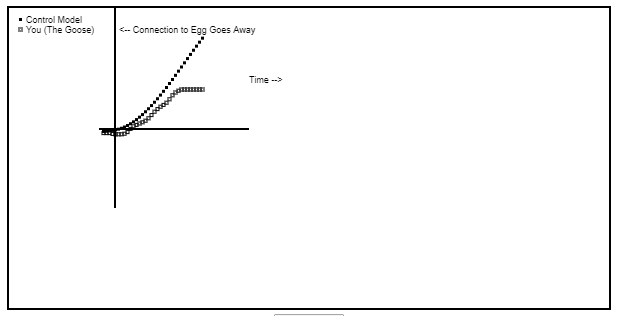
> RM: The Y axis is the position of the mouse, not the cursor. So you are seeing how the mouse moves when it no longer has any effect on the cursor, as was the case with the goose when the egg is removed. The movement of the mouse after the connection to the “egg” – cursor – goes away is equivalent to the eggless movement of the gooses neck after the egg is removed. That is, the movement of the mouse after the vertical line indicating the point where connection to the cursor is lost is an example of an apparent “fixed action pattern”.Â
>
> Â
>
> > ```
> > RY: The graph doesn't seem to reflect my experience. Each run lasts
> >
> > ```
> >
> > about eight seconds and I am able to keep the cursor on the target
> > until about one second from the end, but the graph seems to show the
> > connection disappearing near the beginning.
>
> RM: Yes, the graph shows only a brief part of the trial before the “egg” (the connection of mouse to cursor) is removed (the vertical line). The remained of the graph is the last few seconds of the trial when the mouse had no effect on the cursor – the “fixed action pattern” part.Â
>
> > RY: Why does my response go flat towards the end?
>
> Â RM: A higher order system in you realized the futility of your mouse movements and dismantled the control system that was controlling the cursor. So the mouse just stopped moving; it “flat-lined”.
>
> > ```
> > RM: I've been thinking of writing a paper about "motor control" (arguing
> >
> > ```
> >
> > against) with respect to robotics, so am particularly interested in
> > this at the moment.
> >
> > RY: Have you come across this paper before,
> >
> > [https://www.dropbox.com/s/j9tqpqi7dqfvf7q/Convergent%20Force%20Fields%20Frog.pdf?dl=0](https://urldefense.proofpoint.com/v2/url?u=https-3A__www.dropbox.com_s_j9tqpqi7dqfvf7q_Convergent-2520Force-2520Fields-2520Frog.pdf-3Fdl-3D0&d=DwMDaQ&c=8hUWFZcy2Z-Za5rBPlktOQ&r=-dJBNItYEMOLt6aj_KjGi2LMO_Q8QB-ZzxIZIF8DGyQ&m=nluqepoGYqdhl4txsp-0QT9AucGTUMcWLSHjiR2sVlY&s=-SFBEHP_BdEw9C14MpHKmeAjNRyQmzbUZbBUeuXFX74&e=)
> >
> > ```
> > RY: I've only read the abstract so far, but it seems to be an
> >
> > ```
> >
> > influential paper within robotics of support for “movement
> > primitives.”
> >
> > RY: How would PCT interpret the work described here?
>
> RM: It will take me a while to decipher it. Same is true for the other paper you sent on “movement primitives”. But the PCT interpretation of these “movement primitives”, if they actually exist as consistently produced movement patterns, is that the are controlled perceptual patterns, not controlled movements patterns.
>
> Â BestÂ
>
> Rick
>
> –
> Richard S. MarkenÂ
>
> "Perfection is achieved not when you have nothing more to add, but when you
> have nothing left to take away.�
> Â Â Â Â Â Â Â Â Â Â Â Â Â Â Â Â --Antoine de Saint-Exupery
>
> ```
> RM: Glad you asked. A simple model of
>
> ```
>
> Tinbergen’s original observations of an apparent “fixed action
> pattern” in the graylag goose is shown in my “Fixed Action
> Pattern” demo:Â
>
> [http://www.mindreadings.com/ControlDemo/Goose.html](https://urldefense.proofpoint.com/v2/url?u=http-3A__www.mindreadings.com_ControlDemo_Goose.html&d=DwMDaQ&c=8hUWFZcy2Z-Za5rBPlktOQ&r=-dJBNItYEMOLt6aj_KjGi2LMO_Q8QB-ZzxIZIF8DGyQ&m=nluqepoGYqdhl4txsp-0QT9AucGTUMcWLSHjiR2sVlY&s=Y4XtOd3uRSNxND6KI-iVmKB1HQ3DvWe39MBBIZxvVfE&e=)
---
### Author:  [@MartinT](http://discourse.iapct.org/u/MartinT)
#### Post date: [August 6, 2017, 3:26am UTC](http://discourse.iapct.org/t/side-effects/10438/10 "2017-08-06T03:26:54Z")
[Martin Taylor 2017.08.05.
> [From Rick Marken (2017.08.02.1850)]
```
Likewise, an experimenter doing the Test for the Controlled variable
```
can’t perceive what the subject perceives. That doesn’t mean that
the experiment is pointless. The experimenter can observe how the
subject’s corrections for disturbances act on the subject’s external
environment (which includes the experimenter), and hypothesize what
perception the subject might be controlling by those actions. That’s
what the TCV is supposed to do, after all.
```
If a performer such as a magician (for that is the immediate context
```
of this comment) wants an audience to perceive something such as a
coin disappearing from one place and being found in someone’s ear,
and the audience sits there without changing expression, the
magician may well perceive that the audience did not perceive the
magical effect. But if they show signs of surprise or interest, the
magician may perceive that they did see something unexpected. Maybe
an omniscient God would know whether they did or didn’t, but the
magician was controlling for perceiving that they did, and his
actions have (or have not) brought his perception of what they
perceive to its reference value.
```
I can't perceive another person's perceptions and know that my
```
perceptions are true, any more than I can perceive a chair and know
that I am seeing a chair rather than a hologram of a chair or an
illusory chair.
```

But I can control for perceiving a chair, if it is a chair, to be in
```
a particular place, by acting on what I perceive to be a chair and
being able by my actions to bring my perception of its placement to
be where I want to perceive it.
```
The same goes for controlling my perception of what another person
```
perceives. I can do various things that ought to influence what they
perceive, as when I move the chair, and if the effects I can
perceive correspond to what I expect them to be if the person is
perceiving what I think they are, then I am controlling my
perception of their perception. Of course, I could be wrong. The
person may be being deceptive, and if they are good at it, I would
never know. But I can control my perception of their perception,
whether they are deceptive or not.
```
Suppose I want people to perceive me to be a slob (or a natty
```
dresser). I don’t know what way they do perceive me, but if I show
up at a semi-formal party wearing torn T-shirt and jeans, I expect
that I would be likely to perceive some actions that they would make
if they perceived me to be a slob, but different from what I would
see if they perceived me to be a fashion icon. Likewise, if I show
up at the formal party in top-hat and tails, I would expect some
discernable actions compensating for the disturbances to their
controlled perceptions. They might ask why I dressed that way, for
example. If I show up in a costume similar to that of the other
party-goers, I would expect to see quite different actions again.
```
Yes, I can control my perception of how others perceive me, however
```
they actually see me (something I can never know). And I have been
doing it from earliest infancy. As have you.
```
Martin
```
> **···**
>
> > Martin Taylor (2017.08.01.14.54)
>
> > …
>
> > ```
> > MT: A controlled exoself perception
> >
> > ```
> >
> > is just as much a controlled perception as is the
> > position of a hand picking up a glass of water.
>
> ```
> RM: That's true if the controller can perceive the
>
> ```
>
> exoself perception. I was taking exoself perception to be
> the perceptions that others have of yourself; you can’t
> perceive what others are perceiving about you so you can’t
> control such perceptions.
---
### Author:  [@rsmarken](http://discourse.iapct.org/u/rsmarken)
#### Post date: [August 6, 2017, 7:47pm UTC](http://discourse.iapct.org/t/side-effects/10438/11 "2017-08-06T19:47:37Z")
[From Rick Marken (2017.08.06.1250)]
> **···**
>
> > Martin Taylor 2017.08.05.
>
> > ```
> > MT: Likewise, an experimenter doing the Test for the Controlled variable
> >
> > ```
> >
> > can’t perceive what the subject perceives. That doesn’t mean that
> > the experiment is pointless.
>
> RM: Actually, an experimenter (E) doing the TCV can perceive what the subject (S) perceives. Though they might disagree about what to call it, as in the example of E perceiving the “zig zag pattern” that S is controlling in the description of the “coin game” in B:CP.Â
>
> Â
>
> > ```
> > MT: The experimenter can observe how the
> >
> > ```
> >
> > subject’s corrections for disturbances act on the subject’s external
> > environment (which includes the experimenter), and hypothesize what
> > perception the subject might be controlling by those actions. That’s
> > what the TCV is supposed to do, after all.
>
> RM: What E observes is how S prevents disturbances from affecting the aspect of the environment that E perceives, either via his own perceptual systems, as in the example of the “coin game”, or via instrumentation, as in the example of the “analysis of a rat experiment”, both in the Experimental Methods section of B:CP.Â
>
> Â
>
> > ```
> > MT: If a performer such as a magician (for that is the immediate context
> >
> > ```
> >
> > of this comment) wants an audience to perceive something such as a
> > coin disappearing from one place and being found in someone’s ear,
> > and the audience sits there without changing expression, the
> > magician may well perceive that the audience did not perceive the
> > magical effect. But if they show signs of surprise or interest, the
> > magician may perceive that they did see something unexpected. Maybe
> > an omniscient God would know whether they did or didn’t, but the
> > magician was controlling for perceiving that they did, and his
> > actions have (or have not) brought his perception of what they
> > perceive to its reference value.
>
> RM: Yes, the magician can use her perception of what the audience is doing to infer what the audience is perceiving, as in the TCV. But the magician cannot control _what_ the audience is perceiving. A better way to look at it, I think, is that the magician is taking advantage of the perceptions that she has found audiences to be controlling for. “Misdirection” is a disturbance to these variables, which forces audiences to correct for these disturbances (by changing where they are looking, for example) and prevents them noticing variations in the perceptions that would give away the trick.Â
>
> > ```
> > MT: I can't perceive another person's perceptions and know that my
> >
> > ```
> >
> > perceptions are true,
>
> RM: But using the TCV you can perceive the same thing that another person is perceiving and know that this is truly what the other person is also perceiving with some degree of accuracy.Â
>
> Â
>
> > ```
> > MT: any more than I can perceive a chair and know
> >
> > ```
> >
> > that I am seeing a chair rather than a hologram of a chair or an
> > illusory chair.
>
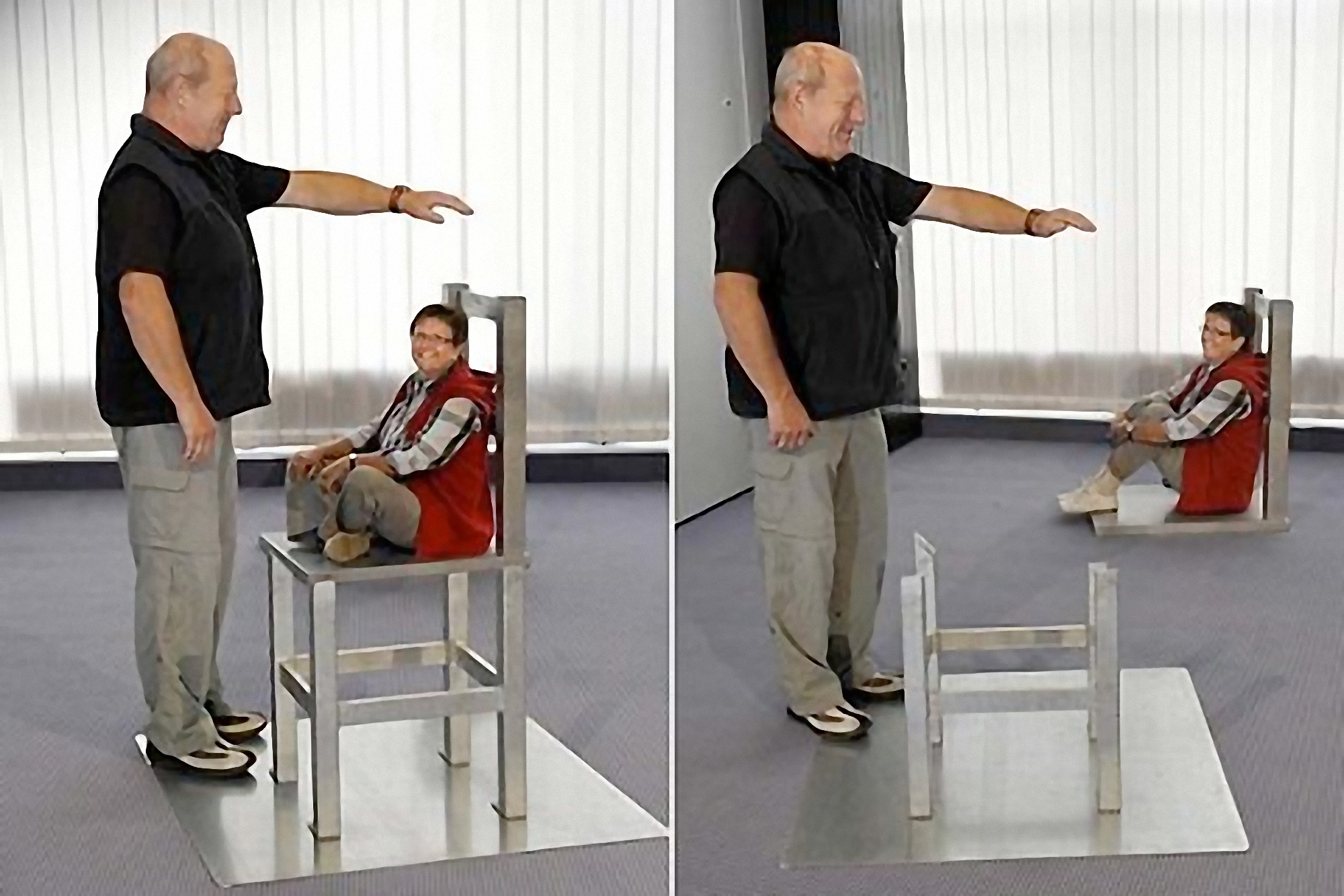
> RM: But you can test to determine whether the chair you perceive is illusory by changing your orientation relative to it, as you show in the pictures below.Â
>
> > ```
> > MT: The same goes for controlling my perception of what another person
> >
> > ```
> >
> > perceives. I can do various things that ought to influence what they
> > perceive, as when I move the chair, and if the effects I can
> > perceive correspond to what I expect them to be if the person is
> > perceiving what I think they are, then I am controlling my
> > perception of their perception.
>
> RM: But you are not really controlling _what_ they perceive, but you are forcing them act in a way that keeps the perception in its reference state. So in a way I guess you are controlling their perceptions in the sense that you are forcing them to vary the lower level perceptions that are the means of controlling the perceptual variable you are disturbing.Â
>
> > ```
> > MT: Yes, I can control my perception of how others perceive me, however
> >
> > ```
> >
> > they actually see me (something I can never know). And I have been
> > doing it from earliest infancy. As have you.
>
> RM: I think you can control your own perception of how people react to you. And I think you can make pretty good inferences about what aspects of you other people are perceiving. But I don’t think you can control _what_ people are perceiving, though, like the magician, you can control the means used to control the perceptions you disturb.Â
>
> ```
> RM: That's true if the controller can perceive the
>
> ```
>
> exoself perception. I was taking exoself perception to be
> the perceptions that others have of yourself; you can’t
> perceive what others are perceiving about you so you can’t
> control such perceptions.
>
> RM: But this is all rather tangential to the topic I am most interested in; the fact that the control model of behavior shows that many of the aspects of what have been called “behaviors” are irrelevant side effects of controlling. I’m asking for other examples of “side -effects” of behavior than those I mentioned in earlier posts:Â fixed action patterns, linear optical trajectories, invariant movement velocity profiles, the power law of movement, the matching law in operant behavior, serial position curve in memory. Any others?Â
>
> BestÂ
>
> Rick
>
> –
> Richard S. MarkenÂ
>
> "Perfection is achieved not when you have nothing more to add, but when you
> have nothing left to take away.�
> Â Â Â Â Â Â Â Â Â Â Â Â Â Â Â Â --Antoine de Saint-Exupery
---
### Author:  [@bnhpct](http://discourse.iapct.org/u/bnhpct)
#### Post date: [August 13, 2017, 4:17am UTC](http://discourse.iapct.org/t/side-effects/10438/12 "2017-08-13T04:17:12Z")
[Bruce Nevin (2017.08.12.21:13 PDT)]
My control of my perceptions of how I imagine that others perceive me is not a side-effect of control, it is control of variables that are important for social animals to control.
You may have missed Martin Taylor 2017.07.29.11.37 and the preceding discussion.
And yes of course there are also unintended side effects that others perceive as among our attributes.

> **···**
>
> On Sun, Aug 6, 2017 at 12:47 PM, Richard Marken [rsmarken@gmail.com](mailto:rsmarken@gmail.com) wrote:
>
> > [From Rick Marken (2017.08.06.1250)]
>
> > Martin Taylor 2017.08.05.
>
> > ```
> > MT: Likewise, an experimenter doing the Test for the Controlled variable
> >
> > ```
> >
> > can’t perceive what the subject perceives. That doesn’t mean that
> > the experiment is pointless.
>
> RM: Actually, an experimenter (E) doing the TCV can perceive what the subject (S) perceives. Though they might disagree about what to call it, as in the example of E perceiving the “zig zag pattern” that S is controlling in the description of the “coin game” in B:CP.Â
>
> Â
>
> > ```
> > MT: The experimenter can observe how the
> >
> > ```
> >
> > subject’s corrections for disturbances act on the subject’s external
> > environment (which includes the experimenter), and hypothesize what
> > perception the subject might be controlling by those actions. That’s
> > what the TCV is supposed to do, after all.
>
> RM: What E observes is how S prevents disturbances from affecting the aspect of the environment that E perceives, either via his own perceptual systems, as in the example of the “coin game”, or via instrumentation, as in the example of the “analysis of a rat experiment”, both in the Experimental Methods section of B:CP.Â
>
> Â
>
> > ```
> > MT: If a performer such as a magician (for that is the immediate context
> >
> > ```
> >
> > of this comment) wants an audience to perceive something such as a
> > coin disappearing from one place and being found in someone’s ear,
> > and the audience sits there without changing expression, the
> > magician may well perceive that the audience did not perceive the
> > magical effect. But if they show signs of surprise or interest, the
> > magician may perceive that they did see something unexpected. Maybe
> > an omniscient God would know whether they did or didn’t, but the
> > magician was controlling for perceiving that they did, and his
> > actions have (or have not) brought his perception of what they
> > perceive to its reference value.
>
> RM: Yes, the magician can use her perception of what the audience is doing to infer what the audience is perceiving, as in the TCV. But the magician cannot control _what_ the audience is perceiving. A better way to look at it, I think, is that the magician is taking advantage of the perceptions that she has found audiences to be controlling for. “Misdirection” is a disturbance to these variables, which forces audiences to correct for these disturbances (by changing where they are looking, for example) and prevents them noticing variations in the perceptions that would give away the trick.Â
>
> > ```
> > MT: I can't perceive another person's perceptions and know that my
> >
> > ```
> >
> > perceptions are true,
>
> RM: But using the TCV you can perceive the same thing that another person is perceiving and know that this is truly what the other person is also perceiving with some degree of accuracy.Â
>
> Â
>
> > ```
> > MT: any more than I can perceive a chair and know
> >
> > ```
> >
> > that I am seeing a chair rather than a hologram of a chair or an
> > illusory chair.
>
> RM: But you can test to determine whether the chair you perceive is illusory by changing your orientation relative to it, as you show in the pictures below.Â
>
> > ```
> > MT: The same goes for controlling my perception of what another person
> >
> > ```
> >
> > perceives. I can do various things that ought to influence what they
> > perceive, as when I move the chair, and if the effects I can
> > perceive correspond to what I expect them to be if the person is
> > perceiving what I think they are, then I am controlling my
> > perception of their perception.
>
> RM: But you are not really controlling _what_ they perceive, but you are forcing them act in a way that keeps the perception in its reference state. So in a way I guess you are controlling their perceptions in the sense that you are forcing them to vary the lower level perceptions that are the means of controlling the perceptual variable you are disturbing.Â
>
> > ```
> > MT: Yes, I can control my perception of how others perceive me, however
> >
> > ```
> >
> > they actually see me (something I can never know). And I have been
> > doing it from earliest infancy. As have you.
>
> RM: I think you can control your own perception of how people react to you. And I think you can make pretty good inferences about what aspects of you other people are perceiving. But I don’t think you can control _what_ people are perceiving, though, like the magician, you can control the means used to control the perceptions you disturb.Â
>
> ```
> RM: That's true if the controller can perceive the
>
> ```
>
> exoself perception. I was taking exoself perception to be
> the perceptions that others have of yourself; you can’t
> perceive what others are perceiving about you so you can’t
> control such perceptions.
>
> RM: But this is all rather tangential to the topic I am most interested in; the fact that the control model of behavior shows that many of the aspects of what have been called “behaviors” are irrelevant side effects of controlling. I’m asking for other examples of “side -effects” of behavior than those I mentioned in earlier posts:Â fixed action patterns, linear optical trajectories, invariant movement velocity profiles, the power law of movement, the matching law in operant behavior, serial position curve in memory. Any others?Â
>
> BestÂ
>
> Rick
>
> –
> Richard S. MarkenÂ
>
> "Perfection is achieved not when you have nothing more to add, but when you
> have nothing left to take away.�
> Â Â Â Â Â Â Â Â Â Â Â Â Â Â Â Â --Antoine de Saint-Exupery
---
### Author:  [@rsmarken](http://discourse.iapct.org/u/rsmarken)
#### Post date: [August 13, 2017, 5:56pm UTC](http://discourse.iapct.org/t/side-effects/10438/13 "2017-08-13T17:56:48Z")
[From Rick Marken (2017.08.13.1055)]
> **···**
>
> RM: John Kirkland was kind enough to answer my request in a private post that he said I could reply on the net. John begins with a list of what I take to be other examples of “side effects”:Â
>
> > Schedules of reinforcement
> > behavioural analyses
> > operant conditioning,imprinting
> > critical phases
> > neural networks
> > machine learning
> > S-R analyses
> > evidence/facts (BTW, I do savour that oxymoron, “the fact of perception”)
> > science, as magic that works (Vonnegut)
>
> RM: These suggestions make me realize that the first step here should be defining what is meant by “side effects”. None of the the items listed above are what I would call “side effects” of control.  “Schedules of reinforcement”, for example, are a component of the feedback connection between an organism’s output (key presses, for example) and its inputs. The other entries refer to things that are too general to qualify as what I think of as “side effects” of contorl.Â
>
> RM: My definition of “side effects” is as follows: All effects of the actions of a control system that do not affect the state of the variable that is under control. Another term for this is “irrelevant side effects” since these are observable effects of control actions that are irrelevant to keeping the controlled variable under control. A rather clear example of such “irrelevant side effects” can be seen in my “Mind Reading” demo ([www.mindreadings.com/ControlDemo/Mindread.html](http://www.mindreadings.com/ControlDemo/Mindread.html)). When you are controlling the position of one of the avatars your mouse movements are also having an effect on the other two. The movements of these two uncontrolled avatars are, thus, irrelevant side effects of the actions (mouse movements) that are keeping the controlled avatar under control.Â
>
> RM: Another nice example of irrelevant side effects of control is demonstrated in teh  “Control Blindness” paper (Willett, Marken,
> Parker& Mansell(2017) Control Blindness: Why
> People Can Make Incorrect Inferences about the Intentions of Others, _Attention, Perception & Performance_,
> doi:10.3758/s13414-016-1268-3).The irrelevant side effect is the _pattern_ of movements that are made as a person acts to keep the knot connecting two rubber bands over a target dot. It’s a little tougher to see that the pattern of movements is a side-effect of control actions in this example since that pattern of actions is the exact mirror of the pattern of disturbances. So it seems like the pattern of actions its – what some people saw as two kangaroos boxing – could be considered the action that keeps the knot on target. But a model of the behavior in this situation shows that the only relevant control action is the instantaneous movement of the finger in the x and y dimensions to  counter the instantaneous disturbances to the position of the knot in those dimensions. The pattern that resulted from those actions is not part of the model; it is an irrelevant side effect of the control actions.Â
>
> RM: So given the above definition of irrelevant side effects of control, can anyone think of other examples of such side effects besides those I’ve already mentioned.
>
> BestÂ
>
> Rick
>
> –
> Richard S. MarkenÂ
>
> "Perfection is achieved not when you have nothing more to add, but when you
> have nothing left to take away.�
> Â Â Â Â Â Â Â Â Â Â Â Â Â Â Â Â --Antoine de Saint-Exupery
>
> RM: Â I’m asking for other examples of “side -effects” of behavior than those I mentioned in earlier posts:Â fixed action patterns, linear optical trajectories, invariant movement velocity profiles, the power law of movement, the matching law in operant behavior, serial position curve in memory. Any others?Â
---
### Author:  [@rsmarken](http://discourse.iapct.org/u/rsmarken)
#### Post date: [August 13, 2017, 10:17pm UTC](http://discourse.iapct.org/t/side-effects/10438/14 "2017-08-13T22:17:23Z")
[From Rick Marken (2017.08.13.1515)]

> **···**
>
> > Bruce Nevin (2017.08.12.21:13 PDT)–
>
> > BN: My control of my perceptions of how I imagine that others perceive me is not a side-effect of control, it is control of variables that are important for social animals to control.
>
> RM: I’m having difficulty answering this because I don’t know what you mean by “perceptions of how I imagine that others perceive me”. I don’t know what it means to perceive how you imagine others to perceive you.Â
>
> RM: I think what you might mean is that you control certain perceptions as the means of getting people to perceive you in a particular way. And when you do this, you are imagining how it makes people feel about you. For example, you can control certain proprioceptive perceptions in your mouth to produce what you know will be a smile when in the presence of another person. You do this in the hopes of getting the other person to see that you are friendly. That is, you imagine you will be perceived as friendly if smile.Â
>
> RM: The smile itself is actually a side effect of controlling the proprioceptive perceptions in your mouth because you can’t see it (unless you are looking in a mirror). The other person’s perception of you as friendly (or not) can also be considered a side effect of your control of the proprioceptive perceptions in your mouth since you cannot perceive the person’s perception of you. However, you can perceive (and, thus, control) what the other person does. So if you are controlling the proprioceptive perceptions in your mouth as the means of getting the other person to smile as well, then their smile is an intended effect (and not a side effect) of your controlling. Of course, when the other person smiles in response to your smile, you can _imagine_ that the other person is perceiving you are being friendly. But this is just an imagined perception, which may be true (correspond to what is actually going on) or not. The person may be smiling in response to your smile while perceiving you as a potential enemy, for example.Â
>
> BestÂ
>
> Rick
>
> Â
>
> >
>
> > You may have missed Martin Taylor 2017.07.29.11.37 and the preceding discussion.
>
> >
>
> > And yes of course there are also unintended side effects that others perceive as among our attributes.
>
> –
> Richard S. MarkenÂ
>
> "Perfection is achieved not when you have nothing more to add, but when you
> have nothing left to take away.�
> Â Â Â Â Â Â Â Â Â Â Â Â Â Â Â Â --Antoine de Saint-Exupery
>
> On Sun, Aug 6, 2017 at 12:47 PM, Richard Marken [rsmarken@gmail.com](mailto:rsmarken@gmail.com) wrote:
>
> > [From Rick Marken (2017.08.06.1250)]
>
> > Martin Taylor 2017.08.05.
>
> > ```
> > MT: Likewise, an experimenter doing the Test for the Controlled variable
> >
> > ```
> >
> > can’t perceive what the subject perceives. That doesn’t mean that
> > the experiment is pointless.
>
> RM: Actually, an experimenter (E) doing the TCV can perceive what the subject (S) perceives. Though they might disagree about what to call it, as in the example of E perceiving the “zig zag pattern” that S is controlling in the description of the “coin game” in B:CP.Â
>
> Â
>
> > ```
> > MT: The experimenter can observe how the
> >
> > ```
> >
> > subject’s corrections for disturbances act on the subject’s external
> > environment (which includes the experimenter), and hypothesize what
> > perception the subject might be controlling by those actions. That’s
> > what the TCV is supposed to do, after all.
>
> RM: What E observes is how S prevents disturbances from affecting the aspect of the environment that E perceives, either via his own perceptual systems, as in the example of the “coin game”, or via instrumentation, as in the example of the “analysis of a rat experiment”, both in the Experimental Methods section of B:CP.Â
>
> Â
>
> > ```
> > MT: If a performer such as a magician (for that is the immediate context
> >
> > ```
> >
> > of this comment) wants an audience to perceive something such as a
> > coin disappearing from one place and being found in someone’s ear,
> > and the audience sits there without changing expression, the
> > magician may well perceive that the audience did not perceive the
> > magical effect. But if they show signs of surprise or interest, the
> > magician may perceive that they did see something unexpected. Maybe
> > an omniscient God would know whether they did or didn’t, but the
> > magician was controlling for perceiving that they did, and his
> > actions have (or have not) brought his perception of what they
> > perceive to its reference value.
>
> RM: Yes, the magician can use her perception of what the audience is doing to infer what the audience is perceiving, as in the TCV. But the magician cannot control _what_ the audience is perceiving. A better way to look at it, I think, is that the magician is taking advantage of the perceptions that she has found audiences to be controlling for. “Misdirection” is a disturbance to these variables, which forces audiences to correct for these disturbances (by changing where they are looking, for example) and prevents them noticing variations in the perceptions that would give away the trick.Â
>
> > ```
> > MT: I can't perceive another person's perceptions and know that my
> >
> > ```
> >
> > perceptions are true,
>
> RM: But using the TCV you can perceive the same thing that another person is perceiving and know that this is truly what the other person is also perceiving with some degree of accuracy.Â
>
> Â
>
> > ```
> > MT: any more than I can perceive a chair and know
> >
> > ```
> >
> > that I am seeing a chair rather than a hologram of a chair or an
> > illusory chair.
>
> RM: But you can test to determine whether the chair you perceive is illusory by changing your orientation relative to it, as you show in the pictures below.Â
>
> > ```
> > MT: The same goes for controlling my perception of what another person
> >
> > ```
> >
> > perceives. I can do various things that ought to influence what they
> > perceive, as when I move the chair, and if the effects I can
> > perceive correspond to what I expect them to be if the person is
> > perceiving what I think they are, then I am controlling my
> > perception of their perception.
>
> RM: But you are not really controlling _what_ they perceive, but you are forcing them act in a way that keeps the perception in its reference state. So in a way I guess you are controlling their perceptions in the sense that you are forcing them to vary the lower level perceptions that are the means of controlling the perceptual variable you are disturbing.Â
>
> > ```
> > MT: Yes, I can control my perception of how others perceive me, however
> >
> > ```
> >
> > they actually see me (something I can never know). And I have been
> > doing it from earliest infancy. As have you.
>
> RM: I think you can control your own perception of how people react to you. And I think you can make pretty good inferences about what aspects of you other people are perceiving. But I don’t think you can control _what_ people are perceiving, though, like the magician, you can control the means used to control the perceptions you disturb.Â
>
> ```
> RM: That's true if the controller can perceive the
>
> ```
>
> exoself perception. I was taking exoself perception to be
> the perceptions that others have of yourself; you can’t
> perceive what others are perceiving about you so you can’t
> control such perceptions.
>
> RM: But this is all rather tangential to the topic I am most interested in; the fact that the control model of behavior shows that many of the aspects of what have been called “behaviors” are irrelevant side effects of controlling. I’m asking for other examples of “side -effects” of behavior than those I mentioned in earlier posts:Â fixed action patterns, linear optical trajectories, invariant movement velocity profiles, the power law of movement, the matching law in operant behavior, serial position curve in memory. Any others?Â
>
> BestÂ
>
> Rick
>
> –
> Richard S. MarkenÂ
>
> "Perfection is achieved not when you have nothing more to add, but when you
> have nothing left to take away.�
> Â Â Â Â Â Â Â Â Â Â Â Â Â Â Â Â --Antoine de Saint-Exupery
---
### Author:  [@AngusJ](http://discourse.iapct.org/u/AngusJ)
#### Post date: [August 14, 2017, 3:44pm UTC](http://discourse.iapct.org/t/side-effects/10438/15 "2017-08-14T15:44:17Z")
[Angus Jenkinson: 2017-08-11, 12.59 UK)
RM: My definition of “side effects” is as follows: All effects of the actions of a control system that do not affect the state
of the variable that is under control. Another term for this is “irrelevant side effects” since these are observable effects of control actions that are irrelevant to keeping the controlled variable under control.
Rick, nice initial definition: These are often called
_unintended consequences_ in sociology literature, see Anthony Giddens for extensive treatment. They are very much not irrelevant to the social situation; indeed it is a major influencer of repetitive patterns in society.
> **···**
>
> …………………………………………………………………………….
>
> Angus Jenkinson
>
> On 13/08/2017, 18:57, “Richard Marken” [rsmarken@gmail.com](mailto:rsmarken@gmail.com) wrote:
>
> RM: My definition of “side effects” is as follows: All effects of the actions of a control system that do not affect the state of the variable that is under
> control. Another term for this is “irrelevant side effects” since these are observable effects of control actions that are irrelevant to keeping the controlled variable under control.
---
### Author:  [@rsmarken](http://discourse.iapct.org/u/rsmarken)
#### Post date: [August 14, 2017, 6:50pm UTC](http://discourse.iapct.org/t/side-effects/10438/16 "2017-08-14T18:50:56Z")
[From Rick Marken (2017.08.14.1150)]
> **···**
>
> > Angus Jenkinson (2017-08-11, 12.59 UK)
>
> > Â
>
> > RM: My definition of “side effects” is as follows: All effects of the actions of a control system that do not affect the state
> > of the variable that is under control. Another term for this is “irrelevant side effects” since these are observable effects of control actions that are irrelevant to keeping the controlled variable under control.
>
> > Â
>
> > AJ: Rick, nice initial definition: These are often called
> > _unintended consequences_ in sociology literature, see Anthony Giddens for extensive treatment.
>
> RM: Yes, exactly. They are called that in everyday life as well. When they have unfortunate effects on others they are also called “accidents”. One of my first papers on PCT (at that time just called “control theory”) was about how control theory allows you to formally distinguish intentional from accidental consequences of action:Â Marken,
> R. S. (1982) Intentional and Accidental Behavior: A Control Theory Analysis. _Psychological Reports_, 50, 647-650.
>
> > AJ: They are very much not irrelevant to the social situation; indeed it is a major influencer of repetitive patterns in society.
>
> RM: You bet! PCT would say that they are a major source of unintended disturbances to variables others are controlling. Lawyers would have little to do without them;-)
>
> BestÂ
>
> Rick
>
> Â
>
> > ………â€â€¦â€¦……………………………………………………….………….
>
> > Angus Jenkinson
>
> > Â
>
> > Â
>
> > Â
>
> > On 13/08/2017, 18:57, “Richard Marken” [rsmarken@gmail.com](mailto:rsmarken@gmail.com) wrote:
>
> > Â
>
> > RM: My definition of “side effects” is as follows: All effects of the actions of a control system that do not affect the state of the variable that is under
> > control. Another term for this is “irrelevant side effects” since these are observable effects of control actions that are irrelevant to keeping the controlled variable under control.
>
> –
> Richard S. MarkenÂ
>
> "Perfection is achieved not when you have nothing more to add, but when you
> have nothing left to take away.�
> Â Â Â Â Â Â Â Â Â Â Â Â Â Â Â Â --Antoine de Saint-Exupery
---
### Author:  [@MartinT](http://discourse.iapct.org/u/MartinT)
#### Post date: [August 18, 2017, 9:33pm UTC](http://discourse.iapct.org/t/side-effects/10438/17 "2017-08-18T21:33:38Z")
[Martin Taylor 2017.08.18.16.20]
```
This isn't a response to any particular message, but a musing on
```
side-effects in the general scheme of things.
```
I start with a definition that I hope is non-controversial: A
```
side-effect of control is an effect that was not on the perception
being controlled.
```
There are wider usages of "side-effect" that don't involve control
```
at all, such as “The bow wave is a side-effect of the ship’s motion
through the water.” The ship’s motion is a cause, the bow-wave an
effect, but why would someone say it was a “side-effect”. I think
the reason is based in the speaker’s perception that it would make
no (or not much) difference to the ship’s progress if it could make
its way through the water without creating a bow wave.
```
But I'm not at the moment interested in this wider use of
```
“side-effect”, except to say that the side-effects of control have
the same quality of being irrelevant to the primary effect, while
being caused by whatever action produced the primary effect. An
observer cannot always tell what is a side-effect of the actions
involved in control, and what is a direct effect, either being a
direct cause of change in the perception being controlled or itself
being the controlled perception. Sometimes the observer can make a
pretty reliable guess, but not always.
```
For a historical example, consider the death of Thomas à Beckett,
```
Archbishop of Canterbury, who grew up as a great friend and
companion of the boy who became King Henry II. Henry appointed
Thomas as head of the Church in England, but was frustrated when
Thomas acted for the Church when the Church had interests that
conflicted with Henry’s. As the story goes, at a banquet (presumably
a rather drunken one), Henry exclaimed “Will no-one rid me of this
troublesome priest” or words to that effect, whereupon four knights
left the banquet and went to the Cathedral to murder Beckett. Now
was Beckett’s death a side-effect of Henry’s action or did Henry
control for Beckett to be dead? That was not determined in the 12th
century, and we can’t determine it now. But we can say that his
death was not a side-effect of the actions of the knights, who were
presumably controlling for pleasing the King by cleaving Thomas’s
skull.
```
One might presume that the subsequent excommunication of Henry by
```
the Pope was a side-effect for the knights, and for Henry, because
you would think none of them did what they did in order for this to
happen. I is not unreasonable to suppose that rival Kings (such as
the French) might have perceived England to be weak and to have
launched attacks on English domains in what is now France, which
would have been a rather large disturbance to Henry’s perceptions. I
don’t know my European history well enough to know whether they
actually did.
```
This little example illustrates several things, that one
```
controller’s side-effect can be another’s main effect, that actions
can have influences that last for a very long time, that an action
(by Henry) that causes a disturbance to another’s perception (the
knights), whose control action has side-effects that disturb others’
perceptions (the Pope, among many others) whose control actions
disturb the perceptions of the first actor. In other words,
side-effects can ripple through very extensive networks of
controllers and create feedback loops that are hard to follow or
whose existence would not easily have been predicted.
```
The example also shows that the notion of "side-effect" cannot be
```
considered in the abstract. You can’t always observe something
influencing something else and say definitively that the result was
or was not a side-effect of control. Maybe Henry deliberately said
what he did in order for Thomas to be killed.
```
Some times it's pretty obvious. Consider the power-law relation
```
between velocity and curvature that has been so contentious in
respect of whether it constitutes a behavioural illusion. Whether it
is a behavioural illusion or not, it is highly unlikely that any of
the controllers that have produced behaviour that conforms to it
were actually controlling for their velocity of movement to conform
to the power law. It was almost certainly a side-effect every time
it has been observed in an experiment, because it is very unlikely
that any of the actors was capable of perceiving the statistical
relationship between velocity and curvature. They were all
controlling some quite different perception.
```
If it is not possible to say in the abstract that something is a
```
side-effect, what else do we need if we are to make that assertion?
I think we need to look in the other direction, and go back to the
definition: “A side-effect of control is an effect that was _ **not** _
on the perception being controlled.” I highlight the “not”, because
although to say something “is” X, that statement restricts the world
of possibility, whereas to say something “is not” X is to leave open
the possibility that it is anything else in the whole wide world.
It’s the difference between being confined in a prison cell and
being on the other side of the bars. So what we must, I think, say
is that a particular effect caused by a certain action is or is not
a side-effect of controlling a particular perception. Without
specifying the perception, at least as a category, to say something
is a side-effect is to make an unsupportable claim.
```
Consider the cries of an infant. Whatever their effect, those sound
```
waves are unlikely to directly influence the baby’s perceptions
other than the perception of the cry itself. But it might disturb a
perception of the baby’s comfort level in its mother, whose control
action might be to feed it. The cry would have been an action that
controlled the baby’s hunger perception, and the mother’s action in
feeding it would have controlled her perception of the baby’s level
of distress. It would be hard to say that either of these effects
are side-effects, though neither the baby’s nor the mother’s actions
directly influenced the actor’s perceptions. The effects they had
were on the actions of the other, but through the actions of the
other each controlled their own perception.
```
Side-effects seem easy in principle, but like so much else when you
```
look closely, they are not so easy in practice, at least not in the
real, complex world full of myriads of other controllers.
```
Just musing.
Martin
```
---
### Author:  [@rsmarken](http://discourse.iapct.org/u/rsmarken)
#### Post date: [August 19, 2017, 7:59pm UTC](http://discourse.iapct.org/t/side-effects/10438/18 "2017-08-19T19:59:10Z")
[From Rick Marken (2017.08.19.1255)]
> **···**
>
> > Martin Taylor (2017.08.18.16.20)–
> >
> > ```
> > MT: This isn't a response to any particular message, but a musing on
> >
> > ```
> >
> > side-effects in the general scheme of things.
> >
> > ```
> > MT: I start with a definition that I hope is non-controversial: A
> >
> > ```
> >
> > side-effect of control is an effect that was not on the perception
> > being controlled.
>
> RM: Yes, it’s the same as the one I used: “All effects of the actions of a control system that do not affect the state of the variable that is under control.”
>
> Â
>
> > ```
> > MT: An
> >
> > ```
> >
> > observer cannot always tell what is a side-effect of the actions
> > involved in control, and what is a direct effect, either being a
> > direct cause of change in the perception being controlled or itself
> > being the controlled perception. Sometimes the observer can make a
> > pretty reliable guess, but not always.
>
> RM: Right. In order to determine with certainly whether or not an effect of a person’s actions is a side effect (an unintended consequence of actions) Â you have to do the formal Test for the Controlled Variable (TCV) to determine whether the effect is controlled (intended).Â
>
> > ```
> > MT: For a historical example, consider the death of Thomas à Beckett,
> >
> > ```
> >
> > Archbishop of Canterbury…
> >
> > ```
> > MT: The example also shows that the notion of "side-effect" cannot be
> >
> > ```
> >
> > considered in the abstract. You can’t always observe something
> > influencing something else and say definitively that the result was
> > or was not a side-effect of control.Â
>
> RM: True. You can only determine whether an observed consequence of an organism’s actions is a side effect by testing under laboratory conditions.
>
> Â
>
> > ```
> > MT: If it is not possible to say in the abstract that something is a
> >
> > ```
> >
> > side-effect, what else do we need if we are to make that assertion?
>
> RM: All that is needed is the TCV. A side effect is simply an uncontrolled (unintended) result of an organism’s actions; an unintentional behavior. The TCV makes it possible to scientifically discriminate intentional from unintentional (accidental) behaviors.
>
> Â
>
> > ```
> > MT: I think we need to look in the other direction, and go back to the
> >
> > ```
> >
> > definition: “A side-effect of control is an effect that was _ **not** _
> > on the perception being controlled.” I highlight the “not”, because
> > although to say something “is” X, that statement restricts the world
> > of possibility, whereas to say something “is not” X is to leave open
> > the possibility that it is anything else in the whole wide world…
> >
> > ```
> > MT: Consider the cries of an infant. Whatever their effect, those sound
> >
> > ```
> >
> > waves are unlikely to directly influence the baby’s perceptions
> > other than the perception of the cry itself. But it might disturb a
> > perception of the baby’s comfort level in its mother, whose control
> > action might be to feed it. The cry would have been an action that
> > controlled the baby’s hunger perception, and the mother’s action in
> > feeding it would have controlled her perception of the baby’s level
> > of distress. It would be hard to say that either of these effects
> > are side-effects, though neither the baby’s nor the mother’s actions
> > directly influenced the actor’s perceptions. The effects they had
> > were on the actions of the other, but through the actions of the
> > other each controlled their own perception.
>
> RM: This is a difficult case only because the baby itself can’t yet control on its for things like getting fed, keeping warm and staying dry. What results it gets are gotten via a caretaker who is controlling for trying to provide the baby with what he thinks it wants when it cries. So the baby is not really controlling any of these variables and all can be considered a side effect of it’s actions
>
> Â
>
> > ```
> > MT: Side-effects seem easy in principle, but like so much else when you
> >
> > ```
> >
> > look closely, they are not so easy in practice, at least not in the
> > real, complex world full of myriads of other controllers.
>
> RM: Side effects are clearly and precisely defined in the PCT. They are defined as you and I defined them:  All effects of the actions of a control system that do not affect the state of the variable that is under control. What the “real, complex world full of myriads of other controllers” can make difficult is the identification the side-effects (it also makes it difficult to identify effects – controlled variables – as well). But this is true in any science. That’s why laboratories were invented. It would have been tough, for example, to determine that objects accelerate linearly as they fall by watching a tennis match.Â
>
> > MT: Just musing.
>
> RM: Again, my goal in pointing to the existence of “side-effects” of behavior (control) is that this concept  is unique to PCT, a theory that sees behavior as a control process. Conventional psychology sees behavior as “a show put on for the benefit of the observer” so anything organisms are seen to be doing is their behavior. Behaviors are what psychologistst “operationally define” them to be, where an “operational definition” of behavior is a description of how to measure it. There is no concept that what is being measured as behavior – such as the instantaneous velocity and curvature of a curved movement – might be an unintended side-effect of what the organisms is doing intentionally.Â
>
> Â Best
>
> Rick
>
> > ```
> > Martin
> >
> > ```
>
> –
> Richard S. MarkenÂ
>
> "Perfection is achieved not when you have nothing more to add, but when you
> have nothing left to take away.�
> Â Â Â Â Â Â Â Â Â Â Â Â Â Â Â Â --Antoine de Saint-Exupery
---
### Author:  [@FredNickols](http://discourse.iapct.org/u/FredNickols)
#### Post date: [August 19, 2017, 8:29pm UTC](http://discourse.iapct.org/t/side-effects/10438/19 "2017-08-19T20:29:14Z")
[From Fred Nickols (2017.08.19.1625 ET)]
FWIW, I think it’s worth drawing a distinction between “side effects� and “unintended side effects.�
In the ordinary, everyday world of mere mortals, we are frequently surprised by some of the side effects of our actions and we generally label them as “unintended consequences.â€? However, in many cases we are acutely aware of the side effects of our actions, even though they don’t tie to the variable we are trying to control. When we reduce staff, for example, staffing levels and staff costs are the variables of interest. In reducing staff, we also know we are, to various degrees, creating financial hardships for those being let go, incurring resentment, perhaps triggering the loss of a home and, in some cases, even a divorce. These are clearly the side effects of our action of reducing staff yet, they are not our primary aim. As Ollie North’s T-shirt had it, “S…t Happens.â€?
Fred Nickols
> **···**
>
> **From:** Richard Marken [[mailto:rsmarken@gmail.com](mailto:rsmarken@gmail.com)]
> **Sent:** Saturday, August 19, 2017 3:59 PM
> **To:** csgnet@lists.illinois.edu
> **Subject:** Re: Side-effects
>
> [From Rick Marken (2017.08.19.1255)]
>
> > Martin Taylor (2017.08.18.16.20)–
> >
> > MT: This isn’t a response to any particular message, but a musing on side-effects in the general scheme of things.
> >
> > MT: I start with a definition that I hope is non-controversial: A side-effect of control is an effect that was not on the perception being controlled.
>
> RM: Yes, it’s the same as the one I used: “All effects of the actions of a control system that do not affect the state of the variable that is under control.”
>
> > MT: An observer cannot always tell what is a side-effect of the actions involved in control, and what is a direct effect, either being a direct cause of change in the perception being controlled or itself being the controlled perception. Sometimes the observer can make a pretty reliable guess, but not always.
>
> RM: Right. In order to determine with certainly whether or not an effect of a person’s actions is a side effect (an unintended consequence of actions) you have to do the formal Test for the Controlled Variable (TCV) to determine whether the effect is controlled (intended).
>
> > MT: For a historical example, consider the death of Thomas à Beckett, Archbishop of Canterbury…
> >
> > MT: The example also shows that the notion of “side-effect” cannot be considered in the abstract. You can’t always observe something influencing something else and say definitively that the result was or was not a side-effect of control.
>
> RM: True. You can only determine whether an observed consequence of an organism’s actions is a side effect by testing under laboratory conditions.
>
> > MT: If it is not possible to say in the abstract that something is a side-effect, what else do we need if we are to make that assertion?
>
> RM: All that is needed is the TCV. A side effect is simply an uncontrolled (unintended) result of an organism’s actions; an unintentional behavior. The TCV makes it possible to scientifically discriminate intentional from unintentional (accidental) behaviors.
>
> > MT: I think we need to look in the other direction, and go back to the definition: “A side-effect of control is an effect that was _ **not** _ on the perception being controlled.” I highlight the “not”, because although to say something “is” X, that statement restricts the world of possibility, whereas to say something “is not” X is to leave open the possibility that it is anything else in the whole wide world…
> >
> > MT: Consider the cries of an infant. Whatever their effect, those sound waves are unlikely to directly influence the baby’s perceptions other than the perception of the cry itself. But it might disturb a perception of the baby’s comfort level in its mother, whose control action might be to feed it. The cry would have been an action that controlled the baby’s hunger perception, and the mother’s action in feeding it would have controlled her perception of the baby’s level of distress. It would be hard to say that either of these effects are side-effects, though neither the baby’s nor the mother’s actions directly influenced the actor’s perceptions. The effects they had were on the actions of the other, but through the actions of the other each controlled their own perception.
>
> RM: This is a difficult case only because the baby itself can’t yet control on its for things like getting fed, keeping warm and staying dry. What results it gets are gotten via a caretaker who is controlling for trying to provide the baby with what he thinks it wants when it cries. So the baby is not really controlling any of these variables and all can be considered a side effect of it’s actions
>
> > MT: Side-effects seem easy in principle, but like so much else when you look closely, they are not so easy in practice, at least not in the real, complex world full of myriads of other controllers.
>
> RM: Side effects are clearly and precisely defined in the PCT. They are defined as you and I defined them: All effects of the actions of a control system that do not affect the state of the variable that is under control. What the “real, complex world full of myriads of other controllers” can make difficult is the identification the side-effects (it also makes it difficult to identify effects – controlled variables – as well). But this is true in any science. That’s why laboratories were invented. It would have been tough, for example, to determine that objects accelerate linearly as they fall by watching a tennis match.
>
> > MT: Just musing.
>
> RM: Again, my goal in pointing to the existence of “side-effects” of behavior (control) is that this concept is unique to PCT, a theory that sees behavior as a control process. Conventional psychology sees behavior as “a show put on for the benefit of the observer” so anything organisms are seen to be doing is their behavior. Behaviors are what psychologistst “operationally define” them to be, where an “operational definition” of behavior is a description of how to measure it. There is no concept that what is being measured as behavior – such as the instantaneous velocity and curvature of a curved movement – might be an unintended side-effect of what the organisms is doing intentionally.
>
> Best
>
> Rick
>
> > Martin
>
> –
>
> Richard S. Marken
>
> "Perfection is achieved not when you have nothing more to add, but when you
> have nothing left to take away.�
> –Antoine de Saint-Exupery
---
### Author:  [@MartinT](http://discourse.iapct.org/u/MartinT)
#### Post date: [August 19, 2017, 8:44pm UTC](http://discourse.iapct.org/t/side-effects/10438/20 "2017-08-19T20:44:24Z")
[Martin Taylor 2017.08.19.16.38]
```
Rick, you rather missed the point of my musings. I was looking at
```
side effects as the waves and eddies in the sea in which fish swim,
rather than as the effects of the swimming fish of which the fish is
unaware. You look only from the viewpoint of the fish.
```
In the small "pond" of the laboratory, you can often stabilize the
```
“sea” so that you can actually perform the TCV. In the open “sea”
its much more difficult to stabilize ANY reference value enough to
allow the TCV to be performed. The somewhat artificial situation of
a conversation in which each participant is trying to help the other
to perceive what they want is a possible exception.
```
Martin
```
> **···**
>
> > Martin Taylor (2017.08.18.16.20)–
> >
> > ```
> > MT: This isn't a response to any particular message, but
> >
> > ```
> >
> > a musing on side-effects in the general scheme of
> > things.
> >
> > ```
> > MT: I start with a definition that I hope is
> >
> > ```
> >
> > non-controversial: A side-effect of control is an effect
> > that was not on the perception being controlled.
>
> ```
> RM: Yes, it's the same as the one I used: "All effects
>
> ```
>
> of the actions of a control system that do not affect the
> state of the variable that is under control."
>
> Â
>
> > ```
> > MT: An observer cannot always tell
> >
> > ```
> >
> > what is a side-effect of the actions involved in
> > control, and what is a direct effect, either being a
> > direct cause of change in the perception being
> > controlled or itself being the controlled perception.
> > Sometimes the observer can make a pretty reliable guess,
> > but not always.
>
> ```
> RM: Right. In order to determine with certainly whether
>
> ```
>
> or not an effect of a person’s actions is a side effect
> (an unintended consequence of actions) Â you have to do the
> formal Test for the Controlled Variable (TCV) to determine
> whether the effect is controlled (intended).Â
>
> > ```
> > MT: For a historical example, consider the death of
> >
> > ```
> >
> > Thomas à Beckett, Archbishop of Canterbury…
> >
> > ```
> > MT: The example also shows that the notion of
> >
> > ```
> >
> > “side-effect” cannot be considered in the abstract. You
> > can’t always observe something influencing something
> > else and say definitively that the result was or was not
> > a side-effect of control.Â
>
> ```
> RM: True. You can only determine whether an observed
>
> ```
>
> consequence of an organism’s actions is a side effect by
> testing under laboratory conditions.
>
> Â
>
> > ```
> > MT: If it is not possible to say in
> >
> > ```
> >
> > the abstract that something is a side-effect, what else
> > do we need if we are to make that assertion?
>
> ```
> RM: All that is needed is the TCV. A side effect is
>
> ```
>
> simply an uncontrolled (unintended) result of an
> organism’s actions; an unintentional behavior. The TCV
> makes it possible to scientifically discriminate
> intentional from unintentional (accidental) behaviors.
>
> Â
>
> > ```
> > MT: I think we need to look in the
> >
> > ```
> >
> > other direction, and go back to the definition: “A
> > side-effect of control is an effect that was _ **not** _
> > on the perception being controlled.” I highlight the
> > “not”, because although to say something “is” X, that
> > statement restricts the world of possibility, whereas to
> > say something “is not” X is to leave open the
> > possibility that it is anything else in the whole wide
> > world…
> >
> > ```
> > MT: Consider the cries of an infant. Whatever their
> >
> > ```
> >
> > effect, those sound waves are unlikely to directly
> > influence the baby’s perceptions other than the
> > perception of the cry itself. But it might disturb a
> > perception of the baby’s comfort level in its mother,
> > whose control action might be to feed it. The cry would
> > have been an action that controlled the baby’s hunger
> > perception, and the mother’s action in feeding it would
> > have controlled her perception of the baby’s level of
> > distress. It would be hard to say that either of these
> > effects are side-effects, though neither the baby’s nor
> > the mother’s actions directly influenced the actor’s
> > perceptions. The effects they had were on the actions of
> > the other, but through the actions of the other each
> > controlled their own perception.
>
> ```
> RM: This is a difficult case only because the baby
>
> ```
>
> itself can’t yet control on its for things like getting
> fed, keeping warm and staying dry. What results it gets
> are gotten via a caretaker who is controlling for trying
> to provide the baby with what he thinks it wants when it
> cries. So the baby is not really controlling any of these
> variables and all can be considered a side effect of it’s
> actions
>
> Â
>
> > ```
> > MT: Side-effects seem easy in
> >
> > ```
> >
> > principle, but like so much else when you look closely,
> > they are not so easy in practice, at least not in the
> > real, complex world full of myriads of other
> > controllers.
>
> ```
> RM: Side effects are clearly and precisely defined in
>
> ```
>
> the PCT. They are defined as you and I defined
> them:  All effects of the actions of a control system that
> do not affect the state of the variable that is under
> control. What the “real, complex world full of myriads of
> other controllers” can make difficult is the
> identification the side-effects (it also makes it
> difficult to identify effects – controlled variables –
> as well). But this is true in any science. That’s why
> laboratories were invented. It would have been tough, for
> example, to determine that objects accelerate linearly as
> they fall by watching a tennis match.Â
>
> > ```
> > MT: Just musing.
> >
> > ```
>
> ```
> RM: Again, my goal in pointing to the existence of
>
> ```
>
> “side-effects” of behavior (control) is that this concept
> Â is unique to PCT, a theory that sees behavior as a
> control process. Conventional psychology sees behavior as
> “a show put on for the benefit of the observer” so
> anything organisms are seen to be doing is their behavior.
> Behaviors are what psychologistst “operationally define”
> them to be, where an “operational definition” of behavior
> is a description of how to measure it. There is no concept
> that what is being measured as behavior – such as the
> instantaneous velocity and curvature of a curved movement
> – might be an unintended side-effect of what the
> organisms is doing intentionally.Â
>
> Â Best
>
> Rick
>
> > ```
> > Martin
> >
> > ```
>
> –
> Richard S. MarkenÂ
>
> ```
> "Perfection
>
> ```
>
> is achieved not when you have
> nothing more to add, but when you
> have
> nothing left to take away.�
> Â Â Â
> Â Â Â Â Â Â Â Â Â Â Â Â Â
> –Antoine de Saint-Exupery
[Next page](http://discourse.iapct.org/t/side-effects/10438.md?page=2)