Good point. I should probably use automated trial and error instead of doing it myself. I’m a bit afraid of this scenario: https://xkcd.com/1319/

Definitely need to try reorganization to improve parameters of control. Thanks for the input!
···
On Thu, Mar 20, 2014 at 12:15 PM, Warren Mansell wmansell@gmail.com wrote:
Warren
That’s wonderful. I’ll link to it from pctweb. I guess reorganisation is one way to optimise the parameters that otherwise you would have to do your own trial and error testing of, but when we have tried to implement reorganisation, it is no mean task as there are parameters within the reorganisation process that themselves need to be estimated (time windows, starting values for parameters & their rate of change, etc).
On Thu, Mar 20, 2014 at 10:39 AM, Adam Matic adam.matic@gmail.com wrote:
Thanks Warren, I’ll make a video soon, I’ll post updates for any major steps.
I might try implementing reorganization in this arm after testing the tracking task, or perhaps in a different robotic system, I still don’t really know what I’ll do after the tracking task. There are many options.
For example, I could try going for more lower-level physiological realism and try making tension control systems with opposing flexor and extensor ‘muscles’ for each joint. I could try finding out more about higher levels of control, such as event and program control. Making more detailed version of the visual system would be very interesting. Reorganization is certainly one of the things I want to try out an learn about.
I plan to make detailed description of how the system was made and put source code online, so if anyone else would like to make similar projects, they could use it, and try out themselves what they find interesting.
Adam
–
Dr Warren Mansell
Reader in Psychology
Cognitive Behavioural Therapist & Chartered Clinical Psychologist
School of Psychological Sciences
Coupland I
University of Manchester
Oxford Road
Manchester M13 9PL
Email: warren.mansell@manchester.ac.uk
Tel: +44 (0) 161 275 8589
Website: http://www.psych-sci.manchester.ac.uk/staff/131406
See teamstrial.net for further information on our trial of CBT for Bipolar Disorders in NW England
The highly acclaimed therapy manual on A Transdiagnostic Approach to CBT using Method of Levels is available now.
Check www.pctweb.org for further information on Perceptual Control Theory
On Thu, Mar 20, 2014 at 9:14 AM, Warren Mansell wmansell@gmail.com wrote:
Hi Adam, this is really exciting to see! It will be very interesting to see some data and/or videos to show the control performance, and to see the specification in detail when it is complete. You must have such perseverence and focus to produce this and I wish you all the best in your continued work on it! Keep us all posted!
By the way, are you planning to equip it with the capacity for reorganisation?
Warren
On Wed, Mar 19, 2014 at 8:39 PM, Adam Matic adam.matic@gmail.com wrote:
[From Adam Matic 2014.03.17 2140 cet]
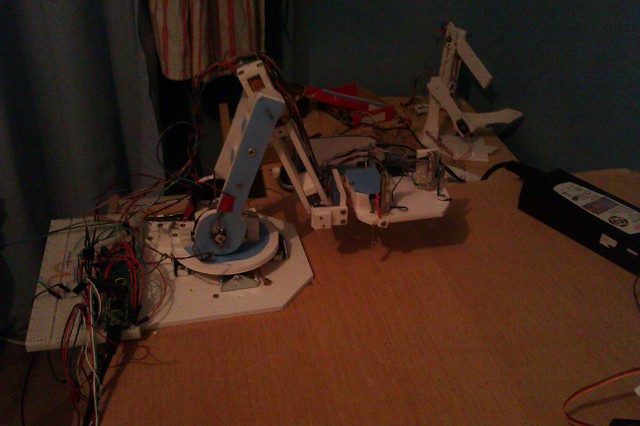
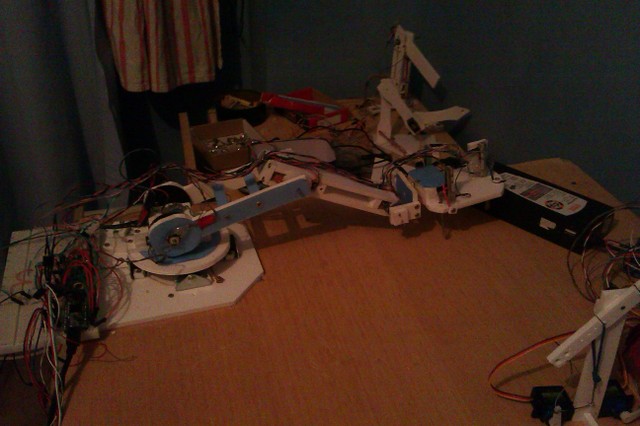
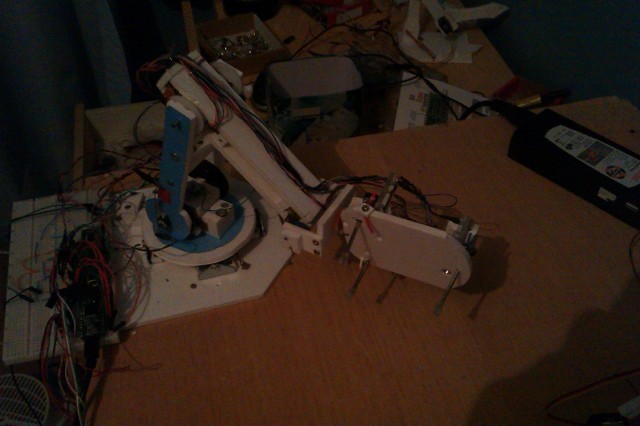
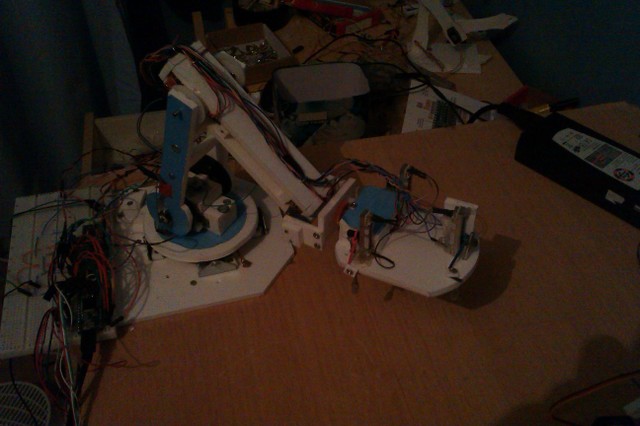
Attached are some pictures of the robot arm I’m making and trying to tune. It is similar to the arm from Coordination Demo, but with less degrees of freedom.
Level one and two are angular velocity and angular position control for each joint, so each joint is like a servo motor system. There are five joints - rotation of the base, shoulder pitch, elbow pitch, wrist roll and wrist pitch. I’ve made these fairly low gain, but very small dt, around 1 ms, and large resolution of input angular position measurements - 13 bits.
–
Dr Warren Mansell
Reader in Psychology
Cognitive Behavioural Therapist & Chartered Clinical Psychologist
School of Psychological Sciences
Coupland I
University of Manchester
Oxford Road
Manchester M13 9PL
Email: warren.mansell@manchester.ac.uk
Tel: +44 (0) 161 275 8589
Website: http://www.psych-sci.manchester.ac.uk/staff/131406
See teamstrial.net for further information on our trial of CBT for Bipolar Disorders in NW England
The highly acclaimed therapy manual on A Transdiagnostic Approach to CBT using Method of Levels is available now.
Check www.pctweb.org for further information on Perceptual Control Theory
Level three are reach, elevation, hand pitch, hand roll and lateral displacement systems. Perceptual signals for these are constructed like in Coordination Demo, using basic geometry formulas from arm segment lengths and joint angles. However, they are noisy, so they and their output are filtered.
I think they now work fairly well, considering how they worked before. There may still be room for improvement, but I’ll see about that as I go. At the moment, I’m working on adding touch/pressure sensing to the hand. There are three metal ‘nails’ on the hand that push a slider potentiometer up when pressed, and will be used to construct pressure perceptions. These pressure perceptions will be used to keep the hand holding a computer mouse. So, that will be a level above coordination of joints. I have no idea how I’ll tune these, but as Bill said, if it doesn’t work, just keep reorganizing.
When touch is finished, I plan to add a very simple visual system so I could do a tracking task. A camera will be pointed to the computer screen where I will have a target circle and a cursor circle, so that the Little Man Robot will control the distance between them.
Arm segments are cut from foam plastics and connected with screws, superglue and hot glue. Each joint has one or two micro geared DC motors and a potentiometer to measure joint angle. I’m using a Teensy 3.1 electronic board which is programmed like an Arduino, in C.
I have no idea when it will be finished. Soon, I hope. I’ll do some test and write a paper and this will be my M.A. in psychology in University of Zadar, Croatia. I have a B.A in psychology for which I did a standard tracking task in two dimensions. Before psychology I spent some time studying electrical engineering and computer science, but I wasn’t any good at electrical engineering so I dropped out and worked for I while, then decided to study psychology.
Adam