There is a lot of bullshit on CSGnet from Rick. So I’ll try to summerize and answer. What a mess…
RM :Alas, it appears that this was one of the few times Bill was wrong.
HB : It’s vica verse Rick. You appear to be wrong not Bill. You don’t understand PCT and that’s why you think that Bill appeared to be wrong. You have to undertsand first what you are reading. You obviously don’t.
RM : I am well aware of the fact that a control system keeps the controlled quantity (Qi) in a reference state by acting on the environment (the v variables in the Science article) so as to move, p,the perceptual correlate of Qi, toward the state specified by the reference signal in the control system and keep it there, protected from disturbances.
HB : The »controlled quantity« is generally not kept in reference state in outer environment. Speccially not the v variables. But you can keep perception near reference state (perception that is to be controlled). Or try to. There is no control in outer environment. There is no reference state in Q.I. See Bills’ diagram (LCS III). Q.I. is just added effects, nothing else. And here is something what can give you the right feeling for PCT or what is controlled.
Bill P.:
Our only view of the real world is our view of the neural signals that represent it inside our own brains. When we act to make a perception change to our more desireble state – when we make the perception of the glass change from »on thhe table« to »near the mouth« - we have no direct knowledge of what we are doing to the reality that is the origin of our neural signal; we know only the final result, how the result looks, feels, smells, sounds, tastes, and so forth…It means that we produce actions that alter the world of perception…
HB : If you don’t know what you are doing to reality how can you control anything ? It’s other mechanisms that are present here. That’s why PCT is so specific and unique and different from RCT and behvirola and self-regulaton theoris. But the »secret mechanism« is sure not Telekinesis that can transfer »control« into outer environment simultaneously when perception is controlled. You got it wrong and Warren with you.
You are not acting on the enviromment to keep some »controlled quantity« in some »reference state« or to keep some »aspect of environment in some reference state«, but you act to keep the world of perceptions alter… and keep the organism in reference state wwhich is genetically defined.
There is no »simultaneous control« in outer environment, because you are simply not aware what you are doing to reality. But you are aware of perceptions which are controlled. So the control loop can not control twice : in organism and outside. Speccially not simultaneously as you and Warren try to present.
BA: The simple answer is that control systems control perceptions.
RM: And by doing so they are controlling the aspects of the environment that correspond to those perceptions.
HB : No they are not Rick. The outer environment is not controlled as you are not aware what you are doing to reality. How many times do we have to tell you that there is no simultaneous (double) control in organism and outer environment. This will show clearly example with saying »Hello« to people arround, and example of sleeping, sunshining, and so on… What you are sayinng is simply not true, it doesn’t feet into »real experiences«. There is no »simultaneous control« in outer environment what definitions of control clearly sho. It’s just control in the controlling system.
Bill P :
CONTROL : Achievement and maintenance of a preselected state in the controlling system, through actions on the environment that also cancel the effects of disturbances.
HB : Why don’t you do your homework and do the test »saying hello« to people on the street. Are you afraid that results will not match your RCT ??? It’s realistic fear.
The ilussion of »controlling the aspect« of environment comes from simple example of pereceptual control like« tracking task« or »knot over dot«. In complex human relationship there will be no trace of cohereny with control in outer environment. You can’t control outer environment and you can’t control other people. But the effects of control can be seen outside if you are acquanted with PCT.
HB : The second problem you have Rick is to prove that you can tranfser »Control of perception« into environmental control. We already establishd that you can’t do that with behavior, because you can’t control behavior. So with what you will transfer control into «aspect of environment« ??? Telekinesis ? Is this Occultist forum ???
So if I can conclude from all the mess Rick produced :
-
There is some »controlled vaiable« in environment of LCS, which is controlled through acting on environment
-
Control of behavior or Telekinesis. Somehow Rick and Warren managed to transfer »control of perception« simultaneously (at the same time) into outer environment… So at the same time when percpetion is controlled is also controlled some »aspect of environment«
-
Control is tranffered into organism through »controlled perception« (symbolized p) or »controlled perceptual variable« (symbolized CPV)
-
Risk is protected from disturbances so he is simply »untouchable«
-
He has some extrasensory perception.
-
Rick can exactly determine the »reference« of other people so he has also some ability of Telephaty.
The only problem is that such a RCT control theory does not match PCT but Occultism and Parapsychology. Also I can’t find terms which Rick is using in Bills’ books.
So if summerize what Rick is talking about we can made his RCT definitons of control loop :
-
CONTROL : Keeping of some »aspect of outer environment« in reference state, protected from disturbances.
-
OUTPUT FUNCTION : controlled effects (control of behavior) to outer environment so to keep some »controlled variable« in reference state
-
FEED-BACK FUNCTION : »Control« of some »aspect of outer environment« in reference state.
-
INPUT FUNCTION : produce »Controlled Perceptual Variable« or »Controlled Perception«, the perceptual correlate of »controlled q.i.«
-
COMPARATOR : ????
This seems to be the »Control loop« Rick is trying to sell instead of PCT definitions. Now we have to go through PCT definitions of control loop. Why do I have to do it so many times ?
Bill P (B:CP):
CONTROL : Achievement and maintenance of a preselected state in the controlling system, through actions on the environment that also cancel the effects of disturbances.
Bill P (B:CP):
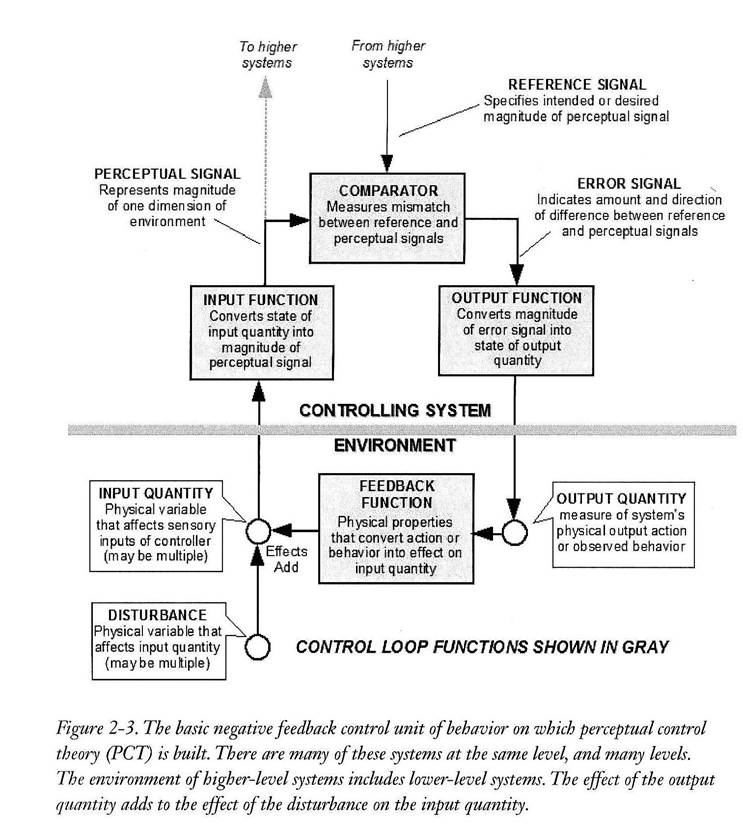
OUTPUT FUNCTION : The portion of a system that converts the magnitude or state of a signal inside the system into a corresponding set of effects on the immediate environment of the system…
Bill P (LCS III):
:…the output function shown in it’s own box represents the means this system has for causing changes in it’s environment.
Bill P (LCS III):
FEED-BACK FUNCTION : The box represents the set of physical laws, properties, arrangements, linkages, by which the action of this system feeds-back to affect its own input, the controlled variable. That’s what feed-back means : it’s an effect of a system’s output on it’s own input.
Bill P (B:CP) :
INPUT FUNCTION : The portion of a system that receives signals or stimuli from outside the system, and generates a perceptual signal that is some function of the received signals or stimuli.
Bill P (B:CP) :
COMPARATOR : The portion of control system that computes the magnitude and direction of mismatch between perceptual and reference signal.
HB : WE can see clearly that Ricks’ definitions are totally out of line of PCT. We can say that they are »orthogonal« to PCT. RCT (Ricks’ Control Theory) has nothing to do with PCT.
So I’m asking Rick for the last time to provide evidences where did he find the PCT control loop to be working like he showed in RCT (Ricks’ Control Theory). I’m speccially interested if Rick can provide evidences how can »control« in organism and environment be executed simultaneously or at the same time (Telekinesis), how can he exactly know which references people have (Telephaty), how his »extrasensory perception« works and speccially how can he be »protected from disturbances« in »reality« not only in his theory.
If anybody is interested he can continue with further reading down….
···
From: Richard Marken [mailto:rsmarken@gmail.com]
Sent: Thursday, February 23, 2017 9:09 PM
To: csgnet@lists.illinois.edu
Subject: Watch Your p’s and Qi’s
[From Rick Marken (2017.02.23.1210)]
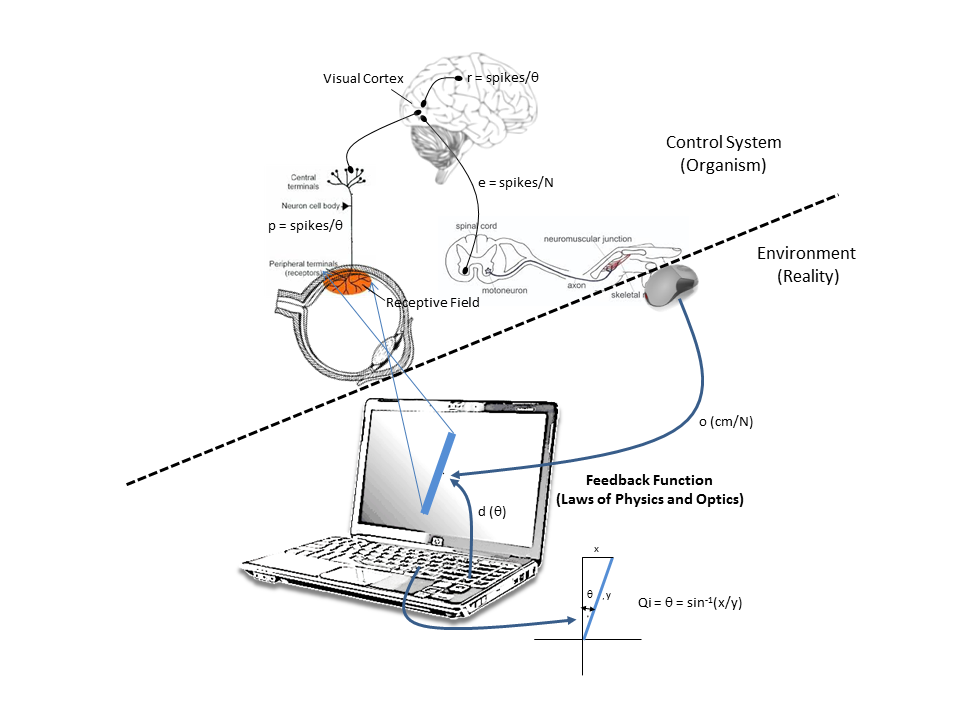
RM: The relationship between the controlled perception (symbolized p) and the controlled quantity (symbolized Qi) has created some confusion so I have drawn a couple of diagrams to illustrate the relationship.
HB : Rick there is no »controlled perception« . Where the hell did you see this term in Bills’ books. ??? Bills’ PCT is just opposite. See definitions.
Perceptual signal is blank. See B:CP. There is no control in his structure. There is no »controlled quantiy« in outer environment in the sense that is controlled outside to form »controlled perception«. You are destroying whole Bills’ work just because of your egoistic nature to take care of yourself and your useless demos and books. What do you want to achieve with this bullshit ???
RM : The diagrams depict the situation in my Control of Perception demo where the subject (you) controls the angle (rather than the shape or area) of the displayed rectangle. You might want to try this demo before reading any further. The demo is at:
http://www.mindreadings.com/ControlDemo/ControlOfPerception.html
HB : Show us how this works with sleeping, sunshininng, walking down the street and saying hello to poeple, catching the baseball and so on….
Don’t you understand that your RCT is working just in your RCT world and just in some cases. Its’ even not working in »baseball catch«. Stop confusing people.
RM: The PCT view
HB : It’s not PCT view. It’s RCT view.
of your behavior when you are controlling the angle of the rectangle is illustrated in the figure below (this and the next figure are attached in a PowerPoint file in case there is a problem seeing them clearly in the email) . First note that PCT distinguishes between the environment (also known as reality), shown below the dashed line, and the control system (the organism), shown above the line.
HB : This could go through.
RM : The control system is controlling some variable aspect of the environment, in this case the angle of the rectangle on the computer display.
HB : Where do you see that control system is controlling some variable aspect of environment. How do you see that ?
![Inline image 2]()
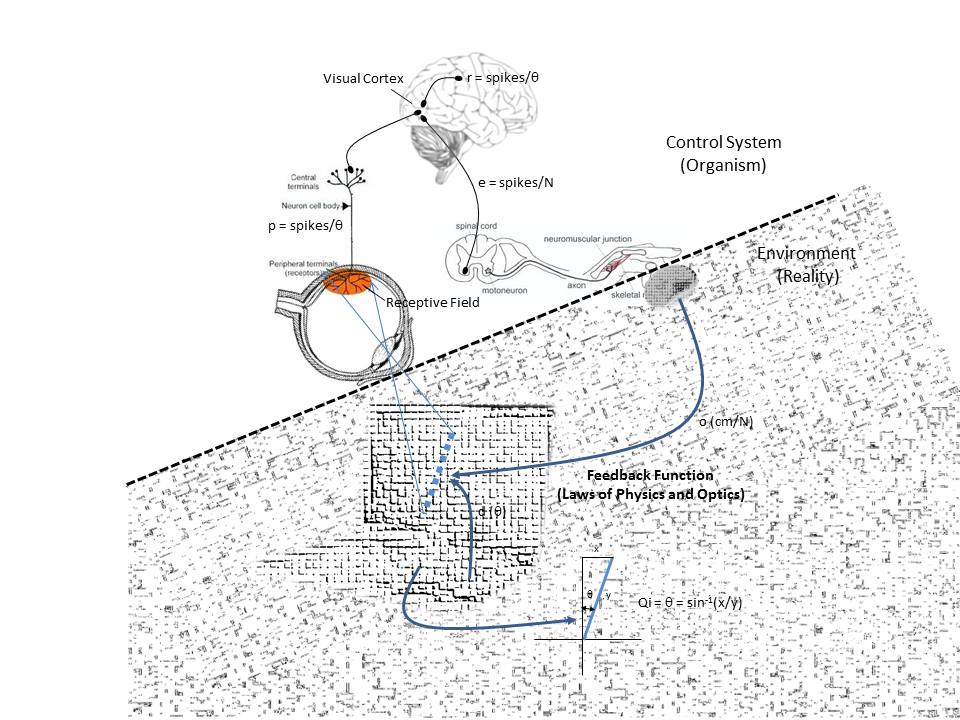
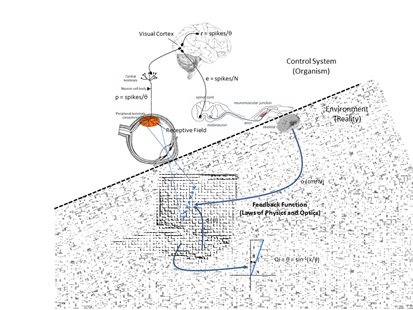
RM: The environment is made up of the physical variables and entities postulated by the models of physics and chemistry. But in the diagram it looks like the environment consists of a mouse and a laptop computer displaying a blue rectangle at a slight angle with respect to vertical. But these are your own perceptions of what is in the environment side of the diagram. Perhaps a better way to depict what constitutes the environment (reality) in PCT is shown in the next figure.
HB : If it is PCT where we can see Bill’s diagram ? So Rick explain to us with Bills’ diagram how it works ? Why do you avoid PCT explanation ?
![cid:image003.jpg@01D23694.7341FD90]()
![Inline image 3]()
RM: Here the environment is represented as an array of points of varying intensity and wavelength,. You can still make out a computer and mouse – that’s you perceptual systems at work again – but I think this way of depicting the environment makes it clearer that what is presumed
HB : Now what it’s gone be. You are presuming that something is outside or you are »controlling« with your behavior what is outside ?
RM : ….to be out there in the environment is a collection of physical variables like the intensity and wavelength of light energy and entities, like atoms. It’s our perceptual systems that organize this “booming, buzzing confusion” into things like computers, mice and so on. Actually, it’s the booming, buzzing confusion of the sensory effects of the physical variables and entities that our perceptual systems organize into computers, mice, and so on
HB : But simultaneously (at the same time) nothing is controlled in environment.
The main mistake you are making Rick is that you don’t understand what is general theory about how organisms function. You are all the time wrongly connecting control of Living Control Systems with »control in outer environment«. Do you understand what your mistake is ? Generaly control is what Bill used in his definition of control and you are not using it.
RM: So with that understanding in hand, let’s trace out the processes that are taking place (according to PCT) when you control the angle of the displayed rectangle. Let’s start with the physical variables in the environment. This array of energy stimulates receptors in the retina via the laws of optics. An array of these receptors, called a receptive field, is the input to a neural network that is a perceptual function that produces a perceptual signal, p,
HB : So it’s perceptual signal not »controlled perception« or »Controlled Perceptual Variable« ???
RM : ….that is proportional to the angle,&nnbsp;q, of the line on the screen relative to vertical. (Actually, the computation of the angle perception is most likely carried out by a perceptual function that is higher up in the optical pathway but we will assume for simplicity that it is done at the retinal level).
HB : You are simplifying too much. It’s not done at the retina level. You are simplifying beacuse you don’t understand how integration of signals work on higher levels of hierarchy. You don’t understand PCT. That’s why you are simplifying. Whatever you think that it’s carried higher through optical pathway it’s not even »most likely« equal to what is done at retina level. So your asumption is wrong. See how hierarchy works in B:CP. Â
RM: The perceptual signal is a train of neural impulses carried by the cell body (axon) of the neuron leaving the receptive field network, the rate of impulses (spikes) being proportional to q.
HB : You just have to open one physiological book and see how structure of eye-ball and photoreceptors and ganglions look like and waht they do. Cell body is not the same as axon. What a mess….
RM : So the greater the spike rate, the greater the angle that is perceived. And this is the first place where things could get confusing because, when you are doing this control task, what you perceive is the angle of the blue rectangle relative to vertical, not a varying rate of neural impulses. But it is this rate of impulses – the perceptual signal --, in theory, is being controlled. Why that train of impulses looks like a varying angle rather than something else is, I believe, what is called the “hard problem” of consciousness. It is actually a problem of understanding perception and I solve it to my own satisfaction by assuming that that’s the way it looks when you are the neuron carrying the varying rates of neural impulses.
HB : Rick did you consider option of visiting a psychiatrist or at least psychotherapist. You need help.
RM: The perceptual signal, measured in spikes/q is the first step in the PCT model of control of the angle in the Control of Perception demo.
HB : Where in PCT books or any kind of PCT literature can we find this ? PCT model of »control of the angle« ? Not your books or literature. PCT books.
RM : The next steps are shown clearly in both figures: The neuron carrying the perceptual signal, p, and a neuron carrying the reference signal, r, synapse with opposite signs (one is excitatory and the other inhibitory) on a neuron carrying the error signal, e. The spike rate of the reference signal, like that of the perceptual signal, is in spikes/q; in this way the spike rate of the reference signal “specifies” the spike rate of the perceptual signal. The result of the opposite effects of the perceptual and reference signal on the neuron carry the error signal is the firing rate of the error signal, e, neuron represents something close to the arithmetic difference between r and p: e = r-p. This error signal neuron ultimately drives the muscular output that moves the mouse. So the spike rate of the error signal causes an amount of force to be produced by the muscles; so the error signal is in spike rate per unit force (which are Newtons, N, in the figures).
HB : Again find some physiological book and clear your head with what is what.
RM: The forces produced by the muscles (as a result of the error signal) have their effects on the external environment. Their immediate effect is on the position of the mouse, which is the output variable, o. The output variable in a control loop is a physical variable measured in physical units. In this case, the output variable – mouse movement-- is measured in units of distance moved per units of force exerted: cm/N. These mouse movements affect, via the computer, the physical variables that correspond to the perception of the angle of the blue rectangle, q. These physical variables are also affected by a disturbance variable, d, produced by the computer. The physical variables that correspond to variations in p, the perception of q, stimulate,via the laws of optics, the receptors that make up the receptive field that calculates p,
HB : Where did you get this one ? Receptors »calculate« p ? Usually human sensors (photoreceptors) are just converters not calculators. But in you RCT anything is possible.
RM : …the perceptual (spike rate) value of q, and we are back to the beginning, closing the loop from input (stimulation of the receptive field receptors) back to the same input. The loop is completed via the feedback function that links the output (mouse movements) by the laws of physics and optics to the input (stimulation of the receptive field receptors).
HB : So what here is exactly »controlled variable in environment« or »controlled aspect of environment« by theory of RCT ?
RM: Note that Qi does not show up in this loop.
HB : In which loop does it show ? So Qi is something what is not a part of control loop but still sometimes it appears in control loop ?
RM : This was done to emphasize the fact that there is no Qi in the environment.
HB : How do you Rick explain presence of Qi in Bills’ diagram ?
Bill P :
![cid:image003.jpg@01D23694.7341FD90]()
HB : It seems that Bruce and Huddy already explained you what are you missing with interpretation of diagram in LCS I in the continuation of your post so I’ll stop here.
Boris
All that is in the environment are physical variables – the v’s in Figure 1 of Powers’ 1973 Science article (reprinted on p. 66 of LCS I). Qi doesn’t exist unless there is an observer around to perceive it. When you control the angle of the blue rectangle in the Control of Perception demo – keeping it at 0 degrees relative to vertical – and do it with no one watching you, the only observer is the computer itself. This is shown in the figures as the line coming out of the computer and computing Qi = q = sin-1(x/y), where x and y stand for the physical variables that are the basis for the computation of q. If the computer were not computing q then Qi would not exist and the only place where q would exist during this demo would be as a perception in the person doing the demo, a perception produced by computations carried out by the neural network that makes up the receptive field.
RM: So, in summary, what is called Qi, the controlled input variable, is the observer’s perception of the perception that a controller is controlling. So Qi is p from the observer’s perspective (if there is an observer). If there is no observer, then all that is controlled is p, a perceptual variable constructed by perceptual functions such as the receptive fields in the Figures above.
RM: One last point. Qi is important in PCT because it is the basic data of PCT. It is a variable that an observer can see is being controlled. So Qi is a perception for the observer; p is part of the observer’s theoretical explanation of how this control is being done.
Best regards
Rick
–
Richard S. Marken
"Perfection is achieved not when you have nothing more to add, but when you
have nothing left to take away.�
–Antoine de Saint-Exupery