My copy of Rick and Tim’s book arrived yesterday and I’ve started reading it.
In Chapter 1 they refer to the LP cover shown below and use it to illustrate the paradox of control; namely, that Henry Higgins is controlling Eliza Doolittle (a puppet on strings) yet Higgins himself is a puppet on strings being control by playwright Shaw.
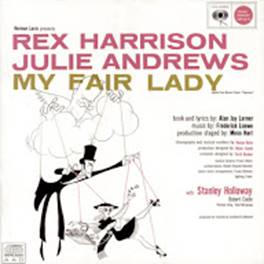
Rick and Tim write, “When we ignore the fact that Higgins is a marionette himself we can see him as being in control of Eliza. But as soon as we pay attention to the fact that Shaw is pulling his strings, Higgins is no longer seen as being in control of Eliza but, rather, as being under control. But we can’t really see him both ways at the same time because each way is incompatible with the other; seeing Higgins as in control of Eliza is incompatible with seeing him as controlled by Shaw and seeing him as controlled by Shaw is incompatible with seeing him as in control of Eliza.” (p.6)
What comes through to me from the LP cover is that Shaw was in control of Higgins and, through Higgins, in control of Eliza. That fits nicely with the notion that control is often exercised indirectly. Thus our direct, immediate actions affect one set of variables and, through them other variables are affected as well. Thus we often try to control some variable over which we exercise no direct control; hence, the utility of thinking about proximate, intermediate and ultimate variables.
So I don’t know about the incompatibility argument but the LP cover does indeed illustrate proximate (Shaw’s behavior) through intermediate (Higgins’ behavior) to ultimate (Eliza’s behavior). Thanks for that pointer. I will have considerable use for that cover.
Regards,
Fred Nickols, CPT
Solution Engineer
DISTANCE CONSULTING LLC
“Assistance at a Distance”
Be sure you measure what you want.
Be sure you want what you measure.
[From Rick Marken (2016.01.10.1315)]

···
On Sun, Jan 10, 2016 at 9:25 AM, Fred Nickols fred@nickols.us wrote:
FN: My copy of Rick and Tim’s book arrived yesterday and I’ve started reading it.
Â
FN: In Chapter 1 they refer to the LP cover shown below and use it to illustrate the paradox of control; namely, that Henry Higgins is controlling Eliza Doolittle (a puppet on strings) yet Higgins himself is a puppet on strings being control by playwright Shaw.
Â
Â
FN: Rick and Tim write, “When we ignore the fact that Higgins is a marionette himself we can see him as being in control of Eliza. But as soon as we pay attention to the fact that Shaw is pulling his strings, Higgins is no longer seen as being in control of Eliza but, rather, as being under control. But we can’t really see him both ways at the same time because each way is incompatible with the other; seeing Higgins as in control of Eliza is incompatible with seeing him as controlled by Shaw and seeing him as controlled by Shaw is incompatible with seeing him as in control of Eliza.� (p.6)
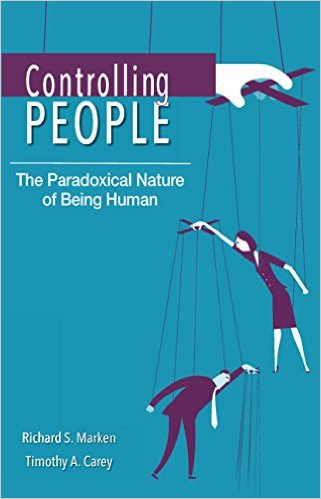
RM: Actually, the same paradox is illustrated by the cover art too. We were going to use the “My Fair Lady” cover art (by the great caricaturist Al Herschfeld) as the cover art for the book but the publisher correctly (I think) suggested that it was too specific to the musical so we got the present cover, which I think is even better because there is no highest level controller (as Shaw is in the Herschfeld cartoon) and no lowest level controlee (as Eliza is in the cartoon), which, I think, better illustrates the paradox of “controlling people”. I think the cover art that the publisher came up with us is great; what do you think?
Â
FN: What comes through to me from the LP cover is that Shaw was in control of Higgins and, through Higgins, in control of Eliza. That fits nicely with the notion that control is often exercised indirectly.Â
RM: I think this is why the cover art that we used for the book (copied below) is better than the My Fair Lady cartoon. In the My Fair Lady cartoon Shaw is, unambiguously “in control” of Higgins; no one is “pulling Shaw’s strings”. But the point of out book is that everyone is a controlling person, in the sense that they can both control and be controlled. So on the cover of our book even the top controller (whose arm is all that is visible) is also controlled (as evidenced by the strings coming down from above. So unlike Shaw, we can’t see some people as being the ultimate controllers of other people; all people are both controllers and controlee’s. The book explains why (and how) this apparently paradoxical situation can exist and how we can live successfully in the context of our controlling (and controllable) nature.Â
BestÂ
Rick
Â
Thus our direct, immediate actions affect one set of variables and, through them other variables are affected as well. Thus we often try to control some variable over which we exercise no direct control; hence, the utility of thinking about proximate, intermediate and ultimate variables.
Â
So I don’t know about the incompatibility argument but the LP cover does indeed illustrate proximate (Shaw’s behavior) through intermediate (Higgins’ behavior) to ultimate (Eliza’s behavior). Thanks for that pointer. I will have considerable use for that cover.
Â
Regards,
Â
Fred Nickols, CPT
Solution Engineer
DISTANCE CONSULTING LLC
“Assistance at a Distance�
Be sure you measure what you want.
Be sure you want what you measure.
Â
Â
–
Richard S. MarkenÂ
Author, with Timothy A. Carey, of  Controlling People: The Paradoxical Nature of Being Human.Â

