[From Rupert Young (2017.06.18 13.30)]
(Dag Forssell (2017.05.31 16.30 PST)]
DF: Rupert, what an interesting story. I eagerly await the "To be
continued" part.
Here goes.
So, on my PhD I started with an interest in "visual attention" as
I thought that movement was important aspect of vision, rather
than just the static information extraction approach of Marr.
Though I wasn’t really in tune with my department which was
basically electrical engineering, and their philosophy was in line
with Marr. I went there because they had a robot arm/camera I
wanted to use. So, my supervisor and I didn’t really see
eye-to-eye, as he didn’t have an interest the more active,
bio-inspired approach. I had to toe the line and at one point he
had me analysing images to extract measures of symmetry (yawn!).
Going into my second year I still had no idea where my research
was going.
Around this time I had an epiphany when I was walking around a
supermarket. I was thinking of being in an art gallery, when you
can’t work out what a picture was. I realised that to recognise
what was in the picture you sometimes had to move back or
forwards. So, it wasn’t a matter of static “information” flow
from the image to the observer, but the observer was able to
influence the information by how they acted in the world. I wasn’t
quite sure where this would take me but it seemed important.
At some point I posted a message on a forum about how the neural
architecture could implement simple mathematical functions.
Someone called Shannon Williams responded and recommended a book
called B:CP. Luckily there was a single copy in my University
(Surrey) library so I sought it out and began to read. It was then
that my head exploded! This seemed to provide significant answers
to all my questions, and there had been no mention of it
whatsoever on my AI degree. I had found a direction for my
research.
Unfortunately for my supervisor it was around then that he had a
personal crisis and withdrew from his supervisory duties.
Fortunately for me my supervisor had a personal crisis and
withdrew from his supervisory duties, which meant I was let to my
own devices for about two years in which time I was able to focus
on PCT research. Unfortunately for me after two years my
department realised that I wasn’t being supervised, and that I had
been focussing on PCT, research that they didn’t understand. This
meant that I had to give up PCT research and work on a project
which was in line with their way of thinking. This is why my
thesis has two quite different themes. I thought that this might
be a big problem for graduating, but fortunately the external
examiner approved my thesis saying that he liked it because he
thought it was “wacky!”
During this time I discovered CSGNet, and conversed with Bill.
Surprisingly he invited me to stay at his place if I ever visited
the US, and also offered me money to attend the CSG conference in
1997. I did wonder if I was being drawn into some sort of obscure
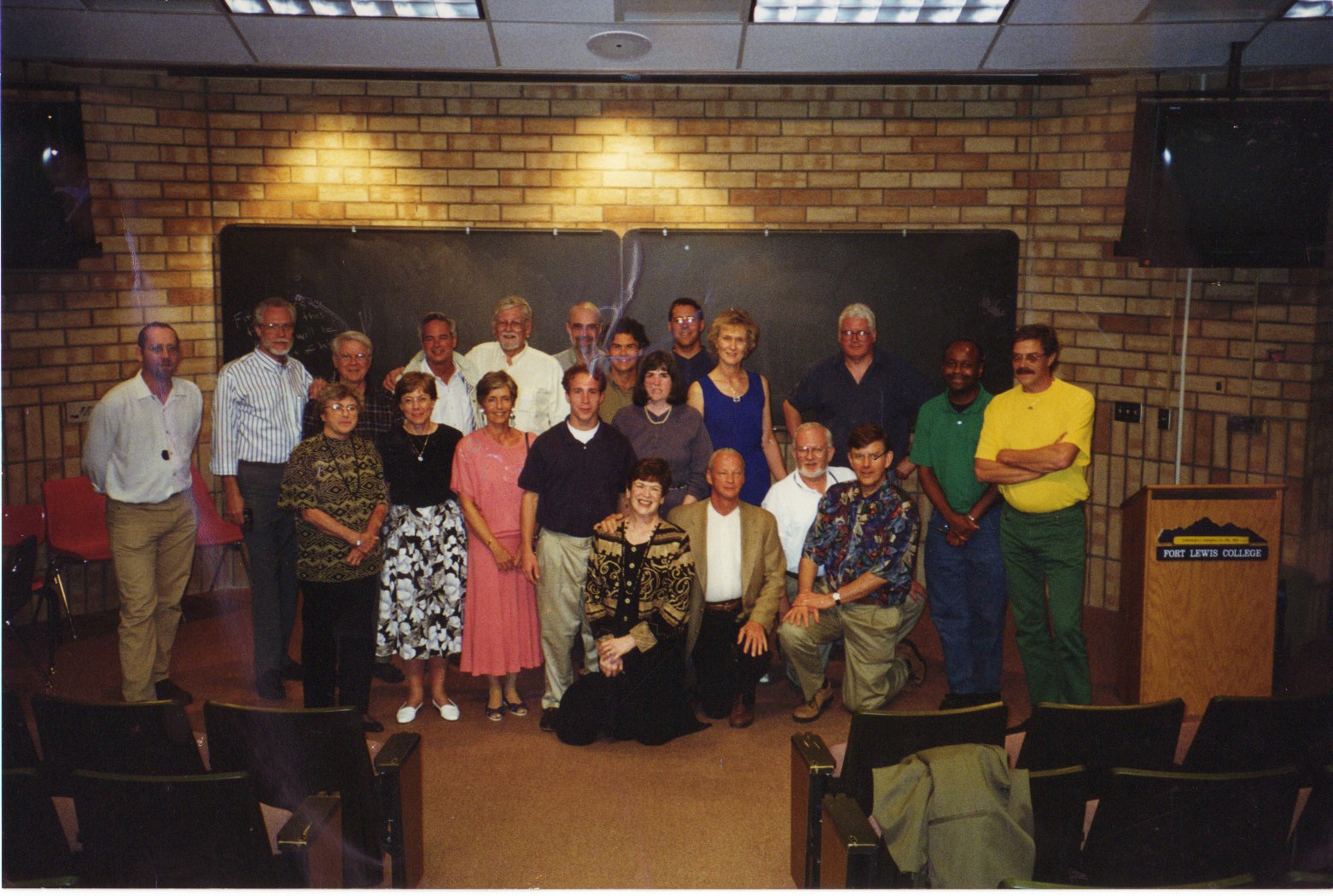
cult and I would never make it back home! But I did attend (see
attached) and was impressed with the hospitality. I stayed with
Bill and Mary for a night at their place in Durango, and well
remember watching the space shuttle live on his TV, and also
looking at the moon through his telescope in the garden.
Anyway, in 2000 I completed my PhD, five and a half years after I
started. Bill read my thesis and called it a “masterpiece”, though
I’ve since tried to find that email to no avail so maybe I was
just dreaming 
I had thought that I wanted to be an academic, but now realised
that I could only do that if it involved PCT, as I would not want
to teach subjects and approaches in which I no longer believed and
thought were invalid. However, there were no PCT opportunities at
that time. So, I decided to go into commercial IT. Bill Powers
killed my academic career!
PCT had to take a back burner as I had the distraction of a large
student loan to pay off and a new marriage.
However, PCT remained a passion of mine and occasionally I would
return to it in my spare time. I spent quite a long time trying to
apply it to the stock market, only to realise it was a fool’s
errand as the only action available, buying and selling shares,
had no effect on the value of the funds invested. The only
variable that can be controlled is the number of shares invested,
which was of no use to anyone.
I discovered the Lego robots and started to implement some simple
PCT systems on them. In 2009 I posted one such video on youtube.
Two years later I noticed a comment on the video, which had been
there for months. It was from a guy called Warren Mansell. We
communicated and as I happened to visit Manchester to give an IT
talk we met up for a beer. I was amazed to hear that someone was
actually teaching a course on PCT at a real university and doing
research as well. This inspired me to take my “hobby” seriously
and that there was real potential to progress PCT-based robots.
In 2012 I went freelance so I could spend more time with my
robots. And in 2014 as I no longer had the pesky distraction of a
student loan, or a marriage, I stopped work to concentrate on PCT
robotics full-time. I decided that what I needed to do was to get
the PCT robotics approach published, to give it legitimacy, in the
eyes of most of the world. So, I thought I’d write up the
architecture and methodology I’d been working on in a paper. As it
was January I thought I could do it in cold, wet UK or go
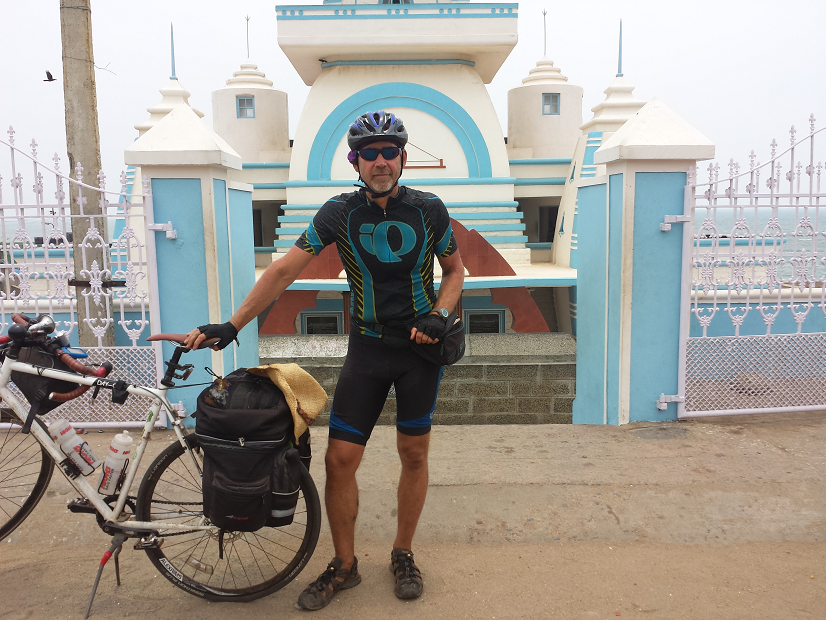
somewhere more interesting. So I went to India and cycled 1,000
miles down the West coast from Mumbai to the southern tip
(attached, me arriving in Kanyakumari). I did it over two months
stopping off for a few days here and there to write on scraps of
paper and then type it up when I could find an internet cafe. It
was a very interesting and, at times, very dodgy trip, but I would
recommend it as a good way to write a paper, if time allows. The
actual cycling gave me time to think about what I was writing so I
think it turned out better than if I had stayed at home and
written it all in one go.
When I returned to the UK I submitted it. The Artificial
Intelligence journal rejected it outright, but the Artificial Life
journal accepted it, pending review. They said the earliest they
could publish it was August, of 2014. But that didn’t take into
the account what turned out to be a horrendously slow review
process. It went through the review process twice and each time it
took well over six months for me to get the reviews back. Thanks
for feedback and advice I got from Rick, Martin and Warren through
this time. Eventually it was accepted last summer, but not
scheduled for actual publication until now.
So, I managed to achieve (and no-one is more surprised than me)
the goal I set three years ago, and twenty years on I am also
still part of the cult. More than ever I feel optimistic that PCT
can be shown to have significant impact on robotics and
fundamentally change the direction of the entire field. Hopefully,
if that happens, it will have a domino effect throughout the
behavioural sciences. That’s the plan anyway

···
Regards,
Rupert
On 27/05/2017 11:34, Rupert Young
wrote:
[From Rupert Young (2017.05.27 11.30)]
Thanks Bruce, and Fred and Rick, for your kind words.
Yes, I am pleased that this has been published. Not just
because it is a major journal, but also that it is not just a
brief report of some results, but a substantial presentation of
the theory. When I first submitted it (a less substantial
document) I was buoyed that the first feedback I got, before
reviews, from the editor (philosopher Mark Bedau), was that it
had “significant merit”. So all credit to him for recognising
there was value there!
I concur with others that it is important to publish in high
impact journals. I think there is a significant advantage of
robotics over other fields in that actual physical systems are
produced that everyone can see and touch; you don’t have wait to
replicate studies or experiments to actually see something.
So, I would encourage all to get involved in PCT robotics. We
could do it reasonably simply with Lego robots implementing PC
systems I have already created. Over the next few months I hope
to have progress a PCT application and GUI, for the execution of
PC systems, on robots like the Lego system. And you won’t have
to write a line of code!
When I left my day job three years ago to work on PCT full time
I had two goals in terms of promulgating PCT. One was to try and
get PCT robotics published in a major journal; I’ll mention the
other when I manage to achieve it (otherwise I’ll keep quiet).
So, as it is a substantial piece, in terms of the claims it
makes with respect to conventional AI, even if people don’t
understand it, agree with it or like it, I hope it generates
discussion and gets PCT more widely known.
I am motivated with the assumption, and confidence, that PCT
will have its time. But as it is battling against ill winds we
have to push it into the limelight, and I am hoping that
building robots in the real world will capture people’s
imagination. But it has been a long road just to get to this
point. In the mid-80s I was working in the most boring place in
the universe, Kuwait, and had a lot of time to think about my
own purpose and existence. At the same time I bought a Commodore
Amiga, which, with a colour graphical screen and a whopping half
a meg of RAM really catapulted computers into my life and
imagination. So, with my dissatisfaction with my existence as it
was, and my new found interest in the Mind and computer
technology I did what anyone would do under the circumstances…
I went and lived on a tropical island in Thailand (I’d lived
there for four years as a child) for a year and a half and ran a
business for water skiing and parasailing.
However, living on a tropical island is not all it is cracked
up to be, with very little mental stimulation. So, I returned to
the UK, and in the late 80’s I heard about something I’d never
imagined, but combined my two main interests at the time;
Artificial Intelligence. I managed to get on a degree course as
a mature student, and fancied being an academic. Most AI courses
were Computer Science with a bit of AI, but mine was different.
It was actually a BA as it combined AI computing, Cognitive
Psychology and Philosophy of the Mind.
I was somewhat unimpressed by the state of AI and found the
approaches unconvincing. This was exemplified by the dominant
approach to computer vision being David Marr’s static feature
extraction methodology. Gibson’s dynamic approach seemed more
realistic so went on to do PhD with some intention of looking in
to more “active” vision.
To be continued …
Regards,
Rupert
On 26/05/2017 21:05, Bruce Nevin
wrote:
Rupert,
You must be immensely proud of this achievement, and
justly so!
This has such great importance. An existence proof,
demonstrating autonomous control within an environment with
arrangements and changes in arrangement that are
unpredictable by the robot. A demonstration that no other
theory (do they merit that term?) can match.
The recovery from deadlock uses a very simple means that
may be an alternative answer to our questions about what
happens when an organism meets insurmountable conflict.
/Bruce
On Wed, May 24, 2017 at 11:44 AM,
Rupert Young rupert@perceptualrobots.com
wrote:
[From Rupert Young (2017.05.24 16.40)]
–
Regards,
Rupert
www.perceptualrobots.com
Twitter LinkedIn YouTube
+44 7795
480387
I am pleased to announce that after three years of
hubble and bubble, my toil and trouble is finally over
and my paper is published, in the Artificial Life
journal. Commence the fireworks! (As long as there is
not just indifference).
[http://www.mitpressjournals.org/doi/pdf/10.1162/ARTL_a_00229](https://urldefense.proofpoint.com/v2/url?u=http-3A__www.mitpressjournals.org_doi_pdf_10.1162_ARTL-5Fa-5F00229&d=DwMCaQ&c=8hUWFZcy2Z-Za5rBPlktOQ&r=-dJBNItYEMOLt6aj_KjGi2LMO_Q8QB-ZzxIZIF8DGyQ&m=kQ7Axk3by-EsiNDG4Fb3laxabd_rIw0sl_4L2JDbXsU&s=mR8swZHLhrl5XAywVhhLkO5nE2hbV1hTXPXb3oVvP3c&e=)


If anyone would like a not-to-be-distributed pdf copy send me a
private email and I’ll oblige.


 ?
? I think if we could convince