Ashby's Law of Requisite Variety

[From Bruce Abbott (2012.12.13.1355 EST)]

Rick Marken (2012.12.12.1835)–

BA: Bruce Abbott (2012.12.12.2030 EST)

RM: To determine whether a particular variable is under control using disturbances to the hypothetical controlled variable to see if there is resistance (per “The Test”) what you should look at is the relationship between disturbances and the hypothetical controlled variable (as I do in my demo of the test at http://www.mindreadings.com/ControlDemo/Mindread.html) rather than the relationship between disturbances and outputs…

BA: True enough, but what does this have to do with an information analysis?

RM : You said " Neither Martin nor I have claimed that the relation between disturbance and output reveals anything about the organism, other than the fact that it is controlling the variable in question", which sounded to me like you use informational analysis to test for controlled variables.

Is this some kind of Orwellian Newspeak? I asserted that IF a variable is under control, THEN information in the disturbance will be passed to the feedback variable. I did not describe a test for the controlled variable, but a fact that is true if the variable is under control.

RM: When you measure the information in the output about the disturbance to a controlled variable you are treating the organism as a communication channel: communicating information about d to o. So you are measuring a characteristic of the organism. But PCT shows that the relationship between disturbance and output has nothing to do with the organism (when control is good). So what you are actually measuring is characteristics of the feedback and disturbance function. You think you are measuring a characteristic of the organism (its ability to transfer information about the disturbance to its output) but what you are actually measuring is the nature of the feedback and disturbance functions of a control loop. You (and Martin) have fallen for the behavioral illusion hook, line and sinker.

BA: If you transmit a message over the phone and I measure the information I receive in the message, am I measuring a characteristic of the communication channel, or of the message received? Clearly, I am NOT measuring a characteristic of that channel (unless the channel imposes some limit on the information it transmits).

RM: So you are using information theory to measure a characteristic of the disturbance, which is analogous to the message when you are analyzing the information about the disturbance in the output. How much do learn about the message in the little demo I just posted? (http://www.mindreadings.com/ControlDemo/InfoDist.html)

Martin and I have already explained this. The information is completely recoverable in your little demo.

BA: I was hoping to gain some insight into how you have come to this conclusion[that you and Martin have fallen completely for the behavioral illusion) by reading your answers to my two simple questions. Sadly, I am still awaiting them.

RM: I thought I answered them. But hopefully this post will give you some idea of how I came to the conclusion that you (and Martin) have fallen (willingly, apparently, since you guys know PCT) for the behavioral illusion.

BA: No, it completely evades my questions. To save you the trouble of looking them up, there they are again:

BA: Now, here’s a question for YOU, if you’re up to the challenge. When control is excellent, with high gain, and the reference signal is constant, how is it that the pattern of variation of the disturbance is mirrored by the pattern of variation of the feedback to the CV, without that pattern being evident in the error signal?

RM: I do remember answering them. You probably just didn’t like my answers. I’ll try again.

I wish you would point me to the post in which you did, because I certainly don’t recall seeing it.

RM: The first thing to understand is that the mirroring of output (which is what I presume you mean by feedback to the CV) and disturbance only occurs when the feedback and disturbance functions are constants and 1.0 (as they typically are in our tracking tasks).

Feedback to the CV is just what is says it is. It’s what comes out of the environmental feedback function and affects the CV in such a way as to oppose the effect of the disturbance on the CV. Because the disturbance and feedback are mirror images (if control is excellent), then whatever information appears in the feedback must have come from the disturbance. There is no other place from which it could have come. There is no logical escape from that fact, because by definition, a variable is under control to the extent that the feedback opposes the disturbance. The question we are addressing is not whether that information is present (it logically has to be), but how it got there.

If you don’t understand that fact, then there’s no point in my going further with this exchange.

RM: The disturbance pattern will be evident in the error signal in this case (though at a phase lag I believe) is there is no noise in the loop.

Yes.

RM: If there is noise in the loop (as there is in normal human controlling) then the the disturbance pattern will not be evident at all in the error signal;

Incorrect. It may be difficult to perceive, but it will still be there, mixed in with the noise.

RM: the closed loop integration filters out this noise so that control is still nearly perfect;

And to that extent potentially removes some of the information in the disturbance. For example, the higher-frequency components may be attenuated or eliminated. (It depends on what one takes to be the information that is being transmitted through the channel provided by the control system.)

RM: the output nearly perfectly mirrors the disturbance despite this noise. The reason this works, I believe, is because the noise is like an additional disturbance to the controlled variable. SO, for example, if the noise, e, is added to the error signal, the output will be o + e. So the input will be o+d+e and the error signal will be r-(o+d+e) and the output driven by this error will net cancel out its own noise (that’s the closed loop filtering process).

If the noise is added to the error signal and does not originate in the CV or in the input function, then it will act like a change of reference level. The CV and perception will change even though the noise has not acted as a disturbance to the CV, thus introducing unwanted variation in the CV and the perception. If the noise is introduced in the perceptual input function (e.g, sensor noise), the system will act to oppose the effect of the noise on the perception while introducing variation in the CV. If the noise is introduced in the CV, then it’s just part of the overall disturbance and the feedback will mirror the effect of this overall disturbance.

BA: Follow-up question: In the case described above, the feedback waveform almost perfectly matches the disturbance waveform. In what sense is it that the feedback waveform tells you nothing about the disturbance waveform? (Nothing = no information in the disturbance waveform appears in the feedback waveform.)

RM: Because the observed output waveform is not necessarily a mirrior of the disturbance. For example,suppose the output waveform that you observe is a perfect sine wave. You say that this means that the disturbance is also a sine wave, but 180 degrees out of phase. But it could be that the disturbance is a sine wave that is 0 degrees out of phase with the output. This would be true if, unknown to you, the feedback function were = -1. Or if the disturbance function were -1. Or the disturbance might a sine and cosine wave that add up to produce the total disturbance to the CV. There are many different reasons why you are seeing a particular output waveform other than that it is a mirror of a disturbance variable. Consider again, for example, my area/ perimeter control study. There we see a change in the output waveform with no change at all in the disturbance variable; the change s a result of controlling a different perception.

In each of these cases, the feedback to the CV must be a mirror image of the disturbance if control is excellent. If it isn’t, then control isn’t excellent.

Furthermore, I specifically stated that your analysis was to be applied to the simple case I described. Your response was to bring up some other case in which you believe that the output would not mirror the disturbance, thereby avoiding answering my question about the case at hand.

RM: So these are the reasons why I would say that, in general, the output of a control system contains no information about the disturbance(s) to the variable being controlled by the system.

RM: Hope I passed the audition.

No, you failed miserably. But I still hold out hope for you, if you really want to understand. It’s not that difficult.

Bruce
[From bill Powers (2012.12.13.1240 MST)]

From Bruce Abbott (2012.12.13.1355 EST) --

Is this some kind of Orwellian Newspeak? I asserted that IF a variable is under control, THEN information in the disturbance will be passed to the feedback variable. I did not describe a test for the controlled variable, but a fact that is true if the variable is under control.

BP: Can we get back to the question of what the information path is? I think that if you measure the information in the perceptual signal, you will find that it does not resemble the disturbance very much at all. This is because while the control is going on, the disturbance variations meet the output variations in the controlled variable, so the perceptual signal variations show only the difference between the output variable and the disturbing variable.

On the other hand, the effects from the output on the controlled variable are about equal and opposite to the effects from the disturbing variable. Those two paths are not inside the organism, but are properties of its environment. In the path from perceptual input to output inside the organism, there is little regularity in a relationship to the disturbance. In fact the correlation of output to perceptual signal will be close to zero, so we can't conclude that information is simply passed from input to output through the organism. The feedback effects as well as the integral in the output function spoil that possible regularity.

Some actual calculations from actual data would be very helpful here, as Rick suggested. I don't have any idea what they would look like, and would like to see them.

Best,

Bill P.

[From Rick Marken (2012.12.13.1240)]

Bruce Abbott (2012.12.13.1355 EST)–

RM : You said " Neither Martin nor I have claimed that the relation between disturbance and output reveals anything about the organism, other than the fact that it is controlling the variable in question", which sounded to me like you use informational analysis to test for controlled variables.

BA: Is this some kind of Orwellian Newspeak? I asserted that IF a variable is under control, THEN information in the disturbance will be passed to the feedback variable. I did not describe a test for the controlled variable, but a fact that is true if the variable is under control.

RM: But that is the test for the controlled variable. IF the variable is under control THEN you will see the output mirror the disturbance (assuming feedback and disturbance factors are constant at 1.0). IF it’s not under control, you won’t. So you would know it’s not a controlled variable.

Bill keeps telling me that you are using information theory only as an analysis tool and that you don’t really believe that information about the disturbance is the basis of output. That is, Bill says you don’t believe in the input-output model of behavior. But that conclusion is very hard to reconcile with your statement that “IF a variable is under control, THEN information in the disturbance will be passed to the feedback variable”. If Bill is right then what you mean by this must only be that “If the variable is under control THEN a measure of information about the disturbance in the output will be high.” And you would know that the information about the disturbance that you measure in the output is a reflection of the behavioral illusion: the fact that o = -(k.e/k.o)d and has nothing to do with the functioning of the control system.

RM: So you are using information theory to measure a characteristic of the disturbance, which is analogous to the message when you are analyzing the information about the disturbance in the output. How much do learn about the message in the little demo I just posted? (http://www.mindreadings.com/ControlDemo/InfoDist.html)

BA: Martin and I have already explained this. The information is completely recoverable in your little demo.

RM: Great. Please show me how. I asked Martin to show me an informational analysis of my (or any) control task; now I’m asking you. Please show me what an informational analysis of control looks like. I think Bill would like to see it too.

RM: Hope I passed the audition.

BA: No, you failed miserably.

RM: Well, I guess I won’t be signing up for your class.

BA: But I still hold out hope for you, if you really want to understand. It’s not that difficult.

RM: I really think it would be best (for your stress level) if you abandoned hope for me. I’m pretty much stuck on PCT. But keep trying if you like. A good way to possibly convince me of the merits of information theory is to show me an informational analysis of a control task.

Best

Rick

···


Richard S. Marken PhD
rsmarken@gmail.com
www.mindreadings.com

[Martin Taylor 2012.12.13.23.15]

[From Rick Marken (2012.12.13.0850)]

              Fred

Nickols (2012.12.13.0642 AZ)–

              RM:

I’m with Erling. The term “disturbance” should be
used to refer to the effect or impact on the
controlled variable.

      RM: I didn't notice that in Erling's post but I disagree. I

don’t think we should use any term – “perturbation” or
“disturbance” – for the effect of of an independent variable
(like the wind) on a controlled variable (like the position of
a car). The reason is that giving such an effect a name gives
the impression that it can be detected (as Martin assumes,
incorrectly, in his analysis).

I can't imagine what I can have written that gave you that

impression. You really do say a lot about what I have said without
much reference to what I actually have said. It’s a useful political
device, much used in recent years, but not very helpful in
scientific debate.

I have been using "disturbance" and "disturbance waveform" when I

want to make clear it’s a time-varying influence to refer to the
action on the controlled environmental variable that is countered by
the action of the output. “Action” is used here specifically to
avoid using “force”. The disturbance action might be somebody moving
an item that I then return to the position I want, it might be the
ongoing political pressure to make something happen that I oppose,
or it might actually be a physical force. Whatever it is, the
perceptual signal in the control system is a function of the
controlled environmental variable, nothing else in the outer world.
If the countering output is delayed after the disturbing influnece
has had its effect, then, by proxy, the effect of disturbance can
indeed be detected, as in the case of the moved item. In the kinds
of tracking studies much favoured here, the disturbance cannot be
detected as such in the perceptual signal.

Martin

[Martin Taylor 2012.12.13.14.59]

[From Rick Marken (2012.12.12.1710)]

      Snarkey

Taylor (2012.12.12.19.01__

      ST: Rick has spent message after message claiming that if the

environmental feedback path is a function other than a simple
connector (a multiplication by 1.0), that makes a difference
to the informational relationship between the output and the
disturbance as compared to the relationship between the
disturbance and the influence of the output. It doesn’t, as I
have equally often pointed out.

  RM: OK, I've put a little tracking demo up on the net at


  [http://www.mindreadings.com/ControlDemo/InfoDist.html](http://www.mindreadings.com/ControlDemo/InfoDist.html)


  ...

  So how much information does output contain about the disturbance

in the demo?

That's very nice, Rick. I get the impression that you have

understood the section on the mutual information relationships among
three variables, because you seem to have used it in order to set up
your demo. I’m glad about that, because I won’t have to explain it
any more. I will, though, just a little, at the end of this message.

When I was learning to code in LiveCode (which is rather nice, by

the way), I made a tracking task with a similarly variable
environmental feedback path, except that my extrinsic disturbance
was multiplicative and the multiplication factor depended on the
position of the mouse orthogonal to the direction that influenced
the cursor. If I analyzed your demo correctly, the two disturbances
are simply independent random variables that add to generate the
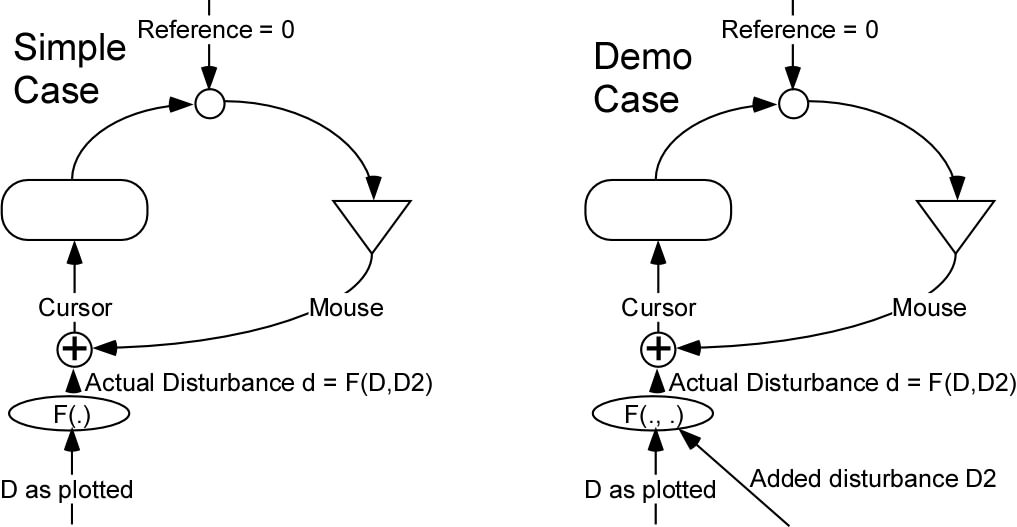
real disturbance that is countered by the output. Here’s a picture
of what I judge to be the situation Rick coded (on the left) and a
loop that is the mathematical equivalent at all points in the
circuitry except the place marked X in the left diagram.

![AddedDisturbance.jpg|1035x546](upload://4hYIiHMpPfBtzigAFtaUAO7u2Qm.jpeg)

In Rick's Demo, the two disturbances have similar ranges, but D2 has

about twice the bandwidth, or twice the information rate. This means
that 2/3 of the information in mouse movement is M(mouse:D2) and
only 1/3 is M(mouse:D1). In passing, it may be worth noting that
zero correlation does not imply zero mutual information, just in
case that thought occurred to someone.

The fact that the mouse output includes information from both

disturbances makes a nice tutorial point. Here are some relevant
passages from the “mutual information” message [Martin Taylor
2012.12.11.11.18]:

-----start extracts-----
First, we can take the joint variable (X,Y) to be a single variable

W whose value takes on all the values of combinations of x and y; if
x1, y2 = 3, w1,2 = 3. In that case the analysis for W and Z is as
above for X and Y.

[MT now: This is what we do if we only want to deal with the total

disturbance, as in the right-hand diagram.]

Usually, however, we want to keep separate the relationships of X

and Z, and Y and Z, and then we must consider also any relationship
between X and Y.

First, we keep the condition that X and Y are independent. That

doesn’t mean that their effects on Z are independent. Suppose, for
example, that Z = X*Y. The effect of X changing from 1 to 2 is
vastly different if Y=1 or if Y=100. When we treated each
combination of x and y as a unique value w, this didn’t matter, but
when we are teasing out the uncertainty relations among the three
variables, it does matter.

...

M(Z:X,Y) = U(Z) - Ux,y(Z) (The mutual information between Z and

individual combinations of X and Y values is the uncertainty of Z
before observing X or Y less its uncertainty if the values of X and
Y are known).

M(Z:X) = U(Z) - Ux(Z) (the Uncertainty of Z less the uncertainty of

Z if you know the value of X)

My(Z:X) = Uy(Z) - Ux,y(Z)  (the same if y is known, averaged over

the different possible values of y)

It's worth pausing a moment here, to think again about the example Z

= XY. If you just know the value of x, you have hardly affected how
much you know about Z. If x=1, Z is distributed as Y. If x = 100, Z
is distributed as 100
Y. Your probabilities for small values of Z
are greater if x = 1 than they are if x = 100, but the uncertainty
of Z is in both cases equal to U(Y). You haven’t learned very much
about Z by observing X, though you have learned something; M(Z:X) ~
0.

The situation is very different for the second equation above. If y

is known, whatever its value, as soon as you also observe X to have
the value x, you know the value of Z = X*Y exactly. This means that
Ux,y(Z) = 0 and My(Z:X) = Uy(Z). Knowing Y, X contains all the
information about Z that there is to know; My(Z:X) ~ min(U(X),
U(Z)).

--------end extracts--------

The issue Rick apparently is trying clarify is whether information

can be said to circulate around the loop, and in particular, whether
information from the disturbance can cycle back to the input
variable through the sequential pathways and functions in the
control system.

If you think only of the loop itself, using the left diagram, there

are three places (four if you include the reference input), where
something might influence the circulation of information around the
cycle. One is the integrator output function, which will pass only
G*1.443 bits/second, and the other two are inputs of independent
sources of variation from outside the loop. In the diagrams those
two variables are labelled D and D2. D directly influences the CEV
(controlled environmental variable; remember, it’s perception we
control, but in the absence of noise, the perceptual signal is a
single-valued function of the corresponding environmental variable,
so it is legitimate to talk of the controlled environmental
variable). D2 changes the relationship between the mouse output and
the CEV in the way mentioned in the extracts above, apart from the
substitution of addition for multiplication.

Both D and D2 are external information sources. It is common to call

such sources information “generators”, but really they should be
called “uncertainty” generators, because if you know their value at
time t0, and then don’t observe them for a while, over time your
uncertainty about their value will grow at a fixed rate up to some
level determined only by their long-term statistical probability
distributions. “Information” is what you get when you observe them,
and you can’t get it faster than their uncertainty generation rate
once you have reached the maximum observation precision of which you
are capable.

The uncertainty generation rate of a band-limited waveform is

proportional to its bandwidth. Shannon found an absolute value even
for continuous-valued waveforms, but that value was based on there
being a system noise floor to produce a signal-to-noise ratio, There
always is noise in every physical (or biological) system, but we are
analyzing ideal noise-free systems at the moment, so we can’t use
that stratagem to get an absolute value. We can, however, get a
relative uncertainty value by measuring changes in some arbitrary
unit, so long as we keep that unit constant from observation to
observation. That’s how it is possible to say that the information
rate of the D2 disturbance in the output (mouse) in Rick’s demo is
twice that of the D disturbance Rick plots, and why the uncertainty
of the mouse value is 2/3 due to information from D2 and only 1/3
due to information from D.

Rick finds no correlation between the mouse and the D disturbance,

despite the fact that control is possible (I found it very
difficult, because even though I did get Java working, for some
reason it stops taking notice of anything for seconds at a time
several times per run). The measure that would most closely relate
to that correlation is M(D:mouse). But this isn’t the only mutual
information measure that can be taken, and it’s not even the one
that is important in situations like this. As noted in the extract I
quoted above, when the added D2 disturbance exists, to see the
mutual information, you need Md2(D:mouse).

If you take D2 as simply noise added to the mouse value before its

influence on the cursor, the D2 disturbance has twice the power of
the D1 disturbance, fairly well swamping it. I can’t give a measure
of SNR from the traces I got, but I’m guessing it is about -3db. If
that was a signal in noise, it would be almost inaudible, and if D2
acted simply as noise, control would be impossible. But there is a
circuit through the control system, and information from D2 gets to
the output. Since D2 is slow enough to allow control, Md1(D:mouse)
becomes comparable in magnitude to U(D).

Anyway, I'm happy that Rick produced this Demo that I could use as

an example to illustrate one way in which the information measures
work with three variables in play.

Martin

[From Erling Jorgensen (2012.12.14.0830 EST)]

Bruce Abbott (2012.12.13.0930 EST)

Erling Jorgensen (2012.12.12.2100 EST)

Thank you, Bruce, for your considered response to my post.

EJ: My background is not mathematics. While I have a Ph.D. degree, I
always have to follow closely those who can translate the mathematical
concepts into more intuitive ways of understanding them.

The same goes for me.

I had to laugh when I saw this, thinking to myself, �Oh really?� I always
considered you sort of a math & research methods whiz. Nice to hear there
are other intuitive types out there.

I appreciate your trying to explain what Ashby was trying to do. But
I think we�re getting too caught up in Ashby�s postulate of �perfect
control,� which led him (erroneously) to conclude that �a feed forward
controller� had to be more efficient that �an error-controlled regulator.�
He set up a straw man with the notion of perfect control, proceeded to
knock it down as a logical absurdity, & then set off with this fantastical
claim that living organisms have developed channels of information, for
instance eyes and ears, that supposedly �supply them with information
about D before the chain of cause and effect goes so far as to cause
actual error� (p. 9 of Ashby�s 1958 article on �Requisite variety and
its implications for the control of complex systems�.)

The only reason his error-controlled regulator didn�t have the �requisite
variety� in its output for counteracting disturbances was that he had
ruled it out a priori by his postulate of perfect control! As you
yourself say:

Bill Powers
and I have both noted that in the real world the apparent advantage of
Ashby's "feed forward" controller evaporates, for two reasons. First, a
well-designed error-controlled system can keep the error vanishingly small
(even though control is not "perfect" in Ashby's sense).

I like that image of an error kept �vanishingly small.� Variables that
approach a limit can approximate pretty well what would happen at the
limit. You go on:

Second, there are
all sorts of difficulties implementing Ashby's controller, not least of
which is knowing exactly how the disturbance will affect the CV and knowing
how to generate an opposing output that has exactly an equal and opposite
effect on the CV. Even if you do come up with the right adjustments, the
whole thing goes to pieces if those relationships should change.

It seems much better, & more efficient, just to operate in real time.
Instead of having to calculate ahead of time (based on what?) �exactly
how the disturbance will affect the CV,� why not just let it do the
affecting & work with what you get? Evolution�s first primordial control
systems, whatever they were, didn�t have to be smart. They just had to
have a certain type of circular causation in their organization, in order
for them to start stabilizing variables that were important to them. Who
needs perfect results, when any bias above 50-50 will gradually get you
there?

Sorry to start preaching at Ashby there, (with the choir listening in...)

I do need to return to a point that you keep making, Bruce, with which I
differ.

EJ: In this postulated perfect control system, "the error signal would
never vary from zero," supposedly meaning "no variation in the output,"
but really only signifying no _further_ variation in the output.

BA: Incorrect. Zero error means zero error. None. If the error is zero,
then the output must necessarily be zero. Remember, the output is
computed by multiplying the error times the gain of the output function.
Zero times X is zero.

You are committing the mistake of leaving time out of the analysis, a
fallacy I stressed in my post. Even perfect control, if there were
such a thing, has to get there. We don�t just land in a world where
everything I have I already want, & the things I don�t have I already
want not to have them. Zero error doesn�t just arise ex nihilo.

Moreover, the output of a PCT control system is typically modeled via an
integrating function. As I understand them, an integrating function adds
the new computation of the output to the previous value of the output.
So, yes, zero error (once you get there) means no new output value is
added, because zero times the gain is still zero. But that doesn�t
instantly remove the prior output value. Perhaps with a leaky integrator,
if I understand it right, it would converge back toward zero. But things
don�t just happen, without time to allow them to happen. (Maybe I�m so
keen on this because the start of the title of my Dissertation was �Time
Matters:...�)

This is what I tried to say in my earlier post.

EJ: I don't understand why we wouldn't simply say that the channel
is 'not currently conveying information.' It is not a static, never-
changing situation. Just reintroduce variation into the disturbance,
& the error signal starts changing again.

BA: In the perfect controller under consideration, the information is
NEVER transmitted because the error signal, under the assumption of
perfection, never varies from zero error.

Again, why are we bound by Ashby�s postulated impossibility here? Real
control systems don�t work that way.

Another question I tried to address, or at least ask, was uncertainty
about what? That came up in several ways, & I am still not sure whether
you or anyone else sees it the same way.

EJ: The technical understanding of information here means reduction
in uncertainty. So isn't the error signal conveying information (i.e.,
reducing uncertainty) about the _perception_, not the disturbance, by
saying the perception is not yet equal to the reference?

BA: As I mentioned above, information is transmitted from disturbance
through the CV, perceptual signal, error signal, output, feedback, in
that order. Transmission is blocked if the error signal cannot vary
from zero.

Please throw out Ashby�s impossibility for a moment, & address the
uncertainty question. Isn�t it uncertainty about the _perception_ that
is reduced, because that is the value converging towards the reference
value?

I tried to consider whether there was still an information-theoretic
statement to make regarding the disturbance, in terms of uncertainty
reduction, but again the point seemed to get sidetracked.

EJ: I guess I can also see that while control is perfect, then that means
compensation for the disturbance by the output is also perfect. In that
sense, all the variation of the disturbance is being (inversely) captured
in the output, with no further uncertainty to reduce. ...[snip]...

BA: As I noted, this type of controller cannot achieve perfect control,
even theoretically. ...[snip]...

We keep getting caught by how Ashby set up the discussion. I�m trying to
say something about the reduction in uncertainty, in the technical sense
of information theory.

When a control system has settled into a stabilized state of good
control, aren�t the following two things true? (1) The uncertainty
of the perceptual signal has been reduced to near zero, because it
closely tracks the value of the reference signal. (2) The uncertainty
of the net disturbance, at the spot where it affects the controlled
variable, has been reduced to near zero, because its variability has
been inversely captured by the output as amplified by the environmental
feedback function.

I think you already agree with number (2) above, because you say:

BA: In other words, uncertainty is reduced only about the actual
disturbance affecting the CV.

But I was puzzled by your next comment:

EJ: If so, then at best the output
accumulates information (i.e., reduced uncertainty) about the net
perturbation.

BA: Yes, but you still can work backward from perturbation to the
information in the net disturbance that caused the perturbation.

This would seem to require an additional set of extensive environmental
measurements, to reduce uncertainty about exactly what caused what, (i.e.,
was it the wind? was it the tire pressure? was it the road?) I don�t
think you can easily take that next step back to the sources of the net
disturbance.

You make a final point, to which I just have a couple of comments.

BA: But I should raise one other issue. If there is a constant
disturbance acting on the CV (e.g., a constant side wind pushing against
the car), and the driver is functioning as a good control system, there
will be a constant nonzero output (force keeping the steering wheel, and
thus the car's front wheels, turned to generate a counterforce that
equals the force of the wind. This is not a condition of zero error in
the control system compensating for the side wind. If there were zero
error, there would be no error to generate the muscle force against
the steering wheel and keep the wheels turned to oppose the wind's
effects. ...

I still think this is a fallacy about how the equations work.

BA: ...The error in this case of constant disturbance would itself be
constant and nonzero.

I agree that in actual functioning control systems there is (always?)
residual error, & because of loop gain that bit of leftover error is
absolutely no problem for the control system. I believe you are making
the additional, stronger claim that residual error is necessary, to keep
driving the output of the control system.

Again, thank you for the helpful exchange.

All the best,
Erling

[From Bill Powers (2012.12.14.0831 MST)]

Martin Taylor 2012.12.13.23.15

I have been using “disturbance” and “disturbance
waveform” when I want to make clear it’s a time-varying influence to
refer to the action on the controlled environmental variable that is
countered by the action of the output. “Action” is used here
specifically to avoid using “force”. The disturbance action
might be somebody moving an item that I then return to the position I
want, it might be the ongoing political pressure to make something happen
that I oppose, or it might actually be a physical force. Whatever it is,
the perceptual signal in the control system is a function of the
controlled environmental variable, nothing else in the outer
world.

BP: Before Rick lands on you with both feet I think you should think
about this some more. Another influence in the outer world is the
feedback effect of the output the controller is generating. You seem to
limit yourself to cases in which the action is separated in time from a
transient disturbance long enough for the disturbance to have its full
effect on the controlled variable before any action at all starts. When
that is the case there is no negative feedback during the application of
the disturbance, and all the nice relationships that exist in a closed
loop are absent. The behavioral illusion will not be seen, for example.
The situation will look just like the old idea of sequential cause and
effect, response or stimulus chaining, which can be handled without
seeming to need control theory.

In most control processes, even when there is no obvious disturbance the
output is still affecting the input, and varying to correct minor changes
in the input perhaps due to small random fluctuations somewhere in the
system. Or we can say simply that the system is in momentary equilbrium
with no output action in progress, but still poised to act when the
slightest disturbance arises.

In a real control process, the effect of a changing disturbance begins to
be countered before the change is complete, and often only a few
milliseconds after it has begun. For most of the time, the feedback
effect of an output action is building up or continuing to change at the
same time the disturbance is building up or changing. So most of the
time, the state of the controlled variable is a joint function of both
the disturbance and the action.

When output is delayed for a long time after a disturbance, the lower
levels of control are not activated because the perception is one that
can be detected only after some time passes. In your example, an item is
moved, and after the move is complete, a control system puts it back
where it was. This implies that the controller is not active until
something at a higher level recognizes that the move has happened, and in
turn activates the lower-order systems that will pick it up and move it
back. If you reach out and start nudging a Ming vase toward the edge of
the shelf it is on, I think you will most likely find your efforts
opposed by someone else before the vase is in much danger, unless
everyone else has left the room or is misdirected by some other event and
are not aware of what you’re doing.

You then wrap up by making the same point, which makes me wonder what the
point of the interlude was.

MT: If the countering output is
delayed after the disturbing influnece has had its effect, then, by
proxy, the effect of disturbance can indeed be detected, as in the case
of the moved item. In the kinds of tracking studies much favoured here,
the disturbance cannot be detected as such in the perceptual
signal.

BP: Well, perhaps I can see it in the last sentence: “the kinds of
tracking studies much favored here.” The implication of that is that
Rick and I and others have selected some seldom-seen phenomena that fit
our prejudices and methods, while ignoring much more common cases. When I
say it so baldly, I would be surprised if you didn’t deny intending to
convey such a meaning. Well, I will make my position clearer: the case of
continually-present control, I assert, is by far the most common
situation, although at different times we may find that the active
controllers are different because of context. One does not need to
control by using the brake or accelerator pedal while seated in a movie
theater. On the other hand, I will assert that the sequential type of
analysis has been a widespread choice by psychologists in cases where
feedback effects were obvious but there were practical, personal, or
political reasons not to employ control theory to deal with
them.

In most cases I agree with you that “the disturbance cannot be
detected as such in the perceptual signal”. So what are we arguing
about?

Best,

Bill P.

[From Bruce Abbott (2012.12.14.1150 EST)]

Erling Jorgensen (2012.12.14.0830 EST)

Bruce Abbott (2012.12.13.0930 EST)

Erling Jorgensen (2012.12.12.2100 EST)

Thank you, Bruce, for your considered response to my post.

EJ: My background is not mathematics. While I have a Ph.D. degree, I
always have to follow closely those who can translate the mathematical
concepts into more intuitive ways of understanding them.

The same goes for me.

EJ: I had to laugh when I saw this, thinking to myself, "Oh really?" I
always
considered you sort of a math & research methods whiz. Nice to hear there
are other intuitive types out there.

Fortunately there are real mathematicians out there who can set us straight
when intuition fails!

EJ: I appreciate your trying to explain what Ashby was trying to do. But
I think we're getting too caught up in Ashby's postulate of "perfect
control," which led him (erroneously) to conclude that "a feed forward
controller" had to be more efficient that "an error-controlled regulator."

I don't understand why you think that this is an error, if by "more
efficient," you mean THEORETICALLY able to keep a disturbance from affecting
a controlled variable, whereas an error-controlled regulator MUST allow at
least some small level of error. Ashby is absolutely correct about this.

EJ: He set up a straw man with the notion of perfect control, proceeded to
knock it down as a logical absurdity, & then set off with this fantastical
claim that living organisms have developed channels of information, for
instance eyes and ears, that supposedly "supply them with information
about D before the chain of cause and effect goes so far as to cause
actual error" (p. 9 of Ashby's 1958 article on "Requisite variety and
its implications for the control of complex systems".)

Perfect control is not a logical absurdity for the feed forward system;
logically, theoretically, such a system can achieve perfect control. But as
Bill Powers and I have both insisted, real-world controllers are another
matter entirely. Feed forward systems must be more complex than equivalent
error-driven systems; furthermore, measurement errors, system "noise,"
imperfect knowledge about the properties of the system to be controlled, and
other factors make achieving excellent control difficult in most practical
situations.

But I would not dismiss feed forward systems as entirely useless, especially
when they are combined with feedback systems of the sort we usually describe
in PCT. A biological example might be provided by our body's ability to
thermoregulate. The hypothalamus can detect a change in core body
temperature and set in motion opposing outputs that counter these changes,
such as sweating when we overheat or shivering when we become cold. But skin
temperature changes long before body core temperature begins to be affected.
It's possible that signals from temperature sensors in the skin initiate
cause the hypothalamus to initiate some degree of counteraction before the
body has gained or lost much temperature, reducing response lag. Because
skin temperature changes occur ahead of core temperature changes, they can
be "fed forward" to apply a counteracting action in advance of body core
changes. Similarly, you may raise your hands to ward off a blow before the
blow reaches the point of pushing your head backward, preventing your neck
muscles from having to deal with that disturbance.

I don't know whether either of those two descriptions are accurate; only
research can decide what sort of systems are actually in play in a real
biological system. But we shouldn't rule out possible roles for feed forward
in such systems in advance, nor to my knowledge is there anything in PCT
that would require us to do so.

EJ: The only reason his error-controlled regulator didn't have the
"requisite
variety" in its output for counteracting disturbances was that he had
ruled it out a priori by his postulate of perfect control! As you
yourself say:

Bill Powers
and I have both noted that in the real world the apparent advantage of
Ashby's "feed forward" controller evaporates, for two reasons. First, a
well-designed error-controlled system can keep the error vanishingly small
(even though control is not "perfect" in Ashby's sense).

All Ashby was saying there is that the error signal must vary in order to
produce the necessary variation in output required to oppose the
disturbance. He was making the point that there must be "variety" in the
error signal or the feedback controller cannot work.

But Ashby's analysis goes beyond this. Requisite variety basically refers to
the controller's ability to produce outputs that match the variety in the
disturbance. This might occur, even in a real, practical control system. For
example, if the controller can only generate fairly widely spaced step
outputs, then disturbance values that fall between the steps cannot be
accurately countered.

EJ: I like that image of an error kept "vanishingly small." Variables that
approach a limit can approximate pretty well what would happen at the
limit. You go on:

Second, there are
all sorts of difficulties implementing Ashby's controller, not least of
which is knowing exactly how the disturbance will affect the CV and knowing
how to generate an opposing output that has exactly an equal and opposite
effect on the CV. Even if you do come up with the right adjustments, the
whole thing goes to pieces if those relationships should change.

EJ: It seems much better, & more efficient, just to operate in real time.
Instead of having to calculate ahead of time (based on what?) "exactly
how the disturbance will affect the CV," why not just let it do the
affecting & work with what you get? Evolution's first primordial control
systems, whatever they were, didn't have to be smart. They just had to
have a certain type of circular causation in their organization, in order
for them to start stabilizing variables that were important to them. Who
needs perfect results, when any bias above 50-50 will gradually get you
there?

Right, except that some degree of feed forward can also be helpful to
"anticipate" changes, especially when it takes time to develop the required
level of an opposing response. Keep in mind also that evolution is more of a
tinkerer than a designer. It takes what is already there and modifies it.
This process can lead to some unnecessarily complicated systems the
nevertheless function well enough for the purpose. We shouldn't assume that
evolution has necessarily arrived at the most efficient design.

EJ: Sorry to start preaching at Ashby there, (with the choir listening
in...)

EJ: I do need to return to a point that you keep making, Bruce, with which I

differ.

EJ: In this postulated perfect control system, "the error signal would
never vary from zero," supposedly meaning "no variation in the output,"
but really only signifying no _further_ variation in the output.

BA: Incorrect. Zero error means zero error. None. If the error is zero,
then the output must necessarily be zero. Remember, the output is
computed by multiplying the error times the gain of the output function.
Zero times X is zero.

EJ: You are committing the mistake of leaving time out of the analysis, a
fallacy I stressed in my post. Even perfect control, if there were
such a thing, has to get there. We don't just land in a world where
everything I have I already want, & the things I don't have I already
want not to have them. Zero error doesn't just arise ex nihilo.

I don't think it's a mistake. It's not perfect control if the error ever
departs from zero.

Ashby was just making a simple point about what is theoretically possible in
the ideal versions of each type of control system. If we add time into the
analysis, we are still left with the fact that the output must remain at
some nonzero value to oppose any continuing effect of the disturbance. Yet
we are assuming that we will reach a state of zero error and then never
depart from that state, even in the face of disturbances. It can't happen.
Which is just another way of stating that, to be sensed and corrected, error
must first occur.

EJ: Moreover, the output of a PCT control system is typically modeled via an

integrating function. As I understand them, an integrating function adds
the new computation of the output to the previous value of the output.
So, yes, zero error (once you get there) means no new output value is
added, because zero times the gain is still zero. But that doesn't
instantly remove the prior output value. Perhaps with a leaky integrator,
if I understand it right, it would converge back toward zero. But things
don't just happen, without time to allow them to happen. (Maybe I'm so
keen on this because the start of the title of my Dissertation was "Time
Matters:...")

EJ: This is what I tried to say in my earlier post.

This is the same point I dealt with above, so I won't repeat my explanation
here.

EJ: I don't understand why we wouldn't simply say that the channel
is 'not currently conveying information.' It is not a static, never-
changing situation. Just reintroduce variation into the disturbance,
& the error signal starts changing again.

Perfect control is not possible in such a system. As soon as you allow error
to occur, control is not perfect. However, as I've noted before, error can
be made as small as you please (within limits), in which case there is both
excellent control and transmission of information. When the error is clamped
at zero (under the assumption of perfect control), the transmission channel
is blocked and control is impossible. That's the relationship Ashby
demonstrated with his example -- a relationship between information
transmission within the control system and control.

BA: In the perfect controller under consideration, the information is
NEVER transmitted because the error signal, under the assumption of
perfection, never varies from zero error.

EJ: Again, why are we bound by Ashby's postulated impossibility here? Real
control systems don't work that way.

EJ: Another question I tried to address, or at least ask, was uncertainty
about what? That came up in several ways, & I am still not sure whether
you or anyone else sees it the same way.

EJ: The technical understanding of information here means reduction
in uncertainty. So isn't the error signal conveying information (i.e.,
reducing uncertainty) about the _perception_, not the disturbance, by
saying the perception is not yet equal to the reference?

No. Information in the disturbance is communicated via the perception, error
signal, etc. My post about communicating a phone number (Bruce Abbott
(2012.12.13.1555 EST)) may help to clarify this point.

BA: As I mentioned above, information is transmitted from disturbance
through the CV, perceptual signal, error signal, output, feedback, in
that order. Transmission is blocked if the error signal cannot vary
from zero.

Please throw out Ashby's impossibility for a moment, & address the
uncertainty question. Isn't it uncertainty about the _perception_ that
is reduced, because that is the value converging towards the reference
value?

I tried to consider whether there was still an information-theoretic
statement to make regarding the disturbance, in terms of uncertainty
reduction, but again the point seemed to get sidetracked.

EJ: I guess I can also see that while control is perfect, then that means
compensation for the disturbance by the output is also perfect. In that
sense, all the variation of the disturbance is being (inversely) captured
in the output, with no further uncertainty to reduce. ...[snip]...

BA: As I noted, this type of controller cannot achieve perfect control,
even theoretically. ...[snip]...

EJ: We keep getting caught by how Ashby set up the discussion. I'm trying
to
say something about the reduction in uncertainty, in the technical sense
of information theory.

I've removed the balance of your post as most of the objections you raise
there seem already to have been addressed.

I hope this has been helpful.

Bruce

[From Chad Green (2012.12.14.1243 EST)]

Here's a brief article by John Lane Bell that puts this thread into perspective for me at least (see last two paragraphs in particular).

Source: Professor John L. Bell

Best,
Chad

Chad Green, PMP
Program Analyst
Loudoun County Public Schools
21000 Education Court
Ashburn, VA 20148
Voice: 571-252-1486
Fax: 571-252-1633

"If you want sense, you'll have to make it yourself." - Norton Juster

Bruce Abbott <bbabbott@FRONTIER.COM> 12/14/2012 11:50 AM >>>

[From Bruce Abbott (2012.12.14.1150 EST)]

Erling Jorgensen (2012.12.14.0830 EST)

Bruce Abbott (2012.12.13.0930 EST)

Erling Jorgensen (2012.12.12.2100 EST)

Thank you, Bruce, for your considered response to my post.

EJ: My background is not mathematics. While I have a Ph.D. degree, I
always have to follow closely those who can translate the mathematical
concepts into more intuitive ways of understanding them.

The same goes for me.

EJ: I had to laugh when I saw this, thinking to myself, "Oh really?" I
always
considered you sort of a math & research methods whiz. Nice to hear there
are other intuitive types out there.

Fortunately there are real mathematicians out there who can set us straight
when intuition fails!

EJ: I appreciate your trying to explain what Ashby was trying to do. But
I think we're getting too caught up in Ashby's postulate of "perfect
control," which led him (erroneously) to conclude that "a feed forward
controller" had to be more efficient that "an error-controlled regulator."

I don't understand why you think that this is an error, if by "more
efficient," you mean THEORETICALLY able to keep a disturbance from affecting
a controlled variable, whereas an error-controlled regulator MUST allow at
least some small level of error. Ashby is absolutely correct about this.

EJ: He set up a straw man with the notion of perfect control, proceeded to
knock it down as a logical absurdity, & then set off with this fantastical
claim that living organisms have developed channels of information, for
instance eyes and ears, that supposedly "supply them with information
about D before the chain of cause and effect goes so far as to cause
actual error" (p. 9 of Ashby's 1958 article on "Requisite variety and
its implications for the control of complex systems".)

Perfect control is not a logical absurdity for the feed forward system;
logically, theoretically, such a system can achieve perfect control. But as
Bill Powers and I have both insisted, real-world controllers are another
matter entirely. Feed forward systems must be more complex than equivalent
error-driven systems; furthermore, measurement errors, system "noise,"
imperfect knowledge about the properties of the system to be controlled, and
other factors make achieving excellent control difficult in most practical
situations.

But I would not dismiss feed forward systems as entirely useless, especially
when they are combined with feedback systems of the sort we usually describe
in PCT. A biological example might be provided by our body's ability to
thermoregulate. The hypothalamus can detect a change in core body
temperature and set in motion opposing outputs that counter these changes,
such as sweating when we overheat or shivering when we become cold. But skin
temperature changes long before body core temperature begins to be affected.
It's possible that signals from temperature sensors in the skin initiate
cause the hypothalamus to initiate some degree of counteraction before the
body has gained or lost much temperature, reducing response lag. Because
skin temperature changes occur ahead of core temperature changes, they can
be "fed forward" to apply a counteracting action in advance of body core
changes. Similarly, you may raise your hands to ward off a blow before the
blow reaches the point of pushing your head backward, preventing your neck
muscles from having to deal with that disturbance.

I don't know whether either of those two descriptions are accurate; only
research can decide what sort of systems are actually in play in a real
biological system. But we shouldn't rule out possible roles for feed forward
in such systems in advance, nor to my knowledge is there anything in PCT
that would require us to do so.

EJ: The only reason his error-controlled regulator didn't have the
"requisite
variety" in its output for counteracting disturbances was that he had
ruled it out a priori by his postulate of perfect control! As you
yourself say:

Bill Powers
and I have both noted that in the real world the apparent advantage of
Ashby's "feed forward" controller evaporates, for two reasons. First, a
well-designed error-controlled system can keep the error vanishingly small
(even though control is not "perfect" in Ashby's sense).

All Ashby was saying there is that the error signal must vary in order to
produce the necessary variation in output required to oppose the
disturbance. He was making the point that there must be "variety" in the
error signal or the feedback controller cannot work.

But Ashby's analysis goes beyond this. Requisite variety basically refers to
the controller's ability to produce outputs that match the variety in the
disturbance. This might occur, even in a real, practical control system. For
example, if the controller can only generate fairly widely spaced step
outputs, then disturbance values that fall between the steps cannot be
accurately countered.

EJ: I like that image of an error kept "vanishingly small." Variables that
approach a limit can approximate pretty well what would happen at the
limit. You go on:

Second, there are
all sorts of difficulties implementing Ashby's controller, not least of
which is knowing exactly how the disturbance will affect the CV and knowing
how to generate an opposing output that has exactly an equal and opposite
effect on the CV. Even if you do come up with the right adjustments, the
whole thing goes to pieces if those relationships should change.

EJ: It seems much better, & more efficient, just to operate in real time.
Instead of having to calculate ahead of time (based on what?) "exactly
how the disturbance will affect the CV," why not just let it do the
affecting & work with what you get? Evolution's first primordial control
systems, whatever they were, didn't have to be smart. They just had to
have a certain type of circular causation in their organization, in order
for them to start stabilizing variables that were important to them. Who
needs perfect results, when any bias above 50-50 will gradually get you
there?

Right, except that some degree of feed forward can also be helpful to
"anticipate" changes, especially when it takes time to develop the required
level of an opposing response. Keep in mind also that evolution is more of a
tinkerer than a designer. It takes what is already there and modifies it.
This process can lead to some unnecessarily complicated systems the
nevertheless function well enough for the purpose. We shouldn't assume that
evolution has necessarily arrived at the most efficient design.

EJ: Sorry to start preaching at Ashby there, (with the choir listening
in...)

EJ: I do need to return to a point that you keep making, Bruce, with which I

differ.

EJ: In this postulated perfect control system, "the error signal would
never vary from zero," supposedly meaning "no variation in the output,"
but really only signifying no _further_ variation in the output.

BA: Incorrect. Zero error means zero error. None. If the error is zero,
then the output must necessarily be zero. Remember, the output is
computed by multiplying the error times the gain of the output function.
Zero times X is zero.

EJ: You are committing the mistake of leaving time out of the analysis, a
fallacy I stressed in my post. Even perfect control, if there were
such a thing, has to get there. We don't just land in a world where
everything I have I already want, & the things I don't have I already
want not to have them. Zero error doesn't just arise ex nihilo.

I don't think it's a mistake. It's not perfect control if the error ever
departs from zero.

Ashby was just making a simple point about what is theoretically possible in
the ideal versions of each type of control system. If we add time into the
analysis, we are still left with the fact that the output must remain at
some nonzero value to oppose any continuing effect of the disturbance. Yet
we are assuming that we will reach a state of zero error and then never
depart from that state, even in the face of disturbances. It can't happen.
Which is just another way of stating that, to be sensed and corrected, error
must first occur.

EJ: Moreover, the output of a PCT control system is typically modeled via an

integrating function. As I understand them, an integrating function adds
the new computation of the output to the previous value of the output.
So, yes, zero error (once you get there) means no new output value is
added, because zero times the gain is still zero. But that doesn't
instantly remove the prior output value. Perhaps with a leaky integrator,
if I understand it right, it would converge back toward zero. But things
don't just happen, without time to allow them to happen. (Maybe I'm so
keen on this because the start of the title of my Dissertation was "Time
Matters:...")

EJ: This is what I tried to say in my earlier post.

This is the same point I dealt with above, so I won't repeat my explanation
here.

EJ: I don't understand why we wouldn't simply say that the channel
is 'not currently conveying information.' It is not a static, never-
changing situation. Just reintroduce variation into the disturbance,
& the error signal starts changing again.

Perfect control is not possible in such a system. As soon as you allow error
to occur, control is not perfect. However, as I've noted before, error can
be made as small as you please (within limits), in which case there is both
excellent control and transmission of information. When the error is clamped
at zero (under the assumption of perfect control), the transmission channel
is blocked and control is impossible. That's the relationship Ashby
demonstrated with his example -- a relationship between information
transmission within the control system and control.

BA: In the perfect controller under consideration, the information is
NEVER transmitted because the error signal, under the assumption of
perfection, never varies from zero error.

EJ: Again, why are we bound by Ashby's postulated impossibility here? Real
control systems don't work that way.

EJ: Another question I tried to address, or at least ask, was uncertainty
about what? That came up in several ways, & I am still not sure whether
you or anyone else sees it the same way.

EJ: The technical understanding of information here means reduction
in uncertainty. So isn't the error signal conveying information (i.e.,
reducing uncertainty) about the _perception_, not the disturbance, by
saying the perception is not yet equal to the reference?

No. Information in the disturbance is communicated via the perception, error
signal, etc. My post about communicating a phone number (Bruce Abbott
(2012.12.13.1555 EST)) may help to clarify this point.

BA: As I mentioned above, information is transmitted from disturbance
through the CV, perceptual signal, error signal, output, feedback, in
that order. Transmission is blocked if the error signal cannot vary
from zero.

Please throw out Ashby's impossibility for a moment, & address the
uncertainty question. Isn't it uncertainty about the _perception_ that
is reduced, because that is the value converging towards the reference
value?

I tried to consider whether there was still an information-theoretic
statement to make regarding the disturbance, in terms of uncertainty
reduction, but again the point seemed to get sidetracked.

EJ: I guess I can also see that while control is perfect, then that means
compensation for the disturbance by the output is also perfect. In that
sense, all the variation of the disturbance is being (inversely) captured
in the output, with no further uncertainty to reduce. ...[snip]...

BA: As I noted, this type of controller cannot achieve perfect control,
even theoretically. ...[snip]...

EJ: We keep getting caught by how Ashby set up the discussion. I'm trying
to
say something about the reduction in uncertainty, in the technical sense
of information theory.

I've removed the balance of your post as most of the objections you raise
there seem already to have been addressed.

I hope this has been helpful.

Bruce

John Lane Bell.docx (286 KB)

[From Bill Powers (2012.12.14.1231 MST)]

Bruce Abbott (2012.12.14.1150 EST) –

Erling Jorgensen
(2012.12.14.0830 EST)

I’ve been wanting to make a comment about “requisite variety”
and keep getting sidetracked before getting to it.
The problem with requisite variety is that it’s one of those
generalizations that destroys itself when you try to apply it.
For example, you can generalize to say that organisms need food. But does
this mean that wombats like olives? They don’t? Whoa, folks, Aussie
animals don’t like food! Amazing to think they can get along without it

Variety matching means only that types of outputs must be related to the
types of variables to be controlled. But that is nowhere near good enough
to guarantee control. Specific outputs must link up with specific
controlled variables, the ones that are sensed and used to measure error
in the same loop. And the feedback must be negative, and the
overall loop must look like a simple integrator. Variety matching will
not guarantee even that the right outputs get to the right inputs, much
less guaranteeing the rest of the essential design details.

Best,

Bill P.

[From Rick Marken (2012.12.15.0940)]

Martin Taylor (2012.12.13.14.59)–

RM: OK, I’ve put a little tracking demo up on the net at

  [http://www.mindreadings.com/ControlDemo/InfoDist.html](http://www.mindreadings.com/ControlDemo/InfoDist.html)
  So how much information does output contain about the disturbance

in the demo?

MT: In Rick's Demo, the two disturbances have similar ranges, but D2 has

about twice the bandwidth, or twice the information rate.

RM: Actually, it’s not a second disturbance; it’s a variable multiplier that connects the disturbance to the controller variable.

MT: This means

that 2/3 of the information in mouse movement is M(mouse:D2) and
only 1/3 is M(mouse:D1). In passing, it may be worth noting that
zero correlation does not imply zero mutual information, just in
case that thought occurred to someone.

RM: There is only one disturbance (independent variable) in this study. How much information about that disturbance is in the output?

MT: The fact that the mouse output includes information from both

disturbances makes a nice tutorial point.

RM: There is only one disturbance. How much information about that disturbance is there in the output?

MT: The issue Rick apparently is trying clarify is whether information

can be said to circulate around the loop, and in particular, whether
information from the disturbance can cycle back to the input
variable through the sequential pathways and functions in the
control system.

RM: No, Rick just wants to know how much information about the disturbance is in the output?

MT: Rick finds no correlation between the mouse and the D disturbance,

despite the fact that control is possible (I found it very
difficult, because even though I did get Java working, for some
reason it stops taking notice of anything for seconds at a time
several times per run). The measure that would most closely relate
to that correlation is M(D:mouse). But this isn’t the only mutual
information measure that can be taken, and it’s not even the one
that is important in situations like this. As noted in the extract I
quoted above, when the added D2 disturbance exists, to see the
mutual information, you need Md2(D:mouse).

RM: There is no D2. How much information about the disturbance is there in the output?

MT: If you take D2 as simply noise added to the mouse value before its

influence on the cursor, the D2 disturbance has twice the power of
the D1 disturbance, fairly well swamping it. I can’t give a measure
of SNR from the traces I got, but I’m guessing it is about -3db. If
that was a signal in noise, it would be almost inaudible, and if D2
acted simply as noise, control would be impossible. But there is a
circuit through the control system, and information from D2 gets to
the output. Since D2 is slow enough to allow control, Md1(D:mouse)
becomes comparable in magnitude to U(D).

RM: But exactly how much information about the disturbance, D, the one disturbance manipulated in the experiment, is there in the output? I presume this would be measured in bits.

MT: Anyway, I'm happy that Rick produced this Demo that I could use as

an example to illustrate one way in which the information measures
work with three variables in play.

RM: But you didn’t show how I could measure the amount of information about the disturbance in the output. Based on the observed correlation between disturbance and output I would say that there is no information at all about the disturbance in the output. But you say there is. So show me how to measure it.

Words, words, words, I’m so sick of words

I get words all day through

First from Abbott, now you

Is that all you information theorists can do

Don’t talk of love of control theory you bear

If info is there show me

Tell me not how the info got there

If in the output its clear show me

(With apologies to Lerner and Lowe;-)

Best

Rick

···


Richard S. Marken PhD
rsmarken@gmail.com

www.mindreadings.com

[Martin Taylor 2012.12.15.13.41]

[From Bill Powers (2012.12.14.0831 MST)]

Martin Taylor 2012.12.13.23.15 --
I have been using "disturbance" and "disturbance waveform" when I want to make clear it's a time-varying influence to refer to the action on the controlled environmental variable that is countered by the action of the output. "Action" is used here specifically to avoid using "force". The disturbance action might be somebody moving an item that I then return to the position I want, it might be the ongoing political pressure to make something happen that I oppose, or it might actually be a physical force. Whatever it is, the perceptual signal in the control system is a function of the controlled environmental variable, nothing else in the outer world.

BP: Before Rick lands on you with both feet I think you should think about this some more. Another influence in the outer world is the feedback effect of the output the controller is generating.

You are right. I should have said "from the outer world".

Martin

[Martin Taylor 2012.12.15.13.44]

[From Rick Marken (2012.12.15.0940)]

        Martin Taylor

(2012.12.13.14.59)–

            RM: OK, I've put a little tracking demo up on the net

at

            [http://www.mindreadings.com/ControlDemo/InfoDist.html](http://www.mindreadings.com/ControlDemo/InfoDist.html)
            So how much information does output contain about the

disturbance in the demo?

        MT: In Rick's Demo, the two disturbances have similar

ranges, but D2 has about twice the bandwidth, or twice the
information rate.

      RM: Actually, it's not a second disturbance; it's a variable

multiplier that connects the disturbance to the controller
variable.

That's what I expected it to be, but I don't think that's what your

program does. Try not controlling, but move the mouse abruptly by a
moderate amount. You will see that the cursor and mouse always move
by the same amount. It’s easiest to see if you make the abrupt moves
when the error is about zero, but it’s true no matter when you move
the mouse. The added effect is additive.

        MT: This means that 2/3

of the information in mouse movement is M(mouse:D2) and only
1/3 is M(mouse:D1). In passing, it may be worth noting that
zero correlation does not imply zero mutual information,
just in case that thought occurred to someone.

      RM: There is only one disturbance (independent variable) in

this study. How much information about that disturbance is in
the output?

No, there are two disturbances, one to the CEV and one to the system

parameters.

The answer to your question isn't in bits, it's in proportion, and I

gave you my best answer to that from a by-eye observation of the
waveforms of the two disturbances. To get the answer in bits, you
have to have the parameters of the two disturbances, and their
relationship if they are not independent. I don’t have those values.

I also gave you the information you need to calculate it for

yourself.

Martin

[From Rick Marken (2012.12.15.1200)]

Martin Taylor (2012.12.15.13.44)_-

        MT: In Rick's Demo, the two disturbances have similar

ranges, but D2 has about twice the bandwidth, or twice the
information rate.

      RM: Actually, it's not a second disturbance; it's a variable

multiplier that connects the disturbance to the controller
variable.

MT: That's what I expected it to be, but I don't think that's what your

program does. Try not controlling, but move the mouse abruptly by a
moderate amount.

You will see that the cursor and mouse always move

by the same amount. It’s easiest to see if you make the abrupt moves
when the error is about zero, but it’s true no matter when you move
the mouse. The added effect is additive.

RM: That’s because the multiplier connects the disturbance, NOT the mouse, to the controlled variable. The code is:

cursor = mouse+ d * f.d

where f.d is the varying coefficient that represents the disturbance function.

        MT: This means that 2/3

of the information in mouse movement is M(mouse:D2) and only
1/3 is M(mouse:D1). In passing, it may be worth noting that
zero correlation does not imply zero mutual information,
just in case that thought occurred to someone.

      RM: There is only one disturbance (independent variable) in

this study. How much information about that disturbance is in
the output?

MT: No, there are two disturbances, one to the CEV and one to the system

parameters.

RM: OK, you can consider f.d a disturbance if you like. But it is not a variable manipulated by the experimenter. The demo represents a situation where the experimenter (studying characteristics of the controller – the person doing the demo) knows only d and o (mouse) and c (cursor). That’s why those are the only three variables printed out. But if you want to assume that the experimenter also knows the varying values of the feedback functions, that’s ok with me. We can use that information also in our calculations of the information in the output about these variables.

MT: The answer to your question isn't in bits, it's in proportion, and I

gave you my best answer to that from a by-eye observation of the
waveforms of the two disturbances.

RM: If you can only give the answer as a proportion then it’s kind of meaningless. Your answer is that .66 of the information n the output comes from variations in the disturbance function and .33 comes from variations in the disturbance. But the total amount of information in the output could be close to zero or it could be close to infinity. So the proportions mean quite different things depending on the total amount of information in the output about these variables. As you probably know given your skill at mathematics. .66 of .00000001 is considerably less than .66 of 10000000.0. Same applies to .33. So I really would still like to see how much information (in bits) is in the output.

MT: To get the answer in bits, you

have to have the parameters of the two disturbances, and their
relationship if they are not independent. I don’t have those values.

RM: What parameters would you like? If you can just give me the formula for computing information in the output I could put it into the demo and print out that value as a result of a tracking run.

MT: I also gave you the information you need to calculate it for

yourself.

RM: Perhaps I just didn’t know what I was seeing. Could you give it to me in the form of a formula that would allow me to do the calculations based on the parameters of the disturbance(s) and, I presume, characteristics of the output as well. Then I could start including information measures in my demos. Ow wouldn’t that be loverly;-)

Best

Rick

···


Richard S. Marken PhD
rsmarken@gmail.com
www.mindreadings.com

[From Bruce Abbott (2012.12.15.1730 EST)]

Rick Marken (2012.12.15.0940) to Martin Taylor:

Words, words, words, I’m so sick of words
I get words all day through
First from Abbott, now you
Is that all you information theorists can do

Don’t talk of love of control theory you bear
If info is there show me
Tell me not how the info got there
If in the output its clear show me

(With apologies to Lerner and Lowe;-)

And, perhaps, to Martin and Abbott. The criticism you offer in this little poem is quite unfair. However, I don’t wish to get into a debate about that.

My only interest throughout this whole exchange has been to show that information theory (a la Shannon) can be legitimately applied to analyze the performance of a control system. I’ve tried to correct certain misunderstandings about such an application of information theory, such as the false idea that, from an information-theoretic perspective, the control system extracts information and “uses” it as a means of control, or that it somehow provides an alternative explanation for how control systems work than the set of equations that describe the various transformations of variables in various parts of the closed loop. I’ve demonstrated, contrary to your repeated assertions, that in our standard control system, information does get transmitted from disturbance to the output of the feedback function, as information theory leads one to expect. I’ve tried to correct the belief you apparently hold that information theory somehow attempts to challenge the validity of the usual mathematical accounts of how control systems work. (Otherwise, I cannot account for the vigor with which you attempt to “prove” either that the information theory approach is invalid or, failing that, to convince yourself and others that such an approach is nearly useless.)

Why do I care that we get this right? I care because I believe that having members of our group make nonsense statements about information theory makes us out, to those who do understand information theory, to be a bunch of kooks who have no idea what we are talking about but are willing to make the most absurd statements about it nevertheless. It damages our credibility. If we have this wrong, how can we be trusted to know what we are talking with respect to control theory?

As for myself, I don’t have the expertise to properly apply information theory to the quantitative analysis of control system performance, so I won’t be providing the quantitative examples you are now demanding. However, I do believe that such analyses are possible and may even prove useful for some purposes, just as a frequency-domain or time-domain analysis of control-system performance is useful for some purposes.

That said, I do have other pressing matters to which I must now attend. (Indeed, I’ve already devoted much more of my time to this thread that I ever intended or anticipated.) Martin and others may wish to continue, but I simply must move on to other things, for now.

Bruce

[Martin Taylor 2102.12.15.20.33]

Why do you call "d" the disturbance, then? From the equation qi = qo
  • qd, the disturbance is d*f.d. You haven’t changed the situation at
    all. No analysis of any kind, of any control system could say anything
    about functions that are not part of the control system. The only
    facts relevant to a control system analysis are the functions in the
    loop and the waveforms of the two inputs (reference and disturbance)
    together with any other inputs that a more refined model might add,
    such as system noise or gain controls. Your whole so-called demo is
    entirely pointless. Apparently you produced it only to muddy the
    issue. I wonder why?
    Martin
···

On 2012/12/15 3:03 PM, Richard Marken
wrote:

[From Rick Marken (2012.12.15.1200)]

        Martin Taylor

(2012.12.15.13.44)_-

                  MT: In Rick's

Demo, the two disturbances have similar ranges,
but D2 has about twice the bandwidth, or twice the
information rate.

                RM: Actually, it's not a second disturbance; it's a

variable multiplier that connects the disturbance to
the controller variable.

        MT: That's what I expected it to be, but I don't think

that’s what your program does. Try not controlling, but move
the mouse abruptly by a moderate amount.

        You will see that the

cursor and mouse always move by the same amount. It’s
easiest to see if you make the abrupt moves when the error
is about zero, but it’s true no matter when you move the
mouse. The added effect is additive.

      RM: That's because the multiplier connects the disturbance,

NOT the mouse, to the controlled variable. The code is:

      cursor =  mouse+ d  * f.d


      where f.d is the varying coefficient that represents the

disturbance function.

[From Rick Marken (2012.12.15.2210)]

Bruce Abbott (2012.12.15.1730 EST)–

BA: My only interest throughout this whole exchange has been to show that information theory (a la Shannon) can be legitimately applied to analyze the performance of a control system.

RM: And my only interest has been to show that it isn’t.

BA: I’ve demonstrated, contrary to your repeated assertions, that in our standard control system, information does get transmitted from disturbance to the output of the feedback function, as information theory leads one to expect.

RM: And I’ve shown hat it doesn’t.

BA: I’ve tried to correct the belief you apparently hold that information theory somehow attempts to challenge the validity of the usual mathematical accounts of how control systems work.

RM: That is not my belief. My belief is that control theory challenges the validity of the information theory view of how control works.

BA: (Otherwise, I cannot account for the vigor with which you attempt to “prove” either that the information theory approach is invalid or, failing that, to convince yourself and others that such an approach is nearly useless.)

RM: The vigor with which I attempt to prove that the information theory approach is invalid comes from the same well of vigor that motivates my efforts to prove that the causal model of behavior. That is the well that wants capable researchers, like you, for example, to start studying behavior from a PCT perspective.

BA: Why do I care that we get this right? I care because I believe that having members of our group make nonsense statements about information theory makes us out, to those who do understand information theory, to be a bunch of kooks who have no idea what we are talking about but are willing to make the most absurd statements about it nevertheless.

RM: Kookiness is in the eye of the beholder. The nonsense statements you think we make about information theory are the same as the nonsense statements Bill Powers made about the scientific method in psychology in his 1978 Psych Review people and that I have made in several publications demonstrating the same points. And on that note I’ll leave you with another tune:

They all laughed at Christopher Columbus

When he said the world was round

They all laughed when Edison recorded sound

They all laughed at Wilbur and his brother

When they said that man could fly

They told Marconi

Wireless was a phony

It’s the same old cry

They all said I never could be happy

They laughed at me and how!

But ho, ho, ho!

Who’s got the last laugh now?

BA: It damages our credibility. If we have this wrong, how can we be trusted to know what we are talking with respect to control theory?

RM: But I don’t think we have it wrong.

BA: As for myself, I don’t have the expertise to properly apply information theory to the quantitative analysis of control system performance, so I won’t be providing the quantitative examples you are now demanding. However, I do believe that such analyses are possible and may even prove useful for some purposes, just as a frequency-domain or time-domain analysis of control-system performance is useful for some purposes.

RM: Great. But in the mean time all I can do is say what information theory says to me about control and it all says is completely misleading.

BA: That said, I do have other pressing matters to which I must now attend. (Indeed, I’ve already devoted much more of my time to this thread that I ever intended or anticipated.) Martin and others may wish to continue, but I simply must move on to other things, for now.

RM: No problem. You are a great asset to PCT and no “real” psychologists take me too seriously anyway so don’t pay any attention to all the “nonsense” coming out of me; no one else does;-)

Happy Holidays

Best

Rick

···


Richard S. Marken PhD
rsmarken@gmail.com
www.mindreadings.com

[From Rick Marken (2012.12.15.2240)]

Martin Taylor (2102.12.15.20.33)–

      RM: That's because the multiplier connects the disturbance,

NOT the mouse, to the controlled variable. The code is:

      cursor =  mouse+ d  * f.d


      where f.d is the varying coefficient that represents the

disturbance function.

MT: Why do you call "d" the disturbance, then? From the equation qi = qo
  • qd, the disturbance is d*f.d. You haven’t changed the situation at
    all.

RM:: Because d is the disturbance. f.d is the (linear) disturbance function. In most of our demos f.d is a constant and 1.0. But in the real world f.d is often not a constant. For example, when driving a car down the road the force of the wind is d; the lateral position of the car is q.i (a controlled variable, equivalent to cursor position in a tracking task). One factor determine how much d will affect q.i is the angle of the car relative to the direction of the wind. When the car is moving directly into the wind, the effect of d on q.i will be negligible; ;when the road curves so that the car is moving perpendicular to the direction of the wind the effect of d on q.i will be substantial. So the angle of the car relative to the direction of the wind is equivalent to f.d; f.d is small when the angle of the car relative to the direction of the wind is 0 degrees (into the wind) and large when that angle is 90 degrees.

MT: No analysis of any kind, of any control system could say anything

about functions that are not part of the control system.

RM: A control system analysis does this all the time.

MT: The only

facts relevant to a control system analysis are the functions in the
loop and the waveforms of the two inputs (reference and disturbance)
together with any other inputs that a more refined model might add,
such as system noise or gain controls. Your whole so-called demo is
entirely pointless.

RM: Actually it did have a point, which was to show that a control system can control quite well even though there was no evidence of information about the disurbance in the output. This demonstrates that control happens without any information about the disturbance being transmitted to the output.

MT: Apparently you produced it only to muddy the

issue. I wonder why?

RM: I think it made the “issue” quite clear; there can be control when there is no evidence that any information about the disturbance is transmitted to the output. That’s just a fact. I think your next move might be to say that the information that is transmitted is about the effect of the disturbance on the input. That is, you would probably argue now that the information transmitted to the output is about f.d*d and not d. Is that where we’re going next?

Best

Rick

···


Richard S. Marken PhD
rsmarken@gmail.com
www.mindreadings.com

[Martin Taylor 2012.12.17.23.48]

Very interesting. That's something I never heard in the two decades

I thought I understood PCT fairly well. It is always nice to learn
something new.
You could make your comment explicit by explaining how to do the
control system analysis that tells you you something about the
function F(.) in the simple setup in the left figure, then in your
setup, which I now draw like the right figure, showing the actual
disturbance to be a function of two separate waveforms (I hope it is
right this time). It would be really nice if your method would
return the actual functions, but I ask only for it to return some,
any, useful fact about the functions. Of course, your analysis will
use only the control system functional parameters and the actual
disturbance value (labelled “d” in the figures), because that’s all
the control system has access to so long as the reference value
stays at zero.
I will add your technique to my set of useful tools, as I have no
tool at the moment that could tell me anything about F(.) whether it
is a function of one variable or two.
Martin

···

On 2012/12/16 1:37 AM, Richard Marken
wrote:

[From Rick Marken (2012.12.15.2240)]

        MT: No analysis of any

kind, of any control system could say anything about
functions that are not part of the control system.

      RM: A control system analysis does this all the time.

[From Rick Marken (2012.12.18.0915)]

Martin Taylor (2012.12.17.23.48)–

Rick Marken (2012.12.15.2240)

        MT: No analysis of any

kind, of any control system could say anything about
functions that are not part of the control system.

      RM: A control system analysis does this all the time.
MT: Very interesting. That's something I never heard in the two decades

I thought I understood PCT fairly well. It is always nice to learn
something new.

RM: I took “say” to mean “include”. A control theory analysis of the situation in my tracking task which you diagram below would have include what is known about the environmental in which the system does it’s controlling. Control theory is a theory of what goes on inside the organism when it is controlling; I wouldn’t use control theory to analyze what is going on in the environment outside the control system; there are physical measuring instruments for that.

Best

Rick

···
You could make your comment explicit by explaining how to do the

control system analysis that tells you you something about the
function F(.) in the simple setup in the left figure, then in your
setup, which I now draw like the right figure, showing the actual
disturbance to be a function of two separate waveforms (I hope it is
right this time). It would be really nice if your method would
return the actual functions, but I ask only for it to return some,
any, useful fact about the functions. Of course, your analysis will
use only the control system functional parameters and the actual
disturbance value (labelled “d” in the figures), because that’s all
the control system has access to so long as the reference value
stays at zero.

<img alt="" src="cid:part1.08040803.04020201@mmtaylor.net" height="239" width="462">


I will add your technique to my set of useful tools, as I have no

tool at the moment that could tell me anything about F(.) whether it
is a function of one variable or two.


Richard S. Marken PhD
rsmarken@gmail.com

www.mindreadings.com