[From Rick Marken (2017.08.31.1120)]
···
Fred Nickols (2017.08.30.1227 ET)–
Â
FN: I believe that behavior serves to control our perceptions.Â
RM: That’s true as long as “behavior” is understood to refer only to the observable actions that bring a controlled perception to the reference state and keep it there, protected from disturbance. Â
 Â
FN: However, the perceptions we control are perceptions of something, often some variable in the environment.Â
RM: Right. And these variables are the controlled variables that are also seen as “behaviors”. So by limiting the term “behavior” to refer only to actions (as you do when you say “behavior serves to control perceptions”) you are leaving out a lot of things we call “behaviors”. Indeed, most of the things we call “behavior” are controlled variables – even the actions that keep those variables under control.Â
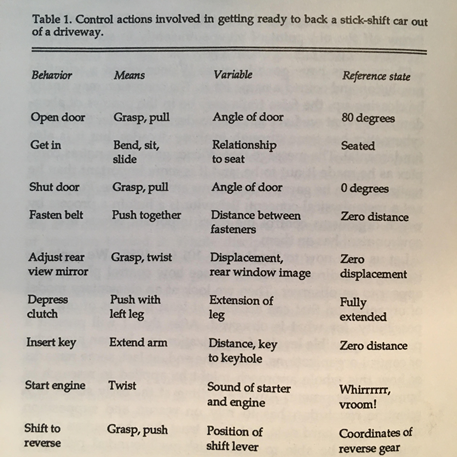
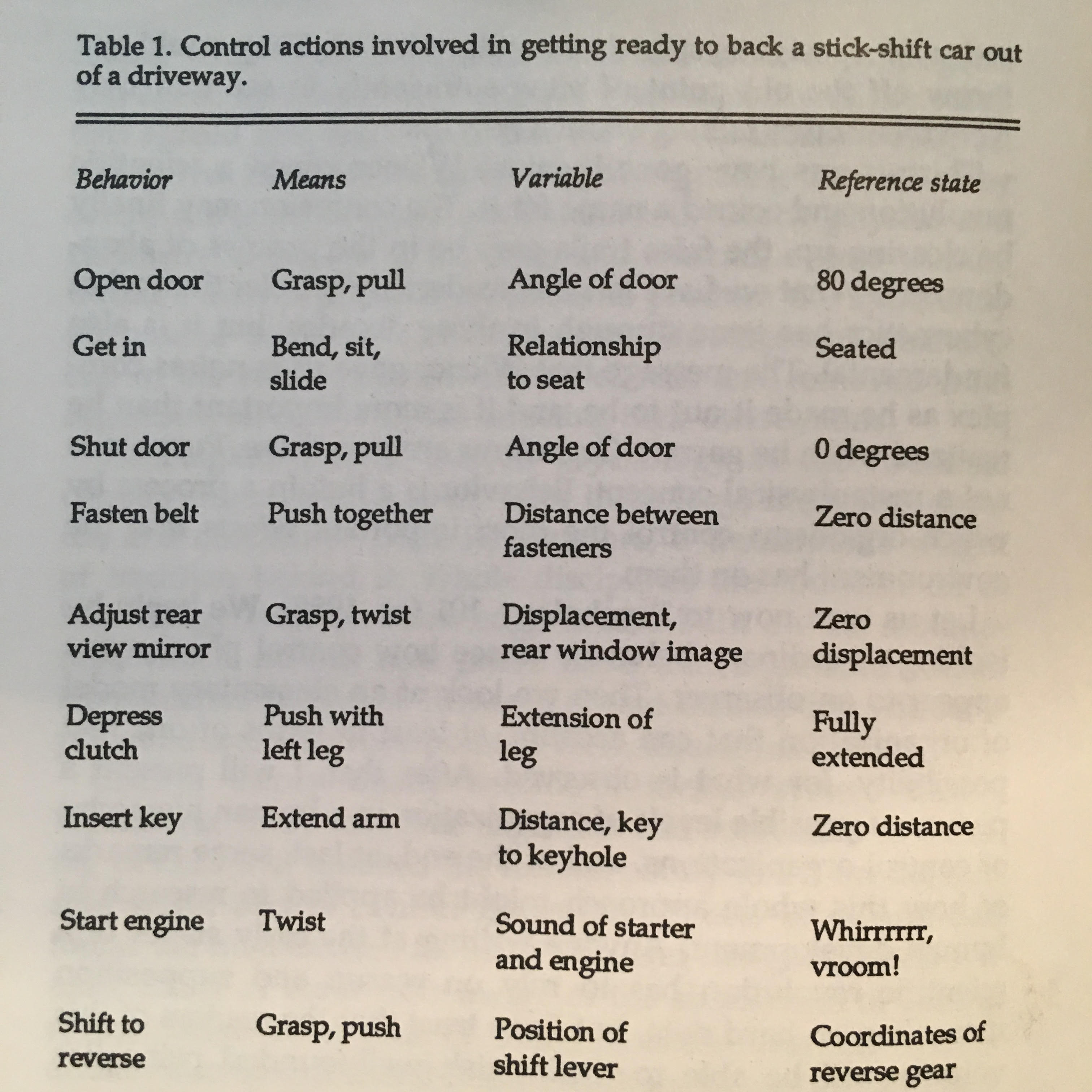
RM: This is nicely explained in Powers’ paper “A Cybernetic Model for Research in Human Development”, which is reprinted in LCS I (and which I have recommended to this group many times before). In particular, I recommend the section called “The Phenomenon of Control” which starts on page 171 of LCS I. In that section is the following Table:
Â
RM: The Table nicely illustrates the fact that what we call “Behavior” (the things listed in the first column of the Table) is a process of control, where variable Means (the actions listed in the second column) are used to bring a Variable (the variable aspects of the environment listed in the third column) to a Reference states (the values listed in the fourth column). So the behavior we call “Opening the car door” (Open door) involves using variable Means (acting by appropriately varying one’s grasp to fit the door handle and pulling on the door with the appropriate force; Grasp, pull) to bring a Variable aspect of the environment (the angle of the door relative to the side of the car; Angle of door) to a Reference state (80 degrees).Â
RM: So what you are seeing when you see a Behavior such as “fastening a seat belt” is the Means (buckling) used to bring a Variable (distance between fasteners) to a Reference state (zero distance); in PCT diagrams Means, Variable and Reference state are referred to as Output, Controlled Quantity (or Controlled Variable) and Reference state, respectively. And in virtually all cases where the Means of controlling a variable are visible, these Means are themselves Variables that are controlled (Controlled Variables). So, for example, when you grasp the handle to open a car door, the shape of the grasp is itself a Variable that is brought to a Reference state (one that fits the particular door handle) by variable Means (appropriate variations of the muscle forces exerted on the fingers).Â
FN: It is our perception of that variable we seek to control.Â
RM: Yes, of course. But, again, I think it’s important to keep clear in one’s mind the distinction between observation and theory. Behavior is an observation; PCT is a theory that says that the behavior we observe is the control of perception. What we observe when we see the behavior “opening a car door” is a person bringing a variable (angle of the door) to a reference state (80 degree angle) by appropriate variations in the means (pulling, grasping) used to produce this result. The theory of how a person does this is that the person’s nervous system is producing variable outputs aimed at bringing a perceptual signal that corresponds to the angle of the door into a match with a reference signal that corresponds to the the 80 degree angle of the door relative to the side of the car.Â
RM: While PCT does say that observed behavior is the control of perception, I think that there has come to be an unfortunate emphasis on the “perception” part of that phrase and a de-emphasis on the “control” part.  I think this is unfortunate because it misrepresents what is most important about PCT. Emphasis on the “perception” part of *control of perception *gives the impression that what is important about PCT is the idea that our behavior depends on how we perceive the environment, not on what is actually out there. But the fact is that all theories in psychology recognize that the environment exists for organisms only as perceptions. The problem is that all of these theories say that these perceptions are the ultimate cause of what organisms do – their behavior. By recognizing the fact that behavior itself is a process of control, PCT turns things around completely by showing that organisms themselves are the ultimate cause of what they perceive. It is the idea that organisms autonomously specify, in the form of reference signals, the states that they want their perceptual experience to be in that distinguishes PCT from all other theories of behavior (and mind), including other applications of control theory in psychology. What is important about PCT, then, is that is says that organisms CONTROL, not that they perceive. PCT says that organisms autonomously specify the desired states of perceptual aspects of the environment and act to maintain those variables in those specified states.
BestÂ
Rick
Â
Our behaviors affects the environmental variable and as a consequence our perception of that variable changes. Other factors also affect the variables we perceive and we refer to them as “disturbances.� Fortunately, unless we are overwhelmed, the effects of our behavior nullify the effects of disturbances and thus our perceptions stay aligned with our reference.
Â
Do you have a problem with anything I’ve said above
Â
–
Richard S. MarkenÂ
"Perfection is achieved not when you have nothing more to add, but when you
have nothing left to take away.�
                --Antoine de Saint-Exupery