Yes, thank you for tying it all together so neatly…
clap clap clap
···
On Thu, Apr 24, 2014 at 3:42 PM, Fred Nickols fred@nickols.us wrote:
Nice job, Rick.
Fred Nickols
Performance Improvement Professional
Distance Consulting LLC
Richard Marken wrote:
[From Rick Marken (2014.04.24.1310)]
This is a reply to three threads, the one’s called “Words”, "What’s wrong
with this picture" and “Self-Regulation”. I think these topics have close
ties to one another so I’m going reply to all three at the same time and
try to show how they are all related to one another and, hopefully, bring
it all back home to Perceptual Control Theory.
Here are the issues as I see them:
The “Words” thread seems to be about whether anything is lost if we avoid
the word “control” in favor terms like “self-regulation” in the the hopes
of making PCT sound more attractive to potential “buyers”; the "What’s
wrong with this picture" thread is about what might be wrong with the
control system diagram of a fly ball governor from a PCT perspective;
and the “Self-Regulation” thread seems to be about whether self-regulation
theories are equivalent to PCT.
I think avoiding the term “control” when discussing PCT is a bad idea for
many reasons not the least of which being that PCT is based on recognition
that the behavior of living organisms is control. Powers’ fundamental
insight was that control is a phenomenon – a fact – and that thebehavior
of living organisms is an example of that phenomenon: the production of
consistent results under circumstances that should produce inconsistency.
Understanding the phenomenon of control and how it is seen in the behavior
of living organisms is central to a PCT-based understand of living
systems.
So using a term other than “control” to describe PCT may be a good idea if
you’re trying to sell PCT but it’s a bad idea if you want to keep the
central focus of the theory – the phenomenon of control as it is seen in
the behavior of living systems-- front and center. I prefer to use labels
in a way that gives an accurate picture of what is being described rather
than as propaganda.
Keeping the word “control” in the description of PCT is also important
because Powers did not invent control theory. What he “invented” was the
correct application of control theory to the behavior of living systems.
And Bill was able to do this because of his recognition of the fact that
the behavior of living systems is control. It was recognition of the* fact
of control* that allowed Powers to apply the already existing *theory of
control *correctly to the behavior of living organisms. Which brings us to
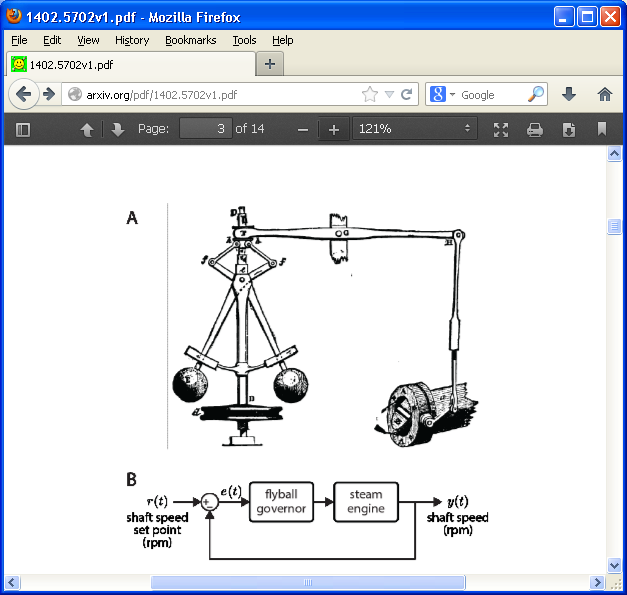
what is wrong, form a PCT perspective, with the control system diagram ofthe Watt governor:
[image: Inline image 1]
There is really nothing wrong with this diagram from the point of view of
an engineer who is trying to build a stable control system. The engineer
wants to build a system that keeps shaft speed, y(t), nearly equal to the
set point speed, r(t), with very little oscillation (instability) around
it. But from the point of view of a psychologist trying to understand how
an existing stable control system (a living organism) works this diagram
is
misleading and leaves out the most important thing we want to know about
that control control system in order to understand its: what it is
controlling.
Because Powers understood that behavior is control he knew that when we
look at the behavior of a living system we are looking at the behavior of
a
control system from the outside. And what we see are it’s actions – which
are equivalent to the movements of the collar of the flyball governor in
the diagram above – and the results of those actions – some of which are
equivalent to the controlled shaft speed, y(t), in the diagram above. So
the psychologist looking at the behavior of a living control system
doesn’t
know what the engineer looking at the behavior of an artifactual control
system knows: what variable it is controlling. The engineer working to
improve the stability of the shaft speed control system knows that the
system is controlling shaft speed because that’s what it’s been built to
control; the psychologist looking at the behavior of a living control
system can only guess at what that system is controlling. PCT shows how
the
psychologist can test that guess; and it shows it by adding some features
to the control diagram that were not really needed in the diagram used by
the engineer.
The main thing that is missing from the diagram (from a PCT perspective)
is
an indication that a controlled variable (y(t) in the diagram) has to be
perceived in order to be controlled. The engineer automatically includes a
mechanisms for perceiving the variable to be controlled – such as the
spinning flyball that “perceives” the the speed of shaft rotation – so an
engineering diagram typically leaves off a box for the sensor element
because it’s taken for granted. But Powers understood that including the
perceptual function box in the control diagram of a living system was
essential because determining what a living system is controlling is a
matter of determining what perceptions it is controlling. So that’s the
main problem that I see with the control diagram above; it takes for
granted that there is a mechanism for perceiving y(t) and that it is the
perceive value of y(t) that is controlled. If course, another problem is
that r(t) can be manipulated from outside the system with artifactual
control systems but not with living control systems. This is another
aspect
of the remapping of the control model to the behavior of living system
when
that behavior is understood to be an example of control.
So Powers’ recognition that behavior is control resulted in the proper
application (or mapping) of control theory to behavior, a mapping that wehere on CSGNet call PCT. And this proper mapping-- whatever you want to
call it, PCT, self-regulation, goal tending – results in a picture of
behavior as the control of perception. And when behavior is understood to
be the control of perception, understand the behavior is, first and
foremost, a matter of determining what perceptions the behaving system is
controlling. So if “self-regulation” theory is the same as PCT (if it maps
control theory to behavior in the same way as specified in B:CP) then
research based on self-regulation should be all about figuring out what
perceptual variables organisms are controlling. To my knowledge there is
not much research on self-regulation that has the determination of
controlled perceptual variables as its main aim. But I may be wrong about
this. Of course, determining what variables are controlled is not the only
aim of research based on PCT (or whatever you want to call theories that
properly map control theory to behavior). It’s also interesting to find
out
how people control the variables they control – and I suspect that this
is
mainly what Jeff’s research and modeling is about. But I do think that
determining what variables organisms control should really be the first
order of business in research based on PCT.
But my point here is simply that the way to judge whether any theory is
(or
is not) PCT (a theory that is based on a proper mapping of control theory
to behavior) is to look at the research, not the flow diagrams. I say this
based on my experience reading the first book by Carver and Scheier (I
think it was published in 1982). I was very excited when I discovered this
book because I thought I was one of the only people in the world (along
with Tom Bourbon, David Goldstein and Bill, of course) doing research on
PCT (it was just called control theory back then). I remember the first
couple of chapters of that book as giving an excellent account of Powers’
theory. But the wheels fell of in later chapter when they described their
research, which had nothing to do with determining controlled variables.
So
I learned way back then that it was possible to get all the diagrams right
and still not understand what the theory that we now call PCT is all
about.
It’s about understanding the controlling done by living systems which,
when control theory is properly applied to their behavior, means
*determining
the perceptual variables* that living systems control.
Best
Rick
–
Richard S. Marken PhD
It is difficult to get a man to
understand<http://en.wikiquote.org/wiki/Understand> something,
when his salary depends upon his not understanding it. – Upton Sinclair