Coffee in the Cup and more

[From Fred Nickols (2018.05.23.0826)]

I’m still working my way through this q.i. and control thing so once again bear with me. If you make it to the end of this post you will see what I think has been a breakthrough in my understanding.

I want a cup of fresh coffee. So I make a fresh pot and when it’s finished I pour some into my cup. I fill the cup to about three-quarters of an inch short of its lip.

Two variables are of interest here: (1) the freshness of the coffee and (2) the amount of coffee in the cup.

Two patterned actions on my part are apparent: (1) making a pot of coffee and (2) pouring coffee into the cup.

I start pouring coffee into the cup because it’s empty. I stop when it reaches my desired level of fullness indicating the desired amount of coffee in the cup.

I have a reference for the amount of coffee in the cup: about three-quarters of an inch short of its lip. I perceive the level or amount of coffee rise as I pour. I stop when the level of coffee reaches the reference level.

Were you to ask me after filling my coffee cup “How much coffee is in the cup?” I could only reply, “I don’t know the exact amount in terms of ounces or whatever, but I do know it (the level of coffee in the cup) is where I want it.” So I guess I’m actually controlling for the level of coffee in the cup, not some exact amount of coffee.

“Out there” – in the world outside me – is a cup with some coffee in it. I have a perception of the level of the coffee in the cup. I compare that perception with my desired level of coffee and when it reaches that level I stop pouring coffee into the cup. The difference or gap between my perceived level of coffee in the cup and my desired level of coffee in the cup has been closed.

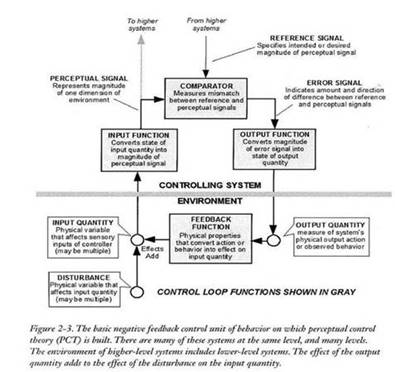
As I understand PCT, my perception of the level of coffee in the cup is represented by p. It is a perceptual signal that corresponds to the actual level of coffee in the cup. In PCT, the actual level of the coffee in the cup is represented as q.i. My desired level of coffee in the cup is the reference signal or r. Any gap or difference between p and r produces an error signal, represented in PCT as e. The error signal is an input to the output function which results in an output quantity represented as q.o. (the act of pouring coffee). Presumably, the feedback function has to do with things like the position of the coffee pot in relation to the coffee cup, the rate of pouring, and the path the stream of coffee follows in entering the cup. Through this feedback function, the level of coffee in the cup (q.i.) rises. As it rises, p, my perception of the level of coffee in the cup changes. When p = r, I stop pouring.

To continue some PCT parlance, I would be inclined to say with respect to p that I am controlling for my perceived level of coffee in the cup §. I cannot imagine anyone would take issue with the statement that my act of pouring coffee into the cup affects the level of coffee in the cup. I would also be inclined to say that my pouring behavior actually controls the level of coffee in the cup (q.i.). Yet, that latter statement seems capable of stirring up quite a controversy. Why is that?

Whoa there! I just had a flash of insight in relation to a sentence in the paragraph above. I stand by the assertion that my act of pouring coffee into the cup affects the level of coffee in the cup. But I think I just realized something about the next sentence. My pouring behavior does indeed affect the level of coffee in the cup, but it does not control the level of coffee in the cup. My behavior controls my perception of the level of coffee in the cup. In turn, that perception in relation to my reference for the level of coffee in the cup controls my behavior. As Bill said, behavior is the control of perception. Perhaps it’s equally true that perception controls behavior.

Regards,

Fred Nickols

Managing Partner

Distance Consulting LLC

“Assistance at a Distance”
[From Fred Nickols (2018.05.23.0848)]

I think I should clarify the last sentence in the post below.

I wrote “Perhaps it’s equally true that perception controls behavior.” I should have written, “Perhaps it’s equally true that perception, in relation to reference, controls behavior.” (At least in a start-stop sense.)

Fred Nickols

···

From: “Fred Nickols” (fred@nickols.us via csgnet Mailing List) csgnet@lists.illinois.edu
Sent: Wednesday, May 23, 2018 8:29 AM
To: csgnet@lists.illinois.edu
Subject: Coffee in the Cup and more

[From Fred Nickols (2018.05.23.0826)]

I’m still working my way through this q.i. and control thing so once again bear with me. If you make it to the end of this post you will see what I think has been a breakthrough in my understanding.

I want a cup of fresh coffee. So I make a fresh pot and when it’s finished I pour some into my cup. I fill the cup to about three-quarters of an inch short of its lip.

Two variables are of interest here: (1) the freshness of the coffee and (2) the amount of coffee in the cup.

Two patterned actions on my part are apparent: (1) making a pot of coffee and (2) pouring coffee into the cup.

I start pouring coffee into the cup because it’s empty. I stop when it reaches my desired level of fullness indicating the desired amount of coffee in the cup.

I have a reference for the amount of coffee in the cup: about three-quarters of an inch short of its lip. I perceive the level or amount of coffee rise as I pour. I stop when the level of coffee reaches the reference level.

Were you to ask me after filling my coffee cup “How much coffee is in the cup?” I could only reply, “I don’t know the exact amount in terms of ounces or whatever, but I do know it (the level of coffee in the cup) is where I want it.” So I guess I’m actually controlling for the level of coffee in the cup, not some exact amount of coffee.

“Out there” – in the world outside me – is a cup with some coffee in it. I have a perception of the level of the coffee in the cup. I compare that perception with my desired level of coffee and when it reaches that level I stop pouring coffee into the cup. The difference or gap between my perceived level of coffee in the cup and my desired level of coffee in the cup has been closed.

As I understand PCT, my perception of the level of coffee in the cup is represented by p. It is a perceptual signal that corresponds to the actual level of coffee in the cup. In PCT, the actual level of the coffee in the cup is represented as q.i. My desired level of coffee in the cup is the reference signal or r. Any gap or difference between p and r produces an error signal, represented in PCT as e. The error signal is an input to the output function which results in an output quantity represented as q.o. (the act of pouring coffee). Presumably, the feedback function has to do with things like the position of the coffee pot in relation to the coffee cup, the rate of pouring, and the path the stream of coffee follows in entering the cup. Through this feedback function, the level of coffee in the cup (q.i.) rises. As it rises, p, my perception of the level of coffee in the cup changes. When p = r, I stop pouring.

To continue some PCT parlance, I would be inclined to say with respect to p that I am controlling for my perceived level of coffee in the cup §. I cannot imagine anyone would take issue with the statement that my act of pouring coffee into the cup affects the level of coffee in the cup. I would also be inclined to say that my pouring behavior actually controls the level of coffee in the cup (q.i.). Yet, that latter statement seems capable of stirring up quite a controversy. Why is that?

Whoa there! I just had a flash of insight in relation to a sentence in the paragraph above. I stand by the assertion that my act of pouring coffee into the cup affects the level of coffee in the cup. But I think I just realized something about the next sentence. My pouring behavior does indeed affect the level of coffee in the cup, but it does not control the level of coffee in the cup. My behavior controls my perception of the level of coffee in the cup. In turn, that perception in relation to my reference for the level of coffee in the cup controls my behavior. As Bill said, behavior is the control of perception. Perhaps it’s equally true that perception controls behavior.

Regards,

Fred Nickols

Managing Partner

Distance Consulting LLC

“Assistance at a Distance”

Fred it seems that you’ll not stop thinking in Ricks’ way. He poisoned CSGnet with his RCT.

···

From: “Fred Nickols” (fred@nickols.us via csgnet Mailing List) csgnet@lists.illinois.edu
Sent: Wednesday, May 23, 2018 2:50 PM
To: csgnet@lists.illinois.edu
Subject: RE: Coffee in the Cup and more

[From Fred Nickols (2018.05.23.0848)]

I think I should clarify the last sentence in the post below.

FN : I wrote “Perhaps it’s equally true that perception controls behavior.” I should have written, “Perhaps it’s equally true that perception, in relation to reference, controls behavior.” (At least in a start-stop sense.)

HB : It’s neither the first one nor the second statement right. I advised you many time that you should turn to Bill not to Rick. There is no “Control of behavior” in PCT definitions and diagram. And thus “Behavior can’t control perception”. You are not manipulating with your hands “cup of coffee” in environment. At least in PCT you are not “controlling behavior”. But you just affect immediate environment with “output”.

Bill P (B:CP)

  1. COMPARATOR : The portion of control system that computes the magnitude and direction of mismatch between perceptual and reference signal.

  2. OUTPUT FUNCTION : The portion of a system that converts the magnitude or state of a signal inside the system into a corresponding set of effects on the immediate environment of the system

  3. FEED-BACK FUNCTION : The box represents the set of physical laws, properties, arrangements, linkages, by which the action of this system feeds-back to affect its own input, the controlled variable. That’s what feed-back means : it’s an effect of a system’s output on it’s own input.

HB : It’s just effects to environment that affect input. There is no “controlled effects” so that you could control “aspect of environment” or “perception” with behavior. Can you read it and remember it if you are talking about PCT ? If you talk about RCT where you control with behavior “aspect of environment” and perception there is no problem. You can use whatever you want. It’s anarchy.

Boris

Fred Nickols

From: “Fred Nickols” (fred@nickols.us via csgnet Mailing List) csgnet@lists.illinois.edu
Sent: Wednesday, May 23, 2018 8:29 AM
To: csgnet@lists.illinois.edu
Subject: Coffee in the Cup and more

[From Fred Nickols (2018.05.23.0826)]

I’m still working my way through this q.i. and control thing so once again bear with me. If you make it to the end of this post you will see what I think has been a breakthrough in my understanding.

I want a cup of fresh coffee. So I make a fresh pot and when it’s finished I pour some into my cup. I fill the cup to about three-quarters of an inch short of its lip.

Two variables are of interest here: (1) the freshness of the coffee and (2) the amount of coffee in the cup.

Two patterned actions on my part are apparent: (1) making a pot of coffee and (2) pouring coffee into the cup.

I start pouring coffee into the cup because it’s empty. I stop when it reaches my desired level of fullness indicating the desired amount of coffee in the cup.

I have a reference for the amount of coffee in the cup: about three-quarters of an inch short of its lip. I perceive the level or amount of coffee rise as I pour. I stop when the level of coffee reaches the reference level.

Were you to ask me after filling my coffee cup “How much coffee is in the cup?” I could only reply, “I don’t know the exact amount in terms of ounces or whatever, but I do know it (the level of coffee in the cup) is where I want it.” So I guess I’m actually controlling for the level of coffee in the cup, not some exact amount of coffee.

“Out there” – in the world outside me – is a cup with some coffee in it. I have a perception of the level of the coffee in the cup. I compare that perception with my desired level of coffee and when it reaches that level I stop pouring coffee into the cup. The difference or gap between my perceived level of coffee in the cup and my desired level of coffee in the cup has been closed.

As I understand PCT, my perception of the level of coffee in the cup is represented by p. It is a perceptual signal that corresponds to the actual level of coffee in the cup. In PCT, the actual level of the coffee in the cup is represented as q.i. My desired level of coffee in the cup is the reference signal or r. Any gap or difference between p and r produces an error signal, represented in PCT as e. The error signal is an input to the output function which results in an output quantity represented as q.o. (the act of pouring coffee). Presumably, the feedback function has to do with things like the position of the coffee pot in relation to the coffee cup, the rate of pouring, and the path the stream of coffee follows in entering the cup. Through this feedback function, the level of coffee in the cup (q.i.) rises. As it rises, p, my perception of the level of coffee in the cup changes. When p = r, I stop pouring.

To continue some PCT parlance, I would be inclined to say with respect to p that I am controlling for my perceived level of coffee in the cup §. I cannot imagine anyone would take issue with the statement that my act of pouring coffee into the cup affects the level of coffee in the cup. I would also be inclined to say that my pouring behavior actually controls the level of coffee in the cup (q.i.). Yet, that latter statement seems capable of stirring up quite a controversy. Why is that?

Whoa there! I just had a flash of insight in relation to a sentence in the paragraph above. I stand by the assertion that my act of pouring coffee into the cup affects the level of coffee in the cup. But I think I just realized something about the next sentence. My pouring behavior does indeed affect the level of coffee in the cup, but it does not control the level of coffee in the cup. My behavior controls my perception of the level of coffee in the cup. In turn, that perception in relation to my reference for the level of coffee in the cup controls my behavior. As Bill said, behavior is the control of perception. Perhaps it’s equally true that perception controls behavior.

Regards,

Fred Nickols

Managing Partner

Distance Consulting LLC

“Assistance at a Distance”

[Bruce Nevin 2018-05-26_13:34:34 ET]

Fred Nickols (2018.05.23.0826)

I would also be inclined to say that my pouring behavior actually controls the level of coffee in the cup (q.i.). Yet, that latter statement seems capable of stirring up quite a controversy. Why is that?

[…] my act of pouring coffee into the cup affects the level of coffee in the cup[…], but it does not control the level of coffee in the cup. My behavior controls my perception of the level of coffee in the cup. In turn, that perception in relation to my reference for the level of coffee in the cup controls my behavior. Â

Fred, control is what an entire control loop (or combination of such loops) does. The net effect of q.o + d, by way of properties of the environment determines the value of q.i; it does not control it because the relationships between these variables are not structured as a control loop. Likewise, the (variable) state of q.i  determines the value of p by way of perceptual input functions but does not control it; the difference between the value of p and that of r determines the value of e but does not control it, and the value of e by way of output functions determines but does not control the value of q.o.

Fred Nickols (2018.05.23.0826)

As Bill said, behavior is the control of perception. Perhaps it’s equally true that perception controls behavior.

Fred Nickols (2018.05.23.0848)

I wrote “Perhaps it’s equally true that perception controls behavior.� I should have written, “Perhaps it’s equally true that perception, in relation to reference, controls behavior.� (At least in a start-stop sense.)

You are confusing yourself a bit by using the word ‘behavior’ in two senses. In Bill’s phrase, behavior is what a control loop does: behavior is control. Part of behavior in the PCT sense–that is, part of the control loop that is doing the behaving–is the observable behavioral outputs that participate in the particular control loop under consideration. The other and more generic sense of the word ‘behavior’ refers only to observable behavioral outputs.Â

When we identify the specific outputs that counter identified disturbances so as to maintain an identified and measured input quantity q.i at a thereby identified reference level, the relevant ‘behavior’ in this sense of behavioral outputs is measured as q.o, which according to theory is determined by e, which is determined by r-p, which is determined by q.i, which is determined by d+q.o, etc. all effectively at the same time, and control is what that whole loop is doing.

When we have not quantified the observable variables q.o, d, q.i, and r (outside of an experimental setup we are usually unable to quantify them precisely), we still speak in these terms on the plausible assumption that the theory that has been demonstrated quantitatively for some behavior applies generally.Â

···

On Wed, May 23, 2018 at 8:49 AM, “Fred Nickols” csgnet@lists.illinois.edu wrote:

[From Fred Nickols (2018.05.23.0848)]

Â

I think I should clarify the last sentence in the post below.

Â

I wrote “Perhaps it’s equally true that perception controls behavior.� I should have written, “Perhaps it’s equally true that perception, in relation to reference, controls behavior.� (At least in a start-stop sense.)

Â

Fred Nickols

Â

From: “Fred Nickols” (fred@nickols.us via csgnet Mailing List) csgnet@lists.illinois.edu
Sent: Wednesday, May 23, 2018 8:29 AM
To: csgnet@lists.illinois.edu
Subject: Coffee in the Cup and more

Â

[From Fred Nickols (2018.05.23.0826)]

Â

I’m still working my way through this q.i. and control thing so once again bear with me. If you make it to the end of this post you will see what I think has been a breakthrough in my understanding.

Â

I want a cup of fresh coffee. So I make a fresh pot and when it’s finished I pour some into my cup. I fill the cup to about three-quarters of an inch short of its lip.

Two variables are of interest here: (1) the freshness of the coffee and (2) the amount of coffee in the cup.

Â

Two patterned actions on my part are apparent: (1) making a pot of coffee and (2) pouring coffee into the cup.

Â

I start pouring coffee into the cup because it’s empty. I stop when it reaches my desired level of fullness indicating the desired amount of coffee in the cup.

Â

I have a reference for the amount of coffee in the cup: about three-quarters of an inch short of its lip. I perceive the level or amount of coffee rise as I pour. I stop when the level of coffee reaches the reference level.

Â

Were you to ask me after filling my coffee cup “How much coffee is in the cup?� I could only reply, “I don’t know the exact amount in terms of ounces or whatever, but I do know it (the level of coffee in the cup) is where I want it.� So I guess I’m actually controlling for the level of coffee in the cup, not some exact amount of coffee.

Â

“Out thereâ€? – in the world outside me – is a cup up with some coffee in it. I have a perception of the level of the coffee in the cup. I compare that perception with my desired level of coffee and when it reaches that level I stop pouring coffee into the cup. The difference or gap between my perceived level of coffee in the cup and my desired level of coffee in the cup has been closed.

As I understand PCT, my perception of the level of coffee in the cup is represented by p. It is a perceptual signal that corresponds to the actual level of coffee in the cup. In PCT, the actual level of the coffee in the cup is represented as q.i. My desired level of coffee in the cup is the reference signal or r. Any gap or difference between p and r produces an error signal, represented in PCT as e. The error signal is an input to the output function which results in an output quantity represented as q.o. (the act of pouring coffee). Presumably, the feedback function has to do with things like the position of the coffee pot in relation to the coffee cup, the rate of pouring, and the path the stream of coffee follows in entering the cup. Through this feedback function, the level of coffee in the cup (q.i.) rises. As it rises, p, my perception of the level of coffee in the cup changes. When p = r, I stop pouring.

Â

To continue some PCT parlance, I would be inclined to say with respect to p that I am controlling for my perceived level of coffee in the cup (p). I cannot imagine anyone would take issue with the statement that my act of pouring coffee into the cup affects the level of coffee in the cup. I would also be inclined to say that my pouring behavior actually controls the level of coffee in the cup (q.i.). Yet, that latter statement seems capable of stirring up quite a controversy. Why is that?

Â

Whoa there! I just had a flash of insight in relation to a sentence in the paragraph above. I stand by the assertion that my act of pouring coffee into the cup affects the level of coffee in the cup. But I think I just realized something about the next sentence. My pouring behavior does indeed affect the level of coffee in the cup, but it does not control the level of coffee in the cup. My behavior controls my perception of the level of coffee in the cup. In turn, that perception in relation to my reference for the level of coffee in the cup controls my behavior. As Bill said, behavior is the control of perception. Perhaps it’s equally true that perception controls behavior.

Â

Â

Regards,

Â

Fred Nickols

Managing Partner

Distance Consulting LLC

“Assistance at a Distance�

Â

[Rick Marken 2018-05-27_22:19:53]

[Bruce Nevin 2018-05-26_13:34:34 ET]

BN: I would also be inclined to say that my pouring behavior actually controls the level of coffee in the cup (q.i.). Yet, that latter statement seems capable of stirring up quite a controversy. Why is that?
[...] my act of pouring coffee into the cup affects the level of coffee in the cup[...], but it does not control the level of coffee in the cup. My behavior controls my perception of the level of coffee in the cup. In turn, that perception in relation to my reference for the level of coffee in the cup controls my behavior. Â

BN: Fred, control is what an entire control loop (or combination of such loops) does. The net effect of q.o + d, by way of properties of the environment determines the value of q.i; it does not control it because the relationships between these variables are not structured as a control loop. Likewise, the (variable) state of q.i  determines the value of p by way of perceptual input functions but does not control it; the difference between the value of p and that of r determines the value of e but does not control it, and the value of e by way of output functions determines but does not control the value of q.o.

RM: This is pretty good except for one crucial error: according to PCT it's the perceptual function, not q.i, that determines the value of p. This perceptual function also defines the controlled input quantity, q.i.Â

FN: I wrote “Perhaps it’s equally true that perception controls behavior.� I should have written, “Perhaps it’s equally true that perception, in relation to reference, controls behavior.� (At least in a start-stop sense.)

BN: You are confusing yourself a bit by using the word 'behavior' in two senses. In Bill's phrase, behavior is what a control loop does: behavior is control. Part of behavior in the PCT sense--that is, part of the control loop that is doing the behaving--is the observable behavioral outputs that participate in the particular control loop under consideration. The other and more generic sense of the word 'behavior' refers only to observable behavioral outputs.Â

RM: This is great right up to the last sentence, which should have been left off because it's not true. The things we refer to as "behaviors" are typically both the outputs, q.o, and controlled variables, q.i. For example, when you see the behavior called "playing the piano" you are seeing both an output component of a control loop, such as the key presses, and a controlled variable component, the resulting sound made by each key press. And because of the hierarchical nature of control in organisms, the output component is also a controlled variable (the key presses are a controlled result of varying muscle tension) and the controlled variable component is also an output component (the sounds are the means of producing the musical phrase).

RM: These facts about behavior can be identified objectively; no theory is needed to see that this is what we are seeing when we look at the things we call "behaviors". In order to do this you have to know what control IS and, as you correctly say above, that behavior IS control. If the people studying the power law of movement had known these two things about the nature of behavior they would not have continued to believe that the power law reveals anything about how curved movement behavior is generated.Â
BestÂ
Rick

···

When we identify the specific outputs that counter identified disturbances so as to maintain an identified and measured input quantity q.i at a thereby identified reference level, the relevant 'behavior' in this sense of behavioral outputs is measured as q.o, which according to theory is determined by e, which is determined by r-p, which is determined by q.i, which is determined by d+q.o, etc. all effectively at the same time, and control is what that whole loop is doing.
When we have not quantified the observable variables q.o, d, q.i, and r (outside of an experimental setup we are usually unable to quantify them precisely), we still speak in these terms on the plausible assumption that the theory that has been demonstrated quantitatively for some behavior applies generally.Â

/Bruce

On Wed, May 23, 2018 at 8:49 AM, "Fred Nickols" <<mailto:csgnet@lists.illinois.edu>csgnet@lists.illinois.edu> wrote:

[From Fred Nickols (2018.05.23.0848)]

Â

I think I should clarify the last sentence in the post below.

Â

I wrote “Perhaps it’s equally true that perception controls behavior.� I should have written, “Perhaps it’s equally true that perception, in relation to reference, controls behavior.� (At least in a start-stop sense.)

Â

Fred Nickols

Â

From: "Fred Nickols" (<mailto:fred@nickols.us>fred@nickols.us via csgnet Mailing List) <<mailto:csgnet@lists.illinois.edu>csgnet@lists.illinois.edu>
Sent: Wednesday, May 23, 2018 8:29 AM
To: <mailto:csgnet@lists.illinois.edu>csgnet@lists.illinois.edu
Subject: Coffee in the Cup and more

Â

[From Fred Nickols (2018.05.23.0826)]

Â

I’m still working my way through this q.i. and control thing so once again bear with me. If you make it to the end of this post you will see what I think has been a breakthrough in my understanding.

Â

I want a cup of fresh coffee. So I make a fresh pot and when it’s finished I pour some into my cup. I fill the cup to about three-quarters of an inch short of its lip.

Two variables are of interest here: (1) the freshness of the coffee and (2) the amount of coffee in the cup.

Â

Two patterned actions on my part are apparent: (1) making a pot of coffee and (2) pouring coffee into the cup.

Â

I start pouring coffee into the cup because it’s empty. I stop when it reaches my desired level of fullness indicating the desired amount of coffee in the cup.

Â

I have a reference for the amount of coffee in the cup: about three-quarters of an inch short of its lip. I perceive the level or amount of coffee rise as I pour. I stop when the level of coffee reaches the reference level.

Â

Were you to ask me after filling my coffee cup “How much coffee is in the cup?� I could only reply, “I don’t know the exact amount in terms of ounces or whatever, but I do know it (the level of coffee in the cup) is where I want it.� So I guess I’m actually controlling for the level of coffee in the cup, not some exact amount of coffee.

Â

“Out thereâ€? – in the world outside me  “ is a cup with some coffee in it. I have a perception of the level of the coffee in the cup. I compare that perception with my desired level of coffee and when it reaches that level I stop pouring coffee into the cup. The difference or gap between my perceived level of coffee in the cup and my desired level of coffee in the cup has been closed.

As I understand PCT, my perception of the level of coffee in the cup is represented by p. It is a perceptual signal that corresponds to the actual level of coffee in the cup. In PCT, the actual level of the coffee in the cup is represented as q.i. My desired level of coffee in the cup is the reference signal or r. Any gap or difference between p and r produces an error signal, represented in PCT as e. The error signal is an input to the output function which results in an output quantity represented as q.o. (the act of pouring coffee). Presumably, the feedback function has to do with things like the position of the coffee pot in relation to the coffee cup, the rate of pouring, and the path the stream of coffee follows in entering the cup. Through this feedback function, the level of coffee in the cup (q.i.) rises. As it rises, p, my perception of the level of coffee in the cup changes. When p = r, I stop pouring.

Â

To continue some PCT parlance, I would be inclined to say with respect to p that I am controlling for my perceived level of coffee in the cup (p). I cannot imagine anyone would take issue with the statement that my act of pouring coffee into the cup affects the level of coffee in the cup. I would also be inclined to say that my pouring behavior actually controls the level of coffee in the cup (q.i.). Yet, that latter statement seems capable of stirring up quite a controversy. Why is that?

Â

Whoa there! I just had a flash of insight in relation to a sentence in the paragraph above. I stand by the assertion that my act of pouring coffee into the cup affects the level of coffee in the cup. But I think I just realized something about the next sentence. My pouring behavior does indeed affect the level of coffee in the cup, but it does not control the level of coffee in the cup. My behavior controls my perception of the level of coffee in the cup. In turn, that perception in relation to my reference for the level of coffee in the cup controls my behavior. As Bill said, behavior is the control of perception. Perhaps it’s equally true that perception controls behavior.

Â

Â

Regards,

Â

Fred Nickols

Managing Partner

<http://www.nickols.us/&gt;&gt;&gt; Distance Consulting LLC

“Assistance at a Distance�

Â

--
Richard S. MarkenÂ
"Perfection is achieved not when you have nothing more to add, but when you
have nothing left to take away.�
                --Antoine de Saint-Exupery

[Bruce Nevin 2018-05-28_09:57:18 ET]

BN: You are confusing yourself a bit by using the word ‘behavior’ in two senses. In Bill’s phrase, behavior is what a control loop does: behavior is control. Part of behavior in the PCT sense–that is, part of the control loop that is doing the behaving–is the observable behavioral outputs that participate in the particular control loop under consideration. The other and more generic sense of the word ‘behavior’ refers only to observable behavioral outputs.Â

RM: This is great right up to the last sentence, which should have been left off because it’s not true. The things we refer to as “behaviors” are typically both the outputs, q.o, and controlled variables, q.i. For example, when you see the behavior called “playing the piano” you are seeing both an output component of a control loop, such as the key presses, and a controlled variable component, the resulting sound made by each key press. And because of the hierarchical nature of control in organisms, the output component is also a controlled variable (the key presses are a controlled result of varying muscle tension) and the controlled variable component is also an output component (the sounds are the means of producing the musical phrase).

Oh, sure. I agree, common usage of the word ‘behavior’ is different from our PCT understanding of behavior. Fred proposed that (2018.05.23.0826) “it’s equally true that perception controls behavior” and (2018.05.23.0848) “Perhaps it’s equally true that perception, in relation to reference, controls behaviorâ€?. His use of the word ‘behavior’ here means the output of a control loop.Â

In the earlier paragraph I pointed to the distinction between controlling a value (what the entire loop does) and determining a value (the relation between successive variables around the loop). It would have been simpler to leave it at that. The error value, which is determined by r-p, determines the value of the output. In Fred’s terms, “perception, in relation to reference, determines behaviorâ€? but does not “control” it. Control is what the whole loop does.

Â

···

On Mon, May 28, 2018 at 1:20 AM, Richard Marken csgnet@lists.illinois.edu wrote:

[Rick Marken 2018-05-27_22:19:53]

[Bruce Nevin 2018-05-26_13:34:34 ET]

BN: I would also be inclined to say that my pouring behavior actually controls the level of coffee in the cup (q.i.). Yet, that latter statement seems capable of stirring up quite a controversy. Why is that?

[…] my act of pouring coffee into the cup affects the level of coffee in the cup[…], but it does not control the level of coffee in the cup. My behavior controls my perception of the level of coffee in the cup. In turn, that perception in relation to my reference for the level of coffee in the cup controls my behavior. Â

BN: Fred, control is what an entire control loop (or combination of such loops) does. The net effect of q.o + d, by way of properties of the environment determines the value of q.i; it does not control it because the relationships between these variables are not structured as a control loop. Likewise, the (variable) state of q.i  determines the value of p by way of perceptual input functions but does not control it; the difference between the value of p and that of r determines the value of e but does not control it, and the value of e by way of output functions determines but does not control the value of q.o.

RM: This is pretty good except for one crucial error: according to PCT it’s the perceptual function, not q.i, that determines the value of p. This perceptual function also defines the controlled input quantity, q.i.Â

FN: I wrote “Perhaps it’s equally true that perception controls behavior.� I should have written, “Perhaps it’s equally true that perception, in relation to reference, controls behavior.� (At least in a start-stop sense.)

BN: You are confusing yourself a bit by using the word ‘behavior’ in two senses. In Bill’s phrase, behavior is what a control loop does: behavior is control. Part of behavior in the PCT sense–that is, part of the control loop that is doing the behaving–is the observable behavioral outputs that participate in the particular control loop under consideration. The other and more generic sense of the word ‘behavior’ refers only to observable behavioral outputs.Â

RM: This is great right up to the last sentence, which should have been left off because it’s not true. The things we refer to as “behaviors” are typically both the outputs, q.o, and controlled variables, q.i. For example, when you see the behavior called “playing the piano” you are seeing both an output component of a control loop, such as the key presses, and a controlled variable component, the resulting sound made by each key press. And because of the hierarchical nature of control in organisms, the output component is also a controlled variable (the key presses are a controlled result of varying muscle tension) and the controlled variable component is also an output component (the sounds are the means of producing the musical phrase).

RM: These facts about behavior can be identified objectively; no theory is needed to see that this is what we are seeing when we look at the things we call “behaviors”. In order to do this you have to know what control IS and, as you correctly say above, that behavior IS control. If the people studying the power law of movement had known these two things about the nature of behavior they would not have continued to believe that the power law reveals anything about how curved movement behavior is generated.Â

BestÂ

Rick

When we identify the specific outputs that counter identified disturbances so as to maintain an identified and measured input quantity q.i at a thereby identified reference level, the relevant ‘behavior’ in this sense of behavioral outputs is measured as q.o, which according to theory is determined by e, which is determined by r-p, which is determined by q.i, which is determined by d+q.o, etc. all effectively at the same time, and control is what that whole loop is doing.

When we have not quantified the observable variables q.o, d, q.i, and r (outside of an experimental setup we are usually unable to quantify them precisely), we still speak in these terms on the plausible assumption that the theory that has been demonstrated quantitatively for some behavior applies generally.Â

/Bruce

Richard S. MarkenÂ

"Perfection is achieved not when you have nothing more to add, but when you
have nothing left to take away.�
                --Antoine de Saint-Exupery

On Wed, May 23, 2018 at 8:49 AM, “Fred Nickols” csgnet@lists.illinois.edu wrote:

[From Fred Nickols (2018.05.23.0848)]

Â

I think I should clarify the last sentence in the post below.

Â

I wrote “Perhaps it’s equally true that perception controls behavior.� I should have written, “Perhaps it’s equally true that perception, in relation to reference, controls behavior.� (At least in a start-stop sense.)

Â

Fred Nickols

Â

From: “Fred Nickols” (fred@nickols.us via csgnet Mailing List) csgnet@lists.illinois.edu
Sent: Wednesday, May 23, 2018 8:29 AM
To: csgnet@lists.illinois.edu
Subject: Coffee in the Cup and more

Â

[From Fred Nickols (2018.05.23.0826)]

Â

I’m still working my way through this q.i. and control thing so once again bear with me. If you make it to the end of this post you will see what I think has been a breakthrough in my understanding.

Â

I want a cup of fresh coffee. So I make a fresh pot and when it’s finished I pour some into my cup. I fill the cup to about three-quarters of an inch short of its lip.

Two variables are of interest here: (1) the freshness of the coffee and (2) the amount of coffee in the cup.

Â

Two patterned actions on my part are apparent: (1) making a pot of coffee and (2) pouring coffee into the cup.

Â

I start pouring coffee into the cup because it’s empty. I stop when it reaches my desired level of fullness indicating the desired amount of coffee in the cup.

Â

I have a reference for the amount of coffee in the cup: about three-quarters of an inch short of its lip. I perceive the level or amount of coffee rise as I pour. I stop when the level of coffee reaches the reference level.

Â

Were you to ask me after filling my coffee cup “How much coffee is in the cup?� I could only reply, “I don’t know the exact amount in terms of ounces or whatever, but I do know it (the level of coffee in the cup) is where I want it.� So I guess I’m actually controlling for the level of coffee in the cup, not some exact amount of coffee.

Â

“Out thereâ€? – in the world ooutside me – is a cup with some coffee in it. I have a percepttion of the level of the coffee in the cup. I compare that perception with my desired level of coffee and when it reaches that level I stop pouring coffee into the cup. The difference or gap between my perceived level of coffee in the cup and my desired level of coffee in the cup has been closed.

As I understand PCT, my perception of the level of coffee in the cup is represented by p. It is a perceptual signal that corresponds to the actual level of coffee in the cup. In PCT, the actual level of the coffee in the cup is represented as q.i. My desired level of coffee in the cup is the reference signal or r. Any gap or difference between p and r produces an error signal, represented in PCT as e. The error signal is an input to the output function which results in an output quantity represented as q.o. (the act of pouring coffee). Presumably, the feedback function has to do with things like the position of the coffee pot in relation to the coffee cup, the rate of pouring, and the path the stream of coffee follows in entering the cup. Through this feedback function, the level of coffee in the cup (q.i.) rises. As it rises, p, my perception of the level of coffee in the cup changes. When p = r, I stop pouring.

Â

To continue some PCT parlance, I would be inclined to say with respect to p that I am controlling for my perceived level of coffee in the cup (p). I cannot imagine anyone would take issue with the statement that my act of pouring coffee into the cup affects the level of coffee in the cup. I would also be inclined to say that my pouring behavior actually controls the level of coffee in the cup (q.i.). Yet, that latter statement seems capable of stirring up quite a controversy. Why is that?

Â

Whoa there! I just had a flash of insight in relation to a sentence in the paragraph above. I stand by the assertion that my act of pouring coffee into the cup affects the level of coffee in the cup. But I think I just realized something about the next sentence. My pouring behavior does indeed affect the level of coffee in the cup, but it does not control the level of coffee in the cup. My behavior controls my perception of the level of coffee in the cup. In turn, that perception in relation to my reference for the level of coffee in the cup controls my behavior. As Bill said, behavior is the control of perception. Perhaps it’s equally true that perception controls behavior.

Â

Â

Regards,

Â

Fred Nickols

Managing Partner

Distance Consulting LLC

“Assistance at a Distance�

Â

Bruce,

BN : ….so as to maintain an identified and measured input quantity q.i at a thereby identified reference level, the relevant ‘behavior’ in this sense of behavioral outputs is measured as q.o, which according to theory is determined by e, which is determined by r-p, which is determined by q.i, which is determined by d+q.o, etc. all effectively at the same time,

HB : I have two questions :

  1. How can “q.i.” determine “e” (r-p) and thus output (behavior) ? Is this new behavioristic “stimulus – respons” theory?

  2. What does it mean “all effectivelly at the same time” ? Does it mean that all events in “control loop” which you described happen at the same time including that when “p” is controlled also “q.i.” is controlled ? Does it include also that to the extend that “p” is controlled also “q.i.” is controlled ?

Can you expalin to me what you wrote about control loop above from tha aspect of Bills’ definitions and diagram ?

PCT Definitions of control loop :

Bill P (B:CP):

  1. CONTROL : Achievement and maintenance of a preselected state in the controlling system, through actions on the environment that also cancel the effects of disturbances.

Bill P (B:CP):

  1. OUTPUT FUNCTION : The portion of a system that converts the magnitude or state of a signal inside the system into a corresponding set of effects on the immediate environment of the system

Bill P (LCS III):…the output function shown in it’s own box represents the means this system has for causing changes in it’s environment.

Bill P (LCS III):

  1. FEED-BACK FUNCTION : The box represents the set of physical laws, properties, arrangements, linkages, by which the action of this system feeds-back to affect its own input, the controlled variable. That’s what feed-back means : it’s an effect of a system’s output on it’s own input.

Bill P (B:CP) :

  1. INPUT FUNCTION : The portion of a system that receives signals or stimuli from outside the system, and generates a perceptual signal that is some function of the received signals or stimuli.

Bill P (B:CP) :

  1. COMPARATOR : The portion of control system that computes the magnitude and direction of mismatch between perceptual and reference signal.

Bill P (B:CP)

  1. ERROR : The discrepancy between a perceptual signal and a reference signal, which drives a control system’s output function. The discrepancy between a controlled quantity and it’s present reference level, which causes observable behavior.

Bill P (B:CP) :

  1. ERROR SIGNAL : A signal indicating the magnitude and direction of error.

image002109.jpg

Boris

···

On Wed, May 23, 2018 at 8:49 AM, “Fred Nickols” csgnet@lists.illinois.edu wrote:

[From Fred Nickols (2018.05.23.0848)]

I think I should clarify the last sentence in the post below.

I wrote “Perhaps it’s equally true that perception controls behavior.” I should have written, “Perhaps it’s equally true that perception, in relation to reference, controls behavior.” (At least in a start-stop sense.)

Fred Nickols

From: “Fred Nickols” (fred@nickols.us via csgnet Mailing List) csgnet@lists.illinois.edu
Sent: Wednesday, May 23, 2018 8:29 AM
To: csgnet@lists.illinois.edu
Subject: Coffee in the Cup and more

[From Fred Nickols (2018.05.23.0826)]

I’m still working my way through this q.i. and control thing so once again bear with me. If you make it to the end of this post you will see what I think has been a breakthrough in my understanding.

I want a cup of fresh coffee. So I make a fresh pot and when it’s finished I pour some into my cup. I fill the cup to about three-quarters of an inch short of its lip.

Two variables are of interest here: (1) the freshness of the coffee and (2) the amount of coffee in the cup.

Two patterned actions on my part are apparent: (1) making a pot of coffee and (2) pouring coffee into the cup.

I start pouring coffee into the cup because it’s empty. I stop when it reaches my desired level of fullness indicating the desired amount of coffee in the cup.

I have a reference for the amount of coffee in the cup: about three-quarters of an inch short of its lip. I perceive the level or amount of coffee rise as I pour. I stop when the level of coffee reaches the reference level.

Were you to ask me after filling my coffee cup “How much coffee is in the cup?” I could only reply, “I don’t know the exact amount in terms of ounces or whatever, but I do know it (the level of coffee in the cup) is where I want it.” So I guess I’m actually controlling for the level of coffee in the cup, not some exact amount of coffee.

“Out there” – in the world outside me – is a cup with some coffee in it. I have a perception of the level of the coffee in the cup. I compare that perception with my desired level of coffee and when it reaches that level I stop pouring coffee into the cup. The difference or gap between my perceived level of coffee in the cup and my desired level of coffee in the cup has been closed.

As I understand PCT, my perception of the level of coffee in the cup is represented by p. It is a perceptual signal that corresponds to the actual level of coffee in the cup. In PCT, the actual level of the coffee in the cup is represented as q.i. My desired level of coffee in the cup is the reference signal or r. Any gap or difference between p and r produces an error signal, represented in PCT as e. The error signal is an input to the output function which results in an output quantity represented as q.o. (the act of pouring coffee). Presumably, the feedback function has to do with things like the position of the coffee pot in relation to the coffee cup, the rate of pouring, and the path the stream of coffee follows in entering the cup. Through this feedback function, the level of coffee in the cup (q.i.) rises. As it rises, p, my perception of the level of coffee in the cup changes. When p = r, I stop pouring.

To continue some PCT parlance, I would be inclined to say with respect to p that I am controlling for my perceived level of coffee in the cup (p). I cannot imagine anyone would take issue with the statement that my act of pouring coffee into the cup affects the level of coffee in the cup. I would also be inclined to say that my pouring behavior actually controls the level of coffee in the cup (q.i.). Yet, that latter statement seems capable of stirring up quite a controversy. Why is that?

Whoa there! I just had a flash of insight in relation to a sentence in the paragraph above. I stand by the assertion that my act of pouring coffee into the cup affects the level of coffee in the cup. But I think I just realized something about the next sentence. My pouring behavior does indeed affect the level of coffee in the cup, but it does not control the level of coffee in the cup. My behavior controls my perception of the level of coffee in the cup. In turn, that perception in relation to my reference for the level of coffee in the cup controls my behavior. As Bill said, behavior is the control of perception. Perhaps it’s equally true that perception controls behavior.

Regards,

Fred Nickols

Managing Partner

Distance Consulting LLC

“Assistance at a Distance”

[From Fred Nickols (2018.05.28.1127 ET)]

Boris:

I’ll let Bruce N speak for himself regarding your questions of him; however, I will speak to the bit about “all effectively at the same time” and I’ll do so from the perspective of an old weapons systems technician. When we say that things are happening at the same time all around a closed loop, that is true. The loop is “live” so to speak and at all times there is a p, an r, perhaps an e, perhaps a q.o., perhaps a disturbance, perhaps a q.i. (if we’re not finished with it). However, some folks take the notion that things are happening at the same time all around the loop to mean that my output is happening at the same time the error that gives rise to it is happening. It takes time for signals to move around a loop. For the most part, at least in electronic circuits, that is happening at the speed of light or close to it. That said, at the exact same moment in time that an error signal comes into existence, whatever my output might be does not yet reflect that error. This is especially true with respect to conscious, intentional or purposeful overt behavior. Moreover, from the time the state of the input quantity is altered to the time I perceive that alteration and p changes, can have a time lapse, too.

So, being an old salt, I take the assertion that things are “happening all around the loop at the same time” with a grain of salt. Of course they are but they are different things.

image002109.jpg

···

From: “Boris Hartman” (boris.hartman@masicom.net via csgnet Mailing List) csgnet@lists.illinois.edu
Sent: Monday, May 28, 2018 11:00 AM
To: csgnet@lists.illinois.edu
Subject: RE: Coffee in the Cup and more

Bruce,

BN : ….so as to maintain an identified and measured input quantity q.i at a thereby identified reference level, the relevant ‘behavior’ in this sense of behavioral outputs is measured as q.o, which according to theory is determined by e, which is determined by r-p, which is determined by q.i, which is determined by d+q.o, etc. all effectively at the same time,

HB : I have two questions :

  1.   How can "q.i." determine "e" (r-p) and thus output (behavior) ? Is this new behavioristic "stimulus – respons" theory?
    
  2.   What does it mean "all effectivelly at the same time" ? Does it mean that all events in "control loop" which you described happen at the same time including that when "p" is controlled also "q.i." is controlled ? Does it include also that to the extend that "p" is controlled also "q.i." is controlled ?
    

Can you expalin to me what you wrote about control loop above from tha aspect of Bills’ definitions and diagram ?

PCT Definitions of control loop :

Bill P (B:CP):

  1.   CONTROL : Achievement and maintenance of a preselected state in the controlling system, through actions on the environment that also cancel the effects of disturbances.
    

Bill P (B:CP):

  1.   OUTPUT FUNCTION : The portion of a system that converts the magnitude or state of a signal inside the system into a corresponding set of effects on the immediate environment of the system
    

Bill P (LCS III):…the output function shown in it’s own box represents the means this system has for causing changes in it’s environment.

Bill P (LCS III):

  1.   FEED-BACK FUNCTION : The box represents the set of physical laws, properties, arrangements, linkages, by which the action of this system feeds-back to affect its own input, the controlled variable. That's what feed-back means : it's an effect of a system's output on it's own input.
    

Bill P (B:CP) :

  1.  INPUT FUNCTION : The portion of a system that receives  signals or stimuli from outside the system, and generates a perceptual signal that is some function of the received signals or stimuli.
    

Bill P (B:CP) :

  1.   COMPARATOR : The portion of control system that computes the magnitude and direction of mismatch between perceptual and reference signal.
    

Bill P (B:CP)

  1.    ERROR : The discrepancy between a perceptual signal and a reference signal, which drives a control system’s output function. The discrepancy between a controlled quantity and it’s present reference level, which causes observable behavior.
    

Bill P (B:CP) :

  1.   ERROR SIGNAL : A signal indicating the magnitude and direction of error.
    

cid:image001.jpg@01D37ABE.36063DF0

Boris

On Wed, May 23, 2018 at 8:49 AM, “Fred Nickols” csgnet@lists.illinois.edu wrote:

[From Fred Nickols (2018.05.23.0848)]

I think I should clarify the last sentence in the post below.

I wrote “Perhaps it’s equally true that perception controls behavior.” I should have written, “Perhaps it’s equally true that perception, in relation to reference, controls behavior.” (At least in a start-stop sense.)

Fred Nickols

From: “Fred Nickols” (fred@nickols.us via csgnet Mailing List) csgnet@lists.illinois.edu
Sent: Wednesday, May 23, 2018 8:29 AM
To: csgnet@lists.illinois.edu
Subject: Coffee in the Cup and more

[From Fred Nickols (2018.05.23.0826)]

I’m still working my way through this q.i. and control thing so once again bear with me. If you make it to the end of this post you will see what I think has been a breakthrough in my understanding.

I want a cup of fresh coffee. So I make a fresh pot and when it’s finished I pour some into my cup. I fill the cup to about three-quarters of an inch short of its lip.

Two variables are of interest here: (1) the freshness of the coffee and (2) the amount of coffee in the cup.

Two patterned actions on my part are apparent: (1) making a pot of coffee and (2) pouring coffee into the cup.

I start pouring coffee into the cup because it’s empty. I stop when it reaches my desired level of fullness indicating the desired amount of coffee in the cup.

I have a reference for the amount of coffee in the cup: about three-quarters of an inch short of its lip. I perceive the level or amount of coffee rise as I pour. I stop when the level of coffee reaches the reference level.

Were you to ask me after filling my coffee cup “How much coffee is in the cup?” I could only reply, “I don’t know the exact amount in terms of ounces or whatever, but I do know it (the level of coffee in the cup) is where I want it.” So I guess I’m actually controlling for the level of coffee in the cup, not some exact amount of coffee.

“Out there” – in the world outside me – is a cup with some coffee in it. I have a perception of the level of the coffee in the cup. I compare that perception with my desired level of coffee and when it reaches that level I stop pouring coffee into the cup. The difference or gap between my perceived level of coffee in the cup and my desired level of coffee in the cup has been closed.

As I understand PCT, my perception of the level of coffee in the cup is represented by p. It is a perceptual signal that corresponds to the actual level of coffee in the cup. In PCT, the actual level of the coffee in the cup is represented as q.i. My desired level of coffee in the cup is the reference signal or r. Any gap or difference between p and r produces an error signal, represented in PCT as e. The error signal is an input to the output function which results in an output quantity represented as q.o. (the act of pouring coffee). Presumably, the feedback function has to do with things like the position of the coffee pot in relation to the coffee cup, the rate of pouring, and the path the stream of coffee follows in entering the cup. Through this feedback function, the level of coffee in the cup (q.i.) rises. As it rises, p, my perception of the level of coffee in the cup changes. When p = r, I stop pouring.

To continue some PCT parlance, I would be inclined to say with respect to p that I am controlling for my perceived level of coffee in the cup (p). I cannot imagine anyone would take issue with the statement that my act of pouring coffee into the cup affects the level of coffee in the cup. I would also be inclined to say that my pouring behavior actually controls the level of coffee in the cup (q.i.). Yet, that latter statement seems capable of stirring up quite a controversy. Why is that?

Whoa there! I just had a flash of insight in relation to a sentence in the paragraph above. I stand by the assertion that my act of pouring coffee into the cup affects the level of coffee in the cup. But I think I just realized something about the next sentence. My pouring behavior does indeed affect the level of coffee in the cup, but it does not control the level of coffee in the cup. My behavior controls my perception of the level of coffee in the cup. In turn, that perception in relation to my reference for the level of coffee in the cup controls my behavior. As Bill said, behavior is the control of perception. Perhaps it’s equally true that perception controls behavior.

Regards,

Fred Nickols

Managing Partner

Distance Consulting LLC

“Assistance at a Distance”

Fred

image002109.jpg

···

From: “Fred Nickols” (fred@nickols.us via csgnet Mailing List) csgnet@lists.illinois.edu
Sent: Monday, May 28, 2018 5:36 PM
To: csgnet@lists.illinois.edu
Subject: RE: Coffee in the Cup and more

[From Fred Nickols (2018.05.28.1127 ET)]

Boris:

I’ll let Bruce N speak for himself regarding your questions of him; however, I will speak to the bit about “all effectively at the same time” and I’ll do so from the perspective of an old weapons systems technician. When we say that things are happening at the same time all around a closed loop, that is true. The loop is “live” so to speak and at all times there is a p, an r, perhaps an e, perhaps a q.o., perhaps a disturbance, perhaps a q.i. (if we’re not finished with it). However, some folks take the notion that things are happening at the same time all around the loop to mean that my output is happening at the same time the error that gives rise to it is happening. It takes time for signals to move around a loop. For the most part, at least in electronic circuits, that is happening at the speed of light or close to it. That said, at the exact same moment in time that an error signal comes into existence, whatever my output might be does not yet reflect that error. This is especially true with respect to conscious, intentional or purposeful overt behavior. Moreover, from the time the state of the input quantity is altered to the time I perceive that alteration and p changes, can have a time lapse, too.

HB : Fred I hope we agree that causality (time-line of control events) in control loop (different events at different time) happens with “transport lags” like it is described in LCS III.

Bill P :

In a real systems there are time delays cause by the fact that signals take time to travel and computations take time to carry out.

Because if that is not true, non of living beings could survive. “Control of p” and adequate “affect on environment” do not happen at the same time.

It’s easy to play in imagination, but when “reality” is questioned, there is no place for “word game” any more. When somebody has cancer and is dying. Could you tell him that it’s better that he doesn’t worry because we are living at the same time. Is there any sense in saying that ?

We are forced to control in accordance to reality. We were created by reality. So we imagine on the basis of our perceptions. And reality can be extremely unkind. So the control process has to be extremely efficient. Do we understand what we are talking about ? We are talking about “Control in LCS” and the way they survive. It has nothing to do with “empty” statement that we live at the same time.

Talking about that all things in Universe happens at the same time is of no use. What exactly do we say with that ? That we exist at the same time ? So what ? Can you explain how we exist at the same time ?

FN : So, being an old salt, I take the assertion that things are “happening all around the loop at the same time” with a grain of salt. Of course they are but they are different things.

HB : Even if living beings exist at the same time with salt or without, they control differently and efficiently moment after moment. And that’s the main point. How they control to exist ? So how casuality in control loop (event after event in time line) affects the environment so that we survive ?

Boris

From: “Boris Hartman” (boris.hartman@masicom.net via csgnet Mailing List) csgnet@lists.illinois.edu
Sent: Monday, May 28, 2018 11:00 AM
To: csgnet@lists.illinois.edu
Subject: RE: Coffee in the Cup and more

Bruce,

BN : ….so as to maintain an identified and measured input quantity q.i at a thereby identified reference level, the relevant ‘behavior’ in this sense of behavioral outputs is measured as q.o, which according to theory is determined by e, which is determined by r-p, which is determined by q.i, which is determined by d+q.o, etc. all effectively at the same time,

HB : I have two questions :

  1.   How can "q.i." determine "e" (r-p) and thus output (behavior) ? Is this new behavioristic "stimulus – respons" theory?
    
  2.   What does it mean "all effectivelly at the same time" ? Does it mean that all events in "control loop" which you described happen at the same time including that when "p" is controlled also "q.i." is controlled ? Does it include also that to the extend that "p" is controlled also "q.i." is controlled ?
    

Can you expalin to me what you wrote about control loop above from tha aspect of Bills’ definitions and diagram ?

PCT Definitions of control loop :

Bill P (B:CP):

  1.   CONTROL : Achievement and maintenance of a preselected state in the controlling system, through actions on the environment that also cancel the effects of disturbances.
    

Bill P (B:CP):

  1.   OUTPUT FUNCTION : The portion of a system that converts the magnitude or state of a signal inside the system into a corresponding set of effects on the immediate environment of the system
    

Bill P (LCS III):…the output function shown in it’s own box represents the means this system has for causing changes in it’s environment.

Bill P (LCS III):

  1.   FEED-BACK FUNCTION : The box represents the set of physical laws, properties, arrangements, linkages, by which the action of this system feeds-back to affect its own input, the controlled variable. That's what feed-back means : it's an effect of a system's output on it's own input.
    

Bill P (B:CP) :

  1.  INPUT FUNCTION : The portion of a system that receives  signals or stimuli from outside the system, and generates a perceptual signal that is some function of the received signals or stimuli.
    

Bill P (B:CP) :

  1.   COMPARATOR : The portion of control system that computes the magnitude and direction of mismatch between perceptual and reference signal.
    

Bill P (B:CP)

  1.    ERROR : The discrepancy between a perceptual signal and a reference signal, which drives a control system’s output function. The discrepancy between a controlled quantity and it’s present reference level, which causes observable behavior.
    

Bill P (B:CP) :

  1.   ERROR SIGNAL : A signal indicating the magnitude and direction of error.
    

cid:image001.jpg@01D37ABE.36063DF0

Boris

On Wed, May 23, 2018 at 8:49 AM, “Fred Nickols” csgnet@lists.illinois.edu wrote:

[From Fred Nickols (2018.05.23.0848)]

I think I should clarify the last sentence in the post below.

I wrote “Perhaps it’s equally true that perception controls behavior.” I should have written, “Perhaps it’s equally true that perception, in relation to reference, controls behavior.” (At least in a start-stop sense.)

Fred Nickols

From: “Fred Nickols” (fred@nickols.us via csgnet Mailing List) csgnet@lists.illinois.edu
Sent: Wednesday, May 23, 2018 8:29 AM
To: csgnet@lists.illinois.edu
Subject: Coffee in the Cup and more

[From Fred Nickols (2018.05.23.0826)]

I’m still working my way through this q.i. and control thing so once again bear with me. If you make it to the end of this post you will see what I think has been a breakthrough in my understanding.

I want a cup of fresh coffee. So I make a fresh pot and when it’s finished I pour some into my cup. I fill the cup to about three-quarters of an inch short of its lip.

Two variables are of interest here: (1) the freshness of the coffee and (2) the amount of coffee in the cup.

Two patterned actions on my part are apparent: (1) making a pot of coffee and (2) pouring coffee into the cup.

I start pouring coffee into the cup because it’s empty. I stop when it reaches my desired level of fullness indicating the desired amount of coffee in the cup.

I have a reference for the amount of coffee in the cup: about three-quarters of an inch short of its lip. I perceive the level or amount of coffee rise as I pour. I stop when the level of coffee reaches the reference level.

Were you to ask me after filling my coffee cup “How much coffee is in the cup?” I could only reply, “I don’t know the exact amount in terms of ounces or whatever, but I do know it (the level of coffee in the cup) is where I want it.” So I guess I’m actually controlling for the level of coffee in the cup, not some exact amount of coffee.

“Out there” – in the world outside me – is a cup with some coffee in it. I have a perception of the level of the coffee in the cup. I compare that perception with my desired level of coffee and when it reaches that level I stop pouring coffee into the cup. The difference or gap between my perceived level of coffee in the cup and my desired level of coffee in the cup has been closed.

As I understand PCT, my perception of the level of coffee in the cup is represented by p. It is a perceptual signal that corresponds to the actual level of coffee in the cup. In PCT, the actual level of the coffee in the cup is represented as q.i. My desired level of coffee in the cup is the reference signal or r. Any gap or difference between p and r produces an error signal, represented in PCT as e. The error signal is an input to the output function which results in an output quantity represented as q.o. (the act of pouring coffee). Presumably, the feedback function has to do with things like the position of the coffee pot in relation to the coffee cup, the rate of pouring, and the path the stream of coffee follows in entering the cup. Through this feedback function, the level of coffee in the cup (q.i.) rises. As it rises, p, my perception of the level of coffee in the cup changes. When p = r, I stop pouring.

To continue some PCT parlance, I would be inclined to say with respect to p that I am controlling for my perceived level of coffee in the cup (p). I cannot imagine anyone would take issue with the statement that my act of pouring coffee into the cup affects the level of coffee in the cup. I would also be inclined to say that my pouring behavior actually controls the level of coffee in the cup (q.i.). Yet, that latter statement seems capable of stirring up quite a controversy. Why is that?

Whoa there! I just had a flash of insight in relation to a sentence in the paragraph above. I stand by the assertion that my act of pouring coffee into the cup affects the level of coffee in the cup. But I think I just realized something about the next sentence. My pouring behavior does indeed affect the level of coffee in the cup, but it does not control the level of coffee in the cup. My behavior controls my perception of the level of coffee in the cup. In turn, that perception in relation to my reference for the level of coffee in the cup controls my behavior. As Bill said, behavior is the control of perception. Perhaps it’s equally true that perception controls behavior.

Regards,

Fred Nickols

Managing Partner

Distance Consulting LLC

“Assistance at a Distance”

RM: These facts about behavior can be identified objectively; no theory is needed to see that this is what we are seeing when we look at the things we call “behaviors”. In order to do this you have to know what control IS and, as you correctly say above, that behavior IS control.

HB : As I wrote many times before, Rick is the only measure of “truth” about reality and the only source that can confirm what is “really” happening in reality.

He can identify facts about behavior objectively. What he perceives is exact reality what he is calling facts. He doesn’t need theory or expert oppinion of others who perceive reality differently than he does. He “sees” that behavior IS control and that is a fact for him. He will not prove to us with other expert oppinion how behavior can be control. His word and his observations are enough. It’s not because he hasn’t any proof of that but because he doesn’t need theory or observation of other people to  "see what he is seeing when he looks at the things he call “behaviors” to be the only “Holy Truth”. Amen. God has spoken.

Rick, did you make an appointment with TIM ?

Boris

···

From: Richard Marken (rsmarken@gmail.com via csgnet Mailing List) csgnet@lists.illinois.edu
Sent: Monday, May 28, 2018 7:20 AM
To: csgnet@lists.illinois.edu
Subject: Re: Coffee in the Cup and more

[Rick Marken 2018-05-27_22:19:53]

[Bruce Nevin 2018-05-26_13:34:34 ET]

BN: I would also be inclined to say that my pouring behavior actually controls the level of coffee in the cup (q.i.). Yet, that latter statement seems capable of stirring up quite a controversy. Why is that?

[…] my act of pouring coffee into the cup affects the level of coffee in the cup[…], but it does not control the level of coffee in the cup. My behavior controls my perception of the level of coffee in the cup. In turn, that perception in relation to my reference for the level of coffee in the cup controls my behavior.

BN: Fred, control is what an entire control loop (or combination of such loops) does. The net effect of q.o + d, by way of properties of the environment determines the value of q.i; it does not control it because the relationships between these variables are not structured as a control loop. Likewise, the (variable) state of q.i determines the value of p by way of perceptual input functions but does not control it; the difference between the value of p and that of r determines the value of e but does not control it, and the value of e by way of output functions determines but does not control the value of q.o.

RM: This is pretty good except for one crucial error: according to PCT it’s the perceptual function, not q.i, that determines the value of p. This perceptual function also defines the controlled input quantity, q.i.

FN: I wrote “Perhaps it’s equally true that perception controls behavior.â€? I should have written, “Perhaps it’s equally true that perception, in relation to reference, controls behavior.â€? (At least in a start-stop sense.)

BN: You are confusing yourself a bit by using the word ‘behavior’ in two senses. In Bill’s phrase, behavior is what a control loop does: behavior is control. Part of behavior in the PCT sense–that is, part of the control loop that is doing the behaving–is the observable behavioral outputs that participate in the particular control loop under consideration. The other and more generic sense of the word ‘behavior’ refers only to observable behavioral outputs.

RM: This is great right up to the last sentence, which should have been left off because it’s not true. The things we refer to as “behaviors” are typically both the outputs, q.o, and controlled variables, q.i. For example, when you see the behavior called “playing the piano” you are seeing both an output component of a control loop, such as the key presses, and a controlled variable component, the resulting sound made by each key press. And because of the hierarchical nature of control in organisms, the output component is also a controlled variable (the key presses are a controlled result of varying muscle tension) and the controlled variable component is also an output component (the sounds are the means of producing the musical phrase).

RM: These facts about behavior can be identified objectively; no theory is needed to see that this is what we are seeing when we look at the things we call “behaviors”. In order to do this you have to know what control IS and, as you correctly say above, that behavior IS control. If the people studying the power law of movement had known these two things about the nature of behavior they would not have continued to believe that the power law reveals anything about how curved movement behavior is generated.

Best

Rick

When we identify the specific outputs that counter identified disturbances so as to maintain an identified and measured input quantity q.i at a thereby identified reference level, the relevant ‘behavior’ in this sense of behavioral outputs is measured as q.o, which according to theory is determined by e, which is determined by r-p, which is determined by q.i, which is determined by d+q.o, etc. all effectively at the same time, and control is what that whole loop is doing.

When we have not quantified the observable variables q.o, d, q.i, and r (outside of an experimental setup we are usually unable to quantify them precisely), we still speak in these terms on the plausible assumption that the theory that has been demonstrated quantitatively for some behavior applies generally.

/Bruce

On Wed, May 23, 2018 at 8:49 AM, “Fred Nickols” csgnet@lists.illinois.edu wrote:

[From Fred Nickols (2018.05.23.0848)]

I think I should clarify the last sentence in the post below.

I wrote “Perhaps it’s equally true that perception controls behavior.â€? I should have written, “Perhaps it’s equally true that perception, in relation to reference, controls behavior.â€? (At least in a start-stop sense.)

Fred Nickols

From: “Fred Nickols” (fred@nickols.us via csgnet Mailing List) csgnet@lists.illinois.edu
Sent: Wednesday, May 23, 2018 8:29 AM
To: csgnet@lists.illinois.edu
Subject: Coffee in the Cup and more

[From Fred Nickols (2018.05.23.0826)]

I’m still working my way through this q.i. and control thing so once again bear with me. If you make it to the end of this post you will see what I think has been a breakthrough in my understanding.

I want a cup of fresh coffee. So I make a fresh pot and when it’s finished I pour some into my cup. I fill the cup to about three-quarters of an inch short of its lip.

Two variables are of interest here: (1) the freshness of the coffee and (2) the amount of coffee in the cup.

Two patterned actions on my part are apparent: (1) making a pot of coffee and (2) pouring coffee into the cup.

I start pouring coffee into the cup because it’s empty. I stop when it reaches my desired level of fullness indicating the desired amount of coffee in the cup.

I have a reference for the amount of coffee in the cup: about three-quarters of an inch short of its lip. I perceive the level or amount of coffee rise as I pour. I stop when the level of coffee reaches the reference level.

Were you to ask me after filling my coffee cup “How much coffee is in the cup?â€? I could only reply, “I don’t know the exact amount in terms of ounces or whatever, but I do know it (the level of coffee in the cup) is where I want it.â€? So I guess I’m actually controlling for the level of coffee in the cup, not some exact amount of coffee.

“Out thereâ€? – in the world outside me â– is a cup with some coffee in it. I have a perception of the level of the coffee in the cup. I compare that perception with my desired level of coffee and when it reaches that level I stop pouring coffee into the cup. The difference or gap between my perceived level of coffee in the cup and my desired level of coffee in the cup has been closed.

As I understand PCT, my perception of the level of coffee in the cup is represented by p. It is a perceptual signal that corresponds to the actual level of coffee in the cup. In PCT, the actual level of the coffee in the cup is represented as q.i. My desired level of coffee in the cup is the reference signal or r. Any gap or difference between p and r produces an error signal, represented in PCT as e. The error signal is an input to the output function which results in an output quantity represented as q.o. (the act of pouring coffee). Presumably, the feedback function has to do with things like the position of the coffee pot in relation to the coffee cup, the rate of pouring, and the path the stream of coffee follows in entering the cup. Through this feedback function, the level of coffee in the cup (q.i.) rises. As it rises, p, my perception of the level of coffee in the cup changes. When p = r, I stop pouring.

To continue some PCT parlance, I would be inclined to say with respect to p that I am controlling for my perceived level of coffee in the cup (p). I cannot imagine anyone would take issue with the statement that my act of pouring coffee into the cup affects the level of coffee in the cup. I would also be inclined to say that my pouring behavior actually controls the level of coffee in the cup (q.i.). Yet, that latter statement seems capable of stirring up quite a controversy. Why is that?

Whoa there! I just had a flash of insight in relation to a sentence in the paragraph above. I stand by the assertion that my act of pouring coffee into the cup affects the level of coffee in the cup. But I think I just realized something about the next sentence. My pouring behavior does indeed affect the level of coffee in the cup, but it does not control the level of coffee in the cup. My behavior controls my perception of the level of coffee in the cup. In turn, that perception in relation to my reference for the level of coffee in the cup controls my behavior. As Bill said, behavior is the control of perception. Perhaps it’s equally true that perception controls behavior.

Regards,

Fred Nickols

Managing Partner

Distance Consulting LLC

“Assistance at a Distanceâ€?

Richard S. Marken

"Perfection is achieved not when you have nothing more to add, but when you
have nothing left to take away.�
–Antoine de Saint-Exupery

[Fred Nickols (2018.05.28.1734 ET)]

I think we are in agreement, Boris.

Fred

image002109.jpg

···

From: “Boris Hartman” (boris.hartman@masicom.net via csgnet Mailing List) csgnet@lists.illinois.edu
Sent: Monday, May 28, 2018 5:00 PM
To: csgnet@lists.illinois.edu
Subject: RE: Coffee in the Cup and more

Fred

From: “Fred Nickols” (fred@nickols.us via csgnet Mailing List) csgnet@lists.illinois.edu
Sent: Monday, May 28, 2018 5:36 PM
To: csgnet@lists.illinois.edu
Subject: RE: Coffee in the Cup and more

[From Fred Nickols (2018.05.28.1127 ET)]

Boris:

I’ll let Bruce N speak for himself regarding your questions of him; however, I will speak to the bit about “all effectively at the same time” and I’ll do so from the perspective of an old weapons systems technician. When we say that things are happening at the same time all around a closed loop, that is true. The loop is “live” so to speak and at all times there is a p, an r, perhaps an e, perhaps a q.o., perhaps a disturbance, perhaps a q.i. (if we’re not finished with it). However, some folks take the notion that things are happening at the same time all around the loop to mean that my output is happening at the same time the error that gives rise to it is happening. It takes time for signals to move around a loop. For the most part, at least in electronic circuits, that is happening at the speed of light or close to it. That said, at the exact same moment in time that an error signal comes into existence, whatever my output might be does not yet reflect that error. This is especially true with respect to conscious, intentional or purposeful overt behavior. Moreover, from the time the state of the input quantity is altered to the time I perceive that alteration and p changes, can have a time lapse, too.

HB : Fred I hope we agree that causality (time-line of control events) in control loop (different events at different time) happens with “transport lags” like it is described in LCS III.

Bill P :

In a real systems there are time delays cause by the fact that signals take time to travel and computations take time to carry out.

Because if that is not true, non of living beings could survive. “Control of p” and adequate “affect on environment” do not happen at the same time.

It’s easy to play in imagination, but when “reality” is questioned, there is no place for “word game” any more. When somebody has cancer and is dying. Could you tell him that it’s better that he doesn’t worry because we are living at the same time. Is there any sense in saying that ?

We are forced to control in accordance to reality. We were created by reality. So we imagine on the basis of our perceptions. And reality can be extremely unkind. So the control process has to be extremely efficient. Do we understand what we are talking about ? We are talking about “Control in LCS” and the way they survive. It has nothing to do with “empty” statement that we live at the same time.

Talking about that all things in Universe happens at the same time is of no use. What exactly do we say with that ? That we exist at the same time ? So what ? Can you explain how we exist at the same time ?

FN : So, being an old salt, I take the assertion that things are “happening all around the loop at the same time” with a grain of salt. Of course they are but they are different things.

HB : Even if living beings exist at the same time with salt or without, they control differently and efficiently moment after moment. And that’s the main point. How they control to exist ? So how casuality in control loop (event after event in time line) affects the environment so that we survive ?

Boris

From: “Boris Hartman” (boris.hartman@masicom.net via csgnet Mailing List) csgnet@lists.illinois.edu
Sent: Monday, May 28, 2018 11:00 AM
To: csgnet@lists.illinois.edu
Subject: RE: Coffee in the Cup and more

Bruce,

BN : ….so as to maintain an identified and measured input quantity q.i at a thereby identified reference level, the relevant ‘behavior’ in this sense of behavioral outputs is measured as q.o, which according to theory is determined by e, which is determined by r-p, which is determined by q.i, which is determined by d+q.o, etc. all effectively at the same time,

HB : I have two questions :

  1.   How can "q.i." determine "e" (r-p) and thus output (behavior) ? Is this new behavioristic "stimulus – respons" theory?
    
  2.   What does it mean "all effectivelly at the same time" ? Does it mean that all events in "control loop" which you described happen at the same time including that when "p" is controlled also "q.i." is controlled ? Does it include also that to the extend that "p" is controlled also "q.i." is controlled ?
    

Can you expalin to me what you wrote about control loop above from tha aspect of Bills’ definitions and diagram ?

PCT Definitions of control loop :

Bill P (B:CP):

  1.   CONTROL : Achievement and maintenance of a preselected state in the controlling system, through actions on the environment that also cancel the effects of disturbances.
    

Bill P (B:CP):

  1.   OUTPUT FUNCTION : The portion of a system that converts the magnitude or state of a signal inside the system into a corresponding set of effects on the immediate environment of the system
    

Bill P (LCS III):…the output function shown in it’s own box represents the means this system has for causing changes in it’s environment.

Bill P (LCS III):

  1.   FEED-BACK FUNCTION : The box represents the set of physical laws, properties, arrangements, linkages, by which the action of this system feeds-back to affect its own input, the controlled variable. That's what feed-back means : it's an effect of a system's output on it's own input.
    

Bill P (B:CP) :

  1.  INPUT FUNCTION : The portion of a system that receives  signals or stimuli from outside the system, and generates a perceptual signal that is some function of the received signals or stimuli.
    

Bill P (B:CP) :

  1.   COMPARATOR : The portion of control system that computes the magnitude and direction of mismatch between perceptual and reference signal.
    

Bill P (B:CP)

  1.    ERROR : The discrepancy between a perceptual signal and a reference signal, which drives a control system’s output function. The discrepancy between a controlled quantity and it’s present reference level, which causes observable behavior.
    

Bill P (B:CP) :

  1.   ERROR SIGNAL : A signal indicating the magnitude and direction of error.
    

cid:image001.jpg@01D37ABE.36063DF0

Boris

On Wed, May 23, 2018 at 8:49 AM, “Fred Nickols” csgnet@lists.illinois.edu wrote:

[From Fred Nickols (2018.05.23.0848)]

I think I should clarify the last sentence in the post below.

I wrote “Perhaps it’s equally true that perception controls behavior.” I should have written, “Perhaps it’s equally true that perception, in relation to reference, controls behavior.” (At least in a start-stop sense.)

Fred Nickols

From: “Fred Nickols” (fred@nickols.us via csgnet Mailing List) csgnet@lists.illinois.edu
Sent: Wednesday, May 23, 2018 8:29 AM
To: csgnet@lists.illinois.edu
Subject: Coffee in the Cup and more

[From Fred Nickols (2018.05.23.0826)]

I’m still working my way through this q.i. and control thing so once again bear with me. If you make it to the end of this post you will see what I think has been a breakthrough in my understanding.

I want a cup of fresh coffee. So I make a fresh pot and when it’s finished I pour some into my cup. I fill the cup to about three-quarters of an inch short of its lip.

Two variables are of interest here: (1) the freshness of the coffee and (2) the amount of coffee in the cup.

Two patterned actions on my part are apparent: (1) making a pot of coffee and (2) pouring coffee into the cup.

I start pouring coffee into the cup because it’s empty. I stop when it reaches my desired level of fullness indicating the desired amount of coffee in the cup.

I have a reference for the amount of coffee in the cup: about three-quarters of an inch short of its lip. I perceive the level or amount of coffee rise as I pour. I stop when the level of coffee reaches the reference level.

Were you to ask me after filling my coffee cup “How much coffee is in the cup?” I could only reply, “I don’t know the exact amount in terms of ounces or whatever, but I do know it (the level of coffee in the cup) is where I want it.” So I guess I’m actually controlling for the level of coffee in the cup, not some exact amount of coffee.

“Out there” – in the world outside me – is a cup with some coffee in it. I have a perception of the level of the coffee in the cup. I compare that perception with my desired level of coffee and when it reaches that level I stop pouring coffee into the cup. The difference or gap between my perceived level of coffee in the cup and my desired level of coffee in the cup has been closed.

As I understand PCT, my perception of the level of coffee in the cup is represented by p. It is a perceptual signal that corresponds to the actual level of coffee in the cup. In PCT, the actual level of the coffee in the cup is represented as q.i. My desired level of coffee in the cup is the reference signal or r. Any gap or difference between p and r produces an error signal, represented in PCT as e. The error signal is an input to the output function which results in an output quantity represented as q.o. (the act of pouring coffee). Presumably, the feedback function has to do with things like the position of the coffee pot in relation to the coffee cup, the rate of pouring, and the path the stream of coffee follows in entering the cup. Through this feedback function, the level of coffee in the cup (q.i.) rises. As it rises, p, my perception of the level of coffee in the cup changes. When p = r, I stop pouring.

To continue some PCT parlance, I would be inclined to say with respect to p that I am controlling for my perceived level of coffee in the cup (p). I cannot imagine anyone would take issue with the statement that my act of pouring coffee into the cup affects the level of coffee in the cup. I would also be inclined to say that my pouring behavior actually controls the level of coffee in the cup (q.i.). Yet, that latter statement seems capable of stirring up quite a controversy. Why is that?

Whoa there! I just had a flash of insight in relation to a sentence in the paragraph above. I stand by the assertion that my act of pouring coffee into the cup affects the level of coffee in the cup. But I think I just realized something about the next sentence. My pouring behavior does indeed affect the level of coffee in the cup, but it does not control the level of coffee in the cup. My behavior controls my perception of the level of coffee in the cup. In turn, that perception in relation to my reference for the level of coffee in the cup controls my behavior. As Bill said, behavior is the control of perception. Perhaps it’s equally true that perception controls behavior.

Regards,

Fred Nickols

Managing Partner

Distance Consulting LLC

“Assistance at a Distance”