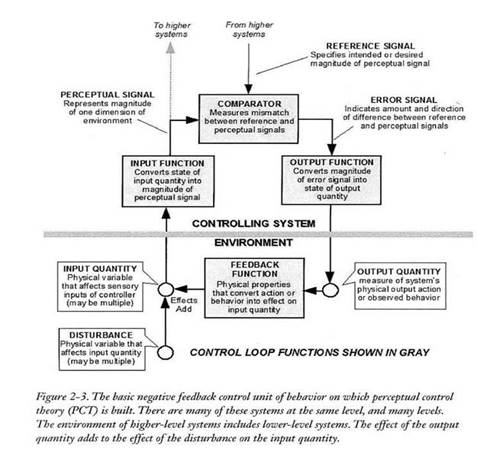
Reading this made me think about whether disturbing a controlled variable has a similar function as punishment. Looking at the examples above, they are all consistent with the hypothesis that disturbing a controlled variable may eliminate some aspect of behavior, but cannot produce any specific behavior. If we deduce a conclusion, it follows that one cannot attain a specific goal by disturbing a controlled variable because all they can do is cause behavior to reorganize. Â
···
On Thu, May 10, 2018 at 5:42 AM, bara0361@gmail.com bara0361@gmail.com wrote:
From Barb Powers, 20180510, 06:30
At the conference I think it would be beneficial to go back to basics and ry the rubber band demonstration. Also, I hope it will be possible for you to play a few rounds of the TTTriples board game. Both are excellent demonstrations of attempting to influence the behavior of others. while still attaining your own goal.
My recollection of conversations with Dad about this is that ultimately one does not actually have control over what somebody else chooses to do. One may, of course, attempt to try to influence them. It still is their decision whether or not to be influenced.
This is why conflict resolution is not very effective when attempted through physical means (whether violent or not), or threats or coercion. I think we all are familiar with the way people have a natural tendency to resist being told what to do, or feel forced to do something. This may create a further internal conflict for them because it may not necessarily be helping them to achieve their own internal goal.
If one attempts to influence another and the other concedes, it gives the appearance of having influenced or controlled the other. That is only the perception of the one (and gives him a great deal of satisfaction at the same time!). Â
The fact remains that the other still has made their own independent decision. They may or may not have made that decision because of this apparent influence. Ultimately it isx still because they have shifted their perception of the situation and either seen a new path toward their goal or set a new goal.
On May 10, 2018 02:13, “PHILIP JERAIR YERANOSIAN” csgnet@lists.illinois.edu wrote:
Why would you say that non-arbitrary control of behavior is the basis of civilized society? Rick
On Wednesday, May 9, 2018, Richard Pfau csgnet@lists.illinois.edu wrote:
[From: RichardPfau (2018.05.09 20:50 EDT)]
For what it’s worth, I’m in the process of proposing to present a paper at our Annual IAPCT Meeting this October (2018)Â with the title Can We Control the Behavior of Others or Only Influence It? PCT and Interpersonal Perspectives.
The description at present reads: “This paper focuses on Perceptual Control Theory perspectives concerning whether we can control the behavior of others or only influence that behavior. Related issues are also discussed concerning how to effectively affect the behavior of others and interpersonal aspects of doing so.”
I hope that you-all will be coming to the conference so we can have an informed discussion of this important topic.
With Regards,
Richard Pfau
Website: richardpfau.com
On Wed, May 9, 2018 at 8:02 PM, Richard Marken csgnet@lists.illinois.edu wrote:
[Rick Marken 2018-05-09_16:53:40]
On Wed, May 9, 2018 at 11:21 AM, PHILIP JERAIR YERANOSIAN csgnet@lists.illinois.edu wrote:
PY: PCT shows that you can’t control the behavior of another person.
RM: If PCT showed that then it would be showing something that is demonstrably false. It’s easy to show that you can control the behavior of another person – and that another person can control yours.
PY: In 10 minutes, Bill writes:
PY: 2. Control theory explains how organisms can control
what happens to them. This means all organisms from
the amoeba to Humankind. It explains
why one organism can’t control another without
physical violence.
RM: I’m pretty sure Bill meant to say "It explains why one organism can’t arbitrarily control another without physical violence." PCT shows that a person can indeed control another without physical violence; a person just can’t control another person “arbitrarily” without physical violence in the sense that a person can’t, without physical violence, make another person do what that other person doesn’t want to do.
PY: Are we proposing there is a way of controlling people that doesn’t involve physical violence?
RM: There are many ways to control people that don’t involve physical violence. The most common way is described in B:CP (2nd edition, p.245). It involves having the controller disturb a variable controlled by the controllee in a way that requires that the controllee make a compensating action that is precisely the aspect of the controllee’s behavior that the controller wants controlled. Powers demonstrates this kind of control using the rubber band game. If one player (S) controls the position of the knot, the other player (E) can control the position of S’s finger. Or, as Bill says “if S wants to control the knot, E can control S’s finger…”. So contrary to what Bill said in the quote above – that “one organism can’t control another withoutÂ
physical violence” – what we have here is Bill demonstrating "control by manipulation" where one person (E) controls another (S) without any physical violence at all.Â
RM: Control will lead to violence only if the controller persists in trying to get the controllee to do something the controllee doesn’t want to do. For example, if E in the rubber band game tries to get S to run S’s finger into a hot soldering iron, S will resist. If E is committed to getting S to run his finger into the soldering iron and starts using physical force to get that to happen, S is likely to fight back. If E is much stronger than S then E might succeed in controlling S’s finger – getting it to run into the soldering iron. And this would be an example of controlling behavior using physical violence. It is also an example of arbitrary control of behavior because E is forcing S to do something without regard to how S feels about doing it. Using the concepts of PCT, we can define arbitrary control of behavior as a situation where a controller is trying to get the controllee to control a variable (like the distance of the controllee’s finger from the soldering iron) without regard to the controllee’s references for the state of that variable. So what the controller wants the controllee to do is arbitrary with respect to the desires of the controllee.
RM: Arbitrary control of behavior almost always involves physical violence. Non-arbitrary control of behavior never involves physical violence and, I would argue, is the basis of civilized society. Non-arbitrary control of behavior is controlling that is done with awareness that you want another control system to do something that it might not want to do; it is controlling that is only done contingent on the agreement of the controllee.
Best
Rick
–
Richard S. MarkenÂ
"Perfection is achieved not when you have nothing more to add, but when you
have nothing left to take away.�
                --Antoine de Saint-Exupery