Environmental reference? (was ... - long live William T. Powers)

[Martin Taylor 2017.06.15.13.29]

[From Rick Marken (2017.06.13.1050)]

            EP: What you see in

the environment is not any reference value/state but
rather some value/state which you infer (possibly by
using some kind of TCV) to be constrained by a subject
who is controlling its/his/her perceptions.

    RM: See, this is what irritates me. Instead of asking me to

clarify the concept of reference state you are telling me
something about it as though you are the expert in PCT and I am
the student. And what you are telling me is wrong, “plain and
simple”.

Since there are those of us who think Eetu is correct "plain and

simple", perhaps some reasoning to support it rather than bald
statements such as " * In fact, what you see in the environment is
the reference state of the CV* ." are not reasoned argument. The
following quote from Bill is unproblematic and is precise, but it
doesn’t say anything to support your claim.

Imagine that the following is one frame from a compensatory tracking

study, in which the subject is influencing the lateral position of
the “o” cursor. I have put markers on the guide lines to serve as a
ruler (in practice the computer would do the measurement
internally).

`----|----|----|----|----|

         o

  ----|----|----|----|----|

      5   10   15   20   25

`    Can you see in that environment the current location of the "o"

cursor? I suspect that you can, and would say that the “o” is at
location 8. What is the location of the reference, which you say is
similarly observable in the environment? You must be able to see it,
but I can’t.

Some empty space deliberately left here while you think about

whether you perceive the environmental reference location for the
“o” in the same way as you perceive the current location of the “o”.

.

.

.

.

.

.

.

.

.

.

.

.

.

.

.

.

.

.

.

.

.

.

.

.

.

.

.

.

.

.

.

.

.

.

.

.

.

.

Here are a few more positions of the cursor in some well separated

sample frames:

`----|----|----|----|----|

          o

  ----|----|----|----|----|

      5   10   15   20   25

`

`----|----|----|----|----|

           o

  ----|----|----|----|----|

      5   10   15   20   25

`

`----|----|----|----|----|

          o

  ----|----|----|----|----|

      5   10   15   20   25`

`----|----|----|----|----|

           o

  ----|----|----|----|----|

      5   10   15   20   25

`
`----|----|----|----|----|

         o

  ----|----|----|----|----|

      5   10   15   20   25

`    Knowing that the perceived location of the "o" is being

controlled, I can now infer that if the reference value has been the
same through all the frames, its value must be somewhere near 9. But
I still can’t see it directly, as you say you can. Maybe I need
special perception training to see it?

My conclusion, since I can't see the reference location in the

environment, but must infer it from the observed motions of the
cursor, is that the reference location does not exist in the
environment, but is a projection onto the environment of something
inside the subject. “According to PCT”, that something is the
reference value of a controlled perception, but (as your Bill quote
says), you don’t have to believe PCT to infer that something that we
can call a “reference state” or simply “reference” must exist in the
subject and is projected by the subject into the environment.

Martin
···
                [Eetu Pikkarainen 2017-06-13

3]

[From Rick Marken (2017.06.16.1000)]

···

Martin Taylor (2017.06.15.13.29)–

            EP: What you see in

the environment is not any reference value/state but
rather some value/state which you infer (possibly by
using some kind of TCV) to be constrained by a subject
who is controlling its/his/her perceptions.

    RM: See, this is what irritates me. Instead of asking me to

clarify the concept of reference state you are telling me
something about it as though you are the expert in PCT and I am
the student. And what you are telling me is wrong, “plain and
simple”.

MT: Since there are those of us who think Eetu is correct "plain and

simple", perhaps some reasoning to support it rather than bald
statements such as " * In fact, what you see in the environment is
the reference state of the CV* ." are not reasoned argument. The
following quote from Bill is unproblematic and is precise, but it
doesn’t say anything to support your claim.

RM: I don’t see the “following quote” that you refer to. But perhaps it is this one:

Â

RM: Assuming this is the quote to which you refer, I think it supports my claim rather well. The term “variable” in this definition of reference state refers to a variable aspect of the environment, such as the angle of the car door relative to the car frame when a person is doing the behavior called “opening the door”, which is the example Bill here. The final condition to which this variable – the controlled variable – is brought despite disturbance is 80 degrees. This is the reference state of the controlled variable. So the reference state is the state (80 degrees) of a controlled variable (“angle of the door relative to the car frame”) that is seen as being in the environment. So my “bald statement” that “what you see in the environment is the reference state of the CV” is perfectly consistent with Powers’ definition of a reference state.

MT: Knowing that the perceived location of the “o” is being controlled, I can now infer that if the reference value has been the same through all the frames, its value must be somewhere near 9. But I still can’t see it directly, as you say you can. Maybe I need special perception training to see it?

RM: No, I think your problem is that you privilege theory over observation. Seeing that the position of “o” is controlled is equivalent to seeing that the position of “o” is being kept in a reference state. The reference state is the observation that a variable is being kept in a some state, not at some exact value, protected from disturbance. Although Bill gave the example of the reference state of a car door being 80 degrees, he certainly didn’t mean to imply that the door was brought to and maintained at exactly 80 degrees. People can’t do that any more than they can keep the position of a cursor (your “o”) exactly at some particular value.Â

RM: The notion that the concept of reference state applies to an exact value of a controlled variable is an example of privileging theory over observation. “Reference state” refers to an observation – the observation that some variables in an organism’s environment can be seen to be controlled inasmuch as they are maintained in reference states, where “states” implies a range of values that is much narrower than the range that would be expected to be seen if there were no control. The theory that explains this phenomenon posits that controllers have reference signals in their brains that specify the reference state of the controlled variable as a specific value. So given this theoretical explanation of the existence of the reference state you say that they the reference state is actually a specific value that cannot be seen.Â

RM: That is, you are using the theory (PCT) that was designed to explain an observation (reference states) to deny the existence of that observation. This is what comes from privileging theory over observation.

MT: "According to PCT", that something is the

reference value of a controlled perception, but (as your Bill quote
says), you don’t have to believe PCT to infer that something that we
can call a “reference state” or simply “reference” must exist in the
subject and is projected by the subject into the environment.

RM: Â That’s not what Bill’s quote says at all. Bill’s quote says rather clearly that the reference state is the state of a variable that we see as being in the environment of the control system. And you certainly do have to “believe” PCT to infer that what determines the reference state exists inside the subject.

BestÂ

Rick

Richard S. MarkenÂ

"Perfection is achieved not when you have nothing more to add, but when you
have nothing left to take away.�
                --Antoine de Saint-Exupery

[Martin Taylor 2017.06.16.14.24]

[From Rick Marken (2017.06.16.1000)]

I don't, as I will explain below. Whether it does or doesn't, an

appeal to Bill rather than to Nature is not a scientific argument
that follows reasoning from an agreed starting point. The question
at issue is whether while a variable is being controlled, it is
possible to see, rather than to infer, its reference value. Since
the quote from Bill, in its context, refers only to “final
condition”, not to the variable while control is active, the quote
is irrelevant to the issue in question. Furthermore, even in the
“final condition”, an observer can see only the variable, and must
infer that because control has ceased altering it, it must therefore
be at its reference value.

No. What you see in the environment is the state of the variable as

it was when the controller ceased acting on it. Maybe the person got
called to the phone before the variable reached its reference state.
You still see the state of the variable, but you must infer that
there is a reference state.

That also is irrelevant. I'm asking you whether you can see the

reference state in the same way you can see the environmental
variable. That is your claim, is it not? I’m pointing out that you
are not able to see the reference state in the environment, and that
it is you, not I, who is privileging theory over observation. I say
that the theory is that control is occurring. We seem to agree (I’m
never sure when I say that we agree on anything) that control
requires that there be a reference state – a theoretical position
in itself. You say that independent of theory, you can see where the
reference value for the location of the “o” is in my first diagram.
I say you can’t. I say you must infer it from several independent
observations of the environmental variable (the location of the “o”
on the scale).

`----|----|----|----|----|

         o

  ----|----|----|----|----|

      5   10   15   20   25`

That's a rather imprecise use of language isn't it? A "state" is an

“observation”, and the observation is of a process, not of a value
or of a state. Would you agree to the paraphrase “The reference
state is a value to which the variable tends to return when
disturbed away from that value”?

Well, at least we agree on something (I think).

That's weird. I thought you were arguing that the reference state

was where the controller wanted the variable to be, an observable
state of the environment. Now you are saying it can’t be that,
because control isn’t perfect. I am lost in Wonderland.

I would call that evidence of control, not a definition of a

reference state

.

Yes.

No.

Now my interpretation of Bill’s quote.

1. "*      Reference state refers to the final condition to which the

variable is brought despite variable disturbances*."

He assumes here that there is some variable, which we can assume is

observable, for the sake of argument though the assumption is not
necessary, that has been controlled but is no longer being
controlled because it has reached its reference value. Note that he
is not saying that the reference state can be observed. It is the
variable that is observed, and the reference state inferred from the
fact that control has ceased with the controller “satisfied”.

2. "*      The existence of these states is not conjectural; once

behavior has been defined in terms of an appropriate variable,
such reference states always exist*."

It's hard to interpret this sentence other than in the context

surrounding the paragraph, which is that the “appropriate variable”
has been controlled.

3. "*      They can be discovered experimentally, and defined in terms

of observable relationships*."

This is the key sentence. The reference states cannot be observed

directly, but must be “* defined in terms of observable
relationships.”* As I read that proviso, Bill explicitly says
that reference states are not directly observable, but must be
inferred from observable relationships.

4. "*Whether or not they* should *      exist according to

anyone’s theory, they* do exist."

It's difficult to justify statements like this, which encompass all

theories past, present, and future, other than as a statement of
faith. Within a smaller range of possibilities that include everyday
common sense, the sentence plants a flag on the territory: “Here I
stand.”

I would have no problem with this paragraph at all, were it not for

the fact that you interpret it differently.

Martin

···

Martin Taylor (2017.06.15.13.29)–

                        EP: What

you see in the environment is not any
reference value/state but rather some
value/state which you infer (possibly by
using some kind of TCV) to be constrained by
a subject who is controlling its/his/her
perceptions.

                RM: See, this is what irritates me. Instead of

asking me to clarify the concept of reference state
you are telling me something about it as though you
are the expert in PCT and I am the student. And what
you are telling me is wrong, “plain and simple”.

            MT: Since there are those of us who think Eetu is

correct “plain and simple”, perhaps some reasoning to
support it rather than bald statements such as " * In
fact, what you see in the environment is the reference
state of the CV* ." are not reasoned argument. The
following quote from Bill is unproblematic and is
precise, but it doesn’t say anything to support your
claim.

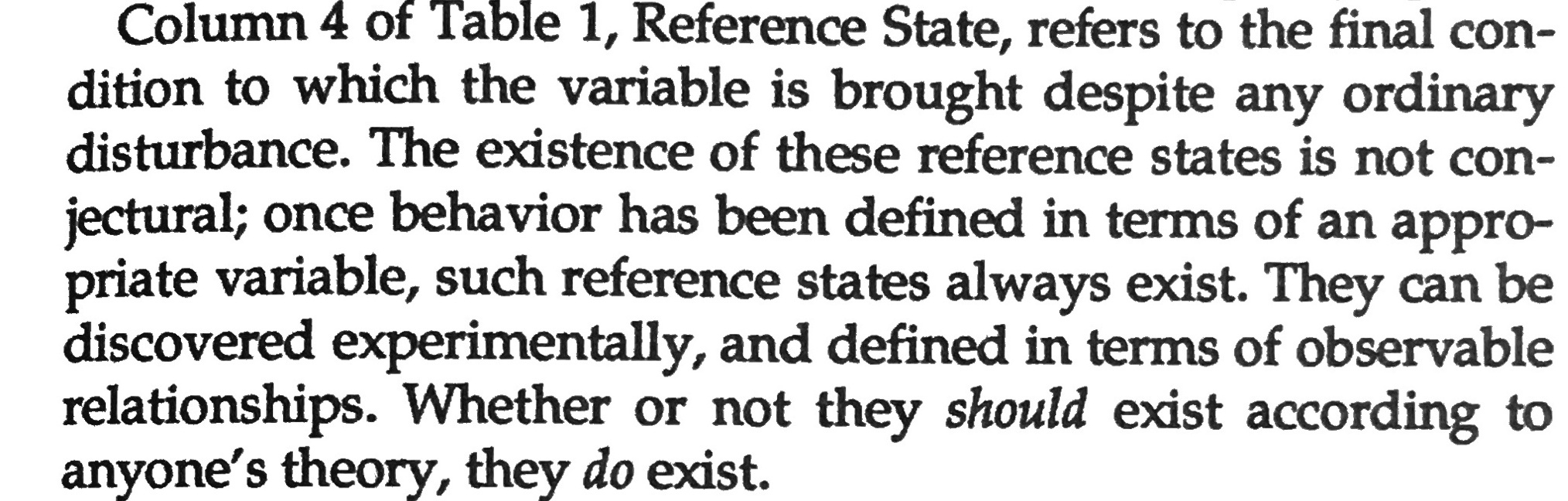
          RM: I don't see the "following quote" that you refer

to. But perhaps it is this one:

        RM: Assuming this is the quote to

which you refer, I think it supports my claim rather well.

        The term "variable" in this

definition of reference state refers to a variable aspect of
the environment, such as the angle of the car door relative
to the car frame when a person is doing the behavior called
“opening the door”, which is the example Bill here. The
final condition to which this variable – the controlled
variable – is brought despite disturbance is 80 degrees.
This is the reference state of the controlled variable. So
the reference state is the state (80 degrees) of a
controlled variable (“angle of the door relative to the car
frame”) that is seen as being in the environment. So my
“bald statement” that "* what you see in the environment is
the reference state of the CV* " is perfectly consistent
with Powers’ definition of a reference state.

            MT: Knowing that the perceived

location of the “o” is being controlled, I can now infer
that if the reference value has been the same through
all the frames, its value must be somewhere near 9. But
I still can’t see it directly, as you say you can. Maybe
I need special perception training to see it?

        RM: No, I think your problem is that

you privilege theory over observation. Seeing that the
position of “o” is controlled is equivalent to seeing that
the position of “o” is being kept in a reference state.

        The reference state is the

observation that a variable is being kept in a some state,
not at some exact value, protected from disturbance.

        Although Bill gave the example of the

reference state of a car door being 80 degrees, he certainly
didn’t mean to imply that the door was brought to and
maintained at exactly 80 degrees. People can’t do
that any more than they can keep the position of a cursor
(your “o”) exactly at some particular value.

        RM: The notion that the concept of

reference state applies to an exact value of a controlled
variable is an example of privileging theory over
observation.

        "Reference state" refers to an

observation – the observation that some variables in an
organism’s environment can be seen to be controlled inasmuch
as they are maintained in reference states, where “states”
implies a range of values that is much narrower than the
range that would be expected to be seen if there were no
control.

        The theory that explains this

phenomenon posits that controllers have reference signals in
their brains that specify the reference state of the
controlled variable as a specific value. So given this
theoretical explanation of the existence of the reference
state you say that they the reference state is actually a
specific value that cannot be seen.

        RM: That is, you are using the theory

(PCT) that was designed to explain an observation (reference
states) to deny the existence of that observation. This is
what comes from privileging theory over observation.

            MT: "According to PCT", that something is the

reference value of a controlled perception, but (as your
Bill quote says), you don’t have to believe PCT to infer
that something that we can call a “reference state” or
simply “reference” must exist in the subject and is
projected by the subject into the environment.

      RM:  That's not what Bill's quote says at all. Bill's quote

says rather clearly that the reference state is the state of a
variable that we see as being in the environment of the
control system. And you certainly do have to “believe” PCT to
infer that what determines the reference state exists inside
the subject.
[From Rick Marken (2016.06.16.1620)]

[Martin Taylor 2017.06.16.14.24]

MT: Â I'm asking you whether you can see the reference state in the same way you can see the environmental variable. That is your claim, is it not?Â

RM: Yes, but I see your point about not being able to see the reference state by just looking at the behavior of the controlled variable. So in your example of the compensatory tracking task where the position of an "o" is being controlled, you are correct to say that you cannot see the reference state by simply looking at the behavior of the "o". I realized that you were right about this when I looked up the definition of "reference state" in B:CP. In B:CP the reference state is called a reference condition and here's the definition:

Reference Condition: The state of a controlled quantity at which a control system's output ceases to tend to alter the controlled quantity. The state toward which a control system's output tends to alter the controlled quantity.Â

RM: The term "controlled quantity" is synonymous with the term "controlled variable", as I've been using it. Here's the definition.Â

Controlled Quantity: An environmental variable corresponding to the perceptual signal in a control system; a physical quantity (or a function of several physical quantities) that is affected and controlled by the outputs from a control system's output function.Â

RM: So the reference state (or condition) is the state of an environmental variable, as I have been saying, so it certainly can be seen by an observer. But Martin was correct to say that the reference state cannot be seen in this situation just by looking. To find the reference state (or condition) of a controlled quantity (or variable) you have to find the value "at which a control system's output ceases to tend to alter the controlled quantity." For example, you could find the reference state for the position of the "o" in the compensatory tracking task by "turning off" the disturbance and letting the subject move the "o" to the position where he or she produced no more output aimed at altering the position of the "o"; the "o" would be in the reference state.
RM: Note that finding the reference state requires knowing 1) that the controlled variable (or quantity) is influenced by the output of a control system and 2) that control systems act (produce outputs) aimed at keeping controlled variables in reference states. This means that you do have to know control theory in order to determine the reference state of a variable. So in this case theory does precede observation. But you do have to determine that a variable is under control -- that it is a controlled variable (or quantity) -- before using theory as the basis for determining the reference state of that variable. So observation (of control) precedes theory (control theory) which precedes observation (of the reference state) and so it goes; science is and interactive dance between observation and theory.Â
RM: So I would score this debate a tie. Martin correctly noted that theory must inform the approach to observing the reference state and I correctly noted that the reference state is an observable state of an environmental variable. But I think this debate shows the benefits of discussions on CSGNet. I certainly learned something from it; I hope others did too.Â
Best
Rick
Â

···

MT: You say that independent of theory, you can see where the reference value for the location of the "o" is in my first diagram. I say you can't. I say you must infer it from several independent observations of the environmental variable (the location of the "o" on the scale).

----|----|----|----|----|
      o
----|----|----|----|----|
   5  10  15  20  25

The reference state is the observation that a variable is being kept in a some state, not at some exact value, protected from disturbance.

That's a rather imprecise use of language isn't it? A "state" is an "observation", and the observation is of a process, not of a value or of a state. Would you agree to the paraphrase "The reference state is a value to which the variable tends to return when disturbed away from that value"?

Although Bill gave the example of the reference state of a car door being 80 degrees, he certainly didn't mean to imply that the door was brought to and maintained at exactly 80 degrees. People can't do that any more than they can keep the position of a cursor (your "o") exactly at some particular value.

Well, at least we agree on something (I think).

RM: The notion that the concept of reference state applies to an exact value of a controlled variable is an example of privileging theory over observation.

That's weird. I thought you were arguing that the reference state was where the controller wanted the variable to be, an observable state of the environment. Now you are saying it can't be that, because control isn't perfect. I am lost in Wonderland.

"Reference state" refers to an observation -- the observation that some variables in an organism's environment can be seen to be controlled inasmuch as they are maintained in reference states, where "states" implies a range of values that is much narrower than the range that would be expected to be seen if there were no control.

I would call that evidence of control, not a definition of a reference state
.

The theory that explains this phenomenon posits that controllers have reference signals in their brains that specify the reference state of the controlled variable as a specific value. So given this theoretical explanation of the existence of the reference state you say that they the reference state is actually a specific value that cannot be seen.

Yes.

RM: That is, you are using the theory (PCT) that was designed to explain an observation (reference states) to deny the existence of that observation. This is what comes from privileging theory over observation.

No.

MT: "According to PCT", that something is the reference value of a controlled perception, but (as your Bill quote says), you don't have to believe PCT to infer that something that we can call a "reference state" or simply "reference" must exist in the subject and is projected by the subject into the environment.

RM: Â That's not what Bill's quote says at all. Bill's quote says rather clearly that the reference state is the state of a variable that we see as being in the environment of the control system. And you certainly do have to "believe" PCT to infer that what determines the reference state exists inside the subject.

Now my interpretation of Bill's quote.

1. "Reference state refers to the final condition to which the variable is brought despite variable disturbances."

He assumes here that there is some variable, which we can assume is observable, for the sake of argument though the assumption is not necessary, that has been controlled but is no longer being controlled because it has reached its reference value. Note that he is not saying that the reference state can be observed. It is the variable that is observed, and the reference state inferred from the fact that control has ceased with the controller "satisfied".

2. "The existence of these states is not conjectural; once behavior has been defined in terms of an appropriate variable, such reference states always exist."

It's hard to interpret this sentence other than in the context surrounding the paragraph, which is that the "appropriate variable" has been controlled.

3. "They can be discovered experimentally, and defined in terms of observable relationships."

This is the key sentence. The reference states cannot be observed directly, but must be "defined in terms of observable relationships." As I read that proviso, Bill explicitly says that reference states are not directly observable, but must be inferred from observable relationships.

4. "Whether or not they should exist according to anyone's theory, they do exist."

It's difficult to justify statements like this, which encompass all theories past, present, and future, other than as a statement of faith. Within a smaller range of possibilities that include everyday common sense, the sentence plants a flag on the territory: "Here I stand."

I would have no problem with this paragraph at all, were it not for the fact that you interpret it differently.

Martin

--
Richard S. MarkenÂ
"Perfection is achieved not when you have nothing more to add, but when you
have nothing left to take away.�
                --Antoine de Saint-Exupery

[From Leeanne Wright (2017.06.17)]

Hi Rick and Martin (and others),

I have been following these and other discussions and have found them enormously helpful. I wanted to say thank you. I often think of questions (when I am in bed and should be sleeping) but because of the time difference someone has usually asked them by the time I check my emails the next morning:)

Regards

Leeanne

···

[From Rick Marken (2016.06.16.1620)]

[Martin Taylor 2017.06.16.14.24]

MT: I’m asking you whether you can see the reference state in the same way you can see the environmental variable. That is your claim, is it not?

RM: Yes, but I see your point about not being able to see the reference state by just looking at the behavior of the controlled variable. So in your example of the compensatory tracking task where the position of an “o” is being controlled, you are correct to say that you cannot see the reference state by simply looking at the behavior of the “o”. I realized that you were right about this when I looked up the definition of “reference state” in B:CP. In B:CP the reference state is called a reference condition and here’s the definition:

Reference Condition: The state of a controlled quantity at which a control system’s output ceases to tend to alter the controlled quantity. The state toward which a control system’s output tends to alter the controlled quantity.

RM: The term “controlled quantity” is synonymous with the term “controlled variable”, as I’ve been using it. Here’s the definition.

Controlled Quantity: An environmental variable corresponding to the perceptual signal in a control system; a physical quantity (or a function of several physical quantities) that is affected and controlled by the outputs from a control system’s output function.

RM: So the reference state (or condition) is the state of an environmental variable, as I have been saying, so it certainly can be seen by an observer. But Martin was correct to say that the reference state cannot be seen in this situation just by looking. To find the reference state (or condition) of a controlled quantity (or variable) you have to find the value “at which a control system’s output ceases to tend to alter the controlled quantity.” For example, you could find the reference state for the position of the “o” in the compensatory tracking task by “turning off” the disturbance and letting the subject move the “o” to the position where he or she produced no more output aimed at altering the position of the “o”; the “o” would be in the reference state.

RM: Note that finding the reference state requires knowing 1) that the controlled variable (or quantity) is influenced by the output of a control system and 2) that control systems act (produce outputs) aimed at keeping controlled variables in reference states. This means that you do have to know control theory in order to determine the reference state of a variable. So in this case theory does precede observation. But you do have to determine that a variable is under control – that it is a controlled variable (or quantity) – before using theory as the basis for determining the reference state of that variable. So observation (of control) precedes theory (control theory) which precedes observation (of the reference state) and so it goes; science is and interactive dance between observation and theory.

RM: So I would score this debate a tie. Martin correctly noted that theory must inform the approach to observing the reference state and I correctly noted that the reference state is an observable state of an environmental variable. But I think this debate shows the benefits of discussions on CSGNet. I certainly learned something from it; I hope others did too.

Best

Rick

MT: You say that independent of theory, you can see where the reference value for the location of the “o” is in my first diagram. I say you can’t. I say you must infer it from several independent observations of the environmental variable (the location of the “o” on the scale).

----|----|----|----|----| o ----|----|----|----|----| 5 10 15 20 25

That’s a rather imprecise use of language isn’t it? A “state” is an “observation”, and the observation is of a process, not of a value or of a state. Would you agree to the paraphrase “The reference state is a value to which the variable tends to return when disturbed away from that value”?

Well, at least we agree on something (I think).

That’s weird. I thought you were arguing that the reference state was where the controller wanted the variable to be, an observable state of the environment. Now you are saying it can’t be that, because control isn’t perfect. I am lost in Wonderland.

I would call that evidence of control, not a definition of a reference state
.

Yes.

No.

Now my interpretation of Bill’s quote.

  1. Reference state refers to the final condition to which the variable is brought despite variable disturbances.”
    He assumes here that there is some variable, which we can assume is observable, for the sake of argument though the assumption is not necessary, that has been controlled but is no longer being controlled because it has reached its reference value. Note that he is not saying that the reference state can be observed. It is the variable that is observed, and the reference state inferred from the fact that control has ceased with the controller “satisfied”.
  2. The existence of these states is not conjectural; once behavior has been defined in terms of an appropriate variable, such reference states always exist.”
    It’s hard to interpret this sentence other than in the context surrounding the paragraph, which is that the “appropriate variable” has been controlled.
  3. They can be discovered experimentally, and defined in terms of observable relationships.”
    This is the key sentence. The reference states cannot be observed directly, but must be “*defined in terms of observable relationships.” *As I read that proviso, Bill explicitly says that reference states are not directly observable, but must be inferred from observable relationships.
  4. Whether or not they should exist according to anyone’s theory, they do exist.”

It’s difficult to justify statements like this, which encompass all theories past, present, and future, other than as a statement of faith. Within a smaller range of possibilities that include everyday common sense, the sentence plants a flag on the territory: “Here I stand.”

I would have no problem with this paragraph at all, were it not for the fact that you interpret it differently.

Martin


Richard S. Marken

"Perfection is achieved not when you have nothing more to add, but when you
have nothing left to take away.�
–Antoine de Saint-Exupery

The reference state is the observation that a variable is being kept in a some state, not at some exact value, protected from disturbance.

Although Bill gave the example of the reference state of a car door being 80 degrees, he certainly didn’t mean to imply that the door was brought to and maintained at exactly 80 degrees. People can’t do that any more than they can keep the position of a cursor (your “o”) exactly at some particular value.

RM: The notion that the concept of reference state applies to an exact value of a controlled variable is an example of privileging theory over observation.

“Reference state” refers to an observation – the observation that some variables in an organism’s environment can be seen to be controlled inasmuch as they are maintained in reference states, where “states” implies a range of values that is much narrower than the range that would be expected to be seen if there were no control.

The theory that explains this phenomenon posits that controllers have reference signals in their brains that specify the reference state of the controlled variable as a specific value. So given this theoretical explanation of the existence of the reference state you say that they the reference state is actually a specific value that cannot be seen.

RM: That is, you are using the theory (PCT) that was designed to explain an observation (reference states) to deny the existence of that observation. This is what comes from privileging theory over observation.

MT: “According to PCT”, that something is the reference value of a controlled perception, but (as your Bill quote says), you don’t have to believe PCT to infer that something that we can call a “reference state” or simply “reference” must exist in the subject and is projected by the subject into the environment.

RM: That’s not what Bill’s quote says at all. Bill’s quote says rather clearly that the reference state is the state of a variable that we see as being in the environment of the control system. And you certainly do have to “believe” PCT to infer that what determines the reference state exists inside the subject.