And the relevance of that to my point that q.i = p is…?
Yes, and q.i and p are not the same thing. In the “What is Size” demo, q.i is a pattern of illuminance and p is theorized to be a neural firing rate. But it’s still true that, in theory, q.i = p. What is equal is the charaterization (or definition) of the controlled variable, q.i. If qi is found to be area, h * w for examole, then the theory assumes that p varies as h * w. It’s in this sense that p = q.i. If this weren’t the case, then the theory of control (PCT) would not account for the observed fact of control.
That’s why, when using the PCT theory to explain some behavior, you have to first determine the variable(s) around which that behavior is organized. This means that the centerpiece of study of living systems from a PCT perspective has to be the charaterization of the variables organisms control – controlled variables – via experimental test.
I think the idea that p <> q.i came into being to justify a “theory first” or, more often, a “theory only” approach to PCT. I, like Bill, prefer a demonstration (or phenomena) first approach to PCT. I think it produces more powerful (and more valid!) results. But I think Bill himself explained it best in this CSGNet post from 1995 where he came to realize that the basis of his “friction” with Martin Taylor was Martin’s “theory first (or only)” approach to PCT. I’ve highlighted the sections that I think are particularly relevant to the “friction” I am experiencing nowadays on Discourse.
Great, so we’re all agreed. 
According to my New and Improved PCT, it’s false that p=qi, because, as I have clearly demonstrated ( ), p = 7*qi. Unfortunately for my burgeoning sect, in many contexts the differences between analogy, equality, equivalence and covariance aren’t important enough to create a schism over, and it’s also true that p=qi. There is no contradiction, and the views needn’t be incompatible.
A von Glaserfeld quotation dear to my heart:
[When discussing abstract matters]…the difficulties often become insurmountable if the participants believe that the meanings of the words they have used are fixed, independent entities in an objective world that is the same for all speakers. If, however, the participants adopt a constructivist view and begin by assuming that a speaker’s meanings connot be anything but subjective constructs, a productive accommodation and adaptation can mostly be reached. (from Radical Constructivism)
Mind you, Bill’s words regarding seeming to be in agreement:
…remind me of another Radical Constructivism quote:
To return to what I have called “corroboration by others”, one might think, that it is more easily and much more frequently achieved by linguistic communication. Although this is a general assumption, we all quite often find ourselves in situations that confound it. Others may be telling us (or we may believe) that they think as we do, but what they say or do shows us, as the interchange goes on, that this cannot be the case. Although the words they use are the same as ours, the network of concepts they seem to have in mind is incompatible with the one we have built up. Communication is a far more complex affair than it seems…
Another side-topic:
Yikes, trawling through the CSG Archives trying (unsuccessfully) to find a direct link to that Powers’ quote, I see “applications friction” was quite a live issue in 1995, to say the least!
I have to remind myself that:
- People change, in often unpredictable ways and timeframes.
- Although from your highlighting behaviour I surmise “friction” is of some importance to you (for some reason), I shouldn’t assume that said “friction” is a problem for you or anyone else unless a problem is explicitly identified. “Friction” is something people sometimes enjoy, after all.
So are we agreed then that they equal each other but they are not the same thing, which is to say that one represents the other (as Bill said). So, p is an internal, theoretical analogue of qi.
Agreed my end, my question’s resolved to my satisfaction thank you Warren.
Sure, that’s OK as far as it goes. But I think is important to know why p is a theoretical analog of qi. It’s because q.i is defined by the perceptual function that produces p. What p “represents” is a function of physical variables, x.i: p = f(x.1,x.2…x.n).
So you can get as excited as you want about the word “represents” but if you don’t know what p represents, you still could be way off PCT base. That is, you could still be making the mistake of thinking that p represents some entity in the environment (the mistake made by Martin Taylor and his acolytes) when, in fact, p represents some **aspect of the (internal or external) environment ** that is defined by the perceptual function, those aspects being what we call perceptual variables.
I consider that to be an unfortunate mistake because (as I said in my IAPCT talk) it diverts attention from what Bill (the coiner of the magic word “represents” saw as the primary goal of a behavioral science based on PCT: the determination of the aspects of the environment – the perceptual variables – that organisms control, how they control them and why.
Best, Rick
Thank you, Rick.
Thanks John. If you are coming to PCT from an MOL perspective, I hope you can see that my “background thought” in this argument (about whether or not q.i = p) has been to get behavioral researchers to realize that the focus of PCT - based reseach should be on the determination of the aspects of the environment – the, q.i’s – around which the behavior of organisms is organized. That is, PCT research should be aimed at finding the variables organisms control, how they control them and why. But I guess I’ve been rather coy about what that means. So here is a paper descibing the kind of research I would hope to see more of.
I did this paper with a fellow who liked my work on basball catching. He’s not a PCTer but he is a good scientist and he had some data on object interception and asked me if I’d like to do some conrtol system modeling on it. He had a lab where he was able to capture the 3-D position of people as the ran to intercept toy helicopters (choppers), whose 3-D position was also captured.The part of the paper that contains my PCT anaysis of his data starts after the section titled “Testing working models of object interception—COV and GOAC”.
What you will see is that I made control models of each subject in the study that (like the subjects) controlled for intercepting the randomly moving helicopter on each trial. The input to the model was the data on the varying position of the helicopter.. Two control models were compared. One model controlled the perceived optical velocity of the helicopter, tryng to keep it at 0; the other model controlled the perceived optical acceleration of the helicopter, also trying to keep it at 0. There perceptions were derived from the continuously changing geometry of the relationship between the positions of subject and helicopter. Both models did remarkably well at reproduciong the behavior (running patterns) of the subjects, but optical velocity was definitely superior so it is currently the best candidate for the variable that is controlled when catching (or otherwise intercepting) moving objects.
This research is an example of testing to determine a controlled variable using modeling. I would like to see this or similar methods developed for testing to determine what variables organisms control when performing all kinds of behaviors. But I am not smart enough to do it myself. That’s why I’m trying to get other (and younger!!) researchers to start doing this kind of unabashedly PCT research. If I can’t get anyone to do this kind of work, I’ll keep trying to do what I can on my own. But it would be nice to have some company.
Thanks Rick - yes and I appreciated you going “up a level” in your conference talk as well.
I’ve had some “aha” moments over the last couple of days. I found, for once ( ), support for what you’re saying in Bill’s writing. And also, I think I’ve found a distinction (and possible change in usage) that might make all of this much, much clearer.
First, further emphasising your point, yesterday I found this in the “Experimental Methods” chapter of B:CP, subsection “The Basic Experimental Paradigm” (emphasis mine):
Consider once again the meaning of the term controlled quantity. A controlled quantity is detected only because it is detected by a control system, compared with a reference, and affected by outputs based on the error thus detected. The controlled quantity is defined strictly by the behaving system’s perceptual computers; it may or may not be identifiable as an objective (need I put that in quotes?) property of, or entity in, the environment. …The organism’s activities will cause many changes the observer can notice, but what is controlled will only occasionally prove to be identical with any of those effects. Instead, it will normally be some function of the effects and the observer’s task is to discover the nature of that function…
The primary purpose of The Test is to reveal what is wrong with definitions of controlled quantities…If an irrelevant variable is made part of the definition, the test will expose it…"
Thank you for keeping this front and centre.
Now, for the distinction/suggestion:
We should be saying p = q.e, not p = q.i, following the usage in Powers’ 1973 paper “Feedback: Beyond Behaviorism” (reprinted in Living Control Systems 1, pdf available from livingcontrolsystems.com).
If my reading of this paper is correct, the controlled quantity q.e is nowhere identified with the input quantity.
I’ve come to agree with you that this is the best diagram:
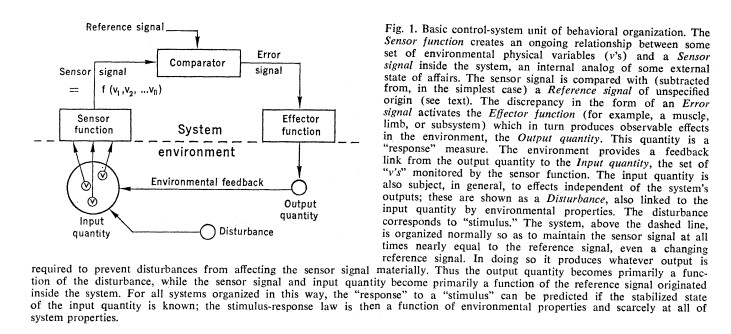
Look at the fine print. The Input Quantity is the set of “v’s”, not a function thereof. It’s not a function of a “complex environmental variable”, it is a complex of environmental variables. The purpose of The Test is to prune that set, and find the form of the function relating those variables to q.e.
So:
Input quantity = {v1, v2,…,vn}
We might say, vector quantity qi=(v1,v2,…,vn)
p = qe = f(v1,v2,…vn) = f(qi).
Is that a reasonable translation of what you’ve been saying all along?
You are the one who has understanding of the subject matter, deeper that the symbolic manipulation we’re engaging in in attempt to communicate.
But I think some of us controlling for mathematical/logical/conceptual coherence, and trying to reconcile all the various statements, will continue to be “in error” without a distinction along these lines. With this distinction, everything falls into place, for me at least.
If p is a scalar (which I presume it has to be?), then p = qi doesn’t even make sense - except in the one-dimensional case qi = {v}, or qi = v.
Then, and only then,
p = qe = f(qi) = ki*qi (linear approximation as in B:CP Appendix), normalised so ki = 1, and p = qe = qi
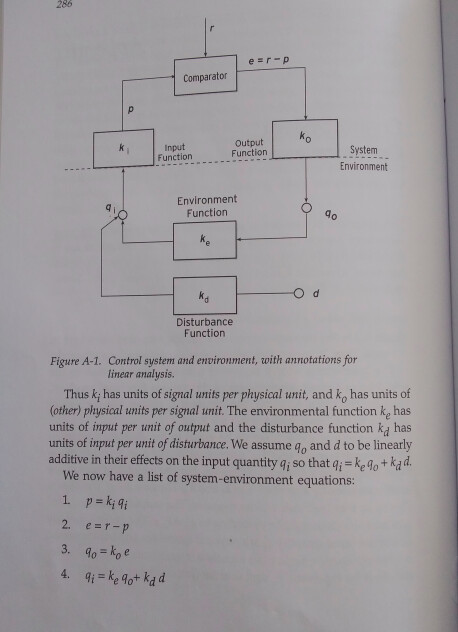
What do you think?
Ok I think I might have it (thanks for bearing with me).
If I form the set Qi = {v1,v2,…,vn} defined by the correct form of the perceptual function f(v1,v2,…vn), as pruned by The Test, everything turns out right. If that is rightly understood, it won’t so much matter whether I call the controlled quantity q.e or q.i (the former is less confusing to me). q.e = f(v1,v2,…vn)
And of course the perceptual signal p is the theoretical analog/representation of the controlled quantity, so p = q.e
If this is all okay I’d prefer to speak of the controlled quantity (for q.e. or q.i), and controlled set of variables for Qi. “Controlled variable” seems kind of muddy.
How does that sit with people?
Last attempt before getting some exercise:
No, I was right first time, to make everything work in my mind it seems:
controlled quantity (as defined by the perceptual function) should be q.e.
I’d propose Qi = {v1…vn} is the controlled set of variables (a.k.a. Input Quantity in above diagram), also defined by the correct form of the perceptual function.
q.i seems better to fit the one-dimensional case Qi={q.i.}, in which case we can speak of q.i. as the controlled variable.
p = q.e = f(q.i). I think we need this for B:CP Appendix to work.
And if you don’t mind q.i as a vector then
p = q.e = f(q.i)
The controlled quantity and the controlled variable (or set of variables) would then be distinct.
Thanks for this wonderful post, John. I forgot that all this was explained in B:CP. Not only do Bill’s words support what I’m saying about the controlled quantity, qi, being equal (or, if you prefer, equivalent) to the perceptual variable, p, (since, as Bill says “the controlled quantity is defined strictly by the behaving system’s perceptual computers” which produce p) but also because it appears in the “Experimental Methods” chapter of B:CP, the chapter least likely to be read, let alone correctly understood, by those who take a 'theory first" or “theory only” approach to science.
But I’m afraid that I’m not a big fan of your suggested change in usage. You say:
We should be saying p = q.e, not p = q.i, following the usage in Powers’ 1973 paper “Feedback: Beyond Behaviorism” (reprinted in Living Control Systems 1, pdf available from livingcontrolsystems.com).
If my reading of this paper is correct, the controlled quantity q.e is nowhere identified with the input quantity.
It’s true that the diagram in that paper (and in reality) shows that the inputs to the system are physical variables, symbolized as v. But what’s being controlled is a function of those variables – a function that defines the controlled quantity, qi.
When we study living control systems, we want to know if our guesses about the functions that define the variables being controlled – the qi – correspond to the perceptual functions that produce the perceptions – p --that are actually under control. So in my study of object interception, for example, I made guesses about the possible functions of the helicopter movements, the v’s, that were being controlled. My guesses were about what qi might be when people intercept moving objects. I knew that there were two good possibilities, qi = dv/dt and qi = d^2v/dt^2 (optical velocity or optical acceleration).These are hypotheses about the nature of the perceptual function that produces the perceptual variable, p, that people actually control when intercepting a moving object. And it turned out, the best guess was that p ~ dv/dt, where “~” means approximately equal to.
Perhaps your problem is that you can’t see how a scalar variable, like p, which presumably varies only in terms of firing rate, can represent a complex variable like dv/dt or d^2v/dt^2. So I thought that maybe if I describe an artificial control systems that controls a complex variable, such as humidity, that is based on several physical variables, like temperature and water vapor, you might be able to get your mind around it better.
In a humidity control system, measures of the temperature and water vapor in the air are combined in a formula – the perceptual function of the humidity control system – that produces an electrical voltage that varies with changes in relative humidity. The formula that produces this voltage is
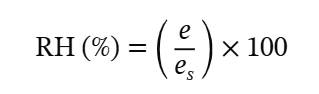
where RH is the voltage that is proportional to relative humidity (measured as a %), e is a measure of water vapor and e.s is the saturation level of water vapor (the maximum level of water vaper vapor that the air at the current temperature can hold).
If the humidity controller works, then RH is the controlled quantity, q.i, that can be measured from outside the humidity control system by an engineer, and p is the voltage that is equal to RH. The engineer can check how well the humidity control system is controlling humidity by seeing whether his measure of RH remains at a reference (set point) level despite variations in temperature and water vapor in the air.
In PCT, we don’t know what our living control system are controlling when they do things like catching fly balls. So we have to guess, and then develop the equivalent of the engineer’s humidity measuring device that measures the aspect of the physical environment that we think is being controlled; that is, we measure a function of physical variables that is our guess about what qi is, which is a guess about what p is. If we find, by observational test, that q.i is under control, then we can confidently conclude that we have found the perceptual variable,p, that the organism is controlling.
So let’s just stick with qi being the variable, possibly defined by a very complex formula, that is our guess about what perceptual variable, p, is being controlled. And if test proves that we have guessed right – if we find that our guess about qi is correct --then we can conclude with confidence, as I did in the Chasing Choppers paper, that qi = p; qi is the perception, p, that is being controlled.
I hope this helps. But if it doesn’t, I have many other ways of trying to help people understand that q.i = p. But understand it one must if one wants to do PCT based research or just understand PCT.
That is a great clarification, thank you Rick. I think I was pretty much there, but you’ve brought out much more clearly something I was wobbly on, that the aim of The Test is not only to sort out the identity of the relevant v’s, but also the form of the perceptual function (a.k.a. input function?) f(v1,…vn) defining the controlled quantity.
And I just read (but have now lost again) in the 1978 Quantitative Analysis paper, Bill saying the “controlled input quantity” is “a variable or a function of one or more variables” [this to me is clearer and more accurate than “complex variable”, btw] - so you can forget all my guff about qi being a vector.
For me the 1973 use of the symbol q.e for controlled quantity helped me get to level of understanding I’ve got to so far. There’s still a bit of a puzzle as to why many diagrams have an “input function” box sitting between q.i. and p. (the 1978 paper doesn’t include a diagram with such a function box).( B:CP doesn’t help. q.i as used there seems to be simply ‘v’ when you map it onto Bill’s Intro to Psych chapter, and so is ambiguous in the context of this conversation. The Appendix is still a stumbling block for simply equating qi with p - I will leave that one for more experienced hands!).
So going back to the start, I think what can be agreed upon is, using cq for controlled quantity:
(p=f(v1,…,vn)) ≡ (cq = f(v1,…,vn))
p and cq are interchangeable mathematically - both being defined by the correct form of the perceptual function - so from that point of view how you characterise the difference in connotation between them is neither here nor there.
You’ve given us a wealth of material to digest and refer back to in this and the other threads Rick - thanks!
I’m like a dog with a bone here.
I’m interested in how you (or others) think about ‘k.i’, which you haven’t addressed yet.
Try this on for size:
Perhaps a more correct formulation expressing the equivalence relation is:
Under normalisation (k.i. = 1) :
(p = 1 * f(v1,…,vn)) ≡ (q.i = f(v1,…,vn)).
We’ve already agreed that p and q.i are not synonymous.
Wilfred Hodges, in Logic: an introduction to elementary logic(2e) writes:
Philosophers, who like to be precise in their words, often use possible situations in order to explain subtle differences between the meanings of words. The method is to describe a possible situation in which one sentence would be true, but another similar sentence would be true but another similar sentence would be false.
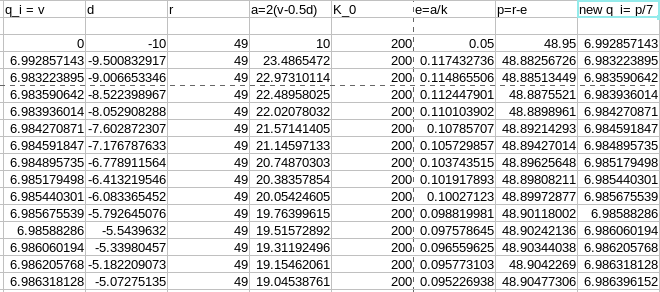
I think my spreadsheet shows a situation where
q.i = v is true,
but p = v is false.
In the Appendix to B:CP, subsection “Nonlinearities”, Bill outlines another situation showing p and q.i are not the same (emphasis added) :
A nonlinear input function involves exactly the same consideration. However, the input quantity qi is no longer numerically equal to the perceptual signal p except at maximum (the normalising point). In general, if the perceptual signal p depends on the input quantity qi according to p = g(qi), then qi = g-1(p) and q* = g-1(r) (where g is any arbitrary function)…The form of the input function determines the relationship between reference signal…and the external quantity qi affected by the system’s output.
It seems like what is being said here is,
while the controlled quantity is defined as qi = f(v1,…vn)
The input function g is defined by p = g(qi).
In other words, p = g(f(v1,…vn))
What sayest thou?
Update: You’ve given me the key right here, for if and when I manage to keep my nose to the grindstone long enough to get through the paper and spreadsheet. I was nudged back to it by trying to get through the B:CP chapter on Sensation control.
For second-order control symptoms, the controlled quantity simply is the perceptual signal p = g(i1, i2…in)
For first-order perceptions, p = qi for a slightly different reason:
From B:CP ch.5 on “The Control-System Unit of Organisation”:
The neural currents resulting from physical stimulation of of nerve endings enter an “input function”. This is a neural computing device that generates a neural current - the “perceptual signal”- that varies as a function of sensory-ending stimulations. If this input function has the form of the inverse of the function relating a one-dimensional remote physical phenomenon to the proximal stimuli, then the perceptual signal will correspond in magnitude to the magnitude of the remote physical phenomenon
As you point out in your paper, while simply stating this correspondence as p = qi keeps things simple:
The formula represents the sensor as a perfect linear transducer that transforms an input variable, located in Cell I, into a perceptual signal.
Setting the Level 1 perceptual signal to the value in Cell I implies that the perceptual signal is an exact measure of the physical variable. A more realistic model of the sensor might represent the perceptual signal as a logarithmic or exponential function of the input variable.
Okay, so for first order perceptions,
p = g(qi)
and qi= f(v1,v2…vn)
Does this mean f(v1,v2…vn) is… the feedback function?  [Edit: oops, nope! feedback function is g(qo) ]
That way madness lies.
This really set off some heavy thinking. My conclusion is that k.i is a linear approximation to a perceptual function. But this created a problem for me because, if k.i is a perceptual function, then it’s the function that defines q.i as a function of physical variables, v. But Bill defines p in Appendix A as p = k.i*q.i, which makes k.i look like a scaling factor matching physical units to neural units, thus treating q.i as a physical variable, v.
I think Bill was being confusing here for the sake of simplifying the calculation of the effects of loop gain on control. My proposed resolution to the confusion is based on the fact that PCT is a hierarchical control model. This means that the inputs to the perceptual functions are different at each level of hte hierarchy.
At the lowest level of the hierarchy are intensity perceptions and the perceptual functions at this level are like transducers that convert physical variables, v, into neural signals, p. So the equation for one of these intensity transducers, would be p = k.i*v, assuming k.i to be a linear approximation to the perceptual function.
There is considerable evidence that, at the intensity level, the perceptual function relating p to v is a log transform. So at the intensity level, p.1 = k*log(v), where p.1 is an intensity perception at level 1 of the hierarchy and k is a scaling factor. Since perceptual functions define controlled variables, a controlled intensity variable, q.i1, is defined as k * log(v). This definiiton of level 1 perceptual variables seems to be right since it explains certain behaviors involving control of intensity variables, such as the magnitude estimation behavior in psychophysical experiments, as demonstrated in this paper.
At the next level up in the PCT hierarchy are perceptual functions that produce sensation perceptions. The the inputs to these sensation producing perceptual functions are the perceptions, p.1, that are the outputs. of the intensity functions at the lower level. Since the intensity level perceptions are equivalent to q.i1, the perceptual functions at this level can be written as Bill wrote the general equation for perceptual functions: p = k.i (q.i). Using the current notation that identifies the level at which the perception is computed, we can write it as p.2 = k.2(q.i1).
Since perceptions at all levels above level 1 in the PCT hierarchy produce neural currents, p.N, based on inputs that are themselves neural currents, p.N-1,and since all these perceptual variables correspond to controlled variables, q.iN, Bill’s general equation for perceptual functions holds: p = k.i*q.i.
I don’t quite understand your spreadsheet. But my spreadshhet hierarchy shows what I described above: At level 1 of the hierarchy the perceptions are defined as p.1 = kv; and they are shown to be equivalent to q.i1 (though not using that notation). The perceptual function is a linear rather than a log function for reasons I’ll discuss in another post. Above level 1 of the hierarchy the perceptions are defined as p.N = k q.iN and they are shown to be equivalent to q.iN
I would say that the controlled variable is defined as qi = f(v1,…vn) at level 1 of the control hierarchy and as qi = f(q.i11,…q.i1n) for all percpetions above level 1. And that’s because p = g(f(v1,…vn)) only level 1; above level 1 p = g(f(q.iN1,…q.iNn)).
At least, this is the understanding of what BIll is saying that has worked in my efforts to build PCT models.
Best, Rick
Thank you Rick - it’s great to have, in the power law/log law paper, a concrete example of the behavioural illusion.
It’s reassuring to see that, in my last post above yours, my thinking is starting to head in the right direction (my feedback function blunder not withstanding!).
I’ve started to get an inkling of why, from a certain point of view, a lot of the above disputation is unimportant.
I noticed that in the 1978 Quantitative Analysis paper, there is no mention whatsoever of p, r, or e. Instead there is just qi, qi*, and (qi - qi*).
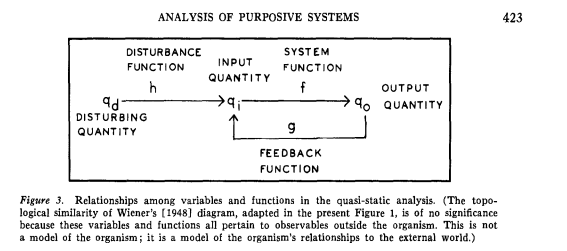
It seems a lot of the time your main purpose is establishing the fact of control, and the identity of the controlled variable(s) - and the all theoretical apparatus of r’s and p’s and e’s and input functions, is for building testable models towards those ends. Is that more or less it?
There is still one potentially fraught matter of interpretation.
In a first order intensity control situation, say one where
qi is light intensity at the retina,
qo is pupil diameter, and
qd is the experimenter’s lightbulb dimmer control…
…it’s easy to imagine qi as being something in a sense outside the organism (although of course the retina is inside the eyeball).
But for higher order perceptions:
…it’s harder to imagine what relationship the controlled quantity has to anything that might or might not exist outside the organism; the nature of its correspondence with a “presumed physical quantity” in a “hypothetical external world”, as Bill puts it in B:CP Figure 8.1.
[There’s also the question of what the feedback function physically refers to in these more complicated perceptual control scenarios… perhaps someone could start a thread about that ]
I still need to spend more time with your hierarchy spreadsheet/paper, What is Size demo, and Chasing Choppers paper.
Please do!
Thank you!
My life in a nutshell;-)
My experience is that this is the most difficult thing to understand about PCT. What we call qi – the controlled quantity or variable – is a perceptual, not an environmental, variable. It is the external (environmental) correlate of the internal controlled perceptual variable, p, only in the sense that an external observer with the proper perceptual equipment can perceive it. This applies to both higher and lower order perceptions. In both cases, qi is not directly related to the physical variables that we think of as existing outside the organism.
For example, even an apparently simple perception, like loudness, is not directly related to a physical variable in the enviroment. It is a function of what we presume is the physical reality of presure variations in the air. What we perceive (p) and control as loudness is apparently a log function of sound pressure level (SPL) which is itself a function of air pressure variations averaged over time. We know this because engineers have developed devices for measuring (perceiving) different aspects of variations in sound pressure level (qi) and found that a measure like k*log (SPL) seems to correlate best with human ratings of loudness.
The reason is that a log function only produces values that are >=0. And a control system seems to need to produce negative values for output when p>r. In my spreadsheet hierarchy all the control systems work because all the variables, includeding the neural variable inside the system, can be positive or negative. I am working on building a more realistic control model, where all variables can only be >=0. I’m designing it to perform the matching task described in the power law/log law paper that you read. As soon as I finish that simulation I’ll discuss how it works in another post.
I look forward to it, thanks Rick.