FW: Re: Do we control "environmental variables"?

(Seems like list servers behavior had changed so that replies go more easily just to original author and not to the list!)

[Eetu Pikkarainen 2018-05-11_09:29:19 UTC]

···

[Rick Marken 2018-05-10_17:36:40]

FN: Do I believe there are often strong – very sstrong – correlations between those environmmental variables and our perceptions of
them.

RM: It is not environmental variables that are controlled but
aspects (functions) of those variables that are controlled. The aspects of the environment that are controlled are called controlled variables.

Rick,

Are those �aspects� variables? If they are do they exist in the (external) environment?

Eetu

The existence of controlled variables is the main fact that is explained by PCT – the fact of control.
This fact is explained by assuming that controlled variables are represented in organisms as perceptual signals – perceptions – that are compared to reference signals, resulting in error signals, the magnitude of which drives outputs that drive the
controlled variable – and the equivalent perceptual signal – toward the reference signal. So the correlation between controlled variables – the aspects of the environment that are controlled – and perceptions – the perceptual signals that are the theoretical
analog of the controlled variables – is 1.0 because the PCT explanation of the observed controlling done by organisms includes the
assumption that controlled variables are the same variable as the perceptual signals.

Best

Rick

You betcha! I f there weren’t,
I wouldn’t dream of getting in my car and driving to the grocery store; much too risky if there’s no correlation between my perceptions and physical reality. More specifically, there sure as heck better be a good correlation between my perception of my car’s
position in its lane and its actual, physical position in that lane. If not, me and lots of other drivers could be at serious risk.

EJ: It is those “strong correlations” that allow us to use the “pragmatic, real-world” language of ‘controlling the environmental variables’.
AND YET, the correlations get somewhat weaker when we get up into the more abstract reaches of the perceptual hierarchy. There are fiery political debates whether either side is sufficiently
correlated with a principle of ‘Acting With Integrity’.

EJ: I would make two suggestions, to try to keep the distinctions clean. First, I wonder if we ought to resurrect the old CSGNet language (from some 20+ years ago) of “controlling
for” a certain outcome. Maybe that can be the way we talk about those environmental variables, that we are “controlling for them to be in a certain state.” Then the term “control” by itself can stay with the perceptions, where the internal matching to references
takes place.

EJ: The second suggestion is a question that always occurs to me, when people talk about controlling the environment or controlling people. “Which specific aspects of said
people or whatever are you seeking to control? No, which specific aspects do you care about, and which ones do you not care about?”

EJ: I even want that to be the question when we use a loose term like “behavior”. Behavior must be deconstructed into its various levels of implementation: Is it the Event
quality of the action? Is it the Transitions that are underway? Is it a Categorical sense of whatever output seems to arise? Is it the Configurational joint angles? Is it the pooled muscle force Intensities? Any or all of those things are operative when ‘behavior’
is underway. So which_specific_aspects are being talked about in any given conversation? I do not think it is sufficient to assume ‘we all know what we mean’.

FN: So I will happily agree to the existence of environmental variables and that we can affect their value by way of our actions. Do we or can we control them? Sometimes,
yes; sometimes, no.

EJ: Back to those correlations between what is going on in the environment and what we think we perceive. One of the enormous strengths of Perceptual Control Theory, to my
way of thinking, is the realization that control loops are (typically) closed through the environment. In my work as a psychologist and therapist, I have a number of clients who operate with what the clinical world calls “delusions or psychotic beliefs.” I
always try to reframe those as “idiosyncratic beliefs” that do not line up with a more “consensual reality” of those around them. From a PCT perspective, there seems to be a liberal use of “the imagination connection” to close the control loops for these clients.
It is almost as if they operate with a presumption, ‘I think it, therefore it is.’ That may work for them, except where they may need to interface more with others.

EJ: There is certainly value in the use of imagination, because much creativity is born that way. It helps to see what ‘could be’ possible. But there is also value in actually
taking the step to close the control loop environmentally. Because that helps confirm what actually ‘is’ possible. What I like about PCT is how that reality test is built into every standard-operating control loop. The Environment gets a vote, in terms of
those strong correlations you talked about.

FN: And here’s my final point: So far as I know, disturbances (at least most of them) do not directly affect our perceptions. Instead, they affect the environmental variable
and, through that, our perceptions change to match changes in the controlled variable. At least, that’s what I think is going on.

EJ: I’m thinking yes and no on this one. I appreciate the reminder that it is a mediated effect on our perceptions. And in fact, it is the NET disturbance, from any relevant
source, that we seek to counteract when we control a certain perception. So, yes, disturbances are one step removed and their influences are pooled onto perceptions that matter to us.

EJ: However, I also wonder about the disturbing effect of mis-perceptions. People can take umbrage at something that was not intended. And it seems in many of those instances,
there is an ‘imagination connection’ piece going on. So did it amount to an imagined disturbance that had little connection with the actual environment? Don’t know.

EJ: In any event, thanks for your clear and lucid thoughts here.

All the best,

Erling

Richard S. Marken

"Perfection is achieved not when you have nothing more to add, but when you

have nothing left to take away.�

                            --Antoine de Saint-Exupery
Well Rick this Is confussion of all confussions.

RM: It is not environmental variables that are controlled but aspects (functions) of those variables that are controlled.

HB : Do I understand right that nothing is controlled in environment but only perception is controlled ? Functions ?

RM : The aspects of the environment that are controlled are called controlled variables.

HB : You said above that only “perceptual signal” is controlled. Just Functions ? You said that “environmental variables” are not controlled if I understood right.

RM : The existence of controlled variables is the main fact that is explained by PCT – the fact of control.

HB : What is now “controlled variable” ? Perceptual signal or “aspect of environment” ?

RM : This fact is explained by assuming that controlled variables are represented in organisms as perceptual signals – perceptions – that are compared to reference signals,

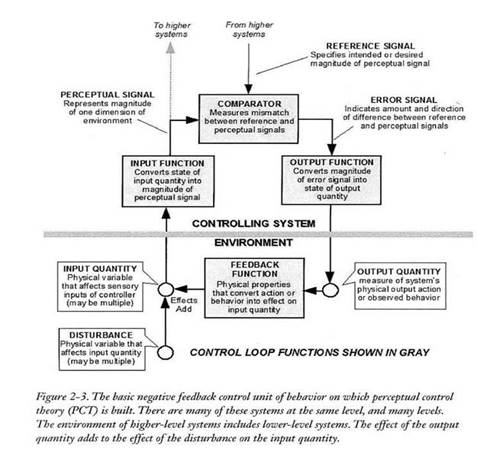
HB : So if I understand right “controlled variable” in environment is represented in “perceptual signal” so it is “Controlled Perceptual Variable” or PCV which is compared to reference signal. What a mess and confussion. Where can we see this construct to work. Show us in PCT diagram LCS III how it works :

image001199.jpg

RM : ….resulting iin error signals, the magnitude of which drives outputs that drive the controlled variable – and the equivalent perceptual signal – toward the reference signal.

HB : And how “output” (behavior) drives (controls) “the controlled variable” which is the equivalent to perceptual signal. Can you explain this to us through Bills Control loop how it works.

PCT Definitions of control loop :

Bill P (B:CP):

  1. CONTROL : Achievement and maintenance of a preselected state in the controlling system, through actions on the environment that also cancel the effects of disturbances.

Bill P (B:CP):

  1. OUTPUT FUNCTION : The portion of a system that converts the magnitude or state of a signal inside the system into a corresponding set of effects on the immediate environment of the system

Bill P (LCS III):…the output function shown in it’s own box represents the mmeans this system has for causing changes in it’s environment.

Bill P (LCS III):

  1. FEED-BACK FUNCTION : The box represents the set of physical laws, properties, arrangements, linkages, by which the action of this system feeds-back to affect its own input, the controlled variable. That’s what feed-back means : it’s an effect of a system’s output on it’s own input.

Bill P (B:CP) :

  1. INPUT FUNCTION : The portion of a system that receives signals or stimuli from outside the system, and generates a perceptual signal that is some function of the received signals or stimuli.

Bill P (B:CP) :

  1. COMPARATOR : The portion of control system that computes the magnitude and direction of mismatch between perceptual and reference signal.

Bill P (B:CP)

  1. ERROR : The discrepancy between a perceptual signal and a reference signal, which drives a control system’s output function. The discrepancy between a controlled quantity and it’s present reference level, which causes observable behavior.

Bill P (B:CP) :

  1. ERROR SIGNAL : A signal indicating the magnitude and direction of error.

RM : So the correlation between controlled variables – the aspects of the environment that are controlled – and perceptions –

HB : So the correlation between “aspect of environment” and perception is expressed in “Controlled Perceptual Variable” ?

RM : …the perceptual signals thhat are the theoretical analog of the controlled variables – is 1.0 because the PCT explanation of the observed controlling done by organisms includes the assumption that controlled variables are the same variable as the perceptual signals.

HB : Perceptual signal is not theoretical variable. At least not in PCT. It was scientifically proved by Bill. It can be measured very precisely. It’s theoretical only in your head where you think that “perceptual signal” is PCV (Perceptual Control Variable). This is Theoretical construct which derives from RCT (Ricks’ Control Theory) where :

  1. Behavior is Control

  2. There is some “controlled aspect of environment”

  3. There exist some “Controlled Perceptual Variable”

You never proved (so it’s not scientific) that “Behavior is Control”. You are theorizing and imagining and of course confuse CSGnet and public

RM : The perceptual signal is a theoretical variable that accounts for the observed fact that the controlled variable is controlled.

HB : Where did you take this construct from ? RCT collection. What kind of nonsense is this ? So "Perceptual signal is indeed “Controlled Perceptual Variable”. What an imagination. Do you intend to prove something from these constructs or it is just because Rick said. Everything what Rick observes is fact. Vauu. Superman Ricky. Only he knows what is really in reality. He probably has “laser vision”.

Boris

Best

Rick

···

You betcha! I f there weren’t, I wouldn’t dream of getting in my car and driving to the grocery store; much too risky if there’s no correlation between my perceptions and physical reality. More specifically, there sure as heck better be a good correlation between my perception of my car’s position in its lane and its actual, physical position in that lane. If not, me and lots of other drivers could be at serious risk.

EJ: It is those “strong correlations” that allow us to use the “pragmatic, real-world” language of ‘controlling the environmental variables’. AND YET, the correlations get somewhat weaker when we get up into the more abstract reaches of the perceptual hierarchy. There are fiery political debates whether either side is sufficiently correlated with a principle of ‘Acting With Integrity’.

EJ: I would make two suggestions, to try to keep the distinctions clean. First, I wonder if we ought to resurrect the old CSGNet language (from some 20+ years ago) of “controlling for” a certain outcome. Maybe that can be the way we talk about those environmental variables, that we are “controlling for them to be in a certain state.” Then the term “control” by itself can stay with the perceptions, where the internal matching to references takes place.

EJ: The second suggestion is a question that always occurs to me, when people talk about controlling the environment or controlling people. “Which specific aspects of said people or whatever are you seeking to control? No, which specific aspects do you care about, and which ones do you not care about?”

EJ: I even want that to be the question when we use a loose term like “behavior”. Behavior must be deconstructed into its various levels of implementation: Is it the Event quality of the action? Is it the Transitions that are underway? Is it a Categorical sense of whatever output seems to arise? Is it the Configurational joint angles? Is it the pooled muscle force Intensities? Any or all of those things are operative when ‘behavior’ is underway. So which_specific_aspects are being talked about in any given conversation? I do not think it is sufficient to assume ‘we all know what we mean’.

FN: So I will happily agree to the existence of environmental variables and that we can affect their value by way of our actions. Do we or can we control them? Sometimes, yes; sometimes, no.

EJ: Back to those correlations between what is going on in the environment and what we think we perceive. One of the enormous strengths of Perceptual Control Theory, to my way of thinking, is the realization that control loops are (typically) closed through the environment. In my work as a psychologist and therapist, I have a number of clients who operate with what the clinical world calls “delusions or psychotic beliefs.” I always try to reframe those as “idiosyncratic beliefs” that do not line up with a more “consensual reality” of those around them. From a PCT perspective, there seems to be a liberal use of “the imagination connection” to close the control loops for these clients. It is almost as if they operate with a presumption, ‘I think it, therefore it is.’ That may work for them, except where they may need to interface more with others.

EJ: There is certainly value in the use of imagination, because much creativity is born that way. It helps to see what ‘could be’ possible. But there is also value in actually taking the step to close the control loop environmentally. Because that helps confirm what actually ‘is’ possible. What I like about PCT is how that reality test is built into every standard-operating control loop. The Environment gets a vote, in terms of those strong correlations you talked about.

FN: And here’s my final point: So far as I know, disturbances (at least most of them) do not directly affect our perceptions. Instead, they affect the environmental variable and, through that, our perceptions change to match changes in the controlled variable. At least, that’s what I think is going on.

EJ: I’m thinking yes and no on this one. I appreciate the reminder that it is a mediated effect on our perceptions. And in fact, it is the NET disturbance, from any relevant source, that we seek to counteract when we control a certain perception. So, yes, disturbances are one step removed and their influences are pooled onto perceptions that matter to us.

EJ: However, I also wonder about the disturbing effect of mis-perceptions. People can take umbrage at something that was not intended. And it seems in many of those instances, there is an ‘imagination connection’ piece going on. So did it amount to an imagined disturbance that had little connection with the actual environment? Don’t know.

EJ: In any event, thanks for your clear and lucid thoughts here.

All the best,

Erling

Richard S. Marken

"Perfection is achieved not when you have nothing more to add, but when you
have nothing left to take away.�
–Antoine de Saint-Exupery