MOL tells us what to do in a session: help the person notice their experience, stay with it, and follow it up a level until reorganization can do its work. What it does not yet give us is a way to work out, in numbers, what follows from that picture. How long should attention stay on the source of a conflict? Does it matter whether it stays there continuously or keeps coming back? What separates a resolved conflict from temporary relief?
These are questions about a control system, and a control system can be written down and run. Livia is a small workbench built for exactly that.
What Livia is
A browser-based tool (phone included) for turning a PCT idea you hold in words into a control loop that runs, in the tradition of Powers’ Quantitative analysis of purposive systems (1978).
- You write the loop explicitly. Perception, reference, comparator, output, environment and disturbance each get an equation with units. Every assumption is recorded next to the relation it belongs to.
- Livia checks it. Dimensional errors are caught and named. A loop that depends on itself instantly, with no dynamic state, is rejected rather than quietly patched.
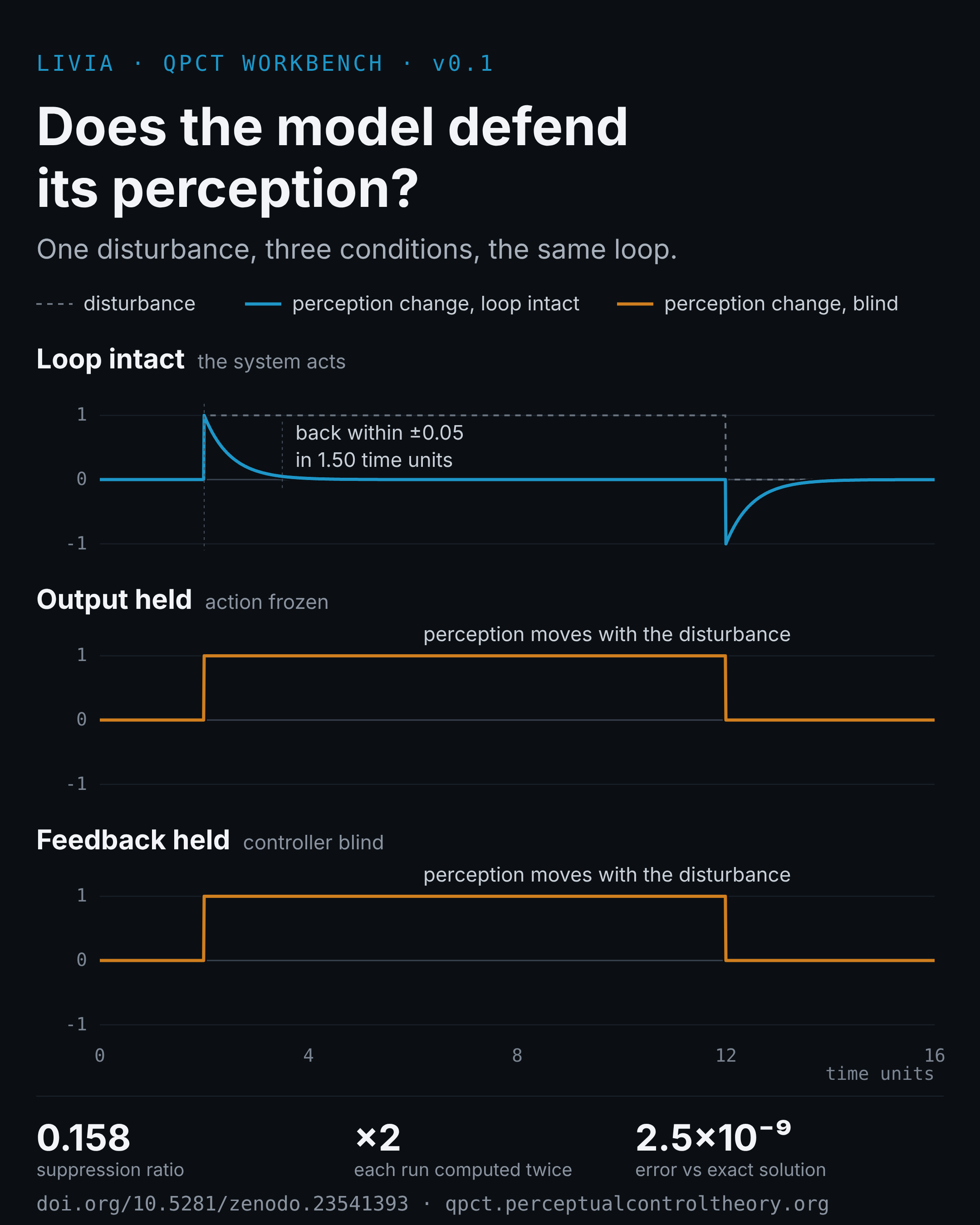
- Livia disturbs it under three conditions:
| Condition | What happens | What it shows |
|---|---|---|
| Loop intact | the system acts normally | how it defends its perception |
| Output held | action frozen at its pre-event value | what the disturbance does with no response |
| Feedback held | the comparator gets the pre-event perception | whether control disappears when the system is blind |
- You compare alternatives. Change one assumption (for example, a limit on how strongly the system can act) and run it under the identical protocol, point by point.
- Everything is reproducible. Each run is computed twice at tighter tolerances; no agreement, no verdict. The whole experiment, code included, exports as one package another researcher can rerun.
Up to three controllers fit in one model, with a shared environment and a hierarchy in which a higher output sets a lower reference. That is already enough to write down two goals in conflict.
What it is not, yet
- Synthetic models only. No import of session data, no parameter fitting.
- No reorganization yet. That is the next module, and the reason for this post.
- A simulation analogue of the logic of the TCV, not a TCV. A model passing in Livia says nothing about whether a person controls that variable.
- Psychological meaning stays with you. Livia checks equations and units. Dimensional validity is not construct validity.
Why I am posting here
The next module models reorganization, and I would rather build it around questions from MOL practice than around what is easy to code.
@Kuba has already sent the first set, and one of them is narrow enough to start with:
Sustained attention versus repeated returns. With the same total time and the same aspect of the conflict, does keeping awareness continuously on the source of a conflict lead to different reorganization than returning to it several times?
In a model, this becomes two controllers in conflict, a Powers-style reorganizing system acting only where “attention” is, and an attention schedule: one continuous block against several short blocks with the same sum. Whether reorganization stops between returns or decays gradually is itself an assumption, so both versions get run. The answer will tell us what follows from the model’s assumptions, not what happens in people. That is still a useful thing to know before designing a study.
If you practise or research MOL, I would value:
- the questions you would most like a model to answer;
- which of them you think are already well enough defined to be written as equations;
- anything published that a reorganization model should be checked against.
Access
Livia is free for research, teaching, clinical practice by individual therapists, and non-profit use. Access is by login during this first phase. Write to me here or at pct.theory2026@gmail.com and I will send one.
- Lab: https://qpct.perceptualcontroltheory.org
- Citation: Diener, Ł. (2026). Livia: a computational workbench for Perceptual Control Theory (Version 0.1.0). Zenodo. https://doi.org/10.5281/zenodo.23541393
Luk