Minority Report

[From Rick Marken (2018.4.28.1645)]

RM: Some of you may have noticed that I have not posted to CSGNet in a while. Actually, I stopped in late March when I read a post from Martin Taylor that began by saying that my PCT interpretation of the power law of movement was an “infection”. Perhaps it’s my ethnic background but I didn’t read on from that point because when people start calling my ideas an “infection” my inclination, like my grandfather’s, is to get the hell out of there – in my case, out of CSGNet rather than Poland. But, unlike my grandfather, I do have the luxury of explaining why I’m leaving. It’s not just because of the constant ad hominum attacks. It’s mainly because the discussions on CSGNet have been based on some fundamental misunderstandings of what PCT is about, such as:

  • Organisms control only perceptions, not the aspects of the environment that correspond to those perceptions.Â
  • The test for the controlled variable is not an essential component of PCT-based research.Â
  • PCT shows that you can’t control the behavior of another person.
  • Social stability arises from interpersonal conflict.Â
  • The power law of movement is not an example of a behavioral illusion.Â
    RM: All of these ideas (and several others that have come up since Bill passed away) have been shown, at one time or another, to be false. But when I offered up my expertise on this, I got repaid with scorn. So CSGNet hasn’t proved to offer me much shelter from the storm of opposition to PCTÂ – opposition to what I have taken to be PCT anyway.Â

RM: But it’s not the opposition per se that bothers me; it’s the fact that the opposition has been virtually unanimous. What this means to me, besides the fact that I am taken to be the person on CSGNet who is most ignorant of PCT, is that discussions on CSGNet are not going to lead to any progress in the development of what I see (and have seen for the last 40 years) as PCT science; every one of the bulleted ideas above is a red herring pulled across the path of progress toward an understanding of living organisms as input control systems (Powers, 1978). Â

RM: So since my contributions to CSGNet seem to result in nothing but rather strong opposition I will no longer contribute unsolicited posts to CSGNet. But I will monitor CSGNet and will answer questions if I am asked for my opinion about specific topics. If, however, anyone would like to talk with me about doing a PCT research project, feel free to contact me directly at rsmarken@gmail.com.Â

Best regards

Rick

···

Richard S. MarkenÂ

"Perfection is achieved not when you have nothing more to add, but when you
have nothing left to take away.�
                --Antoine de Saint-Exupery

[From Fred Nickols (2018.04.29.0601 ET)]

“Virtually unanimous� is incorrect, Rick. I do not subscribe to the first three of the bulleted items below. I believe that we do indeed control aspects of our environment, as informed by our perceptions of those aspects; I believe the TCV is an essential component of PCT-based research; and I believe we can control the behavior of other people (and I do not believe PCT shows we can’t). As for the fourth item, I don’t even know what that pertains to. Finally, I have no grasp whatsoever of the power law of movement so I would say it was or wasn’t an example of a behavioral illusion.

My take on the attacks on you is also different from what you describe. My view is that only Boris attacks you. You and Martin have some pretty severe disagreements from time to time but they are, in my view, disagreements, not attacks.

If I recall correctly, Bill used to correct your thinking from time to time but I don’t recall any major flaws.

Your decision to withdraw from active participation is yours but I am glad you will be available to answer questions.

Fred Nickols

···

From: Richard Marken rsmarken@gmail.com
Sent: Saturday, April 28, 2018 7:45 PM
To: csgnet@lists.illinois.edu
Subject: Minority Report

[From Rick Marken (2018.4.28.1645)]

RM: Some of you may have noticed that I have not posted to CSGNet in a while. Actually, I stopped in late March when I read a post from Martin Taylor that began by saying that my PCT interpretation of the power law of movement was an “infection”. Perhaps it’s my ethnic background but I didn’t read on from that point because when people start calling my ideas an “infection” my inclination, like my grandfather’s, is to get the hell out of there – in my case, out of CSGNet rather than Poland. But, unlike my grandfather, I do have the luxury of explaining why I’m leaving. It’s not just because of the constant ad hominum attacks. It’s mainly because the discussions on CSGNet have been based on some fundamental misunderstandings of what PCT is about, such as:

· Organisms control only perceptions, not the aspects of the environment that correspond to those perceptions.

· The test for the controlled variable is not an essential component of PCT-based research.

· PCT shows that you can’t control the behavior of another person.

· Social stability arises from interpersonal conflict.

· The power law of movement is not an example of a behavioral illusion.

RM: All of these ideas (and several others that have come up since Bill passed away) have been shown, at one time or another, to be false. But when I offered up my expertise on this, I got repaid with scorn. So CSGNet hasn’t proved to offer me much shelter from the storm of opposition to PCT – opposition to what I have taken to be PCT anyway.

RM: But it’s not the opposition per se that bothers me; it’s the fact that the opposition has been virtually unanimous. What this means to me, besides the fact that I am taken to be the person on CSGNet who is most ignorant of PCT, is that discussions on CSGNet are not going to lead to any progress in the development of what I see (and have seen for the last 40 years) as PCT science; every one of the bulleted ideas above is a red herring pulled across the path of progress toward an understanding of living organisms as input control systems (Powers, 1978).

RM: So since my contributions to CSGNet seem to result in nothing but rather strong opposition I will no longer contribute unsolicited posts to CSGNet. But I will monitor CSGNet and will answer questions if I am asked for my opinion about specific topics. If, however, anyone would like to talk with me about doing a PCT research project, feel free to contact me directly at rsmarken@gmail.com.

Best regards

Rick


Richard S. Marken

"Perfection is achieved not when you have nothing more to add, but when you
have nothing left to take away.�
–Antoine de Saint-Exupery

Down…

image001199.jpg

···

From: Richard Marken rsmarken@gmail.com
Sent: Sunday, April 29, 2018 1:45 AM
To: csgnet@lists.illinois.edu
Subject: Minority Report

[From Rick Marken (2018.4.28.1645)]

RM: Some of you may have noticed that I have not posted to CSGNet in a while. Actually, I stopped in late March when I read a post from Martin Taylor that began by saying that my PCT interpretation of the power law of movement was an “infection”.

HB : Your »PCT« interpretation in your and Schaffer article was disaster. It was disaster from mathematical (Alex, Martin) and also from physiologcial (nervous system) and »space moving« view. But you could repair what you’ve done wrong with recognizing mistake and writing new article. I would help you. And I think Martin would do the same. He gave you a chance to make it right.

RM : Perhaps it’s my ethnic background but I didn’t read on from that point because when people start calling my ideas an “infection” my inclination, like my grandfather’s, is to get the hell out of there – in my case, out of CSGNet rather than Poland. But, unlike my grandfather, I do have the luxury of explaining why I’m leaving. It’s not just because of the constant ad hominum attacks.

HB : You are getting it wrong Rick. Why you call critics »attacks« like Fred ? Who is attacking you ? Is saying the truth and giving mathematical proofs and PCT or biological or physiological arguments »attacks« and thus forbiden on CSGmet. Are we in »Dark Age« ?

RM : It’s mainly because the discussions on CSGNet have been based on some fundamental misunderstandings of what PCT is about, such as:

  • Organisms control only perceptions, not the aspects of the environment that correspond to those perceptions.

  • The test for the controlled variable is not an essential component of PCT-based research.

  • PCT shows that you can’t control the behavior of another person.

  • Social stability arises from interpersonal conflict.

  • The power law of movement is not an example of a behavioral illusion.

HB : These are not »fundamental misunderstandings« of PCT but »fundamental understandings« of PCT. It’s a fact that PCT is about »Controlling perception« not »behavior«. You wrote it for yourself that TCV is not almighty method.

RM (2013) : But the intentional behavior that occurs in real life often involves the control of variables that are impossible to represent as simple function of physical variables, e.g., the honesty of a communication or the intimacy of a realtionship. A quantitative approcah to the TCV will not work when trying to study such abstract variables….

HB : And Alison Powers gave you direct arguments why people can’t control people. You wrote a book about people »try to control other people« based on our discussions. If you can control other people behavior you can exactly predict what they will do in next moment. Can you ? Does what people will do depend from you or from them ?

RM: All of these ideas (and several others that have come up since Bill passed away) have been shown, at one time or another, to be false.

HB : Who showed that they were false ? You ??? Sometimes you even agreed with them and sometimes not.

Since Bill died you tryed to change his PCT into RCT. See CSGnet archives. You started with changing definitions. Obviously they presented disturbance to your RCT. If I wouldn’t stop you who knows what could happen.

Can you exatly expalin what is false in lines above ? Of course we expect you to give some evidences what is false from PCT view (Bills’ literature). You proved many times that your RCT (Ricks’ Control Theory) differ from Bills’ PCT.

Let us see what PCT is.

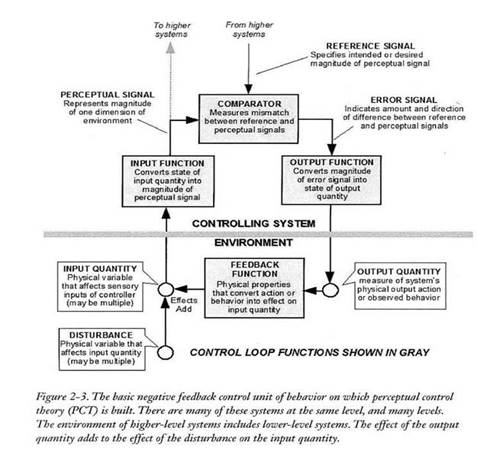
PCT Definitions of control loop :

Bill P (B:CP):

  1. CONTROL : Achievement and maintenance of a preselected state in the controlling system, through actions on the environment that also cancel the effects of disturbances.

Bill P (B:CP):

  1. OUTPUT FUNCTION : The portion of a system that converts the magnitude or state of a signal inside the system into a corresponding set of effects on the immediate environment of the system

Bill P (LCS III):…the output function shown in it’s own box represents the means this system has for causing changes in it’s environment.

Bill P (LCS III):

  1. FEED-BACK FUNCTION : The box represents the set of physical laws, properties, arrangements, linkages, by which the action of this system feeds-back to affect its own input, the controlled variable. That’s what feed-back means : it’s an effect of a system’s output on it’s own input.

Bill P (B:CP) :

  1. INPUT FUNCTION : The portion of a system that receives signals or stimuli from outside the system, and generates a perceptual signal that is some function of the received signals or stimuli.

Bill P (B:CP) :

  1. COMPARATOR : The portion of control system that computes the magnitude and direction of mismatch between perceptual and reference signal.

Bill P (B:CP)

  1. ERROR : The discrepancy between a perceptual signal and a reference signal, which drives a control system’s output function. The discrepancy between a controlled quantity and it’s present reference level, which causes observable behavior.

Bill P (B:CP) :

  1. ERROR SIGNAL : A signal indicating the magnitude and direction of error.

PCT diagram in LCS III

cid:image001.jpg@01D37ABE.36063DF0

And this is yours theory about how people control, because you can’t aply your »control theory« to all organims, what PCT can :

RCT (Ricks Control Theory) definition of control loop

  1. CONTROL : Keeping of some »aspect of outer environment« in reference state, protected (defended) from disturbances.

  2. OUTPUT FUNCTION : controlled effects (control of behavior) to outer environment so to keep some »controlled variable« in reference state

  3. FEED-BACK FUNCTION : »Control« of some »aspect of outer environment« in reference state.

  4. INPUT FUNCTION : produce »Controlled Perceptual Variable« or »Controlled Perception«, the perceptual correlate of »controlled q.i.«

  5. COMPARATOR : ???

  6. ERROR SIGNAL : ???

You proved with your writings only that your RCT theory is totatly opposite to PCT

RCT (Ricks Control Theory)

PCT (Perceptual Control Theory)

Behavior is control

Behavior is not control

Controlled variable in outer environment

There is no controlled variable in environment

Controlled Perceptual Variable

Ordinary perceptual signal

I’ve proved for every point you listed above from Bills’ literature that statements are correct. It’s you turn to prove opposite.

  1. First we need your agreement with Bills’ and Mary’ Thesis about PCT. You never agreed.

  2. We need your agreement with »deifinitions of PCT« (see up)

  3. We need your agreement with diagram in LCS III.

  4. Etc.

RM : But when I offered up my expertise on this, I got repaid with scorn.

HB : Which of your expertise ? I never saw any evidences for your RCT (Ricks Control Theory).

You call expertise something that is giving wrong description of nervous system functioning and without any physiological evidences ??? Is expertise something what is moving in »TWO-DIMENSIONAL SPACE« ? Is expertise behavioristic description of »controlled variable« that you are manipulating in environment. You must be surprised what Bill thought about these constructs…

Bill P (B:CP) :

Behaviorism began in America by John B. Watson near the start of the century…. It was recognized that valid experiment requires fixed experimental conditions and manipulation of single or more variables in environment and observe consequent effects on behavior…. Running throuh out psychology (and almost identical to what is termed “scientific method” in psychology) is a particular concept of what orgsnism does, lies outside the organism…

HB : If by expertise you ment your behavioral analysis in your demos and so on… than I can tell you that you are on wrong way. You promoted ……»behavior is control«, »controlled aspect of envioronment«, »controlled perceptual variable« ???. There is no such things in PCT.

Are you trying to tell us that your RCT (Rick Control Theory) is right ? Prove it ??? We need proves for that. We need PCT proves, we need biological proves (like Maturana), we need physiological proves, etc.

RM : So CSGNet hasn’t proved to offer me much shelter from the storm of opposition to PCT – opposition to what I have taken to be PCT anyway.

HB : Why should PCT offer you shelter ? Are you something special here ? Don’t all members have equal rights ? You have some special status and special rights ? I thought that is not a secret. You had all the time the strongest support on CSGnet you can imagine. I’d be proud if I could have 10% of the same support as you had. My »PCT way« on CSGnet was much harder than yours. Can you imagine how much Bills’ literature I had to read and how much time did I spend for every answer to you or Bruce Nevin etc. ??? Knowledge doesn’t come just like that.

START READING BILLS’ LITERATURE RICK. YOU’LL FIND EVERYTHING ABOUT PCT RIGHT THERE.

What you have taken to be PCT it’s just opposite to what PCT is. You are dragging PCT away from it’s core point. I’m promoting PCT by citating Bills’ literature at every point of my discourses. I offered PCT examples. I offered biological, physiological evidences. What did you offer ? And I’m doing this just for one reason. That PCT would be understood correctly.

RM: But it’s not the opposition per se that bothers me; it’s the fact that the opposition has been virtually unanimous.

HB : This a good news. I didin’t see that on CSGnet and also Bruce Nevin didn’t :

BN earlier :

If we who are best informed in PCT cannot do this among ourselves, what claim do we have on the attention of others about the efficacy and importance of PCT?

RM : What this means to me, besides the fact that I am taken to be the person on CSGNet who is most ignorant of PCT,

HB : I don’t recall that anybody wrote or said that. We just want you to stop being »black and white«. You are sometimes writing in »PCT mode« and mostly in »behaviorist mode«. Start writing only in »PCT mode«.

RM : …. is that discussions on CSGNet are not going to lead to any progress in the development of what I see (and have seen for the last 40 years) as PCT science;

HB : Progress depends how much you’ll contribute to opened questions about PCT. For example the most nedeed resolution for PCT to make a progress is finishing diagram on p. 191 (B:CP, 2005). Another important step is to form right PCT starting-points for research in »Reseacrhgate project«. As I see it now starting-points for research work mostly on »behaviorism«.

RM : ….every one of the bulleted ideas above is a red herring pulled across the path of progress toward an understanding of living organisms as input control systems (Powers, 1978).

HB : Right. Input control not output control as you are promoting. We have to understand how organisms function. And you seemed to be miles away. Sometimes.

HB : All you have to do Rick is to prove me that you are right about your basic »thesis« of PCT :

  1. That »behavior is control« ?

  2. That there is some »controlled aspect of envioronment« ?

  3. That there is some »controlled perceptual variable« or PCV ?

RM: So since my contributions to CSGNet seem to result in nothing but rather strong opposition I will no longer contribute unsolicited posts to CSGNet.

HB : I think this is the worse move you can make. You proved many times that you have extraordinary PCT potential. You wrote couple times in pure PCT manner. And Martin and I supported your good direction in work on »control hierarchy«. Why did you stop ?

RM : But I will monitor CSGNet and will answer questions if I am asked for my opinion about specific topics. If, however, anyone would like to talk with me about doing a PCT research project, feel free to contact me directly at rsmarken@gmail.com.

HB : I tried to talk with you privately but you threatended me that you will expose our private conversation on CSGnet. So I’ll not write to you. It seems quite a common procedure that private conversations among PCT members are exposed. So I’ll have private conversations just with those that understand privacy. There are quite some members here on CSGnet with gentlemen manners.

Boris

Best regards

Rick


Richard S. Marken

"Perfection is achieved not when you have nothing more to add, but when you
have nothing left to take away.”
–Antoine de Saint-Exupery
Hi Fred,

I really hoped that you’ll not »push« with »control aspect of environment«. So I answered your previous post. In the light of your accusations I have posted what I answered to you before. I kept it because I thought you’ll rethink your understanding of PCT.

Why do you think I’m attacking Rick ? I offer PCT proofs for what I’m saying. Why should you call »attack« for something I’m proving that is wrong ? Would you like me not to »attack« Rick and let him write whatever he wants under PCT »umbrella« ? Is that what you want also about your nonderstanding of PCT. Would you like that I don’t answer to »not PCT constructs« ?

Bruce Nevin started with adminstrative means to »remove« me from CSGnet. Do you agree with about that ?

Boris

···

From: Fred Nickols fred@nickols.us
Sent: Sunday, April 29, 2018 12:13 PM
To: csgnet@lists.illinois.edu
Subject: RE: Minority Report

[From Fred Nickols (2018.04.29.0601 ET)]

“Virtually unanimous” is incorrect, Rick. I do not subscribe to the first three of the bulleted items below. I believe that we do indeed control aspects of our environment, as informed by our perceptions of those aspects; I believe the TCV is an essential component of PCT-based research; and I believe we can control the behavior of other people (and I do not believe PCT shows we can’t). As for the fourth item, I don’t even know what that pertains to. Finally, I have no grasp whatsoever of the power law of movement so I would say it was or wasn’t an example of a behavioral illusion.

My take on the attacks on you is also different from what you describe. My view is that only Boris attacks you. You and Martin have some pretty severe disagreements from time to time but they are, in my view, disagreements, not attacks.

If I recall correctly, Bill used to correct your thinking from time to time but I don’t recall any major flaws.

Your decision to withdraw from active participation is yours but I am glad you will be available to answer questions.

Fred Nickols

From: Richard Marken rsmarken@gmail.com
Sent: Saturday, April 28, 2018 7:45 PM
To: csgnet@lists.illinois.edu
Subject: Minority Report

[From Rick Marken (2018.4.28.1645)]

RM: Some of you may have noticed that I have not posted to CSGNet in a while. Actually, I stopped in late March when I read a post from Martin Taylor that began by saying that my PCT interpretation of the power law of movement was an “infection”. Perhaps it’s my ethnic background but I didn’t read on from that point because when people start calling my ideas an “infection” my inclination, like my grandfather’s, is to get the hell out of there – in my case, out of CSGNet rather than Poland. But, unlike my grandfather, I do have the luxury of explaining why I’m leaving. It’s not just because of the constant ad hominum attacks. It’s mainly because the discussions on CSGNet have been based on some fundamental misunderstandings of what PCT is about, such as:

· Organisms control only perceptions, not the aspects of the environment that correspond to those perceptions.

· The test for the controlled variable is not an essential component of PCT-based research.

· PCT shows that you can’t control the behavior of another person.

· Social stability arises from interpersonal conflict.

· The power law of movement is not an example of a behavioral illusion.

RM: All of these ideas (and several others that have come up since Bill passed away) have been shown, at one time or another, to be false. But when I offered up my expertise on this, I got repaid with scorn. So CSGNet hasn’t proved to offer me much shelter from the storm of opposition to PCT – opposition to what I have taken to be PCT anyway.

RM: But it’s not the opposition per se that bothers me; it’s the fact that the opposition has been virtually unanimous. What this means to me, besides the fact that I am taken to be the person on CSGNet who is most ignorant of PCT, is that discussions on CSGNet are not going to lead to any progress in the development of what I see (and have seen for the last 40 years) as PCT science; every one of the bulleted ideas above is a red herring pulled across the path of progress toward an understanding of living organisms as input control systems (Powers, 1978).

RM: So since my contributions to CSGNet seem to result in nothing but rather strong opposition I will no longer contribute unsolicited posts to CSGNet. But I will monitor CSGNet and will answer questions if I am asked for my opinion about specific topics. If, however, anyone would like to talk with me about doing a PCT research project, feel free to contact me directly at rsmarken@gmail.com.

Best regards

Rick


Richard S. Marken

"Perfection is achieved not when you have nothing more to add, but when you
have nothing left to take away.”
–Antoine de Saint-Exupery

rick, the power law affair really set the standards quite low… after that nothing has been the same in your rct’s csg’s…

···

Alex Gomez-Marin, PhD

Research Group Leader

Instituto de Neurociencias

behavior-of-organisms.org

[Bruce Nevin 2018-04-30_15:34:38 ET]

Boris HartmanÂ
Mon, Apr 30, 2018 at 1:17 PM

Bruce Nevin started with adminstrative means to »remove« me from CSGnet. Do you agree with about that ?

Really? When and how did I do that?

···

On Mon, Apr 30, 2018 at 1:17 PM, Boris Hartman boris.hartman@masicom.net wrote:

Hi Fred,

Â

I really hoped that you’ll not »push« with »control aspect of environment«. So I answered your previous post. In the light of your accusations I have posted what I answered to you before. I kept it because I thought you’ll rethink your understanding of PCT.

Â

Why do you think I’m attacking Rick ? I offer PCT proofs for what I’m saying. Why should you call »attack« for something I’m proving that is wrong ? Would you like me not to »attack« Rick and let him write whatever he wants under PCT »umbrella« ? Is that what you want also about your nonderstanding of PCT. Would you like that I don’t answer to »not PCT constructs« ?

Â

Bruce Nevin started with adminstrative means to »remove« me from CSGnet. Do you agree with about that ?

Â

Boris

Â

From: Fred Nickols fred@nickols.us
Sent: Sunday, April 29, 2018 12:13 PM
To: csgnet@lists.illinois.edu
Subject: RE: Minority Report

Â

[From Fred Nickols (2018.04.29.0601 ET)]

Â

“Virtually unanimous� is incorrect, Rick. I do not subscribe to the first three of the bulleted items below. I believe that we do indeed control aspects of our environment, as informed by our perceptions of those aspects; I believe the TCV is an essential component of PCT-based research; and I believe we can control the behavior of other people (and I do not believe PCT shows we can’t). As for the fourth item, I don’t even know what that pertains to. Finally, I have no grasp whatsoever of the power law of movement so I would say it was or wasn’t an example of a behavioral illusion.

Â

My take on the attacks on you is also different from what you describe. My view is that only Boris attacks you. You and Martin have some pretty severe disagreements from time to time but they are, in my view, disagreements, not attacks.

Â

If I recall correctly, Bill used to correct your thinking from time to time but I don’t recall any major flaws.

Â

Your decision to withdraw from active participation is yours but I am glad you will be available to answer questions.

Â

Fred Nickols

Â

From: Richard Marken rsmarken@gmail.com
Sent: Saturday, April 28, 2018 7:45 PM
To: csgnet@lists.illinois.edu
Subject: Minority Report

Â

[From Rick Marken (2018.4.28.1645)]

RM: Some of you may have noticed that I have not posted to CSGNet in a while. Actually, I stopped in late March when I read a post from Martin Taylor that began by saying that my PCT interpretation of the power law of movement was an “infection”. Perhaps it’s my ethnic background but I didn’t read on from that point because when people start calling my ideas an “infection” my inclination, like my grandfather’s, is to get the hell out of there – in my case, out of CSGNet rather than Poland. But, unlike my grandfather, I do have the luxury of explaining why I’m leaving. It’s not just because of the constant ad hominum attacks. It’s mainly because the discussions on CSGNet have been based on some fundamental misunderstandings of what PCT is about, such as:

·        Organisms control only perceptions, not the aspects of the environment that correspond to those perceptions.Â

·        The test for the controlled variable is not an essential component of PCT-based research.Â

·        PCT shows that you can’t control the behavior of another person.

·        Social stability arises from interpersonal conflict.Â

·        The power law of movement is not an example of a behavioral illusion.Â

RM: All of these ideas (and several others that have come up since Bill passed away) have been shown, at one time or another, to be false. But when I offered up my expertise on this, I got repaid with scorn. So CSGNet hasn’t proved to offer me much shelter from the storm of opposition to PCTÂ – opposition to what I have taken to be PCT anyway.Â

Â

RM: But it’s not the opposition per se that bothers me; it’s the fact that the opposition has been virtually unanimous. What this means to me, besides the fact that I am taken to be the person on CSGNet who is most ignorant of PCT, is that discussions on CSGNet are not going to lead to any progress in the development of what I see (and have seen for the last 40 years) as PCT science; every one of the bulleted ideas above is a red herring pulled across the path of progress toward an understanding of living organisms as input control systems (Powers, 1978). Â

Â

RM: So since my contributions to CSGNet seem to result in nothing but rather strong opposition I will no longer contribute unsolicited posts to CSGNet. But I will monitor CSGNet and will answer questions if I am asked for my opinion about specific topics. If, however, anyone would like to talk with me about doing a PCT research project, feel free to contact me directly at rsmarken@gmail.com.Â

Â

Best regards

Â

Rick


Richard S. MarkenÂ

"Perfection is achieved not when you have nothing more to add, but when you
have nothing left to take away.�
                --Antoine de Saint-Exupery