GR: Overwhelming (and
unforeseen) disturbances looks like to me potential severing of the
feedback loop or total blockage of the feedback loop at the controlled
variable.
[From Bill Powers (2011.06.21.2140 MDT)]
Gavin Ritz
2011.06.22.10.44NZT –
GR: This is the part
that really confuses me. If I look at your canonical control system (the
one you posted a few days ago), there is no possibility of any forces
coming into the control system other than directly where the Controlled
Variable is. If it goes directly into the input function (as in the
drawing in the last email) the feedback loop is compromised (its outside
the feedback loop) and then its not a control feedback system any
more.
BP: When I draw multiple arrows going into the input function,
they stand for multiple inputs v1, v2 … vn. The input function
is
p = Fi(v1, v2 … vn).
In words, this says that the perceptual signal is some function of that
set of input variables. At lower levels, a simple function is a weighted
sum, so the form of Fi could be
p = k1v1 + k2v2 + … kn*vn
If k1 = 1 and k2 = -1 and there are only two inputs, the perceptual
signal is just
p = v1 - v2.
When some of the variables are affected by the actions of the control
system we can designate them as v’s, while other variables that are not
affected by those actions (thus being disturbances) are designated as
d’s. Then the general form of the input function is given this
way:
p = Fi(v1,v2,…vn, d1, d2, … dm)
where there are n “variables” and m
“disturbances”.
That’s how we can indicate that the perception depends on some set of
variables that is part of the feedback loop and some set of disturbances
that is not affected by the output of the control system.
BP: “Severing” and “blockage” are not normally what
disturbances do, but that can happen. Disturbances simply add their
effects to the effects of the system’s own outputs on the controlled
perception. A crosswind from the right results in a force on the car
pushing it to the left. Turning the steering wheel toward the right
results in another force pushing the car to the right. The net rightward
force acting on the car would depend on the steering force minus the wind
force. When the two are equal the car goes in a straight line. A steering
control system automatically works that way. It varies the steering wheel
angle until the steering force equals and opposes the disturbing force
and the car is going straight (or curving in the desired way).
In this kind of case we can draw a controlled variable, the car’s left or
right velocity, as if it were in the environment, and represent it as a
little circle with another arrow from the circle into the input function
of a control system. We would say the input function is detecting the
car’s sidewise velocity and that the control system keeps it at zero, as
if the velocity actually exists in the environment and is simply being
sensed.
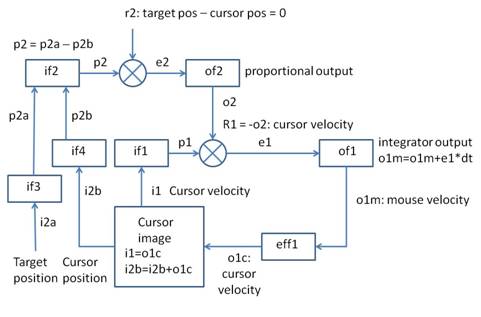
In tracking, we have a cursor that the person can affect with a mouse,
and a target that moves independently of the mouse. Now the controlled
variable is the distance from the cursor to the mouse. We can again
represent this distance as if it were really in the environment, as a
little circle, and show the cursor position as one variable affecting the
distance and the target position as a second variable affecting the
distance. If the target moves upward and is below the cursor, the
distance is decreased, while if the cursor moves upward the distance is
increased. So to compute the distance we say
distance = CursorPosition - TargetPosition
where positive positions are measured in the upward direction from the
origin of the coordinate system. Note that the target position is
formally a “disturbance” because it varies independently of the
action of the control system.
But there is no actual single variable in the environment called a
“distance.” In this case we might say that the input function
receives two variables, one representing the target position and the
other the cursor position. The signal representing one is subtracted from
the signal representing the other to produce a perceptual signal we call
“perceived distance.” Now there is no little circle in the
environment – the subtraction happens inside the input function. That’s
the kind of situation I am representing when I draw multiple input arrows
going into the input function.
Mathematically, it makes no difference whether we show two effects
converging on a little circle in the environment where the effects add
algebraically, or show the two effects entering an input function where
we assume the sensory representations are added in the same way. The
perceptual signal’s magnitude would turn out to be equal to the
algebraic sum of the effects (the sum including the sign of the
variables) in either case.
An “overwhelming” disturbance is simply one that has such a
large magnitude that the control system is physically incapable of
producing the same amount of effect in the opposite direction. In that
special case the control system will generate the maximum output it can
produce, but if the disturbance (and the error) gets even larger, the
control system can’t produce more opposing output. In that case, control
is lost; variations in the disturbance can no longer be met by equal and
opposite variations in the system’s output action until the disturbance
decreases enough. You might then say that the disturbance is
“blocking” or “severing” or “compromising”
control.
GR: So even if
the output variables are affecting the environment the disturbances from
the environment must still connect to the controlled variable. Otherwise
the control systems integrity is compromised. (Ie its not a control
system anymore).
We need to build a model to test these diagrams?
I have tested many models of this kind. In LCS3, Demo 6-1,
“LiveThree”, illustrates it for three control systems, each
affecting and sensing the same three environmental variables which are
also affected by three disturbances. Despite the disturbances and the
strong interactions among the perceptual effects, each control system can
make its own perception closely match any arbitrary reference value while
the other two systems do the same thing with different or the same
reference values.
I have another demo in which up to 500 control systems work the same way:
each system senses a different weighted sum of all 500 environmental
variables, and acts by affecting all 500 variables through another set of
output weighting factors, while maintaining independent control of its
perceptual signal without creating conflict with the other 499
systems.
When you play with demo 6-1 you will see how this works in a simpler
setting. It looks quite impossible, quite magical, but it’s neither. All
that’s required is that the matrix of input weights over all the systems
be the transpose of the matrix of output weights. The transpose of a
matrix is the same matrix with rows and columns interchanged. Richard
Kennaway has shown that this is indeed a sufficient condition for
allowing independent control. I came across it by accident but Richard
actually understands it.
I have also shown that reorganization of the output weights will result
in the same condition of independence given any random selection of
weights in the input function as long as the input matrix is not
singular. I haven’t yet shown that this makes the output matrix the
transpose of the input matrix, but some day we’ll get around to
that.
I hope this is making the meaning of my diagrams clearer, or at least
gives you the sense that there is some fairly well-developed
justification for them. I admit that they’re somewhat ambiguous until
explained in some detail. The problems you see simply show that you’re
trying to understand in some detail, too.
Best,
Bill P.