Multivariate local memory

[From Rupert Young (2015.04.19 17.00)]

In a basic control system its reference goal varies according to the value defined from above, so the same system services multivariate goals. With the addition of local memory (of perceptual signal which can be used later as a reference) what is actually being recorded? Is it a single value of past perception? In which case how can this system be used for anything other than that perceptual value, when memory is employed?

For example, suppose you are looking for different stars in the night sky. You remember their respective locations (bearing), with respect to some initial point. You are able to change your gaze to fixate on each one in turn, from betelgeuse, to polaris, to sirius etc. Maybe there are a couple of levels, at least, here, one for the stars and one for the gaze direction. How is this mulltivariate knowledge incorporated within the PCT memory model? Does the star control system "encode" memory of all stars? Or is there a different control system for each star? If the direction control system memorises a single bearing perception how can it control to a different direction, when based on memory? Does the direction system need memory?

A few queries which don't seem to be answered by the model, as I understand it. Any thoughts?

Regards,
Rupert

[Martin Taylor 2015.04.19.13.25]

[From Rupert Young (2015.04.19 17.00)]

In a basic control system its reference goal varies according to the value defined from above, so the same system services multivariate goals. With the addition of local memory (of perceptual signal which can be used later as a reference) what is actually being recorded? Is it a single value of past perception? In which case how can this system be used for anything other than that perceptual value, when memory is employed?

For example, suppose you are looking for different stars in the night sky. You remember their respective locations (bearing), with respect to some initial point. You are able to change your gaze to fixate on each one in turn, from betelgeuse, to polaris, to sirius etc. Maybe there are a couple of levels, at least, here, one for the stars and one for the gaze direction. How is this mulltivariate knowledge incorporated within the PCT memory model? Does the star control system "encode" memory of all stars? Or is there a different control system for each star? If the direction control system memorises a single bearing perception how can it control to a different direction, when based on memory? Does the direction system need memory?

A few queries which don't seem to be answered by the model, as I understand it. Any thoughts?

Look at B:CP Figure 15.3.

The figure is incomplete, in that it shows only one output from a higher level as influnecing the unit's reference input, and that one output is proposed to act as an address into memory. However, the basic structure of the hierarchy is that each reference input is influenced by the outputs of several higher-level control units. The address that evokes the memory to create the reference value cannot be the value of any one higher-level output, but must be a vector of many. In other words, it as shown in the figure, but only in the context of all the others higher-level outputs. It's a situation-specific memory.

Context is all-important even if the reference input is taken to be the simple sum of all the contributing higher-level outputs rather than an ordered set of values.

I know this isn't a full answer to your question, but does it lead your thoughts in the direction of a possible answer?

Martin

···

On 2015/04/19 10:48 AM, Rupert Young (rupert@perceptualrobots.com via csgnet Mailing List) wrote:

[From Rupert Young (2015.04.19 22.00)]

(Martin Taylor 2015.04.19.13.25]

Look at B:CP Figure 15.3.

The figure is incomplete, in that it shows only one output from a higher level as influnecing the unit's reference input, and that one output is proposed to act as an address into memory. However, the basic structure of the hierarchy is that each reference input is influenced by the outputs of several higher-level control units. The address that evokes the memory to create the reference value cannot be the value of any one higher-level output, but must be a vector of many. In other words, it as shown in the figure, but only in the context of all the others higher-level outputs. It's a situation-specific memory.

Context is all-important even if the reference input is taken to be the simple sum of all the contributing higher-level outputs rather than an ordered set of values.

I know this isn't a full answer to your question, but does it lead your thoughts in the direction of a possible answer?

Not really, I am not sure what you are saying. Do you mean that the local memory is a collection of different values, and a specific value is retrieved by the vector address? So, in the example the address might be "polaris" which gives a memory value of 33 W, say? So, that would mean that this local memory storage stores each perceived bearing value corresponding to each star position?

Regards,
R

[Martin Taylor 2015.04.20.11.13]

Yes, that's what Bill was saying when he talked about addressable

associative memory. Depending on the address, different memory
values are called up.
You have to ask what perceptions are controlled at the higher level
(that’s what the TCV is for) and see how they contribute to the
reference value for the perception you are interested in. But in
this example, it sounds more as though you are asking for a
perceptual input rather than a reference output. I know that the
distinction is rather murky when we are dealing with imagination
loops that produce imagined perceptions as a consequence of output
addressed access to memory, but the way I look at it this morning
(perhaps not yesterday or tomorrow) is that you have heard someone
say “polaris” and you have passively perceived “33W” with control
not yet involved. That’s what I would call a “labelling”
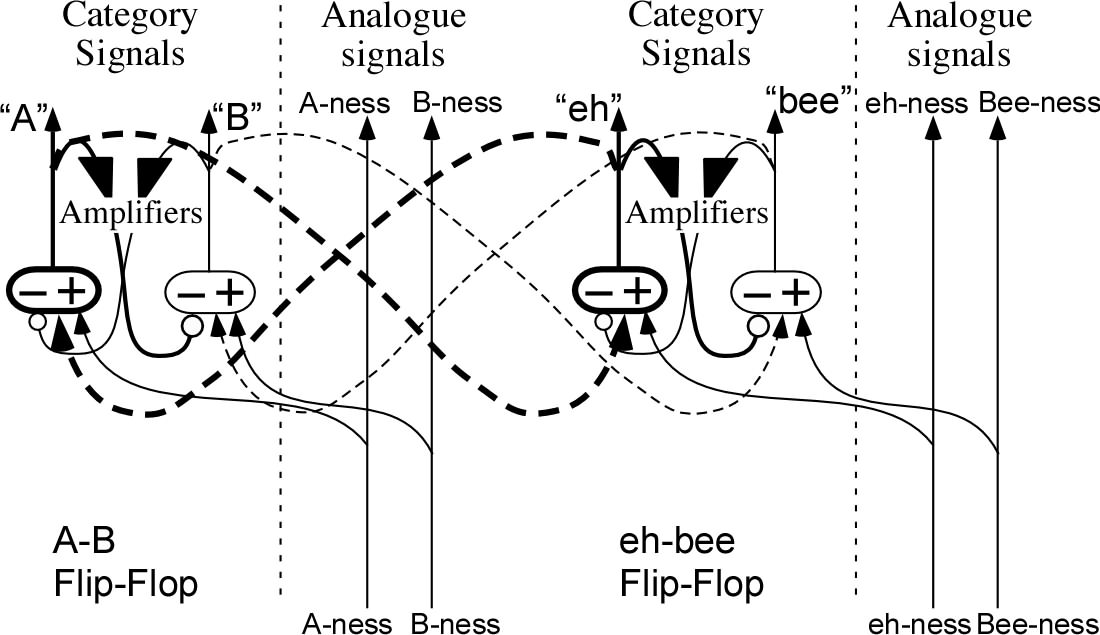
relationship. Here’s a very simplified sketch of the kind of circuit that would do
that. It’s not strictly hierarchic, and is therefore a departure
from Powers’s HPCT, but it would perform the function and the
results are controllable perceptions. This one associates linguistic
labels "eh’ and “bee” with visual forms “A” and “B”. If “eh” is
heard, it is likely that “A” will be imagined, and vice-versa.:
A “flip-flop” is a circuit that tends to hold its outputs in
opposite “Yes-No” states because of positive feedback with limits on
the outputs of the “Amplifiers” as the continuously variable input
changes, until the input change gets large enough to overcome the
positive feedback, and the flip-flop flips to the opposite state.
You can make what I call “polyflop” circuits in which there is one
“Yes” state and several “No” in a group. Long ago, we used such
polyflops to control some psychoacoustic experiments. The same kind
of circuit could work on the output side as well. If you want to
perceive an “A” you might get it by emitting an output “eh” to the
person you are talking to.
If you can recall “33W” when you hear “Polaris”, you must have that
specific relationship or association stored somewhere. You aren’t
remembering them separately, but each as a consequence of the other.
So what you suggest must be right.
Suggestions, not assertions. And I don’t know whether they are in
the direction of an answer to your original question.
Martin

···

On 2015/04/19 3:57 PM, Rupert Young
( via csgnet Mailing List) wrote:

rupert@perceptualrobots.com

  [From Rupert Young (2015.04.19 22.00)]


  (Martin Taylor 2015.04.19.13.25]
    Look at B:CP Figure 15.3.


    The figure is incomplete, in that it shows only one output from

a higher level as influnecing the unit’s reference input, and
that one output is proposed to act as an address into memory.
However, the basic structure of the hierarchy is that each
reference input is influenced by the outputs of several
higher-level control units. The address that evokes the memory
to create the reference value cannot be the value of any one
higher-level output, but must be a vector of many. In other
words, it as shown in the figure, but only in the context of all
the others higher-level outputs. It’s a situation-specific
memory.

    Context is all-important even if the reference input is taken to

be the simple sum of all the contributing higher-level outputs
rather than an ordered set of values.

    I know this isn't a full answer to your question, but does it

lead your thoughts in the direction of a possible answer?

  Not really, I am not sure what you are saying. Do you mean that

the local memory is a collection of different values, and a
specific value is retrieved by the vector address?

  So, in the example the address might be "polaris"

which gives a memory value of 33 W, say?

  So, that would mean that this local memory storage

stores each perceived bearing value corresponding to each star
position?

[From Rupert Young (2015.04.24 21.00)]

(Martin Taylor 2015.04.20.11.13]
  Yes, that's what Bill was saying when he talked about addressable

associative memory. Depending on the address, different memory
values are called up.

Well, I am wondering how this is implemented in neural systems. If

the memory node (which is local to a control system) receives a
vector how is that converted into a specific single memory value?
What sort of structure would the memory node be? Sounds like it may
need to be network in itself (maybe like a hopfield-type network, )
rather than an array on independent nodes which each encode the
individual memories. I would have thought you would have a goal (reference) to perceive
“polaris”, and somehow this evokes the memory of “33 W” which is
then used as a gaze reference. So how do you get from polaris to the
33W bearing? And how does the bearing control system memory record
all the other bearings, required for different stars?
Ok, looks interesting, do you have a working model? I’d need to work
through it to get to grips with it I think.
Moving in the right direction, I think, though the waters be murky!
Regards,
Rupert

···

On 2015/04/19 3:57 PM, Rupert Young (
via csgnet Mailing List) wrote:

rupert@perceptualrobots.com

[From Rupert Young (2015.04.19 22.00)]

    (Martin Taylor 2015.04.19.13.25]
      Look at B:CP Figure 15.3.


      The figure is incomplete, in that it shows only one output

from a higher level as influnecing the unit’s reference input,
and that one output is proposed to act as an address into
memory. However, the basic structure of the hierarchy is that
each reference input is influenced by the outputs of several
higher-level control units. The address that evokes the memory
to create the reference value cannot be the value of any one
higher-level output, but must be a vector of many. In other
words, it as shown in the figure, but only in the context of
all the others higher-level outputs. It’s a situation-specific
memory.

      Context is all-important even if the reference input is taken

to be the simple sum of all the contributing higher-level
outputs rather than an ordered set of values.

      I know this isn't a full answer to your question, but does it

lead your thoughts in the direction of a possible answer?

    Not really, I am not sure what you are saying. Do you mean that

the local memory is a collection of different values, and a
specific value is retrieved by the vector address?

http://en.wikipedia.org/wiki/Hopfield_network
    So, in the example the address might be "polaris"

which gives a memory value of 33 W, say?

  You have to ask what perceptions are controlled at the higher

level (that’s what the TCV is for) and see how they contribute to
the reference value for the perception you are interested in. But
in this example, it sounds more as though you are asking for a
perceptual input rather than a reference output. I know that the
distinction is rather murky when we are dealing with imagination
loops that produce imagined perceptions as a consequence of output
addressed access to memory, but the way I look at it this morning
(perhaps not yesterday or tomorrow) is that you have heard someone
say “polaris” and you have passively perceived “33W” with control
not yet involved. That’s what I would call a “labelling”
relationship.

  Here's a very simplified sketch of the kind of circuit that would

do that. It’s not strictly hierarchic, and is therefore a
departure from Powers’s HPCT, but it would perform the function
and the results are controllable perceptions. This one associates
linguistic labels "eh’ and “bee” with visual forms “A” and “B”. If
“eh” is heard, it is likely that “A” will be imagined, and
vice-versa.:

  A "flip-flop" is a circuit that tends to hold its outputs in

opposite “Yes-No” states because of positive feedback with limits
on the outputs of the “Amplifiers” as the continuously variable
input changes, until the input change gets large enough to
overcome the positive feedback, and the flip-flop flips to the
opposite state. You can make what I call “polyflop” circuits in
which there is one “Yes” state and several “No” in a group. Long
ago, we used such polyflops to control some psychoacoustic
experiments. The same kind of circuit could work on the output
side as well. If you want to perceive an “A” you might get it by
emitting an output “eh” to the person you are talking to.

  Suggestions, not assertions. And I don't know whether they are in

the direction of an answer to your original question.

Hi Rupert, if we are actually talking about stars here, I doubt any of that ‘bearing 33w, etc’ stuff happens at all in normal human memory, surely? Bearings are human inventions rather than parts of the neural system. Surely the most basic way people remember star locations is through matching them with familiar shapes, as in the constellations of Orion, Libra, etc. This adds another level of complexity however of how metaphorical memory perceptions, in this case at the configuration level, are used.
Does this take the discussion any further?

Warren

···

On 2015/04/19 3:57 PM, Rupert Young (
via csgnet Mailing List) wrote:

rupert@perceptualrobots.com

[From Rupert Young (2015.04.19 22.00)]

    (Martin Taylor 2015.04.19.13.25]
      Look at B:CP Figure 15.3.


      The figure is incomplete, in that it shows only one output

from a higher level as influnecing the unit’s reference input,
and that one output is proposed to act as an address into
memory. However, the basic structure of the hierarchy is that
each reference input is influenced by the outputs of several
higher-level control units. The address that evokes the memory
to create the reference value cannot be the value of any one
higher-level output, but must be a vector of many. In other
words, it as shown in the figure, but only in the context of
all the others higher-level outputs. It’s a situation-specific
memory.

      Context is all-important even if the reference input is taken

to be the simple sum of all the contributing higher-level
outputs rather than an ordered set of values.

      I know this isn't a full answer to your question, but does it

lead your thoughts in the direction of a possible answer?

    Not really, I am not sure what you are saying. Do you mean that

the local memory is a collection of different values, and a
specific value is retrieved by the vector address?

http://en.wikipedia.org/wiki/Hopfield_network

    So, in the example the address might be "polaris"

which gives a memory value of 33 W, say?

  You have to ask what perceptions are controlled at the higher

level (that’s what the TCV is for) and see how they contribute to
the reference value for the perception you are interested in. But
in this example, it sounds more as though you are asking for a
perceptual input rather than a reference output. I know that the
distinction is rather murky when we are dealing with imagination
loops that produce imagined perceptions as a consequence of output
addressed access to memory, but the way I look at it this morning
(perhaps not yesterday or tomorrow) is that you have heard someone
say “polaris” and you have passively perceived “33W” with control
not yet involved. That’s what I would call a “labelling”
relationship.

  Here's a very simplified sketch of the kind of circuit that would

do that. It’s not strictly hierarchic, and is therefore a
departure from Powers’s HPCT, but it would perform the function
and the results are controllable perceptions. This one associates
linguistic labels "eh’ and “bee” with visual forms “A” and “B”. If
“eh” is heard, it is likely that “A” will be imagined, and
vice-versa.:

  <mime-attachment.jpg>


  A "flip-flop" is a circuit that tends to hold its outputs in

opposite “Yes-No” states because of positive feedback with limits
on the outputs of the “Amplifiers” as the continuously variable
input changes, until the input change gets large enough to
overcome the positive feedback, and the flip-flop flips to the
opposite state. You can make what I call “polyflop” circuits in
which there is one “Yes” state and several “No” in a group. Long
ago, we used such polyflops to control some psychoacoustic
experiments. The same kind of circuit could work on the output
side as well. If you want to perceive an “A” you might get it by
emitting an output “eh” to the person you are talking to.

  Suggestions, not assertions. And I don't know whether they are in

the direction of an answer to your original question.

Sure, we may remember relative locations such as ‘Second star to the right and straight on till morning’. But for the purposes of our discussion it is easier to say 33w. Rupert

···

On 2015/04/19 3:57 PM, Rupert Young (
via csgnet Mailing List) wrote:

rupert@perceptualrobots.com

[From Rupert Young (2015.04.19 22.00)]

    (Martin Taylor 2015.04.19.13.25]
      Look at B:CP Figure 15.3.


      The figure is incomplete, in that it shows only one output

from a higher level as influnecing the unit’s reference input,
and that one output is proposed to act as an address into
memory. However, the basic structure of the hierarchy is that
each reference input is influenced by the outputs of several
higher-level control units. The address that evokes the memory
to create the reference value cannot be the value of any one
higher-level output, but must be a vector of many. In other
words, it as shown in the figure, but only in the context of
all the others higher-level outputs. It’s a situation-specific
memory.

      Context is all-important even if the reference input is taken

to be the simple sum of all the contributing higher-level
outputs rather than an ordered set of values.

      I know this isn't a full answer to your question, but does it

lead your thoughts in the direction of a possible answer?

    Not really, I am not sure what you are saying. Do you mean that

the local memory is a collection of different values, and a
specific value is retrieved by the vector address?

http://en.wikipedia.org/wiki/Hopfield_network

    So, in the example the address might be "polaris"

which gives a memory value of 33 W, say?

  You have to ask what perceptions are controlled at the higher

level (that’s what the TCV is for) and see how they contribute to
the reference value for the perception you are interested in. But
in this example, it sounds more as though you are asking for a
perceptual input rather than a reference output. I know that the
distinction is rather murky when we are dealing with imagination
loops that produce imagined perceptions as a consequence of output
addressed access to memory, but the way I look at it this morning
(perhaps not yesterday or tomorrow) is that you have heard someone
say “polaris” and you have passively perceived “33W” with control
not yet involved. That’s what I would call a “labelling”
relationship.

  Here's a very simplified sketch of the kind of circuit that would

do that. It’s not strictly hierarchic, and is therefore a
departure from Powers’s HPCT, but it would perform the function
and the results are controllable perceptions. This one associates
linguistic labels "eh’ and “bee” with visual forms “A” and “B”. If
“eh” is heard, it is likely that “A” will be imagined, and
vice-versa.:

  <mime-attachment.jpg>


  A "flip-flop" is a circuit that tends to hold its outputs in

opposite “Yes-No” states because of positive feedback with limits
on the outputs of the “Amplifiers” as the continuously variable
input changes, until the input change gets large enough to
overcome the positive feedback, and the flip-flop flips to the
opposite state. You can make what I call “polyflop” circuits in
which there is one “Yes” state and several “No” in a group. Long
ago, we used such polyflops to control some psychoacoustic
experiments. The same kind of circuit could work on the output
side as well. If you want to perceive an “A” you might get it by
emitting an output “eh” to the person you are talking to.

  Suggestions, not assertions. And I don't know whether they are in

the direction of an answer to your original question.

Hi Rupert, I think it is a really important discussion, but the use of star locations just seems too esoteric are far removed from my everyday life to get a handle on it! Now the locations of my local pubs is a different thing!

Sorry?

Warren

···

On 2015/04/19 3:57 PM, Rupert Young (
via csgnet Mailing List) wrote:

rupert@perceptualrobots.com

[From Rupert Young (2015.04.19 22.00)]

    (Martin Taylor 2015.04.19.13.25]
      Look at B:CP Figure 15.3.


      The figure is incomplete, in that it shows only one output

from a higher level as influnecing the unit’s reference input,
and that one output is proposed to act as an address into
memory. However, the basic structure of the hierarchy is that
each reference input is influenced by the outputs of several
higher-level control units. The address that evokes the memory
to create the reference value cannot be the value of any one
higher-level output, but must be a vector of many. In other
words, it as shown in the figure, but only in the context of
all the others higher-level outputs. It’s a situation-specific
memory.

      Context is all-important even if the reference input is taken

to be the simple sum of all the contributing higher-level
outputs rather than an ordered set of values.

      I know this isn't a full answer to your question, but does it

lead your thoughts in the direction of a possible answer?

    Not really, I am not sure what you are saying. Do you mean that

the local memory is a collection of different values, and a
specific value is retrieved by the vector address?

http://en.wikipedia.org/wiki/Hopfield_network

    So, in the example the address might be "polaris"

which gives a memory value of 33 W, say?

  You have to ask what perceptions are controlled at the higher

level (that’s what the TCV is for) and see how they contribute to
the reference value for the perception you are interested in. But
in this example, it sounds more as though you are asking for a
perceptual input rather than a reference output. I know that the
distinction is rather murky when we are dealing with imagination
loops that produce imagined perceptions as a consequence of output
addressed access to memory, but the way I look at it this morning
(perhaps not yesterday or tomorrow) is that you have heard someone
say “polaris” and you have passively perceived “33W” with control
not yet involved. That’s what I would call a “labelling”
relationship.

  Here's a very simplified sketch of the kind of circuit that would

do that. It’s not strictly hierarchic, and is therefore a
departure from Powers’s HPCT, but it would perform the function
and the results are controllable perceptions. This one associates
linguistic labels "eh’ and “bee” with visual forms “A” and “B”. If
“eh” is heard, it is likely that “A” will be imagined, and
vice-versa.:

  <mime-attachment.jpg>


  A "flip-flop" is a circuit that tends to hold its outputs in

opposite “Yes-No” states because of positive feedback with limits
on the outputs of the “Amplifiers” as the continuously variable
input changes, until the input change gets large enough to
overcome the positive feedback, and the flip-flop flips to the
opposite state. You can make what I call “polyflop” circuits in
which there is one “Yes” state and several “No” in a group. Long
ago, we used such polyflops to control some psychoacoustic
experiments. The same kind of circuit could work on the output
side as well. If you want to perceive an “A” you might get it by
emitting an output “eh” to the person you are talking to.

  Suggestions, not assertions. And I don't know whether they are in

the direction of an answer to your original question.

My local is called “The Star Inn” so I’m not sure there is a
difference!

···

**Regards,
Rupert
**

    On 25/04/2015 13:11, Warren Mansell (

via csgnet Mailing List) wrote:

wmansell@gmail.com

    Hi Rupert, I think it is a really important discussion, but

the use of star locations just seems too esoteric are far
removed from my everyday life to get a handle on it! Now the
locations of my local pubs is a different thing!

Sorry?

Warren

    On 25 Apr 2015, at 09:27, rupert@perceptualrobots.com
    wrote:
      Sure, we may remember relative locations such as 'Second star

to the right and straight on till morning’. But for the
purposes of our discussion it is easier to say 33w. Rupert

        On 25 April 2015 07:43:52 CEST,

Warren Mansell <csgnet@lists.illinois.edu >
wrote:

            Hi Rupert, if we are actually talking about stars

here, I doubt any of that ‘bearing 33w, etc’ stuff
happens at all in normal human memory, surely? Bearings
are human inventions rather than parts of the neural
system. Surely the most basic way people remember star
locations is through matching them with familiar shapes,
as in the constellations of Orion, Libra, etc. This adds
another level of complexity however of how metaphorical
memory perceptions, in this case at the configuration
level, are used.

            Does this take the discussion any further?

Warren

            On 24 Apr 2015, at 20:04, Rupert Young (rupert@perceptualrobots.com
            via csgnet Mailing List) <csgnet@lists.illinois.edu                >

wrote:

[From Rupert Young (2015.04.24 21.00)]

              (Martin Taylor 2015.04.20.11.13]
                Yes, that's what Bill was saying when he talked

about addressable associative memory. Depending on
the address, different memory values are called up.

              Well, I am wondering how this is implemented in neural

systems. If the memory node (which is local to a
control system) receives a vector how is that
converted into a specific single memory value? What
sort of structure would the memory node be? Sounds
like it may need to be network in itself (maybe like a
hopfield-type network, )
rather than an array on independent nodes which each
encode the individual memories. I would have thought you would have a goal (reference)
to perceive “polaris”, and somehow this evokes the
memory of “33 W” which is then used as a gaze
reference. So how do you get from polaris to the 33W
bearing? And how does the bearing control system
memory record all the other bearings, required for
different stars?
Ok, looks interesting, do you have a working model?
I’d need to work through it to get to grips with it I
think.
Moving in the right direction, I think, though the
waters be murky!
Regards,
Rupert

      Regards,

      Dr Rupert Young

      [www.perceptualrobots.com](http://www.perceptualrobots.com)

      --

      Sent from my Android device with K-9 Mail. Please excuse my

brevity.

                  On 2015/04/19 3:57 PM,

Rupert Young (
via csgnet Mailing List) wrote:

rupert@perceptualrobots.com

                  [From Rupert Young (2015.04.19 22.00)]


                  (Martin Taylor 2015.04.19.13.25]
                    Look at B:CP Figure 15.3.


                    The figure is incomplete, in that it shows only

one output from a higher level as influnecing
the unit’s reference input, and that one output
is proposed to act as an address into memory.
However, the basic structure of the hierarchy is
that each reference input is influenced by the
outputs of several higher-level control units.
The address that evokes the memory to create the
reference value cannot be the value of any one
higher-level output, but must be a vector of
many. In other words, it as shown in the figure,
but only in the context of all the others
higher-level outputs. It’s a situation-specific
memory.

                    Context is all-important even if the reference

input is taken to be the simple sum of all the
contributing higher-level outputs rather than an
ordered set of values.

                    I know this isn't a full answer to your

question, but does it lead your thoughts in the
direction of a possible answer?

                  Not really, I am not sure what you are saying. Do

you mean that the local memory is a collection of
different values, and a specific value is
retrieved by the vector address?

http://en.wikipedia.org/wiki/Hopfield_network

                  So, in the example the address might

be “polaris” which gives a memory value of 33 W,
say?

                You have to ask what perceptions are controlled at

the higher level (that’s what the TCV is for) and
see how they contribute to the reference value for
the perception you are interested in. But in this
example, it sounds more as though you are asking for
a perceptual input rather than a reference output. I
know that the distinction is rather murky when we
are dealing with imagination loops that produce
imagined perceptions as a consequence of output
addressed access to memory, but the way I look at it
this morning (perhaps not yesterday or tomorrow) is
that you have heard someone say “polaris” and you
have passively perceived “33W” with control not yet
involved. That’s what I would call a “labelling”
relationship.

                Here's a very simplified sketch of the

kind of circuit that would do that. It’s not
strictly hierarchic, and is therefore a departure
from Powers’s HPCT, but it would perform the
function and the results are controllable
perceptions. This one associates linguistic labels
"eh’ and “bee” with visual forms “A” and “B”. If
“eh” is heard, it is likely that “A” will be
imagined, and vice-versa.:

                <mime-attachment.jpg>


                A "flip-flop" is a circuit that tends to hold its

outputs in opposite “Yes-No” states because of
positive feedback with limits on the outputs of the
“Amplifiers” as the continuously variable input
changes, until the input change gets large enough to
overcome the positive feedback, and the flip-flop
flips to the opposite state. You can make what I
call “polyflop” circuits in which there is one “Yes”
state and several “No” in a group. Long ago, we used
such polyflops to control some psychoacoustic
experiments. The same kind of circuit could work on
the output side as well. If you want to perceive an
“A” you might get it by emitting an output “eh” to
the person you are talking to.

                Suggestions, not assertions. And I

don’t know whether they are in the direction of an
answer to your original question.

Touché!

···

**Regards,
Rupert
**

    On 25/04/2015 13:11, Warren Mansell (

via csgnet Mailing List) wrote:

wmansell@gmail.com

    Hi Rupert, I think it is a really important discussion, but

the use of star locations just seems too esoteric are far
removed from my everyday life to get a handle on it! Now the
locations of my local pubs is a different thing!

Sorry?

Warren

    On 25 Apr 2015, at 09:27, rupert@perceptualrobots.com
    wrote:
      Sure, we may remember relative locations such as 'Second star

to the right and straight on till morning’. But for the
purposes of our discussion it is easier to say 33w. Rupert

        On 25 April 2015 07:43:52 CEST,

Warren Mansell <csgnet@lists.illinois.edu >
wrote:

            Hi Rupert, if we are actually talking about stars

here, I doubt any of that ‘bearing 33w, etc’ stuff
happens at all in normal human memory, surely? Bearings
are human inventions rather than parts of the neural
system. Surely the most basic way people remember star
locations is through matching them with familiar shapes,
as in the constellations of Orion, Libra, etc. This adds
another level of complexity however of how metaphorical
memory perceptions, in this case at the configuration
level, are used.

            Does this take the discussion any further?

Warren

            On 24 Apr 2015, at 20:04, Rupert Young (rupert@perceptualrobots.com
            via csgnet Mailing List) <csgnet@lists.illinois.edu                >

wrote:

[From Rupert Young (2015.04.24 21.00)]

              (Martin Taylor 2015.04.20.11.13]
                Yes, that's what Bill was saying when he talked

about addressable associative memory. Depending on
the address, different memory values are called up.

              Well, I am wondering how this is implemented in neural

systems. If the memory node (which is local to a
control system) receives a vector how is that
converted into a specific single memory value? What
sort of structure would the memory node be? Sounds
like it may need to be network in itself (maybe like a
hopfield-type network, )
rather than an array on independent nodes which each
encode the individual memories. I would have thought you would have a goal (reference)
to perceive “polaris”, and somehow this evokes the
memory of “33 W” which is then used as a gaze
reference. So how do you get from polaris to the 33W
bearing? And how does the bearing control system
memory record all the other bearings, required for
different stars?
Ok, looks interesting, do you have a working model?
I’d need to work through it to get to grips with it I
think.
Moving in the right direction, I think, though the
waters be murky!
Regards,
Rupert

      Regards,

      Dr Rupert Young

      [www.perceptualrobots.com](http://www.perceptualrobots.com)

      --

      Sent from my Android device with K-9 Mail. Please excuse my

brevity.

                  On 2015/04/19 3:57 PM,

Rupert Young (
via csgnet Mailing List) wrote:

rupert@perceptualrobots.com

                  [From Rupert Young (2015.04.19 22.00)]


                  (Martin Taylor 2015.04.19.13.25]
                    Look at B:CP Figure 15.3.


                    The figure is incomplete, in that it shows only

one output from a higher level as influnecing
the unit’s reference input, and that one output
is proposed to act as an address into memory.
However, the basic structure of the hierarchy is
that each reference input is influenced by the
outputs of several higher-level control units.
The address that evokes the memory to create the
reference value cannot be the value of any one
higher-level output, but must be a vector of
many. In other words, it as shown in the figure,
but only in the context of all the others
higher-level outputs. It’s a situation-specific
memory.

                    Context is all-important even if the reference

input is taken to be the simple sum of all the
contributing higher-level outputs rather than an
ordered set of values.

                    I know this isn't a full answer to your

question, but does it lead your thoughts in the
direction of a possible answer?

                  Not really, I am not sure what you are saying. Do

you mean that the local memory is a collection of
different values, and a specific value is
retrieved by the vector address?

http://en.wikipedia.org/wiki/Hopfield_network

                  So, in the example the address might

be “polaris” which gives a memory value of 33 W,
say?

                You have to ask what perceptions are controlled at

the higher level (that’s what the TCV is for) and
see how they contribute to the reference value for
the perception you are interested in. But in this
example, it sounds more as though you are asking for
a perceptual input rather than a reference output. I
know that the distinction is rather murky when we
are dealing with imagination loops that produce
imagined perceptions as a consequence of output
addressed access to memory, but the way I look at it
this morning (perhaps not yesterday or tomorrow) is
that you have heard someone say “polaris” and you
have passively perceived “33W” with control not yet
involved. That’s what I would call a “labelling”
relationship.

                Here's a very simplified sketch of the

kind of circuit that would do that. It’s not
strictly hierarchic, and is therefore a departure
from Powers’s HPCT, but it would perform the
function and the results are controllable
perceptions. This one associates linguistic labels
"eh’ and “bee” with visual forms “A” and “B”. If
“eh” is heard, it is likely that “A” will be
imagined, and vice-versa.:

                <mime-attachment.jpg>


                A "flip-flop" is a circuit that tends to hold its

outputs in opposite “Yes-No” states because of
positive feedback with limits on the outputs of the
“Amplifiers” as the continuously variable input
changes, until the input change gets large enough to
overcome the positive feedback, and the flip-flop
flips to the opposite state. You can make what I
call “polyflop” circuits in which there is one “Yes”
state and several “No” in a group. Long ago, we used
such polyflops to control some psychoacoustic
experiments. The same kind of circuit could work on
the output side as well. If you want to perceive an
“A” you might get it by emitting an output “eh” to
the person you are talking to.

                Suggestions, not assertions. And I

don’t know whether they are in the direction of an
answer to your original question.

[Martin Taylor 2015.04.27.09.52]

I don't know how it would be done in a neural system, and a computer

analogy can be misleading. But, without taking it too seriously as a
model, think of getting a value from memory in a computer. A vector
of ones and zeros is provided to the hardware, and a value pops out.
It’s such a standard operation that we just say that the value is
stored at such-and-such an address. I presume that hardware networks
are involved in extracting that value. But let’s look at it in
another way. There are lots of people in the world, and lots of
street addresses. We know only a tiny fraction of them, but they
exist.
We say that Mr. Jones lives at (vector) 234 Elgin Street, Mudville,
Yorkshire, UK. In this case, the vector is a successive refinement
of individually wide-ranging sets. In fact it’s a kind of matrix,
because you could say that “UK” refines “Elgin Street” of which
there are several scattered around the world, and there are lots of
addresses that are number “234” on their street. Where Mr Jones
lives is at the intersection of all these definitions. We can say
this because we know Mr Jones and have visited his house. We can use
“Mr. Jones” as an entry to a bunch of separate outputs for the
entire vector of the address, and we can use the address to provide
an output “Mr Jones” (and perhaps a few more of the family or other
residents).
Now think of it in a different way Mr. Jones may or may not be the
only person in the world who is about 187cm tall, weighs 152 kg, was
born April 1, 1983, has a scar on his middle finger right-hand, …
That also is a vector address for Mr Jones, and if someone had a
person with them and asked over the phone “Is this Mr Jones”, you
could say probably Yes or certainly No, based on this vector. But it
would be hard to use the vector to find Mr Jones in a crowd.
Come at this from a different direction, and think not of Mr Jones
and where he lives, but what would come out if one or more of these
intersecting activation elements changed value, say from “Elgin
Street” to “Lilac Avenue”, or from “April 1” to “June 22”. Would
anything come out? Would the new vectors bring up a different house
or person? Maybe, maybe not. If not, at least there would be some
activation from the other vector elements, and perhaps a bunch of
different memory units would have some low-level output.
So yes, networks must be involved, and entries that consisted of one
or a few elements of a vector would be expected to produce vectors
of several weak outputs, whereas entry vectors with many elements
would be expected to produce one or a few strong outputs.
It depends on the circumstances. If you want to see polaris in the
sky, then the associative memory is in the reference functions. I
was talking about it as being in the perceptual input, where you
have experienced “polaris” and “33W” together often enough (which
may be just once) that when you perceive one, the other is evoked. No working or simulated model of this, but we did use triflops (only
one of three outputs at a time is high) in hardware to run a series
of psychoacoustic experiments in the 1960s.
Do work though it, and notice that if the cross-link gains are low
you get enhanced outputs but no single one on each side of the
“labelling divide” is exclusively set high, whereas if the
cross-link gains are high, you get the flip-flop action on both
sides, and if they are very high you get rigidity and insensitivity
to contrary data. Also, note that if there are many elements on each
side (A, B, C, D, … and eh, bee, cee, dee, …) then a lot of
low-gain connections have the same effect (almost) as one high-gain
connection, which leads to what I said above: “entries that
consisted of one or a few elements of a vector would be expected to
produce vectors of several weak outputs, whereas entry vectors with
many elements would be expected to produce one or a few strong
outputs”, where “entries” in the diagram are the analogue inputs
from below and/or the values from the other side of the labelling
pair.
Again, only suggestions of possibilities. Could be on the wrong
track entirely, though to me, they just feel right, and should work.
A simulation might not be out of order to test that, but it’s not
one I will do very soon, as I am much involved in other things.
Martin

···

[From Rupert Young (2015.04.24 21.00)]

  (Martin Taylor 2015.04.20.11.13]
    Yes, that's what Bill was saying when he talked about

addressable associative memory. Depending on the address,
different memory values are called up.

  Well, I am wondering how this is implemented in neural systems. If

the memory node (which is local to a control system) receives a
vector how is that converted into a specific single memory value?
What sort of structure would the memory node be? Sounds like it
may need to be network in itself (maybe like a hopfield-type
network, )
rather than an array on independent nodes which each encode the
individual memories.

      So, in the example the address might be "polaris"

which gives a memory value of 33 W, say?

    You have to ask what perceptions are controlled at the higher

level (that’s what the TCV is for) and see how they contribute
to the reference value for the perception you are interested in.
But in this example, it sounds more as though you are asking for
a perceptual input rather than a reference output. I know that
the distinction is rather murky when we are dealing with
imagination loops that produce imagined perceptions as a
consequence of output addressed access to memory, but the way I
look at it this morning (perhaps not yesterday or tomorrow) is
that you have heard someone say “polaris” and you have passively
perceived “33W” with control not yet involved. That’s what I
would call a “labelling” relationship.

  I would have thought you would have a goal (reference) to perceive

“polaris”, and somehow this evokes the memory of “33 W” which is
then used as a gaze reference. So how do you get from polaris to
the 33W bearing? And how does the bearing control system memory
record all the other bearings, required for different stars?

    Here's a very simplified sketch of the kind of circuit that

would do that. It’s not strictly hierarchic, and is therefore a
departure from Powers’s HPCT, but it would perform the function
and the results are controllable perceptions. This one
associates linguistic labels "eh’ and “bee” with visual forms
“A” and “B”. If “eh” is heard, it is likely that “A” will be
imagined, and vice-versa.:

    A "flip-flop" is a circuit that tends to hold its outputs in

opposite “Yes-No” states because of positive feedback with
limits on the outputs of the “Amplifiers” as the continuously
variable input changes, until the input change gets large enough
to overcome the positive feedback, and the flip-flop flips to
the opposite state. You can make what I call “polyflop” circuits
in which there is one “Yes” state and several “No” in a group.
Long ago, we used such polyflops to control some psychoacoustic
experiments. The same kind of circuit could work on the output
side as well. If you want to perceive an “A” you might get it by
emitting an output “eh” to the person you are talking to.

  Ok, looks interesting, do you have a working model? I'd need to

work through it to get to grips with it I think.

    Suggestions, not assertions. And I don't know whether they are

in the direction of an answer to your original question.

  Moving in the right direction, I think, though the waters be

murky!

  Regards,

  Rupert
      On 2015/04/19 3:57 PM, Rupert Young

(
via csgnet Mailing List) wrote:

rupert@perceptualrobots.com

[From Rupert Young (2015.04.19 22.00)]

      ....

      Not really, I am not sure what you are saying. Do you mean

that the local memory is a collection of different values,
and a specific value is retrieved by the vector address?

http://en.wikipedia.org/wiki/Hopfield_network