In a message dated 8/15/2004 2:36:12 PM Eastern Daylight Time, mmt-csg@ROGERS.COM writes:
[Martin Taylor 2004.08.04.1658] (Written then, but apparently not sent)
[From Kenny Kitzke (2004.08.04.1250EDT)]
This is a good example of why I get so frustrated with Rick’s
analyses and claims to have discovered something
profound—something the experts in economics (whatever that means)
have missed.
Whether they missed it or not, Rick’s analysis showed that investment
(as defined by the databanks from which he took the numbers) does not
lead to growth (as defined by the databanks from which he took the
numbers). The data are clearly NOT compatible with that theory.
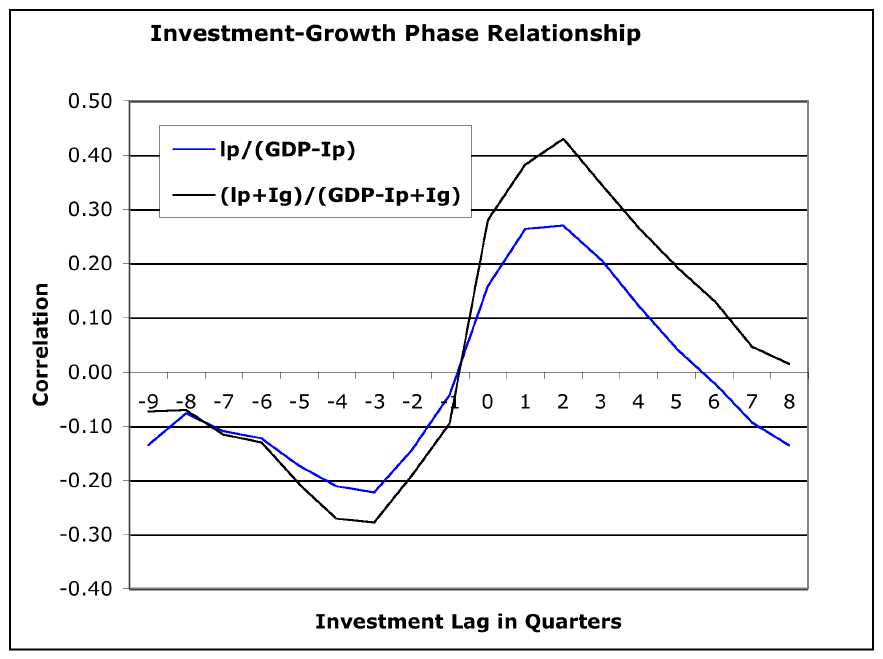
It is my understanding that the analysis done by Rick looked at the correlation of the published quarterly Gross Private Domestic Investment as a fraction of Gross Domestic Product with GDP.
If you think this analysis clearly refutes a general belief by many dedicated and capable economists that Investment leads to Growth, so be it.
Agree. And, for similar reasons, his analysis did not show that investment does not lead to growth—only that the data he analyzed was incompatible with that general belief.
You acknowledged my criticism of Rick comparing a variable I, which
is supposedly “Investment,” to GDP which includes I as a component
to look for a correlation between I and GDP.
<The criticism may well have been correct, but what could its effect
have been on the analysis? You could easily have determined that,
without ever looking at Rick’s actual lagged correlations.
The answer is that including I within the GDP numbers would increase
the zero-lag correlation. X correlates better with X + Y than with Y.
Whether including I in the GDP measure would increase the correlation
at other lags would depend on the autocorrelation function of I.
Presuming that the autocorrelation function of I remains positive for
more than one quarter, the graphed correlation would again be too
high (high-positive, that is). And if you compare Rick’s first graph
with his most recent, you find that is the case, though the
difference is almost trivial. Removing I from GDP increases the
NEGATIVITY of the leading correlation, enhancing his initial
conclusion.>
Of course, you are right. You know it and I knew it when I made my criticism. But, we are not doing the analyses or making the economic claims to have refuted common understandings in economics. Rick is.
Why would anyone wishing to do credible analyses make such a fundamental error in analysis. Why include in the analysis a red flag that any economist familiar with statistical methods would question? Isn’t it a matter of confidence in the analysis and the analyzer?
Have you noticed Bill Power’s acceptance of my criticism and his own admonishment of Rick to be more accurate and credible when stepping into fields of knowledge where he lacks credentials and making claims?
The correlation coefficient was already low with Rick’s initial inappropriate analysis. It was obvious it would get LOWER when corrected. All the more reason to question whether any claims of cause could be made at all. When the inappropriate analysis was corrected and made no significant difference, I see a justification that it did not affect the conclusion so was not important. Rick responded to my criticism, made the correction and showed his conclusion remained the same. I say balderdash. The original analyses was not trustworthy and the corrected analyses remained untrustworthy. The change I suggested was NOT the main criticism of his conclusion. It was just a clear error that detracts from the credibility of the analysis and the conclusion, which in my opinion was fundamentally errant. It reveals a lack of understanding of the variables being analyzed.
This is faulty analysis.
<It’s all very well to criticise faulty analysis, and in the long run
it is good to do so. But when you criticise the implications drawn
from a faulty analysis, it sometimes helps to see whether correcting
the fault would enhance the conclusion or refute it.>
As I have already explained, it was using admittedly low correlations (about 0.25) to speculate whether there is, or IS NOT, a causal relationship (negative or positive) that is suspect. A correlation cofficient of 0.5 is considered weak. Yet, we have Rick drawing conclusions as to relationships, or the lack thereof, with coefficients of closer to 0.25. If 0.5 is considered weak, what Martin would you call the result of r = 0.25? How about highly suspect?
Manipulating time frames in a lagged correlations that hardly increase the coefficient to try and determine which variable leads to (causes) the other to change seems like poor mathematics and poor analyses to me. I would be happy for you to convince me, and other control engineers and statisticians, otherwise. Since most dedicated economists are all wet according to Rick when it comes to analyzing economic data, perhaps all the statisticians are too?
Add to this stew the fact that the variable being plotted by Rick
for “I” is not what I suspect politicians or economists mean when
they claim that we should increase I to increase GDP.
<Rick claims only that he is using the figures supplied by the US
authorities, under the labels he uses. Quite probably those are not
what politicians mean, but presumably they are what at least some
Federally employed economists mean.
Whether Rick’s analysis contradicts any theoretical principles used
by mainstream economists is quite another issue. I’m arguing here
only that with the data at hand, Rick’s analysis is proper and there
are legitimate conclusions that can be drawn from it.>
I disagree and I gave you some things to reconsider. Ball is in your court (I’m a tennis player along with Robertson, Goldstein and Francisca-Winter’s delightful new wife). Please enlighten me.
And, this leaves out other issues raised by me and Bill Williams which might explain why the general claim is true even though Rick’s analysis is correct and trustworthy (which I do not accept). This includes:
a) is it increases in gross or net Private Investment that economists think drives GDP?
b) is it the change in the Private Investment fraction of GDP (which Rick has used) or the change in absolute level of Investment that should be compared to increases in GDP before and conclusion is reached? (Bill Powers thinks it should be rates of change of both Investment and GDP that should be compared; which Rick has not done to my knowledge. What say you Martin?)
c) should residential investment be included to analyze the claim? (Rick uses it)
d) is the fact that even the fraction of Private Investment varies from year to year of roughly + or - 2.5% significant to the analysis and the conclusion? I know it is a huge chunk of money in the US economy?
e) is there a time frame inherent in the general claim or belief that increasing Investment will grow the GDP? I don’t know of one.
<To repeat, one cannot demonstrate from Rick’s data that high
investment causes a reduction in GDP a year later, nor can one
demonstrate that high GDP causes high investment a year later. But
both of those possibilities are consistent with the data, whereas
the claim that high investment causes high GDP a year later is
inconsistent with the data.>
These are statements that assume the variables are directly and exclusively interrelated. It reminds me of the engineering analyzes and experiments I have seen conducted over my career where all process variables are held the same but one when in fact, in complicated processes (and the economy is complex) the real system never behaves the way such models, or the contrived experiments, predict. That usually happens when one does not fully understand the complexity of the real system. Several people have wondered just how much Rick understands the economic system, the theories of how it works or even the definitions of terms essential to such understanding. I think this criticism is fair based on my own experience with free or limited market oriented economys and how they work.
<That’s assuming Rick got the direction of lag right 
Even I will give him the benefit of the doubt on that one. :-))
Good hearing from you and sorry you could not make the conference.
Kenny
Amateur Economist and Psychologist