Hi, here is the open access version of our replication paper:
[Bruce Nevin 2018-05-19_20:12:15 ET]
Excellent paper, Warren and Vyv! The breadth of coverage, both of conventional work and of PCT, is salutary. Very impressive to see the table of correlations of individual and model performance in something like a dozen PCT publications (p. 16). I’m glad you thought to assemble those results in one place. I’m afraid I haven’t avenues to contribute significantly to ‘chatter’ but I trust others are doing so.
···
On Fri, May 18, 2018 at 12:01 PM, Warren Mansell csgnet@lists.illinois.edu wrote:
Hi, here is the open access version of our replication paper:
Hi Warren
···
From: Warren Mansell (wmansell@gmail.com via csgnet Mailing List) csgnet@lists.illinois.edu
Sent: Friday, May 18, 2018 6:01 PM
To: csgnet@lists.illinois.edu; CSGNET@LISTSERV.ILLINOIS.EDU
Subject: Open access version
WM : Hi, here is the open access version of our replication paper:
HB : I’m sorry Warren to notice that you presented “behavioristic” paper if I may conclude what you and Huddy wrote in abstract :
WM, IH : We explain how this shift can be made within a single framework – perceptual control theory - that regards behavior as the control of perceptual input.
HB : Can you show me some evidence that people can “Control behavior” ? If they can (if you’ll show evidences) than I’ll beleive that “percepttion” (input) can be controlled through behavior.
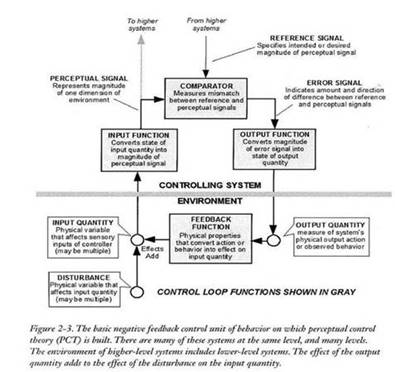
The Title of Bills’ Book is “Behavior : The control of perception”. I don’t understand how you concluded that “behavior can control input” ? From the diagram (LCS III) and definitions of control (B:CP) we can conclude that “behavior is coming after control of perception” in comparator. And it’s affecting immediate enviroment. There is no controlled effects. How can you concluded that behavior controls input, if you don’t know what you are doing to reality through “feedback function” ? It’s just effects to input.
Bill P :
FEED-BACK FUNCTION : The box represents the set of physical laws, properties, arrangements, linkages, by which the action of this system feeds-back to affect its own input, the controlled variable. That’s what feed-back means : it’s an effect of a system’s output on it’s own input.
HB : Why did you use your own explanation of “feedback function” instead of his. Behavior (output) affects it’s own input. It’s not : Behavior “controls” input. Where di you get that ? Maybe Rick is “source” or “hidden joker” ?
Best,
Boris
Warren
···
From: Warren Mansell wmansell@gmail.com
Sent: Thursday, May 24, 2018 10:44 PM
To: boris.hartman@masicom.net
Subject: Re: Open access version
WM : I don’t. I promote PCT, and Rick is a major proponent of PCT and it’s empirical basis.
HB : His empirical bases and his discourses about PCT promote “behaviorism”. He proved it in “rubber band game”.
He can prove to me any time that I’m wrong with my accusation. I need just some scientific evidences that he is right. But he don’t want to present them. It’s porbably he hasn’t any. Â
And he just have to prove to me that “Behavior can be indeed controlled” and that there is “Controlled Perceptual Variable” or CPV. If he do that I’ll stop with accusations that he is promoting RCT. His RCT is in straight opposition to PCT. We can go step by step if you want. I tryed once but you wanished. I just need scientific evidences.
But you two are just talking and phylosophing. Where are evidences ? You both have PhD and we know what you need if you want to support your theory.
But tell me first. Do you agree with Bills definitions of control (B:CP) and diagram (LCS III) ??? RCT (Ricks Control Theory) is drasstically diverging from PCT.
So here are differences between RCT and PCT :Â
RCT (Ricks Control Theory) definition of control loop
-
CONTROL : Keeping of some »aspect of outer environment« in reference state, protected (defended) from disturbances.
-
OUTPUT FUNCTION : controlled effects (control of behavior) to outer environment so to keep some »controlled variable« in reference state
-
FEED-BACK FUNCTION : »Control« of some »aspect of outer environment« in reference state.
-
INPUT FUNCTION : produce »Controlled Perceptual Variable« or »Controlled Perception«, the perceptual correlate of »controlled q.i.«
-
COMPARATOR : ???
-
ERROR SIGNAL : ???
His diagram involves “controlled variable” in environment and “Controlled Perceptual Variable”.
PCT Definitions of control loop :
Bill P (B:CP):
- CONTROL : Achievement and maintenance of a preselected state in the controlling system, through actions on the environment that also cancel the effects of disturbances.
Bill P (B:CP):
- OUTPUT FUNCTION : The portion of a system that converts the magnitude or state of a signal inside the system into a corresponding set of effects on the immediate environment of the system
Bill P (LCS III):…the output function shown in it’s own box represents the means this system has for causing changes in it’s environment.
Bill P (LCS III):
- FEED-BACK FUNCTION : The box represents the set of physical laws, properties, arrangements, linkages, by which the action of this system feeds-back to affect its own input, the controlled variable. That’s what feed-back means : it’s an effect of a system’s output on it’s own input.
Bill P (B:CP) :
- INPUT FUNCTION : The portion of a system that receives signals or stimuli from outside the system, and generates a perceptual signal that is some function of the received signals or stimuli.
Bill P (B:CP) :
- COMPARATOR : The portion of control system that computes the magnitude and direction of mismatch between perceptual and reference signal.
Bill P (B:CP)
- ERROR : The discrepancy between a perceptual signal and a reference signal, which drives a control system’s output function. The discrepancy between a controlled quantity and it’s present reference level, which causes observable behavior.
Bill P (B:CP) :
- ERROR SIGNAL : A signal indicating the magnitude and direction of error.
Boris
Warren
On 24 May 2018, at 19:11, Boris Hartman (boris.hartman@masicom.net via csgnet Mailing List) csgnet@lists.illinois.edu wrote:
Warren,
All I wish is that you stop promoting RCT (Ricks Control Theory) and his mantra “Behavior is control”.
From: Warren Mansell [mailto:wmansell@gmail.com]
Subject: Re: Open access version
Hi Boris, I just read Bill’s work and do my best to articulate it and replicate it as best I can, just like you.
HB : There is a big difference between us Warren how we’ll read Bills’ work, since I understand how organisms function and you don’t. So it’s most probable that you’ll read Bills’ work much differently than I do. If you understand PCT then you’ll not use any more “Behavior is control” or anything else from Ricks behavioristic repertoar like :
RM earlier : …as it will be in the rubber band game after some practice and if the controller’s (E’s) pulls on the rubber band are not too large or abrupt – the a person’s behavior can be controlled rather precisely.
HB : Rick is pure behaviorist. He pulls (stimulus) and people respond precisley as he wanted. He all the time control people.
WM : I ask for advice and keeping making adjustments to my understanding of PCT when I understand that the advice helps me in this regard.
HB : This a very good news Warren. So from now on we can expect that you’ll not use any more “Behavior is control” or any other Ricks’ behavioristic idea.
WM : Rick’s work has been very helpful in this regard,
HB : Ricks’ work can’t be helpfull in regard of PCT because he doesn’t understand PCT. But it can be helpfull in regard of RCT and “Behavior is control”. In PCT we talk about “Control of perception”.
WM : as has Martin Taylor’s, Tim Carey’s,
HB : Well I must admitt I admire both of them because of their huge intelectual potential. But they both change their mind.
WM : …and Kent’s, in particular,
HB : I admire Kent Too. He is very realible and stable source of PCT. How many times did ask him for advise ? I doubt that he would agree with Ricks’ mantra (Behavior is control).
WM : …and there are others.
HB : Others, who ?
WM : I just don’t understand how yours can help me in this regard.
HB : I’m trying to help you understand that there is no “Behavor is control”, no “controlled aspect of environment”, and no “Controlled Perceptual Variable” od CPV.
All the best also to you,
Boris
All the best,
Warren
On Wed, May 23, 2018 at 11:32 AM, Boris Hartman boris.hartman@masicom.net wrote:
Warren,
It’s not about whether you admitt something or not. It’s matter of selfimage. How long can you lie to yourself ?
Boris
From: Warren Mansell wmansell@gmail.com
Sent: Wednesday, May 23, 2018 10:03 AM
To: boris.hartman@masicom.net
Subject: Re: Open access version
Hi Boris, I won’t admit anything you quote on my behalf!
All the best
Warren
On 22 May 2018, at 19:01, Boris Hartman (boris.hartman@masicom.net via csgnet Mailing List) csgnet@lists.illinois.edu wrote:
Warren. I understand that all your work is worthless if you admitt that “Behavior is not control”. But playing a clown is not on the level of University profesor. As I noticed before. CSGnet is becoming oure behavioristic forum where “Behavior is control” there is “Controlled aspect of environment” and there is some misterious “Controlled Perceptual Variable” or PCV. Does anybody beleive in PCT on this forum ?
Boris
From: Warren Mansell wmansell@gmail.com
Sent: Tuesday, May 22, 2018 11:02 AM
To: boris.hartman@masicom.net
Subject: Re: Open access version
I still can’t tell the difference, sorry.
On 21 May 2018, at 20:44, Boris Hartman (boris.hartman@masicom.net via csgnet Mailing List) csgnet@lists.illinois.edu wrote:
Hi Warren
From: Warren Mansell (wmansell@gmail.com via csgnet Mailing List) csgnet@lists.illinois.edu
Sent: Friday, May 18, 2018 6:01 PM
To: csgnet@lists.illinois.edu; CSGNET@LISTSERV.ILLINOIS.EDU
Subject: Open access version
WM : Hi, here is the open access version of our replication paper:
HB : I’m sorry Warren to notice that you presented “behavioristic” paper if I may conclude what you and Huddy wrote in abstract :
WM, IH : We explain how this shift can be made within a single framework – perceptual control theoryy - that regards behavior as the control of perceptual input.
HB : Can you show me some evidence that people can “Control behavior” ? If they can (if you’ll show evidences) than I’ll beleive that “percepttion” (input) can be controlled through behavior.
The Title of Bills’ Book is “Behavior : The control of perception”. I don’t understand how you concluded that “behavior can control input” ? From the diagram (LCS III) and definitions of control (B:CP) we can conclude that “behavior is coming after control of perception” in comparator. And it’s affecting immediate enviroment. There is no controlled effects. How can you concluded that behavior controls input, if you don’t know what you are doing to reality through “feedback function” ? It’s just effects to input.
Bill P :
FEED-BACK FUNCTION : The box represents the set of physical laws, properties, arrangements, linkages, by which the action of this system feeds-back to affect its own input, the controlled variable. That’s what feed-back means : it’s an effect of a system’s output on it’s own input.
HB : Why did you use your own explanation of “feedback function” instead of his. Behavior (output) affects it’s own input. It’s not : Behavior “controls” input. Where di you get that ? Maybe Rick is “source” or “hidden joker” ?
Best,
Boris
–
Dr Warren Mansell
Reader in Clinical Psychology
School of Health Sciences
2nd Floor Zochonis Building
University of Manchester
Oxford Road
Manchester M13 9PL
Email: warren.mansell@manchester.ac.ukTel: +44 (0) 161 275 8589
Advanced notice of a new transdiagnostic therapy manual, authored by Carey, Mansell & Tai - Principles-Based Counselling and Psychotherapy: A Method of Levels Approach
Available Now
Check www.pctweb.org for further information on Perceptual Control Theory
Napaka! Ime datoteke ni navedeno.