Passive Equilibrium Systems and Negative Feedback: A Compromise?

[From Bruce Abbott (2015.02.02.2045 EST)]

Feedback occurs when a change in a variable produces an effect that acts back onto the same variable. In negative feedback, the effect is such as to oppose the change; in positive feedback the effect is such as to exacerbate the change.

With respect to systems such as the spring, pendulum, or ball-in-a-bowl (passive equilibrium systems), a disturbance that displaces the system from its resting state produces a reaction force that opposes the disturbance. As such, these systems meet the formal definition of negative feedback given above.

These systems can be modeled mathematically by applying the laws of physics to derive the appropriate equations of motion – the analytical approach.

These same systems can also be modeled through numerical simulation, in which feedback paths are explicitly included in the calculations – the numerical approach. Except for small errors induced by computing changes in small discrete time-steps (dt) for what are really continuous changes, the numerical approach yields the same predicted behavior of the system as the analytical approach. This result validates the model, and thus demonstrates that negative feedback is present in these physical systems.

However, a major difference exists between the typical negative feedback models presented on CSGnet and those based on these physical systems. There are no sensors, input functions, signals, and so on transporting effects around a loop from input to output to feedback effect on the input. Instead, the forces involved transmit their effects directly to other elements of the system, as when a force applied to a spring compresses the spring, thus directly generating a reaction force in the spring that acts in a direction opposed to the compression of the spring. Although the compression of the spring induces a force opposing the compression, thus meeting the definition of negative feedback given above, the fact that this is accomplished directly through the physical effect of the compressive force on the spring seems to violate the usual picture of negative feedback systems with their sensors and signals and signal transformations and outputs exerting their effects around a loop made up of separate elements. This has led at least one person on this list to conclude that there is no loop involved in these physical systems and therefore, no negative feedback at work there.

My position has been and is that the numerical models with their negative feedback elements are just another way of viewing these physical systems and just as valid as the analytical models. However, for those who may be unwilling to accept this proposition, I have an alternate way to view the problem that you may find acceptable.

What if we view the numerical approach as “saving the appearances” (Angus Jenkinson suggested in his post of January 29th). One could hold that these physical systems do not “really” employ negative feedback, that the appearance of negative feedback in the numerical models is just a fiction that just happens to produce the correct results with respect to system behavior.

But then you must still admit (if you’re being honest) that the numerical model behaves “as if” these systems were closed-loop negative feedback systems. And you will find that, to “save the appearances,” these systems must have a “loop gain” that is greater than zero but less than or equal to 1.0. Thus, these passive equilibrium systems behave like closed loop, negative feedback systems with loop gains as stated. They can be modeled as such, and the results of such models compared to control systems modeled in the same way. Such comparisons can and do illuminate the differences between control systems, with their typically high gains and strong opposition to disturbance, and passive equilibrium systems.

Does that sound like a good compromise? Some of us can go on viewing these passive equilibrium systems as falling into a very general category of negative feedback systems that includes both the traditional sensors-signals-outputs loop structure and physical systems whose elements interact more directly, while others can go on viewing (incorrectly, I believe) negative feedback systems as properly including only the former type.

Bruce

[From Rick Marken (2015.02.03.1800)]

···

Bruce Abbott (2015.02.02.2045 EST) –

Â

BA: Feedback occurs when a change in a variable produces an effect that acts back onto the same variable. In negative feedback, the effect is such as to oppose the change; in positive feedback the effect is such as to exacerbate the change.

Â

BA: With respect to systems such as the spring, pendulum, or ball-in-a-bowl (passive equilibrium systems), a disturbance that displaces the system from its resting state produces a reaction force that opposes the disturbance. As such, these systems meet the formal definition of negative feedback given above.

RM: I don’t agree. Hooke’s law is not a feedback equation. But it doesn’t really matter. If you want to call it negative feedback go ahead. I’ll go with it for the sake of argument (or compromise).Â

Â

BA:Â These systems can be modeled mathematically by applying the laws of physics to derive the appropriate equations of motion – the analytical approach.

Â

BA: These same systems can also be modeled through numerical simulation, in which feedback paths are explicitly included in the calculations – the numerical appproach. Except for small errors induced by computing changes in small discrete time-steps (dt) for what are really continuous changes, the numerical approach yields the same predicted behavior of the system as the analytical approach. This result validates the model, and thus demonstrates that negative feedback is present in these physical systems.

RM: I agree with all that, except for the negative feedback part. But, again, I’ll go with it for the sake of argument. Â

Â

BA: However, a major difference exists between the typical negative feedback models presented on CSGnet and those based on these physical systems. There are no sensors, input functions, signals, and so on transporting effects around a loop from input to output to feedback effect on the input.Â

RM: Actually, I would say that the major difference between the model of a passive equilibrium system and those of the negative feedback systems discussed on CSGNet is that the latter control; the former don’t.Â

Â

BA: Instead, the forces involved transmit their effects directly to other elements of the system, as when a force applied to a spring compresses the spring, thus directly generating a reaction force in the spring that acts in a direction opposed to the compression of the spring. Although the compression of the spring induces a force opposing the compression, thus meeting the definition of negative feedback given above, the fact that this is accomplished directly through the physical effect of the compressive force on the spring seems to violate the usual picture of negative feedback systems with their sensors and signals and signal transformations and outputs exerting their effects around a loop made up of separate elements. This has led at least one person on this list to conclude that there is no loop involved in these physical systems and therefore, no negative feedback at work there.

RM: OK. This is all fine. Â

Â

BA: My position has been and is that the numerical models with their negative feedback elements are just another way of viewing these physical systems and just as valid as the analytical models. However, for those who may be unwilling to accept this proposition, I have an alternate way to view the problem that you may find acceptable.

RM: I am not unwilling to accept that. I accept that the numerical models are just as valid as the analytical models. What I don’t accept is that what you call the “negative feedback” in these physical systems (like the pendulum and mass on a spring) is responsible for the return to the resting state after a disturbance.Â

 BA: What if we view the numerical approach as “saving the appearances� (Angus Jenkinson  suggested in his post of January 29th). One could hold that these physical systems do not “really� employ negative feedback, that the appearance of negative feedback in the numerical models is just a fiction that just happens to produce the correct results with respect to system behavior.

RM: If by “correct results” you mean that the mass (or bob) ends up in its resting state after disturbance, then the fiction is that what you are calling negative feedback (in the model or in the analysis) is responsible for this result.Â

Â

 BA: But then you must still admit (if you’re being honest) that the numerical model behaves “as ifâ€? these systems were closed-loop negative feedback systems.Â

RM: No, they are behaving as open-loop causal systems. If the mass on a spring or pendulum were closed-loop negative feedback systems then the negative feedback would be responsible for the mass (or the bob) returning to (and remaining in) its “resting” position after (and/or during) disturbance.

Â

BA: And you will find that, to “save the appearances,â€? these systems must have a “loop gainâ€? that is greater than zero but less than or equal to 1.0. Thus, these passive equilibrium systems behave like closed loop, negative feedback systems with loop gains as stated.Â

RM: Passive equilibrium systems do not behave at all like low gain closed-loop negative feedback systems; they behave like zero gain negative feedback systems. That is a fact that can be established by “the test”. They don’t behave like closed loop negative feedback systems because the “negative feedback” in these systems does not compensate for disturbances; this can be seen from the fact that, without damping, these systems continue to oscillate with constant amplitude (proportional to the magnitude of the disturbance) and never stop. So the disturbance to a passive equilibrium system without damping is completely effective; the effect of the disturbance is exactly what is predicted by open-loop physics.Â

Â

BA: They can be modeled as such, and the results of such models compared to control systems modeled in the same way. Such comparisons can and do illuminate the differences between control systems, with their typically high gains and strong opposition to disturbance, and passive equilibrium systems.

RM: I think that comparison of the behavior of a control system to that of a passive equilibrium system is a great idea! Indeed, I think that’s what I will do to show that the behavior of a damped mass-spring system is not like that of even a low gain control system. I predict that variations in the position of a mass on a spring will be the same when a control system is controlling the mass and and when just the spring is involved only when the gain of the control system is 0 – that is, no loop.Â

Â

BA: Does that sound like a good compromise?Â

RM: I don’t need to compromise and you are free to do what you like with these passive equilibrium systems. But I’m interested in studying control so equilibrium systems are of interest to me only as components of control systems, like the system that controls arm position.Â

Â

BA: Some of us can go on viewing these passive equilibrium systems as falling into a very general category of negative feedback systems that includes both the traditional sensors-signals-outputs loop structure and physical systems whose elements interact more directly, while others can go on viewing (incorrectly, I believe) negative feedback systems as properly including only the former type.

RM: Of course you can. I will, however, be trying to write a paper to show that these systems don’t do anything like control; they are just like James’ iron filings; they appear to “achieve goals” (like moving to the magnet) but they are not controlling for getting to the goal; it’s just cause-effect. So for anyone interested in understanding the controlling (purposeful behavior) of living systems, the study of passive equilibrium systems is just a waste of time. I wish I could stop you from wasting your time, but obviously I can’t. But this discussion certainly hasn’t wasted my time. It got me to understand some very basic physics and gave me a great idea for a paper.Â

BestÂ

Rick


Richard S. Marken, Ph.D.
Author of  Doing Research on Purpose
Now available from Amazon or Barnes & Noble

[Martin Taylor 2015.02.03.2259]

Well, despite what I said above, this is something that everyone has

agreed about since the start of this theme.
THAT is the nonsense. The ONLY force consistently acting in the
direction of the resting state is the force whose magnitude and
direction opposed the disturbing push when the push was there and
after the push is removed. If there is no friction, the loop gain of
the system is -1.0, but with friction, the energy dissipates into
heat and the absolute loop gain is less than 1.
False.
Which it is.
If that were true, the system would (a) accelerate until the push
were removed, and then maintain its velocity until some other forced
accelerated it back to rest. At that point, it would (b) just stay
put and not (as a real pendulum does) accelerate toward its rest
position.
It exactly compensates for the disturbance, as is evident from the
fact that the acceleration is zero the moment before the disturbance
is removed with the pendulum at rest.
Which is comparing apples with porridge. Force is not energy.
So is the behaviour of EVERY mechanical or physically realizable
system, including ALL control systems. Just think of all the
analyses Kennaway did for Bill. They use the same physics as
everyone except Marken.
And at the same time, do the inverse experiment, comparing it with
the behaviour of a control system that has no damping (i.e.
integration), a loop gain of 1.0 and a time lag commensurate with
the oscillation period of the pendulum or spring.
You might not need to compromise, and there’s certainly no need for
you to study equilibrium systems if you don’t want to, but it would
help if you would stop evangelizing Markenphysics in which force and
energy are interchangeable.
Of course they don’t. Nobody has suggested they do. It’s really no
good keeping trying to gather up all those scattered straws and
building up the man again so you can repetitively keep breaking it
the same way over and over.
So why do you bother wasting your time with them? Other people may
not find it a waste of time to work with them. Or they may find it a
pleasant waste of time. Not your problem.
As we can see, the first half of the last sentence is not true (not
yet, anyway). When you do come to understand some basic physics you
probably will see why the problems persist in the rest of your
message. Just think: F =ma, energy = force times distance, Force !=
energy; in a pendulum, the friction (air resistance) force acts AWAY
from the resting position, which would not move the pendulum the
direction it actually goes, and it’s energy loss to heat because of
friction that allows the pendulum eventually to come to rest (or
nearly so).
Martin

···

I said I was going to quit this, but since Rick persists in
peddling his mixed up nonsense as if it meant something, the
disturbance remains outside my tolerance level.

[From Rick Marken (2015.02.03.1800)]

          RM: Actually, I would say that the major difference

between the model of a passive equilibrium system and
those of the negative feedback systems discussed on CSGNet
is that the latter control; the former don’t.

Â

Â

              BA: My position has been and is

that the numerical models with their negative feedback
elements are just another way of viewing these
physical systems and just as valid as the analytical
models. However, for those who may be unwilling to
accept this proposition, I have an alternate way to
view the problem that you may find acceptable.

          RM: I am not unwilling to accept that. I accept that

the numerical models are just as valid as the analytical
models. What I don’t accept is that what you call the
“negative feedback” in these physical systems (like the
pendulum and mass on a spring) is responsible for the
return to the resting state after a disturbance.

 BA: What if we view the
numerical approach as “saving the appearances� (Angus
Jenkinson  suggested in his post of January 29th). One
could hold that these physical systems do not “really�
employ negative feedback, that the appearance
of negative feedback in the numerical models is just a
fiction that just happens to produce the correct
results with respect to system behavior.

          RM: If by "correct results" you mean that the mass (or

bob) ends up in its resting state after disturbance, then
the fiction is that what you are calling negative feedback
(in the model or in the analysis) is responsible for this
result.

Â

              Â BA:Â But then you must still admit

(if you’re being honest) that the numerical model
behaves “as if� these systems were closed-loop
negative feedback systems.Â

          RM: No, they are behaving as open-loop causal systems.

If the mass on a spring or pendulum were closed-loop
negative feedback systems then the negative feedback would
be responsible for the mass (or the bob) returning to (and
remaining in) its “resting” position after (and/or during)
disturbance.

Â

              BA: And you will find that, to

“save the appearances,� these systems must have a
“loop gain� that is greater than zero but less than or
equal to 1.0. Thus, these passive equilibrium systems
behave like closed loop, negative feedback systems
with loop gains as stated.Â

          RM: Passive equilibrium systems do not behave at all

like low gain closed-loop negative feedback systems; they
behave like zero gain negative feedback systems.

          That is a fact that can be established by "the test".

They don’t behave like closed loop negative feedback
systems because the “negative feedback” in these systems
does not compensate for disturbances;

          this can be seen from the fact that, without damping,

these systems continue to oscillate with constant
amplitude (proportional to the magnitude of the
disturbance) and never stop.

          So the disturbance to a passive equilibrium system

without damping is completely effective; the effect of the
disturbance is exactly what is predicted by open-loop
physics.

Â

              BA: They can be modeled as such,

and the results of such models compared to control
systems modeled in the same way. Such comparisons can
and do illuminate the differences between control
systems, with their typically high gains and strong
opposition to disturbance, and passive equilibrium
systems.

          RM: I think that comparison of the behavior of a

control system to that of a passive equilibrium system is
a great idea! Indeed, I think that’s what I will do to
show that the behavior of a damped mass-spring system is
not like that of even a low gain control system. I predict
that variations in the position of a mass on a spring will
be the same when a control system is controlling the mass
and and when just the spring is involved only when the
gain of the control system is 0 – that is, no loop.

Â

              BA: Does that sound like a good

compromise?Â

          RM: I don't need to compromise and you are free to do

what you like with these passive equilibrium systems. But
I’m interested in studying control so equilibrium systems
are of interest to me only as components of control
systems, like the system that controls arm position.

Â

              BA: Some of us can go on viewing

these passive equilibrium systems as falling into a
very general category of negative feedback systems
that includes both the traditional
sensors-signals-outputs loop structure and physical
systems whose elements interact more directly, while
others can go on viewing (incorrectly, I believe)
negative feedback systems as properly including only
the former type.

          RM: Of course you can. I will, however, be trying to

write a paper to show that these systems don’t do anything
like control

          Â So for anyone interested in understanding the

controlling (purposeful behavior) of living systems, the
study of passive equilibrium systems is just a waste of
time.

          I wish I could stop you from wasting your time, but

obviously I can’t. But this discussion certainly hasn’t
wasted my time. It got me to understand some very basic
physics and gave me a great idea for a paper.Â

[philip.02.03.2015.8:39am]

I have only 1 remark:

  1. I cannot accept the TCV being applied to non-living matter.

what does everybody think?

[From Richard Kennaway (2015.02.04.1712 GMT)]

···

On 4 Feb 2015, at 16:42, PHILIP JERAIR YERANOSIAN wrote:

[philip.02.03.2015.8:39am]

I have only 1 remark:
1. I cannot accept the TCV being applied to non-living matter.

what does everybody think?

The TCV applies to any control system. However, for designed control systems, one usually knows already what the controlled variable is, and if you're trying to reverse engineer someone else's, you can take it apart. Living systems don't come with a blueprint, and it can be difficult to take them apart and put them together again.

-- Richard

--
Richard Kennaway, R.Kennaway@uea.ac.uk, Richard Kennaway
School of Computing Sciences,
University of East Anglia, Norwich NR4 7TJ, U.K.

[From Rick Marken (2015.02.04.1300)]

···

Martin Taylor (2015.02.03.2259)–

  MT: I said I was going to quit this, but since Rick persists in

peddling his mixed up nonsense as if it meant something, the
disturbance remains outside my tolerance level.

RM: You mean the error signal created by the deviation of what you perceive (a function of both the disturbance – what I am saying – and your ongoing output – what you are saying) went outside your tolerance level. Actually, it just resulted in one side of a conflict – the side that wanted to correct my nonsense – overwhelming the other side – the side that wanted to quit. The variable in conflict is posting on the net. I have the same conflict all the time, but it’s your nonsense that usually does it for me;-)

          RM: I accept that

the numerical models are just as valid as the analytical
models. What I don’t accept is that what you call the
“negative feedback” in these physical systems (like the
pendulum and mass on a spring) is responsible for the
return to the resting state after a disturbance.

MT: THAT is the nonsense.

RM: Actually it’s just Physics 101.

MT: The ONLY force consistently acting in the direction of the resting state is the force whose magnitude and direction opposed the disturbing push when the push was there and after the push is removed.

RM: So you are saying that the only force that brings the mass back to its resting state is the restoring force, F, that occurs in response to displacement of the mass from its resting state by an amount x. The restoring force as a function of displacement is given by Hooke’s law:

F = - kx

where k is the spring constant. You are saying that F is “negative feedback” that opposes the disturbance, x, and returns the mass to its pre-disturbance state, x = 0. What I showed is that F doesn’t do that. When there is no damping, Hooke’s law describes a system in which a mass on a spring oscillates forever after the “disturbance” is removed. While it’s true that during this oscillation the mass passes through the resting state, x=0, twice per cycle it doesn’t remain there long (it remains for an amount of time, dt, that approaches 0).

RM: My conclusion that without damping – with only the restoring force, F, (“negative feedback”) acting on the mass – a mass-spring system is not stable (that it continuously oscillates – is based on basic physics. By Newton’s first law (F = ma) Hooke’s law can be written as the following differential equation:

m * dx2/dt2 = -kx (1)

The solution of this differential equation is:

x(t) = a cos(omega*t-phi) (1a)

In other words, when an un-damped mass on a spring is released from displacement (disturbance) it will oscillate (move up and down) in a sinusoidal motion forever. So when we see a displaced mass return to (and remain in) its resting position it’s because there was some damping present. When damping is included in the differential equation describing the motion of the mass on a spring, the solution looks like this:

x(t) = a* exp-(-v/2*t)cos(omegat-phi) (2a)

where v is the magnitude of the damping. The term exp-(-v/2*t) comes from adding the damping force to equation 1 and it’s what bring the mass to rest at its pre-disturbance resting position (x = 0).

MT: False.

RM: I based my conclusion on the results of the analysis described in equations 1 and 1a above. I believe the analysis shows that the restoring force, F, in Hooke’s law is not responsible for the mass ending up in the resting state (x=0) after disturbance. If my conclusion is wrong I would like to know why. I would appreciate it if you would explain my mistake in terms of my analysis.

MT: Which is comparing apples with porridge. Force is not energy.

RM: Apparently there is some kind of energy consideration that I am not taking into account. Please explain why I am comparing apples to porridge. It would be nice if you could do it in terms of my analysis above (equations 1 and 1a).

MT: You might not need to compromise, and there's certainly no need for

you to study equilibrium systems if you don’t want to, but it would
help if you would stop evangelizing Markenphysics in which force and
energy are interchangeable.

RM: I would sure appreciate it if you would explain how I am treating energy and force as interchangeable. I thought my analysis was consistent with Newton’s physics but if it’s not I’d sure appreciate learning what I got wrong.

MT: So why do you bother wasting your time with them?

RM: Because they have been proposed as alternatives to control models by people like Feldman, Turvey and many others in the field of motor control.

MT: As we can see, the first half of the last sentence is not true (not

yet, anyway). When you do come to understand some basic physics you
probably will see why the problems persist in the rest of your
message. Just think: F =ma, energy = force times distance, Force !=
energy; in a pendulum, the friction (air resistance) force acts AWAY
from the resting position, which would not move the pendulum the
direction it actually goes, and it’s energy loss to heat because of
friction that allows the pendulum eventually to come to rest (or
nearly so).

RM: It’s not obvious to me why the fact that energy is defined as (force x distance) invalidates the conclusion I draw from equations 1 and 1a that the restoring force (“negative feedback”) in an equilibrium system has nothing to do with the fact that the system comes to rest (stops moving) after displacement (“disturbance”). So I look forward to you explaining it to me.

Best

Rick


Richard S. Marken, Ph.D.
Author of Doing Research on Purpose.
Now available from Amazon or Barnes & Noble

          RM: If by "correct results" you mean that the mass (or

bob) ends up in its resting state after disturbance, then
the fiction is that what you are calling negative feedback
(in the model or in the analysis) is responsible for this
result.

          RM: this can be seen from the fact that, without damping,

these systems continue to oscillate with constant
amplitude (proportional to the magnitude of the
disturbance) and never stop.

          RM: So for anyone interested in understanding the

controlling (purposeful behavior) of living systems, the
study of passive equilibrium systems is just a waste of
time.

          RM: I wish I could stop you from wasting your time, but

obviously I can’t. But this discussion certainly hasn’t
wasted my time. It got me to understand some very basic
physics and gave me a great idea for a paper.

[From Rick Marken (2015.02.04.1610)]

image00233.jpg

···

Bruce Abbott (2015.02.04.1310 EST)–

BA: Negative feedback produced by spring tension results in oscillation of the spring AROUND its resting point. Friction proportional to velocity (in this example supplied by the damper) allows the negative feedback supplied by the spring to bring the mass to rest at its resting point.Â

RM: Yes! That’s exactly what I am saying. In the mass spring system, what you call “negative feedback” (and what physicists call “restoring force”) produces oscillation (not stability); drag, in the form of friction (and gravity?), brings the mass to it’s resting point. The drag does interact with the oscillation produced by the negative feedback as per my equation 2a:

x(t) = a* exp-(-v/2*t)cos(omegat-phi) Â (2a)Â

RM: Since drag and negative feedback do not have independent effects on the mass I think it is correct to say that the drag “allows” the spring to bring the mass to rest at its resting point. So it’s not negative feedback per se that results in stability in equilibrium systems; you have to have both negative feedback (springiness) and drag.

RM: In a true negative feedback control system the “stability” of a controlled variable can be produced by negative feedback alone. In an equilibrium system stability (such as it is) requires both “negative feedback” and drag; negative feedback alone produces instability (continuous oscillation).

RM: By calling equilibrium systems “negative feedback” systems you are implying that their “stability”, in terms of reaching a final resting place after disturbance, is achieved by the negative feedback, as it is in control systems. So “negative feedback” is being used as a trope to attribute the “stability” producing capabilities of control system to ordinary physical systems (mass/spring or pendulum). I think it’s not only incorrect to do this it confuses things terribly for control theory.

RM: Passive equilibrium systems do not behave at all like low gain closed-loop negative feedback systems;

Â

BA:Â Merely asserting these things as facts does not make them true.Â

RM: You are absolutely right.Â

Â

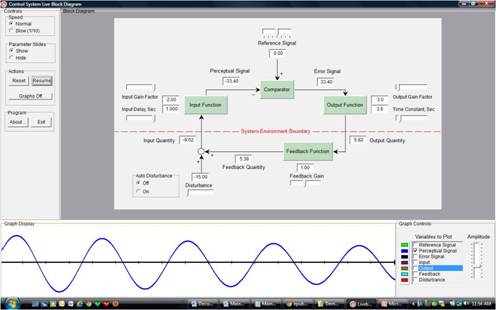
BA; Below is a screen-shot showing the behavior of a negative feedback system with certain parameter values. You will note that it is behaving like a damped oscillator (i.e., like a mass-spring-damper system. But since it’s oscillating instead of moving resolutely toward a reference value, it can’t be a negative feedback system (according to the Marken Test for Negative Feedback, that is).Â

RM: I don’t think you did the Marken Test, which is the Test for the Controlled Variable. All I see is a variable moving with a damped oscillation. I would have to know more about the situation to be able to determine whether or not the behavior I see is that of a controlled variable that of a variable undergoing a damped oscillation.Â

Â

BA: That’s a problem for you, because it’s a perfectly ordinary PCT-style proportional control system. Looking at the behavior, you can’t tell it from a mass-spring-damper system.

RM: Of course not. It’s the same as the situation in my “Detection of Intention” demo (http://www.mindreadings.com/ControlDemo/FindMind.html); you can’t tell which car is controlling for following the red car and which cars are not by just looking at the behavior of the cars. You have to do the Marken Test (I kind of like the ring to that).

RM: I think that comparison of the behavior of a control system to that of a passive equilibrium system is a great idea! Indeed, I think that’s what I will do to show that the behavior of a damped mass-spring system is not like that of even a low gain control system. I predict that variations in the position of a mass on a spring will be the same when a control system is controlling the mass and and when just the spring is involved only when the gain of the control system is 0 – that is, no loop.Â

Â

BA: That’s a GREAT idea! After that, you will be forced to concede my position, assuming that you create a valid model (Excel spreadsheet, perhaps?)

RM: Yes, I’ll try to do that (develop the spreadsheet; hopefully not concede;-)

ASAP. Â

BA: Some of us can go on viewing these passive equilibrium systems as falling into a very general category of negative feedback systems that includes both the traditional sensors-signals-outputs loop structure and physical systems whose elements interact more directly, while others can go on viewing (incorrectly, I believe) negative feedback systems as properly including only the former type.

RM: Of course you can. I will, however, be trying to write a paper to show that these systems don’t do anything like control; they are just like James’ iron filings;Â

Â

BA: The iron filings example is not an equilibrium system. There’s just a force accelerating the filings toward the poles of the magnet. A raindrop running down window is not an equilibrium system. There’s just the force of gravity and a few other forces produced by the characteristics of the glass that determine its path. So whether they appear to “achieve goals� or not is irrelevant to the question of whether passive equilibrium systems are negative feedback systems. You’re confusing these open-loop systems with passive equilibrium systems.

RM: Passive equilibrium systems are like James’ iron filings or the raindrop running to the edge of the window because they end up reaching a “goal” state, which makes their behavior appear purposeful. The physical process that gets an equilibrium system to a goal state is a bit more complex than that which gets the filings to the magnet. But in both cases the goal state is produced by well understood causal processes. Equilibrium systems are just ordinary physical systems that behave exactly according to the open-loop laws of physics. They have no special relevance at all understanding purposeful behavior.Â

RM: But I will try to develop that demonstration to show (I hope) that the behavior of even a low gain control system can be distinguished from that of an open-loop equilibrium system. Hope it works;-)

BestÂ

Rick


Richard S. Marken, Ph.D.
Author of  Doing Research on Purpose
Now available from Amazon or Barnes & Noble

That happens to me all the time; even when I use reply all. I agree; someone should fix it.

Fred Nickols

image00233.jpg

···

From: “Bruce Abbott” (bbabbott@frontier.com via csgnet Mailing List) [mailto:csgnet@lists.illinois.edu]
Sent: Friday, February 06, 2015 7:28 AM
To: CSGnet
Subject: FW: Passive Equilibrium Systems and Negative Feedback: A Compromise?

Looks like this went directly to Rick when I intended it for CSGnet.

Someone (Rick, perhaps?) really should investigate why the list server is directing replies to the poster rather than to the list and fix the problem is possible.

Bruce

From: Bruce Abbott [mailto:bbabbott@frontier.com]
Sent: Wednesday, February 04, 2015 1:12 PM
To: ‘rsmarken@gmail.com’
Subject: RE: Passive Equilibrium Systems and Negative Feedback: A Compromise?

[From Bruce Abbott (2015.02.04.1310 EST)]

Rick Marken (2015.02.03.1800)]

Bruce Abbott (2015.02.02.2045 EST) –

BA: Feedback occurs when a change in a variable produces an effect that acts back onto the same variable. In negative feedback, the effect is such as to oppose the change; in positive feedback the effect is such as to exacerbate the change.

BA: With respect to systems such as the spring, pendulum, or ball-in-a-bowl (passive equilibrium systems), a disturbance that displaces the system from its resting state produces a reaction force that opposes the disturbance. As such, these systems meet the formal definition of negative feedback given above

RM: I don’t agree. Hooke’s law is not a feedback equation. But it doesn’t really matter. If you want to call it negative feedback go ahead. I’ll go with it for the sake of argument (or compromise).

BA: Do you agree with my definition of negative feedback?

BA: These systems can be modeled mathematically by applying the laws of physics to derive the appropriate equations of motion – the analytical approach.

BA: These same systems can also be modeled through numerical simulation, in which feedback paths are explicitly included in the calculations – the numerical approach. Except for small errors induceed by computing changes in small discrete time-steps (dt) for what are really continuous changes, the numerical approach yields the same predicted behavior of the system as the analytical approach. This result validates the model, and thus demonstrates that negative feedback is present in these physical systems.

RM: I agree with all that, except for the negative feedback part. But, again, I’ll go with it for the sake of argument.

BA: Now you are denying established fact. Earlier I posted a Simulink diagram that was used to simulate the mass-spring-damper system, and it included two feedback pathways, represented by arrows leading back, with negative sign, to the mass-acceleration variable. Those provide negative feedback proportional to velocity (from the damper) and negative feedback proportional to spring compression. What do you think those arrows are doing there, if not representing negative feedback pathways?

BA: However, a major difference exists between the typical negative feedback models presented on CSGnet and those based on these physical systems. There are no sensors, input functions, signals, and so on transporting effects around a loop from input to output to feedback effect on the input.

RM: Actually, I would say that the major difference between the model of a passive equilibrium system and those of the negative feedback systems discussed on CSGNet is that the latter control; the former don’t.

BA: I didn’t say THE major difference, I said A major difference. Do you agree about the difference in the way that the models have been presented here?

BA: Instead, the forces involved transmit their effects directly to other elements of the system, as when a force applied to a spring compresses the spring, thus directly generating a reaction force in the spring that acts in a direction opposed to the compression of the spring. Although the compression of the spring induces a force opposing the compression, thus meeting the definition of negative feedback given above, the fact that this is accomplished directly through the physical effect of the compressive force on the spring seems to violate the usual picture of negative feedback systems with their sensors and signals and signal transformations and outputs exerting their effects around a loop made up of separate elements. This has led at least one person on this list to conclude that there is no loop involved in these physical systems and therefore, no negative feedback at work there.

RM: OK. This is all fine.

BA: O.K.

BA: My position has been and is that the numerical models with their negative feedback elements are just another way of viewing these physical systems and just as valid as the analytical models. However, for those who may be unwilling to accept this proposition, I have an alternate way to view the problem that you may find acceptable.

RM: I am not unwilling to accept that. I accept that the numerical models are just as valid as the analytical models. What I don’t accept is that what you call the “negative feedback” in these physical systems (like the pendulum and mass on a spring) is responsible for the return to the resting state after a disturbance.

BA: If you accept the numerical model of the mass-spring-damper system, which has explicit negative feedback paths, then it makes no sense for you to assert that these are not responsible for the return of the spring to the resting state. The position feedback produces opposition (a restorative force) to spring compression by the compressive force (causing the mass to decelerate until it comes to rest despite continued application of the compressive force) and accelerates the mass toward the resting position when the compressive force is removed. That acceleration generates inertia that carries the mass past the resting position, stretching the spring and thus reversing the direction of the restorative force, decelerating the mass until it comes to a stop and then accelerates in the opposite direction. This cycle would persist indefinitely except for the second source of negative feedback – the damper. The damper produces a decelerative force proportional to mass velocity. This eventually drains away the energy driving spring oscillation, bringing the mass to rest at its initial, undisturbed position.

BA: What if we view the numerical approach as “saving the appearances� (Angus Jenkinson suggested in his post of January 29th). One could hold that these physical systems do not “really� employ negative feedback, that the appearance of negative feedback in the numerical models is just a fiction that just happens to produce the correct results with respect to system behavior.

RM: If by “correct results” you mean that the mass (or bob) ends up in its resting state after disturbance, then the fiction is that what you are calling negative feedback (in the model or in the analysis) is responsible for this result.

BA: Negative feedback produced by spring tension results in oscillation of the spring AROUND its resting point. Friction proportional to velocity (in this example supplied by the damper) allows the negative feedback supplied by the spring to bring the mass to rest at its resting point.

BA: But then you must still admit (if you’re being honest) that the numerical model behaves “as if� these systems were closed-loop negative feedback systems.

RM: No, they are behaving as open-loop causal systems. If the mass on a spring or pendulum were closed-loop negative feedback systems then the negative feedback would be responsible for the mass (or the bob) returning to (and remaining in) its “resting” position after (and/or during) disturbance.

BA: And you will find that, to “save the appearances,� these systems must have a “loop gain� that is greater than zero but less than or equal to 1.0. Thus, these passive equilibrium systems behave like closed loop, negative feedback systems with loop gains as stated.

RM: Passive equilibrium systems do not behave at all like low gain closed-loop negative feedback systems; they behave like zero gain negative feedback systems. That is a fact that can be established by “the test”. They don’t behave like closed loop negative feedback systems because the “negative feedback” in these systems does not compensate for disturbances; this can be seen from the fact that, without damping, these systems continue to oscillate with constant amplitude (proportional to the magnitude of the disturbance) and never stop. So the disturbance to a passive equilibrium system without damping is completely effective; the effect of the disturbance is exactly what is predicted by open-loop physics.

BA: Merely asserting these things as facts does not make them true. See above for an explanation of how these negative feedback systems bring about oscillation and eventually bring the system to rest. Below is a screen-shot showing the behavior of a negative feedback system with certain parameter values. You will note that it is behaving like a damped oscillator (i.e., like a mass-spring-damper system. But since it’s oscillating instead of moving resolutely toward a reference value, it can’t be a negative feedback system (according to the Marken Test for Negative Feedback, that is). That’s a problem for you, because it’s a perfectly ordinary PCT-style proportional control system. Looking at the behavior, you can’t tell it from a mass-spring-damper system.

Proportional Control Instability.jpg

BA: They can be modeled as such, and the results of such models compared to control systems modeled in the same way. Such comparisons can and do illuminate the differences between control systems, with their typically high gains and strong opposition to disturbance, and passive equilibrium systems.

RM: I think that comparison of the behavior of a control system to that of a passive equilibrium system is a great idea! Indeed, I think that’s what I will do to show that the behavior of a damped mass-spring system is not like that of even a low gain control system. I predict that variations in the position of a mass on a spring will be the same when a control system is controlling the mass and and when just the spring is involved only when the gain of the control system is 0 – that is, no loop.

BA: That’s a GREAT idea! After that, you will be forced to concede my position, assuming that you create a valid model (Excel spreadsheet, perhaps?)

BA: Does that sound like a good compromise?

RM: I don’t need to compromise and you are free to do what you like with these passive equilibrium systems. But I’m interested in studying control so equilibrium systems are of interest to me only as components of control systems, like the system that controls arm position.

BA: Some of us can go on viewing these passive equilibrium systems as falling into a very general category of negative feedback systems that includes both the traditional sensors-signals-outputs loop structure and physical systems whose elements interact more directly, while others can go on viewing (incorrectly, I believe) negative feedback systems as properly including only the former type.

RM: Of course you can. I will, however, be trying to write a paper to show that these systems don’t do anything like control; they are just like James’ iron filings; they appear to “achieve goals” (like moving to the magnet) but they are not controlling for getting to the goal; it’s just cause-effect. So for anyone interested in understanding the controlling (purposeful behavior) of living systems, the study of passive equilibrium systems is just a waste of time. I wish I could stop you from wasting your time, but obviously I can’t. But this discussion certainly hasn’t wasted my time. It got me to understand some very basic physics and gave me a great idea for a paper.

BA: The iron filings example is not an equilibrium system. There’s just a force accelerating the filings toward the poles of the magnet. A raindrop running down window is not an equilibrium system. There’s just the force of gravity and a few other forces produced by the characteristics of the glass that determine its path. So whether they appear to “achieve goals� or not is irrelevant to the question of whether passive equilibrium systems are negative feedback systems. You’re confusing these open-loop systems with passive equilibrium systems.

Bruce
[From Rick Marken (2015.02.06.0910)]

image00233.jpg

···

On Fri, Feb 6, 2015 at 6:16 AM, “Fred Nickols” csgnet@lists.illinois.edu wrote:

That happens to me all the time; even when I use reply all. I agree; someone should fix it.

Happens to me too. When you hit “reply” it replies to the individual address because csgnet apparently puts the poster’s address first in the “from” location. I don’t know why that happens or how to stop the listserve from doing it but I’ll give it try.

BestÂ

Rick

Â

Fred Nickols

Â

From: “Bruce Abbott” (bbabbott@frontier.com via csgnet Mailing List) [mailto:csgnet@lists.illinois.edu]
Sent: Friday, February 06, 2015 7:28 AM
To: CSGnet
Subject: FW: Passive Equilibrium Systems and Negative Feedback: A Compromise?

Â

Looks like this went directly to Rick when I intended it for CSGnet.

Someone (Rick, perhaps?) really should investigate why the list server is directing replies to the poster rather than to the list and fix the problem is possible.

Bruce

Â

From: Bruce Abbott [mailto:bbabbott@frontier.com]
Sent: Wednesday, February 04, 2015 1:12 PM
To: ‘rsmarken@gmail.com’
Subject: RE: Passive Equilibrium Systems and Negative Feedback: A Compromise?

Â

[From Bruce Abbott (2015.02.04.1310 EST)]

Â

Rick Marken (2015.02.03.1800)]

Bruce Abbott (2015.02.02.2045 EST) –

BA: Feedback occurs when a change in a variable produces an effect that acts back onto the same variable. In negative feedback, the effect is such as to oppose the change; in positive feedback the effect is such as to exacerbate the change.

BA: With respect to systems such as the spring, pendulum, or ball-in-a-bowl (passive equilibrium systems), a disturbance that displaces the system from its resting state produces a reaction force that opposes the disturbance. As such, these systems meet the formal definition of negative feedback given above

RM: I don’t agree. Hooke’s law is not a feedback equation. But it doesn’t really matter. If you want to call it negative feedback go ahead. I’ll go with it for the sake of argument (or compromise). Â

Â

BA: Do you agree with my definition of negative feedback?

BA:Â These systems can be modeled mathematically by applying the laws of physics to derive the appropriate equations of motion – the analytical approach.Â

BA: These same systems can also be modeled through numerical simulation, in which feedback paths are explicitly included in the calculations – the numerical approach. Except for smalll errors induced by computing changes in small discrete time-steps (dt) for what are really continuous changes, the numerical approach yields the same predicted behavior of the system as the analytical approach. This result validates the model, and thus demonstrates that negative feedback is present in these physical systems.

RM: I agree with all that, except for the negative feedback part. But, again, I’ll go with it for the sake of argument.

Â

BA: Now you are denying established fact. Earlier I posted a Simulink diagram that was used to simulate the mass-spring-damper system, and it included two feedback pathways, represented by arrows leading back, with negative sign, to the mass-acceleration variable. Those provide negative feedback proportional to velocity (from the damper) and negative feedback proportional to spring compression. What do you think those arrows are doing there, if not representing negative feedback pathways?Â

BA: However, a major difference exists between the typical negative feedback models presented on CSGnet and those based on these physical systems. There are no sensors, input functions, signals, and so on transporting effects around a loop from input to output to feedback effect on the input.Â

RM: Actually, I would say that the major difference between the model of a passive equilibrium system and those of the negative feedback systems discussed on CSGNet is that the latter control; the former don’t.Â

Â

BA: I didn’t say THE major difference, I said A major difference. Do you agree about the difference in the way that the models have been presented here?

BA: Instead, the forces involved transmit their effects directly to other elements of the system, as when a force applied to a spring compresses the spring, thus directly generating a reaction force in the spring that acts in a direction opposed to the compression of the spring. Although the compression of the spring induces a force opposing the compression, thus meeting the definition of negative feedback given above, the fact that this is accomplished directly through the physical effect of the compressive force on the spring seems to violate the usual picture of negative feedback systems with their sensors and signals and signal transformations and outputs exerting their effects around a loop made up of separate elements. This has led at least one person on this list to conclude that there is no loop involved in these physical systems and therefore, no negative feedback at work there.

RM: OK. This is all fine.

Â

BA: O.K.Â

BA: My position has been and is that the numerical models with their negative feedback elements are just another way of viewing these physical systems and just as valid as the analytical models. However, for those who may be unwilling to accept this proposition, I have an alternate way to view the problem that you may find acceptable.

RM: I am not unwilling to accept that. I accept that the numerical models are just as valid as the analytical models. What I don’t accept is that what you call the “negative feedback” in these physical systems (like the pendulum and mass on a spring) is responsible for the return to the resting state after a disturbance.Â

Â

BA: If you accept the numerical model of the mass-spring-damper system, which has explicit negative feedback paths, then it makes no sense for you to assert that these are not responsible for the return of the spring to the resting state. The position feedback produces opposition (a restorative force) to spring compression by the compressive force (causing the mass to decelerate until it comes to rest despite continued application of the compressive force) and accelerates the mass toward the resting position when the compressive force is removed. That acceleration generates inertia that carries the mass past the resting position, stretching the spring and thus reversing the direction of the restorative force, decelerating the mass until it comes to a stop and then accelerates in the opposite direction. This cycle would persist indefinitely except for the second source of negative feedback – the damper. The damper produces a decelerative force proportional to mass velocity. This eventually drains away the energy driving spring oscillation, bringing the mass to rest at its initial, undisturbed position.

 BA: What if we view the numerical approach as “saving the appearances� (Angus Jenkinson  suggested in his post of January 29th). One could hold that these physical systems do not “really� employ negative feedback, that the appearance of negative feedback in the numerical models is just a fiction that just happens to produce the correct results with respect to system behavior.

RM: If by “correct results” you mean that the mass (or bob) ends up in its resting state after disturbance, then the fiction is that what you are calling negative feedback (in the model or in the analysis) is responsible for this result.Â

Â

BA: Negative feedback produced by spring tension results in oscillation of the spring AROUND its resting point. Friction proportional to velocity (in this example supplied by the damper) allows the negative feedback supplied by the spring to bring the mass to rest at its resting point.Â

 BA: But then you must still admit (if you’re being honest) that the numerical model behaves “as ifâ€? these systems were closed-loop negative feedback systems.Â

Â

RM: No, they are behaving as open-loop causal systems. If the mass on a spring or pendulum were closed-loop negative feedback systems then the negative feedback would be responsible for the mass (or the bob) returning to (and remaining in) its “resting” position after (and/or during) disturbance.

Â

BA: And you will find that, to “save the appearances,â€? these systems must have a “loop gainâ€? that is greater than zero but less than or equal to 1.0. Thus, these passive equilibrium systems behave like closed loop, negative feedback systems with loop gains as stated.Â

RM: Passive equilibrium systems do not behave at all like low gain closed-loop negative feedback systems; they behave like zero gain negative feedback systems. That is a fact that can be established by “the test”. They don’t behave like closed loop negative feedback systems because the “negative feedback” in these systems does not compensate for disturbances; this can be seen from the fact that, without damping, these systems continue to oscillate with constant amplitude (proportional to the magnitude of the disturbance) and never stop. So the disturbance to a passive equilibrium system without damping is completely effective; the effect of the disturbance is exactly what is predicted by open-loop physics.Â

Â

BA: Merely asserting these things as facts does not make them true. See above for an explanation of how these negative feedback systems bring about oscillation and eventually bring the system to rest. Below is a screen-shot showing the behavior of a negative feedback system with certain parameter values. You will note that it is behaving like a damped oscillator (i.e., like a mass-spring-damper system. But since it’s oscillating instead of moving resolutely toward a reference value, it can’t be a negative feedback system (according to the Marken Test for Negative Feedback, that is). That’s a problem for you, because it’s a perfectly ordinary PCT-style proportional control system. Looking at the behavior, you can’t tell it from a mass-spring-damper system.

Â

BA: They can be modeled as such, and the results of such models compared to control systems modeled in the same way. Such comparisons can and do illuminate the differences between control systems, with their typically high gains and strong opposition to disturbance, and passive equilibrium systems.

RM: I think that comparison of the behavior of a control system to that of a passive equilibrium system is a great idea! Indeed, I think that’s what I will do to show that the behavior of a damped mass-spring system is not like that of even a low gain control system. I predict that variations in the position of a mass on a spring will be the same when a control system is controlling the mass and and when just the spring is involved only when the gain of the control system is 0 – that is, no loop.Â

Â

BA: That’s a GREAT idea! After that, you will be forced to concede my position, assuming that you create a valid model (Excel spreadsheet, perhaps?)

BA: Does that sound like a good compromise?Â

RM: I don’t need to compromise and you are free to do what you like with these passive equilibrium systems. But I’m interested in studying control so equilibrium systems are of interest to me only as components of control systems, like the system that controls arm position.Â

BA: Some of us can go on viewing these passive equilibrium systems as falling into a very general category of negative feedback systems that includes both the traditional sensors-signals-outputs loop structure and physical systems whose elements interact more directly, while others can go on viewing (incorrectly, I believe) negative feedback systems as properly including only the former type.

RM: Of course you can. I will, however, be trying to write a paper to show that these systems don’t do anything like control; they are just like James’ iron filings; they appear to “achieve goals” (like moving to the magnet) but they are not controlling for getting to the goal; it’s just cause-effect. So for anyone interested in understanding the controlling (purposeful behavior) of living systems, the study of passive equilibrium systems is just a waste of time. I wish I could stop you from wasting your time, but obviously I can’t. But this discussion certainly hasn’t wasted my time. It got me to understand some very basic physics and gave me a great idea for a paper.Â

Â

BA: The iron filings example is not an equilibrium system. There’s just a force accelerating the filings toward the poles of the magnet. A raindrop running down window is not an equilibrium system. There’s just the force of gravity and a few other forces produced by the characteristics of the glass that determine its path. So whether they appear to “achieve goals� or not is irrelevant to the question of whether passive equilibrium systems are negative feedback systems. You’re confusing these open-loop systems with passive equilibrium systems.

Â

Bruce

Richard S. Marken, Ph.D.
Author of  Doing Research on Purpose
Now available from Amazon or Barnes & Noble

[From Rick Marken (2015.02.06.1225)]

···

On Fri, Feb 6, 2015 at 9:57 AM, Fred Nickols fred@nickols.us wrote:

I think you go into the listserv settings and configure it so that replies go to the list. I googled listserv settings and instructions came up.Â

RM: Thanks Fred. I changed one setting that looked relevant.Let’s see if it helps;-)Â

Best

Rick

Fred Nickols

Managing Partner

Distance Consulting LLC

Be sure you measure what you want.

Be sure you want what you measure.

Sent from my iPad

On Feb 6, 2015, at 12:07 PM, Richard Marken (rsmarken@gmail.com via csgnet Mailing List) csgnet@lists.illinois.edu wrote:

[From Rick Marken (2015.02.06.0910)]


Richard S. Marken, Ph.D.
Author of  Doing Research on Purpose
Now available from Amazon or Barnes & Noble

On Fri, Feb 6, 2015 at 6:16 AM, “Fred Nickols” csgnet@lists.illinois.edu wrote:

That happens to me all the time; even when I use reply all. I agree; someone should fix it.

Happens to me too. When you hit “reply” it replies to the individual address because csgnet apparently puts the poster’s address first in the “from” location. I don’t know why that happens or how to stop the listserve from doing it but I’ll give it try.

BestÂ

Rick

Â

Fred Nickols

Â

From: “Bruce Abbott” (bbabbott@frontier.com via csgnet Mailing List) [mailto:csgnet@lists.illinois.edu]
Sent: Friday, February 06, 2015 7:28 AM
To: CSGnet
Subject: FW: Passive Equilibrium Systems and Negative Feedback: A Compromise?

Â

Looks like this went directly to Rick when I intended it for CSGnet.

Someone (Rick, perhaps?) really should investigate why the list server is directing replies to the poster rather than to the list and fix the problem is possible.

Bruce

Â

From: Bruce Abbott [mailto:bbabbott@frontier.com]
Sent: Wednesday, February 04, 2015 1:12 PM
To: ‘rsmarken@gmail.com’
Subject: RE: Passive Equilibrium Systems and Negative Feedback: A Compromise?

Â

[From Bruce Abbott (2015.02.04.1310 EST)]

Â

Rick Marken (2015.02.03.1800)]

Bruce Abbott (2015.02.02.2045 EST) –

BA: Feedback occurs when a change in a variable produces an effect that acts back onto the same variable. In negative feedback, the effect is such as to oppose the change; in positive feedback the effect is such as to exacerbate the change.

BA: With respect to systems such as the spring, pendulum, or ball-in-a-bowl (passive equilibrium systems), a disturbance that displaces the system from its resting state produces a reaction force that opposes the disturbance. As such, these systems meet the formal definition of negative feedback given above

RM: I don’t agree. Hooke’s law is not a feedback equation. But it doesn’t really matter. If you want to call it negative feedback go ahead. I’ll go with it for the sake of argument (or compromise). Â

Â

BA: Do you agree with my definition of negative feedback?

BA: These systems can be modeled mathematically by applying the laws of physics to derive the appropriate equations of motion – the analytical approach.Â

BA: These same systems can also be modeled through numerical simulation, in which feedback paths are explicitly included in the calculations – the numerical approach. Exceept for small errors induced by computing changes in small discrete time-steps (dt) for what are really continuous changes, the numerical approach yields the same predicted behavior of the system as the analytical approach. This result validates the model, and thus demonstrates that negative feedback is present in these physical systems.

RM: I agree with all that, except for the negative feedback part. But, again, I’ll go with it for the sake of argument.

Â

BA: Now you are denying established fact. Earlier I posted a Simulink diagram that was used to simulate the mass-spring-damper system, and it included two feedback pathways, represented by arrows leading back, with negative sign, to the mass-acceleration variable. Those provide negative feedback proportional to velocity (from the damper) and negative feedback proportional to spring compression. What do you think those arrows are doing there, if not representing negative feedback pathways?Â

BA: However, a major difference exists between the typical negative feedback models presented on CSGnet and those based on these physical systems. There are no sensors, input functions, signals, and so on transporting effects around a loop from input to output to feedback effect on the input.Â

RM: Actually, I would say that the major difference between the model of a passive equilibrium system and those of the negative feedback systems discussed on CSGNet is that the latter control; the former don’t.Â

Â

BA: I didn’t say THE major difference, I said A major difference. Do you agree about the difference in the way that the models have been presented here?

BA: Instead, the forces involved transmit their effects directly to other elements of the system, as when a force applied to a spring compresses the spring, thus directly generating a reaction force in the spring that acts in a direction opposed to the compression of the spring. Although the compression of the spring induces a force opposing the compression, thus meeting the definition of negative feedback given above, the fact that this is accomplished directly through the physical effect of the compressive force on the spring seems to violate the usual picture of negative feedback systems with their sensors and signals and signal transformations and outputs exerting their effects around a loop made up of separate elements. This has led at least one person on this list to conclude that there is no loop involved in these physical systems and therefore, no negative feedback at work there.

RM: OK. This is all fine.

Â

BA: O.K.Â

BA: My position has been and is that the numerical models with their negative feedback elements are just another way of viewing these physical systems and just as valid as the analytical models. However, for those who may be unwilling to accept this proposition, I have an alternate way to view the problem that you may find acceptable.

RM: I am not unwilling to accept that. I accept that the numerical models are just as valid as the analytical models. What I don’t accept is that what you call the “negative feedback” in these physical systems (like the pendulum and mass on a spring) is responsible for the return to the resting state after a disturbance.Â

Â

BA: If you accept the numerical model of the mass-spring-damper system, which has explicit negative feedback paths, then it makes no sense for you to assert that these are not responsible for the return of the spring to the resting state. The position feedback produces opposition (a restorative force) to spring compression by the compressive force (causing the mass to decelerate until it comes to rest despite continued application of the compressive force) and accelerates the mass toward the resting position when the compressive force is removed. That acceleration generates inertia that carries the mass past the resting position, stretching the spring and thus reversing the direction of the restorative force, decelerating the mass until it comes to a stop and then accelerates in the opposite direction. This cycle would persist indefinitely except for the second source of negative feedback – the daamper. The damper produces a decelerative force proportional to mass velocity. This eventually drains away the energy driving spring oscillation, bringing the mass to rest at its initial, undisturbed position.

 BA: What if we view the numerical approach as “saving the appearances� (Angus Jenkinson  suggested in his post of January 29th). One could hold that these physical systems do not “really� employ negative feedback, that the appearance of negative feedback in the numerical models is just a fiction that just happens to produce the correct results with respect to system behavior.

RM: If by “correct results” you mean that the mass (or bob) ends up in its resting state after disturbance, then the fiction is that what you are calling negative feedback (in the model or in the analysis) is responsible for this result.Â

Â

BA: Negative feedback produced by spring tension results in oscillation of the spring AROUND its resting point. Friction proportional to velocity (in this example supplied by the damper) allows the negative feedback supplied by the spring to bring the mass to rest at its resting point.Â

 BA: But then you must still admit (if you’re being honest) that the numerical model behaves “as ifâ€? these systems were closed-loop negative feedback systems.Â

Â

RM: No, they are behaving as open-loop causal systems. If the mass on a spring or pendulum were closed-loop negative feedback systems then the negative feedback would be responsible for the mass (or the bob) returning to (and remaining in) its “resting” position after (and/or during) disturbance.

Â

BA: And you will find that, to “save the appearances,â€? these systems must have a “loop gainâ€? that is greater than zero but less than or equal to 1.0. Thus, these passive equilibrium systems behave like closed loop, negative feedback systems with loop gains as stated.Â

RM: Passive equilibrium systems do not behave at all like low gain closed-loop negative feedback systems; they behave like zero gain negative feedback systems. That is a fact that can be established by “the test”. They don’t behave like closed loop negative feedback systems because the “negative feedback” in these systems does not compensate for disturbances; this can be seen from the fact that, without damping, these systems continue to oscillate with constant amplitude (proportional to the magnitude of the disturbance) and never stop. So the disturbance to a passive equilibrium system without damping is completely effective; the effect of the disturbance is exactly what is predicted by open-loop physics.Â

Â

BA: Merely asserting these things as facts does not make them true. See above for an explanation of how these negative feedback systems bring about oscillation and eventually bring the system to rest. Below is a screen-shot showing the behavior of a negative feedback system with certain parameter values. You will note that it is behaving like a damped oscillator (i.e., like a mass-spring-damper system. But since it’s oscillating instead of moving resolutely toward a reference value, it can’t be a negative feedback system (according to the Marken Test for Negative Feedback, that is). That’s a problem for you, because it’s a perfectly ordinary PCT-style proportional control system. Looking at the behavior, you can’t tell it from a mass-spring-damper system.

Â

<image001.jpg>

BA: They can be modeled as such, and the results of such models compared to control systems modeled in the same way. Such comparisons can and do illuminate the differences between control systems, with their typically high gains and strong opposition to disturbance, and passive equilibrium systems.

RM: I think that comparison of the behavior of a control system to that of a passive equilibrium system is a great idea! Indeed, I think that’s what I will do to show that the behavior of a damped mass-spring system is not like that of even a low gain control system. I predict that variations in the position of a mass on a spring will be the same when a control system is controlling the mass and and when just the spring is involved only when the gain of the control system is 0 – that is, no loop.Â

Â

BA: That’s a GREAT idea! After that, you will be forced to concede my position, assuming that you create a valid model (Excel spreadsheet, perhaps?)

BA: Does that sound like a good compromise?Â

RM: I don’t need to compromise and you are free to do what you like with these passive equilibrium systems. But I’m interested in studying control so equilibrium systems are of interest to me only as components of control systems, like the system that controls arm position.Â

BA: Some of us can go on viewing these passive equilibrium systems as falling into a very general category of negative feedback systems that includes both the traditional sensors-signals-outputs loop structure and physical systems whose elements interact more directly, while others can go on viewing (incorrectly, I believe) negative feedback systems as properly including only the former type.

RM: Of course you can. I will, however, be trying to write a paper to show that these systems don’t do anything like control; they are just like James’ iron filings; they appear to “achieve goals” (like moving to the magnet) but they are not controlling for getting to the goal; it’s just cause-effect. So for anyone interested in understanding the controlling (purposeful behavior) of living systems, the study of passive equilibrium systems is just a waste of time. I wish I could stop you from wasting your time, but obviously I can’t. But this discussion certainly hasn’t wasted my time. It got me to understand some very basic physics and gave me a great idea for a paper.Â

Â

BA: The iron filings example is not an equilibrium system. There’s just a force accelerating the filings toward the poles of the magnet. A raindrop running down window is not an equilibrium system. There’s just the force of gravity and a few other forces produced by the characteristics of the glass that determine its path. So whether they appear to “achieve goals� or not is irrelevant to the question of whether passive equilibrium systems are negative feedback systems. You’re confusing these open-loop systems with passive equilibrium systems.

Â

Bruce


Richard S. Marken, Ph.D.
Author of  Doing Research on Purpose
Now available from Amazon or Barnes & Noble

Reply all seems to work now

Fred Nickols

Managing Partner

Distance Consulting LLC

Be sure you measure what you want.

Be sure you want what you measure.

···

On Fri, Feb 6, 2015 at 9:57 AM, Fred Nickols fred@nickols.us wrote:

I think you go into the listserv settings and configure it so that replies go to the list. I googled listserv settings and instructions came up.

RM: Thanks Fred. I changed one setting that looked relevant.Let’s see if it helps;-)

Best

Rick

Fred Nickols

Managing Partner

Distance Consulting LLC

Be sure you measure what you want.

Be sure you want what you measure.

Sent from my iPad

On Feb 6, 2015, at 12:07 PM, Richard Marken (rsmarken@gmail.com via csgnet Mailing List) csgnet@lists.illinois.edu wrote:

[From Rick Marken (2015.02.06.0910)]


Richard S. Marken, Ph.D.
Author of Doing Research on Purpose.
Now available from Amazon or Barnes & Noble

On Fri, Feb 6, 2015 at 6:16 AM, “Fred Nickols” csgnet@lists.illinois.edu wrote:

That happens to me all the time; even when I use reply all. I agree; someone should fix it.

Happens to me too. When you hit “reply” it replies to the individual address because csgnet apparently puts the poster’s address first in the “from” location. I don’t know why that happens or how to stop the listserve from doing it but I’ll give it try.

Best

Rick

Fred Nickols

From: “Bruce Abbott” (bbabbott@frontier.com via csgnet Mailing List) [mailto:csgnet@lists.illinois.edu]
Sent: Friday, February 06, 2015 7:28 AM
To: CSGnet
Subject: FW: Passive Equilibrium Systems and Negative Feedback: A Compromise?

Looks like this went directly to Rick when I intended it for CSGnet.

Someone (Rick, perhaps?) really should investigate why the list server is directing replies to the poster rather than to the list and fix the problem is possible.

Bruce

From: Bruce Abbott [mailto:bbabbott@frontier.com]
Sent: Wednesday, February 04, 2015 1:12 PM
To: ‘rsmarken@gmail.com’
Subject: RE: Passive Equilibrium Systems and Negative Feedback: A Compromise?

[From Bruce Abbott (2015.02.04.1310 EST)]

Rick Marken (2015.02.03.1800)]

Bruce Abbott (2015.02.02.2045 EST) –

BA: Feedback occurs when a change in a variable produces an effect that acts back onto the same variable. In negative feedback, the effect is such as to oppose the change; in positive feedback the effect is such as to exacerbate the change.

BA: With respect to systems such as the spring, pendulum, or ball-in-a-bowl (passive equilibrium systems), a disturbance that displaces the system from its resting state produces a reaction force that opposes the disturbance. As such, these systems meet the formal definition of negative feedback given above

RM: I don’t agree. Hooke’s law is not a feedback equation. But it doesn’t really matter. If you want to call it negative feedback go ahead. I’ll go with it for the sake of argument (or compromise).

BA: Do you agree with my definition of negative feedback?

BA: These systems can be modeled mathematically by applying the laws of physics to derive the appropriate equations of motion – the analytical approach.

BA: These same systems can also be modeled through numerical simulation, in which feedback paths are explicitly included in the calculations – the numerical approach. Except for small errors induced by computing changes in small discrete time-steps (dt) for what are really continuous changes, the numerical approach yields the same predicted behavior of the system as the analytical approach. This result validates the model, and thus demonstrates that negative feedback is present in these physical systems.

RM: I agree with all that, except for the negative feedback part. But, again, I’ll go with it for the sake of argument.

BA: Now you are denying established fact. Earlier I posted a Simulink diagram that was used to simulate the mass-spring-damper system, and it included two feedback pathways, represented by arrows leading back, with negative sign, to the mass-acceleration variable. Those provide negative feedback proportional to velocity (from the damper) and negative feedback proportional to spring compression. What do you think those arrows are doing there, if not representing negative feedback pathways?

BA: However, a major difference exists between the typical negative feedback models presented on CSGnet and those based on these physical systems. There are no sensors, input functions, signals, and so on transporting effects around a loop from input to output to feedback effect on the input.

RM: Actually, I would say that the major difference between the model of a passive equilibrium system and those of the negative feedback systems discussed on CSGNet is that the latter control; the former don’t.

BA: I didn’t say THE major difference, I said A major difference. Do you agree about the difference in the way that the models have been presented here?

BA: Instead, the forces involved transmit their effects directly to other elements of the system, as when a force applied to a spring compresses the spring, thus directly generating a reaction force in the spring that acts in a direction opposed to the compression of the spring. Although the compression of the spring induces a force opposing the compression, thus meeting the definition of negative feedback given above, the fact that this is accomplished directly through the physical effect of the compressive force on the spring seems to violate the usual picture of negative feedback systems with their sensors and signals and signal transformations and outputs exerting their effects around a loop made up of separate elements. This has led at least one person on this list to conclude that there is no loop involved in these physical systems and therefore, no negative feedback at work there.

RM: OK. This is all fine.

BA: O.K.

BA: My position has been and is that the numerical models with their negative feedback elements are just another way of viewing these physical systems and just as valid as the analytical models. However, for those who may be unwilling to accept this proposition, I have an alternate way to view the problem that you may find acceptable.

RM: I am not unwilling to accept that. I accept that the numerical models are just as valid as the analytical models. What I don’t accept is that what you call the “negative feedback” in these physical systems (like the pendulum and mass on a spring) is responsible for the return to the resting state after a disturbance.

BA: If you accept the numerical model of the mass-spring-damper system, which has explicit negative feedback paths, then it makes no sense for you to assert that these are not responsible for the return of the spring to the resting state. The position feedback produces opposition (a restorative force) to spring compression by the compressive force (causing the mass to decelerate until it comes to rest despite continued application of the compressive force) and accelerates the mass toward the resting position when the compressive force is removed. That acceleration generates inertia that carries the mass past the resting position, stretching the spring and thus reversing the direction of the restorative force, decelerating the mass until it comes to a stop and then accelerates in the opposite direction. This cycle would persist indefinitely except for the second source of negative feedback –“ the damper. The damper produces a decelerative force proportional to mass velocity. This eventually drains away the energy driving spring oscillation, bringing the mass to rest at its initial, undisturbed position.

BA: What if we view the numerical approach as “saving the appearances� (Angus Jenkinson suggested in his post of January 29th). One could hold that these physical systems do not “really� employ negative feedback, that the appearance of negative feedback in the numerical models is just a fiction that just happens to produce the correct results with respect to system behavior.

RM: If by “correct results” you mean that the mass (or bob) ends up in its resting state after disturbance, then the fiction is that what you are calling negative feedback (in the model or in the analysis) is responsible for this result.

BA: Negative feedback produced by spring tension results in oscillation of the spring AROUND its resting point. Friction proportional to velocity (in this example supplied by the damper) allows the negative feedback supplied by the spring to bring the mass to rest at its resting point.

BA: But then you must still admit (if you’re being honest) that the numerical model behaves “as if� these systems were closed-loop negative feedback systems.

RM: No, they are behaving as open-loop causal systems. If the mass on a spring or pendulum were closed-loop negative feedback systems then the negative feedback would be responsible for the mass (or the bob) returning to (and remaining in) its “resting” position after (and/or during) disturbance.

BA: And you will find that, to “save the appearances,� these systems must have a “loop gain� that is greater than zero but less than or equal to 1.0. Thus, these passive equilibrium systems behave like closed loop, negative feedback systems with loop gains as stated.

RM: Passive equilibrium systems do not behave at all like low gain closed-loop negative feedback systems; they behave like zero gain negative feedback systems. That is a fact that can be established by “the test”. They don’t behave like closed loop negative feedback systems because the “negative feedback” in these systems does not compensate for disturbances; this can be seen from the fact that, without damping, these systems continue to oscillate with constant amplitude (proportional to the magnitude of the disturbance) and never stop. So the disturbance to a passive equilibrium system without damping is completely effective; the effect of the disturbance is exactly what is predicted by open-loop physics.

BA: Merely asserting these things as facts does not make them true. See above for an explanation of how these negative feedback systems bring about oscillation and eventually bring the system to rest. Below is a screen-shot showing the behavior of a negative feedback system with certain parameter values. You will note that it is behaving like a damped oscillator (i.e., like a mass-spring-damper system. But since it’s oscillating instead of moving resolutely toward a reference value, it can’t be a negative feedback system (according to the Marken Test for Negative Feedback, that is). That’s a problem for you, because it’s a perfectly ordinary PCT-style proportional control system. Looking at the behavior, you can’t tell it from a mass-spring-damper system.

<image001.jpg>

BA: They can be modeled as such, and the results of such models compared to control systems modeled in the same way. Such comparisons can and do illuminate the differences between control systems, with their typically high gains and strong opposition to disturbance, and passive equilibrium systems.

RM: I think that comparison of the behavior of a control system to that of a passive equilibrium system is a great idea! Indeed, I think that’s what I will do to show that the behavior of a damped mass-spring system is not like that of even a low gain control system. I predict that variations in the position of a mass on a spring will be the same when a control system is controlling the mass and and when just the spring is involved only when the gain of the control system is 0 – that is, no loop.

BA: That’s a GREAT idea! After that, you will be forced to concede my position, assuming that you create a valid model (Excel spreadsheet, perhaps?)

BA: Does that sound like a good compromise?

RM: I don’t need to compromise and you are free to do what you like with these passive equilibrium systems. But I’m interested in studying control so equilibrium systems are of interest to me only as components of control systems, like the system that controls arm position.

BA: Some of us can go on viewing these passive equilibrium systems as falling into a very general category of negative feedback systems that includes both the traditional sensors-signals-outputs loop structure and physical systems whose elements interact more directly, while others can go on viewing (incorrectly, I believe) negative feedback systems as properly including only the former type.

RM: Of course you can. I will, however, be trying to write a paper to show that these systems don’t do anything like control; they are just like James’ iron filings; they appear to “achieve goals” (like moving to the magnet) but they are not controlling for getting to the goal; it’s just cause-effect. So for anyone interested in understanding the controlling (purposeful behavior) of living systems, the study of passive equilibrium systems is just a waste of time. I wish I could stop you from wasting your time, but obviously I can’t. But this discussion certainly hasn’t wasted my time. It got me to understand some very basic physics and gave me a great idea for a paper.

BA: The iron filings example is not an equilibrium system. There’s just a force accelerating the filings toward the poles of the magnet. A raindrop running down window is not an equilibrium system. There’s just the force of gravity and a few other forces produced by the characteristics of the glass that determine its path. So whether they appear to “achieve goals� or not is irrelevant to the question of whether passive equilibrium systems are negative feedback systems. You’re confusing these open-loop systems with passive equilibrium systems.

Bruce


Richard S. Marken, Ph.D.
Author of Doing Research on Purpose.
Now available from Amazon or Barnes & Noble

I would like just “reply” to work. Ill try again later.Â

···

On Fri, Feb 6, 2015 at 12:34 PM, Fred Nickols fred@nickols.us wrote:

Reply all seems to work now

Fred Nickols

Managing Partner

Distance Consulting LLC

Be sure you measure what you want.

Be sure you want what you measure.

Sent from my iPad

On Feb 6, 2015, at 3:25 PM, Richard Marken (rsmarken@gmail.com via csgnet Mailing List) csgnet@lists.illinois.edu wrote:

[From Rick Marken (2015.02.06.1225)]

On Fri, Feb 6, 2015 at 9:57 AM, Fred Nickols fred@nickols.us wrote:

I think you go into the listserv settings and configure it so that replies go to the list. I googled listserv settings and instructions came up.Â

RM: Thanks Fred. I changed one setting that looked relevant.Let’s see if it helps;-)Â

Best

Rick

Fred Nickols

Managing Partner

Distance Consulting LLC

Be sure you measure what you want.

Be sure you want what you measure.

Sent from my iPad

On Feb 6, 2015, at 12:07 PM, Richard Marken (rsmarken@gmail.com via csgnet Mailing List) csgnet@lists.illinois.edu wrote:

[From Rick Marken (2015.02.06.0910)]


Richard S. Marken, Ph.D.
Author of  Doing Research on Purpose
Now available from Amazon or Barnes & Noble

On Fri, Feb 6, 2015 at 6:16 AM, “Fred Nickols” csgnet@lists.illinois.edu wrote:

That happens to me all the time; even when I use reply all. I agree; someone should fix it.

Happens to me too. When you hit “reply” it replies to the individual address because csgnet apparently puts the poster’s address first in the “from” location. I don’t know why that happens or how to stop the listserve from doing it but I’ll give it try.

BestÂ

Rick

Â

Fred Nickols

Â

From: “Bruce Abbott” (bbabbott@frontier.com via csgnet Mailing List) [mailto:csgnet@lists.illinois.edu]
Sent: Friday, February 06, 2015 7:28 AM
To: CSGnet
Subject: FW: Passive Equilibrium Systems and Negative Feedback: A Compromise?

Â

Looks like this went directly to Rick when I intended it for CSGnet.

Someone (Rick, perhaps?) really should investigate why the list server is directing replies to the poster rather than to the list and fix the problem is possible.

Bruce

Â

From: Bruce Abbott [mailto:bbabbott@frontier.com]
Sent: Wednesday, February 04, 2015 1:12 PM
To: ‘rsmarken@gmail.com’
Subject: RE: Passive Equilibrium Systems and Negative Feedback: A Compromise?

Â

[From Bruce Abbott (2015.02.04.1310 EST)]

Â

Rick Marken (2015.02.03.1800)]

Bruce Abbott (2015.02.02.2045 EST) –

BA: Feedback occurs when a change in a variable produces an effect that acts back onto the same variable. In negative feedback, the effect is such as to oppose the change; in positive feedback the effect is such as to exacerbate the change.

BA: With respect to systems such as the spring, pendulum, or ball-in-a-bowl (passive equilibrium systems), a disturbance that displaces the system from its resting state produces a reaction force that opposes the disturbance. As such, these systems meet the formal definition of negative feedback given above

RM: I don’t agree. Hooke’s law is not a feedback equation. But it doesn’t really matter. If you want to call it negative feedback go ahead. I’ll go with it for the sake of argument (or compromise). Â

Â

BA: Do you agree with my definition of negative feedback?

BA: These systems can be modeled mathematically by applying the laws of physics to derive the appropriate equations of motion – the analytical approach.Â

BA: These same systems can also be modeled through numerical simulation, in which feedback paths are explicitly included in the calculations – the numerical approach. Except for small errors induced by computing changes in small discrete time-steps (dt) for what are really continuous changes, the numerical approach yields the same predicted behavior of the system as the analytical approach. This result validates the model, and thus demonstrates that negative feedback is present in these physical systems.

RM: I agree with all that, except for the negative feedback part. But, again, I’ll go with it for the sake of argument.

Â

BA: Now you are denying established fact. Earlier I posted a Simulink diagram that was used to simulate the mass-spring-damper system, and it included two feedback pathways, represented by arrows leading back, with negative sign, to the mass-acceleration variable. Those provide negative feedback proportional to velocity (from the damper) and negative feedback proportional to spring compression. What do you think those arrows are doing there, if not representing negative feedback pathways?Â

BA: However, a major difference exists between the typical negative feedback models presented on CSGnet and those based on these physical systems. There are no sensors, input functions, signals, and so on transporting effects around a loop from input to output to feedback effect on the input.Â

RM: Actually, I would say that the major difference between the model of a passive equilibrium system and those of the negative feedback systems discussed on CSGNet is that the latter control; the former don’t.Â

Â

BA: I didn’t say THE major difference, I said A major difference. Do you agree about the difference in the way that the models have been presented here?

BA: Instead, the forces involved transmit their effects directly to other elements of the system, as when a force applied to a spring compresses the spring, thus directly generating a reaction force in the spring that acts in a direction opposed to the compression of the spring. Although the compression of the spring induces a force opposing the compression, thus meeting the definition of negative feedback given above, the fact that this is accomplished directly through the physical effect of the compressive force on the spring seems to violate the usual picture of negative feedback systems with their sensors and signals and signal transformations and outputs exerting their effects around a loop made up of separate elements. This has led at least one person on this list to conclude that there is no loop involved in these physical systems and therefore, no negative feedback at work there.

RM: OK. This is all fine.

Â

BA: O.K.Â

BA: My position has been and is that the numerical models with their negative feedback elements are just another way of viewing these physical systems and just as valid as the analytical models. However, for those who may be unwilling to accept this proposition, I have an alternate way to view the problem that you may find acceptable.

RM: I am not unwilling to accept that. I accept that the numerical models are just as valid as the analytical models. What I don’t accept is that what you call the “negative feedback” in these physical systems (like the pendulum and mass on a spring) is responsible for the return to the resting state after a disturbance.Â

Â

BA: If you accept the numerical model of the mass-spring-damper system, which has explicit negative feedback paths, then it makes no sense for you to assert that these are not responsible for the return of the spring to the resting state. The position feedback produces opposition (a restorative force) to spring compression by the compressive force (causing the mass to decelerate until it comes to rest despite continued application of the compressive force) and accelerates the mass toward the resting position when the compressive force is removed. That acceleration generates inertia that carries the mass past the resting position, stretching the spring and thus reversing the direction of the restorative force, decelerating the mass until it comes to a stop and then accelerates in the opposite direction. This cycle would persist indefinitely except for the second source of negative feedback – the damper… The damper produces a decelerative force proportional to mass velocity. This eventually drains away the energy driving spring oscillation, bringing the mass to rest at its initial, undisturbed position.

 BA: What if we view the numerical approach as “saving the appearances� (Angus Jenkinson  suggested in his post of January 29th). One could hold that these physical systems do not “really� employ negative feedback, that the appearance of negative feedback in the numerical models is just a fiction that just happens to produce the correct results with respect to system behavior.

RM: If by “correct results” you mean that the mass (or bob) ends up in its resting state after disturbance, then the fiction is that what you are calling negative feedback (in the model or in the analysis) is responsible for this result.Â

Â

BA: Negative feedback produced by spring tension results in oscillation of the spring AROUND its resting point. Friction proportional to velocity (in this example supplied by the damper) allows the negative feedback supplied by the spring to bring the mass to rest at its resting point.Â

 BA: But then you must still admit (if you’re being honest) that the numerical model behaves “as ifâ€? these systems were closed-loop negative feedback systems.Â

Â

RM: No, they are behaving as open-loop causal systems. If the mass on a spring or pendulum were closed-loop negative feedback systems then the negative feedback would be responsible for the mass (or the bob) returning to (and remaining in) its “resting” position after (and/or during) disturbance.

Â

BA: And you will find that, to “save the appearances,â€? these systems must have a “loop gainâ€? that is greater than zero but less than or equal to 1.0. Thus, these passive equilibrium systems behave like closed loop, negative feedback systems with loop gains as stated.Â

RM: Passive equilibrium systems do not behave at all like low gain closed-loop negative feedback systems; they behave like zero gain negative feedback systems. That is a fact that can be established by “the test”. They don’t behave like closed loop negative feedback systems because the “negative feedback” in these systems does not compensate for disturbances; this can be seen from the fact that, without damping, these systems continue to oscillate with constant amplitude (proportional to the magnitude of the disturbance) and never stop. So the disturbance to a passive equilibrium system without damping is completely effective; the effect of the disturbance is exactly what is predicted by open-loop physics.Â

Â

BA: Merely asserting these things as facts does not make them true. See above for an explanation of how these negative feedback systems bring about oscillation and eventually bring the system to rest. Below is a screen-shot showing the behavior of a negative feedback system with certain parameter values. You will note that it is behaving like a damped oscillator (i.e., like a mass-spring-damper system. But since it’s oscillating instead of moving resolutely toward a reference value, it can’t be a negative feedback system (according to the Marken Test for Negative Feedback, that is). That’s a problem for you, because it’s a perfectly ordinary PCT-style proportional control system. Looking at the behavior, you can’t tell it from a mass-spring-damper system.

Â

<image001.jpg>

BA: They can be modeled as such, and the results of such models compared to control systems modeled in the same way. Such comparisons can and do illuminate the differences between control systems, with their typically high gains and strong opposition to disturbance, and passive equilibrium systems.

RM: I think that comparison of the behavior of a control system to that of a passive equilibrium system is a great idea! Indeed, I think that’s what I will do to show that the behavior of a damped mass-spring system is not like that of even a low gain control system. I predict that variations in the position of a mass on a spring will be the same when a control system is controlling the mass and and when just the spring is involved only when the gain of the control system is 0 – that is, no loop.Â

Â

BA: That’s a GREAT idea! After that, you will be forced to concede my position, assuming that you create a valid model (Excel spreadsheet, perhaps?)

BA: Does that sound like a good compromise?Â

RM: I don’t need to compromise and you are free to do what you like with these passive equilibrium systems. But I’m interested in studying control so equilibrium systems are of interest to me only as components of control systems, like the system that controls arm position.Â

BA: Some of us can go on viewing these passive equilibrium systems as falling into a very general category of negative feedback systems that includes both the traditional sensors-signals-outputs loop structure and physical systems whose elements interact more directly, while others can go on viewing (incorrectly, I believe) negative feedback systems as properly including only the former type.

RM: Of course you can. I will, however, be trying to write a paper to show that these systems don’t do anything like control; they are just like James’ iron filings; they appear to “achieve goals” (like moving to the magnet) but they are not controlling for getting to the goal; it’s just cause-effect. So for anyone interested in understanding the controlling (purposeful behavior) of living systems, the study of passive equilibrium systems is just a waste of time. I wish I could stop you from wasting your time, but obviously I can’t. But this discussion certainly hasn’t wasted my time. It got me to understand some very basic physics and gave me a great idea for a paper.Â

Â

BA: The iron filings example is not an equilibrium system. There’s just a force accelerating the filings toward the poles of the magnet. A raindrop running down window is not an equilibrium system. There’s just the force of gravity and a few other forces produced by the characteristics of the glass that determine its path. So whether they appear to “achieve goals� or not is irrelevant to the question of whether passive equilibrium systems are negative feedback systems. You’re confusing these open-loop systems with passive equilibrium systems.

Â

Bruce


Richard S. Marken, Ph.D.
Author of  Doing Research on Purpose
Now available from Amazon or Barnes & Noble

Richard S. Marken, Ph.D.
Author of  Doing Research on Purpose
Now available from Amazon or Barnes & Noble