PCT Research

AP: Aside from deciding what to call perceptually intelligent robots…

AP: I also have felt very strongly that demonstrating PCT through robots holds great potential. Rupert Young certainly holds a key and we need to figure out how we can help him unlock this door - let us hope he already did that with his recent paper!

AP: As you said, Rick, with robots it is possible to create a demonstration that is simple enough so as to get the point across. Your idea of involving the observer in a such a way that they really understand the concept is great. I am all for finding a way to help Rupert build his PI robot!

(It seems that if we might be so bold as to push the idea of Perceptual Intelligence vs Artificial Intelligence that also might help differentiate PCT from conventional efforts at mimicking behavior in machines.)

AP: Martin - thanks for stepping up and putting forth ideas for research. We need to compile these kinds of suggestions and determine how to prioritize what kind of research will best advance the integration of PCT into the life sciences. Your ideas span sociology, consciousness, quantitative proof, linguistics, streamlining work processes, evolution, and survival of the human race. There is a bit of urgency in your post with which we are all too familiar in this day and age. How do we pick a topic for research that will have the greatest impact on the evening news? All of these things are important - but as my own recent studies in human consciousness have taught me - the most important change is the one we make within our own selves. And so we kind of need to do both. Understanding how to manage our own controlled variables has a lot to do with saving the world. Creating a message that all will understand by researching big picture ideas is also just as important.

AP: In addition to research, we also need to be developing ways that will help catapult PCT into younger minds who have less at stake in maintaining the old paradigm. Of course, this relates to creating a fantastic PCT website which we will also discuss in August.

···

On Fri, Jun 2, 2017 at 1:04 PM, Alison Powers controlsystemsgroupconference@gmail.com wrote:

AP: Psychology and psychotherapy preceded the use of the derivative word “psycho” which unfortunately became derogatory thanks in part (as you mentioned) to the movie “Psycho.” There are lot of people who are afraid of robots - we need to be sensitive to the marketing aspects of what we put out there…how will the general public react? We might be okay with the term psychorobots but does it work with regard to making PCT something the general public wants to embrace? Being “perceptive” is considered a positive attribute and that is why I think a perceptual robot is much more likely to be accepted.

In any case, I have been trying to send a response about the research portion of your email which I typed on my phone but it is not pulling through into this thread. I will send it soon.

On Fri, Jun 2, 2017 at 12:34 PM, Richard Marken rsmarken@gmail.com wrote:

[From Rick Marken (2017.06.02.1135)]

On Fri, Jun 2, 2017 at 8:15 AM, Alison Powers controlsystemsgroupconference@gmail.com wrote:

AP: I do have to pipe in briefly here just to say that the term psycho for the general public brings to mind the idea of craziness and violence (at least in my generation it would!).

RM: Gee, if I knew this was going to turn into a discussion of the name I proposed for a demonstration rather than of the demonstration itself I would have left that proposed name out of the discussion. I knew that psychorobotics had that unfortunate allusion to the Hitchcock movie in it. But, then, so does “psychology” and “psychotherapy”.Â

RM: Nevertheless, I am happy to abandon that name if I can just get some discussion going about the proposed demonstration itself. The demonstration involves using some version of the test for the controlled variables to determine the perceptual variables that a robot is controlling - any robot but Rupert’s would be nice because he has described the variables his robots control in his paper – and see how well the person doing the test does at identifying these variables.

BestÂ

Rick

Although the name Perceptual Robots belongs to Rupert I’m guessing his feelings wouldn’t be hurt if that term started to be used the same way people use the word Kleenex when they are talking about tissue paper. I’m blanking on other ideas about how brand names entered into the mainstream language and became common words but I think you get the gist of it. Just putting the word perceptual in front of robotics was brilliant, Â I thought. Â “The ability to accomplish tasks mechanically was greatly improved with the introduction of perceptual robotics.” I think it could be the same with most anything. Perceptual psychology, Â perceptual politics, perceptual relationships…

It is less awkward to say it that way. It is our jobs to get it across that what is behind this terminology is Perceptual Control.

Thoughts?Â


Richard S. MarkenÂ

"Perfection is achieved not when you have nothing more to add, but when you
have nothing left to take away.�
                --Antoine de Saint-Exupery

On Jun 1, 2017 6:28 PM, richardpfau4153@aol.com wrote:

[From:Â Richard Pfau (2017.06.01Â 20:25 EDT)]
Ref: [From Rick Marken (2017.06.01.1415)]

RP: The term and the idea behind “psychorobotics” is great. I’m just concerned that the term by itself, with no obvious linkage to perceptual control when it is used by others, will just become a popular word in the literature with the PCT implications being lost along the way.  Fred’s suggestion of “PCRobotics, standing for Perceptual Control Robotics” (PCR) might keep that linkage in a way that helps keep perceptual control in the forefront.

Richard Pfau (2017.06.01 9:40 EDT)–

RP: To keep PCT at the forefront, I suggest using the term “PCT-psychorobotics” rather than simply “psychorobotics”.

[From Rick Marken (2017.06.01.1415)]

RM: Actually, I was trying to keep methodology in the forefront. The idea was that psychorobotics was about how to evaluate the psychology behind the behavior of robots (and, by inference, that of the behavior of living control systems, like people). I’d be interested to hear what you think of that idea.Â

Best

Rick

-----Original Message-----
From: Richard Marken rsmarken@gmail.com
To: csgnet csgnet@lists.illinois.edu
Sent: Wed, May 31, 2017 10:00 pm
Subject: Re: PCT Research

[From Rick Marken (2017.05.31.1900)

RM: Well, there doesn’t seem to be a great deal of interest in PCT research here on CSGNet but it’s what I am interested in so I’ll follow up on myself. The argument of my first post is summed up in this statement:

RM: What I claim is that the main focus of research based on PCT has to be testing to determine what variables are controlled when we see organisms carrying out various behaviors.

RM: I think there are a couple of reasons why this kind of research has not been pursued by conventional behavioral scientists. One is that these scientists don’t know why this research should be done and the other is that they don’t know how to do this kind of research anyway.Â

RM: I think both of these problems can be solved by leveraging Rupert Young’s robotics work into the new field that I have just christened psychorobotics. Psychorobotics is the field aimed at understanding the psychology of robots, specifically robots that are known to be perceptual control systems. Understanding the behavior of such robots is, then, largely a matter of figuring out what perceptions they are controlling.Â

RM: Psychorobotics is really a process of reverse engineering, which is what we are doing when we are trying to understand the behavior of humans and other living control systems. I am imagining psychorobotics as the study of how best to do this reverse engineering in order to accurately determine the perceptual variables that the robot is controlling. The first step would be to build a robot like the one that Rupert describes in his recently published paper. The next step would be to have people (who are completely unfamiliar with how the robot works, of course) try to figure out what the robot is controlling. To do this, these people will have to be familiar with (or be made familiar with) the principles of perceptual control (PCT) and the methods used to determine what variables the robot is controlling. Then what would be studied is how well these people are able to come up with correct descriptions of the perceptual variables that robots are controlling.Â

RM: Obviously, the new field of psychorobotics needs some more careful thought. But I think the basic idea of showing what’s involved in figuring out what perceptual variables are being controlled by a robot would be a good way to illustrate what PCT researchers are trying to figure out about the behavior of living systems. And, of course, the benefit of doing this reverse engineering process on robots is that we know what perceptions they re actually control because we built them. So we can evaluate how well various approaches to determining the perceptual variables that the robots are controlling actually work.Â

Best regards

Rick


Richard S. MarkenÂ

"Perfection is achieved not when you have nothing more to add, but when you
have nothing left to take away.�
                --Antoine de Saint-Exupery


Richard S. MarkenÂ

"Perfection is achieved not when you have nothing more to add, but when you
have nothing left to take away.�
                --Antoine de Saint-Exupery

AP: I am wondering if you were to embark into psychorobotics, would you be able to apply it to conventional AI or would it only work with PI (Perceptual Intelligence)(Since you are coming up with new words, maybe I can too :slight_smile: ). Perhaps the problems in applying psychorobotics to conventional AI, would lend itself to proving how futile stimulus-response is in human application?

···

On Fri, Jun 2, 2017 at 1:30 PM, Richard Marken rsmarken@gmail.com wrote:

[From Rick Marken (2017.06.02.1230)]

Hi Allie

On Fri, Jun 2, 2017 at 12:04 PM, Alison Powers controlsystemsgroupconference@gmail.com wrote:

AP: Psychology and psychotherapy preceded the use of the derivative word “psycho” which unfortunately became derogatory thanks in part (as you mentioned) to the movie “Psycho.” There are lot of people who are afraid of robots - we need to be sensitive to the marketing aspects of what we put out there…how will the general public react? We might be okay with the term psychorobots but does it work with regard to making PCT something the general public wants to embrace? Being “perceptive” is considered a positive attribute and that is why I think a perceptual robot is much more likely to be accepted.

 RM: I wasn’t proposing the term “psychorobotics” as an alternative to “perceptual robotics”. I like Rupert’s description of his robots. Of course all robots that behave successfully (that produce consistent results, like maintaining balance on a bicycle, in the face of unpredictable disturbance) are perceptual controllers. But Rupert’s term calls attention to the fact that he is “architecting” his robots around this principle – and, indeed,  architecting them based on the principles of hierarchical perceptual control. I proposed the term “psychorobotics” to describe the process of studying the psychology of robots from a PCT perspective. The hierarchical control architecture of Rupert’s robots (another nice name for them) is their psychology; it explains the behavior that we see the robot carrying out. So I was proposing psychorobotics as the study of the psychology of robots in a way that is analogous to psychology, the study of the psychology of people. But in psychorobotics we are in the pleasant position of being able to check our answers, so to speak.Â

RM: But, of course, I am open to other names. But I don’t think we have to worry about how the name would play with the general public. I’m quite sure none of this methodology stuff would be of any interest to them.

AP: In any case, I have been trying to send a response about the research portion of your email which I typed on my phone but it is not pulling through into this thread. I will send it soon.

 RM: I look forward to seeing it!

BestÂ

Rick


Richard S. MarkenÂ

"Perfection is achieved not when you have nothing more to add, but when you
have nothing left to take away.�
                --Antoine de Saint-Exupery

On Fri, Jun 2, 2017 at 12:34 PM, Richard Marken rsmarken@gmail.com wrote:

[From Rick Marken (2017.06.02.1135)]

On Fri, Jun 2, 2017 at 8:15 AM, Alison Powers controlsystemsgroupconference@gmail.com wrote:

AP: I do have to pipe in briefly here just to say that the term psycho for the general public brings to mind the idea of craziness and violence (at least in my generation it would!).

RM: Gee, if I knew this was going to turn into a discussion of the name I proposed for a demonstration rather than of the demonstration itself I would have left that proposed name out of the discussion. I knew that psychorobotics had that unfortunate allusion to the Hitchcock movie in it. But, then, so does “psychology” and “psychotherapy”.Â

RM: Nevertheless, I am happy to abandon that name if I can just get some discussion going about the proposed demonstration itself. The demonstration involves using some version of the test for the controlled variables to determine the perceptual variables that a robot is controlling - any robot but Rupert’s would be nice because he has described the variables his robots control in his paper – and see how well the person doing the test does at identifying these variables.

BestÂ

Rick

Although the name Perceptual Robots belongs to Rupert I’m guessing his feelings wouldn’t be hurt if that term started to be used the same way people use the word Kleenex when they are talking about tissue paper. I’m blanking on other ideas about how brand names entered into the mainstream language and became common words but I think you get the gist of it. Just putting the word perceptual in front of robotics was brilliant, Â I thought. Â “The ability to accomplish tasks mechanically was greatly improved with the introduction of perceptual robotics.” I think it could be the same with most anything. Perceptual psychology, Â perceptual politics, perceptual relationships…

It is less awkward to say it that way. It is our jobs to get it across that what is behind this terminology is Perceptual Control.

Thoughts?Â


Richard S. MarkenÂ

"Perfection is achieved not when you have nothing more to add, but when you
have nothing left to take away.�
                --Antoine de Saint-Exupery

On Jun 1, 2017 6:28 PM, richardpfau4153@aol.com wrote:

[From:Â Richard Pfau (2017.06.01Â 20:25 EDT)]
Ref: [From Rick Marken (2017.06.01.1415)]

RP: The term and the idea behind “psychorobotics” is great. I’m just concerned that the term by itself, with no obvious linkage to perceptual control when it is used by others, will just become a popular word in the literature with the PCT implications being lost along the way.  Fred’s suggestion of “PCRobotics, standing for Perceptual Control Robotics” (PCR) might keep that linkage in a way that helps keep perceptual control in the forefront.

Richard Pfau (2017.06.01 9:40 EDT)–

RP: To keep PCT at the forefront, I suggest using the term “PCT-psychorobotics” rather than simply “psychorobotics”.

[From Rick Marken (2017.06.01.1415)]

RM: Actually, I was trying to keep methodology in the forefront. The idea was that psychorobotics was about how to evaluate the psychology behind the behavior of robots (and, by inference, that of the behavior of living control systems, like people). I’d be interested to hear what you think of that idea.Â

Best

Rick

-----Original Message-----
From: Richard Marken rsmarken@gmail.com
To: csgnet csgnet@lists.illinois.edu
Sent: Wed, May 31, 2017 10:00 pm
Subject: Re: PCT Research

[From Rick Marken (2017.05.31.1900)

RM: Well, there doesn’t seem to be a great deal of interest in PCT research here on CSGNet but it’s what I am interested in so I’ll follow up on myself. The argument of my first post is summed up in this statement:

RM: What I claim is that the main focus of research based on PCT has to be testing to determine what variables are controlled when we see organisms carrying out various behaviors.

RM: I think there are a couple of reasons why this kind of research has not been pursued by conventional behavioral scientists. One is that these scientists don’t know why this research should be done and the other is that they don’t know how to do this kind of research anyway.Â

RM: I think both of these problems can be solved by leveraging Rupert Young’s robotics work into the new field that I have just christened psychorobotics. Psychorobotics is the field aimed at understanding the psychology of robots, specifically robots that are known to be perceptual control systems. Understanding the behavior of such robots is, then, largely a matter of figuring out what perceptions they are controlling.Â

RM: Psychorobotics is really a process of reverse engineering, which is what we are doing when we are trying to understand the behavior of humans and other living control systems. I am imagining psychorobotics as the study of how best to do this reverse engineering in order to accurately determine the perceptual variables that the robot is controlling. The first step would be to build a robot like the one that Rupert describes in his recently published paper. The next step would be to have people (who are completely unfamiliar with how the robot works, of course) try to figure out what the robot is controlling. To do this, these people will have to be familiar with (or be made familiar with) the principles of perceptual control (PCT) and the methods used to determine what variables the robot is controlling. Then what would be studied is how well these people are able to come up with correct descriptions of the perceptual variables that robots are controlling.Â

RM: Obviously, the new field of psychorobotics needs some more careful thought. But I think the basic idea of showing what’s involved in figuring out what perceptual variables are being controlled by a robot would be a good way to illustrate what PCT researchers are trying to figure out about the behavior of living systems. And, of course, the benefit of doing this reverse engineering process on robots is that we know what perceptions they re actually control because we built them. So we can evaluate how well various approaches to determining the perceptual variables that the robots are controlling actually work.Â

Best regards

Rick


Richard S. MarkenÂ

"Perfection is achieved not when you have nothing more to add, but when you
have nothing left to take away.�
                --Antoine de Saint-Exupery


Richard S. MarkenÂ

"Perfection is achieved not when you have nothing more to add, but when you
have nothing left to take away.�
                --Antoine de Saint-Exupery

[Martin Taylor 2017.06.03.11.56]

[From Rick Marken (2017.06.01.1440)]

So you are talking about research that applies PCT to specific

problems. We often, quite arbitrarily, divide “Research” into
“Basic” and “Applied” categories. What you mean by “PCT Research”
seems to be strictly “Applied Research”.

I suppose you don't see it because you don't see the need for "Basic

Research" on PCT after Powers, rather as though after Mendeleev
there would have been no need for further research into the nature
of atoms and their interactions. But number 2 does seem to me to be
the most obvious interpretation of your words.

I would parse this into two kinds of question (not just two

questions, because each kind has a myriad of variants). Both are on
the boundary between research into PCT and research using PCT, or
between Basic and Applied PCT research:

1. In the environment in which they live and with the sensors we

know of, what kinds of perceptual functions would be likely to help
a particular species to survive, leading to questions of whether
individual members of the species do sometimes or always control the
hypothesized perceptions.

2. Under what conditions might members of a species or culture

control a variable that some member of the species has been found to
control on some occasions.

I don't get the logical connection here. You find, for example, that

for the few seconds that a ball is in the air, someone behaves
consistently with the proposition that they are controlling some
particular function(s) of the visual field. I suggest that this is
not helpful in asking how someone (or the same person) picks up and
drinks from a glass, or persuades another person to hold a ladder.
Well, of course I do, but the way you word it suggests that you
don’t. You write as though you think the momentary control of some
perceptions in ball catching does tell you something about what and
how people in general control in different situations.

Not at all. In fact to limit the research to any particular kind of

perception being controlled would probably be detrimental to all of
them except the last, and maybe the one about cultural practices
(though I doubt it). The last item in my list is intended to cover
all applied research that uses PCT rather than enquiring into how
perceptual control actually works.

There's a problem here, because it is a two-edged sword. Unless the

robot has developed its own perceptual functions by reorganization,
they have been designed in so that the robot can do a certain list
of tasks. If it has reorganized, it will be controlling functions
that create perceptions of common patterns in the real world that
help it to fulfill its “Prime Directive(s)” (aka Intrinsic
Variables), but you won’t have ground truth for your tests.

If the perceptual functions have been designed in, they help the

robot do arbitrary tasks imagined by the designer, but depend on the
perceptual controls of the designer to be functional in those tasks.
You could indeed use it to test the ability of the TCV to discover
what the designer had done, but it would be very hard to ensure that
you were blind both to the task list and to the controlled
perceptions. If you were not blind to those, you would have the same
problem that psychologists have warned about for as long as I have
known: unconscious bias leading to the answer you hoped to get.
After all, the tasks almost define some of the controlled
perceptions.

Think about Rupert's robot, and assume you don't know anything about

what it is supposed to be trying to do, but you can see it doing
whatever it does. You could see that it had “eyes”, so you might
think it would act in some way to changes in light, but would you
discover that it had a sense you don’t have (a proximity detector)?
Would you know to disturb a sensor you haven’t detected when doing
the Test? If you did know all its senses, what would you choose to
disturb? There are four levels in the actual design, with eight
perceptions being controlled all the time, but you, the tester,
don’t know that.

Maybe you would guess that with "eyes" it was concerned with light,

but would you test whether the light direction mattered, or the
intensity, or the variety of colour patterns? Suppose the robot were
controlling for finding a zig-zag pattern of red and blue. Would you
test whether it had a surface texture sensor or an inclinometer and
was controlling for some level of surface smoothness, or looking for
a particular gradient? How would you use the TCV for that without
having some prior clue that something of the kind was being
controlled? Would you guess that you might need to test for some
perception you don’t have (such as a combination of light and
proximity), that links the inputs of sensors of different kinds?

If you actually did find someone to run the TCV with Rupert's robot

who had never seen the design, it would be very interesting if that
person could discover all the controlled variables and be able to
exclude other possibilities without dissecting the machine.

Martin
···

Martin Taylor (2017.06.01.08.34)–

MT: I see two possible meanings for this.

            MT: 1. On a particular occasion external observers see a

pattern of actions performed by one or more people, and
one wants to know why those actions were performed.
…According to PCT, all these actions were the direct
effect or the side effect of controlling eleven levels
of perceptions…This means…* variables [were]
controlled*."

          RM: That's basically the meaning I

had in mind.

                          RM: What I claim is

that the main focus of research based on
PCT has to be testing to determine what
variables are controlled when we see
organisms carrying out various behaviors.

          MT: 2. A scientific interpretation

might be to ask whether and why certain perceptions tend
to be controlled by most or all members of a given species
or culture.

          RM: I don't see how this "meaning" is derived from my

claim that “the main focus of research based on PCT has to
be testing to determine what variables are controlled when
we see organisms carrying out various behaviors”.

          Nevertheless, yours is a perfectly reasonable question

but before you could answer it you would have to do the
kind of research I am suggesting – research aimed at
determining the perceptual variables organisms control.
Otherwise, how could you which perceptions tend to be
controlled by most or all members of a given species or
culture.

            MT: My own view on "research" (PCT

or not) would treat meaning (1) as being research on the
same level as asking why it rained today here, but not
in a place 20 km away.

RM: Of course you do.

            MT: For myself, I would include

meaning 2 as a legitimate area of PCT research, but I
would also have a long list of other directions. In no
particular order, here are a few:

            -----------

            Mathematical studies of the behaviours of different

kinds of negative feedback loops,

            Experimental studies about the actual structure of the

control system within an individual and the similarities
and difference across individuals (e.g., if it is a true
hierarchy a la Powers, are there levels that are
universal across individuals within a species, and if
so, do those levels apply across species),

            The ways reorganization might differ in physical and

cultural environments of different complexity,

            The process of reorganization itself on different

time-scales from seconds to aeons,

            How does perceptual control interact with physical

health?

            What is imagination (is it purely conscious or a part of

all control)?

            What is the role of imagination and of dreaming in the

survival of the organism and of its descendants?

            Structures and networks of control systems that are not

all in the same individual,

            The evolution and development of cultural practices (and

in those species that have language) of languages.

            The probabilities of different evolutionary directions

of masses of free-floating controllers (like the
earliest life),

            And application research, such as how best to apply PCT

to social and industrial problems, or (like MoL) to
mind-body issues within individuals, or to build really
useful robots.

            ------------


            MT: Those are just a few general areas I see for PCT

research over the next few generations. In my view, the
“search for the controlled variable” is a minuscule part
of the PCT research of the future.

          RM: And I think that the determination of what

variables are being controlled is an essential part of
every one of the suggested directions for PCT research
that you describe above.

          RM: But the post you are responding to was my

suggestion about using robots, such as the ones developed
by Rupert, to illustrate how to do research aimed at
understanding the behavior of controllers: psychrobotics.
Since you are interested in PCT research I wonder what you
think of this way of demonstrating how to do it?

[From Rick Marken (2017.06.04.1330)]

···

Martin Taylor (2017.06.03.11.56)–

MT: There's a problem here, because it is a two-edged sword. Unless the

robot has developed its own perceptual functions by reorganization,
they have been designed in so that the robot can do a certain list
of tasks. If it has reorganized, it will be controlling functions
that create perceptions of common patterns in the real world that
help it to fulfill its “Prime Directive(s)” (aka Intrinsic
Variables), but you won’t have ground truth for your tests.

RM: I don’t get how re-organization relates to this – there is no reorganizing going on in Rupert’s model. But let me describe what I had in mind in little more detail.Â

RM: In section 7 of his paper Rupert gives a verbal description of some of the robot’s behaviors. Here’s his list:

          RM: But the post you are responding to was my

suggestion about using robots, such as the ones developed
by Rupert, to illustrate how to do research aimed at
understanding the behavior of controllers: psychrobotics.
Since you are interested in PCT research I wonder what you
think of this way of demonstrating how to do it?

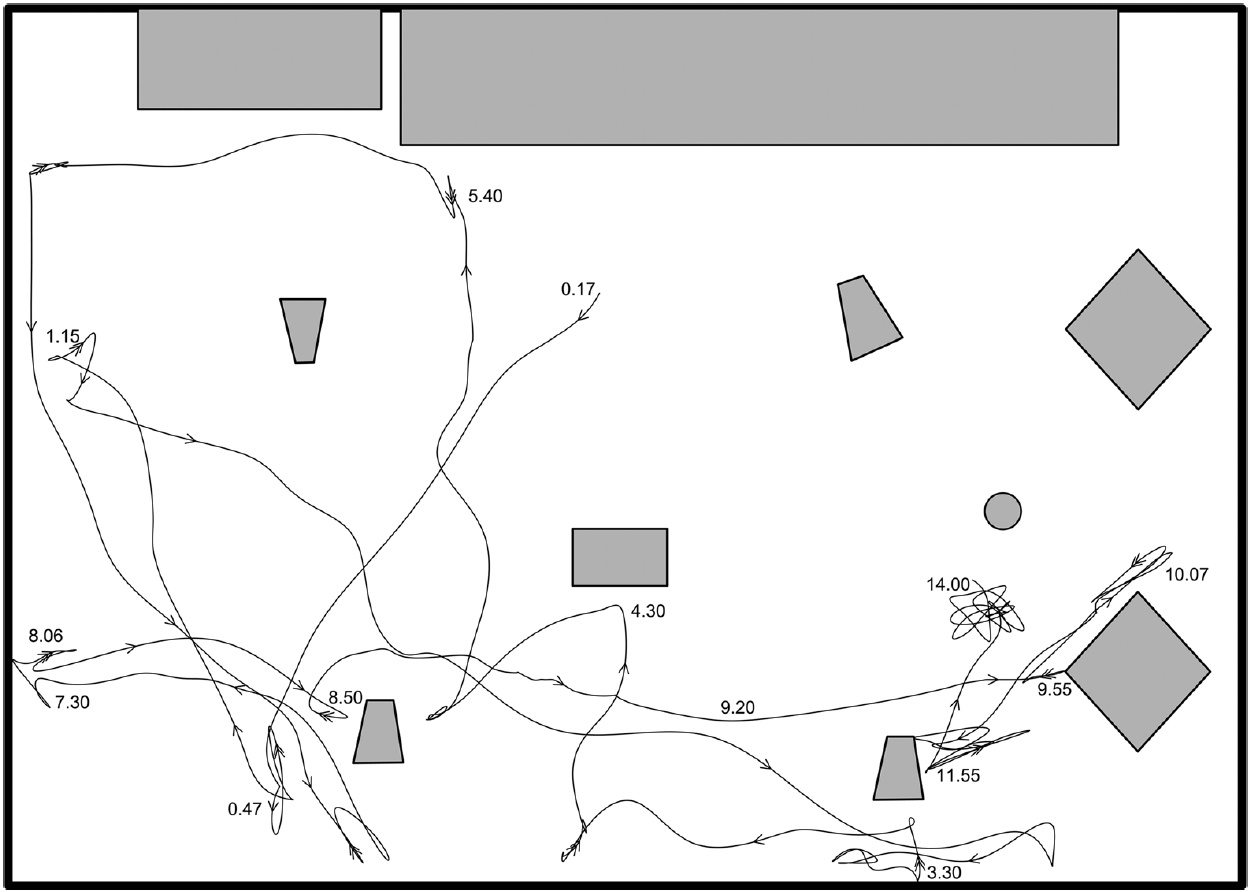
Figure 6, copied below, gives a trace of the movement behavior of the robot during a trial run lasting about 14 minutes.Â

• control of perceived light signal, with resspect to the highest memorized valueÂ
• control of the perceeived change in the signal Â
• control of the perception of a sequence of lower-level perceptions (more than three),
• contrrol of the perceived ultrasonic signal
• control of the sum of peerceived changes of internal values

RM: These variables, which are described more precisely in the Appendix to Rupert’s paper, are the “ground truth” regarding the perceptual variables that the robot is actually controlling; they and the references for their values, are the robot’s “psychology”. My proposal, which I will re-christen “psychological robotics”, is to show how one would go about testing to determine what variables the robot is actually controlling. That is, psychological robotics would be aimed at showing that the complex behavior that we see a robot (a simulated organism) producing is the control of perception. This would be a demonstration of how to find out what control systems – particularly living control systems, like humans – are controlling

MT: Think about Rupert's robot, and assume you don't know anything about

what it is supposed to be trying to do, but you can see it doing
whatever it does. You could see that it had “eyes”, so you might
think it would act in some way to changes in light, but would you
discover that it had a sense you don’t have (a proximity detector)?Â
Would you know to disturb a sensor you haven’t detected when doing
the Test? If you did know all its senses, what would you choose to
disturb? There are four levels in the actual design, with eight
perceptions being controlled all the time, but you, the tester,
don’t know that.

RM: That is, indeed, the research problem and psychological robotics would show how to do this kind of research – research aimed determining the perceptions the robot (qua organism) is controlling.Â

MT: Maybe you would guess that with "eyes" it was concerned with light,

but would you test whether the light direction mattered, or the
intensity, or the variety of colour patterns? Suppose the robot were
controlling for finding a zig-zag pattern of red and blue. Would you
test whether it had a surface texture sensor or an inclinometer and
was controlling for some level of surface smoothness, or looking for
a particular gradient? How would you use the TCV for that without
having some prior clue that something of the kind was being
controlled? Would you guess that you might need to test for some
perception you don’t have (such as a combination of light and
proximity), that links the inputs of sensors of different kinds?

 RM: All good questions that would be answered by the psychological robotics demonstration.Â

MT: If you actually did find someone to run the TCV with Rupert's robot

who had never seen the design, it would be very interesting if that
person could discover all the controlled variables and be able to
exclude other possibilities without dissecting the machine.

RM: This kind of demonstration could be done even by people who are very familiar with the perceptual variables that the robot is controlling. Rupert could do it himself. The person doing the testing would have to demonstrate that a variable is, indeed, controlled, by showing that it is protected from three or more different disturbances (I remember Bill saying somewhere that you were pretty safe in concluding that a variable is, indeed, under control if you can show that it is protected from at least 3 different disturbances – different variables that should have an effect on the hypothetical controlled variable if it were not under control).Â

RM: The rather complex behavior seen in Figure 6 is produced by a robot that is controlling perceptual variables that are also described verbally in section 7:

RM: People who know exactly what perception the robot is actually controlling will likely have an easier time coming up with such a test than will people who know nothing about what the robot is actually controlling (the position we are in when studying actual, living control systems) . But I psychological robotics, even if done by those already familiar with the psychology of the robot under study, Â would be a great way to show psychologists how to do the new kind of research implied by PCT – research aimed at determining the variables that control systems actually control. I believe that if this kind of research is demonstrated to psychologists in a clear, concrete manner some might be willing to take it up. Wouldn’t that be terrific and a wonderful way to honor Powers’ legacy? I sure think it would.Â

BestÂ

Rick

Richard S. MarkenÂ

"Perfection is achieved not when you have nothing more to add, but when you
have nothing left to take away.�
                --Antoine de Saint-Exupery

[From Rick Marken (2017.06.04.1400)]

RM: One more point. I should mention that the robot’s movements shown in Figure 6 of Rupert’s paper (again copied below) would provide a nice test of my analysis of the power law of movement. I predict that, when properly filtered, the movements of the robot will be found to follow a power law relationship between movement curvature and velocity, the exponent of which will deviate from 1/3 (or 2/3 depending on how curvature and velocity are measured) by an amount that depends on the bias resulting from not including the “cross product” variable in the analysis (see Marken, R. and Shaffer, D. (2017)
The Power Law of Movement: An Example of a Behavioral Illusion, Experimental Brain Research, 235,
1835–1842). Rupert, if you have the x,y coordinates of the movementts of the robot for a trial like that shown in Figure 6 I’d like to see what a power law analysis produces.

BestÂ

Rick

image361.jpg

···


Richard S. MarkenÂ

"Perfection is achieved not when you have nothing more to add, but when you
have nothing left to take away.�
                --Antoine de Saint-Exupery

[Martin Taylor 2017.06.04.16.0]

[From Rick Marken (2017.06.04.1330)]

Yes, that was the core of my point. Rupert could design any

higher-level perceptual functions he wanted. Because he did, there
is no assurance that the controlled perceptions correspond to
anything we would say is “out there in the real world”. A
reorganizing system is biased toward generating perceptions that
help it survive and propagate its design by acting on the real world
to control the perceptions it creates. If it has sensors and
effectors very like yours, it is likely to create perceptions that
you would be able to perceive as if they were in the real world. But
if its sensors are not like yours, neither will its perceptions be
reorganized to be like yours, and you won’t see in the “real world”
what it will.

Since Rupert designed the robot without reorganization, you will

have the ground truth you want (but see below for why that might not
be strictly true), but you will also know that the possible
perceptual functions are ones Rupert could imagine might be useful
for the tasks he wanted the robot to achieve. Whether the sensors
are like yours or quite different, yours are like Rupert’s.

      • complete rotation of the unit

searching for the highest light value,

      • partial rotation to fixate on

the light target,

      • movement towards the target,

adjusting the orientation, if away from the target,

      • repetition of a sequence of

(above three) behaviors,

      • avoidance of obstacles


      • recovery from being stuck in

dead-end situations.

The tester must not know this if the demonstration is to mean

anything at all. To discover that the robot can act in those ways * and
no others* is a critical part of the test. Once you know these
things, you already have a fair guide as to what perceptions are
being controlled. It’s by no means perfect, as Rupert showed in (I
think) his thesis by referring to the complex observable
“behaviours” in the Game of Life. But it’s a big head start.

What guarantee do you have that they are the only ones such a robot

might be controlling if you don’t have access to Rupert or his
designs, but only to the robot?

Yes, that is what I thought. I asked how you would do this when you

don’t even know what sensors if might have available to it or what
behaviours it may exhibit, given circumstances you may not think of
exposing it to.

You can show that easily enough. Rupert has done it. You are talking

about doing a functional re-engineering of the robot. There may be
other ways of building a perceptual control robot that could do
these same things. Would the tests be wrong if they came up with
that robot rather than Rupert’s one? Suppose the robot contained a
powerful computer than could do all the calculations the “Predictive
Control” people would ask for so as to compute the right way to
compensate for disturbances in real time? Could anything other than
Occam’s razor distinguish the results?

How would you go about such research? Can you see a way of refining

the search space for the possibly controlled perceptions?

I don't think so. It would be like hiding a toy behind the sofa and

telling the kid “Go find your toy. It’s behind the sofa.” Not a very
good demonstration of a technique for discovering what might
possibly be controlled and then distinguishing the correct one (or
rather the correct eight) from among the set of possibilities.

I suppose it depends on what you mean by "different disturbances".

How would you disturb, say, the proximity detector other than by
changing the robot’s proximity to walls? But showing that a variable
can be controlled is nothing new. “Big Dog” does a pretty good job
of correcting for some pretty dramatic disturbances
https://www.youtube.com/watch?v=cNZPRsrwumQ . Is it a
perceptual control robot?

That's a very different issue. If all you want to do is demonstrate

that control is happening in relation to perceptions you already
know, I doubt that many would be very interested. That’s nothing
new. To show that it is being done without any complex computations
in the robot is interesting.

Sure, if you could do it without knowing the answers before you

start.

Martin

···

Martin Taylor (2017.06.03.11.56)–

            MT: There's a problem here, because it is a

two-edged sword. Unless the robot has developed its own
perceptual functions by reorganization, they have been
designed in so that the robot can do a certain list of
tasks. If it has reorganized, it will be controlling
functions that create perceptions of common patterns in
the real world that help it to fulfill its “Prime
Directive(s)” (aka Intrinsic Variables), but you won’t
have ground truth for your tests.

          RM: I don't get how re-organization relates to this --

there is no reorganizing going on in Rupert’s model.

                        RM: But the post you are responding to

was my suggestion about using robots, such
as the ones developed by Rupert, to
illustrate how to do research aimed at
understanding the behavior of controllers:
psychrobotics. Since you are interested in
PCT research I wonder what you think of this
way of demonstrating how to do it?

          But let me describe what I had in mind in little more

detail.Â

          RM: In section 7 of his paper Rupert gives a verbal

description of some of the robot’s behaviors. Here’s his
list:

          Figure 6, copied below, gives a trace of the movement

behavior of the robot during a trial run lasting about 14
minutes.Â

            • control of perceived

light signal, with respect to the highest memorized
valueÂ

            • control of the perceived change in the signal ÂÂ 

            • control of the perception of a sequence of lower--level

perceptions (more than three),

            • control of the perceived ultrasonic signal


            • control of the sum of perceived changes of internnal

values

          RM: These variables, which are described more precisely

in the Appendix to Rupert’s paper, are the “ground truth”
regarding the perceptual variables that the robot is
actually controlling; they and the references for their
values, are the robot’s “psychology”.

              RM: The rather complex behavior

seen in Figure 6 is produced by a robot that is
controlling perceptual variables that are also
described verbally in section 7:

          My proposal, which I will re-christen "psychological

robotics", is to show how one would go about testing to
determine what variables the robot is actually
controlling.

          That is, psychological robotics would be aimed at

showing that the complex behavior that we see a robot (a
simulated organism) producing is the control of
perception.

          This would be a demonstration of how to find out what

control systems – particularly living control systems,
like humans – are controlling

            MT: Think about Rupert's robot, and

assume you don’t know anything about what it is supposed
to be trying to do, but you can see it doing whatever it
does. You could see that it had “eyes”, so you might
think it would act in some way to changes in light, but
would you discover that it had a sense you don’t have (a
proximity detector)? Would you know to disturb a sensor
you haven’t detected when doing the Test? If you did
know all its senses, what would you choose to disturb?
There are four levels in the actual design, with eight
perceptions being controlled all the time, but you, the
tester, don’t know that.

          RM: That is, indeed, the research problem and

psychological robotics would show how to do this kind of
research – research aimed determining the perceptions the
robot (qua organism) is controlling.

            MT: Maybe you would guess that with "eyes" it was

concerned with light, but would you test whether the
light direction mattered, or the intensity, or the
variety of colour patterns? Suppose the robot were
controlling for finding a zig-zag pattern of red and
blue. Would you test whether it had a surface texture
sensor or an inclinometer and was controlling for some
level of surface smoothness, or looking for a particular
gradient? How would you use the TCV for that without
having some prior clue that something of the kind was
being controlled? Would you guess that you might need to
test for some perception you don’t have (such as a
combination of light and proximity), that links the
inputs of sensors of different kinds?

          Â RM: All good questions that would be answered by the

psychological robotics demonstration.Â

            MT: If you actually did find someone to run the TCV with

Rupert’s robot who had never seen the design, it would
be very interesting if that person could discover all
the controlled variables and be able to exclude other
possibilities without dissecting the machine.

      RM: This kind of demonstration could be done even by people

who are very familiar with the perceptual variables that the
robot is controlling.

        Rupert could do it himself.  The

person doing the testing would have to demonstrate that a
variable is, indeed, controlled, by showing that it is
protected from three or more different disturbances (I
remember Bill saying somewhere that you were pretty safe in
concluding that a variable is, indeed, under control if you
can show that it is protected from at least 3 different
disturbances – different variables that should have an effect
on the hypothetical controlled variable if it were not under
control).

      RM: People who know exactly what

perception the robot is actually controlling will likely have
an easier time coming up with such a test than will people who
know nothing about what the robot is actually controlling (the
position we are in when studying actual, living control
systems) . But I psychological robotics, even if done by those
already familiar with the psychology of the robot under study,
 would be a great way to show psychologists how to do the new
kind of research implied by PCT – research aimed at
determining the variables that control systems actually
control. I believe that if this kind of research is
demonstrated to psychologists in a clear, concrete manner some
might be willing to take it up.

      Wouldn't that be terrific and a

wonderful way to honor Powers’ legacy? I sure think it would.

[Martin Taylor 2017.06.04.17.41]

You would need x, y, t. If the x,y,samples are taken uniformly in

time, though, you already have t. It would indeed be interesting to
know whether the power law applies, and if so, what is the exponent,
which in physiological organisms varies mostly between 1/4 and 1/3.
I haven’t seen your answer to the question I have asked more than
once: If you have asked, what was the editor’s response?
Martin

···

On 2017/06/4 5:00 PM, Richard Marken
wrote:

[From Rick Marken (2017.06.04.1400)]

      RM: One more point. I should mention that the robot's

movements shown in Figure 6 of Rupert’s paper (again copied
below) would provide a nice test of my analysis of the power
law of movement. I predict that, when properly filtered, the
movements of the robot will be found to follow a power law
relationship between movement curvature and velocity, the
exponent of which will deviate from 1/3 (or 2/3 depending on
how curvature and velocity are measured) by an amount that
depends on the bias resulting from not including the “cross
product” variable in the analysis ( see Marken, R. and Shaffer, D. (2017)
The Power Law of Movement: An Example of a Behavioral
Illusion, Experimental Brain Research , 235,
1835–1842). Rupert, if you have the x,y coordinates of the
movements of the robot for a trial like that shown in Figure
6 I’d like to see what a power law analysis produces.

  •  Have you asked the journal editor to get a couple of (or
    

even one) mathematically competent referee to determine whether
the confusion at the start of the paper between d/ds and d/dt
invalidates the rest of the paper or is irrelevant to the
following discussion?*

[From Rick Marken (2017.06.04.1830)]

···

Martin Taylor (2017.06.04.16.0)–

MT: Yes, that was the core of my point. Rupert could design any

higher-level perceptual functions he wanted. Because he did, there
is no assurance that the controlled perceptions correspond to
anything we would say is “out there in the real world”.

RM: If the robot can perceive the variable then clearly a device can be built that monitors the variable while the robot is controlling it. The Test does not depend on the observer’s ability to perceive the controlled variable with their own perceptual systems.Â

Â

MT: Since Rupert designed the robot without reorganization, you will

have the ground truth you want (but see below for why that might not
be strictly true), but you will also know that the possible
perceptual functions are ones Rupert could imagine might be useful
for the tasks he wanted the robot to achieve. Whether the sensors
are like yours or quite different, yours are like Rupert’s.

RM: I’m getting the impression that you think that it is impossible to test for controlled variables. Â

      • complete rotation of the unit

searching for the highest light value,

      • partial rotation to fixate on

the light target,

      • movement towards the target,

adjusting the orientation, if away from the target,

      • repetition of a sequence of

(above three) behaviors,

      • avoidance of obstacles


      • recovery from being stuck in

dead-end situations

MT: The tester must not know this if the demonstration is to mean

anything at all.

RM: This is not true (an alt-fact?). The above are just Rupert’s names for some of the overt behaviors he sees. They certainly hint at what perceptions are controlled (and they are surely influenced by his knowledge of what perceptions are controlled) but when you are testing for controlled variables these behavior descriptions are irrelevant.

MT: Yes, that is what I thought. I asked how you would do this when you

don’t even know what sensors if might have available to it or what
behaviours it may exhibit, given circumstances you may not think of
exposing it to.

RM: Ah, more reasons why it’s impossible to do PCT research. I’m sorry, I don’t remember Powers ever mentioning anything about having to know what sensors are available to the organism before one is able to do The Test.

MT: You can show that easily enough. Rupert has done it.

RM: True. But psychological robotics demonstrates how we can understand the apparently very complex behavior of a control system (such as a robot or human being) by learning what variables it is controlling.Â

MT: You are talking

about doing a functional re-engineering of the robot.

RM: No, a reverse engineering of the robot. This is what we are doing when we try to understand the behavior of systems, like people, that were built by evolution rather than roboticists.

Â

MT: How would you go about such research? Can you see a way of refining

the search space for the possibly controlled perceptions?

RM: Of course. You look at the behavior for hints of what is being controlled, such as proximity to objects. Then you hypothesize specific controlled variables, like reflected sounds, reflected light, etc. Then you introduce disturbances that should affect the affected variable and see if they are effective.Â

MT: I don't think so. It would be like hiding a toy behind the sofa and

telling the kid “Go find your toy. It’s behind the sofa.” Not a very
good demonstration of a technique for discovering what might
possibly be controlled and then distinguishing the correct one (or
rather the correct eight) from among the set of possibilities.

RM: Now I’m sure that this would be a useful demonstration. I hope I can manage to implement it. I think this should be my next project. I hope it’s as convincing as the power law analysis;-)

MT: Sure, if you could do it without knowing the answers before you

start.

RM: Well, that’s better than “no”:wink:

          RM: I don't get how re-organization relates to this --

there is no reorganizing going on in Rupert’s model.

          RM: But let me describe what I had in mind in little more

detail.Â

          RM: In section 7 of his paper Rupert gives a verbal

description of some of the robot’s behaviors. Here’s his
list:

          RM: My proposal, which I will re-christen "psychological

robotics", is to show how one would go about testing to
determine what variables the robot is actually
controlling.

          RM: That is, psychological robotics would be aimed at

showing that the complex behavior that we see a robot (a
simulated organism) producing is the control of
perception.

            MT: Think about Rupert's robot, and

assume you don’t know anything about what it is supposed
to be trying to do, but you can see it doing whatever it
does. You could see that it had “eyes”, so you might
think it would act in some way to changes in light, but
would you discover that it had a sense you don’t have (a
proximity detector)? Would you know to disturb a sensor
you haven’t detected when doing the Test? If you did
know all its senses, what would you choose to disturb?
There are four levels in the actual design, with eight
perceptions being controlled all the time, but you, the
tester, don’t know that.

          RM: That is, indeed, the research problem and

psychological robotics would show how to do this kind of
research – research aimed determining the perceptions the
robot (qua organism) is controlling.Â

      RM: This kind of demonstration could be done even by people

who are very familiar with the perceptual variables that the
robot is controlling.

      RM: Wouldn't that be terrific and a

wonderful way to honor Powers’ legacy? I sure think it would.Â

BestÂ

Rick


Richard S. MarkenÂ

"Perfection is achieved not when you have nothing more to add, but when you
have nothing left to take away.�
                --Antoine de Saint-Exupery

[From John Kirkland (2017.06.05.0646 Israeli time)]

I wonder, here’s a bit of a challenge for tackling controlled variables apparently not pre-programmed and almost independent of human-specific design. It’s another starting point: what could be the algorithms Alphago has designed for itself as a machine learning device? They’re certainly better than any human competitors’ ones.

Imagine some consequences of the new world opening up here. Apart as the usual suspects of sport-game analyses, warfare, riot control, etc. perhaps consider getting out of the stock market which will be levered in ways never seen before.

Is PCT behind the 8 ball here?Â

There’s a plethora of stuff on WWW regarding Alphago

https://www.elektormagazine.com/news/alphago-v-man-3-0-the-dawn-of-aiÂ

Enjoy

JohnK

···

On Mon, Jun 5, 2017 at 1:31 PM, Richard Marken rsmarken@gmail.com wrote:

[From Rick Marken (2017.06.04.1830)]

Martin Taylor (2017.06.04.16.0)–

MT: Yes, that was the core of my point. Rupert could design any

higher-level perceptual functions he wanted. Because he did, there
is no assurance that the controlled perceptions correspond to
anything we would say is “out there in the real world”.

RM: If the robot can perceive the variable then clearly a device can be built that monitors the variable while the robot is controlling it. The Test does not depend on the observer’s ability to perceive the controlled variable with their own perceptual systems.Â

Â

MT: Since Rupert designed the robot without reorganization, you will

have the ground truth you want (but see below for why that might not
be strictly true), but you will also know that the possible
perceptual functions are ones Rupert could imagine might be useful
for the tasks he wanted the robot to achieve. Whether the sensors
are like yours or quite different, yours are like Rupert’s.

RM: I’m getting the impression that you think that it is impossible to test for controlled variables. Â

      • complete rotation of the unit

searching for the highest light value,

      • partial rotation to fixate on

the light target,

      • movement towards the target,

adjusting the orientation, if away from the target,

      • repetition of a sequence of

(above three) behaviors,

      • avoidance of obstacles


      • recovery from being stuck in

dead-end situations

MT: The tester must not know this if the demonstration is to mean

anything at all.

RM: This is not true (an alt-fact?). The above are just Rupert’s names for some of the overt behaviors he sees. They certainly hint at what perceptions are controlled (and they are surely influenced by his knowledge of what perceptions are controlled) but when you are testing for controlled variables these behavior descriptions are irrelevant.

MT: Yes, that is what I thought. I asked how you would do this when you

don’t even know what sensors if might have available to it or what
behaviours it may exhibit, given circumstances you may not think of
exposing it to.

RM: Ah, more reasons why it’s impossible to do PCT research. I’m sorry, I don’t remember Powers ever mentioning anything about having to know what sensors are available to the organism before one is able to do The Test.

MT: You can show that easily enough. Rupert has done it.

RM: True. But psychological robotics demonstrates how we can understand the apparently very complex behavior of a control system (such as a robot or human being) by learning what variables it is controlling.Â

MT: You are talking

about doing a functional re-engineering of the robot.

RM: No, a reverse engineering of the robot. This is what we are doing when we try to understand the behavior of systems, like people, that were built by evolution rather than roboticists.

Â

MT: How would you go about such research? Can you see a way of refining

the search space for the possibly controlled perceptions?

RM: Of course. You look at the behavior for hints of what is being controlled, such as proximity to objects. Then you hypothesize specific controlled variables, like reflected sounds, reflected light, etc. Then you introduce disturbances that should affect the affected variable and see if they are effective.Â

MT: I don't think so. It would be like hiding a toy behind the sofa and

telling the kid “Go find your toy. It’s behind the sofa.” Not a very
good demonstration of a technique for discovering what might
possibly be controlled and then distinguishing the correct one (or
rather the correct eight) from among the set of possibilities.

RM: Now I’m sure that this would be a useful demonstration. I hope I can manage to implement it. I think this should be my next project. I hope it’s as convincing as the power law analysis;-)

MT: Sure, if you could do it without knowing the answers before you

start.

RM: Well, that’s better than “no”:wink:

          RM: I don't get how re-organization relates to this --

there is no reorganizing going on in Rupert’s model.

          RM: But let me describe what I had in mind in little more

detail.Â

          RM: In section 7 of his paper Rupert gives a verbal

description of some of the robot’s behaviors. Here’s his
list:

          RM: My proposal, which I will re-christen "psychological

robotics", is to show how one would go about testing to
determine what variables the robot is actually
controlling.

          RM: That is, psychological robotics would be aimed at

showing that the complex behavior that we see a robot (a
simulated organism) producing is the control of
perception.

            MT: Think about Rupert's robot, and

assume you don’t know anything about what it is supposed
to be trying to do, but you can see it doing whatever it
does. You could see that it had “eyes”, so you might
think it would act in some way to changes in light, but
would you discover that it had a sense you don’t have (a
proximity detector)? Would you know to disturb a sensor
you haven’t detected when doing the Test? If you did
know all its senses, what would you choose to disturb?
There are four levels in the actual design, with eight
perceptions being controlled all the time, but you, the
tester, don’t know that.

          RM: That is, indeed, the research problem and

psychological robotics would show how to do this kind of
research – research aimed determining the perceptions the
robot (qua organism) is controlling.Â

      RM: This kind of demonstration could be done even by people

who are very familiar with the perceptual variables that the
robot is controlling.

      RM: Wouldn't that be terrific and a

wonderful way to honor Powers’ legacy? I sure think it would.Â

BestÂ

Rick


Richard S. MarkenÂ

"Perfection is achieved not when you have nothing more to add, but when you
have nothing left to take away.�
                --Antoine de Saint-Exupery

[From Rick Marken (2017.06.04.2145)]

···

Martin Taylor (2017.06.04.17.41)–

      RM: One more point. I should mention that the robot's

movements shown in Figure 6 of Rupert’s paper (again copied
below) would provide a nice test of my analysis of the power
law of movement. I predict that, when properly filtered, the
movements of the robot will be found to follow a power law
relationship between movement curvature and velocity, the
exponent of which will deviate from 1/3 (or 2/3 depending on
how curvature and velocity are measured) by an amount that
depends on the bias resulting from not including the “cross
product” variable in the analysis ( see Marken, R. and Shaffer, D. (2017)
The Power Law of Movement: An Example of a Behavioral
Illusion, Experimental Brain Research , 235,
1835–1842). Rupert, if you have the x,y coordinates of the
movements of the robot for a trial like that shown in Figure
6 I’d like to see what a power law analysis produces.

MT: You would need x, y, t. If the x,y,samples are taken uniformly in

time, though, you already have t. It would indeed be interesting to
know whether the power law applies, and if so, what is the exponent,
which in physiological organisms varies mostly between 1/4 and 1/3.

MT: I haven't seen your answer to the question I have asked more than

once: * Have you asked the journal editor to get a couple of (or
even one) mathematically competent referee to determine whether
the confusion at the start of the paper between d/ds and d/dt
invalidates the rest of the paper or is irrelevant to the
following discussion?*

RM: Here was my answer (from May 30th):Â

RM: That would be kind of silly, wouldn’t it.  "Dear editor, Please get someone mathematically capable to check our “Power Law of Movement" paper because I’m pretty sure I confused derivatives with respect to time with derivatives with respect to distance. I really shouldn’t have submitted the paper, having made this egregious mistake, but now that it’s there in your possession – and it’s been accepted for publication, even – I think you should find someone who can tell you that the paper should have been rejected. Thanks. Sincerely…”
Â

RM: Actually, I did get another friend of mine from RAND – an internationally renowned mathematical economist (student of Nobelist Kenneth Arrow) – to review the published paper and he thought it was great. I was kind of nervous about having him read it because he had given me a hard time when I interviewed for the position at RAND.Â
Â

RM: I suggest that if you really think the power law paper is not scientifically accurate you write a rebuttal to it for publication in Experimental Brain Research. For all I know, Alex may be doing that right now. Shortly after the paper came out he asked me for [and I promptly sent him] the data on which I based the analysis in the paper. At the same time I asked him for his “fly larva” data, which was available on the net but I couldn’t use because it was in Matlab format. Alex said he would send me a tab limited version of the data; that was two months ago. I think the analysis in the power law paper is pretty iron clad but maybe Alex will be able to find the mistake and I’ll have learned something quite amazing.Â

Best

Rick

If you have asked, what was the editor’s response?

Â


Richard S. MarkenÂ

"Perfection is achieved not when you have nothing more to add, but when you
have nothing left to take away.�
                --Antoine de Saint-Exupery

[From Rick Marken (2017.06.04.2210)]

···

John Kirkland (2017.06.05.0646 Israeli time)–

JK: I wonder, here’s a bit of a challenge for tackling controlled variables apparently not pre-programmed and almost independent of human-specific design. It’s another starting point: what could be the algorithms Alphago has designed for itself as a machine learning device? They’re certainly better than any human competitors’ ones.

JK: Imagine some consequences of the new world opening up here. Apart as the usual suspects of sport-game analyses, warfare, riot control, etc. perhaps consider getting out of the stock market which will be levered in ways never seen before.

JK: Is PCT behind the 8 ball here?Â

JK: There’s a plethora of stuff on WWW regarding Alphago

https://www.elektormagazine.com/news/alphago-v-man-3-0-the-dawn-of-aiÂ

RM: I’m not sure I understand what you are asking (or challenging PCT to) but it should be possible to determine the variables controlled by game playing programs. With Alpha-go, the first thing you would need is an expert go player. Then you would explain to him (or, better, her) how the test works. Then the go player would test for controlled variables by setting up board configurations and seeing how the machine replies. The go players moves are disturbances to the hypothetical variables the machine is controlling for. The go player would have to be able to reset the board to identical positions to see how the machine replies to different moves. Presumably the go player would be able to tell what aspects of the state of the game Alpha-go is controlling for because they are presumably the kind of states that the go player would be controlling for as well.Â

RM: I’ve played go and I never really got very good at it (and that was a long time ago) so I can’t give examples of the kinds of things the machine might be controlling for. But I used to play a bit of chess and so I know that the perceptions a chess playing program would control for are things like “control of the center”, material advantage", etc. A good chess player could pretty easily test to see if the machine is controlling for any of these things. I’m not saying that testing for these controlled variables would be easy; and if the machine really is constantly reorganizing it may be virtually impossible. But I don’t think the machine advantage in games comes from their ability to control for particularly snazzy perceptual states of the game. It probably comes from that and the fact that machine memory is so much better than human memory.Â

RM: Shalom (if only).Â

BestÂ

Rick

Richard S. MarkenÂ

"Perfection is achieved not when you have nothing more to add, but when you
have nothing left to take away.�
                --Antoine de Saint-Exupery

[Eetu Pikkarainen 2017-06-05]

Rick and Martin

Is my next very simplistic understanding about your dialogue at all on the right track?

While Martin wants that PCT research should try to develop a theory about how control of perception generally functions
and develops in a real world,

Rick has perhaps a somewhat more limited approach. In those demos I have seen there are typically some two, three or more
alternatives i.e. different changing variables from which the test person may choose what she tries to control. Then there is an build in TCV in the demo which resolves (on the basis of the stabilization against the disturbances that the program causes to
the variables) which one of the alternatives is actually controlled by the test person (and also how well it is controlled).

Now the “psychological roboticsâ€? does perhaps not offer general knowledge especially about the development of control
in a real world because the robots are designed but humans.

Then we may know, from design, what are the (build in) alternatives of the robots which they can control. Now I think
it is well possible, quit similarly like in those demos, to try to test which alternative variable(s) the robot is currently controlling.

This kind of research can give a new and interesting, simplified description of the phenomenon of control and the idea
of the TCV. (And perhaps it could be utilized in developing and beta testing new and better robots.)

image00287.png

···

Eetu

From: Martin Taylor [mailto:mmt-csg@mmtaylor.net]
Sent: 5. kesäkuuta 2017 0:31
To: csgnet@lists.illinois.edu
Subject: Re: PCT Research

[Martin Taylor 2017.06.04.16.0]

[From Rick Marken (2017.06.04.1330)]

Martin Taylor (2017.06.03.11.56)–

RM: But the post you are responding to was my suggestion about using robots, such as the ones developed by Rupert, to illustrate how to do research aimed at understanding the behavior of controllers: psychrobotics. Since you are interested
in PCT research I wonder what you think of this way of demonstrating how to do it?

MT: There’s a problem here, because it is a two-edged sword. Unless the robot has developed its own perceptual functions by reorganization, they have been designed in so that the robot can do a certain list of tasks. If it has reorganized,
it will be controlling functions that create perceptions of common patterns in the real world that help it to fulfill its “Prime Directive(s)” (aka Intrinsic Variables), but you won’t have ground truth for your tests.

RM: I don’t get how re-organization relates to this – there is no reorganizing going on in Rupert’s model.

Yes, that was the core of my point. Rupert could design any higher-level perceptual functions he wanted. Because he did, there is no assurance that the controlled perceptions correspond to anything we would say is “out there in the real world”. A reorganizing
system is biased toward generating perceptions that help it survive and propagate its design by acting on the real world to control the perceptions it creates. If it has sensors and effectors very like yours, it is likely to create perceptions that you would
be able to perceive as if they were in the real world. But if its sensors are not like yours, neither will its perceptions be reorganized to be like yours, and you won’t see in the “real world” what it will.

Since Rupert designed the robot without reorganization, you will have the ground truth you want (but see below for why that might not be strictly true), but you will also know that the possible perceptual functions are ones Rupert could imagine might be useful
for the tasks he wanted the robot to achieve. Whether the sensors are like yours or quite different, yours are like Rupert’s.

But let me describe what I had in mind in little more detail.

RM: In section 7 of his paper Rupert gives a verbal description of some of the robot’s behaviors. Here’s his list:

• complete rotation of the unit searching foor the highest light value,

• partial rotation to fixate on the light target,

• movement towards the target, adjusting the orientation, if away ffrom the target,

• repetition of a sequence of (above three) behaviors,

• avoidance of obstacles

• recovery from being stuck in dead-end situations.

The tester must not know this if the demonstration is to mean anything at all. To discover that the robot can act in those ways
and no others is a critical part of the test. Once you know these things, you already have a fair guide as to what perceptions are being controlled. It’s by no means perfect, as Rupert showed in (I think) his thesis by referring to the complex observable
“behaviours” in the Game of Life. But it’s a big head start.

Figure 6, copied below, gives a trace of the movement behavior of the robot during a trial run lasting about 14 minutes.

RM: The rather complex behavior seen in Figure 6 is produced by a robot that is controlling perceptual variables that are also described verbally in section 7:

• control of perceived light signal, with respect to the highest memorized value

• control of the perceived change in the signal

• control of the perception of a sequence of lower-level perceptionns (more than three),

• control of the perceived ultrasonic signal

• control of the sum of perceived changes of internal values

/o:p>

RM: These variables, which are described more precisely in the Appendix to Rupert’s paper, are the “ground truth” regarding the perceptual variables that the robot is actually controlling; they and the references for their values, are the
robot’s “psychology”.

What guarantee do you have that they are the only ones such a robot might be controlling if you don’t have access to Rupert or his designs, but only to the robot?

My proposal, which I will re-christen “psychological robotics”, is to show how one would go about testing to determine what variables the robot is actually controlling.

Yes, that is what I thought. I asked how you would do this when you don’t even know what sensors if might have available to it or what behaviours it may exhibit, given circumstances you may not think of exposing it to.

That is, psychological robotics would be aimed at showing that the complex behavior that we see a robot (a simulated organism) producing is the control of perception.

You can show that easily enough. Rupert has done it. You are talking about doing a functional re-engineering of the robot. There may be other ways of building a perceptual control robot that could do these same things. Would the tests be wrong if they came
up with that robot rather than Rupert’s one? Suppose the robot contained a powerful computer than could do all the calculations the “Predictive Control” people would ask for so as to compute the right way to compensate for disturbances in real time? Could
anything other than Occam’s razor distinguish the results?

This would be a demonstration of how to find out what control systems – particularly living control systems, like humans – are controlling

MT: Think about Rupert’s robot, and assume you don’t know anything about what it is supposed to be trying to do, but you can see it doing whatever it does. You could see that it had “eyes”, so you might think it would act in some way to
changes in light, but would you discover that it had a sense you don’t have (a proximity detector)? Would you know to disturb a sensor you haven’t detected when doing the Test? If you did know all its senses, what would you choose to disturb? There are four
levels in the actual design, with eight perceptions being controlled all the time, but you, the tester, don’t know that.

RM: That is, indeed, the research problem and psychological robotics would show how to do this kind of research – research aimed determining the perceptions the robot (qua organism) is controlling.

How would you go about such research? Can you see a way of refining the search space for the possibly controlled perceptions?

MT: Maybe you would guess that with “eyes” it was concerned with light, but would you test whether the light direction mattered, or the intensity, or the variety of colour patterns? Suppose the robot were controlling for finding a zig-zag pattern of red and
blue. Would you test whether it had a surface texture sensor or an inclinometer and was controlling for some level of surface smoothness, or looking for a particular gradient? How would you use the TCV for that without having some prior clue that something
of the kind was being controlled? Would you guess that you might need to test for some perception you don’t have (such as a combination of light and proximity), that links the inputs of sensors of different kinds?

RM: All good questions that would be answered by the psychological robotics demonstration.

MT: If you actually did find someone to run the TCV with Rupert’s robot who had never seen the design, it would be very interesting if that person could discover all the controlled variables and be able to exclude other possibilities without dissecting the
machine.

RM: This kind of demonstration could be done even by people who are very familiar with the perceptual variables that the robot is controlling.

I don’t think so. It would be like hiding a toy behind the sofa and telling the kid “Go find your toy. It’s behind the sofa.” Not a very good demonstration of a technique for discovering what might possibly be controlled and then distinguishing the correct
one (or rather the correct eight) from among the set of possibilities.

Rupert could do it himself. The person doing the testing would have to demonstrate that a variable is, indeed, controlled, by showing that it is protected from three or more different disturbances (I remember Bill saying somewhere that
you were pretty safe in concluding that a variable is, indeed, under control if you can show that it is protected from at least 3 different disturbances – different variables that should have an effect on the hypothetical controlled variable if it were not
under control).

I suppose it depends on what you mean by “different disturbances”. How would you disturb, say, the proximity detector other than by changing the robot’s proximity to walls? But showing that a variable can be controlled is nothing new. “Big Dog” does a pretty
good job of correcting for some pretty dramatic disturbances [

https://www.youtube.com/watch?v=cNZPRsrwumQ](https://urldefense.proofpoint.com/v2/url?u=https-3A__www.youtube.com_watch-3Fv-3DcNZPRsrwumQ&d=DwMGaQ&c=8hUWFZcy2Z-Za5rBPlktOQ&r=-dJBNItYEMOLt6aj_KjGi2LMO_Q8QB-ZzxIZIF8DGyQ&m=2vXToHxhvU0XMM9ZOJottLy06zUoZtwi9TVUyv6w7-U&s=pQ93cOEqPW3VL1DKnOYHTmmPglKdfRqvuvF4GfpNZho&e=). Is it a perceptual control robot?

RM: People who know exactly what perception the robot is actually controlling will likely have an easier time coming up with such a test than will people who know nothing about what the robot is actually controlling (the position we are
in when studying actual, living control systems) . But I psychological robotics, even if done by those already familiar with the psychology of the robot under study, would be a great way to show psychologists how to do the new kind of research implied by
PCT – research aimed at determining the variables that control systems actually control. I believe that if this kind of research is demonstrated to psychologists in a clear, concrete manner some might be willing to take it up.

That’s a very different issue. If all you want to do is demonstrate that control is happening in relation to perceptions you already know, I doubt that many would be very interested. That’s nothing new. To show that it is being done without any complex computations
in the robot is interesting.

Wouldn’t that be terrific and a wonderful way to honor Powers’ legacy? I sure think it would.

Sure, if you could do it without knowing the answers before you start.

Martin

[Martin Taylor 2017.06.05.09.45]

[From Rick Marken (2017.06.04.2145)]

I apologize. I've never seen this message, for some reason.

Yes, such a message would be silly indeed. But that wasn't my

suggestion. My point, and this goes for your RAND colleague, is that
it’s all too easy for a reviewer to see an equation and think “that
must have been checked, so I will assume it is OK.” In this
particular case, it would be even easier for a reviewer to pass the
problem by, since the Newton dot notation is typically used for
differentiation with respect to time. It just isn’t, in this
particular case.

You refer to an earlier paper in which the authors used the "dotty"

notation to refer to differentiation with respect to distance along
an arc when providing a formula for curvature. So long as that
unusual use of the dot notation is kept in mind, their formula is
correct (I suppose it makes a cleaner-looking appearance on the
page). You were easily misled into thinking that they were
differentiating with respect to time, an easy mistake to make,
especially since the result is the same, if and only if the velocity
along the arc is constant.

The Wikipedia article on curvature uses the words "velocity" and

“acceleration” of x and y and uses the same formula for curvature,
meaning time derivatives, but does so only after setting up the
conditional that the along-arc velocity is constant at unity. I know
that the caveat is easy to miss, and I don’t blame you for missing
it initially. But since Alex corrected you a few hours after your
initial posting on this matter, the whole affair should have stopped
there and then.

Did you specifically ask him to check the point about the different

usages for the dot notation for differentiation, which at the time
had for weeks been the only bone of contention?

I had contemplated doing so, but I figured that the request for a

specific check on the specific issue would be more respectful of
your own integrity coming from you. You might say something like
this:

 "*      It has been brought to my attention that there might be a

critical issue with my published paper that was missed by myself,
by my colleagues who I asked for a review before submission, and
by your reviewers. The formula for curvature from which the
argument of the paper proceeds looks visually like a formula with
derivatives with respect to time, because of the use of the Newton
dot notation in the paper to which I referred. It has been brought
to my notice that this formula in fact uses differentiation with
respect to arc length and not time. I would appreciate it if you
would ask a mathematically inclined person to determine whether
this inadvertent error invalidates the rest of the paper and
requires its retraction, or whether the remainder should stand and
an erratum published with respect to the interpretation of the
basic curvature formula*."

All you will have learned is that time and distance are not always

the same thing, and that curvature is a property of space, not of
speed.

If you don't want to ask the editor to do the check, you could make

the same point to your RAND colleague and ask him whether we all
have been correct that the formula refers to differentiation with
respect to arc length and is improperly used in the paper as though
it referred to differentiation with respect to time, and how this
affects the rest of the argument.

I wouldn't normally persevere with this if it were only a private

matter within the CSGnet community. But since you went ahead and
published it without at least letting us know that a respected
independent authority had examined the question of whether it
matters to the following argument that you mixed up the two
different kinds of differentiation, I think it is important to sort
it out and get the formal literature corrected.

Either way, whether the error is or is not important to your

following argument, I think it is incumbent on you – not me, Alex,
or anyone else – to publish an erratum at the very minimum.
Anything less might lead readers to think that PCT is the preserve
of mathematical sloppiness, which is not something of which the
proponents of “Predictive Coding” can often be accused. That’s not
the best way to make someone think PCT is a concept worth pursuing
instead.

Martin
···

Martin Taylor (2017.06.04.17.41)–

            MT: I haven't seen your answer to the question I have

asked more than once: * Have you asked the journal
editor to get a couple of (or even one) mathematically
competent referee to determine whether the confusion
at the start of the paper between d/ds and d/dt
invalidates the rest of the paper or is irrelevant to
the following discussion?*

RM: Here was my answer (from May 30th):

            RM:

That would be kind of silly, wouldn’t it. “Dear editor,
Please get someone mathematically capable to check our “Power Law of
Movement” paper because
I’m pretty sure I confused derivatives with respect to
time with derivatives with respect to distance. I really
shouldn’t have submitted the paper ,
having made this egregious mistake, but now that it’s
there in your possession – and it’s been accepted for
publication, even – I think you should find someone who
can tell you that the paper should
have been rejected. Thanks. Sincerely…”

            RM:

Actually, I did get another friend of mine from RAND –
an internationally renowned mathematical economist
(student of Nobelist Kenneth Arrow) – to review the
published paper and
he thought it was great. I was kind of nervous about
having him read it because he had given me a hard time
when I interviewed for the position at RAND.

            RM:

I suggest that if you really think the power law paper is
not scientifically accurate you write a rebuttal to it
for publication in Experimental Brain Research.

            ...

I think the analysis in the power law paper is
pretty iron clad but maybe Alex will be able to find the
mistake and I’ll have learned something quite amazing.

[From Rick Marken (2017.06.05.0850)]

image00287.png

···

Eetu Pikkarainen (2017-06-05)–

Â

EP: Rick and Martin

Â

EP: Is my next very simplistic understanding about your dialogue at all on the right track?

RM: Here’s my take on it. I want to carry out the type of research program described in the “Experimental Methods” chapter of B:CP (both editions) and in Powers’ two research oriented papers, “Quantitative analysis of purposive systems” and  “A cybernetic model for research in human development”, both of which are reprinted in Living Control Systems I. This research program is aimed at identifying the perceptual variables around which behavior is organized – controlled variables – and developing models of how these variables are controlled. I don’t want to speak for Martin  in terms of the kind of research program he wants to carry out. But I think it’s pretty clear that the research Martin wants to do doesn’t include the central feature of the PCT-based research program envisioned by Powers – identifying controlled variables. Â

BestÂ

Rick

While Martin wants that PCT research should try to develop a theory about how control of perception generally functions
and develops in a real world,

Rick has perhaps a somewhat more limited approach. In those demos I have seen there are typically some two, three or more
alternatives i.e. different changing variables from which the test person may choose what she tries to control. Then there is an build in TCV in the demo which resolves (on the basis of the stabilization against the disturbances that the program causes to
the variables) which one of the alternatives is actually controlled by the test person (and also how well it is controlled).

Now the “psychological robotics� does perhaps not offer general knowledge especially about the development of control
in a real world because the robots are designed but humans.

Then we may know, from design, what are the (build in) alternatives of the robots which they can control. Now I think
it is well possible, quit similarly like in those demos, to try to test which alternative variable(s) the robot is currently controlling.

This kind of research can give a new and interesting, simplified description of the phenomenon of control and the idea
of the TCV. (And perhaps it could be utilized in developing and beta testing new and better robots.)

Â

Eetu

Â

From: Martin Taylor [mailto:mmt-csg@mmtaylor.net
]
Sent: 5. kesäkuuta 2017 0:31
To: csgnet@lists.illinois.edu
Subject: Re: PCT Research

Â

[Martin Taylor 2017.06.04.16.0]

[From Rick Marken (2017.06.04.1330)]

Martin Taylor (2017.06.03.11.56)–

RM: But the post you are responding to was my suggestion about using robots, such as the ones developed by Rupert, to illustrate how to do research aimed at understanding the behavior of controllers: psychrobotics. Since you are interested
in PCT research I wonder what you think of this way of demonstrating how to do it?

MT: There’s a problem here, because it is a two-edged sword. Unless the robot has developed its own perceptual functions by reorganization, they have been designed in so that the robot can do a certain list of tasks. If it has reorganized,
it will be controlling functions that create perceptions of common patterns in the real world that help it to fulfill its “Prime Directive(s)” (aka Intrinsic Variables), but you won’t have ground truth for your tests.

Â

RM: I don’t get how re-organization relates to this – there is no reorganizing going on in Rupert’s model.

Yes, that was the core of my point. Rupert could design any higher-level perceptual functions he wanted. Because he did, there is no assurance that the controlled perceptions correspond to anything we would say is “out there in the real world”. A reorganizing
system is biased toward generating perceptions that help it survive and propagate its design by acting on the real world to control the perceptions it creates. If it has sensors and effectors very like yours, it is likely to create perceptions that you would
be able to perceive as if they were in the real world. But if its sensors are not like yours, neither will its perceptions be reorganized to be like yours, and you won’t see in the “real world” what it will.

Since Rupert designed the robot without reorganization, you will have the ground truth you want (but see below for why that might not be strictly true), but you will also know that the possible perceptual functions are ones Rupert could imagine might be useful
for the tasks he wanted the robot to achieve. Whether the sensors are like yours or quite different, yours are like Rupert’s.

But let me describe what I had in mind in little more detail.Â

Â

RM: In section 7 of his paper Rupert gives a verbal description of some of the robot’s behaviors. Here’s his list:

• complete rotation of the unit searching foor the highest light value,

• partial rotation to fixate on the light target,

• movement towards the target, adjusting the orientation, if away ffrom the target,

• repetition of a sequence of (above three) behaviors,

• avoidance of obstacles

• recovery from being stuck in dead-end situations./p>

The tester must not know this if the demonstration is to mean anything at all. To discover that the robot can act in those ways
and no others is a critical part of the test. Once you know these things, you already have a fair guide as to what perceptions are being controlled. It’s by no means perfect, as Rupert showed in (I think) his thesis by referring to the complex observable
“behaviours” in the Game of Life. But it’s a big head start.

Â

Figure 6, copied below, gives a trace of the movement behavior of the robot during a trial run lasting about 14 minutes.Â

Â

RM: The rather complex behavior seen in Figure 6 is produced by a robot that is controlling perceptual variables that are also described verbally in section 7:

• control of perceived light signal, with respect to the highest memorized valueÂ

• control of the perceived change in the signal Â

• control of the perception of a sequence of lower-level perceptionns (more than three),

• control of the perceived ultrasonic signal

• control of the sum of perceived changes of internal values>

RM: These variables, which are described more precisely in the Appendix to Rupert’s paper, are the “ground truth” regarding the perceptual variables that the robot is actually controlling; they and the references for their values, are the
robot’s “psychology”.

What guarantee do you have that they are the only ones such a robot might be controlling if you don’t have access to Rupert or his designs, but only to the robot?

My proposal, which I will re-christen “psychological robotics”, is to show how one would go about testing to determine what variables the robot is actually controlling.

Yes, that is what I thought. I asked how you would do this when you don’t even know what sensors if might have available to it or what behaviours it may exhibit, given circumstances you may not think of exposing it to.

That is, psychological robotics would be aimed at showing that the complex behavior that we see a robot (a simulated organism) producing is the control of perception.

You can show that easily enough. Rupert has done it. You are talking about doing a functional re-engineering of the robot. There may be other ways of building a perceptual control robot that could do these same things. Would the tests be wrong if they came
up with that robot rather than Rupert’s one? Suppose the robot contained a powerful computer than could do all the calculations the “Predictive Control” people would ask for so as to compute the right way to compensate for disturbances in real time? Could
anything other than Occam’s razor distinguish the results?

This would be a demonstration of how to find out what control systems – particularly living control systems, like humans – are controlling

Â

MT: Think about Rupert’s robot, and assume you don’t know anything about what it is supposed to be trying to do, but you can see it doing whatever it does. You could see that it had “eyes”, so you might think it would act in some way to
changes in light, but would you discover that it had a sense you don’t have (a proximity detector)? Would you know to disturb a sensor you haven’t detected when doing the Test? If you did know all its senses, what would you choose to disturb? There are four
levels in the actual design, with eight perceptions being controlled all the time, but you, the tester, don’t know that.

Â

RM: That is, indeed, the research problem and psychological robotics would show how to do this kind of research – research aimed determining the perceptions the robot (qua organism) is controlling.

How would you go about such research? Can you see a way of refining the search space for the possibly controlled perceptions?

MT: Maybe you would guess that with “eyes” it was concerned with light, but would you test whether the light direction mattered, or the intensity, or the variety of colour patterns? Suppose the robot were controlling for finding a zig-zag pattern of red and
blue. Would you test whether it had a surface texture sensor or an inclinometer and was controlling for some level of surface smoothness, or looking for a particular gradient? How would you use the TCV for that without having some prior clue that something
of the kind was being controlled? Would you guess that you might need to test for some perception you don’t have (such as a combination of light and proximity), that links the inputs of sensors of different kinds?

Â

 RM: All good questions that would be answered by the psychological robotics demonstration.Â

MT: If you actually did find someone to run the TCV with Rupert’s robot who had never seen the design, it would be very interesting if that person could discover all the controlled variables and be able to exclude other possibilities without dissecting the
machine.

RM: This kind of demonstration could be done even by people who are very familiar with the perceptual variables that the robot is controlling.

I don’t think so. It would be like hiding a toy behind the sofa and telling the kid “Go find your toy. It’s behind the sofa.” Not a very good demonstration of a technique for discovering what might possibly be controlled and then distinguishing the correct
one (or rather the correct eight) from among the set of possibilities.

 Rupert could do it himself. The person doing the testing would have to demonstrate that a variable is, indeed, controlled, by showing that it is protected from three or more different disturbances (I remember Bill saying somewhere that
you were pretty safe in concluding that a variable is, indeed, under control if you can show that it is protected from at least 3 different disturbances – different variables that should have an effect on the hypothetical controlled variable if it were not
under control).

I suppose it depends on what you mean by “different disturbances”. How would you disturb, say, the proximity detector other than by changing the robot’s proximity to walls? But showing that a variable can be controlled is nothing new. “Big Dog” does a pretty
good job of correcting for some pretty dramatic disturbances [

https://www.youtube.com/watch?v=cNZPRsrwumQ](https://urldefense.proofpoint.com/v2/url?u=https-3A__www.youtube.com_watch-3Fv-3DcNZPRsrwumQ&d=DwMGaQ&c=8hUWFZcy2Z-Za5rBPlktOQ&r=-dJBNItYEMOLt6aj_KjGi2LMO_Q8QB-ZzxIZIF8DGyQ&m=2vXToHxhvU0XMM9ZOJottLy06zUoZtwi9TVUyv6w7-U&s=pQ93cOEqPW3VL1DKnOYHTmmPglKdfRqvuvF4GfpNZho&e=). Is it a perceptual control robot?

Â

RM: People who know exactly what perception the robot is actually controlling will likely have an easier time coming up with such a test than will people who know nothing about what the robot is actually controlling (the position we are
in when studying actual, living control systems) . But I psychological robotics, even if done by those already familiar with the psychology of the robot under study, Â would be a great way to show psychologists how to do the new kind of research implied by
PCT – research aimed at determining the variables that control systems actually control. I believe that if this kind of research is demonstrated to psychologists in a clear, concrete manner some might be willing to take it up.

That’s a very different issue. If all you want to do is demonstrate that control is happening in relation to perceptions you already know, I doubt that many would be very interested. That’s nothing new. To show that it is being done without any complex computations
in the robot is interesting.

Wouldn’t that be terrific and a wonderful way to honor Powers’ legacy? I sure think it would.

Sure, if you could do it without knowing the answers before you start.

Martin


Richard S. MarkenÂ

"Perfection is achieved not when you have nothing more to add, but when you
have nothing left to take away.�
                --Antoine de Saint-Exupery

[From Rick Marken (2017.06.05.1015)]

···

Martin Taylor (2017.06.05.09.45)–

MT: Yes, such a message would be silly indeed. But that wasn't my

suggestion.

RM: Here’s your suggestion: "*Have you asked the journal editor to get a couple of (or even one) mathematically competent referee to determine whether the confusion at the start of the paper between d/ds and d/dt invalidates the rest of the paper or is irrelevant to the following discussion?"Â *I think my message above follows your suggestion to a T.Â

Â

MT: My point, and this goes for your RAND colleague, is that

it’s all too easy for a reviewer to see an equation and think “that
must have been checked, so I will assume it is OK.” In this
particular case, it would be even easier for a reviewer to pass the
problem by, since the Newton dot notation is typically used for
differentiation with respect to time. It just isn’t, in this
particular case.

RM: That may have been your point. But it wasn’t your suggestion. Â

MT: I had contemplated doing so, but I figured that the request for a

specific check on the specific issue would be more respectful of
your own integrity coming from you.

RM: Thanks but I’m fine with my integrity.Â

MT: All you will have learned is that time and distance are not always

the same thing, and that curvature is a property of space, not of
speed.

RM: What I learned is described in the conclusion of the paper: the power law (as I had suspected) is an example of a behavioral illusion.

Â

MT: If you don't want to ask the editor to do the check, you could make

the same point to your RAND colleague and ask him whether we all
have been correct that the formula refers to differentiation with
respect to arc length and is improperly used in the paper as though
it referred to differentiation with respect to time, and how this
affects the rest of the argument.

RM: OK, I’ll ask him. But I already asked my other mathematical friends and they thought that idea was ridiculous; the derivatives in the equations for both velocity and curvature are with respect to time.Â

Â

MT: I wouldn't normally persevere with this if it were only a private

matter within the CSGnet community. But since you went ahead and
published it without at least letting us know that a respected
independent authority had examined the question of whether it
matters to the following argument that you mixed up the two
different kinds of differentiation, I think it is important to sort
it out and get the formal literature corrected.

RM: And I wrote up and successfully published my analysis of the power law of movement in the very journal where much of the power research has been published because it became depressingly clear to me that much of the CSGNet community and I are not on the same page with respect to PCT.Â

MT: Either way, whether the error is or is not important to your

following argument, I think it is incumbent on you – not me, Alex,
or anyone else – to publish an erratum at the very minimum.

RM: But that’s ridiculous because I don’t think there is any error and neither did my co-author or any of the reviewers. So it is clearly now incumbent on you or Alex or anyone else who thinks that there is an error in the analysis to make it public.Â

Â

MT: Anything less might lead readers to think that PCT is the preserve

of mathematical sloppiness, which is not something of which the
proponents of “Predictive Coding” can often be accused. That’s not
the best way to make someone think PCT is a concept worth pursuing
instead.

RM: Again, there is no mathematical sloppiness. And if our analysis of the power law of movement is wrong then PCT is wrong and output-generation models are right.Â

            RM:

That would be kind of silly, wouldn’t it. Â "Dear editor,
Please get someone mathematically capable to check our “Power Law  of
Movement" paper  because
I’m pretty sure I confused derivatives with respect to
time with derivatives with respect to distance. I really
shouldn’t have submitted the paper ,
having made this egregious mistake, but now that it’s
there in your possession – and it’s been accepted for
publication, even – I think you should find someone who
can tell you that the paper  should
have been rejected. Thanks. Sincerely…”

            RM:

I suggest that if you really think the power law paper  is
not scientifically accurate you write a rebuttal to it
for publication in Experimental Brain Research.

            RM:...

I think the analysis in the power law paper  is
pretty iron clad but maybe Alex will be able to find the
mistake and I’ll have learned something quite amazing.Â

BestÂ

Rick


Richard S. MarkenÂ

"Perfection is achieved not when you have nothing more to add, but when you
have nothing left to take away.�
                --Antoine de Saint-Exupery

[From Rick Marken (2017.06.05.0850)]

Eetu Pikkarainen (2017-06-05)–

EP: Rick and Martin

EP: Is my next very simplistic understanding about your dialogue at all on the right track?

RM: Here’s my take on it. I want to carry out the type of research program described in the “Experimental Methods” chapter of B:CP (both editions) and in Powers’ two research oriented papers, “Quantitative analysis of purposive systems” and “A cybernetic model for research in human development”, both of which are reprinted in Living Control Systems I. This research program is aimed at identifying the perceptual variables around which behavior is organized – controlled variables – and developing models of how these variables are controlled.

HB : And here is your fatal mistake There is not a question how thses variable are controlled. In your RCT theory it’s clear that behavior is always controlling »controlled variable«, which is for you always in outer enviromnent and it is introduced into organism through »Controlled Perceptual Variable«. You don’t need to manipulate. Say it straight.

RMÂ I don’t want to speak for Martin in terms of the kind of research program he wants to carry out. But I think it’s pretty clear that the research Martin wants to do doesn’t include the central feature of the PCT-based research program envisioned by Powers – identifying controlled variables.

HB : Bill Powers vision was all right. But yours is not. Your research program has nothing to do with Powers or with litearature you mentioned. I proved it many times even in time when Bill was with us.

It’s your own idea that you have always to control some »controlled variable« in environment with »Control of behavior«. It’s one of the biggest nonsence in history of PCT theory. If not so you just have to show evidences that you are right and I’m wrong.

Best,

Boris

Best

Rick

image00287.png

···

From: Richard Marken [mailto:rsmarken@gmail.com]
Sent: Monday, June 05, 2017 5:50 PM
To: csgnet@lists.illinois.edu
Subject: Re: PCT Research

While Martin wants that PCT research should try to develop a theory about how control of perception generally functions and develops in a real world,

Rick has perhaps a somewhat more limited approach. In those demos I have seen there are typically some two, three or more alternatives i.e. different changing variables from which the test person may choose what she tries to control. Then there is an build in TCV in the demo which resolves (on the basis of the stabilization against the disturbances that the program causes to the variables) which one of the alternatives is actually controlled by the test person (and also how well it is controlled).

Now the “psychological robotics� does perhaps not offer general knowledge especially about the development of control in a real world because the robots are designed but humans.

Then we may know, from design, what are the (build in) alternatives of the robots which they can control. Now I think it is well possible, quit similarly like in those demos, to try to test which alternative variable(s) the robot is currently controlling.

This kind of research can give a new and interesting, simplified description of the phenomenon of control and the idea of the TCV. (And perhaps it could be utilized in developing and beta testing new and better robots.)

Eetu

From: Martin Taylor [mailto:mmt-csg@mmtaylor.net]
Sent: 5. kesäkuuta 2017 0:31
To: csgnet@lists.illinois.edu
Subject: Re: PCT Research

[Martin Taylor 2017.06.04.16.0]

[From Rick Marken (2017.06.04.1330)]

Martin Taylor (2017.06.03.11.56)–

RM: But the post you are responding to was my suggestion about using robots, such as the ones developed by Rupert, to illustrate how to do research aimed at understanding the behavior of controllers: psychrobotics. Since you are interested in PCT research I wonder what you think of this way of demonstrating how to do it?

MT: There’s a problem here, because it is a two-edged sword. Unless the robot has developed its own perceptual functions by reorganization, they have been designed in so that the robot can do a certain list of tasks. If it has reorganized, it will be controlling functions that create perceptions of common patterns in the real world that help it to fulfill its “Prime Directive(s)” (aka Intrinsic Variables), but you won’t have ground truth for your tests.

RM: I don’t get how re-organization relates to this – there is no reorganizing going on in Rupert’s model.

Yes, that was the core of my point. Rupert could design any higher-level perceptual functions he wanted. Because he did, there is no assurance that the controlled perceptions correspond to anything we would say is “out there in the real world”. A reorganizing system is biased toward generating perceptions that help it survive and propagate its design by acting on the real world to control the perceptions it creates. If it has sensors and effectors very like yours, it is likely to create perceptions that you would be able to perceive as if they were in the real world. But if its sensors are not like yours, neither will its perceptions be reorganized to be like yours, and you won’t see in the “real world” what it will.

Since Rupert designed the robot without reorganization, you will have the ground truth you want (but see below for why that might not be strictly true), but you will also know that the possible perceptual functions are ones Rupert could imagine might be useful for the tasks he wanted the robot to achieve. Whether the sensors are like yours or quite different, yours are like Rupert’s.

But let me describe what I had in mind in little more detail.

RM: In section 7 of his paper Rupert gives a verbal description of some of the robot’s behaviors. Here’s his list:

• complete rotation of the unit searching for the hiighest light value,
• partial rotation to fixate on the light tarrget,
• movement towards the target, adjusting the orientation, iif away from the target,
• repetition of a sequence of (above thrree) behaviors,
• avoidance of obstacles
• recovery fr from being stuck in dead-end situations.

The tester must not know this if the demonstration is to mean anything at all. To discover that the robot can act in those ways and no others is a critical part of the test. Once you know these things, you already have a fair guide as to what perceptions are being controlled. It’s by no means perfect, as Rupert showed in (I think) his thesis by referring to the complex observable “behaviours” in the Game of Life. But it’s a big head start.

Figure 6, copied below, gives a trace of the movement behavior of the robot during a trial run lasting about 14 minutes.

Inline image 2

RM: The rather complex behavior seen in Figure 6 is produced by a robot that is controlling perceptual variables that are also described verbally in section 7:

• control of perceived light signnal, with respect to the highest memorized value
• control of the perceived change in the signal
• control of the peerception of a sequence of lower-level perceptions (more than three),
• control of the perceived ultrasonic signal
• control of tthe sum of perceived changes of internal values

RM: These variables, which are described more precisely in the Appendix to Rupert’s paper, are the “ground truth” regarding the perceptual variables that the robot is actually controlling; they and the references for their values, are the robot’s “psychology”.

What guarantee do you have that they are the only ones such a robot might be controlling if you don’t have access to Rupert or his designs, but only to the robot?

My proposal, which I will re-christen “psychological robotics”, is to show how one would go about testing to determine what variables the robot is actually controlling.

Yes, that is what I thought. I asked how you would do this when you don’t even know what sensors if might have available to it or what behaviours it may exhibit, given circumstances you may not think of exposing it to.

That is, psychological robotics would be aimed at showing that the complex behavior that we see a robot (a simulated organism) producing is the control of perception.

You can show that easily enough. Rupert has done it. You are talking about doing a functional re-engineering of the robot. There may be other ways of building a perceptual control robot that could do these same things. Would the tests be wrong if they came up with that robot rather than Rupert’s one? Suppose the robot contained a powerful computer than could do all the calculations the “Predictive Control” people would ask for so as to compute the right way to compensate for disturbances in real time? Could anything other than Occam’s razor distinguish the results?

This would be a demonstration of how to find out what control systems – particularly living control systems, like humans – are controlling

MT: Think about Rupert’s robot, and assume you don’t know anything about what it is supposed to be trying to do, but you can see it doing whatever it does. You could see that it had “eyes”, so you might think it would act in some way to changes in light, but would you discover that it had a sense you don’t have (a proximity detector)? Would you know to disturb a sensor you haven’t detected when doing the Test? If you did know all its senses, what would you choose to disturb? There are four levels in the actual design, with eight perceptions being controlled all the time, but you, the tester, don’t know that.

RM: That is, indeed, the research problem and psychological robotics would show how to do this kind of research – research aimed determining the perceptions the robot (qua organism) is controlling.

How would you go about such research? Can you see a way of refining the search space for the possibly controlled perceptions?

MT: Maybe you would guess that with “eyes” it was concerned with light, but would you test whether the light direction mattered, or the intensity, or the variety of colour patterns? Suppose the robot were controlling for finding a zig-zag pattern of red and blue. Would you test whether it had a surface texture sensor or an inclinometer and was controlling for some level of surface smoothness, or looking for a particular gradient? How would you use the TCV for that without having some prior clue that something of the kind was being controlled? Would you guess that you might need to test for some perception you don’t have (such as a combination of light and proximity), that links the inputs of sensors of different kinds?

RM: All good questions that would be answered by the psychological robotics demonstration.

MT: If you actually did find someone to run the TCV with Rupert’s robot who had never seen the design, it would be very interesting if that person could discover all the controlled variables and be able to exclude other possibilities without dissecting the machine.

RM: This kind of demonstration could be done even by people who are very familiar with the perceptual variables that the robot is controlling.

I don’t think so. It would be like hiding a toy behind the sofa and telling the kid “Go find your toy. It’s behind the sofa.” Not a very good demonstration of a technique for discovering what might possibly be controlled and then distinguishing the correct one (or rather the correct eight) from among the set of possibilities.

Rupert could do it himself. The person doing the testing would have to demonstrate that a variable is, indeed, controlled, by showing that it is protected from three or more different disturbances (I remember Bill saying somewhere that you were pretty safe in concluding that a variable is, indeed, under control if you can show that it is protected from at least 3 different disturbances – different variables that should have an effect on the hypothetical controlled variable if it were not under control).

I suppose it depends on what you mean by “different disturbances”. How would you disturb, say, the proximity detector other than by changing the robot’s proximity to walls? But showing that a variable can be controlled is nothing new. “Big Dog” does a pretty good job of correcting for some pretty dramatic disturbances https://www.youtube.com/watch?v=cNZPRsrwumQ. Is it a perceptual control robot?

RM: People who know exactly what perception the robot is actually controlling will likely have an easier time coming up with such a test than will people who know nothing about what the robot is actually controlling (the position we are in when studying actual, living control systems) . But I psychological robotics, even if done by those already familiar with the psychology of the robot under study, would be a great way to show psychologists how to do the new kind of research implied by PCT – research aimed at determining the variables that control systems actually control. I believe that if this kind of research is demonstrated to psychologists in a clear, concrete manner some might be willing to take it up.

That’s a very different issue. If all you want to do is demonstrate that control is happening in relation to perceptions you already know, I doubt that many would be very interested. That’s nothing new. To show that it is being done without any complex computations in the robot is interesting.

Wouldn’t that be terrific and a wonderful way to honor Powers’ legacy? I sure think it would.

Sure, if you could do it without knowing the answers before you start.

Martin

Richard S. Marken

"Perfection is achieved not when you have nothing more to add, but when you
have nothing left to take away.�
–Antoine de Saint-Exupery

 I am wondering, Boris, if you are saying in your statement below that it is wrong to think of the controlled variable as outside the organism, in the environment. Are you saying that it is instead inside the mind?Â

“In your RCT theory it’s clear that behavior is always controlling »controlled variable«, which is for you always in outer enviromnent”

image00287.png

···

On Jun 5, 2017 11:51 AM, “Boris Hartman” boris.hartman@masicom.net wrote:

Â

From: Richard Marken [mailto:rsmarken@gmail.com]
Sent: Monday, June 05, 2017 5:50 PM

To: csgnet@lists.illinois.edu
Subject: Re: PCT Research

Â

[From Rick Marken (2017.06.05.0850)]

Â

Eetu Pikkarainen (2017-06-05)–

Â

EP: Rick and Martin

Â

EP: Is my next very simplistic understanding about your dialogue at all on the right track?

Â

RM: Here’s my take on it. I want to carry out the type of research program described in the “Experimental Methods” chapter of B:CP (both editions) and in Powers’ two research oriented papers, “Quantitative analysis of purposive systems” and  “A cybernetic model for research in human development”, both of which are reprinted in Living Control Systems I. This research program is aimed at identifying the perceptual variables around which behavior is organized – controlled variables – and developing models of how these variables are controlled.

Â

HB : And here is your fatal mistake There is not a question how thses variable are controlled. In your RCT theory it’s clear that behavior is always controlling »controlled variable«, which is for you always in outer enviromnent and it is introduced into organism through »Controlled Perceptual Variable«. You don’t need to manipulate. Say it straight.

Â

RM I don’t want to speak for Martin  in terms of the kind of research program he wants to carry out. But I think it’s pretty clear that the research Martin wants to do doesn’t include the central feature of the PCT-based research program envisioned by Powers – identifying controlled variables.

Â

HB : Bill Powers vision was all right. But yours is not. Your research program has nothing to do with Powers or with litearature you mentioned. I proved it many times even in time when Bill was with us.

Â

It’s your own idea that you have always to control some »controlled variable« in environment with »Control of behavior«. It’s one of the biggest nonsence in history of PCT theory. If not so you just have to show evidences that you are right and I’m wrong.

Â

Best,

Â

Boris

Â

Â

BestÂ

Â

Rick

Â

While Martin wants that PCT research should try to develop a theory about how control of perception generally functions and develops in a real world,

Rick has perhaps a somewhat more limited approach. In those demos I have seen there are typically some two, three or more alternatives i.e. different changing variables from which the test person may choose what she tries to control. Then there is an build in TCV in the demo which resolves (on the basis of the stabilization against the disturbances that the program causes to the variables) which one of the alternatives is actually controlled by the test person (and also how well it is controlled).

Now the “psychological robotics� does perhaps not offer general knowledge especially about the development of control in a real world because the robots are designed but humans.

Then we may know, from design, what are the (build in) alternatives of the robots which they can control. Now I think it is well possible, quit similarly like in those demos, to try to test which alternative variable(s) the robot is currently controlling.

This kind of research can give a new and interesting, simplified description of the phenomenon of control and the idea of the TCV. (And perhaps it could be utilized in developing and beta testing new and better robots.)

Â

Eetu

Â

From: Martin Taylor [mailto:mmt-csg@mmtaylor.net]
Sent: 5. kesäkuuta 2017 0:31
To: csgnet@lists.illinois.edu
Subject: Re: PCT Research

Â

[Martin Taylor 2017.06.04.16.0]

[From Rick Marken (2017.06.04.1330)]

Martin Taylor (2017.06.03.11.56)–

RM: But the post you are responding to was my suggestion about using robots, such as the ones developed by Rupert, to illustrate how to do research aimed at understanding the behavior of controllers: psychrobotics. Since you are interested in PCT research I wonder what you think of this way of demonstrating how to do it?

MT: There’s a problem here, because it is a two-edged sword. Unless the robot has developed its own perceptual functions by reorganization, they have been designed in so that the robot can do a certain list of tasks. If it has reorganized, it will be controlling functions that create perceptions of common patterns in the real world that help it to fulfill its “Prime Directive(s)” (aka Intrinsic Variables), but you won’t have ground truth for your tests.

Â

RM: I don’t get how re-organization relates to this – there is no reorganizing going on in Rupert’s model.

Yes, that was the core of my point. Rupert could design any higher-level perceptual functions he wanted. Because he did, there is no assurance that the controlled perceptions correspond to anything we would say is “out there in the real world”. A reorganizing system is biased toward generating perceptions that help it survive and propagate its design by acting on the real world to control the perceptions it creates. If it has sensors and effectors very like yours, it is likely to create perceptions that you would be able to perceive as if they were in the real world. But if its sensors are not like yours, neither will its perceptions be reorganized to be like yours, and you won’t see in the “real world” what it will.

Since Rupert designed the robot without reorganization, you will have the ground truth you want (but see below for why that might not be strictly true), but you will also know that the possible perceptual functions are ones Rupert could imagine might be useful for the tasks he wanted the robot to achieve. Whether the sensors are like yours or quite different, yours are like Rupert’s.

But let me describe what I had in mind in little more detail.Â

Â

RM: In section 7 of his paper Rupert gives a verbal description of some of the robot’s behaviors. Here’s his list:

• complete rotation of the unit searching for the highest light value,
• partial rotatiion to fixate on the light target,
• movement towards the target, adjusting the orientation, if away from the target,
• repetitioon of a sequence of (above three) behaviors,
• avoidance of obstaacles
• recovery from being stuck in dead-end situations.<

The tester must not know this if the demonstration is to mean anything at all. To discover that the robot can act in those ways and no others is a critical part of the test. Once you know these things, you already have a fair guide as to what perceptions are being controlled. It’s by no means perfect, as Rupert showed in (I think) his thesis by referring to the complex observable “behaviours” in the Game of Life. But it’s a big head start.

Â

Figure 6, copied below, gives a trace of the movement behavior of the robot during a trial run lasting about 14 minutes.Â

Â

RM: The rather complex behavior seen in Figure 6 is produced by a robot that is controlling perceptual variables that are also described verbally in section 7:

• control of perceived light signal, with respect to the highest memorized valueÂ
• control of the perceived change in the signal Â
• control of the perception of a sequence of lower-level perceptions (more than three),
• control of the perceived ultrassonic signal
• control of the sum of perceived changes of internaal values

RM: These variables, which are described more precisely in the Appendix to Rupert’s paper, are the “ground truth” regarding the perceptual variables that the robot is actually controlling; they and the references for their values, are the robot’s “psychology”.

What guarantee do you have that they are the only ones such a robot might be controlling if you don’t have access to Rupert or his designs, but only to the robot?

My proposal, which I will re-christen “psychological robotics”, is to show how one would go about testing to determine what variables the robot is actually controlling.

Yes, that is what I thought. I asked how you would do this when you don’t even know what sensors if might have available to it or what behaviours it may exhibit, given circumstances you may not think of exposing it to.

That is, psychological robotics would be aimed at showing that the complex behavior that we see a robot (a simulated organism) producing is the control of perception.

You can show that easily enough. Rupert has done it. You are talking about doing a functional re-engineering of the robot. There may be other ways of building a perceptual control robot that could do these same things. Would the tests be wrong if they came up with that robot rather than Rupert’s one? Suppose the robot contained a powerful computer than could do all the calculations the “Predictive Control” people would ask for so as to compute the right way to compensate for disturbances in real time? Could anything other than Occam’s razor distinguish the results?

This would be a demonstration of how to find out what control systems – particularly living control systems, like humans – are controlling

Â

MT: Think about Rupert’s robot, and assume you don’t know anything about what it is supposed to be trying to do, but you can see it doing whatever it does. You could see that it had “eyes”, so you might think it would act in some way to changes in light, but would you discover that it had a sense you don’t have (a proximity detector)? Would you know to disturb a sensor you haven’t detected when doing the Test? If you did know all its senses, what would you choose to disturb? There are four levels in the actual design, with eight perceptions being controlled all the time, but you, the tester, don’t know that.

Â

RM: That is, indeed, the research problem and psychological robotics would show how to do this kind of research – research aimed determining the perceptions the robot (qua organism) is controlling.

How would you go about such research? Can you see a way of refining the search space for the possibly controlled perceptions?

MT: Maybe you would guess that with “eyes” it was concerned with light, but would you test whether the light direction mattered, or the intensity, or the variety of colour patterns? Suppose the robot were controlling for finding a zig-zag pattern of red and blue. Would you test whether it had a surface texture sensor or an inclinometer and was controlling for some level of surface smoothness, or looking for a particular gradient? How would you use the TCV for that without having some prior clue that something of the kind was being controlled? Would you guess that you might need to test for some perception you don’t have (such as a combination of light and proximity), that links the inputs of sensors of different kinds?

Â

 RM: All good questions that would be answered by the psychological robotics demonstration.Â

MT: If you actually did find someone to run the TCV with Rupert’s robot who had never seen the design, it would be very interesting if that person could discover all the controlled variables and be able to exclude other possibilities without dissecting the machine.

RM: This kind of demonstration could be done even by people who are very familiar with the perceptual variables that the robot is controlling.

I don’t think so. It would be like hiding a toy behind the sofa and telling the kid “Go find your toy. It’s behind the sofa.” Not a very good demonstration of a technique for discovering what might possibly be controlled and then distinguishing the correct one (or rather the correct eight) from among the set of possibilities.

 Rupert could do it himself. The person doing the testing would have to demonstrate that a variable is, indeed, controlled, by showing that it is protected from three or more different disturbances (I remember Bill saying somewhere that you were pretty safe in concluding that a variable is, indeed, under control if you can show that it is protected from at least 3 different disturbances – different variables that should have an effect on the hypothetical controlled variable if it were not under control).

I suppose it depends on what you mean by “different disturbances”. How would you disturb, say, the proximity detector other than by changing the robot’s proximity to walls? But showing that a variable can be controlled is nothing new. “Big Dog” does a pretty good job of correcting for some pretty dramatic disturbances https://www.youtube.com/watch?v=cNZPRsrwumQ. Is it a perceptual control robot?

Â

RM: People who know exactly what perception the robot is actually controlling will likely have an easier time coming up with such a test than will people who know nothing about what the robot is actually controlling (the position we are in when studying actual, living control systems) . But I psychological robotics, even if done by those already familiar with the psychology of the robot under study, Â would be a great way to show psychologists how to do the new kind of research implied by PCT – research aimed at determining the variables that control systems actually control. I believe that if this kind of research is demonstrated to psychologists in a clear, concrete manner some might be willing to take it up.

That’s a very different issue. If all you want to do is demonstrate that control is happening in relation to perceptions you already know, I doubt that many would be very interested. That’s nothing new. To show that it is being done without any complex computations in the robot is interesting.

Wouldn’t that be terrific and a wonderful way to honor Powers’ legacy? I sure think it would.

Sure, if you could do it without knowing the answers before you start.

Martin

Â

Richard S. MarkenÂ

"Perfection is achieved not when you have nothing more to add, but when you
have nothing left to take away.�
                --Antoine de Saint-Exupery

[From Rick Marken (2017.06.06.1555)]

image00287.png

···

On Mon, Jun 5, 2017 at 7:13 PM, Alison Powers controlsystemsgroupconference@gmail.com wrote:

 AP: I am wondering, Boris, if you are saying in your statement below that it is wrong to think of the controlled variable as outside the organism, in the environment. Are you saying that it is instead inside the mind?Â

BH?: “In your RCT theory it’s clear that behavior is always controlling »controlled variable«, which is for you always in outer enviromnent”

RM: I presume that last statement is from Boris. Let me say this about that. The controlled variable is not in the outer environment; rather it is a function of physical variables that are in the outer environment; the function is called a perceptual function

RM: In diagrams of a control system the controlled variable is shown as being in the outer environment of the control system because it looks that way to an observer of the system. But, in fact, the controlled variable is the same perceptual function of physical variables in the outer environment for both the observer of the control system and for the control system itself.Â

RM: So the controlled variable exists only as a perception in the mind of the control system and of the observer of the control system. But this perception is a function of variables in the environment; take away these environmental variables and the perception no longer exists. So while the controlled variable does not exist in the outer environment, what does exist is the aspect of the outer environment that is defined by the perceptual function. So when the control system controls the controlled variable in the form of a perceptual signal it is controlling the aspect of the outer environment that corresponds to that perception.Â

Best

Rick


Richard S. MarkenÂ

"Perfection is achieved not when you have nothing more to add, but when you
have nothing left to take away.�
                --Antoine de Saint-Exupery

Hi Alison

image00287.png

···

From: Alison Powers [mailto:controlsystemsgroupconference@gmail.com]
Sent: Tuesday, June 06, 2017 4:13 AM
To: csgnet@lists.illinois.edu
Subject: RE: PCT Research

AP : I am wondering, Boris, if you are saying in your statement below that it is wrong to think of the controlled variable as outside the organism, in the environment. Are you saying that it is instead inside the mind?

HB : Yes Alison. I’m stating that »controlled variables« are not in outer environment (generally speaking) but in the organism or as you said also in our minds. Generally organisms are not controlling outside but inside. This is not my invention. It’s Bills’ idea that control is done in organism not in outer environment. It’s general definition of control.

Bill P (B:CP):

CONTROL : Achievement and maintenance of a preselected state in the controlling system, through actions on the environment that also cancel the effects of disturbances.

HB : This is one of the main points that can be seen clearly from Bills’ and Marys’ Thesis. Nothing from outside is controlling organism as you also noticed.

Mary Powers :

A control system receives input—perceptions—from its environment. Th This input is a combined function of environmental effects plus the effects of its own actions. The input is compared to a reference state, and the difference drives the output, which is immediately and continuously perceived, along with its effect or lack of effect on the environment. The output varies to reduce the difference between input and reference states.

There is nothing controlled in environment what you can clearly see from Bills’ diagram (LCS III).

The only »controlled variable« in PCT is »perceptual signal«in organism, that is controlled in comparator. There are no traces of »controled variables« in environment in any of Bills’ diagram. General PCT model doesn’t have any »controlled variable« in the environment. It’s pure Ricks’ invention.in his RCT (Ricks’ Control Theory).Â

cid:image003.jpg@01D23694.7341FD90

Show me in diagram where is »controlled variable« ??? This diagram is very sophisticated and it incredibly precisely shows what is happening in control loop and how control looks like in organism. Rick is delibratelly avoiding it, because it’s not supporting his RCT theory. He never backed up his insinuations with Bills’ diagrams because there is no »Controlled variable« in outer environment in diagrams. If somebody understand PCT he will simply use diagram and explain PCT with support of diagram. Isn’t that the right way ?

If you can find any »controlled variable«in outer environment in Bills’ diagrams please show it to me. In Bills  latest diagrams there is even no control in outer environment for ex. LCS III diagram. It’s just »input quantity« which exchanged place with »controlled quantity« that was mentioned sometimes before. But »controlled quantity« is totaly different concept as »controlled variable« in outer environment which is controlled by »output« in RCT.

Bill P :

The Living Control System of this kind must sense the controlled quantity in each dimenssion in which the quantity is to be controlled; this implies the inner model of the quantity in the form of a signal or set of signals…… And finally, the system’ss output must be able to affect the controlled quantity in each dimension that is to be controlled.

HB : There is no control done in outer  environment to achieve some reference state, beccause there is no reference signal outside. It’s only inside. You can find all informations you want about PCT in Bills’ and Mary Powers Thesis. That’s why I put them on CSGnet forum. If Ricks RCT is right he will back up his insinuations with real PCT.

Alison please forgive me. I could explain it in such a way that you could all understand more clear complicated physiological functioning of organism and see where is the problem, as Bills’ language can be very complicated and understanding very aggravated. But I will not. And the only reason is Rick. Sorry. He showed before that he can »steal« information from CSGnet whenever he wants. He is using it in his books. Make CSGnet authors protected and I’ll explain to you whatever you want with all possible arguments I have.

For now you’ll have to help yourself with Bills’ and Marys’ legacy as I did. That’s why I took time to write about Bill and Mary as this is their forum, made for them and it should be dedicated to them, not to Ricks’ RCT.

But beleive me, if you will follow their explanations you will with no doubt come to PCT conclussions not to RCT conclussions as Rick is doing. You are clearly on good way. Your basic understanding of PCT about environmental control is superb. And understanding of human responsability even more.

Best,

Boris

Control is not happening outside but inside. I’m repeating this for a long time.

Henry Yin clearly noticed that if control process is done in environment it must result in some kind of »error«.That is main mistake in engineers thinking today.

And that could mean that control comes into organism. That also means that something that is controlling »controlled variable« outside has to be »Behavior« or »Output«. In most diagrams in Bills’ literature there is no »controlled variable« in envrionment. Thee is »Controlled quantity« but most of the time there is »Input quantity« which consist of effects from output and effects of disturbances. These is represents just amount of quantity of physical variables that enters sensor or »Input function«.

“In your RCT theory it’s clear that behavior is always controlling »controlled variable«, which is for you always in outer enviromnent”

On Jun 5, 2017 11:51 AM, “Boris Hartman” boris.hartman@masicom.net wrote:

From: Richard Marken [mailto:rsmarken@gmail.com]
Sent: Monday, June 05, 2017 5:50 PM

To: csgnet@lists.illinois.edu
Subject: Re: PCT Research

[From Rick Marken (2017.06.05.0850)]

Eetu Pikkarainen (2017-06-05)–

EP: Rick and Martin

EP: Is my next very simplistic understanding about your dialogue at all on the right track?

RM: Here’s my take on it. I want to carry out the type of research program described in the “Experimental Methods” chapter of B:CP (both editions) and in Powers’ two research oriented papers, “Quantitative analysis of purposive systems” and “A cybernetic model for research in human development”, both of which are reprinted in Living Control Systems I. This research program is aimed at identifying the perceptual variables around which behavior is organized – controlled variables – and developing models of how these variables are controlled.

HB : And here is your fatal mistake There is not a question how thses variable are controlled. In your RCT theory it’s clear that behavior is always controlling »controlled variable«, which is for you always in outer enviromnent and it is introduced into organism through »Controlled Perceptual Variable«. You don’t need to manipulate. Say it straight.

RM I don’t want to speak for Martin in terms of the kind of research program he wants to carry out. But I think it’s pretty clear that the research Martin wants to do doesn’t include the central feature of the PCT-based research program envisioned by Powers – identifying controlled variables.

HB : Bill Powers vision was all right. But yours is not. Your research program has nothing to do with Powers or with litearature you mentioned. I proved it many times even in time when Bill was with us.

It’s your own idea that you have always to control some »controlled variable« in environment with »Control of behavior«. It’s one of the biggest nonsence in history of PCT theory. If not so you just have to show evidences that you are right and I’m wrong.

Best,

Boris

Best

Rick

While Martin wants that PCT research should try to develop a theory about how control of perception generally functions and develops in a real world,

Rick has perhaps a somewhat more limited approach. In those demos I have seen there are typically some two, three or more alternatives i.e. different changing variables from which the test person may choose what she tries to control. Then there is an build in TCV in the demo which resolves (on the basis of the stabilization against the disturbances that the program causes to the variables) which one of the alternatives is actually controlled by the test person (and also how well it is controlled).

Now the “psychological robotics� does perhaps not offer general knowledge especially about the development of control in a real world because the robots are designed but humans.

Then we may know, from design, what are the (build in) alternatives of the robots which they can control. Now I think it is well possible, quit similarly like in those demos, to try to test which alternative variable(s) the robot is currently controlling.

This kind of research can give a new and interesting, simplified description of the phenomenon of control and the idea of the TCV. (And perhaps it could be utilized in developing and beta testing new and better robots.)

Eetu

From: Martin Taylor [mailto:mmt-csg@mmtaylor.net]
Sent: 5. kesäkuuta 2017 0:31
To: csgnet@lists.illinois.edu
Subject: Re: PCT Research

[Martin Taylor 2017.06.04.16.0]

[From Rick Marken (2017.06.04.1330)]

Martin Taylor (2017.06.03.11.56)–

RM: But the post you are responding to was my suggestion about using robots, such as the ones developed by Rupert, to illustrate how to do research aimed at understanding the behavior of controllers: psychrobotics. Since you are interested in PCT research I wonder what you think of this way of demonstrating how to do it?

MT: There’s a problem here, because it is a two-edged sword. Unless the robot has developed its own perceptual functions by reorganization, they have been designed in so that the robot can do a certain list of tasks. If it has reorganized, it will be controlling functions that create perceptions of common patterns in the real world that help it to fulfill its “Prime Directive(s)” (aka Intrinsic Variables), but you won’t have ground truth for your tests.

RM: I don’t get how re-organization relates to this – there is no reorganizing going on in Rupert’s model.

Yes, that was the core of my point. Rupert could design any higher-level perceptual functions he wanted. Because he did, there is no assurance that the controlled perceptions correspond to anything we would say is “out there in the real world”. A reorganizing system is biased toward generating perceptions that help it survive and propagate its design by acting on the real world to control the perceptions it creates. If it has sensors and effectors very like yours, it is likely to create perceptions that you would be able to perceive as if they were in the real world. But if its sensors are not like yours, neither will its perceptions be reorganized to be like yours, and you won’t see in the “real world” what it will.

Since Rupert designed the robot without reorganization, you will have the ground truth you want (but see below for why that might not be strictly true), but you will also know that the possible perceptual functions are ones Rupert could imagine might be useful for the tasks he wanted the robot to achieve. Whether the sensors are like yours or quite different, yours are like Rupert’s.

But let me describe what I had in mind in little more detail.

RM: In section 7 of his paper Rupert gives a verbal description of some of the robot’s behaviors. Here’s his list:

• complete rotation of the unit searching for the highest light value,
• partial rotation to fixate on the light target,
• movmovement towards the target, adjusting the orientation, if away from the target,
• repetition of a sequence of (above three) behaviors,
â• avoidance of obstacles
• recovery from being stuck in deaad-end situations.

The tester must not know this if the demonstration is to mean anything at all. To discover that the robot can act in those ways and no others is a critical part of the test. Once you know these things, you already have a fair guide as to what perceptions are being controlled. It’s by no means perfect, as Rupert showed in (I think) his thesis by referring to the complex observable “behaviours” in the Game of Life. But it’s a big head start.

Figure 6, copied below, gives a trace of the movement behavior of the robot during a trial run lasting about 14 minutes.

Inline image 2

RM: The rather complex behavior seen in Figure 6 is produced by a robot that is controlling perceptual variables that are also described verbally in section 7:

• control of perceived light signal, with respect to tthe highest memorized value
• control of the perceived channge in the signal
• control of the perception of a sequencce of lower-level perceptions (more than three),
• control of thee perceived ultrasonic signal
• control of the sum of perceived cchanges of internal values

RM: These variables, which are described more precisely in the Appendix to Rupert’s paper, are the “ground truth” regarding the perceptual variables that the robot is actually controlling; they and the references for their values, are the robot’s “psychology”.

What guarantee do you have that they are the only ones such a robot might be controlling if you don’t have access to Rupert or his designs, but only to the robot?

My proposal, which I will re-christen “psychological robotics”, is to show how one would go about testing to determine what variables the robot is actually controlling.

Yes, that is what I thought. I asked how you would do this when you don’t even know what sensors if might have available to it or what behaviours it may exhibit, given circumstances you may not think of exposing it to.

That is, psychological robotics would be aimed at showing that the complex behavior that we see a robot (a simulated organism) producing is the control of perception.

You can show that easily enough. Rupert has done it. You are talking about doing a functional re-engineering of the robot. There may be other ways of building a perceptual control robot that could do these same things. Would the tests be wrong if they came up with that robot rather than Rupert’s one? Suppose the robot contained a powerful computer than could do all the calculations the “Predictive Control” people would ask for so as to compute the right way to compensate for disturbances in real time? Could anything other than Occam’s razor distinguish the results?

This would be a demonstration of how to find out what control systems – particularly living control systems, like humans – are controlling

MT: Think about Rupert’s robot, and assume you don’t know anything about what it is supposed to be trying to do, but you can see it doing whatever it does. You could see that it had “eyes”, so you might think it would act in some way to changes in light, but would you discover that it had a sense you don’t have (a proximity detector)? Would you know to disturb a sensor you haven’t detected when doing the Test? If you did know all its senses, what would you choose to disturb? There are four levels in the actual design, with eight perceptions being controlled all the time, but you, the tester, don’t know that.

RM: That is, indeed, the research problem and psychological robotics would show how to do this kind of research – research aimed determining the perceptions the robot (qua organism) is controlling.

How would you go about such research? Can you see a way of refining the search space for the possibly controlled perceptions?

MT: Maybe you would guess that with “eyes” it was concerned with light, but would you test whether the light direction mattered, or the intensity, or the variety of colour patterns? Suppose the robot were controlling for finding a zig-zag pattern of red and blue. Would you test whether it had a surface texture sensor or an inclinometer and was controlling for some level of surface smoothness, or looking for a particular gradient? How would you use the TCV for that without having some prior clue that something of the kind was being controlled? Would you guess that you might need to test for some perception you don’t have (such as a combination of light and proximity), that links the inputs of sensors of different kinds?

RM: All good questions that would be answered by the psychological robotics demonstration.

MT: If you actually did find someone to run the TCV with Rupert’s robot who had never seen the design, it would be very interesting if that person could discover all the controlled variables and be able to exclude other possibilities without dissecting the machine.

RM: This kind of demonstration could be done even by people who are very familiar with the perceptual variables that the robot is controlling.

I don’t think so. It would be like hiding a toy behind the sofa and telling the kid “Go find your toy. It’s behind the sofa.” Not a very good demonstration of a technique for discovering what might possibly be controlled and then distinguishing the correct one (or rather the correct eight) from among the set of possibilities.

Rupert could do it himself. The person doing the testing would have to demonstrate that a variable is, indeed, controlled, by showing that it is protected from three or more different disturbances (I remember Bill saying somewhere that you were pretty safe in concluding that a variable is, indeed, under control if you can show that it is protected from at least 3 different disturbances – different variables that should have an effect on the hypothetical controlled variable if it were not under control).

I suppose it depends on what you mean by “different disturbances”. How would you disturb, say, the proximity detector other than by changing the robot’s proximity to walls? But showing that a variable can be controlled is nothing new. “Big Dog” does a pretty good job of correcting for some pretty dramatic disturbances https://www.youtube.com/watch?v=cNZPRsrwumQ. Is it a perceptual control robot?

RM: People who know exactly what perception the robot is actually controlling will likely have an easier time coming up with such a test than will people who know nothing about what the robot is actually controlling (the position we are in when studying actual, living control systems) . But I psychological robotics, even if done by those already familiar with the psychology of the robot under study, would be a great way to show psychologists how to do the new kind of research implied by PCT – research aimed at determining the variables that control systems actually control. I believe that if this kind of research is demonstrated to psychologists in a clear, concrete manner some might be willing to take it up.

That’s a very different issue. If all you want to do is demonstrate that control is happening in relation to perceptions you already know, I doubt that many would be very interested. That’s nothing new. To show that it is being done without any complex computations in the robot is interesting.

Wouldn’t that be terrific and a wonderful way to honor Powers’ legacy? I sure think it would.

Sure, if you could do it without knowing the answers before you start.

Martin

Richard S. Marken

"Perfection is achieved not when you have nothing more to add, but when you
have nothing left to take away.�
–Antoine de Saint-Exupery

Rick,

I would be interested. I am currently studying gun control as a social
problem in Canada. I feel PCT would benefit the study greatly.

I also am interested in doing work on sports shooting. It seems to me
that PCT could be of use since I am interested in how gun owners get the
bullet from gun to target. My gun club would an interesting place to start.

Scott Brandon
McMaster University
Hamilton, ONT Canada
L8S 4M4

e-mail: brandon@mcmaster.ca

···

On Mon, 3 Jun 1996, Richard Marken wrote:

[From Rick Marken (960603.1030)]

A couple days ago Bill Powers said that he would be willing to help
people with their studies of behavior from a PCT perspective. So far,
no one has taken Bill up on this offer. I wish someone would. This
would be a great way to get PCT into the behavioral science mainstream.
So where is everyone. I just checked and I see that there are still
about 140 people subscribed to this list. I can't believe that there
aren't some subscribers who are interested in the study of purposeful
behavior. Or is everyone in the midst of summer vacation.

Best

Rick