PCT Research

[From Rick Marken (2017.05.29.1930)]

Martin Taylor (2017.05.28.07.14)–

MT: Rick Marken frequently claims that the only legitimate research object of PCT is the search for the controlled variable.

RM: Not quite. What I claim is that the main focus of research based on PCT has to be testing to determine what variables are controlled when we see organisms carrying out various behaviors.This was Bill Powers’ vision for a research program based on PCT; it is the program he describes in many places but most explicitly in his paper “A Cybernetic Model for Research in Human Development”, reprinted in Living Control Systems. The reason for this is that the PCT model posits that the observable behavior of organisms is organized around the control of a hierarchy of perceptual variables. Powers has hypothesized, based on subjective experience, that there are at least nine levels of this hierarchy, each level consisting of control systems controlling a different type of perceptual variable.Â

RM: This is the central feature of the PCT model and, therefore, it is the aspect of the model that should receive the greatest amount of attention from research, just as it was the aspect of the model that received the greatest amount of attention (in terms of pages of discussion) in B:CP. But there are certainly other “legitimate” areas for PCT-based research. There has already been some nice research on reorganization (Robertson and Glines) and it would be good to see more of that. It would also be nice to see some research testing the PCT models of memory and imagination. But I think the focus of PCT research should be on the determination of the variables that organisms control.Â

RM: By the way, I am always pushing the idea of doing research aimed at testing to determine the controlled variables around which behavior is organized, not because it’s easy to do this research but because it’s hard (to quote JFK) and I’d like help with it. Research based on PCT is an entirely new kind of research; there are very few examples of this kind of research – mainly the few little studies that Powers and I have done – so doing this kind of research requires a willingness to strike off into a somewhat unknown wilderness. I know what we’re looking for in this wilderness I just don’t know the best ways to find it. I think the smart researchers on CSGNet, like you and Bruce Abbott, could really help me explore this wilderness. So I get a little upset, I’m afraid, when you guys refuse to join in on the explorations.Â

RM: The research you want to do is not really “invalid” from a PCT perspective; it’s just research that doesn’t require PCT. It’s research that has already been done – or could be done – in the context of the control theory used in engineering psychology; control theory that is not explicitly based on the fact that the controlling done by living systems is organized around the control of perceptual variables that can be rather complex.

Â

MT: He also claims that almost nobody does proper PCT research, because they look for something other than the controlled variable.

RM: I think “proper” is not really the correct word. What I have seen is that very few people do research that is aimed at testing the fundamental assumptions of the PCT model.Â

MT: How many of those who do not know much, if anything, about PCT have as their main research purpose the search for the controlled variable? Not many, I think, if any.Â

RM: None, of course. Researchers who don’t know much about PCT don’t know what controlled variables are, let alone how to notice their existence. Controlled variables are not theoretical constructs; they are observable phenomena. Powers showed that the failure to notice the existence of controlled variables is the main failing of conventional behavior research.

Â

MT: So why would they even contemplate learning abut PCT, if that is how PCT is presented by its main guru?

RM: Â Why, indeed. This is exactly why conventional researchers have not taken to PCT. PCT is a theory that explains a phenomenon of which these researchers are not aware: the phenomenon of control as it is seen (in the form of controlled variables) in the behavior of living organisms. As pointed out in Powers 1978 Psych review paper, conventional psychological researchers have been busy studying a side-effect of control – the apparent causal relationship between disturbances (IVs) and actions (DVs) that keeps controlled variables (the unseen CVs) Â in reference states. And conventional researchers are happy to continue doing this kind of research. They get weak, “statistically significant” results but that’s all they expect. So they are not interested in doing PCT research because it is research aimed at finding things that they don’t even know exist. That’s why I think the only way to get PCT “promulgated” into psychology (and the other behavioral sciences) is by doing lots PCT research – testing for controlled variables – Â and, thus, demonstrating what it is that PCT (and research on PCT) is all about.Â

Best regards

Rick

···


Richard S. MarkenÂ

"Perfection is achieved not when you have nothing more to add, but when you
have nothing left to take away.�
                --Antoine de Saint-Exupery
[From Rick Marken (2017.05.31.1900)

···

RM: Well, there doesn’t seem to be a great deal of interest in PCT research here on CSGNet but it’s what I am interested in so I’ll follow up on myself. The argument of my first post is summed up in this statement:

RM: What I claim is that the main focus of research based on PCT has to be testing to determine what variables are controlled when we see organisms carrying out various behaviors.

RM: I think there are a couple of reasons why this kind of research has not been pursued by conventional behavioral scientists. One is that these scientists don’t know why this research should be done and the other is that they don’t know how to do this kind of research anyway.Â

RM: I think both of these problems can be solved by leveraging Rupert Young’s robotics work into the new field that I have just christened psychorobotics. Psychorobotics is the field aimed at understanding the psychology of robots, specifically robots that are known to be perceptual control systems. Understanding the behavior of such robots is, then, largely a matter of figuring out what perceptions they are controlling.Â

RM: Psychorobotics is really a process of reverse engineering, which is what we are doing when we are trying to understand the behavior of humans and other living control systems. I am imagining psychorobotics as the study of how best to do this reverse engineering in order to accurately determine the perceptual variables that the robot is controlling. The first step would be to build a robot like the one that Rupert describes in his recently published paper. The next step would be to have people (who are completely unfamiliar with how the robot works, of course) try to figure out what the robot is controlling. To do this, these people will have to be familiar with (or be made familiar with) the principles of perceptual control (PCT) and the methods used to determine what variables the robot is controlling. Then what would be studied is how well these people are able to come up with correct descriptions of the perceptual variables that robots are controlling.Â

RM: Obviously, the new field of psychorobotics needs some more careful thought. But I think the basic idea of showing what’s involved in figuring out what perceptual variables are being controlled by a robot would be a good way to illustrate what PCT researchers are trying to figure out about the behavior of living systems. And, of course, the benefit of doing this reverse engineering process on robots is that we know what perceptions they re actually control because we built them. So we can evaluate how well various approaches to determining the perceptual variables that the robots are controlling actually work.Â

Best regards

Rick


Richard S. MarkenÂ

"Perfection is achieved not when you have nothing more to add, but when you
have nothing left to take away.�
                --Antoine de Saint-Exupery

[From Rick Marken (970520.1310 PDT)]

Jeff Vancouver (970520.1130 EST) --

There is a difference between the research of conventional psych
and the phenomenon, problems, issues that it attempts (however
poorly) to study.

I'm not sure what your point is here.

I would say that the research we find in conventional psych reflects the
researchers' assumptions about the nature of the "phenomenon, problems
and issues" they study. The methods used in conventional psych assume
that the phenomenon under study (behavior) is a cause-effect process;
that the problems of research involve eliminating "confounding
variables" that might also be causes of the behavior;
and that the main research issue in conventioal psych is whether or
not a particular variable causes the behavior under study.

What would you say, Jeff?

Best

Rick

···

--
Richard S. Marken Phone or Fax: 310 474-0313
Life Learning Associates e-mail: marken@leonardo.net
http://www.leonardo.net/Marken

[from Jeff Vancouver 970520.16:45]

[From Rick Marken (970520.1310 PDT)]

I'm not sure what your point is here.

I would say that the research we find in conventional psych reflects the
researchers' assumptions about the nature of the "phenomenon, problems
and issues" they study. The methods used in conventional psych assume
that the phenomenon under study (behavior) is a cause-effect process;
that the problems of research involve eliminating "confounding
variables" that might also be causes of the behavior;
and that the main research issue in conventioal psych is whether or
not a particular variable causes the behavior under study.

What would you say, Jeff?

I have been thinking about what we (you, me, joe blow) mean by cause. I
was thinking about this in the context of the recently reported finding
of the connection between second hand smoke and heart attacks. The
researcher was talking about one of those conventional studies with
random assignment (probably of rats, for ethical reasons) and mean
differences. He noted that the studied confirmed a causal relationship.
This is common parlance and I think the kind of usage of the word "cause"
that bothers you.

It is clearly the goal of many of these researchers to identify the
relationship between some controllable behavior like smoking and
disease. Further, they wish to figure out the exceptions (or
alternatively, the people at greatest risk) so as better to advise (like
exercise will help). This all seems perfectly reasonable to me.

However, when you think about it. To say smoking CAUSES cancer (or heart
disease or whatever) it does give one pause. These studies (randomized
experiments) show that somehow smoking is involved. But how exactly, as a
catalyst, a causal agent, an inhibitor to a defence mechanism, etc. is
much more complicated. Some of the scientists involved in cancer research
(and others areas) are trying to reach this level of understanding. That
level of understanding is much more analogous to the level of
understanding you seek with PCT. And I suspect that for cancer and other
diseases that level of understanding will be much better in the long run.
But that does not mean that the between-subject experiments and the
interpreted findings are not useful to both society and the scientist
seeking the underlying model. Some are asking, I would think, why does
smoking increase the risk of cancer. Now I don't know this area and maybe
that answer is obvious and they are well beyond it. Both at some point it
might have figured into their thinking ("oh, it seems to effect the immune
system. In fact these cells seem to be key, I wonder what about these
cells...").

I was in a discussion with a colleague about the ability to do
between-subjects studies when the underlying theory is about how an
individual views the world. How others view the world is irrelevant, so
how one compares to others is not as relevant as how one compares to
themselves. I was trying to reconcile this with my acceptance of the
importance of a randomized, 2 group, between subject study on the
advantages of exercise, not smoking or whatever on health or whatever. I
realized that a randomized, 2 group design is really a within subjects
study. The randomization assures that on average the two groups are
equal. Of course the averaging does not help understand within group
differences, but that is another study. After the treatment
(manipulation, intervention), we seek to look at how one (or both) groups
depart from the initial starting place of no difference. This seems to be
between-subjects, but it is really comparing the subjects to how they
would have been had they not received the treatment. This is much
different from a correlation design where one is often (though not always)
compared with others.

I guess my point is a question to Philip Runkel. Should the cancer
researchers stop using randomized 2-group designs?

Jeff

[From Rick Marken (950529.1500)]

Bill Leach (950529.02:40) --

Re the Bill Powers (950527.2115 MDT) "get a book" post.

I was almost floored by this posting.

Thanks, Bill. Glad to see that "the audience if listening".

Bill Powers (950529.0600 MDT)--

It was very sharp of Avery to recognize in Srinivasan's article the
experimental manipulations that amounted to the Test for the
controlled variable. I think it unlikely that we will find in ANYONE's
work, outside PCT, an explicit description of applying disturbances
and testing for resistance to them as a method of testing hypotheses
about what is being perceived and controlled by the test subject.

Of course it was sharp of Avery to notice this; Avery BRILLIANTLY
spotted the essense of PCT research in research that was not
intentionally based on PCT. That's what this whole thread is about, no?
Finding examples of PCT-like research (like the Science study) that
was not exp[licitly based on PCT. Bruce said there were lots of
examples of this research in the insect behavior literature -- but he
provided none.

Do you really believe that I expected Naftigall to be talking about
"disturbances" and "controlled variables"? I think it was clear from the
discussion on the net that Srinivasan never used the terminology of
PCT or conceived of what he was doing as "The Test". I thought that
Bruce was going to do for Naftigall's research what Avery did for
Srinivasan's; explain how what Naftigall was doing was equivalent to
The Test. He didn't. What are you controlling for, Bill?

Bruce Abbott (950529.0935 EST) --

The quoted material shows Nachtigall clearly appreciates that the
systems responsible for the bee's behavior are control systems.

Manual control theorists appreciate that the systems responsible for
driving an automobile are control systems; control systems with
"command" (reference) inputs that come from the environment and
and specify the system's output. Understanding control systems theory
and understanding PCT are two different things.

Rick, you seized on the latter as if IT were the evidence I provided
for Nachtigall's understanding of control theory

I seized on IT (the description of fly landing) as a description of
Naftigall's PCT like research -- because you said it was. Moreover, most
people who understand control theory (like most people who don't) do NOT
understand PCT.

My suggestion to read Nachtigall was offered because you had asserted
based on the fly-landing example that Nachtigall doesn't understand
control system theory.

No. I asserted that the description of fly-landing was not an example of
PCT-like research. Based on the paragraph you quoted, I am willing to
bet that there is no trace of PCT-like research in Nachtigall's book. But I
would not be at all surprised to find that Nachtigall understands
control theory.

What you are getting "ragged for" is making sweeping assertions
based on limited evidence.

Not everyone thinks so. See Bill Leach (950529.02:40).

I never claimed that his book would be filled with examples of "PCT
research."

Are there ANY such examples? Why did you bring up the book in the
first place?

By setting up this straw man you can now obtain the book and then
ask where all the PCT research is.

Caught me. I'm always busy setting up straw me. My usual straw man
is "reinforcement theory" but I'm trying to get a toe hold in the
insect behavior literature;-)

Clearer now? (:->

Yes. I was working under the assumption that you had joined CSG-L
to learn PCT. Now I see that you already know all about it.

While I am busy learning about fly behavior from Nachtigall, I would
really appreciate it if you could post a review of my book, "Mind
Readings". I am learning from you that I have many misconceptions
about PCT: what it is and what it's about. So, before I "strike again"
with another book about PCT I would really appreciate it if you could
point out some of the more egregious errors in "Mind Readings".

Thanks

Rick

[From Rick Marken (960603.1030)]

A couple days ago Bill Powers said that he would be willing to help
people with their studies of behavior from a PCT perspective. So far,
no one has taken Bill up on this offer. I wish someone would. This
would be a great way to get PCT into the behavioral science mainstream.
So where is everyone. I just checked and I see that there are still
about 140 people subscribed to this list. I can't believe that there
aren't some subscribers who are interested in the study of purposeful
behavior. Or is everyone in the midst of summer vacation.

Best

Rick

[From Bruce Gregory (960603.1500 EDT)]

(Rick Marken 960603.1030)

A couple days ago Bill Powers said that he would be willing to help
people with their studies of behavior from a PCT perspective. So far,
no one has taken Bill up on this offer. I wish someone would. This
would be a great way to get PCT into the behavioral science mainstream.
So where is everyone. I just checked and I see that there are still
about 140 people subscribed to this list. I can't believe that there
aren't some subscribers who are interested in the study of purposeful
behavior. Or is everyone in the midst of summer vacation.

I wasn't feeling bad enough that I do nothing but take favors off the
PCT tree without replacing any, but you have to remind me of my
failings...

Here is what I am planning to do in the fall with the nature of
science course. I have adopted the following model, based on my, as
yet limited, understanding of PCT. I am assuming that in order to
learn, the students each must:

     1. Have a goal
     2. Act
     3. Be able to perceive the results of their actions.

Since I lack the the time and the ingenuity to determine the goals of
each student, I decided to make _my_ goal for each class clear and
explicit. Students must then determine for themselves whether they
want to adopt that goal as their own. Further I plan to make it
clear to the students that they bear responsibility for getting the
feedback they need. Those of us teaching the course are committed
to help provide the feedback each student needs, but since we cannot
read their minds (determine their reference levels), they will have
to be responsible for seeing that the gaps between what they perceive
and what they want to perceive are closed. Our job as teachers is to
define the goals that will lead the students to _our_ picture of
understanding. The students' job is to see that _their_ picturing of
understanding is fit by their experiences.

This may not be terribly clear, but it is probably clear that the
effort is too "applied" to contribute much fundamental understanding
to PCT. I am arrogant enough to have no doubt that the approach will
"work"(how could it fail given all that we know about purposeful
behavior?), but I am not clear how to demonstrate its success in a
compelling way. Suggestions welcome.

Regards

Bruce G.

[From Rick Marken (960604.0800)]

Jeff Vancouver (960603.1430 EST) --

I have a paper accepted at _Psychological Bulletin_

Congratulations! I'd love to see a preprint, if possible.

We define goals as internally represented desired states

Desired states of what? Perceptual variables, I hope;-)

we were both surprised by the reception that the paper got from the
reviewers.

Maybe the psychological _zeitgeist_ is now right for PCT.

When I talk to colleagues in these areas they also agree that the control
process is an accepted concept.

Control theory (the control _process_) has always had some acceptance in
psychology. What has been missing from psychology is 1) an understanbding of
the nature of control as a phenomenon and 2) an understanding of the fact
that behavior IS control -- in fact, not in theory.

Psychologists (other than PCTers) who accept or use control theory as a model
of behavior do so in the context of a cause-effect model of behavior; they
accept the theory, but not the fact, of control. This means that they don't
really understand the appropriate application of control theory to behavior.

I believe that psychologists will develop the correct notion of how control
theory fits into our understanding of behavior only after they start looking
at, and studying, behavior as a control phenomenon; as the process of
maintaining perceptual representations of the environment in reference
states, protecting them from the effects of disturbance.

I find that the best way to determine whether a psycholgist understands
control is to watch what he or she does, not what he or she says. The
psychologist who says "control theory is the greatest thing since sliced
bread" while manipulating independent variables to determine their effect on
behavioral responses, does not understand control. The psychologist who says
nothing about control theory while looking for aspects of the organisms
experience that are protected from the effects of independent variables, does
understand control.

Avery Andrews (960604) gives some great hints about where to look for
articles that have contributed to the idea that control theory is not up to
the task of explaining behavior. Surely the "best" article on this topic --
the one that tried to reject PCT in one swell foop -- is one by Fowler and
Turvey (1978) called "Skill acquisition"; it's in G. Stelmach (Ed.)
Information processing in motor control and learning. New Yory; Academic
Press.

Best

Rick

[From Bruce Gregory (960604.1320 EDT)]

(Rick Marken (960604.0800)

Responding to Jeff Vancouver (960603.1430 EST) --

We define goals as internally represented desired states

Desired states of what? Perceptual variables, I hope;-)

My first thought was to ask, "Is it possible to have a goal that
does _not_ involve a perceptual variable? Then I realized that a
fundamental part of teaching involves linking goals to perceptual
variables ("learning to drive" to "keeping the image in the
windshield consistent with 'pictures' involving the centerline, the
shoulder, cars ahead of you, etc."). Psychotherapy is also based on
creating such links.

I believe that psychologists will develop the correct notion of how control
theory fits into our understanding of behavior only after they start looking
at, and studying, behavior as a control phenomenon; as the process of
maintaining perceptual representations of the environment in reference
states, protecting them from the effects of disturbance.

Very nice.

Bruce G.

[From Fred Nickols (2017.06.01.0944 ET)]

···

I’ll play. How about PCRobotics, standing for Perceptual Control Robotics, which is what Rupert seems to have built.

Fred

Fred Nickols, CPT

Writer & Consultant

DISTANCE CONSULTING LLC

“Assistance at a Distance”

View My Books on Amazon

Sent from my iPad

On Jun 1, 2017, at 9:40 AM, richardpfau4153@aol.com wrote:

[From: Richard Pfau (2017.06.01 9:40 EDT)]

To keep PCT at the forefront, I suggest using the term “PCT-psychorobotics” rather than simply “psychorobotics”.

-----Original Message-----
From: Richard Marken rsmarken@gmail.com
To: csgnet csgnet@lists.illinois.edu
Sent: Wed, May 31, 2017 10:00 pm
Subject: Re: PCT Research

[From Rick Marken (2017.05.31.1900)

RM: Well, there doesn’t seem to be a great deal of interest in PCT research here on CSGNet but it’s what I am interested in so I’ll follow up on myself. The argument of my first post is summed up in this statement:

RM: What I claim is that the main focus of research based on PCT has to be testing to determine what variables are controlled when we see organisms carrying out various behaviors.

RM: I think there are a couple of reasons why this kind of research has not been pursued by conventional behavioral scientists. One is that these scientists don’t know why this research should be done and the other is that they don’t know how to do this kind of research anyway.

RM: I think both of these problems can be solved by leveraging Rupert Young’s robotics work into the new field that I have just christened psychorobotics. Psychorobotics is the field aimed at understanding the psychology of robots, specifically robots that are known to be perceptual control systems. Understanding the behavior of such robots is, then, largely a matter of figuring out what perceptions they are controlling.

RM: Psychorobotics is really a process of reverse engineering, which is what we are doing when we are trying to understand the behavior of humans and other living control systems. I am imagining psychorobotics as the study of how best to do this reverse engineering in order to accurately determine the perceptual variables that the robot is controlling. The first step would be to build a robot like the one that Rupert describes in his recently published paper. The next step would be to have people (who are completely unfamiliar with how the robot works, of course) try to figure out what the robot is controlling. To do this, these people will have to be familiar with (or be made familiar with) the principles of perceptual control (PCT) and the methods used to determine what variables the robot is controlling. Then what would be studied is how well these people are able to come up with correct descriptions of the perceptual variables that robots are controlling.

RM: Obviously, the new field of psychorobotics needs some more careful thought. But I think the basic idea of showing what’s involved in figuring out what perceptual variables are being controlled by a robot would be a good way to illustrate what PCT researchers are trying to figure out about the behavior of living systems. And, of course, the benefit of doing this reverse engineering process on robots is that we know what perceptions they re actually control because we built them. So we can evaluate how well various approaches to determining the perceptual variables that the robots are controlling actually work.

Best regards

Rick


Richard S. Marken

"Perfection is achieved not when you have nothing more to add, but when you
have nothing left to take away.�
–Antoine de Saint-Exupery

[Martin Taylor 2017.06.01.08.34]

[From Rick Marken (2017.05.31.1900)

Me, too.

I see two possible meanings for this.

1. On a particular occasion external observers see a pattern of

actions performed by one or more people, and one wants to know why
those actions were performed. Perhaps a crime was committed, or a
“Madness of Crowds” situation occurred (e.g. a stock market bubble
bursting), or someone joined a political party. According to PCT,
all these actions were the direct effect or the side effect of
controlling eleven levels of perceptions. A crime occurs when the
observable actions are against the law. But there is a saying that
without intent there is no crime, and intent is the control of some
perception(s) with reference(s) to produce a result contrary to law.
This means that for the detectives and lawyers “the * main
focus of research based on PCT has to be testing to determine what
variables [were] controlled*.”

2. A scientific interpretation might be to ask whether and why

certain perceptions tend to be controlled by most or all members of
a given species or culture. What is it about the environments of
those individuals or cultures that makes controlling those
perceptions beneficial to the welfare or the individual and the
survival of their descendants? There’s a “Selfish Meme” facet to
this research, as well as a complementary pair of questions:

   2a. When most or all members of a species or culture control a

given perception, how similar are their reference values – leading
to issues of the disturbance levels imposed by their environments at
higher levels .

   2b. If there are members of a species or culture who do not

control some perception controlled by most, what is the effect of
the difference (such as “shunning” of dissident members of a
religious sect, or the ostracism or jailing of people who marry
partners of the wrong colour or sex), why does this occur, and does
the type of perception matter (to the researcher studying the
structures of the culture through a PCT microscope).

My own view on "research" (PCT or not) would treat meaning (1) as

being research on the same level as asking why it rained today here,
but not in a place 20 km away. The answer would be in the values of
a lot of parameters, but these parameters would have to be fitted
into a general weather model. The model would be the result of
scientific research, but the parameter values would not. Meaning (2)
would be equivalent to developing the weather model.

For myself, I would include meaning 2 as a legitimate area of PCT

research, but I would also have a long list of other directions. In
no particular order, here are a few:

···

RM: Well, there doesn’t seem to be a great deal of
interest in PCT research here on CSGNet but it’s what I am
interested

          in so I'll follow up on myself. The argument of my

first post is summed up in this statement:

            RM:

What I claim is that the main focus of research based on
PCT has to be testing to determine what variables are
controlled when we see organisms carrying out various
behaviors.

[Chad Green (2017.06.01.1145 EDT)]

RM: Well, there doesn’t seem to be a great deal of interest in PCT research here on CSGNet but it’s what I am interested in so I’ll follow up on myself. The argument of my first post is summed up in this statement:

RM: What I claim is that the main focus of research based on PCT has to be testing to determine what variables are controlled when we see organisms carrying out various behaviors.

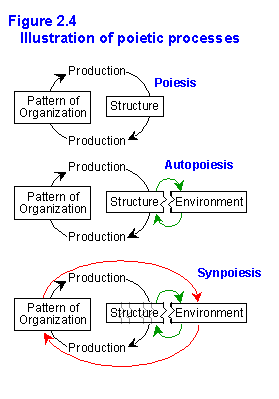
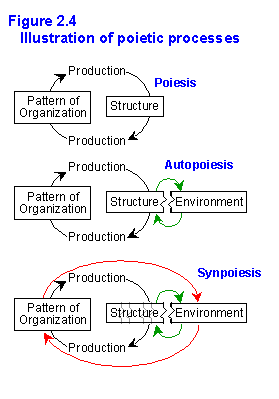
CG: Must PCT be limited to organisms or autopoietic systems alone? Can we extend it to include sympoietic systems? This would very likely require additional
levels in HPCT.

image00136.gif
Source:
http://www.bethd.ca/pubs/mesthe/ch2.html#Autopo

Best,

Chad

Chad T. Green, PMP
Research Office
Loudoun County Public Schools
21000 Education Court
Ashburn, VA 20148
Voice: 571-252-1486
Fax: 571-252-1575

···

[From Rick Marken (2017.05.31.1900)

RM: Well, there doesn’t seem to be a great deal of interest in PCT research here on CSGNet but it’s what I am interested in so I’ll follow up on myself. The argument of my first post is summed up in this statement:

RM: What I claim is that the main focus of research based on PCT has to be testing to determine what variables are controlled when we see organisms carrying out various behaviors.

RM: I think there are a couple of reasons why this kind of research has not been pursued by conventional behavioral scientists. One is that these scientists don’t know why this research should be done and the
other is that they don’t know how to do this kind of research anyway.

RM: I think both of these problems can be solved by leveraging Rupert Young’s robotics work into the new field that I have just christened
psychorobotics . Psychorobotics is the field aimed at understanding the psychology of robots, specifically robots that are known to be perceptual control systems. Understanding the behavior of such robots is, then, largely a matter of figuring out what
perceptions they are controlling.

RM: Psychorobotics is really a process of reverse engineering, which is what we are doing when we are trying to understand the behavior of humans and other living control systems. I am imagining psychorobotics
as the study of how best to do this reverse engineering in order to accurately determine the perceptual variables that the robot is controlling. The first step would be to build a robot like the one that Rupert describes in his recently published paper. The
next step would be to have people (who are completely unfamiliar with how the robot works, of course) try to figure out what the robot is controlling. To do this, these people will have to be familiar with (or be made familiar with) the principles of perceptual
control (PCT) and the methods used to determine what variables the robot is controlling. Then what would be studied is how well these people are able to come up with correct descriptions of the perceptual variables that robots are controlling.

RM: Obviously, the new field of psychorobotics needs some more careful thought. But I think the basic idea of showing what’s involved in figuring out what perceptual variables are being controlled by a robot
would be a good way to illustrate what PCT researchers are trying to figure out about the behavior of living systems. And, of course, the benefit of doing this reverse engineering process on robots is that we know what perceptions they re actually control
because we built them. So we can evaluate how well various approaches to determining the perceptual variables that the robots are controlling actually work.

Best regards

Rick

Richard S. Marken

"Perfection is achieved not when you have nothing more to add, but when you

have nothing left to take away.�

                            --Antoine de Saint-Exupery

[Chad
Green (2017.06.01.1145 EDT)]

Â

      RM: Well, there doesn't seem to be a great

deal of interest in PCT research here on CSGNet but it’s what
I am interested in so I’ll follow up on myself. The argument
of my first post is summed up in this statement:

Â

      RM: What I claim

is that the main focus of research based on PCT has to be
testing to determine what variables are controlled when we see
organisms carrying out various behaviors.

Â

        CG:

Must PCT be limited to organisms or autopoietic systems
alone? Can we extend it to include sympoietic systems?

Re PCT Research.gif

···

[From Rick Marken (2017.05.31.1900)

Â

              RM: Well, there doesn't seem to be

a great deal of interest in PCT research here on
CSGNet but it’s what I am interested in so I’ll follow
up on myself. The argument of my first post is summed
up in this statement:

Â

                RM: What I claim is that the main

focus of research based on PCT has to be testing to
determine what variables are controlled when we see
organisms carrying out various behaviors.

Â

                RM: I

think there are a couple of reasons why this kind of
research has not been pursued by conventional
behavioral scientists. One is that these scientists
don’t know why this research should be done and the
other is that they don’t know how to do this kind of
research anyway.Â

Â

                RM: I

think both of these problems can be solved by
leveraging Rupert Young’s robotics work into the new
field that I have just christened
psychorobotics . Psychorobotics is the field
aimed at understanding the psychology of robots,
specifically robots that are known to be perceptual
control systems. Understanding the behavior of such
robots is, then, largely a matter of figuring out
what perceptions they are controlling.Â

Â

                RM:

Psychorobotics is really a process of reverse
engineering, which is what we are doing when we are
trying to understand the behavior of humans and
other living control systems. I am imagining
psychorobotics as the study of how best to do this
reverse engineering in order to accurately determine
the perceptual variables that the robot is
controlling. The first step would be to build a
robot like the one that Rupert describes in his
recently published paper. The next step would be to
have people (who are completely unfamiliar with how
the robot works, of course) try to figure out what
the robot is controlling. To do this, these people
will have to be familiar with (or be made familiar
with) the principles of perceptual control (PCT) and
the methods used to determine what variables the
robot is controlling. Then what would be studied is
how well these people are able to come up with
correct descriptions of the perceptual variables
that robots are controlling.Â

Â

                RM:

Obviously, the new field of psychorobotics needs
some more careful thought. But I think the basic
idea of showing what’s involved in figuring out what
perceptual variables are being controlled by a robot
would be a good way to illustrate what PCT
researchers are trying to figure out about the
behavior of living systems. And, of course, the
benefit of doing this reverse engineering process on
robots is that we know what perceptions they re
actually control because we built them. So we can
evaluate how well various approaches to determining
the perceptual variables that the robots are
controlling actually work.Â

Â

                Best

regards

Â

Rick

                                  Richard S.

MarkenÂ

                                    "Perfection

is achieved not when you have
nothing more to add, but when
you

                                    have nothing left to take away.�

                                    Â  Â  Â  Â  Â  Â  Â  Â  Â  Â  Â  Â  Â  Â  Â  Â 

–Antoine de Saint-Exupery

[From Rick Marken (2017.06.01.1415)]

···

Richard Pfau (2017.06.01 9:40 EDT)–

RP: To keep PCT at the forefront, I suggest using the term “PCT-psychorobotics” rather than simply “psychorobotics”.

RM: Actually, I was trying to keep methodology in the forefront. The idea was that psychorobotics was about how to evaluate the psychology behind the behavior of robots (and, by inference, that of the behavior of living control systems, like people). I’d be interested to hear what you think of that idea.Â

Best

Rick

-----Original Message-----
From: Richard Marken rsmarken@gmail.com
To: csgnet csgnet@lists.illinois.edu
Sent: Wed, May 31, 2017 10:00 pm
Subject: Re: PCT Research

[From Rick Marken (2017.05.31.1900)

RM: Well, there doesn’t seem to be a great deal of interest in PCT research here on CSGNet but it’s what I am interested in so I’ll follow up on myself. The argument of my first post is summed up in this statement:

RM: What I claim is that the main focus of research based on PCT has to be testing to determine what variables are controlled when we see organisms carrying out various behaviors.

RM: I think there are a couple of reasons why this kind of research has not been pursued by conventional behavioral scientists. One is that these scientists don’t know why this research should be done and the other is that they don’t know how to do this kind of research anyway.Â

RM: I think both of these problems can be solved by leveraging Rupert Young’s robotics work into the new field that I have just christened psychorobotics. Psychorobotics is the field aimed at understanding the psychology of robots, specifically robots that are known to be perceptual control systems. Understanding the behavior of such robots is, then, largely a matter of figuring out what perceptions they are controlling.Â

RM: Psychorobotics is really a process of reverse engineering, which is what we are doing when we are trying to understand the behavior of humans and other living control systems. I am imagining psychorobotics as the study of how best to do this reverse engineering in order to accurately determine the perceptual variables that the robot is controlling. The first step would be to build a robot like the one that Rupert describes in his recently published paper. The next step would be to have people (who are completely unfamiliar with how the robot works, of course) try to figure out what the robot is controlling. To do this, these people will have to be familiar with (or be made familiar with) the principles of perceptual control (PCT) and the methods used to determine what variables the robot is controlling. Then what would be studied is how well these people are able to come up with correct descriptions of the perceptual variables that robots are controlling.Â

RM: Obviously, the new field of psychorobotics needs some more careful thought. But I think the basic idea of showing what’s involved in figuring out what perceptual variables are being controlled by a robot would be a good way to illustrate what PCT researchers are trying to figure out about the behavior of living systems. And, of course, the benefit of doing this reverse engineering process on robots is that we know what perceptions they re actually control because we built them. So we can evaluate how well various approaches to determining the perceptual variables that the robots are controlling actually work.Â

Best regards

Rick


Richard S. MarkenÂ

"Perfection is achieved not when you have nothing more to add, but when you
have nothing left to take away.�
                --Antoine de Saint-Exupery

Richard S. MarkenÂ

"Perfection is achieved not when you have nothing more to add, but when you
have nothing left to take away.�
                --Antoine de Saint-Exupery

[From Rick Marken (2017.06.01.1440)]

···

Martin Taylor (2017.06.01.08.34)–

MT: I see two possible meanings for this.

MT: 1. On a particular occasion external observers see a pattern of

actions performed by one or more people, and one wants to know why
those actions were performed. …According to PCT,
all these actions were the direct effect or the side effect of
controlling eleven levels of perceptions…This means…variables [were] controlled."

RM: That’s basically the meaning I had in mind. Though a PCT researcher would be looking not just at patterns of action but at controlled variables as well. For example, in our research on object interception we looked not only at patterns of action, like the movements of the pursuer, but at the consistently produced results of those actions (interception), results that were produced in the face of varying disturbances (the movements of the object). So we saw that control was happening; the goal of the research was then to determine precisely what variables were being controlled.Â

MT: 2. A scientific interpretation might be to ask whether and why

certain perceptions tend to be controlled by most or all members of
a given species or culture.

RM: I don’t see how this “meaning” is derived from my claim that “the main focus of research based on PCT has to be testing to determine what variables are controlled when we see organisms carrying out various behaviors”. Nevertheless, yours is a perfectly reasonable question but before you could answer it you would have to do the kind of research I am suggesting – research aimed at determining the perceptual variables organisms control. Otherwise, how could you which perceptions tend to be controlled by most or all members of a given species or culture.

Â

MT: My own view on "research" (PCT or not) would treat meaning (1) as

being research on the same level as asking why it rained today here,
but not in a place 20 km away.

RM: Of course you do.

Â

MT: For myself, I would include meaning 2 as a legitimate area of PCT

research, but I would also have a long list of other directions. In
no particular order, here are a few: Â

-----------

Mathematical studies of the behaviours of different kinds of

negative feedback loops,

Experimental studies about the actual structure of the control

system within an individual and the similarities and difference
across individuals (e.g., if it is a true hierarchy a la Powers, are
there levels that are universal across individuals within a species,
and if so, do those levels apply across species),

The ways reorganization might differ in physical and cultural

environments of different complexity,

The process of reorganization itself on different time-scales from

seconds to aeons,

How does perceptual control interact with physical health?


What is imagination (is it purely conscious or a part of all

control)?

What is the role of imagination and of dreaming in the survival of

the organism and of its descendants?

Structures and networks of control systems that are not all in the

same individual,

The evolution and development of cultural practices (and in those

species that have language) of languages.

The probabilities of different evolutionary directions of masses of

free-floating controllers (like the earliest life),

And application research, such as how best to apply PCT to social

and industrial problems, or (like MoL) to mind-body issues within
individuals, or to build really useful robots.

------------


MT: Those are just a few general areas I see for PCT research over the

next few generations. In my view, the “search for the controlled
variable” is a minuscule part of the PCT research of the future.

RM: And I think that the determination of what variables are being controlled is an essential part of every one of the suggested directions for PCT research that you describe above.Â

RM: But the post you are responding to was my suggestion about using robots, such as the ones developed by Rupert, to illustrate how to do research aimed at understanding the behavior of controllers: psychrobotics. Since you are interested in PCT research I wonder what you think of this way of demonstrating how to do it?

Best

Rick

MT: Maybe this is a bit grandiose, but might PCT research eventually

turn out to be the way to save the planet?


Richard S. MarkenÂ

"Perfection is achieved not when you have nothing more to add, but when you
have nothing left to take away.�
                --Antoine de Saint-Exupery

            RM:

What I claim is that the main focus of research based on
PCT has to be testing to determine what variables are
controlled when we see organisms carrying out various
behaviors.

image00136.gif

···

[From Rick Marken (2017.06.01.1450)]

Chad Green (2017.06.01.1145 EDT)

RM: What I claim is that the main focus of research based on PCT has to be testing to determine what variables are controlled when we see organisms carrying out various behaviors.

Â

CG: Must PCT be limited to organisms or autopoietic systems alone? Can we extend it to include sympoietic systems? This would very likely require additional
levels in HPCT.

RM: PCT is only limited to systems that control, whether they are natural (living) or artifactual. I don’t know what an autopoietic or sympoietic system is and I can’t really tell what they are from your diagrams. Maybe a concrete example of each would help.

BestÂ

Rick

Source:
http://www.bethd.ca/pubs/mesthe/ch2.html#Autopo

Â

Best,

Chad

Â

Chad T. Green, PMP

Research Office

Loudoun County Public Schools

21000 Education Court

Ashburn, VA 20148

Voice: 571-252-1486

Fax: 571-252-1575

Â

From: Richard Marken [mailto:rsmarken@gmail.com]
Sent: Wednesday, May 31, 2017 9:59 PM
To: csgnet@lists.illinois.edu
Subject: Re: PCT Research

Â

[From Rick Marken (2017.05.31.1900)

Â

RM: Well, there doesn’t seem to be a great deal of interest in PCT research here on CSGNet but it’s what I am interested in so I’ll follow up on myself. The argument of my first post is summed up in this statement:

Â

RM: What I claim is that the main focus of research based on PCT has to be testing to determine what variables are controlled when we see organisms carrying out various behaviors.

Â

RM: I think there are a couple of reasons why this kind of research has not been pursued by conventional behavioral scientists. One is that these scientists don’t know why this research should be done and the
other is that they don’t know how to do this kind of research anyway.Â

Â

RM: I think both of these problems can be solved by leveraging Rupert Young’s robotics work into the new field that I have just christened
psychorobotics . Psychorobotics is the field aimed at understanding the psychology of robots, specifically robots that are known to be perceptual control systems. Understanding the behavior of such robots is, then, largely a matter of figuring out what
perceptions they are controlling.Â

Â

RM: Psychorobotics is really a process of reverse engineering, which is what we are doing when we are trying to understand the behavior of humans and other living control systems. I am imagining psychorobotics
as the study of how best to do this reverse engineering in order to accurately determine the perceptual variables that the robot is controlling. The first step would be to build a robot like the one that Rupert describes in his recently published paper. The
next step would be to have people (who are completely unfamiliar with how the robot works, of course) try to figure out what the robot is controlling. To do this, these people will have to be familiar with (or be made familiar with) the principles of perceptual
control (PCT) and the methods used to determine what variables the robot is controlling. Then what would be studied is how well these people are able to come up with correct descriptions of the perceptual variables that robots are controlling.Â

Â

RM: Obviously, the new field of psychorobotics needs some more careful thought. But I think the basic idea of showing what’s involved in figuring out what perceptual variables are being controlled by a robot
would be a good way to illustrate what PCT researchers are trying to figure out about the behavior of living systems. And, of course, the benefit of doing this reverse engineering process on robots is that we know what perceptions they re actually control
because we built them. So we can evaluate how well various approaches to determining the perceptual variables that the robots are controlling actually work.Â

Â

Best regards

Â

Rick

Richard S. MarkenÂ

"Perfection is achieved not when you have nothing more to add, but when you

have nothing left to take away.�

                --Antoine de Saint-Exupery


Richard S. MarkenÂ

"Perfection is achieved not when you have nothing more to add, but when you
have nothing left to take away.�
                --Antoine de Saint-Exupery

I do have to pipe in briefly here just to say that the term psycho for the general public brings to mind the idea of craziness and violence (at least in my generation it would!).

Although the name Perceptual Robots belongs to Rupert I’m guessing his feelings wouldn’t be hurt if that term started to be used the same way people use the word Kleenex when they are talking about tissue paper. I’m blanking on other ideas about how brand names entered into the mainstream language and became common words but I think you get the gist of it. Just putting the word perceptual in front of robotics was brilliant, Â I thought. Â “The ability to accomplish tasks mechanically was greatly improved with the introduction of perceptual robotics.” I think it could be the same with most anything. Perceptual psychology, Â perceptual politics, perceptual relationships…

It is less awkward to say it that way. It is our jobs to get it across that what is behind this terminology is Perceptual Control.

Thoughts?Â

···

On Jun 1, 2017 6:28 PM, richardpfau4153@aol.com wrote:

[From:Â Richard Pfau (2017.06.01Â 20:25 EDT)]
Ref: [From Rick Marken (2017.06.01.1415)]

RP: The term and the idea behind “psychorobotics” is great. I’m just concerned that the term by itself, with no obvious linkage to perceptual control when it is used by others, will just become a popular word in the literature with the PCT implications being lost along the way.  Fred’s suggestion of “PCRobotics, standing for Perceptual Control Robotics” (PCR) might keep that linkage in a way that helps keep perceptual control in the forefront.

Richard Pfau (2017.06.01 9:40 EDT)–

RP: To keep PCT at the forefront, I suggest using the term “PCT-psychorobotics” rather than simply “psychorobotics”.

[From Rick Marken (2017.06.01.1415)]

RM: Actually, I was trying to keep methodology in the forefront. The idea was that psychorobotics was about how to evaluate the psychology behind the behavior of robots (and, by inference, that of the behavior of living control systems, like people). I’d be interested to hear what you think of that idea.Â

Best

Rick

-----Original Message-----
From: Richard Marken rsmarken@gmail.com
To: csgnet csgnet@lists.illinois.edu
Sent: Wed, May 31, 2017 10:00 pm
Subject: Re: PCT Research

[From Rick Marken (2017.05.31.1900)

RM: Well, there doesn’t seem to be a great deal of interest in PCT research here on CSGNet but it’s what I am interested in so I’ll follow up on myself. The argument of my first post is summed up in this statement:

RM: What I claim is that the main focus of research based on PCT has to be testing to determine what variables are controlled when we see organisms carrying out various behaviors.

RM: I think there are a couple of reasons why this kind of research has not been pursued by conventional behavioral scientists. One is that these scientists don’t know why this research should be done and the other is that they don’t know how to do this kind of research anyway.Â

RM: I think both of these problems can be solved by leveraging Rupert Young’s robotics work into the new field that I have just christened psychorobotics. Psychorobotics is the field aimed at understanding the psychology of robots, specifically robots that are known to be perceptual control systems. Understanding the behavior of such robots is, then, largely a matter of figuring out what perceptions they are controlling.Â

RM: Psychorobotics is really a process of reverse engineering, which is what we are doing when we are trying to understand the behavior of humans and other living control systems. I am imagining psychorobotics as the study of how best to do this reverse engineering in order to accurately determine the perceptual variables that the robot is controlling. The first step would be to build a robot like the one that Rupert describes in his recently published paper. The next step would be to have people (who are completely unfamiliar with how the robot works, of course) try to figure out what the robot is controlling. To do this, these people will have to be familiar with (or be made familiar with) the principles of perceptual control (PCT) and the methods used to determine what variables the robot is controlling. Then what would be studied is how well these people are able to come up with correct descriptions of the perceptual variables that robots are controlling.Â

RM: Obviously, the new field of psychorobotics needs some more careful thought. But I think the basic idea of showing what’s involved in figuring out what perceptual variables are being controlled by a robot would be a good way to illustrate what PCT researchers are trying to figure out about the behavior of living systems. And, of course, the benefit of doing this reverse engineering process on robots is that we know what perceptions they re actually control because we built them. So we can evaluate how well various approaches to determining the perceptual variables that the robots are controlling actually work.Â

Best regards

Rick


Richard S. MarkenÂ

"Perfection is achieved not when you have nothing more to add, but when you
have nothing left to take away.�
                --Antoine de Saint-Exupery


Richard S. MarkenÂ

"Perfection is achieved not when you have nothing more to add, but when you
have nothing left to take away.�
                --Antoine de Saint-Exupery

[From Rick Marken (2017.06.02.1135)]

···

On Fri, Jun 2, 2017 at 8:15 AM, Alison Powers controlsystemsgroupconference@gmail.com wrote:

AP: I do have to pipe in briefly here just to say that the term psycho for the general public brings to mind the idea of craziness and violence (at least in my generation it would!).

RM: Gee, if I knew this was going to turn into a discussion of the name I proposed for a demonstration rather than of the demonstration itself I would have left that proposed name out of the discussion. I knew that psychorobotics had that unfortunate allusion to the Hitchcock movie in it. But, then, so does “psychology” and “psychotherapy”.Â

RM: Nevertheless, I am happy to abandon that name if I can just get some discussion going about the proposed demonstration itself. The demonstration involves using some version of the test for the controlled variables to determine the perceptual variables that a robot is controlling - any robot but Rupert’s would be nice because he has described the variables his robots control in his paper – and see how well the person doing the test does at identifying these variables.

BestÂ

Rick

Although the name Perceptual Robots belongs to Rupert I’m guessing his feelings wouldn’t be hurt if that term started to be used the same way people use the word Kleenex when they are talking about tissue paper. I’m blanking on other ideas about how brand names entered into the mainstream language and became common words but I think you get the gist of it. Just putting the word perceptual in front of robotics was brilliant, Â I thought. Â “The ability to accomplish tasks mechanically was greatly improved with the introduction of perceptual robotics.” I think it could be the same with most anything. Perceptual psychology, Â perceptual politics, perceptual relationships…

It is less awkward to say it that way. It is our jobs to get it across that what is behind this terminology is Perceptual Control.

Thoughts?Â


Richard S. MarkenÂ

"Perfection is achieved not when you have nothing more to add, but when you
have nothing left to take away.�
                --Antoine de Saint-Exupery

On Jun 1, 2017 6:28 PM, richardpfau4153@aol.com wrote:

[From:Â Richard Pfau (2017.06.01Â 20:25 EDT)]
Ref: [From Rick Marken (2017.06.01.1415)]

RP: The term and the idea behind “psychorobotics” is great. I’m just concerned that the term by itself, with no obvious linkage to perceptual control when it is used by others, will just become a popular word in the literature with the PCT implications being lost along the way.  Fred’s suggestion of “PCRobotics, standing for Perceptual Control Robotics” (PCR) might keep that linkage in a way that helps keep perceptual control in the forefront.

Richard Pfau (2017.06.01 9:40 EDT)–

RP: To keep PCT at the forefront, I suggest using the term “PCT-psychorobotics” rather than simply “psychorobotics”.

[From Rick Marken (2017.06.01.1415)]

RM: Actually, I was trying to keep methodology in the forefront. The idea was that psychorobotics was about how to evaluate the psychology behind the behavior of robots (and, by inference, that of the behavior of living control systems, like people). I’d be interested to hear what you think of that idea.Â

Best

Rick

-----Original Message-----
From: Richard Marken rsmarken@gmail.com
To: csgnet csgnet@lists.illinois.edu
Sent: Wed, May 31, 2017 10:00 pm
Subject: Re: PCT Research

[From Rick Marken (2017.05.31.1900)

RM: Well, there doesn’t seem to be a great deal of interest in PCT research here on CSGNet but it’s what I am interested in so I’ll follow up on myself. The argument of my first post is summed up in this statement:

RM: What I claim is that the main focus of research based on PCT has to be testing to determine what variables are controlled when we see organisms carrying out various behaviors.

RM: I think there are a couple of reasons why this kind of research has not been pursued by conventional behavioral scientists. One is that these scientists don’t know why this research should be done and the other is that they don’t know how to do this kind of research anyway.Â

RM: I think both of these problems can be solved by leveraging Rupert Young’s robotics work into the new field that I have just christened psychorobotics. Psychorobotics is the field aimed at understanding the psychology of robots, specifically robots that are known to be perceptual control systems. Understanding the behavior of such robots is, then, largely a matter of figuring out what perceptions they are controlling.Â

RM: Psychorobotics is really a process of reverse engineering, which is what we are doing when we are trying to understand the behavior of humans and other living control systems. I am imagining psychorobotics as the study of how best to do this reverse engineering in order to accurately determine the perceptual variables that the robot is controlling. The first step would be to build a robot like the one that Rupert describes in his recently published paper. The next step would be to have people (who are completely unfamiliar with how the robot works, of course) try to figure out what the robot is controlling. To do this, these people will have to be familiar with (or be made familiar with) the principles of perceptual control (PCT) and the methods used to determine what variables the robot is controlling. Then what would be studied is how well these people are able to come up with correct descriptions of the perceptual variables that robots are controlling.Â

RM: Obviously, the new field of psychorobotics needs some more careful thought. But I think the basic idea of showing what’s involved in figuring out what perceptual variables are being controlled by a robot would be a good way to illustrate what PCT researchers are trying to figure out about the behavior of living systems. And, of course, the benefit of doing this reverse engineering process on robots is that we know what perceptions they re actually control because we built them. So we can evaluate how well various approaches to determining the perceptual variables that the robots are controlling actually work.Â

Best regards

Rick


Richard S. MarkenÂ

"Perfection is achieved not when you have nothing more to add, but when you
have nothing left to take away.�
                --Antoine de Saint-Exupery


Richard S. MarkenÂ

"Perfection is achieved not when you have nothing more to add, but when you
have nothing left to take away.�
                --Antoine de Saint-Exupery

AP: Psychology and psychotherapy preceded the use of the derivative word “psycho” which unfortunately became derogatory thanks in part (as you mentioned) to the movie “Psycho.” There are lot of people who are afraid of robots - we need to be sensitive to the marketing aspects of what we put out there…how will the general public react? We might be okay with the term psychorobots but does it work with regard to making PCT something the general public wants to embrace? Being “perceptive” is considered a positive attribute and that is why I think a perceptual robot is much more likely to be accepted.

In any case, I have been trying to send a response about the research portion of your email which I typed on my phone but it is not pulling through into this thread. I will send it soon.

···

On Fri, Jun 2, 2017 at 12:34 PM, Richard Marken rsmarken@gmail.com wrote:

[From Rick Marken (2017.06.02.1135)]

On Fri, Jun 2, 2017 at 8:15 AM, Alison Powers controlsystemsgroupconference@gmail.com wrote:

AP: I do have to pipe in briefly here just to say that the term psycho for the general public brings to mind the idea of craziness and violence (at least in my generation it would!).

RM: Gee, if I knew this was going to turn into a discussion of the name I proposed for a demonstration rather than of the demonstration itself I would have left that proposed name out of the discussion. I knew that psychorobotics had that unfortunate allusion to the Hitchcock movie in it. But, then, so does “psychology” and “psychotherapy”.Â

RM: Nevertheless, I am happy to abandon that name if I can just get some discussion going about the proposed demonstration itself. The demonstration involves using some version of the test for the controlled variables to determine the perceptual variables that a robot is controlling - any robot but Rupert’s would be nice because he has described the variables his robots control in his paper – and see how well the person doing the test does at identifying these variables.

BestÂ

Rick

Although the name Perceptual Robots belongs to Rupert I’m guessing his feelings wouldn’t be hurt if that term started to be used the same way people use the word Kleenex when they are talking about tissue paper. I’m blanking on other ideas about how brand names entered into the mainstream language and became common words but I think you get the gist of it. Just putting the word perceptual in front of robotics was brilliant, Â I thought. Â “The ability to accomplish tasks mechanically was greatly improved with the introduction of perceptual robotics.” I think it could be the same with most anything. Perceptual psychology, Â perceptual politics, perceptual relationships…

It is less awkward to say it that way. It is our jobs to get it across that what is behind this terminology is Perceptual Control.

Thoughts?Â


Richard S. MarkenÂ

"Perfection is achieved not when you have nothing more to add, but when you
have nothing left to take away.�
                --Antoine de Saint-Exupery

On Jun 1, 2017 6:28 PM, richardpfau4153@aol.com wrote:

[From:Â Richard Pfau (2017.06.01Â 20:25 EDT)]
Ref: [From Rick Marken (2017.06.01.1415)]

RP: The term and the idea behind “psychorobotics” is great. I’m just concerned that the term by itself, with no obvious linkage to perceptual control when it is used by others, will just become a popular word in the literature with the PCT implications being lost along the way.  Fred’s suggestion of “PCRobotics, standing for Perceptual Control Robotics” (PCR) might keep that linkage in a way that helps keep perceptual control in the forefront.

Richard Pfau (2017.06.01 9:40 EDT)–

RP: To keep PCT at the forefront, I suggest using the term “PCT-psychorobotics” rather than simply “psychorobotics”.

[From Rick Marken (2017.06.01.1415)]

RM: Actually, I was trying to keep methodology in the forefront. The idea was that psychorobotics was about how to evaluate the psychology behind the behavior of robots (and, by inference, that of the behavior of living control systems, like people). I’d be interested to hear what you think of that idea.Â

Best

Rick

-----Original Message-----
From: Richard Marken rsmarken@gmail.com
To: csgnet csgnet@lists.illinois.edu
Sent: Wed, May 31, 2017 10:00 pm
Subject: Re: PCT Research

[From Rick Marken (2017.05.31.1900)

RM: Well, there doesn’t seem to be a great deal of interest in PCT research here on CSGNet but it’s what I am interested in so I’ll follow up on myself. The argument of my first post is summed up in this statement:

RM: What I claim is that the main focus of research based on PCT has to be testing to determine what variables are controlled when we see organisms carrying out various behaviors.

RM: I think there are a couple of reasons why this kind of research has not been pursued by conventional behavioral scientists. One is that these scientists don’t know why this research should be done and the other is that they don’t know how to do this kind of research anyway.Â

RM: I think both of these problems can be solved by leveraging Rupert Young’s robotics work into the new field that I have just christened psychorobotics. Psychorobotics is the field aimed at understanding the psychology of robots, specifically robots that are known to be perceptual control systems. Understanding the behavior of such robots is, then, largely a matter of figuring out what perceptions they are controlling.Â

RM: Psychorobotics is really a process of reverse engineering, which is what we are doing when we are trying to understand the behavior of humans and other living control systems. I am imagining psychorobotics as the study of how best to do this reverse engineering in order to accurately determine the perceptual variables that the robot is controlling. The first step would be to build a robot like the one that Rupert describes in his recently published paper. The next step would be to have people (who are completely unfamiliar with how the robot works, of course) try to figure out what the robot is controlling. To do this, these people will have to be familiar with (or be made familiar with) the principles of perceptual control (PCT) and the methods used to determine what variables the robot is controlling. Then what would be studied is how well these people are able to come up with correct descriptions of the perceptual variables that robots are controlling.Â

RM: Obviously, the new field of psychorobotics needs some more careful thought. But I think the basic idea of showing what’s involved in figuring out what perceptual variables are being controlled by a robot would be a good way to illustrate what PCT researchers are trying to figure out about the behavior of living systems. And, of course, the benefit of doing this reverse engineering process on robots is that we know what perceptions they re actually control because we built them. So we can evaluate how well various approaches to determining the perceptual variables that the robots are controlling actually work.Â

Best regards

Rick


Richard S. MarkenÂ

"Perfection is achieved not when you have nothing more to add, but when you
have nothing left to take away.�
                --Antoine de Saint-Exupery


Richard S. MarkenÂ

"Perfection is achieved not when you have nothing more to add, but when you
have nothing left to take away.�
                --Antoine de Saint-Exupery

[From Rick Marken (2017.06.02.1230)]

···

Hi Allie

On Fri, Jun 2, 2017 at 12:04 PM, Alison Powers controlsystemsgroupconference@gmail.com wrote:

AP: Psychology and psychotherapy preceded the use of the derivative word “psycho” which unfortunately became derogatory thanks in part (as you mentioned) to the movie “Psycho.” There are lot of people who are afraid of robots - we need to be sensitive to the marketing aspects of what we put out there…how will the general public react? We might be okay with the term psychorobots but does it work with regard to making PCT something the general public wants to embrace? Being “perceptive” is considered a positive attribute and that is why I think a perceptual robot is much more likely to be accepted.

 RM: I wasn’t proposing the term “psychorobotics” as an alternative to “perceptual robotics”. I like Rupert’s description of his robots. Of course all robots that behave successfully (that produce consistent results, like maintaining balance on a bicycle, in the face of unpredictable disturbance) are perceptual controllers. But Rupert’s term calls attention to the fact that he is “architecting” his robots around this principle – and, indeed,  architecting them based on the principles of hierarchical perceptual control. I proposed the term “psychorobotics” to describe the process of studying the psychology of robots from a PCT perspective. The hierarchical control architecture of Rupert’s robots (another nice name for them) is their psychology; it explains the behavior that we see the robot carrying out. So I was proposing psychorobotics as the study of the psychology of robots in a way that is analogous to psychology, the study of the psychology of people. But in psychorobotics we are in the pleasant position of being able to check our answers, so to speak.Â

RM: But, of course, I am open to other names. But I don’t think we have to worry about how the name would play with the general public. I’m quite sure none of this methodology stuff would be of any interest to them.

AP: In any case, I have been trying to send a response about the research portion of your email which I typed on my phone but it is not pulling through into this thread. I will send it soon.

 RM: I look forward to seeing it!

BestÂ

Rick


Richard S. MarkenÂ

"Perfection is achieved not when you have nothing more to add, but when you
have nothing left to take away.�
                --Antoine de Saint-Exupery

On Fri, Jun 2, 2017 at 12:34 PM, Richard Marken rsmarken@gmail.com wrote:

[From Rick Marken (2017.06.02.1135)]

On Fri, Jun 2, 2017 at 8:15 AM, Alison Powers controlsystemsgroupconference@gmail.com wrote:

AP: I do have to pipe in briefly here just to say that the term psycho for the general public brings to mind the idea of craziness and violence (at least in my generation it would!).

RM: Gee, if I knew this was going to turn into a discussion of the name I proposed for a demonstration rather than of the demonstration itself I would have left that proposed name out of the discussion. I knew that psychorobotics had that unfortunate allusion to the Hitchcock movie in it. But, then, so does “psychology” and “psychotherapy”.Â

RM: Nevertheless, I am happy to abandon that name if I can just get some discussion going about the proposed demonstration itself. The demonstration involves using some version of the test for the controlled variables to determine the perceptual variables that a robot is controlling - any robot but Rupert’s would be nice because he has described the variables his robots control in his paper – and see how well the person doing the test does at identifying these variables.

BestÂ

Rick

Although the name Perceptual Robots belongs to Rupert I’m guessing his feelings wouldn’t be hurt if that term started to be used the same way people use the word Kleenex when they are talking about tissue paper. I’m blanking on other ideas about how brand names entered into the mainstream language and became common words but I think you get the gist of it. Just putting the word perceptual in front of robotics was brilliant, Â I thought. Â “The ability to accomplish tasks mechanically was greatly improved with the introduction of perceptual robotics.” I think it could be the same with most anything. Perceptual psychology, Â perceptual politics, perceptual relationships…

It is less awkward to say it that way. It is our jobs to get it across that what is behind this terminology is Perceptual Control.

Thoughts?Â


Richard S. MarkenÂ

"Perfection is achieved not when you have nothing more to add, but when you
have nothing left to take away.�
                --Antoine de Saint-Exupery

On Jun 1, 2017 6:28 PM, richardpfau4153@aol.com wrote:

[From:Â Richard Pfau (2017.06.01Â 20:25 EDT)]
Ref: [From Rick Marken (2017.06.01.1415)]

RP: The term and the idea behind “psychorobotics” is great. I’m just concerned that the term by itself, with no obvious linkage to perceptual control when it is used by others, will just become a popular word in the literature with the PCT implications being lost along the way.  Fred’s suggestion of “PCRobotics, standing for Perceptual Control Robotics” (PCR) might keep that linkage in a way that helps keep perceptual control in the forefront.

Richard Pfau (2017.06.01 9:40 EDT)–

RP: To keep PCT at the forefront, I suggest using the term “PCT-psychorobotics” rather than simply “psychorobotics”.

[From Rick Marken (2017.06.01.1415)]

RM: Actually, I was trying to keep methodology in the forefront. The idea was that psychorobotics was about how to evaluate the psychology behind the behavior of robots (and, by inference, that of the behavior of living control systems, like people). I’d be interested to hear what you think of that idea.Â

Best

Rick

-----Original Message-----
From: Richard Marken rsmarken@gmail.com
To: csgnet csgnet@lists.illinois.edu
Sent: Wed, May 31, 2017 10:00 pm
Subject: Re: PCT Research

[From Rick Marken (2017.05.31.1900)

RM: Well, there doesn’t seem to be a great deal of interest in PCT research here on CSGNet but it’s what I am interested in so I’ll follow up on myself. The argument of my first post is summed up in this statement:

RM: What I claim is that the main focus of research based on PCT has to be testing to determine what variables are controlled when we see organisms carrying out various behaviors.

RM: I think there are a couple of reasons why this kind of research has not been pursued by conventional behavioral scientists. One is that these scientists don’t know why this research should be done and the other is that they don’t know how to do this kind of research anyway.Â

RM: I think both of these problems can be solved by leveraging Rupert Young’s robotics work into the new field that I have just christened psychorobotics. Psychorobotics is the field aimed at understanding the psychology of robots, specifically robots that are known to be perceptual control systems. Understanding the behavior of such robots is, then, largely a matter of figuring out what perceptions they are controlling.Â

RM: Psychorobotics is really a process of reverse engineering, which is what we are doing when we are trying to understand the behavior of humans and other living control systems. I am imagining psychorobotics as the study of how best to do this reverse engineering in order to accurately determine the perceptual variables that the robot is controlling. The first step would be to build a robot like the one that Rupert describes in his recently published paper. The next step would be to have people (who are completely unfamiliar with how the robot works, of course) try to figure out what the robot is controlling. To do this, these people will have to be familiar with (or be made familiar with) the principles of perceptual control (PCT) and the methods used to determine what variables the robot is controlling. Then what would be studied is how well these people are able to come up with correct descriptions of the perceptual variables that robots are controlling.Â

RM: Obviously, the new field of psychorobotics needs some more careful thought. But I think the basic idea of showing what’s involved in figuring out what perceptual variables are being controlled by a robot would be a good way to illustrate what PCT researchers are trying to figure out about the behavior of living systems. And, of course, the benefit of doing this reverse engineering process on robots is that we know what perceptions they re actually control because we built them. So we can evaluate how well various approaches to determining the perceptual variables that the robots are controlling actually work.Â

Best regards

Rick


Richard S. MarkenÂ

"Perfection is achieved not when you have nothing more to add, but when you
have nothing left to take away.�
                --Antoine de Saint-Exupery


Richard S. MarkenÂ

"Perfection is achieved not when you have nothing more to add, but when you
have nothing left to take away.�
                --Antoine de Saint-Exupery