[Martin Taylor 2017.07.07.23.08]
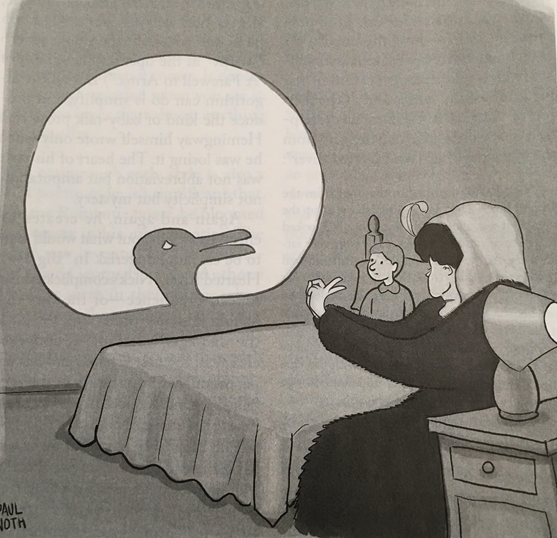
Or, as I suggested, maybe it's a question of the complexity of the
figure. As I pointed out, all our figures were very simple.
Personally, I can switch voluntarily between the interpretations of
the figures in the cartoon, but much more easily with the old-young
woman than for the simple duck-rabbit. I find it harder to keep the
latter in the form I want it to take. It switches over to the other
form quite quickly even if I don’t want it to. That also happens,
but not to the same extent, for the woman.
In either case, though, what you are looking at is a line drawing,
not a duck, a rabbit, or a woman of any age. I doubt you would be
able to see any of the real objects switch to the other form.
Somehow I doubt that our middle-class housewife subjects or
professional colleagues were sufficiently involved with the air of
that ethos!
But I think it is an important observation when you are thinking
about the mechanism of the ambiguity effect. Just as Fred and Erling
didn’t see the rabbit until you told them, so our subjects listening
to the repeated words didn’t perceive nonsense if we told than that
everything they heard would be English, but the ones told that
sometimes they might hear nonsense did sometimes hear nonsense.
Don’t you think that might have something to do with the
construction of political opinion: “Everything X tells you is a lie”
repeatedly told to one group, while “X tells it like it is, but Y
lies all the time” told repeatedly to the other just might affect
the way the different groups perceive X and Y, might it not, since
all most people have to go on is a very sketchy outline of the
things X and Y pontificate about – like the sketchy nature of the
sketches in the ambiguous cartoon.
The logic here escapes me. It’s like saying that because a mother
has two sons, neither boy has a mother.
What IS demonstrated is that a particular sensory input can lead to
a variety of different perceptions. But I guess that’s not news.
Martin
···
On 2017/07/7 3:06 PM, Richard Marken
wrote:
[From Rick Marken (2017.07.07.1205)]
Martin Taylor (2017.07.06.14.51)]
RM: Yes, this may be related toreorganization. But it is an interesting
question; how to we voluntarily switch from
seeing the same environmental variables in
one way (as an old women or a duck) and then
another (young woman and rabbit). Clearly we
are switching between perceptual functions.
How is that done and how does that affect
control? I’ll noodle on this a bit and see
what I can come up with. But I love the
cartoon – an ambiguous figure projecting an
ambiguous figure. It not funny ha ha but it
is funny strange.
MT: I wonder about the word "voluntarily". Howmight one test whether it happens? All you would have to
go on would be subjective experience and what the
subject told you.
RM: Yes, all I can go on is my subjective experience.And I can definitely switch from one perception to another
voluntarily.
MT: When I was working on ambiguous figures in the late60s and early 70s… nobody ever reported being able to
switch voluntarily
https://www.researchgate.net/publication/225324620_Stochastic_processes_in_reversing_figure_perception.
RM: Interesting. Maybe it's a skill I developed as astudent of perception.
In other studies in differentperceptual dimensions (hearing repeated words, beep
rhythm, repetitive motion, Necker Cube, among others),
we found that naive subjects without an academic
background did not necessarily see the forms that
classical psychology suggested they should. The Necker
Cube, for example, might be seen in more than ten
different forms by any one subject. Some of them were
quite intrigued by the way it moved and changed…
RM: Well, this was done during the 60s;-)
RM: One thing that seems to be demonstrated by the factthat we can see the same physical reality in (at least)
two different ways is that there is no such thing as an
environmental variable (EV) that corresponds to a
perception. In the young/old woman “illusion” what we know
is the exact same environmental reality – the same lines
and shadings on the paper or screen – can be perceived in
two different ways: as the young woman or the old woman.