···
From: Bruce Nevin [mailto:bnhpct@gmail.com]
Sent: Tuesday, July 11, 2017 2:21 AM
To: CSG
Subject: Re: Perceptual Cartoon
From Bruce Nevin (2017.07.10. ET)]
Rick Marken (2017.07.10.1130)–
Fred Nickols (2017.07.10.1316 ET)
FN: Why is the observer’s perception of q.i. a fact and my perception of it is theoretical?
RM: Because the observer is not you. So your controlled perception is a theory for the observer; it’s a fact for you.
HB : Of course that observer (experimenter) and Fred are two different persons as Rick and Bill are two different persons.
You are right Rick that anybody can very hardly look into another person, but anyone can imagine in his way what’s going on in another person. So explanations what is happening in other people probably »grow« form the beggining of human rase and better or worse theories were established. But Bill mentioned couple times that it’s very impotant that we imagine preciselly what’s going on in other people if we want to explain control. Among all theories that are trying to penetrate into human mind and body I’m convinced that PCT is the best.
So it’s very important what kind of theory experimenter has in his mind for explaining what is going on in subject.
If people are convinced that there is a devil in children which has to be beat out, then you can imagine what kind of »animalic, agressive behavior« we can expect in people relationship to children. It’s not that far away in time when human history was full of violence just because of misunderstanding the human nature or what is going inside children .
And the state of the environment is a theory represented for you by the fact of your perception, and it is a theory represented for the other party in the transaction of the TCV by the fact of their perception.
HB :How precise you can »represent« theory to the other party (you probbaly never worked in school) it’s quite problematic question so it can be put aside for now.
Adn I think that »state of environment« is not pure theory. It has some actual backgound in actual perception. It’s rather some kind of »model« (Bill Powers) or abstract system (AShby), which is constructed from »perceptual elements« from environment. You can never perceive whole environment. But you can actually feel the environment. I would say tt’s »practice« based theory to make difference to theory which is pure imagination with no »contact« to reality.
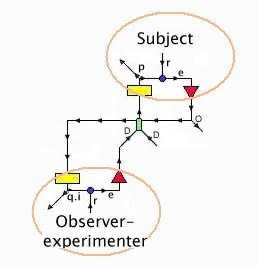
Some of the confusion is that q.i is represented as though it is in the environment. To diagram the location of q.i requires the experimenter to be included in the diagram.
HB : I don’t understand why you would need experimenter to be located in environment to confirm »i.q.«. Are we talking about »iput quanttiy« in the sense Bill used it in his diagram (LCS III) ? Or you are making your own »imagined theory«.Â
Anybody can confirm what he is perceiving (something) from environment. Bill called that »i.q« (INPUT QUNTITY). You don’t need experimenter for confirming that. You need experimenter for guessing what person in perceiving and controlling if he is for some reason interested. But otherwise any LCS is perceiving »I.Q.«.
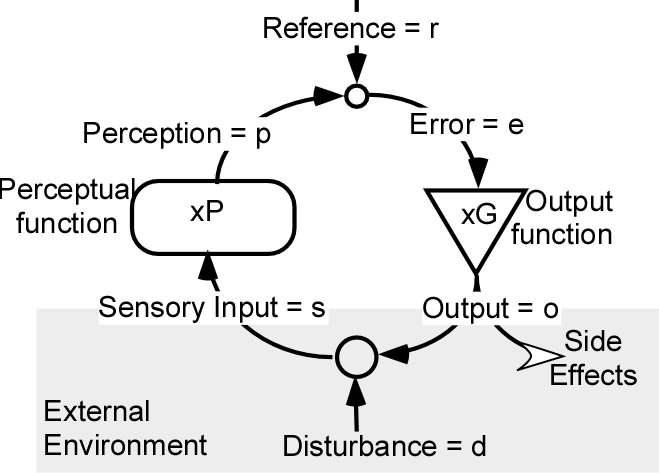
I think that the most reliable for understanding PCT terms is PCT diagram in LCS III. It’s valid for any LCS. There is no diffference in how perceptual signal is produced in subject or experimenter. There is enough »proofs« that control processes work in all LCS the same so BILL called it »The fact of control«.Â
So Fred I sugest you to use Bill’s general model for any human activity (even in interactions) as it is by my oppinion right, if you want to do PCT analysis. So I would suggest that you always turn to Bills’ literature. You don’t need Rick or Bruce N. to explain to you what Bill wrote or that they »sell« you their imagination. Make your own oppinion. Rick is anyway confussed as he couldn’ be more and his friend Bruce N. show the same signs as he is probaly to much under Ricks’ »influence«.
![cid:image002.jpg@01D2E396.F40C1DC0]()
HB : Whatever Rick and Bruce N. are talking about is not PCT diagram. It’s RCT (BNCT) diagram. Bruce said it for himself that it’s his diagram. As it is different from PCT (he made quite some changes which are in accordance to his BNCT diagram).
So I’m waiting his proposal to change PCT diagram in accordance with his BNCT diagram. He didn’t do it till now. But we can assume that he is at least not sure that his diagram is right.
![Inline image 3]()
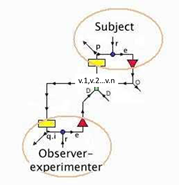
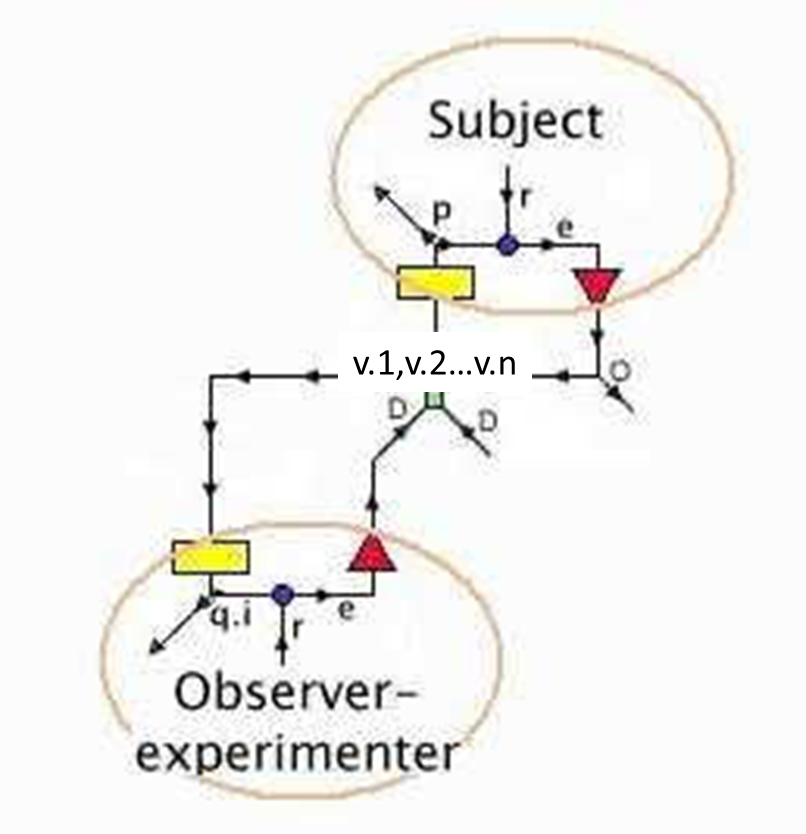
What is labeled O for output from the subject is labeled D for disturbance from the experimenter,
HB : This is your private interpretation and has nothing to do with PCT. If you’ll look at the PCT diagram above you’ll see that output (O) is producing just efects to environment on both sides. What does it mean »output« and »disturbance output« in your theoretical construction…
Bill P (B:CP, LCS III):
OUTPUT FUNCTION : The portion of a system that converts the magnitude or state of a signal inside the system into a corresponding set of effects on the immediate environment of the system…the output function shown in it’s own box represents the means this system has for causing changes in it’s environment.
HB ; So both experimenter and subject are producing efects to environment which can make among other effects also effects to sensors as I.Q. (input quantity). So both experimenter and subject will perceive I.Q. (input quantity). According to PCT diagram.
BN : …¦.and what is labeled p for perception (or perceptual variable) in the subject is labeled q.i for “input quantity” in the experimenter.
HB : I didn’t think that simplifying can be so dangerous. There is no difference in input in PCT. In both cases E and S will »perceive« p. Different »p«. You described why.
The experimenters’ output is causing effects to environment among which some can be perceived by subject S as »i.q.« PCT diagram shows that in every environment of any LCS there is »i.q.« what means added effects of »feedback and disturbances«. Thus »input function« is continuosly »stimulated« by »input quantity« where certain amount of physical variables are transformed (converted) into »afferent nerv signals«. It’s the same for any LCS.
Perceptual signal (p) wll be integrated into LCS hierarchy which is described in B:CP. It’s the same for subject and experimenter. They will perceive »i.q«. They both create p (p1, p2) as the result of transformation of physical variables on sensors. Experimenter and subject will perceive…. You said it for yourself.
BN earlier : Â They cannot have the same p because p represents a neural signal within each. Their genetic and personal histories will have endowed them differently. It is vanishingly unlikely that their respective perceptual organs and nervous systems are constructed so as to generate the same rate of firing. Each will have developed appropriate rates of firing for reference values r corresponding to their perceptual signals p so that they control satisfactorily and get along in life. One may be wearing sunglasses so a different quantity of photons reaches a different retina.
HB : This is the place in our discussions where we agreed.
In the customary and familiar diagrams, like that which you provided, Fred, and like that in Figure A-1 (p. 286) of B:CP, q.i is shown associated with the arrow entering the perceptual input function of the subject (the yellow rectangle above the green rectangle). It is shown there because that is where the experimenter observes it to be.
HB : It seems that you are trying to much to determine what is happening in experimenter and subject. It seems that you want to determine their interaction. You saw it in our conversation that doesn’t work. And also it will not work always as »gentle conflict«.
BN : But that, of course, is a projection of the observer’s controlled perception q.i into the environment.
HB : As I said before. You are too much determining what will happen during interaction. That will not happen in real life. PCT is generaly explaining how LCS control not differently from case to case.
BN : Success in controlling a perception validates and justifies such projections.
HB : Well maybe yes maybe no. Why don’t you use Bills’ diagram for perception and his hierarchy ? Why do you have to create your own imaginatinal constructs. What’s wrong with Bills diagram ?
It seems that you are too much determining control of both E and S. Maybe that is the illusion which you can get in some experiments but in more complex experiments and everyday life it will not happen in most interactions what you are suggesting. And experimenty are probably to prove some general »truth« about relations between people. Don’t they ?
Not included in the diagram of the experimenter is a loop in observation mode for a perception of the subject’s output O, and perhaps another to keep track of any uncontrolled disturbances (the second D in the diagram). The green rectangle representing the state of the actual environment is without a label; or, rather, it has two labels, the perception p in the subject and the perception q.i in the experimenter.
HB : They both are perceiving i.q. (Input Quantity) as »Uncontrolled and »controlled distrubances«  and just both create perceptual signal (p1 and p2) on the bases of tranformation of »physical variables«. Whatever will happen with »p« when its integrated in hierarchy you can read in B:CP slowly »going up a level« and mybe you’ll understand how perceptions will be transformed in hierarchy of any of them. They both create »afferent nerv signal« which is »integrated« in nervous system hierarchy. How any of of these perceptual signals will be »updated« in hierarchy depends from different persons. As you said before signals will have different firing-rates and so on…. So frequency of signals is changing through hierarchy.
But as I said many times before. Diagram of PCT organism on p. 191 in B:CP is not finnished yet, and so we can expect misunderstandings of some crucial points in control through hierarchy. Â
This diagram is adapted from one that Martin provided in an earlier thread.
HB : To make less confussion you’d better use PCT diagram and explain what you are changing in that diagram. And it would be good if you also explain what you are changing in PCT if there is any changes. It would be easier for all to understand.
Boris
/Bruce
On Mon, Jul 10, 2017 at 2:34 PM, Richard Marken rsmarken@gmail.com wrote:
[From Rick Marken (2017.07.10.1130)]
Fred Nickols (2017.07.10.1316 ET)
FN: Why is the observer’s perception of q.i. a fact and my perception of it is theoretical?
RM: Because the observer is not you. So your controlled perception is a theory for the observer; it’s a fact for you.
Best
Rick
Fred (Now I am really confused) Nickols
From: Richard Marken [mailto:rsmarken@gmail.com]
Sent: Monday, July 10, 2017 12:54 PM
To: csgnet@lists.illinois.edu
Subject: Re: Perceptual Cartoon
[From Rick Marken (2017.07.10.0950)]
Fred Nickols (2017.07.10.0723 ET)
FN: Rick: I’m a little confused by your last paragraph below.
RM: This is it, I presume:
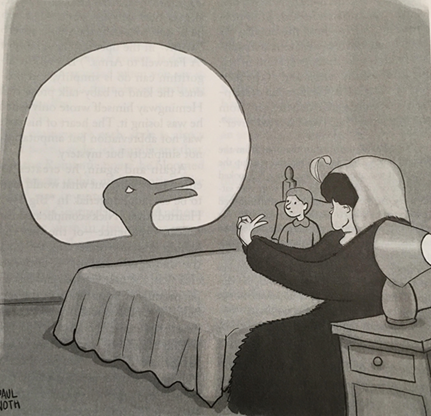
RM: The reason for the choice is that I tend to be biased against inputs knowing what should be done with themselves; seems to much like input guidance. I think the guidance – in this case the guidance to not perceive the young and old woman at the same time – should come from higher level control systems that would have a reason for not wanting this to happen. This idea should be testable but I can’t think of how right now. At the moment I am less interested in why only one state of the ambiguous figure is seen at a time than what the fact that that happens says about the idea that the controlled perception, p, and its environmental correlate, q.i, are two separate entities. What I believe it says is that they are not separate entities. They are the same perceptual variable – the controlled variable – seen from different points of view, that of the control system (p) and that of the observer of the control system (q.i).
FN: Let’s say I’m the control system in question, looking at the cartoon. My perception of that cartoon, whether of a young woman or an old lady, is p. You are the observer, and your perception of the cartoon is q.i. Do I have that correct?
RM: Yes. But when these symbols are used in the PCT diagram, p is the controller’s perception of the controlled variable and q.i is the observer’s perception of the same variable. The point being that the controlled variable is a perceptual variable for both the controller and the observer of the controller. There is no complex environmental variable out there to which p corresponds; p (as well as q.i) is a variable aspect of the physical environmental variables that we never experience directly.
RM: The physical environmental variables of which the perceptions q.i and p are presumed to be a function are the theoretical entities of physics and chemistry that we never directly experience. Everything we do experience is presumed to be a function of these variables (or of the sensory effect of these variables). So these physical environmental variables are purely theoretical, as are the variables (and functions) in the control model. The only things that are not theoretical are the observer’s perceptions. So q.i, the observer’s perception of the controlled variable, is a fact; p, the control system’s perception of the controlled variable, is part of a theoretical explanation of the fact that q.i is controlled. This is another reason why it’s incorrect to say that only p is controlled while q.i is a side effect of control of p. It privileges theory over fact, which is something, up with which I just can’t put.
Best
Rick
–
Richard S. Marken
"Perfection is achieved not when you have nothing more to add, but when you
have nothing left to take away.�
–Antoine de Saint-Exupery
–
Richard S. Marken
"Perfection is achieved not when you have nothing more to add, but when you
have nothing left to take away.�
–Antoine de Saint-Exupery