PID controllers etc. and PCT

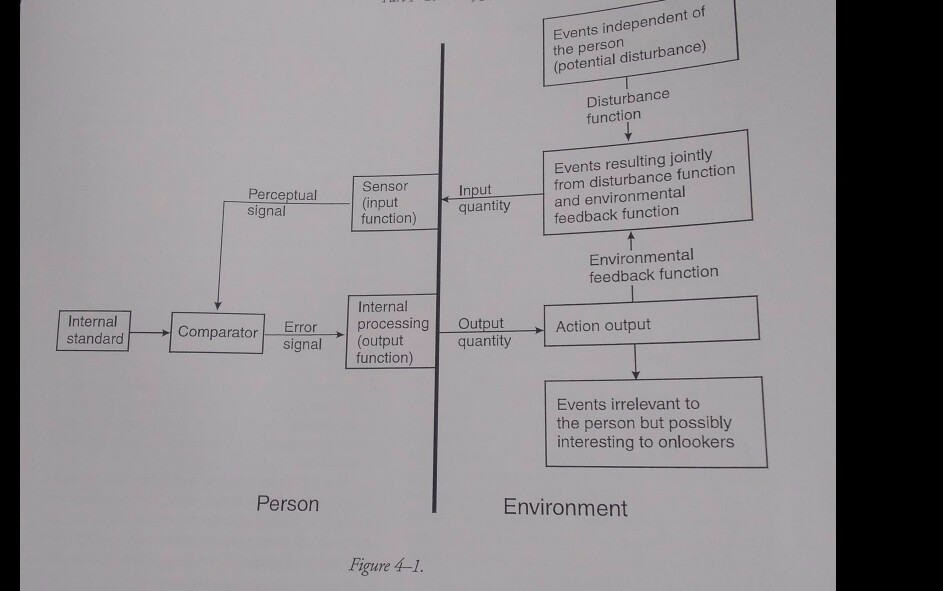
On this forum there is sometimes reference to such terms as PID Controller, actuator, substrate saturation, integrator windup and plant failure.

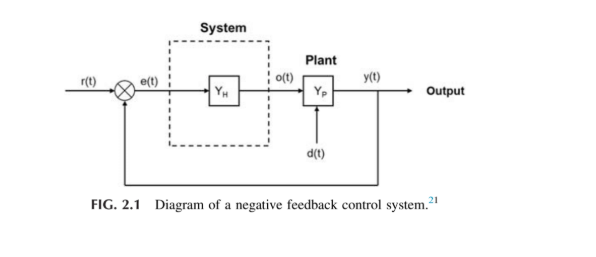
For example, a recent footnote linked to this diagram:
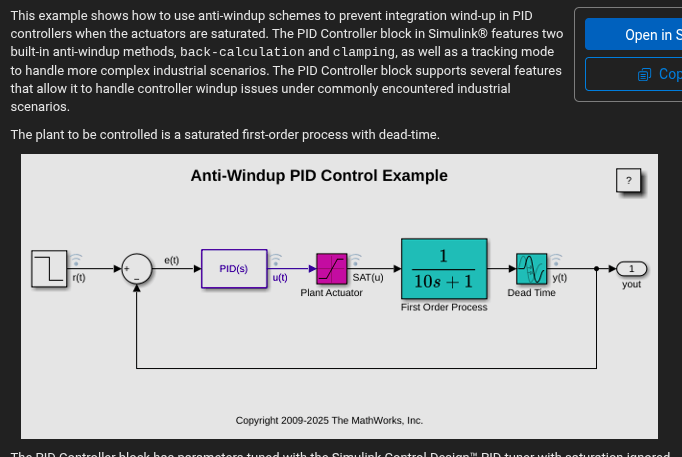
The Wikipedia page on PID Controllers contains this block diagram:
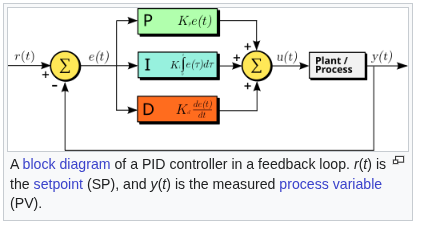
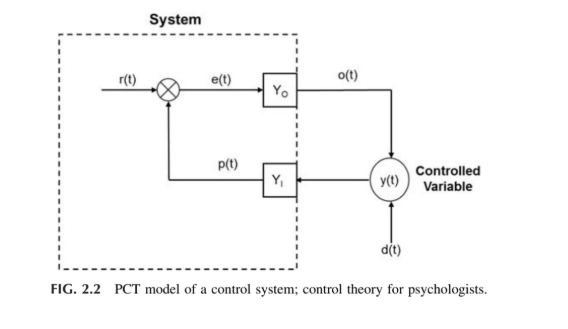
Both diagrams are homologous with this one:
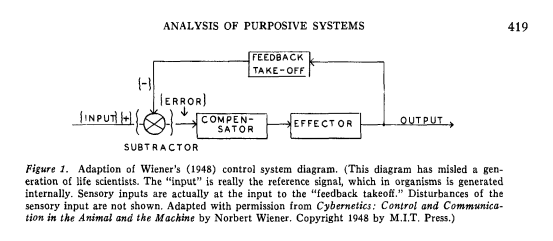
The latter is from Bill Powers’ 1978 Paper, ‘Quantitative Analysis of Purposive Systems: Some Spadework at the Foundations of Scientific Psychology’ (reprinted in Living Control Systems, (pdf available from livingcontrolsystems.com), where Bill outlines “Four Blunders” hindering the development of a scientific psychology along cybernetic lines. Bill saw Wiener’s diagram as not wrong, but open to misinterpretation by those in the life sciences.

Discuss at leisure!

Not incidentally, I highly value Bill’s respectful way of discussing “blunders”.

I hope my implied criticisms have stayed on target because there is no reason to belittle what cyberneticists have done or what engineering psychologists have discovered. The blunders I have described are principally blunders of omission and misinterpretation that have unnecessarily but unavoidably limited the scope of these endeavors. I shall commit blunders of my own just like these, as will we all. That is the penalty for trying something new.

I relish the opportunity to engage with this classic paper (if you so choose) and related concepts.
1 Like

So I’m by no means an engineer, but this is how I think about it:

When an input signal enters the comparator, it produces a difference quantity known as the error signal.

What “informs” this error signal once it has left the comparator? Is it informed by it’s own proportionality? Surely if someone’s skin surface temperature is 10 degrees higher than desired, there is some analog to 10 degrees of error.

Is the error signal informed by error-over-time? Perhaps someone can tolerate 10 degrees of temperature-error for one minute, but five? ten? The gain on the error signal increasing as a function of time, despite the raw error not changing, to me, seems integral.

Is the error signal informed by potential future error? Ground-based infant animals will panic if placed over a plexiglass cliff’s edge. As if they were experiencing the errors associated with falling without them actually occurring, because they expected them to. If I can sense the derivative of my skin temperature error prior to walking outside in the dead of winter, I might grab a coat. Internally simulating this derivative seems to occupy the same perceptual channels. Such as being able to “practically taste” the food of a restaurant I’m going to, before I’ve gotten there, in terms of an error-lowering derivative.

I think that if an error signal’s gain can be informed by not only its own size, but it’s size over time, and its potential future size - then a PID controller might fit somewhere in the model. Perhaps not where the Cyberneticists put it. But as it stands, I find it more intuitive to think of “error-over-time” as an integral, and “potential future error” as a derivative, alongside the raw proportional error. There may be different gain function that seems more plausible I’m unaware of.

A relationship may end when small errors have gone on for too long, despite themselves not being proportionally significant. Coupled with some derived expectation that these errors will not be resolved. Two relationships with equivalently proportional problems - one ends in a year, the other in 10. One’s integral gain may be stronger (Ki=0.8). The other tolerates more error-over-time (Ki=0.1). Until such a threshold is reached where the errors from these respective relationships outweigh some other internal conflict(s), and the breakup finally occurs.

Just spitballing…

I am not convinced we have to “choose” between a PID controller and a PCT controller. You could just stick the PID controller in the PCT controller. I imagine it in-between the Comparator and the Output, simply a function upscaling or downscaling an error signal thus affecting the output response time…but that’s just me.

The problem with PID controllers is not the PID, it’s the way the diagrams of these systems are mapped to reality. The three diagrams you posted charaterize a control system as an input-output device, which it is from the point of view of the engineers who build control systems.

In all three diagrams the input come into the system as a specification, r(t), for what the output, y(t), should be. For example, an engineer considers the input to a thermostat to be the temperature you select by turning the dial on the device on the wall. The output is the controlled temperature of the room. The engineer is designing the system so that it brings room temperature, y(t) to the reference value, r(t) and keeps it there in a stable state (with miniman oscillation over time. And to a large extent, the stability of the output depends on giving the system the proper dynamics, which is what the PID output system is all about.

But note that the PID diagrams have no perceptual functions. There must be one in the systems because in all the diagrams the line going to the controlled Output bends back (as "Feedback Take-off in the Weiner diagram) to be compared with the Reference Input, resulting in the Error that drives the output. So there should be a perceptual function somewhere before the output leaves as y(t). In a thermostat, that perceptual function is the coiled bimetallic strip that perceives the temperature of the air in the room. It’s not shown in PID diagrams because the engineer, who knows what variable the system has to control (in this case, termperature), is mainly concerned with designing the system to produce output (heating or cooling) that keeps this variable stable at the reference level. And the PID system – producing output with the proper blend of proportional, integral and differential transforms of the error signal – is the tool used to get optimal stability.

In PCT we are already dealing with stable control systems (unless they are defective or the are learning to control) so our main concern is figuring out what variables these systems are controlling, how they control them and why. In this case, the perceptual function plays an important role in diagrams of living control systems and determining the perceptual functions of living systems is (or should be) the primary concern of research on living control systems. I call this kind of research “reverse engineering” control systems because we are dealing with control systems that have already been “built” successfully. I discuss all this in my contribution to LCS IV v. 2.

I should just quickly mention that even if your interest is defective control or in how control is learnned you still have to know how the controlling works when it is not defective or when it has already been learned. And to do that you really have to know the controlled variables around which the behavior is organized.

Brilliant, thanks Rick. I loved your two contrasting diagrams:

What if anything do you think is the relevance of these words from Bill (1978, see above) to our discussions hereabouts, and interpretation of ‘y(t)’?

The arrow labeled “output” and exiting toward the right should really be labelled “irrelevant side effects” because effects of output that do not enter into the operation of the system are of importance only to some external observer or user. Those side effects tell us nothing about the principles of control.

The only`PCT diagram I can find mentioning “irrelevant side effects” is this from Philip Runkel’s People as Living Things

Thanks Rick, really helpful.

[quote=“JohnGraham, post:4, topic:16278, full:true”]
Brilliant, thanks Rick. I loved your two contrasting diagrams:


Thank you!!

What Bill means is that the only “output” that matters in the operation of a control system is the output that affects the controlled variable, q.i. I think this is easiest to see with the thermostat that controls “room temperture”. Actually, the thermostat doesn’t really control room temperature; it controls the temperature of the air that directly affects the bimetallic strip, that is the perceptual function that measures temperature.The temperature in the room is an side effect of this control: irrelevent to the thermostat but relevant to the people the room.

The heat from the output of the thermostat – the heater and/or cooler – heats the room as a side effect of heating the air near the bimetallic strip. So when you set up your thermostat you have to take into account the location of the output devices (heater/cooler) relative to the input devices (bimetallic strip) so that you get the best effect of the output on room temp that occurs as a side effect of the output’s effect on the controlled variable .

In living systems, the side effects of control are one of the main causes of discord among people! So side effects are actually one of the main attractions in social life.

How do you mean? This seems important.

I think this should be moved to a new thread. I’m not sure I know how to do it so I’ll just start an answer here and hope some sharp person who kows how to create snappy titles for new threads (I’m looking at you John) can do the moving.

What I mean when I say side effects of control are one of the main causes of social discord is that these side effects can lead to conflict. For example, a side effect of chewing food (a very sophisticted control process) can be an annoying smacking sound, at least, when it was done by my brother. This smacking sound was not intended but it was a disturbance to something I was controlling (possibly, hearing nice sounds at the dinner table) and resulted in my attempts to end the smacking sounds by me yelling “stop making that noise”. We never came to blows over it but it was sometimes close. .

A more serious example is when one takes offense at what a person says when the person intended no offense. The different ways that the acoustic waveform produced by the speaker can be perceived, other than the way intended by the speaker, are the side effects. This kind of side-effect is very common and can obviously lead to considerable discord if not tamped down by convincing apologies.

Now I leave it to you, John, and any others who care to give it a try, to move this to a new thread and, maybe, come up with a few other common examples of side effects of control causing discord.

Best, Rick