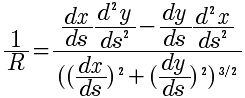
[Martin Taylor 2017.06.05.14.19]
[From Rick Marken (2017.06.05.1015)]
I disagree, but that's not unusual. Starting with "I'm pretty sure",
what you proposed has nothing to do with my suggestion, and is
largely false into the bargain. You are not pretty sure you confused
derivative, as the rest of your message makes very plain. You don’t
believe anything in the following part of your message, and I never
suggested you should do something in which you don’t believe. I
hoped that you would believe that there were responsible and
competent people who think there is a problem whereas you don’t, and
that a good way to resolve it would be to describe the problem
accurately, and ask for an independent expert opinion (or two).
No it wasn't.What you quote here was a gentle way of excusing your
initial mistake and suggesting why the reviewers might have passed
over it to get onto the meat of the paper.
I imagine you are. One of the hypotheses associated with the control
hierarchy is that self-image is controlled quite high if not at the
actual top. But I think there are two kinds of perceptions there,
self as seen by self, and self as seen by others, which might have
rather different reference values for the different dimensions of
the self-image. All would probably be controlled at rather a high
gain, I would guess. I have attempted to disturb one component of
your self-as-seen-by-others image.
That's very interesting. Maybe you or one of your "mathematical
friends" could compute dx/dt for a point on the rim of a dartboard.
How does the dartboard change over time as the point moves through
space? Does the whole dartboard move with that point on its rim, or
what?
For another example, take a point on the rim of a glass and mark it
with a marker pen. When you move the glass to your lips, that point
does have a measurable movement through space, but so long as it is
sitting on the table, it doesn’t, does it (at least not relative to
the table, as the Earth goes spinning away on its journey through
space)? If curvature depends on the velocity of the point through
space as you claim, does the glass rim have zero or infinite
curvature at that point while the glass is sitting on the table, and
a finite non-zero curvature when the glass is on its way to your
lips? If not, how then does the curvature of the rim vary as
the velocity of the point changes?
Most are, in most respects. Just not when you say something that
appears not to be correct. If you are controlling for being
perceived to be always correct, of course most CSGnet posters will
post material that disturbs your controlled perception. If, instead,
you are controlling for being correct, you will control for finding
out what their objection might be, and would try to test its
correctness by other means to do what my advisor called
“triangulating the truth”. Maybe it is true that “much of the CSGNet
community and [you] are not on the same page with respect to PCT”,
but I have seen precious little evidence of it in CSGnet
discussions.
Well, if that's is your wish, I shall take it as my command. But I
do think you would come off better in the end if you were to do it
yourself, as though you had discovered the possibility for error.
You don’t even have to admit that there was an error, which is what
I would do if I were to write to the Editor. All you would have to
do is say that several colleagues have called into question the
equivalence of differentiation with respect to arc length and
differentiation with respect to time, but you think they are wrong
and would like to have an independent expert decide the issue.
There are two extra mistakes in the second sentence of that
paragraph, apart from the disputable assertion in the first
sentence. I leave it to the reader to see them, because I think they
are pretty obvious.
Martin
···
Martin Taylor (2017.06.05.09.45)–
MT: Yes, such a message would be silly indeed.But that wasn’t my suggestion.
RM: Here’s your suggestion: “* Have
you asked the journal editor to get a couple of (or
even one) mathematically competent referee to
determine whether the confusion at the start of the
paper between d/ds and d/dt invalidates the rest of
the paper or is irrelevant to the following
discussion?” * I think my message above follows your
suggestion to a T.
RM: That would be kindof silly, wouldn’t it. “Dear editor,
Please get someone mathematically capable
to check our “Power Law of
Movement” paper because
I’m pretty sure I confused derivatives
with respect to time with derivatives with
respect to distance. I really shouldn’t
have submitted the paper ,
having made this egregious mistake, but
now that it’s there in your possession –
and it’s been accepted for publication,
even – I think you should find someone
who can tell you that the paper should
have been rejected. Thanks. Sincerely…”
MT: My point, and this goes foryour RAND colleague, is that it’s all too easy for a
reviewer to see an equation and think “that must have
been checked, so I will assume it is OK.” In this
particular case, it would be even easier for a reviewer
to pass the problem by, since the Newton dot notation is
typically used for differentiation with respect to time.
It just isn’t, in this particular case.
RM: That may have been your point. But it wasn't your
suggestion.
MT: I had contemplated doing so, but I figuredthat the request for a specific check on the specific
issue would be more respectful of your own integrity
coming from you.
RM: Thanks but I’m fine with my integrity.
RM: I suggest that ifyou really think the power law paper is
not scientifically accurate you write a
rebuttal to it for publication in * Experimental
Brain Research*.
MT: All you will have learned is that time and distanceare not always the same thing, and that curvature is a
property of space, not of speed.
RM: What I learned is described in the conclusion of
the paper: the power law (as I had suspected) is an
example of a behavioral illusion.
MT: If you don't want to ask theeditor to do the check, you could make the same point to
your RAND colleague and ask him whether we all have been
correct that the formula refers to differentiation with
respect to arc length and is improperly used in the
paper as though it referred to differentiation with
respect to time, and how this affects the rest of the
argument.
RM: OK, I'll ask him. But I already asked my other
mathematical friends and they thought that idea was
ridiculous; the derivatives in the equations for both
velocity and curvature are with respect to time.
RM:... I think theanalysis in the power law paper is
pretty iron clad but maybe Alex will be able
to find the mistake and I’ll have learned
something quite amazing.
MT: I wouldn't normally perseverewith this if it were only a private matter within the
CSGnet community. But since you went ahead and published
it without at least letting us know that a respected
independent authority had examined the question of
whether it matters to the following argument that you
mixed up the two different kinds of differentiation, I
think it is important to sort it out and get the formal
literature corrected.
RM: And I wrote up and successfully published my
analysis of the power law of movement in the very journal
where much of the power research has been published
because it became depressingly clear to me that much of
the CSGNet community and I are not on the same page with
respect to PCT.
MT: Either way, whether the erroris or is not important to your following argument, I
think it is incumbent on you – not me, Alex, or anyone
else – to publish an erratum at the very minimum.
RM: But that's ridiculous because I don't think there
is any error and neither did my co-author or any of the
reviewers. So it is clearly now incumbent on you or Alex
or anyone else who thinks that there is an error in the
analysis to make it public.
MT: Anything less might leadreaders to think that PCT is the preserve of
mathematical sloppiness, which is not something of which
the proponents of “Predictive Coding” can often be
accused. That’s not the best way to make someone think
PCT is a concept worth pursuing instead.
RM: Again, there is no mathematical sloppiness. And if our
analysis of the power law of movement is wrong then PCT is
wrong and output-generation models are right.