[Martin Taylor 2014.09.07.23.01]
Hi, Rick and Boris and Ken. I hope you are all doing well. I see
that my name has come up in this exchange …
And Uncle Tom Cobbley and all.
But protocols are serious and real. Kent has it almost right, but
not entirely. Here’s Figure 14 from my Chapter including its
caption.
In normal reorganization, when a perception has sustained error,
reorganization is likely to change the actions performed to correct
the error. Eventually, reorganization may result in the person
performing actions that result in the perception being well
controlled, meaning that the actions create a stream of effects
through the environment that influence the controlled perception in
a direction to reduce the error. Seen from the viewpoint of the
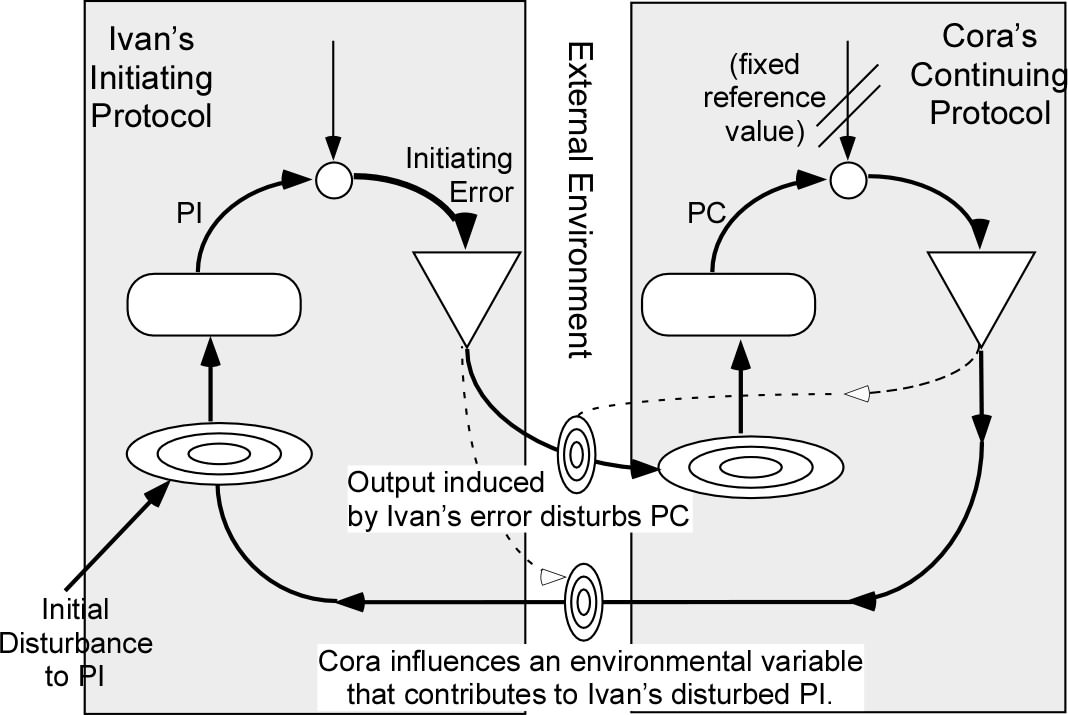
initiating partner (Ivan in the lower figure), a protocol is no
different. Ivan has reorganized so that his actions result in his
controlled perception being influenced in the direction to reduce
error.
Taking the analyst’s viewpoint, this description remains true, but
the analyst can see that the effect of Ivan’s action is to disturb a
perception Cora is controlling, and Cora has reorganized in such a
way that her actions to reduce the error in that perception counter
the disturbance to Ivan’s perception. In the example I use in the
Chapter, Ivan is a baby. When his stomach perception (whatever he
feels when we would say he is hungry) departs from its reference, he
cries. Cora, his mother, controls a perception of his contentment
that is disturbed by the crying. She has reorganized so that she can
control that perception by feeding Ivan, thereby stopping the crying
and increasing her perception of Ivan’s contentment to somewhere
near its reference level.
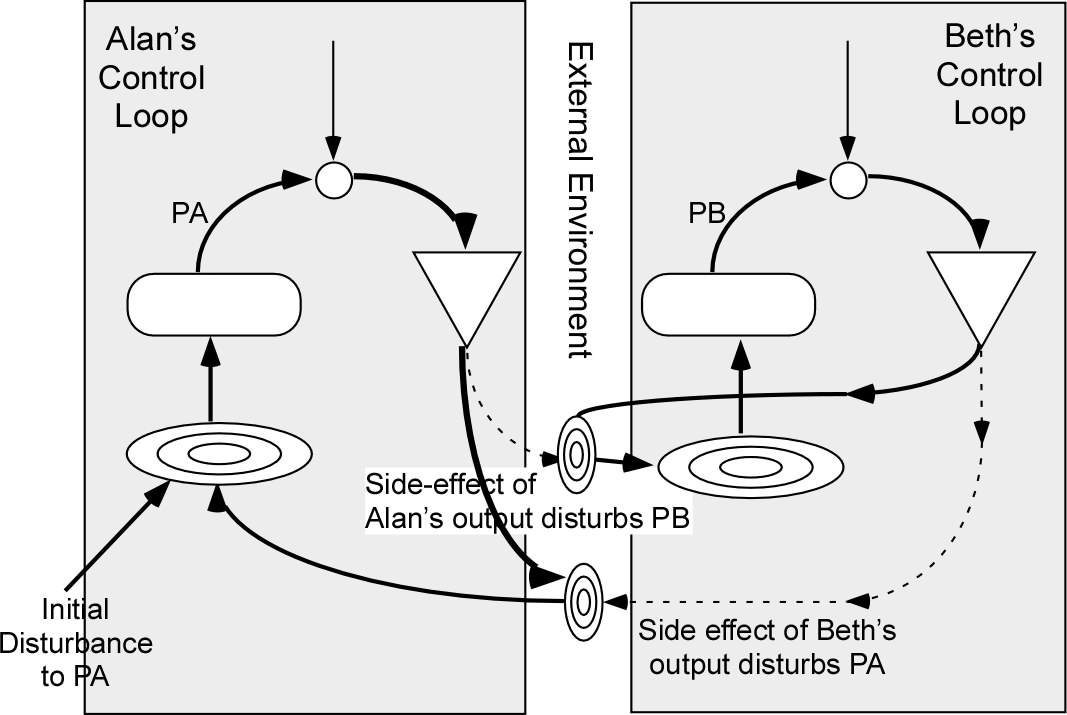
The upper part of the Figure suggests how such a protocol might
initially be developed. All actions have side-effects which could
influence someone else’s controlled perception. An example might be
a farmer who is controlling for having a money at a reference level
that is more money than he actually has. His actions to increase the
level of his perception of how much money he has involve growing
crops and selling them to some agent, and that’s the end of it. A
side effect of his growing crops is that food appears on supermarket
shelves. At the same time, a woman is controlling perception of her
family being not hungry, which she controls in part by giving money
to the supermarket in exchange for food. A side-effect of her
control is that the farmer gets a little more money. The woman and
the farmer neither know nor care that the other exists.
When the interaction between two people is a little closer than that
between the grocery shopper and the farmer, similar mutually
beneficial side-effect loops can exist. But one of the mantras of
PCT is “many means to the same end, many ends by the same means”. If
one of the people changes the actions that control a perception in a
side-effect loop, the side-effect goes away. As Kent has shown, if
there are two influences on a controlled variable, control is better
than if there is only one – the effective gain is increased. So
unless the different action controls better than does the action
with the useful side-effect, reorganization will tend to favour the
action with the side-effect for controlling that perception. The
same is true in both partners, so we are talking about the same
mechanism as occurs in co-evolution. I call it co-reorganization.
At some point in the co-reorganization, what was a side-effect may
become a main effect, in the sense that one of Alan’s lower-level
control systems actually controls a perception OF Beth, rather than
controlling something else that influences some perception IN Beth.
Since the loop is mutually beneficial, co-reorganization also alters
the Beth’s actions so as to make it easier for Alan to perceive
something about her that he can disturb in a way that she has
reorganized so that she is likely to act so as to influence the
perception Alan is controlling. How she does this, and how Alan also
reorganizes to produce something Beth can perceive about him that
she can influence to control her own perception, is totally
arbitrary, but however it is done, the result is to move from the
diagram at the top of the figure to the diagram in the lower panel.
We are talking here about the arbitrary nature of language, verbal,
gestural, body posture, facial expression, or whatever. It’s totally
arbitrary, but it is agreed by the process of co-reorganization, not
by some authority. Language, considered in the widest sense so as to
include, for example, the flashing colours of deep sea denizens or
the cries of a crow, is required for the development of secure
protocols, secure in the sense that unless Beth has a conflict, she
will do what Alan wants when he initiates the loop actions.
I hope that’s enough to get across the concept of a protocol, and to
sketch one of the several ways a protocol can be established.
I’m afraid I don’t have time to go into a discussion on this,
because the Chapter for LCS IV is just one of three publications I’m
working on, all of which have deadlines only days or weeks distant.
But when it’s done, you should be able to buy LCS IV and read about
it in excessive detail. Then I’ll be happy (I hope) to enter into
discussions about it.
Martin
···
     [From Kent McClelland (2014.09.07.2050)
Rick Marken (2014.09.07.1100)] in response to Boris Hartman
Hi, Rick and Boris. I hope you're both doing well. I see that my name has come up in this exchange,...
RM: One example: When I give a cashier $10 for a $5 item I am controlling for the cashier giving me $5 change. The cashier is also controlling for me paying $5 for the item. Typically, we both get the behaviors from each other than we want: a nice example of mutual control, and no one gets hurt (or oppressed). This kind of agreed on mutual control is the basis of civilization.KM: Martin Taylor, in the chapter he's writing for the LCS IV book edited by Warren Mansell (a preliminary draft of which I've been lucky enough to see), calls this kind of exchange transaction a "protocol," and, if I understand his concept correctly, protocols provide a way for two people acting together to control two different perceptions. The side-effects of one person's behavior in controlling his or her own perception allow the other person to control a different perception (and vice-versa). In your example, the cashier controls the perception of completing a sale by getting your money and giving you the item and $5 change, while you control the perception of buying the item by handing over the money and getting the item and change back.
Figure 14. The development and structure of a
basic protocol pair. (a, top) Alan and Beth each control
some perception, oblivious to the presence of the other. A
side-effect of Alan’s control disturbs the perception Beth
is controlling, and a side-effect of Beth’s control disturbs
a perception Alan is controlling. If those side-effects
happen to be beneficial, one or both of them might change
their output action so that they deliberately disturb the
other, as in (b, bottom) in which Ivan has a controlled
perception that differs from its reference. He cannot
influence it by his own actions, but Cora can. Ivan disturbs
a controlled perception in Cora that Cora cannot influence
directly. As Cora influences Ivan’s perception in a way to
reduce its error, Ivan’s output acts on Cora’s perception in
a way that reduces her error. The loop serves to reduce the
error in perceptions in both parties, but is initiated when
Ivan’s controlled perception is disturbed.