···
From: Bruce Nevin bnhpct@gmail.com
Sent: Saturday, April 28, 2018 6:18 PM
To: IAPCT csgnet@lists.illinois.edu
Subject: responsibility to our science
[Bruce Nevin 2018-04-28_12:04:04 ET]
BN : We are here to investigate, test, demonstrate, and promulgate perceptual control theory.
HB : Before doing all these thought operations you have to understand PCT. But I agree that CSGnet forum is for promulgating PCT and preserve memory on Bill and Mary Powers.
BN : We cannot attain these aims without a practical grasp of the phenomenon of control. The last of these aims–promulgation–requires other people, many others, to achieve a practical grasp of the phenomenon of control. Without the existential perception of control as a phenomenon in the environment, the theory is just another castle of empty words.
HB : You wrote it down that »promulgation« of PCT can be efective through examples (Albert Schweizer). If you’ll check through CSGnet I’m probably the one who contributed most of PCT examples though conversations with Bill, Rick, Barb, Martin, Fred, Bruce A… And of course lately with Alison.Â
BN : A mode or quality of communication has become accepted among us which is inimical to these purposes.
HB : Well… mode of quality of communication depends on all of us. I don’t understand about which mode you are talking about when you are saying »among us« ? Is that a specific mode among your friends ? Or you have »mode of communication« in which you respect every member the same. If you would appologize for your starting attitude to me (which had nothing to do with respect) , I would sure answer with »respectfull mode« of conversation to you.
BN : It is as though a troll lurks within each of us, quick to take offense and to offend. My friends, we are too few, and too isolated in the sea of willful ignorance that surrounds us, to afford this.
HB : This sounds like call for cooperation ?
BN : If we really care to control those stated purposes in this email forum, then we must apply the principles of perceptual control theory to our own conduct.
HB : And which are the principles of perceptual control theory ? Are these principles listed below right ? Do you agree with them ?
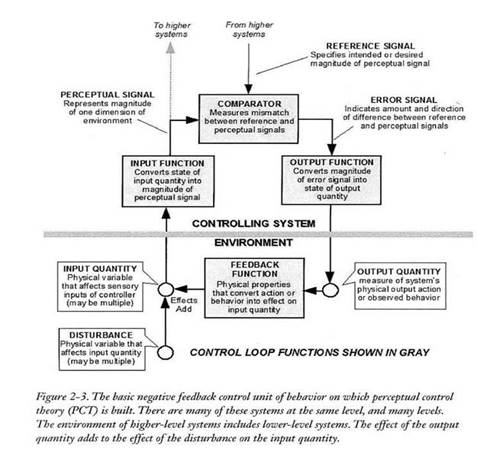
PCT Definitions of control loop :
Bill P (B:CP):
- CONTROL : Achievement and maintenance of a preselected state in the controlling system, through actions on the environment that also cancel the effects of disturbances.
Bill P (B:CP):
- OUTPUT FUNCTION : The portion of a system that converts the magnitude or state of a signal inside the system into a corresponding set of effects on the immediate environment of the system
Bill P (LCS III):…the ooutput function shown in it’s own box represents the means this system has for causing changes in it’s environment.
Bill P (LCS III):
- FEED-BACK FUNCTION : The box represents the set of physical laws, properties, arrangements, linkages, by which the action of this system feeds-back to affect its own input, the controlled variable. That’s what feed-back means : it’s an effect of a system’s output on it’s own input.
Bill P (B:CP) :
- INPUT FUNCTION : The portion of a system that receives signals or stimuli from outside the system, and generates a perceptual signal that is some function of the received signals or stimuli.
Bill P (B:CP) :
- COMPARATOR : The portion of control system that computes the magnitude and direction of mismatch between perceptual and reference signal.
Bill P (B:CP)
- ERROR : The discrepancy between a perceptual signal and a reference signal, which drives a control system’s output function. The discrepancy between a controlled quantity and it’s present reference level, which causes observable behavior.
Bill P (B:CP) :
- ERROR SIGNAL : A signal indicating the magnitude and direction of error.
PCT diagram in LCS III
![cid:image001.jpg@01D37ABE.36063DF0]()
BN : What can this mean? When we perceive the phenomenon of control what we perceive is resistance to disturbances.
HB : I think you’ll have to check your understanding of how organisms function ?
BN : To perceive the phenomenon of control, we control two perceptions: perception of disturbances and perception of that which is disturbed.
HB : I keep telling you, that you don’t perceive only with »outer« receptors. For understanding how organims function you have to understand how internal structure function. The control is primary going on inside organisms. That is definition of control.
Bill P :
CONTROL : Achievement and maintenance of a preselected state in the controlling system, through actions on the environment that also cancel the effects of disturbances.
HB : Thinking only that perception is outside phenomenon is old psychology. Even modern psychologist see the importance of understanding how organisms function.
BN : The Test ensures that these perceptions originate in the environment rather than in imagination.
HB : Which »test« ??? For »outer perception« ? Come on Bruce. Let behaviorism stay and rest in past. It’s PCT time.
BN : When conflict arises (as it inevitably does), an alert control theorist can dial the intensity of disturbance back so as to employ the ongoing conflict gently as a Test for controlled variables.
HB : Even Rick confirmed limitaions of TCV. It’s better to use also other methods of understanding what other people control (think).Â
RM (2013) : But the intentional behavior that occurs in real life often involves the control of variables that are impossible to represent as simple function of physical variables, e.g., the honesty of a communication or the intimacy of a realtionship. A quantitative approcah to the TCV will not work when trying to study such abstract variables….
HB : So why should you be doing just »test for controlled variables« ? You have many other methods for understanding what is going on in other person. Anyway any »test« is not certain, because if you don’t understand how orgsnisms function you’ll never know whether person behaves so to express what is going on inside her or is just facking what is really going on inside. People can lie, imagine and can trick you.
BN : By contrast, when conflict arises the troll within pushes harder, or seeks alternative means to win perceived advantage. This troll metaphor obviously alludes to control of purposes (‘personality needs’) other than those listed above.
HB : How can you know for sure that other person is revealing to you his real purposes ?
BN : In a troll mood we are quick to point out where someone has not ‘got it right’ or to suggest that they do not even ‘get it’ at all. It seems to me, after 27 years of participant observation, that by these means we control a demonstration to others that we ourselves are the ones who have ‘got it’.
HB : Well show me what you »got« from PCT ? BNCT ?
BN : The trolling mode of communication puts perceptual control theory at risk of drowning, to be rediscovered by some future generation. Given the global situation, it may not be hyperbole to suggest that we risk leaving PCT to be rediscovered by some future species.
HB : Well first you have to judge for yourself and your contribution to PCT. Until you’ll promote RCT or BNCT, PCT will slowly dissapear. And if you promote »behavioral« tools for »Researchgate project« you are on good way that PCT will not be researched but behaviorism.
BN : Amid and behind all our efforts to reorganize our respective specializations of science, organize and carry out research, and publish–rightly where our foremost attention and effort lies–our challenge is to master how to resolve conflict and make it fruitful.
HB : Well difficult question. If you think on Rick publishing, than I can say only that he made more damage to PCT than anyone else. I think that Powers ladies or IAPCT should form some group of real PCT’ers, who should examine whatever is to be published about PCT and allow it or not if it’s not in accordance to Billls’ writings.
BN : If we who are best informed in PCT cannot do this among ourselves, what claim do we have on the attention of others about the efficacy and importance of PCT?
HB : Yes I’m wondering why is there so many »control theories« on CSGnet. Maybe because many members have their own image of what PCT is. I think that only what is in accordance to Bills’ PCT is considered as right PCT. So every text should be supported by Bills’ writings, like I’m doing all the time for example.
BN : Albert Schweizer said there are three ways to teach a child. The first is by example. The second is by example. And the third is by example. If we cannot be a living demonstration of what it means really to grasp the phenomenon of control, how credible are our words?
HB : Well I can hardly recall any of your PCT examples, but you can get at least 10 my PCT examples on CSGnet. Search through archives. The last example was in cooperation with Alison. Why didn’t you take part ?
BN : Our responsibility is great. Come, friends, let us be about it.
HB : Well it would be nice if you would be the first to start thinking in PCT manner.
Boris
 And also insufficiently general. (Abstraction != generalization.) Trolling has more variety on perhaps a continuum with flaming intermediate and more legitimate forms of disputation at the other end. For example, your suggestion doesn’t capture thread-jacking to an obsessively re-introduced opinion, irrelevant to the topic of the thread.