[Martin Taylor 2014.02.25.10.26]
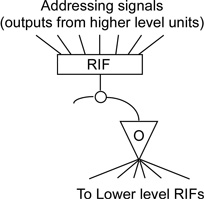
Many years ago, Bill and I had a discussion on Reference Input
Functions (RIFs). The point we were considering was that the
reference value for any elementary control unit (ECU) at level N
depends on the output of many, possibly very many, ECUs at the next
higher level, N+1. The way these outputs combine to generate a
reference value for an ECU is a “Reference Input Function” (RIF), and, as Rick suggested in [From Rick Marken (2014.02.23.1440)] it is
very likely that the form of an RIF varies from level to level, as
do the forms of the Perceptual Input Functions (PIFs). At low
levels, an RIF might well be a weighted summation, while at some
high level it might be the kind of associative memory implied by
B:CP figure 15.3. At other levels of the hierarchy an RIF could well
have completely different form, such as a shift register with
weighted input values, or even (again as Rick suggested) a complete
program as in a computer.
The concept of a Meme is not that of a scalar signal value. It is a
complex structure. If it is relevant to the RIF at all, the meme
would have to be the particular pattern of input values, not any one
of them. However, is it more likely that a meme is a perception
rather than the patterning that generates a reference value?
Martin
···
Warren Mansell (apparently 2014.02.25.07.51) said
Hi Rick, I was only restricting my reply to the perceptualhierarchy under its immediate working properties. I recognise
that intrinsic reference values are a separate issue. However,
reorganisation, as I understand it would not lead to the same
kind of ‘variation’ in reference signals in the uppermost system
as the variation that all the (relatively) lower order systems
experience. As reorganisation alters the parameters of the
control unit rather than the reference signal directly, then one
might get a change in the impact of the reference signal on the
outputs that are generated, but not a time varied change in
reference signal that all the lower order systems would
experience.
I like Kent's focus on attention, his MOL link makes sense,and I think it would be fascinating if a meme could be
considered as the current uppermost system in attention at any
one time, which could be inferred by viewing quite automatically
and passed on from agent to agent, regardless of the potentially
different lower order systems and signals in those systems used
on the basis of different environments and between individuals.
Warren