Roth, Sponberg, Cowan (2014): A comparative approach to closed-loop computation

[From Matti Kolu (2014.04.16.1245 CET)]

A comparative approach to closed-loop computation
E Roth, S Sponberg, NJ Cowan
http://dx.doi.org/10.1016/j.conb.2013.11.005
Current Opinion in Neurobiology. Volume 25, April 2014, Pages 54�62

"Neural computation is inescapably closed-loop: the nervous system
processes sensory signals to shape motor output, and motor output
consequently shapes sensory input. Technological advances have enabled
neuroscientists to close, open, and alter feedback loops in a wide
range of experimental preparations. The experimental capability of
manipulating the topology�that is, how information can flow between

subsystems�provides new opportunities to understand the mechanisms and
computations underlying behavior. These experiments encompass a
spectrum of approaches from fully open-loop, restrained preparations
to the fully closed-loop character of free behavior. Control theory
and system identification provide a clear computational framework for
relating these experimental approaches. We describe recent progress
and new directions for translating experiments at one level in this
spectrum to predictions at another level. Operating across this
spectrum can reveal new understanding of how low-level neural
mechanisms relate to high-level function during closed-loop behavior."

http://www.sciencedirect.com/science/article/pii/S095943881300216X

Full-text currently available at
http://limbs.lcsr.jhu.edu/wp-content/uploads/2013/12/rothcomparative2014.pdf or
http://faculty.washington.edu/bergs/Simon_Sponberg/Publications_files/Roth_Sponberg_2014_Curr%20Opin%20Neurobiol.pdf

Matti

Hi Matti,

Hmm, maybe I’ll have to skim the thing more closely… 8-]

I took “free behavior” to include things like ethological observational studies, similar to what Frans & Hetty Plooij did in their investigations of how levels of control developed in infant chimpanzees. Whenever we’re observing an organism, without interrupting or severing its ability to control, aren’t we dealing with dozens or even hundreds of intact closed loops? Doesn’t the problem become one of limiting the dimensionality (as they say in the article), so that useful or testable conclusions can be drawn?

The thing I didn’t like about the article is that the language is fairly thick, by which I mean compressed & technical, which keeps forcing me to translate it in my head to more understandable language. (I also don’t like that they use Wiener’s way of diagraming negative feedback loops, instead of the much more intuitive way that Bill Powers does it.)

But unless I’m doing an awful lot of generous wishful thinking in how I translate what they’re getting at, I think they’re raising something substantive. It is at least refreshing to find someone in the general literature proposing closed-loop experimental analyses, & showing the ways other forms of experimentation are opening the loop. Since when have we seen other articles with that degree of self-awareness about what is being tested & how?

As I said, this is an initial (perhaps superficial) impression, but I’m not so sure. I still appreciate your finding such articles & posting them for our consideration. I’m going to Cc: this emerging discussion to CSGNet, in case others have impressions they want to share.

All the best,

Erling

Matti Kolu matti.kolu@gmail.com 4/16/2014 4:18 PM >>>
Hm.

“Free behavior” that can involve “dozens of closed loops”?

The paper is terrible. :slight_smile:

(But some of the references are interesting.)

Matti

···

On Wed, Apr 16, 2014 at 7:29 PM, Erling Jorgensen EJorgensen@riverbendcmhc.org wrote:

Hi Matti,
Just a quick reply personally, not enough to bother the Net with…

I’ve just started to skim this, but thanks for finding this article. It
seems to present a fairly nuanced understanding of the role of control
theory formulations within a range of experimental settings, including their
potential for generating testable hypotheses. Good find!
Erling

Matti Kolu matti.kolu@gmail.com 4/16/2014 6:45 AM >>>
[From Matti Kolu (2014.04.16.1245 CET)]

A comparative approach to closed-loop computation
E Roth, S Sponberg, NJ Cowan
http://dx.doi.org/10.1016/j.conb.2013.11.005
Current Opinion in Neurobiology. Volume 25, April 2014, Pages 54–62

“Neural computation is inescapably closed-loop: the nervous system
processes sensory signals to shape motor output, and motor output
consequently shapes sensory input. Technological advances have enabled
neuroscientists to close, open, and alter feedback loops in a wide
range of experimental preparations. The experimental capability of
manipulating the topology—that is, how information can flow between
subsystems—provides new opportunities to understand the mechanisms and
computations underlying behavior. These experiments encompass a
spectrum of approaches from fully open-loop, restrained preparations
to the fully closed-loop character of free behavior. Control theory
and system identification provide a clear computational framework for
relating these experimental approaches. We describe recent progress
and new directions for translating experiments at one level in this
spectrum to predictions at another level. Operating across this
spectrum can reveal new understanding of how low-level neural
mechanisms relate to high-level function during closed-loop behavior.”

http://www.sciencedirect.com/science/article/pii/S095943881300216X

Full-text currently available at
http://limbs.lcsr.jhu.edu/wp-content/uploads/2013/12/rothcomparative2014.pdf
or
http://faculty.washington.edu/bergs/Simon_Sponberg/Publications_files/Roth_Sponberg_2014_Curr%20Opin%20Neurobiol.pdf

Matti
  NOTICE: This e-mail communication (including any attachments) is CONFIDENTIAL and the materials contained herein are PRIVILEGED and intended only for disclosure to or use by the person(s) listed above. If you are neither the intended recipient(s), nor a person responsible for the delivery of this communication to the intended recipient(s), you are hereby notified that any retention, dissemination, distribution or copying of this communication is strictly prohibited. If you have received this communication in error, please notify me immediately by using the "reply" feature or by calling me at the number listed above, and then immediately delete this message and all attachments from your computer. Thank you.

[From Kent McClelland (2013.04.17.1530 CDT)]

  Matti Kolu (2014.04.16.1245 CET) (2014.04.16.1900 CET)

Thanks Matti, for alerting us to the work of the researchers in the LIMBS Laboratory for Mechanical Engineering at Johns Hopkins University. Here's another forthcoming publication that I found on their website, which suggests to me that these researchers are really beginning to "get it" about the importance of feedback control.

Noah J. Cowan, M. Mert Ankarali, Jonathan P. Dyhr, Manu S. Madhav, Eatai Roth, Shahin Sefati, Simon Sponberg, Sarah A. Stamper, Eric S. Fortune, and Thomas L. Daniel . �Feedback control as a framework for understanding tradeoffs in biology�. arXiv:1402.5702, 2014.

Control theory arose from a need to control synthetic systems.
from regulating steam engines to tuning radios to devices
capable of autonomous movement, it provided a formal
mathematical basis for understanding the role of feedback in
the stability (or change) of dynamical systems. It provides a
framework for understanding any system with feedback regulation,
including biological ones such as regulatory gene networks,
cellular metabolic systems, sensorimotor dynamics of
moving animals, and even ecological or evolutionary dynamics
of organisms and populations. Here we focus on four case
studies of the sensorimotor dynamics of animals, each of which
involves the application of principles from control theory to
probe stability and feedback in an organism's response to
perturbations. We use examples from aquatic (electric fish
station keeping and jamming avoidance), terrestrial (cockroach
wall following) and aerial environments (flight control
in moths) to highlight how one can use control theory to understand
how feedback mechanisms interact with the physical
dynamics of animals to determine their stability and response
to sensory inputs and perturbations. Each case study is cast
as a control problem with sensory input, neural processing,
and motor dynamics, the output of which feeds back to the
sensory inputs. Collectively, the interaction of these systems
in a closed loop determines the behavior of the entire system.

Keywords: feedback, control theory, neuromechanics, stability,
locomotion.

By going to this URL, you can download the full-text document. It's listed as number 1 under the heading, Preprints.

http://limbs.lcsr.jhu.edu/publications/

Best,

Kent

···

On Apr 16, 2014, at 5:45 AM, Matti Kolu wrote:

[From Matti Kolu (2014.04.16.1245 CET)]

A comparative approach to closed-loop computation
E Roth, S Sponberg, NJ Cowan
http://dx.doi.org/10.1016/j.conb.2013.11.005
Current Opinion in Neurobiology. Volume 25, April 2014, Pages 54�62

"Neural computation is inescapably closed-loop: the nervous system
processes sensory signals to shape motor output, and motor output
consequently shapes sensory input. Technological advances have enabled
neuroscientists to close, open, and alter feedback loops in a wide
range of experimental preparations. The experimental capability of
manipulating the topology�that is, how information can flow between
subsystems�provides new opportunities to understand the mechanisms and
computations underlying behavior. These experiments encompass a
spectrum of approaches from fully open-loop, restrained preparations
to the fully closed-loop character of free behavior. Control theory
and system identification provide a clear computational framework for
relating these experimental approaches. We describe recent progress
and new directions for translating experiments at one level in this
spectrum to predictions at another level. Operating across this
spectrum can reveal new understanding of how low-level neural
mechanisms relate to high-level function during closed-loop behavior."

http://www.sciencedirect.com/science/article/pii/S095943881300216X

Full-text currently available at
http://limbs.lcsr.jhu.edu/wp-content/uploads/2013/12/rothcomparative2014.pdf or
http://faculty.washington.edu/bergs/Simon_Sponberg/Publications_files/Roth_Sponberg_2014_Curr%20Opin%20Neurobiol.pdf

Matti

···

[From Rick Marken (2014.04.17.1500)]

Kent McClelland (2013.04.17.1530 CDT)

Matti Kolu (2014.04.16.1245 CET) (2014.04.16.1900 CET)

KM: Thanks Matti, for alerting us to the work of the researchers in the LIMBS Laboratory for Mechanical Engineering at Johns Hopkins University. Here’s another forthcoming publication that I found on their website, which suggests to me that these researchers are really beginning to “get it” about the importance of feedback control.

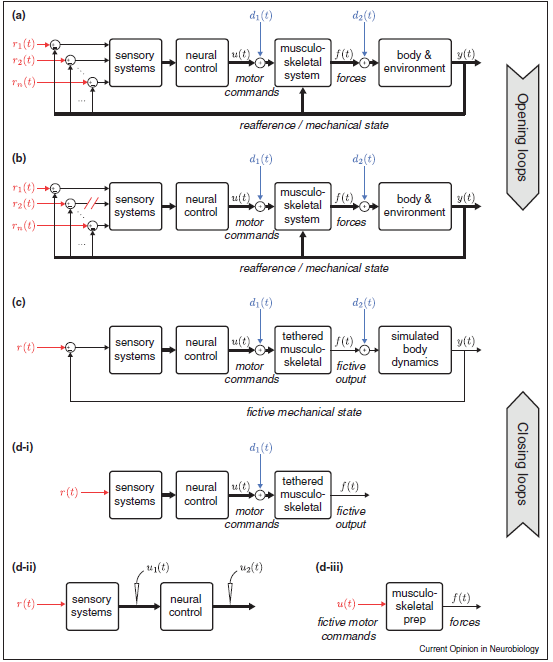
RM: With all due respect, Kent, can you look at their diagram of a closed loop system at the top of their Figure 1 (copied below) and say (with a straight face) that they are beginning to “get it”.

The r(t) in this figure are,indeed, reference signals!!

Best

Rick


Richard S. Marken PhD
www.mindreadings.com
It is difficult to get a man to understand something, when his salary depends upon his not understanding it. – Upton Sinclair

[From Kent McClelland (2014.04.18.0830)]

···

Rick Marken (2014.04.17.1500)

RM: With all due respect, Kent, can you look at their diagram of a closed loop system at the top of their Figure 1 (copied below) and say (with a straight face) that they are beginning to “get it”.

KM: Well, yes, I did come to the conclusion that they were beginning to get it, but only after reading the article closely. The diagram you copied from the beginning of the article dismayed me a bit, I admit. The control loop that they present is hardly
an orthodox PCT diagram, and they present it along with all the various open-loop possibilities that other investigators have put forward.

KM: It turns out when you read further, at least as I read it, that the whole point of the article is to assert the superiority of a feedback-control model for making sense of animal locomotion in conditions when the animals are subjected to the “perturbations”
of a natural environment, and not just in controlled laboratory conditions where researchers investigate behavior as if it’s open-loop (e.g., as when investigators try to understand the flying behavior of moths by tethering them so that they can’t move and
then examining the flapping patterns of their wings).

KM: Cowan’s very friendly response to Warren’s email suggests to me that there are some pretty large overlaps between what they are doing and the PCT perspective for looking at behavior. I guess I’d encourage you to take a closer look at the article and
see what you think. If I’m missing something, I’d like to know about it.

Best,

Kent

[From Rick Marken (2014.04.17.1500)]

Kent McClelland (2013.04.17.1530 CDT)

Matti Kolu (2014.04.16.1245 CET) (2014.04.16.1900 CET)

KM: Thanks Matti, for alerting us to the work of the researchers in the LIMBS Laboratory for Mechanical Engineering at Johns Hopkins University. Here’s another forthcoming publication that I found on their website, which suggests to me that these researchers
are really beginning to “get it” about the importance of feedback control.

RM: With all due respect, Kent, can you look at their diagram of a closed loop system at the top of their Figure 1 (copied below) and say (with a straight face) that they are beginning to “get it”.

The r(t) in this figure are,indeed, reference signals!!

Best

Rick


Richard S. Marken PhD

www.mindreadings.com
It is difficult to get a man to understand something,
when his salary depends upon his not understanding it. – Upton Sinclair

[From Rick Marken (2014.04.18.1110)]

···

Kent McClelland (2014.04.18.0830)–

Control theory for humans: Quantitative approaches to modeling performance,

RM: The problem, of course, is that the reference signals come into the sensory systems from the environment. This is the same thing that is done by psychologists who have applied control theory to understanding behavior (and there are many of them who have done and are doing this; it’s a huge field (see, for example Jagacinski, R and Flach, J. (2002) NJ: Erlbaum). Putting references in the environment makes it possible to apply control theory in a way that is consistent with the basic input-output view of behavior that is the basis of all social science theory and research. When control theory is applied in this way it is seen as a way to “trim up” behavior output, not as a way to control perceptions.

RM: The thing about PCT is that it applies control theory to behavior in a way that recognizes that behavior is organized around the control of perceptual input, not behavioral output. So unlike all other applications of control theory to understanding behavior, PCT puts the focus on determining the perceptual variables that are being controlled rather than on determining the factors that affect how accurately output variables are produced.

RM: Bill and I have have many interactions with psychologists and biologists who have applied control theory to understanding behavior (Flach was one of them) in the hopes that, because of their interest in and rather deep understanding of control theory they would come on board with PCT. But, alas, this has not turned out to be the case. Control theorists can be just as resistant to PCT as anyone else, maybe more so. What it seems to take to “get” PCT is a willingness to abandon one’s preconceptions about how behavior works. People who understand control theory – even in great mathematical detail – are no better than anyone else at doing this. Indeed, since they know control theory so well they tend to take umbrage at any suggestion that they might be applying it incorrectly.

RM: I hate to be cynical about this; maybe Cowan (whom Warren has contacted and who seems like a nice fellow) and his colleagues will get on board with PCT. That would be great. But, like Charlie Brown, I’ve had the football pulled away from me by control theorists too often to want to try another punt. But I hope it works out.

Best regards

Rick


Richard S. Marken PhD
www.mindreadings.com
It is difficult to get a man to understand something, when his salary depends upon his not understanding it. – Upton Sinclair

Rick Marken (2014.04.17.1500)

RM: With all due respect, Kent, can you look at their diagram of a closed loop system at the top of their Figure 1 (copied below) and say (with a straight face) that they are beginning to “get it”.

KM: Well, yes, I did come to the conclusion that they were beginning to get it, but only after reading the article closely. The diagram you copied from the beginning of the article dismayed me a bit, I admit. The control loop that they present is hardly
an orthodox PCT diagram, and they present it along with all the various open-loop possibilities that other investigators have put forward.

KM: It turns out when you read further, at least as I read it, that the whole point of the article is to assert the superiority of a feedback-control model for making sense of animal locomotion in conditions when the animals are subjected to the “perturbations”
of a natural environment, and not just in controlled laboratory conditions where researchers investigate behavior as if it’s open-loop (e.g., as when investigators try to understand the flying behavior of moths by tethering them so that they can’t move and
then examining the flapping patterns of their wings).

KM: Cowan’s very friendly response to Warren’s email suggests to me that there are some pretty large overlaps between what they are doing and the PCT perspective for looking at behavior. I guess I’d encourage you to take a closer look at the article and
see what you think. If I’m missing something, I’d like to know about it.

Best,

Kent

from Kent McClelland (2014.04.18.1350)]

Rick Marken (2014.04.18.1110)

KM: We seem to be in a half-full-half empty situation here, where I’m looking at the hopeful side and you, at the other. You’re right that Cowan et al. talk about “external” reference signals and their diagrams seem to show it that way, though their text in
other places could be read as implying that reference signals are sometimes internal. Still, they don’t seem to have quite grasped the idea of a hierarchical architecture where higher levels supply reference signals for the lower ones, nor the fundamental
insight that it’s the input that’s controlled, not the output.

Speculating about what they really think probably isn’t worth our time, but I’ve got to hope that at some point the sad history of resistance to PCT will stop repeating itself. I’m pleased to hear that Warren has contacted Cowan and that Cowan seems interested
in what Warren is saying. We’ll just have to wait and see.

Best,

Kent

I’m glad to have heard that Warren has contacted Cowan, and that Cowan

···

On Apr 18, 2014, at 1:09 PM, Richard Marken wrote:

[From Rick Marken (2014.04.18.1110)]

Kent McClelland (2014.04.18.0830)–

Rick Marken (2014.04.17.1500)

RM: With all due respect, Kent, can you look at their diagram of a closed loop system at the top of their Figure 1 (copied below) and say (with a straight face) that they are beginning to “get it”.

KM: Well, yes, I did come to the conclusion that they were beginning to get it, but only after reading the article closely. The diagram you copied from the beginning of the article dismayed me a bit, I admit. The control loop that they present is hardly an
orthodox PCT diagram, and they present it along with all the various open-loop possibilities that other investigators have put forward.

RM: The problem, of course, is that the reference signals come into the sensory systems from the environment. This is the same thing that is done by psychologists who have applied control theory to understanding behavior (and there are many of them who have
done and are doing this; it’s a huge field (see, for example Jagacinski, R and Flach, J. (2002) Control theory for humans: Quantitative approaches to modeling performance, NJ: Erlbaum). Putting references in the environment makes it possible to apply control
theory in a way that is consistent with the basic input-output view of behavior that is the basis of all social science theory and research. When control theory is applied in this way it is seen as a way to “trim up” behavior output, not as a way to control
perceptions.

RM: The thing about PCT is that it applies control theory to behavior in a way that recognizes that behavior is organized around the control of perceptual input, not behavioral output. So unlike all other applications of control theory to understanding behavior,
PCT puts the focus on determining the perceptual variables that are being controlled rather than on determining the factors that affect how accurately output variables are produced.

RM: Bill and I have have many interactions with psychologists and biologists who have applied control theory to understanding behavior (Flach was one of them) in the hopes that, because of their interest in and rather deep understanding of control theory they
would come on board with PCT. But, alas, this has not turned out to be the case. Control theorists can be just as resistant to PCT as anyone else, maybe more so. What it seems to take to “get” PCT is a willingness to abandon one’s preconceptions about how
behavior works. People who understand control theory – even in great mathematical detail – are no better than anyone else at doing this. Indeed, since they know control theory so well they tend to take umbrage at any suggestion that they might be applying
it incorrectly.

RM: I hate to be cynical about this; maybe Cowan (whom Warren has contacted and who seems like a nice fellow) and his colleagues will get on board with PCT. That would be great. But, like Charlie Brown, I’ve had the football pulled away from me by control theorists
too often to want to try another punt. But I hope it works out.

Best regards

Rick

KM: It turns out when you read further, at least as I read it, that the whole point of the article is to assert the superiority of a feedback-control model for making sense of animal locomotion in conditions when the animals are subjected to the “perturbations” of
a natural environment, and not just in controlled laboratory conditions where researchers investigate behavior as if it’s open-loop (e.g., as when investigators try to understand the flying behavior of moths by tethering them so that they can’t move and then
examining the flapping patterns of their wings).

KM: Cowan’s very friendly response to Warren’s email suggests to me that there are some pretty large overlaps between what they are doing and the PCT perspective for looking at behavior. I guess I’d encourage you to take a closer look at the article and see
what you think. If I’m missing something, I’d like to know about it.

Best,

Kent

Richard S. Marken PhD

www.mindreadings.com

It is difficult to get a man to understand something, when his salary depends upon his not understanding it. – Upton Sinclair

[From Rick Marken (2014.04.19.0900)]

···

Kent McClelland (2014.04.18.1350)

KM: We seem to be in a half-full-half empty situation here, where I’m looking at the hopeful side and you, at the other.

RM: Well, I can be as optimistic as you are when my glass is half full of vodka;-)

Unfortunately I don’t drink so I’ll just have to try to be optimistic sans chemical support. But I’m not too optimistic about being optimistic;-)

Best

Rick

You’re right that Cowan et al. talk about “external” reference signals and their diagrams seem to show it that way, though their text in
other places could be read as implying that reference signals are sometimes internal. Still, they don’t seem to have quite grasped the idea of a hierarchical architecture where higher levels supply reference signals for the lower ones, nor the fundamental
insight that it’s the input that’s controlled, not the output.

Speculating about what they really think probably isn’t worth our time, but I’ve got to hope that at some point the sad history of resistance to PCT will stop repeating itself. I’m pleased to hear that Warren has contacted Cowan and that Cowan seems interested
in what Warren is saying. We’ll just have to wait and see.

Best,

Kent

I’m glad to have heard that Warren has contacted Cowan, and that Cowan

On Apr 18, 2014, at 1:09 PM, Richard Marken wrote:

[From Rick Marken (2014.04.18.1110)]

Kent McClelland (2014.04.18.0830)–

Rick Marken (2014.04.17.1500)

RM: With all due respect, Kent, can you look at their diagram of a closed loop system at the top of their Figure 1 (copied below) and say (with a straight face) that they are beginning to “get it”.

KM: Well, yes, I did come to the conclusion that they were beginning to get it, but only after reading the article closely. The diagram you copied from the beginning of the article dismayed me a bit, I admit. The control loop that they present is hardly an
orthodox PCT diagram, and they present it along with all the various open-loop possibilities that other investigators have put forward.

RM: The problem, of course, is that the reference signals come into the sensory systems from the environment. This is the same thing that is done by psychologists who have applied control theory to understanding behavior (and there are many of them who have
done and are doing this; it’s a huge field (see, for example Jagacinski, R and Flach, J. (2002) Control theory for humans: Quantitative approaches to modeling performance, NJ: Erlbaum). Putting references in the environment makes it possible to apply control
theory in a way that is consistent with the basic input-output view of behavior that is the basis of all social science theory and research. When control theory is applied in this way it is seen as a way to “trim up” behavior output, not as a way to control
perceptions.

RM: The thing about PCT is that it applies control theory to behavior in a way that recognizes that behavior is organized around the control of perceptual input, not behavioral output. So unlike all other applications of control theory to understanding behavior,
PCT puts the focus on determining the perceptual variables that are being controlled rather than on determining the factors that affect how accurately output variables are produced.

RM: Bill and I have have many interactions with psychologists and biologists who have applied control theory to understanding behavior (Flach was one of them) in the hopes that, because of their interest in and rather deep understanding of control theory they
would come on board with PCT. But, alas, this has not turned out to be the case. Control theorists can be just as resistant to PCT as anyone else, maybe more so. What it seems to take to “get” PCT is a willingness to abandon one’s preconceptions about how
behavior works. People who understand control theory – even in great mathematical detail – are no better than anyone else at doing this. Indeed, since they know control theory so well they tend to take umbrage at any suggestion that they might be applying
it incorrectly.

RM: I hate to be cynical about this; maybe Cowan (whom Warren has contacted and who seems like a nice fellow) and his colleagues will get on board with PCT. That would be great. But, like Charlie Brown, I’ve had the football pulled away from me by control theorists
too often to want to try another punt. But I hope it works out.

Best regards

Rick

KM: It turns out when you read further, at least as I read it, that the whole point of the article is to assert the superiority of a feedback-control model for making sense of animal locomotion in conditions when the animals are subjected to the “perturbations” of
a natural environment, and not just in controlled laboratory conditions where researchers investigate behavior as if it’s open-loop (e.g., as when investigators try to understand the flying behavior of moths by tethering them so that they can’t move and then
examining the flapping patterns of their wings).

KM: Cowan’s very friendly response to Warren’s email suggests to me that there are some pretty large overlaps between what they are doing and the PCT perspective for looking at behavior. I guess I’d encourage you to take a closer look at the article and see
what you think. If I’m missing something, I’d like to know about it.

Best,

Kent

Richard S. Marken PhD

www.mindreadings.com

It is difficult to get a man to understand something, when his salary depends upon his not understanding it. – Upton Sinclair


Richard S. Marken PhD
www.mindreadings.com
It is difficult to get a man to understand something, when his salary depends upon his not understanding it. – Upton Sinclair