I’ve been speculating a lot about the state of things lately.
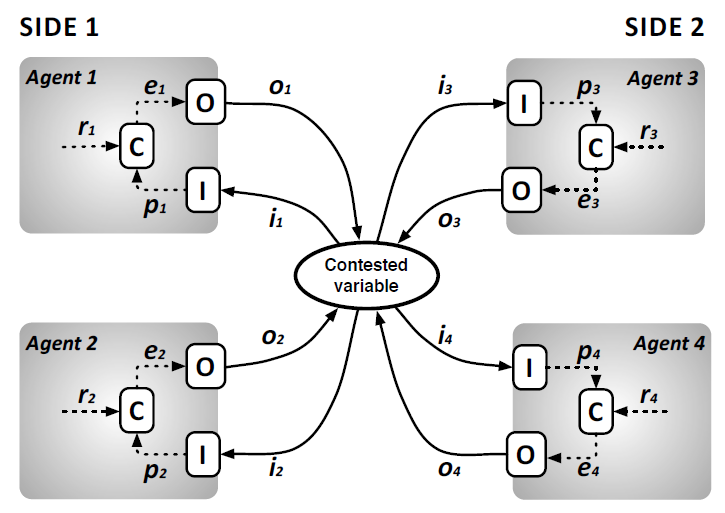
There’s two “emotions” that I think are worth honing in on. “Schadenfreude” and “Dissonance”. I make a couple assumptions first, that “happiness/relief” is an emotional signal related to a reduction in error from a reference range. And that anger is related to increasing error.
Schadenfreude
Schadenfreude, German for “Harm-Joy”, is an emotion described as feeling joy as a result of the suffering of others. This seems to suggest that there is a reference range for “other-suffering”, and that as other-suffering approaches this range, happiness is generated. There is some evidence for anger when desired other-suffering does not manifest as well. The “Opposer’s Loss Effect” suggests that people react more negatively when they are rooting for an opposing team to lose, than if they rooting for a preferred team to win. (Teeny & Petty 2025).
The Schadenfreude literature suggests 3 sub-types, Aggression, Rival, and Justice (Wang, Lilienfeld, & Rochat 2019), it is a taxonomy of “why” schadenfreude might pop up in various contexts, such as wanting to see justice done against someone who has harmed the group, or wanting one’s own group to gain an advantage over another, or one wanting to gain standing over an envied rival. Though they all share in having a reference for other-suffering, and it’s possible they can occur simultaneously. There was some evolutionary advantage to this, if someone senior in a hierarchy met misfortune - you may stand to benefit. If another tribe competing for resources in the same area met misfortune, your tribe stood a better chance. And if a tribe member stole or harmed another, a sense of schadenfreude might drive “justice”. However, having maintained that wiring in far more complex environments today, there are many ways to carve out us/them groups, and many ways ‘justice’ can be interpreted.
So one area I’m seeing Schadenfreude in right-wing spaces is in response to the ICE shootings & ICE enforcement. The “whatabout” invoked is Covid Mask Mandates. This seems to suggest that during Covid, MAGA felt “autonomy-error”. (Autonomy being control over one’s own behavior). And that ICE actions against “liberals” seem to invoke this sort of “you caused me X control-error so I want to see you suffer X+1 control-error”. This might be “justice schadenfreude”, rather than anything to do with system-level ideas about governance. There are parallels to this in Nazi Germany, whereby there must have been a setpoint for other-suffering in regard to marginalized populations as “causes” of economic & cultural suffering & war loss. Creating a “they deserved it because ‘they’ harmed ‘us’ first in XYZ way” justification. “Owning the libs”, in other words, causing emotional distress for one’s own amusement, is also a commonly controlled outcome.
Dissonance
An information state abstracted as “truth as I know it”, might have an error signal which occurs when new information does not fit within that reference range. This may be psychic discomfort itself, cognitive dissonance. Causal Inference: The Mixtape by Scott Cunningham mentions a parable of a woman sailing a boat. From a naive observer’s perspective, her rudder movements are not correlated to her heading - which remains fixed. So they may conclude the rudder is broken. Yet from the sailor’s perspective, they are controlling their heading - protecting it from the disturbing effects of wind and current via the rudder. I imagine “truth as I know it” much like this heading, incompatible information behaving like port & starboard winds. The mind then counter-steers using various biases and heuristics available to it to resolve the dissonance. The stronger the incompatible information, the stronger the counter-steering. It seems like regardless of the scale of information presented, the scale of the cognitive counter-steering rises to meet it. This effect is strong enough for apocalypse cult members to rationalize away their dissonance as the date for end-times comes and goes (Festinger, Riecken, Schachter 1956). Likewise, information that is agreeable, is like wind from the stern and a favorable current. It takes no steering whatsoever to let it drift you forward, and no effort may be made at all to interrogate its truthfulness.
Identity-Error
If someone does not self-identify as a Nazi, fascist, racist, bigot etc…then the incoming information saying they are (perhaps in the form of being called that in a comment on social-media) is sure to cause some dissonance. One person is saying “you and your group’s behavior is fitting a pattern, which is commonly described by this word”. As the other person says “but I don’t hate Jewish people, how could I be a fascist Nazi? What a rude thing to say”. A category error perhaps, as one person’s use of the word may mean “your behavior meet approximately 50-80% of this pattern”, while the other interprets it all-or-nothing. Any discomfort or dissonance from this identity-error would naturally be interpreted as “caused” by the other person. The same way a person might think the cold “caused” them to put a jacket on. Ignoring that their temperature was below an internally specified range, and their behavior sought to correct that error. This external view of causality would then facilitate some schadenfreude, if the person or kinds of people that “caused” that identity-error got some kind of suffering themselves.
The Market Crashed & The Tribe Has Spoken
I believe there is some evolutionary precedent for all of this, as we see it play out time & time again. If a tribe was struggling with having enough resources (food/water/space/jobs/etc) for all it’s members, it may decide to redraw the boundaries of who is us and who is them in order to shore up resources and exile those who are perceived to be weighing the tribe down. And just like any old human tribe, most modern human countries try to start with the “violent criminals” first. “Why should we share resources with murderers?”. But if economic woes are not relieved, the line may be pushed to immigrants. Propaganda may suggest a race or class is “intrinsically criminal”. But you cannot exile enough people to fix a fundamentally broken system, as we discover over and over again throughout history.
Re-Animating Popper
I think Karl Popper’s Open Society and its Enemies (1945) is begging for a PCT refresh. It was written by the philosopher of science while in political exile in New Zealand from Germany. He was intimately familiar with the problems of Fascism & Communism, and he critiqued both as “historicist doctrines”. In other word, both Fascism & Communism claim to understand the mechanisms of national success and you need only follow them to utopia.
I’ll focus on Popper’s critique of Fascism, which begins by attacking Plato as a Proto-Authoritarian. Plato had the idea of philosophers ruling, soldiers soldiering, workers working, and slaves slaving - bringing about an “arrested society”, a utopia that never changes. It is attractive to the authoritarian leader, who would declare themselves the philosopher. It’s also attractive to others who feel “naturally born for” a military or trade lifestyle. This arrested society would not be a democracy, as mob rule could not be trusted to maintain the order.
Since the days of Plato’s Republic, as countries enter times of economic struggles - it’s fashionable for someone to step up, point to some time in that country’s history where they were “closest” to utopia, and declare we should return to that. This is usually followed up with the accusation that democracy or some out-group “caused” the fall from utopia, and if we want to get back on track we’ll have to do away with that. For Nazi Germany this was pre-WW1, and Jews, Immigrants, LGBT, Gypsies, Liberals, etc were blamed for the fall. For America, it seems like they are picturing 1950’s postwar US, a job that could sustain a family, cheap college, plenty of housing, a wife you could cheat on and get away with it. It’s no surprise though that women and people of color have a tendency to ask “When exactly was America great for us?”
Steve Bannon’s recent interview on The Economist had the aura of Platonian righteousness. That Trump is chosen by God to lead, and that democracy or term limits should not get in the way of that.
The Big Lie
If you pay attention, Trump is actually the best at everything and the best person who ever existed. Just ask the people that told him so. I have a theory that any time he experiences some dissonance, he will invent a 3rd person who tells him the thing that, if true, would make him feel better. For example, if he’s feeling dishonest he will say “people tell me I’m the most honest guy in the world”. If he doesn’t understand something about economics: “nobody knows more about economics than me, they say”. And if it feels bad to lose an election, then of course - “they say it was stolen”. This of course directly led to fraudulent elector scandals and Jan 6th.
Indeed, Jan 6th insurrectionists felt very justified in their behavior, because they believed Trump was the rightful president, and that this attack on the Capitol was “justice”. Just like a sailor steers to protect a heading from the disturbing effects of wind, but does not steer when winds are favorable…Donald Trump did not steer when he watched the news that day. No behavior at all, meant that things were developing favorably to his goals.
Conclusion
This comment got a bit longer than I anticipated. I do not know how excessive schadenfreude or dissonance can be resolved, or if it is even possible. But if there is any chance, it may lie in the parameterization of the reference values - rather than in simply presenting information which creates dissonance & is resisted, or pointing out cruelty, which is reframed as justice.
One potential avenue is Popper’s critique of Fascism & Communism, as two wings of the same Historicist bird. A good critique of Fascism may be possible to Trojan-Horse inside a good critique of Communism.