taxonomies of reality

[From Bruce Nevin (2004.06.27 09:20 EDT)]

Bill Powers (2004.06.22.2220 MDT) –

Back in the dim mists of time, Bob Clark and I
worked out a sort of

taxonomy of reality. It proposed three types of reality:

  1. Directly Perceived Reality. … the reality that we cannot
    doubt,

because even doubting is part of it. If you think, "I doubt that
there is a

reality," there can be no doubt that you experienced that thought.
… the world of perceptions and activities in the
brain

  1. Deduced Reality. This is a subset of
    Directly Perceived Reality. … includes propositions about
    reality
  1. Real Reality. This is a subset of Deduced
    Reality. It consists of all

propositions about a world that exists independently of and outside
of

directly experienced reality. …

It’s odd to call this a taxonomy of reality. It sounds like a taxonomy of
thoughts and propositions. Directly perceived reality is thoughts &
“activities in the brain”, deduced reality is propositions
about reality and a body of (propositions about) evidence and reasoning
about those propositions. Real reality is those propositions that posit
aspects of a world that exists independently and outside of directly
experienced reality. (That last admits propositions of many kinds other
than those of science, by the way.)

Here’s a diagram of the set inclusions that you have stated:
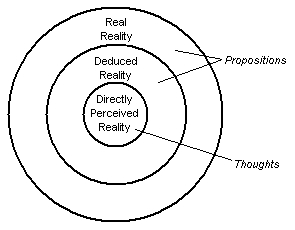
1dbfc2fd.jpg

The propositional nature of this description might be expected to appeal
to a linguist, but I’d rather distinguish between propositions and that
to which propositions refer.

  1. We live in Real Reality, which is richer than the realm of our unaided
    perceptions. (This is shown by perceived evidence that non-human
    creatures perceive aspects of reality that we do not and by perceptions
    using instrumental extensions of our senses.)

  2. Of Real Reality, we know only our perceptions. Insofar as these
    perceptions are defined in PCT as neural signals, they are included in
    Real Reality. Where the qualia of subjective experience subsist, we
    cannot say, any more than we can say where consciousness subsists.

  3. Perceptions are constructed, beginning with perceptions that are a
    function of perceptual input functions, sensors, and presumed environment
    variables. Among and from these perceptions we construct theories,
    models, etc., some of them by deduction, some by abduction, some by what
    we call intuition. (Intuition probably means deduction and abduction that
    we have not consciously directed or traced. However, it may also refer to
    modes of perception whose existence is denied in our culture or in our
    personal construction of experience and of which we therefore are
    unaware. The owner of Hans sincerely believed that the horse could count,
    and that was his perception. We can be our own Hans, misperceiving our
    own performances.)

  4. All these perceptual constructs are validated to the extent that we
    are able to control them successfully. Successful control is
    corroborative.

  5. In particular, intersubjective agreement is constructed as a
    perception of the reliability of the agreed perceptions. This encompasses
    all of culture and “social reality”.

  6. A subset of the perceptions of (5) are validated by the socially
    agreed and socially conducted methods of science. These (your “Real
    Reality”) are our best current model of the Really Real Reality in
    which our Really Real bodies actually live.

  7. There is a residuum of perceptions that we perceive as indubitable,
    such as the perception of one’s own process or act of doubting. By
    contrast to the explicitly public perceptions of (5), these are
    completely subjective, uncommunicable, private. In this, they are like
    the qualia of experience. In contradistinction to the perceptual universe
    of (2-6), these are not constructed as a function of environment
    variables. Here, we touch on the obdurate but usually ignored distinction
    between perceptions as defined in PCT and perceptions as we experience
    them. We ignore this, I think, because we haven’t the foggiest idea what
    to do about it.

In the following diagram, (7) is the innermost circle, at the farthest
retreat from reality into the qualia of subjective experience. (4-6) are
in the circle labelled “Verified Perceptions” – one may
imagine here a gradation of concentric circles according to how well
verified. (3) includes all perceptions, whether verified or not. All of
this perceiving and verifying is carried on amid variables of the actual
environment. Propositions about perceptions (that is, constructions
dependant upon language) are another matter that I have not yet been
successful in communicating. (And Richard, that does not mean
“no”. I am not Japanese.)
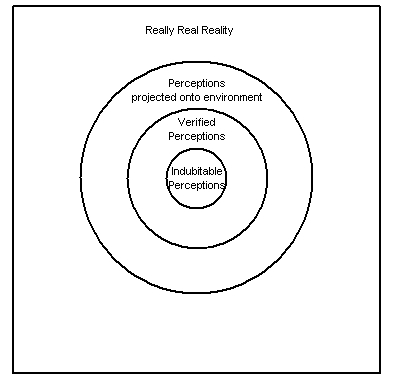
1dbfc32f.jpg

We live in Real Reality. All we know of it is our perceptions. Some of
these perceptions are unarguably veridical, and those perceptions just
happen to be the ones that are the most utterly subjective and incapable
of corroboration by others – your example was a Descartes-like
“dubito ergo dubitatio mea est” (I doubt, therefore my doubt
exists). These are surely a subset of Real Reality, qua perceptions, and
you do not doubt their existence. But so are all the other perceptions,
qua perceptions, included in Reality.

Are the indubitable perceptions that you call “Directly Perceived
Reality” accessible to verification by the Test for Controlled
variables? There are no environment variables in the public environment
for the observer to perceive. How could the observer perceive disturbance
and resistance to disturbance? Only indirectly and inferentially. For the
observer, the very existence of such perceptions in the observed system
is a matter of indirect evidence.

OK, so what about subjective observation? What is the introspective
evidence? The evidence you cite as the basis for subjectively not
doubting their existence is no more than the qualia of experiencing one’s
thoughts. In exactly the same way, you cannot doubt your subjective
experience of the yellowness of yellow. Indubitable to yourself,
incommunicable to others, the qualia of experience have precisely the
same place in the model that awareness has – none at all. Nor is it much
of a corner of Reality, that big box in the diagram above. Is there any
other evidence, then, that is available for subjective observation? Only
the very same indirect evidence that is available to the other person as
observer. And the indirect evidence is inferential and, for the most
part, in the form of propositions. Do you doubt? What is it that you
doubt? Already, we have shifted from perception to propositions about
perception.

Propositional evidence has obvious limitations. A report of what one is
controlling is not reliable evidence of what one is controlling. We fool
ourselves with wishful thinking and fears, we are not aware of all that
we control, language is ambiguous, and so on.

What do we mean by reality? According to the PCT model, per (6), we mean
the environment variables of which our perceptions are a function. But on
the other hand we ordinarily and routinely presume that our perceptions
are perceptions of reality. Either way, and even if all we have of it is
perceptions and propositions about perceptions, there is clearly a
distinction between perceptions and reality.

Now, what of the social realities of which I have been writing? These
social perceptions cannot be controlled or even perceived by one person
in isolation, because they are constructed in part of perceptions of
other people’s controlled variables. The perceptions themselves are in
Real Reality just as any perceptions are, that is, to the extent that
they are constituted of controlled variables in the brains (as we deduce
from the model) of the people controlling them. But absent other people
to perceive and control them there are no environment variables from
which an individual could construct perceptions to control. As with any
perception, successful control corroborates the veridicality of the
perception, but with social realities the corroboration is mutual between
more than one person. In fact, the realities to which these perceptions
refer become real only by virtue of the perceptions being
corroborated.

The perception that social realities are in Real Reality is what you
called a deduced perception. However, there are subjective qualia of the
experience of corroboration – connecting, each knowing what the other is
doing and why – that cannot be doubted. This is in your inner circle of
subjective “directly perceived reality”.

This is the reality that we cannot
doubt,

because even doubting is part of it. If you think, "I doubt that
there is a

reality," there can be no doubt that you experienced that thought.
In PCT

terms, this is the world of perceptions and activities in the brain

which thought is, of course, part of my own directly perceived reality.
But

those terms belong to the next category.

For you, this is the ground and starting place for what Bill Williams
calls a solipsistic approach. You worked out the perceptual hierarchy by
introspection into your subjective experience. You have given indications
how others could make their own such investigation. (If any have done so,
I have not seen their reports.)

The alternative advanced now takes as its ground and starting place the
social context of verification and the social context in which any infant
becomes a mature human living control system. It adopts a pragmatic view
that successful control is adequate validation of perceptions and leaves
the correspondence of perceptions to Really Real Reality to those
investigators who are constructing and testing models in fields like
physics and chemistry, accepting that the purview of PCT is behavior as
the means of controlling perceptual input. Recognizing that the
methodology of PCT is grounded in dyadic conflict between an observed
controller and an observing controller who disturbs what are guessed to
be controlled variables, this alternative point of view embraces the
social nature of our perceptual universe as a fundamental given with
which PCT must deal or be vapid.

    /Bruce

Nevin

···

At 10:42 PM 6/22/2004 -0600, Bill Powers wrote:
[From Bill Powers (2004.06.27.1432 MDT)]

Bruce Nevin (2004.06.27 09:20
EDT)–

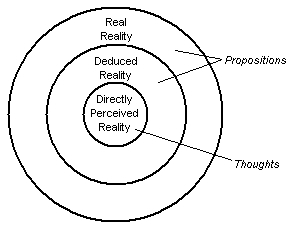
Here’s a diagram of the set
inclusions that you have stated:

1cbd7e5.jpg

The propositional nature of this description might be expected to appeal
to a linguist, but I’d rather distinguish between propositions and that
to which propositions refer.

“That to which propositions refer” consists of nonverbal
perceptions, actual or imagined. They are part of Directly Perceived
Reality.

There is no place you can stand from which you can see “that to
which the propositions refer” in any other sense. You can only
imagine such a thing.

The labeling on your diagram is the inverse of my intention (the second
diagram is also inside out – the most inclusive class is Indubitably
Perceived Reality, because we perceive nothing else). The outermost
circle is Directly Perceived Reality. There is really no outer boundary
because it includes all that can be experienced by any means. It
includes, for example, our concepts of the entire Universe.

Directly Perceived Reality includes Deduced Reality: that is, we form
systematic deductions about reality in our minds, and are aware of the
deductions, so they qualify as members of Directly Perceived Reality. But
DPR includes more than deductions.

Deduced Reality contains Real Reality, which we know only as a special
set of propositions about what we imagine to exist outside the world of
the senses. Deduced Reality includes more than Real Reality, of course –
not all our deductions are about the nature of the world outside the
senses.

You have to remain aware of what you’re doing while doing this sort of
analysis. If you remain aware, you will see that nothing you say,
observe, or do can be outside the realm of Directly Perceived Reality.
You may think there is a way, but that thought is itself a member of
Directly Perceived Reality, probably in the subset called Deduced
Reality. There is no place to which you can retreat from which you can
see what is going on outside of Directly Perceived Reality. You can only
imagine it, and make propositions about its nature – and those
propositions are also part of Directly Perceived Reality.

Best,

Bill P.

[From Bruce Nevin (2004.06.27 20:48 EDT)]

The labeling on your diagram is the inverse of my intention

You know, that was the way I had it at first, and it didn't make sense to
me, so I reversed it. It didn't make sense to me because I don't take
perceptions for reality. Not unless it's a perception of someone else's
perception (social reality). Also because you characterized "directly
perceived reality" as thoughts, very private, very subjective, not
accessible for collaborative control in a public. It was not clear how
broadly you intended the term.

There is no place you can stand from which you can see "that to which the
propositions refer" in any other sense. You can only imagine such a thing.

Of course.

What I am saying is that perceptions are not Reality, whatever that is.
Thoughts are not Reality, whatever that is. So you have described a
taxonomy, not of reality, but of perceptions.

That we routinely take our perceptions for reality, I agree. I am
accustomed to your inveighing against this as a mistake, and affirming --
even complaining -- that we cannot get beyond or behind perceptions to
reality. I even see a reiteration of this in the first sentence quoted
above. You will forgive me if I didn't realize that now you want take
perceptions for reality. And forgive me, too, for resisting. I prefer to
differentiate, even if it is not possible for me to make that distinction
by pointing somehow to reality vs. perceptions of it.

Going back to Bill Powers (2004.06.22.2220 MDT):

1. Directly Perceived Reality. ... the reality that we cannot doubt,
because even doubting is part of it. If you think, "I doubt that there is a
reality," there can be no doubt that you experienced that thought. ... the
world of perceptions and activities in the brain

"Perceptions that we cannot doubt" is the term I would prefer. Why? If we
are making a distinction between illusion and reality (as we perceive it),
then I can doubt any perception. That perception of pressure, that
perception of an edge where the matting ends and the photograph begins,
that perception of 60 cycle hum from the fluorescent light, each of these
perceptions could be an illusion. But if I accept that an illusory
perception is still a perception, then yes, these are perceptions that I
cannot doubt having. Your example is the undoubted perception of a pink
elephant flying by, vs. the deduced perception that you must be hallucinating.

2. Deduced Reality. This is a subset of Directly Perceived Reality. ...
includes propositions ... about another part of
directly perceived reality -- a body of evidence and reasoning.

If we do not to take perceptions for reality, these are perceptions.
Perhaps we call them something like "perceptions controlled by means of
reasoning processes." Include here the control of perceptions that
constitutes the reasoning processes themselves, and reasoning includes
inductive and abductive reasoning in addition to deductive reasoning.

These perceptions can be false or incorrect or incomplete, but they cannot
really be illusory. Well, I suppose the perception of having reached a
valid conclusion could be said to be illusory, but the difference is
obvious: A good sensory illusion is fascinating because it persists even
when you see how the trick is done. When you see your mistake in logic the
perception of having reached a valid conclusion does not persist.

The deductions themselves, and conclusions drawn from them, are, as you
say, perceptions which, when you have them, you cannot doubt having.
Reasoning processes, and conclusions perceived as such (that is, in context
of the reasoning that supports them and by virtue of which they are
conclusions and not mere assertions) are perceptions that it is very
difficult to doubt as illusory. But on the other hand, they can't be
supposed to correlate with realities that persist independent of whether
you are perceiving them, not unless you are a Platonist.

3. Real Reality. This is a subset of Deduced Reality. It consists of all
propositions about a world that exists independently of and outside of
directly experienced reality. ...

And again, as a subset of conclusions reached by reasoning from evidence,
these are perceptions. They are propositions about that world which the
propositions propose to exist. They are not that world itself, they are not
a reality which, if we could somehow apprehend direct knowledge of it,
would confirm or disconfirm those propositions. They are perceptions.

So that is all I am objecting to, Bill. As a taxonomy of perceptions, it is
interesting. It is a taxonomy of reality only if we take our perceptions to
be reality. And except for reciprocal perceptions of each others'
perceptions (social perceptions), I do not. Those have the peculiar status
of being perceptions whose correlation between persons is a real
environment variable, so far as we can tell that any environment variable
is real.

         /Bruce Nevin

···

At 02:48 PM 6/27/2004 -0600, Bill Powers wrote:

[From Bill Powers (2004.06.28.0133 MDT)]

Bruce Nevin (2004.06.27 20:48 EDT) --

You know, that was the way I had it at first, and it didn't make sense to
me, so I reversed it. It didn't make sense to me because I don't take
perceptions for reality.

But you do. When you look at the screen in front of you, can you have any
doubt that it looks the way it looks? Putting the label "perception" on it,
a theoretical construct, doesn't change it or make it any less real and
immediate (unmediated), does it?

What you think about this experience is another matter.Perhaps when you
look at the screen, you think "That is only a perception, not the reality."
Whatever you think about the screen, that thought, too, is experienced as
real, immediate, and undoubted. It is just as real as the screen.

Or perhaps it's the other way around. Perhaps you think "That screen there
is the reality, and somewhere inside my brain there is a perception of it."
But in that case your thought would be about something that you can't
perceive. None of us can see inside our brains or anyone else's.

This all gets very confusing. If thoughts about an experience are just as
real as the experience, are the thoughts part of the reality that gives
rise to perceptions? Is it that we can see reality, but not our perceptions
of it?

My solution to this was to accept immediate experience, direct experience,
as the primary reality that is present beyond doubt. And then I simply
attached another label to each aspect of this reality: "This is a
perception in my brain. This is how perceptual signals in my brain appear
to me." I do not, of course, experience that identification directly,
because I can't see perceptual signals in my brain as neural signals being
emitted in one place, and fanning out to be received in many other places.
That picture is theoretical; it's what I have to imagine precisely because
I can't directly experience it. It fills in the gaps in experience whether
I'm talking about myself or other people.

Now what about really real reality, the reality that in theory underlies
our experiences and is independent of them? The odd thing is that all our
most careful and reliable observations and experiments assume such a
reality, and appear to support it very strongly. Yet this support is not in
the form of direct contact with that underlying reality. We have to find it
through sense data, with the aid of instruments of various sorts, and by
applying theories to the resulting observations. We are always on _this_
side of the sensors, on _this_ side of the instruments looking at their
scales, dials, tracks of droplets, or numerical displays with our eyes, and
then reasoning about these results in our thoughts. The very facts we
learn, when applied to the human body, tell us that experience is happening
inside us, not outside us.

Many people have trod this path, and I think that most of them have fallen
into one of the two main possible errors. The first error is solipsism,
which says that if all experiences are inside my head, nothing else exists,
not even other people. That leads further to the erroneous idea that
reality is therefore anything I want it to be. That is what Dr. Johnson was
really refuting when he kicked the stone. He was saying, "I see a rock
there, and I see and feel my leg and foot. When I perform an operation on
the rock by moving the leg and foot, I experience the results I expect: the
rock moves and my toes hurt. Therefore a really real reality really
exists." He was showing that he could NOT perform the operation WITHOUT
experiencing the expected results (quibbles aside, all of which contain an
explanation for any missing observations, such as novocain).

What he did not realize, apparently, was that this entire experimental
process was undeniably experienced by him -- either the actual leg and
stone movements and so on, or their imagined counterparts in the thought
experiment. And it was experienced from the only point of view available to
him, from inside his brain. That is where the thought-process called
"refutation" took place. That is where everything took place. He had made a
convincing case for the existence of a really real reality, but it was made
entirely out of the stuff of perception and thought. Not once could he say,
"I see a stone, and by stepping aside and looking around the edges of my
retinas, I see that there is a stone actually there corresponding to what I
see." That is impossible. The stone that is "actually there" is imagined.
Only the experience is real.

The other main mistake is to reject solipsism by fiat, on the flimsy basis
that the conclusions one would draw from it are unacceptable. That flouts
reason, which is always a mistake, and is unnecessary. Where this generally
leads is to devaluing direct experience as being "merely perception", and
elevating one's thoughts and theories to the status of being more real than
direct experience (as if the thoughts and theories were not themselves
directly experienced). Thus the physicist pounds on the solid table top and
says "This is an illusion, since the tabletop is REALLY mostly empty space
and waves and fields and flying particles." Of course it is not an
illusion; the experience is the reality, while the empty space, the fields
and particles, are imagined entities which, if they actually did exist,
would account for what we experience. The second mistake is to interchange
real-time perception and imagination, taking what is real for imaginary,
and what is imagined for real.

I suggest that you have made the second type of mistake when you propose
that perceptions are "very private, very subjective, not accessible for
collaborative control in a public [way]." They are the only things
accesssible to you; they are the only reality you can experience directly
and immediately. All else consists of thoughts about those very private
things, private thoughts that include the opinion that there is a permanent
reality beyond your experiences that you can only infer. I have that same
opinion, held very strongly and relied upon all the time -- yet I have no
difficulty with accepting that this is my opinion, arrived at through
thought and experiment, so acceptable as "knowledge", yet still fallible.
Thought and reason are tools that can both lead and mislead.

What I am saying is that perceptions are not Reality, whatever that is.
Thoughts are not Reality, whatever that is. So you have described a
taxonomy, not of reality, but of perceptions.

Yet reality, as you refer to it, is a thought in your mind, not something
you can know directly -- as you have frequently agreed. It is, therefore,
something you imagine. Remember that what we say about experience does not
determine the experience, but only what we think about the experience, how
we explain the experience, what we do about the experience, and so on. Even
if the experience proves to be a hallucination, it is a real hallucination,
we are actually experiencing it. Aside from the fact that having
hallucinations in broad daylight is not normal (they're OK in dreams), the
experience of having a hallucination can be as useful as any other kind of
experience in helping us to understand perception. To say that a
hallucination is imagined is not to say it doesn't exist; imagination is
(theoretically) simply perception internally generated (at a low level in
the hierarchy) instead of arising from sensory inputs in the usual way. The
person perceiving a pink elephant may be in doubt about the reality of the
apparition, but can't doubt the apparition itself. There it is.

I've read what all the Old Boys said on this subject, or most of them, but
I think they missed the answers because all that thinking took place before
anyone had a real concept of a nervous system and brain. When you're forced
to accept the basic theory of brains and neurons, and there isn't really
any other game in town, you simply can't fit most theories about reality
into the same universe with those facts, unless (I claim) you analyze the
situation as I have done above. To say that everything you experience
consists of neural signals in a brain is, of course, a theory. But it's a
good theory; it explains everything I know about so far.

Best,

Bill P.

[From Rick Marken (2004.06.28.1040)]

Bill Powers (2004.06.28.0133 MDT)--

Great post, Bill!!

There must be some respected journal where a paper on this topic could be
published. I found a journal called _Philosophical Psychology_ that looks
pretty good (Taylor & Francis - Harnessing the Power of Knowledge). Taylor
and Francis, who publishes it, is a British house that publishes some high
quality journals (they publish _Ergonomics_ which is where I placed my
medical error model paper). I think you could expand this post, add a bit
on the phenomenology of the perceptual hierarchy and add some references and
you would have one hell of a great paper. I'd be happy to help if I could
get co-authorship. I'm becoming a glutton for publications.

Best regards

Rick

···

--
Richard S. Marken
MindReadings.com
Home: 310 474 0313
Cell: 310 729 1400