Using PCT as a Framework for Behavior Change

[From Bill Powers (2012.07.06.0702 MDT)]

HM: Now I think
this is enough, Rick. You are to quick in decissions, as I have feeling
that your tongue is running in front of your “thinking”
(controlling on higher level). It’s obviuos to me, that you are
controlling your tongue with lower levels. But that doesn’t make an
excuse for your insulting behavior, even if you were maybe misguided by
some Bill’s thoughts.

BP: If you want Rick to stop insulting you, wouldn’t it be wise to stop
insulting him?

HB : Is this again
festival of behaviorism hear on CSGnet. It happened quite some time. Does
it mean that “We control
others’ behavior and they control ours all the time…”
, that with “stimuli” that arise from our
action and “influence” other people state (as something
objective in environment), we perceive and think that other person are
behaving in wanted manner all the time. So does it go like this : you see
your “stimuli” and you see “other persons behavior”
that is matching your perception of wanted behavior and heureka, we are
controlling other person. So stimuli - behavior, cause - effect, where is
here controlling in other person ? Does it mean that any
“stimuli” (perceptual input) from physical or social
environment is controlling people’s behavior all the time ? What’s the
difference between the perceptual input that is produced by physical and
social environment ?

I think you may have missed some discussions of this
interpretation. Of course PCT does not support the
idea that “stimuli (perceptual input) from physical or social
environment is controlling people’s behavior all the time.” It is
certainly true that one conventional interpretation of observable
relationships is that some environmental events simply “cause”
the behavior that follows them. That’s a logical fallacy called
“begging the question” or “petitio principii” (see
Google). The PCT view is that when we see apparent examples of
stimuli causing responses, what is really happening is that certain
environmental variables disturb a variable that a person is controlling,
and the so-called response is the person’s action that opposes the effect
of the disturbance. That sort of thing happens, as Rick says, all the
time. Most of a person’s actions, we might say, would be unnecessary if
there were no disturbances causing errors in controlled variables. When
you drive a car from home to work, the only times you would turn the
steering wheel would be when you turn off one road and onto another or
into a parking lot. The rest of the time you would just hold it steady,
and nothing would cause the car to change its direction. Of course that
is not how the real world works.
It follows that you can cause a predictable change in a person’s behavior
if you know that the person is controlling some particular variable. All
you have to do is disturb that variable. You may not know which of
several possible behaviors will take place, but you can predict
that whatever behavior does occur, it will have an effect equal and
opposite to the effect of the disturbance you apply. If there happens to
be only one behavior that will have that effect, you can predict quite
reliably the behavior that will take place. You can then control whether
or not the person shows that behavior by applying or not applying the
disturbance (and making sure nothing else causes the same disturbance
when your goal is for that behavior not to occur).

A disturbance is defined as any variable which, if unopposed, can alter
the state of a controlled variable independently of the control system’s
own behavior. This broadens the definition to include anything that can
disturb a controlled variable, including even such simple things as
saying “hello” to someone unknown to you passing by. Try it –
you are very likely to see a definition reaction of surprise or
suspicion, showing that just saying “hello” to a stranger can
disturb variables that person is controlling, so the person feels it
necessary to produce some behavior such as saying “Well, hello to
you, too” before walking on. That looks like a stimulus-response
event, but PCT says that is not what is happening.

Theory aside, you can’t deny that many events occur all day long in which
there is an illusion of stimulus and response. That is why many
intelligent people observing human behavior thought they were observing a
simple cause-effect phenomenon. They were not stupid or evil people; they
simply didn’t know of any other explanation. They happen to have been
wrong, but that doesn’t say that the apparent causes and effects do not
occur. They do occur, and are everywhere. These S-R theorists
observed the environmental events and the behaviors correctly; they
simply guessed wrong about the connection between them.

The reason that you can control other people’s behavior is not that you
can apply stimuli that cause them to respond in a certain way. It is that
once you know what another person is controlling, you can often find a
disturbance which can be counteracted in only one way, and predict
successfully that the person will use that way to prevent your
disturbance from having any continuing effect on the controlled variable.
Walk up to a policeman and say angrily that you’re going to punch him in
the nose. You can predict with some confidence that he will subdue you
and put you under arrest. In the 1960s, protesters in Chicago made
policemen demonstrate brutal behavior in front of television cameras.
This is how they did it.

I’m sure that you can think of many more examples of this kind. I
recommend doing so if you want to understand the reasons for both Rick’s
and my claim that all of us are having our behavior controlled quite
frequently, and that most of the time our reaction against the effect of
a disturbance is quite successful and not at all inconvenient. A simple
disturbance like “Please pass the salt” can be disposed of in
three seconds without causing any problem at all.

Best,

Bill P.

···

At 03:42 AM 7/6/2012, Boris Hartman wrote:

RM : It’s also probably the reason why people want to think that they
aren’t controlling people’s behavior when they are controlling people’s
behavior.They don’t want to think that they are like the people who are
trying to control them. So PCT provides a nice out; we control only
perceptions so even when I’m controlling people I’m just controlling my
perception of people. So all those people who are being forced into
cattle cars at gunpoint by Nazis are just perceptions.

HB : Yes all there is, is perception. “Even when you
are controlling people, you are just controlling your perception of
people”. What else by your oppinion you are doing ? But you can
conclude, that you are controlling something outside, and you will never
know excatly what. But you can make better or worse guess. Science is
talking about more or less porbabibility. But I have never seen results
in science that are 100 % probable. If you are in desert and you see in
“phatamorgana” - fasle perception “lake and water”
and you come near and there is suddenly no perception of “lake and
water” anymore, what is really outside ? So once perception are
showing something and later perception are showing something else
(unexpected) on the same place in “Real relaity”. What is your
“objective” variable ? You can rely only on your senses, what
is outside. There’s no other “objective” meassure to say what
is outside.

How do you know about Nazis and what was happening in that
time ? From perception of perception of perception of other people ? Or
you were there in 1942 and you were “directly looking” in Nazis
with what ? Microscope ? Telescope ? Something-scope ?

And all that people being “forced into cattle”, according to
“perceptual” sources, didn’t behave in the same way. Some
resist and bravely die, some “reorganized” and survived. Some
were even not caught by Nazis and were hiding. Look in the history of
2.World War and you will see, percept (as that is all you can do)
different pallete of behaviors, which people invented in that
life-situation to survive. They all chose their different behaviors, when
their control of their perception was disturbed “and their behavior
wouldn’t have occured in that particular way if Nazis actions haven’t had
effective engridient”. But that doesn’t mean that Nazis were
controlling their behavior. People did control their behavior on the
bases of disturbances to their control and decided whatever they did. I
know something about Nazis in 2.World War, mostly from my fathers and
grandfathers talking (perception). And from whom you know it ? Because
that is the “objective truth” ?

RM : This view of control of human
behavior is so creepy to me that it is another reason why I would like to
consider abandoning the PCT label and just call it CT. Or, keep the PCT
but make sure people understand that the P stands for
Powers.

HB : My feeling is, that only “creepy” here is you. And yes,
maybe you could really consider abandoning PCT, as you’ll probably never
really understand it.

I “saw” you quite some time insulting people who
have different view here on CSGnet. If somebody here on CSGnet have
“chauvinistic” views, than maybe you could seriously consider
option that you are “the one”. Think about your control of
perception of some people which you insulted…

If any PCT view can be considered as CT, than there is no
doubt for me. You are CT (behaviorist, your command - other people
behave, input - output, cause - effect). I think that you don’t really
understand PCT enough to judge who understand it and who doesn’t. So I
told you to do homework to understand PCT, but you didn’t do it. So go
again and study PCT with the “model of PCT” on the picture on
p.191, B:CP, 2005 (that’s just my proposal). If you and Bill will agree
that REFERENCE SIGNAL can be produced from organism’s environment -
physcal or social - which for now is comming from anywhere or nowhere
(inside the organism) on 11th level, than I’ll consider option of
abandoning PCT, because it could mean that there is 12th level of control
(maybe social organism) which is providing the reference for 11th level
and so on down the hierarchy. Than I’ll beleive that people can
“control” other people, or in other words control systems can
be “controlled” from outside (environment), where references
for organisms control is suplied. That will also mean for me, that there
is no PCT, it’s only CT. But I think you’ll hardly convince Bill, that
there is 12th level, or that the reference is produced outside
organisms…As that could mean that the organism is not the only one who
can control it’s internal stability, or better it’s almost constant
internal environment (homeostasis). That could mean also that something
else in environment can “set” references on 11th level beside
the organism. That could really mean a revolution in PCT thinking as fa
as I understand it. It can be a possibility. We mustn’t exclude that
maybe I understood something wrong what you wrote. It’s possible, but I
can’t tell it in scientific language what is the value of probablility
that I was wrong. Maybe you can calculate for me ? :slight_smile:

If I’m to beleive PCT, people always control just
“perceptual disturbance” to each other control. So I beleive
that they can’t control other people, because every organism is already
controlling itself until control units are working properly. If they work
properly they will control. If they dont control properly, the organism
dies. Environment, other people can reduce their control, can be helpfull
to organisms control, can even destroy the control, but can not overtake
the control in organism and control behavior of other people. Behavior in
PCT as I see it (diagram) is controlled from inside not outside, as any
other effector in organism like glands, nerv ends… . Other people can’t
overtake the control, because references are genetically set (even if you
make modification to genetics, genes will still exhibit changed control).

But somehow is becomming obvious to me, that you will maybe hardly
decline the idea that you can and must “control” other people
here on CSGnet, intruding them with your own point of view as the only
right.

You are quite brave to “blindly” rely on theory
which has so many holes in the “model”, which is guessing where
the reference signal on the highest level (probably the most important
part of PCT) is coming from. And insult views, which are maybe right. I
told you to read, read and read…and think, with upper head.

And if you don’t mind telling me, whom did you manage to control in your
whole life, who he or she was doing always, whatever you wanted or will
do whatever and anytime you want ? Observe more carefully and you’ll see
that people have their own control as primary goal. Oberve yourself. She
or he will be doing whatever is wanted mostly because of their own
control not others. Maybe you are trapped in “behavioral
illusion”. The most you can probably do to “control”
others people behavior is to “contribute” to people’s control
as much as perceptual signal can “contribute” to control in
comparator. But as far I see (percept) PCT, it says that there are
disturbances to perceptual control, not “overtaking” the
control. But maybe we misunderstood in terms of control.

Best,

Boris

----- Original Message -----
From: Richard Marken
To:

CSGNET@LISTSERV.ILLINOIS.EDU
Sent: Thursday, July 05, 2012 11:57 PM
Subject: Re: Using PCT as a Framework for Behavior
Change

[From Rick Marken (2012.07.05.1500)]

On Wed, Jul 4, 2012 at 9:53 AM, Bill Powers > powers_w@frontier.net > wrote:
Hello, Rick and Boris –

BP: To say that we control perceptions is, of course, correct in
terms of PCT, but it does not mean that we don’t control something in the
outside world that these perceptions represent. It just means that we
can’t know directly what is being controlled in the world
outside.

RM: Of course it means that. But I think the reason we call PCT
Perceptual control theory rather than just control theory is to
emphasize the fact that control systems control perceptual
representations of variables in the environment. That is, to emphasize
the fact that control systems control perceptual inputs, not behavioral
outputs. But I think we also call it PCT to emphasize the fact that one
of the main goals of a science based on control theory is to discover the
perceptual input variables that are being controlled in any observed
instance of behavior.

By emphasizing control of perception we are implying that there are
many different ways the same environmental variables can be perceived. So
we have to use some version of the test for the controlled variable to
try to get at what these perceptual variables are; what are the
perceptual aspect(s) of the environment that are under control in any
particular behavioral situation. Unfortunately (as you note below)
control of perception could imply that we control only perceptions –
that there is no external reality – so PCT often ends up being
attractive to the solipsists and their modern cohort, the post-modernists
who really have no particular interest in science. Indeed, they seem to
be rather anti-science. It’s enough to want to make one want to go back
to calling PCT just CT.

BP: Now, is it possible to control other people’s behavior? In
many cases, certainly. I can very often act on my world in such a way as
to experience another person doing something I wanted that person to
do.

RM: I don’t know why this gets some people so upset. We control
others’ behavior and they control ours all the time and it is almost
always by agreement and it is almost always to produce a collective
result that could not be produced alone. Think orchestra or computer
production company. Agreed on mutual control is called cooperation and
it’s kind of the basis of human civilization. The problem is not that
people can (and do) control other people’s behavior. The problem is that
sometimes this is done without mutual agreement (as in
dictatorships) – that is, it is done arbitrarily, without respect for
the needs and wants of the person/people being controlled. When mutual
control is agreed on then the controlling is done respectfully and
doesn’t create too many problems. But problems are always possible, even
when the mutual control is consensual, and PCT helps us understand why
this is the case and how to minimize the problems that arise even with
consensual mutual control.

BP: We must ask, however, whether it is possible to control other
people’s behavior without showing knowledge of and respect for their own
goals. If we try to make another person behave in a way that causes
errors inside that person, our efforts will be resisted, perhaps
violently. Since an understanding of control systems is not widespread,
this sort of result probably happens quite often. This result probably
accounts for the fierceness with which some people refuse to admit that
they can be controlled by other people in any way at all.

RM: Yes, I agree. It’s also probably the reason why people want to
think that they aren’t controlling people’s behavior when they are
controlling people’s behavior. They don’t want to think that they are
like the people who are trying to control them. So PCT provides a nice
out; we control only perceptions so even when I’m controlling people I’m
just controlling my perception of people. So all those people who are
being forced into cattle cars at gunpoint by Nazis are just perceptions.
This view of control of human behavior is so creepy to me that it is
another reason why I would like to consider abandoning the PCT label and
just call it CT. Or, keep the PCT but make sure people understand that
the P stands for Powers.

Best

Rick


Richard S. Marken PhD
rsmarken@gmail.com

www.mindreadings.com

[Chad Green (2012.07.06.1043 EDT)]

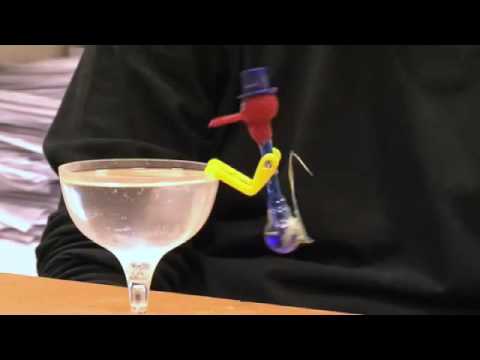
Bill, what is your take on the physics of the drinking bird apparatus:

I ask because it serves as my latest metaphor for education in general (e.g., the water is relational trust).

Thanks!
Chad

Chad Green, PMP
Program Analyst
Loudoun County Public Schools
21000 Education Court
Ashburn, VA 20148
Voice: 571-252-1486
Fax: 571-252-1633

"If you want sense, you'll have to make it yourself." - Norton Juster

Bill Powers <powers_w@FRONTIER.NET> 7/6/2012 10:01 AM >>>

[From Bill Powers (2012.07.06.0702 MDT)]

HM: Now I think this is enough, Rick. You are to quick in
decissions, as I have feeling that your tongue is running in front
of your "thinking" (controlling on higher level). It's obviuos to
me, that you are controlling your tongue with lower levels. But that
doesn't make an excuse for your insulting behavior, even if you were
maybe misguided by some Bill's thoughts.

BP: If you want Rick to stop insulting you, wouldn't it be wise to
stop insulting him?

HB : Is this again festival of behaviorism hear on CSGnet. It
happened quite some time. Does it mean that "We control others'
behavior and they control ours all the time..." , that with
"stimuli" that arise from our action and "influence" other people
state (as something objective in environment), we perceive and think
that other person are behaving in wanted manner all the time. So
does it go like this : you see your "stimuli" and you see "other
persons behavior" that is matching your perception of wanted
behavior and heureka, we are controlling other person. So stimuli -
behavior, cause - effect, where is here controlling in other person
? Does it mean that any "stimuli" (perceptual input) from physical
or social environment is controlling people's behavior all the time
? What's the difference between the perceptual input that is
produced by physical and social environment ?

I think you may have missed some discussions of this
interpretation. Of course PCT does not support the idea that
"stimuli (perceptual input) from physical or social environment is
controlling people's behavior all the time." It is certainly true
that one conventional interpretation of observable relationships is
that some environmental events simply "cause" the behavior that
follows them. That's a logical fallacy called "begging the question"
or "petitio principii" (see Google). The PCT view is that when we see
apparent examples of stimuli causing responses, what is really
happening is that certain environmental variables disturb a variable
that a person is controlling, and the so-called response is the
person's action that opposes the effect of the disturbance. That sort
of thing happens, as Rick says, all the time. Most of a person's
actions, we might say, would be unnecessary if there were no
disturbances causing errors in controlled variables. When you drive a
car from home to work, the only times you would turn the steering
wheel would be when you turn off one road and onto another or into a
parking lot. The rest of the time you would just hold it steady, and
nothing would cause the car to change its direction. Of course that
is not how the real world works.

It follows that you can cause a predictable change in a person's
behavior if you know that the person is controlling some particular
variable. All you have to do is disturb that variable. You may not
know which of several possible behaviors will take place, but you can
predict that whatever behavior does occur, it will have an effect
equal and opposite to the effect of the disturbance you apply. If
there happens to be only one behavior that will have that effect, you
can predict quite reliably the behavior that will take place. You can
then control whether or not the person shows that behavior by
applying or not applying the disturbance (and making sure nothing
else causes the same disturbance when your goal is for that behavior
not to occur).

A disturbance is defined as any variable which, if unopposed, can
alter the state of a controlled variable independently of the control
system's own behavior. This broadens the definition to include
anything that can disturb a controlled variable, including even such
simple things as saying "hello" to someone unknown to you passing by.
Try it -- you are very likely to see a definition reaction of
surprise or suspicion, showing that just saying "hello" to a stranger
can disturb variables that person is controlling, so the person feels
it necessary to produce some behavior such as saying "Well, hello to
you, too" before walking on. That looks like a stimulus-response
event, but PCT says that is not what is happening.

Theory aside, you can't deny that many events occur all day long in
which there is an illusion of stimulus and response. That is why many
intelligent people observing human behavior thought they were
observing a simple cause-effect phenomenon. They were not stupid or
evil people; they simply didn't know of any other explanation. They
happen to have been wrong, but that doesn't say that the apparent
causes and effects do not occur. They do occur, and are everywhere.
These S-R theorists observed the environmental events and the
behaviors correctly; they simply guessed wrong about the connection
between them.

The reason that you can control other people's behavior is not that
you can apply stimuli that cause them to respond in a certain way. It
is that once you know what another person is controlling, you can
often find a disturbance which can be counteracted in only one way,
and predict successfully that the person will use that way to prevent
your disturbance from having any continuing effect on the controlled
variable. Walk up to a policeman and say angrily that you're going to
punch him in the nose. You can predict with some confidence that he
will subdue you and put you under arrest. In the 1960s, protesters in
Chicago made policemen demonstrate brutal behavior in front of
television cameras. This is how they did it.

I'm sure that you can think of many more examples of this kind. I
recommend doing so if you want to understand the reasons for both
Rick's and my claim that all of us are having our behavior controlled
quite frequently, and that most of the time our reaction against the
effect of a disturbance is quite successful and not at all
inconvenient. A simple disturbance like "Please pass the salt" can be
disposed of in three seconds without causing any problem at all.

Best,

Bill P.

···

At 03:42 AM 7/6/2012, Boris Hartman wrote:

[From Bill Powers (2012.07.061241 MDT)]

[Chad Green (2012.07.06.1043 EDT)]

Bill, what is your take on the physics of the drinking bird apparatus:
http://www.youtube.com/watch?v=KUvHzFm29cg

BP: See this link for how it works.

CG: I ask because it serves as my latest metaphor for education in general (e.g., the water is relational trust).

BP: That's a pretty mysterious metaphor, and anyway it's not water in one version, though it is in the other.

Best,

Bill P.

[Chad Green (2012.07.06.1456 EDT)]

Actually I was wondering if you could describe it in PCT terms if possible.

Best,
Chad

Chad Green, PMP
Program Analyst
Loudoun County Public Schools
21000 Education Court
Ashburn, VA 20148
Voice: 571-252-1486
Fax: 571-252-1633

"If you want sense, you'll have to make it yourself." - Norton Juster

Bill Powers <powers_w@FRONTIER.NET> 7/6/2012 2:50 PM >>>

[From Bill Powers (2012.07.061241 MDT)]

[Chad Green (2012.07.06.1043 EDT)]

Bill, what is your take on the physics of the drinking bird apparatus:
http://www.youtube.com/watch?v=KUvHzFm29cg

BP: See this link for how it works.

CG: I ask because it serves as my latest metaphor for education in
general (e.g., the water is relational trust).

BP: That's a pretty mysterious metaphor, and anyway it's not water in
one version, though it is in the other.

Best,

Bill P.

[From Bill Powers (2012.06=7.-6.1500 MDT)]

[Chad Green (2012.07.06.1456 EDT)]

Actually I was wondering if you could describe it in PCT terms if possible.

The drinking bird is not a control system.

Best,

Bill P.

[Martin Lewitt 2012 July 7 [0749]

** snip ***

The reason that you can control other people’s behavior is not that you
can apply stimuli that cause them to respond in a certain way. It is that
once you know what another person is controlling, you can often find a
disturbance which can be counteracted in only one way, and predict
successfully that the person will use that way to prevent your
disturbance from having any continuing effect on the controlled variable.

Could there be less pejorative alternatives to the terms “disturbance” and “control” when it comes to relationships with other persons? I’m thinking of circumstances where people WANT to be controlled, assuming such is possible under PCT, is it? Could the disturbance be a mere signal? Or even less, a “perceived need”?

As a concrete example, I control for restaurant service that keeps my ice tea glass full, without my having to do anything other than drink it. I could control for that by communicating my standards for a good tip to a server who wants a tip, and base my willingness to return to the restaurant upon how well that communication succeeds in eliciting the desired perceptual experience.

But lets say I am not that explicitly controlling of other people. Instead of communicating, I leave a usual tip, and search for another restaurant until I find one that keeps my tea glass full without my having to communicate that I control for that perception. Have I controlled others? Is my less than full glass a disturbance? Were the server or owner controlling for the perception of me being more likely to return? Was I just finding compatible people that I didn’t have to control? Or who were controlling for the same perceptual variable? Was I wanting to be controlled, e.g., for the likelihood to return?

In my model of the world, I have a preference for not controlling other people, and a preference for people not trying to control me. It could be laziness on my part. If I want a new auto, I could take a cattle prod to RM and try to disturb him through the process of constructing an auto, or instead I could go to people who want to be “controlled” for supplying me with an auto, and who perhaps think they are controlling for me purchasing their offering, and save all the funds I would have expended on cattle prod batteries to produce what would probably have been a much less satisfactory auto.

– Martin L

** snip***

···

On 7/6/12 8:01 AM, “Bill Powers” powers_w@FRONTIER.NET wrote:

bob hintz 2012.7.7

I suspect that the primary variable you are controlling is the level of iced tea in your glass. Do you care who fills it for you? Do you care which hand they use to pour the iced tea? Do you care if you even notice when they do it? Your secondary variable might be a restaurant where your glass of iced tea is always practically full when you look at it and want to drink from it. I imagine that if no one fills your glass that you will do something to correct that perception. It might mean that you get up and find a source of tea and fill the glass yourself. However, you would probably never go back to that place.

We might want to think of signals as messages about ourselves, ie. what we perceive, and what we want to perceive. All behavior provides some information about these as we are always organizing output in terms of error signals derived from this comparison, but only other control systems would bother to make an effort to determine what these might be. If you told your wait person, “your tip depends on my tea never being lower than 2” from the lip of my glass.", you would be giving that person precise information about how to control your behavior if they wish to have a bigger tip.

Are you controlling their behavior or helping them control your behavior? Or are you merely providing information allowing them to control a variable that they want to control, ie., how much money they find on the table after you leave?

bob

···

On Sat, Jul 7, 2012 at 9:17 AM, Martin Lewitt mlewitt@comcast.net wrote:

[Martin Lewitt 2012 July 7 [0749]

On 7/6/12 8:01 AM, “Bill Powers” powers_w@FRONTIER.NET wrote:

** snip ***

The reason that you can control other people’s behavior is not that you
can apply stimuli that cause them to respond in a certain way. It is that
once you know what another person is controlling, you can often find a
disturbance which can be counteracted in only one way, and predict
successfully that the person will use that way to prevent your
disturbance from having any continuing effect on the controlled variable.

Could there be less pejorative alternatives to the terms “disturbance” and “control” when it comes to relationships with other persons? I’m thinking of circumstances where people WANT to be controlled, assuming such is possible under PCT, is it? Could the disturbance be a mere signal? Or even less, a “perceived need”?

As a concrete example, I control for restaurant service that keeps my ice tea glass full, without my having to do anything other than drink it. I could control for that by communicating my standards for a good tip to a server who wants a tip, and base my willingness to return to the restaurant upon how well that communication succeeds in eliciting the desired perceptual experience.

But lets say I am not that explicitly controlling of other people. Instead of communicating, I leave a usual tip, and search for another restaurant until I find one that keeps my tea glass full without my having to communicate that I control for that perception. Have I controlled others? Is my less than full glass a disturbance? Were the server or owner controlling for the perception of me being more likely to return? Was I just finding compatible people that I didn’t have to control? Or who were controlling for the same perceptual variable? Was I wanting to be controlled, e.g., for the likelihood to return?

In my model of the world, I have a preference for not controlling other people, and a preference for people not trying to control me. It could be laziness on my part. If I want a new auto, I could take a cattle prod to RM and try to disturb him through the process of constructing an auto, or instead I could go to people who want to be “controlled” for supplying me with an auto, and who perhaps think they are controlling for me purchasing their offering, and save all the funds I would have expended on cattle prod batteries to produce what would probably have been a much less satisfactory auto.

– Martin L

** snip***

[From Bill Powers (2012.07.07.0901 M<DTY)]

Martin Lewitt 2012 July 7 [0749] --

Could there be less pejorative alternatives to the terms "disturbance" and "control" when it comes to relationships with other persons? I'm thinking of circumstances where people WANT to be controlled, assuming such is possible under PCT, is it? Could the disturbance be a mere signal? Or even less, a "perceived need"?

BP: It helps if you specify what it is that you want to control, rather than just saying you want to control "a person." In the case of passing the salt, it's not even the other person's behavior you're trying to control -- it's the location of the salt. You're just asking the other person to help you control it. Most people don't mind your temporarily commandeering their behavior in that way.

But rather than looking for new ways of wording descriptions, I would prefer people to understand what is wrong with trying in certain specific ways to control what other people do. What's wrong is not trying to get someone else to do you a favor, it's trying to do that without any consideration for what the other person wants or what helping you will cost that person. Control is not always a pejorative term, but in specific cases it is.

Though I wouldn't use this as a general argument, I think of people who consider only their own goals and impose their wishes on other people as simply having underdeveloped higher level perceptions. They don't seem to grasp some rather simple bits of worldly knowledge, such as "what goes around comes around" and " as you sow, so shall you reap." They understand their own personal goals and have skills for achieving them, but they seem to miss the fact that when you ignore other people's welfare (as they see it), you simply make it more difficult to look after your own.

ML: As a concrete example, I control for restaurant service that keeps my ice tea glass full, without my having to do anything other than drink it. I could control for that by communicating my standards for a good tip to a server who wants a tip, and base my willingness to return to the restaurant upon how well that communication succeeds in eliciting the desired perceptual experience.

BP: Probably the best tip that a waitperson could receive would be to stop having to spend every second trying to satisfy an unreasonably fussy customer. In fact, if the customer follows your advice, the iced tea may remain chronically unfilled until the waiter or waitress makes sure that customer will not come back. Management might not like that, but it's not management that gets the tips and has to neglect other customers.

ML: But lets say I am not that explicitly controlling of other people. Instead of communicating, I leave a usual tip, and search for another restaurant until I find one that keeps my tea glass full without my having to communicate that I control for that perception. Have I controlled others?

BP: Not unless you have found something they are actually trying to control and have systematically applied carefully-chosen disturbances to it which they are resisting in the way you want them to resist. As you describe the situation, I would say that you're just controlling for having your glass of iced tea kept full, while the attendant is controlling for whatever is of concern to that person. Each person disturbs what the other is controlling, but not in a goal-directed way. Each person makes whatever adjustments are required to counteract effects of disturbances caused by the other, just as you do when driving a car in traffic. This is just normal life, normal interaction of independent control systems sharing a common environment.

ML: Is my less than full glass a disturbance? Were the server or owner controlling for the perception of me being more likely to return? Was I just finding compatible people that I didn't have to control? Or who were controlling for the same perceptual variable? Was I wanting to be controlled, e.g., for the likelihood to return?

BP: All those are possibilities, aren't they? The server or owner might adjust the degree of attention given to your iced tea as a means of controlling for your returning, or adjust it to assure your not returning. If the issue of control doesn't come up, you may simply adjust your choice of restaurant until you get the service you want, without even considering whether your actions matter to the personnel of one restaurant or a different one. You might get extra fussy about the service and leave an insulting tip simply to show the server that you are the boss and the server had better please you if he or she needs the money. To some people, controlling other people is a pleasant experience that reassures them of their own worth. But I don't think many people really do that and I'm sure you don't.

ML: In my model of the world, I have a preference for not controlling other people, and a preference for people not trying to control me.

BP: You can be assured that you can't control "other people" and that they can't control "you". That is too loose a way to describe control. What you control something, it's always some variable attribute of it that you control, rather than controlling its mere existence (which is seldom possible). You definitely can control certain aspects of other people's behavior and they can control aspects of yours, if they or you know what the other is controlling for such as a full glass of iced tea. Disturbances can be of various kinds -- for example, there is the disturbance known as "malicious compliance," which in your example might be a waitress carefully filling your glass of iced tea exactly to the brim so you can't pick it up without spilling tea on yourself. "You said you wanted me to keep it full," she says innocently, when you complain.

ML: It could be laziness on my part. If I want a new auto, I could take a cattle prod to RM and try to disturb him through the process of constructing an auto,

BP: That would be unwise, since you know you will be disturbing a lot of irrelevant variables and that RM will vigorously oppose your actions and perhaps even your continued existence. The skill of controlling behavior is to disturb something in such a way that the person can act to prevent any serious effect of your disturbance without losing control of the variable. Remember that in PCT, a disturbance is an independent variable that has some effect on a controlled variable. You can varying the disturbing variable, but if there is a sensitive control system at work, it will immediately act to have an opposing effect on the controlled variable being disturbed, and prevent any significant perturbation from happening (allowing just enough to detect). If you use too large a disturbance and disrupt control of the controlled variable, you will probably not see the opposing effort you were hoping to bring about.

ML: ... or instead I could go to people who want to be "controlled" for supplying me with an auto, and who perhaps think they are controlling for me purchasing their offering, and save all the funds I would have expended on cattle prod batteries to produce what would probably have been a much less satisfactory auto.

That sounds like a likely scenario that is unlikely to be recognized as such. When you hand a $10 bill to a cashier and wait for the change, are you always viewing this as a question of who is controlling whom? You are certainly expecting the cashier to perform certain actions as a result of your disturbance, and will complain if it's not done correctly, so there is clearly something about the cashier's behavior that you want to see happening, and if it doesn't match your reference level for the result, you will take steps to correct. So you're controlling the cashier's behavior, but it's not a big deal because that's what the cashier expects you to do. And if you're a normal person, you don't give it a second thought, either.

Mutual control becomes a problem only when it's done unskillfully and when it disturbs experiences you really don't want disturbed too much You want the cashier to give you the right change and you check to see if that was done, but the third time that cashier short-changes you, you will take energetic action to put a stop to that. But usually the cashier gives you exactly what you expected and no action is required. The control system is still there and functioning, but there's no error to correct.

When controlling or being controlled becomes the primary concern, regardless of any qualifying details, I begin to suspect some background problem other than the specific example of controlling. An example is road rage. A driver who is suspicious that some other driver is deliberately ignoring him or taunting him by getting too close or by deliberately getting in front and slowing down will instantly react as if the other driver is trying to control him, basing his reaction not on what he perceives but on what he expects and imagines. In its more extreme forms this is known as paranoia, and it often leads to fatal consequences.

I doubt that anyone unversed in PCT is likely to judge correctly whether another person is trying to control his behavior. This is a rather technical subject and requires the kind of cool analysis not likely to be carried out by a person who develops a hair-trigger reaction to real or imagined threats of control. Most actual instances of interpersonal control are innocuous and are not likely even to be recognized as such because they are so common and so transient. In many cases there is no one attempting specifically to control your behavior, as when you encounter a stop-sign on a country road, but because you're disturbed you want to have a target for your outrage so you personalize the disturbance and treat it as if aimed at you in particular. I have seen and heard people doing this not only with stop signs, but with locked or jammed doors, wet newspapers, and gravity.

Best,

Bill P.

[Chad Green (2012.07.09.1111 EDT)]

Now I see why Jefferson saw the potential of public education (i.e., distributed intelligence) as a necessary counterbalance to power in government:

"Whereas it appeareth that however certain forms of government are better calculated than others to protect individuals in the free exercise of their natural rights, and are at the same time themselves better guarded against degeneracy, yet experience hath shewn, that even under the best forms, those entrusted with power have, in time, and by slow operations, perverted it into tyranny; and it is believed that the most effectual means of preventing this would be, to illuminate, as far as practicable, the minds of the people at large, and more especially to give them knowledge of those facts, which history exhibiteth, that, possessed thereby of the experience of other ages and countries, they may be enabled to know ambition under all its shapes, and prompt to exert their natural powers to defeat its purposes." - Thomas Jefferson (A Bill for the More General Diffusion of Knowledge)

Source: A Bill for the More General Diffusion of Knowledge | Thomas Jefferson's Monticello

Chad

Chad Green, PMP
Program Analyst
Loudoun County Public Schools
21000 Education Court
Ashburn, VA 20148
Voice: 571-252-1486
Fax: 571-252-1633

"If you want sense, you'll have to make it yourself." - Norton Juster

Bill Powers <powers_w@FRONTIER.NET> 7/6/2012 4:59 PM >>>

[From Bill Powers (2012.06=7.-6.1500 MDT)]

[Chad Green (2012.07.06.1456 EDT)]

Actually I was wondering if you could describe it in PCT terms if possible.

The drinking bird is not a control system.

Best,

Bill P.

[From Rick Marken (2012.07.09.0855)]

Chad Green (2012.07.09.1111 EDT)–

CG: Actually I was wondering if you could describe it in PCT terms if possible.

BP: The drinking bird is not a control system.

CG: Now I see why Jefferson saw the potential of public education (i.e., distributed intelligence) as a necessary counterbalance to power in government:

RM: You really must tell me how you got from the fact that the drinking bird is not a control system to seeing why Jefferson saw public education as a counterbalance to the power of government.

Best

Rick

···


Richard S. Marken PhD
rsmarken@gmail.com
www.mindreadings.com
[From Chad Green (2012.07.10.1334)]

Making distinctions between social constructs such as government and education is splitting hairs; relational trust encompasses them all. They are simply manifestations of unenlightened self-interest.

Best,
Chad

Chad Green, PMP
Program Analyst
Loudoun County Public Schools
21000 Education Court
Ashburn, VA 20148
Voice: 571-252-1486
Fax: 571-252-1633

"If you want sense, you'll have to make it yourself." - Norton Juster

Richard Marken <rsmarken@GMAIL.COM> 7/9/2012 11:53 AM >>>

[From Rick Marken (2012.07.09.0855)]

Chad Green (2012.07.09.1111 EDT)--

CG: Actually I was wondering if you could describe it in PCT terms if

possible.

BP: The drinking bird is not a control system.

CG: Now I see why Jefferson saw the potential of public education (i.e.,

distributed intelligence) as a necessary counterbalance to power in
government:

RM: You really must tell me how you got from the fact that the drinking
bird is not a control system to seeing why Jefferson saw public education
as a counterbalance to the power of government.

Best

Rick

···

--
Richard S. Marken PhD
rsmarken@gmail.com
www.mindreadings.com

[From Bill Powers (2012.0.7.11.0650 MDT)]

Chad Green (2012.07.10.1334) --

Making distinctions between social constructs such as government and education is splitting hairs; relational trust encompasses them all. They are simply manifestations of unenlightened self-interest.

Sorry, Chad, but I have no idea what you're talking about. Is it necessary to make such mysterious pronouncements without the least explanation of what you mean? I don't think it's very likely that anybody on this list could decipher your message (if I'm wrong about that, someone please enlighten me).

Bill P.

[Chad Green (2012.0.7.11.1346 EDT)]

Bill, this article published on June 27 sums it up quite well:

Gene Weingarten: Eulogy for my Drinking Duck
http://www.washingtonpost.com/lifestyle/magazine/gene-weingarten-eulogy-for-my-drinking-duck/2012/06/19/gJQARYsR7V_story.html

As for what the water represents, it's the inner product spaces as I've mentioned before on this list.

Best,
Chad

Chad Green, PMP
Program Analyst
Loudoun County Public Schools
21000 Education Court
Ashburn, VA 20148
Voice: 571-252-1486
Fax: 571-252-1633

"If you want sense, you'll have to make it yourself." - Norton Juster

Bill Powers <powers_w@FRONTIER.NET> 7/11/2012 8:54 AM >>>

[From Bill Powers (2012.0.7.11.0650 MDT)]

Chad Green (2012.07.10.1334) --

Making distinctions between social constructs such as government and
education is splitting hairs; relational trust encompasses them
all. They are simply manifestations of unenlightened self-interest.

Sorry, Chad, but I have no idea what you're talking about. Is it
necessary to make such mysterious pronouncements without the least
explanation of what you mean? I don't think it's very likely that
anybody on this list could decipher your message (if I'm wrong about
that, someone please enlighten me).

Bill P.

[From Rick Marken (2012.07.11.1410)]

Bill Powers (2012.0.7.11.0650 MDT)]

Chad Green (2012.07.10.1334) –

CG: Making distinctions between social constructs such as government and

education is splitting hairs; relational trust encompasses them

all. They are simply manifestations of unenlightened self-interest.

BP: Sorry, Chad, but I have no idea what you’re talking about. Is it

necessary to make such mysterious pronouncements without the least

explanation of what you mean? I don’t think it’s very likely that

anybody on this list could decipher your message (if I’m wrong about

that, someone please enlighten me).

CG: Bill, this article published on June 27 sums it up quite well:

Gene Weingarten: Eulogy for my Drinking Duck

> http://www.washingtonpost.com/lifestyle/magazine/gene-weingarten-eulogy-

for-my- drinking-duck/2012/06/19/gJQARYsR7V_story.html

As for what the water represents, it’s the inner product spaces as I’ve mentioned
before on this list.

RM: I still have absolutely no idea what you are talking about Chad (and I read the article). I certainly have no idea what the relevance of all this is to PCT, if there is any such relevance. Can’t you just say say what your point is instead of pointing us to articles that supposedly make your point for you. I have no idea what it is in the article that “sums up” your point. Is it that he had to add water to the glass regularly? that his family got upset? that he anthropomorphized a causal device? what?

RSM

···


Richard S. Marken PhD
rsmarken@gmail.com
www.mindreadings.com

[From Bill Powers (2012.07.11.1725 MDT)]

Chad Green (2012.0.7.11.1346 EDT) --

CG: Bill, this article published on June 27 sums it up quite well:

Gene Weingarten: Eulogy for my Drinking Duck
http://www.washingtonpost.com/lifestyle/magazine/gene-weingarten-eulogy-for-my-drinking-duck/2012/06/19/gJQARYsR7V_story.html

BP: I was getting pretty annoyed with your showing off, but finally realized that you may have a false impression of the things you say and quote. They evidently elaborate in your consciousness into rich tapestries of associated images, attitudes, longings, and implications which are so vivid to you that it seems impossible for other people not to feel the resonances and experience the same images.

Unfortunately, they don't. The quote at the end of the post says it: " 'If you want sense, you'll have to make it yourself.'- Norton Juster." You are doing the making of any sense there is behind your words. The sense begins and ends inside your own imagination. It never gets outside you to affect anyone else. The only person they could communicate any meaning to comparable to what you see would be a clone of you. But there are few clones of you, none of them complete.

Each of us is alone in here. No matter how much we might want to share the immediate world of our experience, there is no way to do that. We can share only what is duplicated from one person to another, which only skims the surface. The trick of communicating is to give up on transmitting the whole experience, and look for what is possible to share. After that, each listener will make his own sense of it, as Juster says, and you just have to resign yourself to the fact that it is not the sense you make of it. But at the next level above the deepest one, there is still something to share. When you figure out what that is, your words will become, by comparison, perfectly clear.

An example: you say, "As for what the water represents, it's the inner product spaces as I've mentioned before on this list." You may have mentioned it previously without explaining it, and if so you have now done so twice. Perhaps -- I can only guess from your profession -- you have sufficient mathematical sophistication to be referring to what this wiki page talks about: Inner product space - Wikipedia. Whoever wrote this entry might understand some of your other communications, but only one or two people on this list would if they're following this thread. That leaves me out, and leaves you orating to a mostly empty room, showing off your advanced capabilities to unappreciative and unenlightened rows of empty chairs.

Best,

Bill P.

Best,

Bill P.

[From Chad Green (2012.07.12.1132)]

Rick, what drew me to the drinking bird metaphor was the observation that all my program logic models and rubrics appeared to be leading to the same outcome contextually, namely, that the implicit goal of education, and of institutions in general, is the pursuit of trust in one another. Because this goal is valued so highly, we have created institutions in a vain attempt to enforce it. However, given that these institutions are themselves manifestations of broken trust, they destroy the very conditions that are needed to create it! In short, we are our own worst enemy.

It puts a new spin on the old saying "For with much wisdom comes much sorrow; the more knowledge, the more grief" (Ecclesiastes 1:18).

Note that I discovered this drinking bird metaphor by accident only a few weeks ago, so for me to fully explain it now would be premature. My previous metaphor of choice, the gyroscope, took years to resolve because each time that I thought I had overwhelmed it with noise (i.e., superimposed other concepts), it would turn out to be just another facet of the same metaphor.

The bottom line is that metaphors must empower the sense-making process. In my case, if it can handle the stress to which I submit it, then it survives another day. If not, it gets subsumed among the others so that I can continue the journey.

Perhaps a solution would entail sharing metaphors so that we can get a sense of each other's unique perspectives on concepts?

Best,
Chad

Chad Green, PMP
Program Analyst
Loudoun County Public Schools
21000 Education Court
Ashburn, VA 20148
Voice: 571-252-1486
Fax: 571-252-1633

"If you want sense, you'll have to make it yourself." - Norton Juster

Richard Marken <rsmarken@GMAIL.COM> 7/11/2012 5:10 PM >>>

[From Rick Marken (2012.07.11.1410)]

Bill Powers (2012.0.7.11.0650 MDT)]

Chad Green (2012.07.10.1334) --

CG: Making distinctions between social constructs such as government and
education is splitting hairs; relational trust encompasses them
all. They are simply manifestations of unenlightened self-interest.

BP: Sorry, Chad, but I have no idea what you're talking about. Is it
necessary to make such mysterious pronouncements without the least
explanation of what you mean? I don't think it's very likely that
anybody on this list could decipher your message (if I'm wrong about
that, someone please enlighten me).

CG: Bill, this article published on June 27 sums it up quite well:

Gene Weingarten: Eulogy for my Drinking Duck
http://www.washingtonpost.com/lifestyle/magazine/gene-weingarten-eulogy-for-my-drinking-duck/2012/06/19/gJQARYsR7V_story.html&gt;
for-my-<http://www.washingtonpost.com/lifestyle/magazine/gene-weingarten-eulogy-for-my-drinking-duck/2012/06/19/gJQARYsR7V_story.html&gt;drinking\-duck/2012/06/19/gJQARYsR7V\_story\.html&lt;http://www.washingtonpost.com/lifestyle/magazine/gene-weingarten-eulogy-for-my-drinking-duck/2012/06/19/gJQARYsR7V_story.html&gt;

As for what the water represents, it's the inner product spaces as I've

mentioned

before on this list.

RM: I still have absolutely no idea what you are talking about Chad (and I
read the article). I certainly have no idea what the relevance of all this
is to PCT, if there is any such relevance. Can't you just say say what your
point is instead of pointing us to articles that supposedly make your
point for you. I have no idea what it is in the article that "sums up" your
point. Is it that he had to add water to the glass regularly? that his
family got upset? that he anthropomorphized a causal device? what?

RSM

···

--
Richard S. Marken PhD
rsmarken@gmail.com
www.mindreadings.com

[From Rick Marken (2012.07.12.1040)]

Chad Green (2012.07.12.1132)–

CG: Rick, what drew me to the drinking bird metaphor was the observation that all my program logic models and rubrics appeared to be leading to the same outcome contextually, namely, that the implicit goal of education, and of institutions in general, is the pursuit of trust in one another.

RM: I don’t understand how models could lead you to an outcome (did you mean “conclusion”?). I think of models as inventions of the mind that are created to explain what we observe. The models themselves don’t lead us to outcomes (conclusions?); it’s the observations that lead to the models. If further testing (observation) leads us to accept the model, then we conclude that the model is a good explanation. But, ultimately, it’s the test of the model against observation – not the model itself – that leads to an outcome (that the model does or doesn’t work). At least that’s the way I see it.

CG: Because this goal is valued so highly, we have created institutions in a vain attempt to enforce it. However, given that these institutions are themselves manifestations of broken trust, they destroy the very conditions that are needed to create it! In short, we are our own worst enemy.

RM: Looking at this from a PCT perspective I am wondering what is “education” that it can have a “goal” (reference) for a result like “trust”. And how do you know that this is the goal of education? And is this the only goal of education? I have used models to infer goals but it’s not the models themselves that justify the inference; it’s the fit of the models (with particular goals) to the data that is the basis for my inference about goals. Is your inference about the goal of education based on fitting your model(s) to data? If so, could you tell us what data you used and how you evaluated the fit of the model to the data?

CG: It puts a new spin on the old saying “For with much wisdom comes much sorrow; the more knowledge, the more grief” (Ecclesiastes 1:18).

RM: The things that you’re liable to read in the bible it ain’t necessarily so;-) The fact is that wisdom for me has been a mixed blessing, probably biased in favor of happiness rather than sorrow. But Ecclesiastes is definitely one of the great pieces in the Old Testament.

CG: The bottom line is that metaphors must empower the sense-making process. In my case, if it can handle the stress to which I submit it, then it survives another day. If not, it gets subsumed among the others so that I can continue the journey.

Perhaps a solution would entail sharing metaphors so that we can get a sense of each other’s unique perspectives on concepts?

RM: Sounds good. Here’s my take on metaphors: they make for great poetry but lousy science. My “perspective” on life in general – and human nature in particular – is based on models, not metaphors. PCT is a model, not a metaphor. It’s a model that, so far, has stood the test of detailed experimental test. So I feel comfortable looking at behavior (control)-- which is what the PCT model was invented to explain – through PCT glasses. So how does this jibe with your metaphorical approach?

By the way, if you are so interested in metaphors why are you interested in PCT, which is a model, not a metaphor.

Best

Rick

···


Richard S. Marken PhD
rsmarken@gmail.com

www.mindreadings.com

[From Chad Green (2012.07.13.1240)]

Rick, let me put it this way: The theory of everything that our brightest minds have been trying to resolve remains elusive because the models that have been derived to explain it simply cannot contain its comprehensiveness. It is the metaphor of metaphors.

My research is no different. I use models for the sole purpose of exploring the richness of meaningful metaphors, to explore and test their limits, to atomize them, and finally, annihilate them so that more powerfully meaningful metaphors emerge.

Models serve merely to probe the metaphors because they are idols of the mind. They all fall on their swords eventually. :slight_smile:

Best,
Chad

Chad Green, PMP
Program Analyst
Loudoun County Public Schools
21000 Education Court
Ashburn, VA 20148
Voice: 571-252-1486
Fax: 571-252-1633

"If you want sense, you'll have to make it yourself." - Norton Juster

Richard Marken <rsmarken@GMAIL.COM> 7/12/2012 1:39 PM >>>

[From Rick Marken (2012.07.12.1040)]

Chad Green (2012.07.12.1132)--

CG: Rick, what drew me to the drinking bird metaphor was the observation
that all my program logic models and rubrics appeared to be leading to the
same outcome contextually, namely, that the implicit goal of education, and
of institutions in general, is the pursuit of trust in one another.

RM: I don't understand how models could lead you to an outcome (did you
mean "conclusion"?). I think of models as inventions of the mind that are
created to explain what we observe. The models themselves don't lead us to
outcomes (conclusions?); it's the observations that lead to the models. If
further testing (observation) leads us to accept the model, then we
conclude that the model is a good explanation. But, ultimately, it's the
test of the model against observation -- not the model itself -- that leads
to an outcome (that the model does or doesn't work). At least that's the
way I see it.

CG: Because this goal is valued so highly, we have created institutions in
a vain attempt to enforce it. However, given that these institutions are
themselves manifestations of broken trust, they destroy the very conditions
that are needed to create it! In short, we are our own worst enemy.

RM: Looking at this from a PCT perspective I am wondering what is
"education" that it can have a "goal" (reference) for a result like
"trust". And how do you know that this is the goal of education? And is
this the only goal of education? I have used models to infer goals but it's
not the models themselves that justify the inference; it's the fit of the
models (with particular goals) to the data that is the basis for my
inference about goals. Is your inference about the goal of education based
on fitting your model(s) to data? If so, could you tell us what data you
used and how you evaluated the fit of the model to the data?

CG: It puts a new spin on the old saying "For with much wisdom comes much
sorrow; the more knowledge, the more grief" (Ecclesiastes 1:18).

RM: The things that you're liable to read in the bible it ain't necessarily
so;-) The fact is that wisdom for me has been a mixed blessing, probably
biased in favor of happiness rather than sorrow. But Ecclesiastes is
definitely one of the great pieces in the Old Testament.

CG: The bottom line is that metaphors must empower the sense-making

process. In my case, if it can handle the stress to which I submit it,
then it survives another day. If not, it gets subsumed among the others so
that I can continue the journey.

Perhaps a solution would entail sharing metaphors so that we can get a
sense of each other's unique perspectives on concepts?

RM: Sounds good. Here's my take on metaphors: they make for great poetry
but lousy science. My "perspective" on life in general -- and human nature
in particular -- is based on models, not metaphors. PCT is a model, not a
metaphor. It's a model that, so far, has stood the test of detailed
experimental test. So I feel comfortable looking at behavior (control)--
which is what the PCT model was invented to explain -- through PCT
glasses. So how does this jibe with your metaphorical approach?

By the way, if you are so interested in metaphors why are you interested in
PCT, which is a model, not a metaphor.

Best

Rick

···

--
Richard S. Marken PhD
rsmarken@gmail.com
www.mindreadings.com

[From Chad Green (2012.07.13.1248 EDT)]

Good call, Bill. Let's move on. I prefer to operate from the sidelines anyway.

Best,
Chad

Chad Green, PMP
Program Analyst
Loudoun County Public Schools
21000 Education Court
Ashburn, VA 20148
Voice: 571-252-1486
Fax: 571-252-1633

"If you want sense, you'll have to make it yourself." - Norton Juster

Bill Powers <powers_w@FRONTIER.NET> 7/11/2012 8:08 PM >>>

[From Bill Powers (2012.07.11.1725 MDT)]

Chad Green (2012.0.7.11.1346 EDT) --

CG: Bill, this article published on June 27 sums it up quite well:

Gene Weingarten: Eulogy for my Drinking Duck
http://www.washingtonpost.com/lifestyle/magazine/gene-weingarten-eulogy-for-my-drinking-duck/2012/06/19/gJQARYsR7V_story.html

BP: I was getting pretty annoyed with your showing off, but finally
realized that you may have a false impression of the things you say
and quote. They evidently elaborate in your consciousness into rich
tapestries of associated images, attitudes, longings, and
implications which are so vivid to you that it seems impossible for
other people not to feel the resonances and experience the same images.

Unfortunately, they don't. The quote at the end of the post says it:
" 'If you want sense, you'll have to make it yourself.'- Norton
Juster." You are doing the making of any sense there is behind your
words. The sense begins and ends inside your own imagination. It
never gets outside you to affect anyone else. The only person they
could communicate any meaning to comparable to what you see would be
a clone of you. But there are few clones of you, none of them complete.

Each of us is alone in here. No matter how much we might want to
share the immediate world of our experience, there is no way to do
that. We can share only what is duplicated from one person to
another, which only skims the surface. The trick of communicating is
to give up on transmitting the whole experience, and look for what is
possible to share. After that, each listener will make his own sense
of it, as Juster says, and you just have to resign yourself to the
fact that it is not the sense you make of it. But at the next level
above the deepest one, there is still something to share. When you
figure out what that is, your words will become, by comparison,
perfectly clear.

An example: you say, "As for what the water represents, it's the
inner product spaces as I've mentioned before on this list." You may
have mentioned it previously without explaining it, and if so you
have now done so twice. Perhaps -- I can only guess from your
profession -- you have sufficient mathematical sophistication to be
referring to what this wiki page talks about:
Inner product space - Wikipedia. Whoever wrote this
entry might understand some of your other communications, but only
one or two people on this list would if they're following this
thread. That leaves me out, and leaves you orating to a mostly empty
room, showing off your advanced capabilities to unappreciative and
unenlightened rows of empty chairs.

Best,

Bill P.

Best,

Bill P.

[From Rick Marken (2012.07.13.1015)]

Chad Green (2012.07.13.1240)–

CG: Rick, let me put it this way: The theory of everything that our brightest minds have been trying to resolve remains elusive because the models that have been derived to explain it simply cannot contain its comprehensiveness. It is the metaphor of metaphors.

RM: Boy I wish you had put it another way. This way is, once again, incomprehensible to me.

CG: My research is no different. I use models for the sole purpose of exploring the richness of meaningful metaphors, to explore and test their limits, to atomize them, and finally, annihilate them so that more powerfully meaningful metaphors emerge.

RM: Maybe if you gave a nice, simple, concrete example of your research I could understand it. Could you do that? Does your research involve the use of data, by the way? By “data” I mean measures of variations in the variables that a model purports to explain.

Best

Rick

···

Models serve merely to probe the metaphors because they are idols of the mind. They all fall on their swords eventually. :slight_smile:

Best,

Chad

Chad Green, PMP

Program Analyst

Loudoun County Public Schools

21000 Education Court

Ashburn, VA 20148

Voice: 571-252-1486

Fax: 571-252-1633

“If you want sense, you’ll have to make it yourself.” - Norton Juster

Richard Marken rsmarken@GMAIL.COM 7/12/2012 1:39 PM >>>
[From Rick Marken (2012.07.12.1040)]

Chad Green (2012.07.12.1132)–

CG: Rick, what drew me to the drinking bird metaphor was the observation

that all my program logic models and rubrics appeared to be leading to the

same outcome contextually, namely, that the implicit goal of education, and

of institutions in general, is the pursuit of trust in one another.

RM: I don’t understand how models could lead you to an outcome (did you

mean “conclusion”?). I think of models as inventions of the mind that are

created to explain what we observe. The models themselves don’t lead us to

outcomes (conclusions?); it’s the observations that lead to the models. If

further testing (observation) leads us to accept the model, then we

conclude that the model is a good explanation. But, ultimately, it’s the

test of the model against observation – not the model itself – that leads

to an outcome (that the model does or doesn’t work). At least that’s the

way I see it.

CG: Because this goal is valued so highly, we have created institutions in

a vain attempt to enforce it. However, given that these institutions are

themselves manifestations of broken trust, they destroy the very conditions

that are needed to create it! In short, we are our own worst enemy.

RM: Looking at this from a PCT perspective I am wondering what is

“education” that it can have a “goal” (reference) for a result like

“trust”. And how do you know that this is the goal of education? And is

this the only goal of education? I have used models to infer goals but it’s

not the models themselves that justify the inference; it’s the fit of the

models (with particular goals) to the data that is the basis for my

inference about goals. Is your inference about the goal of education based

on fitting your model(s) to data? If so, could you tell us what data you

used and how you evaluated the fit of the model to the data?

CG: It puts a new spin on the old saying "For with much wisdom comes much

sorrow; the more knowledge, the more grief" (Ecclesiastes 1:18).

RM: The things that you’re liable to read in the bible it ain’t necessarily

so;-) The fact is that wisdom for me has been a mixed blessing, probably

biased in favor of happiness rather than sorrow. But Ecclesiastes is

definitely one of the great pieces in the Old Testament.

CG: The bottom line is that metaphors must empower the sense-making

process. In my case, if it can handle the stress to which I submit it,

then it survives another day. If not, it gets subsumed among the others so

that I can continue the journey.

Perhaps a solution would entail sharing metaphors so that we can get a

sense of each other’s unique perspectives on concepts?

RM: Sounds good. Here’s my take on metaphors: they make for great poetry

but lousy science. My “perspective” on life in general – and human nature

in particular – is based on models, not metaphors. PCT is a model, not a

metaphor. It’s a model that, so far, has stood the test of detailed

experimental test. So I feel comfortable looking at behavior (control)–

which is what the PCT model was invented to explain – through PCT

glasses. So how does this jibe with your metaphorical approach?

By the way, if you are so interested in metaphors why are you interested in

PCT, which is a model, not a metaphor.

Best

Rick

Richard S. Marken PhD

rsmarken@gmail.com

www.mindreadings.com


Richard S. Marken PhD
rsmarken@gmail.com
www.mindreadings.com