What's wrong with this picture?

[From Fred Nickols (2009.07.22.0739 EDT]

The way I'd put it ties to the difference between natural and contrived or engineered systems.

I wonder if their diagram would hold up if you included a human being as the natural control system operating their engineered control system. In the case of the thermostat, my guess is that they would have to have the person setting the thermostat reference being told by another person what temperature to set it to. And that's probably why applications of engineering control theory to managing people go awry: orders or commands do not necessarily establish reference signals - unless, of course, you're a thermostat.

···

--
Regards,

Fred Nickols
Managing Partner
Distance Consulting, LLC
nickols@att.net
www.nickols.us

"Assistance at A Distance"
  
-------------- Original message ----------------------
From: Bill Powers <powers_w@FRONTIER.NET>

[From Bill Powers (2009.07.21.1939 MDT)]

Rick Marken (2009.07.21.1620) --

>RM: Hey, you weren't supposed to answer;-)

BP: I thought I waited long enough for those who were going to reply
to do so. But I guess I'm too impatient.
...

>RM: But the really interesting question to me is: Why did the
>authors of this diagram/derivation, who are behavioral scientists,
>use this mapping? Why, in other words, did they imply in their
>diagram that the Reference variable is an external input variable
>and the controlled input variable is an Output variable? Was it
>carelessness? Or was it done because they were predisposed to see
>this mapping because it is consistent with their existing beliefs
>about how behavior is organized?

BP: I think it was simply because control engineers told them that
this is how control systems work. It is quite correct if you're
thinking of a customer who wants you to build a control system to
control something he wants controlled. You give him a box with a knob
on it, which allows the customer to input reference-level settings,
and the wires coming out of the box operate some motors or furnaces
or valves that produce the output the customer wanted to control with
the knob. Just think of how a cruise control works. You input the
reference speed by clicking the lever when the speedometer indicates
the speed you want. Then the control box somehow operates the engine,
producing the speed you selected. A nice simple input-output system,
if you know nothing about how it works.

>RM: Or was it done because they could not conceive of an
>alternative mapping? Or was it done for some other reason that I
>can't think of at the moment? Only the shadow knows.

BP: I think it was just because they knew nothing about control and
believed whatever the engineers told them, and were happy if they
understood half of it.

Best,

Bill P.

[From Erling Jorgensen (2009.07.22 1120 EDT)]

Rick Marken (2009.07.20.2220)]

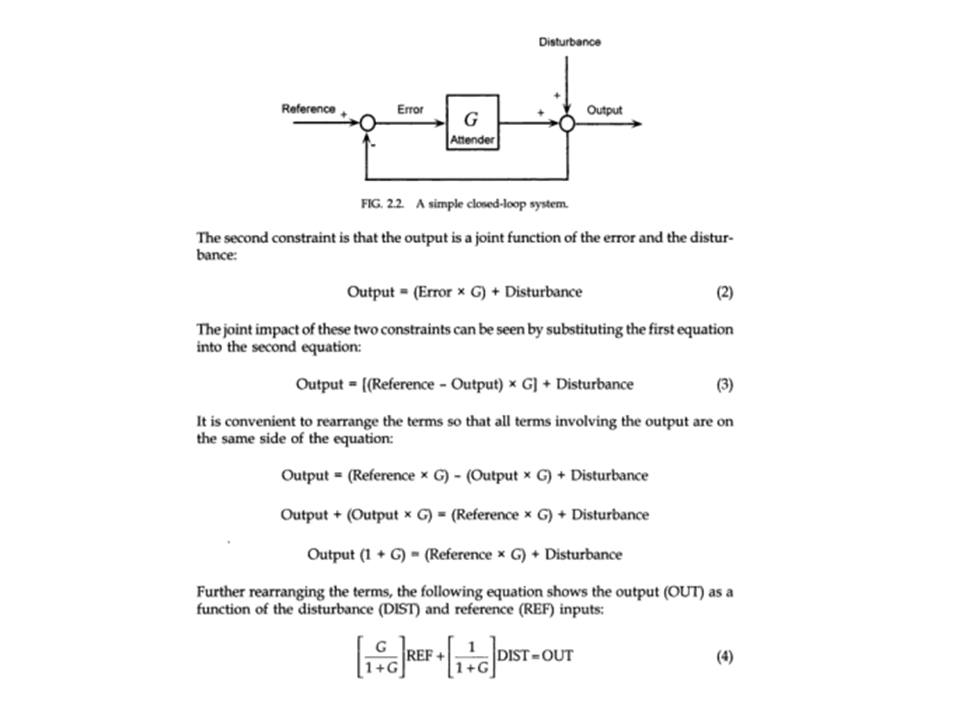
Here's a diagram of a control system from a textbook on control theory
for behavioral scientists.

...

There is a problem with the diagram and/or the derivation. I wonder if
anyone can spot it

I'm a little behind on following non-work-related discussions. Others
have commented on the problem with the diagram, but I wanted to add a
little bit.

On CSG, we talk about "Output" as the behavior of the control system,
as distinct from the perceptual consequences of that behavior. And, as
others have noted, the textbook diagram inserts a disturbance in computing
that behavior itself, instead of the way PCT diagrams it, with the
behavior compensating for disturbances (later along the path) to a
perceptual result that matters to the system.

A couple of examples come to mind that perhaps mimic (not perfectly) that
state of affairs. And I think they make sense of the equations and
derivation, such as they are.

The first example that occurred to me, of trying to imagine a disturbance
to behavior itself & not just the results of the behavior, is as follows.
There are times when my 12 year old daughter & I have been walking beside
each other, & she has tried (or, truth be told, sometimes it's me doing
the initiating) to playfully push me off my walking trajectory. Yes, that
interferes with my _perception_ of walking in a somewhat straight line,
and yes, that aspect is not captured very well on the textbook diagram.
But it also seems to interfere with my behavior itself. So let's look
at what happens.

Usually, I start leaning against her disturbance, & we start playfully
jostling for who's going to win out by pushing the other one off their
mark. I think this lines up with the textbook equations. The derivation
suggests that, if the Gain is high enough, the resulting behavior is
almost entirely determined by the Reference signal. [One divided by (one
plus a high Gain)] means that the Disturbance makes a neglible
contribution to the behavior, whereas [a high Gain divided by (one plus a
high Gain)] means that the Reference will predominate. And that is indeed
what happens if I really lean back in return. I keep changing the
Reference for my walking, by the amount I lean to one side, to basically
keep my trajectory on track. Being bigger than her, I can mostly nullify
the effects of her leaning, and it turns into a pushing and giggling fest
to see which one will win out. By the way, she usually responds by rapidly
removing the Disturbance, by quickly moving out of the way faster than I
can compensate, and so she ends up disturbing my trajectory after all, in
the opposite direction!

The other example that occurred to me is with my new glasses. The newer
and lighter polycarbonate lenses do not focus as well as my previous
plastic lenses did in my peripheral fields of vision. So when I use my
old behaviors of just moving my eyes to the side to pick up something
peripherally, it is quite blurry. I have gone back to upgrade to a
different type of lens that doesn't have as much of that problem. But in
the meantime, it seems like a fixed disturbance at the point where I
generate my old behaviors, and I have to move my whole head to bring
something peripheral into clear focus.

Now, again, the textbook diagram does a terrible job of placing the
disturbance. What I really care about is seeing clearly, which is a
perceptual consequence of my behavior. I can make that come about by
changing the references which generate my interim behavior, & turn my
whole head. And when my newer glasses come in, I can go back to mostly
just moving my eyes to make the periphery clear. But technically, the
textbook equations do demonstrate that the disturbance produced by my
current lenses can be largely nullified by changes in the references.
What it masks is the realization of an inverse relationship between
disturbances and compensating behavior. And it obviously obfuscates
(do you like the alliteration?) the point that behavior is only for the
purpose of getting the right _perceptual_ consequences.

So, while the diagram and equations are not technically wrong, neither are
they very useful. They end up emphasizing all the wrong things.

All the best,
Erling

( Gavin
Ritz 2009.07.23.9.50NZT)

Great thank you Rick. I’m getting somewhere at last. The principles of PCT
are very simple I’m not so sure why they have been made so complicated.

Regards

Gavin

[From
Rick Marken (2009.07.21.2245)]

···

On Tue, Jul 21, 2009 at 7:15 PM, Gavin Ritz garritz@xtra.co.nz wrote:

Hey Rick
can you give me the actual formulas for calculating the

· Perceptual Signal

· Input quantity (controlled variable)

· Output Quantity

· Feedback Quantity

· Error Signal

I’ve attached a little spreadsheet model that I just cobbled together. It shows
how the controlled variable (which I see as equivalent to the perceptual
signal) is defined by the perceptual function. I’ve picked a very simple
perceptual function: a linear combination of three scalar physical variables,
two of which can vary independent of the actions of the system and are thus
called “disturbances”; and one of which is the physical output of the
system, which represents the feedback effect of the system’s output on it’s
input. The output function is a pure integrator. I’ve shown text versions
of both the perceptual and output functions; the actual functions are in the
cells that do the computations: the perceptual function is computed in the cell
that produces the value of the controlled variable; the output function is
computer in the cell that produces the value of the output variable.

The spreadsheet uses automatic calculation so if you enter a new value for the
reference (the blue cell to the right of “Reference”) the spreadsheet
will very quickly iterate to produce an output that brings the controlled
variable into a match with the reference. So by typing different values for the
reference you can see that the control system quickly brings the controlled
perceptual variable into a match with it. You can also type in new values
for the disturbance variables (the two blue cells above the word
“Disturbances”). Note that however these values are changed, the
output varies so as to keep the controlled variable matching the reference.

The blue cells are the only ones into which you can enter new numbers without
potentially screwing up the behavior of the control system. I’ve
highlighted the controlled variable cell in rose color just so it’s easy to
compare this value to the reference value (in blue) above it. However,
you can certainly play around with this a bit. The most drastic (and
interesting) changes would be to the perceptual or output functions. Changes to
these could make the system unstable (and, thus, go into a positive feedback,
runaway regime). But you can always leave the sheet without saving it so don’t
worry about breaking it;-)

Have a ball.

Best

Rick

Richard S. Marken PhD
rsmarken@gmail.com

[From Rick Marken (2009.07.23.0850)]

Gavin
Ritz (2009.07.23.9.50NZT)

Great thank you Rick.

You’re welcome.

I’m getting somewhere at last. The principles of PCT
are very simple I’m not so sure why they have been made so complicated.

Yes, the principles of PCT are very simple – even I can understand them. I think what gets complicated is the application of those principles to actual behavior. The application of PCT principles to behavior is not really all that complicated but I think it can seem so because the proper application of these principles often leads to conclusions that conflict with existing assumptions about how behavior (or the mind or the nervous system) actually works. So complex rationales are developed to explain why these conclusions couldn’t be correct even though PCT is.

We see this, for example, in the diagram and derivation I posted; the authors clearly understand control theory – the basis of PCT – they just don’t understand how it applies to living systems because understanding this would conflict with their existing input-output view of how behavior works. So the reference becomes a sensory input and the controlled variable becomes a behavioral output. And when a PCTer tries to explain why this mapping is wrong the explanation can seem very complex. We have also seen this in our discussions of methodology. When the simple principles of control theory are shown to imply that a basic assumption of experimental psychology --that there is a causal connection between environmental variables (IVs) and behavior (DVs) – is based on an illusion, very complex rationales are developed to show that this isn’t true, at least in some cases.

I’ve found that the best way to keep PCT simple is to give up all pre-PCT beliefs related to how behavior works and just go with PCT.

Best

Rick

···


Richard S. Marken PhD

rsmarken@gmail.com

[From Andrew Nichols 2009.7.23 11:22 CST]

This post resonates with me. I was trained in psychodynamic,
cognitive-behavioral, and family systems methods of psychotherapy.

What I have found is that PCT (and MOL) provide a lucid explanation
for human behavior and some practical applications in psychotherapy,
but I seem to alternate between periods when everything is clear and
others where I am befuddled once again, especially in areas concerning
practical applications in accord with PCT. Hopefully, this is evidence
of reorganization and not some organic brain disorder :wink:

···

On 7/23/09, Richard Marken <rsmarken@gmail.com> wrote:

[From Rick Marken (2009.07.23.0850)]

Gavin Ritz (2009.07.23.9.50NZT)

Great thank you Rick.

You're welcome.

I�m getting somewhere at last. The principles of PCT are very simple I�m
not so sure why they have been made so complicated.

Yes, the principles of PCT are very simple -- even I can understand them. I
think what gets complicated is the application of those principles to actual
behavior. The application of PCT principles to behavior is not really all
that complicated but I think it can seem so because the proper application
of these principles often leads to conclusions that conflict with existing
assumptions about how behavior (or the mind or the nervous system) actually
works. So complex rationales are developed to explain why these conclusions
couldn't be correct even though PCT is.

We see this, for example, in the diagram and derivation I posted; the
authors clearly understand control theory -- the basis of PCT -- they just
don't understand how it applies to living systems because understanding this
would conflict with their existing input-output view of how behavior works.
So the reference becomes a sensory input and the controlled variable becomes
a behavioral output. And when a PCTer tries to explain why this mapping is
wrong the explanation can seem very complex. We have also seen this in our
discussions of methodology. When the simple principles of control theory are
shown to imply that a basic assumption of experimental psychology --that
there is a causal connection between environmental variables (IVs) and
behavior (DVs) -- is based on an illusion, very complex rationales are
developed to show that this isn't true, at least in _some_ cases.

I've found that the best way to keep PCT simple is to give up all pre-PCT
beliefs related to how behavior works and just go with PCT.

Best

Rick

--
Richard S. Marken PhD
rsmarken@gmail.com

[From Bill Powers (2009.07.23.1207 MDT)]

Rick Marken (2009.07.23.0850)]

RM: the authors clearly
understand control theory – the basis of PCT – they just don’t
understand how it applies to living systems because understanding this
would conflict with their existing input-output view of how behavior
works. So the reference becomes a sensory input and the controlled
variable becomes a behavioral output.

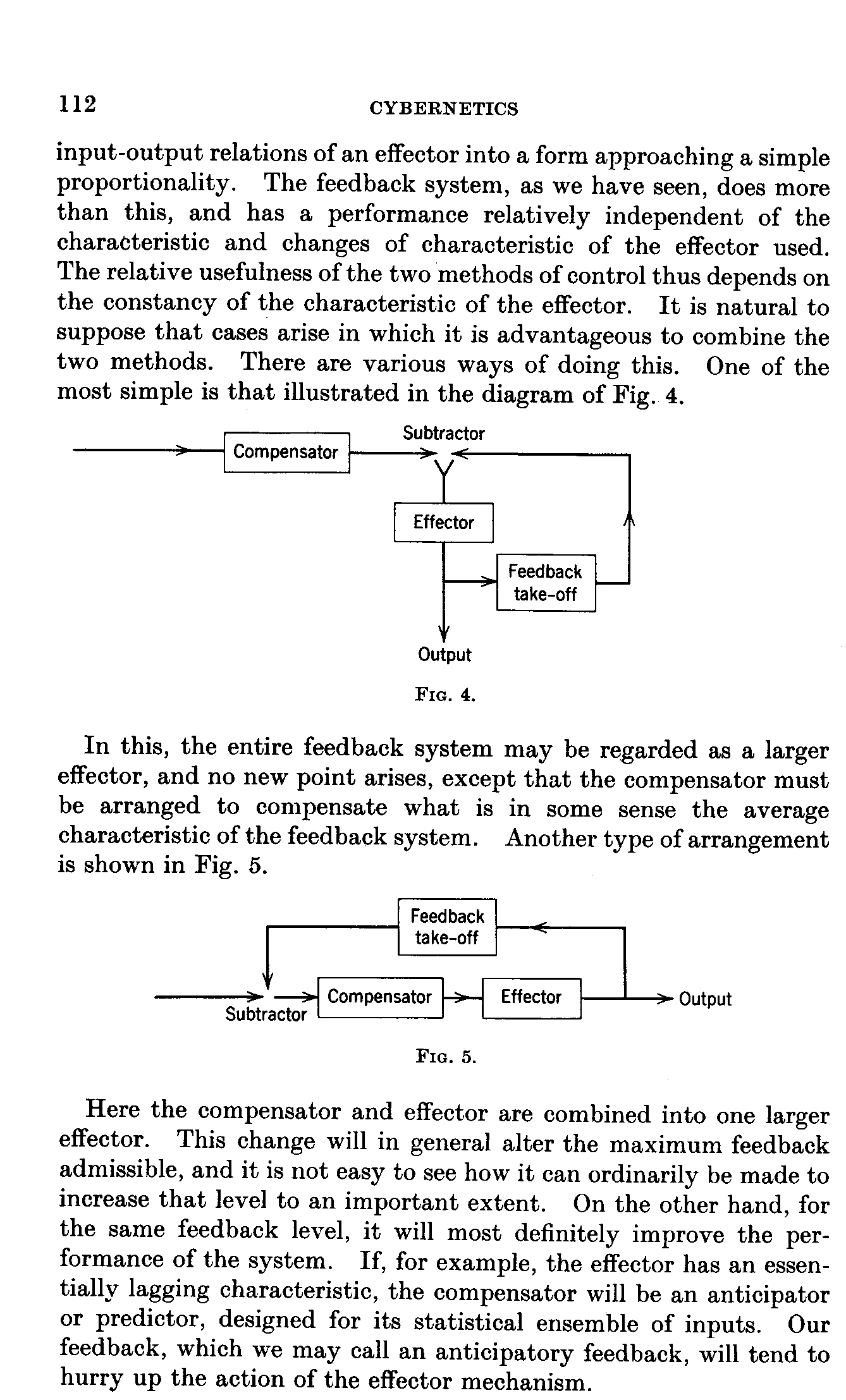
The fault lies not so much with the authors but with the sources from
which they got their acquaintance with control system diagrams. Attached
are two diagrams that were published by Norbert Wiener, the father of
cybernetics, copyrighted in 1948 (and again in the second edition in
1961), in his book Cybernetics: control and communication in the
animal and the machine
. As you can see from the text around these
figures, Wiener had hardly more than an amateur’s understanding of
control systems. And both diagrams show an input(unlabeled) and an
output, with the feedback added to this S-R-looking diagram.
Note particularly Fig. 4, in which there is a compensator between the
input and the subtractor (comparator). This compensator is meant to make
the output follow the input more closely – there isn’t the slightest
hint of the idea that the reference signal (which is what the input
really is) determines the perceptual signal coming out of the
“feedback takeoff” or is to be matched by the perceptual
signal. The design engineer doesn’t care what the control system
perceives; he just sticks a compensator in to make the output (that is,
the controlled input) be what he wants it to be. Wiener didn’t see
anything wrong with that as a model of the organism. Maybe he believed in
a Divine Engineer who tweaked all the control systems this way.
The first place I saw the concept of “control of input” was in
a book published by the Philbrick company and included with the Philbrick
analog computer I got while at the VA Research Hospital in
Chicago:
Henry Martyn Paynter: A palimpsest on the electronic analog art; being
a collection of reprints of papers & other writings which have been
in demand over the past several years.
(Amazon has a few copies
left).

I’ve mentioned it before. The context was a discussion of the
operational amplifiers used in electronic analog computers. The author
pointed out that to understand how an op amp works, you have to start by
realizing that it keeps its negative input terminal (the perceptual
signal input) at the same voltage as its positive input terminal (the
reference signal). Given that, it’s easy to figure out how the op amp
works with specific components plugged in (resistors and capacitors,
mainly).

When I read that somewhere around 1955 or 1956, I had been trying to
figure out how the input-output relationships work in the human control
system. This was one of those huge AHA experiences in which everything
suddenly fell into place. Living control systems control their inputs! I
had never seen that said before in print, or in any models I had seen
from the engineering psychologists, control engineers, or behavioral
modelers. Once I saw it, it made perfect sense to me. So I’m pretty sure
that none of the control-system engineers or engineering psychologists or
cyberneticists whose work I had read before then understood this concept.
And nobody who got their ideas of control systems from them understood
it, either. The roots of many mistaken ideas about control systems go all
the way back to the origins of cybernetics in the 1940s.

Best,

Bill P.

[From Rick Marken (2009.07.23.1310)]

Bill Powers (2009.07.23.1207 MDT)–

Rick Marken (2009.07.23.0850)]

RM: the authors clearly
understand control theory – the basis of PCT – they just don’t
understand how it applies to living systems because understanding this
would conflict with their existing input-output view of how behavior
works. So the reference becomes a sensory input and the controlled
variable becomes a behavioral output.

The fault lies not so much with the authors but with the sources from
which they got their acquaintance with control system diagrams…

This is very interesting history. But I still think my interpretation is correct – that it’s the authors’ preconceptions about how behavior works rather than the sources from which they got their acquaintance with control system diagrams that led them to their input-output view of control. I say this because the authors were familiar with your work and one was a fan of it. So they were surely acquainted with the correct way to draw control system diagrams of a behaving organism. But they ended up drawing the diagram in a way that is consistent with an input-output view of behavior. I would imagine that they didn’t even see that the PCT diagrams were inconsistent with an input-output view of behavior. Such is the power of preconceptions (references for principle perceptions).

Best

Rick

···


Richard S. Marken PhD
rsmarken@gmail.com

[From Bill Powers (2009.07.23.1423 MD)]

Rick Marken (2009.07.23.1310) --

This is very interesting history. But I still think my interpretation is correct -- that it's the authors' preconceptions about how behavior works rather than the sources from which they got their acquaintance with control system diagrams that led them to their input-output view of control.

If so, they were the same preconceptions that led even control engineers and cyberneticists to think of control systems as input-output devices. The true meaning of control theory as a model of people simply was too different from conventional views in all branches of science and even engineering. It still is.

Best,

Bill P.

[From Rick Marken (2009.07.23.1345)]

Bill Powers (2009.07.23.1423 MD)–

Rick Marken (2009.07.23.1310) –

This is very interesting history. But I still think my interpretation is correct – that it’s the authors’ preconceptions about how behavior works rather than the sources from which they got their acquaintance with control system diagrams that led them to their input-output view of control.

If so, they were the same preconceptions that led even control engineers and cyberneticists to think of control systems as input-output devices.

Sure. But what’s interesting to me is that while the early cyberneticists can be “excused” for succumbing to the “input-output” preconception because they did not have access to B:CP, the behavioral scientists who created the diagram that I posted cannot be so excused. They had read and presumably understood B:CP and still created the diagram (and derivation) that I posted.

Best

Rick

···


Richard S. Marken PhD
rsmarken@gmail.com

[Martin Taylor 2009.07.26]

Back again for a few days.

I’ve read through this thread, and so far as I can see, nobody has
noted that the “standard issue” PCT control loop is an input-output
system that has two inputs and two outputs, namely Reference and
Disturbance inputs, Perceptual Signal and Side-Effects outputs. All
other signal values are internal to the loop.

ctrl.logo.png

One output (shown in the “Simple Closed Loop” diagram provided by Rick)
is the perceptual signal. The other is the side-effect output that
influences the world OUTSIDE the control loop. The controlled variable
(the perceptual signal) is important to the controller. The side-effect
output is not, and I don’t find it unreasonable that the side-effect
output is omitted from the diagram presented by Rick. I do think it
would have been clearer had the authors connected the lower “perceptual
signal” line to the output arrow rather than making it a second output
from the right-hand circle, but that’s more a matter of graphic clarity
than of system understanding. The text shows that they are intended to
be the same thing.

PCT labelling, rather perversely, uses the term “output” to refer to a
signal WITHIN the control loop that is not an output at all, but a
signal that might better be called the “feedback signal”, since it is
the variable value on what is usually called “the environmental
feedback path”. I don’t see it as at all unreasonable for people
unacquainted with the PCT nomenclature to consider the “output” of the
control loop to be the result the control loop is built to produce,
namely the setting of the perceptual signal to a value determined by
the reference input to the control loop. I do think it unfair to
complain that the authors don’t understand control on the basis that
they use the term “output” to mean the controlled variable rather than
the feedback signal.

from the passage Rick included in his message, there is nothing at all
to say where the reference input to the control loop comes from,
whether inside or outside the person. The description is of an abstract
control loop, as is the diagram I include. Only the wavy line in my
diagram suggests the possibility of an inside and an outside, but that
“inside” and “outside” are not inside and outside the loop. They are
inside and outside something else entirely, possibly the skin of a
person, possibly not. In the diagram Rick presented, there is an
implication of an inside and an outside in the open-ended arrows, but
they are the inside and outside of the control loop, not necessarily of
the person.

Perhaps text on pages not included by Rick do justify his comments
about where the reference input comes from, but the diagram and
accompanying analysis do not.

I’m still swamped with other issues, and won’t contribute much for some
time, but I thought this point had not been brought out in the
discussion so far, and it was worth mentioning. I still have 130 unread
messages on CSGnet :frowning:

Martin

···

[From Rick Marken (2009.07.20.2220)]
Here's a diagram of a control system from a textbook on control theory
for behavioral scientists. I found this as I was looking for
background material for another paper I'm writing on the failure of
the input-output model, which is the basis of conventional
psychological science. The diagram and derivation that goes along
with it are interesting because it seems like control theory is being
used to justify the input-output model, quite the opposite of the way
I use control theory in my _Revolution_ paper. So what gives?
According to the control system diagram and derivation variations in
system output are driven by variations in a reference variable. From
the diagram, the reference seems to be the input to the system,
although it's not clear what is system and what is environment in the
diagram. So this diagram seem to be trying to show that variations in
behavior (output) depend on variations in reference signal (input),
which is perfectly consistent with the input-output model of behavior.
There is a problem with the diagram and/or the derivation. I wonder if
anyone can spot it (not you Bill;-)
Best
Rick

[From Rick Marken (2009.07.26.1630)]

Martin Taylor (2009.07.26)

One output (shown in the "Simple Closed Loop" diagram provided by Rick) is
the perceptual signal.

That's right. If they had called the "output" the "perceptual input"
-- and put the
perceptual function in the right place to show that this "output" is actually a
perceptual input and not a motor output -- then they would have been there (in
PCT world), showing that control is the control of _perception_ . And
they would
see that understanding the controlling done by a living organism means
finding out
what perceptual variables are being controlled. Unfortunately, by
missing that little
detail (that their "output" is a controlled perceptual variable) they
missed the
chance to see that control theory is a whole new way of understanding the
behavior of organisms and that achieving this understanding requires a whole
new approach to studying behavior, viz., the test to determine what perceptual
variables are being controlled.

PCT labelling, rather perversely, uses the term "output" to refer to a
signal WITHIN the control loop that is not an output at all, but a signal
that might better be called the "feedback signal",

Actually, it's the output _function_ that is inside the system. At the lowest
level these functions turn an error signal (efferent neural signal) into a
physical variable, that we call the "output" (or, better, the "output
variable").
So in a control diagram of a low level system, the term "output" refers to
a physical variable, such as the position of a handle or the state (pressed
or not) of a button.

I do think it unfair to complain that the authors don't understand control on
the basis that they use the term "output" to mean the controlled variable
rather than the feedback signal.

I don't think any of us (there were a number of us who thought the diagram
was either wrong or terribly misleading) said that the authors don't understand
control. Their derivation shows that they understand that control involves
bringing one variable (which they call "output") into a match with another
(the reference) while protecting that variable from the effects of disturbance.
What they clearly don't understand is how to map the variables and functions
in a control system to the behavior of a living organism. Bill made this point
by explaining that the diagram is a model of a control system from the point
of view of the observer of the system; someone who views the variable the
system is designed to control (such as room temperature) as the system's
"output". Ehrling and Fred (as I recall) said the same thing in
different words.

The point I was trying to make by posting this diagram (and derivation) is
that it is possible to understand control (and control theory) well enough so
that one can do the mathematics (and, for that matter, the engineering) of
control just fine -- after all, control theory was developed well before Powers
wrote B:CP-- without knowing how (or, perhaps, without being willing) to
apply the theory properly (to map it correctly) to living systems.

If the authors of this diagram/derivation had mapped control theory correctly
to living systems, they would have realized that the variable(s) controlled
by these systems are perceptual functions of physical variables and that
the reference specifications for the state of these variables is set
autonomously by the system itself. They would have also realized that
the variations in the physical outputs of living systems (the dependent
variables in behavioral research) depend as much on disturbances to the
controlled perceptual variables as they do on variations in the
autonomously varied reference specifications for the state of these
variables. That is, they would understand PCT and they would very
likely be enthusiastic participants on CSGNet.

Best

Rick

···

--
Richard S. Marken PhD
rsmarken@gmail.com

[Martin Taylor 2009.07.27.14.35]

[From Rick Marken (2009.07.26.1630)]
Martin Taylor (2009.07.26)

One output (shown in the "Simple Closed Loop" diagram provided by Rick) is
the perceptual signal.
That's right. If they had called the "output" the "perceptual input"
-- and put the
perceptual function in the right place to show that this "output" is actually a
perceptual input and not a motor output -- then they would have been there (in
PCT world), showing that control is the control of _perception_ . And
they would
see that understanding the controlling done by a living organism means
finding out
what perceptual variables are being controlled. Unfortunately, by
missing that little
detail (that their "output" is a controlled perceptual variable) they
missed the
chance to see that control theory is a whole new way of understanding the
behavior of organisms and that achieving this understanding requires a whole
new approach to studying behavior, viz., the test to determine what perceptual
variables are being controlled.

Rick, none of what you say is implied either by the diagram or the
analysis that accompanies it on the page you posted. Your comments may
well be justified by what is written elsewhere in the book from which
you took it, but you provide no evidence to support them.


PCT labelling, rather perversely, uses the term "output" to refer to a
signal WITHIN the control loop that is not an output at all, but a signal
that might better be called the "feedback signal",
 Actually, it's the output _function_ that is inside the system. At the lowest
level these functions turn an error signal (efferent neural signal) into a
physical variable, that we call the "output" (or, better, the "output
variable").
So in a control diagram of a low level system, the term "output" refers to
a physical variable, such as the position of a handle or the state (pressed
or not) of a button.

What you say is true of the labelling used in PCT discussions. But
think about it a little, from the point of view of a naive but
interested and competent person. There are two completely independent
ways to look at the situation. One is to think of a person as a skin
bag full of bones and muscles and whatnot, For such a view, input is
what goes into the person an output is the sum of all the ways the
person influences the external world. Not all of those influences are
detectable to the observer, and none can be unambigously associated
with the control of any particular input, not least because the outside
observer can only infer what inputs the person might be getting at any
moment. So, from that point of view, the person has a mass of possible
inputs and causes a mass of possible outputs, some of which presumably
influence the inputs. From that point of view, your definition of
“output” as the variation of a physical variable makes good sense. The
problem is that to associate it with a specified control loop requires
inference, and from a control point of view, it isn’t really output at
all; it’s an internal variable of the control loop, even though it’s
outside the person’s skin bag.

The other point of view is to consider a simple control system, or a
complex of simple control systems that form a complex control system.
from this point of view, there are variables that chase each other
round the loop, and variables that affect the loop from outside
(inputs) and influences on variables outside the loop (outputs). From
this point of view, every control loop has two inputs and two outputs,
but neither of the outputs is the physical variable such as the
position of a handle. The true outputs of a control loop are the
perceptual signal (which in HPCT is internal to the control loop of a
higher-level controlled variable) and the side-effects of the muscular
output on parts of the world outside the control loop – such as the
observer’s measuring instruments that read the position of the handle.
It’s true that some or all of these side effects are correlated with,
and perhaps identical to, the feedback variable in the loop, but that
does not mean that the feedback variable IS the output.

Don’t take me as wanting to alter the PCT labelling. Any speciality has
its specialized nomenclature, and PCT certainly needs a term for the
output of the output function (the fed-back variable). I have no
objection to calling it the “output”. My comment was simply to say that
when someone treats the raison-d’être of the control system as its
“output”, we need not assume that they don’t know what they are talking
about. From a non-PCT linguistic environment, it makes eminent sense to
say that the controlled variable is the output of the control system.


I do think it unfair to complain that the authors don't understand control on
the basis that they use the term "output" to mean the controlled variable
rather than the feedback signal.
I don't think any of us (there were a number of us who thought the diagram
was either wrong or terribly misleading) said that the authors don't understand
control. Their derivation shows that they understand that control involves
bringing one variable (which they call "output") into a match with another
(the reference) while protecting that variable from the effects of disturbance.
What they clearly don't understand is how to map the variables and functions
in a control system to the behavior of a living organism. Bill made this point
by explaining that the diagram is a model of a control system from the point
of view of the observer of the system; someone who views the variable the
system is designed to control (such as room temperature) as the system's
"output". Ehrling and Fred (as I recall) said the same thing in
different words.

I know. What I would like to know is on what basis your and they made
the claim:

"What they clearly don't understand is how to map the variables and functions
in a control system to the behavior of a living organism."

You had read the book in question, and presumably have evidence to
support that claim. They had no such evidence, but unless they had also
read the book in question, they simply assumed that because the word
“output” was used in the everyday sense, the authors must have no idea
how control is used in living organisms.

If the authors of this diagram/derivation had mapped control theory correctly
to living systems, they would have realized that the variable(s) controlled
by these systems are perceptual functions of physical variables and that
the reference specifications for the state of these variables is set
autonomously by the system itself.

Yes. It would be nice if you showed evidence that they do not realize
this. I’m quite prepared to believe that they don’t, but the page you
presented shows no evidence to that effect.

They would have also realized that
the variations in the physical outputs of living systems (the dependent
variables in behavioral research) depend as much on disturbances to the
controlled perceptual variables as they do on variations in the
autonomously varied reference specifications for the state of these
variables. That is, they would understand PCT and they would very
likely be enthusiastic participants on CSGNet.

Not necessarily. It takes both understanding of simple and hierarchic
control, and a very tolerant temperament, for one to be an
“enthusiastic participant on CSGnet” for very long. Only the former is
required for one to be an enthusiastic investigator of PCT.

Martin

[From Bill Powers (2009.07.27.1318 MDT)]

Martin Taylor 2009.07.27.14.35 –

Martin, I think the input/output nomenclature is a lot simpler than your
approach would suggest. The inputs to a physical control system enter its
sensors or input functions, and the outputs come from its effectors or
output functions. Why make it more complicated than that? A given control
system, particularly one that can reorganize, can work in a wide variety
of environments. See Demo 5-1 in LCS3. It makes no sense to change the
definition of a control system every time you put it in a different
environment or even point it in a different direction ( a star
tracker).

The output comes out of the control system; the control system puts it
out into the environment. The input goes into the control system; the
environment puts it into the control system. Between the output and the
input, various physical functions can come into play; they are part of
that which is being controlled, the environment, not part of that which
is doing the controlling, the device we call the control system or the
controller. Engineers who drew the diagrams that Wiener copied
oversimplified by implying that what comes out of a controller is the
same thing that goes back into it. They didn’t make a place where the
properties of the environment could be shown. The cyberneticists who
followed overgeneralized by treating the entire control loop as a single
entity; they made it impossible to distinguish between the controller and
the controlled.

Keep It Simple, Sam (we are not saying “stupid” just now
in the USA).

Best,

Bill P.

The control loop is not unitary; it has two parts. One part is the
controller, the other part is a feature of the environment of the
controller. The external part normally changes while the internal part
remains the same. If the internal part of the loop changes we say the
controller is adapting, but it is adapting itself. Usually, and in all
simple control systems, the internal part does not change; only the
environment changes. Demo 5-1 shows how a properly designed controller
can continue to control quickly and accurately without adapting itself
even if the properties of the environment change over a wide range – so
wide that it’s easy to assume that the controller must have adapted
itself to the changing load (as early engineering psychologists assumed
just because the Bode plot changed).

···
[From Rick Marken
(2009.07.26.1630)]
Martin Taylor (2009.07.26)

One output (shown in the "Simple Closed Loop" diagram
provided by Rick) is
the perceptual signal.
That's right. If they had called the "output" the
"perceptual input"
-- and put the
perceptual function in the right place to show that this
"output" is actually a
perceptual input and not a motor output -- then they would have been
there (in
PCT world), showing that control is the control of _perception_ . 
And
they would
see that understanding the controlling done by a living organism means
finding out
what perceptual variables are being controlled. Unfortunately, by
missing that little
detail (that their "output" is a controlled perceptual
variable) they
missed the
chance to see that control theory is a whole new way of understanding
the
behavior of organisms and that achieving this understanding requires a
whole
new approach to studying behavior, viz., the test to determine what
perceptual
variables are being controlled.

Rick, none of what you say is implied either by the diagram or the
analysis that accompanies it on the page you posted. Your comments may
well be justified by what is written elsewhere in the book from which you
took it, but you provide no evidence to support them.


PCT labelling, rather perversely, uses the term "output"
to refer to a
signal WITHIN the control loop that is not an output at all, but a
signal
that might better be called the "feedback signal",
Actually, it's the output _function_ that is inside the system. At the
lowest
level these functions turn an error signal (efferent neural signal) into
a
physical variable, that we call the "output" (or, better, the
"output
variable").
 So in a control diagram of a low level system, the term
"output" refers to
a physical variable, such as the position of a handle or the state
(pressed
or not) of a button.

What you say is true of the labelling used in PCT discussions. But think
about it a little, from the point of view of a naive but interested and
competent person. There are two completely independent ways to look at
the situation. One is to think of a person as a skin bag full of bones
and muscles and whatnot, For such a view, input is what goes into the
person an output is the sum of all the ways the person influences the
external world. Not all of those influences are detectable to the
observer, and none can be unambigously associated with the control of any
particular input, not least because the outside observer can only infer
what inputs the person might be getting at any moment. So, from that
point of view, the person has a mass of possible inputs and causes a mass
of possible outputs, some of which presumably influence the inputs. From
that point of view, your definition of “output” as the
variation of a physical variable makes good sense. The problem is that to
associate it with a specified control loop requires inference, and from a
control point of view, it isn’t really output at all; it’s an internal
variable of the control loop, even though it’s outside the person’s skin
bag.

The other point of view is to consider a simple control system, or a
complex of simple control systems that form a complex control system.
from this point of view, there are variables that chase each other round
the loop, and variables that affect the loop from outside (inputs) and
influences on variables outside the loop (outputs). From this point of
view, every control loop has two inputs and two outputs, but neither of
the outputs is the physical variable such as the position of a handle.
The true outputs of a control loop are the perceptual signal (which in
HPCT is internal to the control loop of a higher-level controlled
variable) and the side-effects of the muscular output on parts of the
world outside the control loop – such as the observer’s measuring
instruments that read the position of the handle. It’s true that some or
all of these side effects are correlated with, and perhaps identical to,
the feedback variable in the loop, but that does not mean that the
feedback variable IS the output.

Don’t take me as wanting to alter the PCT labelling. Any speciality has
its specialized nomenclature, and PCT certainly needs a term for the
output of the output function (the fed-back variable). I have no
objection to calling it the “output”. My comment was simply to
say that when someone treats the raison-d’être of the control system as
its “output”, we need not assume that they don’t know what they
are talking about. From a non-PCT linguistic environment, it makes
eminent sense to say that the controlled variable is the output of the
control system.


I do think it unfair to complain that the authors don't understand
control on
the basis that they use the term "output" to mean the
controlled variable
rather than the feedback signal.
I don't think any of us (there were a number of us who thought the
diagram
was either wrong or terribly misleading) said that the authors don't
understand
control. Their derivation shows that they understand that control
involves
bringing one variable (which they call "output") into a match
with another
(the reference) while protecting that variable from the effects of
disturbance.
What they clearly don't understand is how to map the variables and
functions
in a control system to the behavior of a living organism. Bill made this
point
by explaining that the diagram is a model of a control system from the
point
of view of the observer of the system; someone who views the variable
the
system is designed to control (such as room temperature) as the system's
"output".  Ehrling and Fred (as I recall) said the same
thing in
different words.

I know. What I would like to know is on what basis your and they made the
claim:

"What they clearly don't understand is how to map the variables
and functions
in a control system to the behavior of a living
organism."

You had
read the book in question, and presumably have evidence to support that
claim. They had no such evidence, but unless they had also read the book
in question, they simply assumed that because the word “output”
was used in the everyday sense, the authors must have no idea how control
is used in living organisms.

If the authors of this diagram/derivation had mapped control theory
correctly
to living systems, they would have realized that the variable(s)
controlled
by these systems are perceptual functions of physical variables and that
the reference specifications for the state of these variables is set
autonomously by the system itself.

Yes. It would be nice if you showed evidence that they do not realize
this. I’m quite prepared to believe that they don’t, but the page you
presented shows no evidence to that effect.

They would have also realized that
the variations in the physical outputs of living systems (the dependent
variables in behavioral research) depend as much on disturbances to the
controlled perceptual variables as they do on variations in the
autonomously varied reference specifications for the state of these
variables. That is, they would understand PCT and they would very
likely be enthusiastic participants on CSGNet.

Not necessarily. It takes both understanding of simple and hierarchic
control, and a very tolerant temperament, for one to be an
“enthusiastic participant on CSGnet” for very long. Only the
former is required for one to be an enthusiastic investigator of
PCT.

Martin

[From Rick Marken (2009.07.27.1330)]

Martin Taylor (2009.07.27.14.35)

Rick Marken (2009.07.26.1630)

Martin Taylor (2009.07.26)

One output (shown in the "Simple Closed Loop" diagram provided by Rick) is
the perceptual signal.

That's right. If they had called the "output" the "perceptual input"
-- and put the perceptual function in the right place to show that
this "output" is actually a perceptual input and not a motor
output -- then they would have been there (in PCT world),
showing that control is the control of _perception_ ...

Rick, none of what you say is implied either by the diagram or the analysis
that accompanies it on the page you posted.

Actually, some of it is: the part quoted above, where I say that what
they call "output" is actually a perceptual input, which is what you
said as well. I was _agreeing_ with you.

What I would like to know is on what basis your and they made the
claim:

"What they clearly don't understand is how to map the variables and
functions in a control system to the behavior of a living organism."

On the basis of looking at the diagram and the derivation, which shows
that they think of behavior as controlled output.

If the authors of this diagram/derivation had mapped control theory
correctly to living systems, they would have realized that the variable(s)
controlled by these systems are perceptual functions of physical variables
and that the reference specifications for the state of these variables is set
autonomously by the system itself.

Yes. It would be nice if you showed evidence that they do not realize this.

The diagram and derivation are certainly some evidence of this. The
other is that these authors _never_ discuss testing for controlled
perceptual variables as being a goal (let alone being _the_ main goal)
of research aimed at understanding the behavior of living control
systems.

That is, they would understand PCT and they would very
likely be enthusiastic participants on CSGNet.

Not necessarily. It takes both understanding of simple and hierarchic
control, and a very tolerant temperament, for one to be an "enthusiastic
participant on CSGnet" for very long. Only the former is required for one to
be an enthusiastic investigator of PCT.

I think I'm living proof that a tolerant temperament is not
prerequisite for long term participation on CSGNet;-)

Best

Rick

···

--
Richard S. Marken PhD
rsmarken@gmail.com

[From Rick Marken (2009.07.27.1410)]

Bill Powers (2009.07.27.1318 MDT)--

Keep It Simple, Sam� (we are not saying "stupid" just now in the USA).

I can't believe the stupidity (there, I said it) Obama has to put up
with. And he deals with it with such aplomb. How a country that
elected GW Bush (twice!!) could elect a person of this caliber is
beyond me. God bless the USA.

I now return you to your regularly scheduled argument.

Best

Rick

···

--
Richard S. Marken PhD
rsmarken@gmail.com

Hi Rick,

You are not such proof. If the list were dominated by Martin, and
Bill was not supporting you, you would threaten to leave the list. In
fact, I kind of remember something like that... And you did leave, I
think, until you were persuaded to return. I am very glad that you
did return, and I am very glad that Martin (among others) are very
tolerant.

Hi Rick and Martin,

Now come talk with me about the guiding natural principle that led to
the evolution of the brain.. a brain whose organization can be
described by PCT. A principle missed (so far) by the folks trying to
understand natural intelligence and/or trying to create artificial
intelligence. They will stumble around and around it, until someday
(soon?) they will stumble upon it. Ours will probably be a quick
discussion, either because it is so obvious or because it isn't.

Yours patiently,
Shannon

···

On Mon, Jul 27, 2009 at 3:31 PM, Richard Marken<rsmarken@gmail.com> wrote:

Not necessarily. It takes both understanding of simple and hierarchic
control, and a very tolerant temperament, for one to be an "enthusiastic
participant on CSGnet" for very long. Only the former is required for one to
be an enthusiastic investigator of PCT.

I think I'm living proof that a tolerant temperament is not
prerequisite for long term participation on CSGNet;-)

[From Rick Marken (2009.07.28.0800)]

I said:

I think I'm living proof that a tolerant temperament is not
prerequisite for long term participation on CSGNet;-)

Shannon replies:

You are not such proof.

Aw, shucks!

Now come talk with me about the guiding natural principle that led to
the evolution of the brain.. a brain whose organization can be
described by PCT. �A principle missed (so far) by the folks trying to
understand natural intelligence and/or trying to create artificial
intelligence. �They will stumble around and around it, until someday
(soon?) they will stumble upon it. �Ours will probably be a quick
discussion, either because it is so obvious or because it isn't.

I guess I would say it's the principle of _control_. I think what
"guides" evolution is the development of structures (like the brain)
and functions (like the ability to control certain variables or the
ability to develop the ability to control certain variables) that make
it possible for the system to survive at least long enough to
reproduce, so that new generations can go on to successfully control
what they need to control to survive and reproduce.

So that would be my suggestion for the guiding natural principle
behind the evolution of the brain (and everything else that has
evolved): control. I think that principle doesn't kick in until there
exists a relatively high gain, negative feedback structure that can
control _and_ reproduce. The first such structure on earth was
probably molecular. So the "guiding principle" of evolution wouldn't
have even existed (on earth) before this controlling, reproducing
molecule existed.

The guiding principle is likely to exist somewhere else in the
universe; where ever such a controlling, reproducing molecular "seed"
happened (or will happen; we've still got a few billion years to go, I
think). And given the number of planets in the universe, I think it's
highly likely that the guiding principle -- control -- exists in many
other places in the universe.

Am I right? :wink:

Best

Rick

···

On Tue, Jul 28, 2009 at 6:47 AM, Shannon Williams<verbingle@gmail.com> wrote:
--
Richard S. Marken PhD
rsmarken@gmail.com

[Martin Taylor 2009.07.28.17.43]

[From Bill Powers (2009.07.27.1318 MDT)]

Martin Taylor 2009.07.27.14.35 --

Martin, I think the input/output nomenclature is a lot simpler than your approach would suggest.

Putting my original point in another way: Simplicity is in the eyes of the beholder.

The inputs to a physical control system enter its sensors or input functions, and the outputs come from its effectors or output functions. Why make it more complicated than that?

What is "a physical control system" to a naive user? Consider a thermostat. To an everyday user, the input to the thermostat is the dial setting (to a PCT scientist, the reference value), while the output is the desired temperature (the controlled variable). Very simple. The user does not need to see anything about connections to the air conditioner or furnace, need know nothing about the (PCT) effectors, and just knows that if he inputs 21 degrees C, the room goes to 21 degrees C. Simple input-output.

When one is trying to introduce PCT to a newbie, it can help if the terms can be mapped onto something the newbie already knows. If control engineers use the common language, in which the "output" is the controlled variable, then they can perhaps come to terms with PCT more easily if they are told not that they are wrong, but that in PCT discussions, the control loop is split into halves, in which the "input" and the "output" are defined not by the bounds of the control loop but by the seperatrix of the halves of the loop. Yes, it's a simple idea, but not simple to one used to thinking of inputs and outputs of a loop as being from and to the environment external to the loop.

The output comes out of the control system; the control system puts it out into the environment. The input goes into the control system; the environment puts it into the control system. Between the output and the input, various physical functions can come into play; they are part of that which is being controlled, the environment, not part of that which is doing the controlling, the device we call the control system or the controller.

All of this is true, but remember that the "environment" of a higher-level control unit consists of all the control units to which it sends reference values, and its input consists of all the control units whose perceptual signals it senses. That's useful to a PCT analyst, but it does not provide for any observable inputs and outputs. The "environment" for the observer consists of the multiplicity of outputs from the lowest level actuators, and the input of the multiplicity of inputs to the peripheral sensors. These are not the inputs and outputs in the PCT sense to and from the higher-level control system. However, if you naively think of the controlled variable as the output of a control system, then, to take an example, the action output is "knocking on the door" and the controlled variable (output) is "the door opening".

Which way of looking at the world of control is simpler depends on where you are coming from, and what you want to analyze.

All I'm saying is that nomenclature can be a barrier to understanding, if the same words are used to mean something one does not expect them to mean. And most people think of the output of control as being the controlled variable.

Keep It Simple, Sam (we are not saying "stupid" just now in the USA).

Yep. That's what I'm advocating.

Martin

I guess I would say it's the principle of _control_.

Yes. Definitely. Absolutely!

I think what
"guides" evolution is the development of structures (like the brain)
and functions (like the ability to control certain variables or the
ability to develop the ability to control certain variables) that make
it possible for the system to survive at least long enough to
reproduce, so that new generations can go on to successfully control
what they need to control to survive and reproduce.

So that would be my suggestion for the guiding natural principle
behind the evolution of the brain (and everything else that has
evolved): control. I think that principle doesn't kick in until there
exists a relatively high gain, negative feedback structure that can
control _and_ reproduce. The first such structure on earth was
probably molecular. So the "guiding principle" of evolution wouldn't
have even existed (on earth) before this controlling, reproducing
molecule existed.

What principle/concept/thing is the brain controlling when it controls
perceptions? What is the advantage of an organizing system?

···

On Tue, Jul 28, 2009 at 10:03 AM, Richard Marken<rsmarken@gmail.com> wrote:

[From Bill Powers (2009.07.29.0851 MDT)]

Martin Taylor 2009.07.28.17.43 --

The inputs to a physical control system enter its sensors or input functions, and the outputs come from its effectors or output functions. Why make it more complicated than that?

What is "a physical control system" to a naive user? Consider a thermostat. To an everyday user, the input to the thermostat is the dial setting (to a PCT scientist, the reference value), while the output is the desired temperature (the controlled variable). Very simple.

Yes, for uninformed users. Typically of most oversimplifications, it misinforms more than it informs. It is misleading enough to have given a lot of people (like Bertalanffy, for example) the impression that a control system is just a stimulus-response system with a feedback loop added, because it encourages confusing the reference input with a sensory input. I tried to lay out the model and define its parts to eliminate the confusions that I saw. You may have noticed that the diagrams like those Wiener used don't even show a sensor. Most psychologists who have borrowed that diagram think of the "input" label as meaning "sensory input." The actual sensory input isn't even labeled in that diagram.

The user does not need to see anything about connections to the air conditioner or furnace, need know nothing about the (PCT) effectors, and just knows that if he inputs 21 degrees C, the room goes to 21 degrees C. Simple input-output.

I have pointed out that very interpretation as the cause of many misunderstandings about control systems. It gets pretty hard to systain that rather careless interpretation when speaking about control systems like the iris reflex, that act to control the illumination of the retina. It's rather strained to insist that the light falling on the retina is an output of the control system. It's a little hard to keep a straight face while explaining that the output of the body's thermoregulation system is the sensation of skin temperature or internal body temperature.

When one is trying to introduce PCT to a newbie, it can help if the terms can be mapped onto something the newbie already knows.

What that usually accomplishes is to mislead the newbie into thinking he already understands negative feedback control. My career has been littered with such people. I much prefer to find out what the newbie already understands, and contrast it with the PCT understanding so the difference is made perfectly clear. Then it's up to the newbie to grasp the difference if he or she wants to. If the newbie doesn't want to grasp the difference, the newbie can go study something else.

If control engineers use the common language, in which the "output" is the controlled variable, then they can perhaps come to terms with PCT more easily if they are told not that they are wrong, but that in PCT discussions, the control loop is split into halves, in which the "input" and the "output" are defined not by the bounds of the control loop but by the seperatrix of the halves of the loop. Yes, it's a simple idea, but not simple to one used to thinking of inputs and outputs of a loop as being from and to the environment external to the loop.

That sounds plausible but I think the confusions are much worse than that. At a Gordon Research conference on cybernetics some years back, I showed the Little Man and explained my way of modeling control systems. Afterward, a man from the University of Texas came up to me and said he had been teaching control theory to undergraduates for some years, and for the first time he thought he could actually get the way control systems work across to them. He had been very disappointed with the results and now knew why.

Unfortunately, you would have to explain to the engineers that the "input" they talk about is not a sensory input, and that the apparent link to stimulus-response psychology is extremely misleading because of that. You would also have to point out that in their diagrams they commonly leave out the actual sensory input, which increases the confusion, and they also leave out the environmental functions between the actual outputs of the controller and the sensory input. The actual outputs of the controller are also omitted. It's a sloppy mess because the engineers think they're communicating with idiots and leave out all the details that might make their explanations correct.

The output comes out of the control system; the control system puts it out into the environment. The input goes into the control system; the environment puts it into the control system. ...

All of this is true, but remember that the "environment" of a higher-level control unit consists of all the control units to which it sends reference values, and its input consists of all the control units whose perceptual signals it senses. That's useful to a PCT analyst, but it does not provide for any observable inputs and outputs.

Of course it does. You observe them in the same way you observe your own higher-level inputs and outputs. You observe the degree to which someone is acting honestly, and you observe the effects of his actions on your perception of honesty. You can do this because you're observing from inside your own higher levels, and can experience the world from various points of view.

The "environment" for the observer consists of the multiplicity of outputs from the lowest level actuators, and the input of the multiplicity of inputs to the peripheral sensors. These are not the inputs and outputs in the PCT sense to and from the higher-level control system.

No; the inputs are the environmental inputs to the higher-level system's input function; out of that input function comes the perceptual signal that is the system's perception of a controlled variable.

The problem is that you're jumping around among points of view. It's by far the simplest to say that a control system lives in an environment consisting of lower-level systems. It receives inputs from those systems (copies of their perceptual signals) and it generates outputs that go into those systems (the reference signals for the lower systems). This view can be maintained consistently for any level of system, with the slight modification that the lowest-level control system gets its input from sensors and sends its output signals into effectors instead of comparators. This leaves the environment outside the hierarchy where it belongs, and lets us deal with it explicitly as a function that makes the controller's inputs partly dependent on the controller's outputs and by no means identical to them (as Wiener's "feedback take-off" implies).

However, if you naively think of the controlled variable as the output of a control system, then, to take an example, the action output is "knocking on the door" and the controlled variable (output) is "the door opening".

I'm not interested in thinking of the controlled variable naively; I want to think about it correctly and consistently. If you said the above, I would ask you how you know the door is opening. You would have to say you see, feel, or hear it opening. I would ask if seeing, feeling and hearing should be called outputs or inputs. I hope you would be embarrassed to find yourself saying "outputs." If you're not embarrassed I can't explain control theory to you -- you wouldn't understand it.

Which way of looking at the world of control is simpler depends on where you are coming from, and what you want to analyze.

Absolutely. That's why we have to find a way of looking that is consistent with itself and everything else we observe, and make sure that our method of analysis doesn't lead to contradictions.

All I'm saying is that nomenclature can be a barrier to understanding, if the same words are used to mean something one does not expect them to mean. And most people think of the output of control as being the controlled variable.

Which is a barrier to understanding. They should change their understanding because it is wrong and impossible to use consistently. Wasn't it Will Rogers who said that what's wrong isn't because of what we know, but what we know that ain't so? Well, controlled variables are not outputs from the control system, and I can prove it by measuring the actual effector outputs and showing that they do not always, or even very often, covary with the state of the controlled variable. If you want to object to that, you have the onus of explaining how something going into the control system can be an output, while what is actually coming out of the control system doesn't even correlate with it.

Or are you going to start maintaining that what the effectors do to the environment is the same thing sensed by the control system? We already know that that ain't so.

Einstein said we should make our explanations of nature as simple as possible, but no simpler than that.

Best,

Bill P.